The New York Times, March 28, 2009
Despite Red Flags About Judges, a Kickback Scheme Flourished
By IAN URBINA
WILKES-BARRE, Pa. — Things were different in the Luzerne County juvenile courtroom, and everyone knew it. Proceedings on average took less than two minutes. Detention center workers were told in advance how many juveniles to expect at the end of each day — even before hearings to determine their innocence or guilt. Lawyers told families not to bother hiring them. They would not be allowed to speak anyway.

Judges Mark A Ciavarella, center, and Michael T. Conahan on Feb. 12 leaving the federal courthouse in Scranton, Pa.
“The judge’s whim is all that mattered in that courtroom,” said Marsha Levick, the legal director of the Juvenile Law Center, a child advocacy organization in Philadelphia, which began raising concerns about the court to state authorities in 1999. “The law was basically irrelevant.”
Last month, the law caught up with Judge Mark A. Ciavarella Jr., 58, who ran that juvenile court for 12 years, and Judge Michael T. Conahan, 56, a colleague on the county’s Court of Common Pleas.
In what authorities are calling the biggest legal scandal in state history, the two judges pleaded guilty to tax evasion and wire fraud in a scheme that involved sending thousands of juveniles to two private detention centers in exchange for $2.6 million in kickbacks.
On Thursday, the State Supreme Court ordered that the records be cleaned for hundreds of the 2,500 or so juveniles sentenced by Judge Ciavarella, and in the coming weeks, the two judges will be sentenced, under a plea agreement, to more than seven years in prison.
While the scandal continues to ripple nationally as legal experts debate whether juvenile courts have sufficient oversight, here in Luzerne County people are grappling with more immediate questions: How did two native sons, elected twice to the bench to protect children and serve justice, decide to do the opposite? And why did no one stop them?
Old Friends Hatch a Plan
It all started in June 2000 with a simple business proposition, according to the judges’ indictment and more than 40 interviews with courtroom workers, authorities and others.
Robert J. Powell, a wealthy personal-injury lawyer from Hazleton and longtime friend of Judge Conahan, wanted to know how he might get a contract to build a private detention center. Judge Ciavarella thought he could help.
The two men agreed to meet and, according to prosecutors, somewhere in that conversation a plan was hatched that courthouse workers and county officials would later describe as a “freight train without brakes.”
First, Judge Ciavarella put Mr. Powell in touch with a developer who also happened to be an old friend, Robert K. Mericle, to start work on finding a site. Then, in January 2002 — the month Judge Conahan became president judge, giving him control of the courthouse budget — he signed a secret deal with Mr. Powell, agreeing that the court would pay $1.3 million in annual rent, on top of the tens of millions of dollars that the county and the state would pay to house the delinquent juveniles. And by the end of that year, Judge Conahan had gotten rid of the competition by eliminating financing for the county detention center.
“They were unstoppable,” said Judge Chester B. Muroski, who sent a letter to county commissioners raising concerns about detention costs, only to be transferred days later to another court by Judge Conahan. “I knew something was wrong, but they silenced all dissent.”
Other dissenters were also steamrolled.
When the county controller, Steve Flood, leaked a state audit that described the state’s lease of the center as a “bad deal,” the center’s owner filed a “trade secrets” lawsuit against Mr. Flood, and Judge Conahan sealed the suit to limit other documents’ getting out. His decision was later overturned.
“Everyone began to assume that the judges had some vested interest in the private center because they were pushing it so doggedly,” one courthouse worker said. Virtually all former colleagues and courthouse workers would not allow themselves to be identified because the federal investigation into the kickback scheme was continuing and they feared for their jobs if they alienated former allies of the judges.
Mr. Powell has not been charged. His lawyer said that the judges had coerced him into paying the kickbacks and that he was cooperating with investigators.
The few officials who had concerns at the time say their hands were tied. Probation officers say they suspected that something was amiss but were overruled every time they requested lighter sentences or for sentences to be served at home. County commissioners were the only ones authorized to sign contracts for detention centers. But by eliminating money for the county center, Judge Conahan left them little alternative but to sign on to the deal for the private facility.
Prosecutors say that by sentencing juveniles to detention at twice the state average, Judge Ciavarella was holding up his end of the bargain. And by late 2003, so much money was rolling in that the two judges were struggling to hide it all. So in 2004, they bought a $785,000 condominium together in Florida to help conceal the payments, and they began disguising transactions as rent and other related fees.
“We did what we could to stop it,” said Commissioner Stephen A. Urban, who repeatedly argued that the county should build its own center rather than lease the private one. “There were so many red flags that no one could mistake them as any other color.”
Disparate Upbringings
One red flag was the 56-foot yacht in front of the judges’ Florida condo, where they and Mr. Powell started spending much of their time. Owned by Mr. Powell, the $1.5 million boat was named the Reel Justice.
The conspicuous wealth Judge Ciavarella enjoyed in Florida was a far cry from the rough East End neighborhood in Wilkes-Barre where he grew up and is still known as “the local kid who made it big.”
A stellar athlete and student, Judge Ciavarella was the son of a brewery worker and a phone company operator. Nicknamed Scooch, like his father, he drove a beat-up Volkswagen Beetle for years, and even after moving away, he visited his aging mother daily until she died in 2007.
After law school at Duquesne University in Pittsburgh, Mr. Ciavarella ran for a seat on the county’s Court of Common Pleas in August 1994. On the bench, he became known for a stern hand in sentencing and a sharp wit in making sure everyone knew who was boss.
By contrast, Judge Conahan was known for being quiet, even secretive, on and off the bench. His neighbors observed that in a community known for holiday parties and open houses, no one they knew had ever seen the inside of Judge Conahan’s house.
Raised in Hazleton, on the other side of the county from Wilkes Barre, Judge Conahan came from money and had a political pedigree.
His father, who owned a funeral home, was Hazleton’s mayor from 1962 to 1974. Judge Conahan attended Villanova University and went to law school at Temple University.
Despite their differences, the two men became close friends on the bench, connected, former colleagues say, by a similarly stern view of justice.
In 2004, Judge Conahan bought the house next to Judge Ciavarella’s in Mountain Top, a wealthy suburb of Wilkes-Barre, where Mr. Powell also lives. The judges and their wives began sharing a recreational vehicle to tailgate at Penn State football games and vacationing together in Florida.
“They were pretty average guys,” Frank Monaco, the superintendent of the Florida condominium building, said of the judges and Mr. Powell. “Average for people with lots of money.”
Though the judges and Mr. Powell generally kept to themselves, Mr. Monaco said, they lost that low profile in 2004 after Mr. Powell got into a dispute with marina officials who wanted to end his slip lease. Mr. Powell went to court to force the marina to let him keep his boat there, but he filed his motion in Luzerne County, not Florida.
A colleague of Judge Conahan and Judge Ciavarella ruled in favor of Mr. Powell, despite a protest from the marina’s lawyer that the case should have been heard in Florida and that he could not attend the hearing because he had been given only one day’s notice.
“People at the marina thought that seemed like a real abuse of power,” Mr. Monaco said. The lawsuit was dropped after Mr. Powell moved his boat to another marina.
“You get enough power and you’re bound to start abusing it, I suppose,” Mr. Monaco said.
Troubling Trends
There was never doubt about who had the power in Courtroom 4 in the Luzerne County Courthouse. Though courteous, even jocular, Judge Ciavarella ran hearings with breakneck efficiency, cutting lawyers off when they rambled, scolding them when they arrived unprepared.
Sometimes, he helped his friends, too.
One courthouse worker recounted seeing a high school friend appear before Judge Ciavarella on a speeding charge. When the state trooper testified that he had clocked the man going 80 in a 55-mile-per-hour zone, the judge interrupted. “No, I think he was just going 60. Matter closed,” the worker recalled the judge saying. Shocked, the trooper turned to face the judge. “You’re dismissed,” the judge said.
But the juveniles being sentenced in that dim oak-paneled courtroom tended to be less lucky. Parents who arrived with their children typically left without them.
“Your arguments in sentencing weren’t persuasive,” said Basil G. Russin, the Luzerne County public defender, who represented many juveniles in Judge Ciavarella’s court. “You expected your kid to go away.”
While judges elsewhere in the state were shifting away from incarcerating juveniles for delinquency, Luzerne County was becoming infamous for imposing heavy sentences for minor infractions.
Kurt Kruger, for example, was 17 when he was sent to a boot camp for five months in 2004 for being a lookout for a friend who was stealing DVDs from a Wal-Mart. DayQuawn Johnson was 13 when he was sent to a detention center for several days in 2006 for failing to appear at a hearing as a witness to a fight, even though his family had never been notified about the hearing and he had already told school officials that he had not seen anything. Both juveniles were first-time offenders.
Judge Ciavarella had never made a secret about liking his justice swift and firm. Nicknamed Mr. Zero Tolerance in the courthouse, he once put a father in jail after he could not pay court-imposed fees for his daughter, whom the judge had previously locked up.
Asked last year why he did not make a habit of telling juveniles of their right to a lawyer before hearings, Judge Ciavarella said, “I just don’t believe I have to spoon-feed people to do things in their life.”
But as he pleaded guilty last month and admitted having “disgraced” the bench, Judge Ciavarella denied that payments had influenced his sentencing decisions.
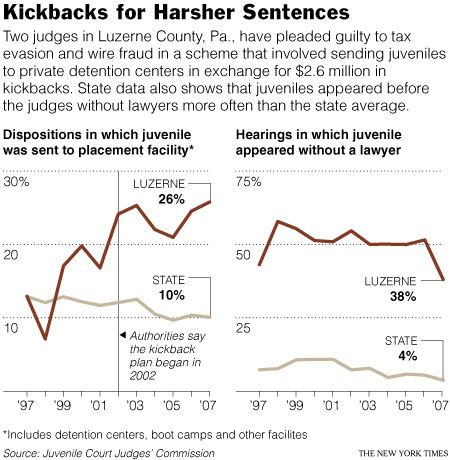
State data, however, give a different picture. The number of juveniles he sent to secure facilities outside the home more than doubled from 2001 to 2002, around the time that the authorities say he and Judge Conahan hatched their kickback plan. And that sentencing trend — more than double the state average — continued through 2007, according to data analyzed by The New York Times. (No data was available for 2008.)
After the Juvenile Law Center appealed a case involving a child who was sentenced without a lawyer, Judge Ciavarella told reporters in 2000 that he would avoid letting juveniles appear without counsel in the future. But state data indicate that the problem only worsened. From 1997 to 2003, juveniles appeared before Judge Ciavarella without counsel at more than five times the state average, and from 2003 through 2007, that rate was around 10 times the state average.
Federal authorities have declined to say when they began investigating the judges. But these trends started worrying State Department of Public Welfare auditors in 2003, when they noticed that the county was billing the state for the same amount every month for detention services. In most other counties, the bill fluctuates based on the changing numbers of juvenile offenders each month.
In a separate review, state auditors found that the detention centers were systematically overbilling the county and that the centers had fallen behind in their bills and begun receiving shut-off notices from utility companies.
“Those were all red flags to us,” said Ted Dallas, executive deputy secretary for the Department of Public Welfare, adding that his office tried to work with the county to lower its use of detention because the state pays partial reimbursement for those costs.
But, like so many others, Mr. Dallas said there was little he could do. Since the centers were privately owned, state auditors had limited authority. And since the judges were on the side of the centers, the auditors had little recourse in the event of a conflict.
“In the end,” Mr. Dallas said, “it all came down to what the judge decided.”
Sean D. Hamill contributed reporting.
A Judge’s Victims
Voices of those who went through the courtroom of Judge Mark A. Ciavarella Jr. in Luzerne County, Pa. Judge Ciavarella has pleaded guilty in connection to a scheme that involved sending thousandsof juveniles to two private detention centers for kickbacks.
mp3 links:
Chad Uca, speakers: The Uca family
DayQuawn Johnson, speaker: Sonji Johnson, mother
Source New York Times