The following articles from the Halifax Herald were not posted on their public website. We thank Connie Brauer for sending them privately.
The authors accept without skepticism the psychological assessment of a short temper as a pathology. The description of the triplets on video shows clearly that Carline is not a child abuser.
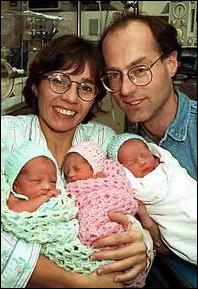
Long road to lost children
VandenElsen: from mother to crusader
When Carline VandenElsen gave birth in 1993 to Canada's first New Year's triplets, she likely had no idea she'd be on the front page almost eight years later accused of kidnapping them.
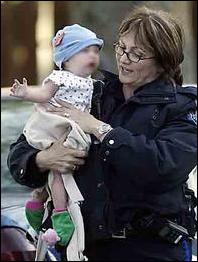
Or that she'd later emerge from Halifax's longest police standoff with a baby strapped to her chest, carrying a stretcher bearing her mother-in-law's body.
"It was like watching someone you didn't know," says her sister, Maureen Davidson.
Ms. Davidson recalls her terrified family watching events unfold on television in their native Ontario.
"It just broke my heart," she says.
Ms. VandenElsen's road from celebrated mother to anti-establishment icon was long. And an all-out war over custody and access to the triplets - Peter, Gray and Olivia - paved the way, her supporters say.
Ms. VandenElsen is a bright woman whom her second ex-husband, Craig Merkley, and the court system have labelled as an unstable, bad mother, Ms. Davidson says.
A decade ago, Ms. VandenElsen was a high school drafting teacher in Stratford, Ont., with a love for music, and she also volunteered with the Stratford Multiple Birth Association. Her sister and friends interviewed in Stratford describe her as caring and warm - a supermom.
"She was an average, loving, hard-working, supportive person, and this is what the family court system dwindled her down to," Ms. Davidson says.
Sgt. John Wilson, the Stratford police officer who tracked Ms. VandenElsen when she allegedly fled first to Nova Scotia and then to Mexico with her triplets in October 2000, described her as "a bit of an eccentric" and an environmentalist who rode her bike everywhere in the small theatre city.
Stratford, on the banks of the Avon River, is known for its graceful swans and summer theatre festival.
The city, surrounded by farms but only a 90-minute drive west of Toronto, pairs trendy restaurants and artsy shops with small-town charm.
On this June day, cheers emanate from a midday rugby match and flower baskets hang at the entrance to the brick Stratford jail.
In the favoured city for Hogtown retirees, Ms. VandenElsen wasn't all that different.
"Nothing really too much of an extreme until the tree-hugging thing and she just went overboard on that one," Sgt. Wilson says.
She was arrested June 13, 2000, for breaching the peace after she climbed a tree in front of her Hibernia Street house to prevent city crews from cutting it and others on the street.
Aside from that, Sgt. Wilson says, he didn't know much about her until she was accused of abducting her children on Oct. 14, 2000. Since then, he has been the go-to guy in his hometown for all calls related to her and the Merkleys.
"When I look over the last five years or so, I think if we could've seen where she is now back then, we would've pushed every panic button we could on that Saturday prior (to the abduction)," he says.
Years of legal wrangling began just before Christmas 1995 when Mr. Merkley, Ms. VandenElsen's husband at the time, alleged that she was unstable, unfaithful, had abandoned the family and had bought marijuana from a student.
Ms. VandenElsen, who cannot be interviewed while on a hunger strike at the Central Nova Scotia Correctional Facility in Dartmouth, has denied these claims in court documents.
Mr. Merkley declined to be interviewed for this series and directed questions to his lawyer.
Three boxes of unsealed documents, videotapes and pictures at Ontario Superior Court in Stratford - one sealed box remains, contents unknown - offer a glimpse into their lives before and during the acrimonious court battle.
Ms. VandenElsen, the sixth of eight children born to Dutch immigrants, grew up on a tobacco farm in Scotland, Ont., and attended Catholic school. She went to university, worked for the Highways Department and later opened a maternity clothes shop in London, Ont., with her sister Frances. They closed the store in 1986 when Frances started a family.
It was 1987 when Ms. VandenElsen, already a divorcee, met Mr. Merkley.
She was working in a grocery store when a contract came up at the Upper Thames River Conservation Authority. Mr. Merkley was one of the interviewers. She got the job, and eventually, the man.
The pair were polar opposites, says a May 1998 assessment by Waterloo psychologist Dr. Robert Doering: he's quiet and reserved and she's loud, demanding and aggressive.
"She was attracted to him because he was quiet and reserved," the report states. Mr. Merkley felt "that he was seduced in a manipulative manner by her, stating 'I was bowled over by her.' "
They began living together in November 1987 and were married in London in October 1988. She was 26 and he was 32.
But according to Mr. Merkley, the marriage "went wrong from the beginning."
He claims Ms. VandenElsen was "enraged at him" after a minor tiff, he told the psychologist.
He told Dr. Doering that his wife felt that "all her problems would be solved if she became pregnant."
She, on the other hand, described Mr. Merkley as "aloof and rather indifferent to the subject of children."
After 18 months of unsuccessful attempts to become pregnant, they turned to the fertility clinic in London and both had surgery. She had an operation to clear her Fallopian tubes and he had a procedure to deal with low sperm motility.
Ultimately, they tried in vitro fertilization with donor sperm.
Dr. Chris Newton, a psychologist at University Hospital in London, first met the couple in April 1991. Ms. VandenElsen was angry, frustrated and sad, he wrote, while Mr. Merkley felt guilty and inadequate.
She later saw a therapist, court records show, for stress related to infertility and her work. She had earned her teacher's certificate and was teaching drafting, a traditionally male-taught subject.
Dr. Newton recommended that the first in vitro fertilization attempt be postponed until Ms. VandenElsen completed her teaching year. Mr. Merkley wanted to wait but his wife wanted to push on.
The couple settled down in Stratford, halfway between her job in Waterloo and his in London. They moved into a modest, two-storey red brick house with a sweeping yard on tree-lined Centre Street.
Ms. VandenElsen's physical health was continually an issue, and she was torn between the joys of pregnancy and fears of miscarriage.
She was on bedrest in a London hospital when the triplets arrived, prematurely, minutes into New Year's Day 1993.
The smiling couple and their miracle babies were on the front of the local papers and on television as Canada's first New Year's triplets.
They were later transferred to hospital in Stratford, and eventually mom and the two boys were able to go home. Little Olivia had to stay longer.
People were in and out of the family home with food and to help change and feed the babies.
Mr. Merkley returned to work, and he has said the couple agreed he'd save his vacation time for an extended summer break.
After one of the children caught a cold, Ms. VandenElsen would only allow one person in fof frequent visits - babysitter Alice Schofield. A religious, grandmotherly woman with long, greying hair, Ms. Schofield remains one of Ms. VandenElsen's staunchest supporters and is among those who regularly meet in Stratford to discuss her case.
When two of Ms. VandenElsen's sisters, Maureen and Theresa, visited on weekends, "I remember thinking, 'She's doing this all alone,' " Ms. Davidson says. "I don't know how she did it."
During 1993, Ms. VandenElsen's family doctor referred her to a psychiatrist, who wrote that she showed signs of postpartum depression. She needed more help with the children, he said, and he put her on antidepressants and expected to have more sessions with her.
Mr. Merkley told a jury in 2001 that he was having concerns about his wife in 1994 and 1995. She was having mood swings, he said, and was frequently angry and sad. He came home one day to find a hole punched in the wall and she told him the kids did it.
There were anonymous calls to the Children's Aid agency in Stratford complaining that Ms. VandenElsen yelled at the children, let them wander and allowed them to play in a car alone. At least one of the calls later turned out to be from Jan Searle, the next-door neighbour.
After a visit to British Columbia in 1994, Ms. VandenElsen thought about moving there to teach but decided against it.
She needed time alone and rented an apartment in London. As far as she was concerned, she later told a court, she was still married. Mr. Merkley said she'd left.
Ms. Schofield says Ms. VandenElsen often worried she wasn't seeing the children enough, even when she was with them almost every day.
"She loves those children," Ms. Schofield says.
Ms. VandenElsen wasn't expecting a judge's order granting interim custody of her children to her husband.
After Ms. VandenElsen got her own lawyer in the summer of 1996 to help finalize things, her custody was cut, she has testified.
She took the matter to court and was granted access on alternate weekdays and one weekend a month.
The roller-coaster continued. She moved to Toronto with her new boyfriend in August 1997 and toyed with moving to Costa Rica. The pair eventually moved into a house on Hibernia Street, and she began working as a bar manager and part-time supply teacher.
Ms. Searle eventually became the children's daytime caregiver. By the winter of 1997, she and Mr. Merkley had become an item.
Mr. Merkley and Ms. VandenElsen eventually divorced in January 1998 and he married Ms. Searle on Aug. 27, 2001.
Ms. VandenElsen still believes Ms. Searle was the driving force in Mr. Merkley's corner.
Mr. Merkley and Ms. Searle claimed that Ms. VandenElsen's erratic and manipulative behaviour caused the children extreme stress. One wet the bed, one became more aggressive and the other was withdrawn, they alleged.
They said Ms. VandenElsen's sometimes erratic behaviour, her discussions of court proceedings and her disparaging of Mr. Merkley, Ms. Searle and Ms. Searle's children exacerbated the triplets' problems.
Ms. VandenElsen attributed her children's difficulties to the lack of their mother's attention and the involvement of others such as Ms. Searle.
The triplets' psychiatrist, who interviewed both Ms. Searle and Mr. Merkley, recommended the mother not be allowed to see them. The psychiatrist later withdrew from their care due to Ms. VandenElsen's alleged harassment.
Ms. VandenElsen's access dropped to alternate weekends in November 1997, bounced back up to alternate weekdays and one weekend a month in December, and changed again later.
After a court-ordered psychological assessment of the parents, the triplets and Ms. Searle, Dr. Doering concluded that Ms. VandenElsen should have substantial access to the children.
The custody battle eventually became her full-time job, her friends say. She was frustrated by the system and by what she saw as inadequate legal representation. She filed at least one complaint against one of her lawyers, which was later dismissed, and lost her Hibernia Street home at a public auction to pay court costs.
Ms. Davidson, who attended some of the family court hearings, says no one ever looked at how Mr. Merkley got interim custody in the first place.
"It just seemed like the truth was never brought out, or it was past this or we won't reverse that," Ms. Davidson says.
The judges were more interested in keeping the status quo, she says.
As Ms. VandenElsen's frustration grew, so did her anger.
Both inside and outside the courtroom, Ms. VandenElsen can be pushy and downright rude - shouting, smirking or making a popping sound with her finger in her mouth at a Stratford judge.
Even her family and closest friends have had to shake their heads at some of her actions. They say she was driven to it, but Alfred Mamo, Mr. Merkley's lawyer, doesn't see it that way.
"It is completely erroneous to think that somehow this is a case of a - though quite unique - completely normal person who somehow has been made abnormal or has been sacrificed by society or by the justice system," he says. "Nothing could be further from the truth.
"The justice system has given Ms. VandenElsen every opportunity to be child-focused and to do the right thing, and every time she's chosen not to do that."
As for Sgt. Wilson, the woman he sees on the TV news is the woman he knows.
"I think you're getting a 100 per cent clear picture of what she's all about," he says.
"You just take a look at her courtroom antics. She uses the hundred-dollar words, which gives us a pretty good indication that she's educated, but she just flips at the drop of a hat - her unpredictability and what's she going to come up with next - I think you guys have a very good indication of what she's all about as far as her mental makeup goes."
Mr. Mamo appreciates that her supporters may not see it that way.
"People do have different personalities. And yes, there are times when I am sure when they were with their friends at a barbecue and having a jolly good time, they look very normal and they are normal," he said.
"But when it comes to being in a situation with child welfare authorities, with police, with the legal system, they act in a very different way."
At the 1999 trial over custody of the triplets, Mr. Merkley tried to show a different side of Ms. VandenElsen using transcripts of recorded snippets from 11 of her phone calls with the triplets from March 1998 to September 1999. In those, Ms. VandenElsen demeans Mr. Merkley, Ms. Searle and Ms. Searle's young daughter and complains about the custody arrangements.
Ms. VandenElsen told the judge that she was provoked, then felt bad and apologized to the children.
Ms. Schofield and her neighbour, Ann Kelly, both testified they'd never seen anything that caused them concern over Ms. VandenElsen's parenting skills.
(Ms. Kelly, a mother of twins who were friends of the triplets, recently followed a liquid diet for 21 days in support of Ms. VandenElsen's continuing hunger strike.)
Dr. Doering listened to four of the calls and called them emotional abuse of the triplets, who were five and six at the time.
Dr. Doering - reluctantly, the judge said - recommended the mother see the children only on special occasions.
The judge, like Dr. Doering, was concerned "as to whether the defendant really recognized the children's paramount need to be removed and sheltered from the hostile environment existing between herself and the plaintiff."
The judge ruled in March 2000 that it was in the best interests of the children for them to remain with Mr. Merkley and Ms. Searle.
But, the judge said in 2000, Ms. VandenElsen "has been and continues to be a highly stimulating parent."
"She has the potential of contributing positively and significantly to the lives of the children. She has an energy about her which, if channelled properly, can be an important contributor to the enrichment of the children's lives."
Ms. VandenElsen was granted access, the full extent of which was to be determined that fall.
But by October 2000, she had put that energy into something else - liquidating about $60,000 in RRSPs, renting her house and formulating a plan to secretly leave the country with the triplets.
Her friends and sister say she did it out of love and, in part, desperation.
When the children didn't come home from a weekend visit with their mother, Mr. Merkley called police, who didn't start actively investigating until two days later.
The mother and the three seven-year-olds stayed at a cottage in Queensland, outside Halifax, drove through the United States and ended up in Mexico, where they were found in January 2001. Ms. VandenElsen chronicled their journey in a book, America's Most Wanted Mother.
Mr. Merkley's lawyer points to her tales as proof of her attempts to manipulate the children, thereby causing them psychological harm.
"All you have to do is read her book to give you an instruction on the kind of life that she put the children through and her attitude when she was indoctrinating her children about being anti-authority and anti their father," Mr. Mamo says.
Ms. VandenElsen steadfastly maintains that she took her children because she feared they would be psychologically harmed by not having her in their lives.
An allegation that she had inappropriately disciplined the children in Mexico was investigated and no further action was taken.
She was granted two access visits all summer in 2001. She was upset at how little time she had with the children, and Mr. Merkley feared they would be taken from him again.
After a jury acquitted Ms. VandenElsen of abducting the triplets, her sister believes she was close to getting more access and possibly joint custody.
"I think she was doing very well until she met this person, who, unfortunately, had some problems of his own."
That person was Larry Finck, a former Halifax man who'd served time for abducting his daughter in 1999.
Ms. VandenElsen married Mr. Finck in April 2003 and they lived in a red brick bungalow in Stratford a short walk from the triplets' home.
"As soon as Larry came on the scene and he had a record, that was enough for Craig to go back to court and say the kids were in danger," Ms. Davidson says. "He's not an animal, he's not a thief, he's not a rapist.
There's no doubt in Mr. Mamo's mind that Mr. Finck's involvement turned up the heat.
"Ms. VandenElsen is quite capable of causing quite a few ripples in everybody's life on her own," Mr. Mamo says. "But certainly their meeting and the combination of the two of them causes more concern and causes more conflict."
Ms. VandenElsen had become known as the woman who took her children, and although she had her supporters, she had a hard time finding work. But she was overjoyed at being pregnant again and happy to share the news with the triplets, who were also excited.
By the time Ms. VandenElsen and Mr. Finck left Stratford for Nova Scotia in late 2003, she faced a new trial and had lost access to her kids.
It's unlikely Ms. VandenElsen, now 43, will have another child.
Ms. Davidson doesn't believe in what her sister and Mr. Finck have done - their standoff with police - but does believe they are fighting for the right reasons.
"I just feel for them to have this awful chain of events happen."
In a recent letter to The Chronicle Herald, Ms. VandenElsen writes: "These days I wear leg shackles, I'm strip-searched and am transported in a cage, taken to a dark and dank cell in the basement of the courthouse because I can no longer endure the sight of the Children's Aid worker, the Children's Aid lawyer and the judge."
She talks about "whore lawyers," how the system "manoeuvres" to take her child and that she and her husband were targeted because they are activists.
"But if I were a dog, the public might be moved," she wrote. "For shame Canada, for shame the media hounds for not informing the public. God bless us all."
What was she thinking?
After a jury acquitted Carline VandenElsen of abducting her triplets in 2001, the media and local residents had a field day.
A news director appeared on an Ontario television commentary program set in a boxing ring and practically spat out what many were thinking: "She's nuts!"
And that's why she lost her kids, he said.
"Is she crazy?" asks her sister, Maureen Davidson in a recent interview.
"I think there's quite a difference between crazy and desperate."
Ms. VandenElsen was a devoted mother who naively believed that her husband had agreed to a separate living arrangement with shared access to their triplets, her sister said.
But when he applied for custody in 1995, her then-husband Craig Merkley claimed that Ms. VandenElsen was bipolar. And he alleged that her illness contributed to her inability to parent.
"It shocked me that the courts would give full custody without saying, 'Give me proof,' " Ms. Davidson said.
She denies, as Ms. VandenElsen has in court documents, that her sister suffers from mental illness.
According to the Canadian Medical Association, bipolar disorder is a manic-depressive illness characterized by mood swings between opposite extremes. Mood shifts have been linked to changing levels of the chemical dopamine in parts of the brain, the association says.
Bipolar disorder "responds well to treatment once the illness has been diagnosed," a Canadian Mental Health Association website says.
In three boxes of court information reviewed in Stratford, Ont., by The Chronicle Herald, there is no evidence to support Mr. Merkley's original claim. However, there are also sealed files, described only as a box of filings and exhibits, related to the case.
The judge's reasons for issuing the Dec. 20, 1995, interim custody order are not in the public files.
The public documents do contain references to postpartum depression, depression, high stress levels following pregnancy and during the long custody battle.
The earliest reports date back to April 1991, when Ms. VandenElsen and Mr. Merkley went to counselling to deal with the stress of fertility treatments.
Dr. Chris Newton, a psychologist at University Hospital in London, Ont., first met the couple in April 1991. He wrote that personality tests on Ms. VandenElsen "suggest the presence of a borderline depressive state with feelings of sadness, discouragement and failure."
She was feeling angry and frustrated by the whole process, while Mr. Merkley felt guilty, sad and inadequate.
Both, he felt, may lack "stamina to manage difficult circumstances."
The reports indicate that Ms. VandenElsen received counselling in the summer of 1991. She also was trained in relaxation techniques, but her anger and frustration continued.
Dr. Newton wrote in 1996 that Ms. VandenElsen had in 1991 displayed a "good deal of anger and resentment . . . and obvious tension in the marriage relationship, which had prompted my recommendation that the couple seek marital counselling before proceeding with treatment."
Ms. VandenElsen saw a therapist from November 1991 to January 1992, which ended "as Carline reported feeling significantly better."
But when the triplets were seven months old, her family doctor referred her to a Stratford psychiatrist.
Dr. Biju Mathew, in a letter to the family doctor, writes that Ms. VandenElsen "presents with features of a postpartum depression."
"The heavy physical needs of three babies is a lot more than she actually anticipated," he wrote.
"Initially there was a sense of shock, followed by gradual acceptance of the demands."
She had a helper two days a week, but no family support, the doctor said. She cried frequently since the birth, had little energy and "on many occasions she has felt that life is not worth living and wanted to end it all."
He described her as subjectively depressed and that she felt helpless and hopeless. Dr. Mathew started her on antidepressants and continued counselling.
Ms. VandenElsen reported later that she decided not to take the medication.
"I do feel that she needs a lot more support in bringing up three infants at this point," Dr. Mathew wrote. "I am not sure how she will handle this when she returned back to school in the fall. Certainly the children are not in any kind of danger at this point."
In 1998, the court ordered Ms. VandenElsen, Mr. Merkley, his current wife, Jan Searle, and the triplets to undergo psychological assessments.
A May 1998 report by psychologist Dr. Robert Doering states that Ms. VandenElsen "acknowledges that she is stressed and frustrated by the current dispute and her difficulties getting access to the children.
"She denies Mr. Merkley's allegations about psychological problems or anger control problems and also denies that she is currently depressed."
It noted that she saw psychologist Ann McHugh six times from January to April 1995, and was "suffering from a significant depression, as well as showing indications of underlying anger and personality problems."
Dr. McHugh recommended "that she not make any major life decisions at the time because the depression and anger were colouring her judgment."
She again refused medication.
When Dr. McHugh saw her again in April 1997 and January 1998, Ms. VandenElsen wasn't depressed, but was angry, disappointed and frustrated by the custody battle.
In the report by Dr. Doering, Ms. VandenElsen acknowledged that she is a "loud person," both in her job and in her day-to-day life, but states that she is also excitable in a positive way.
Tests showed that she wasn't bipolar or depressed or suffering from acute mental health problems at the time.
"They do suggest personality problems," he wrote.
He described her as angry, mistrustful, self-indulgent and easily angered.
"She is likely to demand attention and sympathy from others but resents even small demands others place on her," Dr. Doering writes.
He also wrote that she "had a disregard for authority figures, tends to deny responsibility and blames others for her problems."
"She may become angry or argumentative over seemingly insignificant events."
Alfred Mamo, lawyer for Mr. Merkley, says the issue of a diagnosed illness is no longer an issue.
"It's completely irrelevant from this point of view," he said. "The real issue here is the effect that her actions have on the children and the erratic, violent behaviour that she exhibits, whether it's generated from a personality disorder, a medical disorder or simply and emotional disorder.
"At this point a diagnosis is not important."
Mr. Mamo was not Mr. Merkley's lawyer at the time the original allegations were made, but says his client stands by claims that she is unstable.
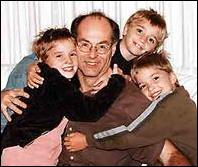
A family torn apart
Craig Merkley won bitter battle for triplets
A judge in Stratford, Ont., granted Craig Merkley interim custody of his toddler triplets just days before Christmas 1995.
The then-husband of Carline VandenElsen claimed she was bipolar or manic depressive, that she "abdicated her responsibilities" and was unable to be the custodial parent due to her illness.
Mr. Merkley was represented by a lawyer, and neither he nor Ms. Vand-enElsen was in court that day.
Ms. VandenElsen doesn't know what was said in court, she has said, and the judge's ruling was not in the unsealed portion of the case on file in Ontario Superior Court in Stratford.
In an affidavit filed before the Dec. 20, 1995, hearing, Mr. Merkley alleged that his then-wife "unilaterally decided to vacate" their home on Sept. 1, 1995, to rent an apartment in London, Ont.
She returned home to visit their children - Peter, Gray and Olivia - once a week, "although the frequency of the visiting varies," Mr. Merkley said in the affidavit. He also stated that he hadn't "interfered with or discouraged access between the defendant and our children."
Mr. Merkley accused his then-wife of "repeated instances of marital infidelity," using marijuana and buying it from a student, depleting their joint bank account for her living expenses and appearing at their home to stay for however long she wanted.
Although Ms. VandenElsen was a high school teacher, Mr. Merkley said she wanted to "be a singer and/or run a coffee house."
He stated that he was "the only parent physically and emotionally capable of providing appropriate child care."
"The fact is that the defendant has been suffering for years from a bipolar mood disorder and may be manic depressive."
The condition was "made worse by the demands presented by the birth of the parties' triplets."
The children were conceived through in vitro fertilization, using donor sperm, and were born on Jan. 1, 1993. But, Mr. Merkley wrote, counsellors recommended Ms. VandenElsen not go through the process "due to emotional instability."
The couple were beyond the point of reconciliation, Mr. Merkley wrote in 1995. He asked the judge for custody of the children, $300 a month in child support, exclusive possession of the matrimonial home, court costs and a restraining order against Ms. VandenElsen barring her from "molesting, annoying or harassing the applicant or the children in his custody."
Ms. VandenElsen was stunned to find these papers a couple of weeks before the December 1995 hearing, she told a jury in October 2001.
She said Mr. Merkley had told her in 1995 "his intention was to drop the proceeding, this wasn't the direction he wanted to take, but he felt confused at the time and that he would speak to his lawyer about dropping the proceedings."
She and Mr. Merkley were in the process of buying a cottage in December 1995 and she had no reason not to believe him, she testified.
Over Christmas 1995, the couple attended Mr. Merkley's work party, held a New Year's party for friends and celebrated the children's third birthday on Jan. 1, 1996.
Then Ms. VandenElsen found the court order, granting him custody. Mr. Merkley said he couldn't stop the proceedings, she told the court.
"I was ignorant of this court order's implications," Ms. VandenElsen testified. "Mr. Merkley said things would stay the same and they did.
"I wasn't challenged for any reason and I didn't want to go to a lawyer at that time. I suppose, in hindsight, yes, I should have, but I didn't because I truly believed that had I got another lawyer, that trouble would begin."
Mr. Merkley admitted to a jury in 2001 he hadn't told his wife in 1995 he'd met with a lawyer, and he said she found some legal papers - he didn't know what they were - in his car. He didn't recall saying anything about stopping the case.
Ms. VandenElsen didn't get a lawyer until the summer of 1996 when her access to the children was limited.
In a statement of defence filed in July 1996, she denied her husband's claims. She wasn't bipolar or manic depressive, she wrote, and although the couple were counselled about the consequences of undergoing the in vitro fertilization process, she was "not advised to not undergo the procedure."
She acknowledged seeing a psychiatrist "on one or two occasions when the children were three or four months old to receive support with being the primary caregiver for three newborn babies," she wrote.
"However, it in no way affected the defendant's ability to provide the proper care and nurturing for the children, and lasted a very short time."
The decision for her to move out "was a mutual one," she wrote in 1996, and she visited with the children three times a week for about 25 hours a week while Mr. Merkley was at work.
She later moved to a cottage near his work so the children could stay with her.
In February 1996, she said, she was working full time as a teacher and saw the children every day after school until Mr. Merkley came home. While on summer vacation, she had the children four days a week, twice overnight and on alternate weekends. She claims she spent more time with the triplets than he did.
That October, a judge ordered that Mr. Merkley retain interim custody and granted specific and frequent access to Ms. VandenElsen.
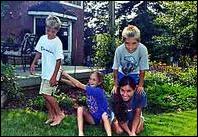
Custody dispute's toll
Feud between VandenElsen, ex-husband harmful for their triplets, reports say
Even in the most amicable of divorces, the battle for custody of the little ones can get downright nasty.
Place the children between two people who can barely sit in a room together and add the fact that their classmates, their hometown and the entire country knows details of their lives, and the effects can be devastating.
"The three (Merkley) children seem to have tolerated the turmoil better than one might expect," Justice David Aston of Ontario Superior Court wrote in a February 2003 decision.
"Perhaps as triplets they can draw strength from one another and know that they are special.
"They certainly know they are loved."
According to a large number of unsealed documents in Ontario Superior Court in Stratford, the lives of the triplets of Carline VandenElsen and Craig Merkley, born Jan. 1, 1993, have been far from easy.
What's contained in the sealed portion of the file, described only as a box of filings and exhibits, remains unknown. But here's what was open to review:
Notes the children wrote at school about the time when their mother allegedly abducted them in October 2000 during an access visit and took them eventually to Mexico.
"I em (am) back," one of the triplets, then eight, wrote in a school journal after their return.
"I went to Mexico and Panama and the United States. To get acros the borter intothe United States mom pot us in the trungk. She turned the music on three times that ment to be very cwite as cwite as you can."
- A videotaped interview of the triplets telling a Children's Aid worker in Stratford that they want to live with their mom so they can see both parents whenever they want. They also say their stepmother hates them.
- A videotape of them going on their first visit to see their mother after returning to Canada after the alleged abduction. All of the children are smiling and laughing until Ms. VandenElsen's sisters tell them to say goodbye to their father. Olivia's expression suddenly changes and she stares wide-eyed, while the boys wave excitedly at their dad.
- A page with three separate typewritten notes signed by the children and dealing with living at their mom's place. These notes were written during their last visit with their mother before a judge cutoff all contact.
- Discussions the children had about their father not producing sperm. Court documents state that their mother told them their father is not their biological father.
- There are also pages upon pages of reports related to their mental health.
One child tried to commit suicide by hanging in Mr. Merkley's home. Reports later stated the child tried to commit suicide but also believed people could come back when they died.
That same child once drew blood when tying a shoelace around a sibling's neck and has fought with others. The child was eventually placed on medication.
Another had bedwetting and daytime soiling problems, which doctors felt was due to the stress of the conflict.
The third child was withdrawn to the point that doctors were concerned.
In a May 1998 psychological assessment done when the children were five, one of the children expressed fear of losing the parents and being left alone.
Another "does not like it when she (Ms. VandenElsen) cries when (the children) leave." The child also said their father keeps them away from their mother.
The third child said: "Mom gets mad at me a lot," and "Mom raises her voice a lot," and "I wish I stayed at Daddy's and Jan's forever: I wish I never saw Mommy again."
The 1998 report, written by Dr. Robert Doering, stated: "The children are being detrimentally affected by being exposed to a power struggle between their parents which is clearly harmful to their psychological and emotional well-being."
At another point in the litigation, authorities recommended the children see counsellors whose reports would not become part of the court battle.
Although Dr. Doering recommended the children continue living with their father, he also saw "a potential risk of parental alienation given the present adversarial situation" and advised Mr. Merkley and Jan Searle, his fiancee and future wife, to "facilitate a positive and significant role for the mother in their children's lives."
He later changed his mind after hearing snippets of 11 phone conversations that Mr. Merkley secretly recorded in which Ms. VandenElsen denigrated her ex-husband, Ms. Searle and Ms. Searle's children and drew the triplets into the conflict.
The psychologist reported it to Children's Aid as emotional abuse.
The triplets haven't seen their mother since late 2003, and Alfred Mamo, lawyer for the Merkleys, said they are leading "very normal, uneventful lives, which is something they need after all the activity there was."
They haven't asked about their mother's situation, he said.
Sgt. John Wilson, the Stratford police officer who tracked Ms. VandenElsen when she allegedly fled the country and is the point man for allMerkley-VandenElsen calls, said the children are well cared for and doing well. Just what will happen when Ms. VandenElsen returns to Stratford for her retrial on the abduction charges, scheduled to begin July 18, remains to be seen.
"When she's out there (in Nova Scotia), it isn't a big deal here - the kids know what to expect," Sgt. Wilson said.
"The issue hasn't really raised its ugly head here. . . . It's a good thing it will be summer."
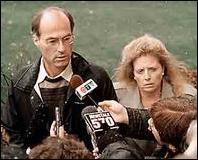

Triplets wanted their mom
Children asked for access to both parents, 2003 videotaped interview reveals
It had been 19 months since the triplets had last visited their mother.
On Sept. 8, 2003, the 10-year-old triplets drove their bikes from their elementary school to see their mother, Carline VandenElsen, who was living in a nearby bungalow in Stratford, Ont.
Their mother was at an appointment, but the visit prompted her husband, Larry Finck, to call the Children's Aid Society.
The children stayed, but just days later, a judge ordered them returned to their father and temporarily barred their mother from all contact.
The triplets, seen sitting around a table at their mother's home in a videotaped interview with a social worker on that Sept. 8, tell him they want to live with their mother.
They say that if they live with their father, Craig Merkley, they're not allowed to see their mother. But if they live with their mother, they say, they've been told they can see their dad any time they want.
"Any problems at Dad's?" the social worker asks.
Yes, they say.
"Like with Jan, our stepmom," Olivia says.
The little girl with the brown hair tucks her long, skinny legs up toward her chest at times during the interview.
Her father had earlier reported that after their mother allegedly abducted the triplets for a few months when they were seven, Olivia was incredibly afraid of being taken again and extremely shaken to visit her mother.
But on the videotape, Olivia, at 10, is quick to answer the social worker's questions and appears angry with her stepmother, Jan Merkley.
Gray, a child with many reported difficulties including aggression and a suicide attempt, appears talkative and outgoing. Their brother Peter is quiet and at one point stares wide-eyed at the camera.
All know they're being videotaped.
Olivia and Gray say their stepmother is mean to them and doesn't let them go play further than their own street.
When asked about their stepmother, Gray begins: "She was the one who . . ."
"If Jan didn't live next door or anything . . ." Olivia interrupts.
"Jan's who told our dad to go to court and get custody," Peter blurts out.
"And if Jan wasn't in our life, our mom and our dad would still be divorced but they'd still be friends," Olivia says.
The four fall silent as Olivia sits back in the wooden chair, folds her arms and looks around.
"She ruined my life," Olivia says.
"You think she ruined your life?" the social worker asks.
"Yes," Olivia says.
Peter rubs his eyes but doesn't say anything.
"We know she hates us," Olivia says.
Hate is a pretty strong word, the social worker says.
"Then she dislikes us," Olivia says with a sneer.
Neither she nor Gray is able to explain why.
But Olivia says: "I want to live with our mom and visit our dad whenever we want."
One of the triplets then explains that their mom and Mr. Finck are going to Supreme Court to get his daughter Chantelle back.
And one of the triplets says: "If we didn't come here, they're going to try to go to the Supreme Court to get us back."
"Our mom is pregnant and if we stayed there (at Dad's), we wouldn't be able to see our little brother," Gray says.
The social worker asks if they're excited about the baby. They light up, talking all at once about their mom's big belly and how fat the baby will be when he's born. The baby, a girl, was born in December 2003 in Halifax.
On the videotape, Olivia and Gray are clear - they want to be with their mother and see their father whenever they want. And that's what Ms. VandenElsen's family and supporters say.
Ms. VandenElsen's friends in Stratford say she always wanted Mr. Merkley to play a role in the children's lives.
Her sister, Maureen Davidson, who supervised Ms. VandenElsen's court-ordered visits with her children while she was awaiting trial for child abduction, says the tapes show what she saw during those times together.
"They can't get enough of her," Ms. Davidson says.
The children would climb over each other to sit in their mother's lap and laugh and play.
"They love their mother and they really do want to be with her," Ms. Davidson says.
But Alfred Mamo, the lawyer representing Mr. Merkley, believes the triplets' wishes are not that easy to determine.
"Given the history of this file, it is very, very difficult to ascertain what the children's true wishes are because the children have been involved in so much and because Ms. VandenElsen has manipulated them so much and put them through so much."
It's only natural for children to want a relationship with both parents, he says.
"They know their father's love for them is unconditional," Mr. Mamo says, adding that "they did enjoy various moments that they had with their mother."
But, he says, "they don't have the maturity to be able to appreciate that some of the things that they were being drawn into were inappropriate and not good for their emotional and psychological health."
Court documents state that when the children were very young, they were often subjected to Ms. VandenElsen's accounts of her court proceedings. Mr. Merkley claims this and other actions on her part caused stress and behavioural problems in the children. She has denied those claims.
Mr. Mamo attributes the children's desire to live with their mother to Ms. VandenElsen and says she offered them no real choice.
"If you put it on the basis to the children that the only way you can have a relationship with both your parents is to be with me, then of course they're going to say, 'Well, then we want to live with you because we want to have a relationship with both parents,' " Mr. Mamo says. "That's really what that tape was about."
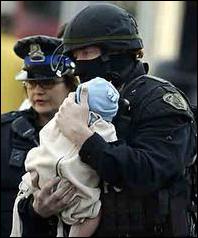
Merkley told Children's Aid VandenElsen had new baby
Agency issued national alert
Just what triggered the chain of events leading to a 67-hour armed standoff in Halifax?
It may have been a conversation Carline VandenElsen's ex-husband, Craig Merkley, had with Children's Aid officials in Stratford, Ont., in December 2003.
According to a report by the Huron-Perth Children's Aid Society dated Dec. 18, 2003, Mr. Merkley's family told him that his ex-wife had given birth. And he told Children's Aid.
Mr. Merkley and Ms. VandenElsen had been embroiled in a nasty custody battle that began in 1995. But in November 2003, she lost all rights of access to the children and was facing a retrial for allegedly abducting them in October 2000.
The report states that in December 2003, a person identified as Loran Green, an associate of Ms. VandenElsen's, said she had given birth to a baby girl, the letter states.
Mr. Merkley "further stated . . . that he believes (she) is in Halifax, Nova Scotia."
The child actually wasn't born until Dec. 23.
A Canada-wide child protection alert had been issued calling for a warrant to apprehend "expectant mother" Carline Antonia VandenElsen, also known by the last names Finck and Merkley.
"Baby - birth expected December 2003 or January 2004."
The exact date the alert was issued is unclear, as a court stamp covers that part of the page.
The alert said Ms. VandenElsen's access to her triplets had recently been terminated and "concern existed for their emotional safety due to her attempts to have the children align with her throughout a lengthy custody and access dispute."
It also said the mother was being tried on abduction charges and her husband, Larry Finck, was on probation for abducting his daughter.
The pair are "confrontational and verbally aggressive," the alert states.
"Mental health requires assessment."
Mr. Merkley declined to be interviewed, but his lawyer, Alfred Mamo, said Children's Aid workers "kept in touch with Mr. Merkley in terms of their monitoring how the children are doing."
His client spoke to Children's Aid but "it wasn't intended to provide information to say: 'You better do something about it.'"
Protecting Children
According to Nova Scotia's Community Services Department, the decision to remove a child from his or her home is made by a family court judge. A hearing must be held within five days if the child is removed by a social worker in an emergency situation. Parents have access to case files and workers' notes. Families that can't afford a lawyer are provided one. Under the provincial Children and Family Services Act, there are 14 situations in which a youngster is in need of protection from a parent or guardian:
- The child has suffered physical harm, inflicted by a parent or guardian . . . or caused by the failure of a parent or guardian to supervise and protect the child adequately.
- There is a substantial risk that the child will suffer physical harm inflicted or caused as described in the previous paragraph.
- The child has been sexually abused by a parent or guardian, . . . or by another person where a parent or guardian of the child knows or should know of the possibility of sexual abuse, and fails to protect the child.
- There is a substantial risk that the child will be sexually abused as described in the previous paragraph.
- A child requires medical treatment to cure, prevent or alleviate physical harm or suffering, and the child's parent does not provide, or refuses or is unavailable or is unable to consent to the treatment.
- The child has suffered emotional harm, demonstrated by severe anxiety, depression, withdrawal, or self-destructive or aggressive behaviour and the child's parent or guardian does not provide, or refuses, or is unavailable or unable to consent to services or treatment to remedy or alleviate the harm.
- There is a substantial risk that the child will suffer emotional harm of the kind described in the previous paragraph, and the parent or guardian does not provide, or refuses, or is unavailable or unable to consent to services or treatment to remedy or alleviate the harm.
- The child suffers from a mental, an emotional or a developmental condition that, if not remedied, could seriously impair the child's development and the child's parent or guardian does not provide, or refuses, or is unavailable or unable to consent to services or treatment to remedy or alleviate the condition.
- The child has suffered physical or emotional harm caused by being exposed to repeated domestic violence by or toward a parent or guardian, . . . and the child's parent or guardian fails or refuses to obtain services or treatment to remedy or alleviate the violence.
- The child has suffered physical harm by chronic and serious neglect by a parent or guardian, . . . and the parent or guardian does not provide or refuses or is unavailable or is unable to consent to services or treatment to remedy or alleviate the harm.
- There is a substantial risk that the child will suffer physical harm inflicted or caused as described in the previous paragraph.
- The child has been abandoned, the child's only parent or guardian has died or is unavailable to exercise custodial rights over the child and has not made adequate provisions for the child's care and custody, or the child is in the care of an agency or another person and the parent or guardian . . . refuses or is unable or unwilling to resume the child's care and custody.
- The child is under age 12 and has killed or seriously injured another person or caused serious damage to another person's property, and services or treatment are necessary to prevent a recurrence and a parent or guardian . . . does not provide or refuses or is unavailable or unable to consent to the necessary services or treatment.
- The child is under age 12 and has on more than one occasion injured another person or caused loss or damage to another person's property with the encouragement of a parent or guardian, . . . or because of the parent's or guardian's failure or inability to supervise the child adequately.
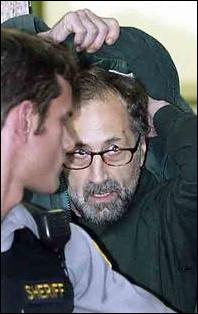
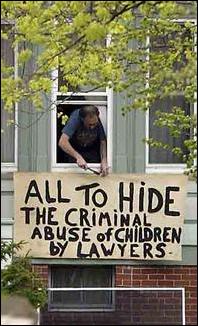
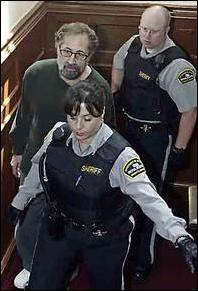
Fighting the system
Finck's custody battles have been bitter ones
Larry Finck had run-ins with the law for drug and weapons offences and child abduction long before the three-day armed standoff in Halifax that thrust him into the national spotlight in May 2004.
Psychiatrists have called him delusional and potentially dangerous.
But friends and supporters say the Kentville-born ex-plumber is a loving, supportive man who's a victim of the system.
Mr. Finck, 51, will be sentenced Tuesday for his part in the standoff that developed when authorities tried to seize his infant daughter.
He has already served time for abducting one of his children - two years in federal prison in 2000 for taking a daughter from her legal guardian, an uncle, on a First Nations reserve in Ontario in 1999. (Mr. Finck brought her to Nova Scotia, where he was later arrested by police.)
The girl had been living at the reserve with the guardian since her mother died of cancer on Jan. 13, 1996. Mr. Finck was allowed to have her for two, two-week visits per year, according to documents filed in the Ontario Court of Appeal.
The mother had left instructions that her young daughter was to be solely left in the custody of her uncle, court papers said. At the time of her mother's death, the girl was not quite a year old.
It was during one of those two-week court-ordered visits that Mr. Finck decided not to return his daughter to her uncle, court records show.
The guardian agreed to be interviewed by The Chronicle Herald but broke numerous appointments.
In one brief phone conversation, he said any reference to Mr. Finck having mental problems was "putting it mildly."
Prior to the Ontario abduction, Mr. Finck had tried to get his daughter declared a "child in need of protection" by the courts while she was in her uncle's custody, but that case was dismissed.
The Ontario parole board noted that Mr. Finck had been involved in a "lengthy and bitter" custody battle over his daughter since her mother's death.
Marilyn Pearson, a retired social worker in London, Ont., who first met Mr. Finck while the child's mother was ill, attested to the "awful" fight on his part to gain custody of his young daughter from the mother's family.
"They didn't want Larry to have the child, that's obvious," Mrs. Pearson said in an interview from London.
"I never got the truth. The cultural came before the biological all the way through," she said.
She believes the child's native heritage was a deciding factor in the custody case. "They believe that child should be raised on the reserve.
"He wasn't even able to see the child. It went before the judge. Every time Larry went to get that child, there was a problem," said Mrs. Pearson.
Court papers, including psychiatric records that could not be legally released until after Mr. Finck's conviction on the standoff charges in May, paint a portrait of a man suffering from mental illness who continues to believe the legal system is conspiring against him.
A Halifax psychiatrist who assessed Mr. Finck after the Halifax standoff stated Mr. Finck has delusional disorder of a "persecutory nature," which includes "narcissistic, antisocial and histrionic personality traits."
"The accused suffers from chronic persecutory delusions," wrote Dr. Robert A. Pottle, with the East Coast Forensic Hospital in Dartmouth. "His perception of a persecutory conspiracy extending to the level of the former prime minister J. Chretien, CSIS, and the federal minister of justice is steadfast, despite other more likely alternatives and an absence of concrete evidence," Dr. Pottle wrote in his report, dated June 29, 2004.
After assessing Mr. Finck, and examining information from the Crown file, witness statements, police reports and recordings of 90 telephone conversations that occurred during the standoff, the doctor found him fit to stand trial.
Halifax friend Marilyn Dey, who met Mr. Finck at a family court hearing in January 2003, says Dr. Pottle's report is wrong.
"Larry is and was . . . a loving, attentive concerned father. He adored his daughter," Ms. Dey said in a recent interview.
"I could see the same adoration between him and (his infant daughter). She just looked up at him and focused her full attention on her father." Ms. Dey said psychiatrists label parents whenever parents come in conflict with child welfare authorities.
"This is what they call the assessment. As soon as they apprehend your (child) nothing but garbage . . . comes out of it."
Ms. Dey holds similar disdain for court documents filed in the case. "It's based on hearsay, double hearsay and triple hearsay."
Mrs. Pearson, another Finck ally, said she believes the loss of his daughter in Ontario may have ultimately led to the Halifax standoff.
"I wonder if that happened to me, if I would be the same way too," she said.
"He sometimes carries things too far. . . . There's truth in what he says, but he turns people off with his anger."
Mr. Finck had three children by a previous marriage to Theresa Ann Windjack of St. Catharines, Ont. Their 1975 marriage ended on April 24, 2000, according to family court records in London, Ont.
Ms. Windjack did not return calls from this newspaper.
Mr. Finck, the second-oldest of four siblings, had an "unremarkable" childhood, according to Dr. Pottle.
He said Mr. Finck maintained that he'd completed Grade 12 and was a master plumber. Mr. Finck's friends say he furthered his education and took law courses at the University of Western Ontario in London but did not take bar admission exams in Ontario.
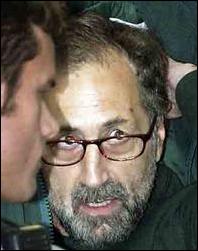
A more promising career appeared possible in 1974, when as a five-foot-10, 180-pound defenceman, he was selected in the eighth round of the National Hockey League draft by the Pittsburgh Penguins.
He never played in the NHL but did skate for Fort Wayne of the International Hockey League.
Dr. Pottle's report states Mr. Finck's plumbing career ceased after he lost his tools in a house fire in Ontario. Mr. Finck has contended the blaze, which happened about a year or so before the assessment, was deliberately set.
"He believes there have been attempts to kill him on at least two occasions," Dr. Pottle stated, noting that Mr. Finck believed the fire was started to thwart his plumbing work and to destroy his law library and volumes of court transcripts.
The psychiatrist noted an apparent paradox of Mr. Finck stating his disdain for lawyers and the justice system, while at the same time holding himself out to be a legal expert. (He represented himself at trial in Halifax on the standoff charges.)
"He spent much of his time at a communal table (in the hospital) covered with heaped documents, often standing in a 'Thinker-like' pose holding a copy of Martin's Annual Criminal Code or documents."
In his and partner Carline VandenElsen's self-representation form, filed last month at Nova Scotia Supreme Court, the two called their then-lawyer, Burnley (Rocky) Jones, and his co-counsel "a couple of dump trucks."
His disdain for the legal profession was also evident during his August 2000 sentencing for abducting his Ontario daughter, when he told the London judge: "I thank you for the penitentiary time and hope possibly there I could be rehabilitated because I'd like to be a scumbag lawyer now."
But Ms. Dey and Mrs. Pearson say the rancour arises from the unfair treatment he and Ms. VandenElsen have received.
Dr. Pottle said Mr. Finck characterized himself as a "hero" in the eyes of First Nations people, boasted about his "superior education" and hogged telephone time from other residents at the facility.
(He was later charged with striking one of them while he was a resident of the psychiatric facility shortly after the standoff.)
National Parole Board officials in Ontario expressed similar opinions to those of Dr. Pottle a few years earlier when rejecting Mr. Finck's request for accelerated parole on the abduction charge. (Having gone to prison on Aug. 2, 2000, he was eventually released on July 10, 2002, on conditions.)
"According to a psychological report of Aug. 23, 2000, your belief in the corruption of the criminal justice system borders on the delusional," parole board members wrote in early 2001. Board members also were fearful he would commit a violent act, stated parole papers obtained by this newspaper.
"The board concludes that there are reasonable grounds to believe that, if released, you are likely to commit an offence involving violence. . . . You have made threatening comments in relation to your daughter's new caregivers, and told police (passage blacked out) that you wanted to bring an AK-47 to (passage blacked out again) . . . and assassinate everyone."
But the board later noted improvements, saying in the papers that he had never acted upon his threats.
According to the board, Mr. Finck's past record included weapons and narcotics possession, but an assault charge against a peace officer was stayed. Dates on the charges were not provided.
Mr. Finck enjoyed a level of family support while going through the legal system; his brother Albert, from Kingston, N.S., testified on his behalf during Mr. Finck's standoff trial. "He has some anger and frustration, but to put it in perspective in terms of how he's been treated by the system, it's quite understandable," Albert testified.
That same support didn't initially appear to come from Mr. Finck's 79-year-old mother, Mona, who died of natural causes during the 2004 standoff.
In her April 21 will, Mrs. Finck left him $5. The remainder of her $740,000 estate was ordered to be divided among her four other adult children.
Still, Mrs. Finck offered her Halifax home on Shirley Street, where the standoff took place, as a place for her son to stay after he was released from jail on the Ontario abduction charge. And there are several photos filed in Nova Scotia Supreme Court showing Mrs. Finck holding and helping feed her grandchild. Others are not so supportive, including Ms. VandenElsen's family members, the police in Stratford, Ont., and the lawyer for her ex-husband, Craig Merkley, also of Stratford.
"I shouldn't say this, but I think he (Finck) was one of her huge downfalls and we couldn't tell her any different," Ms. VandenElsen's sister, Maureen Davidson, of Mannheim, Ont., told this newspaper.
"I think she was doing very well until she met this person, who, unfortunately, had some problems of his own."
It was Mr. Finck's criminal record that helped Ms. VandenElsen's ex-husband get an order severing all contact between her and their triplets.
Mr. Merkley's lawyer, Alfred Mamo, told this newspaper that the pairing of Ms. VandenElsen and Mr. Finck "brought a new dimension to the fight" between herself and her ex-husband.
Stratford police Sgt. John Wilson said in an interview Mr. Finck's influence negatively affected Ms. VandenElsen. "He's pushed her to a new level."
'For all the children . . . affected by CAS'
Friends form a small army of support for woman, man who've lost their kids
Seven people gathered at Ann Kelly's home in Stratford, Ont., one night this month, just two doors down from Carline VandenElsen's former Hibernia Street residence.
They are ordinary people - men and women, younger and older and parents, none with custody battles of their own - who have become activists after meeting the woman who has lost two huge battles over her children.
In 2003, Ms. VandenElsen was denied all access to her triplets and last Thursday, she and husband Larry Finck lost custody of their Halifax-born baby girl.
Now the group wants answers.
"We could smell injustice right from the start," said Ms. Kelly, a friend and former neighbour.
Distrustful of a media they say has maligned the couple, they politely asked to videotape the interview.
But once the conversation started rolling, there was a feeling of warmth and purpose, a genuine belief that a tragic wrong has been done.
"I don't think she thinks she's any kind of hero," Kimberly Lefebvre said of Ms. VandenElsen.
"But I look at it and think (that) this woman is not just an ordinary woman. She is not doing this just to get her kids back but for all of the children that are being affected by CAS (Children's Aid)."
During the four-hour meeting, they presented prepared statements on the need for a public inquiry and letters they've sent to politicians and media. They also played a videotape of various Ontario news accounts of Ms. VandenElsen's previous trial on charges of child abduction for allegedly absconding with the triplets to Mexico in October 2000.
She was acquitted in 2001, based on the defence of necessity: it would likely have caused her children psychological harm to be without her. Her retrial is scheduled to begin July 18.
Watching Ms. VandenElsen on television, the friends cheered her on when she offered a quick answer to a reporter's question. They talked about how healthy she looked and how much she loves her children.
Their eyes filled with tears when she reacted bitterly to being granted two daylong visits with her children while awaiting trial.
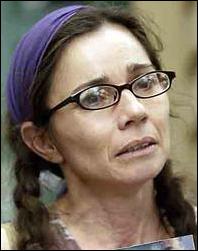
Ms. VandenElsen was a striking woman in her early Stratford court appearances - her long, dark hair flowing behind her as she strode past reporters in a form-fitting black shirt and long skirt. With her dark, thick-rimmed glasses, she projected a trendy, yet purposeful image.
It's a sharp contrast to the woman in a Halifax court: incredibly thin with a gaunt face, often wearing camouflage army pants and big, baggy woollen sweaters.
Ms. VandenElsen's drive to publicize allegations of abuse within the family court and children's services system is seen by some as proof of her instability, while her supporters see it as a commitment for change.
It's that drive that has led her to her latest protest: a hunger strike.
"She's in jail - what more can she do?" asked Ms. Kelly, who followed a liquid diet for 21 days in support of Ms. VandenElsen.
Worried about her health, supporters hoped Ms. VandenElsen would stop. They don't want to see her die.
Maureen Davidson, one of Ms. VandenElsen's sisters living in Mannheim, Ont., said in a separate interview that the VandenElsen family is very worried about her condition, especially given that she is so thin.
"I say a little prayer for her at night and hope God will take care of her," she said.
The Stratford group is pushing for a public inquiry into the role of Children's Aid in the May 2004 seizure of the Halifax-born baby.
They maintain websites related to Ms. VandenElsen's case and that of others fighting for family justice, share information with those in Halifax who speak to her and critique media reports.
They believe the seizure of the baby in Halifax was unjust and unnecessary.
Friend Carol Bast believes it was driven, in part, by a need to punish Ms. VandenElsen, who some say got away with breaking the law.
They also believe that children's services in Nova Scotia and Ontario acted against their mandates.
"They didn't try to keep the child with the parents," Ms. Lefebvre said.
"They had a tip and that was it. (It was) 'We have a court order, we have a court order, we have a court order,' and they went in with all the gunmen and took the baby."
Ms. Kelly believes a public inquiry should start with the Halifax standoff and seizure order and go back to 1995 when a judge granted interim custody of the triplets to Ms. VandenElsen's then-husband, Craig Merkley.
Mr. Merkley was represented by a lawyer at that hearing but the couple didn't attend. Ms. VandenElsen has testified that she didn't know the proceedings were going ahead.
There were no transcripts of the hearing in the unsealed portion of an Ontario Superior Court file in Stratford.
Andre Lefebvre believes this case serves to illustrate the pain and suffering being felt by many parents and children.
"These people are being set up," he said in a telephone call after the June visit.
"There was no reason (to take the baby). They've never been proven to be unfit parents by anyone."
Instead, he said, they've been "pushed to the limit."
Infant needed her own lawyer, group says
Before an armed standoff with police late last spring, Larry Finck went to court to try to keep his daughter.
A group pushing for a public inquiry into the events surrounding the seizure of the newborn by child-welfare workers said Monday the baby should have had her own lawyer.
"No one is independently representing the interests and fundamental rights of (the child)," said Dulcie Conrad, a member of the group.
She said the lack of legal representation is a violation of the United Nations Convention on the Rights of the Child.
The group, composed of neighbours and academics, held a news conference Monday to reinforce their insistence that Justice Minister Michael Baker order a public inquiry into the forcible removal of the baby girl from the care of her mother, Carline VandenElsen, and Mr. Finck.
Members of the group said the public has a right to know what prompted the Children's Aid Society of Halifax to seek the court order that led to police descending on the family home in the wee hours of May 19, 2004. The standoff ensued and lasted until the evening of May 21.
Court documents indicate Nova Scotia authorities were responding to an alert from child welfare officials in Ontario.
"We still don't know why authorities really decided to seize this baby or why they used such massive force to do it," Ms. Conrad said.
The justice minister, in Greenwich for the Tory caucus meeting, repeated Monday he believes there is nothing to warrant an inquiry.
"I'm not aware of any new information . . . that would require an inquiry," Mr. Baker said.
He said the matter has gone before two different judges at two different levels of the court system.
"I don't know if (the issue) is more complicated than (that) people don't like the decision," he said. "That doesn't necessitate an inquiry."
Mr. Baker wouldn't talk about why the child did not have independent representation.
He said proper procedures were followed, "and that's to consider the best interests of the child, not of the parents."
Documents show Justice Deborah Smith of Nova Scotia Supreme Court' s family division had concerns about Ms. VandenElsen's mental health after she went into hiding with the child rather than comply with a court order to undergo a psychiatric evaluation.
But some say evidence that the child was at risk was not presented. Lawyer Ray Kuszelewski said questions remain unanswered about the original court order to seize the newborn.
"It really is important to know how this entire matter got to the point that it did," said Mr. Kuszelewski, who provided some representation for the couple during their high-profile trial on charges related to the standoff.
He said an inquiry would review evidence presented to the family court by Children's Aid staff and also consider larger issues relating to child seizures when concerns exist about the mental stability of parents.
Ms. VandenElsen and Mr. Finck were convicted of several offences in the standoff, and the 18-month-old child is in the care of children's aid.
Did their baby really need to be protected?
Some say an inquiry is the only way to know if child welfare workers acted appropriately
Examining the actions of child welfare authorities during last year's armed standoff on Shirley Street would conceivably be the purpose of a public inquiry into the incident.
But is an inquiry absolutely necessary?
Supporters of the parents at the centre of the controversy say an investigation is not only warranted, it's needed to probe what they consider to be a dysfunctional system harming families.
Others say they're not convinced public hearings, sure to cost taxpayers plenty, will solve anything.
Justice Michael Baker has said he won't authorize an inquiry unless new information comes to light.
Critics who say they've been ill-served by the child welfare system, and have had their children taken from their care, are not happy with the government's position.
"The children in Nova Scotia are being abused by this (child-protection) system," Marilyn Dey, a Halifax supporter of standoff couple Larry Finck and Carline VandenElsen, said in a recent interview.
The couple had their infant daughter removed from their household at the end of the May 2004 siege. In a court ruling Thursday, Mr. Finck and Ms. VandenElsen lost custody of her permanently, though the decision can be appealed.
Ms. Dey acknowledged that backers of the pair, who face a sentencing hearing that begins today for their role in the 67-hour standoff, want a public probe to stretch beyond the Shirley Street event.
"This is the way Larry and Carline feel, too, that the whole child protection business, or industry, needs to be inquired into," Ms. Dey said.
Ms. VandenElsen has been on a jailhouse hunger strike to back demands for a wide-reaching inquiry; Mr. Finck has also been behind bars awaiting sentencing.
They were convicted May 12 of several charges after a jury trial in Nova Scotia Supreme Court.
Halifax police are doing an internal review of how the department handled the standoff, but that report is not expected to be made public.
The provincial Public Inquiries Act says one commissioner or more would be appointed by the government to look into a public matter. Witnesses would testify under oath and relevant documents filed with the commission during open hearings.
Once an inquiry's report is released, the government of the day usually provides an official response.
Recent inquiries called by the province have been linked to the separate deaths of three people: James Guy Bailey, Donald LeBlanc and Theresa McEvoy.
Nova Scotia has had other probes that weren't held under the Public Inquiries Act, including one, called a "review," that examined the province's youth detention compensation program.
The high-profile review was headed by a retired Quebec judge hired by the Nova Scotia government. In 2002, he released a 632-page report with 105 recommendations.
The Halifax standoff case, which made headlines when it happened 13 months ago and later during the trial stage, has prompted letters to the editor and other public commentary.
"Children are not apprehended on a whim; they are apprehended based upon fact," a former child welfare worker said in a letter last month to The Chronicle Herald.
She said an inquiry is unnecessary, adding, a child's "right of privacy far exceeds . . . anyone else's 'need to know' " what happened in the Finck / VandenElsen case.
"Histrionic demands for information by people who don't know the facts accomplishes nothing except to stir up public sentiment with half-truths," the letter writer said.
The apprehension order regarding Mr. Finck's and Ms. VandenElsen's baby was issued after child welfare officials in Ontario alerted colleagues in Nova Scotia. Officials here wanted the couple to agree to home visits to check on their child and undergo mental health assessments, and they wanted the baby to remain in Halifax.
They wouldn't comply.
Ms. VandenElsen's sister, Maureen Davidson, is hoping the government will change its tune and launch a public probe.
"That would be, for me, a miracle," the Mannheim, Ont., woman said, of an independent inquiry.
"I would love for people to see how this really all transpired."
If anything, the Shirley Street standoff has drawn attention to child protection services and prompted those who work in the field to try to explain why the province's 20 child welfare agencies do what they do.
Earlier this month, the Hamm government, along with the Nova Scotia Association of Social Workers, published a pamphlet on child welfare.
It says in 2004, there were about 11,500 child welfare cases in Nova Scotia. Some 840 of those involved court proceedings; less than one per cent of all cases involved taking a child from home.
Graeme Fraser, the association's co-ordinator, said his group has not formally discussed the inquiry issue. Speaking in general terms as someone who knows as much about the case as the public, he said: "I'm not aware of any factors that would warrant a public inquiry."
Mr. Fraser said apprehension orders are executed as "a last resort" in child protection cases, and "only after very thoughtful consideration."
He conceded "no system is perfect." But, Mr. Fraser said, the child welfare system is better at ensuring trustworthiness than most.
"There are a lot of safeguards and checks and balances in this particular system," he said. "Part of the reason for that is because of the kind of authority that the children's services agencies have."
Mr. Fraser added that in his experience, it's "fairly common" for police to accompany social workers removing kids from their homes. "It's such a highly-charged situation," he said, of the reason officers attend.
Halifax lawyer Burnley (Rocky) Jones, who has represented Ms. VandenElsen in the past, said her case opened his eyes "to such an extent, that I never want to see another (family law) case like this."
Asked about a public inquiry, he didn't hesitate before answering yes.
"There needs to be clarification of the role of Children's Aid, which we believe to be a private organization, which on the other hand works as a complete government agency," Mr. Jones said.
"They have it two ways."
Sentencing hearing begins today for standoff couple
Case's 'different circumstances' make parents' fate difficult to determine, Crown attorney says
A sentencing hearing begins today for Halifax's most notorious parents, who refused to hand their baby over to authorities and kept police at bay during a three-day standoff.
Larry Finck, 51, and Carline VandenElsen, 42, were convicted last month after a nine-week trial and two days of jury deliberations.
The charges stem from an armed siege on Shirley Street that began shortly after midnight on May 19, 2004.
Officers trying to enforce a child apprehension order attempted to break down the front door after the couple refused to answer the door or the telephone.
As one police officer began swinging a battering ram at the door, which Mr. Finck had reinforced from the inside, a shot whizzed within inches of the officer's head.
Ms. VandenElsen was convicted of careless use of a shotgun, using a shotgun while committing an indictable offence and threatening to use a shotgun in committing an assault on police.
Both she and her husband were found guilty of abducting their baby in contravention of a child custody order, obstructing a police officer, possessing an unregistered shotgun and possessing a shotgun dangerous to the public peace.
Ms. VandenElsen has been held at the Dartmouth jail since her conviction.
Mr. Finck has been in custody since the standoff ended.
In a recent interview, Crown attorney Rick Woodburn would not reveal what sentences he will recommend Justice Robert Wright impose.
But he did say that coming to a decision has not been easy.
There are few cases involving similar crimes to rely on, he said.
"We consistently ran against the different circumstances that came in this case," said Mr. Woodburn.
For instance, sentences for an armed hostage situation can go up to 10 years.
"But (this) wasn't a classic hostage situation, so it doesn't necessarily fall into the 10-year range," he said.
Little involving the couple's interaction with the law appears to be classic.
Since May 21, the anniversary of the day the standoff ended, Ms. VandenElsen has refused to eat and is on a liquid diet, which reportedly includes a high-calorie meal replacement drink called Ensure.
Ms. VandenElsen has named her protest Starving for the Children.
Last week, the couple, who have not seen their baby girl for more than a year, lost permanent custody of her.
Mr. Finck has been convicted of abducting another daughter from Ontario and Ms. Vanden-Elsen was convicted of abducting her triplets in 2000. That conviction has been overturned and she will be retried next month in Ontario.
Sentences in abduction cases range from about six months to two years, Mr. Woodburn said.
"Finck got two years for his last abduction," he said.
"That (crime) didn't have elements of any weapons. Didn't have any elements of a standoff. Didn't have any elements of a long protracted taking of a child of such tender years.
"So you had to take that and combine it with the elements of the hostage-taking with the elements of the weapons offences that we had and then the assault with a weapon against a police officer. So, you had to combine all those and find out what the appropriate sentencing range was given all those factors."
Sentences must also take into consideration deterrents, denunciation of the crime and rehabilitation, he said.
"Most of the case law that I have reviewed in regards to these offences, the primary sentencing principles are deterrents and denunciation of the crime."
Mr. Finck and Ms. Vanden-Elsen will receive separate sentences, and Mr. Woodburn anticipates he'll take about two hours to present his position.
How long the hearing will last is hard to determine.
Both Ms. VandenElsen and Mr. Finck are representing themselves, after each started the trial with a lawyer. Mr. Finck fired his counsel early on in the hearing and Ms. Vanden-
Elsen let hers go at the tail end.
The trial was marked by outbursts from both accused, sometimes resulting in one or both being taken forcibly from the courtroom.
Despite repeated and apparent patient direction from Justice Wright, both Mr. Finck and Ms. VandenElsen repeatedly tried to argue points that had been overruled by the judge.
As well, they tried to argue aspects of law that Justice Wright frequently explained they both misunderstood.
Often they became sidetracked railing against the judiciary, police, government and media. Mr. Finck would launch into tirades, particularly on days when the courtroom was full. During those outbursts, he would frequently look over his shoulder, apparently gauging reaction to his comments.
The courtroom for the sentencing has been reserved for three days.
The couple have filed documents that they want to appeal their convictions on the grounds they were victims of a miscarriage of justice.
Jury selection for Ms. Van-denElsen's three-week Ontario Superior Court trial begins July 18.
But Stratford police officer Sgt. John Wilson, who tracked Ms. VandenElsen for four months while she was on the run with her children, is unsure the trial will go ahead.
The jury selection itself will likely "be a long, drawn-out process," he said.
"I think there'd be a huge pocket of people that just say 'In my mind, she's guilty.'
"They're going to get a bunch of pig farmers from the townships down here that don't tolerate the kind of behaviour that she displays."
There's also the question of her physical fitness to travel after her hunger strike "or intention to kill herself," he said.
Unless a qualified doctor says she's OK to travel, the officer is adamant he's not going to get her.
"In no circumstance am I going to put myself at risk to be looking after someone in a fragile physical state," he said.
If she is eventually found guilty, the officer doesn't believe Ms. VandenElsen will see any jail time.
And that doesn't bother him a bit, he said. The fact that the appeal was granted was enough to show that "the law is still the law," he said.
"I think they just have to send a message to like-minded people that think this kind of thing is OK when it's not."
Crown seeks stiff sentences for standoff
The Crown says Carline VandenElsen and Larry Finck have no remorse about their actions in last year's Shirley Street standoff with police.
And prosecutor Rick Woodburn wants them to do hard time for their crimes.
Mr. Woodburn asked Supreme Court Justice Robert Wright at a sentencing hearing Tuesday to send Mr. Finck to prison for six years and Ms. VandenElsen for 3 1/2
They seem to have "little or no insight into the danger" that they could have caused to their baby, neighbours or police officers during the May 2004 standoff, Mr. Woodburn said.
A jury found the couple guilty this May 12 of abducting a baby in contravention of a custody order; obstructing a police officer; possessing an unregistered shotgun; and possessing a shotgun dangerous to the public peace.
Mr. Woodburn recommended Mr. Finck serve five years on the abduction charge and one on the other counts.
"This would be a fairly high sentence," Mr. Woodburn said of the proposed abduction term. Although the maximum sentence is 10 years, "the next highest sentence for abduction that I was able to uncover was two years for Mr. Finck," Mr. Woodburn said.
Mr. Finck served two yearsfor the 1999 abduction from her guardian of another child, from an earlier relationship.
The jury also found Ms. VandenElsen guilty of using a shotgun while committing an indictable offence; threatening to use a shotgun in an assault on police; and careless use of a shotgun.
On Tuesday, the Crown stayed the charges of possession the shotgun and careless use of a firearm.
Mr. Woodburn recommended that Ms. VandenElsen serve 1 1/2 years on the abduction charge and two for the other offences. She has no previous convictions.
A jury acquitted Ms. VandenElsen in 2001 of abducting her triplets from their father in Stratford, Ont. She faces a retrial in that case next month.
As Mr. Woodburn described in court how Ms. VandenElsen narrowly missed shooting a Halifax Regional Police officer, she began laughing.
"I suggest to you, Ms. VandenElsen, that this is no laughing matter," Justice Wright said.
"It is," she replied.
"I'm sure you don't realize the kind of pickle you're in," he said.
"The kind you put me in," she said.
The day was peppered with similar exchanges between the couple and the judge.
At one point, Mr. Finck said he didn't have any remorse for his actions "because I didn't do anything wrong. I was protecting my child, I was protecting my family and my mother."
The couple barricaded themselves in the Halifax home of Mr. Finck's mother, Mona Finck, to prevent police from enforcing a court order to seize their baby. The standoff ended May 21, after the elderly woman had died of natural causes.
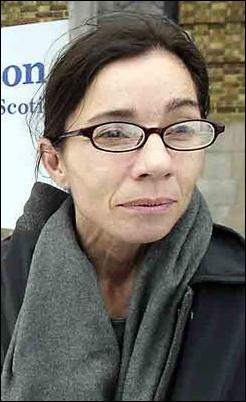
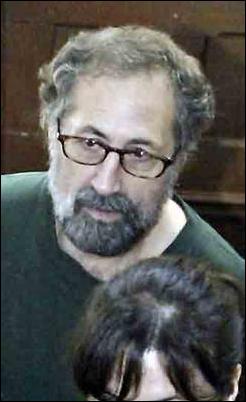
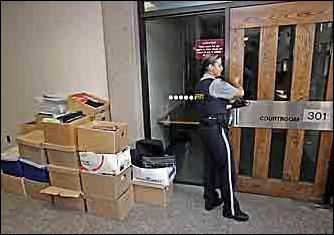
Standoff duo get multi-year sentences
VandenElsen given 3 1/2 years, Finck 4 1/2 years in custody fight gone wrong
Over a year after the armed standoff that cost them their infant daughter and their freedom, Carline VandenElsen and Larry Finck still don't fully understand what they've done, a judge says.
"Like Ms. VandenElsen, Mr. Finck appears to have little appreciation for the seriousness of his unlawful conduct or the danger he put his child in," Supreme Court Justice Robert Wright said Wednesday in sentencing the couple to prison time.
"Like Ms. VandenElsen, he blames everyone but himself."
After two days of hearings, Justice Wright sentenced Mr. Finck to 4 1/2 years in prison and Ms. VandenElsen to 3 1/2 years for their roles in the May 2004 standoff on Halifax's Shirley Street.
In contrast to their frequent outbursts at earlier court appearances, the couple showed little reaction to the ruling: Ms. VandenElsen was busy writing, while Mr. Finck sat back in his chair.
"They made deliberate plans to carry out what they did, and this is where they ended up," Crown Rick Woodburn said outside court after the ruling.
The Crown had asked for a five-year term for Mr. Finck for child abduction contrary to a court order. Mr. Woodburn based that on the circumstances and the fact Mr. Finck committed the Halifax offence while still on probation after serving two years for abducting his daughter, from a previous relationship, from her legal guardian in Ontario.
Earlier in the day, Mr. Finck had asked the judge for house arrest or time served, saying, "Anything further is excessive."
"Both are out of the question," replied the judge.
Justice Wright agreed Mr. Finck should serve more time than he did for the first abduction, but said the Crown's request was "a notch too far."
Mr. Finck received 3 1/2 years for abduction and a year for possessing a shotgun, to be served consecutively.
He also received six months for obstructing a police officer and two months for having an unregistered shotgun, to be served concurrently.
The judge accepted the Crown's proposal about Ms. VandenElsen and gave her 18 months for abduction and two years, to be served consecutively, for using a gun while committing a crime. She was sentenced to a year concurrent for threatening to assault a police officer with the shotgun, obstructing a police officer, having an unregistered shotgun and having a shotgun for a purpose dangerous to the public peace.
The judge gave the couple the customary double credit for the time they've already served. Mr. Finck, who's been in jail since his May 2004 arrest, will see 26 1/2 months shaved off his term, while 200 days will be cut from Ms. VandenElsen's. In the end, Mr. Finck will serve less time than his wife, who has been free most of the time while awaiting, and going to, trial.
He also issued mandatory firearms prohibition orders and a DNA order for Ms. VandenElsen.
The couple came to Nova Scotia from Stratford, Ont., in November 2003 when Ms. VandenElsen lost access to her triplets from a previous marriage after a lengthy custody battle.
She was already pregnant and feared child welfare workers would take the baby.
Ms. VandenElsen told the court they moved into the home of Mona Finck, Mr. Finck's mother, at 6161 Shirley St., to start their lives over. Mona Finck died of natural causes during the standoff.
"I have significant remorse for not terminating my pregnancy when my mother instincts told me that my unborn child would face grave peril," she said Wednesday.
The Children's Aid Society in Halifax applied to the court for supervision orders at the family home and psychological and parental assessments.
Given the reports about the couple and Mr. Finck's behaviour in family court, Justice Wright said, the court ordered the child placed in temporary care.
Ms. VandenElsen fled with the baby, and Mr. Finck continued to appear in court. He admitted during the criminal trial that he lied in family court - he did in fact know where his wife and baby were. They eventually came home, and the couple planned to leave the country.
When police found them at the Shirley Street home on May 19, 2004, the couple refused to let them in and barricaded the door. Pellets from a shotgun fired inside the home passed just inches from a police officer's head.
The emergency response team was called in and the longest standoff in Halifax history began.
Ms. VandenElsen repeated Wednesday that "Big Mona," her mother-in-law, fired the gun, but Justice Wright reminded her a jury convicted her of that offence.
The couple endangered their then-five-month-old baby, the judge said, when they carried her onto a porch overhang and displayed her to reporters and police. They used the standoff to further their "ridiculous theories" that various agencies - the courts, police and child protection agencies - are plotting to sell children to the childless.
Despite repeated warnings by police, "in an act of self-indulgence and outright recklessness," Mr. Finck was carrying a loaded shotgun when he came out of the house on the evening of May 21 with his wife and baby. The couple carried the body of his mother on a makeshift stretcher.
"It's indeed fortunate that no one got hurt," Justice Wright said.
As her sentencing submission, Ms. VandenElsen read from 10 pages of handwritten notes, which Justice Wright termed a "political statement."
She said police "unnecessarily created a massive public spectacle" through the standoff "to sensationalize and justify their earlier actions."
"It's a crime to keep me in jail," she read.
Facing a mandatory one-year sentence on the weapons charge, Ms. VandenElsen said the only remedy was to return all her children to her.
"I can't change who I am," she told the judge. "I understand I can't change the system."
Justice Wright said: "Ms. VandenElsen, it's never too late to turn your life around."
"I tried that and look where I am," she replied.
A handful of supporters attended the hearing Wednesday afternoon, including Mary MacDonald.
The Halifax woman, who knows Ms. VandenElsen "very casually," said the sentence was harsh.
"It will obviously cause her a great deal of grief," she said.
"I would have preferred that Ms. VandenElsen be reunited with her baby daughter rather than go to prison."
Another supporter, Halifax's Marilyn Dey, was displeased but not surprised by the sentence.
The woman, who's known Mr. Finck since his first court case in Ontario, wished the judge had spoken about the pair's emotions because the whole situation involved the apprehension of their child.
"The judge didn't even go there. There was no concern for what they were going through at the time."
Justice Wright noted the couple's "contemptuous conduct at trial," which he said "ranged from the belligerent to the bizarre."
Despite that behaviour, their lack of participation in preparation of a presentence report and their apparent disregard for assessments, he recommended they receive psychological counselling in prison.
"Their co-operation may appear to be a dim prospect at the moment," he said, "but it is still worth a try."
Standoff case and politics in N.S.: the need for a fix
NDP MLA Graham Steele went to court this week to force the Hamm government to obey its own law and set up an advisory committee to review the Children's and Family Services Act. There's a statute that requires the province to do that every year, but there hasn't been such a committee since 1999.
In other words, there's a problem here even before we evoke the dramatic Carline VandenElsen/Larry Finck case, in which the Halifax couple's child was taken away last year after a heavily armed, dead-of-the-night police raid followed by a 67-hour standoff. Now the two have been jailed for three-and-a-half and four-and-a-half years respectively, amid public and media concern about whether officialdom's hostility to the spectacularly antagonistic pair is partly to blame for the debacle. There are demands for a public inquiry.
As far as Justice Minister Michael Baker is concerned, the courts have duly judged and there's nothing more to be said, and no reason for a public inquiry. As for the advisory committee, Community Services Minister David Morse has responded, absurdly, by saying that if Steele knows anybody who wants to sit on such a committee, he should send them to see the appropriate government officials.
In both cases, then, the response is no: no transparency, no openness, no explanations.
Let's do a little review that may, in part, explain why the VandenElsen case and such a reaction from government make many Nova Scotians queasy.
In Nova Scotia, we're just barely out of a 20-year nightmare where everything was going wrong in a big way precisely because of secrecy and political darkness where things festered. The Marshall inquiry that exposed a justice system embarrassingly rank with prejudice, the Westray mine disaster that revealed an inspection system that covered up deadly infractions, and the Shelburne boys' school abuse scandal that resulted in perhaps $100 million in avoidable expenses and a horrible miscarriage of justice for many employees of the institution who were falsely accused - these were just the biggest scandals in a long string of them.
Although things have settled down since, it's easy to trigger the question: Have the lessons of all that really been learned? Specifically, things have settled down since Premier John Hamm's Tories came to power. The method employed to bring this about has been that whenever the Tories were backsliding or overboard, they'd get broadsided by the NDP, even a few times by the Liberals, and they'd back off. In this way, ironically, Premier Hamm finds himself riding high in the polls.
In order to keep looking good, the premier will, I'm sure, do his number and call Baker and Morse in for a little chat, if he hasn't done it already. With regard to Morse, it should be a quick shuffle - before the embarrassment of a court order. After all, the law - Section 88(1), Children and Family Services Act - is clear: "the minister shall establish an advisory committee . . . etc." Steele and two others are looking for a Writ of Mandamus - a legal order designed to force a public official to do his duty.
Whether an advisory committee is enough to do the job in this case is another question. However, Steele says the advisory committee was designed for precisely these situations, where parent, Legal Aid and minority group representatives can get answers, and make sure the law is working right. Parents whose children have been taken by the Children's Aid Society (CAS) often complain to their MLAs, "but we have neither time nor resources to follow up," says Steele. Plus, the complainants are often paranoid and into conspiracy theories, he says (as are VandenElsen and Finck), "but after all that is stripped away, they usually have legitimate questions." Indeed.
As for the embattled CAS, it says it has good reasons for acting as it did in the VandenElsen case, but can't reveal them because of confidentiality. Social workers are always in this bind. I fully assume that the social workers at CAS are trying to do the right thing. But the point is that without regular review and open give-and-take, even the right thing can become the wrong thing. And in terms of public perception, if everything is on the up and up, CAS would benefit from such a review, as would the cause of good government.
Ralph Surette is a veteran Nova Scotia journalist living in Yarmouth County.