help
collapse
Press one of the expand buttons to see the full text of an article. Later press collapse to revert to the original form. The buttons below expand or collapse all articles.
expand
collapse
CAS used as threat
November 14, 2003 permalink
The following article from the Toronto Star about police politicking contains four paragraphs late in the article suggesting that the police threaten people with Children's Aid to gain submissiveness in matters unrelated to child abuse. Here only the four relevant paragraphs are included.
Note: The original url is now dead. It was: http://www.thestar.com/NASApp/cs/ContentServer ?pagename=thestar/Layout/Article_Type1& c=Article&cid=1068765012255& call_pageid=968350130169&col=969483202845
Nov. 14, 2003. 01:00 AM
Police blasted over endorsements
Lawyer groups ask province to clarify legislation Backing politicians called violation of conduct codeJACK LAKEY
CITY HALL BUREAUAfter Morton and Copeland completed their flaying of the police association, about 25 members of the Ontario Coalition Against Poverty entered the board room and interrupted the meeting, chanting "Hands off our kids."
Led by John Clarke, the OCAP group protested police tactics used last weekend near the Don Jail during a demonstration for affordable housing. OCAP member Jeff Shantz said police arrested him, his partner and their toddler son, and threatened to turn the child over to Children's Aid, apparently on the premise that the child's presence at the political event proved the parents were unfit.
Shantz alleged the threat of permanent removal of the child was blackmail, a crude attempt to deny parents their rights of assembly and free speech.
The protest yesterday lasted a few minutes before officers escorted the group out.
Claims of Women's Shelter
November 7, 2003 permalink
Doreen Armstrong
Executive Director
Family Transition Place
20 Bredin Parkway
Orangeville Ontario L9W 4Z9
Dear Ms Armstrong:
I recently received a document distributed by Family Transition Place throughout Dufferin County titled: "Imagine a community of safety, support and hope". I have a number of questions relating to the facts cited in the document.
First, you say: "Research and experience tells us that family violence and woman abuse is a pervasive issue that damages the overall health and well being of our entire community". Since your experience differs from mine, can you give a citation for the research you allude to?
Second, in a section titled "What abusers say" there are statements:
I wish that I had some healthy male role models as a child.
It would have helped if I had a connection with both my parents growing up.
I have personally interviewed several women who took shelter in Family Transition Place. Four of them reported that their experiences were relayed to the Children's Aid Society by your staff, and as a result their children were taken from them and placed in foster care. Why does this activity take place in an organization such as yours that recognizes the importance of parents to their children? And I further note that since you do not admit men to your shelter, any children coming to your facility have already lost their father. None of the women I have spoken to have reported that you made an effort to restore the relationship between the child and his father. What efforts, if any, do you make to keep children in contact with their fathers?
Finally, on the last page you state "Family Transition Place must raise $263,000 this year to continue providing services for abused women and children. To date our community has been generous, but we have not yet reached our goal. Your donation is needed". It has appeared in the past that your organization enjoyed support from the taxpayers through funding by the Province of Ontario. Can you send me a financial statement for Family Transition Place?
Yours truly,
Robert T McQuaid
RR 5
Orangeville Ontario L9W 2Z2
Banner Lauds Foster Parents
October 21, 2003 permalink
A two page puff-piece in today's Orangeville Banner salutes the foster parents of Dufferin. It includes brief notes by seven political figures -- Sandra Card, President of the Board of Directors Dufferin CAS, Gary Putman, Executive Director Dufferin CAS, Drew Brown, Mayor of Orangeville, John Oosterhof, Reeve of East Luther Grand Valley, Bob Currie, Reeve of Amaranth, Earl Lennox, Reeve of East Garafraxa, and Ed Crewson, Mayor of Shelburne. Here is one of them:
Like so many good things, foster parents is something that many of us seem to take for granted. Most of us know about foster parenting but we don't give it much thought and we probably give even less thought to the people who act as foster parents.
When you do stop and think about foster parents though, you can't help realizing what a tremendous service they provide and what very special people they are.
Sometimes children and youths need support and structure in their lives that can only come from a family, but for whatever reason they can't get it from their own families. Foster parents open their hearts and their homes to these young people for periods ranging from a few days to several months. It's an act of love and kindness, and a commitment to our community that has few equals. So, thank you to everyone involved in foster parents. Thank you for being there when young people need you, and for making this a better community in which to live.
Drew Brown
Mayor of the Town of Orangeville
Nick Garisto, the candidate challenging Drew Brown for the mayor's job in the upcoming election November 10, is the only elected officer in Dufferin to offer support to a Dufferin VOCA family in its struggle against Children's Aid. The same issue of the Banner contains an editorial critical of Mr Garisto.
The puffery ends with a fact that could only have come from Gary Putman: As of Oct. 16, there are 100 kids in care and 40 foster families in Dufferin County.
Addendum: Drew Brown won the mayor's election with 3612 votes to Nick Garisto's 2893 votes.
Benevolent Myth Refuted
October 18, 2003 permalink
Dufferin Children's Aid failed to respond to the following email, showing no real interest in helping the community as boasted in their press release.
expand
collapse
October 7, 2003
Dufferin Child and Family Services
50 Fourth Avenue Unit 13
Orangeville Ontario L9W 4P1mail@dcafs.on.ca
Subject: Purple Ribbon Campaign
Sirs:
The press release following this note suggests that I contact my local Children's Aid Society for more information on the Blue Ribbon Campaign. Please send me more information at one of the contact addresses below.
Robert T McQuaid
RR 5
Orangeville Ontario L9W 2Z2
email: rtmq@stn.net
Attention News Editors:
Purple Ribbon Campaign to publicize the need for awareness of child abuse and neglectTORONTO, Oct. 6 /CNW/ - "Public education and prevention are the best ways to end the neglect and abuse of children," said Jeanette Lewis, Executive Director of Ontario Association of Children's Aid Societies at the beginning of the annual Purple Ribbon Campaign to publicize the need to prevent child neglect and abuse.
"By the end of October, we hope that everyone in Ontario will know how they can help prevent child neglect and abuse."
The Purple Ribbon Campaign is organized by many of Ontario's children's aid societies to recognize Child Abuse and Neglect Prevention Month in October. The year 2003 marks the 11th anniversary of the Purple Ribbon Campaign in Ontario.
More than 120,000 purple ribbons will be distributed throughout Ontario during this month by staff and volunteers of Children's Aid Societies to raise awareness of the need to prevent child neglect and abuse.
Child abuse and neglect have long-term effects on children, their development and adjustment in life. A recent study on corporal punishment (MacMillan at al, 1999) indicated that there is an association between the frequency of slapping and spanking during childhood and a lifetime prevalence of anxiety disorder, alcohol abuse or dependence on externalizing problems.
For more information about the Purple Ribbon Campaign, please contact the Ontario Association of Children's Aid Societies or your local children's aid society or child and family services office.
Brave New Family
October 18, 2003 permalink
The Toronto Star prints a portrait of the new family headed by same-sex parents.
expand
collapse
For the kids, it's cool
Children in lesbian and gay families find it perfectly natural to have two moms or two dads But they've learned the hard way to
Home from school, the 7-year-old slumps on the couch. "Dad, we have such hard homework to do," he moans. Dad reassures him that they'll help him, and the other man in the boy's life, Daddy, ushers him to the table for a snack.
The boy has two fathers, two gay men who adopted him three years ago from the Children's Aid Society. They also adopted a 3-year-old boy last year.
"We wanted to make a family that was ours," explains Daddy, a 49-year-old property manager.
"I always wanted to be a father," says Dad, 32, an educational assistant studying social work. They asked not to be named.
In the couple's tidy home, Dad points to a framed photo of the two men and their sons with the judge at the final adoption procedure.
"You know you've done the right thing when the judge tells you he's proud to preside over your second adoption," says Dad. "The judge told us, `I applaud you guys.'"
While same-sex marriage has captured the headlines recently, same-sex parenthood -- a quieter revolution -- has become increasingly popular and possible.
But not everyone is as approving as the adoption judge presiding in the case of Dad and Daddy. Homosexual parents and their children still face blatant prejudices and, more commonly, feel society's downright discomfort when confronted with two moms or two dads.
The kids constantly weigh the risks of coming out about their folks. In a Grade 12 family studies class recently, an 18-year-old girl quietly debated what to do when a boy started saying ill-informed things about children of gays and lesbians.
She decided to go for it. "I come from a family with two lesbian moms," she told her classmates. And their response? "They were nice, but stunned, weirded out. I felt like I dropped a bombshell."
Numbers of gay and lesbian families are hard to gauge. In the 2001 census, 2,900 same-sex couples reported having at least one child living at home, according to Statistics Canada. But that doesn't include single or non-custodial parents or those not willing to identify themselves as a same-sex couple.
While many of the children spring from previous heterosexual unions, more are being born into homosexual families. The lesbian baby boom -- thanks to donor insemination -- began almost two decades ago.
The gay male's embrace of fatherhood is still in the toddler stage. This year, a new workshop, "Daddies and Papas 2B," was offered by the 519 Church Street Community Centre and the Lesbian, Gay, Bisexual, Transgendered Parenting Network. It proved so popular, it's running again this fall. It covers the options: Gay men can now adopt openly as a couple, go the surrogate route -- with at least $35,000 for expenses -- or make arrangements with a woman to have a child and share the parenting.
Not all gays and lesbians, however, cheer on family values. One lesbian reports that when she was pregnant, another said to her: "So you're one of the breeders now."
There's some fear in the community that an emphasis on parenting could make the gay and lesbian movement more traditional, more conservative, explains Rachel Epstein, co-ordinator of the LGBT Parenting Network, part of the Family Service Association. "The debate in the community is how to exercise our desire to be parents and not dull the edges of what's been a radical movement."
For the children, there are now support groups, Web sites and, in some schools, anti-homophobia workshops to help avoid -- at least theoretically -- playground nastiness. There's even recognition from primetime television. This fall, ABC introduced the sitcom It's All Relative, about a young engaged couple -- she was raised by wealthy, educated gay men and he's the son of a prejudiced Irish-Catholic bartender and his wife.
Studies show the children of lesbians and gays are as well-adjusted as their peers.
"No research indicates any emotional, cognitive or mental health problems compared to children of heterosexual parents," says Judith Stacey, sociology professor at New York University. Some studies indicate that they exhibit a greater respect for people's differences.
"As a kid, I learned how fear and misinformation work," says Chris Veldhoven, 36, an anti-homophobia consultant who grew up with a gay father in small-town Nova Scotia. "I'm the stronger for it."
More than 12 years ago, André Chamberlain answered an ad in a gay newspaper looking for a potential sperm donor and co-parent. For him, being an anonymous donor held no appeal. "I always wanted a child in my life, but being a full-time dad wasn't realistic," says Chamberlain, 41, a lawyer.
He met numerous times with Mariana Valverde, who would carry the baby, and her partner, Maggi Redmonds.
"We both really wanted kids -- it was a pivotal issue in coming together," explains Redmonds, 56, a health care administrator. If possible, they felt it preferable for the child to know his father.
A son was born. Chamberlain is the legal father and has access. The two women have legal joint custody. "I live with their decisions," he says.
Differences have arisen but, over the years, the three have been able to talk through any problems. "It's a fairly flexible arrangement that's evolved over time," Redmonds says.
The family grew five years ago when Redmonds adopted a girl, now 7. Chamberlain and the little girl bonded quickly.
"She looked up at me one day and asked, `Are you my Dad?'" Chamberlain recounts. "I said, `Well, dear, we'll have to talk to your mothers about that.'"
The answer was yes. He has the kids every second weekend, either one or two at a time, pitches in with child care and takes them both on holiday every summer. "They're pretty much my anchor to the world," he says.
Now 11, the boy is bright and well-spoken. He was about 5 when he realized most kids didn't have two moms. "It came as a shock," he says. "I've only fully understood in the last few years, talking to my moms and my dad."
Occasionally, kids have teased him. "It's trivial. I don't pay attention," he says. "They want a reaction and I don't give them one."
In the future, he might like to be a lawyer, like his dad, he says, but specialize in discrimination cases. "I could relate. I know what it's like to be different."
For the kids to handle homophobia, the parents must be able to do so. "They have to be prepared to be out or they instill shame in their kids," says Epstein of the LGBT Parenting Network.
It can get tricky if a parent is just coming out. Much will be dictated by how the straight parent reacts, says psychotherapist Mary Dyson. In one case, a teenage boy adopted his father's bigoted attitudes, verbally and physically assaulting his lesbian mother.
While most schools preach anti-discrimination, enforcement on homophobia varies widely. The Toronto District School Board has a history of taking the issue seriously, says David Rayside, professor of political science and sexual diversity studies at the University of Toronto. "Other districts are making baby steps."
A watchdog group largely of parents, the Anti-Homophobia Equity Coalition, monitors what goes on in Toronto schools and provides workshops for teachers. "The schools run the gamut," says chair Lainie Magidsohn. "Some celebrate Pride Day and others are out of the Dark Ages."
In Toronto, school board social worker Steven Solomon runs anti-homophobia workshops for students. Last year, he met with 250 classes in more than 40 schools. Solomon also helps run a support group, COLAGE, Children of Lesbians and Gays Everywhere, that meets twice a month. "For these kids, it's the first time everyone around the table has a family that looks like theirs."
Despite all the best intentions, kids can get burned. The middle school years, when puberty hits, can be particularly rough, Epstein says.
"I told my best friend and she turned on me," says a 15-year-old daughter of lesbians. "She told people I don't like, including a big mouth, that my parents were gay."
The girl started getting harassing messages on MSN one night, and kids at school the next morning kept it up. But her teacher stepped in. While the girl was out of class, he made it clear -- further harassment would lead to suspension. The kids laid off.
That was Grade 7. Her family has since moved and she's now in high school. The few new friends she's told about her family have been supportive. But, initially, she dances around the topic. "I ask questions first, to see how they feel about it. You have to be careful."
As for their own sexual orientation, studies show that the vast majority of children of gays and lesbians are heterosexual, says sociologist Stacey, a senior researcher with the Council on Contemporary Families. She adds that a slightly higher percentage than their peers define themselves as not exclusively heterosexual.
The straight children, however, are still steeped in their parents' world. "It's what feels familiar," says Makeda Zook, 16, the heterosexual daughter of two lesbians. She volunteers with an anti-homophobia group, and one of her best friends is lesbian. "We talk about queer issues," she says. Her boyfriends, she adds, have been cool about her family.
She, however, wasn't always so cool. As a kid, she didn't invite friends home. "Nothing had ever happened. It was just paranoia built up by general remarks." But her high school's atmosphere was accepting and she came out. "I'm confident I'm straight, but I enjoy interacting with lesbians and gays."
There's actually a name coined for this: "Culturally Queer, Erotically Straight," according to Abigail Garner, 31, author of the upcoming book, Families Like Mine: Children Of Gay Parents Tell It Like It Is.
The Minneapolis-based Garner speaks on college campuses, publishes a newsletter, writes articles and has a Web site for gay and lesbian families. When she was 5, her father left her mother for a man, and she grew up in both households.
"Regardless of our own sexual orientation, our heritage has `queered' us," Garner wrote in a U.S. newspaper. From her two gay fathers, she learned to carefully use language, be wary of organized religion, love gourmet food, always demand latex and appreciate musicals.
"I know the words to show tunes," Garner says. "At camp when we'd sweep the cabin, I'd break into Matchmaker, Matchmaker. The other girls were so entertained, I realized, `They don't do this in their homes.'"
Source: Toronto Star
No Recourse when Children's Aid harms children
October 3, 2003 permalink
The Supreme court of Canada yesterday ruled that governments and quaisi-government agencies, such as Children's Aid, are not responsible when they injure their wards. Here is a story from the Montreal Gazette on the subject:
expand
collapse
Top court rulings limit sex-abuse liability
Public authorities not automatically responsibleJOE PARASKEVAS
CanWest News ServiceFriday, October 03, 2003
Public authorities such as governments, school boards or foster home agencies cannot be held automatically responsible for harm caused by people under their control who are in positions of power, if the authorities did nothing wrong in the hiring or supervising of those people, the Supreme Court of Canada said yesterday.
In separate rulings dealing with vicarious - or no-fault - liability, the nine-member court rejected claimants' arguments that public authorities were unconditionally liable in three British Columbia sexual-abuse cases dating from the 1960s and '70s.
Two involved children who were sexually abused in foster homes. The other involved the repeated sexual abuse of an aboriginal girl by a school janitor.
The cases were seen as potentially important to thousands of claimants building cases about abuse allegedly suffered in aboriginal residential schools, many run by various churches from the late 19th century to the 1970s.
In the main case involving foster home abuse, the court said the link between the government and foster parents is not close enough to allow a claim of vicarious liability.
"Foster families serve a public goal - the goal of giving children the experience of a family, so that they may develop into confident and responsible members of society," the court said. "However, (foster families) discharge this public goal in a highly independent manner, free from close government control."
The court confirmed there was negligence in supervision of the foster homes on the part of the superintendent of placements, but the two-year statute of limitations had expired by the time the claimants came forward.
The court also said the Protection of Children Act does not give the provincial superintendent of child welfare "a non-delegable duty to ensure that no harm comes to children through the abuse or negligence of foster parents."
Justice Louise Arbour wrote the dissenting argument, although she agreed the expiration of the statute of limitations impeded the claim.
"The wrongful act at issue here," Arbour wrote, "was sufficiently connected to the tortfeasor's assigned tasks for vicarious liability to be imposed."
In the case of the school janitor, the Supreme Court ruled the vicarious liability argument failed to apply against the school board because the janitor did not normally have daily, direct contact with children, such as a teacher might.
Canadian Alliance justice critic Vic Toews suggested the ruling might surprise parents who expect children to be safe at school regardless of whom they meet while there.
Candidates Avoid Facing Public
September 27, 2003 permalink
Candidates in Dufferin-Peel-Wellington-Grey for the upcoming provincial election on October 2 avoided the customary all-candidates meeting. Instead, five men spoke in a Rogers studio answering prepared questions from journalists, without public participation. The resulting video was shown on Rogers cable television, a channel inaccessible to many rural residents receiving only American satellite TV. The format was adopted at the insistence of Ernie Eves, over objections of the other four candidates.
It is customary for the candidates to appear in a meeting where members of the public can ask questions not otherwise on the agenda. In a past meeting, one voter caught the candidates off guard with a question about purple loosestrife.
In the previous byelection, the format was already modified, by forcing the audience to write questions on a card, with cards drawn by Geoff Mullin. According to a press release by the Ontario Liberal Party, 33 Progressive Conservative candidates in this election have refused to participate in debates at all-candidates meetings.
Only Dave Davies of the Family Coalition Party has mentioned family law in his platform. There is no way to ask candidates about family law issues such as child abduction, divorce, or homosexual marriage.
Suspects threatened with CAS
August 12, 2003 permalink
Most criminal cases today end not with a jury trial, but a confession and guilty plea. The following article from the Toronto Star confirms that the police threaten to take away the children of suspects in order to induce them to confess to a crime. We show only the last six paragraphs of the article.
expand
collapse
Toronto Star
Aug. 10, 2003. 08:33 AM
Why they lie and confessTRACEY TYLER
LEGAL AFFAIRS REPORTERNo Canadian jurisdiction requires police to videotape interrogations, but Toronto police generally do it, with the exception of the hold-up squad, said criminal lawyer Andras Shreck. In June, the Ontario Court of Appeal took the force to task for failing to videotape the interrogation of one of Shreck's clients, Keigo Glen White.
The court said that, in the absence of videotaped evidence, the voluntariness of White's alleged confession was suspect and overturned his four convictions for robbing banks.
After being handcuffed and strip-searched, White was taken to an interrogation room, where he was told -- falsely -- that he resembled photos of the bank robber and that if he confessed police would make a deal, the court said.
White said he confessed because police told him if he didn't, his wife would be charged, lose her job and her child would be seized by the Children's Aid Society.
Constable Mike Hayles, a Toronto police spokesperson, said the force policy is to videotape statements "whenever practicable, which means whenever there is equipment or facilities available."
It isn't hold-up squad practice to refuse to videotape interviews, he added. "I'm not saying it hasn't happened the past." But routinely failing to do so would be "unacceptable."
Wenatchee Witch Hunt
August 11, 2003 permalink
The New American, a publication of the John Birch Society, describes the Wenatchee witch hunt. It contains a brief portrait of Robert Perez, shattering the myth that child-protectors are dedicated public servants motivated only to protect children.
expand
collapse
Victims of the Fury
The tragic story of Wenatchee, Washington, is but one example of child protection services run amok.
Wenatchee, Washington, a quiet, orchard-strewn community of 28,000, is by all appearances unexceptional. For several years in the mid-1990s, however, Wenatchee was the scene of what has become the nation’s most notorious child abuse scandal. Between 1992 and 1995, 43 adults were arrested and charged with roughly 30,000 counts of sex abuse against scores of children. Eighteen adults were eventually convicted and sent to prison. Dozens of children were removed from their homes; some were sent to foster care, and others were placed for adoption.
Many of the charges involved accusations of macabre rituals in which men wearing black suits and sunglasses would molest children on the altar of a local Pentecostal church. Newspapers and television news programs nationwide chronicled each new revelation unearthed by detective Robert Perez, the lead investigator in the case, who was himself lionized for his tireless efforts on behalf of the child victims. Rallying the community to his crusade against child abuse, Perez became a celebrity: He was often seen with his "Purple Ribbon Brigade," a group of supporters who displayed that insignia as a token of loyalty to their hero.
With the 1995 publication of the "Wenatchee Report," a mammoth study by public defender Kathryn Lyon, the case pivoted 180 degrees. Lyon’s study convincingly documented myriad abuses of investigative standards and due process by Perez and the local Child Protective Service (CPS). By 1998, appeals courts — citing Perez’s illegitimate methods of interrogation and other official misconduct — began overturning convictions. Within three years, all of those convicted because of the investigation had either been exonerated outright or, in the words of the Seattle Post-Intelligencer, had entered into "agreements … to plead guilty to lesser and usually unrelated charges." One of those convicted, for example, pleaded guilty to a charge of "spanking."
In 2001, a Spokane County jury found the city of Wenatchee and Douglas County guilty of negligence in allowing the investigation to run amok and awarded $3 million in damages to a couple who had been wrongfully convicted. A few months later, Harold and Idella Everett, the poor, mentally handicapped couple whose daughters were at the center of the scandal, won back parental rights to four of their five children (the fifth, 19 at the time, had been adopted by a Wisconsin family).
Nationwide Craze
Lurid and tragic as the Wenatchee case was, it differed only in degree from many similar episodes that erupted across the country between 1983 and 1998. Some of those scandals involved actual incidents of child abuse embellished into implausible accounts of huge child-sex rings — sometimes involving ritual murder, cannibalism, or, in one instance, evil robots. In some cases, no documentable abuse of any kind occurred. Almost always, the investigations were conducted by CPS officials and social workers who claimed unique powers of discernment and an open-ended mandate to "protect the children" at whatever cost to the rights of the accused — and the well-being of the children themselves.
As former Treasury Department official Paul Craig Roberts notes, these outrages resulted from "a new national bureaucracy" created by the 1974 Mondale Act. In Wenatchee, the scandal took place after local CPS workers "got the word from the state office to find some cases to justify its budget.... It was all a fabrication to justify a budget." Like states throughout the union, Washington was following federal mandates — and soaking up federal subsidies — to do battle against child abuse. These perverse incentives fueled the quixotic efforts of Detective Perez and the CPS to find as many abusers as possible, by whatever means necessary.
Veteran Child-snatcher
Prior to becoming a police officer in 1983, Perez had some experience as a private child-snatcher. In 1971, as an 18-year-old alienated from his parents, Perez (who had a criminal record for petty theft) was taken in by Lenny and Rebecca Williams, a young couple living in Wenatchee. Lenny treated Perez like a son until he discovered that the teenager was having an affair with his wife. Perez was evicted, only to re-materialize five years later when the Williamses divorced. Within weeks Perez had married Rebecca. Shortly thereafter the couple spirited the Williams children to Texas, where Perez adopted them. "It was a custodial kidnapping," recalls Williams. "I was left with basically nothing.... How could somebody take someone’s children?"
As a police officer, Perez was rebuked by a supervisor for displaying an appetite to control and manipulate others. A 1989 evaluation commented that Perez "likes confrontation and likes having power over people.... Has the idea that people always do what he tells them all the time." This disposition, coupled with Perez’s gift for manipulating children and his proven skills as a child-snatcher, would come powerfully into play as the Wenatchee tragedy unfolded.
In 1992, CPS officials questioned the Everetts’ youngest daughter, Ann, after she complained that other children at school had abused her. Because of the Everetts’ poverty and mental disabilities, the CPS was predisposed to conclude that Ann had actually been abused at home. But the child insisted that this was not the case. Moreover, repeated physical examinations failed to corroborate CPS’s suspicions. She was allowed to return to her parents — but she and her siblings (two sisters and twin brothers) were forced to undergo therapy administered by CPS.
Within a year, the children had "disclosed" that they had suffered from parental mistreatment. The older daughters, Melinda and Donna, were sent to live as foster children in the home of detective Robert Perez. In 1994, Perez (who had undergone a few hours of specialized training in child abuse investigations) took his foster daughters on a ride through the streets of Wenatchee, asking them to identify places where they had been abused and people who had abused them. Many of those thus accused were members of the East Wenatchee Pentecostal House of Prayer, a congregation led by Pastor Robert and Connie Roberson.
Most of those caught in Perez’s dragnet were poor, socially isolated families — which provoked the interest of attorney Kathryn Lyon. "I went to Wenatchee to observe and investigate the development of a mass child abuse prosecution," writes Lyon in her book Witch Hunt. "Poor, mentally disabled, and otherwise vulnerable parents were aggressively questioned by government agents who flatly refused to accept information contrary to their expectations. Most of these parents at last yielded, ‘confessed’ and named friends, neighbors, and relatives as their accomplices to bizarre and ritualistic sex orgies. Only by confessing and naming others could an accused person assure himself or herself of a measure of relief."
The same brutal tactics were used against the children the CPS and Detective Perez supposedly sought to save. Lyon describes a nightmare akin to Communist China’s Cultural Revolution:
According to government documents and child interviews, children who failed to cooperate with the inquisition were threatened with arrest; removed from school, neighborhoods, churches, and all extended family; medicated; placed in "recovered memory" therapy; or locked for extended periods in mental facilities where for twenty-four hours a day they were surrounded by professionals who unconditionally believed that they were victims. Not surprisingly, "confessions" proliferated and the circle of "abusers" grew as children and vulnerable adults were encouraged to name others in order to save themselves. Those who dared to speak out on behalf of the accused were suspected, sometimes charged.
Pastor Roberson was himself arrested in April 1995 after speaking out against the methods and tactics employed by Perez and the CPS. As Wall Street Journal reporter Dorothy Rabinowitz observes in her new book No Crueler Tyrannies, a small but determined group of Wenatchee residents "raised questions about the arrests, demanded accountability, and tried to find defense lawyers worthy of the name.... Connie and Mario Fry, leaders of the group, managed to live serenely enough, despite [having] a car window shot out, a living room window shattered by a thrown rock, eggs tossed at their house, anonymous warning letters. During regular meetings held at the Frys … police cars slowly circled the house, while an officer recorded the license plates of the cars in the driveway." The Frys mortgaged their home to finance the defense of one accused couple.
Among those who found themselves denounced as "non-believers" by Perez and the CPS was the late Juana Vasquez, a child welfare supervisor. After expressing skepticism of Perez’s investigation in August 1994, Vasquez was placed on administrative leave and eventually fired. Social worker Paul Glassen was arrested for "witness tampering" and investigated for child abuse after challenging the CPS’s methods. Chelan County Commissioner Earl Marcellus received the same treatment after one of Perez’s foster daughters confided to him that her accusations were bogus.
Thanks to the efforts of these embattled people, and others like them, reason finally regained its footing in Wenatchee — but not before innocent people had been jailed, dozens of families had been rent asunder, and scores of children had suffered genuine abuse at the hands of their supposed protectors. "They robbed me of my childhood, and that’s a terrible thing to do to any child," recalled Kim Allbee.
The same could be said of millions of other children nationwide.
Source: The New American
A foster parent speaks out
August 7, 2003 permalink
Foster mother and author Mary Callahan addresses an Advisory Commission in Maine. Abusive child welfare practices include lies, forcible separation of family members, tricking parents into justifying child removal, disrespect and child removal on whim.
Mary Callahan is an author of two books, an emergency room nurse, and a foster parent in Maine, a state forced to confront the failures of its Department of Human Services (DHS) when five-year-old Logan Marr was taken from her mother, Christie, only to die in foster care, bound to a high chair with 42 feet of duct tape. The foster mother was convicted of manslaughter.
As new leadership faced up to the problems in Maine, Mary Callahan became a respected voice for reform. She was invited to give a presentation to an Advisory Commission working on restructuring human services in Maine. This is the text of that presentation, given on August 7, 2003, reprinted with permission.
The foregoing permission is to NCCPR. In the unlikely event the author objects to the copy by Dufferin VOCA, we will remove it.
expand
collapse
My name is Mary Callahan. I am a mother, a foster mother, and a nurse. Some of you are already familiar with me from the opinion pieces and letters to the editor I've had in the papers. Some of you have even read the book I wrote on my experiences as a foster parent in Maine. And some of you are saying to yourself, "Here it comes again, Mary Callahan and more of her crazy stories."
I know exactly how you feel. I felt the same way for the first two years I was doing foster care when I had to deal with the birth parents of Marie. Every time there was a case review, they would wait for me in the parking lot afterwards to plead their case.
It was all I could do not to roll my eyes. They tried to tell me that DHS lied about them, that DHS tricked them, even that DHS forced them to say things to their kids that they didn't want to say. I wanted to tell them it was time to start taking responsibility for their own actions.
Then I found out they were telling the truth. The case worker, who was leaving his job, admitted to me that everything the parents said was true, and most of what I had been told about them was fiction, made up by the worker before him who hated the dad and was determined to see him lose his kids.
This would be bad enough if it stood alone. But I knew what had happened to Marie since she came into foster care. That's when the real abuse began. For six years she lived in a foster home that I would describe as sadistic. She came to me malnourished and reading four years below grade level, thanks to the constant stress she was under. People outside the system are horrified by her story. The people I went to within the system looked blankly at me and waited for me to tell them something they didn't already know.
That was my first clue that the Child Welfare System in Maine isn't really about the welfare of children.
By the time I wrote my first letter to the editor, I was convinced of that. I wrote that the system should be torn down and rebuilt "from the vision on up," and I still believe it. You may think their vision is to keep children safe. In reality the vision is to keep children safe from those horrible parents that we hate. Sometimes it is those horrible foster parents that we hate.
The emphasis on hating parents instead of caring about children was never clearer than at the foster parent workshop I attended where a speaker was introduced as The Terminator because of the record she had set in terminating parental rights. They didn't say, "She freed this many children for adoption." That might have been an even bigger, more impressive number. It was how many parents she had stuck it to. And the shocking part to me was that the audience applauded.
I would have thought, in a business as delicate as this one, where the stakes are so high, that great care would be taken to prevent the hating from becoming more important than the caring, that supervisors would be constantly on the lookout for workers who let their personal biases cloud their judgment or used the families to grind their own axes. Instead the contempt for families can be spoken out loud and even applauded.
The attitude is so pervasive that it trickles down to people on the periphery of the system, like mandatory reporters. I saw an example of that in the Emergency Room recently. A family brought in their 6-year-old son because they couldn't control him any more. He had a mental health diagnosis and was on medications, but that day he was tearing the curtains down and threatening family members with kitchen knives. I took the family back to the crisis area where, I thought, they would talk with a social worker and come up with a plan.
A few hours later that worker came up to the triage booth with a big grin on his face. "I think we've got `em," he told me."
"Who?" I asked.
"Those parents. I've been sitting with them for an hour and I counted 14 times that the child bit himself, hard." He demonstrated. "The parents didn't do anything. They just looked at him. It's a total parent/child disconnect. I think I have enough to call DHS."
The delight in that social worker's eyes was the same delight I saw at that workshop in The Terminator's eyes. He was so proud of himself, but what will be the end result of his actions? If those parents manage to keep their child, they will never come to the ER for help again. They will handle their problems themselves at home. And who knows what that might mean? We are creating real child abuse when we react with blame when asked for help.
Since I started speaking out, people have come to me with their own stories. I get e-mails, phone calls and letters, and they fall into two categories. They are either professionals who have seen what I have seen and don't know what to do about it, or they are victims.
By professionals, I mean lawyers and psychologists, even social workers who have seen terrible suffering inflicted in the name of protecting children. An example is a police officer who e-mailed me to say that he accompanied a caseworker once when children were being removed only to hear the worker tell a complete fabrication in court about what they had found when they were at the home and how the parents reacted.
I got this email from a foster parent, "Would anyone out there believe how bad the foster care system is in Maine if they were not involved in it? I set out with the desire to try to help a few children while I still had the energy to do it. I never knew I would be asked to lie, look the other way when some major mistakes were made, be part of a cover-up to hide the mistakes of those who were supposed to be protecting children. I watched my children's medical needs not be met. My voice meant nothing at team meetings. I have had 8 families in my area leave foster care in the past two years. They are good, honest people and that was the problem. They are not willing to be a part of a team that doesn't care about the children."
Would any of these people go public with me? No. They don't want to become DHS's next victims.
When I talk to people who see themselves as DHS victims, I know I am only hearing one side of the story. But I also recognize that the same factors come up over and over again, and they are things I have seen for myself. Here are those factors:
1) Lying. Everyone claims the department lied about them. I don't doubt it any more because they have lied about me. Just one example, a foster child asked to move back with me after his kinship placement failed and was told that I said no. Now I ask you to think how that must feel to a child to be rejected by his former foster parent. He is already in the system because we have rejected his parents, now he is being personally rejected. Only he wasn't. I would have taken him back in a second, but his DHS worker didn't like me, so she lied to him. His next placement was told not to let him contact me because I supposedly provided drugs and alcohol for him when he lived with me.
2) Divide and conquer. Just as Christie Marr was told to cut ties with her mother, many of the people who call me say they were forced to cut ties with someone important to them. One mother claims she had to cut her father out of her life when he was terminally ill. She never knew him to hurt anybody, but the department said he had, and made her choose between him and her children.
3) The set-up. "She said to call her if I had any problems, that she would be happy to help, and when I did call, she came out with the cops and took my kids." I've heard that more than once. Another set up is the parenting evaluation. Parents are told if they take it and pass, that it will help them in court. What they are not told is that 95% of the people who take that test fail. They are really taking the test just so the department will have more justification for removing children. I call it the Kiss-of-Death Parenting Eval.
4) Disrespect. Yelling seems to be acceptable behavior. When a parent or grandparent tells me that the worker yelled at them in the DHS waiting room, I believe it because I have seen it happen. I've been yelled at on the phone. As a nurse, I don't even yell back when a drunk berates me in the Emergency Room. I handle it professionally because that's what's expected of me. They don't seem to have the same expectation at DHS.
5) Child removal on a whim. When foster parents contact me it is usually about some child who has been removed with no warning, and apparently no grasp at all on the part of the department of how painful this is for the child. Children are like pawns in a big game, moved more easily than we would move a pet from one household to another. One foster father said he had someone come up to him and ask why he hadn't been to the transition meetings for his foster child. He didn't know the child was moving. What he finally found out was that the caseworker's best friend had become a foster parent and was interested in that particular child, so she was giving her the child like some kind of a gift.
At the center of any of these situations is a power struggle. Parents think they have a certain amount of control over the circumstances surrounding their own children. DHS workers are determined to show them they are wrong. I think we saw that on The Caseworker Files on Frontline when the statement "They're not taking me seriously yet," kept being repeated, until the child was finally taken.
What I experience is a system that is about power, control and hate. But you know what never comes up? Love never comes up. The only time we talk about it, we use a euphemism. When we call kids attachment disordered, we are really saying they don't love the new parents we have given them. And we send them to therapy to fix that. We even say it is caused by a lack of bonding in the first six months of life, another strike against the birth parents. Doesn't it seem illogical to expect kids to love someone just because we have plopped them down in their home? And even if we have given them a half a dozen sets of really lovable foster parents, doesn't it make sense that the kids would be afraid to take the chance of loving again and losing again?
And speaking of logic, how logical is it to take a child because the parent moves too much, as we are told the department did to Logan Marr? No one moves more than a foster child and those moves are made alone. Again, we're leaving out the love factor. Think of your own children. What do you think would be harder on them, moving from place to place with you, the parent they love, or losing you and everyone else in your family, then spending the rest of their childhood waiting for you to come and get them, wondering what they did to lose your love, wanting to go back and find you and ask you why. Love doesn't seem to count for anything in this system.
I spend a lot of time with the families of my foster kids now. I see how easily they fall into each others arms, the way they finish each other's sentences, the way they accept each other for who they are and forgive each other. I've gotten to know the parents myself and I like them. When I went into this business I never thought I would end up saying this, but these mothers who have lost their children to foster care are no different than me. They have just had harder lives. Much harder. Many of them grew up in foster care. And now they have broken hearts on top of it because they couldn't save their children from the same fate.
This state is littered with broken hearts. I see it in my own foster kids and their families. I hear it in the voices at the other end of the phone. I also see it in the Emergency Room when patients come to the crisis unit sobbing because they miss their children so much, children that DHS has taken. One man was actually psychotic in his grief over losing his children, hallucinating that they were still there, looking through the house as if they were just misplaced. And his children had been gone for years. I see it at my other job too, where I teach people to live with heart and lung disease. Three, so far this year, have shared with me their secret pain, that there is a grandchild out there that they may never see again because DHS took them.
And it doesn't have to be that way. Other states have undertaken real reform, working to keep kids with their families in all but the worst of cases and to support those families while they are going through tough times. I've heard some encouraging things lately, things that give me hope that Maine might be going the same way.
The news coverage on the workshop that was held last week said the department was going to work on preventing child abuse instead of reacting to it, focus on a family's strengths instead of their weaknesses. But they also said something that frightened me. Someone said they were going to be focusing on "children who don't get enough attention." I would have thought it was embarrassing enough when, on Frontline's Caseworker Files, a Maine social worker said that she thought "not paying enough attention" to a child might be the worst abuse of all. This was an absurd statement, on a program about a foster child who had been duct taped to a chair and suffocated.
As a mandatory reporter for as long as there have been mandatory reporters, I can tell you that ten years ago spankings and long timeouts were not reportable offenses. They are now. We shouldn't be surprised when the number of child abuse reports goes up at the same time that the definition has been expanded. Reports will go up again if the public can be convinced that they should report children who don't get enough attention. How do they expect to prevent child abuse deaths if they are busy sifting through those kinds of reports and possibly taking those children into foster care? I suggest that if you see a child who doesn't seem to be getting enough attention, give him some attention!
Letting the people who make their livings off child abuse define it sounds like a conflict of interest to me. Imagine if the health care industry worked that way. Hospitals could mandate hospitalizations for cold symptoms and then reap in the bucks. Insurance companies would just keep paying and no one would listen to the occasional voice of reason saying that there were worse infections to be caught inside the hospital and this was doing more harm than good.
We are losing the distinction between child abuse and parenting we don't agree with, just as we have long since lost the distinction between poverty and neglect. Pity the parents who have taken on two jobs to provide for their children, to avoid being accused of neglect, only to be accused of not paying enough attention to them. They might as well just give their children to the state at birth. They can no longer win, no matter what they do.
My greatest hope for the future in Maine is Paul Vincent and the Child Welfare Policy and Practice Group. They have come here to introduce Family Team Meetings to Maine, a program that brings all the players to the table before a child removal to explore and possibly choose an alternative. Hopefully this is only the beginning. He has done wonderful things in other states. If he does here what he did in Alabama, I will have gotten my wish, the foster care system will be torn down and rebuilt from the vision on up.
But even then, I will have one remaining concern. What of those hearts already broken? I said in my book that "DHS means never having to say you're sorry." Will that remain true? Will the powers-that-be say, "It's too late" as Marie's worker said to me when I asked why she wasn't returned to her parents after he took the job and realized what had happened to her? Will the grandparents have to go to their graves with their pain and the parents keep coming to the ER when they feel like dying? Will the children keep going to bed every night asking why somebody had to be paid to love them.
Mary Callahan is the author of "Memoirs of a Baby Stealer: Lessons I've Learned as a Foster Mother" (Pinewoods Press: 2003).
Social Worker Caught Lying
July 29, 2003 permalink
British social worker Christine Purcell avoided jail after pleading guilty to lying in court about a child. Believe it or not, the court says this the only case of a Cafcass worker lying that has ever occurred in Britain.
expand
collapse
Social worker lied to court about children
A SOCIAL worker who lied in court and then asked a foster family to back her story has avoided being sent to jail.
Christine Purcell made up details in a report for Portsmouth Crown Court.
When the 52-year old realised she could be found out she tried lo cover her tracks by persuading foster parents to lie for her. But they went to the authorities.
Al Guildford Crown Court yesterday Judge John Bull QC said that Purcell. of North Street, Westbourne, Emsworth, had abused a position of trust.
Purcell, who had already pleaded guilty to perjury and perverting the course of Justice, was jailed for 12 months but her sentence was suspended because the judge agreed there had been exceptional circumstances in the case and she had been under pressure at home and work.
The court heard earlier that Purcell worked for the Children and Family Court Advisory and Support Service (Cafcass). It was her Job to work with families and advise the courts on how they could act in the best interests of the children.
Prosecutor Helen Khan said Purcell trade false claims in a report to the court. In a family case looking at the futures of three youngsters, she said she had met with the foster family and the children they were looking after to talk about adoption. This was not true.
Miss Khan explained how Purcell called on the foster family's home later, confessed what she had done and asked that they back her story and tell her bosses at Cafcass she had visited.
Emma Broadbent, defending, said Purcell could not explain why she had lied. 'She had nothing to benefit from and it did not affect the outcome of the hearing.' said Miss Broadbent
She said Purcell had some 20 years' experience as a social worker and an exemplary record. Miss Broadbent said Purcell had been working 12 hour days, seven days a week in the lead-up to the incident last summer.
Before the case came to court Purcell resigned from her post
Organisation under fire
JUDGE John Bull said that there had been no other case in England where Cafcass workers had told lies.
But the organisation, which deals with custody battles in the courts, has come In for much criticism since being set up In April 2001.
Last month the organisation was at the centre of a trial at Portsmouth Magistrates' Court In which a disgruntled father appeared on criminal damage charges.
The man — who The News is not allowed to identify — had painted the front door of the Portsmouth Cafcass offices purple in protest at the way in which the group had treated him.
The organisation has been criticised In wider circles for failing families and their children.
This has been blamed on chronic staff shortages in the agency.
Source: photocopy

How to Really Save Children
July 17, 2003 permalink
According to an article by David Teetzel car safety seats for children are almost never installed correctly. Do you want to know how to make children safer? Fire a hundred social workers and replace them with one mechanic. Here is the article:
expand
collapse
Can't somebody make a car seat easy to install?
David Teetzel
07/17/03 00:00:00
I remember the reporter shaking his head in dismay.
In a traffic safety blitz in May 2002, 100 per cent of child car seats failed inspection. Police checked out 21 child seats on York Region roads and not one of them was being properly used.
While another inspection blitz last July brought the pass rate up to a still-dismal 29 per cent, it was back to total failure this year.
That's pretty serious, when you consider more than 90 per cent of injuries to children in traffic accidents can be attributed to improperly installed car seats, according to St. John Ambulance. According to Transport Canada, proper use of approved car seats reduces the risk of injury and death 75 per cent.
I couldn't imagine what was keeping parents from doing this.
Until this week, when I spoke to Lisa Macdonald.
Ms Macdonald had just bought a car seat for young Robin Ashley. She tried to install it using the manufacturer's instructions, which she said were "quite good".
However, instructions said the straps shouldn't give more than one inch in any direction. Her car seat was too loose, even after she tried all the trouble-shooting instructions provided.
Wanting to make sure her baby was safe, she went in search of help. Since police hand out tickets for improper car seats, she went to the York Regional Police station in Newmarket. She was told nobody there had the training.
However, the cops directed her to the region's Health Connection line at 1-800-361-5653.
But when Ms Macdonald called, she was told the next car seat clinic wouldn't be held until fall.
Thinking she might want to drive with her child before that, she went to a car dealership. Surely the service department could help.
Well, no. She was told there were "liability issues" involved with installing car seats. (One would think any mechanical work on a car could leave one open to "liability issues", but never mind.)
The mechanic told her Chrysler offers seminars on child seats.
But the next one isn't till Aug. 19 -- sooner than the public health session, but still a long time to wait.
So she went to the fire hall, the Children's Aid Society and the Red Cross, none of whom could help.
Her last call was to the OPP. One of their suggestions was to go to their next spot check, which will be on Hwy. 400 on the long weekend. If they found the child seat was installed improperly, they would fix it. (One would think if it's dangerous to drive with an improperly installed car seat, one should definitely refrain from doing so at 100 clicks on a busy highway, but never mind.)
But -- hooray -- the OPP's child car safety specialist, Const. Ann Goodwin, was in Aurora this week and agreed to fix Ms Macdonald's car seat.
One would like to think every parent would have the same perseverance and commitment to protecting children as Ms Macdonald, but I wouldn't be surprised if a lot of them give up somewhere around the third or fourth call.
I don't want to slam any of the above agencies. It's great Chrysler and York Region provide resources to help parents with car safety issues -- and I understand they both have plenty of other things to do.
I would also recommend www.carseatdata.org as a great online resource for people choosing a child seat.
But should it really be this complicated? Should a consumer really need help to use such an important item.
I have no children and, therefore, no experience with car seats. A couple of parents I asked told me the complicated part is tethering the seat to a knob over the rear door of the car. I was also told it takes a certain amount of physical strength to pull the straps tight enough.
This should be a challenge to all the engineers and designers employed by seat manufacturers and car makers. Surely somebody should be able to design a safe child seat that is easy to install. How about it?
Lawsuit
June 20, 2003 permalink
A lawsuit is now pending seeking more funding for handicapped children. If the requested relief is granted, this may do families more harm than good by increasing the funding for Children's Aid. The lawyer on the suit, Douglas Elliott, is active in legalizing homosexual marriage. What follows is a recent press release on the suit:
expand
collapse
Special Kids Ontario
Special Kids Class Action certification application dismissed by Ontario Superior Court of Justice
(Huntsville, June 17, 2003) An Ontario Superior Court decision released yesterday by Justice Maurice Cullity declined to certify the lawsuit as a class action. The Court also ruled that parents and families denied access to special needs agreements would not be entitled to damages. The Court left open the question of whether the Province was permitted to cancel the special needs program and to require parents to surrender custody of their children in order to gain access to residential care. Lawyers for the plaintiff say an appeal challenging the ruling will be filed immediately.
Anne Larcade, mother of Alexander Larcade, acted as the representative plaintiff in a class action application on behalf of thousands of other Ontario families with disabled children. Until 1997, these families had been able to access special needs agreements to help meet the needs of their children when community programs proved insufficient. The Minister of Community and Family Services unilaterally cancelled the program that year, without asking the Legislature to change the law which Ms. Larcade claims mandates the program.
Few of the affected families have the emotional or financial resources to challenge the government's actions. Ms. Larcade believed a class action would help to provide the solution to these needy families.
Justice Cullity rejected the class action certification application on the grounds that the government could not be held liable for damages arising from a budgetary decision. Given that finding, the Court concluded that the unresolved question of the legality of the Minister's cancellation of the program could be better determined by a simple application to the Court than by a class action.
Commenting on the case, Anne Larcade said, "My family and others are extremely disappointed by this setback, but we remain committed to ensuring that families of disabled children living in Ontario receive the programs they deserve. The public distaste for the terrible position in which the Ontario Government has put disabled children and their families is not going to go away. No one should have to give up their child to get suitable care."
Douglas Elliott, of McGowan Elliott and Kim LLP, lawyer for Ms. Larcade, observed that Justice Cullity indicated that the issue might be dealt with more suitably as a test case rather than a class action.
Mr. Elliott stated, "While we are vigorously pursuing an appeal, there is nothing to stop an individual family from pursuing a test case on the legality of the Minister's actions. The government has failed to produce the alleged directive that cancelled the program. It is very clear that the Court has not excused the Minister's conduct in cancelling this program without the approval of the legislature."
For more information, please contact: Rob Brown or Sasha Dmitrenko at McGowan Elliott & Kim - 416-362-1989
CAS Annual Meeting
June 17, 2003 permalink
The annual membership meeting was uneventful, restricted to routine matters of approving previous business and electing directors, an event that cannot now be opposed. The annual report to the members this year was abbreviated to omit the staff, plunging CAS deeper into secrecy. Are staffers ashamed to be identified with their employer? One unusual item was the introduction of two observers from the Ministry, presumably the Ministry of Community, Family and Children's Services.
Innocent bystander attacked after CAS action
June 17, 2003 permalink
A Toronto woman bereft of her children by CAS has savagely attacked a neighbor suspected of snitching. This is a good reason for non-parents to take notice of Children's Aid -- even you could be its victim. Since links to newspaper articles rarely last for more than a few days, here is the story as reported by J. Kelly Nestruck in the National Post on June 13, 2003:
expand
collapse
A Scarborough woman has had her hands surgically reattached after they were severed by a machete-wielding neighbour.
Madeline Monast, a 44-year-old single mother of five, is in stable condition at Toronto Western Hospital, but whether she will regain the full or partial use of her hands is still uncertain, her sister, Dawn Irwin, said.
"She's holding up very well," Ms. Irwin said. "The hands have been reattached. There's a possibility that the left one will be OK. The right one doesn't look too promising at this time."
The attack on Ms. Monast took place on Wednesday moments after the police and officials from the Children's Aid Society seized her neighbour's four children. The neighbour, a 38-year-old single mother, allegedly attacked Ms. Monast believing she was the one who had alerted Children's Aid.
With her hands hanging by their tendons, Ms. Monast was rushed to Toronto Western Hospital, where she underwent an eight-hour "replantation" surgery.
Doctor Herb von Schroeder, a microvascular hand surgeon at Toronto Western, said 80% of the appendages his unit reattaches survive. "We'll typically estimate that an average amputation will get 80% of the sensation back and 80% of the mobility back."
It takes considerable strength to completely sever a hand, he said. "We see several machete injuries a year here and it takes a very significant force.... It's not a simple cut."
Dr. von Schroeder said the psychological effects of a serious hand injury are tremendous. "[Hands] are the way we interact with our environment, with each other."
A teenage neighbour, who lives behind Ms. Monast's residence on Charles Le Blvd. in the Victoria Park and Finch area, was shocked by the attack. He said Ms. Monast is a friendly woman who volunteered at Chester Le Public School. "I don't really see her as someone who could make someone want to do that," he said. The accused, who cannot be identified, was charged yesterday with aggravated assault and failure to appear in court.
The Toronto Sun's article on the subject of June 17, 2003 ended with the paragraph:
To donate to the CAS Madeline's Hope trust fund, call the Children's Aid Foundation at 416-923-0924 or visit www.cafdn.org
Even with blood on their hands, they still solicit your money.
Chaos in New Jersey
June 10, 2003 permalink
A lawsuit brought by Children's Rights Inc (Marcia Lowry Executive Director), the New York Times and others against New Jersey's Division of Youth and Family Services, DYFS, resulted in a disclosure of hundreds of case files to the plaintiffs. The original documents remain in their custody, but an analysis by Richard Gelles was recently posted on the the web. Marcia Lowry and Richard Gelles are proponents of state operated child protection. Both have fought long and hard to get more funding for child protectors. Their report shows a Dickensian quagmire of incompetence and mismanagement, leading to grave danger and abuse toward children in the care of New Jersey DYFS.
In well over a hundred families interviewed, we have heard of no Dufferin pre-teen children suffering the kinds of abuse routine in New Jersey. But the continued accretion of money and power by an agency isolated from community control can easily lead to chaos similar to New Jersey.
Addendum: The original press release is below.
expand
collapse
For Immediate Release
June 9, 2003Media Contacts:
Jennine Meyer: 212-683-2210
jmeyer@childrensrights.orgGeoffrey Knox: 212-229-0540
REVIEW OF 500 CASE FILES OF CHILDREN IN DYFS CUSTODY REVEALS "CHAOS AND TRAGEDY"
Expert examining files states: "I have never seen such a disorganized and inept child welfare system placing all children in out-of-home care at high risk of harm."
(June 9, 2003) A review of 500 case records of children in the care of New Jersey's Division of Youth and Family Services (DYFS) was released today, showing far too many children living in DYFS placements do not have their basic safety, medical, and psychological needs met. An expert team examined the representative sample of 500 case files of children in DYFS out-of-home care as of May 8, 2002, and presented their findings to the parties in the class-action lawsuit Charlie & Nadine H. v. McGreevey in U.S. District Court for the District of New Jersey.
The report--Falling Into The Abyss: How New Jersey's Division of Youth and Family Services Fails to Protect Children In Its Care--showed that of children in involuntary DYFS custody:
- One in ten were the victims of substantiated abuse or neglect by their DYFS caregiver
- One out of five received no services for documented medical needs
- Half of all children under six who had spent all of their lives in DYFS out-of-home care received none of their immunizations
- 78.4% in care over 3 months had gone 90 days without a contact with a caseworker
Richard J. Gelles, Ph.D., Dean, School of Social Work and Joanne and Raymond Welsh Chair of Child Welfare, at the University of Pennsylvania, oversaw the case record review and stated:
The DYFS picture is not just bleak; it is one of chaos and tragedy. From the reading of the disorganized and incomplete case files, to the statistical analysis of the status of children in the "care" of DYFS, institutional abuse, neglect, and ineptitude are the dominant themes. I have seen many instances of poor child protective service casework lead to tragic outcomes for individual children. I have never seen such a disorganized and inept child welfare system placing all children in out-of-home care at high risk of harm.
Nearly 25% (120) of the 500 cases selected could not be included in the final analysis because it was simply not possible to locate basic information about a child's stay in DYFS custody in the child's case record, leading Gelles to state: "This is both frightening and an example of the horrific condition of DYFS case files that contributes to the professionally unacceptable level of case practice and protection of children documented by this review."
"This review confirms what we have long believed to be true: New Jersey's child welfare system is one of the worst in the country and its chaos hurts children every day," stated Marcia Robinson Lowry, executive director of Children's Rights and a lead attorney in the lawsuit. "Children in DYFS custody are not even receiving basic medical care."
MAJOR FINDINGS [excerpted verbatim]
Children in involuntary DYFS out of home care:(1) Have a nearly a one in ten chance of being abused or neglected, and are at risk of being placed with criminals or adjudicated abusers or neglectors of children;
- One out of five children (19.7%) in out of home care were reported at least once for suspected abuse and neglect at the hands of his or her DYFS caregivers. Of these children, the majority had multiple reports of maltreatment by their caregivers.
- Seven percent (7.3%) of children in out of home care were placed in a home where the caregiver had been substantiated by DYFS for previous child maltreatment or where at least one person in the home had a known criminal conviction.
- Many reports of suspected abuse and neglect in out of home care were never referred to, or investigated by, the Institutional Abuse Investigation Unit as required.
(2) Are at risk of being sent home to abusive or neglectful homes only to require re-removal and replacement in DYFS out-of-home care.
- One in five children (20%) in care had experienced at least one re-entry into DYFS out-of-home care after a failed re-unification.
(3) Do not have all their basic medical or psychological needs met, and are at risk of communicable disease;
- One out of five children whose case files documented a medical need received no related service to address that need.
- Half of the children under 6 years old who spent all of their lives in DYFS out-of-home care received none of their immunizations.
- One in eight children with a documented psychological health need received no related service to address that need.
(4) Are shuffled through multiple placements while staying in out of home care for more than three years;
- The average number of placements children in out-of-home care experienced during their most recent stay in out-of-home care was 2.89, while staying in out-of-home care an average of 39.7 months.
(5) Are rarely seen by their caseworkers, with those children in care the longest receiving the least frequent caseworker contacts.
- Seventy-eight percent (78.4%) of children in out-of-home care for more than 90 days had at least one period of more than 90 days without a contact with a caseworker.
- Those children in care 36 to 41 months were seen by their case workers, on average, less frequently than every 90 days
"This is stark evidence that DYFS is failing to protect children from harm while in the state's custody," said Eric Thompson, senior attorney at Children's Rights. "It will be presented at trial in support of the plaintiff children's claims that DYFS routinely violates their basic constitutional rights."
Background
Charlie and Nadine H. v. McGreevey is a federal civil rights lawsuit filed in 1999 in the U.S. District Court for the District of New Jersey by Children's Rights and the New Jersey law firm of Lowenstein, Sandler, charging that the state's child welfare system is poorly managed, overburdened, underfunded and is harming the health and safety of New Jersey's children. The case record review released today is the third in a series that reports on various aspects of the child welfare system to provide evidence of system-wide failures in practice and management. As the case proceeds toward an expected trial this fall, the parties are also discussing the possibility of settlement under the guidance of a mediator.Children's Rights is a national non-profit organization working in partnership with advocates, experts, policy analysts and government officials to address the needs of children dependent on child welfare systems for protection and care. Children's Rights develops realistic solutions and, where necessary, uses the power of the courts to make sure the rights of these children are recognized and that reform takes place.
Lowenstein, Sandler consistently ranks at the top among New Jersey's largest law firms in the New Jersey Law Journal's annual pro bono survey. The firm has played a visible role in cases involving educational equity, civil rights, and political asylum, and has a deep commitment to children's issues.
Source: Children's Rights Inc press release (expired)
Notice of Annual Meeting
June 6, 2003 permalink
From the June 6, 2003 Orangeville Citizen:
NOTICE TO ALL MEMBERS Annual Meeting Dufferin Child and Family Services (Incorporated as The Children's Aid Society of the County of Dufferin)Tuesday, June 17, 2003 Monora Park Pavilion Banquet Room
Coffee and Refreshments will be served
- 6:30 pm
- Business Meeting
- 7:00 pm
- Speaker: Dr Mary Sue Crawford Upper Grand District School Board
- 7:30-8:00 pm
- Recognition of Service Presentations to Board and Staff
- 8:00-8:15 pm
- Solera Choir
Here are directions to Monora Park. This is a public meeting, and non-members may attend peaceably as well, to support the families of Dufferin.
Survey Underway
June 6, 2003 permalink
This week a flyer was distributed in Dufferin announcing a research study. Here is the text:
expand
collapse
Information, Parents & Childhood Development
A Research StudyOur future is our children; they are our most valuable resource.
We are studying the knowledge, attitudes, and current practices of parents in the County of Dufferin.
What services to parents need?
How and where should this information be provided?
Results will be available on the Web in Fall of 2003 at http://www.fis.utoronto.ca
1000 surveys are being mailed to randomly selected homes in Dufferin County. Only households with children 12 years old or younger are asked to participate.
All responses will be kept confidential.
To participate in this survey, or receive more information, contact:
Darla Fraser
Primary InvestigatorDr. Elaine Toms
Associate Professorinfopcd@fis.utoronto.ca
416-978-4715
Faculty of Information Studies
University of TorontoResearch support provided by:
[ logos of FIS, Wellington-Dufferin-Guelph Health Unit Public Health, Invest in Kids, U of T, Scholastic, Dufferin Child Care Committee, County of Dufferin. ]This research needs your opinions and ideas regarding parenting, children and your community.
Based on previous experience, social services may try to stack the results by getting their own staff to participate. But parents can do the same.
This is a good opportunity for Dufferin parents to get on record with your true views of Children's Aid. Call the phone number in the flyer to participate. Surveys will be mailed out next week, so you must act promptly.
Warning! Be cautious about the promise of confidentiality.
The News We Kept to Ourselves
April 11, 2003 permalink
Dufferin VOCA has gathered a large volume of news regarding Children's Aid which does not appear on this website. The following article from the New York Times by Eason Jordan (link expired), describes why news organizations withhold news in terror situations. The reasons expressed are exactly why we fail to report on Children's Aid, though in place of torture and death, the threat is of removal of children.
expand
collapse
The News We Kept to Ourselves
By EASON JORDAN
April 11, 2003ATLANTA -- Over the last dozen years I made 13 trips to Baghdad to lobby the government to keep CNN's Baghdad bureau open and to arrange interviews with Iraqi leaders. Each time I visited, I became more distressed by what I saw and heard -- awful things that could not be reported because doing so would have jeopardized the lives of Iraqis, particularly those on our Baghdad staff.
For example, in the mid-1990's one of our Iraqi cameramen was abducted. For weeks he was beaten and subjected to electroshock torture in the basement of a secret police headquarters because he refused to confirm the government's ludicrous suspicion that I was the Central Intelligence Agency's Iraq station chief. CNN had been in Baghdad long enough to know that telling the world about the torture of one of its employees would almost certainly have gotten him killed and put his family and co-workers at grave risk.
Working for a foreign news organization provided Iraqi citizens no protection. The secret police terrorized Iraqis working for international press services who were courageous enough to try to provide accurate reporting. Some vanished, never to be heard from again. Others disappeared and then surfaced later with whispered tales of being hauled off and tortured in unimaginable ways. Obviously, other news organizations were in the same bind we were when it came to reporting on their own workers.
We also had to worry that our reporting might endanger Iraqis not on our payroll. I knew that CNN could not report that Saddam Hussein's eldest son, Uday, told me in 1995 that he intended to assassinate two of his brothers-in-law who had defected and also the man giving them asylum, King Hussein of Jordan. If we had gone with the story, I was sure he would have responded by killing the Iraqi translator who was the only other participant in the meeting. After all, secret police thugs brutalized even senior officials of the Information Ministry, just to keep them in line (one such official has long been missing all his fingernails).
Still, I felt I had a moral obligation to warn Jordan's monarch, and I did so the next day. King Hussein dismissed the threat as a madman's rant. A few months later Uday lured the brothers-in-law back to Baghdad; they were soon killed.
I came to know several Iraqi officials well enough that they confided in me that Saddam Hussein was a maniac who had to be removed. One Foreign Ministry officer told me of a colleague who, finding out his brother had been executed by the regime, was forced, as a test of loyalty, to write a letter of congratulations on the act to Saddam Hussein. An aide to Uday once told me why he had no front teeth: henchmen had ripped them out with pliers and told him never to wear dentures, so he would always remember the price to be paid for upsetting his boss. Again, we could not broadcast anything these men said to us.
Last December, when I told Information Minister Muhammad Said al-Sahhaf that we intended to send reporters to Kurdish-controlled northern Iraq, he warned me they would "suffer the severest possible consequences." CNN went ahead, and in March, Kurdish officials presented us with evidence that they had thwarted an armed attack on our quarters in Erbil. This included videotaped confessions of two men identifying themselves as Iraqi intelligence agents who said their bosses in Baghdad told them the hotel actually housed C.I.A. and Israeli agents. The Kurds offered to let us interview the suspects on camera, but we refused, for fear of endangering our staff in Baghdad.
Then there were the events that were not unreported but that nonetheless still haunt me. A 31-year-old Kuwaiti woman, Asrar Qabandi, was captured by Iraqi secret police occupying her country in 1990 for "crimes," one of which included speaking with CNN on the phone. They beat her daily for two months, forcing her father to watch. In January 1991, on the eve of the American-led offensive, they smashed her skull and tore her body apart limb by limb. A plastic bag containing her body parts was left on the doorstep of her family's home.
I felt awful having these stories bottled up inside me. Now that Saddam Hussein's regime is gone, I suspect we will hear many, many more gut-wrenching tales from Iraqis about the decades of torment. At last, these stories can be told freely.
Eason Jordan is chief news executive at CNN.
Aylmer Families Ordered Protected
March 26, 2003 permalink
Today the court in the Aylmer case issued a six month protection order against the family.
A rally occurred outside the courthouse while the court was in session. About a hundred family members attended, including children, and a dozen other supporters. Print and broadcast media representatives were on hand to gather stories. After the court hearing, the participants addressed the gathering and the media. The Executive Director of St Thomas Elgin Children's Aid expressed satisfaction with the ruling of the court, and treated the decision as a good one for the children, who were deemed in need of protection. The lawyers for the families appeared, and in legal terms expressed reservations about the decision, suggesting that an appeal was forthcoming. Pastor Henry Hildebrandt addressed the crowd to amens and cheers, promising to place obedience to God ahead of the laws of Ontario. Here is a transcript of the remarks.
Children's Aid seized the children on July 4, 2001 because the social worker thought the children were in immediate danger of harm from their parents. Sometimes actions speak louder than words. In a demonstration with over a hundred members of the Church of God, including their children, the police did not find it necessary to post a single cop to keep the peace.
Click on any of the photos below for a larger image.


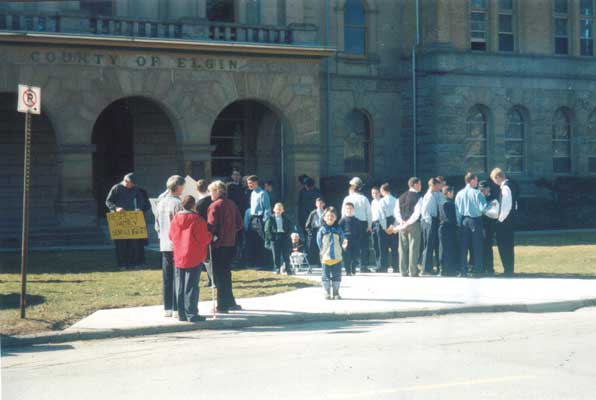
Decision in Aylmer case
March 10, 2003 permalink
Judge Schnall has rendered her decision (in pdf format) in the case of the children seized in Aylmer Ontario on July 4th, 2001. It is in all respects a defeat for families.
In other areas of law, courts have long recognized the extortionate nature of rules requiring an accused to cooperate with his accuser. Yet child protection cases deny families the right to remain silent. The judge alludes to the value of parental cooperation with CAS, since parents are usually the best source of information about their children, but ignores the reality that Children's Aid selects only the facts unfavorable to the family. We have encountered many cases where the family engages in an hour of interviews with one of the Children's Aid stand-ins, then only a single damaging fact gets presented to the court. Why not, as in other areas of the law, let the parents speak for themselves in the court?
As a reason for denying the right of silence to parents, the judge suggests that the loss of children is not an action directed against the parents. Criminals know better. A sure way to a fortune is to hold a wealthy man's child for ransom. In real life, the threat of child removal is more severe than any criminal penalty, up to and including death.
Later, the judge rules on the validity of the search, finding that CAS was admitted to the home voluntarily. This opinion serves as a ratification of the tricks that CAS uses to get into the home without a warrant, and limits protection against search and seizure to families with litigation savvy.
Here is a a non-legal point. Judge Schnall suggests that Pastor Henry Hildebrandt (whom she insults by calling him Hildebrant) endangered the children by arranging for a hundred members of his congregation to assemble outside the home where the children were seized. One of the worse aspects of seizure for the child is the feeling of being abandoned by their parents. The large show of support for the children spared them this grief.
Traditionally only a parent can represent the interests of a child. We now live in a legal wonderland where an outsider can enter a home and claim to act in the best interests of the child, superseding the parents without even a finding of wrongdoing. There seems to be no chance that judges interpreting the charter will restore the traditional respect for parents.
This case confirms our opinion that there can be no relief from child protectors through the courts. Many judges realize what an atrocity child protection really is, and an appeal to their humanity may get relief in individual cases. Where there is an activist judge, there is no relief. In Canada, the mood of the upper levels of appellate courts seems sufficiently hostile to families that no relief can be expected there. Grass-roots organizations are the only way to correct the abuses. We congratulate Pastor Hildebrandt for his efforts in this direction.
Donation to Children's Aid
January 31, 2003 permalink

Source: Orangeville Citizen, January 31, 2003