SUPPLEMENTAL MATERIALS
Contents
Sample Forms and Miscellaneous
Additional Child Abuse Reading
Allegations of Sexual Abuse Amidst Divorce/Custody Disputes
Legal
2
Medical
3
Sample Forms and
Miscellaneous
4
CORNERHOUSE INTERVIEW ROOM SET-UP
SECTIONAL COUCH
Ceiling mounted camera - full picture
WALL- MOUNT- ED DRAW- ING PAD
SECTIONAL
COUCH
TRUNK WITH ANATOMICAL DOLLS
Ceiling mounted camera - picture in picture
DOOR
5
CornerHouse Intake Form (long-hand)
| Interview Date: | Medical Date: | ||
| 1st Interview Reschedule Date: |
1st Medical Reschedule Date: |
||
| 2nd Rescheduled Interview Date: |
2nd Rescheduled Medical Date: |
6
7
| ▢Physical | ▢Emotional |
| ▢Sexual | ▢Neglect |
| ▢Witness to violent crime | ▢Domestic |
8
9
10
CornerHouse
CA SCALE-CRITERIA FOR ANALYSIS*
The CA Scale combines five components to evaluate the child's statements, behaviors and emotions during a forensic interview.
Content
Consistency
Context
Ability Child's
Affect Child's
Adapted from:
Ahlquist, A. & Batko, P. (1985). Hennepin County Community Services.
11
CORNERHOUSE INTERVIEW SYNOPSIS
Name:
DOB:
Client Number:
Parent/Guardian:
Date/Time of Interview:
Videotapes:
Possession:
Interviewer:
Observers:
CC:
Date sent:
12-14
- SAMPLE -
CORNERHOUSE INTERVIEW SYNOPSIS
*All identifying information is fictional*
Name: Jenna Shane
DOB: 8/12/94
Client Number: xxxxx
Parent/Guardian: Jessie Shane
Date/Time of Interview: 6/20/01,10:30 PM
Videotapes: Yes
Possession: CornerHouse, Hennepin Co. Sheriff
Interviewer: Barb Hiltz
Observers: Det. Jim Skaja, Hennepin Co. Sheriff;
Inv. Tina Pomerleau, Osseo PD;
Becky Morrison, Hennepin Co. ACA;
Brandi Coady, CH (video technician)
REASON FOR INTERVIEW AND OTHER PERTINENT INFORMATION
Six-year, eight-month-old, Jenna Shane was referred for a CornerHouse interview by Investigator Tina Pomerleau of Osseo Police Department. According to law enforcement reports, Jenna's mother, Jessie Shane, reported that she dropped Jenna off at her parents' house (where James lives) late on 4/5/01, and picked her up late on 4/6/01. Reportedly on 4/29/01, Jenna told her mother that during that visit, James "touched her private parts" and wanted her to take off her underwear. Jenna reportedly did not do this. James then reportedly told Jenna to "rub his penis because it was hurt," which Jenna did. James also reportedly put his penis in Jenna's mouth and made her suck on it. This reportedly took place in the basement family room of James's residence. The children's grandparents reportedly found the children watching television in the middle of the night and, not realizing there was a problem, made the children go to bed.
Jenna's mother reportedly waited to report the incident because she wanted to talk to Jenna's father and because it seemed that Jenna was okay. Law enforcement recommended that Jenna have a medical examination and seek therapy (unclear if these things have been done).
James Shane was interviewed at CornerHouse as a potential victim on 5/23/01 regarding a separate allegation.
Ms. Shane brought Jenna to CornerHouse for her interview. In a brief, pre-interview meeting with Ms. Shane and Brian Mitchell (Jenna's biological father), Ms. Shane indicated that when the police came to talk to her about her allegation, Jenna would not talk to them. Ms. Shane stated that she sat on her mother's lap and would whisper the answers to the officer's questions in his ear. Ms. Shane indicated that they last talked about this alleged incident on Sunday.
INTERVIEW CONTENT
For complete information regarding this interview, please review the videotape.
Jenna presented as an extremely bright and somewhat timid six-year-old girl. Jenna wrote many of her answers to this interviewer's questions and provided the necessary verbal communication to tell of her experiences. More than once, Jenna moved to the floor and sometimes appeared to be hiding.
Jenna was interviewed using drawings, diagrams and anatomical dolls. Results of this interview appear to indicate that sexual abuse of Jenna did occur. Jenna described that James touched her private part (genitals) on her skin, and made her suck on his private (penis). Jenna provided consistent, detailed information about both events, and used the dolls to clarify the sucking of James's penis. Initially, Jenna indicated that James made her rub his penis, but provided no details of this. Jenna stated, "he's doing this to his girlfriend, too."
Jenna indicated that she was made to suck James's penis more than one time, although it was unclear if this happened on more than one occasion. Jenna described being downstairs at her grandparents' house, laying on a pillow. Jenna denied that anyone else had ever done something similar to her.
Safety messages were given.
Note: After this interview, law enforcement asked that this interviewer explain the CornerHouse medical procedure to Jenna's parents. Ms. Shane and Mr. Mitchell appeared concerned that it would be traumatic for Jenna as she had recently been seen by a general practitioner and had cried. This interviewer indicated that I would consult with Dr. Linda Thompson regarding the need for a CornerHouse exam (see CornerHouse Correspondence Form in file).
CC: Det. Jim Skaja, Hennepin Co. Sheriff's Office Inv. Tina Pomerleau, Osseo PD
Date sent:
15
INTAKE/INTERVIEWER CHECKLIST GUIDE
FOR ESSENTIAL MEDICAL EXAMINATIONS
Child's Name: __________________________________ Date: ____________
Alleged Perpetrator's Name: _____________________ Race: ____________
Adult or Juvenile: ____________________ Relationship to child: _______________
INTERVIEW RESULTS: Abuse occurred ___ Abuse Did Not Occur ___ Inconclusive ___
| YES | NO | |
| ___ | ___ | Non-acute referent request for a sexual abuse examination for purposes of providing health assessment, legal prosecution or social services intervention and investigation. |
| ___ | ___ | Skin on skin contact, or exchange of bodily fluids. |
| ___ | ___ | Report of genital trauma, discharge, bleeding, concern of STD or pregnancy. |
| ___ | ___ | CornerHouse interview conclusions are that abuse occurred and there are allegations of penetration (digital or penile, oral, vaginal, or anal). |
| ___ | ___ | CornerHouse interview conclusions are inconclusive or did not occur yet there remains concern or strong indication that the child is blocking or minimizing. |
| ___ | ___ | Child has expressed concerns about his/her body |
| ___ | ___ | Child under three years of age, or is unable to verbalize experience as a result of developmental stage. |
| ___ | ___ | CornerHouse medical examination recommended: |
| ___ | ___ | Has child reached puberty? (See below ***** footnote) Scheduled: _____________ Results: ___________________ |
| ___ | ___ | Medical examination completed elsewhere: Dr: ________________________ Results: _______________________ |
***** A separate questionnaire needs to be completed if the child has reached puberty
16
Child's Name: __________________ Date of Birth: _______________ Client Number: __________________
Child's Current Residence: _________________________________________________
Examining Physician:______________________ Exam Date/Time: ________________
Primary Physician/Address: ___________________________________________________
Law Enforcement: ___________________________ Child Protection: _____________________________
City: _______________ Phone: ________________ County: _______________ Phone: _________________
PERSONAL MEDICAL HISTORY
Informant/Source of Information: ____________________________________________________
Past Medical History:
_________________________________________
__________________________________________________________
__________________________________________________________
Immunizations Current? [ ] Yes [ ] No [ ] Unknown
Describe:
___________________________________________________________
___________________________________________________________________
Allergies: _____________________________________________________
Current Medications: _____________________________________________________
Previous Abuse? [ ] Yes [ ] No [ ] Unknown
Describe:
___________________________________________________________
___________________________________________________________________
Previous History of Anal/Genital Injuries, Surgeries,
Diagnostic Procedures,
or Medical Treatment?
[ ] Yes
[ ] No
[ ] Unknown
Describe:
___________________________________________________________
___________________________________________________________________
Has Patient Been Sexually Active? [ ] Yes [ ] No [ ] NA
Date/Time of Last Voluntary Intercourse: ______________________________
Does Patient Use Contraceptives? [ ] Yes [ ] No [ ] NA
If YES, Describe: _________________________________________
17
Previous Pregnancies? [ ] Yes [ ] No [ ] NA
Date of Last Menstrual Period: ________________ Average Length: ____________________
Menstrual Irregularities: ________________________________________________________
DESCRIPTION OF ABUSE
[ ] See Interview Report and Description
[ ] Oral Report from CornerHouse Interviewer: __________________________________
Interviewer Description:
________________________________________________
___________________________________________________________________
___________________________________________________________________
___________________________________________________________________
___________________________________________________________________
Parent Description:
________________________________________________
___________________________________________________________________
___________________________________________________________________
___________________________________________________________________
___________________________________________________________________
___________________________________________________________________
___________________________________________________________________
___________________________________________________________________
___________________________________________________________________
Child's Description:
________________________________________________
___________________________________________________________________
___________________________________________________________________
___________________________________________________________________
___________________________________________________________________
18-19
More Than 72 Hours Since Incident(s) [ ] Yes [ ] No [ ] Unknown
Parent Present During Exam? [ ] Yes [ ] No
Medical Assistant Present During Exam? [ ] Yes [ ] No If so, name: ______________
Medical Resident Present During Exam? [ ] Yes [ ] No If so, name: ______________
| Patient | Historian | ||||||||||
| Physical Symptoms | Y | N | U | NA | Y | N | U | NA | Description | ||
| Abdominal Pain | [ ] | [ ] | [ ] | [ ] | [ ] | [ ] | [ ] | [ ] | |||
| Pelvic Pain | [ ] | [ ] | [ ] | [ ] | [ ] | [ ] | [ ] | [ ] | |||
| Enuresis Day | [ ] | [ ] | [ ] | [ ] | [ ] | [ ] | [ ] | [ ] | |||
| Enuresis Night | [ ] | [ ] | [ ] | [ ] | [ ] | [ ] | [ ] | [ ] | |||
| Genital Itching | [ ] | [ ] | [ ] | [ ] | [ ] | [ ] | [ ] | [ ] | |||
| Genital Discomfort/Pain | [ ] | [ ] | [ ] | [ ] | [ ] | [ ] | [ ] | [ ] | |||
| Genital Discharge | [ ] | [ ] | [ ] | [ ] | [ ] | [ ] | [ ] | [ ] | |||
| Genital Bleeding | [ ] | [ ] | [ ] | [ ] | [ ] | [ ] | [ ] | [ ] | |||
| Rectal Pain | [ ] | [ ] | [ ] | [ ] | [ ] | [ ] | [ ] | [ ] | |||
| Rectal Bleeding | [ ] | [ ] | [ ] | [ ] | [ ] | [ ] | [ ] | [ ] | |||
| Rectal Discharge | [ ] | [ ] | [ ] | [ ] | [ ] | [ ] | [ ] | [ ] | |||
| Constipation | [ ] | [ ] | [ ] | [ ] | [ ] | [ ] | [ ] | [ ] | |||
| Incontinent of Stool | [ ] | [ ] | [ ] | [ ] | [ ] | [ ] | [ ] | [ ] | |||
| Physical Injuries | [ ] | [ ] | [ ] | [ ] | [ ] | [ ] | [ ] | [ ] | |||
| Other Somatic Complaints | [ ] | [ ] | [ ] | [ ] | [ ] | [ ] | [ ] | [ ] | |||
| Behavior/Emotion Symptoms | |||||||||||
| Eating Disturbances | [ ] | [ ] | [ ] | [ ] | [ ] | [ ] | [ ] | [ ] | |||
| School Problems | [ ] | [ ] | [ ] | [ ] | [ ] | [ ] | [ ] | [ ] | |||
| Sexual Acting Out | [ ] | [ ] | [ ] | [ ] | [ ] | [ ] | [ ] | [ ] | |||
| Fear | [ ] | [ ] | [ ] | [ ] | [ ] | [ ] | [ ] | [ ] | |||
| Anger | [ ] | [ ] | [ ] | [ ] | [ ] | [ ] | [ ] | [ ] | |||
| Anger | [ ] | [ ] | [ ] | [ ] | [ ] | [ ] | [ ] | [ ] | |||
| Depression | [ ] | [ ] | [ ] | [ ] | [ ] | [ ] | [ ] | [ ] | |||
| Other Symptoms | [ ] | [ ] | [ ] | [ ] | [ ] | [ ] | [ ] | [ ] | |||
Child Receiving Counseling: _________________________________________
Comments and Reactions of Child During Exam:
__________________________
___________________________________________________________________
___________________________________________________________________
___________________________________________________________________
___________________________________________________________________
20
PHYSICAL EXAMINATION
Describe and Draw Physical Injuries in Detail (Use Drawing on Attached Page to Detail Injuries).
Weight(kg): _________________ Height(cm): __________________
| Normal | Abnormal | ||
| HEENT: | [ ] | [ ] | Description: ________________________________________ |
| Neck: | [ ] | [ ] | Description: ________________________________________ |
| Heart: | [ ] | [ ] | Description: ________________________________________ |
| Chest: | [ ] | [ ] | Description: ________________________________________ |
| Abdomen: | [ ] | [ ] | Description: ________________________________________ |
| Back: | [ ] | [ ] | Description: ________________________________________ |
| Buttocks: | [ ] | [ ] | Description: ________________________________________ |
| Extremities: | [ ] | [ ] | Description: ________________________________________ |
| Skin: | [ ] | [ ] | Description: ________________________________________ |
| Other: | Description: _______________________________________________________ | ||
GIRLS:
Exam Position: [ ] AP Supine [ ] Frog Leg [ ] Knee Chest [ ] Lithotomy
Exam Technique: [ ] Traction [ ] Separation
Tanner Stage: Breast: ________________ Genital: ________________
Clitoris: ________________________________________
Labia: ____________________________ Urethra:___________________________
Posterior Fourchette: ___________________________________________
Vestibule: ________________________________________________
Hymen: ____________________________________________________
Vagina: ________________________________________________
Perineum: ________________________________________________
Anus/Rectum: ___________________________________________
BOYS:
Tanner Stage: ____________________________________________
Penis: ________________________________________________
21
Scrotum/Testes: _____________________________________
Perineum: _________________________________________
Anus/Rectum: ______________________________________
Photocolposcope: [ ] Yes [ ] No Photos reviewed by: _______________ Date: ____________
LABORATORY SPECIMENS
For CHCM Lab (See Sexual Assault Lab Report for Results).
| 1. | GC Culture | Y N |
| A. Pharynx | Y N | |
| B. Cervix/Vagina | Y N | |
| C. Rectal | Y N | |
| D. Urethra (Male) | Y N | |
| 2. | Chlamydia Culture | Y N |
| A. Cervix/Vagina | Y N | |
| B. Urethra (Male) | Y N | |
| C. Rectal | Y N | |
| 3. | Pregnancy Test (Urine) | Y N |
| 4. | Routine Bacterial Culture | Y N |
| 5. | Wet Prep | Y N |
| 6. | UA/UC | Y N |
| 7. | Syphilis Screen | Y N |
| 8. | HIV Antibody | Y N |
| 9. | Hepatitis B Surface Antigen | Y N |
| 10. | Hepatitis B Antibody | Y N |
| 11. | Other | Y N |
Other Describe:
______________________________________________
____________________________________________________________
____________________________________________________________
Lab Report Reviewed: __________ Date ___________
DRAW SHAPE OF ANUS AND ANY LESIONS ON GENITALIA, PERINEUM AND BUTTOCKS:
Report of Child Sexual Abuse Exam Reveals:
*[ ] Normal Physical Findings
22
[ ] Exam Consistent with History
[ ] Exam Inconsistent with History
*[ ] Abnormal Physical Findings
[ ] Exam Consistent with History
[ ] Exam Inconsistent with History
ASSESSMENT:
RECOMMENDATIONS:
Examining Physician: _________________________ Date: __________
Print Name:_
CC:______________________________________ Date Sent:
_________________________________________
_________________________________________
23
STATE OF MINNESOTA
DISTRICT COURT
COUNTY OF HENNEPIN
FOURTH JUDICIAL DISTRICT
|
State of Minnesota, Plaintiff, vs. < > Defendant. |
STIPULATION AND OTHER SIP No. < > CA. No. < > |
* * * * * * * * * * * * * * * * * * * * *
The parties to the above-reference action stipulate to the following:
1. That a copy of a videotaped interview of a child witness shall be made available to the defense;
2. That no additional copy of the tape nor any portion of the tape shall be made by the defendant, the defendant's attorney, investigator, expert, or any other representative or agent of the defendant;
3. That said copy shall not be used for any purpose other than to prepare for the defense in the above-referenced action;
4. That said copy shall not be publicly exhibited, shown, displayed, used for educational, research or demonstrative purposes, or used in any other fashion, except in judicial proceedings in the above-referenced action;
5. That said copy may be viewed only by parties, their counsel and their counsel's employees, investigators, and experts;
6. That no transcript of said copy, nor the substance of any portion thereof, shall be divulged to any person not authorized to view the tape;
7. That no person shall be granted access to said copy, any transcription thereof, or the
24
substance of any portion thereof unless that person has first signed an agreement in writing that he or she has received a copy of this stipulation, that he or she submits to the Court's Jurisdiction with respect to it and that he or she will be subject to the Court's contempt powers for any violation of it;
8. That upon final disposition of this case, any and all copies of these tapes and any transcripts thereof shall be returned to the Hennepin County District Court.
_____________________________
Attorney for Plaintiff
Dated: _______________________
_____________________________
Attorney for Defendant
Dated: _______________________
ORDER
IT IS SO ORDERED.
Dated: _______________________
_______________________________
Judge of District Court Fourth Judicial District
25
Additional Child Abuse Reading
26
Reprinted with permission from:
Summit, R. C. (1992). Abuse of the child sexual abuse accommodation syndrome. Journal of Child Sexual Abuse. 1(4153-163
Abuse of the Child Sexual Abuse Accommodation Syndrome
Roland C. Summit, M.D.
Harbor/UCLA Medical Center,
1000 W. Carson St, D-6, Torrance, CA 90509
(310) 533-3129
Introduction
The Child Sexual Abuse Accommodation Syndrome (CSAAS) (Summit, 1983b) is a clinical observation that has become both elevated as gospel and denounced as dangerous pseudoscience. The polarization which inflames every issue of sexual abuse has been kindled further here by the exploitation of a clinical concept as ammunition for battles in court. The excess heat has been generated by false claims advanced by prosecutors as well as by a primary effort by defense interests to strip the paper of any worth or relevance. The following commentary will address the origins of the child sexual abuse accommodation concept and the subsequent distortions that court misuse has imposed. I hope that such a contextual review can serve as a guide toward a more accurate understanding among clinicians, judges, and advocate attorneys.
Background
Appeals decisions have groped for a definition of the intent and purpose of the CSAAS, assuming sometimes that it is intended for diagnosis or for substantiation of complaints. It has been presumed at times to be both an instrument and an opinion. I would propose that the answers to such questions can be found not in adversarial debate but in an examination of the origins of the CSAAS itself.
It was only when I began reviewing courtroom opinions during the late 1970's that it became apparent that prevailing clinical experience was at odds with forensic demands. From the viewpoint of a community psychiatrist specializing in sexual abuse consultation, it had become axiomatic that children were reluctant to disclose sexual victimization and that potentially protective adults were often incredulous and threatened by the implications of a child's complaint. I was surprised to discover that lawyers tended to discredit delayed and inconsistent reports, insisting that any legitimate victim would have made an immediate and convincing complaint. I began to understand that legal assumptions equating reliability of a testimony with a fresh and consistent complaint merely formalized the standoff that has always existed between victimized children and the adults in authority they must face to gain sympathy and protection. The small victim of a private crime must search against fear of rejection for the adult who will listen to an unwelcome, offensive account and take protective action against a trusted peer.
27
In the summer of 1979,1 put together a list of those factors which were both most characteristic of child sexual abuse and most provocative of rejection in the prevailing adult mythology about legitimate victims. The basis for those typical characteristics was my own broad consulting experience throughout Los Angeles County as well as personal discussion with such national visionaries as Ann Burgess, Sue Sgroi, Nicholas Groth, Lloyd Martin, Louise Armstrong, Lucy Berliner, Hank Giarretto, Kee MacFarlane, Karin Meiselman, Judith Herman, Diana Russell and, especially, David Finkelhor.
The first five of the seven factors on the original list formed a logical pattern and sequence of interaction among the victim, the intruder, and the potential caretakers. Together, these five points described both the luxury of the adult world not to listen and the accommodating efforts of the child not to complain. The factors as listed were: (1) secrecy, (2) helplessness, (3) entrapment and accommodation, (4) delayed, conflicted and unconvincing disclosure, and (5) retraction.
I began to use that pattern as an outline for lectures explaining the dynamics of sexual victimization, calling it the Child Sexual Abuse Accommodation Syndrome. The lectures had the compelling effect of helping professional and public audiences to understand, as if for the first time, how sexual abuse can occur. It became commonplace for adult survivors to seek me out after such a lecture to express gratitude that someone could understand. They typically felt relieved and forgiven, having condemned themselves as uniquely weak or bad for their uncomplaining compliance as a child.
The published record of the CSAAS begins with the transcription of an invited lecture in Victoria, British Columbia on September 29,1980 (Summit). That publication served as the basis for the text of the CSAAS which was incorporated in each of two book chapters written during the spring of 1981 (Summit, 1982,1983a). An expanded version was written during the ensuing summer and submitted to a psychiatric journal. The CSAAS was rejected, not because it was radical or unsubstantiated, but because the reviewers felt it was so basic that it contributed nothing new to the literature!
The unexpected rejection after two years of frustrating delays discouraged any further attempt at publication. Copies of the typescript continued to circulate, however, and the CSAAS took on a life of its own in progressively faded facsimile. Kee MacFarlane recommended the paper for inclusion the sexual abuse special issue of the International Journal of Child Abuse and Neglect. The typescript was reviewed, unchanged, in the spring of 1983, and finally published (Summit, 1983b).
The significance of the preceding chronology is that the CSAAS, like the labors of disclosure it seeks to describe, was not relevant to established wisdom. Even as it made sense to those with personal and immediate experience, it was unacceptable to those with gatekeeping authority. Sharing the CSAAS became centrally important to me as I tried to find the way to say it right, but on being rejected I was willing to retract it and give up. In further analogy to the plight of the child, the CSAAS depended on intervention by a sensitive, experienced professional to invite eventual disclosure.
The publication history is important also for the fact that the text of the CSAAS represents the author's experience up to the fall of 1981, more than two years before its eventual publication, with clinical anecdotes derived from consulting experience preceding 1980. The large majority of those first consultations involved incestuous abuse, which then became a convenient model for lecture presentation. Despite intervening contacts with every known
28
form of child sexual victimization, all of which reinforced the accommodation concept, the written persistence of the original anecdotes allows for the misleading impression that the accommodation phenomenon is specific to father-daughter incest. The CSAAS originated, then, not as a laboratory hypothesis or as a designated study of a defined population. It emerged as a summary of diverse clinical consulting experience, defined at the interface with paradoxical forensic reaction. It should be understood without apology that the CSAAS is a clinical opinion, not a scientific instrument.
Abuses
Contrary to its resoundingly constructive clinical reception, lawyers and a few clinical expert witnesses have tended to seize on the CSAAS as a major weapon. Adversarial rivals seem determined either to enhance it or to destroy it according to their designated role. The CSAAS posed a threat to the traditional defense arguments that legitimate victims would fight back and complain, that any good mother would know if her child were a victim, and that retractions confirm the common sense assurance that children typically lie about sexual victimization. Prosecutors saw the CSAAS as a potential offer of proof that an inconsistent victim is truthful.
Some of the adversarial alarm and distortion stems from misunderstanding of the word syndrome. In medical tradition it means a list, or pattern of otherwise unrelated factors which can alert the physician to the possibility of disorder. Such a pattern is not diagnostic, and the cause-and-effect relationship among the factors themselves and with the possible problem is generally obscure. In court circles, syndrome seems to mean a diagnosis which an expert witness contrives to prove an injury. Syndrome evidence has become a generic term for diagnostic medical or psychological testimony which must be closely scrutinized for scientific reliability, lest the intrinsic authority of the expert witness improperly prejudice a jury through contrived or eccentric opinion. Any assertion that a victim-witness or a plaintiff suffers from a disorder that was caused by the claimed injury must be tested for scientific reliability in a so-called Kelly-Frye hearing. Had I known the legal consequences of the word at the time, I might better have chosen a name like the Child Sexual Abuse Accommodation Pattern to avoid any pathological or diagnostic implications.
Despite the potential for semantic misunderstanding, it should have been obvious to a careful reader that the CSAAS was not addressing an illness or disorder. The abstract of the monograph, which was written in the summer of 1983, expresses my last and most careful epitome of what I was trying to describe:
Child victims of sexual abuse face secondary trauma in the crisis of discovery. Their attempts to reconcile their private experiences with the realities of the outer world are assaulted by the disbelief, blame and rejection they experience from adults. The normal coping behavior of the child contradicts the entrenched beliefs and expectations typically held by adults, stigmatizing the child with charges of lying, manipulating or imagining from parents, courts and clinicians...
Evaluation of the responses of normal children to sexual assault provides clear evidence that societal definitions of "normal" victim
29
behavior are inappropriate and procrustean, serving adults as mythic insulators against the child's pain. Within this climate of prejudice, the sequential survival options available to the victim further alienate the child from any hope of outside credibility or acceptance. Ironically, the child's inevitable choice of the "wrong" options reinforces and perpetuates the prejudicial myths. (1983b, p. 177, emphasis added).
These are normal children making normal adjustments to an abnormal environment. The focus is not on the effects of sexual abuse itself but on the conflict between the child's experience and the perverse indifference of the outer, adult world. If there is pathology, it is in the denial and paradoxical demands of adults, not in the survival options found by the child. The words identification, detection, diagnosis, symptom, disorder, illness and pathology, which might infer a diagnostic focus, do not appear in the paper, nor is there a promise of verifying the alleged abuse with such words as test, validate, evaluate, confirm, or prove. The accommodation mechanisms listed in the third category are obviously not specific to sexual assault. Rather, they were selected to illustrate the misleading, self-camouflaging behaviors that inhibit recognition. The CSAAS is meaningless in court discussion unless there has been a disputed disclosure, and in that instance the ultimate issue of truth is the sole responsibility of the trier of fact. The CSAAS acknowledges that there is no clinical method available to distinguish "valid" claims from "those that should be treated as fantasy or deception" (p. 189), and it gives no guidelines for discrimination.
The capacity to listen and the willingness to believe, which the paper invites, is not an
admonition to interrogate or to assume that every disclosure is real:
The purpose of this paper then, is to provide a vehicle for a more sensitive, more therapeutic response to legitimate victims of child sexual abuse and to invite more active, more effective clinical advocacy for the child within the family and within the systems of child protection and criminal justice, (p. 179-180, emphasis added).
Even the word advocacy has a loaded meaning in forensic circles. An advocate is seen as a hireling paid to advance an adversarial view, or someone with a zealous mission who cannot be objective. So the CSAAS can be read by lawyers as a rallying cry for clinicians to go forth and diagnose more children as victims, toward the goal of making more money and putting more people in jail. Whether or not attorneys saw it that way at first, that is certainly the attack directed now against the CSAAS and its alleged minions, the child advocates, or more derisively, child abuse finders or validators, who are said to be conducting a witch hunt and creating an epidemic of false allegations, launched and fueled by the SCAAS. This kill the messenger rhetoric has given the CSAAS a taint of controversy which inhibits expert witnesses from drawing on the paper as supplementary authority. Clinicians may be warned specifically by attorneys to make no reference to the CSAAS, and even to deny being influenced in their training by the views of early theorists.
When CSAAS is not stigmatized outright, it may be attacked as being irrelevant in any disclosures other than those naming the father in an intact family system. This is a frank distortion both of the scope of the CSAAS and of clinical reality. Silence is intrinsic to the
30
victimization process, not to family systems dynamics. A skillful neighborhood offender may be more immune from parental suspicion and victim disclosure than a relative. Experts who swear that a child would have no reason to conceal abuse by a teacher must be unimpressed by a case in Great Neck, NY, where a computer tutor enslaved some 400 boys and girls in pornographic exploitation and sadistic abuse over a span of 7 years with no disclosures, ever. Or the school bus driver in the same county who molested children going back and forth to school. Some 250 young children entered a bus twice a day to be molested, yet no teacher or parent heard a word of that ordeal.
While much of the destructive criticism was contrived to prevent any use of the CSAAS in court, some criticism has been a legitimate defense against improper use by prosecutors and expert witnesses called by prosecution. There has been some tendency to use the CSAAS as an offer of proof that a child has been abused. A child may be said to be suffering from or displaying the CSAAS, as if it is a malady that proves the alleged abuse. Or a child's conspicuous helplessness or silence might be said to be consistent with the CSAAS, as if not complaining proves the complaint. Some have contended that a child who retracts is a more believable victim than one who has maintained a consistent complaint. Such absurd distortions fuel the fire against the CSAAS:
Daffynition: Child Sexual Abuse Accommodation Syndrome: a brief synopsis. 1. When a child denies abuse, they have been abused. 2. When a child says they have been abused, they have been abused. 3. When a child recants an abuse, they have been abused. 4. Therefore, it is logical to conclude that all children have been abused and therefore all who have children have either abused their child or have allowed their child to have been abused. (VOCAL, 1988, p. 6).
The CSAAS is used appropriately in court testimony not to prove a child was molested but to rebut the myths which prejudice endorsement of delayed or inconsistent disclosure. Proper testimony is defined in California's People v. Gray (187 Cal. App. 3d 213: Cal. Rptr. - [Nov. 1986]). Gray translates a state Supreme Court decision into analogous guidelines for CSAAS testimony regarding child witnesses:
...Expert testimony may play a particularly useful role by disabusing the jury of some widely held misconceptions about (child sexual abuse and its) victims, so it may evaluate the evidence free of the constraints of popular myths. {People v. Gray, p. 218).
...It was not error to admit expert testimony to the effect that it was common for child victims to delay reporting of incidents of abuse and to given inconsistent accounts of such incidents to different people, where such evidence was not offered to prove that a molestation in fact occurred, but rather was offered to rebut the inference proffered by the defendant that the alleged victim was being untruthful as shown by her delay and inconsistencies in reporting, by showing that such behavior is not necessarily indicative of deceit in children. Such expert testimony was proper
31
so long as it was limited to discussion of victims as a class (e.g., children), and did not extend to discussion and diagnosis of the witness in the case at hand. (pp. 213-214, emphasis added).
Gray also defines CSAAS testimony as opinion, not scientific evidence, and therefore not subject to Kelly-Frye exclusion. "Thus, expert testimony, even where highly esoteric and controversial, is generally admissible, so long as not derived from a specific experimental or forensic procedure." (p. 214).
Reductio ad Absurdum
The ultimate barrier to CSAAS testimony is to define it as something it is not, then to bar it for its failure to meet irrelevant conditions. If the CSAAS is labeled as a diagnostic instrument, then it must undergo a Kelly-Frye hearing to demonstrate it infallibility and its general acceptance in the scientific community in which it was developed. Since the author is a psychiatrist, it is tested against the psychiatric literature and the official diagnostic and statistical manual, in which, since it is not a diagnosis, it will never appear. Working in the community gave me the privilege of learning about sexual abuse from those who knew: social workers, nurses, police, sociologists, psychologists, journalists and adult survivors. The greatest contribution from psychiatrists was an appreciation of the elitist avoidance that continues to isolate my profession from the interdisciplinary advances of child abuse awareness. The clinical expert best qualified to testify about sexual victimization is likely to be a social worker, not a physician. Yet judges persist in empowering psychiatrists with sole dominion over human behavior.
The Supreme Court of Kentucky has reversed five consecutive sexual abuse convictions involving expert witness testimony, ruling each time that the CSAAS is not a generally accepted medical concept.
However, the issue "has never been properly presented to us" said Kentucky Supreme Court Chief Justice Robert Stephens. The witnesses who testified about the syndrome were social workers and other non-medical personnel rather than traditional experts like doctors and psychiatrists, Stephens said (Nance, 1991, p. A-9).
In January the court reviewed the ultimate test case. The defendant had been condemned to 50 years in prison for molesting and sodomizing his stepdaughter over a period of six years. Expert testimony was offered by Lane Veltkamp, a full professor of psychiatry and Director of the University of Kentucky Child Abuse Center. In his 23 years of experience he had evaluated and treated over 1,000 children. His testimony avoided any reference to the CSAAS, but he was asked to comment on the child's six years of silence. He said in his experience "delayed disclosure was common among sexually abused children." The Supreme Court interpreted that statement as a reference to the CSAAS! The entire testimony was nullified and the CSAAS was scapegoated in absentia because the expert's credentials were judged inadequate to address what the court insists is medical evidence. Professor Veltkamp, medical educator and sexual abuse expert par excellence, was not to be allowed to educate a jury. The Supreme Court reversed the conviction because he is only a Master of Social Work, not a Doctor of Medicine (Nance, 1992).
32
Conclusion
It has been 13 years since I observed that victims of sexual abuse are the object of prejudice because they do not meet our artificial standards of disclosure. I thought that better education would correct this secondary abuse. The CSAAS, written to address that prejudice, was drawn from community resources and published in the interdisciplinary, international journal for child abuse awareness. Nothing in that history implies that the CSAAS is a medical issue. There are infinite behavioral variations which can be subsumed under the five categories of the CSAAS, any of which may be vital to understanding a victim's dilemma. To take all such information away from those who can best express it, to consign it to a category of medical evidence because a psychiatrist once tried to summarize it, and then to rule any and every part of such information forbidden to a trier of fact unless a physician can prove it qualified as medical evidence is the ultimate expression of the very prejudice which the courts seem so reluctant to acknowledge.
Knowledge is not enough. Education is not enough. A good clinical framework like the
CSAAS is not only not enough, it becomes worse than nothing if it offends those who are
determined not to learn. It can be used as a lock on the secret instead of the key.
The problem is not with improper use of expert testimony. The problem is not with skeptical
attorneys or recalcitrant judges; they all merely represent our continuing reluctance as an adult
society to allow an honest view of our children's continuing silence.
The answer lies not in better research or better publications. Scientific progress is no match
for prejudicial ignorance. The answer rests with broader acknowledgment that we all need to
discard familiar reassurances and struggle together for better answers. We aren't yet willing as
a society to prohibit the sexual abuse of children. Why not?
33
References
Nance, K. Supreme Court Bars Testimony on Why Children Stay Silent. Lexington Herald-Leader, December 6, 1991, p. A-9.
Nance, K. Supreme Court Overturns Sex Abuse Conviction. Lexington Herald-Leader, January 17, 1992, p. A-8.
Summit, R.C. Keynote Address. In: P.D. Ross (Ed.), Sexual Abuse of Children within the Family: Conference Proceedings (pp. Ill-1 -111-56). Vancouver, BC: Justice Institute of B.C., 1980.
Summit, R.C. Beyond Belief: The Reluctant Discovery of Incest. In: M. Kirkpatrick (Ed.), Women's Sexual Experience (pp. 127-150). New York: Plenum Press.
Summit, R.C. Recognition and Treatment of Child Sexual Abuse. In: C.
Hollingsworth (Ed.), Coping with Pediatric Illness (pp. 115-172). New York: Spectrum Publications, 1983(a).
Summit, R.C. The Child Sexual Abuse Accommodation Syndrome. Child Abuse and Neglect, 1983(b), 7:177-193.
VOCAL. Great quotes (no author cited). VOCAL's California state Newsletter. P.O. Box 1314, Orangevale, CA 95662. Sept/Oct 1988, 4(5):6.
34
Reprinted with permission from:
Vieth, V. (1994). A strategy for confronting child abuse in rural communities. The Prosecutor. Sept/Oct. 6.
A Strategy for Confronting Child Abuse in Rural Communities
Victor I. Vieth
INTRODUCTION
Recent studies conclude that children in rural communities are as likely and possibly more likely to be abused or neglected than children in metropolitan areas.1 Although rural families face the same drug, alcohol, poverty and stress problems as do families who live in cities and suburbs, rural communities typically have fewer resources.
Recognizing this crisis, the prosecutors in the Cottonwood County, Minnesota attorney's office began a vigorous attack on child abuse and neglect in 1991. This attack has proven effective for the county which has an approximate population on 13,000.
We believe it would be effective for use in other rural and small communities. Our fight against child abuse and neglect consists of six endeavors.
WRITTEN PROTOCOL
First we developed a written child abuse investigation and prosecution protocol for the county attorney's office, local welfare agency and the four law enforcement agencies serving the county.
One issue addressed in the protocol is the vacuum in child abuse expertise existing in rural communities. For instance, small police forces such as ours usually cannot afford to hire a full-time officer to handle child abuse investigations exclusively. Accordingly, the first interview of a child may be done by an on-call officer with limited training in the art of interviewing a child. To correct this problem, we decided that only one named officer or one of two named social workers would conduct interviews of young children. These three investigators would receive the bulk of child abuse framing dollars and would develop expertise in interviewing children in part by doing it more often than other investigators. A child-friendly interview room was established where interviews of young children may be videotaped for possible use in court. The protocol also seeks to involve the prosecutor early in the case. It provides that whenever the investigators believe a child abuse investigation will
1 Hopfensperger, "Rural Counties Score Lower Marks For Child Safety and Welfare." Minneapolis Star Tribune, May 9, 1994, at 1A.
35
result in criminal charges or the filing of a child protection petition, the prosecutor would "be notified regarding the basic facts of the case."2 It also provides that investigators are to "contact the county attorney's office whenever a legal or procedural question arises in an investigation and assessment."3 By involving the prosecutor early in the case, potential legal problems with a case may be avoided. For example, prosecutors can ensure that all elements of a particular charge of child abuse are investigated. In Minnesota, there may be an enhanced penalty if the perpetrator "jointly resides intermittently or regularly" in the household of the victim.4 If the perpetrator is the mother's boyfriend, it is important to determine whether the boyfriend periodically stays over or otherwise resides in the same dwelling as the victim. A prosecutor can remind an investigator of these easily forgotten elements.
If the prosecutor declines to prosecute a case of child abuse, the prosecutor must inform the investigators in writing of the reasons for the decision. In this way, investigations not resulting in charges are, nonetheless, instructive to the investigators because of the degree of evidence needed to bring a case to court.
In drafting the protocol, the prosecutors sent the message to the investigators that their efforts at combating child abuse are appreciated and will be responded to promptly. The protocol also implicitly instructs the community at large that child abuse is a top priority for police and prosecutors.
MANDATED REPORTER TRAINING
Second, we conducted mandated reporter training for public and private school teachers, day care providers, foster parents, nurses and other professionals required by law to report possible abuse or neglect.
The training of the potential reporters was conducted by the assistant county attorney and the social workers who investigate reports of abuse or neglect. The participants were given copies of Minnesota's Mandated reporting law5 and the relevant provisions were explained. In particular, focus was put on the definitions of physical abuse, sexual abuse and neglect. Also discussed were the circumstances under which a report must be made, with particular emphasis on the fact that reporting was their responsibility, and they could not comply with the law by simply informing a superior in their school or agency. The participants were informed of the need to report as soon as possible, because, if the report is received 30 minutes before the close of the school day, it is extremely difficult, if not impossible, to make a well-informed decision whether to allow a child to board the school bus or to be placed in
2 Cottonwood County Attorney's Office, Cottonwood County Protocol for the Investigation and Assessment of Child Abuse Cases. Windom, Minnesota (1993).
3 Id.
4 MINN.STAT. 609.342. 1(g) (1985): 609.343,1(g) (1985);609.341.15(3) (1985).
5 MINN.STAT. 626.556 (1975).
36
protective custody. The social workers discussed the mechanics of making a report and the process they and the police officers use in responding to a report.
One of the difficulties in protecting children in rural and small communities is that everyone knows everyone else; hence, even a mandated reporter can be reluctant to report suspicions for fear the reporter will feel uncomfortable sitting beside the alleged perpetrator at next week's ice cream social. This reluctance can be overcome by yearly training emphasizing the mandate of the law and by giving concrete examples of how the mandated reporting law has spared the lives of countless children.
SEPARATE TRAINING FOR CLERGY
Third, we conducted a separate, mandated reporter training for members of the clergy. A separate training is warranted only because most mandated reporting laws for clergy differ from mandated reporting laws for other professionals. In Minnesota, a member of the clergy is not required to report the possibility of abuse or neglect if the information is obtained while receiving a confession or from a person seeking "religious or spiritual advice."6
This law is discussed in detail with the clergy and numerous examples are given them. For example, if a pastor is visiting a parishioner in the hospital and the parishioner laments about the abuse of a given child, the pastor has received information not obtained during a confession or from someone seeking religious or spiritual advice. In their training of the clergy, the social workers gave the pastors information on behavior and other characteristics of abused children so they can better protect children in their congregations. The members of the clergy were also given information on counseling and other services in our area to which they may direct parishioners facing a particular crisis.
A separate training for pastors is a necessary reflection of the vital role they play in rural communities. Often times, the most respected leaders in these communities do not occupy a position on the school or township board; instead, they preach from a pulpit. Moreover, rural families in crisis typically do not call social services; these families may call their pastor or priest.
When local ministers are enlisted in the fight against child abuse, victory becomes foreseeable. Often times, these ministers see social workers, police officers and prosecutors as part of a government which breaks up families. By helping them understand that families involved in child abuse are already broken, and that investigators are dedicated, caring professionals, we build a bridge over which hurting children may cross and find comfort.
INVOLVING DOCTORS
Fourth, we hired a pediatrician dealing exclusively with cases of child abuse to conduct an advanced training for local doctors in the art of detecting abuse. Because small town doctors
6 MN STAT. 626.556.3(a)(@)(1984); 595.02 1© (1984).
37
are, by necessity, general practitioners, it is vital to give these professionals specialized training on detecting child abuse. Our physicians were trained in the use of a colposcope in the examination of a child victim of sexual abuse. Long-bone fractures and other tell-tale signs of abuse were also discussed. To accommodate their schedules, we conducted our training as an early morning breakfast for our doctors. This accommodation, and the training itself, were well received.
CULTURAL DIVERSITY TRAINING
Fifth, we conducted, in conjunction with other groups, a cultural diversity training program for all interested social workers, police officers and other community leaders. For instance, in some cultures to pat a child on the head is an insult. An investigator needs to know as much as possible about the culture of the child who is to be interviewed. Religious practices and the role men, women and children play in various cultures were discussed.
This was followed up with a meeting between prosecutors, police officers, social workers and members of our Southeast Asian community. Members of its community expressed concerns that if they discipline their children, they will be arrested. We explained what does and does not constitute physical abuse under Minnesota law.
EDUCATING THE PUBLIC
Sixth, we recently began, with the support of local youth groups, a year long media campaign to educate the public about child abuse. We adhere to the African proverb that it takes a whole village to raise one child. Accordingly, no campaign against child abuse can be successful without the support of everyone in the community. To this end, prosecutors and social workers prepared monthly newspaper ads explaining what child abuse is, how to report suspected abuse and how to prevent abuse. In one ad, we listed alternatives to lashing out at your kid. These alternatives include the following:
1. Take a deep breath - and another - then remember you are the adult.
2. Close your eyes and imagine you're hearing what your child is about to hear.
3. Press your lips together and count to 10, or better yet, count to 20.
4. Put your child in a time-out chair. (Use the rule: one time-out minute for each year of age.)
5. Put yourself in a time-out chair. Think about why you are angry: is it your child or is your child simply a convenient target for your anger?
6. Phone a friend.
7. If someone can watch the children, go outside and take a walk.
8. Take a hot bath or splash cold water on your face.
9. Hug a pillow.
10. Turn on some music; maybe even sing along.
11. Pick up a pencil and write down as many helpful words as you can think of. Save the list.
38
A local physician copied this ad and placed it in the waiting area and examining rooms at a local family clinic. A local newspaper gave our local youth group a monthly column to address the needs of children and families.
CONCLUSION
As a result of these and other efforts, more Cottonwood County child abusers have been charged, convicted and imprisoned in the past three years than in the previous 12 years. Although it cannot be proven with statistics, we are optimistic that our prevention efforts have spared numerous children from abuse. The credit belongs to everyone who stood up and proclaimed that children living in the shadows are as loved as those residing in the day light.
Robert Kennedy once said that although few of us will have the greatness to bend history itself, each of us can send a tiny ripple of hope. Today, in Cottonwood County and in rural communities across the nation, abused children have more hope than ever before. May we never lose our resolve to keep this hope alive.
39
Additional Suggested Reading
Anatomical Dolls
Boat B.W. & Everson, M.D. (1994). Putting the anatomical doll controversy in perspective: An examination of the major uses and criticisms of the dolls in child sexual abuse evaluations. Child Abuse & Neglect, 18(2), 113-129.
Renier, A., & Simkins, L. (1996). An analytical review of the empirical literature of
children's play with anatomically detailed dolls. Journal of Child Sexual Abuse, 5(1), 21-45.
Child Development
Bussey, K., Goodman, G. S., Saywitz, K. J., & Stewards, M. S. (1993) Implications of
developmental research for interviewing children. Child Abuse & Neglect, 17(1) 25-38.
Walker, A. G. (1999). Handbook on questioning children: A linguistic perspective (2nd edition.) American Bar Association's Center on Children and the Law.
Cavanagh Johnson, T. (2003). Understanding Children's Sexual Behaviors: What's Natural and Healthy [Booklet].
Child Witnesses
Camparo, L., & Saywitz, K. (1998). Interviewing child witnesses: A developmental perspective. Child Abuse & Neglect, 22(8), 825-843.
Cultural Issues
Bottoms, B. L., Goodman, G. S., Shaver, P. R., & Qin, J. (1996). Religion and child abuse. The APSAC Advisor, 9(2).
Fontes, L. (1993). Sexual abuse in nine North American cultures: Treatment and prevention. Newbury Park, CA: Sage.
Heras, P. (1992). Cultural considerations in the assessment and treatment of child sexual abuse. Journal of Child Sexual Abuse, 1(3). Custody/Divorce
40
Boss, D.C. (1992). Assumptions about child sexual abuse allegations at or about the time of divorce: A commentary. Journal of Child Sexual Abuse, 1(2).
Schudson, C. B. (1992). Antagonistic parents in family courts: false allegations or false assumptions about true allegations of child sexual abuse? Journal of Child Sexual Abuse, 1(2).
Interview Techniques
Garven, S., & Wood, J. M. (2000). How sexual abuse interviews go astray: implications for prosecutors, police, and child protection services. Child Maltreatment, 5(2), 109-118.
Legal
Lyon, T. D., & Saywitz, K. J. (1999). young maltreated children's competence to take the oath. Applied Developmental Science, 3(1), 16-27.
Lyon, T. D. (1996). Assessing children's competence to take the oath: research and recommendations. The APSACAdvisor, 9(1).
Process of Disclosure
Campis, L. B., Demaso, D. R.., & Hebden-Curtis, J. (1993). Developmental differences in
detection and disclosure of sexual abuse. Journal of American Academy of Child and Adolescent Psychiatry, 32(5) 920-924.
Dalenberg, C. J., & Dunkerley, G. K. (1999). Secret-keeping behaviors in black and white children as a function of interviewer race, racial identity and risk for abuse. Maltreatment in Early Childhood: Tool for Research-Based Intervention. Haworth Press, Inc.
Bradley, A. R., & Wood, J. M. (1996). How do children tell? The disclosure process in child sexual abuse. Child Abuse & Neglect, 20(9), 881-891.
Sauzier, M. (1989). Disclosure of child sexual abuse: for better or for worse. Psychiatric Clinics of North America, 12(2).
Briere, J., & Elliott, D. M. (1994). Forensic sexual abuse evaluations of older children:
Disclosures and symptomatology. Behavioral Sciences and the Law, 12,261-277.
41
Process of Inquiry/Instruction
Bartosik, S., Beer, J., Geddie, L.F., & Wuensch, K.L. (2001). The relationship between interview characteristics and accuracy of recall in young children: Do individual differences matter? Child Maltreatment, 6(1), 59-68.
Dowden, C, Peterson, C, & Tobin, J. (1999) Interviewing preschoolers: Comparisons of yes/no and wh- questions. Law and Human Behavior, 23(5), 539-555.
Suggestibility/Memory
Bruck, M., & Ceci, S. J. (1999). The suggestibility of children's memory. Annual Review of Psychology, (50)419.
Bruck, M., & Ceci, S. J. (1995). Jeopardy in the courtroom: A scientific analysis of children's testimony. American Psychological Association, Washington DC.
Lyon, T.D. (1999). The new wave in children's suggestibility research: A critique. Cornell Law Review, 84(4).
42
A Selected Bibliography and Resources on Child Sexual Abuse
Compiled by CornerHouse
Intervention, Investigation & Court Testimony
Goldstein, S. (1987). The sexual exploitation of children: A practical guide to assessment, investigation and intervention. CRC Series in Practical Aspects of Criminal and Forensic Investigations. Boca Raton: CRC Press.
► Written by a law enforcement investigator, it covers various aspects of criminal child sexual abuse investigation.
MacFarlane, K, & Waterman, J. (1986). Sexual abuse of young children. New York: Guilford Press.
► Written by a pioneer in the field, contains sections on the scope of the problem, evaluation of young children, social and legal considerations, and treatment of young children and families. Includes a section on helping parents cope with non-familial molestation.
Zaragoza, M., Grapham, J., Hall, G., Hirschman, R., & Ben-Porath, Y. (Eds.). (1995). Memory and testimony in the child witness, Thousand Oaks, CA: Sage Publications.
► Set of articles by experts in the field on the nature of children's eyewitness testimony, improving children's testimony, and social implications.
Dynamics and Treatment
Barbaree, H., Marshall, W., & Hudson, S. (Eds.). (1993). The juvenile sex offender. New York: Guilford Press.
► Examines the juvenile offender, development of sexually assaultive behavior and current types of treatment.
Finkelhor, D. (Ed.). (1986). A sourcebook on child sexual abuse. Newbury Park, CA: Sage Publications.
► Landmark book on the prevalence and effects of sexual abuse; still useful today.
Fontes, L. A. (Ed.). (1995). Sexual abuse in nine North American cultures: Treatment & prevention. Thousand Oaks, CA: Sage Publications.
► Provides overview of sexual abuse in these cultures: African American; Puerto Rican; Asian, Pacific Island and Filipino Americans; Cambodian; Jewish; Anglo American; Seventh Day Adventist; Gay Males; and Lesbians. Includes chapter on culturally informed interventions in child sexual abuse.
43
Heitritter, L., & Vought, J. (1989). Helping victims of sexual abuse: A sensitive, biblical guide for counselors, victims & families. Minneapolis: Bethany House Publishers.
► Contains sections on understanding the abused child, understanding the abused family and helping the adult victim.
Herman, J. (1992). Trauma and recovery. New York: Basic Books.
► Examines the impact and recovery process for victims of Post-traumatic Stress Syndrome, including childhood sexual abuse.
Mendel, M. P. (1995). The male survivor: The impact of sexual abuse. Thousand Oaks, CA: Sage Publications.
► Reports on the findings of the first national survey of male victims of sexual abuse. Discusses the extent of male sexual abuse and its effects.
Summit, R. (1992). Abuse of the child sexual abuse accommodation syndrome. Journal of Child Sexual Abuse, 1(4), 153-163.
Terr, L. (1994). Unchained memories: True stories of traumatic memories, lost and found New York: Basic Books.
► Written by a psychiatrist specializing in childhood trauma. Presents and discusses seven cases of reclaimed memories.
For Mandated Reporters
Center for the Prevention of Sexual and Domestic Violence. What you need to know if a child is being abused or neglected. 936 North 34th Street, Suite 200, Seattle, Washington 98103.
► This is a brochure designed for clergy, lay leaders and volunteers in churches and synagogues.
ETR Associates. PO Box 1830, Santa Cruz, CA 95061. (800) 321-4407; Web site: http://www.etr.org.
► They publish the guide "When Sex is the Subject." A good resource for parents and teachers.
National Center on Child Abuse and Neglect. PO Box 1182, Washington, DC 20013. (301)251-5157.
National Committee for the Prevention of Child Abuse. 332 S. Michigan Avenue, Chicago, IL 60604. (312)663-3520.
Plummer, C. (1984). Preventing sexual abuse: Activities and strategies for those working with children and adolescents. Holmes Beach, FL: Learning Publications.
► Includes curriculum guides for K-6, 7-12 and special populations.
SIECUS. 130 W. 42nd Street, Suite 350, New York, NY 10036. (212)819-9770; Website: http://www.siecus.org.
44
► This organization has extensive booklets, bibliographies, teacher materials, and a Web site for parents.
Tower, C.C. (1992). The role of educators in the prevention and treatment of child abuse and neglect. Washington, D.C.: National Clearinghouse on Child Abuse and Neglect, U.S. Dept. of Health and Human Services, User Manual Series.
► Includes information on talking with children and parents, what to do, what not to do, as well as other good information on physical and sexual abuse and neglect.
For Parents and Caregivers
Byerly, C. (1985). The mother's book: How to survive the incest of your child. Dubuque, IA: Kendall/Hunt Publishing.
► Provides information and support for mothers of incest victims. Includes chapters on responding to disclosure, parenting issues, cultural issues, and religious perspectives.
Haffher, D.W. (1999). From diapers to dating: A parent's guide to raising sexually healthy children. Newmarket Press, New York.
Indian Child Welfare Council. (1990). Walking in your child's moccasins. Portland, OR: National Indian Child Welfare Association.
► Booklet about child abuse and neglect for parents and caregivers of Native American children.
Ledray, L.E. (1986). Recovering from rape. New York: Henry Holt and Company.
► Provides practical advice on overcoming the trauma and coping with police, hospitals, and court for survivors of sexual assault and for their families and friends.
Rape, Abuse, and Incest National Network. 635 B Pennsylvania Avenue, SE, Washington, DC 20003. (800) 656-HOPE; Web site: http://www.rainn.org.
► This organization can help you deal with cases of rape, sexual abuse and incest.
SDECUS. 130 W. 42nd Street, Suite 350, New York, NY 10036. (212)819-9770; Website: http://www.siecus.org.
► This organization has extensive booklets, bibliographies, teacher materials and a Web site for parents.
For Adult Survivors of Sexual Abuse
Bass, E. & Thornton, L. (Eds.). (1983). / never told anyone: Writings by women survivors of child sexual abuse. New York: Harper & Row.
► True stories of sexual abuse by fathers, other relatives and strangers. Designed to help adult survivors break the silence and begin healing by learning of others' experiences.
45
Barnes, P.D. (1989). The woman inside: From incest victim to survivor. Racine, WI: Mother Courage Press.
► A workbook for women recovering from the effects of incest.
Lee, S. (1995). The Survivor's Guide. Thousand Oaks, CA: Sage Publications.
► For adult sexual abuse survivors. Focuses on the effects of abuse and recovery.
Middleton-Moz, J. & Dwinell, L. (1986). After the tears: Reclaiming the personal losses of childhood Deerfield Beach, FL: Health Communications, Inc.
► Written for adult children of alcoholics who may have experienced a variety of abuse, including sexual abuse. Focuses on grief resolution as part of a recovery process.
For Children & Adolescents
Drake, E. D.; Gilroy, A. E.; & Roane, T. H. Working together: A team effort. Child Care Publications.
► Available from: Child Care Publications (904) 472-4654. This is a book written for boys who are victims of sexual abuse.
Freeman, L. (1986). Loving touches: A book for children about positive, caring kinds of touching. Seattle: Parenting Press..
► Available from: Parenting Press, P. O. Box 15163, Seattle, WA 98115. Describes touching as something that every child needs and shows children positive ways to have this need met. Suitable for very young children.
Hindman, J. (1983). A very touching book Ontario, OR: AlexAndria Associates.
► Can be ordered from AlexAndria Associates, 911 SW 3rd St., Ontario, OR 97914. Excellent book for children on touching, feelings and what to do if there is "secret touching." Introduces and uses correct terms for genitals.
Mather, C. (1994). How long does it hurt? A guide to recovering from incest and sexual abuse for teenagers, their friends, and their families. San Francisco: Jossey-Bass Publishers.
► This is a step-by-step recovery guide for teenagers who have been or are being sexually abused.
Peltier, M. (1994). Breaking the silence: Kids against child abuse. Arnold Shapiro Productions in cooperation with USAA.
► Videotape for children and their parents. With the help of animation, four young children tell what happened to them and how they got help. Provides information on how to stop and prevent child abuse. Emphasizes importance of child telling a trusted adult.
Pucci, L, and Copen, L. (1995). Finding your way: What happens when you tell about abuse. Kenosha, WI: Tree of Serenity Press.
46
► Available from: Tree of Serenity Press, 4109 67th Street, Kenosha, WI 53142. Written for older children and adolescents (ages 9-18) who may have been sexually, physically or emotionally abused, although the primary focus is on sexual abuse. Discusses telling about abuse, what is involved in investigation and court procedures from the child's perspective, and the healing process.
Williams, J. (1983). Redflag green flag people. Fargo, ND: Richtman's Printing
► Available from: Red Flag Green Flag Resources, Rape & Abuse Crisis Center, P. O. Box 2984, Fargo, ND 58108-2984. Phone: (800)627-3675. Thirty-page coloring book introduces concepts of personal safety to children ages 3-5. Materials and curriculum guides for kindergarten and elementary age children are also available.
47
Allegations of Sexual Abuse Amidst Divorce/Custody Disputes
48
Pre-Test on Divorce/Custody *
Please answer the following questions either true or false:
1. Media attention given to parents battling one another and the courts over accusations and denials of child sexual abuse have dramatized the seriousness of allegations of child sexual abuse made in the context of divorce/custody disputes.
True False
2. Allegations of sexual abuse in child-custody disputes are common. True False
3. Parents, especially mothers, often fabricate sexual abuse allegations in child-custody disputes.
True False
4. The "backfire" scenario is when courts award custody to the parent accused of sexual abuse due to the other parent's refusal to allow unsupervised access to the child.
True False
5. A parent accused of child sexual abuse is more likely to confess if his/her family is intact rather than if the family is separated.
True False
6. If a case of reported child sexual abuse is categorized as either unsubstantiated or unfounded, it always means that the act did not happen.
True False
7. It's possible that cases that are substantiated or founded may in fact not be true abuse cases.
True False
49
8. The proper approach for an assessment worker and/or an investigator is to regard the child sexual abuse allegation made in the context of a custody dispute the same as if it were made against a person outside the family or a person inside an intact family.
True False
9. There are systemic problems in the court system which may lend to the myth that the parent fabricated the allegation.
True False
10. (A) False allegations of sexual abuse in the context of child-custody disputes
do occur.
True False
(B) False allegations of sexual abuse in the context of child-custody disputes represent only a minority of cases.
True False
(C) Deliberate fabrication of sexual abuse allegations occur in only a small percentage of cases arising in the context of child-custody disputes.
True False
♦Adapted from:
Corwiri, D. L. Child sexual abuse and custody disputes. Ross Roundtables.
David W. Lloyd, D. W. Contention in custody cases: Legal perspective. Ross Roundtables.
50
Fact Sheet: Child Sexual Abuse Allegations in Custody and Visitation Disputes*
How frequent are child sexual abuse (CSA) allegations in divorce custody disputes?
In a 1990 study of9,000 divorces in 12 states, CSA allegations were made in less than 2% of contested divorces involving child custody. This study was commissioned by the Association of Family and Conciliation Courts.
No reliable national study documents either an increase or decrease in CSA allegations in custody disputes since 1990.
Who makes these allegations?
In the 1990 study cited above,
Mothers accused fathers in 48% of cases
Mothers accused stepfathers or others in 19% of cases
Fathers accused mothers in 6% of cases
Fathers accused stepfathers or others in 16% of cases
Third parties accused fathers, mothers, or others in 11% of cases
How often are these allegations intentionally false?
Determining which allegations are false is often extremely difficult, and few reliable studies on this topic are available. The incidence of intentionally false reports generally appears to be 5% to 8% of all cases.
How often are these allegations "unfounded"?
The large-sample study cited above found that CSA allegations in custody disputes were substantiated about as frequently as all other CSA allegations.
What does "unsubstantiated" or "unfounded" mean?
"Unsubstantiated" and "unfounded" do not mean "false." They mean, "Not enough evidence to make a determination." Cases may be unfounded because:
The caseworker has no time to investigate The alleged victim is too young to testify
The suspicion has been reported previously and determined to be unfounded, and is not re-investigated
♦Adapted from:
Goldstein, S. L. & Tyler, R. P. (1998). Sexual abuse allegations in custody cases: Difficult decisions in divisive divorces. APS AC Advisor. 11(31. 15-18.
51
Source of Allegations of Child Sexual Abuse in Custody and Visitation Disputes*
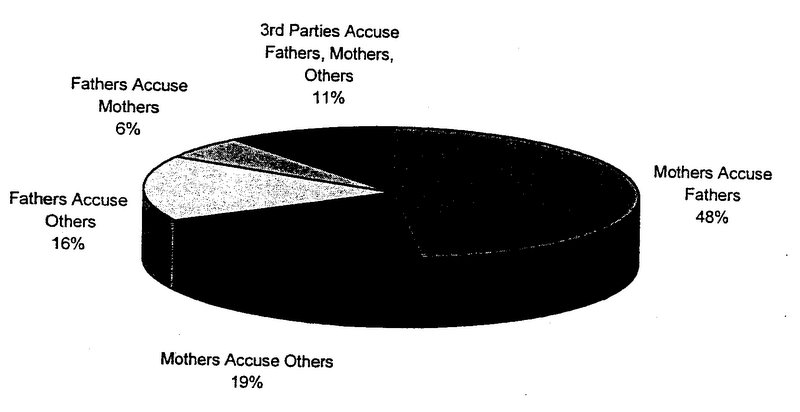
*From:
Thoennes N & Tjaden PG. (1990). The extent, nature, and validity of sexual abuse allegations in custody/visitation disputes. Child Abuse and Neglect 141151-163.
52
Characteristics of a Child-Focused, Non-Fabricating Parent
Versus
Characteristics of an Ex-Spouse-Focused, Suspect Parent
*This is not a check list - just some guidelines
1. Expresses remorse for not protecting the child sufficiently to prevent the abuse.
Versus
Expresses little or no remorse for child only vindictiveness towards ex-spouse.
2. Willing to consider other possible explanations for the behavior or statements that aroused their suspicion.
Versus
Unwilling to consider any other explanation of the child's statements, behavior, or symptoms.
3. Willing to have the child interviewed without being present.
Versus
Insists on being present when the child is interviewed and prompts her when she is questioned about the abuse.
4. Concerned about the impact on the child if he/she has to testify.
Versus
Is eager for the child to testify at all costs.
5. If allegations cannot be verified, they are willing to let go of the investigatory process so long as the child's well-being can be monitored through therapy or some other process.
Versus
53
Shop for other professionals who will verify her suspicions and involve the child in multiple examinations so the investigation can continue, irrespective of the impact the process is having on the child.
Adapted from:
Bresee P., Stearns, G. B., Bess, B. H. & Packer, L. S. (1986). American Journal of Orthopsychiatry. 56(4).
54
Reprinted with permission from:
Faller, K, Corwin, D. L. & Olafson, E. (1993). Literature review: Research on false allegations of sexual abuse in divorce. The APSAC Advisor 6(3). 7-10.
Literature Review:
Research on False Allegations of Sexual Abuse in Divorce
Kathleen Coulborn Faller, David L. Corwin, and Erna Olafson
Introduction
The statement, "There is an epidemic of false allegations of sexual abuse in divorce cases," is regarded by some as a truism. The argument is that women seeking to win custody of their children, to cut off the father's visitation, or to wreak vengeance on former spouses, falsely accuse them of child sexual abuse (Mantell, 1988; Renshaw, 1985; 1986). Such is the assertion of accused fathers, their attorneys (Gordon, 1985), and their expert witnesses (Blush and Ross, 1986; Gardner, 1989). Moreover, the media have supported and broadcast these views, and many professionals with mandated responsibility for these cases, including child protection workers, law enforcement personnel, and, most importantly, judges, have come to believe that abuse allegations during divorce are likely to be false.
Are there any empirical findings that lend credibility to the view that most allegations of child abuse in divorce are false? In this article, literature addressing this issue will be critically reviewed, looking specifically at data cited, sample size, any sample biases, and the criteria employed to determine the veracity of the allegation.
Studies Providing No Data
Writers holding the most extreme positions and promulgating new "syndromes" provide no data to support their statements (Blush and Ross, 1986; Gardner, 1987).
Blush and Ross have propounded the Sexual Allegations in Divorce (SAID) Syndrome, the overwhelming majority of which they assert are false. These false allegations are fostered by mothers, whom Blush and Ross label psychotic or hysterical (dominated, dominating, or "justified vindicators"). They advise that almost no weight should be given to any statement made by the child, and in practice they may not even interview the child. However, Blush and Ross maintain, great weight should be given to the fact that these allegations are made by mothers who wish to restrict their ex-partners' access to their children (Ross, 1988). Blush and Ross find fathers much less likely to make false allegations, and describe those who do as rigid and hypercritical of their estranged wives. Falsely accused men are also described as inadequate, dependent, and passive, descriptors the authors also apply to incest perpetrators.
Since no data are provided, there is no way to evaluate the SAID Syndrome, other than to note that the admonition to put little weight on children's accounts is contrary to general practice (see Conte et al., 1991).
* APSAC is a multidisciplinary society for professionals in the field of child maltreatment. For more information, call (312) 554-0166.
55
Perhaps even stronger views are held by Gardner (1987; 1989; 1991; 1992), who has defined the Parental Alienation Syndrome (PAS), which is manifest in children who "view one parent as all good and the other as all bad." These children have been "programmed by their mothers to hate their father and to subject him to a campaign of denigration" (Gardner, 1992, p. 160). Among the material the mother sometimes also programs the child to believe is that the father has sexually abused him/her. When an allegation arises after a dispute over custody, Gardner believes it possesses a "high likelihood of being false" (Gardner, 1991, p. 4).
A companion to the PAS is the Sexual Abuse Legitimacy Scale (SALS, Gardner, 1987). The present version (1992) contains 84 differentiating criteria, 24 of which apply to the alleged offender, 30 to the child, and 30 to the mother. Many of these criteria relate specifically to allegations of abuse in divorce. For example, if one finds, in examining the mother, "the presence of a child custody dispute and/or litigation," "enlistment of the services of a 'hired gun' attorney or mental health professional," or "history of attempts to destroy, humiliate, or wreak vengeance on the accused," her allegations are less likely to be true, according to Gardner.
Gardner presents no data to validate either the PAS or the SALS. Therefore, the utility of the scales cannot be evaluated. Most of Gardner's writing on these topics is not peer reviewed and is published through his own press.
Studies Involving Small Samples
The first and oft-cited clinical study of false allegations of sexual abuse in divorce involved a single case and reference to a second one (Kaplan and Kaplan, 1981). In the case, described in detail, an 11-year-old boy and his 5-year-old sister made allegations against their father and paternal grandparents. Both children had testified numerous times in court about the abuse and persisted in their accusations when challenged. Indeed, the Kaplans describe one particularly stormy session in which the boy is confronted simultaneously by the paternal grandparents and one of the Drs. Kaplan. Because, during this session, the boy partially recanted and said he had only been anally penetrated once instead of numerous times, the Kaplans conclude that his allegation is false. His partial recantation also led them to doubt the sister's account even though, in addition to her statements, she had a number of behavioral and emotional symptoms of sexual victimization. The Kaplans propose the possible dynamic offolie a deux as an explanation for the children's allegations, despite the fact there was no delusional thinking diagnosed in either child, the mother, or the maternal grandparents, who were supportive of the allegations, and despite the fact that the allegations originated with the children rather than a dominant adult.
Another frequently quoted study is that of Schuman (1986), who cites seven cases determined to be false on the basis of "psychodynamic formulation" and court determinations, out of an unknown number seen in his practice of probate and family court cases. Six of these were sexual abuse allegations against a father or stepfather; the seventh was a physical abuse case. The psychodynamic explanation for the false allegations was regression by the child and the accusing adult; in addition, in some instances (Schuman does not say how many) this adult retracted the allegation. This study is limited by its small sample size and by the lack of an empirical basis for the criteria Schuman uses to determine that allegations are false.
A study that has excited quite a lot of controversy is one reported by Green (1986) involving 11 cases from his practice, four of which (36%) he believed to be false. From these four cases, he generates criteria indicative of a false allegation, including easy disclosure, no evidence of negative affect, use of adult sexual terminology, checking with the accusing parent (mother) during the interview, and an ability to confront the father with the accusation. Falsely accusing mothers are described as hysterical and paranoid.
56
Green's conclusions were challenged because of the size and bias of his sample, and because one of his "false" cases was deemed possibly valid by two other experts in child sexual abuse (which would reduce his rate of false cases to 27%). His paper occasioned a rebuttal article (Corwin, Berliner, Goodman, Goodwin, and White, 1987) as well as a letter to the editor of the journal that published the original article, challenging its findings (Hanson et al., 1988). Among other things, Corwin and colleagues point out that there is a difference between a false (no abuse) and an unsubstantiated case (a null finding). In addition, they note that marital dissolution may increase the risk of sexual abuse and increase the likelihood of disclosure of pre-existing incest.
Benedek and Schetky (1985) also present findings from their private practices. They were interested in studying the characteristics of false allegations in divorce, and Benedek (1987) reports screening at intake to include suspected false cases and to exclude ones that appeared to be true. Fourteen of the 18 cases they assessed involved custody or visitation disputes in the context of divorce (four involved other issues related to custody). The authors thought that 10 of their cases were false (71% of 14 and 56% of 18). Not surprisingly, since they screened for false cases, this is the highest false allegation rate reported by any author presenting case data. All but one of the allegedly false allegations were made by mothers. It is not clear what criteria Benedek and Schetky used to determine that allegations were false; among the explanatory factors they cited were that the mother suffered from psychiatric disturbance ("paranoia" was the diagnosis most frequently mentioned by the authors), or wished to exclude their ex-spouses from their lives, were being vindictive, or were "crying wolf." A much larger study (576 cases ) of sexual abuse cases referred to child protective services provided findings relevant to the issue of sexual abuse and divorce (Jones and McGraw, 1987). Criteria employed in classifying the cases as likely true or likely false consisted of source of report, child's emotional state, physical evidence, confessions, polygraph results, and court role. Of the 5% of cases which a team of sexual abuse experts determined were "fictitious" allegations by adults, a large proportion involved contested custody or visitation. These findings suggest that false accusations are very rare generally, but may be more common in the context of custody disputes. In a subsequent study by Jones and Seig (1988), 20 divorce cases involving accusations of sexual abuse from the Kempe Center were evaluated using the Jones and McGraw (1987) criteria to ascertain the rate of fictitious allegations. Four cases (20%) were determined to be fictitious, 14 (70%) reliable, and 2 (10%) uncertain. In this study, the authors observed that factors thought to be characteristic of false allegations were noted in the reliable cases, and characteristics expected in reliable cases were noted in the fictitious ones.
Using the criteria developed by Jones and McGraw (1987) and used by Jones and Seig (1988), McGraw and Smith (1992) re-examined 18 cases referred to Boulder County Protective Services involving sexual abuse allegations in the context of divorce, all but one of which had been unfounded after CPS investigation. The results of this re-examination were that eight cases (44.4%) were founded, seven cases (39%) had insufficient information or unsubstantiated suspicion, and three (16.5%) were fictitious (one from a child and two from adults). The authors admonish investigators and clinicians to keep an open mind when investigating such cases, rather than assuming that they will be false.
Studies Comparing Divorce Cases to Other Sexual Abuse Cases
Two studies compare results from divorce and non-divorce cases. Paradise, Rostain, and Nathanson (1988) examined 31 cases (25 from Children's Hospital of Philadelphia and six from the first author's private practice), 12 of which involved divorce. Those cases involving divorce were significantly less likely to be substantiated: 67% substantiation rate in divorce cases vs. 95% substantiation rate in cases not involving divorce. In addition, children in the divorce group were significantly younger (5.4 years
57
vs. 7.8); this age difference may have affected substantiation rates, since cases involving younger children may be generally more difficult to substantiate (Thoennes and Tjaden, 1990). Hlady and Gunter (1990) examined the records of 370 children seen at the Child Protection Service Unit at British Columbia Children's Hospital. One hundred seventeen children were primarily referred for alleged physical abuse, and 253 for alleged sexual abuse. Forty-one children were the objects of custody disputes. Surprisingly, children involved in custody disputes were more likely to exhibit physical findings (75% had findings of physical abuse, 17.6% had findings of sexual abuse) than were children not involved in custody disputes (43.6% showing findings of physical abuse, 15% of sexual abuse). Generalizations from these data must be cautious, since the number of custody cases with allegations of physical abuse was small, and the difference on sexual abuse cases was not significant. However, these data suggest that sexual abuse allegations made in the context of divorce are at least as likely to have the corroboration of medical findings.
More studies comparing commonly evaluated characteristics of sexual abuse cases in divorce and other contexts would be very useful.
Studies Involving Larger Samples
To date, there are two pieces of research with samples larger than 100 cases. Faller (1990) studied 136 cases involving divorce that were referred to the University of Michigan Interdisciplinary Project on Child Abuse and Neglect, which includes a tertiary care program for evaluation of child maltreatment cases. Using criteria derived from a study of confessed cases, Faller determined the likelihood of sexual abuse in her sample. These criteria included (1) description of the sexual abuse; (2) details about the context; and (3) affect congruent with allegations and circumstance. Faller categorized these cases into six groups: cases in which disclosure of apparently true abuse leads to divorce (N=l 1; 8.1%); cases in which divorce leads to disclosure of apparently true abuse by the child or belief by the parent (N=26; 19.1%); cases in which divorce leads to sexual abuse (N=52; 38.2%); cases in which apparently false allegations arise in an atmosphere of acrimony surrounding the divorce (N=19; 14%); cases in which false allegations may have been made (N=12; 8.8%); and cases in which other dynamics were at work (N=16; 11.8%). Of the 19 cases involving apparently false allegations, three appeared to be consciously made; two of these three intentionally false allegations were made by fathers.
By far the most important study to date is that conducted by the Association of Family and Conciliation Courts Research Unit (Thoennes, Pearson, and Tjaden, 1988; Thoennes and Tjaden, 1990). The researchers surveyed 9,000 divorce cases involving custody/visitation disputes from 12 domestic relations courts to determine how many such disputes involve allegations of sexual abuse. The researchers found allegations of child sexual abuse in less than two percent (169) of these cases. In 129 cases, the question of sexual abuse was addressed by the domestic relations court. Accusations were made by mothers (67%), fathers (28%), and third parties (11%). Fewer than half of cases involved mothers making accusations against the fathers of children.
Using the Child Protective Services determination and/or the report of a court-appointed mental health evaluator as the criteria for substantiation, the researchers found that 50% of cases were likely, 33% were unlikely, and 17% were uncertain (which included cases in which two evaluators held different opinions). They also attempted to discern the motivation for unlikely reports and found 58 cases in which the case material addressed that issue. In eight cases, child protective service workers thought the allegation was maliciously made. Factors associated with cases being classified as unlikely or uncertain were younger age of the child, a single incident alleged, non-intrusive sexual behavior, a single report, a report less than two years since the filing for divorce, and animosity between the parents.
58
Conclusions
On the basis of the research that has been conducted so far, it is difficult to support an assertion that there are high rates of false allegations of sexual abuse consciously made by mothers in divorce situations.
There is no way to evaluate authors' opinions not supported by data. Thus all that can be said about the SAJD Syndrome and the Parental Alienation Syndrome is that they express the authors' opinions. Moreover, the language used in both suggests a bias against mothers concerned about sexual abuse of their children.
The remainder of the research can be evaluated regarding possible sample biases, sample size, and criteria used to determine that the allegation is false.
With the exception of the research supported by the Association of Family and Conciliation Courts (Thoennes and Tjaden, 1988; Thoennes and Tjaden, 1990) and that by Paradise and colleagues (1988), all of the studies cited rely on cases from a single source. A single site or source may introduce biases based upon geography, the authors' selection criteria, and the reputation of the clinician or the site. Selection criteria include such factors as Benedek's screening for cases she thought might be false, or Faller's taking cases referred by another agency. Payment source for the service may also determine the sorts of cases seen at a particular site. In addition, cases seen in private practices are likely to differ from those seen at an agency or at a hospital.
Sample size is also very important in weighing the utility and potential validity of findings. It is very difficult to draw any conclusions from samples smaller than 20 cases. Particularly problematic is the situation in which the writer draws conclusions about characteristics of false allegations from a subset of a small sample, as does Green (1986).
The most difficult problem in evaluating research on allegations of child sexual abuse is evaluating the criteria researchers use to assess the veracity of allegations. To test these criteria, researchers need to see if they are in fact reflected in a sample of cases proven false or true by some independent measure (for example, that the offender never had access to the victim, or, alternatively, that the offender gave a complete, detailed confession). Since such samples are hard to find and indeed may be unrepresentative, research on the veracity of child sexual abuse allegations cannot draw upon them. Most writers use their clinical judgment, the consensus of several clinicians or experts, or a legally supported decision, such as the disposition of the child protection agency, the conclusion of a court-appointed expert, or a judge's opinion. All of these have limitations. Jones' and Seig's (1988) determination that cases thought to be reliable had characteristics of false reports and vice versa is illustrative. So is the Association of Family and Conciliation Courts' classification of cases as "uncertain" when two opinions disagreed.
Moreover, there is a fair amount of disagreement among writers about characteristics of false allegations. Indeed, one professional's indicator of a false allegation may be another's indicator of a true one. In addition, some criteria lend themselves to a variety of interpretations, either in the context of a single case, or depending upon the case.
When the research is examined critically, the strongest study is that conducted by the Association of Family and Conciliation Courts, because of its large sample, its use of multiple sites, and the fact that cases are fairly representative of the total population of divorce cases with disputes over custody and visitation. Its findings indicate that sexual abuse allegations do occur in the context of divorce, but the overwhelming majority (98%) of disputed custody cases do not involve sexual abuse accusations. Moreover, although the majority of charges are brought by mothers, by no means all are. The predominance of women as accusers and men as accused is consistent with the finding that the majority of offenders are men. This study and that of Faller contradict the assertion by others that
59
Where the Association of Family and Conciliation Courts may be weaker than other studies is in the criteria it used to judge the veracity of an allegation: the child protective services determination or a court-appointed mental health professional's opinion. Perhaps criteria such as those based on a consensus of experts or a collaborative decision (Jones and McGraw, 1987; Jones and Seig, 1988; McGraw and Smith, 1992) or derived indirectly from cases substantiated by confession (Faller, 1990) are more accurate. Interestingly, substantiation rates tend to be higher in such studies and uncertainty rates lower.
Altogether 11 data-based articles about sexual abuse allegations in divorce are cited here. This number is too small to draw more than tentative conclusions. Moreover, characteristics of allegations in divorce may be influenced by increased public education and experience regarding sexual abuse, so that samples that are just five years old may not reflect current caseloads. Perhaps the likelihood of a parent making a false allegation in divorce has increased because of greater awareness of sexual abuse and of the potential power of an allegation. Conversely, adults may be cognizant of the recent outcomes in such cases. These include disbelief by the court or refusal to hear evidence of sexual abuse, incarceration of the parent who refuses visitation, loss of custody by the parent alleging sexual abuse, and negative experiences of parents, who with their children may go so far as to enter the "underground" to avoid court decisions. This knowledge may result in parents becoming less likely to raise a legitimate concern about sexual abuse because the legal consequences may further traumatize a child and family without stopping the abuse.
References
Benedek, E. Court Tstimony. E. Morgan v. E. Foretich, V. Foretich, and D. Foretich. Alexandria, VA: United States District Court, February 18, 1987.
Blush, G., Ross, K. Sexual Allegations in Divorce: The SAID Syndrome. Unpublished manuscript available from the Psychodiagnostic Clinic, Macomb County Circuit Court, Mt. Clemens, MI, 1986.
Coote, J., Sorenson, E., Fogarty, L., Dalla Rosa, J. Evaluating Children's Reports of Sexual Abuse: Results from a Survey of Professionals. American Journal of Orthopsychiatry, 1991, 61:2.
Corwin, D., et al. Child Sexual Abuse and Custody Disputes: No Easy Answers. Journal of Interpersonal Violence 1987,2(1): 91-105.
Faller, K. Criteria for Judging the Credibility of Children's Statements about Their Sexual Abuse. Child Welfare 1988, 67(5):3 89-401.
Faller, K. Possible Explanations for Child Sexual Abuse Allegations in Divorce. American Journal of Orthopsychiatry 1991, 61(1):86-91.
Gardner, R. Differentiating between Bona Fide and Fabricated Allegations of Sexual Abuse of Children. Journal of the American Academy of Matrimonial Lawyers 1989, 5:1-25.
Gardner, R. The Parental Alienation Syndrome and the Differentiation between Fabricated and Genuine Child Sexual Abuse. Cresskill, New Jersey: Creative Therapeutics, 1987.
Gardner, R. True and False Allegations of Child Sex Abuse. Cresskill, New Jersey: Creative Therapeutics, 1987.
Gardner, R. Sex Abuse Hysteria: Salem Witch Trials Revisited. Cresskill, New Jersey: Creative Therapeutics, 1991.
60
Gardner, R. True and False Allegations of Child Sex Abuse. Cresskill, New Jersey: Creative Therapeutics, 1992.
Gordon, C. False Allegations of Abuse in Child Custody Disputes. Minnesota Family Law Journal 1985, 2(14):225-228.
Green, A. True and False Allegations of Sexual Abuse in Child Custody Disputes. Journal of the American Academy of Child Psychiatry 1986,25:449-455.
Hanson, G. The Sex Abuse Controversy: Letter to the Editor. Journal of the American Academy of Child and Adolescent Psychiatry 1988, 27:258.
Hlady, L., Gunter, E. Alleged Child Abuse in Custody Access Disputes. Child Abuse and Neglect 1990, 14(4):591-594.
Jones, D., McGraw, M. Reliable and Fictitious Accounts of Sexual Abuse to Children. Journal of Interpersonal Violence 1987,2(l):27-45.
Jones, D., Seig, A. Child Sexual Abuse Allegations in Custody or Visitation Cases: A Report of 20 Cases. In: B. Nicholson and J. Bulkley (Eds.), Sexual Abuse Allegations in Custody and Visitation Cases. Washington, DC: American Bar Association, 1988.
Kaplan, S., Kaplan, S. The Child's Accusation of Sexual Abuse during a Divorce and Custody Struggle. Hillside Journal of Clinical Psychiatry 1981, 3(l):81-95.
McGraw, J., Smith, H. Child Sexual Abuse Allegations Amidst Divorce and Custody Proceedings: Refining the Validation Process. Journal of Child Sexual Abuse 1992, l(l):49-62.
Mantell, D. Clarifying Erroneous Child Sexual Abuse Allegations. American Journal of Orthopsychiatry 1988, 58(4):618-621.
Paradise, J., Rostain, A., Nathanson, M. Substantiation of Sexual Abuse Charges When Parents Dispute Custody or Visitation. Pediatrics 1988, 81(6):835-839.
Renshaw, D. Child Sexual Abuse: When Wrongly Charged. Encyclopedia Britannica Medical and Health Annual 1987, 301-303.
Renshaw, D. When Sexual Abuse Is Wrongly Charged. Medical Aspects of Human Sexuality 1985, 19(7):116-121.
Ross, K. SAID Syndrome: Fact or Fallacy. Workshop at Grand Valley State University, Grand Rapids, MI, May 1988.
Schetky, D. Allegations of Sexual Abuse in Child Custody Cases. In: E. Benedek and D. Schetky (Eds.), Emerging Issues in Child Psychiatry and the Law. New York, NY: Brunner/Mazel, 1985, 145-156.
Schuman, D. False Allegations of Physical and Sexual Abuse. Bulletin of the American Academy of Psychiatry and the Law 1986, 14(1):5-21.
Thoennes, N., Pearson, J., Tjaden, P. Allegations of Sexual Abuse in Custody and Visitation Cases. Denver, CO: Association of Family and Conciliation Courts, 1988.
Thoennes, N., Tjaden, P. The Extent, Nature, and Validity of Sexual Abuse Allegations in Custocry/Visitation Disputes. Child Abuse and Neglect 1990,14:151-163.
61
Selected Bibliography on Child Sexual Abuse Allegations Amidst Divorce/Custody Disputes
Compiled by CornerHouse
Benedek, E.P. & Schetky, D.H. (1986). Allegations of sexual abuse in child custody and visitation disputes. In: D.H. Schetky & E.P. Benedek (Eds.), Emerging issues in child psychiatry and the law. New York: Brunner/Mazel, 145-158.
Breese, P.G., Stearns, G., Bess, B. & Packer, L. (1986). Allegations of child sexual abuse in child custody disputes: A therapeutic assessment model. American Journal of Orthopsychiatry. 56(4) 56-568.
Children's Forensic Institute. Sexually abused children's bill of rights. Available from the Children's Forensic Institute, 650 Poydras St., Suite 2030, New Orleans, LA 70130.
Commentary: Berliner, L. (1990). Protecting or harming? Parents who flee with their children. Lloyd D. Disobedience to a judicial order. An inappropriate action. Fisher D. Why parents run. Journal of Interpersonal Violence. 5(1), 119-127.
Corwin, D., Berliner, L., Goodman, G., Goodwin, J. & White, S. (1987). Child sexual abuse and custody disputes: No easy answers. Journal of Interpersonal Violence, 2(1), 91-105.
Faller, K.C. (1990). Understanding child sexual maltreatment. Newbury Park, CA: Sage Publications, 211 -240.
Galtney, L. (1993). Mothers on the run. U.S. News & World Report. June 13.22-33.
Green, A. (1986). True and false allegations of sexual abuse in child custody disputes. Journal of the American Academy of Child Psychiatry, 25, 449-456.
Hopkins, E. (1988). Fathers on trial. New York. January 11.42-49.
MacFarlane, K. (1986). Child sexual abuse allegations in divorce proceedings. In: K. MacFarlane, J. Waterman, et al. (Eds.), Sexual abuse of young children. New York: The Guilford Press, 121-150.
Nicholson, B. (Ed.). (1988). Sexual abuse allegations in custody and visitation cases. Washington, DC: American Bar Association Center on Children and the Law.
Paradise, J., Rostain, A. & Nathanson, M. (1988). Substantiation of sexual abuse charges when parents dispute custody or visitation. Pediatrics. 81(6). 835-839.
Podesta, J.S. & Van Biema, D. (1989) Running for their lives. People. January 23. 70-88.
Thoennes, N. & Tjaden, P.G. (1990). The extent, nature, and validity of sexual abuse allegations in custody/visitation disputes. Child Abuse and Neglect 14(2\ 151 -163.
62
Legal
63
(Current through May 2003)
ALABAMA-
Code of Ala. § 15-25-2 (2003)
Videotaped deposition
CRIMES: Physical offense, sexual offense and sexual exploitation.
AGE: Under 16 when the judge issues the order for a deposition.
APPLICABILITY: Victim or witness.
TEXT:
(a) In any criminal prosecution referred to in Section 15-25-1, the court may, upon motion of the district attorney, for good cause shown and after notice to the defendant, order the taking of a videotaped deposition of an alleged victim of or witness to said crime who is under the age of 16 at the time of such order. On any motion for a videotaped deposition of the victim or a witness, the court shall consider the age and maturity of the child, the nature of the offense, the nature of testimony that may be expected, and the possible effect that such testimony in person at trial may have on the victim or witness, along with any other relevant matters that may be required by Supreme Court rule. During the taping of videotaped depositions, the attorney of the parents of the child would be allowed to be present at the tapings. If the court orders that a deposition of the victim or witness shall be had as provided herein, the district attorney shall make all necessary arrangements to have the same videotaped.
Such deposition shall be taken before the judge in his chambers or in such other suitable location as the court may direct and shall be conducted in the presence of the district attorney, the defendant and his attorney, and such other persons as the court in its discretion may permit, taking into consideration the welfare and well-being of the alleged child victim or witness. Examination and cross-examination of the alleged victim or witness shall proceed at the taking of the videotaped deposition as though the alleged victim or witness were testifying personally in the trial of the case. The state shall provide the attorney for the defendant with reasonable access and means to view and hear the videotaped deposition at a suitable and reasonable time prior to the trial of the case. Objections to the introduction into the record of such deposition shall be heard by the judge in whose presence the deposition was taken, and unless the court determines that its introduction in lieu of the victim's or witness's actual appearance as a witness at the trial will unfairly prejudice the defendant, such videotaped deposition shall be entered into the record by the state in lieu of the direct testimony of the alleged victim or witness and shall be viewed and heard at the trial of the case.
(b) For the purposes of this section, "videotaped deposition" means the visual recording on a magnetic tape, together with the associated sound of a witness testifying under oath to be entered in the record in a judicial proceeding.
(c) The Supreme Court may adopt rules of procedure regarding the taking and use of videotaped depositions in criminal proceedings and juvenile cases, as well as for the transcribing of such in the event the case is thereafter appealed.
64
(d) All costs associated with the videotaping of a deposition ordered pursuant to this article shall be paid by the state. The district attorney shall submit all such cost bills to the State Comptroller for approval and payment from the fund entitled "Court Costs Not Otherwise Provided For."
(e) All videotapes ordered pursuant to this article shall be subject to any protective order of the court for the purpose of protecting the privacy of the victim of the offense.
ARIZONA
A.R.S. § 13-4252 (2003)
Recording of testimony
CRIMES: Any. AGE: Under 15.
APPLICABILITY: Victim or witness. TEXT:
A. The recording of an oral statement of a minor made before a proceeding begins is admissible into evidence if all of the following are true:
1. No attorney for either party was present when the statement was made.
2. The recording is both visual and aural and is recorded on film or videotape or by other electronic means.
3. Every voice on the recording is identified.
4. The person conducting the interview of the minor in the recording is present at the proceeding and available to testify or be cross-examined by either party.
5. The defendant or the attorney for the defendant is afforded an opportunity to view the recording before it is offered into evidence.
6. The minor is available to testify.
7. The recording equipment was capable of making an accurate recording, the operator of the equipment was competent and the recording is accurate and has not been altered.
8. The statement was not made in response to questioning calculated to lead the minor to make a particular statement.
B. If the electronic recording of the oral statement of a minor is admitted into evidence under this section, either party may call the minor to testify and the opposing party may cross-examine the minor.
ARKANSAS
A.C.A. § 16-44-203 (2003)
Videotaped deposition of alleged victim under 17 years of age in sexual offense prosecution
CRIMES: Sexual offense or attempt of a sexual offense.
65
AGE: Under 17.
APPLICABILITY: Alleged victim. TEXT:
(a) As used in this section, the term "videotaped deposition" means the visual recording on a magnetic tape, together with the associated sound, of a witness testifying under oath in the course of a judicial proceeding, upon oral examination and where an opportunity is given for cross-examination in the presence of the defendant and intended to be played back upon the trial of the action in court.
(b) In any prosecution for a sexual offense or criminal attempt to commit a sexual offense against a minor, upon motion of the prosecuting attorney and after notice to the opposing counsel, the court may, for good cause shown, order the taking of a videotaped deposition of any alleged victim under the age of seventeen (17) years. The videotaped deposition shall be taken before the judge in chambers in the presence of the prosecuting attorney, the defendant, and the defendant's attorneys. Examination and cross-examination of the alleged victim shall proceed at the taking of the videotaped deposition in the same manner as permitted at trial under the provisions of the Arkansas Uniform Rules of Evidence.
(c) Any videotaped deposition taken under the provisions of this section shall be admissible at trial and received into evidence in lieu of the direct testimony of the alleged victim. However, neither the presentation nor the preparation of such videotaped deposition shall preclude the prosecutor's calling the alleged victim to testify at trial if that is necessary to serve the interests of justice.
(d) Videotapes which are a part of the court record are subject to a protective order of the court for the purpose of protecting the privacy of the alleged victim.
CALIFORNIA
Cal Pen Code § 1346(2003) § 1346.
Videotaping of victim's preliminary hearing testimony; Admission of videotape at trial
CRIMES: Assault with intent to commit mayhem or specified sex offenses; Sexual battery; Seriously disabled or medically incapacitated victims; Rape; "Duress"; "Menace"; Unlawful sexual intercourse with a minor, Misdemeanor or felony violation; Civil penalties; Punishment for aiding or abetting rape; Endangering child or causing or permitting child to suffer physical pain, mental suffering, or injury; Infliction of corporal punishment or injury on child resulting in traumatic condition; Incest; Sodomy; Lewd or lascivious acts involving children; Oral copulation; Continuous sexual abuse of child; Penetration by foreign object; Annoying or molesting children
AGE: 15 or under.
APPLICABILITY: Victim.
TEXT:
(a) When a defendant has been charged with a violation of Section 220,243.4,261,261.5,264.1, 273a, 273d, 285,286,288,288a, 288.5,289, or 647.6, where the victim either is a person 15 years of age or less or is developmentally disabled as a result of mental retardation, as specified in subdivision
66
(a) of Section 4512 of the Welfare and Institutions Code, the people may apply for an order that the victim's testimony at the preliminary hearing, in addition to being stenographically recorded, be recorded and preserved on videotape.
(b) The application for the order shall be in writing and made three days prior to the preliminary hearing.
(c) Upon timely receipt of the application, the magistrate shall order that the testimony of the victim given at the preliminary hearing be taken and preserved on videotape. The videotape shall be transmitted to the clerk of the court in which the action is pending.
(d) If at the time of trial the court finds that further testimony would cause the victim emotional trauma so that the victim is medically unavailable or otherwise unavailable within the meaning of Section 240 of the Evidence Code, the court may admit the videotape of the victim's testimony at the preliminary hearing as former testimony under Section 1291 of the Evidence Code.
(e) Any videotape which is taken pursuant to this section is subject to a protective order of the court for the purpose of protecting the privacy of the victim. This subdivision does not affect the provisions of subdivision (b) of Section 868.7.
(f) Any videotape made pursuant to this section shall be made available to the prosecuting attorney, the defendant, and his or her attorney for viewing during ordinary business hours. Any videotape which is made available pursuant to this section is subject to a protective order of the court for the purpose of protecting the privacy of the victim.
(g) The tape shall be destroyed after five years have elapsed from the date of entry of judgment; provided, however, that if an appeal is filed, the tape shall not be destroyed until a final judgment on appeal has been rendered.
COLORADO
C.R.S. 18-3-413 (2002)
Video tape depositions - children - victims of sexual offenses
CRIMES: Unlawful sexual assault.
AGE: Under 15
APPLICABILITY: Victim
TEXT:
(1) When a defendant has been charged with an unlawful sexual offense, as defined in section 18-3-411 (1), and when the victim at the time of the commission of the act is a child less than fifteen years of age, the prosecution may apply to the court for an order that a deposition be taken of the victim's testimony and that the deposition be recorded and preserved on video tape.
(2) The prosecution shall apply for the order in writing at least three days prior to the taking of the deposition. The defendant shall receive reasonable notice of the taking of the deposition.
(3) Upon timely receipt of the application, the court shall make a preliminary finding regarding whether, at the time of trial, the victim is likely to be medically unavailable or otherwise unavailable within the meaning of rule 804 (a) of the Colorado rules of evidence. Such finding shall be based on, but not be limited to, recommendations from the child's therapist or any other person having direct contact with the child, whose recommendations are based on specific behavioral indicators exhibited by the child. If the court so finds, it shall order that the deposition be taken, pursuant to rule 15 (d) of
67
the Colorado rules of criminal procedure, and preserved on video tape. The prosecution shall transmit the video tape to the clerk of the court in which the action is pending.
(4) If at the time of trial the court finds that further testimony would cause the victim emotional trauma so that the victim is medically unavailable or otherwise unavailable within the meaning of rule 804 (a) of the Colorado rules of evidence, the court may admit the video tape of the victim's deposition as former testimony under rule 804 (b) (1) of the Colorado rules of evidence.
(5) Nothing in this section shall prevent the admission into evidence of any videotaped statements of children which would qualify for admission pursuant to section 13-25-129, C.R.S., or any other statute or rule of evidence.
RECENT CHANGES: Revised to include incest.
LEXSEE 2003 Colo. SB 147 - See section 6.
18-3-413 (1), Colorado Revised Statutes, is amended to read:
18-3-413. Video tape depositions - children - victims of sexual offenses. (1) When a defendant has been charged with an unlawful sexual offense, as defined in section 18-3-411 (1), [A> OR INCEST, AS DEFINED IN SECTION 18-6-301, <A] and when the victim at the time of the commission of the act is a child less than fifteen years of age, the prosecution may apply to the court for an order that a deposition be taken of the victim's testimony and that the deposition be recorded and preserved on video tape.
C.R.S. 18-6-401.3(2002) 18-6-401.3.
Video tape depositions - children - victims of child abuse
CRIMES: Child Abuse
AGE: Under 15
APPLICABILITY: Victim
TEXT:
(1) When a defendant has been charged with an act of child abuse, as defined in section 18-6-401 (1), and when the victim at the time of the commission of the act is a child less than fifteen years of age, the prosecution may apply to the court for an order that a deposition be taken of the victim's testimony and that the deposition be recorded and preserved on video tape.
(2) The prosecution shall apply for the order in writing at least three days prior to the taking of the deposition. The defendant shall receive reasonable notice of the taking of the deposition.
(3) Upon timely receipt of the application, the court shall make a preliminary finding regarding whether, at the time of trial, the victim is likely to be medically unavailable or otherwise unavailable within the meaning of rule 804 (a) of the Colorado rules of evidence. Such finding shall be based on, but not be limited to, recommendations from the child's therapist or any other person having direct contact with the child, whose recommendations are based on specific behavioral indicators exhibited by the child. If the court so finds, it shall order that the deposition be taken, pursuant to rule 15 (d) of the Colorado rules of criminal procedure, and preserved on video tape. The prosecution shall transmit the video tape to the clerk of the court in which the action is pending.
(4) If at the time of trial the court finds that further testimony would cause the victim emotional trauma so that the victim is medically unavailable or otherwise unavailable within the meaning of rule 804 (a) of the Colorado rules of evidence, the court may admit the video tape of the victim's deposition as former testimony under rule 804 (b) (1) of the Colorado rules of evidence.
68
(5) Nothing in this section shall prevent the admission into evidence of any videotaped statements of children that would qualify for admission pursuant to section 13-25-129, C.R.S., or any other statute or rule of evidence.
CONNECTICUT
Conn. Gen. Stat. § 54-86g (2003)
Testimony of victim of child abuse. Court may order testimony taken outside courtroom. Procedure.
CRIMES: Assault, sexual assault, abuse of a child 12 years old or younger.
AGE: 12 or younger.
APPLICABILITY: Victim
TEXT:
(a) In any criminal prosecution of an offense involving assault, sexual assault or abuse of a child twelve years of age or younger, the court may, upon motion of the attorney for any party, order that the testimony of the child be taken in a room other than the courtroom in the presence and under the supervision of the trial judge hearing the matter and be televised by closed circuit equipment in the courtroom or recorded for later showing before the court. Only the judge, the defendant, the attorneys for the defendant and for the state, persons necessary to operate the equipment and any person who would contribute to the welfare and well-being of the child may be present in the room with the child during his testimony, except that the court may order the defendant excluded from the room or screened from the sight and hearing of the child only if the state proves, by clear and convincing evidence, that the child would be so intimidated, or otherwise inhibited, by the physical presence of the defendant that a compelling need exists to take the testimony of the child outside the physical presence of the defendant in order to insure the reliability of such testimony. If the defendant is excluded from the room or screened from the sight and hearing of the child, the court shall ensure that the defendant is able to observe and hear the testimony of the child, but that the child cannot see or hear the defendant. The defendant shall be able to consult privately with his attorney at all times during the taking of the testimony. The attorneys and the judge may question the child. If the court orders the testimony of a child to be taken under this subsection, the child shall not be required to testify in court at the proceeding for which the testimony was taken.
(b) In any criminal prosecution of an offense involving assault, sexual assault or abuse of a child twelve years of age or younger, the court may, upon motion of the attorney for any party, order mat the following procedures be used when the testimony of the child is taken: (1) Persons shall be prohibited from entering and leaving the courtroom during the child's testimony; (2) an adult who is known to the child and with whom the child feels comfortable shall be permitted to sit in close proximity to the child during the child's testimony, provided such person shall not obscure the child from the view of the defendant or the trier of fact; (3) the use of anatomically correct dolls by the child shall be permitted; and (4) the attorneys for the defendant and for the state shall question the child while seated at a table positioned in front of the child, shall remain seated while posing objections and shall ask questions and pose objections in a manner which is not mtimidating to the child.
69
DELAWARE
11 Del. C. §3511 (2002)
Videotaped deposition and procedures for child witnesses
CRIMES: Any criminal case or hearing on delinquency. AGE: Under 12. APPLICABILITY: Any witness. TEXT:
(a) In any criminal case or hearing on delinquency, upon motion of the Deputy Attorney General prior to trial and with notice to the defense, the court may order all questioning of any witnesses under the age of 12 years to be videotaped in a location designated by the court. Persons present during the videotaping shall include the witness, the Deputy Attorney General, the defendant's attorney and any person whose presence would contribute to the welfare and well-being of the witness, and if the court permits, the person necessary for operating the equipment. Only the attorneys or a defendant acting pro se may question the child. The court shall permit the defendant to observe and hear the videotaping of the witness in person or, upon motion by the State, the court may exclude the defendant providing the defendant is able to observe and hear the witness and communicate with the defense attorney. The court shall ensure that:
(1) The recording is both visual and oral and is recorded on film or videotape or by other electronic means;
(2) The recording equipment was capable of making an accurate recording, the operator was competent to operate such equipment and the recording is accurate and is not altered;
(3) Each voice on the recording is identified;
(4) Each party is afforded an opportunity to view the recording before it is shown in the courtroom.
(b) If the court orders testimony of a witness taken under this section, the witness may not be compelled to testify in court at the trial or upon any hearing for which the testimony was taken. At the trial or upon any hearing, a part or all of the videotaped deposition, so far as otherwise admissible under the rules of evidence, may be used as substantive evidence. If only a part of a deposition is offered in evidence by a party, an adverse party may require the party to offer all of it which is relevant to the part offered and any party may offer other parts. Objections to deposition testimony or evidence or parts thereof and the grounds for the objection shall be stated at the time of the taking of the deposition.
(c) The witness need not be physically present in the courtroom when the videotape is admitted into evidence.
(d) The cost of such videotaping shall be paid by the court.
(e) Videotapes which are part of the court record are subject to a protective order of the court for the purpose of protecting the privacy of the witness.
FLORIDA
Fla. Stat. § 92.53 (2002)
Videotaping of testimony of victim or witness under age 16 or person with mental retardation
CRIMES: Sexual abuse, child abuse.
70
AGE: Under 16.
APPLICABILITY: Victim or witness.
TEXT:
(1) On motion and hearing in camera and a finding that there is a substantial likelihood that a victim or witness who is under the age of 16 or who is a person with mental retardation as defined in s.
393.063(42) would suffer at least moderate emotional or mental harm due to the presence of the defendant if the child or person with mental retardation is required to testify in open court, or that such victim or witness is otherwise unavailable as defined in s. 90.804(1), the trial court may order the videotaping of the testimony of the victim or witness in a case, whether civil or criminal in nature, in which videotaped testimony is to be utilized at trial in lieu of trial testimony in open court.
(2) The motion may be filed by:
(a) The victim or witness, or the victim's or witness's attorney, parent, legal guardian, or guardian ad litem;
(b) A trial judge on his or her own motion;
(c) Any party in a civil proceeding; or
(d) The prosecuting attorney or the defendant, or the defendant's counsel.
(3) The judge shall preside, or shall appoint a special master to preside, at the videotaping unless the following conditions are met:
(a) The child or person with mental retardation is represented by a guardian ad litem or counsel;
(b) The representative of the victim or witness and the counsel for each party stipulate that the requirement for the presence of the judge or special master may be waived; and
(c) The court finds at a hearing on the motion that the presence of a judge or special master is not necessary to protect me victim or witness.
(4) The defendant and the defendant's counsel shall be present at the videotaping, unless the defendant has waived this right. The court may require the defendant to view the testimony from outside the presence of the child or person with mental retardation by means of a two-way mirror or another similar method that will ensure that the defendant can observe and hear the testimony of the victim or witness in person, but that the victim or witness cannot hear or see the defendant. The defendant and the attorney for the defendant may communicate by any appropriate private method.
(5) Any party, or the court on its own motion, may request the aid of an interpreter, as provided in s. 90.606, to aid the parties in formulating methods of questioning the child or person with mental retardation and in interpreting the answers of the child or person with mental retardation throughout proceedings conducted under this section.
(6) The motion referred to in subsection (1) may be made at any time with reasonable notice to each party to the cause, and videotaping of testimony may be made any time after the court grants the motion. The videotaped testimony shall be admissible as evidence in the trial of the cause; however, such testimony shall not be admissible in any trial or proceeding in which such witness testifies by use of closed circuit television pursuant to s. 92.54.
(7) The court shall make specific findings of fact, on the record, as to the basis for its ruling under this section.
71
HAWAII
HRS § 804 (2003)
Hearsay exceptions; declarant unavailable
CRIMES: Any act of sexual contact, sexual penetration or physical violence performed on or with a child.
AGE: Under 16. APPLICABILITY: Victim TEXT:
(b)(6) Statement by child. A statement made by a child when under the age of sixteen, describing any act of sexual contact, sexual penetration, or physical violence performed with or against the child by another, if the court determines that the time, content, and circumstances of the statement provide strong assurances of tmstworthiness with regard to appropriate factors that include but are not limited to: (A) age and mental condition of the declarant; (B) spontaneity and absence of suggestion; (C) appropriateness of the language and terminology of the statement, given the child's age; (D) lack of motive to fabricate; (E) time interval between the event and the statement, and the reasons therefor; and (F) whether or not the statement was recorded, and the time, circumstances, and method of the recording. If admitted, the statement may be read or, in the event of a recorded statement, broadcast into evidence but may not itself be received as an exhibit unless offered by an adverse party;
IDAHO (REPEALED in 2003)
Idaho Code § 19-3024A (2002)
Alternative procedure for taking testimony of a child witness — Order
— Presence of counsel and defendant — Filming, videotaping or
transmitting of testimony
CRIMES: Injury to children; sexual abuse of a child under 16 sexual exploitation of a child; lewd conduct with a minor under 16; ritualized abuse of a child; disseminating harmful materials to minors; crime against nature; forcible sexual penetration by use of a foreign object
AGE: 16 or younger.
APPLICABILITY: Victim or witness
TEXT:
1. As used in this section:
(a) "Child witness" means a person who is under the age of sixteen (16) years and who is alleged to have been a witness of, or a witness to an alleged violation of the provisions of sections 18-1501,18-1506,18-1507,18-1508,18-1506A, 18-1514,18-1515, 18-6605 and 18-6608, Idaho Code.
(b) "Simultaneous electronic transmission" means any device capable of projecting a live visual and aural transmission such as closed-circuit television.
2. Notwithstanding any other provision of law or rule of court, the court in any criminal, youth rehabilitation, or child protective act proceeding, upon written notice of the prosecutor made at least three (3) days prior to the date of the preliminary hearing or trial date on which the testimony of the minor is scheduled, or during the course of the proceeding on the court's own motion, may order that
72
the testimony of a minor sixteen (16) years of age or younger at the time of the motion be taken by contemporaneous examination and cross-examination in another place and out of the presence of the judge, jury, defendant and attorneys, and communicated to the courtroom by means of two (2) way closed-circuit television, if the court makes all of the following findings:
(a) The minor's testimony will involve a recitation of the facts of an alleged sexual offense or ritualized abuse committed on or with the minor.
(b) The impact on the minor of one or more of the factors enumerated in paragraphs (1) through (4) of this subsection 2(b), is shown by clear and convincing evidence to be so substantial as to make the minor unavailable as a witness unless closed-circuit television is used.
(1) Threats of serious bodily injury to be inflicted on the minor or a family member, of incarceration or deportation of the minor or a family member, or of removal of the minor from the family or dissolution of the family, in order to prevent or dissuade the minor from attending or giving testimony at any trial or court proceeding or to prevent the minor from reporting the alleged ritualized abuse, physical or sexual offense or from assisting in criminal prosecution.
(2) Use of a firearm or any other deadly weapon during the commission of the crime.
(3) Infliction of great bodily injury upon the victim during the commission of the crime.
(4) Conduct on the part of the defendant or defense counsel during the hearing or trial which causes the minor to be unable to continue his or her testimony notwithstanding the notice requirement contained in subsection 2 of this section.
In making the determination required in this section, the court shall consider the age of the minor, the relationship between the minor and the defendant or defendants, any handicap or disability of the minor, and the nature of the acts charged. The minor's refusal to testify shall not alone constitute sufficient evidence that the special procedure described in this section is necessary in order to obtain the minor's testimony.
(c) The equipment available for use of two (2) way closed-circuit television would accurately communicate the image and demeanor of the minor to the judge, jury, defendant or defendants and attorneys.
3. (a) The hearing on a motion brought pursuant to the provisions of this section shall be conducted out of the presence of the jury.
(b) Notwithstanding any other provision of law or rule of court, the court, in determining the merits of the motion, shall not compel the minor to testify at the hearing; nor shall the court deny the motion on the ground that the minor has not testified.
(c) In determining whether the impact on an individual child of one (1) or more of the four (4) factors enumerated in paragraph (b) of subsection 2 of this section is so substantial that the minor is unavailable as a witness unless closed-circuit television is used, the court may question the minor in chambers, or at some other comfortable place other than the courtroom, on the record for a reasonable period of time with the support person, the prosecutor, and defense counsel present. The defendant or defendants shall not be present. The court shall conduct the questioning of the minor and shall not permit the prosecutor or defense counsel to examine the minor. The prosecutor and defense counsel shall be permitted to submit proposed questions to the court prior to the session in chambers. Defense counsel shall be afforded a reasonable opportunity to consult with the defendant or defendants prior to the conclusion of the session in chambers.
4. When the court orders the testimony of a minor to be taken in another place outside of the courtroom, the court shall do all of the following:
(a) Make a brief statement on the record, outside of the presence of the jury, of the reasons in support of its order. While the statement need not include traditional findings of fact, the reasons shall be set forth with sufficient specificity to permit meaningful review and to demonstrate that discretion was
73
exercised in a careful, reasonable and equitable manner.
(b) Instruct the members of the jury that they are to draw no inferences from the use of two (2) way closed-circuit television as a means of facilitating the testimony of the minor.
(c) Instruct respective counsel outside of the presence of the jury, that they are to make no comment during the course of the trial on the use of two (2) way closed-circuit television procedures.
(d) Instruct the support witness, outside the presence of the jury, that he is not to coach, cue, or in any way influence or attempt to influence the testimony of the minor.
(e) Order that a complete record of the examination of the minor, including the images and voices of all persons who in any way participate in the examination, be made and preserved on videotape in addition to being stenographically recorded. The videotape shall be transmitted to the clerk of the court in which the action is pending and shall be made available for viewing to the prosecuting attorney, the defendant, and his attorney during ordinary business hours. The videotape shall be destroyed after five (5) years have elapsed from the date of entry of judgment. If an appeal is filed, the tape shall not be destroyed until a final judgment on appeal has been ordered. Any videotape which is taken pursuant to the provisions of this section is subject to a protective order of the court for the purpose of protecting the privacy of the witness.
5. When the court orders the testimony of a minor to be taken in another place outside the courtroom, only the minor, a support person designated by the court, a nonuniformed bailiff, and, after consultation with the prosecution and the defense, a representative appointed by the court, shall be physically present for the testimony. A videotape shall record the image of the minor and his testimony, and a separate videotape shall record the image of the support person.
6. When the court orders the testimony of a minor to be taken in another place outside the courtroom, the minor shall be brought into the judge's chambers prior to the taking of his testimony to meet for a reasonable period of time with the judge, the prosecutor, and defense counsel. A support person for the minor shall also be present. This meeting shall be for the purpose of explaining the court process to the child and to allow the attorneys an opportunity to establish rapport with the child to facilitate later questioning by closed-circuit television. No participant shall discuss the defendant or any of the facts of the case with the minor during this meeting.
7. When the court orders the testimony of a minor to be taken in another place outside the courtroom, nothing in this section shall prohibit the court from ordering the minor to be brought into the courtroom for a limited purpose including the identification of the defendant or defendants as the court deems necessary.
8. The examination shall be under oath and the defendant's image shall be transmitted live to the witness via two (2) way contemporaneous closed-circuit television.
9. Nothing in this section shall affect the disqualification of witnesses pursuant to section 601 of the Idaho rules of evidence.
10. The criminal justice council shall submit a report to the legislature on or before January 1,1990, summarizing the experience of courts which have used contemporaneous closed-circuit television pursuant to the provisions of this section.
11. The provisions of this section shall not be construed to amend section 19-3024 or 19-809A, Idaho Code, or rule 803(24) or 804(5) of the Idaho rules of evidence.
REVISED: 2003 Ida. ALS152; 2003 Idaho Sess. Laws 152; 2003 Ida. Ch. 152; 2003 Ida. SB 1016
SECTION 1. That Section 19-3024A, Idaho Code, be, and the same is hereby repealed.
74
INDIANA
Burns Ind. Code Ann. § 35-37-4-6 (2003)
Admissibility of statement or videotape of a child of fourteen or under in certain criminal actions
CRIMES: Sex crimes, battery upon a child, kidnapping and confinement, incest, neglect of a dependent, and attempt of any of the above offenses.
AGE: Under 14.
APPLICABILITY: Any child under 14. TEXT:
(a) This section applies to a criminal action under the following:
(1) Sex crimes (IC 35-42-4).
(2) Battery upon a child (IC 35-42-2-1 (2)(B) [IC 35-42-2-1 (a)(2)(B)]).
(3) Kidnapping and confinement (IC 35-42-3).
(4) Incest (IC 35-46-1-3).
(5) Neglect of a dependent (IC 35-46-1-4).
(6) An attempt under IC 35-41-5-1 for an offense listed in subdivisions (1) through (5).
(b) As used in this section, "protected person" means:
(1) A child who is less than fourteen (14) years of age; or
(2) A mentally disabled individual who has a disability attributable to an impairment of general intellectual functioning or adaptive behavior that:
(A) Is manifested before the individual is eighteen (18) years of age;
(B) Is likely to continue indefinitely;
(C) Constitutes a substantial impairment of the individual's ability to function normally in society; and
(D) Reflects the individual's heed for a combination and sequence of special, interdisciplinary, or generic care, treatment, or other services that are of lifelong or extended duration and are individually planned and coordinated.
(c) A statement or videotape that:
(1) Is made by a person who at the time of trial is a protected person;
(2) Concerns an act that is a material element of an offense listed in subsection (a) that was allegedly committed against the person; and
(3) Is not otherwise admissible in evidence;
is admissible in evidence in a criminal action for an offense listed in subsection (a) if the requirements of subsection (d) are met
(d) A statement or videotape described in subsection (c) is admissible in evidence in a criminal action listed in subsection (a) if, after notice to the defendant of a hearing and of his right to be present, all of the following conditions are met:
(1) The court finds, in a hearing:
(A) Conducted outside the presence of the jury; and
(B) Attended by the protected person;
that the time, content, and circumstances of the statement or videotape provide sufficient indications of reliability.
(2) The protected person:
(A) Testifies at the trial; or
(B) Is found by the court to be unavailable as a witness for one (1) of the following reasons:
(i) From the testimony of a psychiatrist, physician, or psychologist arid other evidence, if any, the
75
court finds that the protected person's testifying in the physical presence of the defendant will cause the protected person to suffer serious emotional distress such that the protected person cannot reasonably communicate.
(ii) The protected person cannot participate in the trial for medical reasons.
(iii) The court has determined that the protected person is incapable of understanding the nature and obligation of an oath.
(e) If a protected person is unavailable to testify at the trial for a reason listed in subsection (d)(2)(B), a statement or videotape may be admitted in evidence under this section only if the protected person was available for cross-examination:
(1) At the hearing described in subsection (d)(1); or
(2) When the statement or videotape was made.
(f) A statement or videotape may not be admitted in evidence under this section unless the prosecuting attorney informs the defendant and the defendant's attorney at least ten (10) days before the trial of:
(1) His intention to introduce the statement or videotape in evidence; and
(2) The content of the statement or videotape.
(g) If a statement or videotape is admitted in evidence under this section, the court shall instruct the jury that it is for the jury to determine the weight and credit to be given the statement or videotape and that, in making that determination, the jury shall consider the following:
(1) The mental and physical age of the person making the statement or videotape.
(2) The nature of the statement or videotape.
(3) The circumstances under which the statement or videotape was made.
(4) Other relevant factors.
Burns Ind. Code Ann. § 35-37-4-8 (2003)
Taking of child's testimony - Closed circuit television — Videotape
— Conditions
CRIMES: Sex crimes, battery upon a child, kidnapping and confinement, incest, neglect of a dependent, and attempt of any of the above offenses.
AGE: Under 14.
APPLICABILITY: Any child under 14. TEXT:
(a) This section applies to a criminal action under the following:
(1) Sex crimes (IC 35-42-4).
(2) Battery upon a child (IC 35-42-2-1(2)(B) [IC 35-42-2-1(a)(2)(B)]).
(3) Kidnapping and confinement (IC 35-42-3).
(4) Incest (IC 35-46-1-3).
(5) Neglect of a dependent (IC 35-46-1-4).
(6) An attempt under IC 35-41-5-1 for an offense listed in subdivisions (1) through (5).
(b) As used in this section, "protected person" has the meaning set forth in section 6 [IC 35-37-4-6] of this chapter.
(c) On the motion of the prosecuting attorney, the court may order that the testimony of a protected person be taken in a room other than the courtroom, and that the questioning of the protected person by the prosecution and the defense be transmitted using a two-way closed circuit television arrangement that:
76
(1) Allows the protected person to see the accused and the trier of fact; and
(2) Allows the accused and the trier of fact to see and hear the protected person.
(d) On the motion of the prosecuting attorney or the defendant, the court may order that the testimony of a protected person be videotaped for use at trial. The videotaping of the testimony of a protected person under this subsection must meet the requirements of subsection (c).
(e) The court may not make an order under subsection (c) or (d) unless: (1) The testimony to be taken is the testimony of a protected person who:
(A) Is the alleged victim of an offense listed in subsection (a) for which the defendant is being tried or is a witness in a trial for an offense listed in subsection (a); and
(B) Is found by the court to be a protected person who should be permitted to testify outside the courtroom because:
(1) The court finds from the testimony of a psychiatrist, physician, or psychologist and any other evidence that the protected person's testifying in the physical presence of the defendant would cause the protected person to suffer serious emotional harm and the court finds that the protected person could not reasonably communicate in the physical presence of the defendant to the trier of fact;
(ii) A physician has certified that the protected person cannot be present in the courtroom for medical reasons; or
(iii) Evidence has been introduced concerning the effect of the protected person's testifying in the physical presence of the defendant, and the court finds that it is more likely than not that the protected person's testifying in the physical presence of the defendant creates a substantial likelihood of emotional or mental harm to the protected person;
(2) The prosecuting attorney has informed the defendant and the defendant's attorney of the intention to have the protected person testify outside the courtroom; and
(3) The prosecuting attorney informed the defendant and the defendant's attorney under subdivision (2) at least ten (10) days before the trial of the prosecuting attorney's intention to have the protected person testify outside the courtroom.
(f) If the court makes an order under subsection (c), only the following persons may be in the same room as the protected person during the protected person's testimony:
(1) A defense attorney if:
(A) The defendant is represented by the defense attorney; and
(B) The prosecuting attorney is also in the same room.
(2) The prosecuting attorney if:
(A) The defendant is represented by a defense attorney; and
(B) The defense attorney is also in the same room.
(3) Persons necessary to operate the closed circuit television equipment.
(4) Persons whose presence the court finds will contribute to the protected person's well-being.
(5) A court bailiff or court representative.
(g) If the court makes an order under subsection (d), only the following persons may be in the same room as the protected person during" the protected person's videotaped testimony:
(1) The judge.
(2) The prosecuting attorney.
(3) The defendant's attorney (or the defendant, if the defendant is not represented by an attorney).
(4) Persons necessary to operate the electronic equipment.
(5) The court reporter.
(6) Persons whose presence the court finds will contribute to the protected person's well-being.
(7) The defendant, who can observe and hear the testimony of the protected person with the protected person being able to observe or hear the defendant. However, if the defendant is not represented by an
77
attorney, the defendant may question the protected person.
(h) If the court makes an order under subsection (c) or (d), only the following persons may question the protected person:
(1) The prosecuting attorney.
(2) The defendant's attorney (or the defendant, if the defendant is not represented by an attorney).
(3) The judge.
IOWA
Iowa Code § 915.38 (2003) 915.38
Televised, videotaped, and recorded evidence — limited court testimony
— minors and others.
CRIMES: Any.
AGE: Under 18.
APPLICABILITY: Witness or victim. TEXT:
1. Upon its own motion or upon motion of any party, a court may protect a minor, as defined in section 599.1, from trauma caused by testifying in the physical presence of the defendant where it would impair the minor's ability to communicate, by ordering that the testimony of the minor be taken in a room other than the courtroom and be televised by closed-circuit equipment for viewing in the courtroom. However, such an order shall be entered only upon a specific finding by the court that such measures are necessary to protect the minor from trauma Only the judge, prosecuting attorney, defendant's attorney, persons necessary to operate the equipment, and any person whose presence, in the opinion of the court, would contribute to the welfare and well-being of the minor may be present in the room with the minor during the minor's testimony. The judge shall inform the minor that the defendant will not be present in the room in which the minor will be testifying but that the defendant will be viewing the minor's testimony through closed-circuit television.
During the minor's testimony the defendant shall remain in the courtroom and shall be allowed to communicate with the defendant's counsel in the room where the minor is testifying by an appropriate electronic method.
In addition, upon a finding of necessity, the court may allow the testimony of a victim or witness with a mental illness, mental retardation, or other developmental disability to be taken as provided in this subsection, regardless of the age of the victim or witness.
2. The court may, upon its own motion or upon motion of a party, order that the testimony of a minor, as defined in section 599.1, be taken by recorded deposition for use at trial, pursuant to rule of criminal procedure 2.13(2)(b). In addition to requiring that such testimony be recorded by stenographic means, the court may on motion and hearing, and upon a finding that the minor is unavailable as provided in rule of evidence 5.804(a), order the videotaping of the minor's testimony for viewing in the courtroom by the court. The videotaping shall comply with the provisions of rule of criminal procedure 2.13(2)(b), and shall be admissible as evidence in the trial. In addition, upon a finding of necessity, the court may allow the testimony of a victim or witness with a mental illness,
78
mental retardation, or other developmental disability to be taken as provided in this subsection, regardless of the age of the victim or witness.
3. The court may upon motion of a party admit into evidence the recorded statements of a child, as defined in section 702.5, describing sexual contact performed with or on the child, not otherwise admissible in evidence by statute or court rule if the court determines that the recorded statements substantially comport with the requirements for admission under rule of evidence 5.803(24) or 5.804(b)(5).
4. A court may, upon its own motion or upon the motion of a party, order the court testimony of a child to be limited in duration in accordance with the developmental maturity of the child. The court may consider or hear expert testimony in order to determine the appropriate limitation on the duration of a child's testimony. However, the court shall, upon motion, limit the duration of a child's uninterrupted testimony to one hour, at which time the court shall allow the child to rest before continuing to testify.
KANSAS
K.S.A. § 22-3433 (2002)
Recorded statement of child victim admissible in certain cases; limitations.
CRIMES: Any criminal proceeding.
AGE: Under 13.
APPLICABILITY: Victim.
TEXT:
(a) In any criminal proceeding in which a child less than 13 years of age is alleged to be a victim of the crime, a recording of an oral statement of the child, made before the proceeding began is admissible in evidence if:
(1) The court determines that the time, content and circumstances of the statement provide sufficient indicia of reliability;
(2) no attorney for any party is present when the statement is made;
(3) the recording is both visual and aural and is recorded on film or videotape or by other electronic means;
(4) the recording equipment is capable of making an accurate recording, the operator of the equipment is competent and the recording is accurate and has not been altered;
(5) the statement is not made in response to questioning calculated to lead the child to make a particular statement or is clearly shown to be the child's statement and not made solely as a result of a leading or suggestive question;
(6) every voice on the recording is identified;
(7) the person conducting the interview of the child in the recording is present at the proceeding and is available to testify or be cross-examined by any party;
(8) each party to the proceeding is afforded an opportunity to view the recording before it is offered into evidence, and a copy of a written transcript is provided to the parties; and
(9) the child is available to testify.
79
(b) If a recording is admitted in evidence under this section, any party to the proceeding may call the child to testify and be cross-examined, either in the courtroom or as provided by K.S.A. 22-3434 and amendments thereto.
KENTUCKY
KRS§ 421.350 (2002)
Testimony of child allegedly victim of illegal sexual activity
CRIMES: Rape; sodomy; sexual abuse; sexual misconduct; indecent exposure; incest; prostitution; promoting sexual performance by a minor; using a minor in a sexual performance; endangering the welfare of a minor; inducement of a minor to engage in illegal sexual activity.
AGE: 12 or younger.
APPLICABILITY: Victim or witness.
TEXT:
(1) This section applies only to a proceeding in the prosecution of an offense, including but not limited to an offense under KRS 510.040 to 510.150,529.030 to 529.050, 529.070,530.020, 530.060, 530.064,531.310, 531.320, 531.370, and all dependency proceedings pursuant to KRS Chapter 620, when the act is alleged to have been committed against a child twelve (12) years of age or younger, and applies to the statements or testimony of that child or another child who is twelve (12) years of age or younger who witnesses one of the offenses included in this subsection.
(2) The court may, on the motion of the attorney for any party and upon a finding of compelling need, order that the testimony of the child be taken in a room other than the courtroom and be televised by closed circuit equipment in the courtroom to be viewed by the court and the finder of fact in the proceeding. Only the attorneys for the defendant and for the state, persons necessary to operate the equipment, and any person whose presence the court finds would contribute to the welfare and well-being of the child may be present in the room with the child during his testimony. Only the attorneys may question the child. The persons operating the equipment shall be confined to an adjacent room or behind a screen or mirror that permits them to see and hear the child during his testimony, but does not permit the child to see or hear them. The court shall permit the defendant to observe and hear the testimony of the child in person, but shall ensure that the child cannot hear or see the defendant.
(3) The court may, on the motion of the attorney for any party and upon a finding of compelling need, order that the testimony of the child be taken outside the courtroom and be recorded for showing in the courtroom before the court and the finder of fact in the proceeding. Only those persons permitted to be present at the taking of testimony under subsection (3) of this section may be present during the taking of the child's testimony, and the persons operating the equipment shall be confined from the child's sight and hearing as provided by subsection (3) of this section. The court shall permit the defendant to observe and hear the testimony of the child in person, but shall ensure that the child cannot hear or see the defendant. The court shall also ensure that:
(a) The recording is both visual and oral and is recorded on film or videotape or by other electronic means;
(b) The recording equipment was capable of making an accurate recording, the operator was competent, and the recording is accurate and is not altered;
80
(4) If the court orders the testimony of a child to be taken under subsection (2) or (3) of this section, the child may not be required to testify in court at the proceeding for which the testimony was taken.
(5) For the purpose of subsections (2) and (3) of this section, "compelling need" is defined as the substantial probability that the child would be unable to reasonably communicate because of serious emotional distress produced by the defendant's presence.
LOUISIANA
La. R.S. 15:440.5 (2003)
Admissibility of videotaped statements; discovery by defendant
CRIMES: Any proceeding.
AGE: Child.
APPLICABILITY: Child Witness. TEXT:
A. The videotape of an oral statement of the child made before the proceeding begins may be admissible into evidence if:
(1) No attorney for either party was present when the statement was made;
(2) The recording is both visual and oral and is recorded on film or videotape or by other electronic means;
(3) The recording is accurate, has not been altered, and reflects what the witness or victim said;
(4) The statement was not made in response to questioning calculated to lead the child to make a particular statement;
(5) Every voice on the recording is identified;
(6) The person conducting the interview of the child in the recording is present at the proceeding and available to testify or be cross-examined by either party;
(7) The defendant or the attorney for the defendant is afforded an opportunity to view the recording before it is offered into evidence; and
(8) The child is available to testify.
B. The admission into evidence of the videotape of a child as authorized herein shall not preclude the prosecution from calling the child as a witness or taking the child's testimony outside of the courtroom as authorized in R.S. 15:283. Nothing in this Section shall be construed to prohibit the defendant's right of confrontation.
C. In a criminal prosecution, when the state intends to offer as evidence a copy of a videotaped oral statement of a child made pursuant to the provisions of this Subpart, the defendant may be provided a copy of the videotape if the court determines it necessary to prepare a proper defense. If the court orders the defendant be provided a copy of the videotaped statement, only the attorney and the defendant shall be permitted to view the tape and no copies shall be made by any person. The copy shall be returned to the court immediately upon conclusion of the case. Any violation of this Subsection shall be punished as contempt of court.
(c) Each voice on the recording is identified; and
(d) Each party is afforded an opportunity to view the recording before it is shown in the courtroom.
81
MAINE
15M.R.S. § 1205(2003)
Certain out-of-court statements made by minors describing sexual contact
CRIMES: Any act involving a sexual act or sexual contact.
AGE: Under 16.
APPLICABILITY: Victim.
TEXT:
A hearsay statement made by a person under the age of 16 years, describing any incident involving a sexual act or sexual contact performed with or on the minor by another, shall not be excluded as evidence in criminal proceedings in courts of this State if:
1. MENTAL OR PHYSICAL WELL-BEING OF A PERSON. On motion of the attorney for the State and at an in camera hearing, the court finds that the mental or physical well-being of that person will more likely than not be harmed if that person were to testify in open court; and
2. EXAMINATION AND CROSS-EXAMINATION. Pursuant to order of court made on such a motion, the statement is made under oath, subject to all of the rights of confrontation secured to an accused by the Constitution of Maine or the United States Constitution and the statement has been recorded by any means approved by the court, and is made in the presence of a judge or justice.
MASSACHUSETTS
ALM GL ch. 278, § 16D (2003)
Definitions; Alternative Procedure for Taking Testimony of Child Witness;
Order; Presence of Counsel and Defendant; Filming, Videotaping, or
Transmitting of Testimony.
CRIMES: Indecent assault and battery; rape; child abuse; assault with intent to rape; lascivious cohabitation and lewdness; incest; exhibition of deformities; sodomy; unnatural and lascivious acts; child pornography; prostitution related offenses; drugging for sexual intercourse; enticing to unlawful intercourse; unlawful carnal knowledge; dissemination of obscene matter.
AGE: Under 15.
APPLICABILITY: Victim or witness. TEXT:
(a) For the purposes of this section, the following words shall have the following meanings:--"Child witness", a person who is under the age of fifteen years and who is alleged to have been a victim of, or a witness to an alleged violation of section thirteen B, thirteen F, thirteen H, twenty-two, twenty-two A, twenty-three, twenty-four or twenty-four B of chapter two hundred and sixty-five, or section two, three, four, four A, four B, five, six, seven, eight, twelve, thirteen, sixteen, seventeen,
82
twenty-four, twenty-eight, twenty-nine, twenty-nine A, twenty-nine B, thirty-three, thirty-four or thirty-five A of chapter two hundred and seventy-two.
"Simultaneous electronic means", Any device capable of projecting a live visual and aural transmission such as closed-circuit television.
(b) (1) At any time after the issuance of a complaint or indictment alleging an offense punished by any of the statutes listed herein, the court on its own motion or on motion of the proponent of a child witness, and after a hearing, may order the use of a suitable alternative procedure for taking the testimony of the child witness, in proceedings pursuant to said complaint or indictment, provided that the court finds by a preponderance of the evidence at the time of the order that the child witness is likely to suffer psychological or emotional trauma as a result of testifying in open court, as a result of testifying in the presence of the defendant, or as a result of both testifying in open court and testifying in the presence of the defendant. If the court orders the use of a suitable alternative for taking the testimony of a child witness pursuant to this section, the court shall make and enter specific tradings upon the record describing with particularity the reasons for such order.
(2) An order issued under paragraph (1) shall provide that the testimony of the child witness be recorded on videotape or film to be shown in court at a later time or that the testimony be transmitted to the courtroom by simultaneous electronic means.
(3) Testimony taken by an alternative procedure pursuant to an order issued under paragraph (1) shall be taken in the presence of the judge, the prosecutor, defense counsel and such other persons as the court may allow. The defendant shall also have the right to be present unless the court's order under paragraph (1) is based wholly or in part upon a finding that the child witness is likely to suffer trauma as a result of testifying in the presence of the defendant. If the order is based on such a finding, the testimony of the child witness shall not be taken in the presence of the defendant except as provided in paragraph (4).
(4) Testimony taken by an alternative procedure pursuant to an order issued under paragraph (1) shall be taken in a suitable setting outside the courtroom, except that an order based only on a finding that the child witness is likely to suffer trauma as a result of testifying in the presence of the defendant may provide that the testimony be taken in a suitable setting inside the courtroom in a manner so that the child witness is not able to see or hear the defendant.
(5) When testimony is taken by an alternative procedure pursuant to an order issued under paragraph (1), counsel shall be given the opportunity to examine or cross-examine the child witness to the same extent as would be permitted at trial, and the defendant shall be able to see and hear the child witness and to have constant private communication with defense counsel.
(6) The film, videotape or transmission of testimony taken by an alternative procedure pursuant to an order issued under paragraph (1) shall be admissible as substantive evidence to the same extent as and in lieu of live testimony by the child witness in any proceeding for which the order is issued or in any related criminal proceeding against the same defendant when consistent with the interests of justice, provided that such an order is entered or re-entered based on current findings at the time when or within a reasonable time before the film, videotape or transmission is offered into evidence. Subsequent testimony of a child witness in any such proceeding shall also be taken by a suitable alternative procedure pursuant to this section.
(7) Whenever pursuant to an order issued under paragraph (1), testimony is recorded on videotape or film or is transmitted to the courtroom by simultaneous electronic means, the court shall ensure that:
(a) The recording or transmitting equipment is capable of making an accurate recording or transmission and is operated by a competent operator;
(b) The recording or transmission is in color and the witness is visible at all times;
(c) Every voice on the recording or transmission is audible and identified;
83
(d) The courtroom is equipped with monitors which permit the jury and others present in the courtroom to see and hear the recording or transmission;
(e) In the case of recorded testimony, the recording is accurate and has not been altered;
(f) In the case of recorded testimony, each party is afforded the opportunity to view the recording before it is shown in the courtroom.
(8) Nothing in this section shall be deemed to prohibit the court from using other appropriate means, consistent with this section and other laws and with the defendant's rights, to protect a child witness from trauma during a court proceeding.
MICHIGAN
MCL § 712A.17b
Definitions; proceedings to which section applicable; use of dolls or
mannequins; support person; notice; videorecorded statement; shielding of
witness; videorecorded deposition; special arrangements to protect welfare
of witness; section additional to other protections or procedures.
CRIMES: Child abuse; child sexually abusive activity or material; possession of child sexually abusive material; criminal sexual conduct in the first degree; assault with intent to commit conduct involving penetration.
AGE: Under 16.
APPLICABILITY: Victim.
TEXT:
Sec. 17b. (1) As used in this section:
(a) "Custodian of the videorecorded statement" means the family independence agency, investigating law enforcement agency, prosecuting attorney, or department of attorney general or another person designated under the county protocols established as required by section 8 of the child protection law, 1975 PA 238, MCL 722.628.
(b) "Developmental disability" means that term as defined in section 100a of the mental health code, 1974 PA 258, MCL 330.1100a. except that, for the purposes of implementing this section, developmental disability includes only a condition that is attributable to a mental impairment or to a combination of mental and physical impairments, and does not include a condition attributable to a physical impairment unaccompanied by a mental impairment.
(c) "Videorecorded statement" means a witness's statement taken by a custodian of the videorecorded statement as provided in subsection (5). Videorecorded statement does not include a videorecorded deposition taken as provided in subsections (16) and (17).
(d) "Witness" means an alleged victim of an offense listed under subsection (2) who is either of the following:
(1) A person under 16 years of age.
(ii) A person 16 years of age or older with a developmental disability.
(2) This section only applies to either of the following:
(a) A proceeding brought under section 2(a)(1) of this chapter in which the alleged offense, if committed by an adult, would be a felony under section 136b, 145c, 520b to 520e, or 520g of the Michigan penal code, 1931 PA 328, MCL 750.136b. 750.145c. 750.520b to 750.520e. and 750.52Qg. or under former section 136 or 136a of the Michigan penal code, 1931 PA 328.
84
(b) A proceeding brought under section 2(b) of this chapter.
(3) If pertinent, the witness shall be permitted the use of dolls or mannequins, including, but not limited to, anatomically correct dolls or mannequins, to assist the witness in testifying on direct and cross-examination.
(4) A witness who is called upon to testify shall be permitted to have a support person sit with, accompany, or be in close proximity to the witness during his or her testimony. A notice of intent to use a support person shall name the support person, identify the relationship the support person has with the witness, and give notice to all parties to the proceeding that the witness may request that the named support person sit with the witness when the witness is called upon to testify during any stage of the proceeding. The notice of intent to use a named support person shall be filed with the court and shall be served upon all parties to the proceeding. The court shall rule on a motion objecting to the use of a named support person before the date at which the witness desires to use the support person.
(5) A custodian of the videorecorded statement may take a witness's videorecorded statement. The videorecorded statement shall be admitted at all proceedings except the adjudication stage instead of the live testimony of the witness. The videorecorded statement shall state the date and time that the statement was taken; shall identify the persons present in the room and state whether they were present for the entire videorecording or only a portion of the videorecording; and shall show a time clock that is running during the taking of the statement.
(6) In a videorecorded statement, the questioning of the witness should be full and complete ; shall be in accordance with the forensic interview protocol implemented as required by section 8 of the child protection law, 1975 PA 238, MCL 722.628; and, if appropriate for the witness's developmental level, shall include, but need not be limited to, all of the following areas:
(a) The time and date of the alleged offense or offenses.
(b) The location and area of the alleged offense or offenses.
(c) The relationship, if any, between the witness and the respondent.
(d) The details of the offense or offenses.
(e) The names of other persons known to the witness who may have personal knowledge of the offense or offenses.
(7) A custodian of the videorecorded statement may release or consent to the release or use of a videorecorded statement or copies of a videorecorded statement to a law enforcement agency, an agency authorized to prosecute the criminal case to which the videorecorded statement relates, or an entity that is part of county protocols established under section 8 of the child protection law, 1975 PA 238, MCL 722.628. Each respondent and, if represented, his or her attorney has the right to view and hear the videorecorded statement at a reasonable time before it is offered into evidence. In preparation for a court proceeding and under protective conditions, including, but not limited to, a prohibition on the copying, release, display, or circulation of the videorecorded statement, the court may order that a copy of the videorecorded statement be given to the defense.
(8) If authorized by the prosecuting attorney in the county in which the videorecorded statement was taken, a videorecorded statement may be used for purposes of training the custodians of the videorecorded statement in that county on the forensic interview protocol implemented as required by section 8 of the child protection law, 1975 PA 238, MCL 722.628.
(9) Except as provided in this section, an individual, including, but not limited to, a custodian of the videorecorded statement, the witness, or the witness's parent, guardian, guardian ad litem, or attorney, shall not release or consent to release a videorecorded statement or a copy of a videorecorded statement.
(10) A videorecorded statement that becomes part of the court record is subject to a protective order of the court for the purpose of protecting the privacy of the witness.
85
(11) A videorecorded statement shall not be copied or reproduced in any manner except as provided in this section. A videorecorded statement is exempt from disclosure under the freedom of information act, 1976 PA 442, MCL 15.231 to 15.246. is not subject to release under another statute, and is not subject to disclosure under the Michigan court rules governing discovery. This section does not prohibit the production or release of a transcript of a videorecorded statement.
(12) Except as otherwise provided in subsection (15), if, upon the motion of a party or in the court's discretion, the court finds on the record that psychological harm to the witness would occur if the witness were to testify in the presence of the respondent at a court proceeding or in a videorecorded deposition taken as provided in subsection (13), the court shall order that the witness during his or her testimony be shielded from viewing the respondent in such a manner as to enable the respondent to consult with his or her attorney and to see and hear the testimony of the witness without the witness being able to see the respondent.
(13) In a proceeding brought under section 2(b) of this chapter, if, upon the motion of a party or in the court's discretion, the court finds on the record that psychological harm to the witness would occur if the witness were to testify at the adjudication stage, the court shall order to be taken a videorecorded deposition of a witness that shall be admitted into evidence at the adjudication stage instead of the live testimony of the witness. The examination and cross-examination of the witness in the videorecorded deposition shall proceed in the same manner as permitted at the adjudication stage.
(14) In a proceeding brought under section 2(a)(1) of this chapter in which the alleged offense, if committed by an adult, would be a felony under section 136b, 145c, 520b to 520e, or 520g of the Michigan penal code, 1931 PA 328, MCL 750.136b. 750.145c. 750.520b to 750.520e. and 750.520g. or under former section 136 or 136a of the Michigan penal code, 1931 PA 328, if, upon the motion of a party made before the adjudication stage, the court finds on the record that the special arrangements specified in subsection (15) are necessary to protect the welfare of the witness, the court shall order 1 or both of those special arrangements. In determining whether it is necessary to protect the welfare of the witness, the court shall consider both of the following:
(a) The age of the witness.
(b) The nature of the offense or offenses.
(15) If the court determines on the record that it is necessary to protect the welfare of the witness and grants the motion made under subsection (14), the court shall order 1 or both of the following:
(a) In order to protect the witness from directly viewing the respondent, the courtroom shall be arranged so that the respondent is seated as far from the witness stand as is reasonable and not directly in front of the witness stand. The respondent's position shall be located so as to allow the respondent to hear and see all witnesses and be able to communicate with his or her attorney.
(b) A questioner's stand or podium shall be used for all questioning of all witnesses by all parties, and shall be located in front of the witness stand.
(16) In a proceeding brought under section 2(a)(1) of this chapter in which the alleged offense, if committed by an adult, would be a felony under section 136b, 145c, 520b to 520e, or 520g of the Michigan penal code, 1931 PA 328, MCL 750.136b. 750.145c. 750.520b to 750.520e. and 750.520g. or under former section 136 or 136a of the Michigan penal code, 1931 PA 328, if, upon the motion of a party or in the court's discretion, the court finds on the record that the witness is or will be psychologically or emotionally unable to testify at a court proceeding even with the benefit of the protections afforded the witness in subsections (3), (4), and (15), the court shall order that a videorecorded deposition of a witness shall be taken to be admitted at the adjudication stage instead of the witness's live testimony.
(17) For purposes of the videorecorded deposition under subsection (16), the witness's examination and cross-examination shall proceed in the same manner as if the witness testified at the adjudication
86
stage, and the court shall order that the witness, during his or her testimony, shall not be confronted by the respondent but shall permit the respondent to hear the testimony of the witness and to consult with his or her attorney.
(18) This section is in addition to other protections or procedures afforded to a witness by law or court rule.
(19) A person who intentionally releases a videorecorded statement in violation of this section is guilty of a misdemeanor punishable by imprisonment for not more than 93 days or a fine of not more than $500.00, or both.
MINNESOTA
Minn. Stat. § 595.02 (2002) 595.02
Testimony of witnesses Subdivision 3
CRIMES: Any act of sexual contact or penetration performed with or on the child or any act of physical abuse of the child.
AGE: Under 10 years.
APPLICABILITY: Victim.
TEXT:
Subd. 3. Certain out-of-court statements admissible. An out-of-court statement made by a child under the age often years or a person who is mentally impaired as defined in section 609.341, subdivision 6, alleging, explaining, denying, or describing any act of sexual contact or penetration performed with or on the child or any act of physical abuse of the child or the person who is mentally impaired by another, not otherwise admissible by statute or rule of evidence, is admissible as substantive evidence if:
(a) the court or person authorized to receive evidence finds, in a hearing conducted outside of the presence of the jury, that the time, content, and circumstances of the statement and the reliability of the person to whom the statement is made provide sufficient indicia of reliability; and
(b) the child or person mentally impaired as defined in section 609.341, subdivision 6, either:
(i) testifies at the proceedings; or
(ii) is unavailable as a witness and there is corroborative evidence of the act; and
(c) the proponent of the statement notifies the adverse party of the proponent's intention to offer the statement and the particulars of the statement sufficiently in advance of the proceeding at which the proponent intends to offer the statement into evidence to provide the adverse party with a fair opportunity to prepare to meet the statement.
For purposes of this subdivision, an out-of-court statement includes video, audio, or other recorded statements. An unavailable witness includes an incompetent witness.
Subdivision 4
87
CRIMES: An act of physical abuse or an act of sexual contact or penetration performed with or on the child or any other person; an act that constitutes a crime of violence committed against the child or any other person.
AGE: Under 12.
APPLICABILITY: Victim or witness. TEXT:
Subd. 4. Court order, (a) In a proceeding in which a child less than 12 years of age is alleging, denying, or describing:
(1) an act of physical abuse or an act of sexual contact or penetration performed with or on the child or any other person by another; or
(2) an act that constitutes a crime of violence committed against the child or any other person,
the court may, upon its own motion or upon the motion of any party, order that the testimony of the child be taken in a room other than the courtroom or in the courtroom and televised at the same time by closed-circuit equipment, or recorded for later showing to be viewed by the jury in the proceeding, to minimize the trauma to the child of testifying in the courtroom setting and, where necessary, to provide a setting more amenable to securing the child witness's uninhibited, truthful testimony.
(b) At the taking of testimony under this subdivision, only the judge, the attorneys for the defendant and for the state, any person whose presence would contribute to the welfare and well-being of the child, persons necessary to operate the recording or closed-circuit equipment and, in a child protection proceeding under chapter 260 or a dissolution or custody proceeding under chapter 518, the attorneys for those parties with a right to participate may be present with the child during the child's testimony.
(c) The court shall permit the defendant in a criminal or delinquency matter to observe and hear the testimony of the child in person. If .the court, upon its own motion or the motion of any party, finds in a hearing conducted outside the presence of the jury, that the presence of the defendant during testimony taken pursuant to this subdivision would psychologically traumatize the witness so as to render the witness unavailable to testify, the court may order that the testimony be taken in a manner that:
(1) the defendant can see and hear the testimony of the child in person and communicate with counsel, but the child cannot see or hear the defendant; or
(2) the defendant can see and hear the testimony of the child by video or television monitor from a separate room and communicate with counsel, but the child cannot see or hear the defendant.
(d) As used in this subdivision, "crime of violence" has the meaning given it in section 624.712, subdivision 5, and includes violations of section 609.26.
MISSISSIPPI
Miss. Code Ann. § 13-1-407 (2003)
Use of child's videotaped testimony; protective orders; destruction of
videotape
CRIMES: Crime in which the occurrence or non-occurrence of sexual abuse or child abuse is a material fact.
AGE: Under 16.
88
TEXT:
(1) On motion and hearing in camera and a finding based on information placed on the record which was subject to cross-examination:
(a) That there is a substantial likelihood, based on specific behavioral indicators described in Section 13-1-411 exhibited by the child, that a child who is under the age of sixteen (16) would suffer traumatic emotional or mental distress if he were required to testify in open court; or
(b) That such child is otherwise unavailable; a trial court may order the videotaping of the testimony of the victim or witness in a case in which the occurrence or non-occurrence of sexual abuse or child abuse is a material fact, which videotaped testimony is to be utilized at trial in lieu of testimony in open court.
(2) The motion may be made by:
(a) The child, or the attorney, parent, legal guardian or guardian ad litem of the child;
(b) The trial judge acting at his own discretion; or
(c) Any party to the case.
(3) The judge shall preside, or shall appoint a special master to preside, at the videotaping unless the following conditions are met:
(a) The child is represented by a guardian ad litem or counsel;
(b) The child's representative and the counsel for each party stipulate that the requirement for the presence of the judge or special master may be waived; and
(c) The court finds, after a hearing, that the presence of a judge or special master is not necessary to protect the child.
(4) The defendant and the defendant's counsel shall be present at the videotaping, unless the defendant has waived this right. Provided, however, that on motion of a party, or of the child's representative and hearing in camera and a finding based on information placed on the record which was subject to cross-examination that there is a substantial likelihood, based on specific behavioral indicators exhibited by the child, as described in Section 13-1-411, that the child would suffer traumatic emotional or mental distress if he or she were required to testify in the presence of an adult who is alleged to have abused the child, or to have participated in, or concealed such abuse, the court may require that adult, including without limitation a defendant, to view the testimony from outside the presence of the child by means of a two-way mirror or another similar method that will ensure that the defendant can directly observe and hear the testimony of the child, but that the child cannot hear or see the adult. If the defendant is excluded from the room in which testimony is being taken, the defendant and the attorney for the defendant may communicate by any appropriate private electronic or telephonic method.
(5) All questioning shall be done by attorneys for the prosecution and the defense; however, upon stipulation of all parties, the court may appoint a person who is qualified as an expert and who has dealt with the child in a therapeutic setting concerning the offense to aid the court throughout proceedings conducted under this section.
(6) The motion for the taking of videotaped testimony may be made at any time with three (3) days' written notice of the time and place of the taking of the testimony provided to all parties to the proceeding, to the child and to the child's representative or guardian.
(7) Any videotape which is made pursuant to this section is subject to a protective order of the court for the purpose of protecting the privacy of the child. The court shall order the destruction of a videotape made pursuant to this section after five (5) years have elapsed since the entry of the judgment in the case in which the videotape was made. However, such order may be made before the
89
expiration of five (5) years upon motion filed by the child, his attorney, parent, legal guardian or guardian ad litem after notice to the defendant. In no event shall such a videotape be destroyed before a final judgment has been rendered on an appeal.
(8) The court shall make specific findings of fact, on the record, as to the basis for its rulings under this section.
(9) All parties must be represented by counsel at any taking of any testimony under this section.
MISSOURI
§ 492.304 R.S.Mo. (2003)
Visual and aural recordings of child under twelve admissible, when
CRIMES: Assault; sexual offense; offense against the family.
AGE: Under 12.
APPLICABILITY: Victim.
TEXT:
1. In addition to the admissibility of a statement under the provisions of section 492.303, the visual and aural recording of a verbal or nonverbal statement of a child when under the age of twelve who is alleged to be a victim of an offense under the provisions of chapter 565,566 or 568, RSMo, is admissible into evidence if:
(1) No attorney for either party was present when the statement was made;
(2) The recording is both visual and aural and is recorded on film or videotape or by other electronic means;
(3) The recording equipment was capable of making an accurate recording, the operator of the equipment was competent, and the recording is accurate and has not been altered;
(4) The statement was not made in response to questioning calculated to lead the child to make a particular statement or to act in a particular way;
(5) Every voice on the recording is identified;
(6) The person conducting the interview of the child in the recording is present at the proceeding and available to testify or be cross-examined by either party; and
(7) The defendant or the attorney for the defendant is afforded an opportunity to view the recording before it is offered into evidence.
2. If the child does not testify at the proceeding, the visual and aural recording of a verbal or nonverbal statement of the child shall not be admissible under this section unless the recording qualifies for admission under section 491.075, RSMo.
3. If the visual and aural recording of a verbal or nonverbal statement of a child is admissible under this section and the child testifies at the proceeding, it shall be admissible in addition to the testimony of the child at the proceeding whether or not it repeats or duplicates the child's testimony.
4. As used in this section, a nonverbal statement shall be defined as any demonstration of the child by his or her actions, facial expressions, demonstrations with a doll or other visual aid whether or not this demonstration is accompanied by words.
90
MONTANA
Mont. Code Anno., § 46-16-216 (2002)
Videotaped testimony.
CRIMES: Sexual assault on a victim under 16 years old; sexual intercourse without consent; deviate sexual conduct; incest; any offense if the person is under 16 years of age.
AGE: Under 16.
APPLICABILITY: Victim.
TEXT:
(1) For any prosecution commenced under 45-5-502(3), 45-5-503,45-5-505, or 45-5-507 or for prosecution of any offense against the person provided for in Title 45, chapter 5, involving a victim who is under 16 years of age, the testimony of the victim, at the request of the victim and with the concurrence of the prosecutor, may be recorded by means of videotape for presentation at trial. The recorded testimony may be presented at trial and must be received into evidence. The victim need not be physically present in the courtroom when the videotape is admitted into evidence.
(2) The procedural and evidentiary rules of the state that are applicable to criminal trials within the state apply to the videotape proceedings authorized by this section.
(3) The district court judge, the prosecutor, the victim, the defendant, the defendant's attorney, and other persons as are considered necessary by the court to make the recordings authorized under this section must be allowed to attend the videotape proceedings.
(4) Videotapes that are part of the court record are subject to a protective order of the court for the purpose of protecting the privacy of the victim.
Mont. Code Anno., § 46-15-402 (2002)
46-15-402 Procedure at videotaping.
(1) The procedural and evidentiary rules of the state of Montana which are applicable to criminal trials within the state of Montana shall apply to the videotape proceedings authorized by this part.
(2) The district court judge, the prosecuting attorney, the victim, the defendant, the defendant's attorney, and such persons as are deemed necessary by the court to make the recordings authorized under this part shall be allowed to attend the videotape proceedings.
NEBRASKA
R.R.S. Neb. § 29-1926 (2002) § 29-1926.
Child victim or child witness; videotape deposition and in camera testimony;
conditions; use; findings by court; release; violation;
penalty
CRIMES: Any felony.
AGE: 11 years of age or younger at the time the motion to take the deposition is made or at the time of the taking of in camera testimony at trial.
APPLICABILITY: Victim or witness.
91
TEXT:
(1) (a) Upon request of the prosecuting or defense attorney and upon a showing of compelling need, the court shall order the taking of a videotape deposition of a child victim of or child witness to any offense punishable as a felony. The deposition ordinarily shall be in lieu of courtroom or in camera testimony by the child. If the court orders a videotape deposition, the court shall:
(i) Designate the time and place for taking the deposition. The deposition may be conducted in the courtroom, the judge's chambers, or any other location suitable for videotaping;
(ii) Assure adequate time for the defense attorney to complete discovery before taking the deposition; and
(iii) Preside over the taking of the videotape deposition in the same manner as if the child were called as a witness for the prosecution during the course of the trial.
(b) Unless otherwise required by the court, the deposition shall be conducted in the presence of the prosecuting attorney, the defense attorney, the defendant, and any other person deemed necessary by the court, including the parent or guardian of the child victim or child witness or a counselor or other person with whom the child is familiar. Such parent, guardian, counselor, or other person shall be allowed to sit with or near the child unless the court determines that such person would be disruptive to the child's testimony.
(c) At any time subsequent to the taking of the original videotape deposition and upon sufficient cause shown, the court shall order the taking of additional videotape depositions to be admitted at the time of the trial.
(d) If the child testifies at trial in person rather than by videotape deposition, the taking of the child's testimony may, upon request of the prosecuting attorney and upon a showing of compelling need, be conducted in camera.
(e) Unless otherwise required by the court, the child shall testify in the presence of the prosecuting attorney, the defense attorney, the defendant, and any other person deemed necessary by the court, including the parent or guardian of the child victim or child witness or a counselor or other person with whom the child is familiar. Such parent, guardian, counselor, or other person shall be allowed to sit with or near the child unless the court determines that such person would be disruptive to the child's testimony. Unless waived by the defendant, all persons in the room shall be visible on camera except the camera operator.
(f) If deemed necessary to preserve the constitutionality of the child's testimony, the court may direct that during the testimony the child shall at all times be in a position to see the defendant live or on camera.
(g) For purposes of this section, child shall mean a person eleven years of age or younger at the time the motion to take the deposition is made or at the time of the taking of in camera testimony at trial.
(h) Nothing in this section shall restrict the court from conducting the pretrial deposition or in camera proceedings in any manner deemed likely to facilitate and preserve a child's testimony to the fullest extent possible, consistent with the right to confrontation guaranteed in the Sixth Amendment of the Constitution of the United States and Article I, section 11, of the Nebraska Constitution. In deciding whether there is a compelling need that child testimony accommodation is required by pretrial videotape deposition, in camera live testimony, in camera videotape testimony, or any other accommodation, the court shall make particularized findings on the record of:
(i) The nature of the offense;
(ii) The significance of the child's testimony to the case;
(iii) The likelihood of obtaining the child's testimony without modification of trial procedure or with a different modification involving less substantial digression from trial procedure than the modification under consideration;
92
(iv) The child's age;
(v) The child's psychological maturity and understanding; and
(vi) The nature, degree, and duration of potential injury to the child from testifying.
(i) The court may order an independent examination by a psychologist or psychiatrist if the defense attorney requests the opportunity to rebut the showing of compelling need produced by the prosecuting attorney. Such examination shall be conducted in the child's county of residence, (j) After a finding of compelling need by the court, neither party may call the child witness to testify as a live witness at the trial before the jury unless that party demonstrates that the compelling need no longer exists.
(k) Nothing in this section shall limit the right of access of the media or the public to open court.
(1) Nothing in this section shall preclude discovery by the defendant as set forth in section 29-1912. (m) The Supreme Court may adopt and promulgate rules of procedure to administer this section, which rules shall not be in conflict with laws governing such matters.
(2) (a) No custodian of a videotape of a child victim or child witness alleging, explaining, denying, or describing an act of sexual assault pursuant to section 28-319 or 28-320.01 or child abuse pursuant to section 28-707 as part of an investigation or evaluation of the abuse or assault shall release or use a videotape or copies of a videotape or consent, by commission or omission, to the release or use of a videotape or copies of a videotape to or by any other party without a court order, notwithstanding the fact that the child victim or child witness has consented to the release or use of the videotape or that the release or use is authorized under law, except as provided in section 28-730. Any custodian may release or consent to the release or use of a videotape or copies of a videotape to law enforcement agencies or agencies authorized to prosecute such abuse or assault cases on behalf of the state.
(b) The court order may govern the purposes for which the videotape may be used, the reproduction of the videotape, the release of the videotape to other persons, the retention and return of copies of the videotape, and any other requirements reasonably necessary for the protection of the privacy and best interests of the child victim or child witness.
(c) Pursuant to section 29-1912, the defendant described in the videotape may petition the district court in the county where the alleged offense took place or where the custodian of the videotape resides for an order releasing to the defendant a copy of the videotape.
(d) Any person who releases or uses a videotape except as provided in this section shall be guilty of a Class I misdemeanor.
R.R.S. Neb. § 29-1925 (2002)
Child victim or child witness; testimony; legislative intent
The Legislature recognizes that obtaining testimony in a criminal prosecution from a child victim of or a child witness to a felony offense may be a delicate matter and may require some special considerations. It is the intent of the Legislature to promote, facilitate, and preserve the testimony of such child victim or child witness in a criminal prosecution to the fullest extent possible consistent with the constitutional right to confrontation guaranteed by the Sixth Amendment of the Constitution of the United States and Article I, section 11, of the Nebraska Constitution.
NEVADA
NRS § 174.227 (2003)
Videotaped depositions: Order of court; notice to parties;
cross-examination; use
93
CRIMES/APPLICABILITY/AGE: Any child who was victim of sexual abuse; Any witness in a criminal prosecution under the age of 14.
TEXT:
1. A court on its own motion or on the motion of the district attorney may, for good cause shown, order the taking of a videotaped deposition of:
(a) A victim of sexual abuse as that term is defined in NRS 432B. 100; or
(b) A prospective witness in any criminal prosecution if he is less than 14 years of age.
The court may specify the time and place for taking the deposition and the persons who may be present when it is taken.
2. The district attorney shall give every other party reasonable written notice of the time and place for taking the deposition. The notice must include the name of the person to be examined. On the motion of a party upon whom the notice is served, the court:
(a) For good cause shown may release the address of the person to be examined; and
(b) For cause shown may extend or shorten the time.
3. If at the time such a deposition is taken, the district attorney anticipates using the deposition at trial, the court shall so state in the order for the deposition and the accused must be given the opportunity to cross-examine the deponent in the same manner as permitted at trial.
4. Except as limited by NRS 174.228, the court may allow the videotaped deposition to be used at any proceeding in addition to or in lieu of the direct testimony of the deponent. It may also be used by any party to contradict or impeach the testimony of the deponent as a witness. If only a part of the deposition is offered in evidence by a party, an adverse party may require him to offer all of it which is relevant to the part offered and any party may offer other parts.
NEW HAMPSHIRE
RSA517:13-a(2002)
Videotape Trial Testimony Authorized
CRIMES: Any criminal case. AGE: Under 16 at time of offense. APPLICABILITY: Witness or victim. TEXT:
I. In any criminal case, the state may move to take videotape trial testimony of any witness, including the victim, who was 16 years of age or under at the time of the alleged offense. Any victim or other witness who was 16 years of age or under at the time of the offense may also move to take videotape trial testimony. The court shall order videotape trial testimony if it finds by a preponderance of the evidence that:
(a) The child will suffer emotional or mental strain if required to testify in open court; or
(b) Further delay will impair the child's ability to recall and relate the facts of the alleged offense.
II. Videotape trial testimony taken pursuant to this section shall be conducted before the judge at such a place as ordered by the court in the presence of the prosecutors, the defendant and his attorneys, and such other persons as the court allows. Examination and cross-examination of the child shall proceed
94
in the same manner as permitted at trial. Such testimony shall be admissible into evidence at trial in lieu of any other testimony by the child.
III. Unless otherwise ordered by the court for good cause shown, no victim or witness whose testimony is taken pursuant to this section shall be required to appear or testify at trial.
IV. Any witness who is 16 years of age or under shall be allowed to have his parent or any other appropriate adult, or both, present during his testimony.
V. The supreme court shall make any rules necessary to implement the provisions of this section.
NEW MEXICO
N.M. Stat. Ann. § 30-9-17 (2002)
Videotaped depositions of alleged victims who are under sixteen years of age;
procedure; use in lieu of direct testimony
CRIMES: Criminal sexual penetration or criminal sexual contact of a minor. APPLICABILITY: Victim. AGE: Under 16. TEXT:
A. In any prosecution for criminal sexual penetration or criminal sexual contact of a minor, upon motion of the district attorney and after notice to the opposing counsel, the district court may, for a good cause shown, order the taking of a videotaped deposition of any alleged victim under the age of sixteen years. The videotaped deposition shall be taken before the judge in chambers in the presence of the district attorney, the defendant and his attorneys. Examination and cross-examination of the alleged victim shall proceed at the taking of the videotaped deposition in the same manner as permitted at trial under the provisions of Rule 611 of the New Mexico Rules of Evidence [Rule 11-611]. Any videotaped deposition taken under the provisions of this act [this section] shall be viewed and heard at the trial and entered into the record in lieu of the direct testimony of the alleged victim.
B. For the purposes of this section, "videotaped deposition" means the visual recording on a magnetic tape, together with the associated sound, of a witness testifying under oath in the course of a judicial proceeding, upon oral examination and where an opportunity is given for cross-examination in the presence of the defendant and intended to be played back upon the trial of the action in court.
C. The supreme court may adopt rules of procedure and evidence to govern and implement the provisions of this act.
D. The cost of such videotaping shall be paid by the state.
E. Videotapes which are a part of the court record are subject to a protective order of the court for the purpose of protecting the privacy of the victim.
95
NEW YORK
(applies to grand jury only)
NY CLS CPL § 190.30 (2003)
§ 190.30. Grand jury; rules of evidence
4. An examination of a child witness or a special witness by the district
attorney videotaped pursuant to section 190.32 of this chapter may be received
in evidence in such grand jury proceeding as the testimony of such witness.
NYCLS CPL§ 190.25(2003)
Grand jury; proceedings and operation in general
CRIMES: Any sexual offense; endangering a child's welfare; incest; assault; manslaughter; murder.
AGE: Victim less than 12 years older or witness more than 12 years old.
APPLICABILITY: Victim or witness.
TEXT:
3. Except as provided in subdivision three-a of this section, during the deliberations and voting of a grand jury, only the grand jurors may be present in the grand jury room. During its other proceedings, the following persons, in addition to witnesses, may, as the occasion requires, also be present:
(a) The district attorney;
(b) A clerk or other public servant authorized to assist the grand jury in the administrative conduct of its proceedings;
(c) A stenographer authorized to record the proceedings of the grand jury;
(d) An interpreter. Upon request of the grand jury, the prosecutor must provide an interpreter to interpret the testimony of any witness who does not speak the English language well enough to be readily understood. Such interpreter must, if he has not previously taken the constitutional oath of office, first take an oath before the grand jury that he will faithfully interpret the testimony of the witness and that he will keep secret all matters before such grand jury within his knowledge;
(e) A public servant holding a witness in custody. When a person held in official custody is a witness before a grand jury, a public servant assigned to guard him during his grand jury appearance may accompany him in the grand jury room. Such public servant must, if he has not previously taken the constitutional oath of office, first take an oath before the grand jury that he will keep secret all matters before it within his knowledge.
(f) An attorney representing a witness pursuant to section 190.52 of this chapter while that witness is present.
(g) An operator, as that term is defined in section 190.32 of this chapter, while the videotaped examination of either a special witness or a child witness is being played.
(h) A social worker, rape crisis counselor, psychologist or other professional providing emotional support to a child witness twelve years old or younger who is called to give evidence in a grand jury proceeding concerning a crime defined in article one hundred thirty, article two hundred sixty, section 120.10, 125,10,125.15,125.20,125.25,125.27 or 255.25 of the penal law provided that the district attorney consents. Such support person shall not provide the witness with an answer to any question or otherwise participate in such proceeding and shall first take an oath before the grand jury that he or she will keep secret all matters before such grand jury within his or her knowledge.
3-a. Upon the request of a deaf or hearing-impaired grand juror, the prosecutor shall provide a sign language interpreter for such juror. Such interpreter shall be present during all proceedings of the grand jury which the deaf or hearing-impaired grand juror attends, including deliberation and voting.
96
The interpreter shall, if he or she has not previously taken the constitutional oath of office, first take an oath before the grand jury that he or she will faithfully interpret the testimony of the witnesses and the statements of the prosecutor, judge and grand jurors; keep secret all matters before such grand jury within his or her knowledge; and not seek to influence the deliberations and voting of such grand jury.
4. (a) Grand jury proceedings are secret, and no grand juror, or other person specified in subdivision three of this section or section 215.70 of the penal law, may, except in the lawful discharge of his duties or upon written order of the court, disclose the nature or substance of any grand jury testimony, evidence, or any decision, result or other matter attending a grand jury proceeding. For the purpose of assisting the grand jury in conducting its investigation, evidence obtained by a grand jury may be independentiy examined by the district attorney, members of his staff, police officers specifically assigned to the investigation, and such other persons as the court may specifically authorize. Such evidence may not be disclosed to other persons without a court order. Nothing contained herein shall prohibit a witness from disclosing his own testimony.
(b) When a district attorney obtains evidence during a grand jury proceeding which provides reasonable cause to suspect that a child has been abused or maltreated, as those terms are defined by section ten hundred twelve of the family court act, he must apply to the court supervising the grand jury for an order permitting disclosure of such evidence to the state central register of child abuse and maltreatment. A district attorney need not apply to the court for such order if he has previously made or caused a report to be made to the state central register of child abuse and maltreatment pursuant to section four hundred thirteen of the social services law and the evidence obtained during the grand jury proceeding, or substantially similar information, was included in such report. The district attorney's application to the court shall be made ex parte and in camera. The court must grant the application and permit the district attorney to disclose the evidence to the state central register of child abuse and maltreatment unless the court finds that such disclosure would jeopardize the life or safety of any person or interfere with a continuing grand jury proceeding.
5. The grand jury is the exclusive judge of the facts with respect to any matter before it.
6. The legal advisors of the grand jury are the court and the district attorney, and the grand jury may not seek or receive legal advice from any other source. Where necessary or appropriate, the court or the district attorney, or both, must instruct the grand jury concerning the law with respect to its duties or any matter before it, and such instructions must be recorded in the minutes.
NY CLS Family Ct Act § 1038 (2003)
(allows videotaped expert interviews of children))
Records and discovery involving abuse and neglect
CRIMES: Abuse of neglect.
AGE: Child
APPLICABILITY: Any child who is the subject of the proceeding (re: sexual abuse). TEXT:
(a) Each hospital and any other public or private agency having custody of any records, photographs or
97
other evidence relating to abuse or neglect, upon the subpoena of the court, the corporation counsel, county attorney, district attorney, counsel for the child, or one of the parties to the proceeding, shall be required to send such records, photographs or evidence to the court for use in any proceeding relating to abuse or neglect under this article. Notwithstanding any other provision of law to the contrary, service of any such subpoena on a hospital may be made by certified mail, return receipt requested, to the director of the hospital. The court shall establish procedures for the receipt and safeguarding of such records.
(b) Pursuant to a demand pursuant to section thirty-one hundred twenty of the civil practice law and rules, a petitioner or social services official shall provide to a respondent or the law guardian any records, photographs or other evidence demanded relevant to the proceeding, for inspection and photocopying. The petitioner or social services official may delete the identity of the persons who filed reports pursuant to section four hundred fifteen of the social services law, unless such petitioner or official intends to offer such reports into evidence at a hearing held pursuant to this article. The petitioner or social services official may move for a protective order to withhold records, photographs or evidence which will not be offered into evidence and the disclosure of which is likely to endanger the life or health of the child.
(c) A respondent or the law guardian may move for an order directing that any child who is the subject of a proceeding under this article be made available for examination by a physician, psychologist or social worker selected by such party or law guardian. In determining the motion, the court shall consider the need of the respondent or law guardian for such examination to assist in the preparation of the case and the potential harm to the child from the examination. Nothing in this section shall preclude the parties from agreeing upon a person to conduct such examination without court order. Any examination or interview, other than a physical examination, of a child who is the subject of a proceeding under this article, for the purposes of offering expert testimony to a court regarding the sexual abuse of the child, as such term is defined by section one thousand twelve of this article, may, in the discretion of the court, be videotaped in its entirety with access to be provided to the court, the law guardian and all parties. In determining whether such examination or interview should be videotaped, the court shall consider the effect of the videotaping on the reliability of the examination, the effect of the videotaping on the child and the needs of the parties, including the law guardian, for the videotape. Prior to admitting a videotape of an examination or interview into evidence, the person conducting such examination or the person operating the video camera shall submit to the court a verified statement confirming that such videotape is a complete and unaltered videographic record of such examination of the child. The proponent of entry of the videotape into evidence must establish that the potential prejudicial effect is substantially outweighed by the probative value of the videotape in assessing the reliability of the validator in court. Nothing in this section shall in any way affect the admissibility of such evidence in any other court proceeding. The chief administrator of the courts shall promulgate regulations protecting the confidentiality and security of such tapes, and regulating the access thereto, consistent with the provisions of this section.
(d) Unless otherwise proscribed by this article, the provisions and limitations of article thirty-one of the civil practice law and rules shall apply to proceedings under this article. In determining any motion for a protective order, the court shall consider the need of the party for the discovery to assist in the preparation of the case and any potential harm to the child from the discovery. The court shall set a schedule for discovery to avoid unnecessary delay.
98
NORTH DAKOTA
N.D. Cent. Code, § 31-04-04.1 (2002)
Videotaped statement of child sexual offense victim — Criteria for
admission as evidence
CRIMES: Gross sexual imposition; sexual imposition; corruption or solicitation of a minor; sexual assault; sexual abuse of wards; incest.
APPLICABILITY: Victim.
AGE: Under 15.
TEXT:
1. In any prosecution for a violation of section 12.1-20-03,12.1-20-03.1,12.1-20-04,12.1-20-05, 12.1-20-06,12.1-20-07, or 12.1-20-11 in which the victim is less than fifteen years of age, the oral statement of the child victim may be recorded before trial and, subject to subsection 2, is admissible as evidence in any court proceeding regarding the offense if the following conditions are satisfied:
a. The court determines there is reasonable cause to believe that the child victim would experience serious emotional trauma as a result of in-court participation in the proceeding;
b. The accused must be given reasonable written notice of the time and place for taking the videotaped statement;
c. The accused must be afforded the opportunity to hear and view the testimony from outside the presence of the child by means of a two-way mirror or other similar method that will ensure that the child cannot hear or see the accused;
d. The accused must have the opportunity to communicate orally with counsel by electronic means while the videotaped statement is being made; and
e. All questioning must be done by the prosecutor or counsel for the defendant unless the defendant is an attorney pro se. An attorney pro se must conduct all questioning from outside the presence of the child. Upon request of any of the parties or upon the determination of the court that it would be appropriate, the court may appoint a person who is qualified as an expert and who has dealt with the child in a therapeutic setting to aid the court throughout proceedings conducted under this section and the court may appoint a guardian ad litem to protect the interests of the child.
2. A child victim's videotaped statement is admissible pursuant to subsection 1 if the court finds that the child is unavailable as a witness to testify at trial and, upon viewing the videotape recording before it is shown to the jury, determines that it is sufficientiy reliable and trustworthy and that the interests of justice will best be served by admission of the statement into evidence. For purposes of this subsection, "unavailable" includes a determination, based on medical or psychological evidence or expert testimony, that the child would suffer serious emotional or psychological strain if required to testify at trial. The court, in making its findings and determinations under this subsection, shall consider at least the following:
a. The nature of the offense;
b. The significance of the child's testimony to the case;
c. The child's age;
d. The child's psychological maturity and understanding; and
e. The nature, degree, and duration of potential injury to the child from testifying.
99
OHIO
ORC Ann. 2152.81 (Anderson 2002)
Deposition of child victim; videotaping; testimony taken outside courtroom
and televised into it or replayed in courtroom, (applies to juvenile court
only)
CRIMES: Kidnapping and extortion; unlawful restraint; criminal child enticement; rape; sexual battery; gross sexual imposition; sexual imposition; importuning; public indecency; compelling prostitution; procuring; soliciting after positive HIV test; disseminating matter harmful to juveniles; Pandering obscenity; Pandering obscenity involving a minor; Pandering sexually oriented matter involving a minor; Illegal use of minor in nudity-oriented material or performance; Endangering children.
AGE: Eleven years of age or younger at the time the motion to take the deposition is made or at the time of the taking of in camera testimony at trial
APPLICABILITY: Victim
TEXT:
(A)(1) As used in this section, 'Victim" includes any of the following persons:
(a) A person who was a victim of a violation identified in division (A)(2) of this section or an act that would be an offense of violence if committed by an adult;
(b) A person against whom was directed any conduct that constitutes, or that is an element of, a violation identified in division (A)(2) of this section or an act that would be an offense of violence if committed by an adult.
(2) In any proceeding in juvenile court involving a complaint, indictment, or information in which a child is charged with a violation of section 2905.03,2905.05,2907.02,2907.03,2907.05,2907.06, 2907.07,2907.09,2907.21,2907.23,2907.24, 2907.31,2907.32,2907.321 [2907.32.1], 2907.322 [2907.32.2], 2907.323 [2907.32.31. or 2919.22 of the Revised Code or an act that would be an offense of violence if committed by an adult and in which an alleged victim of the violation or act was a child who was less than thirteen years of age when the complaint or information was filed or the indictment was returned, the juvenile judge, upon motion of an attorney for the prosecution, shall order that the testimony of the child victim be taken by deposition. The prosecution also may request that the deposition be videotaped in accordance with division (A)(3) of this section. The judge shall notify the child victim whose deposition is to be taken, the prosecution, and the attorney for the child who is charged with the violation or act of the date, time, and place for taking the deposition. The notice shall identify the child victim who is to be examined and shall indicate whether a request that the deposition be videotaped has been made. The child who is charged with the violation or act shall have the right to attend the deposition and the right to be represented by counsel. Depositions shall be taken in the manner provided in civil cases, except that the judge in the proceeding shall preside at the taking of the deposition and shall rule at that time on any objections of the prosecution or the attorney for the child charged with the violation or act. The prosecution and the attorney for the child charged with the violation or act shall have the right, as at an adjudication hearing, to full examination and cross-examination of the child victim whose deposition is to be taken. If a deposition taken under this division is intended to be offered as evidence in the proceeding, it shall be filed in the juvenile court in which the action is pending and is admissible in the manner described in division (B) of this section. If a deposition of a child victim taken under this division is admitted as evidence at the proceeding under division (B) of this section, the child victim shall not be required to testify in person at the proceeding.
100
However, at any time before the conclusion of the proceeding, the attorney for the child charged with the violation or act may file a motion with the judge requesting that another deposition of the child victim be taken because new evidence material to the defense of the child charged has been discovered that the attorney for the child charged could not with reasonable diligence have discovered prior to the taking of the admitted deposition. Any motion requesting another deposition shall be accompanied by supporting affidavits. Upon the filing of the motion and affidavits, the court may order that additional testimony of the child victim relative to the new evidence be taken by another deposition. If the court orders the taking of another deposition under this provision, the deposition shall be taken in accordance with this division; if the admitted deposition was a videotaped deposition taken in accordance with division (A)(3) of this section, the new deposition also shall be videotaped in accordance with that division, and, in other cases, the new deposition may be videotaped in accordance with that division.
(3) If the prosecution requests that a deposition to be taken under division (A)(2) of this section be videotaped, the juvenile judge shall order that the deposition be videotaped in accordance with this division. If a juvenile judge issues an order to video tape [nl] the deposition, the judge shall exclude from the room in which the deposition is to be taken every person except the child victim giving the testimony, the judge, one or more interpreters if needed, the attorneys for the prosecution and the child who is charged with the violation or act, any person needed to operate the equipment to be used, one person chosen by the child victim giving the deposition, and any person whose presence the judge determines would contribute to the welfare and well-being of the child victim giving the deposition. The person chosen by the child victim shall not be a witness in the proceeding and, both before and during the deposition, shall not discuss the testimony of the child victim with any other witness in the proceeding. To the extent feasible, any person operating the recording equipment shall be restricted to a room adjacent to the room in which the deposition is being taken, or to a location in the room in which the deposition is being taken that is behind a screen or mirror so that the person operating the recording equipment can see and hear, but cannot be seen or heard by, the child victim giving the deposition during the deposition. The child who is charged with the violation or act shall be permitted to observe and hear the testimony of the child victim giving the deposition on a monitor, shall be provided with an electronic means of immediate communication with the attorney of the child who is charged with the violation or act during the testimony, and shall be restricted to a location from which the child who is charged with the violation or act cannot be seen or heard by the child victim giving the deposition, except on a monitor provided for that purpose. The child victim giving the deposition shall be provided with a monitor on which the child victim can observe, while giving testimony, the child who is charged with the violation or act The judge, at the judge's discretion, may preside at the deposition by electronic means from outside the room in which the deposition is to be taken; if the judge presides by electronic means, the judge shall be provided with monitors on which the judge can see each person in the room in which the deposition is to be taken and with an electronic means of communication with each person in that room, and each person in the room shall be provided with a monitor on which that person can see the judge and with an electronic means of communication with the judge. A deposition that is videotaped under this division shall be taken and filed in the manner described in division (A)(2) of this section and is admissible in the manner described in this division and division (B) of this section, and, if a deposition that is videotaped under this division is admitted as evidence at the proceeding, the child victim shall not be required to testify in person at the proceeding. No deposition videotaped under this division shall be admitted as evidence at any proceeding unless division (B) of this section is satisfied relative to the deposition and all of the following apply relative to the recording:
(a) The recording is both aural and visual and is recorded on film or videotape, or by other electronic
101
means.
(b) The recording is authenticated under the Rules of Evidence and the Rules of Criminal Procedure as a fair and accurate representation of what occurred, and the recording is not altered other than at the direction and under the supervision of the judge in the proceeding.
(c) Each voice on the recording that is material to the testimony on the recording or the making of the recording, as determined by the judge, is identified.
(d) Both the prosecution and the child who is charged with the violation or act are afforded an opportunity to view the recording before it is shown in the proceeding.
(B)(1) At any proceeding in relation to which a deposition was taken under division (A) of this section, the deposition or a part of it is admissible in evidence upon motion of the prosecution if the testimony in the deposition or the part to be admitted is not excluded by the hearsay rule and if the deposition or the part to be admitted otherwise is admissible under the Rules of Evidence. For purposes of this division, testimony is not excluded by the hearsay rule if the testimony is not hearsay under Evidence Rule 801; if the testimony is within an exception to the hearsay rule set forth in Evidence Rule 803; if the child victim who gave the testimony is unavailable as a witness, as defined in Evidence Rule 804, and the testimony is admissible under that rule; or if both of the following apply:
(a) The child who is charged with the violation or act had an opportunity and similar motive at the time of the taking of the deposition to develop the testimony by direct, cross, or redirect examination.
(b) The judge determines that there is reasonable cause to believe that, if the child victim who gave the testimony in the deposition were to testify in person at the proceeding, the child victim would experience serious emotional trauma as a result of the child victim's participation at the proceeding.
(2) Objections to receiving in evidence a deposition or a part of it under division (B) of this section shall be made as provided in civil actions.
(3) The provisions of divisions (A) and (B) of this section are in addition to any other provisions of the Revised Code, the Rules of Juvenile Procedure, the Rules of Criminal Procedure, or the Rules of Evidence that pertain to the taking or admission of depositions in a juvenile court proceeding and do not limit the admissibility under any of those other provisions of any deposition taken under division (A) of this section or otherwise taken.
(C) In any proceeding in juvenile court involving a complaint, indictment, or information in which a child is charged with a violation listed in division (A)(2) of this section or an act that would be an offense of violence if committed by an adult and in which an alleged victim of the violation or offense was a child who was less than thirteen years of age when the complaint or information was filed or indictment was returned, the prosecution may file a motion with the juvenile judge requesting the judge to order the testimony of the child victim to be taken in a room other than the room in which the proceeding is being conducted and be televised, by closed circuit equipment, into the room in which the proceeding is being conducted to be viewed by the child who is charged with the violation or act and any other persons who are not permitted in the room in which the testimony is to be taken but who would have been present during the testimony of the child victim had it been given in the room in which the proceeding is being conducted. Except for good cause shown, the prosecution shall file a motion under this division at least seven days before the date of the proceeding. The juvenile judge may issue the order upon the motion of the prosecution filed under this division, if the judge determines that the child victim is unavailable to testify in the room in which the proceeding is being conducted in the physical presence of the child charged with the violation or act, due to one or more of the reasons set forth in division (E) of this section. If a juvenile judge issues an order of that nature, the judge shall exclude from the room in which the testimony is to be taken every person except a person described in division (A)(3) of this section. The judge, at the judge's discretion, may preside during the
102
giving of the testimony by electronic means from outside the room in which it is being given, subject to the limitations set forth in division (A)(3) of this section. To the extent feasible, any person operating the televising equipment shall be hidden from the sight and hearing of the child victim giving the testimony, in a manner similar to that described in division (A)(3) of this section. The child who is charged with the violation or act shall be permitted to observe and hear the testimony of the child victim giving the testimony on a monitor, shall be provided with an electronic means of immediate communication with the attorney of the child who is charged with the violation or act during the testimony, and shall be restricted to a location from which the child who is charged with the violation or act cannot be seen or heard by the child victim giving the testimony, except on a monitor provided for that purpose. The child victim giving the testimony shall be provided with a monitor on which the child victim can observe, while giving testimony, the child who is charged with the violation or act.
(D) In any proceeding in juvenile court involving a complaint, indictment, or information in which a child is charged with a violation listed in division (A)(2) of this section or an act that would be an offense of violence if committed by an adult and in which an alleged victim of the violation or offense was a child who was less than thirteen years of age when the complaint or information was filed or the indictment was returned, the prosecution may file a motion with the juvenile judge requesting the judge to order the testimony of the child victim to be taken outside of the room in which the proceeding is being conducted and be recorded for showing in the room in which the proceeding is being conducted before the judge, the child who is charged with the violation or act, and any other persons who would have been present during the testimony of the child victim had it been given in the room in which the proceeding is being conducted. Except for good cause shown, the prosecution shall file a motion under this division at least seven days before the date of the proceeding. The juvenile judge may issue the order upon the motion of the prosecution filed under this division, if the judge determines that the child victim is unavailable to testify in the room in which the proceeding is being conducted in the physical presence of the child charged with the violation or act, due to one or more of the reasons set forth in division (E) of this section. If a juvenile judge issues an order of that nature, the judge shall exclude from the room in which the testimony is to be taken every person except a person described in division (A)(3) of this section. To the extent feasible, any person operating the recording equipment shall be hidden from the sight and hearing of the child victim giving the testimony, in a manner similar to that described in division (A)(3) of this section. The child who is charged with the violation or act shall be permitted to observe and hear the testimony of the child victim giving the testimony on a monitor, shall be provided with an electronic means of immediate communication with the attorney of the child who is charged with the violation or act during the testimony, and shall be restricted to a location from which the child who is charged with the violation or act cannot be seen or heard by the child victim giving the testimony, except on a monitor provided for that purpose. The child victim giving the testimony shall be provided with a monitor on which the child victim can observe, while giving testimony, the child who is charged with the violation or act. No order for the taking of testimony by recording shall be issued under this division unless the provisions set forth in divisions (A)(3)(a), (b), (c), and (d) of this section apply to the recording of the testimony.
(E) For purposes of divisions (C) and (D) of this section, a juvenile judge may order the testimony of a child victim to be taken outside of the room in which a proceeding is being conducted if the judge determines that the child victim is unavailable to testify in the room in the physical presence of the child charged with the violation or act due to one or more of the following circumstances:
(1) The persistent refusal of the child victim to testify despite judicial requests to do so;
(2) The inability of the child victim to communicate about the alleged violation or offense because of extreme fear, failure of memory, or another similar reason;
103
(3) The substantial likelihood that the child victim will suffer serious emotional trauma from so testifying.
(F)(1) If a juvenile judge issues an order pursuant to division (C) or (D) of this section that requires the testimony of a child victim in a juvenile court proceeding to be taken outside of the room in which the proceeding is being conducted, the order shall specifically identify the child victim to whose testimony it applies, the order applies only during the testimony of the specified child victim, and the child victim giving the testimony shall not be required to testify at the proceeding other than in accordance with the order. The authority of a judge to close the taking of a deposition under division (A)(3) of this section or a proceeding under division (C) or (D) of this section is in addition to the authority of a judge to close a hearing pursuant to section 2151.35 of the Revised Code.
(2) A juvenile judge who makes any determination regarding the admissibility of a deposition under divisions (A) and (B) of this section, the videotaping of a deposition under division (A)(3) of this section, or the taking of testimony outside of the room in which a proceeding is being conducted under division (C) or (D) of this section, shall enter the determination and findings on the record in the proceeding.
ORC Ann. 2945.49 (Anderson 2002)
Testimony of deceased or absent witness; videotaped preliminary hearing
testimony of child victim.
CRIMES: Criminal child enticement; rape; sexual battery; unlawful sexual conduct with a minor; corruption of a minor; gross sexual imposition; compelling prostitution; soliciting after positive HTV test; disseminating matter harmful to juveniles; Pandering obscenity; pandering obscenity involving a minor; pandering sexually oriented matter involving a minor; illegal use of minor in nudity-oriented material or performance; endangering children.
AGE: Under 13 when the complaint or information was filed.
Applicability: Witness.
TEXT:
(A)(1) As used in this section, "victim" includes any person who was a victim of a felony violation identified in division (B)(1) of this section or a felony offense of violence or against whom was directed any conduct that constitutes, or that is an element of, a felony violation identified in division (B)(1) of this section or a felony offense of violence.
(2) Testimony taken at an examination or a preliminary hearing at which the defendant is present, or at a former trial of the cause, or taken by deposition at the instance of the defendant or the state, may be used whenever the witness giving the testimony dies or cannot for any reason be produced at the trial or whenever the witness has, since giving that testimony, become incapacitated to testify. If the former testimony is contained within an authenticated transcript of the testimony, it shall be proven by the transcript, otherwise by other testimony.
(B)(1) At a trial on a charge of a felony violation of section 2905.05,2907.02,2907.03,2907.04, 2907.05,2907.21,2907.24,2907.31,2907.32,2907.321 [2907.32.1], 2907.322 [2907.32.2], 2907.323 [2907.32.3], or 2919.22 of the Revised Code or a felony offense of violence and in which an alleged victim of the alleged violation or offense was less than thirteen years of age when the complaint or information was filed, whichever occurred earlier, the court, upon motion of the prosecutor in the case, may admit videotaped preliminary hearing testimony of the child victim as evidence at the trial, in lieu of the child victim appearing as a witness and testifying at the trial, if all of the following apply:
104
(a) The videotape of the testimony was made at the preliminary hearing at which probable cause of the violation charged was found;
(b) The videotape of the testimony was made in accordance with division (C) of section 2937.11 of the Revised Code;
(c) The testimony in the videotape is not excluded by the hearsay rule and otherwise is admissible under the Rules of Evidence. For purposes of this division, testimony is not excluded by the hearsay rule if the testimony is not hearsay under Evidence Rule 801, if the testimony is within an exception to the hearsay rule set forth in Evidence Rule 803, if the child victim who gave the testimony is unavailable as a witness, as defined in Evidence Rule 804, and the testimony is admissible under that rule, or if both of the following apply:
(1) The accused had an opportunity and similar motive at the preliminary hearing to develop the testimony of the child victim by direct, cross, or redirect examination;
(ii) The court determines that there is reasonable cause to believe that if the child victim who gave the testimony at the preliminary hearing were to testify in person at the trial, the child victim would experience serious emotional trauma as a result of the child victim's participation at the trial.
(2) If a child victim of an alleged felony violation of section 2905.05,2907.02,2907.03,2907.04, 2907.05,2907.21,2907.24,2907.31,2907.32,2907.321 [2907.32.1], 2907.322 [2907.32.2], 2907.323 [2907323], or 2919.22 of the Revised Code or an alleged felony offense of violence testifies at the preliminary hearing in the case, if the testimony of the child victim at the preliminary hearing was videotaped pursuant to division (C) of section 2937.11 of the Revised Code, and if the defendant in the case files a written objection to the use, pursuant to division (B)(1) of this section, of the videotaped testimony at the trial, the court, immediately after the filing of the objection, shall hold a hearing to determine whether the videotaped testimony of the child victim should be admissible at trial under division (B)(1) of this section and, if it is admissible, whether the child victim should be required to provide limited additional testimony of the type described in this division. At the hearing held pursuant to this division, the defendant and the prosecutor in the case may present any evidence that is relevant to the issues to be determined at the hearing, but the child victim shall not be required to testify at the hearing.
After the hearing, the court shall not require the child victim to testify at the trial, unless it determines that both of the following apply:
(a) That the testimony of the child victim at trial is necessary for one or more of the following reasons:
(i) Evidence that was not available at the time of the testimony of the child victim at the preliminary hearing has been discovered;
(ii) The circumstances surrounding the case have changed sufficiently to necessitate that the child victim testify at the trial.
(b) That the testimony of the child victim at the trial is necessary to protect the right of the defendant to a fair trial.
The court shall enter its finding and the reasons for it in the journal. If the court requires the child victim to testily at the trial, the testimony of the victim shall be limited to the new evidence and changed circumstances, and the child victim shall not otherwise be required to testify at the trial. The required testimony of the child victim may be given in person or, upon motion of the prosecution, may be taken by deposition in accordance with division (A) of section 2945.481 [2945.48.11 of the Revised Code provided the deposition is admitted as evidence under division (B) of that section, may be taken outside of the courtroom and televised into the courtroom in accordance with division (C) of that section, or may be taken outside of the courtroom and recorded for showing in the courtroom in accordance with division (D) of that section.
(3) If videotaped testimony of a child victim is admitted at trial in accordance with division (B)(1) of
105
this section, the child victim shall not be compelled in any way to appear as a witness at the trial, except as provided in division (B)(2) of this section.
(C) An order issued pursuant to division (B) of this section shall specifically identify the child victim concerning whose testimony it pertains. The order shall apply only during the testimony of the child victim it specifically identifies.
(D) As used in this section, "prosecutor" has the same meaning as in section 2935.01 of the Revised Code.
ORC Ann. 2937.11 (Anderson 2002)
§ 2937.11 Presentation of state's case.
CRIMES: Same as above. AGE: Under 13. APPLICABILITY: Victim. TEXT:
(A)(1) As used in this section, ''victim" includes any person who was a victim of a felony violation identified in division (B) of this section or a felony offense of violence or against whom was directed any conduct that constitutes, or that is an element of, a felony violation identified in division (B) of this section or a felony offense of violence.
(2) At the preliminary hearing set pursuant to section 2937.10 of the Revised Code and the Criminal Rules, the prosecutor may state, but is not required to state, orally the case for the state and shall then proceed to examine witnesses and introduce exhibits for the state. The accused and the magistrate have full right of cross examination, and the accused has the right of inspection of exhibits prior to their introduction. The hearing shall be conducted under the rules of evidence prevailing in criminal trials generally. On motion of either the state or the accused, witnesses shall be separated and not permitted in the hearing room except when called to testify.
(B) In a case involving an alleged felony violation of section 2905.05,2907.02,2907.03,2907.04, 2907.05,2907.21,2907.24,2907.31,2907.32,2907.321 [2907.32.1], 2907.322 [2907.32.2], 2907.323 [2907.32.3], or 2919.22 of the Revised Code or an alleged felony offense of violence and in which an alleged victim of the alleged violation or offense was less than thirteen years of age when the complaint or information was filed, whichever occurred earlier, upon motion of the prosecution, the testimony of the child victim at the preliminary hearing may be taken in a room other than the room in which the preliminary hearing is being conducted and be televised, by closed circuit equipment, into the room in which the preliminary hearing is being conducted, in accordance with division (C) of section 2945.481 r2945.48.11 of the Revised Code.
(C) In a case involving an alleged felony violation listed in division (B) of this section or an alleged felony offense of violence and in which an alleged victim of the alleged violation or offense was less than thirteen years of age when the complaint or information was filed, whichever occurred earlier, the court, on written motion of the prosecutor in the case filed at least three days prior to the hearing, shall order that all testimony of the child victim be recorded and preserved on videotape, in addition to being recorded for purposes of the transcript of the proceeding. If such an order is issued, it shall specifically identify the child victim concerning whose testimony it pertains, apply only during the testimony of the child victim it specifically identifies, and apply to all testimony of the child victim
106
presented at the hearing, regardless of whether the child victim is called as a witness by the prosecution or by the defense.
OKLAHOMA
22 Okl. St. § 753 (2003)
Taking testimony of certain child witnesses in room other than courtroom
— Recording
CRIMES: Any offense committed against a child 12 years old or younger.
AGE: 12 or under.
APPLICABILITY: Victim or witness. TEXT:
A. This section shall apply only to a proceeding in the prosecution of an offense alleged to have been committed against a child twelve (12) years of age or younger, and shall apply only to the testimony of that child or other child witness.
B. The court may, on the motion of the child witness, the attorney for any party or on its own initiative, order that the testimony of the child be taken in a room other than the courtroom and be televised by closed-circuit equipment in the courtroom to be viewed by the court and the finder of fact in the proceeding. The child giving testimony shall be under oath and only the attorneys for the defendant, the state and the child, persons necessary to operate the equipment and any person whose presence, in the opinion of the court, would contribute to the welfare and well-being of the child may be present in the room with the child during the testimony. Only the attorneys may question the child. The persons operating the equipment shall be confined to an adjacent room or behind a screen or mirror that permits them to see and hear the child during the testimony, but does not permit the child to see or hear them. The court shall permit the defendant to observe and hear the testimony of the child in person, but shall ensure that the child cannot hear or see the defendant. All of the testimony given by a child via closed-circuit television shall simultaneously be recorded by visual and aural recording on film or videotape or by other electronic means, which recording shall be preserved as part of the record in the case, and shall be available for use in any retrial of the case.
C. The court may, on the motion of the child witness, the attorney for any party or on its own initiative, order that the testimony of the child be taken outside the courtroom and be recorded for showing in the courtroom before the court and the finder of fact in the proceeding. Only those persons permitted to be present at the taking of testimony under subsection B of this section may be present during the taking of the child's testimony, and the persons operating the equipment shall be confined from the child's sight and hearing as provided in subsection B of this section. The child giving testimony shall be under oath, and only the attorneys may question the child. The court shall permit the defendant to observe and hear the testimony of the chi; I in person, but shall ensure that the child cannot hear or see the defendant. The court shall also ensure that:
1. The recording is both visual and aural and is recorded c dim or videotape or by other electronic means;
2. The recording equipment is capable of making an accurate recording, the operator of the equipment is competent and the recording is accurate and has not bee altered;
3. Every voice on the recording is identified; and
4. Each party to the proceeding is afforded an opportunity view the recording before it is shown in
107
the courtroom, and a copy of a written transcript transcribed by a licensed or certified court reporter is provided to the parties.
D. If the court orders the testimony of a child to be taken under subsections B or C of this section, the child shall not be required to testify in court at the proceeding for which the testimony was taken.
E. Prior to issuing an order pursuant to either subsection B or C of this section, the court shall, after hearing evidence on the matter, make a determination as to whether or not testimony by the child in the courtroom will result in the child suffering serious emotional distress such that the child cannot reasonably communicate. An affirmative determination is prerequisite to such an order and must be supported by case-specific findings by the court to the effect that:
1. Use of the closed-circuit television procedure as authorized by subsection B of this section or the visual and aural filming or videotaping or other electronic recording as authorized by subsection C of this section is necessary, in the particular case, to protect the welfare of the particular child witness;
2. The particular child witness would be traumatized by the presence of the particular defendant; and
3. The emotional distress which would be suffered by the child witness in the presence of the defendant would be more than de minimus, i.e., more than mere nervousness or excitement or some reluctance to testify.
F. At the conclusion of any trial in which testimony of a child is recorded as authorized by subsections B and C of this section, the trial court shall order such recording to be sealed, and such recording shall remain sealed subject to the further lawful order of a court until the case has been fully and finally adjudicated, on appeal or otherwise, at which time the recording shall be destroyed by the authority having custody.
G. 1. At any retrial of a proceeding in which a child's testimony was taken under subsection B or C of this section, the court may, on motion of the child witness, the attorney for any party or on its own initiative, after hearing evidence on the matter, order that the visual and aural recording of such prior testimony be admitted in evidence, for viewing by the trier of fact, in lieu of a repetition by the child of such earlier testimony.
2. Such an order must be supported by case-specific findings to the effect that:
a. the charge or charges against the defendant in the retrial constitute all or some of the charges on which he was tried in the earlier proceeding,
b. the testimony which would be given by the child in the later proceeding would be substantially cumulative of the child's testimony recorded in the earlier proceeding,
c. the use of such recorded testimony at the retrial, in lieu of the child's testimony either in the courtroom or pursuant to subsection B or C of this section, is necessary in the particular case to protect the welfare of the child witness,
d. the particular child witness, in attempting to repeat such testimony, either in the courtroom or via an alternate procedure provided by subsections B and C of this section, and in being again subjected to cross-examination, would suffer emotional distress which would be more than de minimus and would be of such severity as to render the child unable to reasonably communicate, or, because of the extreme youth of such child at the time of the offense, the passage of time has adversely affected the child's ability to recall details of the events constituting the offense,
and
108
e. court action in granting the new trial, or reversing the previous conviction, was not based on any error associated with the child's previous testimony or the transmission or recording thereof.
3. If the court orders that the visual and aural recording of the child's testimony made under subsection B or C of this section in the earlier proceeding be admitted into evidence at the retrial, the child shall not be required to testify at such retrial either in the courtroom or via procedures provided in subsections B or C of this section.
PENNSYLVANIA
42 Pa.CS. § 5984 (2002)
Videotaped depositions
CRIMES: Any criminal prosecution involving a child victim or witness.
AGE: Under 16.
APPLICABILITY: Victim or material witness.
TEXT:
(a) DEPOSITIONS.-SUBJECT TO SUBSECTION (A.1), IN ANY PROSECUTION OR ADJUDICATION INVOLVING A CHILD VICTIM OR CHILD MATERIAL WITNESS, THE COURT MAY ORDER THE TAKING OF A VIDEOTAPED DEPOSITION OF THE CHILD VICTIM OR CHILD MATERIAL WITNESS. SUCH VIDEOTAPED DEPOSITIONS, IF TAKEN FOR USE AT THE PRELIMINARY HEARING, MAY BE USED ONLY AT THE PRELIMINARY HEARING IN LIEU OF THE TESTIMONY OF THE CHILD. IF SUCH VIDEOTAPED DEPOSITION IS TAKEN FOR USE AT TRIAL, IT MAY BE USED ONLY AT THE TRIAL IN LIEU OF THE TESTIMONY OF THE CHILD. THE DEPOSITIONS SHALL BE TAKEN UNDER OATH OR AFFIRMATION BEFORE THE COURT IN CHAMBERS OR IN A SPECIAL FACILITY DESIGNED FOR TAKING THE DEPOSITIONS OF CHILDREN. ONLY THE ATTORNEYS FOR THE DEFENDANT AND FOR THE COMMONWEALTH, PERSONS NECESSARY TO OPERATE THE EQUIPMENT, A QUALIFIED SHORTHAND REPORTER AND ANY PERSON WHOSE PRESENCE WOULD CONTRIBUTE TO THE WELFARE AND WELL-BEING OF THE CHILD, INCLUDING PERSONS DESIGNATED UNDER SECTION 5983 (RELATING TO RIGHTS AND SERVICES), MAY BE PRESENT IN THE ROOM WITH THE CHILD DURING HIS DEPOSITION. THE COURT SHALL PERMIT THE DEFENDANT TO OBSERVE AND HEAR THE TESTIMONY OF THE CHILD BUT SHALL ENSURE THAT THE CHILD CANNOT HEAR OR SEE THE DEFENDANT. EXAMINATION AND CROSS-EXAMINATION OF THE CHILD SHALL PROCEED IN THE SAME MANNER AS PERMITTED AT TRIAL. THE COURT SHALL MAKE CERTAIN THAT THE DEFENDANT AND DEFENSE COUNSEL HAVE ADEQUATE OPPORTUNITY TO COMMUNICATE FOR THE PURPOSES OF PROVIDING AN EFFECTIVE DEFENSE.
(A.1) DETERMINATION. -BEFORE THE COURT ORDERS THE CHILD VICTIM OR THE CHILD MATERIAL WITNESS TO TESTIFY BY VIDEOTAPED DEPOSITION, THE COURT MUST DETERMINE, BASED ON EVIDENCE PRESENTED TO IT, THAT TESTIFYING IN THE DEFENDANTS PRESENCE WILL RESULT IN THE CHILD SUFFERING SERIOUS EMOTIONAL DISTRESS SUCH THAT THE CHILD VICTIM OR CHILD MATERIAL
109
WITNESS CANNOT REASONABLY COMMUNICATE. IN MAKING THIS DETERMINATION, THE COURT MAY DO ALL OF THE FOLLOWING:
(1) Observe and question the child victim or child material witness, either inside or outside the courtroom.
(2) Hear testimony of a parent or custodian or any other person, such as a person who has dealt with the child victim or child material witness in a medical or therapeutic setting.
(A.2) COUNSEL AND CONFRONTATION.-
(1) If the court observes or questions the child victim or child material witness under subsection (a.l)(l), the attorney for the defendant and the attorney for the Commonwealth have the right to be present, but the court shall not permit the defendant to be present.
(2) If the court hears testimony under subsection (a. 1)(2), the defendant, the attorney for the defendant and the attorney for the Commonwealth have the right to be present.
(b) EFFECT OF ORDER. -IF THE COURT ORDERS THE DEPOSITION OF A CHILD TO BE TAKEN UNDER SUBSECTION (A), THE CHILD MAY NOT BE REQUIRED TO TESTIFY IN COURT AT THE PROCEEDING FOR WHICH THE DEPOSITION WAS TAKEN.
42 Pa.C.S. §5984.1 (2002)
§ 5984.1. Testimony by videotaped recording
TEXT:
(a) VIDEOTAPE.-SUBJECT TO SUBSECTION (B), IN ANY PROSECUTION OR ADJUDICATION INVOLVING A CHILD VICTIM OR CHILD MATERIAL WITNESS, THE COURT MAY ORDER THE TAKING OF THE CHILD VICTIMS OR CHILD MATERIAL WITNESS'S TESTIMONY BY VIDEOTAPED RECORDING. THE TESTIMONY SHALL BE TAKEN UNDER OATH OR AFFIRMATION BEFORE THE COURT IN CHAMBERS OR IN A SPECIAL FACILITY DESIGNED FOR TAKING THE VIDEOTAPED TESTIMONY OF CHILDREN. ONLY THE ATTORNEYS FOR THE DEFENDANT AND FOR THE COMMONWEALTH, PERSONS NECESSARY TO OPERATE THE EQUIPMENT, A QUALIFIED SHORTHAND REPORTER AND ANY PERSON WHOSE PRESENCE WOULD CONTRIBUTE TO THE WELFARE AND WELL-BEING OF THE CHILD, INCLUDING PERSONS DESIGNATED UNDER SECTION 5983 (RELATING TO RIGHTS AND SERVICES), MAY BE PRESENT IN THE ROOM WITH THE CHILD DURING TESTIMONY. THE COURT SHALL PERMIT THE DEFENDANT TO OBSERVE AND HEAR THE TESTIMONY OF THE CHILD BUT SHALL ENSURE THAT THE CHILD CANNOT HEAR OR SEE THE DEFENDANT. EXAMINATION AND CROSS-EXAMINATION OF THE CHILD SHALL PROCEED IN THE SAME MANNER AS PERMITTED AT TRIAL. THE COURT SHALL MAKE CERTAIN THAT THE DEFENDANT AND DEFENSE COUNSEL HAVE ADEQUATE OPPORTUNITY TO COMMUNICATE FOR THE PURPOSE OF PROVIDING AN EFFECTIVE DEFENSE.
(b) DETERMINATION.-BEFORE THE COURT ORDERS THE CHILD VICTIM OR THE CHILD MATERIAL WITNESS TO TESTIFY BY VIDEOTAPED RECORDING, THE COURT MUST DETERMINE, BASED ON EVIDENCE PRESENTED TO IT, THAT TESTIFYING IN THE DEFENDANT'S PRESENCE WILL RESULT IN THE CHILD SUFFERING SERIOUS
110
EMOTIONAL DISTRESS SUCH THAT THE CHILD VICTIM OR CHILD MATERIAL WITNESS CANNOT REASONABLY COMMUNICATE. IN MAKING THIS DETERMINATION, THE COURT MAY DO ANY OF THE FOLLOWING:
(1) Observe and question the child victim or child material witness, either inside or outside the courtroom.
(2) Hear testimony of a parent or custodian or any other person, such as a person who has dealt with the child victim or child material witness in a medical or therapeutic setting.
(c) COUNSEL AND CONFRONTATION.--
(1) If the court observes or questions the child victim or child material witness under subsection (b)( 1), the attorney for the defendant and the attorney for the Commonwealth have the right to be present, but the court shall not permit the defendant to be present.
(2) If the court hears testimony under subsection (b)(2), the defendant, the attorney for the defendant and the attorney for the Commonwealth have the right to be present.
(d) EFFECT OF ORDER. -IF THE COURT ORDERS THE TESTIMONY OF A CHILD TO BE TAKEN UNDER SUBSECTION (A), THE CHILD MAY NOT BE REQUIRED TO TESTIFY IN COURT AT THE PROCEEDING FOR WHICH THE TESTIMONY WAS TAKEN.
RHODE ISLAND
RJL Gen. Laws § 11-37-13.2 (2002) § 11 -37-13.2.
Alternative methods of victim testimony — Child victim
CRIMES: Sexual assault of a child.
AGE: Under 17 at the time of trial.
APPLICABILITY: Victim.
TEXT:
(a) In any judicial proceeding in which a person has been charged with sexual assault of a child who at the time of trial is seventeen (17) years of age or less, the court may order, upon a showing that the child is unable to testify before the court without suffering unreasonable and unnecessary mental or emotional harm, that me testimony of the child be taken in a room other than the courtroom and either be recorded for later showing before the court and or the finder of fact in the proceeding or be broadcast simultaneously by closed circuit television to the court and or finder of fact in the proceeding. When the child is thirteen (13) years of age or younger at the time of trial, there shall be a rebuttable presumption that the child is unable to testify before the court without suffering unreasonable and unnecessary mental or emotional harm. Only the judge, attorneys for the parties,
111
persons necessary to operate the recording or broadcasting equipment, and any person whose presence would contribute to the welfare and well-being of the child may be present in the room with the child during his or her testimony. Examination and cross-examination shall proceed in the same manner as permitted at the trial or hearing.
(b) The persons operating the equipment shall be confined to an adjacent room or behind a screen or mirror which permits them to see and hear the child during his or her testimony, but does not permit the child to see or hear them. The court shall permit the defendant to observe and hear the testimony of the child in person, but ensure that the child cannot hear or see the person alleged to have committed the assault. The defendant shall be afforded a means of communicating with his or her attorney throughout the proceedings, and, upon request of the defendant or his or her attorney, recesses shall be permitted to allow them to confer. The court shall ensure that:
(1) The recording or broadcast is both visual and aural and is recorded on film or videotape or by other electronic means;
(2) The recording equipment was capable of making an accurate recording, the operator of the equipment was competent, and the recording is accurate and has not been altered;
(3) Each voice on the recording is identified;
(4) Each party is afforded an opportunity to view any recording made prior to trial before it is shown in the courtroom; and
(5) The statement is sworn to under oath by the child.
(c) If the court orders the testimony of a child to be so recorded or broadcast, the child shall not be required to testify at the proceeding for which the testimony was taken, and the testimony shall be used in lieu of the live testimony of the child.
R.I. Gen. Laws § 11-37-13.1 (2002)
§ 11-37-13.1. Recording — Grand jury testimony - Child
assault
(applies to grand jury proceedings only)
CRIMES: Sexual assault committed against a child.
AGE: Under 13 years at the time of the proceeding.
APPLICABILITY: Victim.
TEXT:
(a) In any grand jury proceeding investigating a sexual assault alleged to have been committed against a child, a recording of a statement from the alleged victim who is thirteen (13) years of age or younger at the time of the proceeding shall be admissible into evidence at the proceeding if:
(1) The statement is sworn to under oath by the child, and the significance of the oath is explained to the child;
(2) The recording is both visual and aural and is recorded on film or videotape or by other electronic means;
(3) The recording equipment was capable of making an accurate recording, the operator of the equipment was competent, and the recording is accurate and has not been altered;
(4) Every voice on the recording is identified;
(5) The statement was not made in response to questioning calculated to lead the child to make a particular statement;
(6) The person conducting the interview is an attorney in the department of the attorney general or
112
another person chosen by the attorney general to make the proceeding less intimidating to the child, and the interviewer is available to testify at the proceeding;
(7) The child is available to testify if requested by the grand jurors; and
(8) The recording is made a part of the record of the grand jury.
(b) In any grand jury proceeding investigating a sexual assault alleged to have been committed against a child, a recording of a statement from the alleged victim who is more than thirteen (13) years of age and less than eighteen (18) years of age at the time of the proceeding shall be admissible into evidence at the proceeding if:
(1) The attorney general petitions the court for permission to introduce the recording at the proceeding; and
(2) The court grants the petition upon a finding that the child would suffer unreasonable and unnecessary mental or emotional harm if required to appear personally before the grand jury in order to testify; and
(3) All of the conditions as set forth in subsection (a) of this section are followed.
SOUTH DAKOTA
S.D. Codified Laws § 23A-12-9 (2002)
Videotape of young sex crime victim's testimony at preliminary hearing or
deposition — Use at trial
CRIMES: Sexual penetration with a person less than 10 years old, with a person less than 16 years old if the perpetrator is at least 3 years older, with a person less than eighteen years of age and is the child of a spouse or former spouse of the perpetrator; incest; photographing a child in an obscene act.
AGE: Less than 16.
APPLICABILITY: Victim.
TEXT:
Notwithstanding the provisions of § 23A-44-16, if a defendant has been charged with a violation of subdivision 22-22-1 (1), (5) or (6), § 22-22-7,22-22-19.1 or 22-22-23, where the victim is less than sixteen years of age, the prosecuting attorney or defense attorney may apply for an order that the victim's testimony at the preliminary hearing or at a deposition, in addition to being stenographically recorded, be recorded and preserved on videotape. The scope and manner of the examination and cross-examination shall be such as would be allowed at the trial. Notice of any such deposition pursuant to this section shall conform in all respects to the notice requirements contained in § 23A-12-2.
The application for the order shall be in writing and made at least three days before the preliminary hearing or deposition.
Upon timely receipt of the application, the court may order that the testimony of the victim given at the preliminary hearing or deposition be taken and preserved on videotape. The videotape shall be transmitted to the clerk of the court in which the action is pending.
If at the time of trial the court finds that the victim is otherwise unavailable within the meaning of § 19-16-29, or that such testimony would in the opinion of the court be substantially detrimental to the well-being of the victim, the court may admit the videotape of the victim's testimony at the preliminary hearing or deposition as former testimony under § 19-16-30.
113
TEXAS
Tex. Code Crim. Proc. art. 38.071 (2002) Art 38.071.
Testimony of child who is victim of offense
CRIMES: Murder; capital murder; manslaughter; aggravated kidnapping; indecency with a child; sexual assault; aggravated assault; Injury to a child, elderly individual, or disabled individual; prohibited sexual conduct; sexual performance by a child.
AGE: Under 13.
APPLICABILITY: Victim or witness. TEXT:
Sec. 1. This article applies only to a hearing or proceeding in which the court determines that a child younger than 13 years of age would be unavailable to testify in the presence of the defendant about an offense defined by any of the following sections of the Penal Code:
(1) Section 19.02 (Murder);
(2) Section 19.03 (Capital Murder);
(3) Section 19.04 (Manslaughter);
(4) Section 20.04 (Aggravated Kidnapping);
(5) Section 21.11 (Indecency with a Child);
(6) Section 22.011 (Sexual Assault);
(7) Section 22.02 (Aggravated Assault);
(8) Section 22.021 (Aggravated Sexual Assault);
(9) Section 22.04(e) (Injury to a Child, Elderly Individual, or Disabled Individual);
(10) Section 22.04(f) (Injury to a Child, Elderly Individual, or Disabled Individual), if the conduct is committed intentionally or knowingly;
(11) Section 25.02 (Prohibited Sexual Conduct);
(12) Section 29.03 (Aggravated Robbery); or
(13) Section 43.25 (Sexual Performance by a Child).
Sec. 2. (a) The recording of an oral statement of the child made before the indictment is returned or the complaint has been filed is admissible into evidence if the court makes a determination that the factual issues of identity or actual occurrence were fully and fairly inquired into in a detached manner by a neutral individual experienced in child abuse cases that seeks to find the truth of the matter.
(b) If a recording is made under Subsection (a) of this section and after an indictment is returned or a complaint has been filed, by motion of the attorney representing the state or the attorney representing the defendant and on the approval of the court, both attorneys may propound written interrogatories that shall be presented by the same neutral individual who made the initial inquiries, if possible, and recorded under the same or similar circumstances of the original recording with the time and date of the inquiry clearly indicated in the recording.
(c) A recording made under Subsection (a) of this section is not admissible into evidence unless a recording made under Subsection (b) is admitted at the same time if a recording under Subsection (b) was requested prior to the time of the hearing or proceeding.
Sec. 3. (a) On its own motion or on the motion of the attorney representing the state or the attorney representing the defendant, the court may order that the testimony of the child be taken in a room other than the courtroom and be televised by closed circuit equipment in the courtroom to be viewed by the
114
court and the finder of fact. To the extent practicable, only the judge, the court reporter, the attorneys for the defendant and for the state, persons necessary to operate the equipment, and any person whose presence would contribute to the welfare and well-being of the child may be present in the room with the child during his testimony. Only the attorneys and the judge may question the child. To the extent practicable, the persons necessary to operate the equipment shall be confined to an adjacent room or behind a screen or mirror that permits them to see and hear the child during his testimony, but does not permit the child to see or hear them. The court shall permit the defendant to observe and hear the testimony of the child and to communicate contemporaneously with his attorney during periods of recess or by audio contact, but the court shall attempt to ensure that the child cannot hear or see the defendant. The court shall permit the attorney for the defendant adequate opportunity to confer with the defendant during cross-examination of the child. On application of the attorney for the defendant, the court may recess the proceeding before or during cross-examination of the child for a reasonable time to allow the attorney for the defendant to confer with defendant.
(b) The court may set any other conditions and limitations on the taking of the testimony that it finds just and appropriate, taking into consideration the interests of the child, the rights of the defendant, and any other relevant factors.
Sec. 4. (a) After an indictment has been returned or a complaint filed, on its own motion or on the motion of the attorney representing the state or the attorney representing the defendant, the court may order that the testimony of the child be taken outside the courtroom and be recorded for showing in the courtroom before the court and the finder of fact To the extent practicable, only those persons permitted to be present at the taking of testimony under Section 3 of this article may be present during the taking of the child's testimony, and the persons operating the equipment shall be confined from the child's sight and hearing as provided by Section 3. The court shall permit the defendant to observe and hear the testimony of the child and to communicate contemporaneously with his attorney during periods of recess or by audio contact but shall attempt to ensure that the child cannot hear or see the defendant.
(b) The court may set any other conditions and limitations on the taking of the testimony that it finds just and appropriate, taking into consideration the interests of the child, the rights of the defendant, and any other relevant factors. The court shall also ensure that:
(1) the recording is both visual and aural and is recorded on film or videotape or by other electronic means;
(2) the recording equipment was capable of making an accurate recording, the operator was competent the quality of the recording is sufficient to allow the court and the finder of fact to assess the demeanor of the child and the interviewer, and the recording is accurate and is not altered;
(3) each voice on the recording is identified;
(4) the defendant the attorneys for each party, and the expert witnesses for each party are afforded an opportunity to view the recording before it is shown in the courtroom;
(5) before giving his testimony, the child was placed under oath or was otherwise admonished in a manner appropriate to the child's age and maturity to testify truthfully;
(6) the court finds from the recording or through an in camera examination of the child that the child was competent to testify at the time the recording was made; and
(7) only one continuous recording of the child was made or the necessity for pauses in the recordings or for multiple recordings is established at the hearing or proceeding.
(c) After a complaint has been filed or an indictment returned charging the defendant, on the motion of the attorney representing the state, the court may order that the deposition of the child be taken outside of the courtroom in the same manner as a deposition may be taken in a civil matter. A deposition taken under this subsection is admissible into evidence.
115
Sec. 5. (a) On the motion of the attorney representing the state or the attorney representing the defendant and on a finding by the court that the following requirements have been substantially satisfied, the recording of an oral statement of the child made before a complaint has been filed or an indictment returned is admissible into evidence if:
(1) no attorney or peace officer was present when the statement was made;
(2) the recording is both visual and aural and is recorded on film or videotape or by other electronic means;
(3) the recording equipment was capable of making an accurate recording, the operator of the equipment was competent, the quality of the recording is sufficient to allow the court and the finder of fact to assess the demeanor of the child and the interviewer, and the recording is accurate and has not been altered;
(4) the statement was not made in response to questioning calculated to lead the child to make a particular statement;
(5) every voice on the recording is identified;
(6) the person conducting the interview of the child in the recording is expert in the handling, treatment, and investigation of child abuse cases, present at the hearing or proceeding, called by the state, and subject to cross-examination;
(7) immediately after a complaint was filed or an indictment returned, the attorney representing the state notified the court, the defendant, and the attorney representing the defendant of the existence of the recording;
(8) the defendant, the attorney for the defendant, and the expert witnesses for the defendant were afforded an opportunity to view the recording before it is offered into evidence and, if a proceeding was requested as provided by Subsection (b) of this section, in a proceeding conducted before a district court judge but outside the presence of the jury were afforded an opportunity to cross-examine the child as provided by Subsection (b) of this section from any time immediately following the filing of the complaint or the returning of an indictment charging the defendant until the date the hearing or proceeding begins;
(9) the recording of the cross-examination, if there is one, is admissible under Subsection (b) of this section;
(10) before giving his testimony, the child was placed under oath or was otherwise admonished in a manner appropriate to the child's age and maturity to testify truthfully;
(11) the court finds from the recording or through an in camera examination of the child that the child was competent to testify at the time that the recording was made; and
(12) only one continuous recording of the child was made or the necessity for pauses in the recordings or for multiple recordings has been established at the hearing or proceeding.
(b) On the motion of the attorney representing the defendant, a district court may order that the cross-examination of the child be taken and be recorded before the judge of that court at any time until a recording made in accordance with Subsection (a) of this section has been introduced into evidence at the hearing or proceeding. On a finding by the court that the following requirements were satisfied, the recording of the cross-examination of the child is admissible into evidence and shall be viewed by the finder of fact only after the finder of fact has viewed the recording authorized by Subsection (a) of this section if:
(1) the recording is both visual and aural and is recorded on film or videotape or by other electronic means;
(2) the recording equipment was capable of making an accurate recording, the operator of the equipment was competent, the quality of the recording is sufficient to allow the court and the finder of fact to assess the demeanor of the child and the attorney representing the defendant, and the recording
116
is accurate and has not been altered;
(3) every voice on the recording is identified;
(4) the defendant, the attorney representing the defendant, the attorney representing the state, and the expert witnesses for the defendant and the state were afforded an opportunity to view the recording before the hearing or proceeding began;
(5) the child was placed under oath before the cross-examination began or was otherwise admonished in a manner appropriate to the child's age and maturity to testify truthfully; and
(6) only one continuous recording of the child was made or the necessity for pauses in the recordings or for multiple recordings was established at the hearing or proceeding.
(c) During cross-examination under Subsection (b) of this section, to the extent practicable, only a district court judge, the attorney representing the defendant, the attorney representing the state, persons necessary to operate the equipment, and any other person whose presence would contribute to the welfare and well-being of the child may be present in the room with the child during his testimony. Only the attorneys and the judge may question the child. To the extent practicable, the persons operating the equipment shall be confined to an adjacent room or behind a screen or mirror that permits them to see and hear the child during his testimony but does not permit the child to see or hear them. The court shall permit the defendant to observe and hear the testimony of the child and to communicate contemporaneously with his attorney during periods of recess or by audio contact, but shall attempt to ensure that the child cannot hear or see the defendant.
(d) Under Subsection (b) of this section the district court may set any other conditions and limitations on the taking of the cross-examination of a child that it finds just and appropriate, taking into consideration the interests of the child, the rights of the defendant, and any other relevant factors. Sec. 6. If the court orders the testimony of a child to be taken under Section 3 or 4 of this article or if the court finds the testimony of the child taken under Section 2 or 5 of this article is admissible into evidence, the child may not be required to testify in court at the proceeding for which the testimony was taken, unless the court finds there is good cause.
Sec. 7. In making any determination of good cause under this article, the court shall consider the rights of the defendant, the interests of the child, the relationship of the defendant to the child, the character and duration of the alleged offense, any court finding related to the availability of the child to testify, the age, maturity, and emotional stability of the child, the time elapsed since the alleged offense, and any other relevant factors.
Sec. 8. (a) In making a determination of unavailability under this article, the court shall consider relevant factors including the relationship of the defendant to the child, the character and duration of the alleged offense, the age, maturity, and emotional stability of the child, and the time elapsed since the alleged offense, and whether the child is more likely than not to be unavailable to testify because:
(1) of emotional or physical causes, including the confrontation with the defendant; or
(2) the child would suffer undue psychological or physical harm through his involvement at the hearing or proceeding.
(b) A determination of unavailability under this article can be made after an earlier determination of availability. A determination of availability under this article can be made after an earlier determination of unavailability.
Sec. 9. If the court finds the testimony taken under Section 2 or 5 of this article is admissible into evidence or if the court orders the testimony to be taken under Section 3 or 4 of this article and if the identity of the perpetrator is a contested issue, the child additionally must make an in-person identification of the defendant either at or before the hearing or proceeding. Sec. 10. In ordering a child to testify under this article, the court shall take all reasonable steps necessary and available to minimize undue psychological trauma to the child and to mirumize the
117
emotional and physical stress to the child caused by relevant factors, including the confrontation with the defendant and the ordinary participation of the witness in the courtroom. Sec. 11. In a proceeding under Section 2, 3, or 4 or Subsection (b) of Section 5 of this article, if the defendant is not represented by counsel and the court finds that the defendant is not able to obtain counsel for the purposes of the proceeding, the court shall appoint counsel to represent the defendant at the proceeding.
Sec. 12. In this article, "cross-examination" has the same meaning as in other legal proceedings in the state.
Sec. 13. The attorney representing the state shall determine whether to use the procedure provided in Section 2 of this article or the procedure provided in Section 5 of this article.
UTAH
URCrP Rule 15.5 (2003) Rule 15.5.
Visual recording of statement or testimony of child victim or witness of
sexual or physical abuse - Conditions of admissibility.
CRIMES: Child abuse or sexual offense against a child. AGE: Under 14.
APPLICABILITY: Victim or witness. TEXT:
(1) In any. case concerning a charge of child abuse or of a sexual offense against a child, the oral statement of a victim or witness younger than 14 years of age may be recorded prior to the filing of an information or indictment, and upon motion and for good cause shown is admissible as evidence in any court proceeding regarding the offense if all of the following conditions are met:
(a) no attorney for either party is in the child's presence when the statement is recorded;
(b) the recording is visual and aural and is recorded on film or videotape or by other electronic means;
(c) the recording equipment is capable of making an accurate recording, the operator of the equipment is competent, and the recording is accurate and has not been altered;
(d) each voice in the recording is identified;
(e) the person conducting the interview of the child in the recording is present at the proceeding and is available to testify and be cross-examined by either party;
(f) the defendant and his attorney are provided an opportunity to view the recording before it is shown to the court or jury;
(g) the court views the recording before it is shown to the jury and determines that it is sufficiently reliable and trustworthy and that the interest of justice will best be served by admission of the statement into evidence; and.
(h) the child is available to testify and to be cross-examined at trial, either in person or as provided by Subsection (2) or (3), or the court determines that the child is unavailable as a witness to testify at trial under the Utah Rules of Evidence. For purposes of this subsection "unavailable" includes a determination, based on medical or psychological evidence or expert testimony, that the child would suffer serious emotional or mental strain if required to testify at trial.
(2) In any case concerning a charge of child abuse or of a sexual offense against a child, the court may
118
order, upon motion of the prosecution and for good cause shown, that the testimony of any witness or victim younger than 14 years of age be taken in a room other than the court room, and be televised by closed circuit equipment to be viewed by the jury in the court room. All of the following conditions shall be observed:
(a) Only the presiding judge, attorneys for each party, persons necessary to operate equipment, and a counselor or therapist whose presence contributes to the welfare and emotional well-being of the child may be with the child during his testimony. The defendant may also be present during the child's testimony unless he consents to be hidden from the child's view, or the court determines that the child will suffer serious emotional or mental strain if he is required to testify in the defendant's presence, or that the child's testimony will be inherentiy unreliable if he is required to testify in the defendant's presence. If the court makes that determination, or if the defendant consents:
(i) the defendant may not be present during the child's testimony;
(ii) the court shall ensure that the child cannot hear or see the defendant;
(iii) the court shall advise the child prior to his testimony that the defendant is present at the trial and may listen to the child's testimony;
(iv) the defendant shall be permitted to observe and hear the child's testimony, and the court shall ensure that the defendant has a means of two-way telephonic communication with his attorney during the child's testimony; and.
(v) the conditions of a normal court proceeding shall be approximated as nearly as possible.
(b) Only the presiding judge and attorneys may question the child.
(c) As much as possible, persons operating the equipment shall be confined to an adjacent room or behind a screen or mirror so the child cannot see or hear them.
(d) If the defendant is present with the child during the child's testimony, the court may order that persons operating the closed circuit equipment film both the child and the defendant during the child's testimony, so that the jury may view both the child and the defendant, if that may be arranged without violation of other requirements of Subsection (2).
(3) In any case concerning a charge of child abuse or of a sexual offense against a child, the court may order, upon motion of the prosecution and for good cause shown, that the testimony of any witness or victim younger than 14 years of age be taken outside the courtroom and be recorded. That testimony is admissible as evidence, for viewing in any court proceeding regarding the charges if the provisions of Subsection (2) are observed, in addition to the following provisions:
(a) the recording is both visual and aural and recorded on film or videotape or by other electronic means;
(b) the recording equipment is capable of making an accurate recording, the operator is competent, and the recording is accurate and is not altered;
(c) each voice on the recording is identified; and.
(d) each party is given an opportunity to view the recording before it is shown in the courtroom.
(4) If the court orders that the testimony of a child be taken under Subsection (2) or (3), the child may not be required to testify in court at any proceeding where the recorded testimony is used.
Utah R. Juv. P. Rule 29A (2003)
Rule 29 A. Visual recording of statement or testimony of child victim or
witness of sexual or physical abuse — Conditions of admissibility,
(same as above, but applies only to juvenile proceedings)
(1) In any delinquency proceeding or proceeding under Section 78-3a-602 or Section 78-3a-603 concerning a charge of child abuse or of a sexual offense against a child, the oral statement of a victim
119
or witness younger than 14 years of age may be recorded prior to the filing of a petition, and upon motion and for good cause shown is admissible as evidence in any court proceeding regarding the offense if all of the following conditions are met:
(a) no attorney for either party is in the child's presence when the statement is recorded;
(b) the recording is visual and aural and is recorded on film or videotape or by other electronic means;
(c) the recording equipment is capable of making an accurate recording, the operator of the equipment is competent, and the recording is accurate and has not been altered;
(d) each voice in the recording is identified;
(e) the person conducting the interview of the child in the recording is present at the proceeding and is available to testify and be cross-examined by either party;
(f) the defendant and the defendant's attorney are provided an opportunity to view the recording before it is shown to the court;
(g) the court views the recording and determines that it is sufficiently reliable and trustworthy and that the interest of justice will best be served by admission of the statement into evidence; and.
(h) the child is available to testify and to be cross-examined at trial, either in person or as provided by Subsection (2) or (3), or the court determines that the child is unavailable as a witness to testify at trial under the Utah Rules of Evidence. For purposes of this subsection "unavailable" includes a determination, based on medical or psychological evidence or expert testimony, that the child would suffer serious emotional or mental strain if required to testify at trial.
(2) In any proceeding concerning a charge of child abuse or of a sexual offense against a child, the court may order, upon motion of the prosecution and for good cause shown, that the testimony of any witness or victim younger than 14 years of age be taken in a room other than the courtroom. All of the following conditions shall be observed:
(a) Only the judge, attorneys for each party, persons necessary to operate equipment, and a counselor or therapist whose presence contributes to the welfare and emotional well-being of the child may be with the child during the testimony. The defendant may also be present during the child's testimony unless the defendant consents to be hidden from the child's view, or the court determines that the child will suffer serious emotional or mental strain if required to testify in the defendant's presence, or that the child's testimony will be inherently unreliable if required to testify in the defendant's presence. If the court makes that determination, or if the defendant consents:
(i) the defendant may not be present during the child's testimony;
(ii) the court shall ensure that the child cannot hear or see the defendant;
(iii) the court shall advise the child prior to testifying that the defendant is present at the trial and may listen to the child's testimony;
(iv) the defendant shall be permitted to observe and hear the child's testimony, and the court shall ensure that the defendant has a means of two-way telephonic communication with defense counsel during the child's testimony; and.
(v) the conditions of a normal court proceeding shall be approximated as nearly as possible.
(b) Only the judge and attorneys may question the child.
(c) As much as possible, persons operating equipment shall be confined to an adjacent room or behind a screen or mirror so the child cannot see or hear them.
(3) In any case concerning a charge of child abuse or of a sexual offense against a child, the court may order, upon motion of the prosecution and for good cause shown, that the testimony of any witness or victim younger than 14 years of age be taken outside the courtroom and be recorded. That testimony is admissible as evidence, for viewing in any court proceeding regarding the charges if the provisions of Subsection (2) are observed, in addition to the following provisions:
(a) the recording is both visual and aural and recorded on film or videotape or by other electronic
120
means;
(b) the recording equipment is capable of making an accurate recording, the operator is competent, and the recording is accurate and is not altered;
(c) each voice on the recording is identified; and.
(d) each party is given an opportunity to view the recording before it is shown in the courtroom.
(4) If the court orders that the testimony of a child be taken under Subsection (2) or (3), the child may not be required to testify in court at any proceeding where the recorded testimony is used.
VERMONT
V.R.E. 807 (2003) Rule 807.
Testimony Where Victim Is a Minor, a Mentally 111 Person or a Mentally
Retarded Person.
CRIMES: Sexual assault; aggravated sexual assault; lewd and lascivious conduct with a child; incest; abuse, neglect or exploitation.
AGE: Under 12.
APPLICABILITY: Victim.
TEXT:
(a) Application. This rule applies only to the testimony of a child age 12 or under or mentally ill or mentally retarded person as defined in 14 V.S.A. § 3061(4) or (5) in a proceeding:
(1) in a prosecution for sexual assault under 13 V.S.A. § 3252 or aggravated sexual assault under 13 V.S.A. § 3253 alleged to have been committed against that child or mentally ill or mentally retarded person;
(2) in a prosecution for lewd and lascivious conduct with a child under 13 V.S.A. § 2602 or incest under 13 V.S.A. § 205 alleged to have been committed against that child;
(3) in a prosecution for abuse, neglect or exploitation under 33 V.S.A. § 6913 or lewd and lascivious conduct under 13 V.S.A. § 2601 alleged to have been committed against that mentally ill or mentally retarded person;
(4) under chapter 55 of Tide 33 involving a delinquent act alleged to have been committed against that child or mentally ill or mentally retarded person, if that delinquent act would be an offense listed in this subsection if committed by an adult;
(5) in a civil action in which one of the parties or witnesses has been an alleged victim of causes of action alleging sexual assault, lewd and lascivious conduct or sexual activity as defined in 33 V.S.A. § 6902.
(b) Who may move. The court may, on motion of any party, on its own motion or on motion of the attorney or guardian ad litem for the child or mentally ill or mentally retarded person order that the testimony of the child or mentally ill or mentally retarded person be taken by two-way closed-circuit television or by recorded testimony under this rule.
(c) Finding a trauma. The court shall make an order for two-way closed-circuit television or recorded testimony under this rule only upon a finding that requiring the child or mentally ill or mentally retarded person to testify in court will present a substantial risk of trauma to the child or mentally ill or mentally retarded person which would substantially impair the ability of the child or mentally ill or mentally retarded person to testify.
(d) Recorded testimony. The testimony of the child or mentally ill or mentally retarded person may be
121
taken outside the courtroom and recorded for showing in the courtroom before the court and the finder of fact in the proceeding. Only the court and the attorneys may question the child or mentally ill or mentally retarded person. In pro se proceedings, the court may modify the provisions of this subsection relating to the role of a pro se party. The court shall permit the person against whom the child, or mentally ill or mentally retarded person is testifying to observe and hear the testimony of the child or mentally ill or mentally retarded person in person and to confer personally with his or her attorney. Only the person against whom the testimony is directed, the attorneys, the court, persons necessary to operate the equipment and any person who is not a potential witness and whose presence the court finds would contribute to the welfare and well-being of the child or mentally ill or mentally retarded person may be present in the room with the child or mentally ill or mentally retarded person during the testimony. The persons operating the equipment shall be situated whenever possible in such a way that they can see and hear the child or mentally ill or mentally retarded person during the testimony, but the child or mentally ill or mentally retarded person cannot see or hear them. If the testimony is taken under this subsection, the court shall also ensure that:
(1) the recording is both visual and aural and is recorded on film or videotape or by other electronic means;
(2) the recording equipment was capable of making an accurate recording, the operator of the equipment was competent, and the recording is accurate and is not altered except as ordered by the court;
(3) each voice on the recording is identified; and
(4) each party is afforded an opportunity to view the recording before it is shown in the courtroom.
(e) Two-way closed-circuit television. The testimony of the child or mentally ill or mentally retarded person may be taken in a room other than the courtroom and be televised by two-way closed-circuit equipment to be viewed by the finder of fact and others present in the courtroom. Only the persons necessary to operate the equipment and a person who is not a potential witness and whose presence the court finds would contribute to the welfare and well-being of the child or mentally ill or mentally retarded person may be present in the room with the child or mentally ill or mentally retarded person during the testimony.
(f) Placing of the party against whom the testimony is directed. During the recording of testimony under subsection (d) of this rule the party shall be situated in such a way that the child or mentally ill or mentally retarded person can hear and see the party unless the court finds that requiring the child or mentally ill or mentally retarded person to hear and see the party presents a substantial risk of trauma to the child or mentally ill or mentally retarded person which would substantially impair the ability of the child or mentally ill or mentally retarded person to testify, in which case the court may order that the party be situated in such a way that the child or mentally ill or mentally retarded person cannot hear or see the party. During the taking of testimony by two-way closed-circuit equipment under subsection (e) the party's image shall be transmitted to the witness unless the court finds that requiring the witness to hear and see the party presents a substantial risk of trauma to the witness which would substantially impair the ability of the witness to testify, in which case the image of the party shall not be transmitted to the witness.
(g) In-court testimony not required. If the court orders the testimony of a child or mentally ill or mentally retarded person to be taken under this rule, the child or mentally ill or mentally retarded person may not be required to testify in court at the proceeding for which the testimony was taken, unless otherwise ordered by the court for good cause shown.
122
WEST VIRGINIA
W. Va. Code § 62-6B-5 (2003) § 62-6B-5.
Memorialization of statements of certain child witnesses; admissibility;
hearing
CRIMES: Sexual assault in the first degree; sexual assault in the second degree; sexual assault in the third degree; sexual abuse in the first degree.
AGE: 13 or younger.
APPLICABILITY: Victim.
TEXT:
(a) After the effective date of this section, whenever any law-enforcement officer, physician, psychologist, social worker or investigator, in the course of his or her employment or profession or while engaged in an active criminal investigation as a law-enforcement officer or an agent of a prosecuting attorney, obtains a statement from a child thirteen years of age or younger who is an alleged victim in an investigation or prosecution alleging a violation of the provisions of section three, four, five or seven, [61-8B-3,61-8B-4,61-8B-5 or 61-8B-7], article eight-b, chapter sixty-one of this code, he or she shall forthwith make a contemporaneous written notation and recitation of the statement received or obtained. An audio recording or video recording with sound capability of the statement may be used in lieu of the written recitation required by the provisions of this section. Failure to comply with the provisions of this section creates a presumption that the statement is inadmissible. The statement may be admitted if, after a hearing on the matter, the court finds by clear and convincing evidence that the failure to comply with the provisions of this section was a good faith omission and that the content of the proffered statement is an accurate recital of the information provided by the child and is otherwise admissible.
(b) The provisions of this section shall not apply to:
(1) Persons engaged in investigation pursuant to the provisions of article six or seven [§§ 49-6-1 et seq. or 49-7-1 et seq.], chapter forty-nine of this code;
(2) Medical personnel and other persons performing a forensic medical examination of a child who is an alleged victim; and
(3) Prosecuting attorneys when counseling with a child in preparation for eliciting the child's testimony in court.
WISCONSIN
Wis. Stat. § 908.08 (2002) 908.08.
Videotaped statements of children.
CRIMES: Any criminal hearing.
AGE: Under 12 years of age or under 16 years of age if the interests of justice warrant admission of the statement at the time of the proceeding.
APPLICABILITY: Victim or witness.
TEXT:
(1) In any criminal trial or hearing, juvenile fact-finding hearing under s. 48.31 or 938.31 or revocation
123
hearing under s. 302.113 (9) (am), 302.114 (9) (am), 304.06 (3), or 973.10 (2), the court or hearing examiner may admit into evidence the videotaped oral statement of a child who is available to testify, as provided in this section.
Wis. Stat. § 967.04 (2002)
967.04. Depositions in criminal proceedings.
(1) If it appears that a prospective witness may be unable to attend or prevented from attending a criminal trial or hearing, that the prospective witnesss testimony is material and that it is necessary to take the prospective witnesss deposition in order to prevent a failure of justice, the court at any time after the filing of an indictment or information may upon motion and notice to the parties order that the prospective witnesss testimony be taken by deposition and that any designated books, papers, documents or tangible objects, not privileged, be produced at the same time and place. If a witness is committed pursuant to s. 969.01 (3), the court shall direct that the witnesss deposition be taken upon notice to the parties. After the deposition has been subscribed, the court shall discharge the witness.
(2) The party at whose instance a deposition is to be taken shall give to every other party reasonable written notice of the time and place for taking the deposition. The notice shall state the name and address of each person to be examined. On motion of a party upon whom the notice is served, the court for cause shown may extend or shorten the time. Upon request of all defendants, unless good cause to the contrary is shown, the court may order that a deposition under this section be taken on the record by telephone or live audiovisual means.
(3) A deposition shall be taken as provided in civil actions. At the request of a party, the court may direct that a deposition be taken on written interrogatories as provided in civil actions.
(4)
(a) If the state or a witness procures such an order, the notice shall inform the defendant that the defendant is required to personally attend at the taking of the deposition and that the defendants failure so to do is a waiver of the defendants right to face the witness whose deposition is to be taken. Failure to attend shall constitute a waiver unless the defendant was physically unable to attend.
(b) If the defendant is not in custody, the defendant shall be paid witness fees for travel and attendance. If the defendant is in custody, the defendants custodian shall, at county expense, produce the defendant at the taking of the deposition. If the defendant is in custody, leave to take a deposition on motion of the state shall not be granted unless all states which the custodian will enter with the defendant in going to the place the deposition is to be taken have conferred upon the officers of this state the right to convey prisoners in and through them.
(5)
(a) At the trial or upon any hearing, a part or all of a deposition, so far as it is otherwise admissible under the rules of evidence, may be used if any of the following conditions appears to have been met:
1. The witness is dead.
2. The witness is out of state, unless it appears that the absence of the witness was procured by the party offering the deposition.
3. The witness is unable to attend or testify because of sickness or infirmity.
4. The party offering the deposition has been unable to procure the attendance of the witness by subpoena.
(b) Any deposition may also be used by any party for the purpose of contradicting or impeaching the testimony of the deponent as a witness. If only part of a deposition is offered in evidence by a party, an adverse party may require the offering party to offer all of it which is relevant to the part offered and
124
any party may offer other parts.
(6) Objections to receiving in evidence a deposition may be made as in civil actions. (7)
(a) In any criminal prosecution or any proceeding under ch. 48 or 938, any party may move the court to order the taking of a videotaped deposition of a child who has been or is likely to be called as a witness. Upon notice and hearing, the court may issue an order for such a deposition if the trial or hearing in which the child may be called will commence:
1. Prior to the childs 12th birthday; or
2. Prior to the childs 16th birthday and the court finds that the interests of justice warrant that the childs testimony be prerecorded for use at the trial or hearing under par. (b)
(b) Among the factors which the court may consider in determining the interests of justice are any of the following:
1. The childs chronological age, level of development and capacity to comprehend the significance of the events and to verbalize about them.
2. The childs general physical and mental health.
3. Whether the events about which the child will testify constituted criminal or antisocial conduct against the child or a person with whom the child had a close emotional relationship and, if the conduct constituted a battery or a sexual assault, its duration and the extent of physical or emotional injury thereby caused.
4. The childs custodial situation and the attitude of other household members to the events about which the child will testify and to the underlying proceeding.
5. The childs familial or emotional relationship to those involved in the underlying proceeding.
6. The childs behavior at or reaction to previous interviews concerning the events involved.
7. Whether the child blames himself or herself for the events involved or has ever been told by any person not to disclose them; whether the childs prior reports to associates or authorities of the events have been disbelieved or not acted upon; and the childs subjective belief regarding what consequences to himself or herself, or persons with whom the child has a close emotional relationship, will ensue from providing testimony.
8. Whether the child manifests or has manifested symptoms associated with posttraumatic stress disorder or other mental disorders, including, without limitation, reexperiencing the events, fear of their repetition, withdrawal, regression, guilt, anxiety, stress, nightmares, enuresis, lack of self-esteem, mood changes, compulsive behaviors, school problems, delinquent or antisocial behavior, phobias or changes in interpersonal relationships.
9. The number of separate investigative, administrative and judicial proceedings at which the childs testimony may be required, the likely length of time until the last such proceeding, and the mental or emotional strain associated with keeping the childs recollection of the events witnessed fresh for that period of time.
10. Whether a videotaped deposition would reduce the mental or emotional strain of testifying and whether the deposition could be used to reduce the number of times the child will be required to testify.
(8)
(a) If the court orders a deposition under sub. (7), the judge shall preside at the taking of the deposition and enforce compliance with the applicable provisions of ss. 885.44 to 885.47 Notwithstanding s. 885.44 (5), counsel may make objections and the judge shall make rulings thereon as at trial. The clerk of court shall keep the certified original videotape deposition under sub. (7) in a secure place. No person may inspect or copy the deposition except by order of the court upon a showing that inspection or copying is required for editing under s. 885.44 (12) or for the investigation, prosecution or defense
125
of the action in which it was authorized or the provision of services to the child.
(b) If the court orders a videotape deposition under sub. (7), the court shall do all of the following:
1. Schedule the deposition on a date when the childs recollection is likely to be fresh and at a time of day when the childs energy and attention span are likely to be greatest.
2. Schedule the deposition in a room which provides adequate privacy, freedom from distractions, informality and comfort appropriate to the childs developmental level.
3. Order a recess whenever the energy, comfort or attention span of the child or other circumstances so warrant.
4. Determine that the child understands that it is wrong to tell a lie and will testify truthfully if the childs developmental level or verbal skills are such that administration of an oath or affirmation in the usual form would be inappropriate.
5. Before questioning by the parties begins, attempt to place the child at ease, explain to the child the purpose of the deposition and identify all persons attending.
6. Allow any questioner to have an adviser to assist the questioner, and upon permission of the judge, to conduct the questioning.
7. Supervise the spatial arrangements of the room and the location, movement, and deportment of all persons in attendance.
8. Allow the child to testify while sitting on the floor, on a platform, on an appropriately sized chair, or on the lap of a trusted adult, or while moving about the room within range of the visual and audio recording equipment.
9. Permit the defendant to be in a position from which the defendant can communicate privately and conveniently with counsel.
10. Upon request, make appropriate orders for the discovery and examination by the defendant of documents and other evidence in the possession of the state which are relevant to the issues to be covered at the deposition at a reasonable time prior thereto.
11. Bar or terminate the attendance of any person whose presence is not necessary to the taking of the deposition, or whose behavior is disruptive of the deposition or unduly stressful to the child. A reasonable number of persons deemed by the court supportive of the child or any defendant may be considered necessary to the taking of the deposition under this paragraph.
(9) In any criminal prosecution or juvenile fact-finding hearing under s. 48.31 or 938.31, the court may admit into evidence a videotaped deposition taken under subs. (7) and (8) without an additional hearing under s. 908.08 In any proceeding under s. 302.113 (9) (am), 302.114 (9) (am), 304.06 (3), or 973.10 (2), the hearing examiner may order and preside at the taking of a videotaped deposition using the procedure provided in subs. (7) and (8) and may admit the videotaped deposition into evidence without an additional hearing under s. 908.08NOTE: Sub. (9) is shown as amended eff. 2-1-03 by 2001 Wis. Act 109. Prior to 2-1-03 it reads:(9)In any criminal prosecution or juvenile fact-finding hearing under s. 48.31 or 938.31, the court may admit into evidence a videotaped deposition taken under subs. (7) and (8) without an additional hearing under s. 908.08. In any proceeding under s. 304.06 (3) or 973.10 (2), the hearing examiner may order and preside at the taking of a videotaped deposition using the procedure provided in subs. (7) and (8) and may admit the videotaped deposition into evidence without an additional hearing under s. 908.08.
(10) If a court or hearing examiner admits a videotaped deposition into evidence under sub. (9), the child may not be called as a witness at the proceeding in which it was admitted unless the court or hearing examiner so orders upon a showing that additional testimony by the child is required in the interest of fairness for reasons neither known nor with reasonable diligence discoverable at the time of the deposition by the party seeking to call the child. The testimony of a child who is required to testify
126
under this subsection may be taken in accordance with s. 972.11 (2m), if applicable.
WYOMING
Wyo. Stat. §7-11-408 (2003) § 7-11-408.
Videotape depositions
CRIMES: Incest; sexual assault. AGE: Under 12. APPLICABILITY: Victim. TEXT:
(a) In any case in which the defendant is charged with incest as defined in W.S. 6-4-402(a) or sexual assault as defined in W.S. 6-2-302 through 6-2-305 [6-2-304] and a child less than twelve (12) years of age is the victim, the judge may order the taking of a videotape deposition of the child. The videotaping shall be done under the supervision of the court.
(b) Persons allowed to be present at the videotaping of the deposition are the child, the judge, prosecutor, defendant and defense counsel, a family member who was not a witness to the offense or a support person for the child and any technicians required to operate the equipment.
(c) Before ordering the deposition, the judge shall find that:
(i) The child's testimony would be relevant and material;
(ii) The best interests of the child would be served by permitting the videotape deposition;
(iii) A potential physical or psychological harm to the child is likely to occur if the child is required to testify which would effectively render the child incapable to testify at the trial; and
(iv) The defendant or his legal counsel has the opportunity to be present and to Cross-examine the child at the videotape deposition.
(d) The judge may deny the defendant's face-to-face confrontation of the child at the videotape deposition if:
(i) The defendant is alleged to have inflicted physical harm or is alleged to have threatened to inflict physical harm upon the child, and physical or psychological harm to the child is likely to occur if there is a face-to-face confrontation of the child by defendant;
(ii) The defendant's legal counsel will have reasonable opportunity to confer with his client before and at any time during the videotape deposition; and
(iii) The defendant will have opportunity to view and hear the proceedings while being taken.
(e) A videotape deposition may be admitted at trial in lieu of the direct testimony of the child, if the judge finds, after hearing, that:
(i) The visual and sound qualities of the videotape are satisfactory;
(ii) The videotape is not misleading;
(iii) All portions of the videotape that have been ruled inadmissible have been deleted; and
(iv) A potential physical or psychological harm to the child is likely to occur if the child is required to testify which would effectively render the child incapable to testify at the trial.
(f) Children unable to articulate what was done to them will be permitted to demonstrate the sexual act or acts committed against them with the aid of anatomically correct dolls. Such demonstrations will be under the supervision of the court and shall be videotaped to be viewed at trial, and shall be received into evidence as demonstrative evidence.
127
(g) Videotapes which are part of the court record are subject to a protective order to preserve the privacy of the child.
(h) If the prosecutor elects to utilize a videotaped deposition pursuant to this section and the videotape has been taken and is admissible, the child may not testify in court without the consent of the defendant.
LEGISLATION NOT DIRECTLY ON POINT
GEORGIA - Has a law allowing Closed Circuit Televised testimony for kids under 10 (O.C.G.A. § 17-8-55 (2002)
ILLINOIS - Has a Law allowing children under 18 to testify via a closed circuit television (725ILCS 5/106B-5 (2003)).
MARYLAND - Has a law allowing out of court statements by a child victim, as an exception to the heresay rule, but does not specifically address videotaping a child's testimony. (Md. CRIMINAL PROCEDURE Code Ann. § 11-304 (2002) "Out of court statements of certain child victims".
VIRGINIA
Va. Code Ann. § 63.2-1523 (2003)
§ 63.2-1523. Use of videotaped statements of complaining witnesses as
evidence
CRIMES: In a civil proceeding involving alleged abuse or neglect of a child.
AGE: Under 12.
APPLICABILITY: Victim.
TEXT:
A. In any civil proceeding involving alleged abuse or neglect of a child pursuant to this chapter or pursuant to §§ 16.1-241,16.1-251,16.1-252,16.1-253,16.1-283 or § 20-107.2, a recording of a statement of the alleged victim of the offense, made prior to the proceeding, may be admissible as evidence if the requirements of subsection B are met and the court determines that:
1. The alleged victim is the age of twelve or under at the time the statement is offered into evidence;
2. The recording is both visual and oral, and every person appearing in, and every voice recorded on, the tape is identified;
3. The recording is on videotape or was recorded by other electronic means capable of making an accurate recording;
4. The recording has not been altered;
5. No attorney for any party to the proceeding was present when the statement was made;
6. The person conducting the interview of the alleged victim was authorized to do so by the child-protective services coordinator of the local department;
7. All persons present at the time the statement was taken, including the alleged victim, are present and available to testify or be cross examined at the proceeding when the recording is offered; and
8. The parties or their attorneys were provided with a list of all persons present at the recording and
128
were afforded an opportunity to view the recording at least ten days prior to the scheduled proceedings.
B. A recorded statement may be admitted into evidence as provided in subsection A if:
1. The child testifies at the proceeding, or testifies by means of closed-circuit television, and at the time of such testimony is subject to cross examination concerning the recorded statement or the child is found by the court to be unavailable to testify on any of these grounds:
a. The child's death;
b. The child's absence from the jurisdiction, provided such absence is not for the purpose of preventing the availability of the child to testify;
c. The child's total failure of memory;
d. The child's physical or mental disability;
e. The existence of a privilege involving the child;
f. The child's incompetency, including the child's inability to communicate about the offense because of fear or a similar reason;
g. The substantial likelihood, based upon expert opinion testimony, that the child would suffer severe emotional trauma from testifying at the proceeding or by means of closed-circuit television; and
2. The child's recorded statement is shown to possess particularized guarantees of trustworthiness and reliability.
C. A recorded statement may not be admitted under this section unless the proponent of the statement notifies the adverse party of his intention to offer the statement and the substance of the statement sufficiently in advance of the proceedings to provide the adverse party with a reasonable opportunity to prepare to meet the statement, including the opportunity to subpoena witnesses.
D. In determining whether a recorded statement possesses particularized guarantees of trustworthiness and reliability under subdivision B 2, the court shall consider, but is not limited to, the following factors:
1. The child's personal knowledge of the event;
2. The age and maturity of the child;
3. Any apparent motive the child may have to falsify or distort the event, including bias, corruption, or coercion;
4. The timing of the child's statement;
5. Whether the child was suffering pain or distress when making the statement;
6. Whether the child's age makes it unlikely that the child fabricated a statement that represents a graphic, detailed account beyond the child's knowledge and experience;
7. Whether the statement has a "ring of verity," has internal consistency or coherence, and uses terminology appropriate to the child's age;
8. Whether the statement is spontaneous or directly responsive to questions;
9. Whether the statement is responsive to suggestive or leading questions; and
10. Whether extrinsic evidence exists to show the defendant's opportunity to commit the act complained of in the child's statement.
E. The court shall support with findings on the record, or with written findings in a court not of record, any rulings pertaining to the child's unavailability and the trustworthiness and reliability of the recorded statement.
Va. Code Ann. § 63.2-1522 (2003)
§ 63.2-1522. Admission of evidence of sexual acts with children
(same as above but regarding depositions)
129
TEXT:
A. In any civil proceeding involving alleged abuse or neglect of a child pursuant to this chapter or pursuant to §§ 16.1-241, 16.1-251, 16.1-252, 16.1-253, 16.1-283 or § 20-107.2, an out-of-court statement made by a child the age of twelve or under at the time the statement is offered into evidence, describing any act of a sexual nature performed with or on the child by another, not otherwise admissible by statute or rule, may be admissible in evidence if the requirements of subsection B are met.
B. An out-of-court statement may be admitted into evidence as provided in subsection A if:
1. The child testifies at the proceeding, or testifies by means of a videotaped deposition or closed-circuit television, and at the time of such testimony. is subject to cross examination concerning the out-of-court statement or the child is found by the court to be unavailable to testify on any of these grounds:
a. The child's death;
b. The child's absence from the jurisdiction, provided such absence is not for the purpose of preventing the availability of the child to testify;
c. The child's total failure of memory;
d. The child's physical or mental disability;
e. The existence of a privilege involving the child;
f. The child's incompetency, including the child's inability to communicate about the offense because of fear or a similar reason; and
g. The substantial likelihood, based upon expert opinion testimony, that the child would suffer severe emotional trauma from testifying at the proceeding or by means of a videotaped deposition or closed-circuit television.
2. The child's out-of-court statement is shown to possess particularized guarantees of trustworthiness and reliability.
C. A statement may not be admitted under this section unless the proponent of the statement notifies the adverse party of his intention to offer the statement and the substance of the statement sufficiently in advance of the proceedings to provide the adverse party with a reasonable opportunity to prepare to meet the statement, including the opportunity to subpoena witnesses.
D. In determining whether a statement possesses particularized guarantees of trustworthiness and reliability under subdivision B 2, the court shall consider, but is not limited to, the following factors:
1. The child's personal knowledge of the event;
2. The age and maturity of the child;
3. Certainty that the statement was made, including the credibility of the person testifying about the statement and any apparent motive such person may have to falsify or distort the event including bias, corruption or coercion;
4. Any apparent motive the child may have to falsify or distort the event, including bias, corruption, or coercion;
5. The timing of the child's statement;
6. Whether more than one person heard the statement;
7. Whether the child was suffering pain or distress when making the statement;
8. Whether the child's age makes it unlikely that the child fabricated a statement that represents a graphic, detailed account beyond the child's knowledge and experience;
9. Whether the statement has internal consistency or coherence, and uses terminology appropriate to the child's age;
10. Whether the statement is spontaneous or directly responsive to questions;
11. Whether the statement is responsive to suggestive or leading questions; and
12. Whether extrinsic evidence exists to show the defendant's opportunity to commit the act complained of in the child's statement.
E. The court shall support with findings on the record, or with written findings in a court not of record, any rulings pertaining to the child's unavailability and the trustworthiness and reliability of the out-of-court statement.
130
Prosecution of Child Abuse Resource List
Manual for Investigation and Prosecution of Child Abuse
A comprehensive manual designed to serve as a guide for prosecutors in their efforts to
prosecute child abuse cases. American Prosecutors Research Institute, National Center for the Prosecution of Child Abuse, 1033 N. Fairfax Street, Suite 200, Alexandria, VA 22314. Telephone: (703)739-0321
Using Expert Witnesses in Child Abuse and Neglect Cases
A manual to assist legal professionals in their preparation for using an expert witness in child abuse and neglect cases.
Published by the Minnesota County Attorney's Association, 40 N. Milton Street, Suite 200, St. Paul, MN 55102. Telephone: (651) 227-7493.
Minnesota County Attorney's Association
Minnesota County Attorney's Association, 40 N. Milton Street, Suite 200, St. Paul, MN 55102. Telephone: (651) 227-7493.
National Center for the Prosecution of Child Abuse
Serves prosecutors by providing expert training and technical assistance) an information clearinghouse; specialized publications, guides, and resource materials; research; and a nation-wide network of child abuse prosecutors.
American Prosecutors Research Institute, National Center for the Prosecution of Child Abuse,
1033 N. Fairfax Street, Suite 200, Alexandria, VA 22314.
Telephone: (703)739-0321
WebSite: www.ndaa-apri.org
Manual for Prosecution of Child Abuse
A manual to assist prosecutors primarily in the prosecution of sexual abuse.
Published by the Minnesota County Attorney's Association, 40 N. Milton Street, Suite 200, St.
PauLMN 55102. Telephone: (651)227-7493.
131
Medical
132
Received for publication June 7, 1993; accepted
Feb. 3,1994.
Reqprint requests to (J.A.A.) Department of Pediatrics, Valley Medical
Center, 445 South Cedar Avenue, Fresno, CA 93702.
PEDIATRICS ASSN 0031 40050. Copyright © 1994 by the American
Academy of Pediatrics
Examination Findings in Legally Confirmed Child Sexual Abuse:
It's Normal to be Normal
Joyce A. Adams, MD; Katherine Harper, PA-C; Sandra Knudson, PNP; and Juliette Revilla,FNP
ABSTRACT. Background. Studies of alleged victims of child sexual abuse vary greatly in the reported frequency of physical findings based on differences in definition of abuse and of "findings." This study was designed to determine the frequency of abnormal findings in a population of children with legal confirmation of sexual abuse, using a standardized classification system for colposcopic photographic findings.
Methods. Case files and colposcopic photographs of 236 children with perpetrator conviction for sexual abuse, were reviewed. The photos were reviewed blindly by a team member other than the examiner, and specific anatomical findings were noted and classified as normal to abnormal on a scale of 1 to 5. Historical and behavioral information, as well as legal outcome was recorded, and all data entered into a dBase Ifl program. Correlations were sought between abnormal findings and other variables.
Results. The mean age of the patients was 9.0 years (range 8 months to 17 years, 11 months), with 63% reporting penile-genital contact. Genital examination findings in girls were normal in 28%, nonspecific in 49%, suspicious in 9%, and abnormal in 14% of cases. Abnormal anal findings were found in only 1% of patients. Using disciminant analysis, the two factors which significantly correlated with the presence of abnormal genital findings in girls were the time since the last incident, and a history of blood being reported at the time of the molest.
Conclusions. Abnormal genital findings are not common in sexually abused girls, based on a standardized classification system. More emphasis should be placed on documenting the child's description of the molestation, and educating prosecutors that, for children alleging abuse: "It's normal to be normal." Pediatrics 1994;94: 310-317; child sexual abuse, genital findings.
ABBREVIATION. CSAEP, Child Sexual Abuse Evaluation Program.
Children who give a history of having been sexually molested, and children in whom abuse is suspected for other reasons, are increasingly referred for medical evaluation. Questions regarding the frequency of abnormal findings in sexually abused children have been difficult to answer with certainty for two reasons: changing definitions of what constitutes an "abnormality," and the lack of a true "gold standard" for proven abuse.
The publication of studies describing the appearance of the genitalia and peri-anal tissues in non-abused prepubertal children,1"3 and of the hymen in newborns,4 have helped examiners to understand which variations should be considered normal, or at least nonspecific for abuse.
133
Likewise, there appears to be a growing consensus among researchers in the field of medical examination of sexually abused children as to which findings can be considered conclusive or specific for abuse.5"7
Two studies reviewing cases in which the alleged perpetrator was convicted of molesting the child reported a frequency of abnormal findings of 45%8 and 23%9 among the children examined. Again, the definition of genital abnormalities differed, as did the type of examination conducted.
This study was designed in order to determine the frequency of abnormalities among children in whose case the perpetrator was convicted of abusing the child, using a standardized classification system for blindly rating colposcopic photographs for the presence of findings suggestive or conclusive of abuse. The classification scale, which was previously described in detail,10 was developed using published data on abused and nonabused children.
METHODS
At the Child Sexual Abuse Evaluation Program (CSAEP) at Valley Medical Center in Fresno, CA, notations have been made on cases in which the alleged perpetrator confessed, plead guilty, or was found guilty in court of sexual abuse. Of the 2732 children evaluated by members of CSAEP between July 1,1986 and July 1,1993, there were 262 cases in which information was obtained confirming that the perpetrator had been convicted.
The case files of patients of patients seen before July 1,1991 were reviewed by one of the authors (who had not been the original examiner), and only those cases with good quality colposcopic photographs were selected for the study. There were 18 cases with no photographs and eight with nonmagnified Polaroid photographs. After excluding these cases, 141 cases (130 girls, 11 boys) of children examined before July 1, 1991 were carefully reviewed. These photographs were all taken using a Cryomedics MM4000 or MM6000 colposcope with a 35-mm Olympus camera attached. The photographs were reviewed without referring to the case history, and the findings were recorded and classified using our previously reported classification scale.10 Measurements of the hymenal and anal orifice were taken from the photographs using a method described by McCann et al.11 Anal and genital photographs were separately rated as being normal, nonspecific, suspicous, suggestive, or showing clear evidence of penetrating injury, as listed in Table 1. Normal findings are those which have been reported in nonabused children and newborns. Nonspecific findings may be due to abuse, especially if they are found shortly after an abusive episode, but may also have other causes. After the photographs were rated, the complete record was reviewed. An overall assessment of the likelihood of abuse was made, based on the quality and clarity of the child's statement, the reported emotional and behavioral changes in the child, and the presence of laboratory findings, if any. The overall scale is shown in Table 2. Specific details of the molestation were also recorded, if available.
134
TABLE 1
Proposed Classification of Anogenital Findings in Children*Normal (Class 1)
Periurethral bands
Intravaginal ridges or columns
Increased erythema in the sulcus
Hymenal tags, mounds, or bumps
Elongated hymenal orifice in an obese child
Ample posterior hymenal rim (1-2 mm wide)
Estrogen changes (thickened, redundant hyman)
Diastasis ani/smooth area at 6 or 12 o'clock in perianal area
Anal tag/thickened fold in midline
Nonspecific findings (Class 2)§
Erythema of vestibule or perianal tissues Increased vascularity of vestibule or hymen Labial adhesions
Rolled hymenal edges in the knee-chest position
Narrow hymenal rim, but at least 1 mm wide
Vaginal discharge
Anal fissures
Flattened anal folds
Thickened anal folds
Anal gaping with stool present
Venous congestion of perianal tissues, delayed in exam Fecal soiling
Suspicious for abuse (Class 3)**
Enlarged hymenal opening — greater than two SDs from nonabused study (McCann et al).2
Immediate anal dilitation of at least 15 mm with stool not visible or palpable in rectal vault.
Immediate, extensive venous congestion of perianal tissues
Distorted, irregular anal folds
Posterior hymenal rim less than 1 mm in all views
Condyloma acuminata in a child
Acute abrasions or lacerations in the vestibule or on the labia (not involving the hymen), or perianal lacerations
Suggestive of Abuse/Penetration (Class 4)
Combination of two or more suspicious anal findings or two or more suspicious genital findings
Scar or fresh laceration of the posterior fourchette with sparing of the hymen Scar in peri-anal area (must take history into consideration)
Clear Evidence of Penetrating Injury (Class 5)
135
Areas with an absence of hymenal tissue, (below the 3 o'clock to 9 o'clock line with patient
supine) which is confirmed in the knee-chest position Hymenal transections or lacerations
Perianal laceration extending beyond (deep to) the external anal sphincter Laceration of posterior fourchette, extending to involve hymen
Scar of posterior fourchette associated with a loss of hymenal tissue between 5 and 7 o'clock
* Table has been modified slightly from that which was published in AdolescPediatr Gynecol (1992;5:73-75).
§ Findings that may be caused by sexual abuse, but may also be caused by other medical conditions. History is vital
in determining significance.
** Findings that should prompt the examiner to quesiton the child carefully about possible abuse. May or may not require a report to Protective Services in the absense of a history.
TABLE 2
Overall Assessment of the Likelihood of Sexual Abuse*Class 1: No evidence of abuse
Normal exam, no history, no behavioral changes, no witnessed abuse Nonspecific findings with another known etiology, and no history or behavioral changes Child considered at risk for sexual abuse, but gives no history and has nonspecific behavior changes
Class 2: Possible abuse
Class 1,2, or 3 findings in combination with significant behavioral changes, especially
sexualized behaviors, but child unable to give history of abuse Presence of condyloma or herpes 1 (genital) in the absence of a history of abuse, and with
otherwise normal exam Child has made a statement, but not detailed or consistent Class 3 findings with no
disclosure of abuse
Class 3: Probable abuse
Child gives a clear, consistent, detailed description of molestation, with or without other findings present
Class 4 or 5 findings in a child, with or without a history of abuse, in the absence of any
convincing history of accidental penetrating injury Culture-proven infection with Chlamydia trachomatis (child over 2 years of age) in a
prepubertal child. Also culture proven herpes type 2 infection in a child, or documented
Trichomonas infection
Class 4: Definite evidence of abuse or sexual contact
Finding of sperm or seminal fluid in or on a child's body
Witnessed episode of sexual molestation. This also applies to cases where pornographic
photographs or videotapes are acquired as evidence Nonaccidental, blunt penetrating injury to the vaginal or anal orifice Positive, confirmed cultures for Neisseria gonorrhoeae in a prepubertal child, or serologic
confirmation of acquired syphilis
136
* Table reprinted with permission of Springer-Verlag, New York. Publihsed in Adolesc Pediatr Gynecol (1992;5:73-75).
For children seen between July 1, 1991 and July 1, 1993 (n = 770), data cards were completed by the CSAEP examiner within 1 week of the examination. Colposcopic photographs, which were taken on all patients, were reviewed weekly, and a team member other than the examiner "read" the photographs and recorded and coded the findings, without being told the history on the child. The classification scale was then used to give a rating for genital findings and anal findings. The history and laboratory findings were then reviewed, a rating was given for the overall likelihood of sexual abuse, and this information was recorded. There were 95 cases (85 girls and 10 boys) reviewed in this manner in which we were able to determine that the legal outcome was a guilty plea, court conviction, or confession.
137
Information regarding legal outcome was provided by the law enforcement agency or District Attorney's office prior to or following the child's examination. Written requests for follow-up on legal outcome, and telephone calls to the District Attorney's office were also made by clerical staff, and by the research assistant. Information was sought concerning the type of criminal count, and whether the sentence included probation, house arrest, jail time, or fines. We were unable to obtain details on counts and sentencing on many cases, due to difficulty in tracking cases decided prior to 1991.
Data from all reviewed cases were entered into a dBase III program, and a BMDP statistical package was used to analyze the data. Discriminant analysis was used to identify variables which could predict the presence of abnormal (Class 4 or 5) genital findings on examination. Chi square analysis was used to compare the proportion of cases with abnormal findings between different groups, and paired t tests were used to compare data between groups with different legal outcomes.
RESULTS
In the final sample of 236 children, the mean age was 9.0 years, with a range of 8 months to 17 years 11 months. The majority of children (63%) were 8 years of age or older. There were 215 girls (91%) and 21 boys (9%). The distribution of racial background of the victims was 49% white, 42% Hispanic, 6% African-American, 1% Asian, and 2% mixed ethnicity. In 98% of cases, the suspected perpetrator was an adult male known to the child, and in 26% of cases was the father.
The type of molestation described by the child was fondling in 36%, oral-genital contact in 31%, digital-vaginal penetration in 44% of girls, and penile-vaginal contact in 63% of girls. Most children described more than one type of contact. Penile-anal contact/penetration was described by 28% of the children. The child reported experiencing pain in 45% of cases, and blood was found or reported at the time of the assault in 43 of 130 cases (34%) in which this information was available. The mean number of episodes of molestation, which were known in 63 cases, was 5.2. These numbers were estimates given by the children, and could not be verified.
The majority of suspected perpetrators (72%) plead guilty immediately prior to the trial or hearing. The court found 34 (14%) guilty following a jury trial, and 32 (14%) of the suspects confessed to varying degrees of sexual abuse. The type of criminal count was known in 172 cases. For the remaining 64 cases, the only information recorded on the chart by our office was that the perpetrator had pled guilty or confessed. We were unable to obtain further details on these cases because of different numbering systems at the police and the district attorney's office. The most common criminal counts were as follows: oral copulation (38%); "lewd and lascivious acts," which involve touching, but not necessarily penetration (15%); child molest, which includes exhibitionism and does not require that the child was touched (10%); other acts, including incest and sodomy (15%); digital penetration (8%); and rape (6%). The criminal counts often did not correlate with the specific acts alleged by the child. Sentencing included jail time in 90%, with a mean sentence of 7 years, as well as probation (30%), and other outcomes, especially fines (12%). Sentences often included probation or fines in addition to jail time.
138
Utilizing our classification systrem, we found the cases to break down as follows: 1) No evidence of abuse (4%); 2) Possible abuse (5%); 3) Probable abuse (81%); and 4) Definate evidence (10%). In the probable abuse category, 94% were based on a history of molest alone. Table 3 shows the frequency of normal and abnormal genital findings in girls, and of normal to abnormal anal findings in both girls and boys. None of the boys had abnormal genital findings.
|
TABLE 3 Frequency of Findings, by Type | ||||
| Classification | Genital Findings in Girls (n = 213)* |
Anal Findings in Boys and Girls (n = 213)** |
||
| n | % | n | % | |
| Normal | 59 | 28% | 67 | 31% |
| Nonspecific | 104 | 49% | 132 | 62% |
| Suspicious | 20 | 9% | 12 | 6% |
| Suggestive | 10 | 5% | 0 | 0% |
| Clear evidence | 20 | 9% | 2 | 1% |
|
* Genital photos on girls were unable to be classified in two cases, due to inability to clearly visualize the entire hymenal rim ** Anal photos were not taken on 23 girls | ||||
Table 4 shows the frequency of the two or three most common specific findings in each class. Percentages were calculated using a total N = 213 for girls. There were 23 cases in which no anal photos were taken on girls, and two cases where the genital photographs did not show the hymenal rim clearly enough to make an assessment. These percentages do not necessarily correlate with the percentage of cases with overall genital or anal ratings in Table 3, because most patients had a combination of normal and nonspecific findings.
139
|
TABLE 4 Frequency of Specific Findings | ||||
| n | % overall | |||
| A. Genital finding in girls (n = 213) | ||||
| Normal | ||||
| 1. Normal appearance of hymen | 107 | 50% | ||
| 2. Ample posterior rim | 104 | 48% | ||
| 3. Estrogen changes | 93 | 43% | ||
| Nonspecific | ||||
| 1. Erythema | 68 | 32% | ||
| 2. Increased vascularity | 53 | 25% | ||
| 3. Labial adhesions | 37 | 17% | ||
| Suspicious | ||||
| 1. Narrowing of posterior hymenal rim to less than 1 mm (notch) | 14 | 6% | ||
| 2. Acute abrasions or lacerations in vestibule or labia (not involving hymen) | 5 | 2% | ||
| Suggestive | ||||
| 1. Combination of two or more suspicious genital findings | 8 | 4% | ||
| Clear evidence | ||||
| 1. Areas with an absence of hymenal tissue posteriorly, confirmed in knee-chest position | 8 | 4% | ||
| 2. Hymenal transection | 11 | 5% | ||
| Anal finding in both (n = 213) | ||||
| Normal | ||||
| 1. Normal anal folds | 119 | 56% | ||
| Nonspecific | ||||
| 1. Fecal soiling | 47 | 22% | ||
| 2. Thickened anal folds | 38 | 18% | ||
| 3. Venous congestion | 40 | 19% | ||
| Suspicious | ||||
| 1. Anal dilatation of at least 15 mm, no stool | 10 | 5% | ||
| Clear evidence | ||||
| 1. Anal laceration | 2 | 1% | ||
Figures 1 through 4 provide examples of genital findings using colposcopic photographs, with explanations of how each case was rated using the standard classification scale. For data analysis on genital findings in girls, the 213 cases with classifiable genital photos were studied.
In order to determine which variables predicted the presence of Class 4 or Class 5 (abnormal) genital findings in girls, discriminant analysis was performed using the following variables: age, child or caretaker's report of blood being observed with an episode of molest,
140
time since last incident, description by the child of penile-genital contact or penetration, and Tanner genital stage. Of the 213 cases, there were only 90 wth complete data on all five variables. The F value to enter was 4.0, to give a statistical significance of P < .05.
The only variables which significantly discriminated between cases with and without abnormal genital findings in girls were the time since the last episode of molest and the reported presence of blood at the time of the molest. Chi square analysis showed a significantly higher incidence of abnormal genital findings in girls examined within 72 hours of the last episode of molest. Chi square analysis showed a significantly higher incidence of abnormal genital findings in girls examined within 72 hours of the last episode of molest (8/19, 42%) compared to that seen in girls examined 1 month or more after the last episode (7/88, 8%; P = .003). Of 43 cases in which blood was reported in girls, the genital examination was abnormal in 20 (46%), compared to being abnormal in 7 of 87 (8%) cases where no blood was reported. Using chi square, this difference was also highly significant at P = .000. Of the 20 cases with a history of bleeding, 12 had acute trauma, with nine rated Class 5 and three rated Class 4 for genital findings. Eight girls had evidence of prior injury (nonacute), which was healed; five were Class 5 findings, and three were Class 4.
|
TABLE 5 Probability of Abnormal* Genital Findings in Girls | |||
| Time Since Incident‡ | n | Blood Found or Reported§ | |
| Less than 72 hours | 19 | .90 | .72 |
| 4 to 14 days | 28 | .79 | .52 |
| 15 days to 5 months | 59 | .61 | .32 |
| More than 6 months | 29 | .40 | .16 |
| * Class 4 or 5 genital findings ‡ Time known in 135 cases § History available in 130 cases | |||
Table 5 shows the probability of finding Class 4 or 5 genital findings in girls, according to time since assault and history of bleeding. Using chi square analysis, the proportion of cases with abnormal genital findings in girls did not vary significantly according to age group, reports of pain, Tanner genital stage, or report of penile-vaginal contact/penetration.
The mean size of the horizontal diameter of the hymenal opening, using labial traction, was compared between 19 Tanner Stage 1 girls, age 8 years to 10 years, 11 months, who had described penile-vaginal contact/penetration (7.7 ± 2.6 mm), and published data on nonabused children of the same age (6.9 ± 2.2 mm2)- There was no significant difference in these measurements. The girls alleging genital-genital contact had all stated: "He touched my private with his private," or some variation. Only one girl (see Fig 3) had an abnormal (suggestive) examination, with increased orifice size (11 mm) and hymenal narrowing to less than 1 mm.
141
Because the cases of 129 of the girls were reviewed retrospectively, based on photographs, and 84 were reviewed prospectively, the mean rating of genital findings in girls were compared between the "old" (N = 129) and "new" (N = 84) groups using a pooled t test. The P value was .81, which is not significant. Similarly, the cases (girls only) with a legal outcome of guilty plea (N = 151), confession (N = 29), and court conviction (N = 33) were compared on the following variables: age, history of penile penetration, report of blood, report of pain, time since last incident, and classification of genital findings. Analysis of variance revealed no significant differences between the groups on any of these variables. In a separate analysis of 29 confession cases in girls, details of specific acts confessed to were available in 11 cases. Of six cases in which the perpetrator confessed to digital-vaginal penetration, none had an abnormal examination, while abnormal (Class 4 or 5) findings were seen in four of five cases in which the perpetrator confessed to penile-vaginal penetration.
In order to determine whether cases with legal confirmation differed from cases without such confirmation, the 213 cases (girls) in this study were compared, using paired t tests or chi square analysis, with 157 cases of girls referred to our program in which it was confirmed that no criminal charges were filed. The mean age of the child in the legally confirmed cases was significantly higher than in the "no charges filed" (NCF) group (9.0 vs 7.3 years, P = .000). Descriptions of penile-vaginal contact and pain were more frequent; however, there was no significant difference in reports of bleeding. The mean rating of genital findings was significantly higher in the confirmed cases (2.2 vs 1.8, P = .001), using the paired t test. Using chi square analysis, the frequency of abnormal genital findings was significantly higher in the confirmed, compared to the NCF group (14% vs 2%, P < .005).
DISCUSSION
The patients in this study were chosen because the legal outcome in each case involved conviction of the alleged perpetrator. This selection method may have inadvertently included children who were not actually molested, therefore, the frequency of abnormal findings may be falsely low. Legal confirmation of sexual abuse was used as a selection criteria in order to obtain the largest undiluted population of referred children who were probably molested. The number of cases in which the perpetrator confessed to specifics acts11 was too small to conduct meaningful statistical analysis.
Since the charges in 170 of the 236 cases were the result of plea bargain agreements, there was no correlation between the acts described by the child (penile-vaginal penetration in 63%) and the specific counts to which the perpetrator plead guilty (rape in 6%). The perpetrator pled guilty to lesser charges, even though vaginal or anal penetration may have occurred. Also, since the examiner testified in court in 34 of the cases in which the perpetrator was convicted following a jury trial, it is possible that testimony concerning medical findings contributed to the conviction. However, the proportion of cases with abnormal genital findings did not differ between those involving confession, court conviction, and guilty pleas.
Child victims in the legally confirmed cases were significantly older, reported penetration
and pain more frequently, and had more abnormal examination findings than children in those
cases in which no charges were filed. These observations reflect the fact that in the six Central
Valley counties that refer patients to our program, decisions whether to proceed with criminal
charges are often based on either physical evidence, the child's ability to describe the abuse in
142
detail, or a combination of both factors. In addition, age is very often a factor in whether or not a child is perceived to be a "good witness."
Kerns and Ritter17 have reported that there was no difference in the likelihood of abnormal genital findings between a group of 83 girls in whose case the perpetrator confessed, and 563 girls with suspected abuse, but no confession. In their study, colposcopic photos were taken on all subjects, and reviewed in a standard manner. Their data also showed that 8 of 13 patients (61.5%) with perpetrator confessions of digital-vaginal penetration had normal examinations, compared to only 4 of 22 (18.2%) in which the perpetrator confessed to penile-vaginal penetration. In our study, the number of cases with specific details was small, however, a large percentage (4/5, 80%) of girls had abnormal findings when the perpetrator.confessed to penile-vaginal penetration.
The classification of genital and anal findings using a standardized classification scale allowed for the independent review and rating of colposcopic photographs of each child, an objective process which has not been applied previously in this type of study. In Muram's study8, genital findings were classified using a four-point scale, however, colposcopic photographs were not used.
The frequency of normal or nonspecific genital findings in our study is the same as that reported by DeJong and Rose9, who reported that 77% of the 115 subjects whose charts they reviewed had no "physical evidence" of sexual abuse. In their study, colposcopic examinations were not performed, and photographs were not taken. Examinations took place at two or three different centers, and were conducted primarily by residents. The fact that we found the same proportion of normal cases using colposcopy and photographic review suggests that the detection of significant injuries may not necessarily require the use of the colposcope. We utilized measurements of the hymenal rim from the photographs to determine whether areas of apparent narrowing were less than 1 mm wide, and whether apparent enlarged hymenal openings were larger than two standard deviations beyond reported means for age and position. Using this method, many questionable abnormalities on examination were rated as nonspecific, rather than suggestive or clearly abnormal.
Our assessment of genital findings was based solely on review of the colposcopic photographs, and not on reports of what was noted by the examiner during the genital examination. This method may have led to an under-reporting of abnormalities, especially in pubertal females. Changes during a dynamic examination may not be reflected in static photographs. We used photographic findings in an attempt to use more objective criteria for reviewing the cases.
In rating the photographs without knowing the history, it might be possible to underestimate the significance of nonspecific findings such as erythema, superficial abrasions, and venous congestion found immediately after an episode of molest. An overall assessment is alsyas given, however, and if the child's history is clear, the overall rating would still be "probable abuse." In the summary of the evaluation sent to the referring child protection agency, the examiner would comment that, for example: "The marked erythema of the vulva noted two hours after the alleged episode of molest is consistent with the child's history, and most likely reflects residual to such contact." Likewise, if a child describes only fondling and oral
143
copulation, the examination would be expected to be normal, and that information is also given to the referring agency. Many kinds of touching leave no signs.
Muram8 found a higher frequency of abnormal genital finding (45%) in the 31 cases he reviewed. In his study the suspects confessed to sexually molesting the victims, and 18 of 31 cases, confessed to vaginal penetration. Information as to whether blood was reported, and the time since the last episode of abuse, was not provided in any of the three studies.
In our study, a history of penile-vaginal contact or penetration was not found to correlate with the presence of abnormal genital findings. This contrasts with the data presented by other authors8'12 and even with data from an earlier study by one of us (J.A.A.).13 One reason for this difference may be that we grouped together cases where the child described penile-genital contact and penile-vaginal penetration. Our rationale for this was that young children have no concept of what is meant by the term: "in the vagina." A statement such as "He put his thing in my private," may or may not mean that full penetration of the vagina occurred. Also because estrogen changes in the hymen were seen in 42% of the girls in this study, the increased elasticity and distensibility of the hymen may have accounted for the lack of correlation between a history of penetration and the presence of abnormal findings.
The only significant predictors of abnormal genital findings in this study were the time since the last episode and the history that blood was reported or observed at the time of the molest. This finding may have been influenced by the characteristics of the patients referred to our center. Only 10% of the patients in this study were examined within 3 days of the last episode of molest. It is known that acute injuries to the anogenital tissues heal rapidly, and may be difficult to detect after weeks or months.18"20 The association of abnormal findings with a history of blood being reported or observed is not unexpected, even though it has not previously been reported.
The frequency of abnormal anal findings in our study was 1%. It is difficult to compare these results to other research, because the definition of abnormal findings differs from one study to another and has changed over time. Hobbs and Wynne16 reported abnormal examination findings in 25% of girls and 83% of boys in their population of patients with suspected abuse, however, findings such as erythema, venous congestion, hyperpigmentation, and intermittent anal dilatation, which were considered abnormal, have subsequently been documented in nonabused children.1 In addition, most studies do not list individual findings and their frequency, so that a comparison of the frequency of selected findings between studies is impossible.
One limitation of the current study is the lack of certainty regarding the exact type of abuse suffered by the child victims, since most charges were the result of plea bargain agreements. As in the entire area of child sexual abuse evaluation, we must rely upon the child's description of the molestation as the best method of characterizing the abuse.
In this study, 63% of the girls described penile-vaginal penetration as having occurred. There is no way to know whether the penetration was only through the labia, or partially into the vagina, without the events being videotaped or observed by a third party. Using the child's report alone, the only conclusion justified by this data is that the child's description of penetration was not significantly correlated with the presence of abnormal findings, in cases where the perpetrator
144
was convicted. In most states, the legal definition of penetration is: "penetration of the female external genitalia or anus, however slight," so that it should not be necessary to prove that penetration beyond the hymen occurred before a child's description of the act is believed. In order to determine the frequency of abnormal genital findings in cases where there is some type of verification that full penile-vaginal penetration occurred, it will be necessary to review colposcopic photographs from cases where the perpetrator has confessed to penile-vaginal penetration. Because the number of cases is relatively small at each institution, a collaborative study is needed to collect sufficient data.
It could be argued that the review of the colposcopic photographs was not completely blinded, as it was known that all children photographed were referred for suspected abuse. However, at the time of the photo review, the findings were documented and classified using our scale before any historical information was reviewed. A truly blinded review would require that photographs of nonabused children as well as photos from legally confirmed cases of abuse be reviewed and rated by an outside consultant.
It should be noted that the classification scale used in this study is currently undergoing revisions as more data are reported on nonabused children and known victims of penetrating genital injuries. This classification system was developed in order to maintain some internal consistency in the review process used at our center, and does not represent a consensus of medical experts regarding the classification of findings with respect to abuse. Although efforts are underway by committees of the American Professional Society on the Abuse of Children to reach a consensus on classification of findings, this will be a lengthy process.
CONCLUSIONS
This study provides additional data that the majority of children with legally confirmed sexual abuse will have normal or nonspecific genital findings. Abnormal anal findings are very rarely found. The best predictors of abnormal genital findings in female victims are the time since the assault and a history that blood was reported or observed at the time of the molest. A history of vaginal penetration given by the child did not significantly correlate with abnormal genital findings.
The use of a clearly defined method of classifying the significance of anal or genital findings, and determining the overall likelihood of abuse, allowed for the objective review of a large number of cases. It is hoped that this classification scale, or its revised version, may enable researchers and clinicians at other centers to collaborate effectively in future research endeavors.
This study also reaffirms that the history of the molest provided by the child is probably the most important evidence of sexual abuse. While widely accepted in the medical field, this fact is still not universally accepted in the legal arena. There are many reasons why a child's examination may be normal, as reviewed by Bays and Chadwick6, and these reasons need to be reiterated to professionals involved in the assessment of children who have been molested, as well as those who are responsible for decisions regarding legal proceedings.
A comprehensive discussion of the importance of interviewing children in a sensitive manner, as well as a presentation of interviewing techniques, appears in a recent textbook on child abuse evaluation.21 This book is an excellent resource for all health professionals working
145
with children who may have been abused. When the child makes a statement that is clear, consistent, and detailed, the physical examination should not be relied upon to provide the "proof before proceeding with criminal charges. Health professionals who examine children must be as diligent in obtaining and recording the details of the child's statement as we are in recording the appearance of the hymen, and not be pressured to make a "diagnosis" of sexual abuse based on medical findings alone.
ACKNOWLEDGMENTS
We extend our appreciation to Geni Krogstad, who tracked down information on legal outcome and performed the data entry, and to the University of California Central Valley Medical Education Foundation for supporting her work. Denise Ogan, Lee Vang, and Shari Escareno also assisted in this effort. We also thank Ana Marie Graf for computer services, and Kathy Colone for manuscript preparation.
The Child Sexual Abuse Evaluation Program is supported in part by funding through the California Department of Social Services, Office of Child Abuse Prevention.
146
REFERENCES
1. McCann J, Voris J., Simon M., Wells R. Perianal findings in perpubertal children selected for non-abuse: a descriptive study. Child Abuse & Neglect. 1989; 13:179-193.
2. McCann J., Wells R., Simon M, Voris J. Genital findings in prepubertal children selected for non-abuse: a descriptive study. Pediatrics, 1990;86:428-439.
3. Berenson A.B., Heger A.H., Hayes J.M., Biley R.K., Emans S.J. Appearance of the hymen in prepubertal girls. Pediatrics. 1992;89:387-394.
4. Berenson A.B., Heger A., Andrews S. Appearance of the hymen in newborns. Pediatrics. 1991;87:458-465.
5. DeJong, A.R. Genital and anal trauma. In: Ludwig S., and Komberg A.E., ed. Child Abuse, A Medical Reference, 2nd ed. New York, Edinburgh, London, Melbourne, Tokyo: 1992; 18:245.
6. Bays J., Chadwick D. Meical diagnosis of the sexually abused child, child Abuse & Neglect. 1993;17:91-110.
7. Adams J. Significance of medical findings in suspected sexual abuse: moving towards consensus. Child Sexual Abuse, 1992;1:91-99.
8. Muram D. Child sexual abuse; relationship between sexual acts and genital findings. Child Abuse & Neglect. 1989;13:211-216.
9. DeJong A.R., Rose M. Legal proof of child sexual abuse in the absence of physical evidence. Pediatrics. 1991;88:506-511.
10. Adams J.A., Harper K, Knudson S. A proposed system for the classification of anogenital findings in children with suspected sexual abuse. Adolesc Pediatr Gynecol. 1992;5:73-75.
11. McCann J., Voris J., Simon M., Wells R. Comparison of genital examination techniques in prepubertal girls. Pediatrics 1992;90:265-272.
12. Kerns D.L., Ritter M.L. Medical findings in child sexual abuse cases with perpetrator confessions. AmerJ Dis Child. 1992; 146:494.
13. Adams J.A., Ahmad M., Phillips P. Anogenital findings and hymenal diameter in children referred for sexual abuse examination. Adol Pediatr Gynecol, 1988;1:123-127.
14. Emans S.J., Woods E.R., Flagg N.T., Freeman A. Genital findings in sexually abused, symptomatic and asymptomatic, girls. Pediatrics. 1987;79:778-785.
15. White S.T., Ingram D.L., Lyna P.R. Vaginal introital diameter in the evaluation of sexual abuse. Child Abuse & Neglect, 1989:13:217-224.
16. Hobbs D.J., wynne J.M. Sexual abuse of English boys and girls: the importance of anal examination. Child Abuse & Neglect. 1989; 13:195-210.
17. Kems D.L., Ritter M.L. Medical findings in child sexual abuse cases with perpetrator confessions. Amer JDis Child 1992; 146:494.
18. McCann J., Voris J., Simon M. Genital injuries resulting from sexual abuse: a longitudinal study. Pediatrics. 1993;91:390-397.
19. Finkel M.A., Anogenital trauma in sexually abused children. Pediatrics. 1989;84:317-322.
20. McCann J., Voris J. Perianal injuries resulting from sexual abuse: a longitudinal study. Pediatrics. 1993;91:390-397.
21. Finkel M.A., DeJong A. Medical findings in child sexual abuse. In: Reece R.M. Child Abuse - Medical Diagnosis and Management. Philadelphia, PA: Lea & Febinger; 1994:185-247.
147
Reprinted with permission from:
Sandt, C. (1995). Legal analysis: Understanding medical evidence and how
physicians diagnose child sexual abuse. Adapted from Key evidentiary issues in
child sexual abuse cases in J. Bulkley
& C. Sandt (Eds.), A judicial primer on child sexual abuse. ABA Center on
Children and the Law.
LEGAL ANALYSIS
Understanding Medical Evidence and How Physicians Diagnose Child Sexual
Abuse*
by Claire Sandt
I. Introduction
Greater awareness of child sexual abuse is resulting in improved, systematic approaches in the medical field for evaluating the presence and degree of sexual abuse. While certain physical indicators now are known to be definitive of abuse, it is widely recognized that the lack of physical evidence does not mean abuse did not occur.1 Improvements in medical technology, such as the colposcope and genetic fingerprinting, enhance physicians abilities to examine human genitalia.2 Likewise, classification schemes, developed by medical professionals, which rate likelihood of sexual abuse on physical and behavioral indicators, result in more consistent and accurate diagnoses of sexual abuse.3 These improvements are influencing the quality and reliability of medical evidence presented in child sexual abuse cases.
The trier of fact in a child sexual abuse case must understand how physicians make a diagnosis of sexual abuse. Furthermore, the trier of fact should be able to distinguish between physical findings that clearly suggest abuse and those caused by non-traumatic factors.4 A familiarity with the important role the child's medical history plays when physical evidence is lacking also is necessary. Medical terminology and procedures used to assess sexual abuse can be technical and difficult for individuals outside the medical community to understand. However, when medical evidence exists, it offers the strongest support for an allegation of child sexual abuse due to its scientific nature. Thus, it is critical that the trier of fact have a basic understanding of the medical issues involved. This article will provide an overview of how physicians, through medical examination, diagnose child sexual abuse. It will also discuss relevant studies, how physical findings are classified, and admissibility of medical evidence at trial.
H. Understanding How Physicians Diagnose Child Sexual Abuse Through Medical Examination
Among physicians, child sexual abuse is recognized as a medical diagnosis.5 To arrive at a medical diagnosis, the physician performs a thorough medical examination, which includes a physical examination, medical history and laboratory tests when appropriate. The primary purpose of the medical examination is "to evaluate medical problems, gather evidence and provide the child with a supportive, protective environment where the child can deal with issues that follow sexual abuse." 6
*This article was adapted from Key Evidentiary Issues in Child Sexual Abuse Cases, in A Judicial Primer on Child Sexual Abuse (J. Bulkley & C. Sandt eds., 1994), ©ABA Center on Children and the Law. All Rights Reserved. Reprinted with permission.
148
In some cases, physician findings may so clearly indicate sexual abuse that laboratory tests and medical history are unnecessary. More often, no physical evidence is found and the physician must make a diagnosis based on the child's medical history. In other cases, physical evidence is questionable and the medical history and lab results are used to support or refute physical findings.8
A. Physical Examination
A complete physical examination of the child's entire body is recommended as soon as abuse is suspected; this requires obtaining the child's consent in all cases except medical emergencies.9 A prompt examination is critical since physical indicators, when present, usually appear immediately after abuse and heal rapidly.10 The physical examination includes inspection of genitalia for injury, as well as examination of the outside of the body for physical indicators characteristic of forced abuse or attempts to restrain or silence the child. A variety of extragenital indicators of sexual abuse may exist, including: bite marks, bruises, cuts and scratches, grip marks, hair loss, chipped teeth, injuries to the throat or mouth, suck bruises and suffocation marks.11
Genital Examination: The genital examination involves inspection of the hymen in girls for signs of injury or enlargement. Breaks or bleeding in hymenal tissue is rre, as hymenal tissue is remarkably resistant and elastic in nature. For this reason, any disruption to the hymen is believed to be "significant" or strongly suggestive of abuse.12 Changes in hymenal size, due to healing and scarring, is also a significant finding.13 According to Myers, the most commonly observed site of hymenal injury occurs along the bottom rim of the hymen from the three oclock to nine oclock position; this is explained by the downward deflection of the penetrating object as it strikes the child's small pelvic opening.14 Injury to the upper rim may occur if the pelvic opening is digitally penetrated and a finger is directed in an upward motion.15
Changes in the appearance of the hymen in girls may result from a number of nonabusive factors.16 Normal hormone-induced changes can be easily confused with signs of abuse. For example, in a study of the effects of estrogen on the hymen in young girls during three prepubertal stages (2-4 years, latency, and the onset of puberty), researchers found that estrogen significantly altered the appearance and sensitivity of the hymen during each stage.17 Thus, since physicians look for changes in the appearance of the hymen during the genital exam, it is important that the physician is careful not to misinterpret normal physical changes with indicators of abuse. Different examining positions and techniques also are known to alter the appearance of the hymen and should also be considered by the diagnosing physician.18
Anal Examination: An anal examination is performed to assess damage to tissue or muscle in the anal area. Injury caused by anal penetration varies depending on the size of the child, size of the penetrating object, whether force was used and whether any lubrication was used.19 Damage to the anus by penetration is relatively rare, however, since stools the size of a penis or finger pass regularly through the anus.20 Anal signs of abuse include redness, swelling, change in the color and strength of the sphincter muscle, anal warts, and bruising or hematomas.21 As was true in the genital exam, certain nontraumatic factors may explain anal abnormalities and should be considered by the examining physician before making a diagnosis of child sexual abuse.22
149
Trauma to Breasts, Buttocks, Lower Abdomen, or Thighs: Use of force during sexual activity may result in injury to the breasts, buttocks, lower abdomen or thighs. A child's description of abusive events may be corroborated by the presence of injuries to these areas, including: bruises, scratches or abrasions. For example, a physicians discovery of belt marks on a child's buttocks may be used to substantiate a child's report that he was whipped with a belt.
Pregnancy: Pregnancy is an indicator of sexual activity. Most perpetrators are unaware that girls as young as nine years of age may be capable of becoming impregnated. Young girls who become pregnant at a very early age usually do so by accident. While it is customary to assume a girl became pregnant through consenting to sexual intercourse, a physician examining a child for sexual abuse should always consider pregnancy as a possible indicator of sexual abuse in young girls. Special consideration should be given when the girl is particularly young, as the chances that she was pressured or forced to engage in sexual activity are higher.24
Differential Diagnosis: To ensure precision in the diagnosis, the physician forms a "differential diagnosis," which involves comparison of two or more possible diseases or conditions.25 The differential diagnosis allows the physician to screen out any factors which may mimic signs of abuse. During this stage, the history obtained from the parents or caretaker is carefully considered to ensure they have not misinterpreted normal masturbation or sexual play. Other factors also are considered to ensure accurate findings, such as whether the parents are involved in a custody dispute or whether they themselves were abused.26
Classification of Physical Findings: There appears to be general agreement in the medical field that certain physical findings are definitive or clear evidence of sexual abuse.27 A recent classification of anogenital findings in children suspected for sexual abuse characterized definitive findings as: "those explained only by penetrating trauma to the hymen or peri-anal tissues." The following physical indicators have been suggested as clear and convincing evidence of penetrating injury: 1) absence of hymenal tissue in areas of the posterior half of the hymenal rim, observed when the child is in a knee-chest position; 2) obvious hymenal transections; 3) peri-anal lacerations extending beyond the external anal sphincter; 4) recent hymenal-vaginal lacerations; 5) lacerations through the hymen and posterior fourchette or perineum.29 A number of sexually transmitted diseases also were included in the classification for clear and convincing evidence of sexual contact. These include: syphilis, gonorrhea, condylomalata, trichomonas, herpes type II and chlamydia.30
Findings not definitive of or clear evidence of sexual abuse have been classified as: 1) suggestive, suspicious or consistent with sexual abuse;31 2) non-specific or sometimes seen in sexually abused children;32 or 3) normal or unlikely to be caused by sexual abuse.33
Several factors influence the types of physical evidence discovered during the examination. They include: type of abuse; objects or body parts used; child's age; degree of force used; use of lubricants; number of episodes of abuse; and the amount of time elapsed before the exam.34 The examining physician evaluates the child for these factors during the medical history stage and uses them to help explain physical findings.
B. Medical History
150
The purpose of the medical history is threefold: (1) to determine the nature of the abuse; (2) to uncover the frequency of the abuse; and (3) to discover the identity of the perpetrator.35 This is accomplished by interviewing the child, the child's family, and others who may have knowledge about the child and the alleged abuse.36 The interview is usually conducted by a physician, nurse or social worker. A variety of aids, including anatomical dolls and drawings, are used by the interviewer to obtain information about what happened.37
Components of the medical history are: (1) the complaint; (2) the history of the present illness; (3) past medical history; (4) family history; (5) psychosocial history; and (6) a review of body systems.38 Certain trends and patterns may be uncovered in the medical history that are relevant to sexual abuse (e.g., genital trauma, nightmares, signs of suicide or depression, school problems, developmental or behavioral problems, rashes and history of drug/alcohol abuse).39 The history also is important to help the physician recommend further tests or to refer the child to a specialist, both of which can lead to a more accurate diagnosis.
Physical Indicators Lacking: In cases where no physical indicators are found during the medical exam, the physician relies on the medical history to make a diagnosis.40 Studies show that in a majority of cases, no physical evidence of sexual abuse exists. It is important that the trier of fact be aware that lack of physical evidence does not mean that sexual abuse did not occur. In the medical community, it is widely recognized that the lack of physical evidence does not rule out the possibility of abuse. For this reason, greater weight is placed on the medical history in making a diagnosis. A summary of data from 12 studies of medical findings in allegedly abused children revealed normal examinations in 26%-73% of girls (mean 50%) and 17-82% (mean 53%) of boys; whereas, findings diagnostic of sexual abuse were found in only 3% to 16% of child victims.41 These findings suggest that, in most cases, physicians rely heavily on the medical history when diagnosing child sexual abuse.
Several forms of sexual contact leave no physical signs. These include: fondling, kissing, fellatio, cunnilingus and use of children in pornography.42 There are a number of other reasons why physical evidence of sexual abuse may be lacking. One reason is that full penetration of the penis may not result in damage to the hymen. As discussed earlier, the hymen is very strong and resistant to injury. Physical evidence also may be lacking because the offender suffers erectile/ejaculatory dysfunction. Healing of genital injuries before the child is medically examined is yet another reason.43 In instances where physical indicators are lacking, a physicians testimony explaining that lack of physical evidence does not rule out the possibility of abuse, followed by the results of the medical history, is critical.44
Physical Indicators Present: The medical history plays an equally significant role in the diagnosis when physical evidence is clearly present. In one study of 39 cases of child sexual abuse, in which penetration was proven legally by felony conviction of the perpetrator, the conviction rate was higher in cases where there was no physical evidence (69%), compared with those where physical evidence was present (94%). In the cases where no physical evidence was found, the diagnosing physician relied on the victims medical histories. The conclusion drawn from these findings suggests that an overemphasis on physical evidence "distract[s] from the most important element in child sexual abuse cases, the history." 45
Medical history can shed light on and clarify physical findings. In cases where an infection or disease is believed to have been transmitted sexually, the possibility that the child may have acquired a sexual disease by nonsexual means places particular importance on the medical history to help determine the
151
likelihood of sexual abuse. In these cases, the history helps identify sources of sexual contact, where the contact took place, and ultimately whether sexual contact did in fact occur.47
C. Laboratory Tests
Laboratory tests also may play an integral role in diagnosing child sexual abuse and are especially useful for confirming the presence of physical evidence. Certain tests aid in the discovery of bodily fluids which may have been transmitted sexually. Some tests are useful for identifying the perpetrator. Others reveal injuries too small to be seen with the unaided eye. The absence of laboratory evidence, however, does not mean abuse did not occur.49
Genetic Fingerprinting: Genetic fingerprinting is a fairly new technique finding increasing acceptance among medical professionals. The technique is used to identify the perpetratory and Involves comparison of DNA coding material contained in sperm found on the child victims body with a sample from the defendant. The test has been regarded by courts as "sufficientiy reliable" for admissibility purposes because the possibility that DNA coding material could be duplicated in a person other than the defendant is highly unlikely.50
Colposcope: Use of the colposcope in medical examinations for child sexual abuse also is gaining recognition among medical professionals. Like the microscope, the colposcope is a magnification device used during the genital examination to make observations that cannot be made with the unaided eye. A 1986 study examining use of the colposcope over a four year period to diagnose child sexual abuse revealed that in 10% of cases, the colposcope identified lesions that otherwise would not have been detected.51 A photographic device is usually attached to the colposcope to document findings and preserve evidence. Critics argue that the Frye rule excludes findings made with the colposcope because it is a "novel device." This argument has received tittle support however, as courts recognize the colposcope has long been used by the medical community to detect sexual abuse and rape.52
Special Dyes and Solutions. Other laboratory procedures include use of special dyes to identify presence of lacerations and other injuries to the genital area Toluidine blue and Lugols solution are two dyes that help reveal fissures and acute lacerations commonly caused by sexual abuse. Additionally, venereal warts may be identified through application of acetic acid to the genitalia53
152
III. Admissibility of Expert Medical Testimony
For the most part, expert testimony regarding medical evidence of sexual abuse is admissible. The guiding principal in determining whether expert testimony is admissible is whether it will assist the jury understand the evidence or determine a fact in issue.
Myers et al. describe four types of expert medical testimony which courts have found admissible.55 First, some courts have allowed experts to state a child was sexually abused based on medical findings.56 However, such testimony is subject to an ultimate factual inquiring before the court which may limit its admissibility. Other courts limit medical experts to statements of fact that are clearly within their own expertise. Under this reasoning, a physician might be permitted to describe the type of contact or findings made during the physical examination. In cases where the physicians opinion is based on the medical history or laboratory tests, the physician may be permitted to describe how they influenced his opinion. Second, some courts permit physicians to assert that the child has a "diagnosis" of child sexual abuse; this enhances the first type of testimony, as it adds medical certainty to support the assertion that a child was sexually abused. Third, physicians also have been permitted to testify that the child's condition is "consistent with" sexual abuse. And finally, physicians have been permitted to testify that a child demonstrates no physical or medical evidence of child sexual abuse, but that the lack of evidence does not rule out the possibility abuse occurred; this assertion is particularly important in the event the defense argues that lacking physical evidence implies abuse did not occur.
Physicians may be asked to render an opinion regarding the cause of injuries.57 Most courts permit physicians to respond to questions concerning whether injuries could have occurred in a particular way,58 whether a caregivers explanation of injuries is reasonable,59 and whether penetration actually occurred.60 In cases requiring that penetration be established, medical testimony is not always necessary. Some courts permit circumstantial evidence, such as the victims testimony, to establish penetration. However, prosecutors must be certain the record contains enough detail to support such a finding, since descriptions of penetration offered by child victims are often incomplete and nonspecific.61
In state cases, findings made with the aid of new scientific devices and techniques, such as the colposcope and genetic fingerprinting, are admissible if they have gained general acceptance in the medical community. In People v. Mendibles, it was argued that the colposcope was a "novel device;" therefore any findings made with the colposcope were subject to the Frye test, which excludes evidence established through "novel" means. It was further argued that formation of medical judgments regarding sexual abuse, based on physical evidence, was a novel scientific technique. Both arguments were rejected, however, since use of the colposcope and the physical examination have long been recognized as legitimate medical techniques for diagnosing child sexual abuse.64
In federal cases, however, and in states which have adopted Rule 702 of the Federal Rules of Evidence, the general standard of relevancy and reliability set forth in the Federal Rules of Evidence 702, not the Frye rule, governs admissibility of scientific evidence. This was recently established by the Supreme Courts opinion in Daubert v. Merrell Dow Pharmaceuticals.65
IV. Conclusion
153
There is considerable information, often detailed and directed toward medical professionals, about medical evidence in child sexual abuse cases.66 The information in this article provides an overview of the medical examination, emphasizing three stages involved in the diagnosis for child sexual abuse: physical examination, medical history and laboratory tests. An understanding of the importance of these three parts, the types of medical evidence obtained by physicians during each stage, and how evidence is classified is useful for determining the reliability of physicians medical testimony and evidence presented in court. New developments will continue to evolve and improve the quality and understanding of evidence in child sexual abuse cases. It is important to note that the information provided here is merely a framework and that, as awareness of child sexual abuse continues to increase, many new techniques for assessing medical indicators of abuse will surely result that will affect how courts address use of medical evidence in child sexual abuse cases.
1 See Joyce A. Adams, Classification of Anogenital Findings in Children with Suspected Sexual Abuse: An Evolving Process, 6 The Advisor 1 (1993), for classifications of definitive evidence of sexual abuse. See also Jan Bays & David Chadwick, Medical Diagnosis of the Sexually Abuse Child, 17 Child Abuse & Neglect 91 (1993).
2 See Martin A. Finkel & Allen R. DeJong, Point/Counterpoint: The Colposcopic Examination, 3 Violence Update 3 (1993), for a detailed discussion of the use of the colposcope in child sexual abuse examinations. See also John E.B. Myers et al., Expert Testimony in Child Sexual Abuse Litigation, 69 Neb. L. Rev. 46 (1989), for further discussion of innovative medical techniques and devices used during the physical exam.
3 See sources cited supra note 1.
4 When diagnosing child sexual abuse, a physician must consider a number of nontraumatic factors which may result in findings resembling sexual abuse. These include accidental injuries, and masturbation. Myers et al., supra note 2, at 45.
5 Myers et al., supra note 2, at 36.
6 Sarah R. Kaplan, American Bar Association, Medical Evidence, in the Child Sexual Abuse Judicial Education Manual 71 (J. Bulkley & C. Sandt eds., 1993).
7 Bays & Chadwick, supra note 1.
8 See Bays & Chadwick, supra note 1, at 92, for further discussion of the various ways physicians diagnose child sexual abuse.
9 Kaplan, supra note 6, at 73.
10 Id.
11 Id.
12 Bays & Chadwick, supra note 1, at 105.
13 Id.
14 John E.B. Myers, Evidence in Abuse and Neglect Cases °<y4.22 (2d ed. 1992)
15 Id.
16 See sources cited supra note 1.
154
17 Bays & Chadwick, supra note 1, at 97.
18 Kaplan, supra note 6, at 77.
19 Myers, supra note 14, "<s>4.22.
20 Id.
21 See Myers et al., supra note 2, at 43-45, for complete list of anal indicators of sexual abuse.
22 These may include Crohns disease, hemolytic uremic syndromes, postmortem anal dilation, neurogenic patulous anus, lichen sclerosis and chronic constipation. Bays & Chadwick, supra note 1, at 96.
23 Suzanne M. Sgroi et al., Validation of Child Sexual Abuse, in Handbook of Clinical Intervention in Child Sexual Abuse (S. Sgroi ed., 1982).
24 Id.
25 See Bays & Chadwick, supra note 1, at 95, for a detailed discussion of conditions which may mimic findings caused by sexual abuse.
26 Id.
27 Joyce A. Adams, Classification of Anogenital Findings in Children with Suspected Sexual Abuse: An Evolving Process, 6 The Advisor 1 (1992); Bays & Chadwick, supra note 1.
28 Adams, supra note 1, at 1.
29 Id.
30 Id.
31 These findings may include: 1) presence of sexually transmitted disease (i.e., trichomonas, chlamydia, condyloma acuminata, or herpes II); 2) marked enlargement or dilation of hymenal opening; 3) disruptions of hymen tissue; 4) anal dilation; 5) anal scars or skin tags outside midline. See Adams, supra note 1, at 13, for a complete list of these findings.
32 Non-specific findings include vaginal discharge, anal fissures, and swelling of peri-anal tissues. See Adams, supra note 1, at 12, for a more complete list of these findings.
33 Normal findings include hymenal changes caused by estrogen, hymenal bumps, and longitudinal vaginal ridges. See Adams, supra note 1, at 12, for a complete list of these findings.
34 Bays & Chadwick, supra note 1, at 103.
35 Kaplan, supra note 6, at 74.
36 Teachers, therapists, neighbors, day care providers, and religious officials are examples of individuals who may posses information about the child relevant to the medical history.
37 Kaplan, supra note 6, at 73.
38 Myers, supra note 14, *^f4.21.
155
39 Myers et. al.,supra note 2, at 36.
40 Id. at 37.
41 Bays & Chadwock, supra note 1, at 92 (citing J.E. Paradise, The Medical Evaluation of the Sexually Abused Child, 37 Pediatric Clinics of North America 839-862 (1990)).
42 Id.
43 Bays & Chadwick have summarized a number of generally accepted reasons why physical findings may be lacking in sexually abused children. They include: 1) delayed medical examination reduces likelihood of positive findings; 2) semen or evidence of ejaculate is unlikely to be found during examination of sexually abused children, especially when child has washed, urinated or defecated and more than 72 hours have passed since time of assault; 3) anal sphincter allows passage of stools larger than diameter of penis with no damage; and 4) hymen tissue is usually elastic, thus full penetration by finger or penis is unlikely to cause visible trauma. Id.
44 Myers et al., supra note 2, at 38.
45 Bays & Chadwick, supra note 8, at 102 (citing A.R. DeJong & M. Rose, Legal Proof of Child Sexual Abuse in the Absence of Physical Evidence, 143 Am. J. Of Diseases Of Children 422 (1989)).
46 David L. Ingram, Controversies About the Sexual and Nonsexual Transmission of Adult STDs to Children, in Child Sexual Abuse 14-27 (1991).
47 Myers, supra note 14, «<v4.21.
48 Myers et al., supra note 2, at 45.
49 Id. at 46.
50 See Andrews v. State, 533 So. 2d 841, 843 (Fla. Dist. Ct. App. 1988).
51 Woodling & Heger, The Use of the Colposcope in the Diagnosis of Sexual Abuse in the Pediatric Age Group, 10 Child Abuse & Neglect 111,114 (1986).
52 Id.
53 Myers et al., supra note 2, at 46.
54 Id.at 48.
55 Id.
56 See State v. Butler, 349 S.E.2d 684, 685 (1986).
57 Myers et al., supra note 2, at 49. See People v. Medibles, 245 Cal Rptr. 553, 562 (1988).
58 Id. See Owens v. State, 514 N.E.2d 1257 (Ind. 1987).
59 Id. See State v. Tanner, 675 P.2d. 539, 544 (Utah 1983).
60 Id.
61 Myers, supra note 14, «^4.28. See Edmonds v. State, 380 So.2d 396, 398 (Ala. Crim App. 1980). See also Davis v. State, 569 So.2d 1317, 1319 (Fla. Dist. Ct. App. 1990); State v. Moore, 404 S.E.2d 695, 698-99 (1991); Vernon
156
v. State, 814 S.W.2d845 (Tex. Ct. App. 1991). For an example of a sexual abuse case where a childs testimony was not specific enough to establish penetration, see State v. Oneill, 589 A.2d 999 (N.H. 1991).
62 Myers et al., supra note 2, at 50.
63 People v. Mendibles, 245 Cal Rptr. 553, 562 (1988).
64 Id.
65 113 S. Ct. 2786 (1993). See also United Stated v. Martinez, 3 F.3d 1191 (8th Cir. 1993) (findings DNA testing reliable under the Daubert standard).
66 See, e.g., Joyce A. Adams, Significance of Medical Findings in Suspected Sexual Abuse: Moving Toward Consensus, 1 J. Child Sexual Abuse 91-99 (1992); Jan Bays, Medical Signs Which May Mimic Sexual Abuse, 3 The Advisor 5 (1990); Carol D. Berkowitz, Physical Findings in Sexually Abused Children: What Do We Know in the 1990s?, in Child Sexual Abuse 2-14 (R.D. Krugman & J.M. Levanthal eds., 1991); Allan r. DeJong & Mimi Rose, Frequency and Significance of Physical Evidence in Legally Proven Cases of Child Sexual Abuse, 84 Pediatrics 1022 (1986); Martin A. Finkel, The Medical Evaluation of Child Sexual Abuse, in Child Sexual Abuse: A Handbook for Health Care and Legal Professionals 82 (D. Schetky & A. Green eds., 1988).
end
American Prosecutors Research Institute 2004 CornerHouse
Finding Words Training Manual