help
collapse
Press one of the expand buttons to see the full text of an article. Later press collapse to revert to the original form. The buttons below expand or collapse all articles.
expand
collapse
Sham Court Hearing
June 28, 2007 permalink
More on the death of Matthew Reid.
Let's review. A girl is taken from mom and dad for reasons not yet published. She is placed for adoption in a forever family along with her siblings But the adoption fails after she assaults her younger sister, and she goes back to foster care. At age 14 she elopes with a man, but is soon arrested for stealing the getaway car. Children's aid treats her like a baby, putting her in a new foster home without alerting the foster family to her history of assault. Within a day she kills Matthew Reid. Now at age 15 she functions at a mental level of a six year old, a condition that could be congenital or drug-induced.
The girl has "pleaded guilty", though in normal legal practice such a plea cannot come from someone with such diminished faculties. Her parents, the crown, hired a lawyer for her who convinced her to plead. A court is now deciding whether to punish her as an adult. In doing so, it avoids the question of whether to punish the social workers as adults.
The money grabbers are not done with this case. Tony Van Schie, probation manager of youth justice services in Niagara, is maneuvering for $100,000 per year on behalf of the girl.
expand
collapse
Mental capacity key in sentencing of teen who murdered toddler
By Amy Lazar, Standard Staff, Thursday, June 28, 2007 - 01:00
Local News - Fidgeting and unable to sit still, the 15-year-old girl awaiting her sentence for the second-degree murder of toddler Matthew Reid had a hard time paying attention in court Thursday.
The girl, whose identity is protected by the Youth Criminal Justice Act, is at the “cognitive age of six,” said Dr. Lindley Bassarath, referring to his recent interviews with her and a psychological assessment done last year.
“She can be treated, yes, but how much she can gain from the treatment is the question,” Bassarath said from the witness box in a St. Catharines courtroom.
The psychiatrist, an assistant professor at the University of Toronto and head of adolescent services at the Centre for Addiction and Mental Health, was the first of six experts to be called before Judge Ann Watson to provide insight into whether the girl should be sentenced as a youth or an adult.
The Crown is seeking an adult sentence.
The girl pleaded guilty to second-degree murder on Jan. 22, a little more than a year after three-year-old Matthew was found dead, suffocated and smeared with blood in his bedroom.
It happened the morning of Dec. 15, 2005 — less than a day after the girl arrived at the Welland home where both children were in foster care.
At the time, the girl was 14 and had lived in various foster homes before being adopted along with her biological brother and sister.
She was later removed from the home after assaulting her sister and was placed under foster care in Niagara Falls.
While in that home, she started a sexual relationship with a man and later stole her foster family’s van to meet him at a hotel room.
She was arrested and charged, and upon her release, placed in the Welland foster home where Matthew was living.
Matthew’s mother said he was placed in foster care because the Haldimand-Norfolk Children’s Aid Society believed she suffered from depression, though she denies she was an unfit mother and still has custody of a second son.
Calling the girl’s behaviour pattern into question, assistant Crown attorney Patricia Vadacchino asked Bassarath about a diagnosis of fetal alcohol syndrome.
A lack of information from her biological mother made it impossible to formally diagnose the girl, but Bassarath said she exhibits symptoms of suffering from an alcohol-related neurological developmental disorder.
She also has a mild intellectual disability, an attachment disorder and attention deficit hyperactive disorder, Bassarath said.
For more than a year, the girl has been in custody at a youth centre, where she has been under close supervision, receiving school instruction and counselling.
Moving her to an adult institution for the remainder of a sentence would disrupt her, Bassarath said, and it would also put a girl who is easily persuaded in the company of older women with poor social skills, which could cause problems.
The court also heard from Terri Austin, a parole supervisor with Correction Services of Canada, who explained that the Grand Valley Institution for women in Kitchener has a program for offenders with special needs.
However, it is a short-term program that transitions women into the regular prison routine, which is not as highly supervised, Austin said.
The downside of placing the girl in an adult institution is that she won’t be able to access the rehabilitative program through the Ministry of Child and Youth Services, said Tony Van Schie, probation manager of youth justice services in Niagara.
Van Schie told court up to $100,000 of federal funding per child per year is available and the girl’s mental health issues make her a good candidate for the program.
Court will resume Aug. 7 in St. Catharines.
Source: St. Catharines Standard
André Marin Reports
June 28, 2007 permalink
Ontario Ombudsman André Marin has released his Annual Report 2006-2007. Mr Marin recognizes that readers are more likely to respond to an entertaining report than a dull one, and has livened up the presentation with clever language and cartoons. Below we include the portions relating to children's aid societies.
The Ombudsman has posted the transcript of today's online chat.
expand
collapse
BEYOND SCRUTINY
At times we in the Office of the Ombudsman have to say “no” – and not only to complaints that do not have merit. We are forced to say “no” thousands of times a year to citizens with serious problems because of a discreditable technicality: We do not have jurisdiction. We have been shut out of what I like to call the MUSH sector, which stands for municipalities, universities, school boards, hospitals and long-term care facilities, and other organizations such as police and children’s aid societies. These areas consume the bulk of provincial budgets, and more importantly, they represent the most serious contacts that Ontarians can have with their government. Yet they are immune from our scrutiny.
Over the last year, I have continued the quest to offer oversight in these critically important areas, but to no avail. It is not a mission I initiated. Ever since the great Arthur Maloney, the first Ombudsman of Ontario, filed his 600-page post-retirement report in 1979, my predecessors have been calling for the modernization of this Office’s mandate. It has not happened in Ontario, even though most other provincial ombudsmen have jurisdiction over most of these critically sensitive sectors.
The failure of Ontario to permit its citizens to seek shelter in my Office when things go wrong within these zones of immunity is not due to lack of demand. As the next section of this report – “Oversight Denied” – documents, we have had to decline nearly 2,400 pleas for help involving the MUSH sector this past year alone. Thousands of Ontarians are seeking our help in areas that our statute and our website make clear are outside our purview. How many more complaints would we have if we could act on them? And support of Ombudsman oversight in these areas is not limited to those who are desperately seeking help – an online poll conducted by the Toronto Star in May 2007 indicated that of more than 1,800 respondents, some 94% were in favour of ombudsman oversight of Ontario hospitals.
It is not as if our Office is not up to overseeing these areas. As this report chronicles, our systemic investigations have been done professionally, efficiently and inexpensively and have produced a perfect track record of improvement. Our work has saved tax dollars, improved the quality of life of those who have sought our aid, and without the pain, uncertainty, expense and delay of litigation.
Nor can it be said that the MUSH sector is not in need of independent oversight. As the next section of this report explains, while there are bodies with jurisdiction over some of these areas, deeply disturbing gaps remain. Moreover, none of the empowered agencies has the same combination of independence, investigative experience and investigative powers as the Ombudsman’s Office.
Consider, for example, children’s aid societies (CASs). While spending irregularities at CASs are now subject to the review of the province’s Auditor General, their child protection policies and practices – which if flawed can literally be a matter of life and death for a child – are still not subject to investigative review or a rigorous complaints system.
The legacy of Jeffrey Baldwin, whose terrible death in 2002 highlighted failings in Ontario’s ability to safeguard our children, should have been the establishment of a powerful, independent mechanism to oversee and investigate CASs. Instead, when the Child and Family Services Statute Law Amendment Act, 2006 was proclaimed in force in November 2006, it simply provided for the limited expansion of the Child and Family Services Review Board’s mandate. The board may well be an effective adjudicative tribunal, but it has neither the power to conduct investigations in response to complaints nor the ability to address systemic problems.
In response to my advice that these new provisions fell far short of what was required, the government touted the review board – which remains an agency of the Ministry of Children and Youth Services – as “an independent, arm’s-length third party.” It described the new complaints process as “smoother, stronger and more objective” and even suggested that my Office would play a “key role” as a “critical check and balance,” because ultimately we would have jurisdiction to consider complaints about the Child and Family Services Review Board. What this fails to acknowledge is that my role in such cases would be restricted to investigating only the conduct of the board itself. I continue to be blocked from effectively investigating the complaints it receives against CASs.
To compound this situation, instead of being empowered to tackle significant issues regarding child welfare protection policies and practices, the board’s authority is largely focused on procedural defects relating to the administration of CASs. Substantive complaints regarding the services sought or received from children’s aid societies remain subject only to internal review. The promise of a system of external, transparent, and accountable oversight of the complaints process was never kept. While the government has also put forward Bill 165, the Provincial Advocate for Children and Youth Act, 2007, which establishes the creation of a new legislative officer to advocate on behalf of Ontario’s children and youth, this positive step is only a very small part of what is needed to ensure an effective system of protection for Ontario’s children. A strong, independent investigative oversight mechanism for complaints is still glaringly absent in Ontario.
ZONES OF IMMUNITY
As these recent inadequate legislative changes relating to the child protection area illustrate, the government has clearly chosen to keep this zone immune from Ombudsman oversight. As well, it has introduced legislation touching on oversight of the police (Bill 103, the Independent Police Review Act, 2007) and dealing with municipalities (Bill 130, the Municipal Statute Law Amendment Act, 2006), and largely shut us out of both. It has also refused to endorse opposition bills that would give my Office jurisdiction over children’s aid societies, school boards, hospitals and long-term care facilities.
All of this leaves unanswered the question of why government policy-makers have resisted strengthening oversight of the MUSH sector. I have heard rationalizations that range from standard excuses to the truly bizarre and unacceptable. For instance, it has been proposed that individuals can always launch a lawsuit if they are unhappy – an expensive, time-consuming and acrimonious process that would be out of the question for many Ontarians. In the case of children’s aid societies, it has even been suggested that the coroner’s pediatric death review committee was somehow an adequate stand-in for the Ombudsman – even though, unlike that committee, we would not have to await the death of a child to intercede. Then there’s the “we have always done it this way” excuse, which was used to explain the illogical exclusion of the Ombudsman from police oversight. The most incredible explanation might be the “it’s premature” evasion offered by the Ontario Hospital Association, advising that we should wait and see how the province’s praiseworthy but irrelevant “adverse events reporting” initiative works out.
I am reluctant to appear cynical, but it seems the real reason for all this is self-interest. Why would a government resist bringing this Office’s scrutiny into areas costing the provincial purse tens of billions of dollars? The short answer is because it can. If you and those who report to you have been permitted to do your work without someone looking over your shoulder, why would you want to change that? This, however, is not about politics but an important public principle. Institutions that receive funds from the province to perform a public duty should be subject to the full panoply of checks and balances, not some watered-down or incomplete version that allows them to operate in a zone of immunity. Until the Ombudsman’s mandate is modernized, thousands of Ontarians will have no recourse to an independent investigative oversight body in critically important areas of their lives, and the Office will remain powerless to help them.
A PARTING PROMISE
Since I have pursued the theme of promises here, let me end by making a few more on behalf of my team. We pledge to continue to work hard to hold the government to the promises that it has made and to put the “serve” back in public service. As well, we will continue to work to roll back zones of immunity and extend the remarkable tool of ombudsmanry to those Ontario citizens who experience problems in their dealings with their cities and towns, their schools, their hospitals, their police, and the child protection system.
OVERSIGHT DENIED
Unlike in other provinces, the Ombudsman of Ontario does not have jurisdiction over what can be called the MUSH sector (comprising municipalities, universities, school boards and hospitals and long-term care facilities, as well as children’s aid societies and the police). In the past year, our Office has had to decline thousands of complaints because of this. The breakdown is as follows:
Selected Non-Jurisdictional Complaints and Inquiries Received During Fiscal Year 2006-2007 Total: 2,395
Universities 37
School Boards 102
Hospitals and Long-Term Care Facilities 237
Police and the O.C.C.P.S.* 376
Children’s Aid Societies 600
Municipalities 1043* Ontario Civilian Commission on Police Services
CHILDREN’S AID SOCIETIES
The Ombudsman continues to receive hundreds of complaints about children’s aid societies (CASs) – 600 in the past year, up from 436 in 2005-06 – but cannot investigate them. Many of these complaints and inquiries were from families concerned about the welfare of children under CAS care. Some alleged that children were sexually abused while in care, while two distraught families expressed concerns about the adequacy of CAS supervision after their children had died. Others spoke of retaliatory actions taken by CAS staff when families had complained. Some complainants were upset about CAS staff failing to exercise a duty of care; others that they overreacted where they should have shown restraint.
In December 2006, in response to the provincial Auditor General’s first-ever audit of children’s aid societies under an expanded mandate (he reviewed the four largest), the Ministry of Children and Youth Services announced the creation of an Accountability Office to monitor CAS performance. However, to date, children and their families have no recourse to an independent oversight body to investigate complaints about services sought or received from Ontario’s 53 children’s aid societies – a situation that does not exist in any other province.
“Mr. Marin isn’t asking for anything more than to simply answer the hundreds of complaints he receives every month. Until you’ve lost a child or have had your rights trampled on, you’ll never quite know just how important the Ombudsman’s job really is.”
– LETTER TO THE EDITOR, NEWMARKET/AURORA ERA BANNER, JULY 6, 2006In December 2005, the Ombudsman appeared before the Standing Committee examining Bill 210, which amended the Child and Family Services Act. He urged that it be changed to allow the Ombudsman to investigate complaints about CASs. Instead, the amended Act – which came into force on Nov. 30, 2006 – merely broadened the adjudicative authority of the Child and Family Services Review Board. The regulations confirm that complaints about the accuracy of a CAS file or record must go through the CAS’s internal process before being raised with the board. The board has paltry remedial power, including steps such as ordering a “note of disagreement” to be added to a complainant’s file, confirming a CAS’s decision, or ordering a CAS to provide written reasons for a decision. Moreover, complaint areas within its jurisdiction are essentially procedural. The type of complaints that may be raised include, for example, that a CAS has failed to respond to a complaint within the required time frame; failed to comply with the complaint review procedure; failed to give a child or parent an opportunity to be represented when decisions affecting their interests are made; or failed to provide reasons for a decision. The board does not investigate complaints about the conduct of children’s aid societies and there remains no independent external body that can do so.
The limitations of this framework mean serious cases where children are being hurt or in danger will continue to fall through the cracks – and families will have nowhere to turn for independent investigative help. The Ombudsman recently had to turn away two such families:
THE STORY OF “J”
Eight-year-old J had been diagnosed with and treated for a number of psychiatric conditions when he was made a temporary ward of the CAS and placed in a group home. While there, he was prescribed additional medication. J’s grandparents became progressively concerned about his medication regime, and what they viewed as his deteriorating condition. They claim the CAS did not listen to their concerns. They were eventually able to obtain guardianship of J, supported by a psychologist who criticized the high doses of psychotropic drugs he had been subjected to while in CAS care. After a 10-month period of detoxification, J is now thriving. His grandparents raised a number of concerns with the Ombudsman, including the society’s refusal to act on their concerns, threats of loss of visitation while J was in the group home, failure to disclose alleged sexual abuse, and refusal to respond to their letters. We were forced to decline their complaint as out of our Office’s jurisdiction.
THE STORY OF SERENA AND SOPHIA CAMPIONE
After three-year-old Serena Campione and her one-year old sister Sophia were found dead in a Barrie apartment in October 2006, their mother was charged with two counts of first-degree murder. The deaths took place in the midst of acrimonious divorce proceedings and allegations of domestic assault against the girls’ father, Leonardo Campione. The girls’ mother had reportedly been hospitalized three times in the previous year for psychiatric problems, and the girls had been cared for by their paternal grandparents. After the tragic death of his daughters, Mr. Campione complained to the Ombudsman that the CAS staff responsible for supervising his children while in their mother’s care were negligent. He did not understand how his estranged wife, who had displayed such difficulty in caring for the children, could have been allowed custody. The Ombudsman is powerless to investigate his allegations, and the Child and Family Services Review Board does not have the power to investigate the actions of the CAS. Nor does it have the power to review systemic issues such as what process the society has in place to deal with placement and supervision of children when a parent has suffered acute psychiatric problems. These issues could potentially be examined by the Ontario coroner’s pediatric death review committee or a coroner’s inquest, given that the children are dead. However, there is no opportunity for independent investigative oversight to address errors of the kind alleged before they become fatal.
On April 5, 2006, MPP Andrea Horwath introduced a private member’s bill, Bill 88, the Ombudsman Amendment Act (Children’s Aid Societies), 2006, proposing that the Ombudsman be given authority to investigate the conduct of children’s aid societies. The bill died when the House was prorogued on June 5, 2007.
ANOTHER MISSED OPPORTUNITY
“Despite all the government rhetoric that ‘children are our future,’ we in Ontario are choosing to rid ourselves of hundreds of these serious allegations every year by taking a trip to the dumpster and looking the other way.”
– OMBUDSMAN’S SUBMISSION ON BILL 165On April 24, 2007, the Ombudsman made a submission to the Standing Committee on Justice Policy regarding Bill 165, the Provincial Advocate for Children and Youth Act, 2007, which made the Provincial Advocate for Children and Youth an Officer of the Legislative Assembly. He noted that while a welcome voice for children, the Advocate, unlike an Ombudsman, would have no investigative powers. Citing the hundreds of complaints about CASs that must be turned away from the Ombudsman’s Office every year, he repeated his call to be allowed to investigate children’s aid societies. Two members of the Committee moved that the Ombudsman’s authority be extended in this way, but were ruled out of order. The bill was passed and given Royal Assent on June 4, 2007.
Source: Annual Report 2006-2007 (pdf)
Rent Your Uterus!
June 26, 2007 permalink
Here is a new business opportunity for healthy Canadian women: rent your uterus to a foreign couple. Canadians have a price advantage over Americans because the Canadian health care system treats the pregnancy at no cost to the family. Canadian doctors are used to seeing a stranger take a newborn baby, so that won't attract any attention. Because there are regulations restricting compensation to surrogate mothers, a minor in money laundering is a helpful adjunct.
expand
collapse
Health: CROSS-BORDER REPRODUCTION
Canada: destination for infertile couples
An increasing number of foreigners are choosing Canadian surrogates because the practice is illegal in their home countries
Infertile couples from France, Italy, Sweden and Australia are travelling to Canada to have a Canadian surrogate give birth to their children.
An increasing number of foreigners are making the choice because surrogacy is illegal in their home countries.
Between 200 and 400 couples from France alone have turned to Canada or the United States, according to Maia, a French association that supports infertile couples.
Christine and Thierry are one of those couples.
Christine, 28, has a birth defect that prevents her from carrying a child. She and Thierry, 30, her boyfriend of three years (they asked that their real names not be used), live in Paris and found out about surrogacy from another French couple who went through the process in Canada.
For Christine and Thierry, the long search led to a British Columbia woman. They met her once in March, and they talk with her daily over the Internet.
"We consider them [the surrogate and her husband] as friends," Christine said. "She is not just an oven."
In mid-June in Toronto, their new friend was implanted with two embryos, created using donor eggs and Thierry's sperm.
Christine said she is "happy to have a child who will look like the man I love." And she appeared pleased with the Canadian connection: "We feel more Canadian than American. I mean, I think their mentalities are more similar to ours."
Joanne Wright, who helps both Canadian and foreign couples connect with potential surrogates through her company, Canadian Surrogacy Options, said many foreigners "feel a real affinity to Canada - they almost feel at home."
Nobody keeps official numbers, but Ms. Wright estimated that, in the last five years, the number of international couples coming to Canada has more than doubled.
She said about 15 per cent of the 50 to 60 couples she sees each year come from abroad, many from France and Australia. They seem remarkably trusting.
"It surprises me how often I go to my mailbox, and there's just paperwork in there and a cheque, and nobody's called to say it's coming," Ms. Wright said.
Battling with the cost
Surrogacy can be expensive in Canada, and some couples struggle financially to cover drugs, embryo transfers, lawyers, psychological exams and other costs, with no guarantee it will work on the first try.
Some take out a second mortgage or ask their parents for money.
Foreign couples face the increased financial burden of travel. Christine estimated that the whole process, including flying the surrogate and her husband to France for a visit, will cost $60,000.
But surrogacy could cost foreigners much more if they break the law in their own country.
French couples could be fined $23,000 and face up to a year in prison.
In Italy, people risk a fine of up to $1.5-million and two years in jail.
Ms. Wright suggested there may be other reasons why foreigners are attracted to Canadian surrogacy, including the health-care system.
Ontario pays pregnancy and delivery costs of a surrogate who lives in the province, regardless of where the intended parents of the child come from.
"If an Ontario woman acting as a surrogate meets the eligibility requirements that the ministry demands for health insurance coverage, then she would be covered ... just as anyone else would," a spokesman for the Ontario Ministry of Health and Long Term Care said.
Delivering a child costs the system about $800, but the spokesman said the ministry does not track the cost of an entire pregnancy, from conception to delivery.
"In Canada, you get more bang for your buck," Ms. Wright said.
"In the States, it's really big business. It's just a lot more expensive."
Would-be parents who go to the United States have to pay hospital and medical fees that they wouldn't in Canada.
In the United States, surrogates can receive financial compensation. Canada's Assisted Human Reproduction Act prohibits surrogates from making a profit, but allows them to be reimbursed for expenses as long as they can produce receipts.
Health Canada is not sure yet what is an acceptable expense, or how much a potential cap could be.
"Right now there's no regulations, so ... basically as long as there is an expenditure, you can reimburse," said Francine Manseau, a senior official at Health Canada's Assisted Human Reproduction Implementation Office.
"My contracts say the [intended parents] pay all reasonable expenses - that doesn't include a trip to Europe to see what the finest maternity clothes look like," said Larry Kahn, of law firm Kahn Zack Ehrlich Lithwick, in Richmond, B.C.
Mr. Kahn is one of a handful of Canadian lawyers who draw up the surrogacy contracts, which ensure everyone is tested for diseases and has been psychologically assessed.
Mr. Kahn said costs can include food, transportation for doctor visits, folic acid, maternity clothes, massage therapy and fitness expenses. Couples also pay for postpartum care - expenses that can run up to $15,000.
Ms. Wright added that surrogates have claimed phone and Internet bills to keep in contact with the couple, and child care for their existing children.
Some surrogates make cash
Christine said she and Thierry will do everything in accordance with Canadian laws to make sure they bring their baby home.
But other couples are dishing out more than expenses, and at least some surrogates are pocketing that extra money.
Penalties, which can include 10 years in jail and a fine of half a million dollars, are not being enforced until a new agency, Assisted Human Reproduction Canada, sorts out the details in the next few months.
The Health Canada agency, which held its first meeting in March, is designed to regulate the growing field of new reproductive technologies.
In rare instances, posts on infertility message boards tell surrogates looking to receive more than their expenses to use cash, the online payment system PayPal, or offshore bank accounts.
In a March post on an assisted reproduction message board, ivf.ca, a user conceded that some surrogates are receiving more money than their expenses, but denied doing so herself.
"The contracts are being 'done by the book,' but that is not what is going on. People are still making their own separate agreements verbally.
"Obviously, I can't speak for every arrangement, but all the people I know are not doing it for 'expenses only'... The law didn't stop compensation at all, people just figured out how to keep doing it ...
"The government hasn't enacted the board yet that will investigate and enforce the new legislation and I think that's another reason why people aren't too worried.
"If you watch these ads regularily (sic), you still see Canadian couples offering 'generous compensation' or surrogates writing 'fee negotiable.' "
Ms. Manseau said Health Canada will scrutinize clinics to make sure everything happens by the book.
"There are inspectors at Health Canada that have started to visit the clinic, and provide some information," she said.
But Carole Craig, manager at fertility clinic IVF Canada in Toronto, said that because the regulations have not been set, her clinic has not seen inspectors.
"If they found any clinic doing something outside the realm of what the legislation has proposed, they would not get very far with it because they have not provided anybody with any framework," Ms. Craig said.
Citizenship and Immigration Canada would not confirm what implications a surrogacy arrangement may have on the Canadian citizenship of the child.
"We don't comment on hypothetical situations," said Philippe Mailhot, the press secretary at the Citizenship and Immigration Minister's office in Ottawa.
"This is a very specific question as to potential review."
But Audrey Macklin, who teaches citizenship law at the University of Toronto, said birth by surrogacy is no bar to being Canadian.
"As long as the child is physically born in Canada," she said, "there's no question of citizenship."
Sharing the load
As for Christine and Thierry, they have learned to rely on the kindness of strangers - or at least, their new friends across the sea.
"We really had no other choice than trusting people so far away, and we were very lucky because we got along with the surrogate and her husband very easily," Christine said.
"We think it's a great experience to share such a journey with a couple from a foreign country."
But, she admitted, it isn't easy.
"We feel very alone in the process - it can be very risky because we could have met bad people who could take all our money."
Yet they are taking those risks, putting their faith in people a world away because, as Christine said, "Our desire for a baby is bigger than everything."
Surrogacy contracts
Larry Kahn, of law firm Kahn Zack Ehrlich Lithwick in Richmond, B.C., is one of a handful of lawyers who write surrogacy contracts. Mr. Kahn drafts up to 20 surrogacy contracts each year, with one or two of them for foreign couples. The contracts:
Require appropriate medical testing, including STD and psychological testing.
Call for the surrogate and intended parents to follow the advice of their obstetrician.
State the maximum number of children the couple wants from the pregnancy.
Outline any removal of embryos in case of disease or if there are more viable embryos than were agreed upon.
Clarify that although the surrogate mother is the legal mother at birth, she gives custody to the intended parents.
Cost up to $2,500 to be drawn up.
Mary Gazze
A SURROGATE'S TALE
Maria (who asked that her real name not be used) started researching surrogacy after seeing a friend suffer multiple miscarriages. Last year, the 33-year-old surrogate gave birth to a girl, who is now living with a couple in Australia.
"We're talking birth, labour, medication for four months, a complete interruption in your life," she said about the process.
She at first had reservations about working with an international couple, but liked the Australians because they spoke the same language.
She was aware of the risks associated with surrogacy - the same risks associated with any pregnancy - but still went through with it because she felt the couple would make good parents, and the risks weren't too high.
"Pregnancy is pregnancy; giving up your liver is forever," she jokes.
To prepare for the embryo transfer, she had to inject herself with drugs for four months and deal with some negative reactions from her neighbours.
"I was told it was against God from a lady down the street," she said.
She said people need to understand why she was a surrogate before they criticize her choice. "Until you humanize something, it's easy to be judgmental," she said.
After a healthy pregnancy, the Australians were with Maria when she gave birth in a Vancouver hospital.
In Canada, the mother who gives birth is the legal mother, and hospital staff asked Maria if she wanted to hold the baby. "I said, 'Ask the parents,' " she said. "In no way, shape or form did we emotionally, physically, mentally think that this baby was ours," she said about herself and her husband.
Since the birth, Maria talks with the couple on a monthly basis, and she and her family plan to visit them in Australia in five years.
Maria said she had such a good experience being a surrogate that she has now offered to be a surrogate for an American couple.
Source: Globe and Mail
Judy Finlay Reports
June 25, 2007 permalink
Last week Judy Finlay released a report We are your Sons and Daughters (pdf). Her office did not respond to requests for a copy, but we have found one on the internet.
Press reports concentrated on her conclusion that foster care produced better results than group homes.
The research team interviewed a sample of children in the care of three of the four children's aid societies that were the subject of the Ontario Auditor General's report last December. That research method prevented discovery of the most serious problems, since children living in fear of their fosters find it too dangerous to be candid about their problems. The advocate never looked into the abuses used to separate children from their parents.
The average number of placements per youth was 3.9, found by asking the sampled children. In principle, this figure could be found more accurately by examining the records of the children's aid societies. Perhaps even the child advocate has trouble getting the records.
The report confirms one abuse reported frequently by Canada Court Watch — foster parents embezzled the kids' money. As the report states it: "Didn't get clothing allowance (very common complaint)".
The report recommends: "That there be a public inquiry into the standards and quality of care afforded children in state care across Canada". A good idea sure to be ignored. Any inquiry will use the same method as Mrs Finlay: evidence gathered in private from witnesses never named.
A few of the kids mentioned their mom and dad in answer to the research questions. The report itself never uses the words mother or father, except as foster parents. While ignoring the resource of parents, the child advocate calls for the recruitment of more foster parents.
Rally in Barrie
June 22, 2007 permalink
Canada Court Watch is planning another rally in Barrie for Friday July 6. There will be no further public announcements. If you are interested you must register for more information.
expand
collapse
by: CourtWatch
Posted: Sat Jun 16, 2007 4:49 am
subject: Rally and Barbecue on Friday July 6 in BarrieCourt Watch will be hosting its second annual rally in Barrie on Friday July 6, 2007. Persons wishing to attend or willing to help out with this event are asked to pre-register by sending an email to info@canadacourtwatch.com to let us know if you will be attending and how many will come with you. The event last year was a good success for the adults and children who attended. Persons are needed to hand out flyers at the court and throughout Barrie and surrounding communities.
We want to ensure that there is enough food for everyone who attends so your confirmation of attendance would be very much appreciated. Further information about the event will be sent to only those who indicated their attendance.
Children are welcome to attend. Swimming, mini-golf and kids playground are located in Barrie.
Source: Canada Court Watch forum
Trial on Adoption Disclosure
June 22, 2007 permalink
The challenge to the Adoption Information Disclosure Act will be heard next week. Below is the announcement from COAR.
expand
collapse
June 22, 2007
Dear friends,
The Constitutional challenge to Bill 183, The Adoption Information Disclosure Act (AIDA) is about to begin! It will begin at 10:00 AM on next Monday June 25th, in Toronto at Osgoode Hall (attached to 361 University) in courtroom #6, and then again on Tuesday June 26th and Wednesday June 27th.
The bad news is, we have just heard, that the courtroom is very small. It could probably accommodate only five or six supporters. For that reason, if you were planning to attend, we have to advise you that there is seating only on a first-come-first-serve basis.
The COAR Co-ordinating Committee - Wendy, Michael and Karen - will be there to monitor the entire proceedings.
Given that the great majority of you won't be there, we will do our best to keep you informed about the proceedings.
In solidarity,
The COAR Co-ordinating Committee
Michael Grand
mgrand@uoguelph.caKaren Lynn
ccnm@rogers.comWendy Rowney
wrowney@rogers.comSource: email from COAR
Addendum: The arguments in the challenge to the Adoption Information Disclosure Act have been completed. A decision can be expected in August.
expand
collapse
A Bulletin from the COALITION for OPEN ADOPTION RECORDS (COAR)
June 27, 2007
Dear friends,
The arguments are all over. Yesterday afternoon the arguments challenging the Adoption Information Disclosure Act (AIDA) and its defence by the Government of Ontario and COAR, the intervenors, concluded.
The arguments essentially focused on section 7 of the Charter of Rights and Freedoms. There were very lengthy debates about whether or not privacy is a "principle of fundamental justice". Judge Edward Belobaba said that under section 7, everyone has a right to "life, liberty and security of the person", but the government can take 'a right' away as long as they do it in accordance with the principles of fundamental justice. Hence, the issue at hand is, "Does AIDA violate a principle of fundamental justice?" While many of the questions posed over the two days of the hearing may appear to have common-sense answers, our lawyers reminded us that this is a legal battle and all points must be legally sound rather then simply common sense.
The applicants' lawyer, Clayton Ruby, cited many cases to support his thesis that privacy is a principle of fundamental justice and that it was violated. Janet Minor, arguing for the government of Ontario, made many excellent clear points. For example, she said that everyone would agree that "the best interests of the child" is a legal principle, but it is not a principal of fundamental justice because it may be subordinated if necessary. So, for example, a parent may be sent to jail for robbery even though it may not be in the best interests of the child for the parent to be away for years. There are many legal principles that we all support, but they are not necessarily elevated to principles of fundamental justice
When talking about the adoption order, Ms. Minor made the point that it contains the name of the adopted person at birth. As you know, the surname of the adopted person at birth is usually the mother's surname. Therefore, the adoption order contains the name of two people: the adopted person and his or her mother. Ms. Minor argued that the difficulty is, you don't even know to whom it applies because the information is about two people.
COAR's lawyer, Ivan Whitehall, was accompanied by two junior lawyers and a law student. Showing his very considerable expertise in constitutional law, he gave a robust challenge to Ruby's views on privacy as a principle of fundamental justice. His critique focused on how Ruby had failed to come up to the mark. He also challenged Mr. Ruby over the notion that AIDA is retroactive saying that it is not retroactive, it is retrospective legislation because, although it deals with past events, the legal effect is in the future.
Mr. Whitehall delivered a stirring presentation in defence of "unwed mothers and bastards" in which he claimed that we were discriminated against historically - for centuries. In so doing he was invoking section 15 of the Charter, the famous "equality clause". It was a very emotional moment for many of us in the courtroom, to say the least. It really felt, for the first time, that there was recognition for the historical and discriminatory affects of adoption laws in Canada on those of us who have always had the fewest choices.
Now we wait and see what Justice Belobaba has to say. He had said at the being of the trial that this would be a difficult case to make and that the applicants had the toughest job. He seemed to be a very fair man, but he may not personally support openness unless both sides agree to it. Despite his feelings, he said that he will make his decision based on the arguments presented and not on his own views. He said that he planned to report his decision by the end of August.
Michael Grand, mgrand@uoguelph.ca
Karen Lynn, ccnm@rogers.com
Wendy Rowney, wrowney@rogers.comThe COAR Coordinating Committee
Source: email from COAR
Judge Saves Girl from Marijuana
June 20, 2007 permalink
Sarnia judge Mark Hornblower has saved a girl from a mother who gave her marijuana. Now that the girl is no longer in her mother's custody, she can expect prescriptions for Celexa, Risperdal, Trileptal, Ritalin, Concerta, lithium and olanzapine, all administered by force of arms. We congratulate Judge Hornblower for saving this otherwise doomed girl.
In case you are wondering, a mother who does not want to be named watched her child get all of the drugs in the list.
expand
collapse
Pot used to 'control' girl's hyperactivity; Judge calls it 'extreme' abuse, sentences mother to nine months of house arrest
Local News - A Sarnia woman who used marijuana to control her eight-year-old daughter's hyperactivity was placed under house arrest for nine months Monday.
The 34-year-old mother pleaded guilty in Sarnia court to marijuana trafficking because she gave the marijuana to her child.
Outside the courtroom federal prosecutor Michael Robb said the child was given marijuana several times a week, but there was no indication how long it had been done.
Tests showed residual evidence of marijuana in the child's system.
The Children's Aid Society was notified of the problem after the girl told a teacher she was taking marijuana. The mother was charged in fall of 2006.
Justice Mark Hornblower called it "extreme" abuse and said the mother did not appear to fully understand how wrong it was.
The court heard the mother had been suffering from depression.
Defence lawyer David Stoesser told the court the mother was responding to treatment. But Robb said the follow-up to initial treatment has been a problem.
The woman had no prior criminal record and Hornblower said sufficient resources to help the woman could not be provided if she was in a jail setting.
During house arrest the woman must undergo counselling and is prohibited from using drugs or alcohol, and she cannot allow anyone with drugs into her house.
Also, she can be instructed to undergo drug testing and police can enter her home at any time to ensure she is complying with the conditions.
Following the house arrest she will be on probation for two years, during which she must continue counselling.
Contact with her daughter must be approved by authorities or in accordance with a family court order.
There can be no reuniting with her daughter unless she takes the needed steps, Hornblower said.
The woman's name has not been published to protect the child.
Source: Sarnia Observer
Parents to be Criminalized
June 20, 2007 permalink
To achieve the worthy goal of reducing the level of spanking of children, reformers are proposing a change that would criminalize the most trivial use of force on a child. In the future all parents will be criminals.
expand
collapse
Parents could face spanking charges
Justice department lawyers warn. Strapping toddlers into car seats could lead to assault prosecutions if law changed
Removing the parental defence in the Criminal Code to prevent parents from spanking their children could lead to parents being slapped with assault charges for something as simple as trying to strap a screaming toddler into a car seat, Justice department lawyers warned a senate committee yesterday.
Testifying before the Standing Senate Committee on Human Rights yesterday, justice department officials Gillian Blackell and Elissa Lieff warned the threshold for charges of simple assault is very low and the Criminal Code is a very blunt instrument.
Technically, all that is needed is the intent to apply any force against someone's will, they said.
Thus, without Section 43 of the Criminal Code which allows parents to use reasonable force by way of correction, parents could easily face criminal charges, they warned.
"If Section 43 was simply repealed, any non-consensual force that a parent or teacher uses on a child or pupil could be an assault, given the broad definition under the Criminal Code," Blackell said.
"There would no longer be a statutory defence to criminal charges where the force used is minor corrective force of a transitory or trifling nature," she said.
"Parents who physically put a reluctant child in a car seat or remove a child to their bedroom for a time-out are applying non-consensual force and could be convicted of simple assault," Blackell added.
The Supreme Court has already put limits on the way in which parents can use force to correct their children's behaviour, they added.
The justice officials were the last to testify yesterday as the committee wrapped up its hearings into a bill tabled by Quebec Liberal Senator Celine Hervieux-Payette, which could open the door to parents who routinely spank their children facing charges of assault.
The bill, which goes to clause by clause consideration, would remove the defence currently contained in Section 43 of the Criminal Code for parents and educators who resort to corporal punishment as a disciplinary measure.
In a comprehensive report tabled in April on the rights of children, the committee recommended that Section 43 of the Criminal Code be repealed by April 2009.
The committee also recommended the government launch an information campaign on the negative effects of corporal punishment, research alternative methods of discipline and examine whether alternate defences should be made available to those charged with assaulting a child.
Conservative Senator Raynell Andreychuk, chairwoman of the committee and a former judge, said the challenge for the committee will be how to balance its desire to prevent corporal punishment while still allowing parents the possibility of using reasonable restraint.
Currently, following a Supreme Court ruling, it is illegal for parents to strike a child under the age of 2 or over the age of 12.
However, it is legal to use reasonable force "by way of correction" for children between those ages.
Many members of the committee, however, questioned whether corporal punishment was acceptable at any age.
"There's no such thing as reasonable force," said Senator Jim Munson, pointing out many countries around the world have banned corporal punishment of children.
"You either hit a child or you don't hit a child."
Recalling his own experience in school, Senator Romeo Dallaire said times have changed and so should Canada's law.
"If I wrote with my left hand, the brothers smashed me with a ruler because God didn't want me to write with my left hand."
Source: Montreal Gazette
Adoptive Mom Murdered
June 20, 2007 permalink
Police and social workers are mystified why a teenaged boy would kill his mother. It's no mystery to Lori Carangelo. In her book Chosen Children she interviews several prisoners who murdered their adoptive parents.
expand
collapse
Victim 'very special'
Devoted public servant spoke highly of her son -- the teen now wanted in her murder
 Aaron Howard is being sought on a first-degree murder warrant.
To neighbours, she was a mystery woman occasionally seen walking her dog or driving in her red BMW.
Many didn't know murder victim Deborah Frankel-Howard, recently retired from Health Canada, where she worked for 35 years and where she was a mentor to younger public servants with whom she became close friends.
"She was a nurturing and caring soul whose heart was always on her sleeve," said Jessica Brinkworth, describing Frankel-Howard as "extroverted, celebratory and loyal."
Frankel-Howard was Brinkworth's supervisor at Health Canada.
"She was incredibly smart and utterly willing to share her expertise with you to help solve an issue," Brinkworth said. "She was a public servant who clearly worked in the public's service. That's a very special employee. She had great integrity."
Ottawa police were looking for her adopted son, Aaron Howard, 19. Major-crime detectives have a warrant for his arrest on the charge of first-degree murder.
The two-bedroom bungalow at 1735 Gage Cres. in Bel Air Heights, where Frankel-Howard's body was found Friday, remained under police investigation yesterday.
Detectives have been working at the house since police found Frankel-Howard's body.
Those who knew Frankel-Howard well said she loved Aaron.
She always spoke highly of him and co-workers could easily tell others about the teenager by simply recounting the glowing details provided by Frankel-Howard.
DAD IN A FOG
Paul Howard, Aaron's father who lives in central Ottawa, said he has been "walking around in circles" in confusion this week.
The 58-year-old man was married to Frankel-Howard for 20 years. He called her a "good mother" who was a "ferocious reader" and loved to travel.
Frankel-Howard, who has always lived in Ottawa, retired earlier this year, Paul Howard said.
He didn't want to discuss his son. He said he hasn't heard from Aaron since police secured the arrest warrant.
While most Gage Cres. residents didn't know Frankel-Howard well, at least one neighbour knew enough about her to notice something unusual at her house last Monday. The neighbour said he saw Aaron Howard showing off his mother's BMW to another man between 30 and 40 years old, as if the vehicle was being sold.
The next day, the car was gone.
Then, last Thursday night, the same neighbour saw Howard come out of the house wearing his baseball uniform and carrying a suitcase. Howard told the neighbour his mother was out of town looking for a new vehicle.
The teenager hasn't been seen since.
Anyone with information about the murder is asked to call major crime detectives at 613-236-1222, ext. 5493 or Crime Stoppers at 613-233-TIPS (8477).
Source: Ottawa Sun
Following are some excerts from Chosen Children chapter 11 Why Adoptees Kill Their Adopters
expand
collapse
11 Why Adoptees Kill Their Adopters
There has been a deliberate effort to debunk the notion that adoption itself has so burdened some adoptees that they are at risk of becoming killers by virtue of their adoptive status. When an adoptee murders his adopter, contributory factors such as drug use or rebellion against parental authority are often mistaken for the root cause of what may be the adoptee's single act of violence. Eric Harris had been prescribed Luvox, a Prozac-like drug, prior to the Littleton (Colorado) school shootings. Such drugs sometimes prescribed to adoptees commonly produce manic psychoses, aggression, and other behavioral abnormalities in children and may be the proximate cause triggering violence. But when an adoptee commits parricide, the trigger or proximate cause can be extremely subtle while the root cause, which is often overlooked, goes back to the moment the child was transformed into an adoptee. Some adoption supporters have advanced the theory that there must be mental illness in their biological parents which somehow predisposes their children to become criminals.
It is believed that adoptees are overrepresented in the numbers of children who kill their adopters. They, as well as adoptees who become "substitute" or "serial" killers, may have been physically, sexually and/or emotionally abused as children. But according to David Kirschner, Ph.D., a forensic psychologist who studied "hundreds of adoptees" in over 25 years of his private practice, all of his subjects reportedly exhibit antisocial Adopted Child Syndrome (ACS) behaviors to varying degrees, including (1) conflict with authority, such as truancy; (2) preoccupation with fantasizing; (3) pathological lying; (4) stealing; (5) running away; (6) underachievement; (7) lack of impulse control, from sexual acting out or promiscuity to sex offenses; (8) firesetting or arousal from fire. Their personalities are characterized by impulsivity, low frustration tolerance, manipulativeness, deceptive charm, shallowness of attachment. There is also an absence of normal guilt or anxiety about one's deeds. However, Dr. Kirschner also refers to ACS as an "extreme form of adoption- related psychopathology."
Adopters are more likely to be frustrated by a child who cannot attach to his substitute caretakers simply because they are not like him, physically or in personality. While adopters may be no more or less skilled in parenting than biological parents, adopters may be overly concerned about acceptance and as a result, may be too permissive or too strict, in either case imposing unreasonable expectations on a child who may eventually rebel.
Adopted children are hospitalized for psychiatric disorders ten times more frequently than other children. This is largely attributed to feelings of rejection and an incomplete sense of identity. It leaves the adoptee not only more vulnerable to other basic factors (such as child abuse) but also more violently reactive. Extreme examples include David Berkowitz ("Son of Sam") and Kenneth Bianchi ("The Hillside Strangler"). Nevertheless, adoption records continue to be sealed in most areas of North America. — Trailer at end of movie, Natural Enemy, starring Donald Sutherland, produced in Montreal, Canada, aired 1/29/97 on HBO in the United States by October Films, NY
While the movie Natural Enemy was a fictional dramatization about a male adoptee who seeks revenge upon his mother, the portrayal of an adoptee who has deep seated anger, and feelings of being unwanted and unloved, is, to varying degrees, the reality for most American adoptees. For many, the answers to "Who am I?" and "Who are my parents?" and "Why was I given up for adoption?" are as important as breathing. Others just as adamantly deny having normal curiosity about their pre-adoption existence, afraid of being perceived as less than a "well adjusted adoptees" and to avoid a second rejection ... by their adopters.
Furthermore, the compulsion of these adoptees to kill was specifically directed at their adopters and appears to have been satisfied upon committing the murder. At least, they express no desire nor inclination to kill anyone else. As a fictional serial murder suspect explained (on Law and Order). "I'm not a serial killer. I killed my mother. I only had one mother."
When adoptees kill, rarely is the fact of their adoption ever considered at trial. Most convictions result from plea bargains that endeavor to punish rather than to analyze, profile and discover ways to treat or even prevent similar circumstances which triggered in murder. Perhaps it's because doing so would pit the professionals against those who espouse adoption is a "quick fix" for a variety of social ills, despite that officials resists collecting and publishing data on adoptees' outcomes. Adoption professionals are not unaware of negative outcomes, they either dismiss it as an aberration or blame the adoptee or his genes.
Source: Chosen Children
Foster Mom Convicted
June 19, 2007 permalink
Legal action following the death of Isaac Lethbridge has proceeded to the conviction of his foster mother. Earlier stories: Aug 18, Aug 23, Sept 2, Sept 20 (all 2006) and March 31, 2007.
When a ship sinks, does the captain take responsibility, or does he blame a deck-hand? In the current case, the foster mom, with no discretionary control over the child beyond routine food and shelter, has been convicted. Others with even less authority may be prosecuted next. The social worker who had real authority and responsibility for Isaac has remained out of the picture. She is not named in the press reports, and will not come forward to accept responsibility for the death of her ward.
expand
collapse
Foster mother guilty in Isaac's death
Adams-Rogers jailed before sentencing
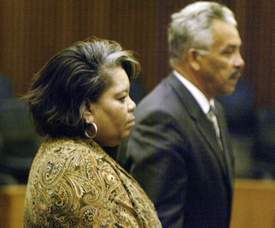 (MARY SCHROEDER/Detroit Free Press)
Charlsie Adams-Rogers listens Monday in a Detroit courtroom as a jury finds her guilty of involuntary manslaughter and child abuse in the death of 2-year-old Isaac Lethbridge in August.
Saying she questioned the character of a former Detroit foster mother and her family, a Wayne County judge jailed the woman moments after a jury convicted her Monday of involuntary manslaughter and child abuse in the death of a 2-year-old boy in her home in August.
The jury of nine women and three men took a little more than two hours to convict Charlsie Adams-Rogers, 60, on charges related to the Aug. 16 beating death of Isaac Lethbridge, who had been placed in Rogers' foster home six weeks earlier. Adams-Rogers, also known as Paris Rogers, was acquitted of a misdemeanor child abuse charge involving Isaac's 4-year-old sister.
In sending Adams-Rogers to jail pending sentencing July 2, Judge Vera Massey Jones said the woman and her family showed they could not be trusted and that she might not return to court to be sentenced.
Last week, Jones barred Adams-Rogers' family from the courthouse after complaints from the jury two days in a row that her family members were intimidating them.
Wayne County Assistant Prosecutor Lisa Lindsey said Adams-Rogers' family has obstructed the search for truth in Isaac's killing. Because Adams-Rogers is not believed to have inflicted any of Isaac's injuries, Lindsey said, charges may be brought against others in Adams-Rogers' home that day, including a now 13-year-old emotionally disturbed girl suspected of abusing Isaac and his sister.
"There's a lot we still don't know about exactly what happened in the house," Lindsey said after the verdicts were reached about 3:36 p.m. "Who else was culpable, we're still looking into. But, obviously, we don't have the cooperation of the people who were there."
Lindsey said she and Detroit police Sgt. Constance Slappey had spoken to neighbors who were afraid to testify about what was going on in Adams-Rogers' home. According to testimony, after a neighbor called Child Protective Services about how the foster children were being treated, Adams-Rogers wrote a letter to neighbors telling them to mind their own business and had her adopted daughter deliver it.
"Now that the conviction has been had, perhaps those people would feel more comfortable about giving more information about exactly what they know," Lindsey said. She urged witnesses to call Slappey at 313-596-2266 anytime.
Adams-Rogers could be sentenced to up to 15 years in prison on the involuntary manslaughter charge and up to four years on the second-degree child abuse charge.
A Free Press examination of the case after Isaac's death showed that the Lula Belle Stewart Center of Detroit had placed him and his sister in three troubled foster homes in 11 months.
None of the homes appeared to be suitable, according to records obtained by the Free Press. There also were irregularities in how Adams-Rogers was assessed for her foster care license and a string of nine complaints about her that failed to raise alarms.
Isaac's father, Matthew Lethbridge of Canton, said he was happy with the verdicts.
"I hope they don't stop here. There are many people who are responsible, who could have protected Isaac from the fate that he received," he said.
Adams-Rogers, whose testimony last week was seen by several observers as disingenuous, showed no emotion as the verdicts were read. After the judge sent her to jail, she calmly handed her purse to a woman who had been with her and was led away by sheriff's deputies.
Her attorney, Warren Harris, had no comment about the verdicts but said his client "handled it very well, I think."
"Naturally," Harris said, "she doesn't feel good. It hurts."
A family member said Adams-Rogers is likely to appeal her convictions.
In a written statement, family members said a key witness lied, the judge was biased, and the verdict by a jury with only two African-American jurors was unjust.
Isaac and his sister entered Michigan's foster care system in September 2005 after being found by Westland police in a filthy home rented by their parents, Matthew and Jennifer Lethbridge. The Lethbridges had previously lost permanent custody of six other kids in Washtenaw County because of environmental and medical neglect.
On June 29, 2006, Isaac and his sister were removed from one foster home because the sister may have been sexually abused and their Lula Belle foster care worker, Karl Troy, placed them in Adams-Rogers' home on Greenlawn in northwest Detroit.
The Lula Belle agency apparently did not consider the risk of placing such young children in a crowded home with an emotionally disturbed girl who needed medications to control her behavior.
According to his autopsy, Isaac had brain hemorrhaging, a broken right collarbone, many bruises and abrasions and second-degree burns on his torso.
"The last days of his life were a living hell," assistant prosecutor Lindsey told the jury. Then, motioning to Adams-Rogers, Lindsey said, "and that is directly her responsibility."
Source: Detroit Free Press
CAS Holds Three Kids
June 19, 2007 permalink
Mark Bonokoski gets a CAS story almost right. CAS does not remain mum because of any law — when they want to talk about a case, they do so with real names. Here they don't want to. And the real reason for keeping three kids in foster care is the buckets of money CAS gets from the taxpayers.
expand
collapse
The father is an upstanding, sober citizen. The drug-addled mother can't care for their children. Why is he being denied custody?
From the outside looking in, it was the perfect Father's Day weekend. The kids' eyes lit up when they heard they were going for a boat ride on the lake where their paternal grandparents ran a country store and inn.
The store had a candy counter, of course.
It was a kid's dream come true.
From there, it was off to a reunion of his father's side of the family. Lots of pop and hot dogs. Lots of cousins to play with. Lots of fun.
And then it was home to the Oshawa area, the kids fast asleep from the exhaustion that comes from burned energy and fresh air.
When their father dropped them off, however, it was not at their mother's house, even though the courts had once given her joint custody.
No, instead of dropping his children off at his ex-wife's house, he had to drop them off at the homes of their foster parents -- the oldest boy, at 13, going to one foster home, while the two youngest, his 10-year-old son and his 8-year-old daughter, having to go to another.
'BREAKS MY HEART'
"It breaks their heart, and it breaks my heart," the father says. "All I can tell them is to trust me ... that things will work out eventually.
"But what a nightmare."
The Durham Children's Aid had scooped his kids from their mother's custodial care and, from the outside looking in, social workers could not be criticized for their initial actions -- not by a long shot.
They had responded to a 911 call from one of the children. There was no food in the house, the child had said, and they were hungry.
When Durham Regional Police arrived, the children's mother had trouble talking coherently and negotiating the hallway.
Drug use was suspected.
Before the children's parents broke up, and later divorced, their mother was a pharmaceutical technician. Unfortunately, it also led to her allegedly treating each pharmacy as if it were its own kind of candy store.
It led to lost jobs for suspected theft of narcotics. It led to an addiction to prescription painkillers. And it led to her going into detox and rehab.
In rehab, she got knocked up by another patient.
That child, now 3, is also in foster care.
And that, in a nutshell, is all she wrote on this mother -- other than the impaired driving charge she is also facing, having blown into the balloon at 0.14, almost twice the legal limit, and all while driving on a suspended licence.
It would seem, however, that the Durham CAS is doing everything it can to give the children's mother more chances than she deserves to straighten out her life than it is willing to give the children's' father even one chance at trial custody.
STEADY JOB
And here is what he has to offer, as compared to the woman he divorced several years ago. He has a steady job that earns him $65,000-plus a year. He is married to a woman who holds an executive position as the general manager of a Holiday Inn and who wants, and has said so in writing, to be the stepmother of his children.
Unlike his ex-wife, the father has no substance abuse issues. He also has no criminal record, all which can be verified because, as a licensed aircraft mechanic, he has done high-level contract work for the American military, which had him checked out every-which-way but Sunday.
The reason the Durham Children's Aid is balking at giving him custody is as simple as its reasons are complex for siding with the drug-addicted mother who is now facing a drunk-driving charge.
The mother lives in Durham Region.
The father lives eight hours away, but those eight hours take him across the border into a small town in the northeastern United States.
He lives in a three-bedroom townhouse in what he describe as a "picture postcard town, with blue-ribbon schools." And he is employed by a subsidiary company of the Sikorsky helicopter corporation as manager of its composite shop, a job which had its beginnings in Toronto when it accepted an offer to do a contract job in West Virginia five years ago when his marriage tanked and his divorce was finalized.
No calls were made to the Durham CAS, by the by, for either confirmation or denial of the scenario presented here. The Privacy Act prevents the CAS from commenting on any specific case and, from past experience, the Privacy Act is also used as blanket to cover any and all controversy -- which is one reason Ontario Ombudsman Andre Marin wants to oversee CAS operations province-wide.
But there is such a thing as court documents, and those in the Sun's possession paint a fairly clear picture.
Within the week, the lawyer representing the father of these children will be appearing before the Superior Court of Justice, yet again, in an attempt to persuade the judge to cut the father some slack.
By month's end, the children's school year will have ended and, rather than have them spend their summer in a foster home, he is seeking the court's permission to take them home to the States -- first for two weeks, then possibly for a month.
The childrens' mother, it should be noted, also remarried, but it was not to the man who made her pregnant while in drug rehab.
Unfortunately, this marriage, too, is reportedly ending in divorce.
Source: Toronto Sun
Brantford Rally
June 19, 2007 permalink
On June 18 eleven persons participated in a rally in Brantford. Carrying signs "CAS destroys families" and "Children's Aid = Children's Raid" they marched outside the main Children's Aid Office, then the family court. As usual at these events, a dozen passersby shared their own stories of abuse at the hands of child protection agencies. photo.
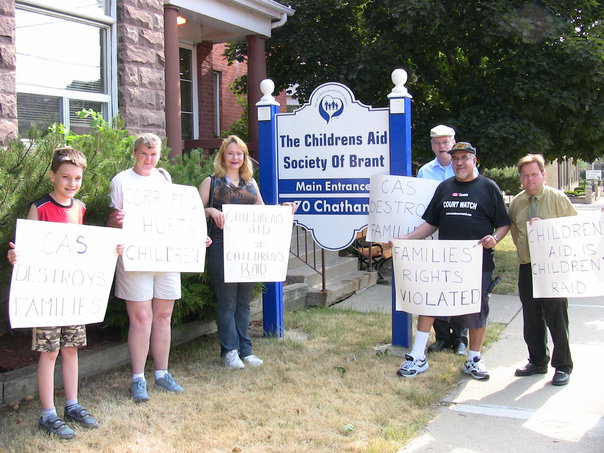
Brantford Rally
June 16, 2007 permalink
Here is the schedule for the Brantford Rally this Monday, June 18.
expand
collapse
June 15, 2007 at 3:36pm
Subject: Brantford Rally
This is the itinerary for the rally Monday June 18.
Everyone should meet at Tim Horton's on Colborne St in Brantford at 8:30am. We will proceed to the CAS offices at 70 Chatam St at 9:00am. From there we will walk to the City Hall and then to the MP's office.
We will be organizing a lunch BBQ at Mowhawk Park at 12:00pm.
For those looking for directions, a map and or a ride, please email me at gammy@inbox.com
If you can take anyone with you, email me and I will try and coordinate the rides.
Please feel free to copy and paste this information on any boards you feel would be interested.
Source: Sarnia's Smoking Gun
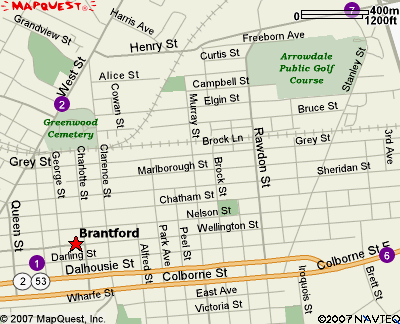
On this map, the 6 icon points to the Tim Horton's, 648 Colborne Street, Brantford, just east of Puleston Street.
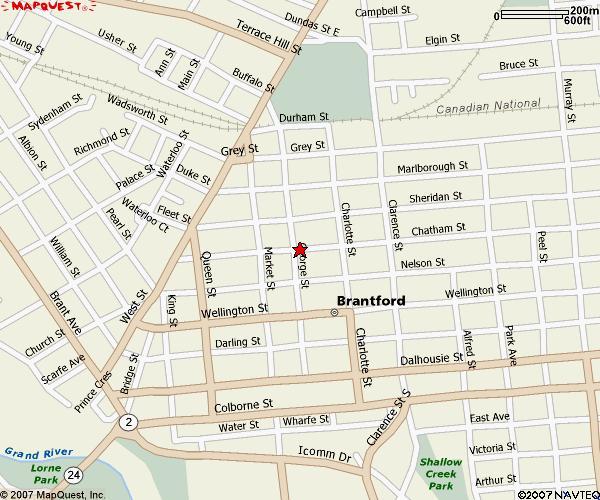
Brant CAS is at 70 Chatham Street, Brantford, the star on the map. City Hall is two blocks south, at 100 Wellington Street. For more information, email Gammy at gammy@inbox.com or Mike Conn at ditto@execulink.com phone 519 753-2132.
Fathers Arrested Preemptively
June 16, 2007 permalink
Police in England have arrested nine fathers who were not committing any acts, out of fear that they might carry out another Fathers-4-Justice stunt. Here are two reports, one from F4J, the other from the BBC.
expand
collapse
News has been received from our activist brothers in the United Kingdom that 9 F4J members of Fathers 4 Justice have been arrested "as a precautionary measure" by MI5 agents within London in the past few hours. F4J sources within Special Branch indicate this was a planned operation by the UK intelligence service in advance of a ceremony at Buckingham Palace. Currently 9 parents are being held by police. it is not as yet clear whether this security 'operation' has or will extend to F4J and allied operations in other countries. More information will be forwarded as it becomes available.
Source: email from Jeremy Swanson
Protest at royal parade prevented
Campaigners failed to stage a stunt in front of the Queen when nine arrests were made before Trooping the Colour.
The Fathers 4 Justice group had planned to handcuff a member to the monarch's carriage at her annual birthday parade.
But police said they made the arrests before the event began and released the group without charge once it was over.
A police statement said: "The arrests took place prior to any principals passing and were due to vigilant, robust and decisive police action."
He said the arrests were made to prevent a breach of the peace, as part of a large proactive policing operation.
A spokesman for Fathers4Justice said they had other demonstrations planned.
He added they had previously engaged in dialogue but it was now a "war of attrition".
Source: BBC
Lake Family Termination
June 15, 2007 permalink
Two years ago we reported on the girl Emily Lake maced and taken from her mother in Oregon for forceful repatriation to the state of Michigan. Here is the follow-up on July 6, 2006
The state of Michigan has now moved to terminate parental rights in this case, turning the girl into a paper orphan.
expand
collapse
Wednesday, June 13, 2007
Michigan Alert
Michigan Parents call to action, in support of Midland mother scheduled for TPR hearing.
Notice to Michigan Parents! Please mark your calendars for August 27th 2007. We need anyone who can make him or herself available to assist one of our sisters Lynnae Lake in Midland, MI, because the state is attempting to terminate her parental rights.
We want to flood this courtroom like never before. We want people outside the courthouse with signs showing our disgust in a system that steals children for profit.
I have attended hearings with Ms. Lake and I can tell you first-hand that the attorney for DHS recommended termination of her parental rights, because the case workers didn't get along with her. The GAL recommended termination because she didn't complete 1 of 6 releases of information.
At no time did any of them state that their recommendation was based on her neglecting or abusing her child.
This is yet another case of a child being Kidjacked by the state, in order to obtain adoption bonuses. Now is the time for us to come together and be heard! Please lend your support to the worthy cause of opposing yet another instance of parental rights violations.
(Permission is granted post this alert to all groups.)
Sincerely,
Ron SmithSource: Ron Smith, relayed by Annette M. Hall

Addendum: A lawsuit filed by Lynnae Lake against the state of Michigan (MS-word format) may be the motive for termination of parental rights. It is easier for the state to terminate rights than to win the lawsuit. Once rights are terminated, the suit will be dismissed on grounds of lack of standing.
Child Protector Convicted
June 13, 2007 permalink
A child protection caseworker in Indiana has been convicted of 17 charges of sexually molesting two teenaged boys in his care, one of them mentally handicapped.
expand
collapse
 Cory Heinzman
Caseworker Convicted Of Molesting 2 Teens
Man Was CPS Caseworker In Hamilton County
NOBLESVILLE, Ind. -- A former Child Protective Services caseworker was convicted Wednesday of molesting two teenagers, including an autistic boy he had mentored.
A Hamilton Superior Court jury of 10 men and two women found 38-year-old Cory Heinzman guilty of 17 counts and acquitted him of four. Three of the molestation counts are felonies that carry 20 to 50 years in prison each.
Hamilton County Prosecutor Sonia Leerkamp said in closing arguments Tuesday that testimony proved the Acardia man breached the trust of the mentally challenged boys.
"This defendant ... preyed on these young men," she said. "He knew full well their limited abilities to make good judgments on their own behalf."
The form of autism in one of the boys limits his social skills to that of a 10-year-old, officials said. His mother called Riley Hospital for Children in May 2005 to report that her then-13-year-old son had been molested by Heinzman over eight months beginning in 2004.
After Heinzman was charged in that case, a 15-year-old boy came forward to accuse him as well, officials said.
Heinzman was an Indiana Department of Child Services caseworker for the 13-year-old, who had been referred to the agency after a school official reported that the boy claimed his mother abused him. Heinzman had worked for the agency in Hamilton County from 2002 until he was accused in the crimes.
Heinzman met the 15-year-old in 2004 and arranged for the boy to be admitted to a youth psychological treatment center, according to court testimony.
Heinzman testified that the younger teen, who is now 16, slept in the same bed during overnight visits to Heinzman's home but said both of them always wore clothes. He also denied molesting the other boy, now 18, who testified Heinzman fondled him when they went on drives during off-site visits from the treatment center.
Defense attorney Andrew Barker called the charges "lies and false allegations" and tried to convince the jury that there was no physical evidence to show improper sexual contact had taken place.
Eight of the 29 charges against Heinzman were dropped Monday after defense attorney Rodney Sarkovics convinced Judge Daniel Pfleging the state lacked enough evidence.
"What does that tell you about the state's case? It should tell you they're playing roulette," Sarkovics said. "If you question the truth or voracity of one of these charges, you have to question them all."
Sarkovics also questioned the reliability of statements made by his client's accusers.
Heinzman was convicted of nine felonies: two counts of sexual misconduct with a minor; five counts of child molestation; one count of corrupt business influence; one count of sexual performance in the presence of a minor. He also was found guilty of eight counts of official misconduct, all misdemeanors.
Source: WRTV 6 Indianapolis

Perjury Charge for Social Worker
June 13, 2007 permalink
An Iowa social worker lied to the court in an effort to terminate parental rights. Now she has been charged with perjury. This is an extraordinary event. Maybe it shows a change in mood toward the social services system, or maybe it will be like the case against Denise C Moore, convicted of lying in a case that led to the death of her ward, but ultimately exonerated by an appellate court.
expand
collapse
Tuesday, June 12, 2007 12:02 PM CDT
Social worker charged with perjury
By JOSH NELSON, Courier Staff Writer
INDEPENDENCE --- A Buchanan County social worker was charged last week with three counts of perjury for allegedly filing false child welfare reports to the court.
Marie Mahler, 39, of Cedar Falls, filed three reports between Aug. 27, 2004, and Oct. 7, 2004, used in a juvenile court case that she "knew or reasonably should have known were false" and that the reports would be used by a judge to make a decision in the case, according to court records obtained by the Courier.
Mahler entered a written plea of not guilty Thursday.
According to court records, the case was to determine whether or not a mother's parental rights should be terminated. Mahler repeatedly included misrepresentations of conversations, events and relationships of the people involved with the case, according to court records.
Court records say she claimed that Jesup police officers were called to the mother's home for a drug investigation in August 2004. Records indicate an officer was called to the home not for drugs, but to prevent an altercation between two siblings. No signs of drugs were found.
Roger Munns, spokesman for the Iowa Department of Human Services, confirmed Mahler is an employee of the department. Mahler received her social work license in 1998. She has no record of disciplinary action and still is on active duty, according to department records. She has been a social worker in Buchanan County since 1998.
In a parental rights termination case, the decision is made by a judge, Munns said. People involved in the case, like biological parents, adoptive parents or social workers, can give input to help the judge's decision, he said. It's rare to have people charged with such a crime in these cases, Munns said.
"This is really quite unusual," he said.
Munns did not comment further on the case.
Delaware County Attorney John Bernau has been appointed special prosecutor to the case because of a conflict of interest. The Buchanan County Attorney's Office has represented Mahler in juvenile court proceedings.
Bernau said he couldn't comment on specifics about the case, but said perjury charges often are hard to investigate.
While the offenses occurred in 2004, Bernau said Mahler is exempt from Iowa's statute of limitations law because she is still a state employee. In most felony cases, charges have to be filed within three years of the offense. However, that three-year period begins for state employees only after they are no longer working for the state.
Perjury is a Class D felony punishable by up to five years in prison.
Contact Josh Nelson at (319) 291-1565 or josh.nelson@wcfcourier.com.
Source: Waterloo/Cedar Falls Courier
Girl Escapes CAS
June 12, 2007 permalink

A 16-year-old girl has escaped a CAS group home in Elora Ontario. Jessica Faubert left on June 4. We wish her well in her new life free from social workers.
Source: press release from Wellington County OPP
Ontario Child Deaths
June 11, 2007 permalink
The full Report of the Paediatric Death Review Committee and Deaths Under Five Committee (pdf) is now available online. It includes 83 deaths of children in 2006 with open CAS files. The only indication of the death rate in foster care is a note on page 22 that 19 of those deaths occurred in CAS care. For the 19035 foster children in Ontario in 2006, the reported death rate was 100 per hundred thousand, 3.5 times as dangerous as parental care. The best available data from Arizona and Saskatchewan suggests death rates of 147 and 266 per hundred thousand. Either Ontario has the world's safest foster care or some deaths have been omitted. The report does not claim to include all child deaths.
Addendum: Since the original report has been withdrawn from the web, here is our local copy (pdf).
Half of Crown Wards Drugged
June 9, 2007 permalink
What is the best way to induce compliance among children resentful toward the workers who stole them from their parents and placed them with strangers? Force them to take drugs that shut down parts of their brain. That is done to half of Ontario's nine thousand crown wards.
expand
collapse
Nearly half of children in Crown care are medicated
Psychotropic drugs are being prescribed to nearly half the Crown wards in a sample of Ontario children's aid societies, kindling fears that the agencies are overusing medication with the province's most vulnerable children.
According to government documents obtained by The Globe and Mail under Ontario's Freedom of Information Act, 47 per cent of the Crown wards – the children in permanent CAS care – at five randomly picked agencies were prescribed psychotropic drugs last year to treat depression, attention deficit disorder, anxiety and other mental-health problems. And, the wards are diagnosed and medicated far more often than are children in the general population.
“These children have lots of issues and the quickest and easiest way to deal with it is to put them on medication, but it doesn't really deal with the issues,” said child psychiatrist Dick Meen, clinical director of Kinark Child and Family Services, the largest children's mental health agency in Ontario.
“In this day and age, particularly in North America, there's a rush for quick fixes. And so a lot of kids, especially those that don't have parents, will get placed on medication in order to keep them under control.”
Psychiatric drugs and children are a contentious mix. New, safer drugs with fewer side effects are the salvation of some mentally ill children. But some drugs have not been scientifically tested for use on children, and recent research has linked children on antidepressants with a greater risk of suicide.
Yet the number of children taking these drugs keeps rising, even in the population at large.
Pharmacies dispensed 51 million prescriptions to Canadians for psychotropic medication last year, a 32-per-cent jump in just four years, according to pharmaceutical information company IMS Health Canada. Prescriptions sold for the class of antidepressants, including Ritalin, most prescribed to children to tackle such disorders as attention deficit hyperactivity disorder (ADHD) rose more than 47 per cent, to 1.87 million last year; a new generation of antipsychotic medication increasingly prescribed to children nearly doubled in the same span, climbing 92 per cent to 8.7 million prescriptions.
And with close to half of Crown wards on psychotropic medication, their numbers are more than triple the rate of drug prescriptions for psychiatric problems among children in general.
With histories of abuse, neglect and loss, children in foster care often bear psychological scars unknown to most of their peers. But without a doting parent in their corner, they are open to hasty diagnoses and heavy-handed prescriptions. Oversight for administering the drugs and watching for side effects is left to often low-paid, inexperienced staff working in privately owned, loosely regulated group homes and to overburdened caseworkers legally bound to visit their charges only once every three months.
Unease over the number of medicated wards of the state is growing: This September, when provincial child advocates convene in Edmonton for their biannual meeting, the use of medication to manage the behaviour of foster children across Canada will be at the top of their agenda.
‘whole range of disorders'
Nowhere is concern greater than in Ontario, where the provincial government recently appointed a panel of experts to develop standards of care for administering drugs to children in foster care, group homes and detention centres.
The move was made after the high-profile case last year of a now-13-year-old boy in a group home outside Toronto came to light. The boy was saddled with four serious psychiatric diagnoses, including oppositional defiant disorder and Tourette syndrome, and doused daily with a cocktail of psychotropic drugs before his grandparents came to his rescue. Now living with his grandparents, he is free of diagnoses and drugs.
Marti McKay is the Toronto child psychologist who, when hired by the local CAS to assess the grandparents' capacity as guardians to the boy, discovered a child so chemically altered that his real character was clouded by the side effects of adult doses of drugs.
“There are lots of other kids like that,” said Dr. McKay, one of the experts on the government panel. “If you look at the group homes, it's close to 100 per cent of the kids who are on not just one drug, but on drug cocktails with multiple diagnoses.
“There are too many kids being diagnosed with…a whole range of disorders that are way out of proportion to the normal population. …It's just not reasonable to think the children in care would have such overrepresentation in these rather obscure disorders.”
The report from a government investigation into the case obtained by The Globe uncovered group home staff untrained in the use and side effects of the psychotropic drugs they were doling out; no requests from the psychiatrist to monitor the boy for problems, and little evidence of efforts to treat the boy's apparent mental-health issues other than with heavy-duty pharmaceuticals.
James Dubray, executive director of the Durham CAS where the boy was a Crown ward, acknowledges that the agency's monitoring of children on medication was lacking.
But it is no small feat, he said, for agencies like his to raise challenging children and adolescents – including some with behaviours so insufferable that their parents turn them over – when there is a chronic shortage of children's mental-health services across Canada and disruptive young people are stranded on waiting lists for psychiatrists and therapies for as long as a year.
With few specialists available, growing numbers of child-welfare workers are turning to family physicians, typically with next to no training in psychiatric disorders and no expertise in the new cutting-edge psychotropic drugs.
Are children being overmedicated out of expedience?
“I don't think that's an unfair conclusion,” Dr. Dubray allowed. “I find it hard to make a judgment. I just know we tend to see kids for which there are either no resources or their parents can't handle them.”
Behaviour management
For Judy Finlay, Ontario's chief child advocate, the use of psychotropic drugs is a burning issue.
Since the inquests into the deaths of a handful of troubled adolescents being forcibly restrained in group homes a few years ago – and the tougher regulations on the use of physical restraints that followed – she has observed a growing trend among group homes to turn to chemical restraints to control unruly behaviour.
These children have trauma and loss in their backgrounds and, as they grow older and foster parents can no longer tolerate their behaviour, they are moved to group homes operating on a culture of strict curfews and rules. Here, too often, troubled teenagers live in close quarters, staff turnover is rapid, police visits are not uncommon, and watching television is the usual pastime.
“It's more about behaviour management than it is about intervening into mental health issues,” Ms. Finlay said.
“It's the adolescents who are being given medication usually, and it's adolescents who are noncompliant. But they're supposed to be,” she added. “That's their job. So as adolescents grow and challenge the system or challenge staff, it's at that time that we begin to medicate them. They are going to be challenging, and medicating isn't the way to help them through adolescence.”
In fact, child psychiatrists and physicians say they face a tricky call when confronted with a tormented child or adolescent whose behaviour appears to be the symptom of a disorder that, if not treated with drugs and other therapies, will inevitably grow harder to tame.
The newer drugs are safer and backed by a growing stack of research, and physicians insist they allow some mentally ill children to function normally when nothing else works. Yet many drugs have never been tested on children by the pharmaceutical companies funding most of the research; have been studied for only short periods that fail to measure the impact of prolonged use; and are not formally approved to treat the condition being addressed.
“Just because it's safe and effective in adults doesn't mean it's safe and effective in a young person, and that's one of my concerns about the lack of research in young people,” said Stan Kutcher, a child psychiatrist and Sun Life Financial chair in adolescent mental health at the IWK Health Centre in Halifax.
“Young people aren't little adults. They have different physiologies. They have different metabolisms. Their brains react differently. Their bodies react differently to drugs.”
And therein lies a “horrible conundrum” for doctors. “I'm uncomfortable with kids being really sick,” Dr. Kutcher said, “and I'm uncomfortable with the treatments that we have.”
The National Youth in Care Network, an advocacy group for young people raised in the child welfare system, is just completing a three-year study, funded by Health Canada, of psychotropic drug use among children and adolescents in care across the country.
The researchers have found that not only were psychotropic drugs prescribed to a clear majority of the current and former wards interviewed, but most were diagnosed with mental-health disorders by a family doctor, never visited a child psychiatrist or another doctor for a second opinion, and doubted the accuracy of their diagnosis.
A disturbing number, the network's research director, Yolanda Lambe, added, have traded the child-welfare system for a life on the street.
“A lot of people are using drugs now,” she said. “There's a lot of homeless young people who have been medicated quite heavily.”
Source: Globe and Mail
Two unsigned sidebars give many facts about psychotropic drug use by children in Canada.
Ritalin's reign
Globe and Mail Update
June 9, 2007 at 1:44 AM EDT
Ritalin, the brand name for methylphenidate hydrochloride, has been the drug of choice to treat children with attention-deficit hyperactivity disorder (ADHD) for nearly 40 years.
Developed by the pharmaceutical company Ciba in 1954, it was initially prescribed to adults as a treatment for depression, chronic fatigue and narcolepsy.
Beginning in the 1960s, the central-nervous-system stimulant began to be prescribed to hyperactive children for its calming effect. In particular, it increased the time children could stay focused on an activity.
During the 1980s, prescriptions in the United States for children really began to climb. Canada wasn't far behind, with the psychotropic drug's popularity soaring in the 1990s. Prescriptions were up 500 per cent from the previous decade.
Pediatricians began to take notice of the worrying trend and recommended in 2000 that Ritalin be prescribed only in very limited circumstances, and, even then, only for as long as necessary.
Worldwide, about 75 per cent of Ritalin prescriptions are for children, with four times as many boys on it as girls.
The Public Health Agency of Canada in 2004 reported that many adolescents were taking Ritalin as a recreational drug to stay awake, to increase attentiveness, to suppress appetite and to get high.
Research out of Atlantic Canada found that about 8.5 per cent of children in Grades 7 to 12 had taken Ritalin for non-medicinal purposes, compared with 5.3 per cent who were prescribed it.
Source: Globe and Mail
Doctor's orders
Globe and Mail Update
June 9, 2007 at 1:50 AM EDT
Stan Kutcher, a child psychologist and Sun Life Financial Chair in Adolescent Mental Health at the IWK Health Centre in Halifax, estimates that between 2 and 6 per cent of children ages five to seven suffer from mental-health disorders requiring treatment; for early adolescents under 14, the number rises to 7 to 11 per cent; by the late teens, research indicates roughly 18 per cent have diagnosable mental-health issues.The documents obtained by The Globe and Mail included Crown wards reviews at the Children's Aid Society of Toronto, Toronto Catholic Children's Aid Society, Durham Children's Aid Society, Family and Children's Services of Niagara, and Windsor-Essex Children's Aid Society. The children in permanent care with those agencies accounted for a little more than 18 per cent of the province's roughly 9,400 Crown wards.Psychotropic drugs most commonly prescribed to children:
ANALEPTICS
Examples are Ritalin, Adderall XR, Biphentin and Concerta.
- Used to treat inattention, distractibility, agitation, impulsiveness and hyperactivity.
- Approved by Health Canada for use with children.
- Doctors in Canada recommended their use to treat children 17 and under an estimated 1,125,000 times in 2006.
ATYPICAL ANTIPSYCHOTICS
Examples are Risperdal, Zyprexa, Seroquel and Clozaril.
- Used to treat schizophrenia, bipolar disorder and mania.
- Not approved by Health Canada for use with children.
- Doctors in Canada recommended their use to treat children 17 and under an estimated 363,000 times in 2006.
SEROTONIN REUPTAKE INHIBITORS
Examples are Prozac, Paxil, Zoloft, Celexa, Luvox and Anafranil.
- Used to treat depression, obsessive-compulsive disorder, panic disorder and eating disorders.
- Not approved by Health Canada for use with children.
- Doctors in Canada recommended their use to treat children 17 and under an estimated 360,000 times in 2006. Sources: IMS Health Canada, Health Canada
Source: Globe and Mail
Addendum: The reader comments on this article were shut down for a while on June 9 while lawyers looked over them. They are back now.
Child Abuse Investigator Sets Example
June 8, 2007 permalink
How does London's top child abuse investigator end a love affair? With a murder-suicide.
expand
collapse
Cops in murder-suicide had a relationship
The Canadian Press
 Acting Inspector Kelly Johnson, 40
The Canadian Press retired superintendent David Lucio, 57
LONDON, Ont. (Jun 8, 2007)
Two police colleagues involved in a murder-suicide had a "relationship," police said yesterday as they struggled to come to grips with the loss of their own.
Flags in front of the police station in this southwestern Ontario city flew at half mast for the victims -- Acting Inspector Kelly Johnson, 40, and retired superintendent David Lucio, 57.
Police Chief Murray Faulkner said Johnson and Lucio had a relationship, although the exact nature of it was not immediately known.
Both were shot before the vehicle they were travelling in crashed into Johnson's apartment building early yesterday. Only two shots were fired.
Johnson's service pistol was found at the scene. She was off-duty and did not have permission to take the gun home, Faulkner added.
Johnson had been promoted only a few days ago from within the police sexual assault and child abuse section to the professional standards branch.
Source: Hamilton Spectator
Addendum: The police have not been forthcoming about this case. The parents of the dead man want an inquest to expose the facts about their son's killer. It could also give public insight into the life of a child abuse investigator.
expand
collapse
Angry parents want inquest
Dave Lucio's parents seek details of how police handled the murder-suicide case.
By PATRICK MALONEY AND RANDY RICHMOND, SUN MEDIA
The outraged parents of a former London police officer killed by another in a murder-suicide want an inquest into how police handled the case.
But while police Chief Murray Faulkner rejects that, yesterday -- for the first time -- he said he will ask an outside party to assess what happened and how police missed any signs of trouble brewing.
Just how formal such an outside examination would be, Faulkner couldn't say. "I am not sure of the process yet."
Those twists come a week after acting Inspector Kelly Johnson shot retired superintendent Dave Lucio then turned her gun -- a service pistol she wasn't authorized to have at the time -- on herself in his van. The two had been lovers who had left marriages.
An angry Doug Lucio, father of the slain retired officer, contacted The Free Press to vent his frustrations. "She killed him. She murdered him -- premeditated. Nobody's saying that," the father, 80, said.
Angry about the handling of the case, including what the public was told and when, the father insists discussion about the tragedy has been stifled.
"Out of discussion comes action plans. And out of action plans comes results," he said.
"I will not tolerate this. (An inquest could) let people stop it from happening again."
Regional supervising coroner, Jack Stanborough, said he's weighing whether to call a so-called discretionary inquest. "If a family writes me a letter and says, 'I want an inquest into this and here's why,' and it makes a lot of sense, I give it serious consideration," he said.
Among other things, Lucio wants to know why Faulkner met with the family of Johnson -- the shooter -- but didn't call he and his wife, the parents of her victim and a fellow although retired officer.
He also wants to know why police didn't erase any public doubts about which of the two was the shooter -- thus clearing Lucio's name -- when the truth was clear long before autopsy results were released five days after the shootings.
"They knew. So how come it just came out the day of his funeral (June 11)?" he asked.
Lucio described a dramatic confrontation with Faulkner at his son's funeral Monday.
"I said to him, 'You got a hold of (Johnson's former) husband and you got a hold of her father.' Then I said to him, 'Why didn't you call his mother and I?"
Johnson, cnsidered a rising star on the force, was the daughter of Merv Johnson, former London deputy police chief.
Faulkner said he told Lucio at the funeral he purposely dispatched an inspector close to the family to break the news, only hours afterward.
Faulkner also said there's no need for an inquest. "I don't think an inquest is the proper way to go about it."
Lucio, 57, and Johnson, 40 had had a relationship for several months.
Sometime the night of June 6, Johnson shot Lucio, then turned her service pistol on herself while Lucio was driving the pair to her condo on Picton Street.
Doug Lucio said he has great respect for members of the police force but also wants his son's legacy upheld.
"We still count our blessings but we want to hold onto our respect. And my son's reputation. We don't want to destroy the wonderful things he built up in his life, or see anybody else do it," said the retired Northern Telecom executive.
Faulkner noted family and friends of Lucio and Johnson are grieving and he won't publicly discuss either of their personal lives.
"There are different emotions at this time. Both people need to be protected because they cannot speak for themselves."
Among other concerns raised by Lucio, and Faulkner's responses:
- Why did police not set the record straight sooner about who shot whom?
Faulkner reiterated police couldn't release that until after a June 11 autopsy determined exactly what happened. "That is police procedure."
- Why did a London police officer write a letter, published Tuesday in The Free Press, urging people, on behalf of affected "families," not to talk publicly about the case?
"Families, friends, co-workers and anyone whose lives have been touched by tragedy have so many emotions to deal with as it is," read Const. Pam Matatall's Tuesday letter.
"Out of respect for them, please do not add to their suffering."
Lucio said he "resented" the letter and disagreed with its message.
"They should be talking about it to the high heavens," he said."Quit talking about it?
"That's exactly what you shouldn't do because feelings cannot mend unless you talk about it."
Faulkner said he had no idea a letter was being written by a constable and gave no direction to his staff to do so.
Other members of the Lucio family declined comment, but indicated they hold no ill will toward anyone on the London police department.
The loss of his son has been a heavy blow for the elder Lucio, who plans to spend the next couple of days with his wife at their cottage, privately wrestling with their grief and frustration.
"He was our light, my wife and I. He was the light in the complexities of life," he said. "Couldn't have got a better son, couldn't have got a more compassionate person, either.
"We loved him very much."
Source: London Free Press
Addendum: A curious footnote three years later. This case does not count as domestic violence.
expand
collapse
Barbara Kay, London, Ontario Police statistics on domestic violence show classic signs of abuse
Posted: January 28, 2010, 12:08 PM by Jonathan Kay
After six years of service, Chief Murray Faulkner, 57, of the London police force is expected to announce his retirement at noon today.
He leaves with a statistical stain on his record. For 2007 his department's statistics under the heading of domestic violence (DV) show that there was one DV homicide of a woman by a man, but zero homicides of a man by a woman. Not true.
On June 6, 2007, in a shocking case of love gone awry, police inspector Kelly Johnson, inflamed by her lover, retired police superintendent David Lucio's ending of their affair the day before, shot Lucio in the head with a .40-calibre Glock pistol (which she was not authorized to have in her possession) as he was driving his van through downtown London, and then killed herself with the same gun as the van careened into an apartment building.
If Johnson were a man, the case would have been labelled a cold-blooded DV murder, and exploited as yet another example of the pandemic of male violence against women. But the incident was spun as a kind of bilateral tragedy with no villain, just two victims.
Critics of Faulkner have long grumbled about his preoccupation with male violence against women and his tendency to downplay or ignore female violence against men. Normally it's tough to get the evidence to back up such a claim. But the obviously purposeful refusal to classify the Lucio murder as a case of DV, when it so screamingly is a world-class example of DV at its worst, supports Chief Faulkner's detractors' claim of bias against male victims of DV.
Naturally this lapse calls all the other statistics in Faulkner's tenure into question. We all depend on statistics to help us make up our minds on issues, so it is extremely irresponsible to muck around with them in support of an ideological position. Presently the London police 2007 statistics tell us that DV-related homicide is 100% male on female and 0% female on male. In fact it is 50-50. It would be fitting if Chief Faulkner's last official act were to admit that the Johnson/Lucio homicide was indeed a case of DV, have the 2007 statistic formally changed, and give his successor the nod to review all the stats on DV posted during his tenure.
Source: National Post
BBC Exposes Child Stealing
June 7, 2007 permalink
The BBC has posted three videos dealing with Sheffield Social Services. It is what we have been saying for years, but now the story of secrecy and kidnapping for money is on television for the masses.
expand
collapse
- BBC - Look North - June 04 2007
Fixing the Assessment (wmv)Parents who claim children have been wrongly put up for adoption to meet government targets plan to demonstrate outside the Sheffield Law Courts.
- BBC - Look North - June 05 2007
Concern over child adoptions (wmv)Parents who claim their children were falsely taken into care have been protesting in Sheffield.
- BBC - Look North - June 06 2007
Couple's anger at adoption - John Hemming MP (wmv)A couple have said their lives were ruined after their three grandchildren were taken into care.
Zuker Protested
June 6, 2007 permalink
Here are three reports on the protest against Judge Zuker today, one by Canada Court Watch, one by an observer using screen name Litigator, and one by Fathers-4-Justice.
expand
collapse
Citizens protest against Justice Zuker at 47 Sheppard Ave. E. courthouse in Toronto!
 Protesters outside of the court at 47 Sheppard Ave. E in Toronto carried signs and handed out thousands of flyers and brochures
(June 6, 2007). A group of Ontario citizens carrying signs and handing out flyers and brochures outside of the Sheppard Ave. E. courthouse in Toronto today, protested the recent judicial scandal in which Justice Marvin Zuker admitted to the Ontario Judicial Council that he had tampered with court transcripts in a court case in which he was the presiding judge. According to participants of the group, Justice Zuker should be charged criminally and that there should not be one set of laws for ordinary Canadians and another set of unwritten laws which appear to allow judges to break the law. Altering transcripts is an offence under the Criminal Code of Canada.
According to ex-lawyer Harry Kopyto from Toronto, Justice Zuker altered transcripts and fabricated evidence in his client's court matter. A motion will be heard at 10 am on July 3, 2007, 10:00, to have Justice of the Peace, Dunbrook, make a decision as to whether criminal charges should be laid against Justice Marvin Zuker. Mr. Kopyto indicated that there has been facing staunch resistance by the legal establishment to have charges laid against Justice Zuker. Information about this court hearing will be posted as it becomes available. Members of the public are urged to attend.
Source: Canada Court Watch
Toronto Protest a Smashing Success!!!
screen name: Litigator!
Posted: Wed Jun 06, 2007 9:39 pmAs many of you know there was a protest being held in Toronto at the 47 Sheppard Ave E courthouse this morning. This protest was about Ontario Court of Justice Judge Marvin Zuker altering court transcripts and breaking the law. I am pleased to report that the protest was a huge success. People came from far and wide. We had huge signs, a gallows with a hanging Judge and a megaphone being contantly manned. We gathered a large number of signatures on our petition to have Justice Zuker removed from the bench. Cars were stopping in the street to request the flyers being handed out. There was a steady crowd of people who were quite disturbed to learn of this. The Police were present and trying to intimidate people however they were generally well behaved lol. There were supporters present from a number of citizen's rights groups including, F4J or Father 4 Justice, Canada Court Watch and the Citizen's Coalition for Judicial Accountability.
Source: Canada Court Watch message board
... our brothers and sisters in the fight for Justice were all descending on the Sheppard St. Courthouse protesting the institutionalized corruption that is manifested in the criminal behavior of INJustice Zucker. We were thinking about you. Hopefully that will be the start of a core of people who will go out twice a week at that courthouse.
The day was a little cool and windy but mostly uneventful. A lot of the regulars and people who have already signed the petition. Their is a Female Lawyer who says she was stalked by Fathers 4 Justice and they even killed her dog. It was not anyone I know. A couple of months back she talked to me a little more and it turned out it was something that apparently happened years ago, sounds like it was in the days of Fathers FOR Justice. In telling the story she comes off as quite loony.
Detective Hanlon also came out who has warned me twice about affixing signs to the fence. Jeet wanted to put up the banner so I said OK but no tying it down. Luckily it blew over just before he came out.
Denis Van Decker
York Region Coordinator
Fathers 4 Justice CanadaSource: Fathers-4-Justice
Addendum: There is a slide show of the Zuker protest.
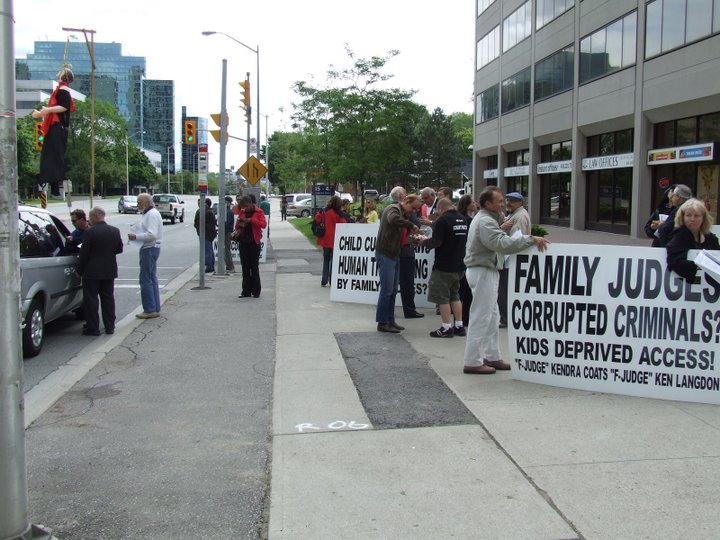
Life in a Group Home
June 6, 2007 permalink
A woman, Jeanette Antoine, gave testimony of her experiences living in a Cornwall Ontario area group home in the 1960s and 1970s.
expand
collapse
June 5, 2007
Woman tells of grim trail of abuse
Project Truth Inquiry hears more unsettling allegations
By CP
CORNWALL — A former city woman told an inquiry on Monday that she was sexually and physically abused by a Children’s Aid Society caseworker and even held for a period of time in the trunk of the man’s car.
Jeanette Antoine first became a ward of the CAS when she was five years old in 1965 and over the course of the following 11 years endured what she claims was repeated physical and sexual abuse at the hands of foster parents and even her own caseworker.
Antoine told the inquiry probing the institutional response to allegations of systemic sexual abuse in the Cornwall area that when she was 16, she and a handful of other teens ran away from a CAS-run group home where she says they were being abused by workers.
The group broke into a cottage in Summerstown, and stayed on their own for a few days before being apprehended by police and dropped off at the CAS office in Cornwall. Antoine said there were a group of workers there to take the kids from the police.
“One worker would take a kid,” said Antoine, who said she was under the care of her caseworker, a man by the name of Brian Keough. “Brian grabbed me and put me in the trunk of his car while the other workers talked to the kids.”
The woman, who is now 46 years old and lives in Edmonton, said she can’t remember exactly how long she was in the trunk, but she remembers she fell asleep.
“He came out and took me back into the CAS office into this big conference room,” said the woman. “I remember all the kids were there and there were a lot of workers there.”
The woman said she and other teenagers who were living at the group home in the 1970s were physically and sexually abused by Keough and other workers on a regular basis.
“He (Keough) would do something to at least one of them every week,” said the woman. “Each week it would be a different girl.”
Antoine said she remembers a time when all the girls in the home were prescribed birth control pills, although she says she was never in danger of becoming pregnant.
“He (Keough) never actually had sex with me,” said Antoine. “He molested me, but it was never sex.”
Antoine testified she was also sexually abused by other men during her time in foster care.
When she was six years old and her sister was eight years old, the girls were living in a foster home in the city. Antoine said her foster father began to sexually and physically abuse her and her sister within months of their arrival at the home.
“He would come downstairs (to the girls’ bedroom) and get in bed between us and put his hands on both of us at the same time,” said Antoine, speaking in a voice barely above a whisper. “He would tell his wife he was reading us a book.”
Antoine said she was also physically abused by the man, his wife and their biological daughter.
She said she told Keough about some of the incidents of abuse, but wasn’t believed.
“He said I was a liar,” said Antoine. “He said that was the best foster home they had and I was lucky to be there.”
No one has ever been charged with any crime related to Antoine’s allegations.
The inquiry continues.
Source: Ottawa Sun
Ontario Courts Allow Recording
June 5, 2007 permalink
For years parties to legal proceedings in Ontario were forbidden to record the hearings in their own case, even though the law permitted them to do so. Now it appears that the courts are changing policy, and some courts are complying with this law.
expand
collapse
Another Superior Court Judge confirms that recording in court is legal for citizens of Ontario
(June 5, 2007) - While some citizens continue to complain about judges in Ontario court violating the law by preventing citizens from unobtrusively using tape recorders in the court, another Ontario judge of the Superior Court of Justice has affirmed that citizens do have the right to record their court hearings under section 136 of the Courts of Justice Act and that the court directive by the former Chief Justice of Ontario, Justice Howland, is still in force today.
On April 23, 2007, Justice D. Brown of the Superior Court of Justice after reviewing arguments about recording in court and after reviewing the Courts of Justice Act and the Practice Directive from the former Chief Justice Howland, ruled that recording of court proceedings was permitted under law. The citizens of Ontario can thank Justice Brown for his correct decision and for joining the ranks of those judges who have correctly applied the law as it relates to recording in the courts.
It should also be mentioned that the Attorney General of Ontario, Michael Bryant, stated before an audience of journalists in Toronto at the Global Investigative Journalism Conference held in Toronto last week, that the citizens of Ontario should be allowed to record their hearings and that the Attorney General's Office will be taking steps to put an end to the practice of judges not interpreting the Courts of Justice Act correctly. Hopefully, these few remaining judges who continue to violate the laws of Ontario will be straightened out once and for all.
Source: Canada Court Watch
Motherhood Criminalized
June 5, 2007 permalink
Mothers are now getting the treatment previously reserved for pimps and drug smugglers. Women who try to reunite mothers and children are hunted down and spend years in jail.
expand
collapse
Jun 4, 4:39 PM EDT
Women prosecuted for smuggling children
By AMANDA LEE MYERS, Associated Press Writer
PHOENIX (AP) -- An increasing number of illegal immigrants who left their children back home are hiring complete strangers to bring the youngsters into this country by bluffing their way past U.S. border inspectors.
Typically, the stranger poses as the child's mother or another relative as she drives through a checkpoint. Sometimes the children are given cough syrup to sedate them and ensure they don't say or do anything to make border guards suspicious.
U.S. officials say they are seeing more such cases because stepped-up enforcement along the border has made it more dangerous to sneak into the country by trekking across the desert.
"People who may be afraid or think it's too dangerous to bring a child through the desert when it's 120 degrees think it's better to place a child in the hands of a total stranger," said Roger Maier, a U.S. Customs and Border Protection spokesman in Texas.
U.S. officials warned that entrusting children to a stranger is foolish, too.
"There's no guarantee that you're going to be reunited with your child. There's no guarantee that your child is being cared for," said Brian Levin, a U.S. Customs and Border Protection spokesman in Arizona.
Nevertheless, officials at the border could not cite a specific case of a child being hurt or stolen in the smuggling scheme.
Dozens of U.S. citizens, permanent residents and other women with a legal right to be in this country have been prosecuted in the past few years for trying to smuggle children into the U.S. Border officials said they do not have exact numbers but believe such cases are on the rise.
The women are typically poor, and are hired by smugglers for $100 to $500 for the transaction. They are often mothers themselves, and use their own children's birth certificates when they drive through a checkpoint.
"They're a vulnerable class of people who get sucked into this," said Joel Parris, an assistant federal public defender in Tucson who has defended several women smugglers. "These women are so focused on surviving and taking care of their own kids, when someone comes with a pity trip, their sympathy is so strong they can't resist."
Ana Meza-Montano, a 36-year-old single mother from Agua Prieta, Mexico, across the border from Douglas, Ariz., had a border crossing card that allowed her to enter the United States for short periods to shop and run other errands.
Meza-Montano was caught at the Douglas port of entry trying to smuggle a 1-year-old girl who she said was her daughter.
Parris, who defended her, said Meza-Montano agreed to the transaction because a smuggler offered to pay off her son's $100 bicycle, which was on layaway at a Wal-Mart. The woman is serving a 15-month prison sentence.
Sandra Ramirez, a 24-year-old single mother of four, was caught trying to sneak an 11-year-old boy through the Nogales, Ariz., port of entry, and said a co-worker offered her $1,000 to do it. Now Ramirez is serving a 15-month prison sentence and will be deported to Mexico after she gets out.
"This is just one of the most overwhelmingly saddest cases," said Ramirez's lawyer, Stephanie Meade. "She had no idea of the kind of consequences and trouble that she would get in."
Officials say the smuggling tactic has become more common partly because more illegal immigrants are deciding to bring their families into the country. In the past, it was more common for men to leave their families behind and return periodically for visits.
Also, because of tighter enforcement by the Border Patrol and the National Guard, illegal immigrants who want to sneak across the desert are being forced to make the attempt along more remote, more rugged - and more dangerous - stretches of the border.
The U.S. Attorney's Office in Arizona has made prosecuting these child-smuggling cases one of its top priorities.
"Children are being put in situations where the risk of something happening to them is high, and we felt that people need to be held accountable for this," spokesman Wyn Hornbuckle said.
He added: "There are many examples of how violent these smuggling organizations are and how ruthless they've become, and they'd be the last people I'd entrust my kids to."
Source: Associated Press
Ritalin Mystery
June 4, 2007 permalink
Researcher Lisa Strohschein has found that children of divorce get Ritalin prescriptions at a higher rate than the children of intact families, though she has no explanation of why. Following a news article below is the explanation.
expand
collapse
SCIENCE NEWS
June 04, 2007
Ritalin use doubles after divorce, study finds
By Scott Anderson
TORONTO (Reuters) - Children from broken marriages are twice as likely to be prescribed attention-deficit drugs as children whose parents stay together, a Canadian researcher said on Monday, and she said the reasons should be investigated.
More than 6 percent of 633 children from divorced families were prescribed Ritalin, compared with 3.3 percent of children whose parents stayed together, University of Alberta professor Lisa Strohschein reported in the Canadian Medical Association Journal.
The study of more than 4,700 children started in 1994, while all the families were intact, Strohschein said. They followed the children's progress to see what happened to their families and to see what drugs were prescribed.
"It shows clearly that divorce is a risk factor for kids to be prescribed Ritalin," Strohschein said.
Other studies have shown that children of single parents are more likely to get prescribed drugs such as Ritalin. But is the problem caused by being born to a never-married mother, or some other factor?
"So the question was, 'is it possible that divorce acts a stressful life event that creates adjustment problems for children, which might increase acting out behavior, leading to a prescription for Ritalin?"' Strohschein said in a statement.
"On the other hand, there is also the very public perception that divorce is always bad for kids and so when children of divorce come to the attention of the health-care system -- possibly because parents anticipate their child must be going through adjustment problems -- doctors may be more likely to diagnose a problem and prescribe Ritalin."
Ritalin, known generically as methylphenidate, is a psychostimulant drug most commonly prescribed for the treatment of attention-deficit hyperactivity disorder in children.
There is a big debate in much of the developed world over whether it may be over-prescribed -- given to children who do not really need it. In March, a University of California, Berkeley study found that the use of drugs to treat ADHD has more than tripled worldwide since 1993.
Strohschein said it is possible that some mental health problems pre-date the divorce, so "it is possible that these kids had these problems before, but are only being identified afterward."
Her study was not designed to find out why the children were prescribed the drug.
"I might be finished with the survey, but I am not necessarily finished with the question," she said in a telephone interview.
Source: Scientific American
June 4, 2007
Strohschein, Lisa
University of Alberta
lisa.strohschein@ualberta.caSubject: Ritalin use
Madam:
In several articles in today's press you are quoted as the author of a study showing that Ritalin prescriptions are more frequent for children of divorced couples than for children of intact families. Research other than yours shows that children of single mothers also have higher prescription rates. The articles say you are now looking into why divorce leads to higher prescription rates.
I can save you some effort. The reason is the Canadian therapeutic system, which in the case of children is largely coercive. Divorce courts and child protection cases both steer children to psychiatrists in large numbers. The children of intact families are more likely to stay away from psychiatrists, and the parents who stay together are better able to resist the coercion.
Once referred for psychiatric help, the rest is driven by financial incentives for the professionals, and coercion for the parents and children. Wives are tempted to divorce their husbands by the prospect of generous child support and custody of the children. Child protectors get large per-diem rates for children in foster care, but the rates multiply as soon as a doctor diagnoses a disorder qualifying the child as "special needs". Doctors are not, as far as I know, rewarded per prescription, but they are assured of a steady stream of clients as long as they diagnose disorders and prescribe psychotropics. The drug companies can be relied on to mount a lobbying effort to preserve the current regime any time reform is on the legislative agenda. As for parents, refusing to follow a doctor's prescription is treated as medical neglect, allowing child protectors to take the child into long-term foster care.
In any future research, I hope you can include methods for measuring the effect of the therapeutic system on the rate of Ritalin use.
Robert T McQuaid
email: rtmq@fixcas.com
Breastfeeders Busted
June 4, 2007 permalink
A report by Ontario Coroner Jim Cairns suggests that sleeping arrangements for babies can be dangerous. He wants mothers and babies separated while sleeping. This kind of report, which could provide useful feedback on improving safety, will in practice become the justification for taking more babies from mothers. We hope to have more when the full report becomes available.
expand
collapse
Unsafe sleeping arrangements cause rise in infant deaths: report
Last Updated: Monday, June 4, 2007 | 5:46 PM ET, CBC News
Infants are dying needlessly because they're in overcrowded cribs and sleeping in beds with others, an Ontario coroner's report released Monday says.
The 28-page report released by Ontario's Office of the Chief Coroner noted a rise in child deaths from unsafe sleeping environments, such as crowded cribs and babies sharing beds with siblings or parents.
Ontario's Deputy Chief Coroner Dr. Jim Cairns was resolute in his recommendations: "There ain't any ands, ifs or buts. The only safe sleeping environment for a baby is in a crib with a proper-fitting mattress.
"No bumper pads, no toys, no blankets, no anything," he added. A small baby blanket is okay, but must be tucked in, he said.
Twenty-one children died from unsafe sleeping environments in 2005, a rise from the 16 in 2004.
Cairns pointed to a case in which a five-week-old baby suffocated in a crib filled with adult-sized pillows, comforters and stuffed toys.
"It's a very dramatic example. And unfortunately, it's not rare," he said.
Parents also shouldn't share beds with young children because of the risk of rolling onto them or suffocation from the bedding, Cairns said.
Some groups, however, say the advantages of parents sleeping with their children shouldn't be discounted, if co-sleeping is done safely. La Leche League touts benefit of keeping baby close
"There is some research that shows that mothers who have babies either in the bed with them, or very close by in one of these sidecar arrangements, were more likely to be able to continue breastfeeding longer," said Teresa Pitman, of the Canadian breastfeeding support group La Leche League of Canada.
Health Canada, however, warns parents not to sleep with infants under the age of two.
Monday's report looked at 195 investigated deaths between 2004 and 2006 that involved accidents, negligence, suicide and homicide.
The report was the second of its kind by the Ontario coroner's office. Cairns hopes with long-term funding it could become an annual review.
Source: CBC
Fund Kids, not Bureaucrats
June 3, 2007 permalink
The article below shows how at the political level the appropriation of money to take power from parents is sold as a benefit for children. Stephen Harper started his government with a policy to give daycare money to parents instead of the bureaucracy. We will be watching to see if he sticks to that policy.
expand
collapse
Web-exclusive comment
In child care, 'the greatest choice for the greatest number'
KATE TENNIER
Special to Globe and Mail Update
June 1, 2007 at 2:04 AM EDT
Last month, I appeared as a "witness" at the parliamentary committee reviewing Bill C-303. "Combatant" would be a more accurate term, as these committees often resemble full-blown contact sports, especially when it comes to emotionally wrought subjects such as child care.
This New Democratic private member's bill is another attempt to impose a government overlay on family child-care decisions by forcing any future federal money going to the provinces to be used only for state-regulated care. The whole exercise could be for naught — it could die a quick death if an election were to be called, or a slow painful one if federal money is never funnelled into it. Those who still believe in universal daycare, however, insist that the bill's greatest strength is to keep the daycare debate going. So be it.
That it is one of the most illiberal bills ever proposed in Canada is enough reason to hope for its early demise. With brown being the new black, liberalism appears to be the new conservatism when it comes to the lives of working mothers.
A recent article on super-mothers in Britain — CEO moms — found that these women could not pull it off without serious domestic help. On average, they paid 2-1/2 women to perform the domestic chores they had no time to do.
What is not as well appreciated is that domestic help is just as much a necessity for mothers working in lowly paid jobs as it is for the corporate mom. Research and experience show that without it, many of these mothers simply choose not to be in the work force, even with the offer of fully subsidized daycare.
Since the 1996 U.S. introduction of the euphemistically titled "welfare reform program," there has been a decidedly mixed level of success for single mothers. While analysis is still being teased out on why some benefited and others didn't, a report called "The Effect of Work and Welfare on Living Conditions in Single Parent Households" by the population division of the U.S. Census Bureau sheds some light.
In classic academic understatement, it notes: "That single mothers in the work force may have lower material well-being despite higher income is a potentially interesting finding." Even controlling for the cost of daycare, the report suggests several reasons why this may be so, not the least of which is "loss of time to take care of household needs." Many poor women realize that this loss of time — the kind CEO moms can buy — is simply too high a price to pay. Their best option is to remain on income support.
Canadian universal-daycare advocates routinely point out that our experience can't compare to that of Americans. But when it comes to the hardships many parents face, similarities prevail.
Such is the lack of "daycare uptake" by poor mothers that in 2004, British Columbia's child-care advisory council actually lamented that "families are not applying for subsidies." And, while the Toronto Children's Services website shows waiting lists, it also reports numerous vacancies for subsidized spots in all wards. Furthermore, the amount of children whose parents have applied for these spaces is but a fraction of those living below the poverty line in Toronto.
One would think that if parents saw the offer of heavily subsidized daycare as the poverty-alleviating solution it is purported to be, Canada's poor mothers would be beating a path to its door. Clearly, they are not. Each parent is so unique in their life circumstances that although daycare may be a solution for one, it may be the defeat of another. That parents are in the best position to determine this should be the basis for all child-care policy in this country and should be a guaranteed right for all parents. To not do so is tantamount to promoting a monoculture.
Indeed, it was truly liberal U.S. feminists such as Anna Quindlen and Barbara Ehrenreich who saw their country's "welfare reform" for what it really was — workfare — and correctly predicted that many lives would be the worse for it.
While Canada's daycare policies are not yet workfare, poor mothers do receive a massive and disproportionate amount of state benefits only if they fit themselves and their children into the market economy. Toronto will pay the full $18,000 daycare fee if a mother goes out and earns the same. Will it pay $36,000 if she has two children? If we follow Sweden's lead, it will. It was reported that a mother in that country along with her truck-driver husband requested a small subsidy to lift them above the poverty line while they looked after their own children. City officials said no, offering two $20,000-a-year daycare spots instead.
Returning to the committee proceedings, irony abounded. The sight of two eloquent witnesses, a Christian minister from Ontario and a home-schooling mother of five from Alberta, arguing for diversity, choice and inclusiveness while never once criticizing daycare or a family's right to choose it was something to behold, especially when compared to the intransigence of the federal parties still supporting this bill.
Perhaps we need a 21st century update of a classic liberal doctrine. "The greatest choice for the greatest number" should be our country's new mantra. Family policy would be a wonderful place to start.
Kate Tennier was an organizer for the "Fund the child (not the system)" rallies that took place in 17 cities across Canada on Nov. 19, 2005.
Source: Globe and Mail
How to Avoid CPS
May 31, 2007 permalink
On February 12 Ann S Banaszewski was stopped by police for drunk driving while her three children were in her car. So how did she prevent child protectors from taking her kids? Her father, Antonin Scalia, was on the US Supreme Court. The story below shows the outcome, without any threat to her children.
expand
collapse
Scalia Daughter Pleads to DUI Charge
Associated Press 05.31.07, 5:53 AM ET
The daughter of U.S. Supreme Court Justice Antonin Scalia was sentenced to 18 months of court supervision after pleading guilty to drunken driving.
Ann S. Banaszewski, 45, of Wheaton, on Wednesday accepted a plea agreement under which prosecutors dropped four other charges including endangering the life of a child and failure to secure a child younger than eight in a child-restraint system.
She was arrested Feb. 12 while driving away from a fast-food restaurant in Wheaton, 20 miles west of Chicago. Three of her children were inside her 1996 Ford van when someone called police to report a suspected intoxicated driver, authorities have said.
Banaszewski didn't contest the automatic six-month suspension of her driver's license for refusing to take a breath test.
A DuPage County judge also sentenced her to 140 hours of public service and to attend counseling sessions, according to Paul Darrah, a spokesman for the DuPage County state's attorney's office.
Banaszewski's attorney, Donald Ramsell, said the plea agreement was fair to both sides.
Scalia, who began serving on the Supreme Court in 1986, has nine children.
Source: Forbes
Zuker Alert
May 30, 2007 permalink
Judge Marvin A Zuker violated the criminal code by falsifying the records of his own court. There was no penalty. There will be a gathering outside his courthouse next Wednesday to draw public attention to the abuses in family courts.
expand
collapse
NOTICE:

PROTEST AT COURT CORRUPTION
and Criminal Activity involving Judge Marvin Zuker6th June 2007
Courthouse- 47 Sheppard Avenue E
TorontoTime: 8.30 AM
Judge Zuker- A picture of Corruption
There will be a public awareness event on Wednesday June 6, 2007 at the 47 Sheppard Ave E court in Toronto. It is located just east of Yonge St on Sheppard and is fully accessible by public transportation. The focus of the event is to make the public aware of the corruption and abuse of families going on in the Ontario court. Aptly we have chosen Justice Zuker as the focus of this event. Participants will be asked to pass out flyers at the court house and in the surrounding community. An activist alert will follow as we would like to see as many people as possible come out and stand up for their rights and expose the corruption in the courts.
Distributed by:
Jeremy SwansonFathers and Men's Rights Activist
"For The Children”
Ottawa, Ontario
Phone: (613) 237-1320 ext 2438
swanson@storm.caSource: email from Jeremy Swanson
Addendum: Here are two more items from Canada Court Watch, one promising more cases of altered records in Judge Zuker's court, the other calling for volunteers to collect petition signatures to have Judge Zuker removed from the bench. Punition toward judges is not the only way of solving the problem. The attorney general could alter court procedures to place the preparation of transcripts out of the control of judges.
expand
collapse
More tampering with transcripts at Sheppard Ave E court claims local citizen
(June 1, 2007) - Another citizen contacted Court Watch today to advise us that his transcripts from the Sheppard Ave. E. court in Toronto have serious problems with them. According to this citizen, significant sections of what was said in court was missing from the transcripts which it would make it more difficult for him to appeal the judge's case. In light of the recent story of senior judge, Marvin Zuker, being caught for altering court transcripts, could the altering of court transcripts at the Sheppard Ave. E. courthouse be widespread? The citizen has indicated that he will be writing a letter to Court Watch for publication on this website.
Source: Canada Court Watch
expand
collapse
Petition to remove Justice Zuker from the bench
(June 3, 2007) - Court Watch was contacted by citizens from Ontario who indicated that Justice Marvin Zuker of the Ontario Court of Justice should be removed from the bench for breaking section 139(1) and section 122 of the Criminal Code of Canada (Obstruction of Justice for tampering with transcripts and Breach of Trust). In response to the Ontario Judicial Council's inability to protect the public's interest in the administration of justice as a result of Justice Zuker's criminal acts, they have started a petition to have Justice Zuker removed from his position as judge.
If you are a citizen anywhere in Canada who would like to participate in protecting democracy and the administration of justice in Canada by assisting in the effort to have Justice Zuker removed from the bench by collecting signatures on a supplied petition form in your own area, then please send in your request to info@canadacourtwatch.com and we will put you in touch with those involved in this effort. Although many have e mailed us about Justice Zuker, please, only those who are willing to collect some signatures and submit them to their local member of Parliament need apply.
Please include your name, address and phone number as all requests will be verified by phone. An information package will be sent out participants about collecting signatures in their own areas. Participants will be expected to deliver their petitions to their our local Member of Canadian Parliament (Federal) and additionally to their local member of Ontario Provincial Parliament if they live in the Province of Ontario. This will be done in coordination with the other Canadian citizens who will participate in this initiative.
Source: Canada Court Watch
Addendum: The following letter by Marvin A Zuker, published in the Toronto Star, shows that he shares the mindset of a social worker. In solving the problems of children, two words conspicuously missing are "mother" and "father".
expand
collapse
Toronto Star
Letter to the editor
Social inequality matter for us all
The Toronto Star, letter to the editor, by Marvin A. Zuker, Ontario Court of Justice, Toronto, Aug. 17, 2006.
re: Should 10-year-olds face a judge? Aug. 15.
With reference to Tracey Tyler's headline, I would suggest, with great respect to the minister of justice, that if the answer to crime in Canada is to lower the age of responsibility to 10 under the Youth Criminal Justice Act, then this is not the answer. Many young people today have no hope in their lives. Many think nothing about the consequences of their actions. It is as much about filling the gaps in community programs. It is as much about evening recreation events, summer jobs, and college tuition. We must begin by compensating for family disadvantage and look at the background and resources of families in need and children at risk.
Social inequality is a matter for all of us. Child protection agencies, given the expertise they provide, are far better able to deal with our youth, many of whom have mental-health disorders, developmental disabilities or are the victims of abuse, violence and neglect. We need an interdisciplinary approach to deal with the 10-year-old "criminal." Our understaffed, underfunded child protection agencies are still better equipped than the criminal justice system to deal with those under the age of 12.
It is more about keeping kids in school longer, e.g. up to 18; it's more about extending child protection to those up to 18; it's about providing the means for welfare recipients to go to college; it's about providing the opportunity for those children who have gone through our foster care system to be able to go to college. It's about parental behaviour, lack of supervision, rejection of children and the lack of involvement with children. It is about unconscious stereotyping.
The dichotomy of the child as a victim and the child as an offender is mirrored by the canyon between child welfare and corrections. If jails worked, then the United States would be the safest place on earth.
Marvin A. Zuker,
Ontario Court of Justice, Toronto
Source: Canadian Children's Rights Council
Bill 165 Enacted
May 30, 2007 permalink
Bill 165, the Provincial Advocate for Children and Youth Act, has been enacted. It provides some relief for children resourceful enough to get a complaint to the advocate. Barring a change of heart by Judy Finlay, it means an end to any possibility of bringing the scandalous conduct of children's aid societies to the attention of the legislature for reform.
Treatment Centres Expand
May 29, 2007 permalink
Today we present two contrasting items: Another proud announcement by Mary Anne Chambers, part of a $24.5 million expenditure on children's mental health across Ontario, this one targeted at the Niagara region. And a diary by the mother of a now twelve-year-old boy who is a "beneficiary" of the mental health services in the Niagara region. Read her chilling story before you celebrate the mental health expansion.
expand
collapse
McGuinty Government Providing More Assistance For Children And Youth With Special Needs In Niagara Peninsula
McGuinty Government Investments Are A Boost For Ontario's Most Vulnerable Young People
ST. CATHARINES, ON, May 28 /CNW/ - Minister of Children and Youth Services Mary Anne Chambers, Jim Bradley, MPP for St. Catharines and Kim Craitor, MPP for Niagara Falls, met today with children, youth and families with developmental disabilities and mental health challenges in the Niagara Peninsula to talk about new investments that are improving programs and services.
"Children's treatment centres are an important part of the continuum of services that provide young people with disabilities the best opportunities to succeed," said Chambers. "Our government is committed to providing children and youth with a range of complex special needs the support they need to not only reach their potential but realize their dreams just like other children and youth."
The Niagara Peninsula Children's Centre will receive an additional $291,600 in 2007-08. The funding will be used to provide services to 245 children and youth with special needs, including 45 currently on a waiting list. The centre also received $436,450 in funding as part of government investments last fall to better serve children, youth and families while strengthening local economies.
"This is terrific news for children and youth in Niagara with special needs," said Tim Wright, Executive Director of the Niagara Peninsula Children's Centre, site of today's announcement. "This additional funding will increase the centre's ability to provide rehabilitation treatments and other support services to children, youth and their families facing significant challenges."
The government is also providing $354,605 in new funding to six Niagara Peninsula agencies to enhance services to children and youth with mental health and behavioural challenges. The funding is part of an additional $24.5 million annual investment in child and youth mental health across the province and builds on previous investments in more than 260 child and youth mental health agencies and 17 hospital-based outpatient programs. One of the six agencies, Niagara Child and Youth Services, also received $135,500 in funding as part of government investments last fall.
"When we were elected, our government made it a priority to give children and youth with mental health challenges the support they need to reach their potential," said Bradley. "That is why we have increased funding for the child and youth mental health sector by nearly $80 million since 2004 and that is why we will continue to strengthen community programs and services."
This is the second increase in base annual funding to the child and youth mental health sector by the McGuinty government since 2004. Prior to the 2004 budget, the sector had not received a base increase for 12 consecutive years.
"We are working hard on many fronts to make a real difference for our province's most vulnerable young people," said Craitor. "Our government's investment will help our community organizations provide families with the programs and services that help children and youth succeed in school and in life."
Source: Press release from Minstry of Children and Youth Services
There is much more than copied here
Addendum: The story of the twelve-year-old boy has been removed.
News You Don't Need to Know
May 29, 2007 permalink
Yesterday the Toronto Star published a series of articles showing failings of Ontario's daycare system. The articles became the topic of discussion in the legislature, which disclosed that the Star had to prevail in two years of litigation to be able to publish the story. As far as the Ministry of Children and Youth Services is concerned, it is news you don't need to know. Sadly, being the Star, the series suggests that the remedy is to give more tax money to the same ministry. We show one of the articles below. For the next few days you can read the whole series by clicking on "Source" and following the links.
expand
collapse
Dirty little secrets: Abuse in daycares
 TARA WALTON/TORONTO STAR
By filing a series of freedom of information requests that took more than 18 months, the Star obtained records detailing many disturbing incidents at daycare centres in the past three years.You're not supposed to know it, but children in licensed centres endure filthy conditions, bad food and physical and emotional harm
May 28, 2007, Robert Cribb, Dale Brazao, Staff Reporters
Children in provincially licensed daycares have been hit, kicked, allowed to play in filthy conditions and fed allergy-triggering food that nearly claimed their lives.
A Star investigation based on thousands of never-before-released daycare incidents and inspection reports has uncovered a myriad of serious problems including children wandering off unattended, being forcibly confined in closets and storage rooms as punishment, and served meals prepared in mice-infested kitchens.
But even in the most egregious cases, the provincial Ministry of Children and Youth Services is often slow to act.
Daycares with a pattern of problems are allowed to operate for months or even years on provisional licences, while children are exposed to substandard conditions, internal government documents show.
"The conditions you highlight are unacceptable and we take it seriously," said ministry spokesperson Tricia Edgar.
"It is a concern. We're going to be looking at this. I can give you our assurance that we will do that. It isn't consistent with the health and well being of kids."
The records are typically kept secret. Parents who trust their children with a licensed daycare have no way of finding out if their daycare is exemplary or riddled with problems.
The Star obtained the records – which relate to the last three years – following a series of freedom of information requests that took more than two years.
They revealed serious problems at several hundred of the 4,400 licensed daycares in the province.
The highest rate of reported problems was in Toronto, but that may be because the city's daycares are more tightly regulated than others in the province.
Failing Care
Analysis by the Star’s Andrew Bailey
The Star’s investigation is based on three streams of documents and data relating to the last three to four years. The information obtained includes nearly 6,000 serious occurrence reports made by licensed daycares in a two-year period; three years' worth of city and provincial inspection records for food, safety and other issues; and four years of complaints filed by parents or others to the province.
Here’s a breakdown of the serious occurrence reports the Star obtained.
Serious injury accidental:
Toronto (1,150); Outside Toronto (1,281)Disaster on premises:
Toronto (354); Outside Toronto (333)Missing child:
Toronto (394); Outside Toronto (280)Alleged abuse/mistreatment:
Toronto (433); Outside Toronto (242)Serious injury self-inflicted/or unexplained:
Toronto (249); Outside Toronto (205)Complaint made by or about child:
Toronto (303); Outside Toronto (204)Complaint about service standard:
Toronto (135); Outside Toronto (178)Serious injury caused by daycare provider:
Toronto (15); Outside Toronto (11)Use of physical restraint-no injury:
Toronto (0); Outside Toronto (5)Racial incident/human rights violation:
Toronto (42); Outside Toronto (0)Toronto total (3,075); Outside Toronto (2,739)
While the majority of daycares appear to be well run, child care in Ontario suffers from a lack of funding that often translates into troubling conditions and poorly trained or unqualified staff.
"We've had an avalanche of problems," says Bobby Bhar, who operates two Etobicoke daycares that have had repeated problems.
The inspection reports on his two Children's Corner Day Nursery locations are a parent's worst nightmare.
One centre is at Royal York Rd. and Wilson Ave.; the other is on Kipling Ave. south of Steeles Ave.
The reports detail allegations of abuse and mistreatment of children, filthy conditions and child injuries. Repeated problems have meant the daycares have operated beneath minimum legislated standards for much of the past three years.
Despite repeated visits from provincial inspectors, threats of closure and deadlines to make fixes, the two daycares have continued to look after more than 120 children.
Bhar said he would like to provide better care but lacks the funds.
The Star's research is based on four types of information: reports by provincial and city inspectors; serious occurrence reports made by daycares when there is an injury, an allegation of abuse or a child gone missing; enforcement actions by city or provincial authorities; and complaints made by parents.
Since 2000, nearly 500 licensed daycares have received provisional licences, which are granted to centres that do not meet minimum standards on the condition that they will correct serious problems. The ministry has shut down only 13 daycares during that period.
Daycares in Ontario are operated by non-profit organizations, colleges, municipalities and for-profit companies.
Of the nearly 4,400 licensed daycares in Ontario, 78 per cent are non-profit and the remaining 22 per cent are for-profit centres.
Many daycares with the most serious problems, according to provincial and municipal records obtained by the Star, are for-profit operations. Studies have shown higher quality childcare is most often provided by non-profit organizations – findings that are disputed by organizations representing private commercial daycares.
At one commercial daycare in Brampton, a 2-year-old almost died of an allergic reaction to peanuts because the daycare did not call 911.
Instead, staff at Rise-N-Grades Montessori School and Daycare monitored the child and eventually called the parents. When Sylvia and Neil Miggiani arrived they found their daughter covered in hives, eyes nearly swollen shut, vomiting and choking. Sylvia ordered staff to call paramedics who saved the girl's life.
"I went through so much to have a child and to think that in one meal at a daycare centre, that it could have all ended," says the mother.
"I can't even begin to tell you how horrible that was."
Contacted by the Star, Tim Waghorn, who runs the daycare with his wife Karen, declined to comment on the allegations, saying they now have a clear licence to operate.
Experts say problems in Ontario daycares are the result of a childcare crisis in Canada caused by chronic underfunding and the lack of a national program for funding.
A major international study last year ranked Canada at the bottom of a list of 14 industrialized nations when it comes to spending on early childhood education.
The study, conducted by the Paris-based Organization for Economic Co-Operation and Development (OECD), found Canadian child care services rely on underpaid child care workers who receive little support for training, high parent fees and small subsidies.
The Conservative government's decision to scrap funding for a national daycare program in favour of direct payments to families has failed to address what child care advocates call a "mounting social problem."
"We're not even in the game," says Martha Friendly, a child-care advocate and co-ordinator of the Toronto-based Childcare Research and Resource Unit. "We're the lowest spender, which shows how much value we place on it."
The chronic shortage of daycare spots leaves parents with little choice.
Nearly 17,000 families are on waiting lists in Ontario – nearly 9,000 in Toronto alone.
The children's ministry's spokeswoman said that while daycare spots are in short supply, the ministry does not tolerate poor conditions in order to keep substandard centres open.
"The issue of child safety is not a balancing act or something we would waver on. In a situation of immediate danger to health or well-being (a daycare) would be closed immediately. And that does happen."
One harrowing example is Weeza's Wee Ones in Emsdale, Ont. It lost its licence in 2001 after the ministry alleged staff yelled, kicked, slapped and spanked children and even shoved an eraser in the mouth of a child who refused to "shut up."
The operator did not appeal the closure order.
It's legal to operate an unlicensed daycare as long as there are fewer than five children. More than five children in an unlicensed daycare is illegal.
Last month, the operator of an illegal daycare with 26 children in a small Riverdale row house was charged with criminal negligence after a 22-month-old child was allegedly bitten 18 times by another child.
Fewer than 20 per cent of Ontario children attend licensed facilities. The rest are cared for by their families or are in unlicensed daycares.
Even those who are in regulated programs have no guarantee of high quality care.
The provincial Day Nurseries Act sets only a minimum level of care and although the legislation requires daycares to voluntarily report serious occurrences within 24 hours, provincial inspection records contain numerous examples of serious incidents that went unreported.
Dale Brazao and Robert Cribb can be reached at daycare@thestar.ca or (416) 945-8674
Source: Toronto Star
Addendum: Today after much criticism, Mary Anne Chambers conceded that this is news you have a need to know after all — but only after a delay of months. The editorial in the Star below discusses this unnecessary foot-dragging.
expand
collapse
Get daycare data online promptly
May 29, 2007
Parents who are contemplating sending their child to any licensed daycare in Ontario should be able to find out easily whether it meets the minimum standards of safety and cleanliness. But a lengthy Star investigation, based on thousands of daycare incidents and inspection reports that had been kept secret for years, uncovered a wide range of serious problems about which parents had no way of learning.
Among the incidents were cases of children being kicked and slapped, left unattended and forcibly confined in closets and storage rooms. As well, the government had records of numerous centres throughout the province where mice had infested kitchens and where children were forced to play and takes naps in filthy conditions. Overall, there were 5,814 serious occurrences reported in 2005-06 alone.
Despite such appalling findings, the Ontario Ministry of Children and Youth Services, which licenses the centres, apparently dragged its feet when it came to cracking down on the centres, especially on daycares with a history of problems. Some daycares were allowed to operate for months and even years with provisional licences, granted to centres that fail to meet provincial standards.
So why can’t parents easily learn which daycare centres are operating with provisional licences?
Only through repeated Freedom of Information requests that took more than two years to complete was the Star able to obtain the records on Ontario’s 4,400 licensed daycares for the past three years. Even then, large parts of the records were blacked out.
Such secrecy is unconscionable. The ministry has an obligation to inform all parents, not just those whose children might be attending an affected centre, when a daycare is in violation of its licence.
That is especially true given that the Star investigation found that since 2000, some 500 daycares have received provisional licences on condition they would correct serious problems. Yet some of these centres have been allowed to operate on provisional licences for much of the past three years despite repeated threats of closure.
To her credit, Mary Anne Chambers, minister of children and youth services, said yesterday that information on daycare inspections will start to be posted on a government website.
But she says it will take months before the website is operating. Such delay is nonsense. If some teenagers can construct a website and have it up and running in less than a day, what is Queen’s Park’s excuse for taking several months? There is no reason why the site cannot be running by the end of this week. The ministry has all the information, as the Star’s investigation clearly proved.
The website should include reports by city and provincial inspectors, provide easily understandable information about which centres are operating on provisional licences, what steps they must take to get their full licence and how long they have to do so. If an allegation of abuse or neglect is proven, that information should also be posted along with what actions were taken against the owner and staff.
If Chambers cannot have the website running by Friday, she should explain why. Our children need protecting now.
Source: Toronto Star
Addendum: On August 17 Mary Anne Chambers announced the opening of the licensed child care website.
Social Workers Venerated
May 29, 2007 permalink
Pending legislation, bill 171, the Health System Improvements Act, 2007 will allow persons now qualified to be called "social workers" to also use the titles psychotherapist or registered mental health therapist. The relevant sections are in Schedule Q. Soon the professionals who snatch a baby from a mother in the delivery room will have more venerated titles than the physicians who spent years in university learning how to safely deliver babies. A reader points out that supporter George Smitherman could have been the target of mental health therapy himself when homosexuality was still treated as a disease.
Kangaroo Collision
May 26, 2007 permalink
On Thursday news channels reported a collision between a vehicle and a kangaroo near Primrose. Police later withdrew the kangaroo story, saying the animal was a deer.
Information provided to Dufferin VOCA indicates the animal really was a kangaroo, which escaped injured but alive. The kangaroo has taken up residence in the chambers of a Dufferin family law judge.
expand
collapse
Misreported kangaroo collision makes news
Thursday May 24 2007, RICHARD VIVIAN, Banner Staff Writer
After hearing of a kangaroo collision in Primrose, Shelburne-area resident Tony Porter raced to make sure Jackie Jr. was safely where he was supposed to be. Much to the man's relief, his three-year-old pet kangaroo was securely in the barn.
"It was pretty upsetting," says the owner of Fuzzy Foot Farm, explaining he had just gotten up Wednesday morning when his wife heard a traffic report which warned commuters of a slowdown on Highway 10, near Highway 89. Drivers were stopping to take a look at a dead kangaroo on the side of the road.
"She comes flying out of the bedroom ... [and] we go chasing down to the barn and he's standing there."
The collision, which was eventually confirmed by police to involve a fawn, not a kangaroo, was reported on several radio and television morning shows, as well as on the Toronto Sun website. Believed at the time to be a rather unusual occurrence for this part of the world, the matter was joked about by many as the information was presented to listeners and viewers.
News of the incident spread after OPP received a call from a passerby at 7:34 a.m., and posted the provided details on a website used to give traffic updates to the media.
"I did question it at the time," says Const. Julia McCuaig, media relations officer out of the OPP provincial communications centre in Orillia. However, she notes the caller was "someone who's familiar with the area because he knew a farmer in that area owned a kangaroo" which lent credibility to the claim.
Concerned about a road hazard, McCuaig posted the information so commuters could be warned to be careful.
"When there's a large object on the road, generally vehicles swerve to miss it or maybe they stop suddenly," she says.
Dufferin OPP and Porter later attended the scene and located the animal in question at the side of the road.
"The way it was laid out, it isn't really a stretch [to think it was a kangaroo], it's just an odd conclusion," Porter says, suggesting anyone who took a close look would quickly realize it was a deer.
"This has affected a lot of people," he continues, noting that during a stop in Shelburne later in the day, people were approaching him virtually in tears after having heard the initial report. "Jackie is alive and well."
Source: Orangeville Banner

Armed Robbery
May 26, 2007 permalink
Here is yet another sideline for those heroic social workers who save your children — armed robbery. Trent Gunn is accused of driving the getaway car for armed robbers, formerly wards of the State of Connecticut. In firing him, the state seemed most concerned not about the robbery, but about socializing with clients. Wow!
expand
collapse
Worker Tied To Robbery Fired
DCF Says Employee Violated Policies
By COLIN POITRAS, Courant Staff Writer, May 19 2007
A former Department of Children and Families employee of the year has been fired in connection with allegations he participated in a Hartford armed robbery with two youths in state care.
Trent Gunn has been fired effective May 25, DCF officials said Friday.
Gunn, 35, a children's services worker at a state-run group home for abused and neglected youths, has been on paid leave since Feb. 9. Gunn had been chosen at the Connecticut Children's Place in East Hartford as that facility's 2005 employee of the year.
Gunn, who was arrested Jan. 29, has pleaded not guilty to first-degree robbery with a dangerous instrument and first-degree burglary with a firearm. He is free on $100,000 bail pending an appearance in Superior Court in Hartford on May 25.
Hartford police have accused Gunn of taking part in an armed robbery on New Park Avenue on Jan. 28. According to court records, a New Britain man walking along New Park Avenue about 11 p.m. reported he had been robbed by two males who threatened him with a knife and a gun. The thieves made off with $85 and the man's watch, police said.
A car being driven by Gunn that matched the description provided by the robbery victim was stopped about 3 a.m. in West Hartford, records show. The robbery victim identified Gunn and two youths in the car as the people who robbed him, police said. Police found a knife in the car but no gun.
Sources familiar with the investigation said the two youths in the car were former teenage clients of Connecticut Children's Place.
In Gunn's termination letter, DCF officials cited Gunn for violating department policy regarding personal relationships with clients in state care. Gunn was also cited for neglect of duty, deliberate violation of state regulations and engaging in activity detrimental to the agency or state's best interest.
Gunn has a right to appeal his dismissal to the state Office of Labor Relations. Gunn, who lives in Bristol and who was making about $51,200 annually at DCF, could not be reached for comment.
Contact Colin Poitras at cpoitras@courant.com.
Source: Hartford Courant
Real F4J Lives On
May 26, 2007 permalink
Today Pete Chipping climbed onto a courthouse in Carlisle (UK) to express his opinion.
Source:
Real Fathers for Justice
alert by Jeremy Swanson
More on DC Rally
May 25, 2007 permalink
The Rally planned for Washington DC for August 18, 2007 is getting big. Organizers have already raised $32,000 of a needed $75,000. T-shirts for the rally are available online from AFRA. The number of participants should be in the thousands, or more. The organization is even planning for mundane needs such as portable toilets. For readers in southern Ontario and Quebec, this rally can be reached in an overnight trip.
Here are two YouTube videos, one by the rally organizer Minister Ron Smith, and another by AFRA.
Addendum: Here is a passionate call for support from Robert Pedersen
expand
collapse
Similar to the Roman civilization, the few hold power over the many by means of fear. Fathers (usually) remain stagnant because of depression and obsession over their own cases, and the fear of consequences from the family court systems. Even worse, our so called "leaders" and many organizations are failing to seize the perfect opportunity for change.
Upon analysis of family law reform groups in the United States we have see them come and go with minor steps towards progress. The Divorce Racket Busters, MEN International, Million Man March and the Promise Keepers have all tried different avenues towards change. Many remain to this day but are less prominent in scope than once before.
There are more prominent groups today that are failing to seize the perfect opportunity for change. Some are so caught up with their own self identity and their way of doing things that they refuse to openly support the August 18th 2007 Washington, D.C. Rally. The purpose of the Washington, D.C. Rally is to bring EVERYONE together both those who wear costumes and those who refuse to. Even those who want only to educate and refuse to hold a rally sign for fear of not being politically correct.
These groups fall under different chosen categories such as children's rights, father's rights, family law reform, non-custodial parent's rights, non-custodial mother's rights, men's issues, etc. We are far too fragmented to ever be seriously effective. Many of these organizations, in which some of us pay membership fees, are failing us. They are either failing to support the Washington, D.C. rally or they are giving verbal lip service with no serious form of action beyond that. Should we continue supporting all of these numerous fragmented groups if they still do not know how to work with others for the sole purpose of change? Is my money better spent in donating to the Washington, D.C. Rally directly, as opposed to sending my money to various organizations to become a member?
If these organizations do not kick it into overdrive and start helping financially and with other forms of action, I say my money this year is best spent for an event of ACTION. August 18, 2007 Washington, D.C. Rally. If some of these organizations refuse to support this effort because not every one attending the Rally will be wearing a yellow hat, as an example, then it is up to us to recognize that they are too self absorbed in their groups identity and selfishly place their own organization above the perfect opportunity for change. There have been some organizations, such as LA Dads, that have stepped up in a serious way despite being so far away geographically from these events.
There are also naysayer organizations that wish for this Washington, D.C. Rally to fail. Their thought process is that since the rallies in the past have failed in D.C. then surely this one will also. If you seek failure, you most certainly will fail! If you seize this opportunity and seek success, this will most certainly be a self-fulfilling prophecy. We already know based on head count alone that more will be in attendance at the D.C. Rally then compared to the ones in the past which have failed.
My plea to all who read this! Refuse to listen to those who speak of failure! Refuse to listen to those who say since it failed in the past it most certainly will again! Do not support organizations that do not promote family law reform, but only negative energy coupled with a defeatist attitude.
There are also numerous family rights organizations and churches that refuse to support things such as EQUAL Parental Rights after a divorce. These family rights organizations, in Michigan and throughout the U.S., are failing all of us to an extent that people should be outraged. Phyllis Schlafly herself commented on this in her piece titled Fathers Day Lament. I have personally contacted several groups in Michigan and they refuse to support EQUAL Parental Rights, yet their donations keep rolling in.
Shame on all of us for supporting organizations that refuse to recognize that having EQUAL Parental Rights legislation has been shown to reduce crime, reduce divorce rates and helps children in the long run after a divorce. They advocate for family rights, but apparently this ends once a divorce occurs. With families dissolving at a rapid pace, it may be wise for them to look closer at EQUAL Parental Rights as part of their platform.
Another source of frustration among the "foot soldiers" who are fighting daily in the trenches for various family law reforms are with those single individuals who are considered experts or leaders within the areas of children's rights, family rights, and father's rights. You know who they are without a name being mentioned. You have long bought their books, DVDs, articles, advertising, their speeches and even their legal representation.
My second plea to all who should read this. STOP! STOP supporting their work, books, legal services and more. To profit from this industry, under the shield and protection of being titled an advocate for change, is immoral and wrong without actively seeking the end of the industry from which they profit. Now is the time for these "leaders" to step up and standout! How much have they donated to the Washington, D.C. Rally? How much have they donated to the EQUAL Parenting Bike Trek? Are they the ones pedaling over 600 miles for change? Over 9 hours a day in the saddle pedaling for 6 days? If they are too politically correct or fear credibility loss in the eyes of certain elitists, they can certainly make anonymous donations. They are smart people and I am sure they can figure it out.
Some of these "experts" or "leaders" even want to charge a speaking fee to show up for the August 18th Washington, D.C. Rally! All of us should be outraged over this! Immediately stop supporting these individuals! There are enough parasites attached to us now. All of us in the trenches look up and see the various vultures circling around us in the sky above. Stop buying their services, books, DVDs, etc and help in any way you can with the Washington, D.C. Rally. Is $5 too much when you spend $25 on their books? It is time for these leaders to put their money where there mouth is. Or better yet, it is time for them to exercise their writing skills by writing not yet another book, but a check as a donation for this rally.
My third and final plea to all. Stop complaining and start performing measurable forms of action. Complaining will get you and your case nowhere. I have been there and I know it is personally difficult to get over the depression and self obsession of your own case. Get out of the Yahoo groups and start actively helping with the overall movement of changing this current state of madness. Yahoo ... hah! It is more like super glue or perhaps voodoo, it might make you a guru but in the end creates nothing more than the taste of stale tofu. The herd mentality, like a group of lemmings, we do nothing more than jump off the cliff together.
Our various organizations all suffer from those who want to benefit from the efforts of the groups; however they rarely dedicate their own time and energy towards changing the system. However, not everyone is like this and a few have really stood out. For example, there is Paul Burton who openly blogs to the fact that he does not have a penny to his name after buying a bulk order of advocacy bumper stickers. Despite his lack of financial fortune, he has committed to donating a portion of his profits to the EQUAL Parenting Bike Trek. Paul may not have financial wealth but he has a form of wealth that can never be taken away — passion and dedication towards change.
I am by no means the perfect advocate. I do dedicate a lot of time and energy which I really do not have towards the daily pursuit of change. I have never profited from advocacy and continuously I find myself dishing out more time and money than I had intended to. I do not regret any of this. I will, however, no longer support any group or individual "expert" unless if I see their immediate action in helping with the perfect opportunity of change. I am a member of various organizations which have failed me personally with their lack of support towards the D.C. Rally. They will not see a single dime from me ever, if they continue to ignore the perfect opportunity in bringing all of us together on August 18th, 2007. The same holds true of the individual "experts" in the areas of children rights, father's rights, family law reform and family rights. This is the greatest opportunity for all to show whether they are actively apart of the solution.
Onward I charge (and pedal),
Robert Pedersen
Box 119
30 E Columbia Ave Ste F1
Battle Creek, Michigan 49015
robertpedersen@achildsright.netProud dad of two children deprived of their right to EQUAL time with their fit father.
Source: email from Robert Pedersen
Judge Falsifies Records
May 24, 2007 permalink
We have been carrying articles recently about falsification of court records by the court itself, for example Harry Kopyto and Gil Labossiere. Today's story deals with a judge, Marvin A Zuker, admitting to falsifying his records. The penalty? Nothing. The judge wrote a letter to the victim, but remains on the bench. The adjudicator, Justice Robert Blair, treated the incident as a one-time failing, though Canada Court Watch has found the practice to be habitual. Now what would happen if one of us submitted falsified information to the court? Loss of children? Jail? Ten thousand dollar fine? The judge's counsel, high-priced divorce lawyer Phil Epstein, must have been surprised at his client's admission, since he has never benefited from an inaccurate transcript in his own practice.
Note: The judge is Marvin A Zuker. The spelling Zucker below is an error.
expand
collapse
May 24, 2007
Judge gets a slap on wrist
By KEVIN CONNOR, SUN MEDIA
An Ontario Court judge was given a warning yesterday for a "slip from grace" in tampering with court transcripts.
Family court Justice Marvin Zucker admitted to the Ontario Judicial Council that he committed judicial misconduct by making deletions and additions to court transcripts in a case where paralegal Harry Kopyto was trying to represent a woman battling a supervision application by Jewish Family and Children's Services.
In July 2005, Zucker refused to allow Kopyto to represent the women because of his history and for being "adversarial" in court -- remarks Zucker later removed from transcripts.
Zucker apologized to the OJC, admitting it was wrong, but he stuck to his guns about not letting Kopyto represent the woman.
"She faced the possibility of losing her children," Zucker said. "I had grave concerns proceeding with Mr. Kopyto and I felt it was imperative for her to have legal counsel." Kopyto was disbarred in 1989 for bilking Ontario Legal Aid of more than $150,000, said Zucker's lawyer, Phil Epstein, who sat on the disciplinary panel that disbarred Kopyto.
Zucker made a "slip from grace," said OJC chairman Justice Robert Blair, who issued Zucker a warning and ordered him to write a letter of apology to Kopyto and his client.
Calling the outcome "outrageous," Kopyto said it proves judges are above the law.
Source: Toronto Sun
Real Danger to Children
May 24, 2007 permalink
Dr Dolores Sicheri, who has actively opposed the bugaboos used by the children's aid society to steal children from their parents, today comments on a real danger to children — cancer.
expand
collapse
Youth cancer rates 'obscene,' MD says
Film takes aim at health impact of trucks, pollution
Dave Battagello, Windsor Star, Thursday, May 24, 2007
 ALARMING: Dr. Dolores Sicheri, an oncologist at the Windsor Regional Cancer Centre, says cancer is “an environmental disease,” pointing to the volumes of heavy metals and pollutants in our air and water. CREDIT: Dan Janisse, Windsor Star
Babies born in Windsor already have up to 287 industrial chemicals in their blood, a new documentary film reveals.
Toxic Trespass, sponsored in part by the National Film Board of Canada, debuted Wednesday in Vancouver at a documentary film festival. It will be screened again Saturday during a three-day cancer conference in Ottawa.
The film takes aim at the health impact caused by thousands of diesel trucks rolling daily through Windsor's streets, plus the huge volumes of industrial pollution produced across the river.
The writer and director of Toxic Trespass is Toronto filmmaker Barri Cohen, who appears in the film with her daughter to confront polluters, researchers and government officials who see no link between environmental problems and childhood disease.
The documentary was not intended to single out Windsor, but to show that this city is typical of what's happening around the world, said the film's executive producer Dorothy Goldin Rosenberg, a film consultant at the University of Toronto's Ontario Institute for Studies in Education.
Sarnia is also featured in the film.
"It will be an eye-opener for many people as to the extent we are exposed to these chemicals," she said.
"People are getting sick in numbers never seen before. Asthmas, cancers, birth defects, autism, and deformities -- the statistics are growing and we need to do something about this."
The making of the film led to revelations even for Rosenberg: "It was the extent to which these issues are prevalent. There is nothing like seeing it for yourself."
She pointed to the health implications of this city's border truck problems. The resulting diesel emissions spill into nearby homes, she said.
"For the people in Windsor, something needs to be done." For example, she said, freight trains should be used more frequently instead of trucks.
"You can not allow for more of the same.
"Can you imagine what the traffic in Windsor is going to be in the future? People need to think 10 years ahead. There will be even more."
A Windsor mother whose nine-year-old daughter was diagnosed with a rare form of leukemia at the age of 16 months is among those featured in the film, she said. Others include local pediatrician Dr. Mark Awuku and one of the city's top local oncologists, Dr. Dolores Sicheri of the Windsor Regional Cancer Centre, who has spent years on the front line confronting the deadly disease.
ENVIRONMENTAL
"Cancer is an environmental disease," said Sicheri, pointing to the volumes of heavy metals and PCBs in our air and water. "There is an increase in cancers (in Windsor) -- and young cancers.
"There are so many young people with cancer here it's obscene."
Government has failed in its obligation to provide clean air and water, she said, adding numbers have also jumped locally for cardiovascular problems, diabetes, autism, multiple sclerosis, Parkinson's disease and even mental health problems, which she said can also be linked to toxins in the body.
She points to Zug Island, Detroit's incinerator and border trucks as easily identifiable contributors to our health woes.
"If they build another truck route on our streets it will be the death of this city," Sicheri said.
"Diesel is killing us. The smog is so bad. You can't work outside or exercise. We are just the canary in the coal mine. Government has to put more here into prevention. It isn't enough just to treat patients after the illness.
"My fear is that this generation will not live longer than their parents. There will be shorter life spans.
Our failure as a society will cost our children. Our children will have to clean up the mess that we left them."
Leo Petrilli, a local customs officer and environmental activist, is also in the film talking about the impact of trucks on Windsor -- the busiest border crossing in North America, handling $160 billion per year in trade.
"We've never heated the planet faster than we have since NAFTA became reality," he said. "(The film) is important because it will help make everyone realize what's going on.
"Everything is shipped by truck. There are chemicals in diesel and there is not a proper structure (locally) to get freight across. You've got 16 traffic lights and trucks stopping and starting, belching diesel into this community.
CAN'T BREATHE
"You have environment on one end of this and business on the other end. But if you can't breathe, you can't do anything.
"We deserve the best equipment and information. We deserve clean air and water like anybody else. That's not happening. I hope this gets politicians and business on the same side with environmentalists so we can sit down and figure out a way to get business done and get people healthy."
It is anticipated the documentary will soon be shown in Windsor, but no plans are finalized, Rosenberg said.
Source: Windsor Star
Children and Youth Advocate
May 23, 2007 permalink
The Ontario Hansard now has the committee debate tuning the powers of the proposed Provincial Advocate for Children and Youth.
The full bill as amended is also available. In its current form the child protection industry has little to fear from the advocate.
The Advocate must be a person with significant experience in areas such as children’s mental health, child welfare, developmental services, youth justice, education or pediatric health services.
The advocate will likely be a career social worker. Their credentials allow them to earn $100,000 or more in the field, but outside of social work are employable only as waitresses. The advocate will not be jeopardizing her career by attacking her own profession. Appointment of a university professor could sidestep this restriction.
Subpoenas? Not for the advocate:
14 Restriction on advocacy
(3) Nothing in this Act permits the Advocate to summon and enforce the attendance of witnesses, to compel testimony under oath or to compel witnesses to produce records or things.
The advocate must swear an oath of confidentiality. The following provision will prevent identification of rogue social workers and other miscreants:
18 9. The Advocate may not disclose in a public report or public communication the name or identifying information of any individual who has not consented to the disclosure unless a person who is authorized to consent on behalf of the individual in accordance with paragraph 11 has consented to the disclosure.
Based on volume of complaints, child protection reforms are most urgent in Hamilton, Windsor and Kingston, but the advocate will not be able to disclose that, even if she agrees.
Adoption Disclosure Defended
May 22, 2007 permalink
The lawsuit by Clayton Ruby seeking to nullify the Adoption Information and Disclosure Act is being opposed. Here is a newsletter from the group defending adoption disclosure.
expand
collapse
Update from the Coalition for Open Adoption Records
May 20, 2007
Dear friends:
Over the past several months our lawyers at Heenan Blaikie and the COAR Coordinating Committee have been busy preparing simultaneously for our application for intervenor status and the upcoming constitutional challenge to the Adoption Information Disclosure Act (Ontario).
We were delayed initially in making our application for intervenor status because we were waiting for the government lawyers to explain to our lawyers what their strategy in the case would be. In order for a judge to grant intervenor status, the applicant has to demonstrate that they will bring something different to the court case and will not simply repeat information provided by the other parties. We have now made our application and it will be heard by a judge later this month. Not surprisingly, our opponents’ lawyer, Clayton Ruby, has objected to COAR’s application for intervenor status. However, our lawyers are cautiously confident that we will be accepted.
Assuming that we will be granted intervenor status, our lawyers are preparing our case. We are currently busy locating experts willing to get involved and support us.
The case is scheduled to be heard on June 27– 29, 2007 in downtown Toronto. We hope that some of you will be able to come and show your support for open records by sitting in the court room. When we know further details regarding the location and time, we will let you know.
Our lawyers have indicated that this will be a long journey as it is likely that the group that loses the initial case will appeal to the Ontario Court of Appeals. We should all be prepared for a lengthy battle – It’s lucky the adoption community has so much experience in fighting long fights! We’ve been fighting for open records for over thirty years.
We will keep you informed as we learn more.
Sincerely,
Michael Grand mgrand@uoguelph.ca
Karen Lynn ccnm@rogers.com
Wendy Rowney wrowney@rogers.comThe COAR Coordinating Committee
Source: Coalition for Open Adoption Records
Family Law Promotes Crime
May 22, 2007 permalink
Readers of this site know that excessive child protection contributes to crime because of the damage it does to children. There is another way — the large number of cops required for courtroom security reduces the ability to control common crime. The Norris case contained an example. On June 29, 2006 police overstaffed the family court hearing for Cathy Norris. In another courtroom understaffed police were unable to keep the peace in the homicide case against Steven Steacy.
expand
collapse
May 21, 2007
Chief's budget woes
Court security drains force
By SHARON LEM, SUN MEDIA
Providing officers for court security is taking too many cops off the streets, Durham Region's chief of police says.
The $6 million spent to provide daily security for provincial and federal courthouses -- an amount that doesn't include extra security for high-risk cases -- needs to be paid for by the province, Vern White said.
"Court security costs and prisoner counts are absolutely not sustainable, and security decisions have not been based on realistic risk assessments," said White, who implements the security plan.
"We've been providing officers based on what the court and judges are asking for when we should have been basing it on risk assessment.
"I spent the equivalent of 58 officers to supply to the courts when I should have put those 58 officers on the streets to deal with our increased youth crime and gangs," he said.
PROVINCE SHOULD PAY
White doesn't think court security should come from the police service's budget.
"We don't own the building, the province runs the courts and they should take responsibility for court security costs and pay for it instead of downloading that cost onto us," he said.
White said most of the $6 million goes to the wages of police officers and civilian special constables, who protect court participants and take prisoners to and from holding cells.
"Staffing metal detectors and providing armed officers to guard small claims courts are not core police security functions," White said.
He noted that British Columbia's and Alberta's provincial governments pay for their own court security costs.
In 2005, the service handled 14,286 prisoners. That rose to 18,324 in 2006. The numbers are up 25% for the first quarter of 2007.
Source: Toronto Sun
US Parents Can Represent Children
May 21, 2007 permalink
An important decision by the US Supreme Court helps parents protect their own children. In a court, a person can be represented by himself or a lawyer. American courts have used this rule to prevent parents from speaking for their children in the courts. Now the Supreme Court has rejected the idea, and said that the interest of the child is that of the parent. The practical effect is to allow children of parents who are not wealthy to have a voice in judicial proceedings.
expand
collapse
The Washington Post
Justices Back Parents in Special Ed Case
By MARK SHERMAN, The Associated Press, Monday, May 21, 2007; 4:26 PM
WASHINGTON -- Parents need not hire a lawyer to sue public school districts over their children's special education needs, the Supreme Court ruled Monday.
The decision makes it easier for parents to file federal lawsuits if they are unhappy with a local school system's plans to educate children with mental retardation, autism or other disabilities.
Justice Anthony Kennedy, writing for the court, said not just children, but also their parents have legal rights under the Individuals With Disabilities in Education Act, the main federal special education law.
"They are, as a result, entitled to prosecute IDEA claims on their own behalf," Kennedy said.
Justices Antonin Scalia and Clarence Thomas, who partially dissented from the decision, said they favored giving parents more limited rights to sue.
The decision came in the case of Jacob Winkelman, a 9-year-old autistic boy from Ohio, whose parents argued they were effectively denied access to the courts because they could not afford a lawyer to challenge the school district's plans for their son.
Federal law gives every child the right to a free appropriate public education, which in the case of special needs children sometimes means enrollment in a private facility.
But most federal courts had concluded that parents who are not lawyers and who want to challenge decisions have to hire an attorney to represent them.
The court sided with Jacob and his parents, Jeff and Sandee Winkelman, in their fight against the Parma, Ohio school district in suburban Cleveland.
The Winkelmans can't afford a lawyer or the cost of private schooling for Jacob. Neither parent is a lawyer.
The parents objected to the Parma schools' plan to educate Jacob at a public school. They wanted the district to pay for his $56,000 yearly enrollment in a private school that specializes in educating autistic children.
The Winkelmans have spent about $30,000 in legal fees since first contesting Jacob's treatment in 2003. Jeff Winkelman has taken a second job while his wife has researched previous court rulings and written her own filings.
Sandee Winkelman said she might press the case on behalf of Jacob with one of several attorneys who have offered to represent the family for free. If that doesn't work out, she said, the family would proceed without an attorney.
"I would prefer to give Jacob the best chance with an attorney. That's the best-case scenario," she said after the ruling was announced. "I'm very pleased. It restored a lot of faith I have in the system."
It is unclear how many parents forgo lawsuits because they can't afford them, although advocates for disabled children said in court papers that most parents of disabled children lack the means to hire a lawyer.
Nearly 7 million of the nation's 50 million children in public schools are enrolled in special education programs.
Francisco Negron, general counsel for the National School Boards Association, said he understood that the justices worried about not "foreclosing the right of parents to seek their day in court."
But Negron said the decision left unresolved questions about how effectively parents who are not trained in the law could represent their children's interests in a court proceeding.
"Our greatest concern is whether this means parents will see this an open gate to litigate rather than collaborate. That would be a shame because IDEA has always been about collaboration," Negron said.
Parents unhappy with a district's plan can appeal the decision through an administrative process. If they remain dissatisfied, they can file a civil lawsuit on their child's behalf, federal courts have said. At that point, however, most courts have said the parents must hire a lawyer.
Whether Jacob should have private schooling at public expense was not before the Supreme Court, only his parents' right to go into federal court without a lawyer.
The 6th U.S. Circuit Court of Appeals had ruled in the school district's favor. Monday's ruling overturned that decision.
The case number is Winkelman v. Parma City School District, 05-983.
Source: Washington Post
Court Transcripts Altered
May 21, 2007 permalink
Canada Court Watch has posted a letter from Gil Labossiere (pdf), attaching letters from several other cases. Canada Court Watch departs from its usual practice by giving the names of all but one party. Mr Labossiere (website) got court transcripts that were altered — the electronic recordings were altered before being transcribed to paper. Goran Kapetanovic also had his court transcripts altered. In two other cases, David John Sykes and an anonymous litigant were prevented from bringing a recording device to their own court hearing, though Ontario law allows a party to a case to record his own hearing. The last letter is from Gene Colosimo, a father separated from his children for ten years. Here is our local copy of the letter.
Calls to Action
May 20, 2007 permalink
John Dunn is suggesting two actions to help reform children's aid. First, apply for membership. Second, tell him (and a reporter) of any children forced to take psychotropic medications.
Membership:
expand
collapse
I would like to challenge everyone to at least apply to a CAS for a membership. Sometimes the receptionist does not know what you are talking about when you ask for a membership, so if that does happen, just ask to be put through to the Executive office.
Request a membership application form and get back to us on the list if you have done so. I would like to start an association of children's aid society members. You can join the list now at groups.google.com/group/oacasm/about
John Dunn
Psychotropics:
expand
collapse
Here is her message.
Please respond to me at afterfostercare@hotmail.com with the subject line of "kids on drugs" so I know it is about this.
PLEASE DISTRIBUTE FAR AND WIDE:
===Reporter Email ===
Hi there:
Further to our conversation, I'm writing an article about the use of psychotropic medication in the child welfare system. The number of kids in care on drugs prescribed to deal with various diagnoses like ADHD and anxiety is definitely a lot higher than in the mainstream population, and there's some suggestion that drugs are being used as a chemical restraint.
I'm looking for kids, or their families, who are being or have been prescribed psychotropic medication while in the child welfare system and would like to talk about the experience.
Judge Chews Out CAS
May 19, 2007 permalink
A Nova Scotia judge has lambasted the Children's Aid Society of Cape Breton-Victoria for misleading the court. The society has responded with a programmed answer indicating no real intention to reform.
expand
collapse
Last updated at 11:15 PM on 18/05/07
Judge slams children’s aid society for misleading court
STEVE MACINNIS, The Cape Breton Post
SYDNEY — The Children’s Aid Society of Cape Breton-Victoria has breached the very act it is supposed to uphold by intentionally and deliberately withholding information in a child custody case, a Supreme Court judge has ruled.
In a scathing decision, Justice Theresa Forgeron described the testimony of two agency workers — Marilyn MacNeil and her supervisor John Janega — as incredulous, unconvincing and evasive and both were deemed not to be credible.
“The agency made a decision that the children should be with their father and by their failure to disclose made it impossible for this court to properly assess the best interests of the children,” said Forgeron in her decision which stems from an application by a Cape Breton mother to have her two children returned to her care.
“I find the agency did indeed mislead the court and the mother. It remained silent and provided affidavits and other documents which failed to disclose the true circumstances confronting the children.”
The judge said the agency went to great lengths to ensure negative information concerning its plan would not be reviewed by the court.
“I do not accept that this egregious failure to disclose could be anything other than intentional and deliberate. I find that the only plausible reason for doing so was to ensure the court accepted the agency’s plan to have the children placed in their father’s care,” said Forgeron.
In accordance with the Children and Family Services Act, the names of the parents and the children cannot be made public. Also, the act provides for mandatory disclosure by the agency except in certain circumstances which Forgeron ruled were not applicable in this particular case.
The local agency apprehended the children in 2005 from their mother and the agency consented to allow the children to move out of Nova Scotia with their father. The decision was also approved by the court. But the mother later learned details of her offsprings’ new home life and requested a review of the decision. The court directed full and complete disclosure by the agency to the mother.
In her decision, Forgeron lists nine specific areas in which she felt the agency failed to make prompt and balanced disclosure including failing to disclose the father’s new common-law partner had been subject to numerous interventions by another child protection agency. Issues in those cases included domestic violence, neglect and filth in the home, and inappropriate supervision which resulted in one child burning down the home which killed another child. Other information not initially disclosed to the court included allowing one child to live away from the father, which breached an earlier court order, and failing to make reference to protection concerns by the father prior to taking the children out of Nova Scotia.
According to the decision, Janega testified such information was not germane to the agency’s decision to allow the father to parent the children. Both he and MacNeil were at a loss to offer an explanation why such information was not initially made available.
Marie Boone, the agency’s executive director, said Friday steps have been taken to ensure such information never again goes astray.
She said staff is now receiving additional training to ensure all information is properly documented.
“These cases are never black and white and this is only one in hundreds of cases we deal with,” said Boone, adding any decision on disciplinary action is an internal matter.
She said the agency, the second largest in the province, handles about 1,000 cases annually and that Forgeron’s decision should not diminish the dedicated and competent work staff has performed in other cases.
Boone said the decision has been shared with the agency’s board of directors and the Department of Community Services which have both urged additional staff training.
A department spokesperson was not immediately available for comment Friday.
Forgeron ruled that both children are to be returned to Cape Breton and into the care of the agency with provisions for counselling. She also awarded costs in the case to the mother who declined it, urging that such money be used for services to families.
Source: Cape Breton Post
Addendum: The judge provoked an internal review within the Department of Community Services.
expand
collapse
Court ruling prompts review of children's aid group
Workers found to have left out key details in case
Last Updated: Friday, June 8, 2007 | 11:27 AM AT, CBC News
The Department of Community Services is investigating the actions of the Children's Aid Society in Cape Breton after a court found staff gave misleading information about a case.
"Obviously when a concern is identified, we need to address it quickly and learn from it and hope we can move on," said Leonard Doiron, co-ordinator of children protection services with the department.
The incident came to light when a woman from Sydney went to family court to get custody of her 13-year-old son and 16-year-old daughter, who had been sent to live with their father in Alberta.
Evidence at a hearing showed the Children's Aid Society of Cape Breton-Victoria was aware of his common-law wife's 12-year record with the agency, before the children were sent to Calgary.
In a letter dated six days before the children left for Alberta in February 2006, the Calgary Children's Aid Society informed the Cape Breton agency of allegations of domestic violence, sexual abuse between children, neglect and filth in the home.
Calgary workers visited the house six weeks after the children arrived and filed a positive report. But four days later, they found a household in disarray, and described neglect, constant fighting and drug use by the father.
The two children were subsequently separated and placed with various relatives.
In March, Justice Theresa Forgeron found child protection worker Marilyn MacNeil and her supervisor, John Janega, misled the family court in Cape Breton and failed to disclose the true circumstances confronting the children in Calgary.
In her report, Forgeron said the agency knew that its plan to send the children to Alberta would be in jeopardy if the court knew about the common-law wife's history, and said not including that information in the file was intentional and deliberate.
Society executive director Marie Boone acknowledges the court should have had that information, but she says all of the circumstances were considered before the children were sent to Alberta.
"The information was considered as part of a lot of information in that decision-making process," Boone said, adding she could not reveal details about the case.
Doiron will not discuss specifics either, but said a case like this would have priority status.
The Children's Aid Society is a private agency, but it is funded 100 per cent by the provincial government and falls under the jurisdiction of the Department of Community Services and the Child and Family Services Act.
Two people from the department have been to Sydney to talk to all of the workers involved and are going through the files.
While the Children's Aid Society awaits the department's recommendations, Boone said she's making sure workers are trained to properly document their cases and prepare for court. She would not say whether any disciplinary action was taken.
Source: CBC
Addendum: A later article gives more details on the case. The announced management change will improve relations with the court. It may not help children — this is the same province that besieged and jailed Carline VandenElsen and Larry Fink without ever giving a reason.
expand
collapse
Community Services takes over Cape Breton children's aid society
Last Updated: Friday, August 17, 2007 | 9:30 AM AT, CBC News
The Children's Aid Society of Cape Breton-Victoria is now under the direct supervision of the provincial Community Services Department.
The department stepped in after a Family Court judge publicly criticized two of the society's caseworkers in March for withholding information from the court and a parent in a custody case.
That scathing report from the bench led to a departmental review of the society.
What the department found prompted the temporary takeover that will likely last for the next year, Community Services Minister Judy Streatch said Thursday.
"We do routine audits of the children's aid societies across the province. We had already just completed a review and so we went in with a more forensic analysis, so to speak. And we were able to look [at] varying pieces of information," Streatch said.
"We learned that there were deficiencies in the agency's case management and there were a certain number of provincial standards not being met and so certainly we took that very seriously."
Streatch would not say what deficiencies were found, nor would she say what has happened to the society's executive director, Marie Boone.
A news release said a new director will be appointed soon.
"We've got a board of directors who have got a history of understanding the community, and the unique needs of the families and the children. And we've got a staff who are prepared to do the very challenging work of child welfare," Streatch said.
"What we need to do now is as a department go in, work with the board of directors to assist the agency to ensure that what we've got in place is a consistent set of standards, a consistent set of training that allows the agency to do just that."
The incident began when a Sydney woman went to family court in Cape Breton to gain custody of her 13-year-old son and 16-year-old daughter, who were living with their father in Alberta.
Evidence at a hearing showed the Children's Aid Society of Cape Breton-Victoria was aware that the common-law wife of the children's father had a 12-year record with the Calgary Children's Aid Society before the children were sent to live with him in that city.
In a letter dated six days before the children left Cape Breton for Alberta in February 2006, the Calgary Children's Aid Society informed the Cape Breton agency of allegations of domestic violence, sexual abuse between children, neglect and filth in the common-law wife's home.
Household in disarray
Six weeks after the children arrived in Calgary, local children's aid workers visited the house and filed a positive report. But four days later, they found a household in disarray. The workers described neglect, constant fighting and drug use by the father.
The two children were then separated and placed with various relatives.
Family Court Judge Theresa Forgeron found Cape Breton child protection worker Marilyn MacNeil and her supervisor, John Janega, misled the family court and did not disclose the true circumstances confronting the children in Calgary.
In her report, Forgeron said the agency knew that its plan to send the children to Alberta would be in jeopardy if the court knew about the common-law wife's history.
The judge said not including that information in the file was intentional and deliberate.
Source: CBC
German Girl Rejoins Parents
May 18, 2007 permalink
The German girl snatched from her parents to end homeschooling returned to her parents, first without approval of the law, and now with it. So a Nazi law to place the education of all children under control of the state is no longer enforced in Canada Germany.
expand
collapse
POLICE STATE, GERMANY
Court gives Melissa back to family
Says teen not in danger in homeschooling environment
Posted: May 17, 2007, 1:00 a.m. Eastern
By Bob Unruh
 Melissa Busekros, after her return to her home. (Photo courtesy Klaus Guenther)
A German appeals court has ordered legal custody of Melissa Busekros, the teenager who was taken from her home by a police squad and detained in a psychiatric hospital for being homeschooled, be returned to her family because she no longer is in danger.
Confirmation of the decision by the appellate level court in Bavaria came from the Home School Legal Defense Association, with 80,000 member families probably the world's premiere homeschool advocacy organization. It has been helping Melissa's parents, Hubert and Gudrun, with the legal battle for their daughter.
The HSLDA's translation of the German appeals court ruling said custody of the 16-year-old was returned to the family, because while it was "appropriate" for the judge to do what he did at the time, when he ordered her taken into custody, new information now reveals the lack of danger.
The lower court's ruling had ordered police officers to take Melissa – then 15 – from her home, if necessary by force, and place her in a mental institution for a variety of evaluations. She was kept in custody from early February until April, when she turned 16 and under German law was subject to different laws.
At that point she simply walked away from the foster home where she had been required to stay and returned home, but she and her family had been living under the possibility that police would intervene again.
The appellate court's decision said "observations" of Melissa over the last few months "show there is no danger to her well-being and she may now stay with her family," according to Michael Donnelly, a lawyer working with the HSLDA.
The appeals court referred the case back to the local social welfare office that originally brought the complaint resulting in Melissa being removed from her home.
Donnelly pointed out the ruling does not change the climate of harassment in which the case originally developed, because homeschooling remains illegal in Germany. However, he called the decision a huge victory for the family.
"And a costly one. Their attorneys fees already are in the tens of thousands of dollars," he said. The HSLDA already has set up a fund – linked under its reports on homeschooling in Germany – for volunteers to help defray those costs, he said.
WND reported earlier on confirmation from Joel Thornton, president of the International Human Rights Group, that authorities had told the family's lawyer they would "de-escalate" the case.
That statement was issued not long after the teen fled government custody on April 23, her 16th birthday.
Thornton said because of the different German laws that apply to children depending on their age, when Melissa reached the age 16 on April 23, she left a note for the foster family where she had been ordered to stay and returned home on her own, arriving at 3 a.m. to surprised parents and siblings.
"In a letter to the family's attorney, the youth welfare agency responsible for taking her from her home affirmed that they were going to 'de-escalate' the situation and allow her to remain with her family as long as they would continue to dialogue with authorities," Thornton confirmed earlier.
A separate website, FreeMelissaB.com, launched by American homeschool leaders, also had been lobbying on behalf of Melissa, as well as providing contact information for German officials key to the case.
Melissa had fallen behind in math and Latin and was being tutored at home. When school officials in Germany, where homeschooling was banned during Adolf Hitler's reign of power, found out, she was expelled. School officials then took her to court, obtaining the order requiring she be committed to a psychiatric ward.
Wolfgang Drautz, consul general for the Federal Republic of Germany, has commented on the issue on a blog, noting the government "has a legitimate interest in countering the rise of parallel societies that are based on religion or motivated by different world views and in integrating minorities into the population as a whole."
Drautz said homeschool students' test results may be as good as for those in school, but "school teaches not only knowledge but also social conduct, encourages dialogue among people of different beliefs and cultures, and helps students to become responsible citizens."
The German government's defense of its "social" teachings and mandatory public school attendance was clarified during an earlier dispute on which WND reported, when a German family wrote to officials objecting to police officers picking their child up at home and delivering him to a public school.
"The minister of education does not share your attitudes toward so-called homeschooling," said a government letter in response. "... You complain about the forced school escort of primary school children by the responsible local police officers. ... In order to avoid this in future, the education authority is in conversation with the affected family in order to look for possibilities to bring the religious convictions of the family into line with the unalterable school attendance requirement."
Thornton has told WND many other Christian families who object to the German government's sexualized education system are facing persecution, too.
Three other families recently released a letter pleading with Christians worldwide for prayer because of their "difficulties" – fines equal to thousands of dollars, frozen bank accounts and even the threat of the sale of the family home – because they homeschool their children.
The letter came from Alexander and Helene Schneider, Johann and Katharina Harder and Heiko and Anna Krautter and was released through the IHRG.
Thornton told WND the situations are becoming dire and parents more fearful about losing custody of their children because of what happened with Melissa.
"We are turning to all believing gospel Christians and Baptists in the CIS, Europe and America," the three sets of parents wrote. "We are three families of the church in Bischofswerda, and we homeschool our children. For that reason, we had to deal with numerous difficulties with the authorities."
The families cited fines of up to $4,000 the government has imposed – so far.
"We ask that you pray for us and that you make your voice heard before the secular powers," said the letter.
"The German government is taking these actions simply because these parents homeschool their children," Thornton said. "With a very strong Christian faith and a conviction that they should be allowed to raise their children in a Christian educational environment, these families are taking a stand, particularly regarding their right to oversee the sex education of their children as well as protect them from occult influences."
He also said he was able to meet with members of the Brause family, about whom WND has reported. The German courts already have granted custody of the family's five children to social workers, although they had not yet moved them out of the family home.
Michael Farris, founder of the HSLDA, has said he believes the German treatment of Christian homeschoolers is the "edge of the night that's coming" for believers.
"Germany is the only Western democracy taking this incredibly hard-line approach, but there are growing clouds on a number of national horizons," Farris told WND.
"The philosophy that the government knows best how to raise children is really becoming a worldwide phenomenon," Farris said. "I think Germany represents the edge of the night that's coming."
For the U.S., Farris has called for an amendment to the U.S. Constitution to protect the right of parents to educate their children at home.
Bob Unruh is a news editor for WorldNetDaily.com.
Source: WorldNetDaily
Take More Children!
May 16, 2007 permalink
The Saskatchewan children's advocate wants to take more children from mom and dad in the name of safety. This is the kind of report we can expect in Ontario as long as the child advocate is a career social worker.
expand
collapse
CBC News
Cultural, political agendas put ahead of needs of Sask. kids: report
Last Updated: Tuesday, May 15, 2007 | 3:12 PM CT The Canadian Press
Family ties, cultural issues and political agendas are being placed ahead of the welfare of kids, Saskatchewan's children's advocate said in a report released Tuesday.
Marvin Bernstein said in his annual report that children are being left in homes where there is too much risk of harm, and too many chances are being given to some parents.
He said it is important to have the family and cultural needs of children met.
But in his annual report, the advocate warned that those needs don't trump safety considerations or the need for protection.
The report, tabled in the legislature Tuesday, says the Saskatchewan Child and Family Services Act is "out of step" with most child protection statutes in Canada.
Bernstein is calling on the province to commit to a plan to raise the standard of services for children and youth.
Source: CBC
Sure Way to Keep Baby
May 16, 2007 permalink
This article deals with unassisted home birth while avoiding one of its prime motivations. It is the most dangerous medically and the safest from social services. Many women have already given birth at home to avoid baby-snatching in the delivery room.
expand
collapse
DIY delivery
ADRIANA BARTON
From Tuesday's Globe and Mail, May 15, 2007 at 8:41 AM EDT
BURNABY, B.C. — When Nicole Becker felt the pangs of late labour in January, she lit candles in the bathroom of her two-bedroom flat in Burnaby, B.C., and filled the tub. Only her husband and the couple's four-year-old son looked on as baby George slid into the water. "It was my dream birth," Ms. Becker says.
Ms. Becker planned throughout her pregnancy to give birth without a midwife, doctor or other birth attendant. After using a doula for her first child's home birth, Ms. Becker decided that the job of a good midwife is to "let the process happen," she says. So with George she decided to go solo.
Choosing to deliver without skilled help remains a controversial and uncommon choice. But now, spurred by the Internet, unassisted childbirth is reaching a broader range of women than ever before.
On sites such as Birthjunkie.com, Mothering.com and Trustbirth.com, women trade tips on such topics as how to measure the uterus to calculate the due date and how to figure out if the baby is breech. One of the most popular sites, Unassistedchildbirth.com, now has 30,000 to 40,000 visitors each month.
 Jodie Boychuk gave birth unassisted at home to her second child, Eloise, in 2005, after a difficult recovery from the cesarean birth of her first child. (Charla Jones/The Globe and Mail)
Many women join one of nearly 100 Yahoo groups that list unassisted childbirth in their subject lines, including UCbirthnews, an online newsletter with over 1,110 members. They also browse online for books, videos and do-it-yourself resources such as Unhindered Childbirth - The Online Childbirth Class (at Unhinderedliving.com) as well as inflatable birthing pools.
"People who wouldn't have considered this years ago are considering it now," says Laura Shanley of Boulder, Colo., who wrote the influential book Unassisted Childbirth in 1994 and runs the website Unassistedchildbirth.com.
Until recently, "I was hearing more from hippie types, people more on the fringe," says Ms. Shanley, who gave birth to five children without medical attention - including one breech presentation. "I do think it's getting more into the mainstream."
But most doctors and registered midwives strongly oppose the practice. Skilled attendants play a crucial role in identifying problems such as hemorrhages and fetal distress before they become emergencies, they say.
In a few cases, child welfare authorities in Canada and the United States have investigated parents who planned unassisted births.
Although there are no large or recent studies on the outcomes of planned unassisted childbirth, the evidence stacked against the practice is "overwhelming," according to Vyta Senikas, associate executive vice-president for the Society of Obstetricians and Gynecologists of Canada.
Dr. Senikas questions the rationale for choosing unassisted childbirth. "By all means, choose the home," she says, "but have a skilled attendant there."
Childbirth is a natural process, she adds, "but you can die and you can end up having problems."
Advocates of unassisted birth say that any medical interference, no matter how well-meaning, can disrupt the instinctive and hormonal processes of labour, triggering a stress response that halts the birth's progress. They believe that widespread use of interventions that slow labour can contribute to higher rates of C-section.
Adherents base their beliefs on the writings of authors such as French obstetrician Michel Odent, who wrote Birth Reborn in 1984. Although he does not specifically advocate unassisted childbirth, Dr. Odent says that in his practice, women who weren't observed in their labour had faster and easier births.
There is no way of knowing for sure how many Canadians are choosing to give birth unattended, since neither the federal nor provincial governments collect statistics on planned unassisted childbirth. But the rate is probably much lower than home births attended by registered midwives, which accounted for just 1.5 per cent of all deliveries in British Columbia and Ontario in 2005 and 2006.
Jodie Boychuk of Dunnville, Ont., says she chose an unassisted birth for her second child because of the difficult recovery following the cesarean delivery of her first daughter. In September, 2005, her second daughter was born at home into the hands of her husband, Richard. The labour was smooth and the 8½-pound baby was healthy, Ms. Boychuk says.
But the practice remains controversial enough to impel some midwives and authorities to intervene. When Ms. Boychuk declined the services of a registered midwife during her second pregnancy, the midwife - who questioned the safety of even an attended home birth after a cesarean - promptly called the Children's Aid Society.
A two-week investigation ensued, but it was dropped because unassisted childbirth is not illegal.
Even the staunchest advocates of the practice acknowledge that it's not for everyone.
Sarah Buckley, an Australian physician trained in obstetrics and author of the book Gentle Birth, Gentle Mothering, says a woman must be healthy and educated about birth to deliver unassisted.
As well, she says, the woman should be relaxed enough to avoid triggering the fight-or-flight response that can delay the birth, and should have a backup plan such as transferring to a hospital.
Registered midwives agree that too much medical intervention can impede labour - but they "cannot support the concept of unassisted, unattended births" due to the risks, says Elana Johnson, president of the board of directors of the Association of Ontario Midwives.
For Ms. Becker of Burnaby, the birth of her baby in January is still fresh in her mind. It was a joyful occasion to share with her husband and her son Max, she explains, and most of all, "it was just us."
Source: The Globe and Mail
Kill Dad, Take Kid
May 15, 2007 permalink
A mother unsuccessfully tries to kill dad, then children's aid gives her their daughter.
The enclosed article written by a professional journalist was not published in the press. The names Danny Osbourne, Danielle and Sue are pseudonyms.
expand
collapse
Danny Osbourne is a regular guy. He enjoys hockey, his motorcycle, the odd beer and hanging out with his six year old daughter, Sue. And like a number of fathers today, he’s trying to gain full custody of Sue. Sound familiar? And he feels that he has more than enough proof that he should have her.
If you think that Danny is not alone in his fight, he’s not. There are thousands of men who endeavour to gain access and custody of their kids in Ontario each year. Statistic Canada reported that only 11% of children of divorced parents are placed with their fathers. The difference for Danny Osbourne is the fact that his ex partner tried to kill him.
In August of 2005, Danny was living in the sauna house while his ex-girlfriend, Danielle, and their daughter lived in the main house. On August 29th, his ex came to the sauna house to ask for a cigarette. As she left, she turned to Danny and said “Good-bye”. It struck Danny as odd. Good-bye? Not “good night”? He lay down on the bed to think about it. That’s when he smelled the smoke. Rushing to the door of the sauna house, he found it locked. Danny ran to the window, smashed it open and forced himself out. He suffered from minor burns and had a long cut down his arm. He managed to drag himself to the neighbours, trailing blood and asking that they check the house for fear the fire might have spread to the house and harm his daughter.
Despite the fact that the fire was set intentionally, Danielle managed a plea bargain and received a conditional sentence of two years less a day.
Now Osbourne is struggling to have custody of his daughter and is facing what seems like insurmountable resistance from the Children’s Aid Society of Ontario.
He has documented several occurrences of his ex being high when she came to pick up their child. He has seen the bruises on his child when she comes home after visiting her mum. She says that are inflicted upon her by her older half–brothers, who live with their mum. He says that Sue has been pushed over a sofa and kneed in the stomach by the boys; which seem to go beyond the usual sibling rough-housing. He reported Sue’s emergency visit to the hospital on January 22 of 2006, when her brother slammed a door in her face, but was told that because the boy had apologized to her, there was nothing more that the agency could do.
“Even the ladies at the local Robin’s Donuts have asked me what is wrong with Sue. That she seems quieter and more withdrawn than before” he said.
When he brought his concerns forward to the CAS in Thunder Bay, his case worker wanted to know why he felt the ladies at the donut shop were qualified to make a comment on Sue’s condition. Danny replied that they are mothers and can sense when a child is not herself, but more importantly, strangers are observing the same change in his child.
He has noted to his case worker that Sue often arrives at his house, unsecured in her booster seat. He was told this was a police matter and not a CAS one.
But what is the straw that broke the proverbial camel’s back is Sue’s description of her step-father climbing into bed “nakey bum”. When the words “dad” and “naked” come out of a child’s mouth, any parent would be concerned. Danny questioned his child to find out that her step-father has been climbing into the marital bed where she sleeps, nude.
Obviously concerned, he contacted his case worker, who asked him what exactly Sue meant by “nakey bum”. When Danny complained to her supervisor, Rob Robertson, Mr. Robertson told him on September 20th, 2006, that he could do nothing over a “one time issue.” Mr. Robinson did not return requests for comments.
The mandate of the Children’s Aid Society is: :…the voice of child welfare in Ontario, dedicated to providing leadership for the achievement of excellence in the protection of children and in the promotion of their wellbeing within their families and communities.”
Considering the recent scandal and Mr. Osbourne’s concerns, CAS has failed. They have not protected Sue or other children. The Auditor General’s report states that 73% of cases comprehensive risk assessments were not completed on time; which is 180 days. Premier McGuinty has said that the province is not getting “… good value for our dollars in terms of the money we've been sending the Children's Aid Society."
The question we have to ask ourselves is this: how much will it cost before those responsible for these children decide to wake up? Is it when a desperate parent decides to run off with their child? Wasn’t the death of Jeffrey Baldwin enough? The executive director of the Catholic Children’s Aid Society said that they Jeffrey’s grandparents’ criminal records were “buried” in their files, yet somehow they were unaware.
The cost to make changes to protect children seems to be a child’s life. And that cost is just too high.
Source: email from author
Legislator Muzzled
May 14, 2007 permalink
Here is another case of a legislator being bullied by a child protection agency. In this case a Tucson Arizona representative, Jonathan Paton, is subject to prosecution if he says what he knows about the deaths of three children under watch by child protectors. We earlier reported on Ed Dugay in Maine who also got pushed around by the same kind of agency.
Do you think you can help your case by calling your MP or MPP or Senator or Congressman? Don't bother. He can't do anything even if he tries.
expand
collapse
 Ariana Payne
The Arizona Daily Star, Published: 05.13.2007
CPS privacy rules getting new scrutiny
Local kids' deaths raise questions on agency's openness
By Josh Brodesky, ARIZONA DAILY STAR
Tucson, Arizona
The refusal of state Child Protective Services to release details about its connection to Tucson children who died this spring under its watch has raised concerns among some state lawmakers and advocates for open government.
They're concerned that the agency's need for confidentiality has outweighed the public's right to know.
CPS maintains that releasing information to the public violates confidentiality laws, though state law allows case summaries for children who die from abuse or neglect to be made public.
At issue is the agency's role in the deaths of Tucson children Ariana Payne and Brandon Williams and the suspected death of Ariana's brother, Tyler Payne.
"I think the public has a right to know how tax dollars are being spent and how state agencies operate," said Rep. Jonathan Paton, a Republican from Tucson who is part of legislative hearings to examine CPS' role in the two Tucson cases.
Paton is one of a handful of people to review CPS' files for the Payne and Williams cases, but he can't comment on what he's learned because of confidentiality. State law mandates that lawmakers sign confidentiality agreements if they are to review CPS cases.
"It's a misdemeanor of some sort," Paton said, explaining what would happen if he talked about the cases or hearings. "I'm not sure what the level is, but it's serious enough that I don't want to risk it."
Citing a lawsuit filed by the Arizona Daily Star seeking the Payne case summary, CPS spokeswoman Liz Barker Alvarez declined to comment about the agency's use of confidentiality laws. She referred any specific questions about the Payne case to the Attorney General's Office.
CPS was thrust into the spotlight after police discovered 4-year-old Ariana's body Feb. 18 in a plastic tub that had been placed in a trash bin. Her body had been kept in a locker at a storage facility. The body of her 5-year-old brother, Tyler, has not been found despite two searches at Los Reales Landfill, 5300 E. Los Reales Road, where police believe he may be buried.
The children's father, Christopher Matthew Payne, has been charged with two counts of murder.
Court documents and police reports show CPS had been working to help Payne gain custody of the two children.
In the other case, on March 21, Brandon Williams, 5, died after his mother and another woman gave him multiple doses of medications.
CPS has said investigators "made repeated attempts" to find Brandon and his mother, Diane L. Marsh. Marsh has been charged with first-degree murder.
Kids' safety and well-being
Under state and federal law, state CPS case reports are confidential and that is, in part, to protect against false or unsubstantiated reports, said Dan Barr, a Phoenix attorney who is representing the Star in its suit for the Payne case summary.
However, Barr said much of the state's public-records law surrounding CPS balances on whether the release of information will promote or hinder the safety and well-being of children, and that it expressly outlines times when information should be released.
"You withhold the information if it's to promote the safety and well-being of children, but if that goal is promoted by releasing it, you release the information," he said.
With a suspect arrested in the Payne case, and Ariana dead and Tyler believed to be dead, Barr said he thought the release of the case summary could only help to prevent future deaths.
"If something can be learned so that a better decision can be made in another case, then that's certainly beneficial to promoting the safety and well-being of children," he said. "You can't have a meaningful discussion without the facts."
In the Payne case, it's unclear what CPS did or didn't do — even for the family members involved.
Police reports show that in March of last year the children's mother, Jamie Hallam, called police to ask for their help in recovering her kids from Payne, who had kept them for more than six weeks.
Hallam had a court order for sole custody, but when police arrived at Payne's West Side apartment, Payne said he was working with CPS to get custody.
The officers called CPS and spoke with a supervisor who said it would be best to keep the kids with Payne because the agency was investigating Hallam. Records show that the investigation into Hallam ended a month later.
Hallam's grandmother, Linda Cosentino, who lives in New Jersey, said the family was never notified that the investigation was closed until she called CPS out of concern for the welfare of the kids.
"We don't understand why she could not get her kids when she had the court order," Cosentino said.
State law also allows for the agency to release case information to confirm or correct information from outside sources, but Barker Alvarez declined to comment about Cosentino's assertion.
"I can't speak to a particular case," she said, citing the Star's lawsuit. "When we are finished with our investigation, we are required to notify the person who is the subject of the allegation, and that is who we notify."
Despite the lack of public information, Barker Alvarez said there are a number of internal controls to assure the proper handling of cases. Those controls range from attorney representations for parents at dependency hearings, which are not open to the public, to an independent foster-care review board, to a family-advocacy office where grievances can be filed and private legislative hearings conducted, such as the ones in which Paton is taking part.
She declined to answer a question about how not releasing case information might shape the agency's image.
However, Paton and Barr both said they thought the agency was taking a hit.
"I think that the current confidentiality laws that exist, one, prevent this agency from receiving enough scrutiny," Paton said. "Two, I think they hurt the agency in the long run because I think that people develop a lot of conspiracy theories in absence of what's going on."
● Contact reporter Josh Brodesky at 807-7789 or jbrodesky@azstarnet.com.
Source: Arizona Daily Star
Addendum: A few days later another Arizona paper called for reform as well.
expand
collapse
The Arizona Republic
What's left to protect?
May. 20, 2007 12:00 AM
Arizona's Child Protective Services uses unconvincing arguments to deflect public fears about the agency's ineptitude.
By withholding information on the grounds of confidentiality, CPS gets to bury its mistakes along with the dead children it was supposed to protect.
The Arizona Republic is one of two state papers demanding more openness from the agency. This is not done for reporters' egos or institutional nosiness. As The Republic's filing says, what's at stake is the public's "ability to monitor state government's performance of one of its most basic and important duties: safeguarding children from abuse, neglect, injury and death."
The public - you - cannot measure the agency's effectiveness prior to the deaths of three Tucson children without more information.
What's known - from court and police records - is that the mother of Ariana and Tyler Payne had a court order giving her sole custody. When she called police to help her reclaim the children after a visit to their father, Christopher Matthew Payne, he told officers that CPS was working with him to regain custody. CPS subsequently told the police to leave the kids with the father because they were investigating the mother.
The father is now charged with two counts of murder. Four-year-old Ariana's body was found Feb. 18 in a trash bin. Two searches of a local landfill failed to find her 5-year-old brother, though police believe his body is there.
CPS stands behind a claim of confidentiality and refuses to release information. State and federal law calls for confidentiality to protect the identities of child victims and adults who might be falsely accused.
The children in this case are dead. The man accused is facing public trial.
Who is being protected?
Another child whose story is being withheld is 5-year-old Brandon Williams. His mother is accused of first-degree murder in his March 21 death.
The boy's school had alerted CPS when he stopped attending class. CPS failed to find him, but a Pima County Sheriff's deputy located the mother after a missing-person report.
The deputy saw Brandon with bandages covering legs that had been dipped in scalding water. The deputy didn't know about the CPS involvement and accepted the mother's explanation that the child had fallen into cactus.
This failure of two public agencies to communicate was fatal. Brandon subsequently died of a drug overdose.
Again, CPS refuses to release full information about the case.
Again, the only obvious beneficiary is the agency that should have done more for these kids.
CPS may, indeed, feel legally bound to withhold information. If that's the case, then lawmakers should make it even clearer in statute that secrecy is not the same thing as privacy.
Confidentiality is not about covering up.
Source: Arizona Republic
Hearings Published
May 13, 2007 permalink
The legislative hearings held on April 25 and 26 have now been published in the Hansard. The subject before the Standing Committee on Justice Policy was bill 165 to alter the powers of the children's advocate. Many of the witnesses were functionaries of the child protection system, or advocates for handouts to special groups, or children still under the control of the child protection system and so unable to criticize it. But there were many witnesses with valuable contributions.
- Anne Marsden said that the legal procedures for the protection of children are not being followed now, so the enactment of even more rules benefiting children is useless.
- Psychiatric Patient Advocate Office. David Simpson criticized provisions in the law requiring the children's advocate to notify an institution in advance before visiting a child, and requiring the advocate to submit a copy of a report to the ministry thirty days before publication.
- Lawrence Kong. Mr Kong advocated for mom and dad as the best guardians of children, and in their absence, said other relatives offered the best homes. He recounted the sham court processes that now seize children from their parents, and even suggested that committee members educate themselves by reading the websites of Dufferin VOCA and Canada Court Watch.
- Paul Dagenais. His daughter was the target of an attempted rape at school, but for two years nothing was done to remove her attacker.
- Voices for Children. Former crown ward Stephanie Ma likens the experience of seeking relief in foster care to The Trial by Franz Kafka.
- David Witzel, now 60 years old, recounts the horrors of growing up in foster care, and the lifetime of nightmares stemming from it.
- Sarah-Jane Dagg, a former crown-ward, recounted the difficulty of calling for help when access to telephones was controlled, and tells of being drugged into submission with a needle.
- Samuel Fragomeni was separated from his son by the actions of children's aid. He had to watch a lawyer purportedly representing his son, but ignoring the boy's wishes.
- Jeffery Wilson, a family lawyer, said the child advocate needs protection from lawsuits, or her work will become ineffective because of the threat of defamation claims. Also the child advocate needs the power to enter a child care facility without notice, otherwise the facility will use the delay to temporarily remove the problem that is the subject of a complaint.
- Defence for Children International — Canada. Matthew Geigen-Miller voiced concerns for kids in institutions. He said it is vital that such children can call an advocate at any time on their own initiative, and that the advocate must have the power to enter the facility. He advocated making confidentiality rules even stronger.
- Network Group, Pape Adolescent Resource Centre. Witness Julaine (no surname) recounts that a roughhousing incident with her foster parents resulted in a charge of assault, which she was required to fight without help because of lack of access to an advocate. Witness Sashan saw her foster family take their natural kids on vacation while the foster kids had to find somewhere else to go.
Several witnesses thought of the child advocate as a resource to intervene in individual cases to improve the lives of children one at a time. What is also needed is a report on the failings of the system as a whole, something the ombudsman is better suited to do. The child advocate cannot be a substitute for ombudsman oversight.
John Dunn notes that the hearings have been successful in altering the proposed legislation.
expand
collapse
This is something I have not seen happen very often. It appears as if our voices are being heard on this one. Bill 165 is the independant child advocate Bill introduced by the Min. CYS.
The Bill normally goes through first reading, then second reading, then to committee, then to third reading and is passed. This time, it was brought through first, second, committee and then to third but before being read for third it was sent back to committee for changes.
Those changes included removing the 30 day requirement for the Advocate to submit their report to the Ministry before submitting it to the Legislature, something we recomended, so that was done.
Also the Advocate no longer has to warn a resident before entering a facility to look into a child's status. Keep it up people, our voices are being heard.
Here is the latest recomendation in Today's business to return the Bill to committee. IT was recomended by MPP James Bradley.
CONSIDERATION OF BILL 165
Hon. James J. Bradley (Minister of Tourism, minister responsible for seniors, Government House Leader): Mr. Speaker, I believe we have unanimous consent to move a motion without notice regarding discharging a bill from third reading back to committee.
The Speaker (Hon. Michael A. Brown): Mr. Bradley has asked for unanimous consent to move a motion without notice regarding discharging a bill from third reading back to committee. Agreed? Agreed.
Hon. Mr. Bradley: I move that the order for third reading of Bill 165, An Act to establish and provide for the office of the Provincial Advocate for Children and Youth, be discharged and the bill be referred to the standing committee on justice policy; and
That, in addition to its regularly scheduled meeting times, the standing committee on justice policy be authorized to meet Monday, May 14, 2007, between 11 a.m. and 11:30 a.m. for the purpose of clause-by-clause consideration of Bill 165, An Act to establish and provide for the office of the Provincial Advocate for Children and Youth.
May, Monday, 14, 2007, 11:00 a.m. Queens Park, Room No. 228 (can only watch but it's good to be there)
The Speaker: Is it the pleasure of the House that the motion carry? Carried.
CONTACT JAMES BRADLEY TO ASK HIM WHY AND TELL HIM YOU ARE GLAD TO SEE MPP'S LISTENING TO US REGARDING NEEDED CHANGES TO CHILD WELFARE ACCOUNTABILITY
Hon James J. Bradley - Contact Information Constituency 2 - 2 Secord Dr
St. Catharines ON L2N 1K8
Tel: 905-935-0018
Fax: 905-935-0191
email: jbradley.mpp.co@liberal.ola.orgSource: email from John Dunn
Addendum: Here is an item of committee testimony that we overlooked on the first pass. It is from family lawyer Michael Cochrane on April 25:
(11) On some other related points about the family law system, it’s pretty much in a crisis mode right now in Ontario. It’s a mess. Everything is totally delayed. The level of acrimony is awful. I think the part of it that I find most frustrating is that we see families blowing the equity in their homes, burning up their RSPs, cashing them in, to pay lawyers to fight in the justice system. The CAS is often dragged into cases. I would be shocked if the children’s advocate didn’t have to do an investigation of the family law justice system in this province, because it is certainly not helping families and it’s certainly not helping children. We see it every day.
Cole Norris Speaks
May 12, 2007 permalink
Cole Norris has posted a video to YouTube. He details his transfer from his mother's good home to a group home where he was treated like a prisoner. While the family was reduced to penury, he has documents showing the fortune paid to children's aid by the Ontario taxpayers. In case CAS bullies this one off YouTube, here is our local copy (wmv), which requires your own media player.
Indians Steal Baby from White Man
May 12, 2007 permalink
Forty years ago in Canada white people were stealing babies from Indians. Now it is the other way around. The man known only as Jeff is the target of a case known in the trade by the one word "clutter" — it means there is no real abuse. Can Canada ever get a law leaving children with mom and dad regardless of race?
expand
collapse
A white man struggles to reclaim his children
Battle to wrest son and daughter from grandmother on reserve highlights clash of cultures between native and non-native Canadians
MARGARET PHILP
May 11, 2007
He always thought of himself as a doting father, a man who read bedtime stories to his two children every night before tucking them under the covers, who would delight in wrapping his arms around them in a bear hug. If not the picture-perfect father, he figured he was close enough.
But the 45-year-old who now lives alone in a spare townhouse more than 1,000 kilometres from his children was anything but perfect in the eyes of the child-protection workers who scooped his pajama-clad son and daughter from his arms in the wee hours of a summer morning almost two years ago.
In the time since, he has fought for the return of children he insists were grabbed without grounds. He has been deadlocked in an unseemly battle for custody with the Onigaming First Nation in Northwestern Ontario, the native community where he and his wife had raised the children before her untimely death and the unravelling of their family.
It is a tangled case coloured by race, cultural biases and conflicting opinions about children's best interests. Jeff is a white man from Southern Ontario who married his Ojibway wife, the band's welfare administrator, in the mid-1990s before settling down in a house on the reserve where they lived for nine years until her sudden death from pancreatic failure in 2004.
That was when Jeff's troubles began. While his wife was sickly for years -- she had launched a wrongful dismissal suit against the band after she was fired for missing too much work -- her mother accused Jeff of murder. The police launched an investigation into the death that would ultimately clear him.
In the meantime, a nasty fight was ensuing over where the body would be buried, with the grieving husband insisting that his wife's wishes were to be buried in Mississauga in his family's cemetery plot and the band furiously demanding that she be buried on the reserve. He eventually relented.
"It was unbelievable," he said. "I couldn't have people physically fighting for the casket."
As time passed, tensions mounted. A few months after the funeral, the band's child-protection agency opened a file on the family. According to court documents, his house was filthy and that a protection worker visiting one time found a sink full of dirty dishes with flies and insects buzzing around. In a slew of unsavoury allegations, Jeff is portrayed as unstable and unkempt, inappropriately feeding the children a starchy diet rich in doughnuts and pancakes and chocolate milk, providing no boundaries for their behaviour, seldom bathing them, and carelessly dressing them in dirty clothes.
The agency suggests he was suffering from depression and possibly an obsessive compulsive personality disorder that impaired his ability to care for them.
He started making plans to move to Southern Ontario to be near his parents and his sister's family, but had not left before protection workers stepped in and apprehended the children.
"As soon as my wife died, I didn't exist. Suddenly, I was the white man, the enemy. It was devastating. I had lived on reserve for about nine years. I had friends there. I knew a lot of people."
But almost two years later, the children remain with their grandmother under the aboriginal child-welfare policy that children be placed with relatives on the reserve, rather than in foster care with non-native strangers. In native culture, the it-takes-a-village philosophy holds sway, and bonds with community and family are equally sacrosanct.
And so, when a threat looms to remove children from their reserve, the band does not take it lightly. The trouble is, this time the threat has come from the children's own father.
To Jeff, his rights as a father have been trampled in an abuse of power.
But to George Simard, the issue is not so simple. The long-time executive director of Weech-it-te-win Family Services, the native child-welfare agency that supervises the band's child-protection workers, the best interests of native children -- even half-native -- are inextricably bound to aboriginal culture and can never be trumped by the rights of a parent. He would like to see the father and grandmother share custody and legal status under a co-parenting arrangement, with the children spending summers on the reserve.
"There's some truth in what Jeff says and some smoke-screening going on in relation to what he says," said Mr. Simard, who, while not free to discuss case details, insists Jeff lost his children for good reason.
"I'm not necessarily offside with his aspirations. I've talked to Jeff any number of times, and yes, the community and himself are polarized. And my advice to him is: Why do the kids become a pawn in the struggle? Why can't you mutually raise them for their own mental health as opposed to one side winning over the other?"
Jeff is an affable man, plain-spoken and earnest. At Onigaming, he worked as a consultant and for a time as a social-services administrator, but has been unemployed for the past few years. He would like his full name to be made public, but Ontario's child-welfare law prevents it.
"This is what I know," said a traditional native healer who provided counselling to Jeff after his wife died, over the objections of a few band members. "The father does not drink, smoke, or gamble. He wasn't functioning well because of his loss. I could understand that. He took it very hard when he lost his wife.
"Some people didn't see it that way, didn't see that a man who had just lost a wife was really hurting. No support from the community to help him with his grief, that's what I saw. I was the only one that supported him."
When Weech-it-te-win asked a court to declare the children wards of the state, the agency took the uncommon step of citing every grounds possible for removing children: that they had been physically abused, neglected, were likely to be sexually molested or exploited, needed medical and psychological treatment that the father refused to provide, and had suffered emotional abuse.
Jeff's lawyer asked for the case to be dismissed altogether. And while the judge did throw out most of the accusations as baseless, he ruled that the father's depression and reported gaps in parenting skills warranted the children remaining with their grandmother, who collects a foster-care allowance for her troubles.
"This case is unlike any case I've ever had," said Michael Cupello, a Thunder Bay family lawyer who has represented parents in child-welfare cases for 15 years.
"It should have been a child custody proceeding. It should never have been a child protection proceeding."
He advised his client that, with lengthy court delays, his children would be returned sooner if he cut a deal with the band. He signed a settlement, and over the months has fulfilled his end of the bargain -- finding a place to live, taking a parenting course, furnishing proof of his mental-health treatment, and opening his door to a Children's Aid Society social worker to assess his parenting and his home.
Completed this week, that home study concludes the children should live with Jeff, the social worker observing that "... both children appeared to trust Jeff and respond to him in an age-appropriate manner. The family interacts in a positive way. ... Jeff appeared supportive of his children, listening to them and encouraging them."
But Jeff doubts the band will budge. He maintains it has violated the settlement by refusing to return the children, limiting his visits, and under a band council resolution unceremoniously banning him from the reserve.
His lawyer plans to file a motion that the child-protection agency be held in contempt of court and demanding the immediate return of children.
As for the children, they make no secret of their desire to live with their father.
On a rare visit over the Easter weekend, the three of them have just returned from the public library. It is only the children's second visit to their father's home, but already they have made friends with neighbouring children their age. There has been a visit with grandparents and cousins they barely knew, an Easter-egg hunt and a shopping trip for new shoes.
"Hey, when are we moving to Guelph?" the girl demanded of her father, bouncing on the couch in his living room shortly before the Onigaming protection worker arrived to whisk the children back to the reserve.
Over and over, the girl repeated that she wants to live with her father. "It's really fun here," she said. "It's fun, and there's a cool bookstore, and my favourite stores are here. And I really like the school. It's nice and clean. And there are no broken windows."
She said she asks her grandmother about when she can move. "She always says he needs to work things out -- cooking and stuff -- but he already did," she said. "He can cook really good. He made a turkey before for dinner. Lots of stuff.
"When we have the next visit, we don't want it to be a visit. We want it to be we move here."
Child welfare
There are about 140 native child-welfare agencies across Canada, including five in Ontario, with the same authority of mainstream children's aid societies to apprehend youngsters considered in need of protection.
The first aboriginal child-welfare agency was the Siksika Family Service agency in Alberta, which started in the late 1960s during the so-called Sixties Scoop, a period of nearly two decades when non-native social workers with new powers to work on reserves and little understanding of native culture plucked thousands of children from poor families. Many would never return after being placed for adoption with non-native families as far away as Europe. The first native-run agencies were a response to cries of cultural genocide.
The number of aboriginal children in foster care has soared by about 65 per cent in the past decade, with one of every 10 aboriginal children in the care of a native or mainstream child-welfare agency, compared with just one of every 150 non-native Canadian children.
Ontario has the highest native population, but there are only five full-fledged aboriginal children's aid societies, and Ontario has recorded the sharpest jump in the number of native children under care in the past decade.
The Spallumcheen First Nation in British Columbia is the only band in Canada with its own child-welfare law and full authority over its child-protection system.
Margaret Philp
Source: Globe and Mail
Addendum: Dad gets his kids back.
expand
collapse
Dad wins custody fight with reserve
ROB O'FLANAGAN, GUELPH (Jul 11, 2007)
A Guelph father who was separated from his two children for more than two years while a tense child-protection case involving a northern Ontario First Nation's community unfolded will get his children back.
The Caucasian man's son and daughter, who are part Ojibway, were taken from him in 2005 by Weech-it- te-win Family Services, a child-welfare agency serving native communities in northwestern Ontario, after allegations were levelled against him by the Onigaming First Nation near Fort Frances.
The children were placed in the care of their grandmother, and the man, who can be referred to only as Jeff, was evicted from his home on the reserve.
He lived on the reserve for nearly nine years with his Ojibway wife. Soon after she died in 2004, the man said in a recent interview, the reserve took action to keep the children there, levelling allegations of parental incompetency against him.
A hearing was held into the case last Thursday and the outcome was in his favour.
"The process takes its course and ultimately the kids will go back to Guelph with their father," George Simard, the executive director of Weech-it-te-win Family Services, said in a telephone interview.
"As I understand it, there is an interim order of supervision and I believe toward the end of the month is when he will be taking his kids to Guelph."
Jeff's struggle to keep his children may not be over. According to Simard, he will be supervised by children's aid officials for a 12-month period, at which time another hearing will be held to determine if it is in the best interests of the children to stay with their father.
"We intend to proceed with the 12-month supervision," Simard said. "If it is granted, fine, if not, he is on his own."
He said they will have children's aid officials in Guelph "supervise on our behalf during that 12-month period, to lend assistance to Jeff, to ensure that he has the proper resources to care for his kids, to assist him with any supports he might need to give him a fair crack at independence."
Simard expressed his opinion that the children would benefit from having their aboriginal identity fostered, and by having their extended aboriginal family as an integral part of their upbringing.
The case received national media coverage because of its political implications.
For decades in Canada, native children were taken from reserves and placed in foster care off-reserve. It is now widely accepted that the practice was detrimental to the children, and efforts have recently been made to ensure that native children at the centre of child-protection cases remain on reserves.
This is an exceptional case because the father is white.
Jeff, 45, is an automotive parts worker.
He could not reached for comment yesterday.
He has launched two lawsuits, totalling $1.5 million, against the reserve seeking compensation for his claimed hardship. His case has been profiled in the Globe and Mail and on the CTV Newsnet program The Verdict.
Source: The Record, Kitchener Ontario
Addendum: In May 2014 the father identified himself on Facebook as Jeff Geauvreau. In April 2014 he provided fixcas with the outcome of his case. First, he provided the text of another article by Rob O'Flanagan in the Guelph Mercury. It is not online, but Jeff secured a copy by email from the reporter.
expand
collapse
City man, reserve in custody standoff; Resolution may come this week
A Guelph man, who is white, is at the centre of a tense child-protection case involving his two children and a First Nation community in northern Ontario. Jeff (we can only use his first name, for legal reasons) has lived in this city since the fall of 2005, coming here after he was evicted from the Onigaming First Nation near Fort Frances.
Before his life took what he calls a nightmarish turn, he lived with his Ojibway wife on the reserve. The couple had two children, a son and daughter, who were raised in the community.
Shortly after his wife's death from pancreatic failure in 2004, Jeff's life, and his family, unravelled. The children are currently under the protection of a child-welfare agency and in the care of their grandmother on the reserve. The father says the children should be with him and that allegations levelled against him by the reserve and Weech-it-te-win Family Services are completely unfounded. A child-protection hearing in Fort Frances Thursday could determine whether the children will be allowed to join him in Guelph.
Jeff is a nondescript 45-year-old with graying hair and heavy eyeglasses, which he constantly pushes up on his nose. He says his rights as a parent are being violated and his children are being used as pawns in a political game being played out by the reserve and native child-welfare authorities. He has launched two lawsuits, totalling $1.5 million, against the reserve to get his children back as well as compensation for his hardship. And the case has been profiled in the Globe and Mail and on CTV Newsnet's The Verdict. "This case is about the First Nation's rights versus my parental rights," Jeff said in and interview. "They seem to think they have precedence over me as the biological parent. This is pretty well all politically driven -- it's a political highjack. Our legal position is that the children are being held hostage."
But the executive director of Weech-it-te-win Family Services, George Simard, says the agency and the reserve have the right and responsibility to ensure the safety and well-being of children in the community. Simard said the agency conducted a thorough and proper investigation before seeking a court order to remove the children from their father's care. The court found in favour of the agency, Simard said, and a court order placing the children in care remains in place. Part of the mandate of Weech-it-te-win Family Services is to make every effort to keep native children in native communities, ensuring their cultural identity and native values are preserved. But this case, Simard said in a telephone interview, is clearly one involving the protection of the children -- solely revolving around their safety and security, and not around the broader political issues. Although he was not free to disclose details of the case, he said there are legitimate reasons for concern.
Jeff sees it much differently. "It's like one elder up there told me the other day," said Jeff, "the situation is like two trains going at each other at 100 miles an hour. The situation has been continuously escalating. They are doing everything in their power to keep the children on the reserve. What it all boils down to is, they don't want the kids leaving the reserve." Soon after his wife's death, Jeff's troubles began. His mother-in-law, he said, accused him of killing his wife, an accusation that was investigated by police and found baseless. There was a fight over where Jeff's wife would be buried -- the husband's family plot or on the reserve. Jeff, who admits his relationship with his mother-in-law is not an amicable one, said in order to keep the peace he consented to bury his wife on the reserve. As confusion, grief and conflict swirled around his life, Jeff said he decided it was time to leave the reserve. That, he said, is when Weech-it-te-win Family Services was called in by reserve officials. The agency investigated the man's credibility as a parent. In the process, it levelled a number of allegations against Jeff, including that he kept a filthy house, didn't feed his children properly and dressed them in dirty clothes. There were also questions about his emotional stability. The agency was granted a court order to take custody of the children, according to Simard, and it placed the children in their grandmother's care. Since he was not a band member, the reserve passed a resolution to evict Jeff from his reserve home and he has since been banned from setting foot on the reserve.
Mavis Etienne is a Mohawk woman living in Kanehsatake, Que. The head of clinical staff at an addiction treatment centre, she does not know Jeff. But after hearing about his case through the Aboriginal Ministries Council -- an organization that acts on behalf of aboriginal Christian groups -- she came out in support of him, championing his cause against the reserve. She wrote a letter of support which was entered into the child-protection proceedings. "Obviously these children are being held hostage," she said in a telephone interview. "Their mother died and now they are depriving them of their daddy, citing that they would lose their culture because he is a non-native. I feel that is a very racist attitude. Creator God gave the children to him, not to the community. "I think the stance they are taking now will make those children not even want to be proud of being Ojibway," she added. "They are making it harder for them to choose to celebrate who they are as native." Etienne said it is up to a parent to decide how to nurture a child's identity, and the decision to encourage and preserve the children's native identity is not one for the community to make. "It's up to the parent to nurture them and help them grow, that they become proud of who they are on both sides. The parents' rights supercede the rights of the community," she said.
For decades in this country, native children were taken from reserves and placed in foster care in non-native homes, a policy widely recognized as damaging to the children's well-being. A number of native-run child-welfare agencies -- there are about 140 across the country, five in Ontario -- that have come into their own over the past two decades or so are working to reverse that historical trend. It is against this background that the case of the two Onigaming children and their white father's efforts to gain custody of them, is playing out.
Simard said cultural sensitivity was decidedly lacking in the child-welfare system of the past. Native agencies came into being precisely because the former system proved ineffectual at working within the native context. He stressed that Weech-it-te-win has followed procedure in this case and that a resolution to the dispute is not as far out of reach as it may seem. Jeff, he said, was instructed by the court to demonstrate that he is a fit parent and the outcome of this week's court proceeding could result in the man gaining custody of his children, if he can demonstrate that he is capable of taking good care of them. Simard said that in the interests of the children, there is a need for the process to become less adversarial. "This is a blended family issue, in which one party is native, the other non-native," he said, admitting that such cases are fairly frequent and complex. "In my opinion it doesn't have to be adversarial. Why not raise these children together in an environment of unity?" Simard said Jeff has shown a willingness to work to maintain the native identity of his children.
For his part, Jeff said he will not accept a joint custody resolution to the problem, but will guarantee his children's native identity is fostered.
Source: email from Jeff
When Jeff got an order to return his children, it contained an unprecedented provision for enforcement against the Onigaming First Nation, the Onigaming Family Services and Weech-it-te-win Family Services, the native child-welfare agency, in order to assure the immediate return of the children to the father Jeff Geauvreau. This was done because two previous settlements, turned into Court Orders, to return the children to Jeff were not respected by the First Nation and First Nation Agencies.
Two years after Jeff's children were returned to him he had to flee with them to Peru. He had been attacked and beaten by some native men. The family remains in Chiclayo Peru to this day, though Jeff hopes they can return to Canada soon. Jeff's story in his own words is in the expand block. It includes details of the native attempt to forcibly change his wife's burial site. Ironically, the band's efforts to get exclusive control of the children has resulted in their total separation from their Ojibwa heritage.
expand
collapse
Our high profile case has been profiled in the Globe and Mail and on CTV Newsnet's The Verdict and on CFRB Radio Mike Richards show with Guest host Michael Coren along with the American network CNN Larry King show doing a short blurb about the White father against Indian Tribe fighting for custody.
I was lucky to have the public support of one prominent native lady named Mavis. Mavis Etienne is a Kanesatake Mohawk who figured prominently during the Oka crisis, acting as a negotiator for the community in the drawn-out talks to bring down the barricades.
Robert, I had to go on TV , Radio and in the newspapers to force this to become a Public issue. In the TV interview I did on CTV the Verdict with Paula Todd , the Native Children's aid director said the problem with the biological father is that he is a white man and the children are native. When he said that my lawyer called me and said now we have won. They showed their true colors.
One month before we going to court for the last time , I finally received my police record check which showed I had no criminal record. My had asked additionally asked for any Police reports involving me.
We got one report which stated that the Police has received a call from a native child care worker saying that I had apprehended and kidnapped my children and had left the reserve with my children.
The native children's aid worker further stated that my children were wards of the native children native aid and asked for I to be located along with my children and for my children to be returned to the reserve by police agencies across Canada and the USA. The US customs was contacted and told to stop and arrest me for kidnapping and prevent me from leaving Canada with my children.
The report ends that within a few hours the police had ascertain that I was the legal guardian and sole parent and the children were in my legal custody and no crimes had been committed. The native child care worker admits to an officer in the report a few hours after the original call that the children were not wards of the children aid. He had lied to the police.
It is my belief that my plans to remove my children from their reserve and I and move to Mississauga , Ont caused the band to apprehend them and in my belief kidnap them and hold them hostage for 2 years well trying to force me to give co legal custody to my ex mother in law.
If I had agreed I would have my children back within weeks and not 2 years. That is blackmail in my opinion
Robert , If I had accepted joint legal custody 2 years previously I would have had my children back immediately for 6 months of the year. That was then and is now custody blackmail and kidnapping and holding my children hostage for political and cultural purposes.
Margaret Philp was upset that her story was edited and cut down and did not include anything in detail about that after my wife's death that the band and ex mother in law accused me of murder and called the police for a criminal investigation to try to force me to bury my late wife Yvonne on the reserve. It worked and I buried my wife at Onigaming.
Police were also worried that my children could possibly kidnapped to force me to bury my wife on the reserve. This is documented. My children and I were under police guard for about a week.
A day after the investigation was complete I was sitting on my porch watching my children across the road ride their bikes. When my 4 year old son ( 2 weeks shy of his 5th birthday ) was riding his bike he went around the corner of the outdoor ice rink boards. I could still see him but I noticed that the police car that had been sitting to my right suddenly started up and moved forward and stopped when it seemed he could see my son again.
I though am I seeing things or is my imagination leaping to conclusions. I walked off my porch and walked to the Police car and talked to the officer. I told him what I saw and thought. He said yes Jeff we are worried that the first nation of your late wife's family or other native people might try to kidnap your children to force you to bury your wife here on the reserve. Wow , I was thunderstruck and shocked and scared for my children safety and well being.
My wife was buried under a heavy police presence because of threats to steal her casket and bury it on reserve. My wife's casket was also under 24 hour police guard at green funeral home in fort Frances by order of the chief medical examiner so my wife's remains would be protected. She called me and told me to cancel the funeral as she was confiscating Yvonne´s body for protection. I begged her to let us proceed and she relented.
If they would go as far to accuse me of murder to force me to bury my late wife. What would they do to keep my children ? We found out the hard way what they would do.
Robert , I have started to try to start a dialogue for healing and reconciliation with the my ex mother in law and some other band members. I am doing this in the best interest of my children. Also when we come to Canada , I don´t want to have to be looking over my shoulder. I have talked a little my ex mother in law and some band members to try to communicate in a healthy way. It is not easy and opens old wounds and pain.
My ex mother law says she is not interested in bringing up past problems or talking with the kids about things she did or said that caused them harm and apologizing.
How do I forgive somebody that has hurt and caused a lot of pain and damage to my children. This is going to be very hard to do. If they just hurt me then that I forgive but hurt my children. I don´t know how I will do it.
In a recent email to me Mavis Etienne the wonderful and wise Mohawk woman told me some real words of wisdom.
Forgiveness is a decision you make to set yourself free. As long as you don't forgive, you keep yourself chained to the one who has hurt you. Forgiveness doesn't mean you will forget, it just means that you won't allow the pain to continue to steal your contentment today.
We are presently still in Peru and hoping to come back to Canada soon to rebuild our lives there.
Why am I looking at going public again and in the media eye ? It is to make sure all Native people know that I am trying to bring reconciliation and healing to our situation with the Native band and Native community. I don´t want to have looking over my shoulder and I don't want my children be looking over their shoulders when we come back to Canada or to have my children be afraid of the first nation.
I want my children to be proud of who they are. I want them to be proud of being native and non native. I want them to embrace their native heritage and learn more about the Ojibway language and culture.
I want the best for my children. I want us to be able to return to from our extended visit in Peru and return to Canada. To be able to live in peace and harmony and have no problems with the native community in Canada.
Source: email from Jeff
On May 27, 2014 Jeff participated in a radio interview. Our local copy is in six parts about 20 minutes each, all mp3: [1] [2] [3] [4] [5] [6].
Law Protects Killers
May 12, 2007 permalink
Using the restrained language of the press, an editorial in the Edmonton Journal says that confidentiality laws let child protectors get away with murder. Children cannot be safe in state custody until confidentiality laws are abolished. A good start is to end confidentiality for dead children.
expand
collapse
Law lets children die nameless
The Edmonton Journal
Friday, May 11, 2007
In a democratic society, individuals are not supposed to die anonymously.
The community's ability to know the names of the dead and how a citizen leaves this world is a fundamental difference between countries such as Canada and authoritarian states where people can simply disappear.
This is especially important when a person dies in the care of the state. That's how a community holds responsible public bodies to account; a fatality inquiry is the crucial vehicle.
But in Alberta, this principle has been compromised in a troubling way.
The province now prohibits publication of the name of any child who dies in foster care under the Child, Youth and Family Enhancement Act.
This week, for instance, a fatality inquiry began into the case of a 17-year-old who was killed when he jumped out of a social worker's car on the way to the boy's Spruce Grove group home.
The youth, known only as L.S., was made a permanent ward of the state at birth. As a result, he died nameless and will remain nameless in the community.
A sound argument can be made for protecting the identity of minors in care while a child is alive: for instance, to protect a child from teasing at school.
But when someone dies, that justification is no longer valid.
Indeed, refusing to disclose the name could be harmful.
What if others have helpful information about the person, but it does not not come to light because the identity was not made public?
Think of the six deaths which occurred in foster care in 2005-06.
According to the province, the names of these children cannot be disclosed. The Youth and Family Enhancement Act prohibits identifying publicly any child "who has come to the minister's or director's attention under this act or any information serving to identify the guardian of the child."
Although it's not clear why, the province interprets this protection to cover those who have died as well as the living.
The Criminal Code quite rightly protects the identity of victims of sex assault crimes. The name of the four-year-old girl at the centre of a current sex abuse trial cannot be published, for instance.
In that trial, a judge this week agreed to lift the publication ban on the name of the accused, Darcy Don Bannert, the boyfriend of the girl's mother.
Bannert has a different last name from the young victim and her mother, so there is no danger the girl will be identified.
Yet a provincial government lawyer at the court insisted to The Journal that Bannert's identity could not be be disclosed under the provincial act for fear of identifying the child's mother.
The impact of the province's Youth and Family Enhancement Act is far- reaching.
For instance, in a recent murder case, the province interpreted the law as prohibiting the press from asking the question about whether the victim had any involvement with children's services. One media outlet has been prosecuted for doing so.
The intent of the act is to protect young children from the stigma of being in foster care and to afford some privacy to the good-hearted foster parents who take care of them.
But in effect, the law compromises the community's ability to keep these agencies accountable.
We can't find out -- as we did with Richard Cardinal so many years ago -- if a dead child might have been in a series of foster homes.
Surely that's not what was intended.
The Child, Youth and Family Enhancement Act is too blunt an instrument. A community must be able to name the dead, tell their stories and be able to get a full accounting of how their public agencies operate.
Source: Edmonton Journal
Addendum: In later articles, we dubbed this the Alberta Kafka case.
Fosters Usurp Mother's Day
May 11, 2007 permalink
In anticipation of Mother's Day this Sunday the Globe and Mail salutes women who care for the children of others for pay.
Dufferin VOCA extends the salute to mothers who risk their lives to give birth, provide years of care at no pay and continue to love their children even years after they are taken away and placed in the care of others.
expand
collapse
In praise of 'other mothers'
SIRI AGRELL
From Thursday's Globe and Mail, May 10, 2007 at 1:15 PM EDT
Melanie Filiatrault has 42 children, not counting the three she gave birth to herself.
This Sunday, the 52-year-old Kelowna resident expects to receive Mother's Day calls from about 12 of the boys and girls she has provided foster care to over the past 20 years - kids she considers her own.
"Even that one call from a child shows that you've made a difference in their life," said Ms. Filiatrault, who has a collection of Mother's Day cards and trinkets piled in her attic.
But while the children themselves express gratitude, some of Canada's approximately 35,000 foster families say their efforts go largely unnoticed by the rest of society, not just on the second Sunday in May, but throughout the year.
"If you go into it thinking you're going to get rewarded, you probably won't," Ms. Filiatrault said. "But if you go into it thinking you're going to make a difference in a child's life, it'll be worth it."
Yesterday, a group of Toronto-area foster parents gathered for a special audience with author and actress Victoria Rowell, who told them about the difference foster care made in her life.
Famous for her role as Drucilla Winters on the soap opera The Young and the Restless, Ms. Rowell has written a book, The Women Who Raised Me, chronicling the 18 years she spent in foster care in the United States before becoming a professional ballet dancer and, eventually, a daytime television star.
She wrote the book to pay tribute to those who wouldn't let her fall through the cracks, but also to celebrate all the "other mothers" - foster parents, social workers, mentors, aunts and grandmothers who often play a major role in a child's development.
"What they did was raise a child, collectively," she said. "There are millions of women who have done what these women did for me."
Among the women who raised Ms. Rowell was a 54-year-old housewife who took her in as an infant, but was told she could not keep a child who was half black. Another foster mother taught ballet to the dance-obsessed young Victoria out of a magazine.
Ms. Rowell had saved more than 500 letters from her various foster mothers, all of whom helped her get over the shame of not being raised by her biological parents.
Susan McDevitt, a social worker and executive director of the Federation of Foster Families of Nova Scotia, said she sees the same efforts being put forward by the 650 foster families in her province.
Most people who work with displaced young people, from foster parents to Children's Aid Society officials, are motivated by a love of kids. But, she said, many foster families still struggle with issues of negative public perception, fuelled by occasional news stories about abuse or neglect. While those cases are rare, Ms. McDevitt says it is still common to regard foster parents as service providers, not parents.
"They don't feel they're respected," she said.
There have been efforts to improve attitudes toward foster mothers and other caregivers. In 2002, the card maker American Greetings introduced a line of Mother's Day cards that acknowledged the "other mother" phenomenon of adoptive parents, aunts and role models.
"Because you're like a mother to me, I'm thinking of you," one card reads.
Ms. Filiatrault said she thinks of all her foster children on Mother's Day, no matter where they are now, scattered across the country.
"You always hope they're doing awesome," she said. "I'm just very pleased and honoured to have been their parent for a short period of time."
Source: Globe and Mail
John Dunn points out that not all foster mothers are as angelic as suggested by the Globe and Mail.
expand
collapse
Having grown up in foster care for sixteen years, I have to say that yes, there are good foster parents out there. Yet at the same time, I have had my head flushed down a toilet for a large bowel movement causing flooding, sat upon and pushed head first into a furnace for wetting a bed, watched my brother get his back hurt while being pushed over a couch, been in group homes which were shut down due to abuse and much more.
These and thousands more stories of physical, sexual and emotional abuse are locked away deeply in "serious occurrence reports" located in the archives of the Children's Aid Societies who protect them with a vengeance. Of course we only hear of the major stories once in a while about abuse of kids in care if they are "serious enough" and get leaked somehow with evidence.
These agencies have extremely high priced lawyers (paid by your tax dollars) to threaten media outlets who dare to publish information or allegations by child welfare clients. One huge, well known Canadian, Crown Corporation broadcaster is currently involved in law suits by child welfare departments for reporting information of such a nature.
Those who come out of the system who have been damaged by it, or those in it, are often looked at as trouble makers, and are silenced, ignored and made to feel as if they are doing something wrong by speaking out. I can only ask you to remember such stories as Cornwall and Native Residential Schools and how people who were trusted the most with the care of our children and how they failed us and tried so hard to cover it up.
Just remember one thing. Who has the most resources? The government funded agencies with Billion Dollar budgets or those who have been left familyless and on the street at 18.
Source: email from John Dunn
Rampant Child Abuse
May 10, 2007 permalink
This article from The Onion is intended to be a spoof, but sounds a lot like the real claims of child protectors.
expand
collapse
Majority Of Parents Abuse Children, Children Report
April 13, 2007 | Issue 43•15
LOS ANGELES—A chilling national poll of U.S. children ages 3 through 12 estimated that nearly 75 million youngsters suffer both physical and psychological abuse at the hands of their parents on a daily basis.
 An abused child awaits her single allotted hour of television per day.
The poll, whose findings are part of a 700-page report released Tuesday by a coalition of child abuse monitoring and prevention organizations, indicts nearly 95 percent of American parents. It documents abuses ranging from less severe offenses, such as children being denied snacks just before dinner, to more egregious, long-term cases of neglect, such as never ever getting what they want, ever.
"My parents always tell me that I have to finish all my math homework or I won't be allowed to watch TV," said study participant and abuse victim "Derek," 10, who told researchers that some of his earliest memories were of this kind of mistreatment. "They're so mean. I hate them."
"I hate them, I hate them, I hate them," he added.
Encouraged to speak freely and confidentially about their home lives, subjects shocked even seasoned child welfare advocates with tales of systematic deprival and gratuitous cruelty. One Illinois boy told of being forced to linger with his mother in fabric stores and later leaving a Toys "R" Us empty-handed, even though the store sold a water gun he really wanted. An Arkansas 9-year-old said he spent all of third grade carrying a boring brown backpack instead of a super-cool Spider-Man one like a friend, whose parents love him, had. And a 6-year-old girl from Wisconsin was forced to sit at a dining room table for nearly two hours until she finished her canned green beans, a food widely considered by poll respondents to be disgusting and suitable only for adults.
"To hear the sadness in these kids' voices when they talk about how they are scared—literally scared—to bring home poor report cards, is heartbreaking," said Dr. Deirdre Fulton, child psychologist and director of the Nationwide Coalition to End Child Abuse, who co-authored the study. "Some of the children we interviewed even wished they were dead so their parents would feel guilty at their funerals."
"No child should ever wish to die," Fulton added.
According to pollsters, most victims were surprisingly open, even eager, to discuss their abuse, although some were less forthcoming about traumatic experiences that involved inappropriate touching.
"It's so embarrassing, and everybody sees it," said 7-year-old "Harry," whose mother hugs and kisses him goodbye in front of the school bus every day. "When it's happening, I close my eyes and wish it would stop, but it just goes on forever."
Other victims recounted similar forms of privacy invasion, such as being asked if they were wearing clean underwear, and being stripped naked and made to bathe, even after clearly stating that they did not need a bath.
Hair is another focus of unseemly pathological fixations, many children allege: Six out of 10 girls interviewed said that their mothers routinely and painfully pull, twist, and tug their hair into "stupid" hairstyles like pigtails, and some boys said that their mothers go so far as to use saliva to paste their hair into place.
According to the report, a shocking 100 percent of children who claimed to have been abused said their parents repeatedly answered "maybe" to a request, and then withheld from them a definitive answer for hours or, in some cases, days.
In addition to those who admitted to being touched inappropriately, 93 percent of children said they have, at one point or another, been subject to various types of physical abuse.
"My parents make me practice the piano for like 20 hours a day," said 8-year-old "Lacy," adding that sometimes she will hide in her closet to avoid rehearsal. "They told me if I hate it so much I can quit when I'm in seventh grade. That's like 40 years from now."
Some children, mostly boys, have even been pressed into brutal physical labor by their fathers, who demand their sons help them in the yard on Saturdays—one of only two days off for children who spend an average of 600 hours a week at school.
"He treats me like a slave," 12-year-old "Michael" said. "It's like it's my fault that my dad decided to buy a house with a lawn. And then when I do help, he says I shouldn't have had a bad attitude about it."
"Mom just sits there and lets the entire thing happen," "Michael" added.
In some of the more disturbing cases of abuse, parents reportedly take a domineering interest in their children's social lives, often threatening severe but undefined punishment for not being home by dark. Some children said their parents attempt to cut them off completely from the outside world, making many websites and television channels inaccessible and never letting them hang out with their friends.
The National Parents Association declined to comment on the overwhelming levels of abuse. When asked why they wouldn't comment, the NPA released a tersely worded statement: "Because we said so."
Source: The Onion
Lost Son
May 8, 2007 permalink
Rob Ferguson, who has been active in helping CAS victims fight for their children, and in organizing opposition to children's aid, had a court hearing scheduled for today. The court had the options of returning his son, setting a trial date or awarding crown-wardship. The judge ruled for crown-wardship, making his son available for adoption.
Messages of condolence can be sent to Rob Ferguson at rfergusonca2@hotmail.com.
expand
collapse
summary judgment
May 8, 2007 at 6:13pm
Well it's over the judge award crown wardship. My son is lost. An appeal may be far out of reach for me. They even already have been showing him to others for adoption. I don't know anymore. So many things going through my head. Some good some bad. I love my son and always will. Thanks for all the support guys I need a few days to myself.
Source: Sarnia's Smoking Gun
Addendum: Social workers show their glee at getting another baby bounty.
expand
collapse
posted by: robferguson
sick feeling
Thread Started on Today (May 12, 2007) at 10:21am
Last night I was at a supervised access building visiting my oldest two children. But right away I noticed a new microwave, pots and pans, and lots of toys. Must have been 1000's of dollars spent. I then overheard one worker talking to another on how all departments of Brant CAS got extra funds cause an adoption went through. I was using pots and a microwave and toys paid for by the stealing of my son. I felt so sick, is that want our governments do, fund through adoption? My son is worth more then all the gifts given to you bastards.
Source: Sarnia's Smoking Gun
Fear of CPS Kills Toddler
May 8, 2007 permalink
A mother with a sick toddler kept her away from medical care because of a justified fear that her child would be taken away. Every parent now has to weigh the danger when considering whether to seek medical help for a child. Parts of this story may be disturbing to younger viewers, and older ones too.
expand
collapse
Woman Accused of Starving Child to Death Testifies
05/07/2007 - A Fresno mother took the stand on Monday and tried to explain to a jury why her daughter starved to death. *Warning: parts of this story may be disturbing to younger viewers.
Both Darlene Sanchez and her defense attorney broke down crying when they saw pictures of two and one-half year-old Savina Gonzales. The child weighed only 13 pounds when she starved to death in 2003. Sanchez struggled to explain why and how the child died.
Investigators say Savina Gonzales looked like a skeleton when she was found dead. There was no fat and all her bones could be seen on the little girl's emaciated body. But, investigators say Darlene Sanchez's other kids appeared very healthy.
Defense Attorney Linden Lindahl sobbed when he asked his own client "Why on April 28, 2003, did your little girl look like that and no one else did?"
Sanchez replied, "...'cause I was afraid."
Sanchez testified she would feed the little girl, but Savina was having what she called fits, vomiting spells, and losing weight. She said, "I was afraid of CPS. They would have just taken my kids. I know it, I know I should have taken her to the doctor...It was my bad decision."
Sanchez said she never sought help from her family nor doctors.
In her three hours of testimony, Darlene Sanchez could never fully explain why Savina appeared to have been starved, for what prosecutors believe was several months.
Darlene Sanchez faces a second degree murder charge. If convicted, she could be sentenced to life in prison with the possibility of parole.
Jurors are expected to begin deliberating later this week.
Source: KFSN-TV Fresno California (ABC)
Mother Convicted
May 8, 2007 permalink
A Toledo mother has been convicted of poisoning her own son in a case of Munchausen syndrome by proxy. This legal theory has been discredited in every case in which adequate resources were applied to convince the courts. In the current case, the mother has no resources and has to rely on volunteer help. Those volunteers report that the case for toxic mold is scientifically perfect. The jury never heard that the mother suffered the same symptoms as her sick son. The test that revealed ipecac is non-specific, and can produce a positive result from other causes as well. Courtroom theatrics were used to discredit the defense scientific evidence. Defense counsel may advise the mother to admit to a crime that never happened to avoid eight years in prison.
expand
collapse
Mother found guilty of poisoning her son
Boy sick for months, apparently from drug
 Prosecutors say Carrie Weaver, left, used Ipecac, an over-the-counter drug that induces vomiting, to keep her son ill and thereby gain attention for herself. The boy, now 11, has recovered. Weaver was found guilty of child endangering yesterday and is to be sentenced June 8.(THE BLADE/ANDY MORRISON)
By ERICA BLAKE, BLADE STAFF WRITER
Nearly two years after her son was taken away from her, Carrie Weaver last night was found guilty of felony child endangering in what Lucas County prosecutors called a case of Munchausen syndrome by proxy.
Weaver, 28, of Toledo was surrounded by tearful family members as she left the courtroom, ending the emotional, weeklong trial that focused predominantly on medical testimony.
She faces up to eight years in prison when she is sentenced June 8 by Judge James Jensen. Until then, she is free on bond.
Weaver was indicted in October, 2005, on the child endangering charge, about five months after her son was removed from her care.
Prosecutors accused her of giving her son chronic doses of Ipecac, an over-the-counter product that induces vomiting.
Calling it a case of Munchausen syndrome by proxy, prosecutors presented evidence that showed Weaver not as the doting mother at her sick son's bedside, but as the person who made her son ill to bring attention to herself.
"We're absolutely pleased. We've been working on this for two whole years," said Lori Olander, an assistant county prosecutor. "Munchausen by proxy cases, those are all very difficult. We had seven different doctors testify that we had Munchausen by proxy."
Throughout the trial, prosecutors interviewed the many doctors who cared for Weaver's son through his illness. The pediatric specialists testified that they were unable to make a diagnosis until the boy was transferred to a hospital in Michigan where a doctor recognized signs of Ipecac poisoning.
The boy, now 11, testified on the first day of the trial that the illnesses that plagued him during 2004-05 have stopped since he was removed from his mother's care.
He recalled the many days spent in hospitals and the times he spent vomiting and having trouble breathing.
Yesterday, Ms. Olander said that the boy, who now lives with his father, is doing well and is healthy.
Defense attorneys showed a different side of Weaver by questioning family and friends about her character and her dedication as a mother.
Attorney Lorin Zaner also presented evidence suggesting that what ailed Weaver's son was not Ipecac but toxic mold in the home where the two lived with Weaver's mother.
Mr. Zaner called a certified mold inspector and a pathology expert to testify that mold was found in the home and that it was the cause of the boy's heart problems.
The jury of nine women and three men deliberated for about four hours before reaching a verdict just after 9 last night.
Contact Erica Blake at: eblake@theblade.com or 419-213-2134.
Source: Toledo Blade
Press Errors on Child Protection
May 7, 2007 permalink
Stories about child protection in the popular press rarely tell the right story. Today we present an article published in the Arizona Daily Star, along with an analysis by Richard Wexler showing that the story completely misses the mark.
expand
collapse
CPS staff to see pay cuts if goal is unmet
Target is boost in numbers of kids kept in own homes
Child Protective Services workers could take a cut in pay this year if the agency fails to increase the number of children it keeps in their own homes, instead of removing them.
The requirement is part of the new CPS pay-for-performance program, which docks employees if the agency fails to meet target goals for keeping children with their families and reducing institutional placements.
A "bonus," as state documents call it, equal to 30 cents per hour, is already included in employees' pay. But if the agency doesn't meet its performance goals, the incentive gets taken away.
"You don't gain (a bonus)," said Liz Barker Alvarez, spokeswoman for Child Protective Services. "You just lose."
CPS officials defended the performance measures and incentives, saying the agency has long had the goal of keeping more children with their families because it creates greater continuity and stability.
But in light of two recent cases in Tucson where parents have been charged with killing their children, the measures have raised the hackles of state lawmakers who are concerned that financial incentives might affect decisions about child placement.
"We're tipping the scale with performance pay," said state Rep. Jonathan Paton, a Tucson Republican who is part of legislative hearings to examine the CPS role in the two Tucson cases. "It's kind of like telling a judge we have too many people in the jails right now, and we're going to base your pay on how many people you don't send to jail."
The Legislature authorized the "pay-for-performance program" last year. But it was left to each agency to implement the policy and set its own performance measures.
Child Protective Services is overseen by the state's Department of Economic Security.
In order to keep the bonuses, the department must meet two of the following three goals:
- Promote economic self-sufficiency.
- Safely reduce the number of children in out-of-home care.
- Reduce the number of children and adults placed in institutions by developing the capacity of extended families and communities. The financial incentives also apply to the placement of vulnerable adults.
Achieving those goals is measured by hitting preset targets.
For example, each year the agency must reduce the number of CPS children in out-of-home care — foster homes or institutions — by 200. It also needs to keep 72 percent of CPS children with either foster families or relatives.
"Safely reducing the number of children in out-of-home care has been a goal for this agency for a number of years," Barker Alvarez said.
CPS has had a hard time meeting that goal over the last three years.
Between 2003 and 2006, the number of children in out-of-home care jumped from 7,535 to 9,833, according to the most recent semiannual CPS performance report.
The same report shows that between 2003 and 2006, the number of licensed foster homes increased from 1,892 to 3,256.
Lawmakers say the process of providing financial incentives may have unintended consequences.
A frequent critic of CPS, state Sen. Karen Johnson, a Mesa Republican, called the policy "perverse. … We've absolutely seen that CPS workers are not being paid enough," she said, adding the base salary needs to be increased.
Salaries for entry-level CPS specialists begin at $32,342 and can be as much as $55,802 depending on education levels and experience.
The semiannual report says "the recruitment and retention of skilled case managers" is one of the agency's biggest challenges. "The Department continues to struggle with an inexperienced work force that is unable to deal with the complex issues present in the child welfare system," it says.
State Rep. Phil Lopes, a Tucson Democrat and House minority leader, said the incentives could result in families remaining intact because the caseworkers may benefit.
"It's not clear what the motivation is," Lopes said.
Also difficult to understand, Lopes said, is how much control the caseworker has had over the situation, since other entities, like the courts, are involved in making decisions.
Ken Deibert, deputy director for the Division of Children, Youth and Families, dismissed the idea that financial incentives would cloud the judgment of case managers and investigators.
"For anyone to speculate that a person who works in child welfare and has made a career commitment to safety for children, that they would jeopardize a child's well-being for 30 cents an hour is absurd," he said. "Anyone who would make that kind of conjecture demonstrates a lack of understanding of the professional and personal commitment that it takes to do child-protection work."
Moreover, he said when investigations are completed, they are reviewed by supervisors. There is also a foster-care review board, independent of CPS, which examines substantiated abuse complaints. The agency also does random reviews of cases, he said.
It's unclear if other states use pay-for-performance measures on employees.
"I have not seen a pay-for-performance like this in my experience," Deibert said.
Neither had Richard Wexler, executive director of the National Coalition for Child Protection Reform, a Virginia-based advocacy group that agrees with the principle of keeping children with their families.
"As far as I know, linking performance in child welfare to individual pay is extremely unusual," he said.
Nevertheless, he said he supports the idea if it reduces reliance on foster care.
Will Johnson, a senior research analyst with the Welfare Policy Research Project in the University of California president's office, also said he hadn't heard of such incentives in his state.
Source: Arizona Daily Star
expand
collapse
ARIZONA: STATE OF WILLFUL IGNORANCE
Last week, I was contacted by a reporter for the Arizona Daily Star, the larger of two competing dailies in Tucson. He’d contacted me the week before, acknowledging he was new to the child welfare beat and knew little about the subject. This time he was calling because he’d gotten a tip.
He’d been sent a memo showing that in Arizona, state employees receive 30 cents an hour of their pay as an incentive bonus. They lose that 30 cents if their agencies fail to meet certain goals each year. The state human services agency, which includes child protective services, needs to meet any two of the following three goals:
- Promote economic self sufficiency
- Safely reduce the number of children in out-of-home care (by less than one-third-of-one percent) [emphasis added].
- Reduce the number of children and adults placed in institutions by developing the capacity of extended families and communities.
I told the reporter I certainly understood why this was newsworthy and why he was calling, but I told him it also was a bit frustrating. I explained that child welfare was a system filled with pervasive incentives, financial and otherwise, and almost all of them encouraged everyone in the system to do the wrong thing.
These incentives include:
- Bounties paid to the state by the federal government for every finalized adoption over a baseline number.
- Per diem reimbursements for private agencies, encouraging them to hold children, needlessly, in foster care.
- Avoiding the risk of negative news coverage by taking away huge numbers of children needlessly, since no caseworker ever has been attacked in the press for taking away too many children, whereas such attacks are common if a worker leaves a child in his own home and something goes wrong.
- Avoiding firing, suspension, demotion or any other penalty of any kind by doing the same thing. Though caseworkers often claim they’re “damned if we do and damned if we don’t” that’s simply not true; when it comes to taking away children, they’re only damned if they don’t.
But reporters almost never write about these incentives.
In our previous conversation, I’d told the reporter how Arizona was in a state of perennial foster-care panic. Between 2002 and 2004, removals of children had soared 40 percent - -and, as usual, this had left children less safe. By 2005, deaths of children known-to-the-system had set a record, as workers, overwhelmed with false allegations, trivial cases and children who didn’t belong in foster care, actually had less time to find children in real danger.
And, of course, as a result, thousands of children needlessly were torn from everyone loving and familiar; they were forced to endure the emotional devastation of foster care and they were placed at risk of abuse in foster care; where there probably is abuse in at least one foster home in three.
In most states, after a year or two of foster-care panic, people calm down, look around, say, in effect, “Oh, my God, what have we done to these children?” and change course. But in Arizona, the foster-care panic has never stopped. Children still are being taken at the same rate as when the panic was at its height.
To counter the state of never-ending foster-care panic, the financial incentives to take away children and the non-financial incentives to take away children, the State of Arizona offered one puny counter-incentive: 30 cents an hour, which also could be retained by meeting other goals.
And to top it off: It didn’t work. The incentives didn’t, in fact, reduce removals. There is no evidence that the incentive, which required maintaining safety, compromised that safety. But there is plenty of evidence that foster-care panics, including the one in Arizona, leave children less safe.
But one thing deeply disturbed the reporter: Why, he asked, should there be any incentives at all in child welfare? Why can’t workers exist in a state of noble purity, immune from all base influences and able to make decisions based solely on what was best for the children?
I told him that was a nice idea - but it could work only if the public knew about all of the incentives and if policymakers then were able to eliminate all of them. I pointed out that incentives, good and bad, are a fact of life in every endeavor, including journalism.
Reporters self-censor, avoiding stories they know management hates, and pursue stories that appeal to editors’ interests in order to curry favor. Or they work harder when they know there’s a vacancy in a coveted bureau – or rumors of still another round of layoffs. Or they work a little less hard if it’s the Friday before vacation and they’re anxious to get out of the office - -just as a caseworker may not make the extra phone call to find, say, a relative with whom to place a child if she can just dump that child in a shelter instead.
It’s human nature in journalism, child welfare, or any other line of work.
So what could good leadership in a child welfare agency do about this? They could try to repeal the laws of human nature and eliminate all incentives. Or they could do everything possible to balance the incentives, so workers are encouraged to do what’s best for the children, and discouraged from doing anything else. That’s exactly what Arizona tried, except the attempt at balance was so feeble, so pathetic, that it changed nothing.
But readers of the Arizona Daily Star would learn none of this.
On May 3, they would find, instead, a lead story headlined “CPS staff to see pay cuts if goal is unmet.” They would finish the story left with the impression that there existed one, and only one, incentive in child welfare: The 30-cents-an-hour for goals that include safely keeping families together. CPS did nothing to correct this misimpression (or if they did, the reporter omitted it) saying only that the incentive would not prompt workers to compromise safety. (Going only to CPS - an agency nobody ever believes, often for good reason - is the standard way reporters with an axe to grind give the illusion of presenting all sides, without the substance.)
Readers probably weren’t alone in being left in the dark by the Star story. Editors read what a reporter turns in, not what he leaves out. So I don’t know if the reporter’s own editors know about all the other incentives. At least one editor from another part of the paper had no idea there were any financial incentives other than the one in the story (and when I explained this, didn’t much care).
It does not appear that the reporter explained this to people he contacted for quotes, either. So it is no wonder the story was filled with comments like this one from a legislator: “We’re tipping the scales with performance pay,” he said. In fact, the incentive did not tip the scales at all; rather it was a puny, pathetic, failed effort to bring them back into balance.
And soon, even that will be gone. You can bet that within a week a memo will go out rescinding the incentive either in fact or by implication. And, of course, the story itself will give one more kick-start to the never-ending Arizona Foster Care Panic.
When I e-mailed the reporter to complain about the omission of all mention of other incentives, I discovered that in just a few days, his question about “why are there incentives at all?” had morphed into a decree; a dictat from which no dissent shall be permitted. He wrote:
You seem to miss the point. It is not that keeping kids with the family is good or bad. It is not that putting them in foster care is good or bad. It is, rather, the issue of linking employee bonuses to outcomes. Those decisions should be made based strictly on the best interest of the children involved. Financial motivations, or even the perception someone could be swayed by financial motivations, are inappropriate.
There are several problems with this.
For starters, while such a comment is appropriate coming from a columnist or an editorial writer, such pronouncements have no place coming from a reporter. Whether financial incentives are or are not appropriate is something for readers to decide - after being given enough information to make an informed decision.
Second, the story deals with only one kind of incentive - and since that incentive deals with only one kind of outcome, keeping kids with the family, the story does indeed deal with the issue of whether “keeping kids with the family is good or bad.” Only a story which dealt with incentives in both directions could be genuinely neutral on this point.
And third, by pressuring CPS to abolish an incentive in one direction while leaving all the others intact, the story does the opposite of the reporter’s own alleged goal. Arizona’s vulnerable children are a large step farther away from a system that makes decisions purely on the basis of best interests than they were five days ago, because the scales are now father out of balance. And that means, these children are less safe. (Of course, if the reporter’s real goal was to encourage more foster care, then his goal was accomplished; and I’ll leave for another day the whole issue of defining best interests and what happens when the best interests of the child conflict with the best interests of children.)
As it happens, on the very day the Star story appeared, the need for balance in incentives was illustrated, albeit indirectly, in a story in Tucson’s other daily, the Tucson Citizen.
It reported on the trial of a foster mother charged in connection with the death of her foster child, Dwight Hill. Dwight died in November, 2005, within weeks of the death of another Tucson area foster child, Emily Mays. These cases got far less attention than the recent deaths of children in the same community at the hands of birth parents. (Nothing new, there.)
Dwight was born with cocaine in his system. He was confiscated at birth and parked at the local parking place shelter. Then he was placed in a foster home recruited and overseen by a private agency. They also were caring for three other foster children, including two toddlers, and a birth son with medical problems. The foster father listed his occupation as unemployed, the foster mother listed hers as “foster mother” – raising a question about financial incentives a lot bigger than 30 cents an hour.
Eleven days later Dwight Hill was dead. According to the Citizen: “A Pima County coroner's autopsy report indicated the baby died of blunt-force trauma, bleeding in the brain and a fractured skull.” The prosecutor said he died "in a way no person should have to endure."
The foster mother says she has no idea how Dwight died and was not negligent in getting him medical attention. That, a jury will decide.
But here’s what we do know:
There was every incentive for the caseworker to confiscate Dwight at birth - and no incentive for her to, say, fight extra hard to find a drug treatment program where mother and child could live together, which research shows is far better for a child’s well-being than even a good foster home. There was every incentive to just dump Dwight at the shelter – nothing could be easier, and no one would ever question it - and no incentive to work extra hard to find a relative, if Dwight really couldn’t stay with his mother. There was every incentive for the private agency, paid for every day Dwight was held in foster care, to push to keep him there as long as possible. There was every incentive for that private agency to stuff as many foster children into that home as the law allowed. And there was no incentive for anyone to ask if four very young foster children and a disabled birth child were too much for the foster mother.
This all happened before the state tried to balance the scales with that tiny incentive to think more carefully and work a little harder to keep children like Dwight and Emily out of foster care.
So by the logic of the reporter who wrote the Star story, the decisions to remove Dwight Hill from his own home and place him first in a shelter and then in the foster home where he died were perfect in their purity, utterly untainted by filthy lucre, and so, must have been made solely based on Dwight Hill’s best interests. The same must have been true with the decisions in the case of Emily Mays.
One thing puzzles me, though.
How was it in the best interests of Dwight Hill and Emily Mays to die?
Source: Richard Wexler's blog
Mad Nazi Dream of Racial Purity Revealed
May 6, 2007 permalink
An article about two survivors of the Nazi Lebensborn program to breed the master race.
expand
collapse
Mad Nazi Dream of Racial Purity Revealed
Sunday May 6, 2007 6:46 PM
By MELISSA EDDY, Associated Press Writer
POZNAN, Poland (AP) - On a sunny April morning in 1944, 6-year-old Alodia Witaszek was combed and scrubbed, sitting in the children's home that had primed her for membership in Hitler's master race.
Over the past year she had been snatched from her family, gone hungry in a concentration camp and been beaten for speaking her native Polish. Now she had a German name, ``Alice Wittke,'' and a new - German - mother.
``Guten tag, Mutti!'' she called in flawless German to the young woman approaching her. Good morning, Mommy.
Only years later would she discover the full truth: that she was among some 250 children seized from their families as part of a Nazi attempt to improve the Aryan gene pool in pursuit of a mad dream of racial purity.
Her adoptive mother, Luise Dahl, would later say she too had no idea. In a letter written after World War II she said that she knew nothing about snatching children for racial purposes; all she had wanted was to adopt a war orphan. An illness had left her barren, and her husband, a German army officer, was stationed hundreds of miles away, in Paris. She was desperately lonely.
More than 60 years later, the story emerges in part from a rare collection of documents held by the International Tracing Service, or ITS, a unit of the International Committee of the Red Cross, in the small German resort town of Bad Arolsen.
In files to which The Associated Press has been given access in the past seven months are orders from Heinrich Himmler, Adolf Hitler's SS chief, to find children with ``eindeutschungsfaehigskeit'' - the potential to be Germanized. Other documents tell part of the children's stories. One of those children was Alodia Witaszek, aka Alice Wittke.
Luise Dahl had written to more than a dozen orphanages listed in the phone book before a response came asking for personal data about herself and her husband, Wilhelm - health, income, relationship to the Nazi party.
The letter came from an association in Munich with an innocuous-sounding name, Lebensborn, roughly meaning Fountain of Life. But this was no ordinary adoption agency.
Founded by Himmler in 1938, it started out running birthing homes where racially acceptable, mostly unwed mothers could bear their children for adoption by Nazi families. An estimated 20,000 were born in German Lebensborn homes - roughly half of them anonymously - and another 12,000 or so were born to mostly non-German mothers and Nazi fathers in Norway.
After World War II broke out, Lebensborn took on an even more sinister role - it became an adoption agency for hundreds of ``racially desirable'' toddlers and young children seized from their families in Poland and other occupied territories and forcibly Germanized.
``I believe it is correct if we gather up particularly racially acceptable small children from Polish families and place them in special, not too large children's care centers and homes,'' reads an order in ITS files which Himmler sent to SS leaders in 1941.
Another Himmler command, written two years later to SS leaders in the Warthegau region of occupied Poland, decrees: ``All Polish orphans need to be checked for their potential for Germanization'' (Eindeutschung).
With their neatly bobbed blond hair and wide blue eyes, Alodia and her sister, Daria, qualified. ``They told me that I have nice features - like German features,'' Alodia Witaszek recalls today, at 69, sitting in her living room in the Polish city of Poznan, where she was born.
``I was a 'gift for the Fuehrer' - that's what they called us.''
Back on that wartime spring morning, as she walked through a park holding little Alodia's hand, Luise Dahl felt a dream come true. ``I didn't know the Lebensborn, had never even heard of it,'' she would write in 1948 to Allied war crimes prosecutors who contacted her.
``But I must admit, they alone understood me.''
Alodia wasn't the only child of Halina and Franciszek Witaszek. There were five. Their father was a prominent member of the Polish underground, and when he was arrested in 1942, Halina scattered the children among relatives shortly before she too was arrested and sent to Auschwitz.
Alodia and Daria, two years her junior, stayed together.
After the Nazis grabbed them, both girls were taken to a children's concentration camp in Lodz, then to a German-run convent in Kalisz, where the ``Germanization'' began - a combination of intense German-language lessons and brutal punishments.
``They beat German into our minds until we didn't know what was what anymore. If we spoke Polish, they would beat us or lock us in dark rooms for hours,'' Alodia Witaszek said.
She lives in a fifth-floor apartment but uses the stairs. ``Even today I can't take an elevator,'' she explains. ``The space is too small.''
After the girls were taken away, Alodia was told that her parents were now ``stars in the sky.'' Only after the war did she learn that the Nazis had sent her mother to Auschwitz and hanged and beheaded her father for masterminding the killing of Nazi officers by poisoning their coffee.
``I took charge of the child understanding it was an orphaned ethnic German to be adopted, under the German name 'Alice Wittke','' Dahl wrote in 1948, answering a query from a lawyer involved in researching Lebensborn for the Nuremberg trials.
She had sought to adopt Daria as well, but Lebensborn insisted she was promised to another family. The real motive was a policy of separating siblings as part of demolishing and reshaping their identities.
Daria, renamed Doris Wittke, was sent to a foster family outside of Salzburg, Austria.
Alodia's new home was in Stendal, north of Berlin and about 185 miles east of Poznan. At first she longed for her brothers and sisters, and would gaze at the sky, searching for those two stars. Dahl spent most of the first summer with the girl. Her new grandfather built her a dollhouse with nutshells for beds and chairs.
She started school in 1945. She learned to swim and ride a bike, and took ballet lessons. In the spring of 1946 her adoptive father was released from a U.S. POW camp, and the family was complete.
``I was happy. I must have been very happy,'' Witaszek says, looking at photos.
But back in Poland, Halina Witaszek had survived Auschwitz and was struggling to piece her fatherless family back together.
Her two eldest daughters and baby son came back, but Alodia and Daria were missing. Neighbors told her the SS had kidnapped them.
Halina wrote to the Polish Red Cross in February 1946, enclosing a copy of the girls' picture together.
In May 1946, the Dahls petitioned to adopt Alice Wittke, and a year later she legally became Alice Dahl, a German citizen.
And then, in October 1947, a letter arrived from the Polish Red Cross asking for the child to be returned.
The letter, Dahl wrote, ``struck us like lightning.'' But she knew what she had to do.
``It goes without saying that the birth mother has the first right and we will, with a heavy heart, part with this child who has become beloved and dear to us, as long as it is in the best interest of the child,'' she wrote back some six weeks later.
On a dark November morning in 1947, the Dahls picked their way through the rubble of Berlin to put the girl on a Red Cross train to Poland.
Two months later, Daria came back too. The Red Cross had found her in Austria.
Unlike her elder sister, the family that took Daria into its care viewed her more as an extra pair of hands around the house than as a daughter. Her foster mother was not particularly close to the girl, and on the day Daria left, the woman refused to say goodbye.
Before she died a few years ago, she took her own husband and two children to Austria to see where she had lived. In the garden was her foster mother, now stooped with age. She would not even acknowledge Daria.
The return to Poland was harsh at first. Food was scarce. The girls, now 8 and nearly 10, would whisper to each other in German. Their classmates called them ``German pigs.''
``Even after we returned, the war wasn't over for us,'' Witaszek said. ``It went on for many years.''
Before they parted in Berlin, Alodia had made her adoptive parents promise they would meet again, and one night the sisters got so miserable that they sneaked out to the train station, determined to get back to Germany. Their mother talked them out of it.
Shortly afterward, the first letter arrived. ``Mutti'' and ``Vati'' - mom and dad - wanted to hear how their Alice was doing. She wrote back that she missed them and Germany, the food, her toys. The response was a package of goodies, the first of many.
In 1957, aged 18, Alodia Witaszek returned to Germany to visit the Dahls. It became an annual tradition. Later she would bring her two children. She says they accepted without questioning that she has two mothers - a Polish ``Mama'' and a German ``Mutti.''
Luise Dahl died in 1971, Wilhelm in 1983. But the daughter they briefly adopted still travels to Germany regularly, to attend Holocaust memorial ceremonies and visit friends.
In Poland she is Alodia Witaszek, but in Germany she still feels she is Alice Dahl. She is glad of it.
``If I didn't have it today,'' she says, ``I don't think I would be happy.''
Associated Press Correspondent Monika Scislowska contributed to this report from Poznan, Poland.
Source: The Guardian (UK)
Parentectomy for Sick Toddler
May 1, 2007 permalink
A sick child is treated by the medical/child protection systems by cutting him off from mom and dad. This is not the most common kind of protection case, but there have been many others. The story below is an edited version of the mother's own story posted to the internet.
expand
collapse
I need advice
May 1, 2007 at 9:54pm
My 23-month-old son was apprehended from me and my husband May 5, 2006 and still remains in CAS. I have two other children who remain in our care. At the time he was apprehended he had problems one being that he had a feeding adversion and wouldn't drink and two he eventually was diagnosed with acid reflux. All these problems started at the age of two months where he found it painful to eat and wouldn't drink. He then had a feeding tube inserted in his nose and underwent several tests to see why he just wouldn't eat.
He was apprehended because CAS says me and my husband didn't pay enough attention to him and that he was malnutritioned. He has had problems since two months old and we have taken him to the hospital several times to get him help but all those times it was just put against us from CAS in court saying we didn't provide the best care for him. He remains in care and since being in care he has been in the hospital over 20 times if not a lot more for the same reasons as in our care: vomiting, coughing, gagging when on tube feeds, fevers, dehydrations, not eating, etc. He then was transferred to Ottawa's cheo sick kids hospital where they did some of their own tests and found something wrong with him. They found out that the upper sphincters in my son's stomach weren't opening and closing like they should and everything he was eating or drinking was coming right back up. So they had to go in and operate, where they wrapped some of the stomach around the esophagus to put pressure on the sphincters, plus inserted a Gtube in his tummy. He recently was vomiting again from the surgery they did, said it would prevent vomiting. He was admitted back in the hospital in the place I live and was there for a week for vomiting, gagging, and drainage around the site of his tube. He is also back on acid block medication and is out of hospital and so far is doing good.
I am currently fighting CAS and hoping something gives. I have other kids with us that are fine and healthy.
Source: Sarnis's Smoking Gun
Less Help for Families
May 1, 2007 permalink
Families unable to hire a lawyer have been able to use the services of lower-priced paralegals in child protection cases, not to make sophisticated legal arguments, but to fill out basic forms and affidavits giving them an opportunity to present their case to the judge.
No more. The ironically named "Access to Justice Act" prevents paralegals from working in family law cases. Now families lacking the funds to hire a lawyer (most of them) will have to use no representation at all, or go with legal aid, which experience shows is often worse.
expand
collapse
Paralegals now required to have licence to do auto insurance, immigration cases
Peterborough Examiner, By SARAH DEETH, Monday, April 30, 2007 - 00:00
Local News - New legislation that will regulate paralegals through the Law Society of Upper Canada is creating controversy among paralegals.
Don Menzies, a director for the Paralegal Society of Ontario, said the province's legislation is the first of its kind in North America.
It comes into effect Tuesday.
"We're not opposed to regulation but we would rather see the law society regulate lawyers and the paralegal society regulate paralegals," he said, adding that paralegals have always been in favour of self regulation.
The title of the legislation, Access to Justice, is almost an oxymoron, he said.
"They call it 'Access to Justice' but it will deny a lot of people justice," he said.
The Law Society has laid out rules dictating where paralegals can and can't work, Menzies said.
Paralegals can work in Provincial Offences court and in any legislation created by the province, such as disability and pension issues.
Paralegals can also work in auto insurance and immigration, Menzies said, but those areas will require a special licence.
"It's what we're not allowed to do that's creating contention," Menzies said. "We cannot do family law and we cannot do wills and estates."
There has always been a lot of work for paralegals in those areas, he said.
"A lot of people are going to be out of business effective (Tuesday)," Menzies said.
"Paralegals generally represent people who can't afford lawyers. People will fall through the cracks because they can't afford a lawyer."
The Paralegal Society is trying to keep its members up-to-date on the situation, Menzies said, and his e-mail has been flooded with people asking questions.
In addition to turning paralegals away from some areas of law the legislation is going to increase business costs, he said.
Paralegals will have to pay a fee in order to apply to the Law Society of Upper Canada, Menzies said, and will have to pay the cost of an exam scheduled for later this year.
Paralegals will also be required to have a minimum $1 million insurance policy, he said.
"A lot of paralegals don't have insurance," he said.
Paralegals who have practiced in a certain area for more than three years will be able to side-step some of the process by being "grandfathered" in, Menzies said.
This involves proving that you've worked in that area for three years, he said, and the deadline for that process is in November.
It's going to be hard for anyone hoping to start a career as a paralegal, he said, especially someone who's not sure where their career path will take them.
"We're in favour of regulation but it's a question of who's regulating," he said.
(Online at 8 p.m. Monday.)
Source: Peterborough Examiner
Brantford Rally for Norris
May 1, 2007 permalink
The Norris family is a perfect example of the most common children's aid intervention, a family headed by a single mother. It does not involve any of the common problems in such families, such as alcohol or drug abuse, or (before the intervention) poverty. It is the perfect case for a demonstration, and a rally is planned for Monday June 18.
expand
collapse
Rally in Brantford
We are having a rally in Brantford on June 18th, at the CAS offices. They are just across the road from City Hall, I was thinking about a protest walk to the City Hall. Let’s let them know we need this system changed for our children, our families and for our future.
Contact: Cathy casinternment@msn.com
Source: Canada Court Watch forum
Brant CAS is at 70 Chatham Street, Brantford. City Hall is two blocks south, at 100 Wellington Street.
Addendum: More plans made May 10:
expand
collapse
This is the itinerary for the rally Monday June 18.
Everyone should meet at Tim Horton's on Colborne St in Brantford at 8:30am. We will proceed to the CAS offices at 70 Chatam St at 9:00am. From there we will walk to the City Hall and then to the MP's office.
We will be organizing a lunch BBQ at Mowhawk Park at 12:00pm.
For those looking for directions, a map and or a ride, please email me at gammy@inbox.com
If you can take anyone with you, email me and I will try and coordinate the rides.
Please feel free to copy and paste this information on any boards you feel would be interested.