help
collapse
Press one of the expand buttons to see the full text of an article. Later press collapse to revert to the original form. The buttons below expand or collapse all articles.
expand
collapse
Hastings Rally
August 30, 2007 permalink
In two messages posted to Canada Court Watch, Stunned has announced a Rally for Hastings County on October 1, 2007.
expand
collapse
Rally in Hastings County
Howdy all,
We are organizing a rally in the Hastings County area, this is Trenton, Belleville and Bancroft, Ontario. About 1 1/2 hours east of Toronto and 1/2 hour west of Kingston. We are shooting for end of September, early October and have been working with a few people in the area to get this going.
We plan on protesting for about 2 hours at a few different locations. All locations are walking distance from one another. We will meet at a pre-determined spot and walk holding signs from location to location, staying about 1/2 hour at each spot. Our primary goal here is to get some exposure in the area and draw attention to C.A.S and Family Court corruption and unaccountability.
At the end of the rally, we plan on holding a little BBQ for all those in attendance, burgers, hot dogs and pop, all free of charge for those who attend.
Anyone interested in more information can contact us at fixfamilylaw@hotmail.com
Stunned
Posted: Sun Aug 26, 2007 4:07 pm
The Hastings rally in now scheduled for Monday, October 1st 2007.
We hope this gives everyone wanting to attend, time to work out their agenda. Thank you very much to all those who have already replied. We will be emailing out the details to everyone, including times, maps, locations, and close parking spots. Everyting, including the BBQ are within a 5-10 minute walking distance from adecate.
Exposure is the key to public awareness. Whether you are addressing, Children's Aid Society, Family Court Injustice, or equal rights for parents, it is all the same system.
If you are interested, send an email to fixfamilylaw@hotmail.com to get the information package.
Stunned
ShockedSource: Canada Court Watch forum
Public Event in Toronto
August 29, 2007 permalink
A person with screen name LITIGATOR! has announced another event before the court of Judge Zuker, this time on Wednesday September 5 from 8:30 am to 11 am at 47 Sheppard Avenue East.
expand
collapse
Public Awareness Event Wed September 05, 2007
Posted: Sun Aug 26, 2007 12:28 pm
A public awareness event has been scheduled for Wednesday September 05, 2007 from 8:30am - 11:00am at the 47 Sheppard Ave E courthouse of horrors. All persons wishing to attend please confirm your attendance to justice11@journalist.com so we can plan our activities accordingly. all persons will be asked to distribute informational material and collect signatures on the petition to have Justice Marvin Zuker removed from the bench.
For those not familiar with the story of Justice Zuker's criminal act, 47 Sheppard ave E is where the Dishonourable Justice Marvin Zucker sits. Below is some information to refresh memories of those who may have forgotten.
[Refer to the source for the refresher.]
Source: Canada Court Watch forum
More on Matthew Reid
August 29, 2007 permalink
Continued court hearings have revealed a little more about the death of Matthew Reid.
expand
collapse
Niagara Falls Review Impact statements read in trial for three-year-old victim
Local News - The wailing of a 15-year-old girl pierced the quiet courtroom as the boy she smothered to death was remembered on the stand by his devastated grandmother.
"You destroyed my life and my future," Ramona Jakucinskas cried Friday as the girl in the bubblegum pink shirt bawled in the prisoner's box.
Three-year-old Matthew Reid was living in a Welland foster home when the girl suffocated him with his own pillow.
He was found dead the morning of Dec. 15, 2005.
The girl, whose identify is protected under the Youth Criminal Justice Act, pleaded guilty in January to second-degree murder.
Ontario Court of Justice Judge Ann Watson continued to hear submissions Friday in St. Catharines as she determines whether to sentence the girl as a youth or adult.
The court has heard from several experts that the girl has the cognitive age of six and displays signs of fetal alcohol syndrome. She has had a troubled life and lived in various foster homes.
Jakucinskas, reading her victim impact statement in court, said Matthew was supposed to come live with her in Tillsonburg, where she would raise him.
After his death, she couldn't sleep, eat or go to work and would curl up in a ball, she told the court.
She said cooking reminds her of foods Matthew would like; opening the pool reminds her of things he'd like to do and work days remind her of how he should be going to school.
She decorated his bedroom with SpongeBob SquarePants pictures and can't see the character in stores without crying. It took her nearly two years to get rid of his bedding.
"I would have watched him grow up to be a fine young man," she said. The court has heard the girl arrived at the foster home Dec. 14, 2005 and killed Matthew sometime after 9 p.m. that day. She smeared her own blood on his face, making a cross on his forehead, and tucked a note under his head that said, "I know what his last words were before he died. Momma."
Tania Reid, Matthew's biological mother and Jakucinskas' daughter, submitted a victim impact statement for the judge, but did not wish to have it read in court.
Afterwards she said it would have been too hard to hear.
The judge will continue to hear submissions in the case on Oct. 11.
Source: Niagara Falls Review
CAS Alters Evidence
August 29, 2007 permalink
Canada Court Watch has posted a report of the CAS altering the transcript of a video tape to delete exculpatory evidence. Following is an abridged version of the report.
expand
collapse
Toronto Children's Aid Society misleads court
(August 27, 2007) Court Watch has reviewed video tapes and notes from the Toronto CAS which reveal that a CAS worker omitted significant portions of evidence from transcripts of a videotape intend[ing] to mislead the court in a child protection matter. The evidence removed by the CAS worker help[s] protect the credibility a grandmother who was making false allegations of sexual abuse. [The] child told police that the grandmother had lied to police during the police investigation. Evidence that the grandmother had lied to police was removed by the CAS worker in the transcripts.
Although CAS workers had a copy of the videotape in their files for over a year, CAS workers refused to provide a copy of the videotape of the child's testimony to the father who was the subject of the false allegations. Thousands of taxpayer's dollars were wasted to keep the father from having a copy of the videotape. According to the father, both Justice Zuker and Justice Brownstone obstructed justice by refusing to allow the father to examine the videotape. Once a copy of the videotape was obtained however, it was revealed that the child indicated that she had been forced to attend the interview against her wishes and also that police lied to the child during the interview in addition to providing leading questions during the interview itself. Not only was the videotaped interview flawed but when CAS made a transcript of the tape, [it] removed the portion where the child said that her grandmother was lying to police.
Source: Canada Court Watch
Mother Wanted
August 29, 2007 permalink
Police in Vancouver are looking for a mother caring for her own baby. If you see a mother with a three-month-old baby, call the police immediately.
expand
collapse
Police seek missing mom and baby
 Nicole Morgan and her baby, Ethan, have been missing since Monday.
Police and social-service agencies are desperate to find a Vancouver mom and her three-month-old baby.
Vancouver police said Nicole Morgan, 32, and her baby Ethan were last seen in Burnaby on Monday after attending a class sponsored by the Ministry of Children and Family Services.
Morgan had been staying at a Vancouver transition home but left after an altercation with staff. Police said social workers are highly concerned for the welfare of Morgan and her baby.
Police believe Morgan may be staying somewhere in Surrey.
The mother is described as Caucasian, five feet five, with shoulder-length reddish hair and blue eyes.
If you have seen Morgan and her baby call 911, or if you have information on where they might be call Vancouver police missing persons at 604-717-2530.
Source: Vancouver Province
Judge Protects Family
August 29, 2007 permalink
From Florida here is a case in which a judge sided with a family to protect them from a run-away child protection agency.
expand
collapse
Florida Department of Children & Families negligent for removing children from family, judge rules
Allegations against parents dropped
The state Department of Children & Families was negligent in failing to properly investigate two children's medical histories before accusing their mother of intentionally making them sick, a Broward County judge ruled Friday.
Sara Evans and her husband, Donald Evans, spent six months battling with the state agency after DCF successfully petitioned a judge in February 2006 to take temporary custody of their two children, then ages 2 and 5. The DCF dropped the case in July 2006, dismissing all abuse allegations.
DCF officials had argued that the children were victims of Munchausen syndrome by proxy, a rare condition where a person deliberately makes another sick.
But before removing the children from the home, the DCF failed to conduct a full investigation, concluded Circuit Judge Marina Garcia-Wood in a sharply worded decision.
"This court finds that the failure to consult with the children's prior medical doctors and caretakers, and a careful review of all medical records, which were extensive, and the children's medical history was, in fact, medical neglect," the judge wrote.
The children had detailed medical records from California, where the family had lived, and the family's doctors gave sworn statements rejecting the abuse allegations, Garcia-Wood found. Even after the parents supplied the records and doctors' statements to the DCF, the dependency court proceedings continued for another three months, the judge ruled.
"What is apparent to this court is that [DCF officials] came up with a legal theory, i.e. that this was a case of Munchausen by Proxy, a serious form of child abuse, and attempted to substantiate their theory with inaccurate and misleading information," Garcia-Wood wrote.
The Evanses' attorney said they were glad the judge held the DCF accountable for separating the children from their parents.
"[The ruling] sends a strong message to DCF in cases like this to investigate completely what they are alleging about parents before other families are torn apart this way or put through this ordeal," said Michael Hymowitz, an attorney for the Evanses.
DCF spokeswoman Leslie Mann said she couldn't comment on the ruling because the agency hasn't received the order. The DCF had argued that the case was "a battle of medical experts," according to Garcia-Wood's ruling.
In her decision, Garcia-Wood ordered the state agency to pay for the Evanses' legal fees. Hymowitz said they are more than $300,000.
The Evanses have filed a federal lawsuit against three DCF officials, alleging they violated the couple's civil rights by taking the children away. Emily was in shelter care for 144 days and Jacob for 77 days, until they were able to live with grandparents, according to the lawsuit.
Once the children were with their grandparents, Sara and Donald Evans were allowed to see them but not touch them, according to the federal lawsuit. Records indicate Emily has had a series of metabolic and developmental problems, while Jacob had gastro-esophageal reflux.
The family now lives in a constant state of paranoia, fearing they could be separated at any time, said Robert Buschel, one of the Evanses' attorneys.
In the federal case, attorneys for the DCF officials argue that the state workers acted within the scope of their jobs and did not deprive the family of their rights.
Source: South Florida Sun-Sentinel
York Children Safe! (for now)
August 29, 2007 permalink
Children in York Region are safe, at least temporarily, owing to a strike by Children's Aid workers. They are not rewarded enough for putting up with the emotional trauma of breaking up families.
expand
collapse
Front-line CAS workers walk out
 Bill Roberts photo
Striking OPSEU workers picket outside CAS offices in Newmarket Monday.Picket lines went up at Children's Aid Society offices across York Region this morning.
The strike, by 180 members of the Ontario Public Service Employees Union - Local 304, is a first. While front-line workers staged a one-day walkout in the early 1990s, today marks the first official strike at for the agency.
With 450 children under care, 950 families being served and 300 investigations underway, Children Aid Society officials insist there's a solid 24-7 backup plan in place tending to their clients' needs.
However, local union president Lisa Maynard said there will be some disruption of services now that the union members rejected the employer's last position on wages, workload and mileage.
Still, the York CAS executive director Martin McNamara said he is confident he can look after the needs of the children and the families. Of the local CAS's 64 non-union workers, 35 are providing direct service to children and families during the strike.
"The 35 are former front-line workers," Mr. McNamara said. "They know the work."
The union president defends the right to strike.
"The caseloads (in York Region) are heavier than most," Ms Maynard said. "Workers are leaving right, left and centre. We want to stop this revolving door situation once and for all."
The most recent contract between OPSU and the Children's Aid Society expired at the end of March.
Ontario's 62 Children's Aid Societies are non-profit organizations mandated by the Child and Family Services Act to investigate allegations or evidence that children under the 16 may be in need of protection and to protect children when necessary.
Source: YorkRegion.com
Mother Kept Away From Daughter's Funeral
August 27, 2007 permalink
After foster parents killed her eight-year-old daughter Crystal, Teresa Camarillo was not allowed to attend the family's private funeral. The video at the source of the article below captures her grief.
expand
collapse
Foster Parents Charged In Girl's Death
POSTED: 10:27 pm CDT August 26, 2007, UPDATED: 11:17 pm CDT August 26, 2007

SAN ANTONIO -- The Gonzales County Sherrif confirmed Sunday that foster parents of an 8-year-old girl who was found dead last week were charged with injury to a child.
Betty and Steve Ramirez, the girl's uncle and aunt, were arrested last week after 8-year-old Crystal was found dead.
Gonzales County Sheriff Glen Sachtleben said Crystal's death remains a mystery, but the investigation is ongoing and is too important to rush.
Crystal's sister and baby brother were also living with the Ramirez's.
Crystal's mother Teresa Camarillo blames the Ramirez's for her daughter's death.
"I thought foster parents were supposed to protect them, not hurt them," Camarillo said. "I want them to pay for what they've done. They hurt her a baby that can't defend herself."
Camarillo lost custody of her children five years ago after she admitted to selling and using drugs. She said she hasn't seen Crystal since then.
Camarillo said she is not allowed to come to a private funeral service for her daughter because she lost custody of her.
Child Protective Services and the Texas Rangers are assisting with the investigation.
Camarillo said more information about the case will be released on Monday.
Betty Ramirez is being held on a $100,000 bond and Steve Ramirez is being held on a $150,000 bond.
Source: KSAT San Antonio
Wall Street Journal on Foster Care
August 24, 2007 permalink
The topic of foster care rarely reaches the front page of the Wall Street Journal. In this case where it did, the social worker is presented positively, doing her best to save a twelve-year-old boy. She unsuccessfully deals with the effects of nine years of foster care. Once Humpty-Dumpty falls, he cannot be restored.
expand
collapse
SEARCH MISSION
Foster Kids' Last Resort:
Finding the Lost RelativesMs. Librizzi Hunts For Tony Ruiz's Family;
Expecting Anger, PainThe Wall Street Journal, By CHRISTINA BINKLEY, August 23, 2007; Page A1
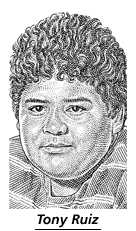
LOS ANGELES -- After nine years in foster care, and nine different homes, 12-year-old Tony Ruiz was in serious trouble. He was on multiple psychiatric drugs, had long been suicidal, was often defiant and disruptive and displayed hopelessness.
"I just want to have a family," Tony told Judy Smith, a volunteer court advocate and the only person who had known him for any length of time. Fearing Tony wouldn't live to see adulthood, Ms. Smith turned to Linda Librizzi, a sleuth of sorts who locates the lost relatives of foster children.
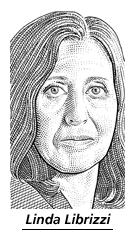
A longtime licensed clinical social worker, 53-year-old Ms. Librizzi is on the vanguard of a growing revolution in child welfare: She is a "family finder." Thanks to computer search technology, social workers have for the first time a powerful tool to locate the family members of "cold cases," children who spend years moving from foster home to foster home until their biological families' whereabouts are unknown.
There are roughly 525,000 children in foster care at any given moment in the U.S., many of them moving to a new foster home every few months. Roughly 25,000 foster children each year reach adulthood without ever having found a permanent home. They are discharged to the streets at 18 years of age, often ending up homeless, incarcerated, or otherwise overseen by the judicial or social welfare systems.
In the 40 or so communities around the U.S. that are using the new data-plumbing techniques, government social workers are placing about 25% of cold-case children in homes, estimates Kevin Campbell, a former social-work administrator in Washington state who pioneered the method. But dedicated family finders like Ms. Librizzi, who works for a private nonprofit agency and isn't distracted by typical social-worker duties, boast success rates as high as 75%. Social workers say the likelihood of these children finding homes is otherwise nil.
Even advocates concede the main problem with family finding is that it isn't being implemented soon enough. They say it would be most effective if it were used to prevent children from spending years in the foster-care system in the first place.
There are other challenges, too. Family finding doesn't solve the psychological problems that can affect foster children, especially when they have bounced from home to home. Few families are fully prepared for the difficulties of taking in a long-lost relative who has spent years in foster care. As a result, some reunions end unhappily.
Here in Los Angeles County, home to the nation's largest child-welfare system, family finding has helped shrink the number of children in foster care to 11,000 from 14,000. That promises significant cost savings. The cost of caring for a foster child in Los Angeles can top $75,000 a year, not including the burden on the judicial system and homeless shelters as troubled children pass into adulthood.
Los Angeles started testing family finding about three years ago and is now training social workers and expanding it countywide. For the children, the process begins with the permission of a social worker -- or in a few cases, with a court order -- requested by someone involved in the child's care.
One corporate partner of this effort is U.S. Search, a unit of First Advantage Corp. which sells such data to social workers for $25 a report, less than it charges other clients. Tapped by Mr. Campbell, U.S. Search, which typically sells its services to private detectives and individuals in search of old girlfriends and others, has a small staff dedicated to working with social workers.
U.S. Search subscribes to databases of records on voter registration, marriage, divorce, criminal filings, credit records and other information. Its software broadens search terms to look for alternative spellings. In one study by Mr. Campbell, U.S. Search was able to find more than 85% of parents who were listed as "whereabouts unknown" in California court records.
Armed with this data, teams of local social workers -- and in one California county, retired police detectives -- make dozens of phone calls, knock on doors and wheedle information to re-forge family connections. They aren't just looking for adoptive homes. They're also hoping to put foster children in touch with their roots and create an additional source of support.
The work is arduous, emotional and slow. The searches, culled from so many databases, can be messy. Data are almost always missing; workers can spend weeks chasing false leads.
Even when social workers find whom they are looking for, the process can open festering family wounds, rekindling the problems surrounding the children's births or their removal from parents' care. Mr. Campbell, the inventor of family finding, tells social workers to expect a third of the family members they reach to refuse further contact. He also tells them to expect anger. "There's a lot of pain in these families," he says.
Mr. Campbell calls Ms. Librizzi one of the most tenacious family finders he has trained. She has spent more than a year trying to connect some children with their family members.
Ms. Librizzi, a dark-haired woman whose accent reveals her New York origins, spent 30 years working in child welfare before her employer, a group home for youths called Hollygrove, cut back to outpatient services for financial reasons. In 2005, she began doing family finding to find homes for Hollygrove's young residents, later expanding her clientele to children identified by the county as most in need of family finding. She declines to divulge her salary, saying only that she works part-time and is paid on an hourly basis.

Two days before Christmas in 2005, Ms. Librizzi was assigned to find the family of Tony, the 12-year-old boy. He weighed nearly 240 pounds and was often picked on at school. Separated from his brother and sister as well as his extended family over the years, Tony was living in a sparsely furnished three-bedroom group home for boys, overseen by a small rotating staff.
Ms. Librizzi began with a few bits of information about Tony's origins from his caseworker: Tony's name and birth date, the name of his mother, her Social Security number and birth date, and her former address. Nothing was known about Tony's father, not even his name. Working from her small shared office, Ms. Librizzi emailed the information to Clif Venable, a data researcher at U.S. Search.
Mr. Venable then went to work in his Culver City, Calif., cubicle, typing the information into his company's computer system. Minutes later, Mr. Venable emailed back a 10-page list of possible relatives, people who had lived at the same address, possible previous addresses, and even neighbors culled from the many databases to which U.S. Search` subscribes. Ms. Librizzi began at the top of the first page that Friday. She quickly thought she'd hit gold with a man who spent an hour discussing Tony. "Turned out, he wasn't even related," Ms. Librizzi says.
Because many of Tony's relatives had moved repeatedly, the names on the list often lacked working phone numbers. On page five, Ms. Librizzi dialed a number in Stafford, Texas -- someone with an entirely different family name.
The woman who answered demanded to know how Ms. Librizzi had gotten her number. "From an Internet search. I just want to reassure you, this is not a crank call," Ms. Librizzi says she responded. The woman finally conceded she was a distant relation -- the sister-in-law of Tony's mother's sister-in-law. She agreed to pass along a message that someone was searching for Tony's family.
An hour later, Ms. Librizzi received a call from a woman in California -- another distant relative -- who said she knew where Tony's mother was. When Ms. Librizzi returned to her office on Monday morning, three voicemail messages from Tony's mother awaited her.
Ms. Librizzi, along with Tony's social worker, pursued the possibility of developing some sort of relationship between Tony and his mother. She phoned various family members on behalf of Tony so many times that the family began to call her "Linda-for-Tony."
Ms. Librizzi also continued following other leads. Building on information from records and family members, she obtained a number for a San Fernando, Calif., Indian tribe, and called its administrator, Rudy Ortega, to find out if the tribe had records of Tony's birth. Mr. Ortega was noncommittal. The tribe receives many calls from people hoping to gain access to a tribe's benefits (even though the San Fernando tribe isn't federally recognized and doesn't receive such benefits). But the call roused Mr. Ortega into action.
As it turns out, the 32-year-old Mr. Ortega and his wife, Samantha, a medical technician, are Tony's great-uncle and great-aunt. They had three children: girls named Citlaly and Itati, and a son named Tomiear -- and they had at one time looked into adopting. They say they would have adopted Tony all those years ago had they been contacted.
Six weeks after the search began, Tony was told his mother had been found. He also learned he came from a line of Indian chiefs from the San Fernando Band of Mission Indians. His great-grandfather was Chief Little Bear Rudy Ortega Sr. The senior Mr. Ortega was interested in bringing a tribal member back into the fold.
At first, L.A. County social workers explored reuniting Tony with his mother. But his mother failed to show consistent interest or ability to care for Tony, say social workers. Social workers say Tony's mother, who has had several other children removed into foster care, moves frequently among the homes of friends or relatives. She could not be reached for this article.
Meanwhile, the tribe pulled together. Three other families quickly volunteered to start proceedings to potentially adopt him, including Rudy and Samantha Ortega. During a meeting that fall, tribal elders determined that the Ortegas were the best match. Tony soon began to visit them, first briefly, then spending weekends at their home.
When he returned to the Lynwood group home each Sunday night, Tony wept and pleaded to stay with the Ortegas. He hung a small dreamcatcher -- an Indian totem said to ensnare bad spirits -- over his bed.
Last fall, Tony announced he wanted to become a veterinarian -- a sign social workers say that he was looking forward to the future. In March, the county court gave him permission to move in with the Ortegas, who took classes in how to deal with troubled children. The family also arranged to have another male relative tutor Tony in the afternoons to help with schoolwork and socialization.
By April, Tony was off medication entirely. Mrs. Ortega discovered he needed glasses -- he had once had them, but lost them in the course of his many moves. Chatty and smiling, he lost 50 pounds. Now 13, he began to earn A's at his new school.
Tony struggled to describe what was special about the Ortegas. "They hug me," he finally said.
Things didn't continue as smoothly. After the initial honeymoon period, many of Tony's former patterns of misbehavior reappeared. He walked out of class at school and at home, his discipline problems escalated and frightened the family. He once waved a kitchen knife at Mrs. Ortega, she says, and she caught him urging the family's pet dog to fight with a neighbor's Chihuahua. He bullied Tomiear, Mrs. Ortega's youngest child, by pushing and teasing the preschooler.
When she discovered she was pregnant with her fourth child, Mrs. Ortega says she feared Tony might become jealous and hurt the baby. Two weeks ago, the family abruptly discontinued the adoption, saying they'd reached the end of their rope. The county didn't fully prepare her for the magnitude of Tony's troubles, said the angry Mrs. Ortega, who drove Tony to his social worker's office and left him there that Friday afternoon. "If I were to do this again, it would be with a child who is much, much younger," she said.
Ms. Librizzi says Tony's experience with his family has revealed behavioral problems that had been ignored when he was being shuffled among foster homes. Tony will begin intensive therapy for these issues, she says.
Mr. Campbell says such outcomes are all too common. "You ask yourself how would Tony's story be different if his family had been found in the first six months after being taken from his mother," he says.
Tony is now once again living with just a few personal belongings in a group home for boys.
Just after he left the Ortegas, new hope for Tony emerged: his tutor. The tutor, a police officer who is engaged to a tribe member, told Tony's social-work team that he remains interested in serving as a mentor -- or possibly more -- to Tony.
"We're going to keep on keeping on," says Ms. Librizzi. "We don't end until we have some sort of personal connection for a kid."
Source: Wall Street Journal
Girl Escapes Foster Care
August 23, 2007 permalink
Another girl has escaped from foster care, this time from Huntsville to North Bay.
expand
collapse
Twelve-year-old girl missing

Family Youth and Child Services of Muskoka and the Huntsville OPP are requesting the public’s assistance to locate 12-year-old Tasha Lavigne.
Lavigne was last seen in Huntsville on Aug. 6 and is believed to be in the North Bay area.
She is five-feet two inches tall and approximately 120 pounds with dark brown shoulder-length hair and brown eyes. She has a fair complexion with pierced ears. It is unknown what she was wearing when she left the home.
Anyone who knows of Lavigne’s whereabouts is asked to call the OPP at 789-5541 or Crime Stoppers at 1-800-222-8477.
Source: Huntsville Forester
Foster Girl Murdered
August 22, 2007 permalink
A fourteen-year-old foster girl has been murdered in Montreal. The press is playing down her residence in a group home.
expand
collapse
CTV.ca
Mtl. police arrest 15-year-old in death of teen
 Francesca St. Pierre is seen in this image taken from video that aired on CTV Montreal.
 'My heart just stopped when I saw him,' Genevieve Moreau, one of the victim's sisters, told CTV Montreal. 'He must be tried as an adult.'
A day after the body of a teenage girl was found strewn in a ditch, Montreal police have charged a 15-year-old suspect with first-degree murder.
Police will not say if the suspect knew the 14-year-old victim, Francesca St. Pierre, or if investigators had figured out a motive for the murder.
Francesca was found with bruises all over her body on Sunday in a wooded area near the group home she was living in. She disappeared from the home Saturday morning at 10:50 a.m. after she told people in charge she'd be running out for an hour or so to run some errands.
When they didn't hear from the girl by later that afternoon, they notified St. Pierre's family and police.
Her body was discovered Sunday night by pedestrians passing through the area. She is Montreal's 23rd homicide of the year.
Police received more than 50 tips from people at a command post near the site where her body was found in Rivière-des-Prairies, a community northeast of Montreal. A suspect was traced to his home and was arrested Monday night.
The young man appeared in court Tuesday afternoon. If found guilty, he faces a maximum of six years in detention, unless he is tried as an adult.
"My heart just stopped when I saw him," Genevieve Moreau, one of the victim's sisters, told CTV Montreal. "He must be tried as an adult."
But the Crown has already indicated it won't seek an adult sentence, which would mean life in prison. The case returns to court on Thursday.
With a report from CTV's Stephane Giroux
Source: CTV
DC Rally
August 19, 2007 permalink
The rally in Washington DC did not make the news services. Below is a preliminary report by the organizer Ron Smith, taken from a public posting by AFRA. More details, including pictures, should be available when the participants return home to post them to the web.
expand
collapse
Dennis,
Let me give you an update. The rally was phenomenal. Fox did interview at the rally. As did many other news and radio programs who interviewed me there at the Lincoln Memorial. It was organized and without incidents. Our speakers forgot their time constraints but for the most part, IT WAS WONDERFUL. We have not seen this kind of networking ever in this movement. We had three-time super bowl champion Tim McKyer who spoke and turned people on, Judge Willie Lipscomb from Detroit had the same reaction as did all of the speakers. The stage was loaded with stuffed animals that spilled into the walkway in front of the stage. It was a sight to see.
There was more hugging, by people who only knew others by their emails and post, than you could imagine. Everyone met others that they knew from this medium.
This was the greatest first step imaginable for well deserved change. This will mean absolutely nothing if we don't continue to work just as hard beginning on Monday!!!! WE HAVE UNITED LIKE NEVER BEFORE!!!!
Ron Smith
Source: AFRA Newshawk
Addendum: Extensive reports on the rally, including videos, are now available from Glenn Sacks and John Murtari. Participation was in the hundreds.
Addendum: The ACFC has videos of all speeches at the rally. Another list is on the dcrally2007 website. Click on the names at the left, for most the wmv file of their speech is on their individual page.
Threat to Pregnant Woman
August 19, 2007 permalink
We have received dozens of personal reports of threats made privately by child protectors. So far, all of them have been the unsubstantiated word of the aggrieved parent. Now in England two parents, Vanessa and Martin Brookes, have secretly recorded a session in which they were threatened with child removal even before the birth of their child. There can be no possible basis for these threats, since it is impossible to commit child abuse before a child legally exists. In a desperate attempt to save her baby the mother has posted the recording of the threats (audio only) on YouTube. The child protectors have responded with legal threats against the parents and YouTube for secretly recording them. Since no child legally exists before birth, the Sunday Telegraph felt safe in publishing the story with real names.
expand
collapse
YouTube row over social services baby threat
Ben Leapman, Home Affairs Correspondent, Sunday Telegraph, Last Updated: 12:57am BST 19/08/2007
A heavily pregnant woman is at the centre of an extraordinary legal battle with social workers after she secretly recorded them threatening to take away her newborn baby.
Vanessa Brookes, 34, who is due to give birth early next month, smuggled taping equipment into a meeting with social services officials, fearing they would try to take her baby for forced adoption.
She recorded a social worker telling her and her husband Martin, 41, that even though there was "no immediate risk to your child from yourselves", the council would seek a court order to place the child in foster care.
Mother and baby would be allowed "two or three days" in hospital together, but should not leave the premises until social workers came to remove the infant. In a desperate attempt to keep their baby, the couple have published the recorded conversation on the internet.
Calderdale council, in West Yorkshire, last night accused them of breaching the Data Protection Act by recording its staff without their knowledge or consent. The council said it had begun legal action to have the recording removed from the YouTube website. Mrs Brookes said: "Even puppies and kittens aren't removed from their mothers at birth. Social workers always record everything, so why shouldn't we record them?"
John Hemming, the Liberal Democrat MP and chairman of campaign group Justice for Families, said: "I find it very odd that a newborn baby would be removed when there is not any allegation by the authorities that the child is at risk. Yet this case is not unique. There are many cases in which newborns are removed because of allegations that their mothers may at some later stage 'emotionally abuse' the child."
The case returns the spotlight to claims that social services are being heavy-handed in removing children from their parents, in order to meet Government adoption targets.
The Sunday Telegraph has previously revealed cases of mothers who were not told why their children were taken away, and cases of families whose children were not returned even after the parents had been cleared of wrongdoing. More than 2,000 babies aged under a year were taken for adoption last year, almost triple the level of a decade ago.
Social services took an interest in the Brookes family after Mrs Brookes, who is partially-sighted, was diagnosed with depression and a personality disorder, leading to concerns that her baby might be subjected to "emotional abuse". Neighbours have complained that the couple's household was disorderly, but neither has been accused of abusing or harming a child.
In the recorded meeting, the social worker tells the couple: "It's our intention as a local authority that when your baby is born, we go into court on that same day and ask for an interim court order because we would wish to place your baby with foster carers."
He tells Mrs Brookes: "I would like you and your baby to stay in hospital until the courts have made a decision."
The social worker says the two or three days the mother has with her baby in hospital will allow her to begin breast-feeding and that once the infant is taken away, social services will pick up expressed breast milk from her home and deliver it to the foster carers for bottle-feeding.
The social worker admits to the couple that a back-up plan is being drawn up in case the judge refuses the application for a care order. He says: "What we also have to think about is a child protection plan that looks at you, at home, with your baby. There is no immediate risk to your child from yourselves, that's my understanding from reading documents."
A spokesman for Calderdale council said officials would seek a meeting with Mr and Mrs Brookes "to understand how this information came into the public domain. We are taking action to have this item removed from YouTube. This recording was made without the knowledge or consent of our member of staff.
"The council does not take lightly any recommendation to the court for a child or a baby to be brought into care. The decision whether or not to institute care proceedings is made by social workers who have to consider the best interests of the child."
Source: Daily Telegraph (UK)
Addendum: The video was removed from YouTube in about a day. We have obtained a copy (13 megabytes, wmv format) from a user who copied it while it was still online.
Addendum: The baby was born a month later. There is no public word on its fate.
expand
collapse
Published Date: 21 September 2007
Source: Evening Courier
Location: Halifax
Mother gives birth to care-threat case baby
By Megan Featherstone
A MUM who has been fighting plans to take away her unborn baby has given birth. Vanessa Brookes of Bradley View, Holywell Green, gave birth at 7.21pm on Wednesday.
But Mrs Brookes and husband Martin could lose their newborn when a court hearing decides the baby's fate today.
In August the couple hit the headlines when they taped a conversation with Calderdale Council staff, who said they would apply for care of their baby as soon as it was born. It is claimed the baby will be at risk of emotional abuse.
The recording was then posted on the video internet site YouTube.
Dad Martin, 41, witnessed the birth. He said: "It was great, really emotional."
But he said his and his wife's happiness had been overshadowed by their worries about having the baby taken from them.
He said the battle had been particularly stressful for his wife who is registered blind. They plan to continue to contest any decision to take the baby into care.
A council spokesman said an interim care order had been applied for and a court hearing was being held today.
Last Updated: 21 September 2007 9:20 AM
Source: recovered from Google cache
Addendum: Once the baby is born, newspapers fear to mention names. There is no way to be certain, but the enclosed article on flight from the hospital seems to be about the same family. Scanning the web years later suggests, without any authoritative source, that the baby was adopted but the courts later ruled there were no grounds for child removal. Too bad. The parents don't get their child back.
expand
collapse
Couple flee with baby - fifth person arrested
A FIFTH person has been arrested after a couple fled Calderdale Royal Hospital with their new-born baby, fearing she would be taken into care.
The man was arrested on Friday evening in Cheshire and is in custody with four others.
The baby was taken from the hospital on Thursday night, against the wishes of medical staff.
Social services bosses and police were alerted and a major investigation was launched to trace the baby and her parents.
Sources have revealed police subsequently visited a farmhouse in the quiet rural village of Flyford, in Worcester, where they discovered the baby.
Four people were arrested, including a couple in their early 30s and 40s. One couple are believed to be the baby's parents.
Yesterday, a court in Leeds agreed to grant Calderdale Council an interim care order – meaning the child has been placed in the care of the local authority while the family is assessed and until the court makes a final decision.
It is thought social services staff had been in touch with the parents of the baby before the birth, advising that the baby was likely to be taken into care.
Detectives are understood to be questioning the baby's father in Halifax while the mother is being interviewed in Worcester.
Police said: "A large police operation was launched to ensure the safe return of a missing baby. A man was arrested and is custody at a West Yorkshire police station.
"Just after 6.15am on Friday, officers recovered the baby from an address in Flyford. The baby is safe. Three people were arrested at the address."
Source: Halifax Courier
Fathers Climb Lincoln Memorial
August 17, 2007 permalink
The memorial to Abraham Lincoln, liberator of America's slaves, was climbed today by Fathers-4-Justice, hoping to achieve similar freedom for fathers. Two men have been arrested. Below is the announcement from Fathers-4-Justice. You can also watch a video made by Mark Tang F4J UK Storms the Lincoln Memorial Aug-17-07(1) on YouTube.
expand
collapse
Breaking News: Lincoln Memorial Climbed by F4J UK
Washington, DC —
Two British activists from Fathers 4 Justice UK have just landed on the Lincoln Memorial. Jolly Stanesby (aka Batman) and Mike Downes (aka Captain America) have climbed The Lincoln Memorial because of Abraham Lincoln’s connection with the abolition of slavery.
This humanitarian mission is designed to save children and parents from the ravages of the for-profit divorce industry that terminates the parental rights of thousands of Americans daily. Many believe these courts and actions are unconstitutional, and much is being done to seek federal intervention. About every two seconds a child’s bond with one good and fit parent is terminated because of a family law system and divorce industry that is in need of serious reform. States receive billions of federal dollars annually as incentives to drive up child support that is paid by American taxpayers.
Jolly Stanesby has been involved in more than fifteen different civil disobedience actions to help children in the UK, and has a dream that someday all American and British parents will be treated equally. He hopes that the family court systems will acknowledge what science has known for decades, that children grow up far better when they have near equal time with both parents.
Fathers 4 Justice has been a nonviolent direct action organization since 2002 and has had a major impact on the treatment of fathers and children in family courts.

Source: Fathers-4-Justice (US)
DCYF Sticks Up Legislators
August 16, 2007 permalink
The article below illustrates better than any other why it is impossible to reform the child protection system. Rhode Island DCYF, under attack by a lawsuit from the state government, has fought back. They have given the legislators the dilemma of: give us more money or we will starve your children. The legislature has already provided money for the purpose, but DCYF has failed to reserve money for foster children first. There is only one possible outcome — the legislators will appropriate more taxpayer money for the profligate child protectors.
The protectors operate with the same moral code as a hostage taker: give me money or I will kill the secretary. There can be no reform until children are no longer cared for with appropriated funds. This proposal is no pipe dream. In the twentieth century countries containing a third of the world's people abolished private farming and had food produced by the state. The result in every case was chronic food shortage or famine. A hundred million hungry people died, more than in battle. Perhaps a children's holocaust of similar proportions will be necessary to force abandonment of the system, and turn children over to the care of private parties, primarily parents, and in extraordinary cases, charity.
expand
collapse
DCYF money woes may leave providers short
PROVIDENCE — The Department of Children, Youth and Families is having a difficult summer.
The agency learned in late June that it was a target of a sweeping class-action lawsuit filed by the state’s child advocate, alleging widespread abuse in Rhode Island’s foster-care system.
Then, the agency was blocked by a Family Court judge from implementing a new policy mandated by the General Assembly that was touted as a cost-saving measure.
Now, it appears that the department is about to go broke.
The DCYF is on pace to spend its entire first-quarter child-welfare budget by mid September, agency director Patricia Martinez said yesterday. And a provision passed in the state budget prevents state officials from shifting money to cover the shortfall until the beginning of the second quarter, Oct. 1.
That will temporarily leave the department unable to pay dozens of child-welfare providers — group homes, shelters, and independent-living programs — that care for thousands of Rhode Island children removed from their homes because of abuse or neglect.
The immediate effect on the children in state custody is unclear, Martinez said. The providers are not legally required to care for Rhode Island’s children without payment.
“That’s something we need to figure out,” Martinez said. “It affects the providers, but also the kids.”
Child-welfare providers representing nearly 40 organizations held an emergency meeting late last week to discuss the DCYF’s financial situation, according to James Harris Jr., the executive director for the Rhode Island Council of Resource Providers.
While Martinez predicts running out of money by Sept. 15, the providers fear it may come even sooner, according to Harris. “I’m hearing the situation is dire,” he said.
Whether or not they get paid, Harris said most providers would struggle to continue caring for the children.
But some organizations may be forced to take out loans to cover monthly expenses such as payroll, rent and utilities, according to Benedict F. Lessing Jr., executive director of Family Resources Community Action, a service provider that offers specialized foster care.
“The implication is that providers have to go to the bank to borrow money,” Lessing said. “Most nonprofit providers can only do that for so long.”
Martinez said it was “realistic” to think that some companies would be forced to take out bank loans to cover expenses. “I think this is one of the most difficult times for any provider,” she said. “I don’t envy them.”
The looming shortfall at the DCYF is attributed largely to cost-cutting provisions in the state budget that have been blocked by the Family Court.
The General Assembly cut the DCYF’s budget by roughly $12 million based on a plan to reduce and restructure services for roughly 600 foster children, ages 18 to 21, who receive state-subsidized health care, housing and education assistance.
In a test case last month, however, Family Court Chief Judge Jeremiah S. Jeremiah Jr. rejected the DCYF’s attempt to end Family Court involvement with Kenneth K., a 20-year-old resident of a state group home. Jeremiah said the budget legislation isn’t retroactive, so it can’t apply to Kenneth, who was under the court’s jurisdiction before the change took effect.
The state Supreme Court declined to overrule Jeremiah, but plans this fall to decide whether to hear a DCYF appeal. The DCYF, however, doesn’t have the luxury of waiting until the fall to abide by the state budget that took effect July 1.
Aside from the Family Court’s ruling, the situation is also complicated by the Assembly’s decision this year to release the DCYF’s financing in four quarterly payments in an attempt to control department overspending — a control applied only to DCYF this year, according to House Finance Committee Chairman Steven M. Costantino.
“We were very concerned about overspending in DCYF. Every year they would come to the Assembly for a supplemental request and we’d find out that a half year has gone by and they’ve already blown by their budget,” Costantino said.
Last year, for example, the Assembly approved a $17.9-million supplemental appropriation (including federal dollars) at the end of the session on top of the DCYF’s $293-million budget.
The quarterly allotments, Costantino said, were a safeguard put in place after the Assembly agreed to restore partial financing for services to 18-to-21 year olds in state care, which the governor had proposed cutting. The plan also required the DCYF to redesign its system to save money by improving department inefficiencies.
“There has not been a lack of money for DCYF over the years,” Costantino said. “Unfortunately, it seems that there has to be a major financial crisis to make change.”
Governor Carcieri’s spokesman Jeff Neal said the governor would reach out to Assembly leadership for guidance in the DCYF’s budget dilemma. The governor’s staff believes it can’t shift money from another area to help the DCYF pay its bills before the end of the quarter based on language in the state budget.
“If the General Assembly has another interpretation, we are very interested in hearing it,” Neal said.
Meanwhile, Judge Jeremiah wasn’t sympathetic to the DCYF’s budget situation when contacted this week.
“I’m only concerned about the best we can do for children in our system that have been neglected and abused. That’s the primary responsibility of every judge in Family Court,” he said. “[The Assembly] should have gone and put more money in [DCYF’s] budget.”
speoples@projo.com
Source: Providence Journal
More Snitches Needed
August 16, 2007 permalink
When the supply of kids runs low, it needs to be replenished. Ontario is providing $1.1 million to train school teachers to turn in kids. If your kid is tired or hungry, or worst of all, so bored with school he wants to jump out of his chair, teachers will now alert CAS.
expand
collapse
Ontario to train teachers to spot abuse
They are well placed to catch early signs of trouble, minister says
August 16, 2007, Louise Brown, Education Reporter
There's not always a bruise to tell the secret.
But a child who is starting to witness violence in the home – or be a victim – may seem a little more sleepy in class, a little more hungry, a little more jumpy and up for a fight, says MPP Sandra Pupatello.
And if someone can read those subtle warning signs, they may be able to intervene before the violence gets worse, says Pupatello, Ontario's minister responsible for women's issues.
A $1.1 million training program announced yesterday will provide workshops for up to 6,000 elementary teachers in how to recognize, and help, children affected by abusive behaviour – with luck, even before it turns to violence.
"Kids spend a large part of their days at school, so educators are in a unique position to read any sudden change in behaviour; to notice a child who is suddenly disruptive or who has an unusual outburst that could point to circumstances happening in the home," Pupatello, MPP for Windsor-West, said in an interview.
While teachers are legally obliged to report any suspected case of child abuse to authorities, Pupatello said they often are not trained in how to ask children questions about their safety in an age-appropriate way, using the right language to draw out the truth without upsetting the child.
Teachers will be able to learn more at the website www.curriculum.org/womanabuse.
The training program is being welcomed by the Elementary Teachers' Federation of Ontario, which represents 70,000 grade school teachers in the province.
At its annual meeting in Toronto yesterday, the federation elected York Region Teacher David Clegg as its new president.
The former junior high school teacher says he will push Queen's Park to shrink the gap in funding that exists between grade school students and their high school counterparts.
Clegg succeeds Emily Noble as president.
Source: Toronto Star

Rick Fredrickson R.I.P.
August 15, 2007 permalink
Rick Fredrickson lost his baby son Liam to the to adoption through a decision by a Saskatchewan court. Efforts to right the injustice came to a premature end with Mr Fredrickson's tragic death in a traffic accident. The link is to a news article on his death, scroll backwards for the full story. He also has his own website.
Addendum: Kris Titus advises: The funeral for Rick Fredrickson will be on Monday at 2:00 at Hill Crest funeral home in Saskatoon.
Addendum: Here is an obituary distributed by Jeremy Swanson.
expand
collapse
Richard Fredrickson

FREDRICKSON - Richard "Rick" Leslie died tragically on Saturday, August 11, 2007. Left to mourn are his new bride Barb and her children Chris and Tamara; his mother Carol Fredrickson, mother-in-law Joyce HeskethJones, and grandmother Mary Fredrickson all of Saskatoon; sister Brenda (Ken) Holowatiuk of Regina and their children, Krystal and Amber; brother Darren (Barb) Fredrickson of Saskatoon and their children, Sarah, Amy and Ryan; and numerous aunts, uncles, cousins and friends. Rick is also survived by two biological children, daughter Desiree and a 16-month-old son. Rick was predeceased by his father Delmer Fredrickson in 2005, his grandfather Jeff Fredrickson and his grandmother Lorena Larson. Rick was born on June 22, 1972. He lived in Speers until the age of six, when the family moved to Saskatoon. He attended school at Lester B. Pearson and briefly at Mount Royal Collegiate. He went to work at a young age, working road construction with his Dad and brother, first with Warner Construction and later with Morsky Construction. After a time, he left the industry and bought Select Music and Sound. Rick loved to DJ and entertain the crowd. He dabbled in many business ventures over the years and in 2004, Rick became the owner/operator of Distress Courier. During the last year of his life, Rick also actively supported Fathers for Justice and touched the lives of many people across the country. When Rick wasn't working he could be found fishing on the riverbank near Borden Bridge or at Auto Clearing Motor Speedway where he raced his #22 Thunderstock car. Rick also enjoyed spending time with his family and friends. He loved to entertain and there was never a dull moment when he was around. He will be sadly missed. Donations in his memory may be made to Fathers-4-Justice Canada, 202 812 12th Street, New Westminster, BC V3M 4K1 or Auto Clearing Motor Speedway, PO Box 169, Saskatoon, SK S7K 3K4. Funeral Service will be held on Monday, August 20, 2007 at 2:00 p.m. in the Chapel of Hillcrest Funeral Home (east on 8th street, turn right before the railway track), Saskatoon, SK. Interment will follow the service in Hillcrest Memorial Gardens. Email condolences may be sent to park@arbormemorial.com. Arrangements have been entrusted to David Schurr of PARK FUNERAL CHAPEL (244-2103).
Baby Girl Tasered
August 15, 2007 permalink
A security guard in Texas fired a Taser at a father holding his baby girl, resulting in injuries to the baby. What is the difference between a hospital and a jail? Opportunistic child protectors have snatched the baby.
expand
collapse
Associated Press
Guard Uses Taser on Man Holding Newborn
HOUSTON -
In a confrontation captured on videotape, a hospital security guard fired a stun gun to stop a defiant father from taking home his newborn, sending both man and child crashing to the floor. Now William Lewis says his baby girl suffers from head trauma because she was dropped.
"I've got to wonder what kind of moron would Tase an adult holding a baby," said George Kirkham, a former police officer and criminologist at Florida State University. "It doesn't take rocket science to realize the baby is going to fall."
Lewis, 30, said the April 13 episode began after he and his wife felt mistreated by staff at the Woman's Hospital of Texas and they decided to leave. Hospital employees told him doctors would not allow it, but Lewis picked up the baby and strode to a bank of elevators.
The elevators would not move because wristband sensors on each baby shut them off if anyone takes an infant without permission.
Lewis, who gave the video to The Associated Press, said his daughter landed on her head, but it cannot be seen on the video. He said the baby continues to suffer ill effects from the fall.
"She shakes a lot and cries a lot," Lewis said, noting doctors have performed several MRIs on the child, Karla. "She's not real responsive. Something is definitely wrong with my daughter."
It was not clear whether the baby received any electrical jolt.
Child Protective Services has custody of the baby because of a history of domestic violence between Lewis and his wife, Jacqueline Gray. Agency spokeswoman Estella Olguin said the infant does not appear to be suffering any health problems from the fall.
David Boling, an off-duty Houston police officer working security at the hospital, and another security guard can be seen on the surveillance video arriving at the elevators and trying to talk with Lewis. Lewis appears agitated as he walks around the elevators holding his daughter in his right arm.
Within 40 seconds of arriving, Boling is holding the Taser. He walks around Lewis and whispers to the other guard, who moves to Lewis' right side.
About a minute later, Boling can be seen casually standing near Lewis, not looking in his direction, when he suddenly raises the Taser and fires it at Lewis, who was still holding his daughter.
Lewis drops to the floor. The other guard, who has not been identified, scoops up the baby and gives her to the child's mother, who was standing nearby in a hospital gown.
The guard then pulls Lewis to his feet with his arms locked behind him. Lewis' T-shirt has two holes under the left side of his chest where the Taser prongs hit him.
Lewis said he did not see the stun gun.
"My wife said `we want to leave' and then he just Tasered me," Lewis said. "He caused me to drop the child."
In a statement, the hospital said Lewis was hostile and uncooperative toward staff members who were trying to find out his relationship to the infant when they saw him trying to leave. Neither Lewis or Gray had indicated they wanted a discharge, according to the statement.
"Mr. Lewis became verbally abusive by using vulgar expletives. When Mr. Lewis' behavior became threatening, endangering the infant and employees, licensed law enforcement officers followed their professional standards to protect those involved," the statement said.
Lewis was arrested and charged with endangering a child. A grand jury in May declined to indict him on that charge, but charged him with retaliation, accusing him of making threats against Boling.
Lewis also has been charged with a second count of retaliation alleging he made a threatening call to Boling at his home.
Lewis denies both charges. He said he is considering suing the hospital but has not filed any legal papers.
Houston police spokesman Gabe Ortiz said the department did not investigate the officer's role, and he declined to elaborate. Boling did not immediately respond to a request for comment given to the police department.
Some 11,000 U.S. law enforcement agencies use Tasers, which some experts say are increasingly being used as a convenient labor-saving device to control uncooperative people.
"The Taser itself is a legitimate law-enforcement tool," said Kirkham, the criminologist. "The problem is the abusive use of them. They're supposed to be only used to protect yourself or another person from imminent aggression and physical harm. They're overused now."
Associated Press writers Chris Duncan and Monica Rhor contributed to this report.
Source: Forbes
Death in CAS Custody
August 10, 2007 permalink
Canada Court Watch reports that an unnamed York Region foster boy has committed suicide. Will he be buried, as he lived, without a name?
expand
collapse
15-year-old boy commits suicide while under supervision of York Region CAS
(August 9, 2007) - Sources connected to CAS have reported to Court Watch that a 15-year-old York Region boy may have committed suicide yesterday. At the time of his death, the boy was under the supervision of the York Region CAS. Court Watch has received a number of calls from parents and children complaining about the mean-spirited actions of over-zealous workers at the York Region CAS, including the worker who was this boy's worker with the CAS. Could this boy's death be the result of yet more incompetence and lack of due diligence by York Region CAS workers and/or the courts? The reports of how the boy died have yet to be confirmed and Court Watch will provide readers with more information as soon as it becomes available.
Source: Canada Court Watch
Foster Child Near Death
August 10, 2007 permalink
An unnamed eighteen-month-old foster boy is in critical condition after drowning in a pool at his Markham foster home.
expand
collapse
 The toddler is loaded onto a helicopter for transport to McMaster University Medical Centre in Hamilton.
Markham toddler discovered in backyard pool
An 18-month-old Markham toddler is fighting for his life after falling into a backyard pool.
The child had no vital signs when he was discovered by his foster father at 83 Pringle Avenue near Highway 7 and the Ninth Line in Markham.
The child was revived and rushed to Stouffville Hospital by paramedics shortly before 1 p.m.
He has since been airlifted to McMaster University Medical Centre in Hamilton.
 The incident happened at 83 Pringle Avenue near Highway 7 and the Ninth Line in Markham.
York police believe the child wandered outside after discovering a door leading from the house to the pool deck was left open.
The boy is one of several foster children living at the residence.
Adults and two of the family's biological children were at home during the accident.
An investigation is under way to determine how the child wandered out into the pool area.
With a report from CTV's Jim Junkin
Source: CTV
Dunn Charges Ottawa CAS
August 9, 2007 permalink
In the press release below John Dunn announces charges against the directors of the Children's Aid Society of Ottawa resulting from their failure to provide him with a membership list as required by law. The release does not make it clear what legal process is being used to pursue the charges.
expand
collapse
For Immediate Release
Date: Wednesday, August 08, 2007
FORMER FOSTER CHILD CHARGES CHILDREN'S AID SOCIETY OF OTTAWA AND ITS EXECUTIVE DIRECTOR UNDER CORPORATIONS ACT.
At a time when the Ombudsman of Ontario has been fighting for jurisdiction over Children's Aid Societies across the province for the purpose of increasing accountability for the services they provide, John Dunn, a former foster child and child-welfare reform advocate, laid charges against the Children's Aid Society of Ottawa and its Executive Director on Wednesday, (August, 8th, 2007) for knowingly and willfully committing the Offence of contravening section 307 (5) of Ontario's Corporations Act.
The Society and its Executive Director, Barbara MacKinnon, if convicted, could face fines of up to one thousand dollars each.
Dunn, wanting to advocate for positive changes to the way child-welfare services are provided to Ottawa's children and youth applied for a membership with the Children's Aid Society of Ottawa, only to have his application denied without a valid explanation.
After several failed attempts to meet with the Society to discuss the matter, Dunn was instructed by Pierre Viger, the Society's Director of Professional Services, to discuss the matter with Ottawa lawyer, Robert C. Morrow of Burke-Robertson Barristers & Solicitors.
Later, while in a meeting with Morrow, Dunn was advised that the Society was not prepared to discuss the matter any further, that the matter was “closed” and that he should seek legal counsel if he wishes to pursue the membership matter any further.
Shocked at the treatment he received from the Society regarding his membership application, Dunn filed a complaint with the Ministry of Children and Youth Services only to be informed by them that Society memberships are a “corporate law” matter and as such, can not be dealt with by the Ministry.
On February 05, 2007, Dunn filed with the Society, a request for a list of its existing members in accordance with section 307 (1) of the Corporation's Act so that he could inform them of how membership applications are being dealt with by the Society's Board of Directors, hoping that he could convince them to vote for change to this practice during a members meeting.
Once again, the Society retained the legal services of Robert C. Morrow who then assisted the Society in committing the Offence of failing to furnish a list of the Society's members when so required, as outlined in section 307 (5) of the Act.
Background:
Normally a person would advocate for service improvements within a Society by applying for an annual membership and voting for, or making requisitions for change at members meetings. Unfortunately, the people who are the most concerned with how a Society operates -- its former wards -- are blocked from obtaining a membership with their originating Society, simply because as adults, they now live outside the jurisdiction of the Society, or because they are currently involved in advocating for improvements to the services a Society delivers in the community.
The only option a person has to advocate for change once their membership application has been denied by a Society is to communicate with the annual members who reside in the community and who support the work a Society performs, through requesting a list of those members in order to allow the person to communicate with them as is allowed under section 307 (1) of the Corporations Act.
It has been made apparent that the Ottawa Children's Aid Society through its Board of Directors, is even willing to commit an Offence in order to prevent anyone from communicating with the members for purposes connected with the Society.
Section 307 (5) of the Act makes it an Offence for the Society and its Directors not to furnish a list of the members to a person who properly requests it, exposing the Society, and its Board members to the risk of being charged and fined one thousand dollars each, not to mention the lawyers fees for defending their illegal conduct.
John Dunn, is a former Crown Ward and child welfare reform activist who founded The Foster Care Council of Canada (the Council), an organization which seeks to involve current and former wards in the process of child welfare reform.
Gary Curtis, of Winchester, (just outside of Ottawa) a former Crown Ward of the Children's Aid Society of Ottawa, aged out of the system in 1961. He recently applied for a membership with the Society only to be informed that he could not be a member since he was no longer living in the Society's jurisdiction.
Approximately four years ago, Curtis applied for access to his own life records which are held by the Society and in doing so, had to put up quite a struggle in order to get anywhere including a Ministry review by an appointed Director. Curtis had a meeting with a representative of the Ministry of Children and Youth Services, Eastern Regional Office who suggested that he file for a review under subsection 68 (3) of the Child and Family Services Act. The review took over a year to conclude producing a report to the Ministry which made the following conclusions:
There is no guiding legislation the Society can follow with regard to the disclosure of information to a former Crown Ward
The Board of Directors were satisfied that the Society's staff complied with all regulations and,
The Society believes their staff satisfied all the requests made by Curtis.
The review appears to have accomplished very little, as anything he did receive from the Society was only due to his own persistence. When Curtis eventually earned access to his records, he discovered something amazing. Gary learned after years of thinking he was an only child, that he had a sister and two half brothers. His sister and one of his brothers live in the greater Ottawa area and the other brother lives in B.C. His sister was placed for adoption at birth, but his two half brothers remained out of care. Curtis has slowly become acquainted with them and they have welcomed him as a long lost family member. Curtis says “Being accepted as a new family member can be a long and slow process and must be done with a lot of caution and care.”
Curtis has since also applied for a list of the members of the Society in accordance with the Corporations Act so that he could communicate with them regarding the Society and its Boards practices and was also denied.
Dunn says “The Society sent the exact same response letter to Gary that their Lawyer sent to me, only this time they copied the content of the Lawyers letter and pasted it onto their own letterhead, then sent it to Gary”.
Curtis is now considering his own legal options.
For further information please visit The Foster Care Council of Canada at http://www.afterfostercare.ca
--30--
Source: email from John Dunn
CPS Responsible for Foster Death
August 9, 2007 permalink
Arizona CPS took Dustin Rhodes away from his mother and placed him with relatives as foster parents. In the habit of child protectors, they then ignored complaints of abuse committed by their own contractors. Dustin Rhodes ultimately died of abuse. Arizona juries decided not to blame the foster parents, but held the child protectors responsible for $1.5 million. It's about time.
expand
collapse
CPS ordered to pay $1.5 million to mother in death of her son
A jury in Maricopa County Superior Court this week awarded $1.5 million to the mother of a 9-year-old Litchfield Park boy who died after Child Protective Services twice investigated suspicions of abuse but failed to remove the boy from his home.
Dustin Rhodes was living with his grandmother, aunt and aunt's boyfriend when he died in August 2003 of "multiple traumatic injuries," according to an autopsy report.
In 2005, the boy's mother, Christina Bowman, filed suit, claiming her son's life might have been spared had CPS fully investigated and removed Dustin from the home.
Bowman's attorney, Steve Copple, said the decision "gives some answers and some accountability" in the death.
"It was a four-year journey for Christina to try to find out why and who and how. So that decision was extremely important for her and, she felt, for Dustin," Copple said.
Spokeswomen for CPS and the Arizona Attorney General's Office declined to comment, saying the litigation is ongoing.
In February 2003, six months before the boy's death, his third-grade teacher reported unusual bruises on his back, waist, leg and eye.
Three months later, a physician examined other injuries, including a swollen face and bruises all over the boy's body.
She found the injuries may have been accidental, but recommended further investigation.
Dustin's parents were not involved in his life then.
His mother's attorney previously told The Arizona Republic that she had recovered from a drug problem and was trying to get her son back at the time.
The jury's verdict was a "very loud and specific acknowledgement of her loss," Copple said.
A related criminal case turned out differently.
Last month, the boy's extended family, including his grandmother Linda Rhodes; aunt, Bethany Pellerin; and the boyfriend, Ryan Pellerin, were acquitted on all counts of child abuse stemming from the incident.
"We expected ours to come out this way, but we didn't expect the other (case) to come out this way," Copple said.
Source: Arizona Republic

Defeat the Devil!
August 8, 2007
permalink

For more information on how to defeat the devil, visit www.dcrally2007.com.
Canadians are welcome at the rally. Here is some rally music by Jacqueline Clemons.
Candidate Rob Ferguson
August 8, 2007 permalink
Rob Ferguson, an advocate for families ruined by children's aid, will be a Family Coalition Party candidate for provincial parliament in the October 10 election.
expand
collapse
City man announces candidacy for Brant's Family Coalition Party
Local News - The Ontario government must pay more attention to the principles and policies that sustain families, says a candidate who is running under the Family Coalition Party banner in Brant riding in the next election.
Rob Ferguson, who runs a home-based marketing and advertising business, says he was drawn to run for the FCP because of the party's focus on families.
"Its platform of simple values and the traditional family makes sense," he said in an interview Tuesday while announcing his candidacy.
Born and raised in Brantford, the 31-year-old Ferguson said he wants more accountability and responsibility in government. He also wants to streamline education to give teachers more preparation time.
He has also been a longtime critic of the Child and Family Services Act, which he claims allows children's aid societies to take children from their parents with little duty to show just cause.
"We should have a policy that says prove the case before apprehending a child," said Ferguson, who has been a well-known advocate on that issue for years.
He has his own ongoing dispute concerning child custody with the Children's Aid Society of Brant.
Ferguson also likes the FCP's call to give more rights to victims in the justice system.
"Today, it's gotten that criminals have more rights," he said. "There has to be a better balance."
Ferguson said he believes Brant voters are tired of Liberal broken promises and slowness to act on issues, unless an election is upon them.
He cited the government's recent decision to give Brantford $5 million for the cleanup of the Greenwich-Mohawk brownfield area.
The visually impaired candidate is also pushing for more accessibility for the disabled.
Ferguson is married to Kelena.
He is running against incumbent Liberal MPP Dave Levac, Progressive Conservative candidate Dan McCreary, a city councillor, and Brian Van Tilborg for the New Democrats. The Greens have yet to choose a candidate.
Source: Brantford Expositor
Oriena Rejola Currie, R.I.P.
August 6, 2007 permalink
Oriena Currie, a board member of Canada Court Watch, has passed away.
expand
collapse
In memory of Oriena Rejola Currie
Canada Court Watch executive, Oriena Currie, passes away at 72 years of age
Sadly, on Sunday, July 22, 2007, Canada Court Watch advocate, Oriena Rejola Currie, 72 years of age, passed away in hospital after losing her final battle with cancer.
To her many friends and associates with whom she had become involved in over the years during her political advocacy and as an executive director of Canada Court Watch, she will be greatly missed.
She is survived by her son, Charles, her daughter, Bonnie, and five grandchildren, Chatham, Cauthen, Quen , Caegan and Kitsym.
Oriena was one of the most respected and senior member of Canada Court Watch, having served on its Board of Directors for a number of years.
Up until her final battle with cancer she proudly stood up for freedom, justice and democracy which were the issues she strongly believed in and fought fearlessly for those beliefs.
Oriena was born November 23, 1934 in Toronto, Ontario. She grew up as a young child in the Cabbagetown community of Toronto and in her teenage years lived in the Mississauga area.
In her later years, Oriena resided in Campbellville, a small community situated on the beautiful Niagara Escarpment close to Milton, Ontario.
She operated a family owned flea market from a small commercial building located on her family's properly on Guelph Line at the southern outskirts of her community.
Most Saturdays and Sundays she could be found at her flea market with her grandchildren close at hand.
Outside of her time spent with her family members and running the family business, Oriena was a powerhouse, devoting much of her knowledge and experience to provide helpful advice to others experiencing problems with the courts and lawyers.
People from all over called Oriena by phone for help with their court related problems with many finding much needed information and support that they were unable to obtain or afford from professionals in legal community.
Oriena stated that advocating for fairness, justice and most all accountability had been a passion and a driving force during most of her life.
Oriena at the Barrie, Ontario rally in 2006 wearing the T shirt which caused court workers to label her and other justice minded Canadian citizens as "gang" members.
She often attended meetings, protests and events in the community designed to bring attention to the plight of those involved with the court system.
Last year in Barrie, Oriena was refused entry to the public washrooms at the Barrie, Ontario courthouse by security forces.
Officers told her that because she was wearing a Canada Court Watch T shirt, she was considered as posing a threat to the security of the court.
Court Security officers told Oriena that court administrators and judges inside the building had labelled the senior citizen a "gang" member.
Afterwards, outside of the Barrie, Ontario courthouse, Oriena laughed and stated the incident at the court about her being refused entry to use of the washroom was a joke.
"I must be doing something right if these big, burly and armed police officers felt threatened by me, a 71-year old senior citizen," she said.
Oriena stated that the actions of police and court workers that day at the Barrie court was an insult to justice and free speech in Canada.
She said that this only showed that the judges and those who work for the court system were more afraid of her Court Watch T shirt and what it stood for than they were of her.
"The judges and court workers are terrified of the public finding out the truth of what is going on inside of their lavish court buildings.
They know what they are doing is wrong and they only want to hide the truth" she said during an interview with reporters outside of the court.
Over the years, Oriena had acquired a small library of legal books which she graciously shared with people who were in need of helpful legal information.
She provided free legal advocacy under the name "YoYo" Law, the phrase YoYo standing for "Your On Your Own".
Oriena coined this unique name because she believed that people had to self educate themselves about the law and about their rights and freedoms.
She often said that the costs associated with people obtaining competent legal services had become unaffordable to all Canadians except those considered wealthy.
Oriena did not fear standing up against injustice and would often stand up for others in the community, especially those who had been pillaged of their assets and then abandoned by legal professionals.
Just days before her passing, Oriena had rescheduled a court hearing in which she was scheduled to appear in court to represent herself in a lawsuit she had prepared and filed by herself prior to her becoming ill.
Her civil lawsuit against authorities involved the Halton Regional Police and the Crown Attorney's office.
Even with her illness facing her, she forged ahead in expectation of being well enough to fight for justice another day.
Although Oriena wanted very much to keep her scheduled court date, in the end her failing health would not permit her to do so.
Even at 72 years of age, Oriena was ready and willing to set an example to all Canadians by single-handedly challenging local authorities who she believed had done wrong, including the police.
In addition to handing out information to people involved in the court system, Oriena loved going to various courts in the southern Ontario region as a Canada Court Watch observer where she would observe court proceedings and report back about irregularities in the courts.
Archbishop Dorian A. Baxter, the National Chairman of Court Watch, said that Oriena was a person full of spirit, determination and dedication in the pursuit of fairness and justice for her fellow Canadians.
"Good, honest and hard working citizens of her calibre are hard to find," said Baxter.
Oriena has been laid to rest at the St. David's Presbyterian Church in Campbellville.
Oriena will be dearly missed by many.
Source: email from Canada Court Watch
CAS Trains Killer
August 5, 2007 permalink
Jesse Imeson became Canada's most wanted man after committing three homicides. The biographical article below discloses that he spent much of his childhood in the care of children's aid. The article is misleading on one point: it says his mother placed him with CAS. We have interviewed many parents who (on paper) relinquished their children to CAS voluntarily. The consent was most often obtained by deception, such as a social worker suggesting to the parent that a signature was a formality necessary for the agency to provide help to the child.
expand
collapse
Murder suspect 'always smiling'
By JENNIFER O'BRIEN, SUN MEDIA
August 4, 2007
He was non-stop.
An adventurous, wide-eyed boy, Jesse Imeson made his babysitter work for her money -- giggling as he chased her through his parents' Amherstburg home south of Windsor.
The eldest of three children, Imeson, seven at the time could be "a little turd," Cheryl White remembers.
"He would chase me through the house with a water gun. He was a jokester," says White, who used to care for Imeson and his younger brother and sister.
"But he was a happy kid. He had these huge eyes and he was always smiling, trying to have fun."
That boyish smile is long behind the six-foot-tall man whose eyes are harder now, and whose body is covered in tattoos, including a Chinese symbol meaning "soldier," on his neck.
At 22, Imeson is suddenly infamous as an unpredictable fugitive, accused of murdering three people in cold blood, and evading a national manhunt for two weeks before his arrest Tuesday.
But his troubles didn't begin overnight. In recent years, Imeson had been a regular at Windsor's jail, and became known to some people as a guy who'd say anything to get what he wanted.
Though his personal life appeared full -- a beautiful girlfriend, the mother of his two-year-old daughter, and a circle of supportive friends and relatives -- many say he considered himself alone since his mom put him into foster care at about age 10.
"He had a rough life," so many have said of Imeson.
There was the suicide of his father, Jeff, who worked in construction in Amherstburg. Imeson has told friends it was he -- then nine-years-old -- who found his father dead.
There was foster care. Shortly after his dad died, Imeson's mom handed over her eldest son -- but not his siblings -- to Children's Aid.
Since turning 18, a Corrections Canada official said, Imeson had often been in the Windsor jail on charges of petty crimes, including possession of stolen goods and robbery.
Then, there's the drug addiction.
And now there are the three killings police link to Imeson -- the strangulation of 25-year-old Carlos Rivera, who was found in Imeson's rented Windsor room on July 19, and the shooting deaths of Bill and Helene Regier, who were found dead, tied up in their Mount Carmel home July 23.
For 12 days, Imeson evaded a manhunt that went Canada-wide after the Regiers killings, until a concerned neighbour spotted him watching television in an unoccupied home in Portage-Du-Fort, Que., and he was chased into the woods.
Then, keeping with his unpredictable reputation, the heavily tattooed, newly bearded fugitive simply laid down beside the loaded gun he carried and let police arrest him.
"His family is so glad," says White. "We all thought it could have ended worse, with the family ( suicide) history."
Imeson took his father's death "badly," White says.
"His dad was his hero. He started to get out of hand. That's how he was reacting to the devastation."
His mom put him in foster care -- a move called "abandonment" by Children's Aid societies. She didn't put his younger siblings into care, but eventually relatives cared for them, too, a cousin says.
"She did it for him," says White. "He was causing trouble in the home and she couldn't handle it at the time."
He went to Leamington, a 45-minute drive from Amherstburg, where his mom lived.
Foster parents wouldn't comment on Imeson, but former classmates who met Imeson in Grade 6 remember the new kid as likeable.
"Everybody knew he had a messed up life," says a woman who went to Leamington's Queen Elizabeth elementary school."He was a little rough, but he was a decent kid."
Imeson graduated from Grade 8 at that school, she says, and went on to Leamington District secondary.
Somehow, he ended up back in Amherstburg, where he began temporary stays with aunts and uncles.
"He stayed with relatives, and his grandparents tried so hard," one cousin says. "He was unworkable."
Today, Imeson is close with his sister and a brother, who is training to be a paramedic, and some cousins, friends say.
Though he had friends in high school -- he went to General Amherst in Amherstburg until dropping out in Grade 11 -- Imeson's reputation was as a hard-partying hot head.
Known for his tough talk, and tough walk, he always had a cigarette in his mouth and usually a beer in his hands.
Though friends say he wasn't a bully, and that he charmed women with his manners and easy grin, he was a bad boy -- even banned from one Amherstburg bar.
"He caused trouble all the time," says a server at Shooters. "The night he was banned, we were all sitting around after work and (talking about it)."
Though Imeson has several tattoos, including his surname etched across his stomach, a Windsor tattoo artist says he was horrible to work on.
"He was hyper and high strung," says Jeff Vella, who booted Imeson from his shop for his behaviour. Vella says Imeson often came in after partying at the casino and sometimes couldn't sit still for more than five minutes.
A well-built man who worked out often, Imeson took odd jobs, doing construction or helping people out, friends say. But he had several criminal convictions.
It's surprising, then, that he wanted to be a cop, enrolling in a police foundations course at a Windsor college. But that's where White -- enrolled in a different course -- ran into the man she once babysat.
Imeson was worried during his time at the college, she says -- his girlfriend was pregnant. She says he graduated, but then couldn't find work.
Imeson left for Whistler, B.C., to do just that, says another friend. He did get a job somewhere, but "he came back after his daughter was born," she says.
But Imeson's drug use -- a former rehab peer says he was into cocaine -- was heavy and his troubles continued.
This summer, Imeson did a 40-day program at Windsor's Salvation Army Addiction and Rehabilitation Centre, where former peers blame drugs for his troubles. While there, Imeson said he wanted to be a better dad and received visits from his baby's "hot" mother, says a former peer.
"He was a nice guy," the friend says.
Imeson graduated from the program "a model client," says Salvation Army Major Wilfred Harbin. But he relapsed.
Imeson moved into a rooming house in downtown Windsor, telling his landlords he had been in the military -- a story police have refuted.
The couple who rented to him say Imeson was polite and quiet, and kept pictures of his daughter in his room.
Friends say he was still in an on-and-off relationship with his daughter's mom.
Imeson was living in that home for three weeks when he decided to go to a downtown gay strip bar, the Tap.
Staff at the Tap say they had never seen Imeson before Tuesday, July 17, when he showed up and began talking to bartender Carlos Rivera.
Always on the hunt for fast cash, the high school dropout told friends he thought he could make good money dancing for men. But he didn't fill out the application, says operator Eddie An.
An said he had a bad feeling about Imeson, who was boasting about being a soldier.
But Rivera was interested and later left with Imeson.
Next morning, the landlords said, Imeson left early. In Rivera's car, he drove the more than 200 kilometres to Grand Bend. Rivera's strangled body remained in his room -- and wasn't found until Thursday, July 19.
Police have said that before Rivera's body was even found, Imeson had hooked up with South Huron teen Lindsey Glavin at a Grand Bend bar.
They hung out until Friday, July 20, when Glavin ended the relationship and dropped Imeson off in a Stephen Township field, north of Mount Carmel Line.
Assisted by Glavin, police combed that field Saturday, July 21, but called off the search the next day.
On Monday, July 23, four concessions east, the Regiers were found dead, spurring the nationwide hunt for Imeson. That hunt ended last Tuesday, eight days later, 600 kilometres away, in a wooded area of Quebec, north of Ottawa.
With no blaze of glory, Imeson went down peacefully, police said, laying down beside his loaded rifle.
He's been charged with first-degree murder in Rivera's death and, within a week, is expected to face the same charge for the deaths of the Regiers.
"He has gotten himself into a lot of trouble over the years but something like this? We are shocked," says White.
Another friend from Amherstburg says she was happy Imeson was captured, "because he doesn't have to run anymore," though she was worried about him, saying he looked thin on the news.
Source: London Free Press
More Runaways
August 4, 2007 permalink
Two more girls have voted against foster care with their feet. They are Kathie McDonald, who left foster care in Hamilton, and Riviera Hollahan of Winnipeg. Some controversy has attended the McDonald case, since CAS feels free to violate the Child and Family Services Act by naming a child in foster care. Another report says McDonald was picked up within two days of publishing her name.
expand
collapse
Public help needed to find missing teen
HAMILTON (AM900 CHML) - The Children's Aid Society is asking for the public's help in finding a missing 14 year-old girl.
Katie McDonald has been missing since last Wednesday, July 18.
She's 5-feet-2 inches, around 105 pounds with green eyes and long blond hair.
She's known to frequent the Barton and Strathearne area as well as the downtown core.
- Ted Michaels
Source: CHML
Mon Jul 23 2007
Girl, 11, missing
 Riviera Hollahan
CITY police are seeking help from the public to find a missing 11-year-old girl. Riviera Hollahan was last seen Friday between 1 p.m. and 4:30 p.m. at the Freight House recreation centre on Isabel Street.
Police describe Riviera as an aboriginal girl, 5 ft. 1 in. tall with a medium build and long dark brown hair with blonde streaks in a pony tail. She was last seen wearing a white and grey tank top, blue jeans and white shoes.
When children go missing, the police must decide whether they’re in trouble or not. So far police don’t believe this girl is in trouble. “Investigators are actively investigating,” Winnipeg Police Service spokeswoman, Const. Jacqueline Chaput said. “At this point, we’re not looking at this as suspicious in nature.”
Any person who may have seen her is requested to contact police at 986-6222.
Source: Winnipeg Free Press
Addendum: Months later the website of the Winnipeg police marked Rivera Hollahan as LOCATED, without any indication of time or place.
Pervert Shrink
August 4, 2007 permalink
Stuart Greenberg was an expert witness in Seattle who earned a living taking children from their parents. He was also a voyeur who secretly photographed women using his bathroom, then used the pictures for his own sexual gratification. He joins the ranks of Ontario's Dr Charles Smith as a discredited expert, requiring reviews of many of the cases in which he provided opinions.
expand
collapse
Friday, July 27, 2007 - 12:00 AM
Therapist's suicide could trigger challenges in legal cases
By Jennifer Sullivan and Maureen O'Hagan, Seattle Times staff reporters
The arrest and suicide of a prominent Seattle psychologist who was often an expert witness in sexual-abuse and child-custody cases could raise questions about his recommendations, and some could be challenged, judges say.
Renton police on Wednesday found Stuart Greenberg's body after employees at the Clarion hotel entered his room and found a note on the floor that read, "medical personnel, do not resuscitate. Let me die," according to a Renton police report.
Officers later found Greenberg in a bathtub. He had cuts on both wrists, and police found a variety of medications in the bathroom. The case is being investigated as an overdose.
Greenberg, 59, was well-known as an expert witness in sexual-abuse cases. He had worked as a consultant to the Archdiocese of Seattle, which was defending itself in priest-abuse cases. He also had served as an expert witness on behalf of sex-abuse victims in other cases.
Greenberg also was frequently appointed as a parenting evaluator in child-custody cases.
Greenberg was arrested then suspended from practice earlier this month after allegations surfaced that he had secretly videotaped a woman in his office bathroom.
He was booked into the King County Jail on July 3 after an acquaintance found the videotape in the psychologist's VCR and alerted the person who appeared on the tape, police said. The tape was then handed over to police.
While in jail, Greenberg had been placed on suicide watch, according to the Renton police report. He was conditionally released two days after his arrest.
Dan Donohoe, spokesman for the King County Prosecutor's Office, said a decision on whether to file charges against Greenberg had not been made. But the state Board of Psychology suspended his license after the voyeurism allegation.
Nationally renowned
Greenberg, as a parenting evaluator in child-custody cases, carried tremendous power. A parenting evaluator's job is to interview all the parties involved and make custody recommendations; typically, the recommendations are followed.
Greenberg had developed a national reputation, as well. His curriculum vitae, listing all his professional accomplishments, runs 19 pages.
Among other things, he served as president of the American Board of Forensic Psychology in 2002-2003 and taught dozens of continuing-education courses across the country for fellow psychologists.
He also trained a crop of would-be psychologists as a clinical assistant professor at the University of Washington, and before that at the University of Southern California and the University of Iowa.
King County Presiding Judge Michael Trickey said the courts — and families going through custody battles — will have to contend with a number of difficult issues in the wake of Greenberg's arrest and subsequent death. He anticipates a flurry of challenges by parties who were unhappy with past evaluations involving Greenberg.
Greenberg's arrest alone wouldn't be enough to reopen a case. But if his recommendations hinged on a parent's alleged sexual deviancy, for example, that parent could argue that Greenberg's opinion was tainted by his alleged actions.
"Never having dealt with this before, I'm not sure how this would play out," Trickey said, adding, "I assume we're going to deal with it sooner rather than later."
The court doesn't keep count of cases assigned to a particular parenting evaluator, so it's impossible to tell how many families could be affected. But it's a given that all of Greenberg's pending cases will have to be reassigned to other evaluators — a process that was already under way since his arrest and suspension of his license to practice psychology.
Judge James Doerty, the chief family-court judge, said a key question in reopening old cases is whether the child-custody plan has been working for the child.
"The problem about going backwards and redoing those decisions is you are actually changing the lives the children have led," Doerty said.
"Great gifts and flaws"
On Sunday, Greenberg's wife checked him into an Extended Stay Deluxe motel in Renton because he said he didn't feel safe at home, the police report said.
Marcia Greenberg told police her husband had been depressed for nearly four months, possibly from a change in heart medication, and was upset by his recent arrest, the report read.
The Greenbergs went to dinner that night and then Marcia Greenberg returned to their Seattle home.
But at some point Greenberg left the motel and checked into the Clarion on Monday, police said.
Marcia Greenberg said she last spoke with her husband around 8 p.m. on Monday, according to the report.
"We are overwhelmed by loss and with grief that we could not convince Stu life was worth living," Marcia Greenberg wrote in a statement released Thursday. "Stu had great gifts and flaws, but to us he was a much loved husband, father, brother, and son. We miss him terribly."
Greenberg left suicide notes to his wife, daughter and "everyone else I hurt," the police report said. His wife said he apologized for his actions in the notes, the report states.
The King County Medical Examiner's Office said an autopsy was done Thursday but a cause of death won't be released until toxicology tests are completed.
Seattle Times staff reporters Nancy Kelsey and Michael Berens contributed to this report.
Jennifer Sullivan: 206-464-8294 or jensullivan@seattletimes.com
Source: Seattle Times
Addendum: Four years of investigative journalism unravel the life of this psychopath masquerading as an expert in psychology.
expand
collapse
Seattle Times special report: Twisted ethics of an expert witness
Stuart Greenberg was at the top of his profession: a renowned forensic psychologist who in court could determine which parent got custody of a child, or whether a jury believed a claim of sexual assault. Trouble is, he built his career on hypocrisy and lies, and as a result, he destroyed lives, including his own.
 Stuart Greenberg
 With the money he made as a forensic psychologist, Stuart Greenberg was able to buy a 39-foot boat, "More Like It," and a wine collection worth $25,000. This picture was taken within a couple of years of Greenberg's death.
 Cathy Graden was 27 when she was summoned to King County Superior Court because of a psychological evaluation conducted by Stuart Greenberg. That evaluation, built on falsehoods, cost Graden custody of her 4-year-old son, J.D.
 Three weeks after he was arrested on suspicion of voyeurism, Stuart Greenberg checked into a Renton hotel room and committed suicide. His body was found on July 24, 2007. Before killing himself, Greenberg placed his effects in order and left three notes on the bed. He placed his wedding ring on the middle note, to his wife.
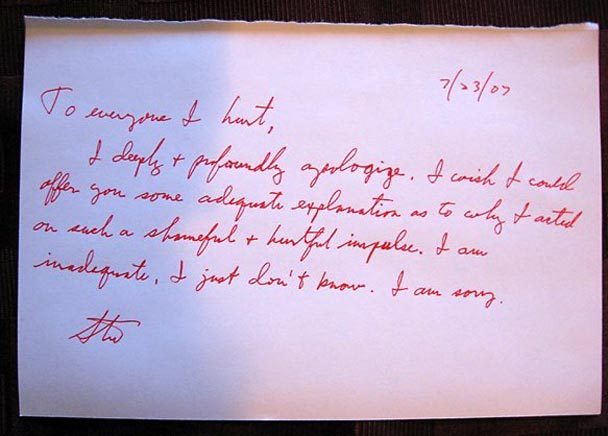 Before committing suicide in a Renton hotel room, Greenberg left three notes of apology on the bed, along with his wallet, driver's license and other personal effects.
The reporting for this story
To uncover the secrets Stuart Greenberg had buried, The Seattle Times got court files unsealed in the superior courts of King and Thurston counties. Through a motion filed by the state Attorney General's Office, the newspaper also got an order lifted that barred public inspection of Greenberg's disciplinary history. Reporters obtained other documents — for example, Greenberg's emails at the University of Washington — through public-records requests, and interviewed colleagues of Greenberg, as well as parents he had evaluated.
Earlier this year, a four-page document with a bland title, "Stipulation for Dismissal with Prejudice," was filed in a civil matter percolating on the King County Courthouse's ninth floor. Hardly anyone took notice. Most everyone had moved on.
But that document — filed by lawyers tangled up in the estate of Stuart Greenberg, a nationally renowned psychologist whose life ended in scandal — signaled the end of a tortuous undertaking.
Greenberg had proved such a toxic force — a poison coursing through the state's court system — that it took more than three years for lawyers and judges to sift through his victims and account for the damage done.
For a quarter century Greenberg testified as an expert in forensic psychology, an inscrutable field with immense power. Purporting to offer insight into the human condition, he evaluated more than 2,000 children, teenagers and adults. His word could determine which parent received custody of a child, or whether a jury believed a claim of sexual assault, or what damages might be awarded for emotional distress.
At conferences and in classrooms, in Washington and beyond, he taught others to do what he did. He became his profession's gatekeeper, quizzing aspirants, judging others' work, writing the national-certification exam. His peers elected him their national president.
But his formidable career was built upon a foundation of hypocrisy and lies. In the years since Greenberg's death, while court officials wrestled over his estate, The Seattle Times worked to unearth Greenberg's secrets, getting court records unsealed and disciplinary records opened.
Those records are a testament to Greenberg's cunning. They show how he played the courts for a fool. He played state regulators for a fool. He played his fellow psychologists for a fool. And were it not for a hidden camera, he might have gotten away with it.
Stripped of all defenses
In summer 1984, Cathy Graden, a 27-year-old surgical nurse from Woodinville, was summoned to King County Superior Court for an emergency hearing in her child-custody case.
Her lawyer said a psychologist's report was behind the hearing. But Graden wasn't allowed to read the report. Nor was she allowed in the courtroom while the psychologist testified.
The psychologist, Stuart Greenberg, had been hired to help resolve a custody dispute involving Graden's only child, a 4-year-old boy whose bright, goopy finger-paintings Graden taped up all over the house.
Although appointed by the court, Greenberg was paid by the parties. He had interviewed the boy and both parents, and run a half-dozen tests with impressive names (the Achenbach Child Behavior Checklist, the Michigan Screening Profile of Parenting ... ).
Graden figured she had nothing to fear. She taught Sunday school; she did volunteer work; she had taken care of her son when the boy's father moved to Alaska after the couple's divorce. "I thought there was no way I could possibly lose this," she says.
Greenberg had arrived in Seattle five years earlier, hired by the University of Washington. A letter written by the department chairman called Greenberg a "last-minute replacement" for a psychology professor who'd resigned. Greenberg's credentials "were on hand," because he'd applied for some other position.
His credentials were acceptable but not extraordinary. He had a Ph.D. from the University of Southern California, where his thesis was a word salad: "Stimulus and Response Generalization of Classes of Imitative and Non-imitative Behavior as a Function of Reinforcement, Task, Cues, and Number of Therapists." On Washington's psychology licensing test, one examiner marked Greenberg's professional judgment as "good," his knowledge and skills, "okay."
Teaching, Greenberg earned just $15,300 his first year. His second year, he was assigned only a single evening class. He left the university and moved into private practice. He picked up court appointments in Western Washington as a custody investigator, expert evaluator, arbiter, mediator, guardian ad litem, special master. He became enmeshed in the court system, buddying up to lawyers, judges, fellow experts.
On the stand, he radiated confidence. "He was just kind of a notch above the rest of us," says Nick Wiltz, a fellow forensic psychologist. "He was able to present reports and information in a very powerful way."
But Greenberg also demonstrated dubious judgment and a cavalier attitude toward his ethical obligations, which forbade even the appearance of a conflict of interest.
In the early 1980s, Greenberg befriended Stanley Stone, who worked in King County as a family-law commissioner — a position akin to judge with the power to appoint experts and approve their fees. On the side, Stone speculated in oil and gas, wooing investors with fantastical claims about the fortunes to be made by digging holes in Kansas.
Although Stone likewise needed to avoid conflicts of interest, his investors included lawyers and expert witnesses who appeared regularly in family court. One of his biggest investors was Greenberg. The psychologist put in $41,250 — expecting, years hence, a whopping return of $891,000 — and encouraged other courthouse regulars to invest, saying he had "the utmost confidence" in Stone, a good friend.
When the investment vehicle went up in smoke, some investors sued, making the enterprise public. Afterward, Stone says, lawyer disciplinary officials admonished him for a breach of ethics. Greenberg could also have been vulnerable to disciplinary action, but his Department of Health licensing file shows no evidence of that ever happening.
Cathy Graden didn't know about any of this. Nor did she know that her ex-husband's lawyer was also an investor, coming on board after Greenberg touted the potential rewards to her. That made them limited business partners — her ex's lawyer and the expert witness who would testify about her parenting.
The report Greenberg filed in court eviscerated Graden. It said she posed a grave danger to her son; that she was "probably" sexually abusing him; that she was psychologically unstable and possibly paranoid. Greenberg's report said he had interviewed the boy's day-care provider — and this provider suspected Graden of abuse and said Graden had encouraged day-care employees to beat her son.
In court, testifying, Greenberg described Graden as "quasi-psychotic," but said the diagnosis was tricky, because Graden might appear "quite normal." She would likely deny doing anything wrong to her son, Greenberg said, or alternatively, she "might genuinely not remember."
By the time Greenberg finished, Graden, out in the hallway, had been stripped of all defenses — and without a clue to what had just happened. If she appeared normal — well, Greenberg said she would. If she denied hurting her son — that was part of her disorder. If she challenged Greenberg's work or motives — she was paranoid.
At the end of the hearing, Judge Donald Haley said: "The doctor has convinced the court." The judge ordered the boy turned immediately over to his father, with Graden allowed to visit only if supervised by a therapist.
Greenberg was accustomed to such influence. Do judges follow your recommendations? he was once asked. "Typically," he said.
But in this case, Graden refused to go away. She obtained a copy of Greenberg's report. She interviewed the people he quoted. She wore a hidden recorder while meeting with him.
And what she learned, she turned over to state disciplinary officials.
The day-care provider, Krista McKee, told The Times that Greenberg "took what I said and just turned it upside down. He made it sound like I said something about Cathy that I just did not say. I never thought Cathy beat or abused (her son) at any level."
Greenberg also mischaracterized what the boy's therapist told him, twisting benign commentary into an urgent call for the boy to be removed from his mother's care.
Greenberg's work violated a host of ethics rules and laws. If he suspected Graden's son was being abused, he was required to report that to police or Child Protective Services. But he'd done no such thing.
Most disturbing of all, Graden's was not an isolated case.
In 1990, after an investigation that dragged on for years, the state Examining Board of Psychology filed a devastating set of disciplinary charges against Greenberg. The charges, 18 pages long, alleged misconduct in four cases between 1983 and 1986, including Graden's.
The board accused Greenberg of being incompetent and unethical. Of being dishonest or corrupt. Of misusing psychological tests and misrepresenting the results. He was accused of demonstrating bias; reaching sweeping conclusions on hearsay; violating confidentiality; and ignoring damning information about one parent while loading up on another.
In one custody case, he conducted a bizarre analysis of the father's new wife, a flight attendant. He reviewed some letters she may have written (although Greenberg wasn't sure), and some photos of the father's son with temporary tattoos — birds and a dragon, on his shoulders and belly button.
Based on those dubious materials, Greenberg concluded that the woman showed signs of a personality disorder: "Highly abstract thinking, schizoid mentation, hysteroid defense mechanisms, and / or exhibitionistic style." He never interviewed her, or the father, or the son.
Greenberg could have fought the board's allegations. Instead, he admitted violating professional guidelines in each of the four cases. He had been seeing a therapist for four years, he told the board, because he was "unable to fully empathize" with parents in child-custody cases and was not sensitive enough to the impact of his opinions.
The board and Greenberg agreed on a severe punishment: a three-year suspension from doing parenting evaluations. Afterward, he could resume only if the board was convinced he was competent.
Graden got her son back in 1989, when the boy's father died in a work accident. Her son was 4 years old when taken away, 9 when he returned.
Saying one thing, doing another
In 1992, prosecutors for the U.S. Air Force asked Greenberg to be an expert witness in the court-martial of a sergeant accused of raping his 15-year-old stepdaughter. Because Greenberg's suspension applied only to child-custody cases, he accepted.
In articles published in professional journals, Greenberg distinguished forensic psychology from therapy: the latter assists a patient, the former, a judge or jury.
Forensic psychologists should avoid psychiatric diagnoses, Greenberg wrote. In therapy, patients have reason to be honest. That's because they want help. But in court settings, they have incentive to lie. A criminal defendant might want to seem insane, and a parent fighting for custody, as normal as can be.
People taking psychological tests can surmise which answers will lead to which results, Greenberg wrote. Attaching a diagnostic category to someone's description of unverifiable feelings provides "unjustified credibility."
One particular diagnosis — post-traumatic-stress disorder — is especially prone to abuse, Greenberg wrote. Someone claims to have experienced something horrific, and describes symptoms consistent with distress. A clinician diagnoses PTSD. In court, this diagnosis gets used "in a circular argument" to prove the horrific event occurred.
Greenberg preached caution. He practiced something else.
In the Air Force case, Greenberg had the stepdaughter take the Beck Depression Inventory — 22 questions, multiple choice. The first question: 1. I do not feel sad; 2. I feel sad; 3. I am sad all the time and I can't snap out of it; 4. I am so sad or unhappy that I can't stand it. She chose 3. He had her take the Beck Hopelessness Scale — 20 questions, true or false. Question 7: My future seems dark to me. She marked true.
After eight tests and 10 hours of interviews, Greenberg diagnosed the teenager with post-traumatic-stress disorder. (He charged the Air Force $12,360 for this work.)
To Sverre Staurset, the sergeant's lawyer, Greenberg was key to the prosecution's case. He vouched for the stepdaughter's credibility — believe him, you believe her.
Unbeknown to Greenberg, Staurset had rounded up the state disciplinary documents in which Greenberg admitted to conduct both incompetent and unethical. With those records, the lawyer destroyed Greenberg on the stand.
"It was worse than a deer in headlights," Staurset says. "He really came apart. There was nothing left of him."
With Greenberg discredited, the sergeant was acquitted.
For an expert witness, credibility is everything. Greenberg knew that if those disciplinary records remained available, his future looked dim.
Hiding his past
A missing sentence. That's what made all the difference — that, and the state's lack of mettle.
During the disciplinary proceedings, Greenberg had signed a five-page stipulation admitting that he had misquoted witnesses, misinterpreted test results, reached damning conclusions on flimsy foundations. But the document was also supposed to say: "That by entering into this agreement, Dr. Greenberg does not admit to any violation of statute or administrative rules governing the practice of psychology."
"That is boilerplate," says Terry West, who was the Examining Board of Psychology's program manager at the time. "That's standard language in any stipulation."
A lawyer for the state dropped the sentence while merging some documents. Boilerplate or not, that missing language represented an opening — and Greenberg seized it. He let the state know he was thinking of suing. The examining board caved.
Nick Wiltz, the board's chairman when Greenberg was suspended, says: "The thing dragged on and on and on. Then, suddenly, because of this error by this inept assistant attorney general, the case blew up completely."
In spring 1993, the board's departing chairman, David Gossett, wrote an open apology to Greenberg, published in the board's newsletter. Greenberg had been "exonerated" of "all allegations," Gossett wrote. The apology asked "all persons" who had kept an earlier board publication describing Greenberg's suspension to return their copies or destroy them.
For Greenberg, this wasn't enough. The agency's paper trail was still publicly available, meaning he might still be confronted on the witness stand with his past admissions.
So Greenberg went to court, asking for the state to be barred from releasing any records about his past suspension. In a remarkable twist, the Examining Board of Psychology joined in this request. Here was a public body — represented by another public body, the state Attorney General's Office — asking the courts to forbid the state from complying with its public-records requirements.
In King County, Judge R. Joseph Wesley refused to go along. So Greenberg went south, to Thurston County. In 1995, Judge Daniel Berschauer agreed to place the state's records off-limits to the public; also sealed was the entire court file describing Greenberg's secrecy request.
Within a year of getting his disciplinary history sealed, Greenberg was giving seminars to other psychologists on the ethics of parenting evaluations.
Greenberg also fended off another kind of challenge. Cathy Graden, the mother who temporarily lost her son, sued Greenberg, accusing him of falsifying evidence against her. But Greenberg cited a decades-old principle — that, as a court-appointed expert, he was entitled to the same "absolute immunity" accorded judges — and Graden dropped her suit, figuring it was doomed.
Greenberg used the same argument to squelch other lawsuits. He became such an expert on this shield that the American Psychological Association would ask him to deliver an address on: "The Liability and Immunity of the Expert Witness."
'Laundering priests'
Although Greenberg attracted a lot of work, his judgment raised doubts.
The Roman Catholic Church sent priests accused of sexual abuse to Greenberg, to get his take on whether they could be returned to ministry without endangering congregants.
"He was really the go-to guy for the Archdiocese of Seattle, and for the Jesuits, when it came to evaluating and laundering priests," says Ken Roosa, an Anchorage attorney who has represented hundreds of people suing the church.
The enterprise was shrouded in secrecy, making it hard to say how many priests Greenberg evaluated. Asked during one lawsuit, Greenberg estimated "10 to 15."
What's clear is how easily one priest deceived Greenberg.
In 1993, the Jesuits sent Father Jim Poole to see the psychologist. Greenberg interviewed Poole for 10 hours and administered nine tests. Poole admitted violating his vow of chastity, but only to the extent of kissing and sexual touching with women.
Greenberg wrote reports saying he believed Poole was being honest and that therapy arranged by the Jesuits had "substantially remedied" his problems. "I must say that I do not think that he is conning me or himself," Greenberg wrote.
But in recommending that Poole be returned to ministry, Greenberg missed the most horrendous aspects of Poole's history. The Jesuits would later settle more than a dozen lawsuits that accused Poole, decades earlier, of raping or molesting girls as young as 6.
Poole denied raping anyone but admitted French-kissing one child dozens of times, saying: "I found it a way of trying to get across how much she was loved."
Confronted, in a lawsuit, about his misreading of Poole, Greenberg said: "The data is that psychologists are no better than anyone else at determining when someone's lying based on interview."
Greenberg also lacked judgment around the office, some employees say. Jacquie Pickrell, a psychologist who worked for Greenberg in the mid-1990s, says he violated boundaries with women employees and seemed a "narcissist."
One morning he came into the office, looking horrible. He told Pickrell he'd had a dreadful night. He described vomiting — "in horrid detail," Pickrell says — while a foot from her face.
When Pickrell advised him to go home, or at least not infect others, Greenberg went into his office, shut the door, and pouted. The next day he told Pickrell she had hurt his feelings, that he was sick and had needed a hug.
Two other women employees described being "weirded" or "creeped out" by Greenberg. One said he rubbed her shoulders; tried to make her go with him, alone, on a business trip to Alaska; and wondered aloud, while shopping for supplies, if other people in the store thought they were lovers.
An orchestrated performance
As the 1990s rolled into the next decade, Greenberg's past problems faded away.
He published in peer-reviewed journals and spoke all over the country. He chaired the committee that wrote a national certification exam for his field. His peers elected him president of the American Board of Forensic Psychology.
His hourly rate rose to $450. His fees in individual cases were known to climb from $8,000 to $12,000 to $20,000 or more. He got a 39-foot boat — "More Like It," so named because he'd had a smaller boat, saw a bigger one, thought, that's more like it, and bought one to match. He owned two houses on Capitol Hill — one for home, the other for work. His wine collection was worth $25,000.
On the side he worked at the UW as a clinical associate professor. The UW heard whispers of a troubled past, asked the state, and was told there was nothing to worry about. (The judge's sealing order prohibited disciplinary officials from saying more.)
To testify as an expert, a witness must be found qualified. Greenberg turned this into an orchestrated performance. He would hand a script to the lawyer who hired him.
Question: "Doctor, isn't it true that one of your articles has become one of the landmarks in the field?"
Response: "Well, my article with Dan Shuman on the differences between assessment by therapists and assessment by forensic examiners has been reprinted often, yes."
Greenberg's script had 32 questions in all. His answers had the effect of whispering: I am objective. I am humble. I am a giant in my field.
The hidden camera
This is the story Greenberg later told police:
He needed an air purifier. He searched the Internet. A gadget popped up that only appeared to be a purifier. The white plastic box, about 8 inches high, whirred like a purifier, but inside was a hidden camera.
Greenberg placed an order. The item was shipped to him on June 6, 2007.
Greenberg said he planned to spy on contractors remodeling a $1.8 million house he had recently bought for a new home-office. Instead, he installed the camera in his office's bathroom, used by employees and people getting psychological evaluations.
His staff became suspicious. On July 3, a psychologist who worked for Greenberg devised a test. She placed an aerosol can in front of the purifier. If this device was a camera, this would block the view. Within half an hour, Greenberg entered the bathroom, shut the door, and moved the can.
In a scene caught on videotape, he then fiddled with the lens, stared into his camera, smiled and masturbated.
Police arrested Greenberg that afternoon. A detective interviewed him in a small room. Greenberg gazed at the room's video-camera, pointed down at him. In court Greenberg had intimidated. Now his voice was barely audible. He sighed, over and over.
Greenberg told the detective he couldn't resist seeing his employees in partial undress. "I enjoyed it. ... It was fun; it was exciting. ... I didn't do this a lot. I'm not minimizing it. I know it's bad. But I didn't do it a lot."
News of Greenberg's arrest went public. At the UW, a colleague informed the psychology-department chairman that Greenberg gave an annual lecture to students titled "Ethical Issues in Forensic Psychology." "Ironic, I know," she wrote in her email.
Three weeks after his arrest, while awaiting charges, Greenberg committed suicide in a Renton hotel room. He was 59.
He left three notes on his hotel bed. In one — addressed, "To everyone I hurt" — Greenberg wrote: "I am inadequate. I just don't know. I am sorry."
He didn't say who "everyone" was. That would be for the courts to decide.
The damage done
When Greenberg died, his personal worth was estimated at $1.7 million. But the claims filed against his estate eclipsed that.
There were claims filed by employees who had been secretly videotaped in Greenberg's bathroom. There were claims filed over cases in which Greenberg failed to finish child-custody evaluations, or did work now deemed tainted or worthless.
Before Greenberg died, some parents in child-custody matters hesitated to criticize his evaluations, fearing any complaint might cost them their children. But since his death, parents have come forward, with women describing bullying tactics, saying he demanded intimate details about their sex lives, and dared them not to answer.
Once the circumstances of Greenberg's downfall became public, courts agreed to take a second look at some of his more recent cases.
In one of them, Greenberg had recommended joint custody in a case where the father had been convicted of beating the mother. Drenched in blood, she had gone to the emergency room and received 15 stitches in her head.
Greenberg branded the mother, a Microsoft employee, as emotionally unstable, saying she complained too much of the abuse she had suffered.
"I was beaten by my husband, and I was beaten up by the system," the woman told The Times. "I was accused of being crazy for not liking being beaten."
After Greenberg's arrest for voyeurism, the woman's lawyer asked to have Greenberg's report tossed out. A King County judge agreed. A new evaluator was appointed — and came to a very different conclusion.
Under the new parenting agreement, the mother is in charge.
Source: Seattle Times
Boy Dies in Care
August 2, 2007 permalink
Two-year-old Gage Guimond died in his foster home in Winnipeg. Other news reports suggest he suffered sustained physical abuse. Over a hundred people attended his funeral, making it harder in Manitoba for child protectors to bury their mistakes.
expand
collapse
August 1, 2007
Toddler mourned
Memories of 'happy boy' recalled
By ROB NAY, SUN MEDIA
 Natasha Guimond, mother of two-year-old Gage Guimond, cries at his funeral yesterday. (Chris Procaylo, Sun Media)
A two-year-old boy was remembered as "a bright ray of sunshine" at his funeral yesterday.
Gage Dakota Guimond died on July 22, 2007, the day after his second birthday and two days after he was taken to hospital in critical condition.
Stuffed toy animals, flowers and a blanket surrounded his small coffin at the funeral service. Photos of the boy playing in a bathtub, eating cake and smiling while sitting on a beach faced the room filled with mourners. A large orange card featuring a child's writing and the words "We love you very much" sat close to the coffin.
Charged with manslaughter in Gage's death is Shirley Guimond, 52, his great-aunt. She had Gage and his three-year-old sister in her care at the time of the incident. A call was made to 911 saying a child had fallen down a flight of stairs.
As mourners entered the room for Gage's funeral, a musician sang and played an acoustic guitar, dedicating songs to Gage, his family and foster family.
Gage's mother, Natasha Guimond, sobbed, "I can't. I can't," as she was led into the room, braced by people who supported her as she struggled to walk.
Natasha temporarily gave up custody of Gage and his three-year-old sister more than a year ago because she wasn't ready to raise them by herself at age 18, she told Sun Media in a previous interview.
ASKS FOR HEALING
Pastor Larry Laquette, who conducted the funeral service, asked people to pray for every one of Gage's family members at the funeral. He asked for healing and restoration in people's lives.
Gage's former foster parents, Russ and Debbie Debassige, spoke about their time with Gage and how he came with them when they went bowling, fishing and camping. "He was a real water baby," said Debbie Debassige. "He loved the beach."
"Everyone who sees the photos at the front can see Gage was a happy boy," said Russ Debassige. "We fell in love with Gage."
While learning to walk, Gage also enjoyed visiting his foster siblings as they went to and from school. "He was always a bright ray of sunshine," said Debbie Debassige, adding the sound of drums soothed the young boy.
As mourners filed past the coffin at the end of the service, nearby musicians sang and beat on drums.
A trust fund for Natasha Guimond's surviving daughter has been set up at the Bank of Montreal at 1010 McPhillips St.
Source: Winnipeg Sun
Adoption Warehouse
August 2, 2007 permalink
Nine lucky children found a forever home with adoptive mother Judith Leekin. In her home they were handcuffed, tied together and burned while being deprived of food, education or toilet facilities. The mother earned a six-figure income from the adoption subsidies.
This could be a case of a mother scamming the system as suggested in the article, or another dumping ground case, in which the child protectors get rid of their problem cases, then blame the adoptive parent. At least in this case, the press is focusing on money as the root of the problem.
expand
collapse
Police: Kids were adopted for profit, abused
PORT ST. LUCIE, Florida (AP) -- They were often handcuffed, tethered together with plastic ties and allowed to soil themselves, investigators say. They had scars on their wrists. Some had burns.
 Police say Judith Leekin enriched herself by adopting and neglecting nine children.
 Police say Leekin bought this house and another one with the state stipends for her adopted children.
None appeared to have more than a fourth-grade education, not even the adults in their 20s. All were starving.
In all, nine teenagers and young adults were held like prisoners in Judith Leekin's home in what appeared to be a decades-long scheme to line her pockets with the government payments she received for adopting and raising them, police say.
From the outside, Leekin's home appeared to be as ordinary as the others in this well-kept working-class neighborhood on the outskirts of this Atlantic coast town, 120 miles north of Miami. But its pink and white stucco exterior hid the horrors inside, authorities say.
"Horrible, I think, would be the best word used to describe what was going on in that house," said police Capt. Scott Bartal.
Investigators have not yet confirmed the identities of the young people and have not established how long Leekin had them. But authorities believe she adopted all of them in New York City under at least five aliases over two decades.
They range in age from 15 to 27. One is blind and mumbles. One can barely walk or stand. One can't read. But authorities said they do not know if the handicaps are a result of the alleged abuse.
The case came to light on July 4, some 200 miles away across the state in St. Petersburg, when police received a call from a grocery store that a teenager was there wandering aimlessly. The 18-year-old woman, who said she has been with Leekin for 13 years, said Leekin drove her there and abandoned her after telling her they were going to an amusement park.
Police and child welfare workers went to Leekin's home, but found nothing awry. Just one child was with her in the house, and Leekin told investigators the 18-year-old ran away a year ago. But police soon returned, and this time they found all the children, who had apparently been hiding on Leekin's orders.
Leekin, 62, was arrested and jailed on 11 charges, including aggravated elder and child abuse. She declined to be interviewed. Her attorney had no comment.
According to authorities, she was unemployed and lived off the monthly stipends provided by child welfare authorities in New York. She owned at least two homes and several cars. The adopted children said they had never seen a doctor or a dentist and had not been allowed to attend school or even leave the house.
"These people have not received any formal education in the time they've been with her," Bartal said. "At times when they were restricted with handcuffs or zip ties, during the night, they soiled themselves because they weren't permitted to go to the bathroom."
They were fed only noodles, and "they would have eventually starved to death," Bartal said.
The 18-year-old told police Leekin threatened to cut her head off if she told anyone what was happening, authorities said.
"Was there any kind of emotional attachment? Yes, it was fear," Bartal said.
Child welfare workers in New York said they are still digging through paperwork to determine how Leekin came to gain custody. It was not until 1999 that New York City child-welfare authorities began fingerprinting adults who adopted children out of foster care.
If Leekin did adopt them in New York City, she could have been making as much as $180,000 a year for a time. Parents who adopt special needs children can get as much as $55 a day.
"If you adopt a child out of the foster care system, you receive a stipend to help with the child's care, to cover clothing and food, and whatever additional costs are involved with caring for the child until the child turns 21," said Sharman Stein, spokeswoman for the New York City Administration for Children's Services.
There is no legal requirement that a person adopting a child from New York City's foster care system live in New York State.
The Florida Department of Children & Families authorities investigated a complaint of child abuse against Leekin in 1999, but the case was later closed. Officials would not give details.
"Right now we're just concentrating on the care of the victims, making sure they get the medical attention and psychological care they need," department spokeswoman Ellen Higinbotham said. "These adults, they're like elderly people, they're frail and vulnerable."
In Leekin's neighborhood, residents said they were shocked.
"You'd think she was your grandmother. There was nothing suspicious at all," neighbor Jim Hammond said. "We never heard anything from over there, no hollering, no screaming. She was just a nice lady."
Source: CNN
Addendum: From later news, it is clear that social services used Judith Leekin to dump problem children. Just about all of the children in her care had mental handicaps. If this case follows the usual pattern, the adoptive mom will be the target of public outrage and put away for a long time. The social workers who dumped their children with her will escape scrutiny. One teenager, Mo, died in Mrs Leekin's care.
expand
collapse
Florida Judge Wants N.Y. Adoption Records
Says They Are Relevant To Leekin Abuse Case
(AP) FORT PIERCE, Fla. A New York judge must decide whether to unseal confidential adoption records, after a Florida court ruled Thursday that they are relevant in the criminal case against a woman accused of abusing 11 adopted children.
Judith Leekin, 62, of Port St. Lucie, is accused of bilking New York City out of $1.26 million in a scheme that involved adopting the children under four aliases to line her pockets with subsidies for their care.
Authorities say the children, now ages 15 to 27, were severely abused, that none have more than a fourth grade education, and all suffer from physical and mental disabilities.
Leekin has pleaded not guilty to the abuse charges.
Circuit Judge James McCann's ruling opens the door for Florida prosecutors to now ask a New York judge to unseal the adoption records.
Prosecutor Marshall Evans said the New York adoption records are needed to confirm the identities of the victims.
The records could also help locate a missing 11th adopted child, prosecutors say. Nine of the children and disabled adults are in Florida state care. A 19-year-old who police say Leekin abandoned in 2004 remains on his own.
The children and adults told police the 11th victim, an 18-year-old boy nicknamed "MO" who suffered from Down's syndrome or autism, died sometime in 1999 or 2000.
"Other than his name and date of birth and a nickname, we know very little about him," Port St. Lucie Police Detective Stuart Klearman told the judge Thursday. "The children have been led to believe that he died but we don't have any record of that."
Klearman also said police need the records to track down the victims' biological parents for DNA comparisons to determine their true identities.
"We do not know for 100 percent fact ... that any of these children are the children adopted out of New York," Klearman said. "They could be almost anybody."
He said copies of their birth certificates obtained from Leekin appear "suspicious."
Klearman also said the victims are now becoming curious.
"They're asking questions -- 'Who are we?"' he said.
Leekin's attorney, Mario Garcia, argued that the adoption records were not relevant in the abuse case.
Outside court, Garcia said the victims received medical care and were taken care of by Leekin.
Garcia also said the Florida Department of Children & Families took custody on Wednesday of the children of Desmond Leekin, who is Leekin's biological son. Desmond Leekin has been questioned by investigators and has said he did not know his mother had all the adopted children in her home.
A telephone message left for the Florida agency was not immediately returned. A telephone listing for Desmond Leekin could not be found.
Source: WCBS-TV New York
Parents have No Rights
August 2, 2007 permalink
The Supreme Court of Canada has issued an important decision in a case in which a child was taken from her parents for an imaginary cause. The care of children by the social services system is too important to allow professionals to be concerned by parental rights. The Supreme Court agrees with the listing of parental rights on our parody page.
Here is the operative part of the opinion:
expand
collapse
The deciding factor in this case is the potential for conflicting duties: imposing a duty of care in respect of the relationship between the family of a child in care and that child’s court‑ordered service providers creates a genuine potential for “serious and significant” conflict with the service providers’ transcendent statutory duty to promote the best interests, protection and well‑being of the children in their care. When a child is placed in the temporary care of the Children’s Aid Society, or if Crown wardship is ordered, the Child and Family Services Act creates an inherently adversarial relationship between parents and the state. The fact that the interests of the parents and of the child may occasionally align does not diminish the concern that in many if not most of the cases, conflict is inevitable. While it is true that ss. 1 and 37(3) of the Child and Family Services Act, which the family seeks to rely on to ground proximity, make reference to the family, nothing in them detracts from the Act’s overall and determinative emphasis on the protection and promotion of the child’s best interests, not those of the family. Furthermore, the treatment centre and B are providing services to R.D. in a treatment context, a context that invokes medical paradigms of confidentiality and privacy. To recognize a duty to parents in this context could also result in conflicting duties in the provision of medical treatment to children who have been removed from their parents’ custody. It is very difficult to see how different professionals, including doctors and social workers, could all effectively work together if some of them owed a duty other than to the child/patient. Lastly, the conclusion that there is no proximity is reinforced by two additional reflections of legislative policy. The first is that the Act itself provides a remedy for families seeking to challenge the way their child is treated. The second is that there is a clear legislative intent to protect those working in the child protection field from liability for the good faith exercise of their statutory duty, and this intent is reflected in statutory immunity provisions. Since the statutory mandate is to treat the child’s interests as paramount, there is, where the duties to the child have been performed in accordance with the statute, no liability to the family.
Source: Supreme Court Decisions hosted by University of Montreal
In case the link is altered, you should be able to find the decision from the citation:
SUPREME COURT OF CANADA, Syl Apps Secure Treatment Centre v. B.D., 2007 SCC 38, Date: 20070727, Docket: 31404.
Anna Mae He Back Home
July 24, 2007 permalink
The parents of Anna Mae He give their newborn daughter temporarily to a Tennessee couple while they worked out their financial problems. The fosters refused to return the girl when the parents wanted her back, and even legally adopted the girl through a Tennessee court. It took years of litigation for the Tennessee Supreme Court to state the obvious, that failure to visit the girl when kept away by force did not amount to abandonment. Even after the courts ruled against them, the baby-snatchers held on through another six months of foot-dragging. Now the girl is finally back with mom and dad.
expand
collapse
Associated Press
Girl, 8, Back With Chinese Parents
MEMPHIS, Tenn. -
A Chinese couple regained legal custody of their 8-year-old daughter Monday after a seven-year fight to get her back from what was supposed to be temporary foster care.
Judge Curtis Person of Memphis Juvenile Court signed an order returning custody of Anna Mae He to parents Shaoqiang and Qin Luo He, Chinese citizens who came to the United States so Shaoqiang He could attend college.
The order revoked the temporary guardianship by Jerry and Louise Baker, former foster parents who had tried to adopt the girl over her parents' objections.
"As far as custody goes, that's it," said David Siegel, the Hes' lawyer. "That's no longer an issue. That's nothing that will ever be an issue again."
The Tennessee Supreme Court ruled in January that Anna Mae He must be reunited with her parents, and she began a series of meetings with them in March. Those meetings, which progressed to overnight stays and weekend visits, were overseen by a lawyer and psychologist appointed by the Juvenile Court.
In his custody order, Person said the Supreme Court mandate had been fulfilled.
"I want everyone to know she will have a bright future," Shaoqiang He said in a telephone interview Monday. He said he expects to return to China with his family after Anna Mae has settled in.
Psychologists helping her adjust to leaving one family for another will decide whether she has further contact with the Bakers, who took her in when she was just less than a month old, He said.
"That depends on Anna Mae and her emotional and psychological needs," He said. "We want to do the best for her."
In its ruling, the state Supreme Court overturned a decision by a Memphis judge that took away the Hes' parental rights. That decision in 2004 followed a trial at which the Bakers argued Anna Mae would have a better life in suburban America than in China.
"I want her to have both cultures, Asian heritage and American culture," He said. "But from today on, she will never have to hide her Chinese heritage. I want her to have pride in it."
The Bakers' lawyer, Larry Parrish, issued a written statement last week saying that they had ended their custody fight. The Bakers contend Anna Mae will be emotionally devastated by leaving the only family she has known, "but further delaying the execution of what she must now suffer cannot be expected to help," Parrish wrote.
The high court said the Hes were penalized because they did not understand the American legal system and thought they were giving up their daughter temporarily so she could get health insurance. The family hit hard financial times when Shaoqiang He lost his graduate school scholarship and student stipend at the University of Memphis.
He also lost his student visa, but the immigration courts have held off on deportation proceedings because of the custody fight.
"I have to leave the United States," He said. "I promised the immigration judge I would take the voluntary departure after the custody issues were resolved."
But He said he hopes his family, which includes a son and another daughter born during the custody fight, can stay in the United States a while longer.
"I hope for the sake of Anna Mae's welfare they can give us ... one year or two years until Anna Mae is well adjusted," he said. Going to China sooner "might be too big a change for her right now."
Source: Forbes
Boy Protected with Pepper Spray
July 23, 2007 permalink
Here is more on the story of the still-anonymous mother who resisted child protectors with force. In a repeat of the Emily Lake seizure the cops "protected" a boy by hitting him with pepper spray. We wonder how safe he feels now
expand
collapse
Police pepper-sprayed boy during standoff with mom: witness
St. John's police officers used pepper spray on a boy during a confrontation in which he and his siblings were seized from their defiant mother, her boyfriend says.
 Sheriff's deputies escort a St. John's mother to provincial court on Thursday. (CBC)
The Royal Newfoundland Constabulary was called to the woman's home on Cookstown Road, near downtown St. John's, on Wednesday night to assist child protection workers who had arrived to take three children into custody.
The woman, however, refused to co-operate and barricaded her family inside the house in a confrontation that went on for hours.
At one point, police said, she swung a baseball bat at an officer's head, grazing but not injuring it.
"She didn't want them to go," the boyfriend, who was at the house during what he called a "crazy" confrontation, told CBC News.
His girlfriend "told the youngsters to sit down. [They were] running around, frightened to death."
CBC News is not identifying the woman or her boyfriend in order to protect the children's identities.
 Const. Paul Davis said incidents like the Cookstown Road confrontation are unusual. (CBC)
The boyfriend said the woman's 12-year-old son was pepper-sprayed while he used a stick to keep a police officer from climbing through a window.
At that time, he said, the mother reached for a baseball bat.
The RNC confirmed pepper spray was used in the incident, but would not say on whom.
Const. Paul Davis said while officers are commonly called to escort social workers who remove children from homes, incidents like the Cookstown Road confrontation are unusual.
"It took a little bit of time," Davis said.
"It was a barricaded situation for a short period of time. We were able to resolve that without anybody being injured."
The RNC called a negotiator in to resolve the situation.
The mother appeared in provincial court on Thursday on a charge of assaulting a police officer. She was released until her next court appearance.
The children — the 12-year-old boy, his 11-year-old sister and their two-year-old brother — are in the custody of child protection officials.
Source: CBC
Mother Defends Children
July 20, 2007 permalink
A Newfoundland mother has used force to defend her family from child protectors coming to take her children. Because there are no names in the story, we will not be able to bring you a follow-up.
expand
collapse
St. John's woman arrested after child-protection standoff
Police arrested a St. John's woman following a confrontation that erupted after child protection workers arrived to remove children from her home.
The Royal Newfoundland Constabulary was called to a Cookstown Road home at about 9:45 p.m. to assist Child, Youth and Family Services employees, who were attempting to take three children into protection.
Police said the woman refused to co-operate with social workers, and had barricaded her door so that officers could not force their way in.
The confrontation lasted several hours, the RNC said.
The woman eventually gave up, although the RNC said the woman swung a baseball bat at one officer. The bat grazed the officer's head, although he was not injured.
The woman, 33, is scheduled to appear in court Thursday on charges of assault with a weapon, uttering threats and obstructing a police officer.
Source: CBC
Smoking Gun Moves
July 20, 2007 permalink
Sarnia's Smoking Gun, site of discussions regarding children's aid societies, has moved to a new web location. It is: svb3d.no-ip.biz/ssg/.
Girl Escapes Foster Home
July 17, 2007 permalink
In April we reported on the disappearance of Sara Linklater, found the next day. Now she is missing again, this time from a foster home near Grimsby Ontario. She has twice voted with her feet against the quality of her foster care.
expand
collapse
Hamilton cops hunt for missing girl, 10
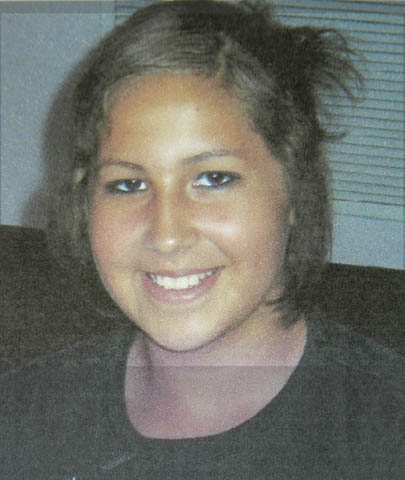 Sara Anne Linklater went missing Thursday.
Police are appealing for help finding a 10-year-old girl who went missing from Waterdown.
Sara Anne Linklater recently moved from the Sudbury area to live in Smithville, near Grimsby. Mountain Staff Sergeant Bob Watts said while at an event at Parkside High School, she reportedly drove away in a car around 2:30 p.m.
Less than an hour later, the car was found abandoned at Guelph Line and the QEW in Burlington.
Police said Sara ‘looks and behaves older than she is.”
Foul play is not suspected in her disappearance. But police said she is considered a high risk because of her age.
He said Sara was relatively new to the area and may be trying to hitch hike north to visit relatives and friends in Sudbury, Sault Ste. Marie or Manitoulin Island.
“We are looking for any information from someone who may have seen her that could give us a clue,” said Watts.
Hamilton police have notified First Nations police and the OPP that she could be coming to their area.
Sara is described as native with a dark complexion, black hair kept in a pony tail. She was wearing a black tank top, flared blue jeans and white running shoes.
Anyone with information is asked to call their local police service or Hamilton police at 905-546-3886 or Crime Stoppers at 1-800-222-8477.
dborcea@thespec.com, 905-526-3214
Source: Hamilton Spectator
Ex-Cop helps Court Watch
July 17, 2007 permalink
Canada Court Watch now has a former policeman who will help in interviewing victims of the family court system.
Ex Police officer helps in efforts to restore justice to family courts
(July 16, 2007) - An ex police officer who acknowledges that he has seen how family courts are responsible for many injustices against children and families has offered his services to conduct videotaped interviews of children who have been physically or emotionally abused or who have had their rights and freedoms violated while in the care of the CAS or by other agencies during family court proceedings. A growing number of professionals have contacted Court Watch in recent months to express their concern about what they see are a growing number of legitimate complaints against the family court system, the CAS and the Office of the Children's Lawyer. These professionals are asking what they can do to help restore justice in our courts. If you have a child who has been abused by the system and who is willing to speak out on videotape, then please contact Court Watch by email at info@canadacourtwatch.com
Source: Canada Court Watch
Damaged Son
July 17, 2007 permalink
A mother using screen name Amy has posted the story of her son, returned from two years in CAS care and damaged beyond her ability to repair.
expand
collapse
child messed up
I do not think that I am the only one who has finally got there kid back from the CAS to find they are very messed up. A year or more of trauma at their hands will do that. So the traumatized kinda messed up kid gets returned and I find that because of the CAS repeatedly degrading me, cutting me down and making me seem powerless in front of them I have so little respect from my child left to be able to help him. So how do we regain parental respect back and work despite what the CAS has spent along time damaging and taking away?
This child was removed because a really dumb negligent unqualified CAS worker heard through the school that I was taking my child to a psychiatrist for help. I had just set up an appointment for my child when he was removed by this worker alleging that — this is true and is on the warrant to apprehend and in court record — I was seeking metal health help for the child. This worker who met my child once decided on his own that he did not need it and apprehended him (to save him from seeing an expert) and thus put my son through hell and prevented any of the help I was seeking for my son. The fact I was seeking help was used against me. This worker alleged that I was mentally ill, despite the professional reports to the contrary.
Now two years later, I am still not treated for any mental health issues I do not have and my son still needs help. But now he is over the age where I can force him. Before I could. This was when they took him and prevented me from getting him this help. He is now without the help I wanted to get for him before and I believe he is worse.
Now with the added trauma from the CAS he will not leave the house. He will not socialize. He rarely showers or changes clothes. He is very verbally abusive. He shot up our last house with his bow and arrow leaving holes in most of our walls. Well he did it again. Shooting out my window and making holes in freshly painted walls. He has also come close to starting fires and has damaged furniture with fires. Now I am told that he is too old to force into treatment. I am told that I can throw him out and this will force him into treatment. I do not want a throw-away kid and having seen what government organizations have done so far (CAS) sure do not want to trust them any further.
The CAS spent all this time tearing me down in my child's eyes and diminishing me, making it even harder to parent and get his respect enough to get him help. Nope he calls me all the names that the CAS told him I was, delusional, crazy, etc (for trying to get him help). He continues to damage the house, start fires, destroy rooms and runs into his room whenever anyone comes over.
The CAS are out now, but how do I fix up the mess they made now and get my son help so he can have a quality of life?
Source: Canada Court Watch forum
Chambers Quitting
July 13, 2007 permalink
Ontario is about to lose its Minister of Children and Youth Services. Mary Anne Chambers has decided not to be a candidate in the provincial election this October. Her predecessor, Marie Bountrogianni, is also quitting politics.
Among the comments to the Globe and Mail:
- al isinwonderland from Canada writes:
Leaving for health reasons, I hope it is nothing more serious than coming down with a bout of honesty. - Karol Karolak from Canada writes:
It is tough job having to defend Liberal policy of baby snatching and baby selling.
expand
collapse
Ontario Liberals lose cabinet minister Chambers
TORONTO — The Liberals are losing another female cabinet minister this fall.
Toronto-area politician Mary Anne Chambers says she is not running again in the October election.
The minister of children and youth services says she is not seeking re-election for unspecified health reasons.
Ms. Chambers says it was a difficult decision to make but she is proud of her accomplishments since her election in 2003.
Premier Dalton McGuinty says Ms. Chambers worked tirelessly and with great passion for the province's most vulnerable residents.
Ms. Chambers is the latest Liberal woman leaving politics — Hamilton cabinet minister Marie Bountrogianni and backbencher Jennifer Mossop both announced they won't be seeking re-election in October either.
Source: Globe and Mail
Hession on CPS
July 11, 2007 permalink
Massachusetts family lawyer Gregory Hession has written an article for the New American, a publication of the John Birch Society. While the mainstream press informs us of the antics of Paris Hilton, it is left to the specialty press to deal with the serious issues. Hession covers every stage in the protection process from the snitch network to the drugging of foster children to keep them docile.
There are reasons why the system does a bad job. Colleges churn out hordes of 23-year-old social-work graduates, childless and clueless, who are sent into homes to make life-changing decisions. Their formal education is grounded in doctrinaire Marxism and feminism, and they believe in their viscera that the state should communally raise children.
Another disincentive to changing the system is the fact that social workers are given legal immunity for almost any discretionary decision no matter what harm results to the children. Social workers exercise virtually unlimited power over families, with little accountability to anyone for overreaching or even for egregious offenses.
expand
collapse
The New American — Cover Story — July 23, 2007
This is Child Protection?
Imagine your terror and panic: you are awakened by an armed SWAT team in the middle of the night, demanding to be let into your home to take your children away. The grim-faced agents show you no warrant, no court order, and no mercy. They give you no reason for their presence, other than having received an unspecified report about child abuse. They bark commands and menace you and your children with their weapons. The children are taken out of your home screaming, shoved into cars, and whisked away into the night.
This is not a Soviet-era movie script, but a reality in thousands of homes in the United States every year, courtesy of state child protective services agencies.
The least reported and understood social crisis of our time is the vast new police state run by these state social services agencies, which are generically referred to as “child protective services,” or CPS. The states have different names for them, such as Department of Social Services or Department of Children and Families, but they are all operating under a federal mandate. Whatever they are called, our next generation of children may never recover from their predatory intrusions into families.
Some may dismiss these concerns as hyperbole, but the numbers are appalling. In 2005 alone, over 3.3 million reports involving six million children were made to state child-abuse hot lines, the vast majority of which eventually proved to be untrue. Over 500,000 children currently are in foster care. Another 300,000 or so are forcibly removed from their homes by the system every year. Tens of billions of dollars are expended every year on the care of these children, and on the juvenile court systems which enable it, along with costs of therapy, drugs, lawyers, and related services.
This system is relatively new. In response to professional agitation to “do something” about the problem of child abuse, Congress set forth standards for state child protection agencies in 1974, in the Child Abuse Protection and Treatment Act, also called the Mondale Act for its senatorial sponsor. If a state conformed their system to the federal mandate, it could get generous reimbursement from the feds. The states immediately complied, and modern child protection was born.
The system does not work, and never has. Thirty years, hundreds of billions of dollars, and millions of ruined families later, the problem of abuse is little improved.
Not one state has ever come close to meeting the bare minimum standards set out in federal law for CPS agencies. Of seven federal criteria that apply, only a few states have even met one, and no state even complies with a few of them.
In almost all cases, children are traumatized by their experiences in state custody. A large number of the children taken into captivity never return — many are adopted out to other families, killed, injured, or caused permanent psychological harm. Parents are rarely helped, even when they need some improvement.
Can this happen in America? It can, and it does. What follows is a brief tour through the seamy underbelly of the CPS system. That these agencies engage in such despicable behavior is often not believed by anyone who has not been directly affected by it. CPS structures and systems resemble those used by totalitarian regimes.
The Snitch Network
The entry point of most children into the child protection system is through a government-mandated “snitch network” consisting of 50-odd professions that are required by law to report any suspected child abuse or neglect to a state “hot line.” Teachers, police, therapists, doctors, nurses, even clergy, must report to CPS, under threat of prosecution. In addition, CPS propaganda has convinced many neighbors and friends and personal enemies to make such reports.
Once a report is made, the CPS agency has to decide whether it is credible, and if so, what to do about it. Of about 3.3 million calls to state hot lines in 2005, about 40 percent were screened out before going any further. For the remaining calls, the agency had to decide whether it was an emergency, or could be administratively investigated in due course.
Why are so many reports of child abuse being generated? A large contributing factor is that the legal definitions of abuse and neglect are so elastic as to encompass virtually any parental behavior, from spanking their children to letting them eat too much “fast food.” Also, supply sometimes creates its own demand, since an army of professionals has arisen to service the industry, and must be kept well fed.
In response to child-abuse emergencies, real or imagined, the agency usually sends CPS agents and police to a home. The police pry the children’s little fingers off their mother, with everyone screaming hysterically during the “pull,” as they call it.
In other cases, children are snatched from school or from buses after school, without notice to parents frantically waiting at bus stops. Often they are taken late on a Friday afternoon, so parents cannot challenge the action in court over the weekend, and so that the children can be held incommunicado and given medications — drugged — during that time. The goal is to soften the kids up to make “disclosures” about parental abuse in order to allow CPS to get a court order for custody. Sometimes CPS agents go to court to get an order before taking the children, but when they do so, it is almost always done in secret in a closed courtroom, without the parents or attorneys present.
Unfortunately, CPS often gets it wrong both ways — genuine abuse is often missed or ignored, while most of what is reported as abuse or neglect does not rise to any reasonable level of seriousness. (See chart below.)
Into the Belly of the Beast
After the snitch network does its part to get the children into the CPS pipeline, the cases either go into an elaborate administrative process, or to a so-called “shelter” court hearing, held within a few days in order to determine whether the removal of the children from the home was proper. At that court hearing, usually conducted in secret without the press or public allowed, the court will appoint separate lawyers for the mother, the father, and the children. Many of these hearings are conducted so quickly that parents do not have time to prepare a defense, and the lawyers often cut corners by telling their clients to just agree to keep the children in custody until a trial, which could be a year or more away. Only later do the parents find out that they had agreed that their children needed state protection and had waived any possibility of getting them back quickly, or even at all.
The cases that do not go to court are shunted into a surreal, nightmarish administrative system, and the children are often allowed to stay at home or with relatives while the bureaucrats dither.
A social worker will eventually make up a document called a “case plan” or “service plan,” in which the alleged failings of the parents are summarized. The case plan includes a set of tasks and social services intended to “fix” the parent, much like one might repair an appliance. In order to get the children back home if they were taken, or to foreshorten an administrative case, the parents must do all the activities mandated on the plan, such as going to parenting classes, meeting with a social worker, going to substance-abuse treatment, or getting psychological evaluations.
Social workers, often severely maladjusted and working out their own tortured past vicariously through their clients, frequently treat the parents with whom they work as property, ordering them around at whim. They set up services to be done during work hours, causing people to lose jobs and placing the family in financial distress. They can order that a man suspected of spanking his children must leave the home, putting additional emotional and financial burdens on a family.
As with most government programs, there are unintended consequences that no one considered when putting the scheme together. Since social workers are so easily duped, divorcing spouses have made extensive use of CPS reports as a weapon in family court. Want to get custody fast? Just call CPS and accuse the other spouse of abuse. CPS will also do the bidding of schools that have trouble handling difficult children, and will threaten parents who do not want to drug their children with ADHD chemicals.
When children are placed in foster care, the agency usually treats them with mercenary callousness. Social workers and foster parents do things to children that if done by parents would likely have triggered removal of the child. Children are routinely kept out of school for weeks, are denied needed medical care, and are even abused physically and sexually. Children with asthma are often placed with heavy smokers, and children with speech impediments are often placed with immigrants who struggle with English. Almost all children are heavily drugged, with up to six powerful mind-bending medications, in order to ensure their docility.
Even in little ways, the system continually shows contempt for its captives. Social workers leave a home without putting the children in car seats, cancel visits with the parents if they have better things to do, or place the children in homes far from the parents in order to make it harder to have visits. The grinding banality of socialist-spawned child care is soulless, loveless, and arbitrary.
Abuse committed against a child while in foster care is supposed to be investigated by a special outside unit, similar to an internal-affairs division in a police department. However, mindful of potential lawsuits if abuse were discovered, the investigators usually don’t find any. Statistics reported to the government about abuse in foster care are low because the agency gets to do its own investigations. In my experience representing parents, most of whose children have been actually abused in foster care, the CPS usually sweeps the allegations under the rug and fails to stop the abuse.
Outcomes of Child-abuse Investigations
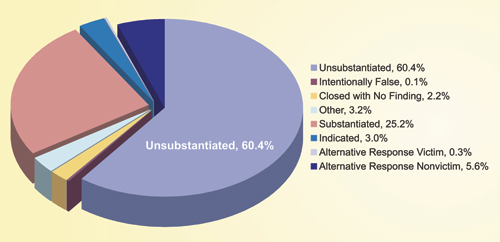
Though states' "child protective services" intervene readily in family situations, using as a guideline for intervention whether a child "is at risk of maltreatment," even after 40 percent of allegations of child abuse are initially screened out, a further 66 percent of the remaining allegations of child abuse are found to be unsubstantiated. (This number includes the cases labeled on the chart as "Alternative Response Nonvictim," where no investigation of the reported child abuse was undertaken, yet it was determined that there was no abuse.)
Your Day in Court
Juvenile or family court is where the fate of millions of children is decided. Not many years ago, these courts were a sleepy sinecure for a few political hacks. Now, with the child-abuse industrial complex in overdrive feeding them, juvenile courts have come into vogue. Crowds of sad-faced parents shuffle around the court’s waiting areas, lining the halls. Lawyers, forgetting the indescribable pain that their clients are enduring, openly laugh and gossip with CPS attorneys and therapists.
At court hearings, the parents usually cannot speak, and the children’s wishes are almost never heard or considered. Hearings often last only a few minutes, or even seconds. The traditional rules of evidence and notions of due process are rarely observed in these special courts, which are neither criminal nor civil. Hearsay on top of hearsay, sometimes three or four layers deep, is often admitted into evidence, which would never be allowed in any traditional court.
The burden of proof for taking children away from parents on a temporary basis is merely to show by a “preponderance of evidence” that the child was abused, which is a weak and ill-defined standard. By contrast, the state has to prove guilt in a speeding ticket case beyond a reasonable doubt. A final termination of parental rights requires that the state prove unfitness by “clear and convincing evidence,” still well short of the quantum of proof required to prove jaywalking.
Most juvenile cases end with a judgment against the parents, allowing CPS to keep the children until they are 18, or to farm them out for adoption. The home team — that is, the CPS prosecutor and social workers — are in front of the judge every day. The process becomes a choreographed dance, like a Mozart-era minuet, with all the players moving in lockstep and the outcome often determined before the first witness is called.
By looking at the numbers, one would conclude that there is an epidemic of child abuse in America. However, the evidence shows that there is actually an epidemic of hysteria about child abuse, because most of the official complaints are either false or greatly exaggerated. It is a squalid business. Big “non-profit” companies have arisen to service the insatiable demand for warehousing children and providing therapy, education, and other services. Special needs children can sometimes fetch thousands of dollars per week for these sub-contractors from the state and the feds, which make millionaires out of the subcontractors owners and officers.
Tens of thousands of parents have their parental rights terminated every year, and their children taken for adoption to other persons or families. In 2005 alone, 67,000 children were removed for adoption. Another 110,000 were waiting for adoptive homes. Each of these children has been through a painful removal from parents, a lengthy court process, numerous foster homes, large amounts of drugs and therapy, and sometimes years of waiting.
The Adoption and Safe Families Act, passed by Congress in 1997, sets out adoption quotas for the states, with money bonuses for exceeding them, and even larger bonuses for processing a larger number of “special needs” children. Thus, adoption becomes the goal for many children who should not be taken from families in the first place. For CPS, it becomes just a commercial sales transaction: meet the quota, collect the cash.
Some parents do abuse children, and states have comprehensive criminal laws to deal with those cases. Most persons would likely disagree with CPS in how it defines abuse or neglect. Families are attacked for home-schooling or spanking their children, for not overseeing all play activities, or for when a child has an accident. Sometimes a child’s illness, poverty, or parents who are going through a time of conflict will trigger CPS involvement. There is also a palpable animus against families who are religious, or who do not like state interference. Only a very small percentage of the 3.3 million reported cases annually prove to be genuine abuse, and the system does a bad job of sorting them out.
There are reasons why the system does a bad job. Colleges churn out hordes of 23-year-old social-work graduates, childless and clueless, who are sent into homes to make life-changing decisions. Their formal education is grounded in doctrinaire Marxism and feminism, and they believe in their viscera that the state should communally raise children.
Another disincentive to changing the system is the fact that social workers are given legal immunity for almost any discretionary decision no matter what harm results to the children. Social workers exercise virtually unlimited power over families, with little accountability to anyone for overreaching or even for egregious offenses.
Federal reimbursement is the locomotive that drives the child-protection business. Regardless of what families actually need, CPS determines where to place its resources based on what returns the most reimbursement. The vast percentage of federal reimbursement (90 percent) comes from taking children into custody, while only a tiny fraction (10 percent) is available to help intact families. In other words, taking children pays, helping families costs.
The game of cadging federal CPS dollars has become so intense that states often hire multi-million dollar consultants to assist them in maximizing federal reimbursement for the children they take. For instance, Massachusetts hired the now-defunct Arthur Anderson Consulting, at an estimated fee of about $8.6 million, to structure the state program to take advantage of as many federal reimbursement categories as possible.
What Can Be Done?
Is the system really as corrupt, incompetent, destructive, and ineffective as this article portrays it? No, it’s actually far worse — if you ask a parent whose children have been victimized by it! The public perception is that CPS is doing a tough job, and standing against child abuse. However, any family caught in its web would testify to a completely different reality. When I take on a new case and forewarn a family about CPS dirty tricks, they usually think I am exaggerating. Surely it can’t be that bad. However, after the first court hearing, or if their children are removed, those families uniformly confirm that I didn’t tell them the half of it.
What should be done to address the problem of child abuse and the problem of abuse by the system of parents and children? It won’t be easy because CPS policies and actions are based on a deeply flawed world view. Moreover, the agencies are run by inept and agenda-driven managers and social workers, and are enabled by a dysfunctional legal system.
Real reform would cut at the very heart of the premise of child protection — that the state is a better parent, a legal doctrine called parens patriae in Latin. Some fixes are obvious — end federal standards for and funding of state child protection agencies, set objective standards for child abuse, require traditional due process in juvenile courts that are open to the public, and eliminate immunity for social-worker malfeasance.
Millions of children are imperiled by this imperious, abusive CPS system, which works quietly without much public scrutiny. Change will likely come only when its cruelties have been exposed, and the public reaffirms that raising children is the responsibility of families, not the state.
Source: John Birch Society
Families Separated by the State
 Victims of false allegations: Neil (right) and Heidi Howard review with their lawyer Gregory Hession the documents that the Department of Social Services used as a basis to take their children. The documents allege that the Howards had the messiest home one social worker had ever seen — failing to mention that their kitchen was in the midst of being remodeled.
The nightmare started when nine-year-old Tevania Tranberg fainted momentarily for no apparent reason when she and her family were at a Trader Joe’s store near their Brookline, Massachusetts apartment. The father, Steven Bennett, went with Tevania in an ambulance to nearby Children’s Hospital to get her emergency care, and hopefully discover the source of her brief collapse. They were joined shortly by the mother, Heidi Tranberg, and Tevania’s four siblings, including 12-day-old Evanna.
At around 10:00 at night, after seven hours in the hospital and many tests, they discovered that Tevania had a low calcium condition. A resident also did some neurological tests and suggested that the situation was not that serious.
Another resident, Catherine James, M.D., then told the family not to listen to the first resident. Not knowing which doctor to believe, the parents asked for a second opinion. Big mistake. Dr. James snapped that she was going to get a restraining order and turned on her heels to go see the legal department. She returned and explained that her request was denied, and the family asked if they could go. At the family’s request, Dr. James prepared a discharge summary, in which she told the parents to get the child to her pediatrician within 48 hours and to watch for any further signs of problems. They took the paper, waited for a ride for half an hour, and left the hospital about 11:30 p.m. that night.
Unbeknownst to the parents, Dr. James called the Massachusetts Department of Social Services (DSS) immediately after they left. DSS told the police and the court that the parents had “fled the hospital,” based on Dr. James’ report, even though she had told them that they were free to leave. Dr. James later admitted to the court investigator that she had never said the parents “fled” the hospital and that “DSS was wrong.”
The SWAT Team Swings Into Action
The next day, the father immediately obtained an appointment with their pediatrician, and both parents were attentive to Tevania’s condition. Thirty-six hours after they left the hospital, several carloads of armed police removed the children to the police station, where half a dozen DSS agents took them, without a warrant or an explanation. Later, the police log showed that DSS had lied to the police by claiming that there had been “injuries from child abuse,” as well as sexual abuse to the children. There was no mention of low calcium, since that might not have seemed quite as urgent.
Families can no longer feel safe, because a state child protective services agency, often generically referred to as “CPS,” may decide to swoop in and take their children into captivity at any time, for any arbitrary reason. Once the children are in their system, it is difficult or impossible to get them back. It usually does not matter if the condition that led to removal is resolved, because there is money to be made in warehousing children — lots of it.
Before I got involved as counsel, Steve Bennett and Heidi Tranberg’s court-appointed counsels told them to waive a temporary custody hearing.
What the lawyers didn’t tell them was that such a waiver means they have no legal means to get the children home for at least a year, if not two. When I came on the case, the damage was done, and every request to return the children is met with a smug, “They waived their hearing. We have custody.”
The Bennett/Tranberg’s five children, including the 12-day-old baby, have been gone since February 23, 2007, with no return in sight. Some calcium supplements were all the children needed. However, the Massachusetts DSS decided to lock four of the five children under 24-hour armed guard for five weeks in the hospital, all courtesy of the taxpayers. For calcium pills.
These parents are not accused of substance abuse, physical abuse or sexual abuse, or anything which would raise a caution. They live in an expensive, spacious apartment in a swanky Boston suburb, and are self-employed professionals. The children are receiving no benefit from being in DSS custody that would be an improvement over their own home. However, when the parents ask DSS why their children can’t come home, they get no answers, other than the continual refrain, “Because we have custody.”
The parents wake up each morning, sick at heart, wondering how to cope with another day of worry about the well-being of their children and how their children will bear up under the stewardship of parents who are not their own. The experience of these parents is not unusual. When children are taken this way, they are often permanently traumatized.
My experience as a lawyer defending parents against false allegations of abuse has thrust me into a world of arbitrary state power and lies, and parents with crushed hopes. The child protection business generates so much money, and employs so many social workers, therapists, lawyers, and other professionals, that it has to continue to obtain fresh meat every day for its gaping maw in order to feed all those who prey on the system.
In the tiny state of Massachusetts, more than 70,000 calls are made every year to the state child-abuse hot line. Thousands of social workers oversee more than 40,000 cases per year, and the state keeps nearly 10,000 children in custody at any one time. Most of these children are heavily drugged, placed in special education classes, and given therapy. When you add up the cost of all of these services in Massachusetts alone, it amounts to billions of dollars per year, which the state can leverage to obtain prodigious quantities of federal reimbursement.
Anything to Take Children
No aspect of life is too remote, and no angle is too obscure for the state to investigate in its fanatic desire to get children away from parents. Neil Howard and his wife Heidi lost their three children to the Massachusetts DSS in October of 1999, when DSS alleged that their home was too messy. Neil had gutted the kitchen, and the new cabinets and flooring were in boxes waiting to be installed in the next few days.
Their severely brain-damaged baby, Faith, was about to come home from the hospital, and DSS took upon itself to send a visiting nurse to their home prior to the child returning. The nurse took a look at the kitchen project, and noted that the home was “the messiest she had ever seen,” without mentioning the remodeling. Things went downhill from there, with DSS interviewing the children, who made vague “disclosures” like the father tapped the son on the head with a book once.
But that was enough to get DSS to swing into action. First, they demanded that Heidi throw her husband out and get a domestic-abuse restraining order against him, even though she told the judge that there was no abuse and DSS was making her do it. After Heidi decided to defy the agency and remove the order, two DSS agents walked into their home without permission, got the police to arrest Neil for violation of the non-existent restraining order, and took the distraught Heidi to a locked hospital psych ward, after promising her she could come right back. Then, of course, they took their two boys, eight-year-old Christopher and four-year-old Ethan, into captivity. For two years.
As happened to the Bennett/Tranberg family, the Howards’ court-appointed lawyers told them to waive their custody hearing, without explaining the consequences. When I later began to represent them, much damage had been done that could not be fixed.
 They’re waiting to come home: Four daughters of Heidi Tranberg (back) enjoy a family outing in Lexington, Massachusetts, prior to being taken into captivity by children’s social services because a doctor had reported the parents for not immediately following her advice after one child was found to have low calcium levels.
Poor little Faith died in the hospital on her first birthday, alone because the parents were prohibited from visiting her. The gracious DSS personnel gave custody of Faith back to the parents after that. The two boys, Chris and Ethan, were kept at foster homes, where Ethan was consistently abused. While in custody, Ethan suffered a broken arm, bruises in many places, wounds on his face, and other medical problems. His day care reported that the bruises were covered up by makeup. Despite all this being reported to DSS, it was all swept under the rug.
In order to provide a pretext for continuing to hold the boys, the DSS bored in on Ethan, who had a pervasive developmental disorder, and worked him over. Therapists hired by the agency elicited patently false and absurd “disclosures” from Ethan, like his daddy cut off his “peewee” with scissors. After continual badgering by another therapist, Chris also made some equally fatuous disclosures.
Meanwhile, Heidi had another baby named Jessica, and DSS wanted her, too. The Howards decided to not turn over the child, so DSS used high-tech GPS and a helicopter to locate her and take her from the arms of the Howards’ pastor, with whom she was staying. The judge also threatened to put me in jail for refusing to disclose Jessica’s whereabouts.
Halfway through a trial, after much of the DSS wrongdoing had been exposed on the witness stand, the three remaining children came home. What started with a bang, ended with a whimper, as most of these cases do. The family will never forget their experience, and they mourn Faith each year on her birthday.
No Checks and Balances
How does this happen? Virtually no checks and balances are in place to ensure that these rogue agencies are accountable. Courts are supposed to perform that function, but rarely dare to defy the plans of child protective services. Although laws in every state comply with the federal requirement that CPS use “reasonable efforts” to keep children with families before taking them, CPS rarely does so.
In my 12 years of doing CPS cases, I have seen enough mockery of the law and harm to families to dissuade even the most hardened believer in the effectiveness of government intervention and to convince any honest person that such a system is incapable of reform.
Fraud is never far away in child protection practice. Kay and Slade Henson were persecuted by CPS in Wisconsin when Kay spanked her disobedient 10-year-old boy with her hand. As a result, Walworth County Department of Health and Social Services took her four school-aged children from their school, and their two toddlers at home. Reports indicated that someone else re-spanked the 10-year-old, in order to exaggerate the damage. After some complicated legal machinations, Kay was jailed for four months.
Kay stood up and spoke out on the abuses perpetrated on their family by Walworth County CPS. She brought a film producer, Suzanne Shell, to Walworth County so she could investigate and document the case in March of 2003. Shell uncovered tampered evidence in Kay’s criminal file, which she filmed. Shortly thereafter, as she was quietly interviewing Kay in a hallway of the courthouse, she was assaulted by deputies, falsely arrested, and her tape confiscated — all of which was captured on videotape. I represented Mrs. Shell in a lawsuit in federal court, where she won a settlement against the county for its officers’ brutal treatment of her based on the video evidence.
Although the six children were returned home in 60 days, they exhibited signs of sexual abuse, which had never been an issue prior to their abduction by CPS. Slade and Kay remain vigilant against further attacks on their family.
The System Attacks Its Own
Many families who try to help children in the system get ground up by it themselves. Kevin Cross, a Baptist minister living in semi-rural Wales, Massachusetts, and his wife Linda have adopted seven children through state social services in several states, including Massachusetts. Records show that they are an exceptionally loving, nurturing family to their multi-cultural adopted brood and their two biological children, and that myriads of social workers had praised their parenting over the years.
Continuing their commitment to helping children, they took in a Russian foster child, who had some behavioral difficulties stemming from early mistreatment. While hospitalized for psychiatric treatment, the child accused Kevin of hitting him. The hospital immediately called the Massachusetts DSS, which concluded that the troubled young man was telling the truth, even though all the other nine children in the home were interviewed separately and denied that there had been any abuse, as did the parents. To CPS agents, disclosures are almost always true, no matter how implausible.
A social-worker intern at the hospital where the foster son was taken told DSS that the parents were “overwhelmed with the care of their nine children and day-to-day tasks.” However, this intern had never met the family and never been to the home. She also noted that the family home-schooled their children and that the father was (horrors!) a Christian minister.
 A unified front: Kevin and Linda Cross and family with their attorney Gregory Hession (left). Though the parents received many accolades from social service workers in the past, one child’s allegation of abuse would have resulted in all the children being abducted by child protective services if the children hadn’t supported the parents 100 percent.
When a DSS investigator demanded to again interview all the children, I got involved. We arranged all nine children and the parents in a circle around the living room, and when the DSS social worker came in, she was greeted by the silent stare of all 12 of us. After just a few minutes, she could tell there was strength in numbers, and she departed, never to be seen again. Although their children were not removed from the home, it was a terribly unnerving experience. “We truly felt like we were in a communist country,” sighed Linda.
All of these stories are true, and happened to families who never expected the club of the state to come crashing down on their heads. The feelings of heartache that these parents experienced can never be fully expressed by mere description in an article. Nor can the sense of disillusionment and betrayal by a system that they thought they could trust.
A lawyer who fights these agencies, rather than simply giving up his clients’ rights (as their previous attorneys often did), is a lonely figure. The one thing that continues to supply me with energy and hope is the knowledge that I can save some families from losing their children, and can help reunite other families that have already been torn apart, for no reason other than the state decreed it be done.
Gregory A. Hession practices constitutional and family law in Springfield, Massachusetts.
Source: John Birch Society
Mother Flees to Save Baby
July 11, 2007 permalink
Police are looking for a mother, Jessilyn Paulhus, who has left Toronto with her baby. If she is found, her baby, Ryan Tenhave, will be taken and she will likely never see him again. If she keeps the baby, she will have to live in the shadows where it will be hard to get food for him. Will anyone suggest an amnesty to save this boy?
expand
collapse

Police Search For Mother And Missing 5-Month-Old Boy
He's just an infant, too young to know the fuss his presence - and absence - has caused. But Toronto Police have issued a notice about him, and are hoping you know where he - and his missing mother - is. They're concerned about 20-year-old Jessilyn Paulhus and her son Ryan Tenhave. The reason - the boy is only five months old and but weighs just 12 lbs. The Children's Aid Society had been monitoring the child until June 29th - when the mother and the kid suddenly disappeared from the Sherbourne and Carlton St. area.
Police aren't accusing the young mom of anything, but say they're worried about the welfare of the baby. "There's a warrant to apprehend the child," Detective Hugh Wong tells CityNews.ca. "The child would be taken into custody" as a safety precaution so the C.A.S. could continue to reassure itself the infant's in good condition.
Paulhus's mother lives out west and police here think she may have gone to either Calgary or B.C. But they need to find little Ryan to be sure he's O.K. The 20-year-old shouldn't be hard to spot. She has several distinguishing features that would be hard to hide. She's described as:
- White,
- 5'7",
- 115 lbs.,
- Light-brown hair shaved on the left side and longer on the right side
- Pierced tongue.
The 5-month-old is:
- White,
- 2',
- 12 lbs.,
- Light-brown hair,
- Blue eyes
- Fair complexion.
Cops were only informed of their absence a few days ago when the C.A.S. confirmed they were gone. If you know where they are now, call (416) 808-5100 or Crime Stoppers anonymously at (416) 222-TIPS.
Source: City-TV
Addendum: Police have found the pair. As usual in this kind of case, they were astonished to find that the mother had not harmed her own baby.
expand
collapse
Missing mom and son found
July 13, 2007, By DOUG MCINTYRE
Cops have located a Toronto mother and her infant son reported missing earlier this week.
Toronto police enlisted the help of their Calgary colleagues after Jessilyn Paulhus, 20, and her five-month-old son Ryan Tenhave went missing last Friday.
At the time, it was believed the pair were headed to, or already in, Calgary or B.C.
Although police initially had concerns about the welfare of the infant, both mother and son were found unharmed.
Source: Calgary Sun
Girl Missing
July 10, 2007 permalink
The OPP and children's aid society are looking for a missing girl, Tasha Lavigne. The press release is silent about her living arrangements before her disappearance, so it is possible she ran away from CAS custody.
expand
collapse
SooToday.com
Mattawa girl missing
OPP NEWS RELEASE
*****************************
Request for public assistance in locating youth
MATTAWA, ON - (July 9) - The Children's Aid Society and the North Bay Ontario Provincial Police are requesting assistance in locating 12-year-old Tasha Lavigne.
Tasha was last seen in Mattawa on Friday, June 22, 2007 and is believed to be in the North Bay area.
Tasha is five-feet, two-inches tall and approximately 120 pounds with dark brown shoulder-length hair and brown eyes.
She has a fair complexion with pierced ears.
She was last seen wearing blue jeans and a brown sweater and black running shoes with burgundy laces.
Any one having information or knowing her whereabouts are requested to call the OPP at 1-888-310-1122 or Crime Stoppers at 1-705-942-7867.
*****************************
Source: Sootoday website (online-only newspaper)
Addendum: The girl was reported found on July 18.
expand
collapse
Police track down missing Mattawa girl
Thursday, July 19, 2007 @ 08:00
Ontario Provincial Police said Wednesday they have found a girl reported missing Monday.
Tasha Lavigne, 12, of Mattawa, hadn't been seen since June 22 when she was reported missing.
Source: North Bay Nugget
Barrie Rally
July 7, 2007 permalink
On Friday, July 6 thirty supporters of Canada Court Watch participated in an awareness event at the Barrie courthouse and surrounding areas. Flyers were handed to persons entering and leaving the courthouse for three hours. The manpower was large enough that leaflets were distributed throughout the city concurrently, so all activities were concluded by noon. A barbecue at the waterfront concluded the event.
Here are copies of the flyers:
Jury Disowns Parents
July 4, 2007 permalink
A Utah couple, James and Connie Roska, had their children taken without cause in 1999. After years of successful litigation in appellate courts they got a jury trial for damages. The jury awarded them $2 for their suffering.
This case illustrates a prerequisites for reform of child protection. It is not enough to write letters to newspaper editors or politicians. It is important as well to get the message out to people not yet involved with the child protection system.
expand
collapse
Skeptical jury awards just $2 for parents' pain over son's improper removal by state
But 1999 incident helped change family-rights laws
 DCFS case workers Melinda Sneddon, left, and Colleen Lasater leave Federal Court on Monday after getting a verdict in their favor regarding the Roska family lawsuit against DCFS. (Francisco Kjolseth/The Salt Lake Tribune)
After watching Utah child-welfare caseworkers drive off with her 12-year-old son, Connie Roska collapsed on the front lawn of her Layton home.
She doesn't remember how she got back into the house.
But the hurt remains fresh for Roska and her husband, James, who testified tearfully in U.S. District Court last week about harms suffered due to Rusty's wrongful removal May 28, 1999. Sleepless nights, a missed graduation ceremony, depression and general distrust of governmental authorities were the suffering for which the Roskas said they deserve compensation.
It wasn't enough to sway a jury, which Monday rejected the couple's injury claim, awarding $2 in nominal damages.
Monday's verdict caps a six-day trial and nearly eight-year legal battle, which helped drive changes to Utah law aimed at safeguarding parents' rights.
But those changes are meaningless, if "you can violate the law without being punished," said the Roskas' lawyer Steven Russell. The Roskas left the courthouse Monday in tears and declined to comment.
The Roskas sued Shirley Morrison, a caseworker at Utah's Division of Child and Family Services, and her two supervisors, Colleen Lasater and Melinda Sneddon. A federal appeals court earlier had ruled the trio violated Utah law - and could be held personally liable - by taking Rusty into protective care without first offering services to his parents.
Caseworkers also violated the 14th Amendment of the U.S. Constitution by taking Rusty without a hearing or warrant, their attorneys acknowledged.
But Utah Assistant Attorney General Matthew Bates asked jurors to "cut these social workers a little slack."
Bates said caseworkers are caring professionals who "work in an extremely demanding and thankless job" and said they followed their training.
"Folks, you don't get damages just because your constitutional rights were violated," Bates said. "This isn't 'The Price Is Right.' [The Roskas] need to prove they were injured."
Caseworkers argued they had no choice but to remove Rusty, who they feared was a victim of abuse, and that removals without due process were common in the late '90s. The practice led Morrison, who worked for the division for one year, to later become an advocate for falsely accused families.
In a taped phone call to the Roskas' attorney, she condemned the state's "Gestapo-style" tactics and agreed to be a witness for the Roskas. That changed when the Roskas sued.
Utah law since has been changed to require a warrant or hearing before removal, unless there's an emergency.
Still, Russell called caseworkers' claims of ignorance "an outrage," citing division training manuals underscoring that removal should be a last resort.
The Roskas alleged caseworkers yelled profanities and shoved children out of their way during Rusty's removal. Sneddon told Roska if she didn't carry Rusty out to the van, she would "drag him up the stairs," Russell said.
A neuropsychologist who examined the family said Rusty Roska, now 21 and living in his parents' home, and his parents display symptoms of post-traumatic stress disorder. Connie has coped by trying to "save the world," working as a parental-rights advocate, while her husband "retreated from the world," Russell said. "He lost the trust of his son and the trust of himself as a father. He still blames himself for what happened."
Bates questioned the Roskas' damage claims, noting each had struggled with mental illnesses before Rusty's removal. "Jim still has a job. Connie runs a day care," he said. "They appear to be living normal lives."
Russell said the Roskas have nearly exhausted their chances to appeal, though they may revive injury claims for their children.
The state had twice offered to settle with the Roskas; once for $100,000 and again for a more generous sum.
Russell said suing the state wasn't an option for the Roskas due to Utah's immunity statute. He fears the verdict will have a chilling effect on future lawsuits. "I can't imagine anyone wanting to go through this after this trial."
kstewart@sltrib.com
The case in brief
- What happened: A jury found three Utah child-welfare workers owe only $2 in damages for the wrongful removal of a 12-year-old boy from his Davis County home.
- History: Social workers and school officials believed the boy was a victim of Munchausen's Syndrome by Proxy, a condition in which a parent acts as if a child is ill, or even causes the child's illness. A doctor corroborated his parents' assertion that he suffered from a kidney disorder. Nevertheless, workers took custody of the boy, who returned home after a week in foster care.
A federal judge had dismissed the parents' lawsuit, but an appeals court ruled the workers were liable for violating Utah law by taking they boy without first offering services to his parents.
Source: Salt Lake Tribune
Rhode Island has Real Child Advocate
July 2, 2007 permalink
In January 2005 Rhode Island governor Donald L Carcieri appointed Jametta O Alston to be the state's child advocate press release. Last Thursday she filed a suit alleging that children are being abused and killed in foster care. Contrast that to Ontario, where the child advocate interviews children and urges hiring more foster parents, all while ignoring the 83 children who died last year under CAS watch.
expand
collapse
Governor vows to 'get to the bottom' of foster care lawsuit
PROVIDENCE, R.I. --Gov. Don Carcieri vowed Monday to "get to the bottom" of allegations contained in a federal lawsuit that the state's foster care system is so broken that children have been placed back with foster parents who abused them, shuttled between more than a dozen homes or even killed in foster care.
"Are the allegations in fact true? Do we have any failings in terms of procedure or policy? Do we have possibly some bad decisions being made?" Carcieri said after a meeting with state child advocate Jametta Alston, who filed the lawsuit Thursday. "I don't know any of that right now, but we're going to get to the bottom of it."
Alston brought the lawsuit, which is seeking class action status, on behalf of the 3,000 children currently in Rhode Island's foster care system. The lawsuit cites federal data that show Rhode Island had the nation's highest rate of abuse or neglect of foster care children in five of the six years between 2000 and 2005.
"If we have youngsters that are being abused that are in our care ... I want it to stop now, and I want to get to the bottom of it," Carcieri said.
Ten children were identified with pseudonyms in the complaint, which included disturbing allegations about their cases and the foster care system.
For instance, the suit says the Department of Children, Youth and Families returned two brothers to their parents even though one of the boys had reported being sexually abused by his father. The month after they were returned, the complaint says, one boy had a bruise around his eye and one had a large mark on his neck.
The lawsuit says one 5-year-old boy was sexually assaulted in his foster home, while another child spent time in more than 14 different homes and institutions -- including one where he was allegedly sexually abused by a roommate.
Patricia Martinez, the director of the department -- which was sued along with the governor -- said she could not comment on any of the alleged abuse cases since her staff was still in the early stages of investigating them. But she said she was troubled by the allegations.
"If we find that we failed a system, that a provider failed, then you bet that we will take corrective actions," Martinez said.
Some of the cases are already several years old, so some of the staff members involved in these cases may no longer be associated with the department, Martinez said.
The suit says caseworkers are so overburdened that children might not get a visit from them for months and contends that children languish for long periods of time in the foster care system because the department is slow in finding them permanent adoptive homes.
Carcieri said Monday that Alston had given him the full names of the children cited in the lawsuit. He said he would be briefed Tuesday by DCYF about their cases and that it was possible that caseworkers would be fired if they knew about problems but did not fix them.
Problems at the department came to the public's attention after 3-year-old T.J. Wright died in foster care in 2004. His aunt and her live-in boyfriend have pleaded not guilty to beating him to death. Their cases have not reached trial.
Carcieri and Alston said they did not discuss specifics of the lawsuit during their conversation but instead focused on ways to improve communication. The governor said he had not been aware of the alleged abuse until he read news accounts of the lawsuit.
Lisa Guillette, executive director of the Rhode Island Foster Parents Association, said it's critical that caseworkers have manageable workloads since they're relied upon to identify problems.
"The stories of the plaintiffs demonstrate systemic failure in a lot of ways -- lack of oversight, lack of adequate support for the children and the placements that are serving them," Guillette said.
Source: Boston Globe
Addendum: Here is a copy of the complaint (pdf).
Addendum: The suit came to an end on April 29, 2009. Children's Rights Inc had a hand in creating this lawsuit, though they were not in the headlines when it started.
expand
collapse
Child advocate’s suit over DCYF care dismissed
01:00 AM EDT on Friday, May 1, 2009, By Katie Mulvaney, Journal Staff Writer
 Alston
PROVIDENCE — A federal judge has dismissed a sweeping lawsuit that alleged widespread abuse of the children in Department of Children, Youth and Families care, saying the state’s child advocate, who brought the suit on behalf of 10 children, had no standing in the case.
Senior U.S. District Judge Ronald R. Lagueux ruled Wednesday that Child Advocate Jametta O. Alston and others who backed the suit had no authority to proceed because the children they claimed to represent are already in the jurisdiction of the state Family Court, where their guardians had been appointed.
Alston and the child-advocacy organization, Children’s Rights, pursued the suit in June 2007 on behalf of the 3,000 children now in state custody, with the aim to overhaul Rhode Island’s entire foster-care system. The suit alleged children in DCYF care were being molested, beaten and, in one high-profile case, killed. Her suit claimed staff faced excessive caseloads and that too many children were being placed in institutions and group homes, or being reunited with abusive parents.
The suit named Governor Carcieri, Jane Hayward, former secretary of the Office of Health and Human Services, and DCYF Director Patricia Martinez as defendants, and charged that the child-welfare system is underfunded, understaffed and mismanaged.
The state asked that the case be dismissed in arguments before Lagueux in January 2008. Lawyers questioned the remedy sought — namely that Alston wanted the court to take control of the DCYF. They argued the case belonged in Family Court, not federal court.
Governor Carcieri, who appointed Alston, praised the decision. “We are pleased with the ruling as we can now concentrate our time and resources on continuous enhancements to the state’s child-welfare system,” Carcieri said in a news release.
The DCYF has worked diligently in the past few years on improvements that have reduced caseloads and the number of children in residential placements, as well as psychiatric hospitalizations, he said.
Alston planned to appeal, saying the ruling leaves in place a system where some children are languishing and not getting needed services. “I still believe children are suffering in our system,” Alston said.
Recent changes involve early intervention, to keep children out of foster care, but do not guarantee well-trained staff and manageable caseloads, she said.
Lagueux’s decision rested on Alston’s ability to bring suit for the 10 children named. A minor may only bring suit when represented by a “next friend” or guardian appointed by the court. Lagueux questioned the three people acting as “next friends” for the children in the case, saying their relationships with the children were minimal or nonexistent.
One “next friend” had been a foster mother for one child from 1996 to 1998, but had not seen the boy in 10 years. Another knew one boy from her time working as a psychologist for his kindergarten class; she had not seen him since June 2007, Lagueux wrote.
The remaining eight children — three of whom are no longer in DCYF care — were to be represented by an associate professor of sociology at Brown University who had never met them, Lagueux said.
Lagueux said he was reluctant to appoint those individuals because the children already have court-appointed advocates who are representing their interests in cases in state Family Court. The court, he said, is hesitant to find that the “next friends” knew the children well enough to make the decision to prosecute the case on their behalf. It would impose a burden on the children that would likely require them to testify about abuse they had suffered at their own families’ hands, he said.
THE CHILDREN come from five families and range from 2 to 16 years in age, according to Lagueux’s ruling. They include “David T.,” who is institutionalized after being shuffled between shelters, foster homes and mental hospitals from age 2. He is now deemed “too damaged” for adoption.
“Sam” and “Tony M.” entered the state foster system when one was 4 years old and the other an infant. They were allowed to return home, where they suffered brutal physical and sexual abuse. Both boys are now institutionalized and separated.
Lagueux noted that Alston had not been involved in their Family Court cases.
Alston said yesterday that she had chosen the 10 children because their experiences were indicative of rampant problems in the state’s foster-care system. Lagueux’s decision, she said, does not address the failings the suit is trying to stop.
“It only further delays getting relief for these children who so desperately need the assistance of the court,” said Marcia Robinson Lowry, Children’s Rights’ executive director.
Typically, a judge would give a party an opportunity to select another “next friend,” not dismiss the case, she said. “He simply closed the courtroom doors on these children.”
Further, Lowry said, state law empowers Alston to bring suit on the children’s behalf. The child advocate’s stated mission is to protect the legal rights of children in state care and to promote policies and practices that ensure their safety.
Children’s Rights has filed class-action lawsuits over child-welfare systems in 14 other states, winning court-ordered improvements in 9 states and Washington, D.C.
DCYF officials said they will continue to strive for improvements. “DCYF is committed to provide the highest level of services to children and their families, and these many achievements could not have been possible without the hard work and dedication of the DCYF staff, providers and community partners,” said Patricia Martinez, director of DCYF in a news release.
Attorney General Patrick C. Lynch, whose lawyers helped argue the state’s case, stopped short of praising Lagueux’s opinion.
“In ruling on a motion to dismiss, the court must accept as true the plaintiffs’ version of the facts as stated in their complaint. …” Lynch said. “Although we can all agree that our state must do a better job of caring for the children in its custody, it would have been the wrong approach to ask the federal court to assume control of Rhode Island’s child-welfare and foster-care systems.”
kmulvane@projo.com
Source: Providence Journal
Five years after its beginning, Jametta Alston has withdrawn from the suit's afterlife.
expand
collapse
Former R.I. child advocate Jametta Alston withdraws from suit against DCYF
PROVIDENCE, R.I. -- Jametta O. Alston, the state's former child advocate, has withdrawn as co-counsel in a class-action lawsuit against the Rhode Island Department of Children, Youth and Families alleging widespread abuse of neglect of children in state foster care.
 JAMETTA ALSTON
Alston, who filed the suit in 2007 with the New York advocacy group Children's Rights, said Wednesday that she is studying to be a minister in Andover, Mass., and her class schedule would interfere with her ability to attend hearings on the case. Alston said she will be available to provide any assistance to the other lawyers handling the case, which is moving forward in U.S. District Court.
Alston's successor, Regina Marie Costa, is not a party to the lawsuit.
Source: Providence Journal
Case dismissed.
expand
collapse
Federal judge dismisses lawsuit against R.I. over foster care
PROVIDENCE, R.I. — A lawsuit that alleged systemic deficiencies in Rhode Island’s child-welfare system, and accused the state of harming two named plaintiffs and failing thousands of other children, was tossed out of U.S. District Court, Providence, on Wednesday.
In a 108-page decision, U.S. District Judge Mary M. Lisi granted a motion to dismiss the case, which defense lawyers had filed on behalf of the defendants, including Governor Chafee and others sued as representatives of the Rhode Island Department of Children, Youth and Families.
The defense had filed the motion in the aftermath of a 16-day trial, following more than six years of litigation brought by the plaintiffs with support from Children’s Rights, a New York-based child advocacy group.
The group’s lawsuit, filed in 2007, accused DCYF of violating certain constitutional and statutory rights afforded to all foster children under federal law.
The agency, the plaintiffs alleged, had failed to provide adequate foster maintenance payments and mandated levels of care and it hadn’t addressed high levels of “maltreatment.”
Those deficiencies, and others, had failed more than 1,800 children over the past six years, according to the lawsuit.
But the plaintiffs’ lawyers did not present testimony on any specific cases beyond the experiences of the two plaintiffs identified as Cassie, who was 17 at the time of the trial, and Danny, who was 11.
Lisi, who heard testimony in late 2013 and early 2014, found there was “nothing to suggest” that DCYF’s foster care harmed either one of them.
“…a review of the circumstances of Danny’s and Cassie’s history, placements, treatments, and services,” says Lisi’s decision, “does not support the … plaintiffs’ claims that DCYF’s acts or omissions caused any harm to either Danny or Cassie, that DCYF subjected them to unreasonable risks, or that it deprived them of their constitutional rights.”
One of the many ways that the state had failed Danny and Cassie involved their exposure to siblings in foster care, according to the suit.
Case files, they alleged, showed no documented visits between Danny and his brother between September 2006 and October 2007. The suit alleged that Cassie hadn’t been reunited with her sister after the two girls were placed in custody in separate homes.
But Lisi found that “none of the evidence presented during trial … supports” the contention that the two plaintiffs’ difficulties were “solely, if at all, attributable” to their experience in foster care.
The plaintiffs also alleged that DCYF had not properly adjusted “basic foster care maintenance rates” — payments to cover food, clothing, shelter, and other reasonable costs. The rates have not been increased in more than a decade, even to adjust for inflation, say the lawyers.
But Lisi was not convinced by the testimony presented at trial. The calculations did not reflect the principle of economies of scale, says her decision.
Ira Lustbader, the associate director of Children’s Rights and one of the lead lawyers for the plaintiffs, said that the organization believes “the court has erred in its ruling.”
“It has denied abused-and-neglected kids any relief from one of the country’s most dangerous and broken foster care systems,” Lustbader said.
Children’s Rights is considering its options for appeal, said Lustbader.
He said his description of the system as dangerous is based on child maltreatment, reliance on institutions rather than family foster homes, heavy caseloads carried by caseworkers and slowness of investigations into situations of alleged abuse.
DCYF’s deputy director, Kevin Aucoin, declined to comment on the decision, referring a reporter to the office of Attorney General Peter F. Kilmartin, who lauded Lisi’s decision and also emphasized the “vital importance” of child welfare and caring for abused and neglected children.
“The care of these children is one of the most important responsibilities of the State,” Kilmartin said.
Source: Providence Journal
Girls Stolen in BC
July 2, 2007 permalink
Here is a YouTube video of three girls stolen from mom and dad in British Columbia. Controversial material often disappears from YouTube in a few days, so watch now. The parents describe their own video as:
Added: June 29, 2007
From: abusiveministry3 sisters taken out of the blue from ... 3 sisters taken out of the blue from their home, separated, isolated, interrogated for months, lied to by the police and social workers. The girls call it jail. They want to see each other more, see their friends, and go home. But BC MCFD have their best interests at heart by antagonizing them to hate the system they have been thrown into. They are not allowed to talk about any thing that happens to them in foster care no matter how outrageous or abusive. If they really have our children's best interests at heart what is BC MCFD trying to hide by not letting the children be allowed to speak out about their feelings and thoughts.
www.abusive-ministry.ca/ — Sign on and tell your story.
The newspaper article below gives some idea of the chaotic state of the social services system in the province, and why it is impossible for parents to get their children back.
expand
collapse
Column: A Closer Look
Uncaring bureaucrat the worst of parents
This says it all: One of the things that now counts against you when the B.C. government is deciding whether to take your children away is whether they also took you away from your parents. In other words, child apprehension begets child apprehension.
Each new generation of state-parented children grows into adults who may end up poor parents themselves. With 10,000 or so children in care in B.C. in any given year and 70,000 across the country, it's a substantial concern. I've, heard the explanations as to why the state makes a lousy parent. Too few foster homes, not enough social workers, caseloads beyond reason.
The children are difficult, the parents troubled, the issues complex. And while your flesh-and-blood parents are there for you long after you turn 19, the state hands you a welfare cheque and considers its job done. But if that's how it is, then there has to be a better way.
Because a government that takes messed-up children away from their homes only to mess them up even more has certainly strayed far from the business of child protection.
Listen to the recent court testimony of local social worker David Roy, who did his job so poorly in one ongoing child-protection case that a provincial court judge deemed last month that he'd breached four of his Ministry's laws, most notably not acting in the child's best interests. Asked if he was aware of the rule requiring regular reviews of plans for children in care, Roy told the court, "I'm aware of the standard, and I'm also aware that we are not meeting the standard. Standards are not being met in any particular case in our office, as far as I know." In fact, the child, - now almost four - has been in care most of his life without anyone in government bothering to map out what's needed to raise him right. Roy said he kept his plans "in his head", noting that a 1999 audit found the government complied with its own regulation in less than a third of all cases. That's an improvement; a couple years before that, it was eight percent.
Roy was involved in the case for two years, during which time he never read the child's file, didn't know the boy was aboriginal, didn't develop a care plan, shredded police documents, made up a hospitalization to bolster his case that the father should be denied access, and blocked one parent or another at every turn through 23 court appearances,
The parents were helpless. The act that governs child apprehensions packs plenty of punch when it comes to the government exercising its rights, but has no remedies for wayward social workers.
Roy's supervisors couldn't intervene, as the only one who can yank a B.C.social worker off a child-custody case is the director of child protection. Even the judge had to work hard to find a way to punish Roy. He ordered the Ministry of Children and Family Development to pay $2,000 to the parents' lawyers, Shannon Buchan and Lex Reynolds, in recognition of the lawyers' dogged (and often unpaid) determination to set things right. And he contemplated bringing contempt-of-court charges against Roy, but decided "indifference and neglect" were not sufficient grounds.
Roy was eventually pulled off the case and his other cases have since been audited by the ministry, which isn't commenting I guess it's a win for somebody, although it's hard to say who. The child who sparked it all is still in the custody of the ministry. His parents and their lawyers thought they'd have to answer all sorts of questions when the ministry investigated Roy. But no one ever called.
Source: Victoria Times-Colonist, recovered from Sarnia's Smoking Gun
Barrie Ontario
Community Justice Awareness Event
July 1, 2007 permalink
Canada Court Watch has organized an event to draw attention to the children and families adversely affected by Ontario's family courts.
The event will start at 9 am Friday July 6, 2007 in front of the courthouse at 114 Worsley Street, Barrie. Participants may meet ahead of time at the Barrie McDonald's, 85 Dunlop Street West, corner of Toronto Street, from 7:30 to 9. For full details, see the announcement from Canada Court Watch (pdf).