help
collapse
Press one of the expand buttons to see the full text of an article. Later press collapse to revert to the original form. The buttons below expand or collapse all articles.
expand
collapse
Reunification Appeal
December 31, 2007 permalink
A mother is seeking reunification with her two sons, both young adults. Her son John Cory was taken for adoption because she was the victim of abuse by her late husband. Even after the husband's death, she could not see her adopted son. She has posted at least a half-dozen appeals on the web to find her boys. Expand for full details. You can send replies to Cindy Darlene Wells/Truckle, cindy_65_2004@hotmail.com
expand
collapse
Her first son, Jeffrey Thomas Anthony Elliott, born March 27, 1983, passed away August 29th 2003 due to severe infection to his finger while in a privately owned prison in Penetang.
mother:husband:
- name at child
- apprehension:
- Cindy Truckle
- name today:
- Cindy Darlene Wells
- date of birth:
- July 21, 1965
son:
- name:
- Nelson Truckle aka Lucky, deceased (suicide April 1990)
son:
- name:
- Christopher Micheal John Elliott
- place of birth:
- Ottawa Ontario
- date of birth:
- June 17, 1984
- name at birth:
- John Cory Truckle
- date of birth:
- October 21, 1985 at 12:39 am
- place of birth:
- Toronto East General ,Toronto Ontario
- birth weight:
- 6 pounds and 2 ounces
- birth condition:
- healthy baby boy
I'm Looking for my son I lost to adoption. He was taken away from me by Dan Freedman in Toronto Ontario Canada, and someone else in the children's aid handled the adoption. I was 20 at the time or 21.
My Son was taken into care for the first time and into an emergency foster home on September 16, 1986, both times due to me being abused. He was returned to me on November 11th 1986. John Cory Truckle was taken once again into care and put in an emergency foster home December 27th 1986. He had been in the care of my ex-husband. He was found to be intoxicated (alcoholism)(drug abuse).
At that time I was allowed 2 hours per week to visit in which John Cory was happy to see me and responded well to me. The visits were: July 27, August 12, 19 and 26, 1986. On January 1988 John Cory became a permanent ward of the agency John Cory met his adoptive parents in March 1988 and moved in May of 1988. Early in 1989 John Cory's adoption had been finalized apparently in Toronto Ontario through a worker in the children's aid - his adoptive parents were both in the 40's age range. They had a baby girl as well that John Cory always played with and was happy with.
Whoever lives around Scarborough, Ontario I know Christopher lives in that area. His last known whereabouts was the Gerrard/Carlaw area
Harold Kenneth Murphy and his mom Margaret were the ones that raised him thinking they were related (As they were told). His real dad is Thomas Donald Elliott of Ottawa. Harold goes by the name of Kenny to all his friends that know him, he used to work at the Applebee Auto Wreckers back in 1984. He is tall, dark hair, skinny build, used to have a blue pickup truck.
My boys if you see this please know I love you both tremendously and didn't give you both away. you were both taken then moved away from me. I've been searching since 1995 with nothing but brick walls
Thanks in advance any help at all is appreciated in the Toronto area.
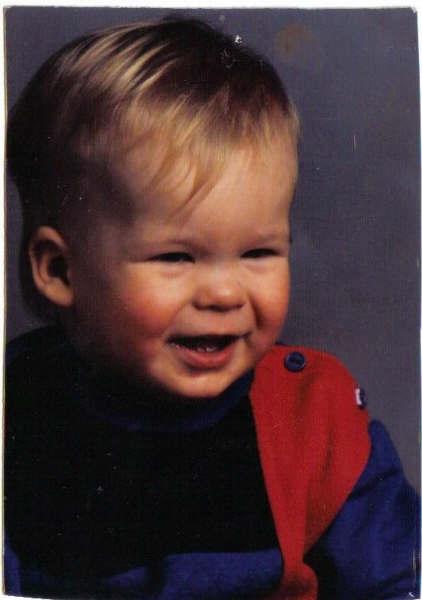 John Cory Truckle, age 17 months
Source: email from Cindy Darlene Wells combined with info from several websites
Northern Ontario Baby Stolen
December 30, 2007 permalink
A Kirkland Lake couple got a Christmas surprise: an apprehension order. Social workers approached the family under false pretenses of assistance, then saved themselves 500 kilometers of driving by inducing the family to drive their baby girl to North Bay, where she was seized. The family got some bad advice on the internet, and has forfeited their opportunity to legally challenge the validity of the apprehension. The dad's dysfunctional mother seems to be the the source of the problem. The story makes clear that the biggest fear of social workers is now video cameras. Since the story uses real names, it will probably be bullied off the internet shortly. Read it while you can.
Addendum: We removed our copy of the story three years later to avoid embarrassing the family.
Fran Lyon Cleared
December 30, 2007 permalink
Fran Lyon, the pregnant woman driven out of the UK by the threat to remove her baby at birth, has been told that it is safe for her to return home. There is no way to tell whether this is an honest change of policy by Northumberland social services, or a sucker play to get her back where her baby can be seized. Fran is taking no chances, and will remain outside England. We had earlier reports on October 18, November 3, November 12 and November 24.
expand
collapse
Pregnant Fran told she's in the clear
A WOMAN who fled the country to avoid her newborn child being taken into care has been told she is safe to be a parent after all.
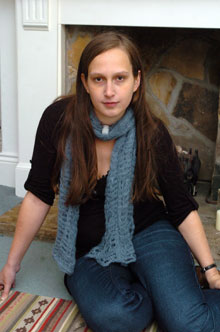 Fran Lyon, 22, Hexham, pictured in her home.
Fran Lyon flew to Continental Europe last month to escape a Northumberland County Council social services ruling that her child would be taken from her 10 minutes after birth.
But now a psychologist’s report to the council has said Ms Lyon, 22, would not be a threat to her baby, who will be named Molly, and that she should be allowed to keep the child if she returns.
The U-turn comes after a previous report said Ms Lyon should not be allowed to keep her baby because psychiatric problems she suffered as a teenager made her a threat to the child.
Speaking exclusively to The Journal, Ms Lyon, who used to live in Hexham, said that despite the new report, she had no intention of returning to the UK.
She said: “It is basically as close as you will get to them saying ‘sorry, we messed up’, as they have realised they wouldn’t stand a chance if it was challenged in court.
“I hit the roof when I found out. Because of them I have lost everything – my job, my home and I have sold everything.
“I literally own what I can carry. Apart from Molly, I have got nothing at all.”
The original decision to remove the child was taken after a paediatrician Miss Lyon had never met said she was likely to suffer from a condition that would cause her to harm her child.
Despite other doctors saying she was fit to be a parent, social services refused to back down – until the latest recommendation was made by a London expert.
Miss Lyon said she was now happily settled in a flat and had an excellent midwife.
“They have said that if I go back, I would be allowed to go into a mother and baby unit with Molly and that I would be allowed to breast feed. But there is absolutely no way I am coming back. Why on Earth should I?
“You think of the damage that they could have done to Molly if she had arrived before I made my decision to leave.
“They simply shouldn’t be allowed to put somebody through this and then at the last minute turn round and say they were wrong.
“They have destroyed so much, I am not going to allow them to destroy any more.”
Molly is due to be born early next month, and Ms Lyon said she had spent much of the past few days shopping and preparing for the new arrival.
A Northumberland County Council spokesman said: “Unfortunately, we are unable to comment on individual cases. However, we can say that child protection recommendations are always subject to review.
“We would never put a child protection plan in place without current and appropriate grounds for serious concerns, and we are concerned that Ms Lyon’s whereabouts are still unknown.
“We urge Ms Lyon to urgently get in touch with us, or a medical adviser, so we can be sure she and her unborn child receive the help and support that they need.
“It is crucial that the authorities wherever she is have relevant information from us to do this.”
Timeline
- August 27, 2007: Ms Lyon – then five months pregnant – tells The Journal she is considering an abortion to prevent her child going into care.
- September 8: She vows not to terminate her pregnancy but will fight to keep her daughter.
- September 13: Ms Lyon is not allowed to attend the meeting deciding the fate of her unborn child. She faces an anxious wait for a letter from the Northumberland County Council’s safeguarding children panel telling her if the appeal has been upheld.
- October 4: Ms Lyon says she is facing losing her home as a result of the battle to keep her child. The time spent attending meetings, seeing doctors and filling in legal forms means she is struggling to work enough to pay the rent.
- November 10: She leaves her home in St Hilda’s Road, Hexham, after receiving a birth plan for her child from Northumberland social services. She says she is being hounded out of the region by council bosses.
- November 26, 2007: Ms Lyon flees to Continental Europe to avoid the social workers planning to take her baby.
Source: website Journal Live (UK)
Adoption Scammers Sentenced
December 27, 2007 permalink
In October a charity called Zoé’s Ark tried to fly 103 children out of Chad to France for adoption. They represented the children as injured orphans from Darfur (Sudan). The injuries were fake, the children were Chadian, not Sudanese, and they had been under the care of their families. Today a Chadian court sentenced the schemers to eight years. Now if we could get children's aid workers before a Chadian judge ...
expand
collapse
French Aid Workers Get 8 Years Hard Labor
DAKAR, Senegal — Six French aid workers were found guilty on Wednesday by a court in Chad and sentenced to eight years of hard labor for trying to take to Europe 103 children who they claimed were orphans of the conflict in Darfur.
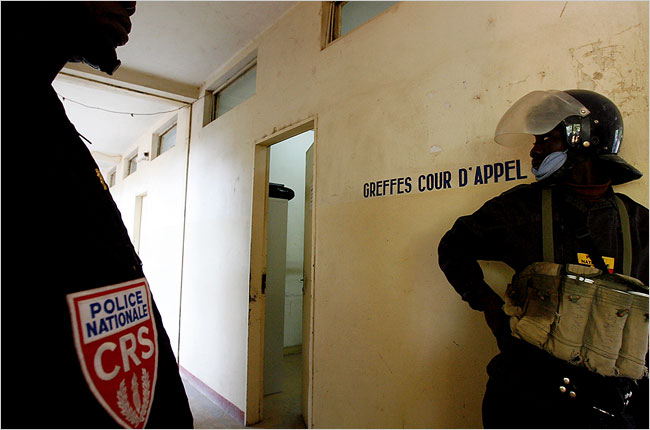 Luc Gnago/Reuters
Police at the Palace of Justice in Chad, where six French citizens were convicted Wednesday of trying to kidnap 103 children.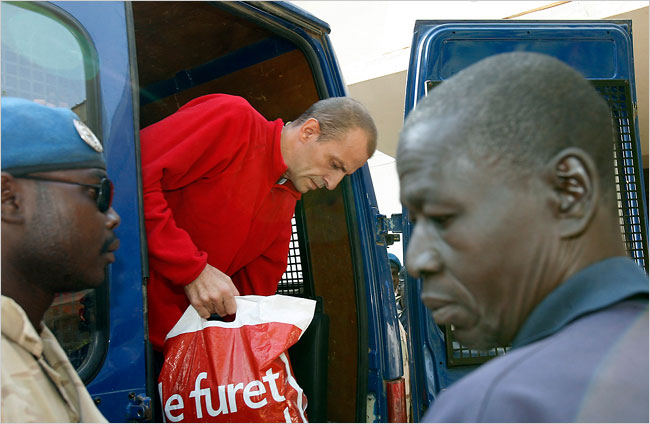 Luc Gnago/Reuters
Éric Breteau, leader of the group that was found guilty.Display images for more detail
The verdict came after four days of closely watched testimony in Chad’s capital, Ndjamena. The case enraged many Chadians and embarrassed France just as a European peacekeeping force made up largely of French troops was to begin deployment in the region. The episode brought condemnation across Africa.
Prosecutors portrayed the aid workers as remorseless kidnappers bent on exploiting Chad’s children. But the workers claimed they were humanitarians acting within the confines of international law, trying to save children from imminent harm.
Diplomats and analysts widely expect that the French workers will be allowed to return to France. Though French officials called the verdict a sovereign decision, they said they would ask Chad to allow the workers to serve their sentences in France, news agencies reported.
The workers claimed they had been rescuing child refugees from parched, war-torn Darfur, in western Sudan, but it turned out the children were for the most part neither Sudanese nor orphans.
This year the aid group, Zoé’s Ark, posted an emotional appeal on its Web site claiming that a child dies in Darfur every five minutes and calling upon families in Europe to help the organization bring the children to Europe for temporary refuge. The group said it planned to rescue 10,000 orphans. Many donated money to help cover the costs of chartered planes.
In October, Chadian officials stopped workers from the group as they hustled dozens of children, some of them in bandages and attached to intravenous drips, onto a plane in eastern Chad. The aid workers were charged with attempted kidnapping.
The bandages and bloodstains turned out to be a ruse. The group’s supporters have argued that local helpers misled the workers about the children’s status, but video images released by a journalist who had traveled with the aid workers showed them putting the fake bandages on the children.
The children were turned over to the Red Cross and found to be in relatively good health. Interviews with those old enough to speak showed that virtually all of them were Chadian, not Sudanese, and had been living with adult relatives they considered to be their parents.
The case touched off anti-French riots in Chad, a former French colony with close ties to France. In street demonstrations, Chadians demanded the death penalty.
French troops occupy two bases in Chad, and French troops are expected to make up a large portion of a European Union peacekeeping force aimed at stabilizing Chad and the Central African Republic, which have been destabilized by the conflict in Darfur and by rebellions of their own.
President Nicolas Sarkozy of France flew to Chad to try to defuse tensions, and eventually the aid workers were allowed to leave on condition they returned for the trial.
Source: New York Times
Addendum: Another article gives more details, allowing for a comparison between children's aid and the French kidnappers.
Local snitches assist in finding families with children. Initial contact with the families is achieved through misrepresentation, in Africa by promising to build a school, in Canada by posing as helpers.
The kidnappers falsely claimed their African finds were orphans. In Canada, the same effect is achieved by getting a judge to declare them crown wards, turning them into paper orphans.
Mr Breteau claimed to act from purely charitable motives, overlooking the Frenchmen back home who had already paid for adoptive children. Again, just like Canada, where at least two different money streams fund the adoption industry, appropriations and fees from prospective adopters.
News of the mass kidnapping spread panic through Chad. A similar kind of panic exists in the west, though limited to parents apprised of the true power of child protectors.
One real difference is the fake medical treatments for the children to fool airport authorities into letting them out of the country. In Canada, fooling the authorities is unnecessary.
Unlike most western countries, the courts in Chad represented the parents, and treated the kidnappers harshly. Until there is a change in political mood, the courts in the US and Canada will continue to represent the interests of the child snatchers, protecting them from punishment.
Chad, a former colony, is a French client state, and the French government arranged for the transfer of the convicted kidnappers to France on December 28, two days after their sentencing. France may yet reduce their punishment.
expand
collapse
Chad jails French volunteers for eight years
PARIS — A court in Chad yesterday convicted six French volunteer charity workers of attempting to kidnap 103 African children and fly them to France without their families' consent.
The four men and two women were sentenced to eight years hard labour by a judge in N'Djamena. They were also ordered to pay $8.9-million in damages to the families of the children they tried to take to France.
One of the six, nurse Nadia Merimi, was in tears and had to be comforted by her lawyer. Another, former soldier Alain Peligat, gave the charity's impassive leader Eric Breteau a brief hug of solidarity.
The aborted airlift has embarrassed France and exasperated legitimate aid organizations working in Chad. The defendants were members of an amateur aid group called Zoe's Ark. They said they believed they were rescuing orphans from “sure death” in Darfur, in neighbouring Sudan. But most of the children, ranging in age from toddlers to 10 years old, turned out to be neither orphans nor from Darfur.
Instead, they had been rounded up from villages in neighbouring Chad. Several of their fathers testified at trial that they had handed over their children because “the white people” from France had promised to build a school nearby and educate them.
The Zoe's Ark members, admitting they knew neither the region nor its culture, said they relied on local intermediaries to search out and bring them orphans to airlift out of the country. Two of the local men they hired, one Sudanese and one from Chad, were also convicted as accomplices. They received lighter sentences of four years in prison.
Just before the end of the trial, Mr. Breteau, who was also convicted of using forged papers, apologized to any Chadian parents who had been separated from their children.
But he again insisted that he and his colleagues had acted in good faith when they tried to fly the children from eastern Chad, near the border with Sudan's conflict-ridden Darfur region, to France.
“If they are Sudanese … we have deprived them of a better future; if they are Chadians and we were lied to, if we separated them from their families, we are really terribly sorry, for we never wanted to separate families.”
The case of the snatched children has complicated France's already delicate relations in Central Africa, where it has a leading role in the planned United Nations-African Union mission for Darfur. The French are seen as crucial to securing the co-operation of Chad, which is to be the staging ground for a massive international peacekeeping mission set to deploy next month in Darfur.
Since the affair broke in late October there has been more than one anti-French protest in the streets of N'Djamena. (Chad, a landlocked Central African country of 10 million people, won independence from France in 1960.) France has not defended the actions of Zoe's Ark, but has requested that the self-proclaimed Good Samaritans be sent home, presumably to serve out at least part of their jail terms.
Chad has done little to stop the popular anger whipped up against the Zoe's Ark operation. UN and private aid workers in the area have said that the French group's actions sparked rumours that Western “child stealers” were at large, panicking Darfur refugees.
Mr. Breteau has insisted he intended only to ask for political asylum status for the children and did not suggest to his supporters they could adopt them. At one point during his detention in Chad, he described himself as the only person in the world trying to do something concrete for Darfur victims.
French President Nicolas Sarkozy has tried to handle the controversy with a combination of behind-the-scenes diplomacy and grand public gestures. He has described the Zoe's Ark operation as “illegal” and “unacceptable.” Foreign Ministry officials said they had repeatedly warned the charity against attempting any sort of private rescue scheme.
But after the group was arrested in late October as they tried to take the children out of Chad in a rented airplane, Mr. Sarkozy intervened personally to secure the release of several journalists and airline crew members who were with the Zoe's Ark group.
He pledged to bring home those remaining in Chad, “no matter what they have done,” and proposed that they be tried in France. Chad's Interior Minister Ahmat Mahamat Bachir briskly rejected the suggestion, calling it an insult. “These bandits should be tried and convicted here,” he said, adding, “Let them get a taste of our prisons.”
Despite the angry words, the French charity workers were apparently treated well. When one of the accused women fell ill during the trial, she was taken to a French military hospital, not a local one, for treatment. The group was held in a low-security detention centre that is one of the newest prisons in Chad. Their fellow detainees were described as people caught up in clan disputes who considered it safer to live in prison than at home.
But French Foreign Ministry officials have apparently been negotiating for some time to bring the Zoe's Ark defendants back to France, taking advantage of a 1976 agreement with Chad that provides for extradition of convicted criminals to their home country to serve out their prison sentences.
A Socialist deputy suggested the price to be paid for the return of the charity workers could be high.
“It's clear that he is going to have to pay a lot of money, to the families [in Chad] as well as to the Chad government,” said Jean-Louis Bianco, one of the leading opposition figures in the National Assembly. “But if this money is used for the development of Chad, why not?”
A quick transfer of the convicted charity workers to France is likely, according to Antoine Glaser, editor of Letter from the Continent, a magazine specializing in Africa. Chad's President Idriss Déby wants French military support to fight the insurgents and Mr. Sarkozy wants to make sure Chad does not create roadblocks for the Darfur peacekeeping force.
“There is a real deal between the two men that goes beyond the Zoe's Ark affair,” Mr. Glaser told the newspaper La Croix. “Just like in the good old days, everything will be worked out between France and Chad without bothering with the sovereignty or judicial process of either country,” he added.
Special to The Globe and Mail, with a report from Agence France-Presse
Source: Globe and Mail
Addendum: Five years later a French court sentences six of the kidnappers.
expand
collapse
Two French charity workers jailed in 'false orphans' case
 File photo taken in Chad in 2007 of, from right to left, Eric Breteau and Emilie Lelouch Eric Breteau and Emilie Lelouch, seen here in 2007, had refused to attend the trial in France
Two French charity workers have been sentenced to two years in prison for illegally trying to fly 103 African children from Chad to France in 2007.
Eric Breteau, who founded Zoe's Ark, and his partner Emilie Lelouch had been tried in absentia but appeared in the Paris court for Tuesday's verdict.
Four other members of the group were given suspended sentences of between six months and a year.
Zoe's Ark received a 100,000 euro (£86,000) fine and has been dissolved.
The children were said to have been orphans from Sudan's war-torn Darfur region, but turned out to be mainly from Chad and with families of their own.
In a case that shocked France, the defendants were arrested in Chad as they tried to load the children on to a plane bound for France in 2007.
They were sentenced later that year to eight years' hard labour by a court in the Chadian capital, N'Djamena, but repatriated to France after receiving a pardon from Chad's president in March 2008.
'Any price'
The six defendants were charged, in France, with acting illegally as an adoption intermediary, facilitating illegal entry into France, and fraud in regard to 358 families who had expected to adopt children.
 An artist's sketch shows (from left) defendants Marie-Agnes Peleran, Alain Peligat , Philippe van Winkelberg and Christophe Letien in court in Paris, 3 December Four of the six defendants turned up for the trial in Paris
Mr Breteau and Ms Lelouch, who had been living in South Africa, refused to attend the start of the trial in early December, reportedly saying they had "no wish to give an account of themselves".
But they appeared in court on Tuesday to hear the judge rule that they should face a two-year prison sentence, a fine of 50,000 euros each and a ban on working with minors. Their lawyer said they would appeal.
The pair "could not have been unaware of the illegality of their project," the court said, adding that they had "knowingly lied to their families".
Of the other defendants, Dr Philippe van Winkelberg and Christophe Letien received a one-year suspended sentence, and Alain Peligat and journalist Marie-Agnes Peleran were each given six-month suspended terms, French media reports.
Mr Breteau, a former volunteer firefighter, set up Zoe's Ark in 2005, initially to aid victims of the December 2004 Asian tsunami.
In April 2007, the charity announced a campaign to evacuate 10,000 young orphans from Darfur in western Sudan, which was suffering a humanitarian crisis following five years of civil war. Zoe's Ark said it planned to place the children, all mainly under five years old, in foster care with French families.
However, the 103 children the charity was putting on to a plane from Chad to France in 2007 were found to be largely from Chad itself, and were not orphans at all.
The court heard damning testimony from Nathalie Cholin, a volunteer nurse who had provided psychological support to medical teams in Chad.
She portrayed Mr Breteau as an "all-powerful manipulator" who had convinced her at a meeting in Paris that his mission in Chad would rescue Darfur orphans find them homes in France.
Assurances were given, she said, that the operation was perfectly legal: "He told us we were acting under the 1951 Geneva Convention and I did not imagine an operation like this could be organised without the backing of the authorities."
However, once in Chad, Ms Cholin found the children were "in good health" and were "crying and asking to go back to where they had come from".
For Eric Breteau, "children had to be brought back at any price", she told the court, adding that she believed he was under "a certain pressure" from the families wishing to adopt the "orphans".
Source: BBC
Lawyers Want Tax Money
December 26, 2007 permalink
Two lawyers, Gregory and Byron Mills, are specializing in suing the state of Nevada on behalf of dead and lost foster children. It looks promising, but it turns out all they are doing is lining up to take tax money, and force the legislature to appropriate more of it. Parents get short shrift in their view, "these people did things to have their children taken away in the first place". Even purported reformers, such as the lawyers in this case and Marcia Lowry of Children's Rights Inc soon join the lineup of claimants on the public treasury. Family integrity cannot be restored through litigation.
expand
collapse
Firm takes up cause of victimized kids in foster care
 Attorneys Byron Mills, left, and brother Gregory are shown at their downtown Las Vegas offices.
LEILA NAVIDI / STAFF PHOTOGRAPHERSometimes the growth of a practice comes in unexpected and even unpleasant forms.
Attorneys Gregory and Byron Mills had a fairly quiet family law practice in the heart of downtown Las Vegas for the last few years, handling a variety of low-profile matters.
But the disappearance last year of one foster child and the death of another launched the brothers into a major new practice area: Fighting for compensation for foster children abused while under the care of the Nevada Child and Family Services Division and left without treatment by the state's foster system.
"The system has to change, and so far the only way we can see to do it is lawsuits. Unfortunately it's the only way," Byron Mills said. "There's no funding to help kids abused in the system, and it's been going on for years. They're not getting the protection and the counseling they deserve after something like that happens. In many cases it's simply been covered up."
Their law firm, Mills & Mills, has five active cases against the state, is working on several more and anticipates a large influx of cases as word gets out about what it is doing. The four-attorney firm has spent many man-hours researching and preparing its first cases, one involving the disappearance of Everlyse Cabrera and the other, the death of a baby boy.
The firm can't afford to do these cases pro bono because of its size and the amount of time the cases will take to prepare. Gregory Mills has already spent months preparing the cases the firm has, and legal legwork could last for years.
If it succeeds in the end, the firm stands to earn hundreds of thousands of dollars from these cases over the next several years. And right now it is the only law firm in town aggressively seeking out abuse victims in the foster care system, preparing advertisements and public information campaigns.
Gregory Mills (who prefers to go by the nickname Gregor) is leading the firm's efforts, representing the biological parents and missing or deceased children. He is seeking restitution as well as additional information about the care that the children received.
Other cases at this point involve children who have been sexually or physically abused at the hands of foster parents or foster siblings and have not received counseling and treatment.
The firm's initial aim is to get the state to pay compensation up front for children abused in the system.
"We can't just ask for the court to give these kids counseling at this point," Byron Mills said. "The family juvenile court already is tasked with getting them counseling, and it isn't. The money from these lawsuits will go into court-monitored and controlled accounts to pay for counseling until the kids are 18. At that point anything that's left over will go directly to the kid."
The idea is for the firm to be a resource for these children since they have nowhere else to turn.
"The sad part is these kids and their parents don't know who they could report it to," Mills said. "I mean, you can't call (the children's service division) on itself. And these kids are not getting the help they need."
The parents will not be able to exploit the situation because they won't have access to these funds except in cases where the child has died, he said.
"If the parents know their kids have been abused or are being abused they can contact us. But they don't stand to gain from it," Mills said. "Remember these people did things to have their children taken away in the first place. So we're very mindful of that."
The firm's secondary aim is to see the department reformed, fully funded and children protected from future abuse.
Ideally, foster care caseworkers have about 20 kids to evaluate, Mills said. In Nevada, funding for the program is so inadequate that one caseworker may be working with 50 or more children, according to media accounts. These caseworkers are supposed to meet these children in person at least once a month, but there simply isn't enough time. They are lucky to see kids once every other month, Byron Mills said.
"It makes it impossible for them to do their jobs," he said.
If a caseworker cannot see the child, she has no way of knowing if abuse is taking place or likely to occur. And the lack of qualified foster homes has led to children being placed in homes that have not been properly evaluated.
"While doing these types of cases we realized that while the foster system is quick to take kids away from their parents, they're not so good at protecting them once the kids are in foster care," Byron Mills said. "People within the foster system have asked us for help. They have a huge amount of cases and not even close to enough caseworkers and nowhere near enough money to run the program and protect the kids."
The Mills brothers have supported legislative lobbying efforts in the last session, although they haven't done any direct lobbying themselves. Gov. Jim Gibbons has pledged to leave the agency's budget intact while many other agencies face budget cuts in the latest round of belt-tightening. And the Mills brothers hope that something will occur in the 2009 Legislature to bring additional funding to the program.
In the meantime, they plan to use the only means they have of persuading lawmakers that fully funding foster care programs is in the state's best interest.
"Just like a large corporation, until it hurts them in the wallet, they're not gong to do anything," Mills said. "It's our goal to hit them so hard and so repeatedly that they're forced to deal with the problem and increase the funding. We hope that in the future we don't have to do this anymore because the problem won't exist."
At the same time, the brothers are urging their colleagues in the legal profession and the business community to get more involved in the issue. They are encouraging lawyers and businesspeople to lobby legislators and to participate in the Court Appointed Special Advocate program, which provides volunteer advocates for abused and neglected children going through the foster care system.
The Mills are also spreading the word about the dire need for foster parents. There are too few foster parents anyway, but even fewer from the professional and business community, and the more good homes foster children have to go to, the better off everyone will be, they said.
"Ultimately this comes out of all our pockets," Byron Mills said. "And if this problem grows, this burden will grow for everyone and in myriad ways."
Stephanie Tavares covers utilities and law for In Business Las Vegas and its sister publication the Las Vegas Sun. She can be reached at 259-4059 or tavares@lasvegassun.com.
Source: In Business Las Vegas
The Night Before CAS
December 24, 2007 permalink
Twas the night before Christmas, when all through the house
Not a creature was stirring, not even a mouse.
The stockings were hung by the chimney with care,
In hopes that Saint Nicholas soon would be there.
The children were nestled all snug in their beds,
While visions of sugarplums danced in their heads;
And mamma in her 'kerchief, and I in my cap,
Had just settled our brains for a long winter's nap -
When out on the lawn there arose such a clatter
I sprang from my bed to see what was the matter.
Away to the window I flew like a flash,
Tore open the shutter, and threw up the sash.
The moon on the breast of the new-fallen snow
Gave a lustre of midday to objects below;
When what to my wondering eyes should appear
But an ugly black sleigh pulled by 8 robot deer
With a CAS worker, it made me quite sick
I knew in a moment it wasn't Saint Nick!
More rapid than eagles her coursers they came,
And she hollered and cursed and called them by name.
"Now Slasher! now Danger! now Pouncer and Tricks 'em!
On Rotten! on Stupid! on Dodo and Blitz 'em!
To the top of the porch, to the top of the wall,
Screaming "I want the children - I want them all!
As dry leaves that before the wild hurricane fly,
When they meet with an obstacle mount to the sky,
So, up to the housetop the robots they flew,
With a sleigh full of cops and CAS too.
And then, in a twinkling, I heard on the roof
The scratching and pawing of each little hoof.
As I drew in my head and was turning around,
Down the chimney the CAS came with a bound:
She was dressed up for combat, from head to her foot,
And her clothes were all tarnished with ashes and soot.
A bundle of toys she carried so well,
And she looked like a witch just casting her spell.
Her eyes, how they glistened! her pimples, how scary!
Her cheeks were so wrinkled, her nose was all hairy;
Her thin smirking mouth was drawn up like a bow,
An attempt to look kind, but just like a troll.
Bearing gifts for the children parents could not afford
"Foster care, foster care, all hurry aboard!"
Then in came a lawyer so slickly and quick
I thought for a moment that HE was St Nick.
"No children tonight! No warrent! no order!
Now get out, now get out! and torment no other!
He gave me a wink and nodded his head,
and so let me know I had no more to dread.
He said nothing to me as he finished his job
Making sure they were gone, the CAS mob.
Then glancing around he so quietly said
"All is now well, you can go back to bed"
As fast as he came,as quick he left
Like a phantom, was gone, with a movement so deft
But I heard him proclaim as he faded from sight,
"Merry Christmas to all, keep your children - tonight
Source: adapted from the work of Clement Moore and Linda Weston
Chatham-Kent to Improve Website
December 22, 2007 permalink
John Dunn has directed us to another example of progress achieved through his advocacy on behalf of children in care. The website of Chatham-Kent Children's Services will be revised to inform readers about the complaint process. So far this kind of advocacy has only brought small improvements.
expand
collapse
Children's Aid website to have complaint info; Lack of details criticized by Foster Care director
Chatham-Kent Children's Services is changing its website and the new one will include complete information about the complaint process.
Chief executive officer Mike Stephens said while the former website contained information about filing a complaint, there is an additional method that was enacted in 2006 that is not on the website.
The local children's aid society was recently criticized by John Dunn, the executive director of the Foster Care Council of Canada, about the lack of complete complaint information on its website.
"This is something that needs to be addressed immediately to meet the needs of children and youth in care from being harmed either physically, sexually or emotionally," Dunn said in an e-mail to the CKCS, which was forwarded to The Chatham Daily News.
Stephens said the agency responded to Dunn's concerns and explained that the agency is re-vamping its online presence. The website is currently under construction.
"There is no legal obligation for us to have it on our website," Stephens said.
He noted the information is given freely to people dealing with CKCS.
"All of our clients who would be in a position to make a complaint get a hard copy of our complaint process," he said.
Stephens said the information that was not on the website deals with taking a complaint to the Child and Family Service Review Board, an option clients are told about if a complaint is made.
He said CKCS gets a handful of complaints a year.
"Most complaints get resolved in the first phone call," he said.
Dunn, who works out of Ottawa as an advocate for children in care, said he noticed the full complaint information was missing while checking the website for membership details.
Source: Chatham Daily News
Brain Damage
December 21, 2007 permalink
A scientific study of Romanian children confirms the obvious, that foster care is worse than parental care, and institutional care is worse still. But this time, the researchers measured the difference. Pre-school children in an orphanage suffer an IQ loss of six points per year relative to foster children, who in turn suffer a similar deficit relative to children in the care of their parents. Which form of care serves the best interest of the child?
expand
collapse
Foster care better than orphanages for kids' IQs
WASHINGTON (AP) -- Toddlers rescued from orphanages and placed in good foster homes score dramatically higher on IQ tests years later than children who were left behind, concludes a one-of-a-kind project in Romania that has profound implications for child welfare around the globe.
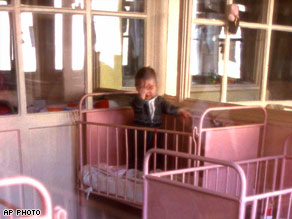 This photo, provided by the journal Science, shows an orphanage in Criova, Romania, in 1994.
The boost meant the difference between borderline retardation and average intelligence for some youngsters.
Most important, children removed from orphanages before age 2 had the biggest improvement -- key new evidence of a sensitive period for brain development, according to the U.S. team that conducted the research.
"What we're really talking about is the importance of getting kids out of bad environments and put into good environments," said Dr. Charles Nelson III of Harvard Medical School, who led the study being published Friday in the journal Science.
The younger that happens, "the less likely the child is to have major problems," he added.
The research is credited with influencing child-care changes in Romania, and UNICEF has begun using the data to push numerous countries that still depend on state-run orphanages to start shifting to foster care-like systems.
"The research provides concrete scientific evidence on the long-term impacts of the deprivation of quality care for children," UNICEF child protection specialist Aaron Greenberg said. "The interesting part about this is the one-on-one caring of a young child impacts ... cognitive and intellectual development."
That orphanages are not optimal for child development comes as no surprise. Earlier studies have found that thousands of children adopted during the 1990s from squalid orphanages in Eastern Europe, China and elsewhere continued to face serious developmental problems even after moving to affluent new homes with doting parents.
But questions remain. Were those abandoned or orphaned children who spent more time in orphanages less healthy to begin with? How much damage does neglect and lack of stimulation in the early months of life do? How long does that damage last?
In the study, U.S. researchers randomly assigned 136 young children in Bucharest's six orphanages to either keep living there or live with foster parents who were specially trained and paid for by the study. Romania had no foster-care system in 2000 when the research began.
The team chose apparently healthy children. Researchers repeatedly tested brain development as those children grew, and tracked those who ultimately were adopted or reunited with family. For comparison, they also tested the cognitive ability of children who never were institutionalized.
By 4½, youngsters in foster care were scoring almost 10 points higher on IQ tests than the children left in orphanages. Children who left the orphanages before 2 saw an almost 15-point increase.
Nelson compared the ages at which children were sent to foster care. For every extra month spent in the orphanage, up to almost age 3, it meant roughly a half-point lower score on those later IQ tests.
Children raised in their biological homes still fared best, with average test scores 10 points to 20 points higher than the foster-care kids.
What does that mean as these children grow up? Just this week an anxious acquaintance cornered Nelson to ask what to expect of a child who spent nine months in a Vietnamese orphanage.
"There's much more to functioning in life than your IQ," Nelson stresses.
Plus, he only now has begun testing these children again as they turn 7 and 8. They might catch up.
For now, Nelson tells adoptive parents, "The older the child is when they leave the institution, the more likely that child may have some developmental problems and the more difficult it may be to ameliorate those problems. ... The message to parents is simply to go into this with their eyes open, but not to give up."
For the U.S. and other countries that depend on foster care instead of orphanages, the study has implications, too, because it used high-quality foster care that is not the norm in many places, Nelson noted. Studies comparing the impact of foster care of varying quality are under way.
The Romanian government requested the study and began its own foster care program shortly thereafter. Early study results are credited with influencing Romania's recent prohibition on institutionalizing children under 2 unless they are severely disabled.
Source: CNN
Escape Utah!
December 20, 2007 permalink
A Utah mother, Denise Mafi, has fled the state to avoid losing her children. One of the few good defenses against child protectors is to leave their jurisdiction before legal process is served. Sadly few parents take this advice, because they are unwilling to believe the abuses committed in the name of children until it is too late. The prospects for Denise Mafi are better, as long as she never returns to Utah.
expand
collapse
POLICE STATE, USA
Woman abandons home to escape public schools
Judge ordered homeschooler to enroll kids or lose custody
A Utah woman who was ordered by a juvenile court judge to enroll her children in public school or lose custody of them has abandoned her home, furniture and other possessions to escape the order.
Denise Mafi, a nine-year veteran of homeschooling, has confirmed to WND she and her children packed up their essentials – clothes and homeschool materials – and fled Utah over the weekend, spending more than 50 hours on a bus trip to an undisclosed part of the country.
There she has obtained an empty home and is spending the Christmas break trying to find beds for her children and herself. After the New Year she will involve the children in a local homeschooling process.
"We're shampooing carpets right now. We have no furniture. We have no beds," she said. "But my kids are not going to public school. They are not going where Jesus isn't welcome."
Her home, furniture and other possessions left behind in Utah? "I'm not going back unless the judge removes the threat of arrest," she said. "I'll fight for the cause but I'm not going to be a martyr."
The case erupted for Mafi because of an apparent paperwork glitch that could be the fault of her local school district. Now Utah home school officials say they have asked the state Legislature to review actions by the judge, whose office has declined comment to WND.
The confrontation developed after Mafi, still married but separated from her husband, already had begun her homeschooling plan for the 2007-2008 year, for which she had received a district exemption as required in Utah. She was told she was being accused of four counts of failing to abide by the state's compulsory education law, with a penalty of up to six months in jail on each count, because the district alleged she had not submitted a required affidavit for the long-completed 2006-2007 school year.
Counseled by a public defender, she thought she was meeting the court's demands earlier when she enrolled her two youngest children in classes in Utah and put her two older children in an online curriculum connected to the public school. However, she soon learned otherwise.
"Well everything fell apart in court today. I had to enroll my two oldest in public school. … If I didn't the judge said I would lose custody of my children. He threw out the plea and we go to trial on January 9th. I have NO CHANCE with this judge. He will find me guilty. He already has. So I will probably be spending some time in jail. Please pray for my children," she noted in an online forum connected to a "Five In A Row" homeschool curriculum she had used when her children were younger.
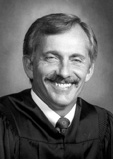 Scott Johansen
At issue are the threats issued by Judge Scott Johansen, who serves in the juvenile division of the state's 7th Judicial District. Johansen threw out the agreement Mafi thought would resolve the charges.
Mafi has reported, and her recollection of events has been confirmed by attorneys, that Johansen told her homeschooling fails 100 percent of the time and he would not allow it.
"I can tell you there are several legislators working on this, including one on the judicial retention committee," said John Yarrington, president of the Utah Home Education Association. "There's no excuse for this kind of bias and prejudice."
Mafi, who has her own copy of the required affidavit, said she faxed it to the school district office Oct. 27, 2006. But the district alleged it didn't arrive, and Mafi failed to keep a fax confirmation she received at the time.
WND contacted the judge's court, but was told to call the state judiciary's office. A spokeswoman confirmed the situation was being reviewed, but she couldn't comment on a pending case. The district attorney's office didn't return a telephone request for comment.
Tom Smith, however, who identified himself as a friend of the judge, wrote to WND in his defense.
"I and another local Republican official wrote to encourage Gov. Bangerter to appoint Scott Johansen, who was a Democrat county attorney at the time, as a juvenile judge. Scott did not like the partisan politics at the time, and many of his views today tend to be more conservative," he said. "I believe he has served our area very well in his capacity of juvenile judge."
Smith cited an occasion when he was teaching a number of years ago, when "some in our school wanted to change the method of teaching to a more liberal way; a method that had not done well in other schools. Judge Johansen took a stand against it with those of us who opposed the change. The result was that several of us teachers were not required to make the change."
Yarrington said a lawyer for the UHEA is working on the case, and lawyers for the Home School Legal Defense Association are reviewing the situation.
Mafi said she is hoping she will not be required to return to Utah for the scheduled Jan. 9 trial, and it was unclear immediately how the fact her children no longer remained in Utah would affect the charges already filed.
She has explained that her opposition to public schools comes from what she sees as an anti-Christian atmosphere. Mafi said she and her husband had decided homeschooling would be their choice even before the children reached school age.
As WND has reported, such threats and actions are becoming more common in Germany, but that nation still makes homeschooling illegal under a law launched when Hitler expressed a desire to control the minds of youth.
A recent court ruling there, in fact, said not only is homeschooling a basis for child endangerment charges, but a local government was remiss in allowing a mother to take her two children to another country where homeschooling is legal.
Wolfgang Drautz, consul general for the Federal Republic of Germany, has commented on the issue on a blog, noting the government "has a legitimate interest in countering the rise of parallel societies that are based on religion or motivated by different world views and in integrating minorities into the population as a whole."
Drautz said homeschool students' test results may be as good as for those in school, but "school teaches not only knowledge but also social conduct, encourages dialogue among people of different beliefs and cultures, and helps students to become responsible citizens."
The German government's defense of its "social" teachings and mandatory public school attendance was clarified during an earlier dispute on which WND reported, when a German family wrote to officials objecting to police officers picking their child up at home and delivering him to a public school.
"The minister of education does not share your attitudes toward so-called homeschooling," said a government letter in response. "... You complain about the forced school escort of primary school children by the responsible local police officers. ... In order to avoid this in future, the education authority is in conversation with the affected family in order to look for possibilities to bring the religious convictions of the family into line with the unalterable school attendance requirement."
Source: WorldNetDaily
Addendum: The family appears to have successfully escaped the wrath of Utah.
expand
collapse
POLICE STATE, USA
Homeschooler's trial date abandoned
Mom who fled state accused of failing to file district affidavit
Saturday, January 12, 2008, Posted: January 12, 2008, 1:00 a.m. Eastern, WorldNetDaily.com
A trial date for a homeschooling mom from Utah who fled the state when a judge threatened to take away custody of her children has been vacated, officials have confirmed.
A lawyer with the Home School Legal Defense Association, which actually became involved in the case after it was well advanced, told WND that parties in the case against Denise Mafi by stipulation had vacated a trial date scheduled this week, and no new court date has been set.
Mafi had fled her Carbon County, Utah, home after a judge had ordered her to enroll her children with a public school within a day or he would remove then from her custody.
Mafi, who at that time had had counsel from a public defender, abandoned her home, furniture and other possessions to leave Utah and seek refuge in another state, where she is getting her four children involved in another homeschooling program.
Mafi told WND she and her children had packed up their essentials – clothes and homeschool materials – and spent more than 50 hours on a bus trip to an undisclosed part of the country.
Charges against her stemmed from what she has described as a paperwork mixup. She says she faxed a required notification of her homeschooling plans to her local school district; officials there say they never received it.
While Mafi's case isn't yet fully resolved, officials with the HSLDA confirm that another situation with similar circumstances was successfully resolved with the case being dismissed.
In the second case, an unidentified homeschooling mother was facing criminal counts for failing to enroll her daughter in a local public school.
"Though the mother had been properly notifying the school district for the past two years that she was homeschooling her 12-year-old daughter, she inadvertently delayed notifying for the 2006-2007 school year until February 2007," according to the organization's report on the situation.
"The district decided that failure to file the affidavit before the first day of the public school year was an automatic criminal violation of the state's compulsory school attendance law. Yet Utah's home education statute does not specify a filing deadline, requiring only that an affidavit be sent to the district 'annually,'" the HSLDA said.
The case eventually was dismissed with prejudice by Utah Juvenile Court Judge Elizabeth Lindsley.
According to attorney Frank Mylar, who worked on the case in Utah, the result "is a great victory for all homeschoolers in Utah."
He said he's hopeful that the message for school districts is that they cannot intimidate families who may inadvertently file their notice after the school year begins.
Mylar, president of the Utah Christian Home Educators, also is working with the HSLDA on the Mafi case, officials said earlier.
When Mafi fled, she told WND she would not return to Utah to retrieve her furniture and other items unless the threat of her arrest was removed. But she did confirm she would be available for scheduled court appearances.
In her new location, she obtained an empty home and spent part the Christmas holiday period finding beds for her children and herself and shampooing carpets. But she was adamant about homeschooling.
"My kids are not going to public school. They are not going where Jesus isn't welcome," she said.
Her plight prompted dozens of WND readers to request a way to make a donation to her, and HSLDA's own foundation, while not immediately set up to transfer donations to one specific individual, does recognize that homeschoolers may have urgent needs, and does respond to those needs.
The case erupted for Mafi because of an apparent paperwork glitch that could be the fault of her local school district.
Mafi, still married but separated from her husband, already had begun her homeschooling plan for the 2007-2008 year, for which she had received a district exemption as required in Utah. Then she was told she was being accused of four counts of failing to abide by the state's compulsory education law, with a penalty of up to six months in jail on each count, because the district alleged she had not submitted a required affidavit for the long-completed 2006-2007 school year.
Counseled by a public defender, she thought she was meeting the court's demands earlier when she enrolled her two youngest children in classes in Utah and put her two older children in an online curriculum connected to the public school. However, she soon learned otherwise.
"Well everything fell apart in court today. I had to enroll my two oldest in public school. … If I didn't the judge said I would lose custody of my children. He threw out the plea … I have NO CHANCE with this judge. He will find me guilty. He already has. So I will probably be spending some time in jail. Please pray for my children," she noted in an online forum connected to a "Five In A Row" homeschool curriculum she had used when her children were younger.
Scott JohansenAt issue are the threats issued by Judge Scott Johansen, who serves in the juvenile division of the state's 7th Judicial District. He threw out the agreement Mafi thought would resolve the charges, and then warned her about losing her children if they were not enrolled in the public school district, or if they missed class without a doctor's note.
Mafi has reported, and her recollection of events has been confirmed by attorneys, that Johansen told her homeschooling fails 100 percent of the time and he would not allow it. Court officials told WND the comments didn't happen as Mafi reported, but have been unable to provide a transcript to confirm either version.
Mafi, who has her own copy of the required 2006-2007 affidavit, said she faxed it to the school district office Oct. 27, 2006. But the district alleged it didn't arrive, and Mafi failed to keep a fax confirmation she received at the time.
Source: World Net Daily
Hanity on Drugs
December 20, 2007 permalink
Sean Hannity with Doug Kennedy (YouTube) shows the connection between anti-depressants and violence, suicide and homicide. Many massacres are committed by students on psychotropic drugs, or recently withdrawn from drugs. The one important issue omitted is that drugs are often administered under threat of child removal. The black box warnings discussed in the program are futile when the drugs are administered by force. You can also view the letter titled The Mental Health Screening of Children (pdf) by Georgia State Senator Nancy Schaefer.
Sidebar: Vegetarians Only!
Do you remember the headlines about the ten-year-old girl who massacred other students with a steak knife? We don't. The principal of Sunrise Elementary School in Ocala Florida is taking no chances. He has had a girl arrested for using a knife on her dinner. She admits to being a repeat offender, and has been charged with a felony.
It is not steak knives that are responsible for school killings. We suggest going after the drug pushers instead.
expand
collapse
Student Arrested After Cutting Food With Knife
10-Year-Old Charged With Possession Of Weapon On School Property
An elementary student in Marion County was arrested Thursday after school officials found her cutting food during lunch with a knife that she brought from home, police said.
The 10-year-old girl, a student at Sunrise Elementary School in Ocala, was charged possession of a weapon on school property, which is a felony.
According to authorities, school employees spotted the girl cutting her food while she was eating lunch and took the steak knife from her.
The girl told sheriff's deputies that she had brought the knife to school on more than one occasion in the past.
Students told officials that the girl did not threaten anyone with the knife.
The girl was arrested and transported to the Juvenile Assessment Center.
Source: WKMG TV-6 Orlando Florida
Addendum: Charges against the knife-wielding girl were dropped.
expand
collapse
OrlandoSentinel.com
Charges dropped against 10-year-old who brought steak knife to school
Katie Fretland, Sentinel Staff Writer
1:37 PM EST, December 26, 2007
The State Attorney's Office has decided not to prosecute a 10-year-old girl who brought a steak knife to school to cut her lunch. After a review of the child's school record, prosecutors determined charges should be dropped, Assistant State Attorney Ric Ridgway said today.
Teachers saw the child using a 4 1/2 inch kitchen knife to cut her steak at lunch on Dec. 13. They notified the Marion County Sheriff's Office and she was arrested on a felony weapons charge. She was also suspended from school for three days.
Investigators with the Department of Juvenile Justice then interviewed the child and looked at her clean school and behavioral record. They recommended that charges should be dropped and the State Attorney's Office agreed.
"She has an excellent school history, no disciplinary problems, good grades and nothing whatsoever to suggest she was a troubled child," Ridgway said.
Source: Orlando Sentinel
Allison Quets Sentenced
December 18, 2007 permalink
Allison Quets has been sentenced. Her story would be rejected for publication as fiction, because it is too absurd. To summarize:
- Allison Quets became pregnant through expensive in vitro fertilization.
- She had life-threatening problems during pregnancy, but gave birth to healthy twins.
- She was cajoled or coerced into consenting to adoption.
- After regaining her health she tried to reclaim her children.
- Lawyers purportedly representing her took a half a million dollars in fees without getting her children back.
- On a visit with her children, she fled with them to Canada.
- She and her children were forcibly returned to the United States.
- She was incarcerated in North Carolina indefinitely until pleading guilty.
- She pleaded guilty as her only means of getting out of jail.
- She has been sentenced to five years probation, with severe restrictions on contact with the family that has taken her children.
- As a convicted felon, she will have no prospect of regaining her children ever, or resuming her high-paying career.
For earlier stories on this case, refer to December 29 2006, January 4, 2007, April 14 and Sept 15
expand
collapse
Biological mom gets five years for kidnapping twins
OTTAWA -- Allison Quets was sentenced to five years probation on Tuesday afternoon for kidnapping her biological twins and crossing the border to Ottawa in December 2006, according to North Carolina media reports.
A federal court judge in Raleigh also ordered the 50-year-old to stay away from two-year-old Holly and Tyler and their adoptive parents without state court approval and a parole officer present. Quets was fined $15,000 and must also pay travel expenses to Kevin and Denise Needham, the reports said.
She must also surrender her U.S. passport.
Quets pleaded guilty on Sept. 14 to two counts of international parental kidnapping, which carries a maximum penalty of three years in prison and a $250,000 fine.
She was released after eight months in jail and prosecutors pledged to recommend a penalty at the low end of federal sentencing guidelines.
On Tuesday, Assistant U.S. Attorney John Bowler accused Quets of harassing the Needhams with her continued efforts to regain custody, according to the News & Observer of Raleigh.
Her case gained notoriety once she drove north in her white minivan, arriving in Ontario on Dec. 23 and spending Christmas at a Kingston, Ont. bed-and-breakfast before renting a city townhouse.
Ottawa police arrested Quets on Dec. 29, and the twins were returned to the Needhams.
Federal authorities argued she planned the cross-border trip months in advance, which included obtaining passports for the children and contacting a Canadian immigration lawyer.
The complicated story began when Quets undertook a pregnancy by in-vitro fertilization at the age of 47, while living in Orlando, Fla.
Holly and Tyler were born in July 2005.
Quets has argued she was in medical distress and never intended to give up the babies one month later to a North Carolina couple, Kevin and Denise Needham.
She has fought to regain custody ever since.
Ottawa Citizen
Source: National Post
Lawyers for Children Sued
December 18, 2007 permalink
Nateyonna Banks was taken into state care in Atlanta Georgia. In July 2006 she was returned to her mother, Shandrell Banks. Under her mother's care, the child was beaten and died on November 9, 2006. Now a lawsuit on behalf of the child's estate has been launched against the state-appointed lawyers who represented the child. Money collected would have to go to the girl's heir, almost certainly the mother who killed her, so this is not a plea to compensate an innocent party. Of more concern, hurting the lawyers financially will scare future lawyers into opposing all reunifications of their clients with their parents.
In Ontario, the Office of the Children's Lawyer already opposes all reunifications, as projected for Georgia. We have never come across a case in which a children's lawyer addressed the court saying: "Your worship, I respectfully suggest that my client's interest would best be served by remaining in the care of his parents". It can only get worse. Recent legislation mandated public inquiries into cases such as Nateyonna Banks in which a child dies in the care of parents after being returned from CAS care. We can expect one such inquest per year, giving widespread publicity to the dangers of returning children to their parents. The dozens of children dying each year in foster homes will remain out of view of the press and the public.
expand
collapse
Suit targets lawyers in tot's death
A 2-year-old Atlanta girl whose death sparked widespread outrage was placed in a dangerous home because her publicly appointed attorneys failed to represent her properly in court hearings, a lawsuit alleges.
Nateyonna Banks died in November 2006 after being placed with her mother, who was charged with beating her to death. The girl's estate filed suit Friday against Fulton County's child advocate attorney office and the lawyers who represented her.
Attorney Don Keenan of the Keenan Law Firm, who filed the suit in Fulton state court, said Fulton's Office of the Child Advocate Attorney failed to fully investigate Nateyonna's mother, Shandrell Banks.
Keenan said Banks had a history of Fulton's Department of Family and Children Services removing her children, had a mental illness and had a drug possession conviction.
The child advocate attorney office is understaffed, underfunded and overworked, Keenan said, citing a University of Georgia study.
"That safety net had a huge hole in it, and Nateyonna fell through and died,'' Keenan said. He compared child advocate attorneys to ''potted plants'' during Juvenile Court proceedings on Nateyonna Banks' placement.
Keenan said he hopes the suit helps repair the legal safety net for children. It seeks unspecified damages to be awarded to Nateyonna Banks' estate, including to her five siblings.
Fulton County and its child advocate office, through a spokeswoman, declined to comment on the lawsuit. Three attorneys who handled Nateyonna's case could not be reached for comment.
Also named as a defendant is a company contracted with DFCS as a case management agency that handled the Banks case. The company, Family Ties Enterprises, did not return a phone call requesting comment on the suit.
Shandrell Banks had given birth to Nateyonna while incarcerated on a cocaine possession charge. She had already had two of her children removed from her care.
Nateyonna's great-aunt, Carolyn Banks, had raised the girl since infancy. She approached the state child welfare agency seeking financial help raising Nateyonna in May 2006.
Fulton County DFCS workers agreed the child should be placed with Carolyn Banks.
But supervisors overruled that decision and recommended placing the child with the mother, which occurred in July 2006.
DFCS Director Mary Dean Harvey later said, ''It was poor decision-making.''
Nateyonna Banks' death caused a shakeup in DFCS.
Keenan said Friday's suit was the first civil litigation in the country naming a governmental child advocate legal department in a suit alleging incompetence.
He cited a Carl Vinson Institute of Government study that found in about half of the cases, Fulton County child advocate attorneys did not review DFCS case documents. In more than 60 percent of cases, child advocate attorneys did not interview at least one family member.
Lawyers in the Fulton County office had an average caseload much higher than recommended, the study said.
Notes from a case management worker reported that two months before Nateyonna died, Shandrell Banks was feeling ''overwhelmed at times'' and ''more and more despair.'' In October, the child had a swollen face and an eye that was closed, the case worker reported.
DFCS is not a defendant because suing the agency is futile, Keenan said, adding that he would rather focus ''on the lawyers that should have done their job.''
"I assume DFCS is not going to do its job,'' he said. "The courts demand — we demand — these kids get effective lawyers. We can't trust DFCS to do their job.''
Source: Atlanta Journal-Constitution
Family Courts Worse than Communism
December 18, 2007 permalink
Professor Stephen Baskerville writes on family law in America, but he could have just as well said Canada or England or Australia. Family law does not attempt to dispense justice, replacing that goal with "the best interest of the child". In the final paragraphs, he recounts the experiences of refugees from eastern European police states. They report that American family courts are harsher than the worst that eastern Europe had to offer.
expand
collapse
TOTALITARIANISM IN AMERICA
Mass incarcerations without trial or charge; forced confessions; children forcibly separated from their parents with no reasons given; doctored hearing transcripts and falsified court records; evidence fabricated against the innocent; government agents entering the homes, examining private papers and personal effects, and seizing the property of citizens who are under no suspicion of legal wrongdoing; special courts created specifically to convict people who cannot be convicted in ordinary courts; children instructed to hate their parents by state functionaries: Is all this the Soviet Union in the 1930s or Communist China in the 1960s? Is this some novelist’s prognosticated dystopia? No, all this and more is routine in the United States today.
Among the most disturbing tales to come out of totalitarianism were the revelations of how both Nazi and Communist governments intruded into family life. The practice of governments dictating to parents what they could tell their children or using children as informers against their parents strikes us as chilling and unnatural. Yet similar practices are occurring in America today on a much more massive scale.
What we are talking about here is family law, a secretive political underworld of which few are aware until it strikes them. Parents summoned to family court discover that their children can be taken away, they can be forced to turn over all their property without explanation to government officials and their private clients, their future earnings can be confiscated to the point where they are unable to house or feed themselves, and they can be incarcerated without trial – all without any evidence or even charge that they have committed any actionable offense.
Unlike any other court, family courts do not even pretend that they are concerned with justice. They claim to determine “the best interest of the child” in divorces or other cases where one party is trying to take away someone else’s children. It is not necessary for the parent or parents whose children are targeted to have done anything legally wrong. Because most parents will spend any amount of money not to have their children taken away, these courts are very lucrative for lawyers and others who have developed a stake in taking control of other people’s children.
Traditionally, parents determined what was best for their own children. Now courts make that determination, over the objection of parents who have done nothing to forfeit the right to make it themselves. Once courts stop administering justice, they start administering injustice; there is no middle ground. Without justice, asked St. Augustine, “What are kingdoms but great robberies?”
Never before in human history has any government created a machinery whose primary purpose is to take children away from their parents. The Nazis and the Communists both did it. But it was not their principal aim. In America, we have created multibillion dollar machinery that exists for no other purpose.
The very idea of incarcerations without trial should be raising an outcry and have us demanding to know what is taking place in the world’s greatest democracy. Yet we hear nothing but silence from journalists, self-styled civil libertarians, and “human rights” groups.
Conservatives have allowed this to happen by credulously swallowing feminist propaganda about “deadbeat dads,” “pedophile” fathers, and wife-beaters. Having given the Left a monopoly as gatekeepers of the Bill of Rights and civil liberties, conservatives can hardly be surprised that they stand defenseless as the Left targets the family, fathers, Christianity, and other “patriarchal” institutions.
The erosion of our freedoms today is so gradual that few can find tangible points at which to oppose it. But here we have an attack on freedom that is much more direct than culture; it involves a direct assault on private family life by a dangerous government machinery. Until we wake up to the fact that radical feminism is a totalitarian ideology and that the family courts are executing the feminist Terror, we will never reverse the family’s decline.
Facile parallels with totalitarian dictatorships drawn by westerners who never experienced those terrors are a much-abused form of criticism and one to which conservatives are especially susceptible. Yet in this case, survivors of those dictatorships readily attest to the similarity. Bogumila and Jerzy Koss compare New York’s family courts to the bureaucratic tyrannies they knew in Poland. “As children we lived through Nazi horror, then through Communist occupation,” they write, “and now, in the United States, the ‘Land of the Free,’ we are persecuted by judicial tyranny.” But in contrast to Nazi and Stalinist regimes, which used children as one weapon among many, today in the Western democracies children and families have become the central object of government tyranny, and parents rather than dissidents have become the targets.
After experiencing American family law, Romanian dissident Mihai Muset gained a new perspective on totalitarian justice under communist dictator Nicolae Ceausescu, by whose regime he had been arrested for a protest. "I was sentenced to two months in prison," he recalls, "but at least I got to appear in court and talk to the judge. That's more than I got in family court."
Stephen Baskerville holds a PhD from the London School of Economics and is president of the American Coalition for Fathers and Children and ssistant professor of government at Patrick Henry College his book, Taken Into Custody: The War Against Fathers, Marriage, and the Family (Cumberland House, 2007).
Web Site: www.stephenbaskerville.net
E-Mail: sbaskerville@cox.net
Source: newswithviews.com
Foster Care Damage is Permanent
December 16, 2007 permalink
The three children of Tim and Gina Williams were taken by British child protectors. When an appeals court ruled in their favor two years later, the children were returned, but they were not the same kids. The family now lives in constant fear. This case shows the futility of trying to undo the damage caused by wrongful intervention in the name of child protection.
expand
collapse
Pain of social work sex slur family
There was supposed to be a happy ending, but for now the scars run too deep.
When Tim and Gina Williams' three children were taken into care, the Mirror described their story as "every parents' nightmare".
Wrongly accused of sexually abusing their children - two girls and a boy all under 10 at the time - the couple were finally vindicated and reunited with their little ones.
But by then their children had spent two agonising and utterly unnecessary years in care.
And now, more than a year after their children were returned to them and they were absolutely vindicated in the High Court, a damning report is to be released listing 32 recommendations that might ensure such an appalling blunder by a social services department never happens again.
The Newport Safeguarding Children Board's full report will remain confidential. But the summary heavily criticises Newport City Council, the Gwent Healthcare NHS Trust and the Gwent police.
Tim and Gina, 38, from Newport, South Wales, want the board to publish the damning faults in full.
But for now they hope the report will ensure no other families endure such living hell.
Tim, also 38, says: "Of course we're still angry at how we've been treated. Of course we're bitter. But we've never been interested in pointing the finger at individuals who made mistakes.
"We just want to know that serious lessons have been learned and that no one suffers like our family. We wouldn't want our worst enemies to go through what we did."
Sadly, the suffering is far from over for the Williams family.
Tim and Gina believe Zara, now 13, Ieuan, 10, and eight-year-old Courtney - whom the family call Buffy - have been damaged by their years in care.
Gina explains: "Our children are so different since they came back to us, it's like having three little strangers at home.
"None can bear to have us out of their sight because they think we won't come back. They believe they were taken into care because we didn't love or want them any more."
Zara had always been happy at school before being taken into care but now her teachers say she can be disruptive and can't settle in class.
Ieuan, once a sensitive little boy, has become an angry child who screams, shouts and hits out at doors and walls. He plays with the boy next door, but won't venture beyond that.
Recently, leaving for a week's school trip to an adventure park, he sobbed so much as the bus pulled away that his parents wanted to take him off.
He was terrified he was waving goodbye to his mummy and daddy for the last time.
Buffy, meanwhile, is too scared to go to sleep in case she wakes to find her parents gone, and tiptoes into their room in the middle of the night to check that Tim and Gina are still there.
She's reluctant to leave their side, choosing to play with dolls and colouring books in the living room rather than in her pink bedroom. She cries each morning as she says goodbye at the school gates.
"All three are extra clingy and constantly fight for our attention," says Tim, who has a heart condition and cannot work.
"If they don't see us at the school gates the moment the bell rings they freak out, so we have to get there 10 minutes early and stand in exactly the same spot. We take them everywhere with us because they refuse to go to babysitters. But whenever we see the children angry or in tears, we have to remember that it's not their fault.
"They were ripped from us and still don't understand why. They think it was because they were naughty, even though we've tried to explain it to them as best we can."
The family's terrible ordeal began on May 15, 2004. An 11-year-old boy had been invited to play with the children in the paddling pool and later in the day he and Buffy were sent to change out of their swimming gear and into their bed clothes.
But when Tim went upstairs he found the boy, minus his pyjama bottoms, on top of his five-year-old daughter whose nightie was above her waist.
Furious, he called the police who were followed by social services. And there began the chain of events that ripped the family to pieces.
Weeks later, Buffy sat with her mummy in hospital while she winced and sobbed as she endured an internal examination. The results devastated her parents.
The doctor said Buffy was the victim of chronic sexual abuse by an adult. Tim immediately became a suspect.
The medical report also said the abuse might have been caused by an implement, thereby also casting suspicion on Gina.
It wasn't long before social services called at the family's terraced home, wanting to take the children into care. "They said if we didn't hand them over they'd get a court order to take them from us," says Tim.
"After three sleepless nights and endless hours of talking, we felt forced to agree to their demands."
Banned from discussing details of the investigation with their children, Tim and Gina drove their distraught children to the social services office, telling them they were going on a little holiday.
Staff whisked Zara, Ieuan and Buffy from their parents' arms as soon as they arrived. They were not even allowed to say goodbye and heard screams of "Mummy! Daddy!" even after they'd left the building.
Over the next bleak two years, Tim and Gina saw their children for 90-minute supervised sessions each week. They missed milestones such as birthdays, learning to ride bikes and school plays and two Christmasses spent in terrible, lonely misery.
This year Tim and Gina have again spent more than they can afford on Christmas.
"All we ever wanted was our kids back where they belonged," says Tim. "Of course we spoil them, we can't help it because we feel we have to make it up to them."
Jessica Good, solicitor for the family, is still fighting their corner.
She says: "Brushing things under the carpet does not help. We will take all the possible steps to secure publication of the full overview report. I hope Tim and Gina can discover the truth about why this happened to them."
But for now, Christmas is a chance to forget for a while.
Ieuan is secretly trying to rip the corners of the Transformer wrapping paper to peek inside a giant present under the tree.
Buffy has knocked a bauble to the floor and Zara almost stands on it in stocking feet.
Within seconds the three are shouting at each other and the Williams' house is filled with the noise of excited, argumentative children. And that's exactly how they like it.
In care According to the Association For Adoption And Fostering there are 60,000 kids - equal to 150 primary schools - in care.
Our two years of torment
How the family's nightmare unravelled...
MAY 15 2004
Tim calls police when 11-year-old boy found on top of five-year-old Buffy.
JUNE 8 2004
Buffy is examined in hospital.
JULY 26 2004
Hospital examination results cast suspicion on Tim and Gina.
AUGUST 23 2004
Children taken into care.
APRIL 29 2005
Local authority applies for court order to ensure children remain in care.
SEPTEMBER 22 2006
Children returned home after Buffy is re-examined by an American doctor, who insists she was not abused.
OCTOBER 17 2006
High Court judgement passed, rejecting allegations of abuse.
DECEMBER 14 2007
The Newport Safe guarding Children Board's report criticises Newport City Council, the Gwent Healthcare NHS Trust and the Gwent police.
Source: Mirror (UK)
Kiddie Shrinks Use Fear Marketing
December 16, 2007 permalink
In New York the shrinks who put labels on normal or gifted children have resorted to fear to sell their unnecessary services. The threats in the form of ransom notes will fall flat with families who have already received real-life ransom demands from their local child protection agencies.
expand
collapse
Link to all images or click one of the paragraphs below.
Source: NYU Child Study Center
Our response:
To: Children's aid societies, psychiatrists, therapists, social workers, divorce lawyers, coroners, group home operators and Office of the Children's Lawyer: We know who you are. We will continue to expose your malfeasance and racketeering until you no longer have the money and power you need to hold our children for ransom.
Addendum: On December 19 the campaign was abandoned for being too controversial.
expand
collapse
Ransom-Note Ads About Children’s Health Are Canceled
The Child Study Center at New York University said on Wednesday that it would halt an advertising campaign aimed at raising awareness of children’s mental and neurological disorders after the effort drew a strongly negative reaction.
The two-week-old campaign, created pro bono by the advertising agency BBDO, used the device of ransom notes to deliver ominous messages concerning disorders like autism, depression, bulimia and attention-deficit hyperactivity disorder.
The note about autism, for example, read: “We have your son. We will make sure he will no longer be able to care for himself or interact socially as long as he lives.”
Advocates for children with autism and for other special-needs children said the ads reinforced negative stereotypes.
“While many individuals spoke to us about the need to continue the campaign, inadvertently we offended others,” said Dr. Harold S. Koplewicz, the Child Study Center’s founder and director, who estimated that he had received 3,000 e-mail messages and phone calls. Thirty percent of those praised the initiative, he said, and 70 percent expressed anger and hurt.
“One woman was crying to me on the phone that she felt alone and ashamed about her child and thanking me because the campaign captured how she felt,” he said. “But we also heard from some parents who are working day and night to help their children, and the way they read the ransom messages was that they weren’t doing enough.”
Ultimately, Dr. Koplewicz said, “I was concerned about the focus of the debate being on the ads rather than on the children.”
Kristina Chew, founder of the blog Autism Vox and the mother of a 10-year-old son with autism, praised the decision. “I’m very glad the campaign is over,” she said.
Dr. Koplewicz said he had “started conversations” with critics of the ransom-note ads. “They said they felt our intentions were good and they wanted to help, so we want to hear their voices as we start to plan the next ads with BBDO.” The goal is to introduce a new campaign in the next three months.
He said that the decision was made by the Child Study Center with no pressure from N.Y.U., and he maintained that, despite the negative publicity, no ground had been lost.
“It’s the first time that the issue of children’s mental health has gotten national attention without being precipitated by a shooting at a high school or college,” he said.
Source: New York Times
Culture of Suspicion
December 15, 2007 permalink
A discussion on a private forum dealt with the subject of the feelings of the victims of CAS child theft. Participants spoke of anger, torment, guilt, shame fear, hate, disgrace and disappointment. CAS targets develop the same habits as eastern Europeans under communism, constantly wondering who to trust, and who not. Our previous research indicated that losing a child to abduction was more painful than seeing a child die. Below are comments by two of the participants, copied with permission.
expand
collapse
luvmykids
My spouse and I have three children who were never abused but taken away anyway cause the grandparents who are abusive and criminals said so. We had a beautiful family and I'm not sure if we are going to get them back or not but if we do I'm afraid of all the damage that may have been done to our children. I'm afraid we won't be the family we used to be. My youngest son who is just turning 4 doesn't understand why he was taken from his loving parents and older siblings. So far we have missed almost a year of our children growing and learning, birthdays and the youngest's first day of school. The CAS are abusive and emotionally traumatizing hundreds of families. When are they going to be held responsible for all the damage they have done?
Sela
I lost everything. I lost my children. My husband, as I knew him. I lost my closest family members....., my friends. My closest friend even. I lost my life as it was.
My neighbours wouldn't speak to me and gave me dirty looks.
Sela
I used to be a fairly trusting person. I didn't have a hard time trusting people and I gave most people the benefit of the doubt.My trust has now been deeply and violently violated, by so many people that I have a hard time trusting anyone. My life seems severely altered. Without trust it is very difficult to for many kind of relationship with others.
This is a major effect that I have suffered at the hands of liars, back-stabbers, betrayers and the CAS who did not attempt to sort out the truth.
I am hardly interested in making new friends, where before I was well-liked and I loved my friends. But now I get irritated easily by people. I find myself wanting to distance myself, rather that trying to make friends.
I am now suspicious of almost everyone.
Source: private
How to Train Prostitutes, Criminals and Addicts
December 14, 2007 permalink
An article in a Vancouver magazine shows that the province's foster care system is a training ground for the next generation of social misfits. Half of mass-killer Robert Pickton's victims were former foster kids. Leaving more kids with parents is suggested as the best remedy.
expand
collapse
Neglected by the province, foster care is a fast track to the streets
By Pieta Woolley, Publish Date: December 13, 2007
 A veteran of Downtown Eastside street life, Jody Coyen says the abuse that drives kids into the foster care system could be addressed with better social supports.
Jody Coyen isn't surprised that half of the women Robert Pickton is guilty of killing are alumnae of the provincial foster-care system. At 34, she's already a veteran of the Downtown Eastside's street life and was friends with many of the missing women. In an interview at the Ovaltine Cafe on December 11, Coyen told the Georgia Straight that "most people down here have the same story. They were abused as children, come from alcoholic homes, stayed in foster care."
In fact, 65 percent of people who live on the street are former kids in care, according to a study commissioned by the B.C. Federation of Foster Parent Associations. The statistic chills the federation's president, Melanie Filiatrault. Having fostered 42 children, she knows some of them are not making good choices and are vulnerable, just like Pickton's victims.
"It just makes my heart ache," she told the Straight in a phone interview. "It's almost criminal."
Filiatrault is travelling around B.C., asking foster families what supports they need to help kids in care make better choices. It's an ongoing project, she said, as foster parents know "the names, addresses, and phone numbers of tomorrow's homeless".
About 9,000 children and youths are in the care of the Ministry of Children and Family Development, according to its Web site. At the University of Victoria, the Promoting Positive Outcomes for Youth From Care project studies what happens to youths after they graduate from the system at 19. It found that within 2.5 years after leaving: 85 percent had been charged with a crime; 38 percent had been diagnosed with depression; and 41 percent reported using marijuana at least a few times per week. Just 21 percent of youths in care graduate from high school, compared to 78 percent across the province.
On November 26, the provincial child and youth officer, Mary Ellen Turpel-Lafond, released a report that found that only 18 of retired judge Ted Hughes's 62 child-protection recommendations had been implemented since they were accepted by the government in April 2006. The recommendations grew out of a review of the entire child-welfare system, precipitated by the 2002 Port Alberni beating death of foster child Sherry Charlie. Earlier this month, the B.C. Liberals refused to increase Turpel-Lafond's budget. She had asked for $6.558 million for 2008-09 but received one-third less.
In light of Turpel-Lafond's report and the Pickton case, the province should play a much bigger role in keeping its children in care from becoming victims, Adrianne Montani told the Straight in a phone interview. Montani is the provincial coordinator for First Call: B.C. Child and Youth Advocacy Coalition. The bigger role will require lighter case loads for social workers, better welfare rates, better budgets for children's services, and a commitment to fund the Ministry of Children and Family Development on the basis of need rather than arbitrarily, as happens now, she said.
"The research tells us that being in foster care is a prognosis for a big vulnerability to an unproductive life," Montani said. "People end up very, very fragile and vulnerable, so they self-medicate as there's so much pain when you're taken away from your family."
She noted that there are plenty of excellent foster parents and some not-so-great ones. But the real problem with the system is that kids are taken away from their parents in the first place, and that creates a base of instability that is difficult to repair.
Realistically, Montani said, some children will always need to be apprehended, as their families cannot care for them safely. However, she said, the number of apprehensions could be cut dramatically if B.C. families were supported properly. Income assistance does not provide enough money to feed kids a proper diet, she said, which makes those families vulnerable to apprehension. The minimum wage is so low, families can barely afford proper clothing and furniture–again, making them vulnerable to apprehension. An accessible child-care system would help families dramatically, she said.
Indeed, the executive director of the B.C. Association of Social Workers, Linda Korvin, said there has always been a lack of political will to care for children and youths properly.
"The system has been underfunded since long before my time," she told the Straight in a phone interview. "It's because they're people without a voice.…I think the public cares when there's a tragedy [such as the homicide of Savannah Hall], but when it's not in the news, people go on to other things. There's not enough consistent public pressure."
Coyen said she wishes the government had intervened when she was a child. Physical abuse, sexual abuse of both her and her brother, and an alcoholic mother pushed her into addiction by the time she was a young teen, she said. Had her mom received some parenting support, she said, her life might have turned out differently.
Source: Straight (Vancouver)
Staffer Hated Group Home Work
December 14, 2007 permalink
A blogger signing her post "Lindsay" describes life as a group home worker. The constraints of the job foster negative attitudes toward the work. It is no wonder the inmates do not make progress.
expand
collapse
Kinda crazy news for me a couple weeks ago. Before I got the job that I have now, I worked in a female adolescent residential facility, or in layman's terms, a group home for youth that have been placed into the Children's Aid Society's care. It was a shitty job. Most people in my field do put their time in there, but never usually last long because the pay is shitty for the work we do. And there's no where to move with it, and the burn out rate is incredibly high! I was working with 6 girls, ranging from 13-18. Anyways, I came to find out that one of my girls was involved in a murder a couple weeks ago. She stabbed a girl over a fight about a boy. I could not believe it. She was 13 when I was with her, and now she's 18. I was just completely shocked! I know that often group home kids do not turn their life around, and end up living on the streets, or following the same chaotic life cycle that they are used to. Anyways, needless to say, I've seen a few interviews that the girl has given and she has not changed a bit. She was all about me when I knew her, and that seems to be the case now. She's looking for her 15 minutes of fame, and unfortunately she thinks that negative behaviours are the way to get it. So that was kind of interesting. On the news one night, they were interviewing street kid that was friends with the girl that was killed, and here it was another one of my girls from the group home. Kinda sad when you see them now and see that they haven't turned it around.
Lindsay
Source: blog by Linds, entry for December 13, 2007
Jail for Grandpa
December 13, 2007 permalink
The British prison system is short of space for murderers and rapists, but has found room to house grandfather Charles Roy Taylor for the offense of meeting his own grandson.
Jack Frost, who brought attention to this case with internet articles in October, says Britain has 200 cases a year of persons jailed by family courts in secret proceedings.
expand
collapse
Free the 'Grandfather One'
Is it really in the public interest that a grandparent is jailed for not avoiding his grandson?
Two MPs have put down an early day motion in the House of Commons to bring attention to what they believe is a miscarriage of justice. It notes that a man named Charles Roy Taylor has been sent to prison for 20 months for being in contact with his stepgrandson. It “wonders if this is a good use of scarce prison resources; and calls for the Secretary of State for Justice to consider whether he should be released for Christmas”. Jack Straw no doubt has bigger things on his mind. And no story like this is ever as simple as it looks. But it deserves attention.
Charles Roy Taylor is a 71-year-old with a heart condition. He knew that a jail sentence was the penalty he might pay if he did not take steps to avoid his stepgrandson. But this seems desperately unfair. The teenager, whom we shall call John, has been in care since his mother died of an overdose. He has been phoning his grandparents and running away to see them for some time. In the end, social services became concerned that the grandparents were “undermining the care plan” by continuing to see John. It does not appear to be clear to the grandparents what the care plan is. But it does not seem to include them, even though they could presumably be John's first port of call when he leaves the care system at 18.
It is not the local authority's fault that this child had a difficult childhood. In taking responsibility for him, social workers were doing their best. Neither he nor his grandparents sound like the easiest people to deal with. But as in so many cases of this kind, bitterness between the family and the authorities appears to have escalated into a ludicrous situation, which simply cannot be in the best interests of the child.
After a great deal of argy-bargy that I cannot go into for legal reasons, Mr Taylor last year gave an undertaking not to communicate with John until he was 18. But asking a man not to pick up the phone to a child, not to take him in when he turns up at the front door, is a harsh demand. It is tantamount to asking him to deny that the child exists, when what that child may need most is attention.
In stalking cases, when Person A is ordered to avoid Person B, it is usually at the explicit request of Person B, who fears assault. In this case, Person B was apparently desperate to see his grandparents. He seems to see them as his best hope. So in whose interests was such an order? If he has broken his undertaking, Mr Taylor has surely been responding as humanely as most of us would. A jail sentence seems wholly disproportionate.
When I first learnt of this case I felt that there must be more to it. That perhaps the grandparents were suspected of abuse. I can find no evidence of any such allegation. Indeed, the authorities initially seemed happy to leave them in contact with John. What appears to have happened is that the exchanges between the family and social workers became increasingly bitter, all of whom no doubt believed themselves to be in the right.
The council cannot comment on individual cases. It will say only that “Mr Taylor was sentenced by the High Court after he breached a court order”. It cannot comment on John's treatment in care. John seems unhappy. He has apparently asked to be discharged. But his voice can only be heard within the system, a system he seems determined to rebel against.
There is a growing campaign on the internet to release Mr Taylor. This has two parts. The first is that a 20-month jail sentence is preposterous when the prisons are so overcrowded that dangerous criminals are being released early. The second is that Mr Taylor was allegedly committed to jail in a “secret court”. This seems unlikely. But it is an allegation that is made frequently. Legally, you cannot send someone to jail in a secret court. In practice, it is questionable whether a judge sitting in a family court from which press and public are excluded, who declares the court open for a few minutes to pronounce sentence, is really “open”.
This matters, because the view of the legal profession increasingly seems to be that the less we know the better. The justification for keeping family courts closed, despite the recommendations of the Commons Constitutional Affairs Select Committee, is to protect children's privacy. Yet this argument is no longer confined to the family courts. It is increasingly being trotted out in criminal cases too.
In the past month, one court has ruled that the defendants in a witchcraft trial, who were alleged to have done unspeakable things to children, could not be named in case this led to the identification of their victims. Another court banned publication of anything about a mother accused of poisoning her child with salt, in case the information affected her surviving child. The Times has recently succeeded in overturning yet another ruling, that a man who pleaded guilty to making indecent images of children could not be named in case his relatives might suffer. The Court of Appeal found that the man should be named, and that the attempts to restrict the proceedings were invalid.
The law must not become a secret process. Some lawyers seem convinced that the media want to identify vulnerable children, but it is always possible to write these stories without doing so. Seeing that justice is done is a fundamental part of law.
What is sad is that our elaborate system of child protection, which is designed to put children first, has sometimes become a way of avoiding accountability. The two MPs are right to ask whose interests Mr Taylor's jailing serves. Presumably, the last thing John wants is for his grandfather to be in jail. They are both victims of a system that asks us to take on trust that it knows best. But prison is surely the wrong place for Charles Roy Taylor.
Source: Times (UK)
Multiple Abuses by Halton CAS
December 12, 2007 permalink
In conjunction with the Barb Turkowska case (below), Canada Court Watch has posted a number of other problems with Halton CAS.
- A family was broken up in January 1995. When the clergy intervened to urge reunification, CAS threatened the church. A letter from Brian Pearson summarized the case. The family has not been reunited, even in 2007.
- Within the past two weeks a teenager in the care of Halton CAS gave a video statement to Canada Court Watch. She reported being beaten and robbed while inside a CAS supervised facility.
- Within the past week, Halton CAS has refused to provide a membership list, as required by the Corporations Act. Canada Court Watch hints they may be concealing irregularities in the list.
The full story is posted on the Canada Court Watch home page in the entry for December 12, 2007. Below you can expand the letter of Brian Pearson.
expand
collapse
The original has a handwritten note:
PLEASE NOTE
Names of family erased because of court order banning identity of child + family.Where the original had an erased name, we have inserted [surname], [mother], [father] or [daughter]. The letter is on the letterhead of:
St Stephen's Anglican Church
1121 - 14th Avenue South West
Calgary, Alberta T2R 0P3April 12, 2000
To whom it may concern:
I am pleased to provide this statement regarding my dealings with the Children's Aid Society through 1995 in support of and, at times, on behalf of the [surname] family, members of St Simon's Anglican Church, Oakville, where I was rector from 1992 to 1997.
The unfolding of the circumstances involving the [surname]s and the Halton Region Children's Aid Society, right from the beginning, revealed to me a shocking abuse of power on the part of the CAS, a callous disregard for fair process, and an unwillingness to make any attempt to reintegrate [daughter], the [surname]'s daughter, with her family following her removal from the home in January, 1995. Instead, [daughter] became a pawn in the battle of wills between [father], her father, in his attempts to see her receive proper medical and psychiatric attention, and the CAS, who seemed solely concerned to protect their reputation after a botched handling of the case.
My involvement with the family has been documented elsewhere (in separate statements including those dated January 26, June 26, September 18 and December 10, 1995). This statement concerns my attempts on their behalf to effect a breaking of the impasse that existed between the family and the CAS as the case entered the fall of 1995.
In the fall of 1995, Irene Richards, a church member well known to the [surname]s, and I visited Ann Mulvale, Mayor of Oakville, outside the Halton Region council chambers. Ms Mulvale was aware of the circumstances involving the [surname]s and the CAS and was offering to help us gain access to the Board of Directors of the Halton Region CAS through Ron Carter, a Regional Councillor and a member of the CAS Board, in order to raise our concerns that the family had never received a fair hearing. She introduced us to Ron Carter, who promised to take our concerns to the next Board meeting. The result of this intervention on our behalf, conveyed to us by Ms Mulvale, was that Mr Carter was told at that meeting that this was one of the "worst cases of abuse the CAS had ever dealt with". No further information was offered substantiating this claim and Mr Carter felt no choice but to withdraw his questions.
In November, 1995, I sought an appointment with Terrance Young, MPP for Oakville North, to seek his help in pressing for a full investigation into the case by the Minister of Community and Social Services. He agreed to meet with the [surname]s and then, having done so, promised to help in contacting the Minister's office. However, following a phone conversation with CAS director Ron Coupland the next week, Mr Young suddenly withdrew his support. Mr Coupland had reiterated to Mr Young that this was one of the "worst cases of abuse the CAS had ever dealt with". Furthermore, in reference to a current media report from the US about a Sri Lankan man kidnapping his intended bride, Mr Coupland had added, "Maybe they do that sort of thing there!". Mr Young asked that neither he nor Mr Coupland be quoted, but said that with this new "evidence" he could no longer offer to help the [surname]s in their quest for a fair hearing.
But most significant was a meeting that took place on September 26, 1995, in the office of the Right Reverend Walter Asbil, then Bishop of the Anglican Diocese of Niagara. In attendance were the Bishop himself, Rob Welch, diocesan Chancellor (legal advisor to the diocese), Archdeacon Ralph Spence, myself, and two lawyers: David MacKenzie, representing the CAS, and Megan Pallett, representing the child, [daughter]. The meeting had been sought by David MacKenzie in the wake of some damaging public comments that had been made by local Anglican churches about the CAS in relation to this case.
At this meeting several revelations were made about the relationship of the CAS to the diocese. One was that the church could expect to "have egg on its fact" for attempting to take up the [surname]s' cause. Another was that, should the father, [father], fail to be reigned in in his fight with the CAS, he could "lose his daughter forever". Both of these seemed to be veiled threats directed at the church should it continue to help the [surname]s press for a fair hearing.
At the same meeting, both David MacKenzie and Megan Pallett agreed that the issue was no longer whether or not abuse had taken place; the issue was protecting the child because the believed abuse had taken place, causing the CAS to step in on her behalf. Megan Pallett agreed that, in any case, steps ought to be taken to reintegrate [daughter] with the family through visits arranged with her mother, [mother]. This reintegration has never taken place, now more than five years later.
At every turn, as these events show, the CAS, from early on, sought to discourage and dissuade those who sought to raise questions about its handling of the case and who supported the [surname]s in their quest for a fair hearing. This did nothing to assuage the concerns of many people, myself included, that the CAS was more interested in protecting itself than it was in protecting and working for her reintegration into her family.
Respectfully,
/signed/
Brian E Pearson
Rector, St Stephen's ChurchSource: Canada Court Watch (pdf)
Secret Police Charge Family
December 12, 2007 permalink
Halton Police are prosecuting in a case in which a social worker left documents in a private home. There is no way to be sure, but this looks like the case we reported on October 26, in which the worker is identified as Barb Turkowska. So who is being prosecuted? Not the social worker, but the family who got her incompetent services.
Do you think this is a miscarriage of justice? Do you want to support the unfairly prosecuted family? You cannot. The proceedings are secret. You are not allowed to know the name of the aggrieved family.
expand
collapse
Halton Children's Aid Worker Compromises Private Confidential Client Information
Halton: The Halton Regional Police Service reported today, that they have laid charges in connection to a complaint made by the Halton Children's Aid Society after confidential files were left at an Oakville client's home.
According to the report; "towards the end of October 2007, Halton Children's Aid Society files were left at the home of a CAS client family in Oakville. The files in question contained confidential information about a number of client families of the Halton Children's Aid Society". The Police report failed to note what 'type' of "confidential information" was contained in the file.
The report alleges; "CAS officials attempted unsuccessfully to retrieve the documents. As a result, the Halton Regional Police Service was contacted and asked to investigate the matter.
On December 8th, 2007 the police investigation resulted in the couple that came into possession of the CAS documents being charged criminally with Theft and Mischief."
Police reported; "The Theft charge resulted from the use of the documents by the couple after they came into possession of them". Once again, the report failed to report; what 'type' of "use" of the documents resulted in - theft charges being laid.
The report did note, however; "The Mischief charge resulted from the couple's refusal to return the highly sensitive documents to the Children's Aid Society, despite efforts made to retrieve them". No mention was made in the report as to whether or not the department retrieved the documents or if the documents might still be at large.
The department did report; "A 33 year old man and 33 year old woman, both Oakville residents, have been charged. They will not be identified, as the Children's Aid Society is still involved with them and their children on a client basis. Both are scheduled to appear in Milton Court on January 30th, 2008."
Source: Halton Herald

Addendum: This family currently does not want to attract attention. Any efforts at helping in the case should be directed to Canada Court Watch.
Return of Adoption Disclosure
December 11, 2007 permalink
Ontario is proposing to replace the adoption disclosure law, changing acronyms from AIDA to AARA. Here is the press release from the Ministry of Community and Social Services. You can already read bill 12, Access to Adoption Records Act (Vital Statistics Statute Law Amendment), 2007. Below is an announcement from COAR, giving an analysis of the bill.
expand
collapse
COAR Update
Today we met with staff members of the Ministry of Community and Social Services. They have created a new adoption disclosure bill. If it passes it will replace the Adoption Information Disclosure Act (AIDA), portions of which Judge Belobaba deemed unconstitutional.
The New Bill
The new bill allows:
- Adopted adults (18 and older) to access their original birth registration.
- Birth parents of adoptees (19 and older) to access the information found in the amended and original birth certificates.
- Birth parents and adopted adults to file a contact veto
- Birth parents and adopted adults to file a disclosure veto
- Individuals who file a disclosure veto to provide updated medical and family histories.
The new bill is very similar to AIDA. The major changes are as follows:
- The addition of the disclosure veto. The disclosure veto will expire after death. Individuals may withdraw the veto at any time.
- Individuals who fear that disclosure may cause them harm no longer may apply to the Child and Family Services Board to keep their names hidden
- Birth parents will not have to wait while the CAS determines whether their child was removed due to abuse. Their applications will be processed more quickly.
There is one other addition which we feel is very good news. Individuals adopted on or after September 1, 2008 and their birth parents will not be able to file a disclosure veto. They will have unrestricted access to information once the adoptee becomes an adult.
Moving the Bill Through the Legislature Today, the government introduced the bill to the legislature. They anticipate that it will return for second reading in early spring. It will then go to committee and return to the legislature for third reading. While we are very pleased that the government has created a new bill so quickly, we realize that we will have to wait several more months before we can apply for information.
We did discuss the current process and were assured that the government will resolve the issues many of you experienced finding applications for non-identifying information and the registry online. If you continue to have problems with this, please let us know and we will make sure that the government knows about them.
Like you we are disappointed to see the introduction of a disclosure veto but we all know that once this new bill becomes law we will be in a much better place than we were before the introduction of AIDA. Based on evidence from other jurisdictions we know that very few people will file a disclosure veto and that the vast majority of adopted adults and their birth parents will have access to their information.
In solidarity,
Michael Grand mgrand@uoguelph.ca
Karen Lynn ccnm@rogers.com
Wendy Rowney wrowney@rogers.comSource: email from COAR
Perfect Gift for Him
December 9, 2007 permalink
The problems with family law do not all originate with social workers. Below we copy the beginning of a FathersCan blog post illustrating the attitudes of a bookseller.
expand
collapse
November 7, 2007.
Ms. Heather Reisman
C.E.O.
Indigo Books and Music Inc.Dear Ms. Reisman,
Earlier this evening I was in the Chapters store at Square One in Mississauga browsing around to see what was new and what was on sale as I frequently do.
I noted two tables in the bargain books section of the store. One had a sign saying "Great Gifts for Her". The other, of course, was "Great Gifts for Him". I went over to take a look.
On the "Great Gifts for Her" table were books on Meditation, Watercolour Painting; books on must see movies and must read books; and collections of Bronte Sister stories and other short story collections.
On the "Great Gifts for Him" table were "The World's Worst Criminals", "The World's Worst Crimes", "Murder Stories", "Homicide Stories", "Crime Stories", and "Crimes of Passion".
For the rest of the letter, refer to the source.
James Williams
National Director of Operations
FathersCan
OttawaSource: FathersCan blog entry for December 8, 2007
Children of Ontario Smokers to be Seized
December 7, 2007 permalink
The law we predicted on November 22 is now pending in the provincial parliament. It is Bill 11, An Act to amend the Smoke-Free Ontario Act to protect children and youth from second-hand smoke in motor vehicles. When proclaimed, Ontario police will be issuing tickets for smoking while driving with a child in the car.
The most important question is not the amount of the fine, but will children's aid societies confiscate the children? The answer is yes, regardless of what the law says. It is standard procedure in Ontario to notify children's aid whenever police issue a ticket for a safety offense with a child in the car. The fact that children fare better with imperfect parents than in foster or group homes will count for nothing when a platoon of social workers marches on your family. And for non-smokers, don't think your children are safe. They can be seized if they hitch a ride with a smoker.
Adoptive Non-Love
December 7, 2007 permalink
An adopted boy is the subject of attempted homicide by his "forever dad", child protective services worker Art Bracke. This case is another example of a child protection insider with an adopted child.
expand
collapse
Man charged with attempted murder
A retired social services officer set fire to his home with his son inside, officials say.
MIDDLESEX
— A retired Middlesex County social services officer is awaiting extradition from a Maryland jail to Middlesex County on charges he torched his Wake home while his adopted son slept inside.
Art Bracke, who retired this summer after more than 20 years as a child protective services officer in Middlesex, is charged with arson and first-degree attempted murder in the Nov. 17 fire at his Mill Wharf Road home.
A state police arson investigator was called to the scene shortly after firefighters responded to the blaze around 1 p.m. Nov. 17, according to Lavinia Thornton, public information officer for the Middlesex Sheriff's department.
Josh Bracke, 19, was inside the home when the fire started but was unharmed, Thornton said. He told police later that when he ran out of the house, he saw his father speed out of the driveway, according to the sheriff's office.
Around 5 p.m. that day, Bracke, 61, was involved in a head-on collision near Joppa, Md., north of Baltimore, said Maryland State Police Investigator J.E. DeCourcy. When Bracke was arrested, just a few miles from the accident scene, he was carrying two handguns that were not registered in Maryland, DeCourcy said.
Bracke was taken into custody and charged by Maryland state police with DUI, leaving the scene of an accident and two counts of possession of a concealed deadly weapon.
As the county's senior social services officer, Bracke investigated reports of child abuse and neglect and worked with courts to place children in foster homes. According to press clippings and a Web site maintained by Bracke, he founded and served as executive director of New Beginnings, a therapeutic foster home for boys located in Newport News and later in Middlesex.
He ran the home from 1975 to 1985, according to his Web site.
Bracke is being held without bail at the Harford County Detention Center, Bel Air, Md. Extradition to Virginia should take about a month, Thornton said.
Source: Newport News Daily Press
Unholy Trinity
December 6, 2007 permalink
The Harold Levy blog on Dr Charles Smith posted an item on December 3 reporting that the Ontario government provided funding for Dr Smith to sue the CBC for an unfavorable broadcast report on November 10, 1999. The comment below is posted by a person knowledgeable about the subject matter of the inquiry, but who wants to remain anonymous.
expand
collapse
December 4, 2007 5:57 AM
To believe that the problems in the Coroner's office are limited to the time frame of one "Dr Charles Smith" would be tantamount to revitalizing the thought process that the world is flat.
This is merely a sacrificial lamb from the lions den.
Feel free to take pictures, form comments, but don't scratch more than the surface. In the realm of Pediatric Death Investigations, Pediatric Death Review Committees there is a clear absence of trained pediatric specialists, however there is also a clear and present danger of the "Trinity of Power" ie The Cops, The Coroner, and the CAS, poised to attack the innocent family of a deceased child.
That is why most of us sit in silence, terrorized to the depths of our souls. We know that there is no where to hide. If we build our cases, take our notes and come forward, they will find a grow op in our homes, create a reason to take our kids, tarnish our reputations, imprison us.
We are the mothers and fathers of these children.
Don't "Goudge us again". Our precious babes are dead, our pockets are empty from fighting the criminal investigations, the civil litigations, our human rights and those of surviving children are non existent. We are looking for an Angel of Mercy. With our empty arms, hardened hearts, we are screaming out to you in our silence: STOP THIS MADNESS!!!
Truth and Justice await us all in the end.
Source: anonymous contributor to Harold Levy blog
Family Tricked
December 6, 2007 permalink
In our news comments we treat all children in custody of child protectors as if they were seized by force of arms, even if the documents say parents gave up the children voluntarily. That is because dozens of parents have told us privately that those consents were obtained by coercion or deception. Today's story from Guam is about a senior US Navy officer, David G Matthews, who was cleared of child abuse by the police, but tricked into getting his family onto a registry of child abusers.
expand
collapse
Guam News
Friday December 7, 2007
$1.9M suit filed against US Navy
By Gina Tabonares, Variety News Staff
A SENIOR ranking officer of the U.S. Navy filed a $1.9 million lawsuit against the federal government for an alleged intentional infliction of emotional distress and invasion of privacy.
David G. Matthews, a GS14 COMNAVMAR member, filed the claim under the Federal Tort Claims Act in the District Court of Guam after the U.S. Navy denied the claim he filed on May 18, 2007 against the Secretary of Defense, the Secretary of the Navy, and COMNAVMAR Guam.
According to Matthews, the defendants’ reckless and unlawful conduct irreparably damaged his good name and reputation, and compelled him to seek early retirement from federal employment that resulted in significant personal, professional and financial implications.
His case stemmed from an incident on June 14, 2005 when his wife Debora was apprehended by COMNAVMAR security for alleged child abuse involving their daughter.
On the same day, the Naval Criminal Investigative Service concluded Debora Matthews did not abuse her daughter and the COMNAVMAR executive officer and attorneys stated there was no criminal investigation by the Navy or referral to the Guam Police Department.
Two days later, the Matthews couple received telephone calls from Vince Pereda, a Family Advocacy Program case manager for the COMNAVMAR Fleet and Family Support Center Guam. They briefly discussed the incident involving Debora Matthews and her daughter.
A review of the FFSC case records reveals Pereda “maintained” case notes as of June 16, 2005. Pereda discussed the case with a Guam Child Protective Services worker after initiating records and without the approval of the plaintiff and his wife.
The case manager and a Guam Child Protective Services worker told the couple that they didn’t need an attorney and that there was no criminal case, but they were never apprised of the potential consequences of their discussions which is the purpose of the PA and FAP program description document.
On June 17, 2005, Pereda asked Debora Matthews to sign two documents which he stated were required to allow FFSC/CPS to interview their daughter.
David Matthews, however, learned that the two documents were the Privacy Act statement and the FFSC Program Description.
He said neither document was explained to them nor Pereda asked his wife to read the documents prior to signing, describing the act as a trick to have Debora Matthews to sign the forms.
The plaintiff asked a criminal investigation concerning the falsified document but they felt that the defendant attempted to conceal the crime.
In September 2005, the Navy placed the plaintiff and his wife in a military tribunal for alleged child abuse. As a result, the Matthews were placed in a federal registry as child abusers.
The information that was illegally and unlawfully obtained from the plaintiff and his wife was used against them in the tribunal.
The Matthews were concerned with the personal and professional ramification of a military tribunal and, on Sept. 1, 2005, they asked the U.S. Navy if they were eligible for Navy legal service support in regard to the military tribunal but a Department of Defense employee said it was a local call denying their eligibility.
The plaintiff said they were put in the child abuser registry and labeled without due process.
Matthew said that placing his name under central registry will have negative impact on his current and future employment and security clearance.
The couple wrote a letter to COMNAVMAR and the DOD asking to remove their names from the federal registry as child abusers and asked additional information, but they were disregarded and provided no response.
They asked the court for compensatory damages of $1.951.894, the removal of their names from the federal registry as child abusers, to provide them all information requested via the Freedom of Information Act, and provide answers to all questions they asked in his original claim.
Source: Marianas Variety
No More Shaken Babies
December 6, 2007 permalink
Over the past two decades there have been many cases of parents accused of abuse or homicide on the basis of shaken baby syndrome. Testimony by Michael Pollanen to the Goudge Inquiry suggests that this condition belongs in the junk science category. English courts have already rejected the syndrome. While reversal of criminal convictions is possible, no adoptions will be undone to right two decades of wrongs.
expand
collapse
The Globe and Mail
MD casts doubt on shaken baby syndrome
KIRK MAKIN, JUSTICE REPORTER, December 6, 2007
The deaths of 142 Ontario babies since 1986 were attributed to a cause many scientists now believe has been discredited - shaken baby syndrome - the province's top forensic pathologist testified yesterday.
Michael Pollanen told Mr. Justice Stephen Goudge that skepticism about SBS is so great that he should consider urging a review of the cases when he produces his report next spring.
Dr. Pollanen said he did not know how many of the 142 cases were investigated as suspicious deaths, resulting in criminal charges, convictions or the seizure of siblings from the parents of the pediatric victims.
"To be very straightforward, this would generate a lot of controversy in the community... because it is very polarized," Dr. Pollanen said.
The inquiry was launched last spring to look at how the province's former star pathologist, Charles Smith, was able to rise to the top of his profession despite a series of autopsy errors that led to miscarriages of justice.
However, Dr. Pollanen's revelation yesterday went beyond Dr. Smith to include the work of other pathologists who diagnosed SBS - a conclusion that was typically made upon the discovery of brain swelling and retinal bleeding combined with tissue damage to the linings of the brain.
Dr. Pollanen said that in recent years, a significant segment of the scientific community has come to believe that these symptoms can be found in babies who suffer an accidental blow to the head or an innocent fall.
He testified that Britain took the lead a couple of years ago, systematically re-examining a large number of SBS cases in what became known as the Goldsmith review.
"In the U.K., some of these convictions were quashed," he said. "The scope of the problem is not clear in Ontario. There needs to be some consideration of whether we should undertake something like the Goldsmith review."
Similar reviews may follow in other countries, Dr. Pollanen said.
"One of the factors to put fuel on the fire in the U.S. is that traditionally, sentences have been robust in these kind of cases - the death penalty or life imprisonment.
"In the face of what some people believe to be remarkable miscarriages of justice in some of these cases, it really has polarized groups of experts."
Dr. Pollanen also testified that:
A 1991 ruling by a judge of the Ontario Court of Justice who acquitted a 12-year-old of murdering a baby was "a masterful analysis of the case ... that was slightly ahead of its time." Dr. Pollanen was effectively endorsing the judge, Mr. Justice Patrick Dunn, who rejected Dr. Smith's testimony in acquitting the babysitter. The inquiry has heard that Dr. Smith often told colleagues that Judge Dunn later confided he regretted the acquittal and should instead have convicted the babysitter.
With not a single medical school in Canada offering forensic pathology training as an area of subspecialty, "I would say we have lagged about 40 years behind in comparison to other systems."
Forensic pathologists working in provincial coroners' systems are "prohibitively" underpaid in comparison to their counterparts in the private sector.
Defence counsel in Ontario will never have more than one or two forensic pathologists willing to work on homicides unless legal aid funding improves substantially and experts get over their revulsion for disputing conclusions by colleagues testifying for the Crown.
Advances in forensic pathology have made it even more clear that a Kingston baby known as Sharon definitely died of bites from a pit bull.
At the time, the fact that most of the injuries were to her neck, shoulders and head was considered highly unusual and suggestive of a homicidal stabbing. However, Dr. Pollanen said that recent studies have shown that, unlike attacks on adults, dogs frequently savage those portions of a child's anatomy.
Source: Globe and Mail
State Ward Kills Eight
December 6, 2007 permalink
The gunman, Robert A Hawkins, who yesterday killed eight people and himself in Omaha, Nebraska, was a state ward for four years. While in state care he was diagnosed with three mood disorders. We don't know for sure that he was medicated, but if not, this is the first time on record psychiatrists diagnosed mood disorders without prescribing drugs. So this continues the pattern of mass shootings by young people — the killer was on psychotropic drugs, or separated from his father by force of arms, or apparently as in this case, both.
expand
collapse
KETV.com
State Spent $265K On Hawkins' Care
Mall Shooter Was State Ward For 4 Years
UPDATED: 5:16 pm CST December 6, 2007
OMAHA, Neb. -- Nebraska spent $265,000 and four years trying to provide help to the 19-year-old who became the Westroads Mall shooter on Wednesday afternoon.
Eight people were killed, in addition to the shooter, Robert A. Hawkins.
Gov. Dave Heineman said Hawkins became a ward of the state on Sept. 17, 2002, but parental rights were not terminated and none of his siblings were state wards. Hawkins was terminated as a state ward on Aug. 24, 2006.
Todd Landry, the director of Child and Family Services for the Department of Health and Human Services, said the state spent $265,000 on services provided to Hawkins over the four years he was a state ward. Landry said Hawkins was made a state ward with no parental fault, but because he needed services, which included stays at residential centers and in-patient at a hospital.
Landry said Hawkins stayed at a facility in Missouri called Piney Ridge, plus Omaha's Cooper Village, Lutheran Family Services and Addiction and Behavioral Health Services Inc. Landry said those homes provide addiction counseling, mental-health counseling and behavioral counseling, among other services, but he could not say exactly what Hawkins was treated for under federal and state privacy laws.
Landry did say that one of the treatment periods came after Hawkins threatened to kill his stepmother.
Hawkins Timeline:
- 2002 became ward of the state
- February 2003 taken to Cooper Village
- November 2003 arrested for a fight
- December 2004 enters foster care
- March 2005 charged with possession with intent to deliver
- December 2005 went to live with his father in La Vista
- August 2006 state care ends under court order
While a state ward, he was diagnosed with attention deficit disorder, mood disorder, oppositional defiant disorder and parent-child relations problems.
Landry said Hawkins was "provided quality services for a youth that needed it."
Chief Outlines Shooter's Day
On Thursday morning, Omaha Police Chief Thomas Warren said Hawkins was in and out of Von Maur before he opened fire.
Hawkins opened fire at 1:42 p.m. Wednesday. Warren said surveillance video shows Hawkins entering the store twice. The second time, he entered the main entrance on the first level of Von Maur about six minutes before police received the first call for shots fired. He said the tapes show that Hawkins was obviously hiding something in a black sweatshirt.
"He took the elevator to the third floor," Warren said. "Upon exiting the elevator, he immediately started firing shots."
It seems that Hawkins started shooting near the children's department. That's where 34-year-old attorney Jeff Schafford was shot in the arm.
On the third floor, Hawkins walked past the escalator atrium and shot down to the second floor, killing a customer, the chief said. He then walked to customer service.
"Several people were mortally injured. Multiple shots fired. In a recessed customer service area, he encountered several individuals (then) took his own life," Warren said.
Customers, shocked and scared, said that's when they began rushing for exits. By the time police arrived, the shooting was over.
Warren speculated that at least 30 rounds were fired from an AK-47 rifle. Warren said he believes the weapon was stolen from Hawkins' stepfather. Warren said the gun had two 30-round magazines with the ability to fire off rounds quickly.
Hawkins apparently left two suicide notes and a will, prompting Warren to call the shootings premeditated. The chief said people may never know why he went on a rampage. Warren said it appears that the victims were chosen randomly. He said it also appears the mall was chosen because it's a large public place where he'd get a lot of attention.
Warren said Hawkins left voice and text messages for his mother, friends and an ex-girlfriend and that Hawkins visited a friend near Westroads before the shooting.
A woman who said she used to hang out with Hawkins said she and the Von Maur shooter would smoke pot together. "Mandy" said her father forced her to quit hanging out with Hawkins and his friends, and in recent weeks she'd received threats from the group.
Mandy said Hawkins had threatened her and her family as recently as two weeks ago. She said one message threatened to shoot her if she didn't stop bad-mouthing Hawkins.
Hawkins was due in Sarpy County Court this month on minor in possession charges. In 2006, charges filed against him in Washington County related to drugs had been dropped.
Source: KETV
Addendum: Here is definite word from his mother that shooter Robert Hawkins started taking Ritalin and Zoloft early in childhood.
expand
collapse
Mom: Omaha mall shooter was troubled child
Published: Dec. 13, 2007 at 8:11 PM
NEW YORK, Dec. 13 (UPI) -- A young man who killed eight people at a Nebraska mall before taking his own life was a troubled child, his mother said Thursday.
Maribel Rodriguez told ABC's "Good Morning America" that Robert Hawkins was taking Ritalin, a drug given to hyperactive children, and the anti-depressant Zoloft when he was 5. From 2002 to 2005, he moved through a succession of foster homes after allegedly threatening his stepmother.
"I'm not a dictator, so I can't tell you what to think,'' Rodriguez said during the interview."But as his mother I loved him, deeply and without end. If you want to hate Rob, hate Rob. You don't need that type of pain. It destroys your soul."
Hawkins had broken up with a girlfriend and lost his job not long before the Dec. 5 shootings. He left a note that suggested he wanted to be famous for something but also said that he did not want to "be a burden" on his loved ones.
Source: United Press International
Smith Bullies Cop
December 5, 2007 permalink
Below is a letter describing an incident in which Dr Charles Smith bullied a cop when given a speeding ticket. Our comments:
- The letter is second-hand, not of evidentiary quality.
- The average measured speed on Ontario's highway 401 (outside the Toronto bottleneck) is 113 km/hr, so Dr Smith's alleged speed is not outrageous.
- Threatening a cop shows a personality trait, that may have extended into his pathology work.
expand
collapse
- date:
- 18 November, 2002
- from:
- Northumberland OPP - Cobourg detachment
- to:
- Chief Coroner Dr. James Young
Dear Dr. Young.
An officer from my detachment has contacted me about the circumstances of a traffic stop that I feel you should be aware of.
The stop took place on the 401 Highway near Percy Street in Cramahe Township on the 9th of November, 2002. Constable Nancy Wagner advised the driver she had clocked him at 136 km/hr and asked if he had a reason for traveling at that speed. He indicated "I was passing". There was one other occupant in the passenger seat, being an 18-20 year old male. The officer showed some discretion and issued the driver a ticket for 115 km/hr which would result in no demerit points (instead of 4) and approximately $200.00 less of a fine.
The driver got angry and said "did you not see my license plate?" The officer said "Yes sir". He then said "Do you know who I am, I am the head of Pediatric Forensic Pathology for this province." He asked "What office do you work out of?" The officer responded "Northumberland OPP, Cobourg office."
He then said "Next time Cobourg needs forensics on a child they won't get one from our office."
The officer asked "So you are denying Cobourg your services because you got a speeding ticket?" He then responded "Yes." The officer clarified "You are going to risk an investigation for a family and child because you got a speeding ticket?" He again motioned with a head nod up and down. The officer advised the motorist she would be speaking to her Inspector about the matter and he quickly drove off.
Constable Wagner was obviously very concerned by the statements made to her. I do not think I need to comment further about the seriousness of this matter.
I look forward to hearing from you in relation to this issue.
/Signed/ J. Szarka
Inspector J.J. (Jim) Szarka, Inspector and Detachment Commander.Source: Blog by Harold Levy December 5, 2007
More on Alana Livas
December 5, 2007 permalink
According to the latest news, five-year-old Alana Livas, taken from CAS by her parents on November 29, suffers from rickets. Inside Toronto says she currently has swelling of the wrists, ankles and rib area, and has heart arrhythmia because of the illness. The girl went into CAS care in March, yet still has serious symptoms. This could be one of the cases where medical problems are the pretext for picking up a child who then gets only perfunctory medical care.
Rickets is correctable with a diet containing calcium and vitamin D. Both are present in fortified milk (the only kind now sold in Canada). Photographs of the parents suggest the mother is not Caucasian, meaning the girl could be lactose intolerant. Fish and certain fortified cereals are other sources of vitamin D. Consulting a physician would almost certainly mean relinquishing her back to perfunctory treatment, so she may be better off without seeing a doctor. In case the parents find this website, here is a list of vitamin D sources from the (US) National Institutes of Health.
expand
collapse
insidetoronto.com
Police seek information about missing girl
Abducted child may face serious medical issues
BY JOANNA LAVOIE, December 4, 2007 05:39 PM
Toronto Police are appealing for details regarding to the abduction of five-year-old Alana Livas.
They are especially encouraging her parents, Peter and Vivene Livas, to bring the child to a medical facility as she may experience serious complications from Rickets, an illness brought on by deficiencies in vitamin D and calcium.
There's a potential that Alana could experience an altering of her heart's electrical function, which may lead to breathing problems, police say. She currently has swelling of the wrists, ankles and rib area, and has heart arrhythmia because of the illness.
"We're quite concerned about this and we're quite concerned that the mom and dad aren't aware of this," said Det.-Sgt. Rick Searl, noting the parents knew of their daughter's condition, but may be unaware of the potential new complications.
"We're trying to appeal to the mom and dad to get Alana to a medical facility."
Peter and Vivene Livas allegedly abducted Alana on the afternoon of Thursday, Nov. 29 from a Children's Aid Society building on Kennedy Road. The couple reportedly took the child from the facility's parking lot following a supervised visit, driving away in a brown 1993 Acura Integra with the licence plate number BCCL 451.
Police recovered that vehicle in Scarborough Monday afternoon with its plates removed. Searl said police believe those plates were transferred to a 1998, light blue GMC Jimmy.
Police are also reporting that the Livas may have access to several other licence plate numbers including AJKA 478, 171 XRN, 279 RPE and JK 221.
Peter and Vivene Livas are currently out on bail and facing charges related to a marijuana grow operation. Their daughter, Alana, is in the custody of an aunt and has been under the supervision of the CAS since March. She is described as white with a dark complexion and long, straight, dark-brown hair.
Anyone with information can call police at 416-808-4100 or Crime Stoppers anonymously at 416-222-TIPS (8477) or online at www.222tips.com.
Source: insidetoronto.com
Dr David Southall Disqualified
December 4, 2007 permalink
British doctor David Southall was struck off, meaning he can no longer practice medicine in the UK. His resumé looks like a duplicate of Ontario's Dr Charles Smith. Lowlights of Dr Southall's career include accusing many mothers of harming their own children, driving Sally Clark to suicide with a years-long ordeal of false accusations, diagnosing a man as a killer after seeing him on television, doing medical experiments on children without parental consent and keeping secret files on those children. He has appeared on these pages before on August 30, 2006, October 7, 2007 and October 27, 2007. For an example of Dr Southall's arrogance, see a 1997 interview (Google video) (local copy mp4).
expand
collapse
The Daily Telegraph
Misconduct case gets doctor struck off register
By Graham Tibbetts, Last Updated: 2:19am GMT 05/12/2007
A paediatrician who wrongly accused a mother of drugging and murdering her son has been struck off the medical register for serious professional misconduct.
 Prof David Southall: guilty
This was the second time the General Medical Council had acted against Prof David Southall.
Three years earlier, he falsely suggested that the husband of the solicitor Sally Clark was responsible for the death of their two children.
Dr Jacqueline Mitton, the chairman of the Fitness to Practise panel, said Prof Southall had "deep-seated attitudinal problems".
"Your misconduct is so serious that it is fundamentally incompatible with your continuing to be a registered medical practitioner," she said.
Prof Southall, 59, did not react as the ruling was given.
The latest case involved a woman, named only as Mrs M, whose 10-year-old son hanged himself in 1996.
The medical council hearing was told that Prof Southall refused to believe her version of events.
He insisted that she had taken needles from the hospital where she worked to give him a lethal dose of drugs. Police officers found no evidence to back his claims.
Prof Southall had maintained that he was investigating the death in a "forensic manner" because he wanted to protect the woman's other son, who was eight.
It was ruled last week that he had acted inappropriately and added to the distress of the mother.
He was also found guilty of other failings linked to children in his care during the 1980s and 1990s. These included removing medical notes to create "special case" files on children, potentially putting them at risk.
Prof Southall, who worked at London's Royal Brompton Hospital and later the North Staffordshire Hospital NHS Trust, was banned from working on child abuse cases for three years in 2004.
He was found guilty of serious professional misconduct for his role in the case of Mrs Clark, wrongly jailed over the deaths of her two sons.
He implied that her husband, Steve, was responsible after watching a television documentary on the case.
Mr Clark was exonerated while Mrs Clark was found dead at her home in Hatfield Peverel, Essex, in March this year after she "drank herself to death".
The panel noted that Prof Southall had never apologised to the Clark family or Mrs M.
He is immediately suspended from the medical register but has 28 days to lodge an appeal.
In a statement read by his solicitor, Anne Ball, he said: "I'm disappointed by today's decision because I have always maintained that the decisions I took were in the best interest of the children involved."
Prof Southall received several expressions of support after the hearing.
Dr Evan Harris, MP, said the ruling was "a serious miscarriage of justice".
Source: Daily Telegraph (UK)
Psychologist Busted
December 3, 2007 permalink
Our glossary defines psych whore as:
Colloquialism among legal professionals to describe psychiatrists who diagnose children with disorders in order to increase funding of child protection agencies.
Three months ago psychologist Marsh Kleinman was charged with malpractice in New Jersey, but the story just circulated on the internet. In Ontario, children's aid societies have a reliable repertoire of such "experts" they can rely on to give testimony slandering parents.
expand
collapse
Family Court Appointed Psychologist Charged by State Attorney General's Office
July 31, 2007
Dear NJCCR Member Mothers, Fathers, Stepparents, Grandparents, Friends and Family Advocates
The New Jersey State Attorney Generals office has officially charged Psychologist Marsha Kleinman of Middlesex County NJ, with multiple counts of malpractice. This development was made possible only through the cooperation of one of our members with the State Attorney General’s office. Ms. Marsha Kleinman is a court appointed Psychologist who has routinely been awarded custody/evaluation cases throughout NJ. She has been involved with the removal of children from their parents by utilizing methods that are considered highly unethical and abusive toward children. Ms Kleinman was charged with multiple counts of gross and/or repeated malpractice on behalf of the child. Additionally, the charge included misleading the family court by not reporting all the facts that were reasonably available.
NJCCR is calling for the immediate suspension and a permanent revocation of her license to practice. Additionally, Ms. Kleinman's ability to be unsupervised around children should be limited indefinitely. This kind of abuse should not be taken lightly. It is the most severe kind of abuse when a person of trust is given the power and control over a child's future, and that person exploits the child's trust and dependency to be able to substantiate personal biased opinions. Mental health exploitation of a child will damage that child for life. We expect criminal charges should follow this complaint and question why they have not already been filed. This kind of behavior is not acceptable toward any child or parent, and certainly our Child Protective Services should not risk exposing any other child to Ms. Kleinman’s practices until this case is adjudicated.
It is unfortunate that Ms. Kleinman, was allowed to continue to practice unmonitored during the years of investigation and thus, there is no way to determine how many other children and families she has adversely affected or abused. It is the New Jersey Council for Children's Rights position that Ms. Kleinman be immediately suspended from seeing any child until this case is adjudicated.
NJCCR views zero tolerance policy for child abuse and actual domestic violence to also apply to court appointed professionals.
For the safety and well being of all children and families, NJCCR urges careful discretion to be used by all parents when choosing to expose your children to a mental health professional.
Other individuals whose children have been exposed to Ms. Kleinman’s practices have already contacted NJCCR. Please contact New Jersey Council for Children's Rights immediately by email to abuse@njccr.org with information of any person who currently or in the past has used Ms. Kleinman's services during divorce proceedings and has been victim to unsubstantiated accusations of child abuse or the like through her treatments. The New Jersey Council for Children's Rights believes that children have the right to both parents regardless of their parents' marital status and as such advocates for shared parenting and the protection of children from predatory professionals that surround the divorce industry. It should be noted that this case is not about a child being sexually abused by a parent, but about the misuse of psychological "experts" during divorce litigation and their ability to mislead the courts and effectually destroy the family’s potential for a positive post divorce environment with both parents involved in the child’s life. Unmonitored, court appointed custody "experts" have tremendous leverage when it comes to custody matters. An unbiased opinion from a court appointed Psychologist is essential to the proper workings of our current family court system. Left unmonitored and loosely regulated only puts our children at further risk of abuse. The real question here is how many other cases has Ms. Kleinman performed in this fashion and what we as citizens can do today to protect our children and make sure that this does not happen again. Every one of Ms. Kleinman's past evaluations must be investigated and the cases re-opened for findings of potential foul play.
New Jersey Council for Children's Rights is calling for our State legislature to establish a "Family safety Act" for the protection of children from the predatory practice of child psychology and for oversight of psychologists that are used in family court through independent family centric organizations such as NJCCR. NJCCR is committed to working with our legislators in establishing these safeguards for protection of NJ families and children. NJCCR is calling for funding this initiative so these types of problems can not only be fully investigated and documented across the family court system, but also prevented in the future.
Sincerely,
Michael Argen
President, NJCCRSource: New Jersey Council for Children's Rights
Hulk and Spiderman Strike
December 3, 2007 permalink
Today the Hulk and Spiderman climbed the structure surrounding the Sapperton Skytrain Station in New Westminster, British Columbia. The weather was poor, but they remained aloft for four hours. The two were processed by police and released with a summons. Here is the Fathers 4 Justice press release (MS-word format).


Source: emails from Gary Keenan and Desmond Van Decker
Ignorance of CPS
December 2, 2007 permalink
The following letter to an advice columnist is a mild story of CPS intervention. The reply shows that among professionals, including reporters, there is still a high level of ignorance and naiveté about child protectors. One of the preconditions for reform is getting the truth out about child protection.
expand
collapse
Since you asked ...
Somebody sent child protective services to my house!
An anonymous complaint brought a scary visitor with a list of accusations.
By Cary Tennis
 Cary Tennis
Nov. 30, 2007 | Dear Cary,
I have an unusual problem that is really hurting me. About two months ago, a worker from the child protection agency in my town appeared on my doorstep. She told me she had received a report about me and my child and was investigating. She came in and read off the accusations. I was reeling and in shock. Someone associated with my small church had sent in a complaint anonymously. The accusations were ridiculous and untrue except for one. My child had kicked another child whom my child was really upset with. This child was jealous and had been teasing a lot, but his parents weren't aware of it. This incident was reported in detail to the agency with the statement that "she didn't care about it," which is, of course, untrue. I was really upset about the kicking and talked to my child about how we settle differences, and then I took away a planned play date. We talked to the parents and I thought the matter had been settled.
I had to furnish names of people who could vouch for my parenting and I gave two friends from church. I also talked to the minister, who is very new to our church and to other church leaders. Everyone I've talked to is shocked and supportive and no one has any idea who could have done this or why.
The mother of this boy grew increasingly distant and angry after this incident and then refused to speak to my child and me at all. They quit coming to our church soon after. This family didn't have many close friends as they are hard to get along with and didn't come very often. Their child didn't have friends at the church either except for my child. We had been very good friends at one time.
I could tell from the worker's demeanor that the charges weren't going to go anywhere but I still haven't heard from the agency. I could be in for a surprise but I seriously doubt it. No one at the church has been contacted by the agency, but the worker had already visited my child and the school counselor before she came to my door. There were no concerns at the school and my child handled herself well so far as I can tell. It's a real nightmare to have this happen.
My problem is that I don't know for sure who did this. If it is this family, they aren't at my church anymore and probably aren't going to be much of a threat in the future. If it's not this family, then it's someone from my church and that is very scary as we are active at the church. We're still going to the church and participating in selected activities. I've curtailed some of my child's activities to lessen the chance that someone might observe something that can be twisted around to look damaging. Other than this mother, I've had no conflicts with anyone else in this town and neither has my child.
What is the most prudent thing for me to do? What is the psychological profile of someone who would do something like this to a child and his mother? Is it likely to be someone I've had a conflict with or a relative stranger?
Thank you so much. I think you give very thoughtful responses to people.
Pretty Good Mom
Dear Pretty Good Mom,
You're telling me that an employee of the state, acting on an anonymous accusation, visited your child and your child's school counselor, and then came into your house and read you a list of accusations made by someone associated with your church. Then you were required by law to furnish a list of people who could vouch for your parenting.
Your letter inspires great outrage. Where is this place? Who are these people?
I couldn't live in a town like that!
But here's what a reasonable citizen might do. A reasonable citizen might go to the agency and ask for a meeting with the caseworker and the caseworker's boss. I would want to learn as much as I could, not about who made this particular complaint, but about how such a system operates. Does it happen often that people are referred in this way? What are the procedures? What records are public and what are private? What is the agency's funding? What is its charter? Who makes decisions about who is hired and fired?
Now, of course our society has to protect children. There are some truly evil people out there.
But I would want to know if I, too, could simply make a complaint about someone at random and cause a case worker to go visit them and scare the living daylights out of them. I would ask them to show me the form and the process by which I could make such an anonymous complaint. I would ask them how they determine the credibility of such a complaint. Must a person making a complaint appear in person, or could such a complaint be made in writing or over the phone? Must the person furnish identification? Are records kept of the person's visit or phone call? Under what conditions are those records made public? What threshold of credibility must a complainant meet? What evidence must be given prior to the sending out of an investigator? What protections are in place so that any old sociopathic busybody can't just use this agency to harass and terrorize his or her neighbors? And if there are protections in place, were they used in this instance?
Finally, I would be very curious to figure out -- though I wouldn't ask this directly -- if a person making a complaint might be able to use specific knowledge of the agency and its personnel in order to cause an investigator to come out.
You know what else I would want to know? I would want to know what kind of academic background and credentials these people have, these people who are empowered to walk into some family's home and read off a list of anonymous accusations. Of all the powers of the state that are available to petty, misguided bureaucrats who might have just a touch of the sadistic and the power-hungry in them, this is one power that ought not be entrusted to just anybody. I'd want to know that anyone doing this job at least had an understanding of the limits on state power in a free society.
And I would want to know how often it can happen that a totally bogus complaint reaches this point. I'd want to know if they audit their activities to determine this. I would want to know if this agency had a higher incidence of such false complaints than other agencies.
And I'd say, well, if this is a public agency with public records, then the press has a right to see them.
And then once I'd learned all I could, I'd contact a reporter at the local newspaper.
I'd tell them my story.
I'd beg the reporter to at least call the agency and inquire about my case.
You wouldn't have to get the reporter to promise to do a story, just to make a phone call.
Come to think of it, the logic is sweet: In the same way that a child protective agency is more or less compelled to investigate any complaint, so a newspaper reporter is more or less compelled to at least make a phone call to check out a tip.
Now, I'm kind of dumb about small town life. It may be that doing these things would make life too uncomfortable for you. If so, I would still suggest that, in order to understand what happened, you learn as much as you can about the social forces in American life that could lead to such a thing. And if I were you I would think seriously about moving to a more cosmopolitan area.
Cary Tennis is Salon's advice columnist.
Source: Salon.com
CAS Shill
December 2, 2007 permalink
The only stories favorable to children's aid come from insiders, or persons never having had personal contact. The story below seems to be an uplifting story of a man helped by children's aid, but really comes from an insider. We have still never heard a non-employee tell of a favorable personal experience with children's aid.
expand
collapse
 CAS SUPPORTER Phil Grimes credits the CAS with helping turn his life around.
CAS helped Grimes turn his world around
By Tim Whitnell, Special to the Beaver, Nov 30, 2007
Phil Grimes says he's the exception to the rule when it comes to success stories about children removed from their home due to parental neglect or abuse and placed into a group home setting.
He's been the victim of ill treatment at his own home as a youngster, bounced around various foster and group homes, lived on his own as a teenager and heard similar stories from others over the years, but he hit a breaking point when a recent story went public that put the Halton Children's Aid Society (CAS) in a bad light.
The 34-year-old Burlington resident, at one time a ward of the Halton CAS for 14 consecutive years, feels the organization has been maligned once too often.
He decided to go public with his own haunting history and eventual redemption, with the help of the CAS, after sensing the organization was under fire.
He says he had heard enough criticism after seeing a story in The Oakville Beaver about CAS client files -- loaded with sensitive information about clients -- being inadvertently left at a private home by a visiting CAS worker.
The family in possession of the confidential files took the faux pas public and the CAS felt some heat from the fallout.
"It always brings out the ugly face of the community," Grimes said of such situations involving the CAS.
The Halton CAS currently has a clientele of about 220, newborns to age 21, some deemed temporary wards who are still at home with their parents with CAS oversight and others who are full Crown wards and placed in either foster or group homes.
"I could give you 30-40 success stories," said Grimes.
His own at times harrowing story is one of them.
"I have three siblings and when I was six we were placed in CAS care," in north Halton. "At that time they didn't take four in one (foster) family so we went separate ways. I was with my younger brother for a while, but he had different needs," Grimes said, explaining that they too ended up in separate homes not long after.
"My dad would come home drunk (occasionally) and think he was the Incredible Hulk and throw me and him (younger brother) around the room. Dad would pick me up by the ears and hold me against the wall. The house was very dirty and we had scabies," a skin disease caused by mites, he recalled.
"At six years old I would have Coke and cereal for dinner. My dad would be passed out and we'd go get groceries."
He admits they stole items from stores on occasion.
"It was always a survival tactic," he said.
As for his mother, Grimes said she was basically absent during the confrontations.
"I think a lot of times she just left the house because she couldn't handle it, or didn't want to.... I had an alcoholic father and my mom had four kids by the age of 21. There was a 15-year age difference between them."
Possibly the worst family incident was one that Grimes said was never reported to the CAS.
He recalled a time when his parents got into separate vehicles and drove at each other on purpose. One of Grimes' older sisters tried to stand between them and was hit and hurt.
"If CAS didn't step in, I think one of us would have been killed."
Grimes kicked around several foster homes in Halton.
He swears he was a good kid who encountered unfortunate luck such as a few of his foster families eventually having their own babies and not being able or willing to continue looking after him.
"I was not a bad kid. I always had ADD (Attention Deficit Disorder). I still just go, go, but I'm not on (medication). I was always fiddling in school; I was just an energetic kind of kid," he said.
By the age of 14 Grimes had been in at least half a dozen foster homes and said he told CAS officials he wanted to try a group home.
It was a mistake, in hindsight.
"I'm telling you, you don't want to live in a group home. It's just a bunch of crazies. I was in a group home in Oakville with six kids between 12-16. You get a lot of manipulation. We had cops there every week because someone had stolen a bike or run away."
He said the group home staff did the best they could, but he decided he needed out of there.
"You're lucky if two out of 10 who come out of there are well adjusted. Fostering is the (better) way to go. I've kept in contact with some of the guys and they're doing well, too. Some have gone on to jail. I've seen a few guys in downtown Hamilton." He said he's not sure if they were okay, homeless or jobless.
Unable to endure group home life anymore, Grimes said he made the unusual request to CAS to let him live on his own. He said he eventually rented a unit on his own on Kerr Street in Oakville at the age of 15. He was supported by minimal provincial government assistance payments.
"When you move out on your own you find out who your friends are," he said.
From there, things have mostly worked out well for Grimes.
He graduated from Sheridan College after studying law and security; he also attended McMaster University.
Grimes was under the care of the CAS until age 21.
He said young adults can continue to remain with a CAS under a special extended care and maintenance agreement if they attend college or university.
While the CAS continues to monitor your personal progress, the provincial government will give you monthly funding.
Grimes now runs his own financial planning business, has been on the Halton CAS volunteer board of directors for eight years and is past president of the Halton CAS Foundation.
He's been married for 10 years to Denise, an Oakville native whom he met at a summer camp for CAS kids where both of them were camp counsellors. They have two children, Abigail, 1, and Maddi, 4.
Denise marvels at how far her husband has come since his troubled youth.
"We are from totally different backgrounds," she said, noting she grew up in a stable home. She has three sisters and has parents who have been married 40 years.
"He came from an abusive background, a family torn apart. Most kids in that situation wouldn't do well."
Said Phil, "I'd give everything up to go back to what she had," he said of his wife's childhood. "There were times at Christmas with no presents. A lot of my drive (to succeed) has come from when I was in the gutter a few times," he said.
"He made the right choices and had an amazing support worker," Denise observed.
The saving grace for Grimes for much of his turbulent adolescence and young adult life was Halton CAS employee Cynthia Thomas.
"Cynthia is like my mom. I was with her from age 9-21. She was my case worker."
Speaking of his mother, Diane, Grimes said she is 55 and living in Kentucky. His father, Richard, died last year.
"She's remarried, but I don't have any contact with her," he said of his biological mom, even though he says she comes up here occasionally to see one of her daughters; Grimes' brother has gone to the U.S. to visit her.
The last time he talked to his mother was more than three years ago, on the phone. The last time they saw each other was at Grimes' wedding about 10 years ago.
"We've tried," he said of connecting with his mom. "She's very emotional. We would call on her birthday and she wouldn't call on mine. In the last 20 years I've seen her three times. It isn't that I blame her. I've said, 'Let the past be the past and move on.'"
Grimes noted all his siblings, older sisters Kathleen and Christine and younger brother Chris, have turned out well. One older sister lives in Georgetown and has three kids.
The other sister lives in Nova Scotia and has two children. His brother works fulltime and has a girlfriend.
They all keep in contact.
The executive director of the Halton CAS Foundation, the fundraising arm of the organization, has nothing but praise for the way Grimes handled his tumultuous upbringing and the things he's doing now to help others going through similar struggles.
"I've known Phil for a long, long time and he truly is a success story, showing such determination in getting his life on track and with his business," said Tina Blatchford.
"He's an ambassador for us. He talks the talk and walks the walk and volunteers with our youth group. He's a real mentor and a real hero to the kids."
Source: Niagara this Week
Move to Empower Ombudsman
December 2, 2007 permalink
The part of the article that matters is at the end. The NDP plans to call for creation of a health-care ombudsman. Maybe they can attach it to their proposal in the last parliament to let the provincial ombudsman look into child protection cases.
expand
collapse
Hospital death-rate report triggers calls for action
 SIMON HAYTER/TORONTO STAR FILE PHOTO
Death rates for Humber River Regional Hospital were not in a recent study due to a flaw in the method of data collection, a hospital spokesperson said.Publicizing rankings `revolutionary': Minister
December 01, 2007, Kerry Gillespie, Tanya Talaga, Robert Cribb, Staff Reporters
Calling the public release of Ontario hospital death rates "revolutionary," Health Minister George Smitherman said the province is contacting hospitals with poor scores to see what can be done to better protect patients.
"Those hospitals that have not been seen to perform well will feel under the most intense pressure to take remedial action," Smitherman said. "The pressure will come from transparency."
For the first time, Ontarians can know death rates in their local acute care hospitals thanks to the release of a breakthrough study Thursday by the Canadian Institute for Health Information.
"It's not out there to be a consumer tool, it is more out there to help hospitals," said CIHI's Christina Lawand. "What are the factors making it higher or lower?"
It's easy to tell which Ontario hospitals will be the target of ministry interest.
The numbers point out which hospitals have above-average patient death rates. The death rate figures – referred to as hospital standardized mortality ratios (HSMR) – compare actual deaths in a hospital with the national average after adjusting for differences in types of patients the hospital cares for.
A score below 100 is better than average while anything above is worse than average. Three Ontario hospitals top the list of worst performers in Canada. The Scarborough Hospital's General site scored 134, while the Niagara Health System's St. Catharines General site scored 135. Kitchener's Grand River Hospital K.W. Health Centre scored 142. "Our first point will be to say: `Are there things we can do to be more helpful as you work to address this?'" Smitherman said in an interview yesterday.
The disclosure of hospital death rates follows a year-long Star investigation into medical secrecy that raised questions about a lack of public reporting in Canada. As part of the series "Medical Secrets," the Star urged CIHI to reveal hospital names with reportable data.
The University Health Network, a large urban teaching hospital, has put measures in place to save lives and as a result the group of hospitals had the lowest death rate score in Toronto (at 87), said Dr. Alan Hudson, a neurosurgeon leading the drive to bring wait times down in five key areas.
"The boards will now pay attention because it is publicly reported," said Hudson. "This is a spotlight shone on them publicly."
But one Toronto-area hospital that has avoided the spotlight so far is Humber River Regional Hospital. The hospital's numbers are not reported in the CIHI study, the result of a discrepancy in data-collection methods, said Gerrard Power, a spokesperson for the hospital.
"We didn't withhold our data," he said. "The way we code end of life patients somehow ... became coded as unexpected deaths. (CIHI) said (they'll) go back and look at it."
If a hospital didn't report its numbers, the Ontario health ministry won't assume it's hiding bad scores. But Toronto resident Joe Pingitore is angry Humber River Regional Hospital didn't release its numbers.
"It really struck a chord," said Pingitore, who is unhappy with the care his 89-year-old mother received at the hospital following her stroke. "If they aren't reporting, there is a reason why."
Many people living in Humber River's catchment area are low-income earners. "The community deserves to know their numbers – there is no excuse for not releasing them," said Paul Ferreira, a consultant who was the former MPP for York South-Weston. "This is one of the neediest areas in the city. Folks need to know they are getting first-class health care. Hiding numbers doesn't tell them that."
In the Toronto area, the best death rate scores belong to the University Health Network – made up of Princess Margaret, Toronto General and Toronto Western. Brampton's Peel Memorial Hospital, part of William Osler Health Centre, also did well with a score of 81.
The publication of hospital death rates in Ontario is already prompting moves toward greater oversight of patient safety.
The provincial New Democrats are calling on the government to create an ombudsman's office.
"It's one thing to put out the statistics, but bringing in an ombudsman who has the mandate to follow through ... would be a good way to make sure hospitals that rate poorly take it really seriously and do something about it," said NDP MPP and health critic France Gélinas (Nickel Belt).
"(The statistics) are close to terrible ... but I have all the faith in the world that our system is going to be able to react and the next time those statistics are measured we will do better," she said.
But an ombudsman with the power to investigate individual cases and systemic issues would speed that up, Gélinas said.
The NDP will be reintroducing their private member's bill calling for a health-care ombudsman in the coming weeks, she said.
Source: Toronto Star
Save the Earth!
December 2, 2007 permalink
Here is a new reason to avoid divorce — it harms the earth. While voluntary divorce may be difficult to curb, shotgun divorce imposed by social services against the will of both parents could be ended with a simple policy change. Come on, policy makers! Do your share to save the earth!
expand
collapse
From The Sunday Times, December 2, 2007
Planet feels heat of divorce
Roger Waite
UNHAPPY couples used to stick together for the sake of the kids. Now they can make the best of a bad marriage in the name of being environmentally friendly.
Scientists have quantified for the first time the extent to which divorce damages the environment. The researchers found that the combined use of electricity across the two new households created rose 53% while water use was up by 42%.
Across America – one of 12 countries studied – divorced households used 73 billion kilowatt-hours of electricity in 2005 that could have been saved if the families had not split up. That is equivalent to about a fifth of Britain’s consumption.
Broken couples also increase demand for housebuilding and infrastructure such as new roads. “The global trend of soaring divorce rates has created more households with fewer people, has taken up more space and has gobbled up more energy and water,” said Jianguo Liu of Michigan University, who carried out the latest research.
The study, to be published tomorrow in the Proceedings of the National Academy of Sciences, found that the average number of rooms per household was between 33% and 95% higher for divorced couples than for married ones.
Liu also calculated that America now has an extra 38.5m rooms in houses and apartments built to meet the demand for more accommodation generated by divorce over the past three decades.
The growth of single-person households is also damaging the environment. Research published in the journal Environment, Development and Sustainability found that:
- One-person households are the biggest consumers of energy, land and household goods, such as washing machines, refrigerators, TVs and stereos, per capita
- They consume 38% more products, 42% more packaging, 55% more electricity and 61% more gas per capita than four-person households
- People living alone create 1½ tons of waste annually compared with a ton by those in households of four or more
Source: Sunday Times (UK)
Social Workers Want More Firepower
December 1, 2007 permalink
From the follow-up story of an attack on a social worker by a mother guarding her child, it appears that more security will be coming to Ontario social workers. It is only a matter of time until they emulate the police in Ohio. In an incident we think of as Kentucy Fried Baby, on November 18 police in Trotwood Ohio zapped a seven-month pregnant mother with a taser. We are not sure whether the cop thought the enlarged woman was a threat to his life, or whether he was inspired by Igor to bring the fetus to life with a jolt from his electrodes. 50,000 volts is about what it takes to separate a mother from her child.
expand
collapse
Security concerns at Children's Aid
Date: 2007-11-30, By Lauren Gilchrist
In light of recent assault at Chemong Road office, frontline worker speaks out about lax security within the organization
Everybody has their breaking point.
One frontline worker at the Kawartha Haliburton Children's Aid Society (CAS) has finally reached hers and is speaking out.
Recently, one of her co-workers was allegedly assaulted at the Chemong Road office by a 34-year-old woman armed with a pair of barber scissors. The accused was arrested and charged with possession of a weapon for a dangerous purpose and assault with a weapon. The victim was treated at the hospital for her injuries.
The frontline worker was baffled when she read executive director Hugh Nicholson's comments in Peterborough This Week shortly after the incident.
“What really smacked me between the eyes was when he said the security systems work fine,” she explains.
“We are almost more dysfunctional than our own clients. We know he [Mr. Nicholson] is going to the board and saying everything is fine and it's not.”
The worker, who has asked to remain anonymous, has now come forward to say the security system at the Children’s Aid Society on Chemong Road is anything but fine.
But Mr. Nicholson says he can understand her concerns.
“That’s understandable given the situation. Everyone is a little nervous after that [the alleged assault].”
But he doesn’t agree with her claim that he is going along telling the board everything is fine.
“No. I’m not saying that. I don’t understand why someone would say that to be quite honest,” he explains.
“Situations like this are upsetting. Unfortunately it sounds like one or some staff may feel like we don’t do something about it, but we are very concerned with it [safety].”
The worker says she was in the office the day the most recent assault happened, but she didn’t witness the event. What she does know is that the receptionist tried to press the panic button but it didn’t work.
“She had the presence of mind to get on the switchboard and call for help,” explains the worker.
She is not only concerned for the staff, but also for the parents and children who come into the facility.
She says to the best of her knowledge there are two panic buttons in the building that trigger the alarm.
“I should bloody well know where all the buttons are, but I don't,” she explains.
She says the only real safety training they have is the two fire drills a year.
“I think maybe the receptionist has been show where it [the button] is. We get tons of training all the time, but not on security in the office.”
Mr. Nicholson confirms there are two panic buttons in the high risk areas. They were installed two years ago in response to another assault that occurred in the back area of the building. When asked whether staff are trained on the use of the buttons he says “yes and no.”
“The staff that are in those areas are trained on the panic buttons,” he explains.
He says there is also a sign posted above the panic buttons listing what workers should do in a crisis. He admits the sign above the button could probably be bigger.
Once the panic button is pressed it triggers an internal alarm with flashing strobe lights.
“That alerts internal staff and they would go to the area where the situation is,” he explains.
Mr. Nicholson says what happened in the most recent case is that the receptionist tried to reach the panic button but for whatever reason couldn’t reach it. She decided it would be quicker to post an alert over the intercom.
Mr. Nicholson says an e-mail went out to staff when the buttons were installed two years ago describing what to do in that sort of emergency.
“We did survey the staff in the building and most seemed to be aware of what to do,” he states.
“We assumed teams would do the training and that always isn’t the case.”
Mr. Nicholson says all staff have enough information to know what to do with the panic buttons.
”We generally have a pretty good response to it.”
The most recent incident has caused not only one frontline worker to speak out, but also for the organization to re-examine their safety protocol.
Mr. Nicholson says what staff are saying now is that they need regular training on the use of the panic buttons. The first training session is already planned for Dec. 10.
“We are also reviewing our system of codes at that time too so people know what they’re going to.”
He says their current policy on emergency codes is vague, and they are reviewing it as well, and clarifying it.
The worker says along with training around the panic buttons, there is the issue of the meeting rooms at the front of the building.
In her opinion this area has no security whatsoever.
“That's an unprotected area where not only staff are vulnerable,” she says.
She says if the most recent alleged assault had happened in one of those meeting rooms and not in the lobby, they could have been in trouble.
Mr. Nicholson confirms there are no panic buttons in those rooms.
“We know who's going in and out of those meetings. That area is always supervised that they're in,” he says.
“They (staff) have raised concerns. We are concerned about what to do in those rooms, and we weren’t aware of (staff's concerns).”
Mr. Nicholson says they need to improve their system of flagging possibly high risk clients who are in the building and have the appropriate people there at that time.
In the back of the building, called the access centre, there are more meeting rooms. But the worker says even in that supposedly secure area, that's where the attack that happened two years ago took place.
“We still have to use those rooms in the front because we get so many parents,” she explains.
During the summer the worker says they had a bomb threat at the office. According to her, it took them a week to inform staff about the incident.
Mr. Nicholson confirms they did have a bomb threat. According to him they got the threat on a Friday afternoon and told workers on the following Tuesday. At that time he felt it would have caused more anxiety to tell the workers about it right away.
“I think right now we have a much better process in place,” he notes.
It's not only safety inside the building that the worker is concerned about. There is also a question about the safety of the workers when they visit client's homes.
The worker says they work closely with the police and have a good working relationship with them.
She says police can't believe workers will go into some these locations on their own.
“The police say they will not go in on their own, they wait for back-up at these locations. I think the courts and management need to take more notice when staff are saying clients are escalating,” she explains.
Mr. Nicholson says workers quite often go into client’s homes alone. But he says if there is a risk a police officer will go with them and, if the client is very high risk, they will ask the client to come into the office instead.
“The workers and the supervisor assess that then determine the most appropriate response,” he explains.
“That’s their job. So they are skilled at handling those situations and making sure when they do go in [to a client’s home] there’s an exit and assessing the situation before they go into the home.”
Mr. Nicholson says they have established a safety task force that will come back at the end of December with recommendations. He says the health and safety committee is also doing an assessment and will also put forward recommendations.
“By the end of January we are going to implement them,” he says.
He notes that along with looking into training around the panic buttons, the newly established task force will also look into the safety of home visits.
“We can always do better,” he admits.
Source: Metroland Media Group
Foster Hell Hole
December 1, 2007 permalink
A teenaged girl, promised a nice home by a social worker instead got a home where she was assaulted and robbed, and watched fellow children use drugs and attempt suicide. The lawyer appointed to protect her interests refused to speak to her.
expand
collapse
CAS workers promise teen a safe home but teen testifies that she was given anything but. She says she was afraid and terrified while in CAS care!
(December 1, 2007) Court Watch conducted a videotaped interview with a 14-year-old girl today who testified on videotape that she was tricked and misled by CAS workers to go into care with the agency. She was promised that she would be staying in a nice home with other great kids. CAS workers made it sound like paradise. The teen reported that she was taken out of a perfectly safe home because she argued with her parents about money and chores and that CAS workers told her that she did not have to put up with that crap from her parents. While in care at a CAS facility the girl was shocked and frightened to see other kids attempt suicide by cutting their wrists which CAS workers tried to conceal while she was there. It seems that CAS does not want some of these stories getting out into the public domain so it keeps these horror stories hidden.
The teen also reported being assaulted and robbed while CAS workers supposedly were supervising the teens. The girl reported that the CAS workers did nothing while she was being assaulted right in the CAS facility. The teen says she was taken from a good home and placed in an environment of fear and intimidation at the CAS facility. She said the other kids hated it there and at least one other teen reported that she had been fooled by the same CAS worker to leave her home as well and that the other girl was now angry and frustrated at the system. Some kids were on drugs while living in the CAS facility.
What this teen also reported which some readers may find interesting is that the police told her that the laying of assault charges against another female while in the care of the CAS were at the discretion of the victim of the crime. In other words, the victim could get to choose if police would lay charges of assault. Yet, when it comes to females complaining about being assaulted by males, females are routinely told by police that they have no discretion and that they must lay charges against males. Court Watch has received a number of calls from women who have confirmed this with the same police force which spoke to this girl. It seems that police have a double standard between males and females when it comes to the laying of assault charges which may explain why some of the domestic violence statistics are cooked to make males look like the main perpetrators of assault.
The girl said she had never been in the presence of so many violent teens in her life and that she was afraid for her physical safety at the CAS facility. She sometimes could not sleep good at night out of fear that someone might come into her room while she slept. She said that nobody with the CAS and the Children's Lawyer seemed interested in listening to her at all. Her children's lawyer did not even return her phone calls. The girl said that she just wanted to go home with her family where she felt safe.
It's no wonder why more and more children and their families are getting fed up with CAS and its tactics which needlessly destroy families. The actions of unaccountable and in most cases unlicensed CAS workers is only going to expose these agencies for multiple lawsuits as these kids come forth in the future to sue agencies and workers alike.
If readers know of other children who wish to speak about their experience with CAS, police or the children's lawyer, please have them contact Canada Court Watch at info@canadacourtwatch.com
Source: Canada Court Watch
Phony Stats
December 1, 2007 permalink
The Globe and Mail reports on a conflict of interest for Ontario's Deputy Chief Coroner Jim Cairns. The company selling the Taser paid his travel expenses. That makes it less likely that Ontario death certificates will list the taser as a cause of death.
Historically, some institutions, such as prisons, have been less than candid in official reports of deaths of their wards. For example, read the book Other Losses by James Bacque. Bias in the coroner's office could be one reason the reported deaths in Ontario foster care are anomalously low. We can have no confidence in the veracity of Ontario death statistics as long as conflicts of interest exist in the coroner's office.
expand
collapse
Taser firms picked up coroner's lecture tab
CAROLINE ALPHONSO AND JESSICA LEEDER AND OMAR EL AKKAD
From Friday's Globe and Mail, November 30, 2007 at 4:22 AM EST
TORONTO; LAS VEGAS — Taser International and another company closely linked to the manufacturer have paid the way for Ontario's deputy chief coroner to lecture at their conferences on the phenomenon of "excited delirium," a medically unrecognized term that the company often cites as a reason people die after being tasered.
James Cairns, one of the country's most high-profile coroners, who publicly advocates the use of the stun gun, has become one of the top Canadian experts Taser officials turn to for help shoring up public support for their products in times of crisis. Since the death of Robert Dziekanski, a Polish immigrant, at Vancouver International Airport last month, Taser has repeatedly urged journalists to contact Dr. Cairns for his pro-taser views.
Dr. Cairns has recently given seminars at two conferences hosted by Taser International - one in July in Chicago and another last year in Las Vegas.
He has also spoken at a Las Vegas conference for the Institute for the Prevention of In-Custody Deaths, a small private company with ties to Taser. It is headed by John Peters, a communications specialist who often acts as a course instructor for Taser International. Its only other director is Michael Brave, a Taser legal executive.
 Clay Winn of Taser International demonstrates one of the company's stun guns in a 2002 file photo. (Joe Cavaretta/Associated Press)
Dr. Cairns was slated to deliver a talk yesterday, titled "Excited Delirium Deaths: Public Inquiry Process; ED Training for Ontario Provincial Police Officer and its Impact on the Coroner's Office" at the institute's 2007 conference. He dropped out because he was testifying at an inquiry in Ontario, where he admitted to shielding disgraced pathologist Charles Smith.
In an interview with The Globe and Mail yesterday, Dr. Cairns said he doesn't believe his participation at the conferences is a conflict of interest. He said he attends the conferences on vacation time and paid his own way to attend the first one.
However, he allowed Taser and the institute to pay his hotel and travel expenses for subsequent conferences.
Bonita Porter, Ontario's chief coroner, said it is not uncommon for members of her staff to have expenses paid by conference hosts.
"If he's going to share our experiences and it might improve public safety anywhere, I don't see how that could be considered to be a conflict," she said.
But Dr. Cairns's attendance raises questions about the appearance of bias when probing the issue of whether tasers can kill. While he has not presided over any taser-related inquests, his expert opinion on the role of tasers in certain in-custody deaths has often been solicited. At a 2005 inquest, he testified that an Ontario man, who was tasered three times by police and died less than an hour later in hospital, was not killed by the taser because of the time lapse between the shocks and his death.
The year before, Dr. Cairns urged the Toronto Police Services Board to expand the use of tasers, saying: "I am absolutely convinced tasers will save lives instead of taking lives. And I hope some day, if I am in the position, please taser me before you shoot me."
Dr. Cairns defended his attendance at various Taser conferences. He said he doesn't accept a fee for speaking to avoid any potential conflicts of interest.
"I am not an agent for Taser or anything else. I do not own Taser shares. I wanted there to be no conflict of interest," he said, adding: "I have been invited to many other conferences across the world to talk about things. In those situations, it's always the same."
Taser International did not return phone calls.
According to Mr. Peters's write-up of the 2006 Taser conference in Las Vegas, Dr. Cairns gave a talk in which he "graphically emphasized ... that none of the numerous in-custody death cases which he has been intimately involved with were caused by the deployment of Taser devices."
On the subject of hosting a seminar on excited delirium at the Taser conferences, Dr. Cairns said: "I think the more that we understand about all these issues, the better."
Source: Globe and Mail
CAS Employee Finds Corruption
November 30, 2007 permalink
A temporary employee of CAS has found corruption within the agency, and does not know what to do with his information. He does not want to communicate with anyone that has their own agenda, making it unlikely that anybody will listen. No one in the CAS chain of command, right up to the Minister of Children and Youth Services, will do anything but kill the messenger. The Ontario press is neutered, and will ignore the matter. Only the internet offers a medium for exposing scandals. Broadening his audience to those with an agenda would allow him to talk to Hamilton East MPP Andrea Horwath, Canada Court Watch or Dufferin VOCA.
expand
collapse
screen name: Shocked&Disillusioned
Re: Children's Aid Society Corruption
Nov 26, 2007 7:56 AM
Ok, first off I would like to say I have NO children and no personal dealings with any of the social workers at CAS.
I always assumed that the CAS was a great organization and thanked God that they were out there saving children and families, I felt that they had right on their side.
After working at one of their offices, I was disgusted. (No, I am not a disgruntled employee, I was given an end date before I started, left on good terms and have a letter of recommendation).
After having intimate knowledge of their data base, employee records and finances, I discovered some shocking information. I feel guilt ridden, but I am bound by confidentiality agreements. I don't know where to turn.
The information I have in no way reflects upon any individual case or child but believe me, it's corruption all the same.
Is there anyone in a position of authority that I may contact anonymously? I have never been in this position before and with all due respect, I DON'T feel comfortable in contacting anyone that has their own agenda, righteous or not, I cannot confirm or deny any other allegations on this board.
I hope all find justified resolution to their crisis.
Source: A&E website
There is no way to ascertain the identity of the informant, or verify his authenticity.
Girl Escapes CAS
November 30, 2007 permalink
A mother and father have escaped from CAS with their own child, five year old Alana Livas. Police want help from the public. So far, there are no pictures. Any time you see a mom and dad caring for their little girl, call the police immediately.
expand
collapse
The Toronto Star
Police seek public's assistance in search for child
November 29, 2007, Sarah Boesveld, Staff Reporter
Toronto police are seeking the public's help finding a 5-year-old girl who was allegedly abducted by her parents this afternoon.
The girl, Alana Livas, was last seen at the Children's Aid Society building on Kennedy Rd. in Scarborough around 1 p.m. today. She is described as female, white with a dark complexion and long straight brown hair.
She was brought to the Children's Aid building by her aunt, who has custody of her.
The child and her parents, Vivene and Peter Livas, were last seen driving on Kennedy Rd., possibly in a 1993 brown Acura Integra with the licence plate BCCL-451.
Anyone with information is asked to call 41 Division at 416-808-4100 or Crime Stoppers at 416-222-TIPS.
Source: Toronto Star
Addendum: Here are pictures of the girl and her family. Look at them and decide whether this is a girl who needs protection from her parents, or a family that needs protection from the Children's Aid Society.
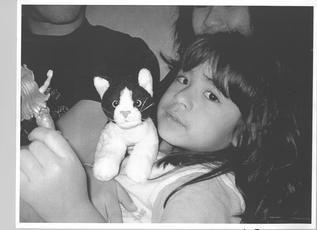


Editorial on Smith et al
November 29, 2007 permalink
Following the retirement of Gary Putman, the Orangeville press is more inclined to deal with the failures of child protection. The editorial below suggests reviewing 200 examinations of child deaths, not just by Dr Charles Smith, but by all pathologists connected to his team at what now appears to be Toronto's Sick Hospital for Children.
expand
collapse
Orangeville Citizen
Editorial, November 29, 2007
Why 'junk science' has no place in our courtrooms
LET'S HOPE the recommendation gets the attention it deserves from Justice Stephen Goudge, who is currently conducting a public inquiry into the role played by Dr. Charles Smith in securing criminal convictions based on his erroneous autopsy findings.
Although the Goudge commission's mandate deals with only about 20 cases where Dr. Smith's now-discredited testimony led to criminal charges against caregivers (usually parents) whose infants died mysteriously, two forensic pathology experts recommended last week that Ontario thoroughly re-examine up to 200 autopsies on dead children.
Under the proposal, the review would concentrate on convictions based on the findings of others than Dr. Smith, particularly by those on his team of pathologists at Toronto's Hospital for Sick Children who shared his "think dirty" philosophy, which saw criminal activity behind unexplained phenomena that had been labelled Sudden Infant Death Syndrome (SIDS).
Ironically, such a review would include another "Smith" case - the manslaughter conviction of Jeffrey Smith, a teen-aged father of twin girls, one of whom died mysteriously on March 22, 1994, just four months after the twins were born three months prematurely, and after both had been rush to hospital many times with a variety of ills, none of which suggested they had been abused.
In that case, the only reason Jeffrey Smith was charged, apart from the pathologists' testimony, was that he was the only one home at the time Katie Smith died. In the jury trial, where he faced a charge of second-degree murder, there wasn't a scintilla of evidence that he had ever become angry at the twins, much less struck them.
Based on what we now know, Katie's death was almost certainly from natural causes related to the prematurity of her birth. The fact that the jury rejected the Crown's bid for a murder conviction, finding only manslaughter, is surely small comfort to Mr. Smith, who now is still labelled a child killer in the eyes of the law.
(The jury verdict was upheld by the Ontario Court of Appeal which, in the interests of "finality," refused to order a new trial at which a British expert, unavailable to the defence during the 10-week trial, would explain her finding that the death was from natural causes.)
The call for review of the other autopsies came from Dr. John Butt, one of three renowned forensic pathologists who conducted a detailed review last year of 43 autopsies Dr. Smith performed between 1991 and 2004. It followed two weeks of revelations at the inquiry about substandard practices and a discredited "think dirty" philosophy that prevailed in the Office of the Chief Coroner during the 1990s, a philosophy which we think could be traced to the Sick Kids team.
Northern Ireland's top pathologist, Jack Crane, agreed that reviewing every criminally suspicious case may be essential to repair public confidence and ensure that no one has been wrongly convicted of killing a child.
"It might be quite an undertaking and require very considerable resources to do it," Dr. Crane said. "But if there are concerns ... to enhance confidence in pediatric pathology, it might be necessary."
James Lockyer, a lawyer for eight people who say they have been wrongly convicted of killing their children in cases involving Dr. Smith, has signalled that he will urge Justice Goudge to recommend a full autopsy review.
On the same day, Mr. Lockyer asked Dr. Butt, Dr. Crane, and a third reviewer, Dr. Christopher Milroy, why defence lawyers, prosecutors and Dr. Smith's fellow pathologists could not bring themselves to blow the whistle on his shortcomings or failed to notice them.
Dr. Butt said that doctors are notoriously unwilling to testify against their brethren. "I don't know how to overcome it," he said. "It is an issue of culture. It is an issue of intimidation. There is a certain revering of figures that starts in medical school."
He said pathologists are also accorded so much respect within the court system that they become comfortable testifying about medical matters that go far beyond their knowledge and training.
"The more the doctor is encouraged to answer questions that he may not know the answer to - and gets away with it - the more the cult of personality grows."
Nor is the problem of "experts" securing convictions based on "junk science" limited to pathologists or criminal courts in Ontario.
Last week, the CBS program 60 Minutes dealt with the fact that for years the Federal Bureau of Investigations (FBI) had been securing convictions based on a now-discredited theory that bullets used in murders could be traced to a single box.
The "bullet lead analysis" was used by the FBI for 40 years in thousands of cases, and some of the people it helped put in jail are likely innocent. One such is Lee Wayne Hunt, now 22 years into a life sentence for murder in North Carolina.
Mr. Hunt was convicted in 1986 of murdering two people based on the testimony of two questionable witnesses and what turned out to be erroneous ballistics testimony from the FBI lab. For years, the FBI believed that lead in bullets had unique chemical signatures, and that by breaking them down and analyzing them, it was possible to match bullets, not only to a single batch of ammunition coming out of a factory, but to a single box of bullets. And that is what the FBI did in the Hunt case.
"I think everybody in the courtroom assumed that this was valid evidence," Mr. Hunt's lawyer said. Clearly, such evidence has no place in any courtroom.
Source: Orangville Citizen
Messy Home
November 28, 2007 permalink
Did CAS take your kids because your home was messy? Here is the office of their former expert witness, Dr Charles Smith. When the mess was finally cleaned up, it revealed exculpatory evidence that led to the exoneration of William Mullins-Johnson after twelve years in jail.
Source: Blog by Harold Levy November 28, 2007
CAS Spy
November 26, 2007 permalink
This is not the first case of close-up spying we have heard, but the first that can be published.
expand
collapse

November 25
A little story of harassment
A little history. As my house arrest was coming to an end. I was not allowed out before 8 am.
I started to notice this fat little piglet jogging by at 7:45 AM every day with her dog.
She was jogging on a path that goes by my home. There is a green belt behind the house. No one is ever back there I can see everything from my window.
At 7:59 AM I was about to let my dog out and I saw that fat little bitch spying on my home from behind a tree. I looked at my watch. Bingo 8 AM I open the door and start chasing the fat piglet through the woods till we come to the home in the picture above. Scared her real good. The next day I'm parked down the street and follow the piglet to work. Guess where? The local Children's Aid Society of Ontario.
My point, always watch your back and its fun to chase a fat lesbian through the woods screaming like a nut.
I never saw that fat pig ever again.
Peter Tarbat, tarspot@msn.com
Source: personal MSN blog
Greg Pound Terminated
November 25, 2007 permalink
High-profile opponent of Florida DCF Greg Pound has had his parental rights terminated. The state of Florida has taken four of his children, his wife has fled with their infant son. Last year we covered the case, including a link to his website. There are many copies of his videos on the internet. Here are more videos by Greg Pound.
expand
collapse
tampabay.com
Father of five loses battle for parental rights
He says he plans to appeal the judge's order. His battle started in 2004.
By CURTIS KRUEGER, Times Staff Writer, Published November 24, 2007
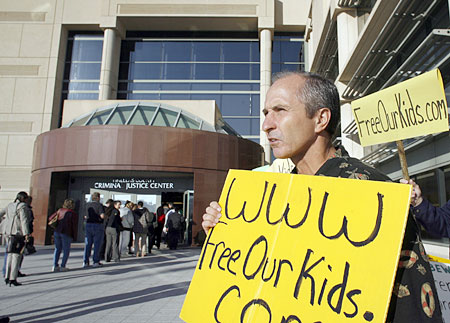
Gregory Pound has battled the foster care system for years, ever since a purported "wolf dog" bit his 2-week-old baby in 2004 and child welfare workers took away his children.
He fought back in court, and has become increasingly visible by founding a Web site (www.rescuemykids.com) and staging regular protests outside Pinellas County's criminal courthouse. He even demonstrated outside a St. Petersburg church because a judge in his case worships there.
Now he has lost in court.
This month a judge terminated his parental rights - meaning he no longer has a legal right to raise his five children, ages 2 to 7.
"They called me today and told me that I have no more visits with my children," Pound, 51, said recently.
His wife's parental rights were severed earlier in the battle, he said. Melissa Pound disappeared last year, along with the couple's youngest child.
Gregory Pound said he plans to appeal.
"Love never gets up," he said, adding: "Me and Melissa both love our children, despite what they say."
The Pounds' four oldest children live in Seminole with Melissa's parents, Linda and Stephen Steenberge.
The Steenberges said they assumed at first the Pounds would complete a list of tasks known as a "case plan" to get their children back. But now that the Pounds' parental rights have been taken away, they said they intend to adopt the children.
"It's a tragic situation in the sense that it could have pretty much been avoided," said Stephen Steenberge, 64.
Tampa Bay news media covered the dog bite case in 2004, widely reporting that the Pounds' 2-week-old baby was bitten in the face by a "wolf hybrid." The dog was destroyed.
Since then, Pound has said that the dog belonged to his sister, who denied it was a wolf hybrid.
Soon after the bite, child welfare authorities removed the Pounds' four children from their home. The exact reasons are not clear because the records are not public.
Pound said child welfare officials claimed Melissa was suffering from depression, but he denied that. Pound also said he was asked to take a domestic violence class as part of a case plan in order to get his children back.
The Pounds completed parts of their case plans, but also fought unsuccessfully in court to prove the children should never have been taken away.
When Melissa gave birth to their fifth child last year, they named him Moses, after another baby whose mother sent him on a journey. Shortly after his 2006 birth, Melissa and the infant disappeared.
Pound was jailed for contempt of court for a month last year for failing to reveal her whereabouts, although he insisted he did not know where to find her.
Now, factions of the family are cut off from each other. Greg and Melissa Pound do not have a legal right to visit their four oldest children, who are living with the Steenberges.
Linda Steenberge, meanwhile, said she has not heard from her daughter Melissa and has not laid eyes on her grandchild, Moses.
"That would make me happy, just a phone call from her," Linda Steenberge said.
On the Web site, Pound claims that foster care workers remove children from families for money.
But Pinellas County sheriff's Capt. George Steffen said child abuse investigators work hard to find alternatives to removing children from their homes. "It's the absolute last resort," Steffen said.
When children are removed, foster care workers try to help moms and dads complete their case plans and bring their children home, said April Putzulu, a spokeswoman for the local foster care agency called the Safe Children Coalition.
"We are totally invested in returning children home to safe environments," she said.
Source: St. Petersburg Times
Fran Lyon Flees Britain
November 24, 2007 permalink
Fran Lyon, the British expectant mother threatened with child removal at birth, has fled Britain after seeing the final plans by social services for her baby.
expand
collapse
24/11/07 - Femail section
I've fled the country to stop social workers taking my baby
By ELIZABETH SANDERSON
She is, on first impressions, just like any other first-time mother. The cot and the pram are on order, she has bought more cuddly toys than she will ever need and she has even given her little girl a name — Molly.
With less than six weeks to go before the birth, the baby is kicking and it brings Fran Lyon an undeniable thrill of pleasure. At least, it does now she finally feels safe to enjoy it.
For all the innocent joys of impending motherhood have been denied Fran since social workers warned her four months ago that Molly would be taken away ten minutes after birth and placed with foster parents.
Fran, a third-year student doing a neuro-science degree at Edinburgh University, is, to everyone who knows her, a sociable, kind and intelligent woman. But to her local authority she is a danger to herself and her baby.
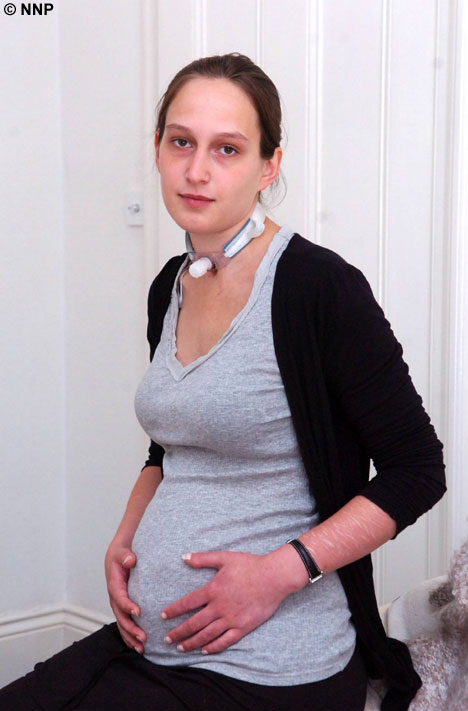 Pregnant Fran Lyon has run away to Europe to stop social workers taking her baby away from her
Seven years ago Fran had an eating and selfharming disorder and spent 13 months in a psychiatric hospital followed by nine successful months of counselling.
Now 22, and with her emotional troubles behind her, Fran is outraged that she should be judged a risk to herself and her child despite a fistful of medical reports that dispute this.
Last week, fearing the worst, Fran moved from her home in Hexham in Northumberland to Birmingham, where she hoped a different authority would treat her more sympathetically.
But with the birth so close, she felt she couldn't take any risks with bureaucracy and on Wednesday, Fran took an even more drastic step. She got on a flight bound for Europe — and went into hiding. Wary of revealing her whereabouts, Fran agreed to talk about her nightmare in a lengthy telephone call to The Mail on Sunday.
 Practical Fran has already had an appointment with a midwife, booked a place at the local hospital and made contact with English-speaking mother-and-baby groups
She will also be seen in an exclusive report tomorrow evening on Tonight With Trevor McDonald. She said: "I wouldn't have done it unless I absolutely had to. Every time there was a twinge, I was absolutely petrified. I just kept thinking, 'Please don't go into labour, please, not yet.' It was terrifying.
"It's a lot better now that I'm away. Lots of people suggested I should leave but I always thought it was too extreme. Then when I went to Birmingham things weren't going to happen quicklyenough. Northumberland's plan stood until Birmingham made their own and I didn't have vast amounts of time.
Now it's such a relief not to be constantly looking over my shoulder. It has been so fraught with other people's interventions. For the first time this will be just us: me and Molly. I just want to enjoy it. I could never do that before.
"For months I've been reading a book called Molly The Hungry Caterpillar and feeling her kicking about. It's lovely, but all the time the fear has been in the back of my mind that these might be the closest moments I will ever have with her."
Fran is in good health apart from suffering a rare condition, angiodoema. It is possible her throat might swell and she has been given tracheotomy equipment in case of an incident.
For such a young woman, Fran seems practical and level headed. In just a few days, she has organised a lease on an apartment, had an appointment with a midwife, booked a place at the local hospital and made contact with Englishspeaking mother-and-baby groups.
It is a considerable testimony to her ability to cope — given what social services had thrown at her. So why did Hexham Children's Services feel it necessary to take such draconian — some might say menacing — steps against a young woman who has battled to put her life in order?
As with almost all cases involving county council children's services, it is extremely difficult to discover why or how a decision has been reached. As a result, it is nigh on impossible for people to challenge what they see as a dubious outcome.
Fran's story began last April when she became pregnant. Although the baby was unexpected, she was delighted. She says: "I was shocked because I'd had the contraceptive injection. But I remember waking up the first morning after I knew and feeling secretly thrilled.
"I didn't have a clue how I was going to make it work with university and my job [for two mental health charities] but I was determined that I was having her."
The first problem began when she and Molly's father fell out. She had become unhappy about something he was doing and reported him to the police. She ended the relationship immediately and he is now the subject of an investigation by police — who alerted social services.
She told them her story — that she was brought up in Northampton in a middleclass household where her parents were teachers, and how at 14 she was raped by an acquaintance.
Traumatised, she became clinically depressed and spent the next three years, on and off, in residential psychiatric hospitals after being diagnosed with a borderline personality disorder characterised by self-harming instability and suicidal tendencies.
For the final 13 months, Fran had individual psychotherapy sessions and group analysis before being discharged into outpatient care. By the age of 18 she had fully recovered and the diagnosis of borderline personality disorder was removed. Despite it all, Fran earned nine A-grade GCSEs, four A-grade A-levels and her place at university.
When she became pregnant, Fran accepted that social services might take an interest in her and went out of her way to cooperate. "I was very up-front with the mental health staff," she said.
"I told them my history and gave them the names of my doctors as I assumed they would want to pursue it further. I thought I might need to see the health visitor a bit more often."
Instead, Fran received a letter informing her that a "child protection case conference" would be held on August 16. Social services contacted a number of experts. One of them, Dr Stella Newith, the psychiatrist who treated Fran as a teenager, had no doubts when called on to give her opinion about her former patient.
In a letter to Northumberland County Council, Dr Newith said: "I consider the risk of harm to a child to be so unlikely as to be negligible.
"There has never been any clinical evidence to suggest that Fran would put herself or others at risk, and certainly no evidence to suggest that she would put a child at risk."
It was a view backed up by Dr Rex Haigh, a psychiatrist who worked with Fran in the charity sector and acted as a character witness. He advised: "I have no doubt that her diligence and capacity, particularly in dealing with complex emotional situations, will stand her in good stead for the rigours of parenthood. Your efforts to protect children would be better directed elsewhere."
Yet the social workers decided, instead, to give more weight to the views of consultant paediatrician Dr Martin Ward Platt — even though he made it clear he had never met Fran.
In a letter, Dr Ward Platt said: "If the professionals were concerned from the evidence available that [this woman] probably does fabricate or induce illness, there would be no option but to put the baby into foster care at birth pending a post-natal forensic psychological assessment."
Fran says she was told by social services that she was in danger of suffering from Munchausen's by Proxy, a controversial and unproven condition in which a parent — usually the mother — invents an illness in her child to draw attention to herself.
Apart from Dr Ward Platt's letter, there has been no other evidence presented to Fran suggesting that she was at such risk. The syndrome was first identified by Sir Roy Meadow, the now-discredited doctor responsible for evidence that led to the wrongful convictions of Angela Canning and Sally Clark for murdering their children.
Dr Ward Platt also recommended that Fran be assessed by professionals. Social services drew up their "birth plan" without doing any of these assessments. In October, Fran was told the plan would mean that Molly would be immediately removed into care, minutes after she was born. Fran was also told she could not be trusted to breast-feed her, for fear that she might try to take strychnine as a way of poisoning her own child.
Fran says: "I was just horrified. It was horrific to sit in this room with these people and realise that they could not only conceive of such a bizarre, terrible thing, but think that I was actually capable of it.
"In some ways I think the whole thing was compounded by a lack of understanding. There is no evidence that Munchausen's by Proxy exists. I was being asked to prove that I wouldn't do something. But how can I do that? They were asking me to do the impossible."
Fran engaged the help of Bill Bache, the lawyer who overturned Angela Canning's conviction, and John Hemming, the Liberal Democrat MP and chairman of the pressure group Justice For Families. And yet all the time, she tried to find a compromise with the social workers.
She says: "I asked to go to a mother and baby unit so we would be under 24-hour supervision. I thought it would show I was willing to cooperate and there could be no argument about Molly's safety, but there was a lot of resistance to the idea."
In one last attempt to find a middleway through the nightmare, Fran agreed to yet another assessment. The assessor was to be appointed by the social workers but would be officially independent. They chose Professor Douglas Turkington, a psychiatrist based at the Royal Victoria Infirmary in Newcastle.
In his report, he said that Fran should not be separated from Molly but should instead be "supervised during the immediate postnatal period in her bonding with Molly and be allowed to breast feed".
It is the breakthrough Fran has been hoping for — but she says she can't risk waiting to see if social services view it in the same light. On November 9, the birth plan from Northumberland Social Services arrived in the post. Fran was expecting it but nothing could have prepared her for its conclusions.
"I just fell apart," she says. "It's only when you see it in writing that it becomes real. It said I would get ten minutes with Molly until the umbilical cord had been cut."
Fran and her baby would then be parted and the baby would be taken to another room in the hospital. Fran feared that the conditions of the birth plan would mean that even her mother, who she said she was very close to, would not be able to see the child.
She added: "They said if I didn't consent they would get a police protection order as soon as she was born. This effectively meant that there would be a policeman stood outside the delivery suite.
"She would be only a few minutes old and by herself. That was the one thing that tore me up inside . . . the thought of Molly lying in some horrible hospital baby cot with no one that loves her.
"I'm not an impulsive or dramatic person. I want to sit down and work things out. But this was agonising. I knew I had to do something."
She didn't know, then, that something would mean fleeing abroad. Despite the drastic upset, Fran is not bitter. "I suppose I feel very disappointed. It didn't seem possible for anyone to backtrack just a little bit, to say there was another way. That's what I found so hard. That and the fact there was no compassion. They said it was about Molly but it certainly never felt like that."
But perhaps most worrying of all is the fact that Fran's case, while undoubtedly extreme, is also indicative of a disturbing trend. Two thousand babies less than a year old were taken from their parents last year by social services — three times the number of ten years ago.
Fran's story already has echoes of Nicky and Mark Webster, formerly known as the Hardinghams, whose case was highlighted in this newspaper. They, too, fled the country in order to stop social services taking away their newborn baby, a boy called Brandon, after their first three children were adopted over abuse allegations.
The Websters have since returned to England and have won a landmark case to keep their fourth child. And what does the future hold for Fran Lyon, a young mother who was dealt a rough hand as a teenager and fought to get a normal life and now just wants to do what's best for her daughter?
Perhaps social workers know something Fran is not revealing. Last night a spokeswoman for Northumberland County Council said: "We are unable to comment on individual cases, and we do not believe that it is in the best interests of any mother or child to discuss personal details through the media, but unfortunately it does mean only one side is being heard.
"Safeguarding arrangements in Northumberland were rated as good in a recent rigorous Government inspection. Ms Lyon and her legal adviser have attended all of her case conferences and have been fully informed of the concerns of the professionals involved in her case.
"Where a child or unborn baby is subject to a child-protection plan and they move to reside in another authority or country, responsibility would normally pass to the new authority or relevant authority in another country. Northumberland County Council would make sure the new authority has all the relevant information it needs to make informed decisions."
Mr Hemming said: "I think it's appalling and very disturbing and, sadly, Fran's case is not unique.
"Of course there are situations where you've got to intervene but the system all too often fails to intervene where it should and then intervenes where it shouldn't. It's a steamroller of a system and it steamrollers mothers and children."
Only one thing remains certain. If Fran proves herself to be a good and loving mother, Northumberland's carefully worked-out "birth plan" can only ever be seen as an act of almost unimaginable cruelty by the State.
Fran's story is told on Tonight With Trevor McDonald, tomorrow at 8pm on ITV1.
Source: Daily Mail (UK)
Georgia Senator Takes On Child Protectors
November 24, 2007 permalink
Nancy Schaefer was elected to the Georgia senate in 2004 representing district 50 in the northeast corner of the state. Today the homepage of her website consists of a document criticizing Georgia DFCS, Department of Family and Children's Services. It reads like a document prepared by a critical website, such as this one. It includes all of the common abuses: children taken on grounds of poverty, parents harassed with endless classes, fraud by caseworkers, shotgun divorce and failure to remove children from truly dangerous situations.
expand
collapse
From the legislative desk of Senator Nancy Schaefer 50th District of Georgia
November 16, 2007
THE CORRUPT BUSINESS OF CHILD PROTECTIVE SERVICES
- BY:
- Nancy Schaefer Senator, 50th District
My introduction into child protective service cases was due to a grandmother in an adjoining state who called me with her tragic story. Her two granddaughters had been taken from her daughter who lived in my district. Her daughter was told wrongly that if she wanted to see her children again she should sign a paper and give up her children. Frightened and young, the daughter did. I have since discovered that parents are often threatened into cooperation of permanent separation of their children.
The children were taken to another county and placed in foster care. The foster parents were told wrongly that they could adopt the children. The grandmother then jumped through every hoop known to man in order to get her granddaughters. When the case finally came to court it was made evident by one of the foster parent’s children that the foster parents had, at any given time, 18 foster children and that the foster mother had an inappropriate relationship with the caseworker.
In the courtroom, the juvenile judge, acted as though she was shocked and said the two girls would be removed quickly. They were not removed. Finally, after much pressure being applied to the Department of Family and Children Services of Georgia (DFCS), the children were driven to South Georgia to meet their grandmother who gladly drove to meet them.
After being with their grandmother two or three days, the judge, quite out of the blue, wrote up a new order to send the girls to their father, who previously had no interest in the case and who lived on the West Coast. The father was in “adult entertainment”. His girlfriend worked as an “escort” and his brother, who also worked in the business, had a sexual charge brought against him.
Within a couple of days the father was knocking on the grandmother’s door and took the girls kicking and screaming to California.
The father developed an unusual relationship with the former foster parents and soon moved back to the southeast, and the foster parents began driving to the father’s residence and picking up the little girls for visits. The oldest child had told her mother and grandmother on two different occasions that the foster father molested her.
To this day after five years, this loving, caring blood relative grandmother does not even have visitation privileges with the children. The little girls are in my opinion permanently traumatized and the young mother of the girls was so traumatized with shock when the girls were first removed from her that she has not recovered.
Throughout this case and through the process of dealing with multiple other mismanaged cases of the Department of Family and Children Services (DFCS), I have worked with other desperate parents and children across the state because they have no rights and no one with whom to turn. I have witnessed ruthless behavior from many caseworkers, social workers, investigators, lawyers, judges, therapists, and others such as those who “pick up” the children. I have been stunned by what I have seen and heard from victims all over the state of Georgia.
In this report, I am focusing on the Georgia Department of Family and Children Services (DFCS). However, I believe Child Protective Services nationwide has become corrupt and that the entire system is broken almost beyond repair. I am convinced parents and families should be warned of the dangers.
The Department of Child Protective Services, known as the Department of Family and Children Service (DFCS) in Georgia and other titles in other states, has become a “protected empire” built on taking children and separating families. This is not to say that there are not those children who do need to be removed from wretched situations and need protection. This report is concerned with the children and parents caught up in “legal kidnapping,” ineffective policies, and DFCS who do does not remove a child or children when a child is enduring torment and abuse. (See Exhibit A and Exhibit B)
In one county in my District, I arranged a meeting for thirty-seven families to speak freely and without fear. These poor parents and grandparents spoke of their painful, heart wrenching encounters with DFCS. Their suffering was overwhelming. They wept and cried. Some did not know where their children were and had not seen them in years. I had witnessed the “Gestapo” at work and I witnessed the deceitful conditions under which children were taken in the middle of the night, out of hospitals, off of school buses, and out of homes. In one county a private drug testing business was operating within the DFCS department that required many, many drug tests from parents and individuals for profit. In another county children were not removed when they were enduring the worst possible abuse.
Due to being exposed, several employees in a particular DFCS office were fired. However, they have now been rehired either in neighboring counties or in the same county again. According to the calls I am now receiving, the conditions in that county are returning to the same practices that they had before the light was shown on their deeds.
Having worked with probably 300 cases statewide, I am convinced there is no responsibility and no accountability in the system.
I have come to the conclusion:
- that poor parents often times are targeted to lose their children because they do not have the where-with-all to hire lawyers and fight the system. Being poor does not mean you are not a good parent or that you do not love your child, or that your child should be removed and placed with strangers;
- that all parents are capable of making mistakes and that making a mistake does not mean your children are always to be removed from the home. Even if the home is not perfect, it is home; and that’s where a child is the safest and where he or she wants to be, with family;
- that parenting classes, anger management classes, counseling referrals, therapy classes and on and on are demanded of parents with no compassion by the system even while they are at work and while their children are separated from them. This can take months or even years and it emotionally devastates both children and parents. Parents are victimized by “the system” that makes a profit for holding children longer and “bonuses” for not returning children;
- that caseworkers and social workers are oftentimes guilty of fraud. They withhold evidence. They fabricate evidence and they seek to terminate parental rights. However, when charges are made against them, the charges are ignored;
- that the separation of families is growing as a business because local governments have grown accustomed to having taxpayer dollars to balance their ever-expanding budgets;
- that Child Protective Service and Juvenile Court can always hide behind a confidentiality clause in order to protect their decisions and keep the funds flowing. There should be open records and “court watches”! Look who is being paid! There are state employees, lawyers, court investigators, court personnel, and judges. There are psychologists, and psychiatrists, counselors, caseworkers, therapists, foster parents, adoptive parents, and on and on. All are looking to the children in state custody to provide job security. Parents do not realize that social workers are the glue that holds “the system” together that funds the court, the child’s attorney, and the multiple other jobs including DFCS’s attorney.
- that The Adoption and the Safe Families Act, set in motion by President Bill Clinton, offered cash “bonuses” to the states for every child they adopted out of foster care. In order to receive the “adoption incentive bonuses” local child protective services need more children. They must have merchandise (children) that sell and you must have plenty of them so the buyer can choose. Some counties are known to give a $4,000 bonus for each child adopted and an additional $2,000 for a “special needs” child. Employees work to keep the federal dollars flowing;
- that there is double dipping. The funding continues as long as the child is out of the home. When a child in foster care is placed with a new family then “adoption bonus funds” are available. When a child is placed in a mental health facility and is on 16 drugs per day, like two children of a constituent of mine, more funds are involved;
- that there are no financial resources and no real drive to unite a family and help keep them together;
- that the incentive for social workers to return children to their parents quickly after taking them has disappeared and who in protective services will step up to the plate and say, “This must end! No one, because they are all in the system together and a system with no leader and no clear policies will always fail the children. Look at the waste in government that is forced upon the tax payer;
- that the “Policy Manuel” is considered “the last word” for DFCS. However, it is too long, too confusing, poorly written and does not take the law into consideration;
- that if the lives of children were improved by removing them from their homes, there might be a greater need for protective services, but today all children are not always safer. Children, of whom I am aware, have been raped and impregnated in foster care and the head of a Foster Parents Association in my District was recently arrested because of child molestation;
- that some parents are even told if they want to see their children or grandchildren, they must divorce their spouse. Many, who are under privileged, feeling they have no option, will divorce and then just continue to live together. This is an anti-family policy, but parents will do anything to get their children home with them.
- fathers, (non-custodial parents) I must add, are oftentimes treated as criminals without access to their own children and have child support payments strangling the very life out of them;
- that the Foster Parents Bill of Rights does not bring out that a foster parent is there only to care for a child until the child can be returned home. Many Foster Parents today use the Foster Parent Bill of Rights to hire a lawyer and seek to adopt the child from the real parents, who are desperately trying to get their child home and out of the system;
- that tax dollars are being used to keep this gigantic system afloat, yet the victims, parents, grandparents, guardians and especially the children, are charged for the system’s services.
- that grandparents have called from all over the State of Georgia trying to get custody of their grandchildren. DFCS claims relatives are contacted, but there are cases that prove differently. Grandparents who lose their grandchildren to strangers have lost their own flesh and blood. The children lose their family heritage and grandparents, and parents too, lose all connections to their heirs.
- that The National Center on Child Abuse and Neglect in 1998 reported that six times as many children died in foster care than in the general public and that once removed to official “safety”, these children are far more likely to suffer abuse, including sexual molestation than in the general population.
- That according to the California Little Hoover Commission Report in 2003, 30% to 70% of the children in California group homes do not belong there and should not have been removed from their homes.
Please continue:
(See Final Remarks below)FINAL REMARKS
On my desk are scores of cases of exhausted families and troubled children. It has been beyond me to turn my back on these suffering, crying, and sometimes beaten down individuals. We are mistreating the most innocent. Child Protective Services have become adult centered to the detriment of children. No longer is judgment based on what the child needs or who the child wants to be with or what is really best for the whole family; it is some adult or bureaucrat who makes the decisions, based often on just hearsay, without ever consulting a family member, or just what is convenient, profitable, or less troublesome for a director of DFCS.
Children deserve better. Families deserve better. It’s time to pull back the curtain and set our children and families free.
“Speak up for those who cannot speak for themselves, for the rights of all who are destitute. Speak up and judge fairly; defend the rights of the poor and the needy” Proverbs 31:8-9
Please continue to read:
Recommendations
Exhibit A
Exhibit BRECOMMENDATIONS
- Call for an independent audit of the Department of Family and Children’s Services (DFCS) to expose corruption and fraud.
- Activate immediate change. Every day that passes means more families and children are subject to being held hostage.
- End the financial incentives that separate families.
- Grant to parents their rights in writing.
- Mandate a search for family members to be given the opportunity to adopt their own relatives.
- Mandate a jury trial where every piece of evidence is presented before removing a child from his or her parents.
- Require a warrant or a positive emergency circumstance before removing children from their parents. (Judge Arthur G. Christean, Utah Bar Journal, January, 1997 reported that “except in emergency circumstances, including the need for immediate medical care, require warrants upon affidavits of probable cause before entry upon private property is permitted for the forcible removal of children from their parents.”)
- Uphold the laws when someone fabricates or presents false evidence. If a parent alleges fraud, hold a hearing with the right to discovery of all evidence.
Continue to Exhibit A
EXHIBIT A
December 5, 2006
Jeremy’s Story
( Some names withheld due to future hearings)
As told to Senator Nancy Schaefer by Sandra (XXXX), a foster parent of Jeremy for 2 ½ years.
My husband and I received Jeremy when he was 2 weeks old and we have been the only parents he has really ever known. He lived with us for 27 months. (XXXX) is the grandfather of Jeremy, and he is known for molesting his own children, for molesting Jeremy and has been court ordered not to be around Jeremy. (XXXX) is the mother of Jeremy, who has been diagnosed to be mentally ill, and also is known to have molested Jeremy. (XXXX) and Jeremy’s uncle is a registered sex offender and (XXXX) is the biological father, who is a drug addict and alcoholic and who continues to be in and out of jail. Having just described Jeremy’s world, all of these adults are not to be any part of Jeremy’s life, yet for years DFCS has known that they are. DFCS had to test (XXXX) (the grandfather) and his son (XXXX) (the uncle) and (XXXX) to determine the real father. (XXXX) is the biological father although any of them might have been. In court, it appeared from the case study, that everyone involved knew that this little boy had been molested by family members, even by his own mother, (XXXX). In court, (XXX), the mother of Jeremy, admitted to having had sex with (XXXX) (the grandfather) and (XXXX) (her own brother) that morning. Judge (XXXX) and DFCS gave Jeremy to his grandmother that same day. (XXXX), the grandmother, is over 300 lbs., is unable to drive, and is unable to take care of Jeremy due to physical problems. She also has been in a mental hospital several times due to her behavior.
Even though it was ordered by the court that the grandfather (XXXX), the uncle (XXXX) (a convicted sex offender), (XXXX) his mother who molested him and (XXXX) his biological father, a convicted drug addict, were not to have anything to do with the child, they all continue to come and go as they please at (XXXX address), where Jeremy has been “sentenced to live” for years. This residence has no bathroom and little heat. The front door and the windows are boarded. (See pictures) This home should have been condemned years ago. I have been in this home. No child should ever have to live like this or with such people.
Jeremy was taken from us at age 2 ½ years after (XXXX) obtained attorney (XXXX), who was the same attorney who represented him in a large settlement from an auto accident. I am told, that attorney (XXXX), as grandfather’s attorney, is known to have repeatedly gotten (XXXX) off of several criminal charges in White County. This is a matter of record and is
known by many in White County. I have copies of some records. (XXXX grandfather), through (XXXX attorney’s) work, got (XXXX), the grandmother of Jeremy, legal custody of Jeremy. (XXXX grandfather) who cannot read or write also got his daughter (XXXX) and son (XXXX) diagnosed by government agencies as mentally ill. (XXXX grandfather), through legal channels, has taken upon himself all control of the family and is able to take possession of any government funding coming to these people.
It was during this time that Jeremy was to have a six-month transitional period between (XXXX grandmother) and my family as we were to give him up. The court ordered agreement was to have been 4 days at our house and 3 days at (XXXX grandmother). DFCS stopped the visits within 2 weeks. The reason given by DFCS was the child was too traumatized going back and forth. In truth, Jeremy begged us and screamed never to be taken back to (XXXX his grandmother) house, which we have on video. We, as a family, have seen Jeremy in stores time to time with (XXXX grandmother) and the very people he is not to be around. At each meeting Jeremy continues to run to us wherever he sees us and it is clear he is suffering. This child is in a desperate situation and this is why I am writing, and begging you Senator Schaefer, to do something in this child’s behalf. Jeremy can clearly describe in detail his sexual molestation by every member of this family and this sexual abuse continues to this day.
When Jeremy was 5 years of age I took him to Dr. (XXXX) of Habersham County who did indeed agree that Jeremy’s rectum was black and blue and the physical damage to the child was clearly a case of sexual molestation .
Early in Jeremy’s life, when he was in such bad physical condition, we took him to Egleston Children Hospital where at two months of age therapy was to begin three times a week. DFCS decided that the (XXXX grandparent family) should participate in his therapy. However, the therapist complained over and over that the (XXXX grandparent family) would not even wash their hands and would cause Jeremy to cry during these sessions. (XXXX the grandmother), after receiving custody no longer allowed the therapy because it was an inconvenience. The therapist reported that this would be a terrible thing to do to this child. Therapy was stopped and it was detrimental to the health of Jeremy.
During (XXXX grandmother) custody, (XXXX uncle) has shot Jeremy with a BB gun and there is a report at (XXXX) County Sheriff’s office. There are several amber alerts at Cornelia Wal-Mart, Commerce Wal-Mart, and a 911 report from (XXXX) County Sheriff’s Department when Jeremy was lost. (XXXX grandmother), to teach Jeremy a lesson, took thorn bush limbs and beat the bottoms of his feet. Jeremy’s feet got infected and his feet had to be lanced by Dr. (XXXX). Then Judy called me to pick him up after about 4 days to take back him to the doctor because of intense pain. I took Jeremy to Dr. (XXXX) in Gainesville. Dr. (XXXX) said surgery was needed immediately and a cast was added. After returning home, (XXXX), his grandfather and (XXXX), his uncle, took him into the hog lot and allowed him to walk in the filth.
Jeremy’s feet became so infected for a 2nd time that he was again taken back to Dr. (XXXX) and the hospital. No one in the hospital could believe this child’s living conditions.
Jeremy is threatened to keep quiet and not say anything to anyone. I have videos, reports, arrest records and almost anything you might need to help Jeremy.
Please call my husband, Wendell, or me at any time.
Sandra and (XXXX) husband (XXXX)
Continue - Exhibit B
EXHIBIT B
Failure of DFCS
to remove six desperate children
A brief report regarding six children that Habersham County DFCS director failed to remove as disclosed to Senator Nancy Schaefer by Sheriff Deray Fincher of Habersham County.
Sheriff Deray Fincher, Chief of Police Don Ford and Chief Investigator Lt. Greg Bowen Chief called me to meet with them immediately, which I did on Tuesday, October 16, 2007
Sheriff Fincher, after contacting the Director of Habersham County DFCS several times to remove six children from being horribly abused, finally had to get a court order to remove the children himself with the help of two police officers.
The children, four boys and two girls, were not just being abused; they were being tortured by a monster father.
The six children and a live in girl friend were terrified of this man, the abuser. The children never slept in a bed, but always on the floor. The place where they lived was unfit for human habitation.
The father on one occasion hit one of the boys across his head with a bat and cut the boy’s head open. The father then proceeded to hold the boy down and sew up the child’s head with a needle and red thread. However, even with beatings and burnings, this is only a fraction of what the father did to these children and to the live-in girlfriend.
Sheriff Fincher has pictures of the abuse and condition of one of the boys and at the writing of this report, he has the father in jail in Habersham County.
It should be noted that when the DFCS director found out that Sheriff Fincher was going to remove the children, she called the father and warned him to flee.
This is not the only time this DFCS director failed to remove a child when she needed to do so. (See Exhibit A)
The egregious acts and abhorrent behavior of officials who are supposed to protect children can no longer be tolerated.
Senator Nancy Schaefer
50th District of GeorgiaSenator Nancy Schaefer
302 B Coverdell Office Building
18 Capitol Square, SW
Atlanta, Georgia 30334
Phone: 404-463-1367
Fax: 404-657-3217Senator Nancy Schaefer
District Office
P O Box 294
Turnerville, Georgia 30580
Phone: 706-754-1998
Fax: 706-754-1803email: senatornancyschaefer@alltel.net
Please forward to anyone interestedSource: Senator Nancy Schaefer
Bereaved Mother Torches Home
November 23, 2007 permalink
Shirley Hart lost her children to CPS in North Carolina, then set fire to her home. Police sent her to a psychiatrist. Instead of her children, she will get a few bottles of pills.
expand
collapse
Woman Arrested In Morning Apartment Fire
Thursday, Nov 22, 2007 - 06:00 PM Updated: 08:00 PM
 Photo By: NBC17
By Carolyn Costello, NBC17 Weekend Anchor, Reporter, WNCN-TV
RALEIGH, N.C. -- Police said a woman in Raleigh set her duplex on fire Thursday morning to retaliate against child protective services for taking her children.
Just after 7:30 this morning fire broke out at an apartment complex on Baker's Grove Way. Police took Shirley Heart into custody and said she is getting psychiatric help.
The fire damaged her neighbor's adjoining duplex as well leaving that woman without a home on Thanksgiving Day.
Tammie Goodson woke up this Thanksgiving morning to a roaring fire. Police said her neighbor, Shirley Heart, torched her own duplex, destroying it and damaging Goodson's.
"Everybody in there was asleep. If the neighbors across the street had not banged on that door and let us know we'd have burned up in there," Goodson said.
Goodson said she had complained about Heart before. She called Child Protective Services who then came and took Heart's children.
Neighbors told police heart had threatened to burn down her home and other homes in the area if authorities took her kids. Police said it appears that's just what she did.
Police took Heart into custody Thursday morning and no charges have been filed.
"She's being evaluated at this point in a medical facility. Charges will depend on the outcome of the medical evaluation and in consulting with the DA's office," said Captain Mike Reynolds of the Raleigh Police Department.
Goodson said her neighbor hasn't been right lately. She said Heart has been up in the middle of the night, waking her kids by yelling and praying.
"She had them up at 3:00 in the morning just praising the Lord," Goodson said.
"Between the landlord and me calling the police no one seemed to listen to me and do anything. What are we left to do now?" Good said.
Source: WNCN - NBC17
Ottawa CAS Back to Court
November 23, 2007 permalink
John Dunn and the Ottawa CAS will be back to court on January 24 in his effort to get the CAS criminally charged for failure to supply a membership list. The press release follows. In an earlier posting we incorrectly said that the case was over, based on the letter from John Dunn to crown prosecutor Yvonne Goebel.
expand
collapse
NEWS RELEASE
John Dunn
Executive Director
The Foster Care Council of Canada
613-228-2178
johndunn@afterfostercare.ca
12-1160 Meadowlands Drive East
Ottawa, ON K2E 6J2
http://www.afterfostercare.caFOR IMMEDIATE RELEASE
Former foster child and child welfare reform advocate John Dunn has laid charges against the Children's Aid Society of Ottawa. Dunn, in his efforts advocate for children and youth in foster care to become voting members of the Society in accordance with Article 12 of the United Nations Convention on the Rights of the Child has had his efforts blocked by the Society who is now in court over the matter.
According to Dunn, the Society is required by section 307 (1) of the Corporations Act, to furnish a list of the members of the Society to any person who requests it in accordance with the legislation so that they can advocate for changes related to the Society through the members. If the Society refuses to furnish the list of its members when required to do so, Dunn says that section 307 (5) of the Act makes it a Offence and that this is where the charge originated.
On the heels of the Ontario Auditor General's Report which focused on inappropriate spending of Tax Payers money within Children's Aid Societies, the Children's Aid Society of Ottawa, within a week of receiving the request for a list of their members retained the services of an outside lawyer, Robert C. Morrow of Burke-Robertson, to assist them in refusing the furnish the list as required by law.
Dunn and the Society will appear again in court to set a trial date on January 24, 2008.
--30--
Source: email from John Dunn
November 22, 2007
Today I went into court expecting to hear a plead from the Society. However, in the back of my mind, I knew something was probably going to surface. What did happen however surprised me. An expectation I had several months ago began to transpire.
I arrived at the court and was contacted by the Provincial Prosecutor at the Court house who informed me that Counsel for the defendants (their Exec. Dir) was concerned that I had not filed the information (the charge) within the legal six months from the time the Offence was committed.
I was, at first taken-aback but soon realized that I had already covered this issue from the beginning by ensuring that the charge was laid within legal limit of six months from the date the actual Offence was committed.
The request was filed with the Society on February 05, 2007. They had ten days to comply with the request before they would be in a position of having committed the Offence of contravening section 307 (5) of the Corporations Act. (Failing to provide the list of members of the Society as required by section 307 (1))
This means that they had to provide the list any time up to and including Thursday, February 15th, 2007 or, in other words prior to Friday, February 16th, 2007 in order to prevent themselves from committing the Offence.
Instead they intentionally retained a lawyer in order to assist them in committing the Offence by having Counsel write a letter to me dated February 14th, 2007 stating that they will not provide the list to me. (therefore demonstrating that they were going to commit the Offence). This letter was written just two days short of the date the Offence would officially have been deemed to have been committed. (Feb. 16th, 2007)
In this letter, three assumptions were made as "reasons" for not furnishing the list to me stating that I was not going to use the list for legal purposes and that they could not provide the list to me due to provisions of the Federal Privacy legislation (PIPEDA) which actually does only applies to commercial businesses or undertakings not exclusively legislated, non-profit organizations -- which is what the Society is.
I have since obtained a letter from the Federal Privacy Commission stating that the Act does not apply to the Society.
So anyhow, this is a strict liability Offence which only affords them the defences of Due Diligence and Mistake of Fact. Neither of which apply in this case. Therefore there is a reasonable prospect of conviction and a public interest in this prosecution since the lives of children in foster care in Ontario are affected by decisions made by the Society and they are blocking the membership from being informed of important issues of interest to the members which will only be brought to their attention via concerned members of the community who have attempted to become a member but who have had their membership applications denied by the Board due to what can only be assumed to be political reasons.
Source: letter from John Dunn to crown prosecutor Yvonne Goebel
Assault on CAS Worker (maybe)
November 23, 2007 permalink
In the following story the perpetrator and victim are both unnamed, so we cannot tell whether it is a fake planted by children's aid to draw sympathy or the story of a mother acting on the animal instinct to guard her children from harm through force if necessary.
expand
collapse
Everyone a little more aware at Children's Aid Society
Date: 2007-11-23, By Lauren Gilchrist
They get threats. There are assaults.
Hugh Nicholson, executive director of the Kawartha Haliburton Children's Aid Society (CAS), says at times the organization's work is dangerous.
That is no more evident than following a recent assault on a CAS worker.
A 34-year-old woman, armed with a pair of barber scissors, is charged after allegedly grabbing a Children's Aid Society worker by the hair.
According to City police, on Wednesday (Nov. 21) at approximately 12:15 p.m. the accused went to the Children's Aid Society offices on Chemong Road. When there, she asked to speak to a worker concerning her child's child care issues. She asked to speak to the victim, a Children's Aid Society worker. The victim, a 42-year-old female, was paged to come to the lobby. When the victim asked the accused how she could help her, the accused allegedly grabbed the victim by the hair with her left hand while armed with a pair of barber scissors in her right hand. While the victim struggled to get free, the accused allegedly grabbed the victim's right arm and left index finger. Several staff members came to the aid of the victim and were able to wrestle the scissors away from the accused and separate the two women.
A day after the incident, Mr. Nicholson says the staff are still on edge.
“A little nervous and concerned about the person that was assaulted. She is home today [Thursday] taking a bit of a break before she comes back in,” he says.
“It makes everyone here more aware of the dangers involved in child protection. It just reminds us all we need to be very careful about it.”
Mr. Nicholson says a staff member was seriously assaulted roughly a year ago.
“It was an assault on one of our staff who came out to supervise a visit between a mother and her child,” he explains.
Mr. Nicholson says every time an incident like this happens they learn something.
“We have pretty good security measures and they worked well in this instance,” he says, referring to Wednesday's alleged assault.
He notes one measure is the panic buttons located in areas where clients are in contact with staff.
“The area itself is pretty secure,” he explains, noting there is also a protocol in place once the panic button is pressed.
“Although this incident was unfortunate, it was terminated very quickly. But there are improvements I think we can make to it.”
He says there is an emergency health and safety meeting scheduled for Monday (Nov. 26) where staff can put forward suggestions.
The accused was arrested and charge with possession of a weapon for a dangerous purpose and assault with a weapon. The victim was treated at the hospital for her injuries. The name of the accused will not be released in order to protect her child's identity.
Source: mykawartha.com, Metroland Media Group
Falsely Convicted Mother
November 22, 2007 permalink
Harold Levy has been closely following the Gouge Inquiry into pathologist Dr Charles Smith. Here is his report on the case of Sherry Sherret.
expand
collapse
Tuesday, November 20, 2007
Goudge Inquiry: Joshua's Case: Part Three; Aftermath Of A Flawed Opinion;
"SOME CASES COME BACK TO HAUNT YOU AND THIS IS ONE OF THEM"
- LAWYER BRUCE HILLIER.On January 4, 1999, something happened that should never happen in Canada's criminal justice system.
Sherry Sherret pleaded guilty to a crime she did not commit.
Dr. Charles Smith's opinion was at the heart of the Agreed Statement of Facts read into the court record;
The Agreed Statement reads:
"Dr. Charles Smith performed an autopsy on the baby at the Toronto Hospital for Sick Children.
He determined the cause of death to be asphyxia.
He ruled out mould or disease as a cause of death.
Pinpoint hemorrhages in the tissue of the eyelids, sometimes present in non-accidental asphyxia were not found in the case.
Dr. Smith was highly suspicion that the death as non-accidental, but there were no overt signs of violence upon which to make a conclusive finding."
"A microscopic skull fracture was discovered months after the original post mortem," the Agreed Statement of Facts continued.
"It was not initially visible to the pathologist."
Dr. Smith testified at the preliminary hearing that this skull fracture could have been caused on either an accidental or non-accidental basis and was not the cause of death.'
One can only imagine what Sherret felt when she heard Justice Byers utter the fallowing words before sentencing her to one year in jail followed by two years probation.
"To this day, I do not understand why she did it," he began.
"There is no doubt that looking after Joshua was very stressful for her; and it would seem that there were warning signs that were there to be seen
But at the end of the day only she knows what she did, and shy she did it.
And she is not telling." denies her guilt and shows no remorse," Byers continued.
"Her support system in the community - her family, her friends - reinforce that position.
Joshua did not die because his mother was suffering from some sort of post-partem depression.
His death, perhaps, is connected the fact that Sherry suffers from what the doctors have called a mixed personality disorder.
Or perhaps not.
No doubt, though, her attitude towards this tragedy is connected to that diagnosis."
We are now aware that Dr. Smith's opinion was terribly flawed.
There was no ashphyxia.
There was no skull fracture.
There was just an innocent grieving mother who had lost her son due to a natural but unexplained death; (One possibility is that Joshua accidentally suffocated during his sleep.)
I sometimes wonder how judges feel on learning that they have passed sentence on an innocent person - and the words they have said on passing sentence are seen in a different light.
In fairness, the judge usually has no information on the case except that which is provided by the parties at the particular time.
The one year prison term - sentencing was left in the hands of the judge - was not the only punishment meted on Ms. Sherret in the aftermath of Dr. Charles Randal Smith's flawed opinion.
Byers also placed her on probation for two years, saying:
"You are not to be in a parental position towards infant children; and,
"If you get pregnant, you must immediately report that to a probation officer."
We learn from an Overview Report on the case prepared by Commission staff that Sherret had a third child in September, 2005 - and that on the basis of her conviction for infanticide the local Children's Aid Society applied for an order removing her from the family home in order to prevent her from living with her new child.
The Report includes a letter "To whom it may concern" drafted by Bruce Hillier, Sherret's lawyer, to assist her with the family court proceedings;
"Faced with the prospect of a conviction and all that flows from that, I vigorously represented Ms. Sherret and at the 11th hour, the Crown's office, no doubt for good reasons, elected to resolve the matter by way of a plea for the rarely used charge of infanticide, the basis at the time, Sherry was suffering from post-partem depression," Hillier wrote;
"The compromise between the Crown and the defence was seen as a way out for both sides - the Crown fearing they couldn't get a conviction of any kind and the defence fearing that a conviction for murder, while not justified, would result in a lengthy period of incarceration."
Sherret then turned to the Association In Defence of the Wrongly Accused for assistance.
Lawyer James Lockyer wrote former Chief Coroner Dr. Barry McLellan, that a review by his office of Joshua's death "acquires huge importance" because Sherret, having lost one child to adoption, now faced loss of her daughter.
"Ms. Sherret has two other children," Lockyer wrote.
"Her first born...was taken away from her at the age of eighteen months after her arrest in March 1996 for Josh's murder.
(He) was subsequently put up for adoption, and now lives with his adoptive parents in Cobourg;
Ms. Sherret has written contact with him every year at Christmas and his birthday,
(He) is now 12 years old.
Her third born...is now five-months old.
Ms. Sherret, (the child's father) and (the child) herself live together at their home in Belleville.
By Court order, Ms. Sherret has not been allowed to be alone at any time with her daughter since her birth;"
Lockyer stressed that a review was imperative because, "if Joshua died of natural causes, as AIDWYC believes he likely did, (and the Chief Coroner's review confirmed: HL) Ms. Sherret may be about to become the victim of a third miscarriage of justice."
"(Her daughter) will become one too."
Finally, on April 5, 2007, the Children's Aid Society applied in Court for an order terminating the existing supervision order.
A child protection worked candidly noted in an affidavit filed with the Court that, "Following the completion of the parenting Capacity Assessment, it was noted that (Sherry's) denial of any wrongdoing was concerning and further, made it impossible to treat her."
"However, it is now believed that (Sherry) may not have done anything wrong.
AIDWYC is now pursuing quashing of the infanticide conviction and an acquittal for Ms. Sherret in the Ontario Court of Appeal;
Lawyer Hillier cogently summed up this case in his letter "to whom it may concern" referred to above.
"Some cases come back to haunt you and this is one of them," he said.
Harold Levy
Posted by harold levy at 2:45 PM
Source: Harold Levy's blog
Motherhood Criminalized
November 22, 2007 permalink
Another mother is facing criminal charges for caring for her own child. This time the mother was arrested so quickly that it was not necessary for police to release her name.
expand
collapse
The Toronto Star
Woman abducts own child
November 20, 2007, Justin Piercy, Staff Reporter
A woman who allegedly abducted her own child from a Children's Aid office today has been charged.
Police arrested a woman near Dufferin and Bloor Sts. after she left the office with her child around noon, said Det. Cst. Dawe of the Toronto police Youth Bureau.
Dawe said the woman was arrested "very shortly" after leaving the office with her child.
Police would not comment on how long the child has been in the care of Children's Aid.
The unidentified woman has been charged with abduction and the investigation is continuing.
Source: Toronto Star
Smokers to Lose Kids
November 22, 2007 permalink
Wolfville Nova Scotia has outlawed smoking in a car with child passengers. The CBC news item omits an important fact. In other areas when police stop a car with a safety violation endangering a child, such a child without a seatbelt, they notify the child protectors. Assuming Nova Scotia is the same, smoking parents will now lose their children in Wolfville. We can expect this law to spread to the rest of Canada in a few years.
expand
collapse
N.S. town bans smoking in cars carrying children
Last Updated: Monday, November 19, 2007 | 10:30 PM AT, CBC News
A small Nova Scotia town on Monday became the first Canadian municipality to ban smoking in vehicles when a child is present.
All seven councillors in Wolfville, a town of 3,600 located about 70 kilometres northwest of Halifax, voted in favour of the measure.
The law, expected to come into effect next June, would prohibit exposing children under the age of 18 to second-hand smoke in a vehicle.
Wolfville Mayor Bob Stead said the RCMP is on side and will issue first-time offenders a warning, while subsequent offences would likely result in a $50 fine.
Stead said there was widespread support for the ban at a public meeting held Nov. 5. The mayor said council members felt it was important to protect children under 18 from health risks posed by the smoke.
Critics have argued the bylaw is intrusive, restricting what people can do inside their own vehicles.
Stead said if people really want to light up while transporting children, there's nothing to stop them from leaving town.
"They can probably do that by driving a couple of kilometres."
With files from the Canadian Press
Source: CBC
John Dunn in Court
November 21, 2007 permalink
John Dunn invites interested persons to attend a court hearing tomorrow in his criminal case against Ottawa Children's Aid.
If you are able to attend a very short hearing to determine a court date for trial between John Dunn and the Ottawa CAS please visit afterfostercare.ca for details
Next Court Date & Location:
Thursday November 22nd, 2007, @ 1:30pm, in court room 102 at 100 Constellation Crescent in Ottawa, Ontario(Traffic Ticket Provincial Court near Algonquin College/Baseline Station)
Source: email from John Dunn
Tasers for Mom and Dad
November 21, 2007 permalink
Those deadly tasers are not just for armed robbers, murderers and people who get stuck in airports. The family is one of their main targets.
expand
collapse
November 19, 2007
Tasers often used by RCMP to quell family disputes, reports show
By Sue Bailey And Jim Bronskill, THE CANADIAN PRESS
OTTAWA - When family disputes turn nasty and the RCMP show up at the door, a Taser stun frequently becomes part of the volatile mix.
Reports filed by the Mounties show officers fired their electronic guns 72 times over a three-year period after being called to a domestic disturbance.
It's a statistical window into how police respond to explosive spousal and child-custody fights that play out in the kitchens and living rooms across the country.
It was just before 11 p.m. when seven officers turned up to quell a spousal dispute in The Pas, Man., in April 2004.
An unarmed man was zapped with a Taser three times, resisting police until he was eventually handcuffed.
It was just one of 563 times the RCMP resorted to stunning suspects with a Taser between March 2002 and March 2005, according to an analysis by The Canadian Press.
The heavily censored reports, obtained under the Access to Information Act, say the RCMP fired Tasers during two other domestic fights in Manitoba during the period, 21 in British Columbia, 18 in Saskatchewan and 12 in Alberta.
RCMP used Tasers in eight domestic incidents in Newfoundland, six in Nunavut, and one each in New Brunswick and the Northwest Territories.
Electronic guns have come under heavy scrutiny since Robert Dziekanski, a Polish immigrant, died at the Vancouver airport last month after being hit twice with a Taser and subdued by the RCMP.
In three-quarters of incidents examined by The Canadian Press in which RCMP fired a Taser, the suspects were unarmed.
But for domestic disputes it was a different story: in more than 60 per cent of cases, at least one of the family members had a weapon.
A Taser was fired in Cole Harbour, N.S., in the wee hours of May 22, 2004, in a bid to defuse a household dispute in which one party had picked up a knife and large piece of wood in addition to tossing furniture around.
Domestic arguments are among the most difficult scenarios for police, said Eileen Morrow, co-ordinator of the Ontario Association of Interval and Transition Houses.
"It's one of the most dangerous calls a police officer makes," Morrow said.
"There's potential for very dangerous behaviour, and unless you know what's going on, you have to assume the person could be lethal."
Public Safety Minister Stockwell Day has ordered the RCMP to review its policy on Taser use.
But he played down the notion the Mounties frequently use the stun guns as a convenient means to make unarmed people - including prisoners and drunks - obey officers.
"Of some three million people in a year that are stopped by RCMP, the vast majority of them, of course, would not be armed," he said Monday.
"So it's not surprising that the majority of people who would encounter an incident like this would in fact not be armed."
Opposition critics urged the government to take tougher action.
NDP Leader Jack Layton called for holstering of the stun guns during the RCMP review "because clearly we don't have a uniform standard across the country for how and when Tasers are to be used."
Liberal public safety critic Ujjal Dosanjh said Day should order a comprehensive, national, independent and public review of Taser use.
Dosanjh, attorney general of British Columbia when the electronic guns were being introduced across Canada, suggested Tasers are not being used the way they were originally intended.
"I was always told that Tasers are an alternative to the use of lethal force," he said.
"Therefore I would have assumed that they would be used where otherwise a gun would have been necessary.
And I think that's the question we need to ask in (the Dziekanski) case and in other cases."
In the Commons, Prime Minister Stephen Harper described Dziekanski's death, captured on video by a fellow traveller at the airport, as "deeply disturbing" and noted inquiries are underway.
"We will be following those inquiries and also looking at what other options and what other actions may be necessary in this case."
Source: canoe.com
Dr Smith Got CAS to Snatch Child
November 21, 2007 permalink
The surviving child of Lianne Thibeault was taken into CAS custody on a fallacious opinion by Dr Charles Smith following the accidental death of another child, Nicholas. The name Thibeault was published two years ago, but is suppressed by the Star in conformance with gag orders from the inquiry. Is the purpose of the inquiry to bring out the facts, or to suppress material previously known?
expand
collapse
The Toronto Star
Smith went too far, Irish expert says
November 20, 2007, Theresa Boyle, Staff Reporter
A top British pathologist says Dr. Charles Smith went too far in concluding that an 11-month-old Sudbury boy died because of deliberately inflicted injuries.
Testifying this morning at the Public Inquiry into Pediatric Forensic Pathology in Ontario, Dr. Jack Crane, State Pathologist for Northern Ireland, said Smith was wrong to conclude that the child known only as Nicholas died in 1995 as a result of suffering a "non-accidental" blunt force injury to his head.
"It's a leap too far," Crane said.
"It's beyond the bounds of credibility," he added.
Nicholas' mother had said her son hit his head on the underside of a sewing machine, but Smith said her explanation wasn't consistent with the medical evidence.
She subsequently had a second child removed from her care for a period of time by local child welfare authorities.
The province called the inquiry after questions were raised about 20 child-death investigations on which Smith worked. In 12 of these cases, parents and caregivers were convicted of crimes. In one case an individual was found not criminally responsible. And in seven cases, people were suspected or charged with crimes but not convicted.
Nicholas' mother Lianne falls into the latter category.
An initial autopsy on Nicholas had revealed he had died of SIDS (Sudden Infant Death Syndrome).
But Smith was brought in to give a second opinion after the case was sent to the Pediatric Review Committee. This required the exhumation of the boy's body.
Crane has been called in by the chief coroner's office to review a number of Smith's cases.
"I am of the view, that Dr. Smith's opinions, as given in this case, were seriously flawed," Crane wrote.
The Irish doctor also called into question an affidavit to the Sudbury child welfare authorities by Ontario's deputy coroner Dr. Jim Cairns, in which he fully backed Smith's work on the case.
"This caused me some concern... It seemed to me the coroner being an independent judicial officer really shouldn't be commenting in this way," Crane said of Cairns.
Crane said Cairns was weighing into the field of pathology, which he had no business doing.
"With the greatest respect to Dr. Cairns, he's not a pathologist.... It's wholly inappropriate for a coroner to comment specifically on a pathological finding," Crane said, noting that the deputy coroner's opinion can carry significant weight.
Meantime, Commissioner Stephen Goudge has rejected a motion by Smith to allow the doctor's lawyers to lead him through his testimony.
Smith's motion had argued that it would be fair and appropriate for him to be examined by his counsel because of the risks to his reputation.
But Goudge ruled that having commission counsel lead Smith through his testimony shouldn't add any risks to Smith's reputation.
As well, Goudge noted that the commission counsel are required to act in the public interest and ensure that all relevant facts are placed before the commission in a fair and impartial way.
Source: Toronto Star
Congressman's Grandchildren Abducted
November 20, 2007 permalink
The three children of Brian Miller have been abducted by their mother, who has withheld visitation from their father and grandfather. There is absolutely nothing unusual about this situation, repeated thousands of times, except that the bereft grandfather is Gary Miller, a US Congressman. We don't know yet whether the senior Mr Miller will use his influence to clean up family law for all families, or just his own. Later news reports indicate that an Amber alert has been issued in the case.
expand
collapse
Whittier, CA, 11/21/2007
Miller spokesman says congressman concerned
Police are still searching for Miller's grandchildren
By Frank C. Girardot, Staff Writer
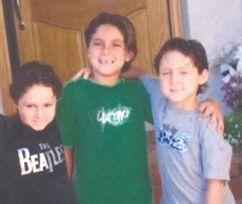 The missing grandchildren of U.S. Rep Gary Miller, R-Brea have been identified as Brian, Evan and Christian Miller, officials said Tuesday.
DIAMOND BAR -- A spokesman for U.S. Rep. Gary Miller, R-Brea, said Tuesday the congressman and his wife are concerned about their missing grandchildren.
"This is a very private matter," said the spokesman Kevin McKee. "An investigation is underway and they are very concerned about what's happening to their grandkids. They are not going to get in the middle of this while their grandkids are unaccounted."
Meanwhile, the father of a woman suspected of abducting the the three children said Tuesday he has not spoken to his daughter for two days.
Jude Lopez, of Diamond Bar, said his daughter, Jennifer DeJongh, 30, is embroiled in a custody dispute with the congressman's son, Brian, and the congressman.
 Jennifer and George DeJongh has been reported missing on Monday along with the three grandchildren of the congressman Gary Miller.
Lopez said his daughter, a former Miss Diamond Bar, is not likely to return anytime soon.
He said he has no idea where she has gone.
Lopez believes DeJongh's husband George is with her and the three children. Lopez identified the children as Brian, 8, and twins, Evan and Christian, 6. The children were reported missing at about 1:30 p.m Monday from their Diamond Bar residence in the 22000 block of Cello Drive, Los Angeles County sheriff's officials said.
Lopez said the three children are students at Maple Hill Elementary School in Diamond Bar. Lopez produced court documents that seemed to indicate the congressman and his wife were awarded a 90-day visitation with the children that was set to begin on Sunday and last through February.
Previously, DeJongh, had sole custody of the children, and the congressman's son was allowed supervised visitation, Lopez said.
Lopez also said that Brian Miller had been convicted in 2000 in a domestic abuse case involving Jennifer DeJongh.
 Published reports indicated that Jennifer DeJongh was driving this Lincoln Aviator, but the car was seen parked at a home in Whittier Tuesday morning. The car belongs to Jennifer DeJongh's mother-in-law, relatives said. (Staff Photo by by Jennifer McLain)
McKee could not confirm the allegation.
A Lincoln Aviator, reportedly belonging to DeJongh, which was wrongly cited by some news sources as being the subject of an amber alert, is currently parked in front of a Whittier home, according to DeJongh's relatives.
Gary Miller represents the 42nd Congressional District, which includes Diamond Bar, Brea, Chino and Chino Hills.
Anyone with information on the whereabouts of the boys is asked to call the Los Angeles County Sheriff's Department at (909) 595-2264.
Source: Whittier Daily News
Addendum: Reunification took place nearly four years later.
expand
collapse
Mexican police find Calif. congressman's grandsons
TIJUANA, Mexico -- Police in Mexico have found the three grandchildren of a California congressman, nearly four years after their mother was believed to have abducted them.
Police in the border city of Tijuana said Thursday that they located the 11-year-old boy and 9-year-old twin boys and arrested Jennifer Dejongh. Police identified the mother by her maiden name, Jennifer Lopez.
The boys - the grandsons of Republican U.S. Rep. Gary Miller - were turned over to U.S. authorities at the border between the two countries early Thursday, said Steve Whitmore, a spokesman for the Los Angeles County Sheriff's Department.
"My wife and I are extremely relieved that after more than 3 1/2 years our grandchildren have been found unharmed and returned safely to the United States," Miller said in a statement.
Dejongh, 34, was turned over to the Los Angeles County Sheriff's Department. She is being held on $500,000 bail, Whitmore said.
Dejongh was charged in November 2007 with three counts of child custody deprivation, said Jane Robison, a spokeswoman for the Los Angeles district attorney's office. Dejongh is due to appear in court oFriday.
Robison said she did not know if Dejongh had an attorney.
The arrest was the result of collaboration among Mexican police, the FBI and Los Angeles County investigators. A U.S. man also was arrested in the Wednesday night operation, Mexican police said in a statement.
Dejongh had joint legal custody of the boys with Miller's son Brian Miller, but there was an ongoing legal dispute between the couple.
In November 2007, she was supposed to drop her three sons off at the congressman's house for an extended visit but did not take them there.
Gary Miller represents the 42nd Congressional District, which includes the communities of Diamond Bar, Brea, Chino and Chino Hills.
Source: Sacramento Bee
Jim Cairns Advocated Child Snatching
November 20, 2007 permalink
In this article on Dr Charles Smith, the part we care about is at the end. Ontario's deputy chief coroner Dr. Jim Cairns prodded a children's aid society to remove a child from his parents.
expand
collapse
Pathologist's work 'bordered on the bizarre': inquiry
Tom Blackwell, National Post
Monday, November 19, 2007
TORONTO -- Dr. Charles Smith's work verged on the bizarre, was sometimes hard to comprehend and showed signs of a "Sherlock Holmes" approach to his scientific discipline, a public inquiry heard Monday.
The discredited Ontario pathologist's record underwent a blunt post-mortem itself as a team of international experts began to dissect his flawed investigations in a series of child deaths.
Many of the pathologist's errors were not subtle miscues, but complete misinterpretations of evidence, the forensic pathologists from Britain and Alberta testified. That included the skull fracture Smith unexpectedly diagnosed from microscopic examination of tissue -- after issuing an autopsy report that said there was no such injury.
"To me, it's almost bordering on the bizarre that, on a chance finding looking down your microscope, you would find a skull fracture," said Dr. Jack Crane, head pathologist for Northern Ireland. "It's just incredible that this would happen."
Crane said he looked at the same tissue sample from the four-month-old baby known at the inquiry as Joshua, and concluded it was a "suture," one of the natural gaps in babies' skulls before the bone fuses together.
In the same case, Smith was quoted in notes by a police officer as saying that autopsy evidence suggested a right-handed person had pushed down on the infant's throat.
There was no science to justify such speculation, which seemed akin to "making it up," said Crane.
"That's sometimes referred to as the Sherlock Holmes approach to pathology," added Dr. Christopher Milroy, chief forensic pathologist with Britain's Forensic Science Service.
Smith had concluded Joshua died from asphyxia, possibly as a result of intentional suffocation. His mother, Sherry Sherret, was charged with first-degree murder, though she was later convicted of infanticide.
The pathologists agreed the cause of death should have been listed as undetermined. Sherret is now trying to get the conviction overturned.
At one point in the same case, Smith said he could not be sure about the cause of death but offered his opinion after saying "If I was a betting man, I would bet that it was ..."
Crane was frank in his assessment of such testimony. "This is not a day at the races," he said. "This was a totally inappropriate phrase to use."
Milroy lambasted the Ontario pathologist for his work in the case of Jenna, a 21-month-old girl whose mother, Brenda Waudby, was also charged with murder. Her charges were eventually dropped, and last year the girl's 14-year-old male babysitter pleaded guilty to manslaughter. Smith incorrectly estimated the time the fatal injuries occurred, diverting attention away from the teenage boy, he said. He also failed to turn over to police a key piece of evidence: a pubic hair found in the toddler's vagina, which turned up in the pathologist's office four years later.
"The situation that arose here, I just find it impossible to imagine it occurring in our system," said Milroy. "There is no way the hair would not have been seized ... There is no way it would have ended up in a pathologist's desk drawer."
The criticism was not isolated to one former pathologist. In the case of Nicholas, Smith said the 11-month-old Sudbury, Ont., boy died of a blunt-force injury that was probably intentional. Though his parents were not charged by police, the Children's Aid Society tried to take away a child born later. The outside experts say there was no basis for the finding, and the cause of death should have been listed as undetermined.
Crane blasted Dr. Jim Cairns, Ontario's deputy chief coroner, for writing a letter in support of the Children's Aid Society application to seize the other child, saying it was "quite inappropriate" for an independent judicial official to intervene on one side of a child-welfare case.
Source: National Post
hush hush
November 19, 2007 permalink
The Edmonton woman who cannot be name charged with killing the child that cannot be named is facing a hearing that cannot be reported. In view of these conditions, we will henceforth refer to this as the Alberta Kafka case.
expand
collapse
Hearing underway for foster mother charged with murder
Edmonton Journal, Monday, November 19, 2007
EDMONTON - The preliminary hearing has started for an Edmonton foster mother charged with with second-degree murder in the death of a three-year-old boy.
The name of the the 32-year-old woman and the boy cannot be released. There is also a publication ban on reporting on the preliminary hearing that is scheduled for five days.
According to previously published reports, the boy died from severe head injuries shortly before midnight on Jan. 27, after being taken off life support.
His foster mother is charged with second-degree murder, assault causing bodily harm, aggravated assault, failure to provide the necessities of life and child abandonment.
Source: Edmonton Journal
Adoption for Dollars
November 19, 2007 permalink
The Windsor Star, a medium sized newspaper, published a letter severely critical of children's aid. How long will it be until the Toronto Star does the same?
expand
collapse
Agencies benefit from adoptions -- not kids
Letter
The Windsor Star, Published: Saturday, November 17, 2007
Children in the care of the province are being marketed like commodities. Does the public not realize that each child has a $10,000 provincial adoption bonus on his/her head, payable to the local child welfare agency?
A Star article shows that the province will accept just about anyone who is not on social welfare themselves as prospective parents. It even says it will consider people with previous criminal records, provided the crime is not too heinous.
Seventeen-year-olds are practically adults. Are they really suitable material for adoption? Should impressionable children be sent into homes with alternative lifestyles?
Increased numbers of Crown wards represent increased agency wealth and more service sector jobs.
The "best interests" of children is not the creation of huge social welfare agencies nested in luxurious quarters built at the expense of poor parents and innocent children.
DOLORES SICHERI
Lakeshore
Source: Windsor Star
Mom on a Roll
November 15, 2007 permalink
In March we mentioned the case of California mother Deanna Fogarty-Hardwick who won a jury verdict of $4.9 million against Orange County for taking her two daughters without cause. Now the courts have awarded her an additional $1.6 million to cover the costs of her litigation.
expand
collapse
Orange County Judge Orders Social Services to Pay Mom $1.6 Million in Attorney's Fees
On October 31, 2007 Orange County Superior Court Judge, Ronald Bauer (Dept. CX-103) awarded Deanna Fogarty-Hardwick over $1.6 million in attorney's fees to help defray the cost of litigation against Orange County Social Services. The fee award arises from Ms. Fogarty-Hardwick's recent court victory against the Orange County Social Services and two of its social workers, Marcia Vreeken and Helen Dwojak, earlier this year.
San Diego, CA (PRWEB) November 8, 2007 --
RE: Fogarty-Hardwick v. County of Orange, et al.
Superior Court of California, County of Orange
Case No. 01CC02379 (Trial before Hon. Ronald L. Bauer, Dept. CX103)On October 31, 2007 Orange County Superior Court Judge, Ronald Bauer (Dept. CX-103) awarded Deanna Fogarty-Hardwick over $1.6 million in attorney's fees to help defray the cost of litigation against Orange County Social Services. The fee award arises from Ms. Fogarty-Hardwick's recent court victory against the Orange County Social Services and two of its social workers, Marcia Vreeken and Helen Dwojak, earlier this year.
The case was brought by Deanna Fogarty against the County of Orange, Marcia Vreeken, Elaine Wilkins, and their supervisor Helen Dwojak to recover damages arising from these defendants' alleged falsification of evidence, perjury, and suppression of exculpatory evidence during a juvenile dependency action back in February of 2000. On March 23, 2007 after over six years of litigation and a seven week trial, an Orange County Jury found against Orange County, social worker Marcia Vreeken, and social worker supervisor Helen Dwojak and awarded monetary damages of $4.9 million. Elaine Wilkins was found not liable.
In addition to seeking damages, Ms. Fogarty-Hardwick also sought to enjoin the Orange County Social Services Agency from continuing its allegedly unlawful practice of making allegations of wrong doing against parents in dependency proceedings without supporting evidence. On May 14, 2007 Orange County Superior Court Judge, Ronald Bauer (Dept. CX-103) issued an injunction against the Orange County Social Services Agency requiring the agency to obtain "reasonable and articulable evidence" prior to initiating dependency proceedings alleging abuse, neglect, or abandonment of a child.
San Diego Lawyer Shawn A. McMillan, of the Law Offices of Shawn A. McMillan, was lead trial counsel in the case.
For additional information, contact:
Shawn A. McMillan, Esq.
The Law Offices of Shawn A. McMillan, A.P.C.
4955 Via Lapiz
San Diego, California 92122
Telephone: (858) 646-0069
Facsimile: (206) 600-4582
Website: www.mcmillan-law.comSource: press release by Shawn A McMillan
More on Rogue Expert Dr Charles Smith
November 15, 2007 permalink
The Goudge inquiry has revealed details of ten new cases in which pathologist Dr Charles Smith acted as an expert. Dr Smith was inclined to find parental wrongdoing in every case. Sadly, psychiatrists with the same inclination are still working as experts in child protection cases.
expand
collapse
Smith inquiry reveals details of 10 new cases
 Justice Stephen Goudge, left, and inquiry lawyer Linda Rothstein.
Discredited pathologist Dr. Charles Smith made questionable findings
Nov 14, 2007 04:30 AM, Theresa Boyle, staff reporter
Extensive details of 10 new cases in which discredited child pathologist Dr. Charles Smith made questionable findings were unveiled at a public inquiry yesterday.
Justice Stephen Goudge, who is heading the Inquiry into Pediatric Forensic Pathology in Ontario, issued a publication ban on the names of some of the victims while others were replaced by pseudonyms.
Lawyers for individuals covered by the ban said the move was necessary to protect their clients from further hardship.
But the case files, some more than 100 pages long, reveal the details of the deaths of the 10 children – most of them infants; one almost 4-years-old.
In all of the cases yesterday, criminal charges were laid against one or both of the parents based on Smith's findings after autopsies on the victims.
The inquiry has chosen to deal with 18 of the 20 cases in which there were found to be problems. The 18 case histories released yesterday – including the 10 previously undisclosed – filled two large binders.
During testimony yesterday, the inquiry heard that senior officials in the province's chief coroner's office decided four years ago that the brakes had to be put on Smith.
"Decision by all present – he can't continue medical-legal post-mortems or committee work," state notes taken by Al O'Marra, then chief legal counsel to the office of the coroner.
He was referring to Smith, who was present at that October 2003 meeting along with then-chief coroner Jim Young, deputy coroner Jim Cairns, and acting chief coroner Barry McLellan.
The committee work referred to in O'Marra's notes were the Pediatric Death Review and Death Under Two committees. Smith sat on both.
O'Marra's notes were tabled yesterday as exhibits.
The province called for the inquiry after it was revealed that problems had been found in 20 child-death investigations in which Smith performed autopsies or rendered opinions. In 12 of those cases, individuals were convicted of crimes; in one, an individual was found not criminally responsible; and in seven, people were suspected or charged with crimes but not convicted.
O'Marra's notes from the high-level meeting indicate that Smith did not want to take responsibility for the problems.
"No insights into problems – deflects all criticism to failings of others," read the notes.
McLellan, who testified yesterday, revealed that there was some disagreement in the chief coroner's office on what to do about Smith. McLellan favoured a hard-line approach, but his boss at the time, Young, disagreed.
"We did not agree. ... Dr. Young was aware of my position. I certainly respected his position as chief coroner," McLellan said.
But when McLellan was promoted to the job of chief coroner in April 2004, he took immediate steps to remove Smith from the position of head of the Ontario Pediatric Forensic Unit, located at the Hospital for Sick Children.
"I met with Dr. Smith and I indicated that I felt he should not be continuing in that role," McLellan said.
The inquiry heard how Young had publicly stated that an internal review was necessary, after murder charges were dropped in the case of Louise Reynolds, who spent two years in jail for the death of her 7-year-old daughter. Smith had concluded the child was stabbed to death but a review by other pathologists determined she was mauled by a pit bull.
Commission counsel Linda Rothstein said evidence will be produced in the coming days showing that despite Young's call for an internal review at that time, the coroner "later determined that a review would not go ahead because of legal advice."
Smith himself had even asked his superiors to intervene after charges were withdrawn in the Reynolds case and in the case of a woman who had been charged with killing her 3-year-old stepson. Other pathologists had determined the boy died after a fall.
In a January 2001 letter to Young, Smith asked to be excused from the performance of medical-legal autopsies and that an external review be done of his work.
Concerns about Smith persisted as the number of questionable cases continued to mount, the inquiry heard.
"I personally had concerns about Dr. Smith's ongoing involvement with committees, with conducting autopsies and with being the director of the unit in the context of ongoing concerns about his work," said McLellan, who also noted that Smith had an ongoing problem with tardiness.
He said that in 2003, Cairns responded to the concerns by removing Smith from the committees that investigate child deaths.
"He was still at this time conducting autopsies on non-homicide and non-criminally suspicious cases and he was still director of the unit," McLellan noted, referring to the Hospital for Sick Children's forensic unit.
Smith's performance was eventually addressed by a forensic services advisory committee, which is expected to be further examined by the inquiry today.
The new cases
1. Baby F
Date: Born and died Nov. 28, 1996.
Case facts: Baby F’s mother, a teenager, told police she had felt sick after coming home from school. After sitting on the toilet for 30 minutes, she saw a great deal of blood. Under hypnosis, she recalled seeing a baby in the toilet covered in blood and water. She put the baby, wrapped in a towel, in a plastic bag in her closet. On July 6, 1998, she pleaded guilty to infanticide and was given a two-month “conditional sentence, to be served at home,” three years’ probation and 150 hours of community service. A psychiatric assessment indicated that Baby F’s mother had been “consistent in denying that she knew about the pregnancy” and was suffering from “acute stress disorder.”
Smith’s finding: The baby girl appeared to be full-term and survived “for a period of time” following delivery. Death was caused by asphyxia, attributed to infanticide.
Outcome: Baby F’s mother was granted a pardon on Oct. 24 last year.
2. Tamara
Date: Born Jan. 18, 1998; died Feb. 8, 1999.
Case facts: Tamara had no contact with her father until September 1998, after which her mother testified he came over three or four times a week and helped look after Tamara and her two sisters. The Children’s Aid Society was notified after Tamara was treated at Sick Kids’ hospital on Jan. 20, 1999, for a broken thigh. Tamara and one of her sisters were left in the care of Tamara’s father the morning of Feb. 8, her mother said. She called several times but he didn’t answer. He told police she was in her playpen with a bottle and he fell asleep. Tamara’s mother testified that when she came home, Tamara was lying on her back with a scrape on her forehead and a bruise on her cheek and not breathing. A radiology report found “multiple fractures in various stages of healing ... highly suspicious for nonaccidental trauma.” The father was charged with second-degree murder.
Smith’s finding: Cause of death was given as “asphyxia associated with multiple traumatic injuries.”
Outcome: Tamara’s father pleaded guilty to manslaughter Aug. 30, 2001; he was sentenced to 15 months time served and 361/2 years prison.
3. Katharina
Date: Born March 20, 1992; found dead Sept. 15, 1995.
Case facts: Katharina’s father, Lawrence Babineau, and mother, Gabriela Chaparro-Najar, married in 1993 when the baby was 11 months old. The family lived in Oshawa until June 1994, when the parents split up and the mother moved with Katharina to her sister’s home in Toronto. A custody battle began with Chaparro-Najar alleging that Babineau had abused the child and Babineau claiming she had threatened to kill Katharina rather than let him have custody. Babineau told police he feared she would flee with the child to her native Colombia. Police forced entry into the apartment. They found Katharina’s body in the bedroom and Chaparro-Najar climbing over the balcony. She was charged with murder.
Smith’s finding: Death was caused by “asphyxia in a pattern of neck or chest compression,” consistent with having been suffocated with a pillow. The exact time of death, he said, was uncertain.
Outcome: On Nov. 3, 1997, Katharina’s mother was found not criminally responsible. She was detained at the Centre for Addiction and Mental Health until April 2001. She received an absolute discharge on Dec. 13, 2001.
4 .Taylor
Date: Born April 16, 1996, in Thunder Bay; found dead July 31, 1996.
Case facts: Taylor’s parents, Lanny and Laura, were charged with second-degree murder, criminal negligence causing death and failure to provide necessities of life. The couple had had an argument, after Taylor had been put to bed, and Laura left the apartment carrying her son from a previous relationship. Lanny followed her and the couple were seen arguing and crying before the three returned home. Lanny reported he fell asleep on the couch and was woken by Laura’s screams. An autopsy revealed several broken ribs and a brain injury. Cause of death was given as acute head injury. There was information that Larry had abused a child he had with another woman.
Smith’s finding: Noting that the original radiologist’s report observed two or three fractures, Smith said a review of evidence indicated a total of 14 fractures and other possible injuries. He said the cause of death was consistent with “blunt trauma,” not shaking.
Outcome: Lanny and Laura were discharged on all counts because “there was no evidence of motive, intent or exclusive opportunity to cause the injury that resulted in Taylor’s death.”
5. Tyrell
Date: Born Feb. 1, 1994; died Jan. 23, 1998.
Case facts: Tyrell’s father, Garth, was in jail for manslaughter and the whereabouts of his mother, Janette, unknown. He lived with Garth’s former partner, Maureen, and her two children. Medical reports said Maureen said Tyrell had been running around, jumped off a couch and fell, hitting his head. He was taken to hospital Jan. 19, 1998, after she couldn’t wake him. He was transferred to the Hospital for Sick Children, where he died. Cause of death was recorded as “herniation of brain stem ..... consistent with a severe shaking episode.” Maureen’s son told police she hit Tyrell “a lot.” Maureen was charged with second-degree murder.
Smith’s finding: Smith reportedly told police that the head injury was caused “by flat object — impact.” He testified that Tyrell did not show signs of “classic shaking” but couldn’t rule out the possibility. Smith noted a contusion or discolouration to the brain that was noted by another examiner, who disagreed with his opinion that “a household fall can result in death only when there is epidural hemorrhaging.”
Outcome: The charge against Maureen was withdrawn Jan. 22, 2001.
6. Dustin
Date: Born Sept. 9, 1992; died Nov. 18, 1992.
Case facts: Dustin lived in Belleville with his parents Mary and Richard. After an argument, Mary spent the night at a friend’s home, leaving Dustin with Richard. When she returned, there was another violent quarrel and Richard left, taking Dustin and Mary’s daughter, who was not his biological child. Richard was later seen pushing a baby carriage. Dustin was in it, a witness said, “with foam (coming) out of his nose. He was white and his eyelids were blue.” The witness told police Richard shook Dustin, but not violently. A hospital radiologist reported injuries “strongly suggestive of a shaken baby.” Cause of death was given as respiratory failure and a traumatic brain injury.
Smith’s finding: Smith commented in his report that “In the absence of a credible explanation, this injury must be regarded as non-accidental in nature.” In testimony, he said, “Though I would prefer the explanation that it was a shaking-type injury, I cannot rule out the possibility that, in fact, he was stuck by some blunt object.”
Outcome: On April 21, 1995, Richard pleaded guilty to aggravated assault and was jailed six months.
7. Gaurov
Date: Born Feb. 11, 1992; died March 20, 1992.
Case facts: On March 18, the mother of a 5-week-old boy called 911 and said he had
stopped breathing. According to the father, he had been fed at 12:30 a.m. A half-hour later the father heard the baby cry and picked him up. He took several breaths, gasped, turned blue and went limp. The father tried to resuscitate him. Emergency services and Gaurov’s aunt and uncle arrived. The aunt shook him a couple of times to try to revive him. He was rushed to hospital with no heartbeat and not breathing. He was intubated and his heartbeat restored. After tests, he was transferred to the Hospital for Sick Children. A CT scan found brain hemorrhaging consistent with shaken baby syndrome. On March 20 baby Gaurov died.Smith’s finding: Smith listed cause of death as “head injury.” In his autopsy report he stated the baby had acute epidural hemorrhaging of the spinal cord and acute subdural hemorrhaging.
Outcome: Gaurov’s father was charged with second-degree murder on July 1, 1992. On Dec. 3, 1992, he pleaded guilty to criminal negligence causing death and was sentenced to 90 days.
8. Delaney
Date: Born Dec. 20, 1992; died May 23, 1993.
Case facts: Five-month-old Delaney lived with his mother, Olga Policarpo, in Woodstock, Ont. On the day before his death his mother had invited her relatives to her house to pray for help for her 2-year-old niece, who had liver and heart problems. Relatives later said they communicated with the Virgin Mary. Delaney was found dead the next day. Policarpo was arrested and taken to hospital, where doctors assessed her as being in a psychotic state.
Smith’s finding: The cause of death was listed as “asphyxia.” Smith told police the baby’s death was caused by compression or blunt trauma injury and there was evidence of hemorrhaging in the upper chest and lower neck. In a request for a skeletal survey of Delaney, he wrote: “Sudden death of baby while family was involved in cult-like activities.”
Outcome: Policarpo was charged with second-degree murder. While in hospital she told Susan Garton, a nurse at London Psychiatric Hospital, that the Lady of Guadeloupe “made me kill my baby.” She was found not guilty of second-degree murder but was convicted of infanticide.
9. Amber
Date: Born March 13, 1987; died July 30, 1988.
Case facts: Amber was born in Timmins, Ont. Her parents, Francis and Richard, left her in the care of S.M., a 12-year-old babysitter, on July 28, 1988. During the day the toddler fell down five stairs, the sitter said. Paramedics found the baby with no visible injuries and breathing irregularly. On July 30, 1988, she was pronounced brain dead. The cause of death was listed by the coroner as “cerebral edema due to head injury after an accidental fall.” An autopsy was requested due to “a high level of suspicion of foul play.”
Smith’s finding: Smith testified he believed Amber had been shaken to death. He told police there was no way the fall could have killed her. The final autopsy report was signed on Nov. 28, 1988, but Smith only cited a “head injury.”
Outcome: S.M. was charged with manslaughter on Dec. 15, 1988. She was acquitted on July 25, 1991. Smith testified Amber’s injuries “don’t fit those from a fall down stairs.” The judge ruled shaking wasn’t established to his satisfaction. S.M.’s father laid a complaint against Smith at the College of Physicians and Surgeons, which ruled Smith’s approach was acceptable.
10. Kenneth
Date: Born May 18, 1991; died Oct. 12, 1993.
Case facts: At the time of his death, the almost 2-1/2-year-old lived with his mother and stepfather, Rick, in Oshawa, Ont. Kenneth’s mother was still in high school in Scarborough when the baby was born. She came from “an abusive and dysfunctional family” and had problems with alcohol abuse and parenting. Kenneth had been in Children’s Aid Society care four times. He had repeated trips to the hospital for seizures, asthma, bumps, bruises and a broken leg. On Oct. 9, after an afternoon nap, Kenneth’s mother woke to find him twisted in his sheets and blankets and unable to breathe. She got him out and called 911. Paramedics found Kenneth without any vital signs. On Oct. 11 he was termed clinically dead.
Smith’s finding: In his post-mortem report Smith said the cause of death was asphyxia. He testified his findings from the autopsy were consistent with suffocation with a soft object or a plastic bag.
Outcome: Kenneth’s mother was convicted of second-degree murder in October 1995 and sentenced to life. While awaiting trial she gave birth to a son, which the CAS took away.
The known cases
Lianne Thibeault: Smith suggested Thibeault was responsible for the death of her 11-month-old son before another pathologist concluded the cause was undetermined.
Brenda Waudby: Because of Smith’s findings, that Waudby’s 21-month-old baby died of abdominal trauma that occurred hours, even days, before her death, Waudby was wrongfully charged. A babysitter later admitted beating the baby shortly before she died.
Anisa and Marco Trotta: After Smith’s pathology reports on the death of their baby were deemed unreliable, the couple, who already spent time in jail, were granted a new trial by the Supreme Court.
Louise Reynolds: After Smith concluded that her 7-year-old daughter’s injuries were consistent with stab wounds, Reynolds was charged with the death. It was later determined that her daughter was killed by a dog.
William Mullins-Johnson: Smith consulted on the case of Mullins-Johnson’s 4-year-old niece, determining she was strangled. After Mullins-Johnson spent 12 years in jail, Smith’s testimony was reviewed and he was acquitted last month.
Angela Veno and Anthony Kporwodu: Smith was criticized for “inexplicable tardiness” in filing reports after the couple was charged with killing their baby — charges later thrown out. Smith was cited for unwillingness to provide crucial evidence in other cases as well.
Sherry Sherrett: Based on Smith’s findings, Sherrett spent six months in jail for the death of her 4-month-old. Another pathologist later determined the baby died of natural causes.
Source: Toronto Star
Addendum Those interested in the Smith case can refer to the website of the Goudge Inquiry. There is a new blog dealing with the case of Dr Charles Randal Smith. The introduction by the author reads:
harold levy
- Industry: Communications or Media
- Occupation: journalist and lawyer: public eye!
- Location: toronto : ontario : Canada
About Me
I recently retired from the Toronto Star where I have been reporting on Dr. Charles Randal Smith - a former pediatric forensic pathologist at the Hospital for Sick Children - for the past six years. I intend, through this blog, to periodically report developments relating to Dr. Smith in the context of the on-going public inquiry, the on-going independent probe of cases he worked on between 1981 and 1991, and cases which have been launched, or will be launched in the civil courts. (Postings to begin early in October, 2007) if not earlier. I am currently researching a book on Dr. Smith and would appreciate hearing from anyone who can provide me with useful information.
Below is a letter posted to the blog on October 31, 2007.
expand
collapse
From Maurice Gagnon to Chief Coroner Dr. James Young, October 5, 1999:
Dear Sir/Madam.
I wish to register a complaint against one Dr. Charles Randal Smith for conduct unbecoming a civilized human being, let alone a member of the medical profession.
Dr. Smith is the Director of the Ontario Pediatric Pathology Unit located at the Hospital for Sick Children in Toronto.
He is also a member of the Pediatric Review Committee of the Office of the Chief Coroner.
My grandson, Nicholas Gagnon, my daughter's only child, died suddenly on November 30, 1995,
On the recommendation of Dr. Smith, and under an order signed by the Attorney General of Ontario, Nicholas was disinterred on June 25, 1997.
We had been assured that the disinterment would occur at daybreak, between 5.30 and 6.30 a.m., to avoid curiosity seekers and to minimize the impact on the family.
However, to accommodate Dr. Smith, the disinterment took place at high noon, in the presence of on-lookers and the child's grieving mother.
Had protocol been followed, my daughter would have been spared this devastation.
In what I can only assume to be unprecedented in the annals of civility, Dr. Smith brought his young son to the grave site to witness the exhumation, no doubt for the boy's entertainment.
Not only did Dr. Smith, the man responsible for the disinterment, trivialize the desecration of our baby's grave, he contemptuously mocked my daughter and the memory of her son, by flaunting his "live" son while cavalierly digging up her "dead" son.
What manner of a man can be so callous, so cruel, so oblivious to the consequences of his actions?
At the very least, my daughter, this family, are deserving of an apology for such an insensitive display by this member of the medical profession... Thank you for your consideration...
Source: Harold Levy blog
See Inside Family Court
November 14, 2007 permalink
An investigative report by Kentucky television station WLKY includes rare video of the proceedings inside a family court. They don't look anything the courts that hear evidence from both sides before reaching a decision. On the video you can see a mother lose three children in a 17 minute hearing. There is no evidence, just an opinion by a social worker, without cross examination or opportunity for rebuttal. In other cases there is biased evidence, long-distance visitation and a caseworker with criminal charges. Social workers show routine disdain for fathers. Even without an audit, there is reason to believe that social services removes children for financial rewards. A legally required hearing is not held. A mother loses her kids for spanking, for leaving younger kids with a 16-year-old and for leaving three kids in a pool while searching for a fourth kid who got lost. While transferring a case from one court to another, damaging evidence was preserved but exculpatory evidence was lost. A social worker had a conflict of interest, a friendship with an adverse party. A family saw a neighbor's child they wanted, and successfully asked child protectors to seize it and give it to them for adoption. When a mother sued the child protection agency, her lawyer's children were taken.
- July 6, 2006 part one
stream
YouTube
local copy (flv)
embedded in web page - July 6, 2006 part two
stream
YouTube
local copy (flv)
embedded in web page - November 13, 2007 part one
stream
YouTube
local copy (flv)
embedded in web page - November 13, 2007 part two
stream
YouTube
local copy (flv)
embedded in web page
For the links above marked "stream" you will have to right-click your mouse and copy the link to the clipboard, then place it in a media player. The embedded pages require Windows Media Player. The first two sometimes require reloading.
expand
collapse
Target 32: Kentucky's Child Protection System Investigated
UPDATED: 10:38 pm EDT July 6, 2006
LOUISVILLE, Ky. -- A Target 32 investigation took a closer look at the state child protection system one year after NewsChannel 32 first raised serious questions about an agency that saw a dramatic rise in the numbers of children it removed from homes.
WLKY had to go to court just to air its initial reports after an attempt by the state to stop it from showing what's currently going on.
While everyone's story can't be told, Target 32 can provide an in-depth look at one case that exemplifies the things represented in hundreds of complaints it's received: allegations of quick trigger child removal with no proof of parental wrongdoing, and then retaliation against those who fight back.
Vanessa Shanks of Hardin County provided WLKY with video of a confidential hearing held to remove her children from her custody.
"They took them right after court, so I didn't get to say goodbye," said Shanks. "They just went straight to my house and removed the kids for one and a half missed days of school."
While it may take weeks, months or years to take someone's freedom away in a circuit courtroom, on May 16, 2005, it took 17 minutes to take three of Shanks' children away in a family courtroom.
The videotaped hearing consisted of a judge, a state-appointed attorney to represent the children, a cabinet for a Health and Family Services attorney, and a witness: state social worker Carlonda Fields.
"Truancy was the original allegation, but then they came to the house and said the home was unsafe because I just got done doing laundry and there was a bleach bottle with the cap off on the floor," said Shanks. "So they said my home was unsafe for children."
The only proof offered of educational neglect is testimony from the social worker that one of the three children they removed had a kindergarten reading level even though he was 11 years old. As for the number of school days missed, no school records were offered -- just an opinion from the case worker.
"The truancy was because she was unable to get up and get them to school," said Fields.
On the allegation of medical neglect, no evidence of that is offered during the preceedings for two of the three children. Fields testified that the other child, who has spina bifida, had missed some doctor's appointments.
According to the video, the judge said he's heard enough about 17 minutes into the hearing.
"I think all the essential requirements have been established, and I find the requirements of the statute have been satisfied and that order of detention be issued for each of the three children," said the judge.
"I didn't see my children for 11 months. It is the hardest thing you can go through," said Shanks. "It's like someone close to you just dies, like you don't have a part of you anymore."
When she fought back -- appealing the ruling -- Shanks said they took her other three children away and then briefly removed 14 children from her extended family.
Target 32 tried to check out this allegation but CPS would not comment about individual cases.
Attorney Bob Bishop said he couldn't believe what he saw when he took Shanks' case and reviewed the hearing that he said contained no proof of wrongdoing.
"There has to be something, some evidence of wrongdoing that has placed a child in danger or has hurt the child, and a pattern of conduct not due to poverty alone," said Bishop.
"He would come home and say 'You wouldn't believe this. I just can't believe these stories I'm hearing.'" said Bishop's wife, Jennifer Bishop. "Then it happened to us."
According to the Bishops, social workers removed their adopted daughter from their home, too.
"They said if you don't cooperate with us, we're going to take all of your children away, and we're going to charge you with emotional abuse," said Jennifer Bishop.
Fortunately for Shanks, the Kentucky Court of Appeals ruled that the judge made a mistake in allowing her three children to be removed, and she is going to get them back.
The court unanimously ruled the state acted in haste and offered no proof of abuse or neglect.
While endings like this are rare, records show terminations of parental rights have been upheld in the majority of such cases before the court over the past 10 years.
The man in charge of CPS, Social Services Commissioner Tom Emberton Jr., said he would not discuss individual cases like Shanks', but he did comment on the issue of retaliation -- the most common theme of the hundreds of complaints WLKY has received..
"I have not seen any signs of retaliation and will not tolerate retaliation," said Emberton. "We deal with a tremendous number of families. Isolated cases are going to surface, and we will address these issues very quickly and appropriately when they do."
Emberton announced that an independent group has been named to come in and review the way parental rights are terminated in Kentucky.
That adoption task force comes in addition to an investigation of CPS under way by the state inspector general.
To submit a complaint, please call Robert Benvenuti at the Office of the Inspector General, at 502-564-2888.
Source: WLKY TV
Target 32 Investigates: Child Protective Services
UPDATED: 10:50 am EST November 14, 2007
LOUISVILLE, Ky. -- The Chief Supreme Court Justice of Kentucky is surveying judges across the state to see if he should suggest opening up child protection courts.
Kentucky is one of 21 states that still close child protection proceedings. But there is a growing movement to open them after the Inspector General of Kentucky documented widespread abuses within the child protection system.
After three years of controversy, problems linger. A Target 32 investigation found that social workers are troubled by what they call suspicious conduct by their colleagues already under fire in the Inspector General’s report.
Linda Roberts, a single mother who had her four children taken away after her ex-husband sexually assaulted one of them, turned over a tape of her child custody proceeding.
“All of a sudden she called in and said ‘remove those kids,’” Roberts said. “It was a very heart-wrenching thing to do after I’d worked so hard to get them back, then for no good reason to take them away again. It was very difficult.”
The next time her children were taken, she didn’t get a hearing to defend herself within 72 hours, as required by law.
“They were just in shock to come home and pick up a few things and go away,” Roberts said.
Now she’s in family court defending herself from an allegation that she spanked her daughter with a belt.
The school system never saw any marks on the children, so the CPS social worker ruled the physical abuse allegation unsubstantiated. Then, Roberts was also accused of neglect due to allegations that she left the children alone.
The Louisville CPS workers also determined the neglect allegation was unsubstantiated, in large part due to a note from a supervisor giving the single working mom permission to leave the children with their 16-year-old sibling for short periods of time, in emergencies, which she did.
The Louisville-based social workers took Roberts’ side, as a success story.
“Ms. Roberts appears to me to go above and beyond with her kids because she puts them in child enrichment programs and takes them to school, she picks them up after school,” a CPS social worker said. “We have letters from supervisors, directors, neighbors, co-workers, all stating that whenever they see Ms. Roberts, they see her kids. Neighbors say they never see kids home alone.”
But judge Shan Embry ruled differently because of a previous court order reading “The children may only be left with their older adult siblings when not in the care of their mother.” Roberts was found in contempt because, according to the court, “younger siblings were left with the 16-year-old on four to five occasions.”
The judge also found that the children “were all physically disciplined by Linda Roberts with a belt and switch on numerous occasions.”
And the final reason cited by the judge for taking Roberts’ children: “Leaving three of her children alone in the Lizard Bay pool at Disney World for at least 30 minutes” while she was looking for another child who got lost.
“They go by what they want to do regardless of the law,” Roberts said.
While that ruling outraged Roberts, something else that happened in the case was disturbing, even to social workers. A supervisor in the Louisville office detailed what she called suspicious conduct in the Meade County CPS office where the case against Roberts originated.
“The case file was not there and we don’t know where the case file went,” the supervisor said. “Once we started requesting the records, the phone calls stopped. We didn’t get any phone calls back.”
The case file that contained records supporting Linda Roberts disappeared, while the information against her was forwarded to Louisville when the case transferred.
Then, Louisville investigators learned the “Meade County investigator who executed the initial affidavit alleging contempt is the best friend of the temporary custodian’s mother-in-law.”
“They can pull strings and do things and files can disappear, reports can be made and children can be snatched out of a home without even a hearing,” Roberts said. “In many ways they make their own decisions, not based on legal grounds, and nobody's doing anything about it."
Source: WLKY TV
Social Workers Allege Child Protection Service Abuses
UPDATED: 3:21 pm EST November 14, 2007
LOUISVILLE, Ky. -- Social workers are alleging abuses in Kentucky's Child Protective Services.
In a follow-up to a 3-year investigation of CPS, NewsChannel 32 interviewed a group of Kentucky social workers who alleged families are harassed and workers are pressured in efforts to boost adoption numbers.
Pat Moore said she was a state social worker until she was fired for not ignoring half a dozen allegations of abuse in a foster home.
"I did what I felt like I had to do," Moore said. "It was the right thing to do and I stand by the complaint."
When Moore found that two foster parents had criminal records, a son living with them had multiple felonies, and a convicted sex offender visited and, sometimes, cared for the children, she refused to arrange an adoption.
Her supervisors responded to her complaint with a memo suggesting the adoption proceed quickly.
"Our theory is that the basis for this is the tie to the federal money," Moore's attorney, Tom Beiting said. "That every time a child is not placed in the home comma the state of Kentucky through its Cabinet is losing money"
After she was fired, Moore filed suit and last month, the Commonwealth paid $380,000 to settle it.
The high-adoption trend apparently began in 2004, when adoptions in Kentucky ballooned to 724 while the federal bonus money more than doubled from $452,000 the previous year to more than $1 million.
"The Cabinet puts pressure on stats because federal and state money come from statistics," said another social worker who wants her identity concealed for fear of retaliation against her family. "You get praised. The Cabinet praises you for terminating rights and adopting kids out immediately."
She said the concerted effort to take children away and put them up for adoption was so brazen, she actually saw someone successfully place an order for children.
"Someone could not have a child and wanted a child so within the community," the social worker said. "This person saw a family in distress, having a hard time, relayed to workers that they would like those children, and that's exactly what has happened."
And a former CPS supervisor, who also wants anonymity for fear of retaliation, said if an order for a child was delayed or denied, her supervisors would overturn local decisions.
"This one family was promised a child, and when it happened that this child was going to be reunified with the parent, they called our regional office, and our regional office came in our county and they harassed the birth parents and that kind of thing because they didn't agree with our decision," the former supervisor said.
Vanessa Shanks had her kids taken away and, when she fought back, her relatives had their children taken away. Then, after she won in court, her attorney's child was taken away.
The former CPS workers said that kind of retaliatory power is common and, in the secretive, one-sided system, they can take anyone's kids away on a moment's notice - and get away with it.
According to data just released, there's a huge disparity between counties on adoption rates. Some counties reunify 100 percent of children taken with their families. Other counties adopted out as many as 82 percent of children taken from their homes.
Source: WLKY TV
Serial Rape
November 13, 2007 permalink
An unnamed Oklahoma girl was raped in her home and became pregnant at age 11. The story does not give her relationship to the man, Tommy James Isbell, but stepfather is a good guess. Social services placed the girl in foster care, where she was raped by her foster father, Timothy Joe Mountford, and became pregnant at age 14. All in the best interest of the child.
expand
collapse
Foster parent arrested on charges of raping 14-year-old
— JAY, Okla. — A Grove man, accused of raping and impregnating his 14-year-old foster daughter, is free on $150,000 bail, court officials said Tuesday.
Timothy Joe Mountford, 49, is charged in Delaware County District Court in Jay with second-degree rape and child sexual abuse, both felonies. He was arrested on Friday.
According to an affidavit warrant signed Sgt. Mark Sheridan, Grove Police Department detective the victim had a seizure at school and was taken to Integris Grove General Hospital.
During the course of the examination, the victim and her foster mother were told the victim was about 11 weeks pregnant, the affidavit states.
When the victim returned home, she confessed to her foster mother Mountford assaulted her before the current school year began the affidavit states.
Mountford also confessed to the victim’s foster mother that “he had sex with … one time at their house in their bedroom on their bed,” the affidavit states.
Nick Lelecas, assistant district attorney declined to comment on the case citing the victim is a juvenile, when asked if the victim had been removed the foster home.
The victim was placed in foster care after she was raped and impregnated when she was 11 years old.
In that case, Tommy James Isbell, 35, of Jay pleaded guilty to four counts of first-degree rape and 12 counts of forcible sodomy and was sentenced to life, court records show.
Isbell confessed to having sex with the child since she was 9, but stated the sexual activity was consensual, according to a Jay Police Department investigative report.
Source: Joplin Globe
Adoptions Remain Secret
November 13, 2007 permalink
The Ontario government has decided not to try to save the Adoption Information Disclosure Act from the decision of the courts, so it is dead. COAR holds out hope for a watered down version from the next session of the legislature.
expand
collapse
COAR Bulletin
November 13, 2007
Today COAR learned that the Ontario government has decided not to appeal Judge Belobaba’s decision. The Minister of Community and Social Services phoned COAR this afternoon to give us the news.
The government plans to amend the Adoption Information Disclosure Act and add a disclosure veto. They plan to do so very quickly.
COAR has already shared with the government the additions we consider necessary to make AIDA a better and workable law.
Please write as soon as possible to the Minister and ask her to amend AIDA to include:
- a comprehensive health history form for individuals who choose to file a disclosure veto
- an active registry open to birth relatives, adult adoptees and their descendants
- the release of comprehensive non-identifying information to birth relatives and adopted adults in a timely fashion
- an improved medical search system that allows adoptees and birth relatives to take preventative action
Please send your letter to Minister Madeleine Meilleur at mmeilleur.mpp@liberal.ola.org . Write also to your MPP to ensure that the government includes as many of your rights as possible when it amends AIDA. To find your MPP's address, click here:
In a few years, AIDA will come up for review. We are hopeful that we can seek further changes at that time. We will continue to fight for those few adoptees and birth parents who are blocked from obtaining information by the disclosure veto.
While we are saddened and disappointed that the government has chosen not to appeal Judge Belobaba’s decision, we see this as an opportunity to improve AIDA and create a law that works. COAR is continuing to fight on behalf of adoptees and birth parents in Ontario.
In solidarity,
Michael Grand, mgrand@uoguelph.ca
Karen Lynn, ccnm@rogers.com
Wendy Rowney, wrowney@rogers.comSource: email from COAR
CAS Dupes TSE
November 13, 2007 permalink
The Toronto Stock Exchange joins the large list of corporations and individuals who have been hoodwinked by children's aid. The Children's Aid Foundation will be allowed to signal the opening of the trading day on November 15. Link here to the original press release.
Boyfriend Gouged
November 12, 2007 permalink
From the just when we thought it couldn't get any worse department. Norwegian foster parents have found a new way to profit from their foster kids. A teenaged foster daughter had a love affair. From the article, it is clearly a genuine love affair, not a child rape. The affair seems to be actionable in Norway because the boy is four years older than the girl. The foster parents have twice gouged the boy for compensation of 10,000 Norwegian Krone over the girl's objections.
expand
collapse
Updated: 08. november 2007 kl.12:42
Girl refuses sex compensation
A nearly 15-year-old girl has refused to accept damages awarded for sex with an older boy in a court case she has opposed from the start.
A four year older man was convicted of having sex with a minor by a Romsdal court, and ordered to pay NOK 10,000 (USD 1880) in compensation, but the girl has opposed the process, newspaper VG reports.
The girl argued that she was not a victim, that she had contacted the man and that she had had sex with him willingly.
The girl's foster parents registered a complaint with child care authorities and filed charges with police, and demanded damages for the girl.
"As long as the girl is a minor and the guardian demanded damages, I had to submit a claim for damages. But I informed the court that she did not wish any form of compensation," the girl's lawyer, Johan Teiseth, told VG.
The court insisted that, legally, the girl could not renounce damages.
The convicted man has had a long and close relationship with the girl, and has one former conviction on similar charges towards the girl, and then too was ordered to pay NOK 10,000 in damages.
Source: website Aftenposten English
Pregnant Woman Flees
November 12, 2007 permalink
Fran Lyon, menaced with baby removal on the expected birth of her child next January, has fled her locality to a different part of Britain. British social services plan to have social workers and police attending the birth, to remove the baby as soon as the cord is cut. If this was fiction, a publisher would reject the story as implausible. We will see whether Fran's move will save her baby. With the hullabaloo about informing pregnant women of baby removal, it is possible British social services will shift to the American model: assure the mother there is no plan to take the baby, then snatch it from the helpless mother in the delivery room, sometimes even before the afterbirth. We had earlier stories on Fran on October 18 and November 3.
expand
collapse
Mum-to-be flees North to keep tot
Nov 11 2007, by Phil Doherty, Sunday Sun
A PREGNANT woman claims she has been hounded from her home by social workers who plan to take her baby as soon as the cord is cut.
Fran Lyon, 22, has been told by Northumberland County Council her unborn daughter will be taken from her because she may suffer from Munchausen Syndrome By Proxy in the future and harm her child.
She has left her Hexham home, alleging the birth plan drawn up by social services is abusive to her unborn child, Molly.
She has moved to the Midlands to be closer to her family for the birth.
She said: “They won’t even let me breast-feed her because they allege I might poison her.
“This is just an extreme over-reaction and complete nonsense. “I’m hoping the acrimony and difficulty between Northumberland County Council and myself will not be repeated with the new social services team.”
Fran, whose baby is due in eight weeks, has told social services of her move and her legal team are due to met the representatives of the new social services team that will now take on her case.
According to the birth plan — which has been seen by the Sunday Sun — two midwives must be present. It details how the baby will be taken from Ms Lyon as soon as the cord is cut, that the child is removed to foster care as soon as possible and that the police will be called if she doesn’t co-operate.
Source: Sunday Sun (UK)
Foster Graduation
November 11, 2007 permalink
We used to wonder where children's aid found all those workers with the extraordinary personality traits allowing them to shamelessly take children from mom and dad. Now we know. They are graduates of foster care themselves.
A reader with unusual patience for tripe has studied a report of Bridgeway Family Homes, a home for foster children and crown wards. Of eighteen graduates profiled, eight aspire to careers in social work, or police work in support of social services.
At the request of one of the students, the body of this article is on a page shielded from search engines. Click for article.
As usual in social services, they make no mention of the foster kids that wound up behind bars, and they name children in a way that would get real parents in jail.
The introduction of the newsletter describes an incident on a public street in which a mother was observed trying to get a garment on a recalcitrant child. The characterization exemplifies the prejudice against natural parents, and favoring fosters: "It may have been a mother and son having a disagreement of some sort and I could have totally misread the whole situation. However I prefer my version where I am reminded of the unconditional love that is extended to foster children from foster parents.".
A later section asks the question: "What can dinosaurs teach us about fostering?". The discussion contains the advice: "If you have a rigid idea of what parenting looks like, fostering is probably not for you". Indeed. Social work is for you. With a rigid idea, you will find lots of parents to relieve of their children. Maybe dinosaurs and the foster system were both too big.
The newsletter publishes the masterpiece below from the Social Work Museum of Fine Arts, by Skylar, age 3.

National Child's Day
November 11, 2007 permalink
Parents will have an opportunity to take their views to the public on Tuesday, November 20 from 8 am to noon in an event organized by Fathers are Capable Too. There is nothing about the cause of separation in the organizing, so parents bereft by child protection can join those affected by divorce.
expand
collapse
Date: Sun, 11 Nov 2007 10:07:28 -0500
National Child's Day
National Child's Day is our annual day for reminding the Courts of International Conventions on the rights of children to family, all family and specifically frequent contact with both parents as parents. This is the anniversary of the day that Canada signed this Convention, but the Courts have long decided that international convention applies only to other nations. Please come out and support the rights of our children -- all of our children -- on this important day.
In Toronto, we will be at the family court building at 393 University Avenue (just south of Dundas) on November 20 at 8:00 am to noon/1pm. We want to let these people know what Canadians think as they show up to work, rather than after they hide in the building. Attire is recommended to be business attire -- like a shirt and tie -- it eliminates the usual dismissals of what we have to say. Please remember that this is November in Canada -- it is COLD. Dress warmly, bring gloves, wear a hat because we will be outside and we will be in the weather.
In other jurisdictions, it is our understanding that other groups will be present also at selected spots. If you are out as an individual, or as a group, please let us know at webmaster@fact.on.ca.
Source: email from Brian Jenkins
Indians Fire Child Protectors
November 11, 2007 permalink
The Bloodvein First Nation in Manitoba has expelled child-welfare workers from its reserve, to protect their families from heavy-handed tactics. What is the chance white men will follow the lead of the Indians?
expand
collapse
Manitoba reserve fires child-welfare workers
Band councillors take over social work duties
Last Updated: Friday, November 9, 2007 | 5:53 PM CT, CBC News
A Manitoba First Nation has kicked child-welfare workers off the reserve, saying its members are tired of their heavy-handed efforts.
Two hundred members of the Bloodvein First Nation handed a petition to their band council in late October, demanding Southeast Child and Family Services workers be ordered off the reserve.
On Oct. 31, the reserve issued a memo to families and foster parents saying the "Bloodvein supervisor and CFS band workers have been relieved of their duties and responsibilities as per band council resolution."
Coun. Stella Keller told CBC News that too many children were being taken into care and shipped off the reserve.
"They approach families and they tell them, 'Well, you know, we can just take your kids, just like that,' and to me that's a threat," she said.
"CFS is not only there to apprehend kids. CFS should work together with the health programs to have intervention, prevention, and this wasn't really happening."
Chief Craig Cook said he opposed firing the workers, but he was outnumbered and had to carry out the wishes of council.
"The CFS staff were doing all they can to confront the issues that plague our children," he said.
"A lot of times our young parents will utilize the funds like the child tax benefit, the welfare payments, to support some of their habits — binge drinking, alcoholism — negative habits that go on in our community."
The band's four councillors have taken over child-welfare duties — including family visits, foster-care payments, local business payments, children in care and all court proceedings — for now.
Keller acknowledged that the replacement workers, herself included, are not qualified social workers and have little information about children in care or at risk in the community.
However, she said, "I've lived here all my life. I know the families."
Parenting skills lost, says father
John Cook, a father of five on the First Nation, had mixed feelings about the firing of the CFS workers. "A few" children on the reserve could be at risk, he said.
"The majority of the problem is alcohol, I believe, and neglect," he said. "Parenting skills, I think, were lost a long time ago during the residential [school] programs, where our kids were taken from our homes and never learned to parent."
Keller said she hoped the reserve will remain peaceful over the upcoming long weekend, since none of the councillors handling child-welfare cases will be in the community for the weekend.
If trouble erupts, she said, the community will have to handle it.
Officials with the Southeast Child and Family Services authority did not return calls from CBC on Friday.
Southeast CFS is run by aboriginal people under a provincial policy launched five years ago in the hopes of increasing social workers' sensitivity to the needs of aboriginal families.
About 600 people live in Bloodvein, an isolated reserve located 200 kilometres north of the province's capital on the east side of Lake Winnipeg.
Source: CBC
Sex-Ed No-No
November 11, 2007 permalink
Politicians used to try to keep children from buying erotic material on the grounds that sex education was the domain of parents. No any more. A Wisconsin mother has been forced to accept punishment for discussing sex with her teenaged sons. Maybe authorities in Wisconsin prefer teens to learn from pimps and prostitutes.
expand
collapse
Sunday, November 11, 2007
Alleged explicit sex discussion gets mom probation
 Smalley
A Pardeeville mother accepted a plea agreement on charges she had a sexually explicit discussion with her two sons, even while she maintained she did nothing wrong and that she didn't understand why she was charged.
Amy J. Smalley, 36, said in court Thursday that she accepted the plea agreement in part because she thought it would be in the best interest of her sons, ages 12 and 16, in that it would spare them from testifying in court.
"I think this is what I'm going to have to do to make everyone happy," she said.
According to the charges filed against her, Smalley last year told her sons about several sexual experiences she had. She also allegedly described performing oral sex and also showed the two a sex toy.
"That is what I'm being charged with, but that is not what I did," Smalley said. "I believe I'm not guilty."
Smalley's attorneys unsuccessfully argued in court in July that the charges should be dismissed as the discussions should be protected as free speech between a parent and her children in the vein of sexual education.
Smalley said the charges were filed after she brought her sons to counseling in an attempt to help them from getting into trouble. One of her sons told authorities he did not think the discussion was appropriate.
"This whole thing's been like a nightmare for me and I can't understand it," she said.
In the agreement, Smalley pleaded no contest to a misdemeanor charge of exposing a child to harmful material in exchange for the dismissal of a felony charge of exposing a child to harmful descriptions.
Columbia County Circuit Court Judge James Miller accepted the agreement and sentenced Smalley to a year of probation in addition to counseling — following the recommendation of Assistant District Attorney Crystal Long.
The felony charge could have levied a sentence of more than three years in prison and fines up to $10,000.
If the trial moved forward, Smalley's sons almost surely would have been required to testify.
"That would cause a great deal of additional pain and discomfort," Maura Melka, Smalley's attorney, said. "This is an internal family matter. ... Having the children testify would just be so hard."
mcall@capitalnewspapers.com 745-3510
Source: Portage Daily Register
Adoption Record Appeal
November 9, 2007 permalink
John Dunn forwards a message from Marie Marchand announcing a hearing on and effort to get her adoption records. Supporters are invited to attend in Toronto on November 13 and 14. Appellate hearings are not very exciting, but this is an opportunity to show the party, and the court, your support.
expand
collapse
PLEASE SHOW YOUR SUPPORT IN TORONTO IF YOU CAN
NOV 13, 14 2007 10:00am
The appeal is on Tuesday and Wednesday at the Ontario Court of Appeal- the buildings on the corner of Queen and University. We start at 10 both days. The case is called Infant #10968 also known as D. Marie Marchand v. The Queen in Right of Ontario.
Peace,
DMPRESS RELEASE - October 22, 2007
Adoptee/lawyer taking on government in Ontario Court of Appeal for open records.
D Marie Marchand, a lawyer and adoptee, will be acting in person arguing an appeal at the Ontario Court of Appeal, on November 13 and 14, 2007 at 10:00 A.M. - at the Queen/University court Complex.
Marchand has been a member of the bar since 1996. She states she feels like "David must have felt when facing Goliath". Like David, she says she has "God on her side but her slingshot is the Charter of Rights and Freedoms".
She will be fighting for open adoption records appealing the decision of Frank J. in Marchand v. Her Majesty the Queen, which found among other things that Marchand didn't have standing to be in her court because Marchand's records weren't sealed. As Marchand states: "This is ridiculous - how am I supposed to know my records are sealed or not when my records are sealed? The government had 23 years to tell me that, but instead they waited until the day the government was to respond to our Notice of Constitutional Question to do so! With this kind of behaviour and its approval by the courts, our right to even assert our constitutional rights is in jeopardy.
There's a 40 percent chance an adopted person's records aren't sealed, so we could face the possibility that nearly half the adopted people who'd be willing to come forward would have the same dilemma. The other thing is the Registrar General or the adoption agencies can use their discretion anytime to release even sealed records. Either way, the case, if handled like Frank J. handles it would always be thrown out of court".
Marchand has a two-fold battle on her hands: the government has not decided whether or not to appeal the Cheskes case which struck down the somewhat less than perfect open records legislation brought forward while in the middle of Marchand's case. They have delayed this decision until November 15, the day after Marchand's appeal is completed.
As a result, it appears the weight of both decisions will fall on Ms. Marchand's shoulders. In Marchand's words, "Why would the government bother to pay their lawyers to do the Cheskes appeal when I'm going to have to do it anyway?".
Marchand may be contacted at [ bigbear3 at sympatico.ca ]
The appeal is on Tuesday and Wednesday at the Ontario Court of Appeal- the buildings on the corner of Queen and University. We start at 10 both days. The case is called Infant #10968 also known as D. Marie Marchand v. The Queen in Right of Ontario.
Peace,
DMSource: email from John Dunn
More on Gary Putman
November 8, 2007 permalink
The Orangeville Banner has another hagiography on the retiring Gary Putman. The publisher of the Banner only prints stories on children's aid that have Mr Putman's prior approval. We have learned a few of the things that will never get into the Banner. Mr Putman has unleashed a reign of terror on the families of Dufferin that generated hundreds of personal pleas for help to Dufferin VOCA. The man who pretends to protect women from violence has taken dozens of children from single mothers. A smattering of other children were taken from intact families, cases in which his staff routinely suggests that one parent should divorce the other to improve their chances of keeping their kids, an implied promise that is never kept. A few foster parents and prospective adoptive parents also complained of harsh treatment from Mr Putman's staff. The terror extended within his own organization to his staff, and to other institutions such as the press. When faced with a membership drive that threatened to undermine his power through legitimate political organizing, he responded not by improving the performance of his agency, but by adopting rule changes cutting the membership out of a voice in the selection of management. In April 2001 Dufferin Children's Aid started five separate actions through its lawyer to get Dufferin VOCA shut down. While failing to shut us down totally, he prevented advocating for particular families by inflicting even more hardship on the families that we did mention.
The article says Mr Putman has three children, without specifying how he got those children. Parents who claim to know have reported that at least one is adopted. Is there any conflict of interest in taking babies by force of arms while also adopting? The photographer was gracious in taking a picture that did not show Mr Putman's extreme obesity.
expand
collapse
Orangeville Banner
Gary Putman retiring after 30 years with family services
Monday November 5 2007, ERIC SPARLING
 Gary Putman
Gary Putman has had a long tenure as the executive director (ED) of Dufferin Child and Family Services. When he started the job, back in 1978, he was just 31. He'll be retiring on Nov. 30. In between, he's raised three kids with his wife, and overseen the growth of the Dufferin Children's Aid Society -- a small agency with eight employees -- into a multi-service agency employing almost 100.
Joining Dufferin CAS from Peel CAS was a smart career move for a young social worker. It also afforded the Putman's the opportunity to get back to their small town roots -- both grew up in rural centres -- to raise their children. But they had a five-year plan, after which the intention was to move on. That didn't happen.
"[We were] quite happy here," says Putman, adding that they lived first in Orangeville, and then in Erin Township. A year ago the couple relocated to Cambridge, where they plan to retire living close to family.
A number of different aspects of the job kept him motivated through the decades, says Putman.
"We know we're doing good work," even if the perception isn't always positive, he says. He also credits the community with keeping his work rewarding, from the pleasures of raising kids in the area, to the partnerships the agency has enjoyed over the years. The growth of the agency, as well as its broader mandate -- agency HR manager Jennifer Moore says it includes child protection, mental health, support for the developmentally-challenged and work with families in crisis -- has kept the ED on his toes.
It was just two years ago that DCFS moved into a building on Riddell Road built by a Guelph developer for their purposes, bringing all of the services under one roof. The agency will be buying the building at the end of a five-year rental contract, says Putman.
The final reason he offers is his colleagues: "A great bunch of people that work here."
Just because he's enjoyed his work doesn't mean it hasn't been without its challenges. Dufferin presents a number of obstacles to happy, healthy families. The first is the commute. A huge number of residents face a daily drive to Peel Region or Toronto. That was true when Putman moved to Orangeville decades ago and it's still true today (although some commutes have actually shortened, he says, due to increased employment opportunities west of Toronto). Long days can put stress on families: kids come home to empty houses and parents miss family time. The ED also began noticing an increase in hard drug use about a decade ago. It doesn't rival the problems faced by large cities, he says, but it's made an impact on the community. And despite the amalgam of services offered by his agency, he says services to families in the region are still "fractured."
Dufferin is a relatively small player in southern Ontario, so local residents find they need to travel to Wellington or Peel -- increasingly the latter -- for help.
"There are some real cracks" in services for kids with serious emotional or mental health needs, says Putman, citing the fact that children who need inpatient psychiatric care are currently sent to Oshawa for treatment.
In a month or so, however, these problems will become someone else's professional responsibility. The soon-to-be retired executive director says many people have asked him his plans for retirement. He won't be doing social work, at least not in the short term; if he wanted to continue working, he'd stay in his current position, he says. With a new grandson and travel plans -- possibly back-to-back summers on the east and west coasts -- Putman figures he has enough to keep him busy. But come six months from now, he may start assessing social work projects he'd like to tackle.
Looking back on almost three decades of service to Dufferin, Putman returns to the kids. When he hears from a child who has been helped by him or the staff -- "had a significant impact" on their lives -- that's one of the job's biggest rewards.
Source: Orangeville Banner
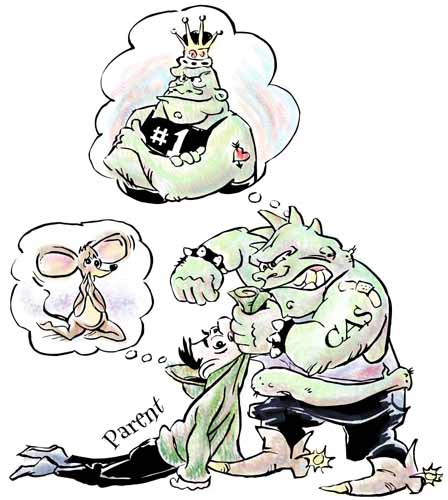
Lawyer Loses Daughter
November 8, 2007 permalink
What should a father do when he sees two women roughly treating his baby daughter? Apparently taking the baby from them by force and leaving is not the correct response. British lawyer Jonathan Phillips has lost his daughter and she will be placed for adoption. This case acts as well as a warning to lawyers: we are more powerful than you, and if you cause us trouble, we will take your children. Remember that the next time you wonder why a lawyer fails to provide effective representation in family court.
expand
collapse
The Daily Mail, 08/11/07
Solicitor jailed for snatching own baby daughter from social workers
By ANDREW LEVY
A solicitor who snatched his baby from two care workers before going on the run has been jailed for 20 months.
Jonathan Phillips, 40, punched the two women, one of whom was heavily pregnant, before grabbing his daughter and speeding away in his car.
The child had been taken into care because of concerns over his wife's mental health - although the couple insist she does not present a risk.
 Regret: Solicitor Jonathan Phillips will spend almost two years in prison and may not be allowed to see his daughter until she is 18
They were allowed to visit their daughter for two hours every day at a family contact centre in King's Lynn, Norfolk. But Phillips lashed out because he felt staff were treating her too roughly.
He shouted, "Take your hands off my baby" before overturning a table, attacking the women and seizing his child, who was four months old at the time.
Phillips, a soldier in the Territorial Army, fled with his wife Erica and the child, who cannot be named for legal reasons. They were stopped on the M6 near Birmingham later the same day.
Phillips, of Downham Market, Norfolk, was sent to prison after admitting kidnap and two charges of assault causing actual bodily harm.
Before he was sentenced he said: "I was acting under extreme provocation. Social services had taken our baby into care under dubious circumstances and whenever we visited her, the staff handled her roughly, overfed her and generally ill-treated her.
"I lashed out in the heat of the moment. I could see my family crumbling before me.
"Now the tragedy is that she looks set to be adopted and we will not be able to see her again until she is 18."
 Wife: Erica Phillips was deemed mentally ill by social services - the couple deny this
Norwich Crown Court heard that Norfolk County Council gained an interim care order in May to place the child in foster care because of Mrs Phillips's mental health. The couple say they have independent evidence showing she was capable of looking after her baby.
Mark Shelley, defending, said Phillips was "a well respected and popular solicitor".
"It was not a planned snatch," he said. "It was a culmination of emotions as he could see his daughter slipping away from him."
The court heard the two care workers suffered cuts and bruises during the attack in August.
Phillips was jailed on Tuesday for 12 months for kidnap and eight months to run consecutively for the assaults.
"These are extremely serious charges and I cannot see them in any other light," Judge Paul Downes told him.
Mrs Phillips, a qualified cardiology nurse, said afterwards that staff at the contact centre were rude and would go out of their way to upset them. She added: 'My husband is a decent man and a kind and loving father and had no criminal convictions before this.'
Norfolk County Council said the sentence sent out a strong message that violence against its staff was unacceptable.
Source: Daily Mail (UK)
Nobody Responsible for Mother's Death
November 7, 2007 permalink
The death of Sally Clark has been ruled accidental. Two of her three children died in infancy, for which she spent three years in prison as a double baby killer until exonerated by the courts. She never recovered. In the face of the obvious evidence that she drank herself to death, the ruling of accident spares the family the embarrassment of admitting that it was suicide, and spares the child protection apparatus the greater embarrassment of admitting that they killed her.
expand
collapse
Wrongly-jailed Sally Clark died from drink
By Matthew Moore, Last Updated: 1:55pm GMT 07/11/2007
A solicitor wrongly jailed for murdering two of her children died of acute alcohol intoxication, a coroner ruled today.
Sally Clark, 42, had so much alcohol in her blood when she died that she would have been five times over the drink-driving limit, post mortem tests showed.
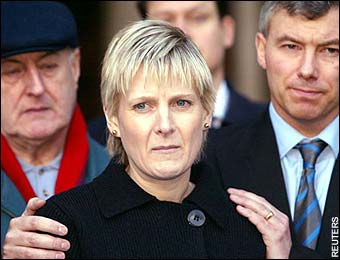 Sally Clark's convictions were crushed by the Appeal Court
Coroner Caroline Beasley-Murray ruled today that Mrs Clark's death was accidental, and said there was no evidence that she intended to commit suicide.
Earlier the hearing heard that Mrs Clark had been receiving treatment for "serious psychiatric problems" since the trauma of her court cases and time in prison.
"These problems included enduring personality change after catastrophic experience, protracted grief reaction and alcohol dependency syndrome," the coroner's officer told the hearing.
Mrs Clark's body was found in bed by her cleaner at her home in Chelmsford, Essex in March this year.
"There has clearly been a most tragic history leading up to Mrs Clark's sad death," the coroner said. "The court's hope is that Mr Clark and the family will be able to treasure all the happy memories they have of Mrs Clark."
Mrs Clark was in prison for four years largely as a result of discredited evidence from the paediatrician Prof Sir Roy Meadow.
She had been accused of smothering her sons Christopher, who was 12 weeks old, and Harry, who was eight weeks old. Her conviction was subsequently quashed by the Court of Appeal.
Today a spokesman for her family said Mrs Clark had never been able to come to terms with the false accusations made against her.
"Having suffered what was acknowledged by the Court of Appeal to be one of the worst miscarriages of justice in recent years, it is hardly surprising that her ordeal culminated in the diagnosis of 'enduring personality change after catastrophic experience', 'protracted grief reaction' and 'alcohol dependency syndrome' and that she was never able to return to being the happy, kind and generous person we all knew and loved," the spokesman said.
"The hope is that some good may come out of the tragedy of her untimely death and that a sense of balance will be restored which will not only protect infants but also their innocent parents."
Mrs Clark was charged with murder following the sudden death of Harry in Jan 1998. Fourteen months earlier, her first child Christopher had died suddenly at home and when Harry died, medical staff called in the police.
The convictions were quashed after the Appeal Court was presented with a medical report discovered by her husband Stephen in November 2001, which showed the presence of the staphylococcus aureus bacteria in Harry's central spinal fluid.
In addition it revealed the presence of a higher than average white to red blood cell ratio and polymorphs - cells which fight infection. All suggested that Harry, rather than being the victim of a non-accidental death, could have been suffering from a rare form of meningitis.
Source: Daily Telegraph
Blame Dad
November 7, 2007 permalink
Kevin Fox was not involved with child protective services, but was still one of its victims. Child protectors have fostered a culture targeting parents, especially fathers, as the worst danger to their children. Mr Fox's three-year-old daughter Riley was raped and murdered, but police, following the anti-parent culture, blamed dad, and even forced him to confess to the crime. In the news article, the exculpatory evidence is postponed until the end.
expand
collapse
Riley Fox's dad set to get his day in federal court
RIGHTS VIOLATED FOR 'CONFESSION'?
November 6, 2007, By KIM SMITH STAFF WRITER
CHICAGO -- Kevin Fox's civil rights lawsuit is scheduled to begin at 10 a.m. today in U.S. District Court.
The lawsuit was initially filed in November of 2004 and lists former Will County State's Attorney Jeff Tomczak; a jailer; a county social worker; six detectives; and a polygraph examiner with conspiring to coerce Kevin Fox into adopting a fabricated tale of how he killed his daughter, Riley.
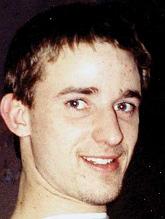 Kevin Fox
U.S. District Judge John W. Darrah has denied all motions to dismiss the civil suit, including the latest one this past September. A trial date of Nov. 5 was set and recently changed to Nov. 6.
"It could take as long as Wednesday before a jury gets selected," said Will County Sheriff's spokesman Pat Barry. "Personally, I think it may not go. There have been talks of settlements."
Around 8 a.m. on June 6, 2004, Kevin Fox reported his daughter missing from their Wilmington home. He told police he had picked up Riley, 3, and her brother Tyler, 7, from their grandparents' home late the night before after attending a concert. His wife, Melissa Fox, was spending the night with friends planning to participate in the Avon Breast Cancer Walk.
The news spread and in hours hundreds of volunteers scoured the area in an attempt to find the missing child. Her body was found that afternoon in Forked Creek nearly four miles from her home.
Kevin Fox was arrested and charged with her murder following a 14-hour police interrogation in October 2004.
Reportedly, he broke down and told authorities he accidently killed Riley when he struck her head with the bathroom door. In his panic, he tried to make her death look like an abduction and sexual assault before dumping her body into the creek.
Later, Kevin Fox said he gave the statement after being misled into thinking he would be charged with involuntary manslaughter instead of first-degree murder. He also said he was threatened and denied access to a lawyer as investigators screamed at him and vowed to see that he was sexually assaulted in prison if he did not give a statement saying he was involved in his daughter's death.
Kevin Fox spent eight months in jail until DNA evidence showed samples recovered from Riley's body were not his.
Kevin Fox is represented by attorney Kathleen Zellner of Naperville. Scott Panek, Zellner's office manager, said it is possible that the jury could get picked today with opening statements to follow either in the afternoon or on Wednesday.
"I am almost sure," Panek said.
Reporter Kim Smith can be reached at (815) 729-6067 or at ksmith@scn1.com
Source: (Chicago) Herald-News
Beyond Repair
November 7, 2007 permalink
The Baltimore Sun reports on the experience of Bill Grimm, who sued the state of Maryland and forced them to implement improvements to their foster care system. Three decades later the system is just as bad.
Among families victimized by the foster care system, the most popular suggestion for reform is a class-action lawsuit. The Grimm case shows the futility of achieving reform through the courts. As long as money gushes into the foster care agencies for each child they take, they will find ways to corrupt the police, courts, doctors and group homes to keep the money flowing. The system can only be cured when legislatures get the courage to cut off the money supply.
expand
collapse
baltimoresun.com
Decades later, and foster kids still suffer
Jean Marbella, November 6, 2007
Bill Grimm was in his mid-30s when he filed a civil rights lawsuit in 1984, charging widespread mistreatment of children in foster care in Baltimore. The suit was settled four years later with the state agreeing to vast, systemwide improvements, and Grimm went off to a California-based national advocacy group to fight similar battles elsewhere, thinking his work was done in Maryland.
Well, not so fast.
Today, Grimm is 58. Suits he has filed against other states have been tried and resolved. He can cite foster care reforms he's helped push in states from Washington to Utah to California. He's even seen one governor he tangled with in Arkansas go on to become president, and now, that governor's wife is running for that office as well.
And how about back in Maryland, the first state in which he tried to help these most vulnerable children, taken from their own homes because of abuse or neglect and at the mercy of the state to place them in safe homes?
"Virtually every aspect of the system is deficient," Grimm said flatly when I reached him yesterday at his office at the National Center for Youth Law in Oakland, Calif.
As Lynn Anderson reports in The Sun today, lawyers for the children went to federal court yesterday to detail - in more than 400 sometimes-heartbreaking pages - how the state continues to fail foster kids. Some are sent to homes where they are abused. Others are bounced from facility to facility. Caseworkers aren't always visiting them monthly, as required, to monitor their well-being. Even the basics - like getting them medical and dental care, or enrolling them in school - prove a challenge for the state and city social services agencies.
In other words, some of the same problems that prompted his lawsuit in 1984 remain, some of the same problems that the state pledged to remedy in the 1988 consent decree that settled the suit.
"We can't expect an agency to change overnight," Grimm said.
Or two decades, for that matter.
"It's amazing these things are still going on," he said.
Grimm was called back to Maryland last summer - he grew up in Kensington and got his undergraduate and law degrees from the University of Maryland - to help with what he calls "intense" negotiations with the state to bring this long-running issue, finally, to true resolution.
"That went nowhere," he said.
Grimm's praise for the lawyers keeping the fight going - including Mitchell Y. Mirviss, who worked with Grimm at the Maryland Legal Aid Bureau to file the initial lawsuit and now is a partner at Venable, and Rhonda Lipkin, of the Public Justice Center - is matched only by his disdain for the agencies and political leaders who have failed to live up to the consent decree that mandated reform.
"There's a lack of sustained will to make change happen," he said. "How many administrations have come and gone and paid lip service to the consent decree?"
Grimm said that the occasional death of a child in foster care will spark outrage and a flurry of promises to fix the system. But, eventually, even those tragic events fade and everyone moves on - because foster children are far from the most powerful of constituencies.
"Where's the political fallout? These kids do not vote. Their parents probably do not vote. These people are from poor neighborhoods. They have no lobbyists," Grimm said. "Frankly, it's pretty easy for politicians to push this aside, except for the occasional sound bite - 'these most needy of children.'"
The problems are deep and beyond the quick fix, Grimm said: Social workers can have too many cases to juggle, kids are often sent to live in group homes rather than with a family, there aren't enough people willing to be foster parents.
"There's a long-standing neglect of foster parents. They are not being supported," he said. "And they're your best recruiters of other foster parents, so if they're not getting the support they need, they're not bringing in new people."
It baffles him that Baltimore's social service agencies have not been able to tap into the city's wealth of great medical and mental health institutions for help. "We've litigated cases in rural areas of Nevada where there were no mental health services, or even medical services," Grimm said. "For an urban area not to be able to pull together the resources to support these children - it's inexcusable. Baltimore should be an example for the nation."
While change hasn't come as quickly as he imagined when he first negotiated the consent decree, he doesn't regret filing the suit. And he still has hope, although maybe not as much as he started out with.
"There are other systems that have made improvements," he said. "They're not perfect; there are no perfect systems. But it's not impossible."
jean.marbella@baltsun.com
Source: Baltimore Sun
City's foster care is faulted
Monitors' lawsuit contends Md., Baltimore not carrying out reforms ordered in 1988
By Lynn Anderson
Sun reporter
November 6, 2007
Baltimore foster children are still being sheltered at a state office building and still missing medical and dental appointments, according to lawyers charged with monitoring a long-standing court decree on care for these children.
In a more than 400-page document filed yesterday in federal court, the lawyers say the state Department of Human Resources and Baltimore's Department of Social Services have persistently failed to comply with a 1988 agreement that called for swift reform in the care of foster children.
Attorneys say that as recently as Oct. 27, a 14-year-old boy in foster care stayed overnight in a state office building on Gay Street in Baltimore and that caseworkers are still too slow to enroll children in school. They say some caseworkers fail to make regular visits to children to ensure that they are well.
"A generation of children, literally tens of thousands of abused and neglected children, has lived in the foster care system since [the consent decree] without receiving the court- ordered services and protections that [the state] agreed to provide," lawyers Mitchell Y. Mirviss and Rhonda Lipkin contend in the document charging the state with contempt of court. "Baltimore's abused and neglected children are entitled to better treatment than this."
State officials must respond to the contempt filing, and a federal judge is expected to consider the allegations. Mirviss and Lipkin hope the judge will appoint a full-time monitor who will follow up on the state's efforts to improve foster child welfare in Baltimore. Such a system has worked well in other states, including Alabama and Utah, they said.
Human Resources Secretary Brenda Donald, who has been in the post for less than a year, said she knew the court action was coming - she had been warned in writing by Mirviss and Lipkin as required by law several months ago. Still, she said she was disappointed that they couldn't wait a bit longer to see whether her initial reform efforts could produce improvements.
Donald's agency recently joined with the Annie E. Casey Foundation to study successful foster care programs in other states and try to replicate them in Maryland. And for the first time yesterday, Donald met with leaders at Baltimore's social services headquarters, including director Samuel Chambers Jr., as part of a new effort called Baltimore ReBuild that she hopes will speed reforms. Chambers also has tried to enact changes during his nearly three years in the position, including creating community centers in several city neighborhoods to reach families in need of counseling and other services.
"This is a 19-year-old lawsuit, and I have only been here nine months," said Donald, who was appointed by Gov. Martin O'Malley this year. She oversees the Baltimore social services office because it is part of the state's human resources network. "We've been making such great strides, and I think there is clear evidence that the central [DHR] office is taking Baltimore very seriously," she said. "We are bringing a large number of resources to the city."
Donald said children are staying at the state office building on Gay Street for a few hours at a time, not days on end as in the spring of 2005 when The Sun first reported that children were sleeping on floors and chairs. She said there are regular reports on the children who stay at the office - which is staffed 24 hours a day - and that those reports are shared with child advocates. In October, 45 children stayed at the office for an average of 1.9 hours, Donald said.
"I believe that the Gay Street situation has been resolved," Donald said. "Certainly, it is an overnight placement office and sometimes children come in in the middle of the night, but they are not staying there for long periods of time."
Mirviss and Lipkin acknowledge that Donald - a former deputy mayor for children, youth, families and elders in Washington - has brought new energy to the agency. However, they said they had heard too many unfulfilled promises since the lawsuit was first filed to wait any longer for evidence of improvements.
"We're at a crisis point," said Lipkin, whose position with the Public Justice Center in Baltimore is funded by legal fees paid by the state out of the consent decree. "What's unfortunate is that we've been at a crisis point for quite a while."
Lawyers used the Freedom of Information Act, which guarantees public access to certain documents, to force the state to let them examine files of numerous foster children in the city. A review enabled attorneys to document a history of unsuitable foster home placements - including an over-reliance on expensive, group home facilities - as well as failure by the state to ensure basic medical and dental care to some children.
In one case documented by the lawyers, city social services case workers allowed a 13-year-old girl to live with a family friend who "drank [alcohol] and physically abused her."
In another case, the agency moved a 14-year-old boy with psychiatric problems to 11 group homes in as many months. As a result, according to court documents, the boy's mental condition deteriorated and he had to be placed in an expensive therapeutic facility.
Mirviss, one of several Baltimore attorneys who represented foster children when the class action lawsuit was filed in the 1980s, said he believes that in some ways the city's system is in worse shape now than 20 years ago.
The attorney said he is worried about the large decrease in the number of foster families in the city - a situation that has been worsened by the agency's decision six years ago to cut day care subsidies to foster families. According to information Mirviss obtained from the state, the total number of foster families in the city has dropped by more than 55 percent - from 3,000 in 2001 to about 1,330 this year.
Donald said her department plans to reinstate day care subsidies for foster families early next year.
But in the meantime, the drop in foster families has meant that officials have had to rely more heavily on group homes, which charge the state up to $60,000 a year per child. Foster families receive a subsidy rate of $735 a month, or about $8,820 a year, Mirviss said.
Group homes often are not the best living situations for foster children, many of whom have been sexually abused or have emotional problems, Mirviss said.
"The system is not providing good outcomes for these kids," he said, adding that while reading some of the foster care files he felt heartbroken and angry. "The children who remain in care aren't getting the services they need to become independent, functioning adults."
lynn.anderson@baltsun.com
Source: Baltimore Sun
Quote of the Week
November 5, 2007 permalink
When Ronnie Nauls spoke to the oldest of his three daughters in foster care, the five-year-old told him: "Daddy, we're ready to come home now, we promise to be good." The family was broken up for using and selling marijuana for medical purposes, acts legalized in California by a referendum in 1996.
expand
collapse
The Federal War on Marijuana Becomes a War on Children
2007-09-10
By Dan Bernath
Automatic weapons. Check. Helicopters. Check. Dogs. Check. Bulletproof vests. Check.
You may not buy the government's characterization of its campaign against medical marijuana patients as a "war on drugs," but increasingly violent, militaristic tactics in recent months offer a troubling glimpse into the federal law enforcement community's mentality: To them, this is war.
Raids on medical marijuana dispensaries throughout California July 17 by federal Drug Enforcement Administration agents, often with local law enforcement officers in tow, seemed designed to send a clear signal that the feds were deliberately escalating their war on medical marijuana patients.
The enemy, then, are people like Ronnie Naulls, a Riverside medical marijuana patient who owned two of the dispensaries raided that day.
A church-going family man who used medical marijuana to ease chronic pain from injuries sustained in a 2001 car accident, Naulls already had two successful businesses – one as an IT consultant and another as a real estate property manager – when he established the Healing Nations Collective to save fellow Corona patients the hours-long drive to Los Angeles for medicine.
By all accounts, Naulls ran his collectives with exemplary scrupulousness. He maintained strict dress codes and professional standards for all employees. He paid state taxes on the dispensaries – amounting to several hundred thousand dollars a year – even when loose tax regulations allowed other dispensary owners to slip through the cracks. Profits from the dispensaries went to local and national cancer organizations.
Nevertheless, at 5:50 a.m., July 17, Naulls' home and businesses were invaded by DEA agents armed with shotguns, automatic rifles – even helicopters. They seized everything he owned: His businesses. His property. All of his accounts.
But that wasn't the worst of it. County child protective services came along on the raid and took Naulls' three daughters, aged 1 to 5, and charged him and his wife with child endangerment. They weren't even accused of breaking any state laws.
When Naulls spoke to his children in their foster home, the oldest said, "Daddy, we're ready to come home now, we promise to be good."
Of course they were too young to understand that they were victims of the strong-arm tactics of drug warriors whose goal was probably to make Naulls regret helping fellow patients receive their medicine in a safe, compassionate environment. Who cares if that means ruining a family financially, imprisoning the parents, and traumatizing the children?
Federal drug warriors have shown no sign of letting up since then, as dispensary raids have continued steadily in California and Oregon. The DEA has even found creative ways to open new fronts in its war by threatening to go after landlords who lease property to licensed dispensaries.
[ paragraphs not relating to Naulls omitted ]
Those wishing to contribute to the Naulls family's legal defense fund can do so at http://www.green-aid.com/defensefunds.htm
Dan Bernath is the Marijuana Policy Project’s assistant director of communications, www.mpp.org. Email him at dbernath@mpp.org.
Source: High Times
Blame Mom by Proxy
November 5, 2007 permalink
Diana Owen took her sick baby to the hospital repeatedly. Instead of finding the problem with the baby, the doctors diagnosed the mother with Munchausen Syndrome by Proxy and social services put the baby in foster care. It is a convenient way for doctors to dispose of difficult cases. Even after the baby's symptoms persisted in the foster home, child protectors continued to harass the family for a year.
The article says Munchausen is rare, but goes on to say that one hospital reported ten cases in a year. Multiply that by the number of hospitals to see that accusations of Munchausen are not at all rare.
The American elite press is now following the British press and reporting on child protection from the innocent parent's point of view. The Boston Globe is owned by the New York Times.
expand
collapse
 Diana Owen of Fall River shared a playful moment with her infant daughter, Bryanna-Rose. (Michele McDonald/ Globe Staff)
A mother's battle to be believed
After diagnosis, woman fights doctors and DSS for daughter
Diana Owen had not slept in days when the hospital staff summoned her to a meeting down the hall from her baby's room.
Four-month-old Bryanna-Rose had spent more than a week in Hasbro Children's Hospital in Providence for tests and observation. Owen had told doctors her daughter's projectile vomiting was getting worse, the contents of her stomach drenching her mother's clothes. While sleeping, the mother had said, the child sometimes skipped breaths. Owen worried that her only child might die of an undiagnosed condition.
But some doctors and nurses had dismissed her as a jittery first-time mother, she recalled. One nurse had rolled her eyes when Owen worried aloud, she said. Owen had responded angrily, telling some staff she used to work as a health aide and was not overreacting.
"I do not have New Mom Syndrome!" she once snapped.
As the 38-year-old mother from Fall River walked into the meeting room on June 26, 2006, Owen noticed all eyes on her.
A half-dozen people, seated in a lounge area, announced their conclusions: Bryanna-Rose had no symptoms if her mother was out of the room. The child would remain in the hospital without Owen present. The baby would be placed into the protective custody of the Massachusetts Department of Social Services.
Owen came to the chilling realization that she was being accused of making up - or even intentionally causing - her daughter's ailments. From her healthcare background, she had heard of the diagnosis the doctors pinned on her: Munchausen by Proxy, a rare mental disorder in which caretakers fabricate or induce illnesses in their children to gain attention from doctors.
She could not believe it. She knew some medical staff had seen her daughter's symptoms - and taken notes. Through sobs, she pleaded, "You can't take my baby!"
Owen was escorted by security out of the hospital. As she left, she kept telling herself: I will get my baby back.
This marked the start of one mother's odyssey to prove her sanity, a task that would require painstaking persistence as authorities clung to their original judgment of her. It is a case where hunches about Owen's mental state rapidly escalated into near-certain conclusions, and contradictory evidence was ignored, medical records show. On multiple occasions, hospital staff recorded seeing the very symptoms that Owen was accused of fabricating, yet they continued to disbelieve her.
In the coming months, even when three mental health specialists would question the agency's assumptions about her, DSS would maintain its view that Owen was unfit to be alone with her child.
Hasbro and DSS officials defended their actions against Owen, saying they had a duty to protect a baby from a mother whose repeated false reporting about symptoms triggered unnecessary testing.
At the center is a loosely defined and disputed disorder. Some psychologists say Munchausen by Proxy is an underdiagnosed condition with serious, sometimes deadly, consequences. Typically, mothers are accused, their drive for attention so intense that some even poison their children. Many of these mothers have backgrounds in medicine, helping them fool doctors.
Other psychologists say the disorder - named after an 18th-century German baron who exaggerated his military exploits - is overdiagnosed and applied to mothers who simply clash with their doctors over the seriousness of their child's condition.
Eric Mart, a New Hampshire psychologist, has testified nationwide in defense of mothers accused of this disorder: "All you have sometimes is an overanxious Mom," he said.
A happy addition
Owen calls Bryanna-Rose her "miracle baby," conceived after she and her husband, Robert, assumed they would be childless. Owen suffered from polycystic ovarian syndrome, which often causes infertility. But after ovarian surgery a few years ago, Owen happily learned she was pregnant. On Feb. 16, 2006, she delivered a healthy baby in Orlando, Fla.
Owen had yearned for her own happy family. The youngest of 10 children, she has many bitter memories of growing up in a working-class family in Fall River. She remembers being sexually abused by a relative. In her 20s and having barely graduated high school, she supported herself through low-wage jobs. Her first marriage ended in divorce, and she was twice treated for depression. Marrying Robert, and having a baby with him, seemed too good to be true.
The euphoria over Bryanna-Rose's birth soon gave way to alarm over her frequent vomiting, with the baby's lips sometimes turning blue. She also seemed to skip breaths while sleeping. But doctors ruled out anything serious. In May 2006, with her husband busy finishing school to become a marine technician, Owen left him in Orlando to show off their daughter to relatives.
In Fall River, Owen's concerns about her baby grew. Twice, Owen and family members took the baby to the emergency room of nearby hospitals. Doctors said the baby had gastroesophageal reflux, a relatively harmless condition that she probably would outgrow. They suggested nonmilk formulas to reduce the vomiting and ordered follow-up tests, which came back normal.
On June 16, after Bryanna-Rose had an intense bout of vomiting, Owen's older sister suggested they drive to Hasbro's emergency room. Bryanna-Rose was admitted for yet more tests.
Early on, staff at least once witnessed projectile vomiting, and on another occasion blueness, or cyanosis, around the lips, according to medical records that Owen provided to the Globe.
On June 22, a nursing student also observed an episode of the baby "not breathing with eyes becoming red and becoming blue around the lips," though the student noted no troubling drop in blood oxygen levels.
Despite those notations, the medical staff on that same day began to raise concerns about Owen's mental state. Owen had reported that her daughter's eyes had become fixed for about a minute, prompting a neurological examination that found no serious problem. The three-page report on the exam ended with the suggestion that the problem might be with Owen: "(?) Munchausen by Proxy," it said.
The next day, Owen was asked to undergo a psychological evaluation. The staff member who questioned her said the mother presented an "inconsistent and fantastic history," including recounting heroic roles in aiding foster children and giving conflicting dates for past events.
Over the next few days, Owen was alternately open, then suspicious. At times, she angrily demanded to know why staff questioned her credibility, once telling a nurse she thought a skeptical doctor was an "ass." She initially concealed her past treatment for depression.
"Everyone is asking me a lot of weird questions," Owen told a nurse, according to the records.
Allegations of abuse
In fact, the hospital's child-protection program had opened a file on Owen, and on June 26, just hours before Owen would be escorted away, the staff filed a suspected case of "medical child abuse" with DSS. Of the 700 cases the hospital refers to state authorities each year, about 10 are related to Munchausen by Proxy.
Dr. Carole Jenny, director of Hasbro's child-protection program, said hospital staff treated Owen with respect, but over time, "we had reasons to believe we couldn't trust her."
Owen came under scrutiny when, on numerous occasions, she reported her baby having symptoms that "no one else" observed, said Jenny, who agreed to a Globe interview with Owen's consent. When told about records confirming some of the baby's symptoms, Jenny said they were considered "clinically insignificant."
Hospital staff also examined the baby's prior medical records, and concluded that a healthy baby was becoming the victim of many unnecessary tests.
After Owen left the hospital, however, Bryanna-Rose remained for 10 more days and continued to have symptoms, according to records. Hasbro staff recorded vomiting or mouthfuls of spit-up about a dozen times, as well as several occasions when they noticed the girl's lips were blue.
Yet the hospital's discharge summary for the baby said that, apart from what the mother reported, "no other episodes of apnea or vomiting were documented during her stay in the hospital."
On July 6, 2006, Bryanna-Rose was released from the hospital into the home of a foster mother.
Foster care stay
Staying with her sister, Owen was inconsolable. She kept replaying the day when she left the hospital without her daughter.
"It was the emptiest feeling I've ever had," she recalled.
The baby's stay in foster care, however, would prove a pivotal event. Days after being with Bryanna-Rose, the foster mother called DSS: "It's not the mother! This baby does have projectile vomiting!" she said, according to a psychiatrist's report.
Owen hoped the foster mother's observation would mean DSS would drop the case. Instead, two weeks after placing Bryanna-Rose in foster care, DSS released the baby into the joint physical custody of the father, who had abruptly quit his schooling in Florida to return to Fall River, and Owen's sister. The agency insisted that, at all times, one of them had to supervise Owen if she was with the baby.
Humiliating as this was to Owen, she was ecstatic to be living with Bryanna-Rose again. Still, with the family needing income, Owen assumed the role of breadwinner, piecing together part-time jobs as a health aide and a retail clerk while her husband cared for their daughter. Her sister's two-bedroom condominium became their cramped home.
DSS required Owen to undergo a psychological examination to gauge whether she was a fit mother, and in late summer, a psychologist interviewed her and found no basis to conclude she had Munchausen by Proxy. He noted, among other reasons, that most mothers with this disorder seek the medical staff's approval for their conscientiousness, while Owen had "alienated" many of them. Still, he advised DSS to get another opinion.
As the autumn leaves fell, the couple traveled with Bryanna-Rose to Arlington to see Dr. Lee Birk, a psychiatrist and associate professor at Harvard Medical School. Owen wore her best pair of black slacks and a brown shirt, hoping to impress Birk, who had warned her by phone that if he believed she abused her child, he would be her worst enemy in court.
Not long after entering Birk's corner office, the couple found themselves in a familiar scene: Bryanna-Rose threw up on the office floor. Birk watched the couple clean up after their daughter, impressed at how they "did not panic" and seemed to lovingly care for her, he recalled. After the visit, Birk interviewed Owen alone, talked to relatives, and reviewed DSS documents. The more he learned, he said in an interview, the more he thought the child abuse allegation "was ridiculous."
He concluded that Owen's belligerence was triggered when she felt disrespected but that she did not have Munchausen by Proxy. He noted that a Boston sleep specialist this year confirmed that Bryanna-Rose skipped breaths in her sleep, and though it was not serious, that her parents were right to be concerned.
Birk said authorities got an idea about Owen, and refused to let go.
"They weren't interested in finding the truth," he said.
Psychological testing
Last November, Owen saw a neuropsychologist, who concluded that her reasoning and communication skills fell in the "lower half of the average range" but that she had no significant limitations. Owen and her husband were hopeful that DSS would finally accept that she was a fit parent. But instead, the agency ordered Owen to sit through another psychological exam, by a Harvard specialist on Munchausen by Proxy.
On April 26, 2007, Owen's lawyer, James Harrington, fired off an angry letter to DSS.
He called its actions "truly shameful," and urged officials to get out of Owen's life instead of requesting "repeated evaluations until it gets an opinion that meets its interpretation of the facts."
The letter appears to have swayed DSS. On May 25, the agency dropped the supervision requirement, allowing Owen to be alone with Bryanna-Rose for the first time in 11 months, though DSS waited another four months to ask a judge to dismiss the case.
Although DSS believed its involvement with Owen's family had been appropriate, the agency "doesn't want to stay in people's lives forever," a spokesman said in an interview last month.
On Sept. 24, a juvenile court judge restored full custody of Bryanna-Rose to her parents. Sitting on a bench, Owen wept in relief.
The family plans to return to Florida, where Owen's husband hopes to resume his schooling and find a job in the boating industry. They have dozens of bills to pay, including thousands of dollars in medical costs not picked up by Medicaid.
As Owen watches over Bryanna-Rose, now an energetic and thriving 20-month-old, she remains bitter.
"It is myself and my family that will face the consequences of this nightmare," she said. "They did not treat my child or myself with dignity."
Patricia Wen can be reached at wen@globe.com.
Source: Boston Globe
Child Protector Arrested
November 3, 2007 permalink
A Nevada child protector, Shajuan Ashley Bush, has been arrested for leaving her infant child alone. Another news source gives her name as Shajuan Huff-Bush.
expand
collapse
Alyson McCarthy, Reporter
Woman Employed to Protect Children Arrested on Child Neglect

A county employee whose job it is to protect children has been arrested for child neglect. It's believed the charge is related to the employee's own infant.
Eyewitness News just confirmed new details with Clark County officials -- including the fact that the young woman who was arrested will not be allowed to return to work pending the outcome of the investigation.
County officials say 24-year-old Shajuan Ashley Bush was arrested Thursday and booked into the Clark County Detention Center on a charge of child neglect.
The public information officer for the Clark County Department of Family Services confirms that Bush was an employee of that department when she was arrested. Her official position was family services specialist.
While we do not know what her specific job duties included, we do know she was not an investigator for Child Protective Services. We also know that the child Bush is accused of neglecting was not under the care of the county and was likely her own child.
A source familiar with the investigation tells Eyewitness News that a maintenance worker had entered Bush's apartment Thursday afternoon to make repairs and discovered a 3-and-a-half month old infant alone inside the apartment. County officials say that child is now safe, unharmed and in protective custody.
Shajuan Bush is scheduled to make her first appearance in Justice Court Saturday morning.
Source: KLAS-TV Las Vegas Now
Fran Lyon on TV
November 3, 2007 permalink
Fran Lyon, the British expectant mother condemned prenatally to lose her baby, has appeared on British TV with her champion, British MP John Hemming. Since the baby does not legally exist, it is impossible for the courts to issue a gag order. When the baby is born, we can expect an immediate gag order, shutting the mother up for eighteen years. There is a copy of the program on the website Family and Social Services Information Team (wmv, 45 megabytes). We regret that it has less than the usual audio quality. Since it may disappear with the gag order, we have a local copy.
Parentless Girl(s) Assaulted
November 2, 2007 permalink
A man, Allan Lewis, has been arrested for sexual assault on a girl, or girls, in a foster home. Being a foster home, the girls did not have a father to guide them through puberty, or chase away unwanted suitors. The article also reminds pedophiles of job opportunities placing them near lots of vulnerable girls.
expand
collapse
Man, 67, charged in foster home sex assault
Nov 02, 2007 09:03 PM, Sarah Boesveld, Staff Reporter
A Toronto man was arrested after a young woman told police she was sexually assaulted in a foster home.
The assaults are alleged to have taken place in an apartment in the East Mall and Burhamthorpe Rd. area, which police say has operated as a foster home for nearly 25 years.
Police believe there are more victims.
Allan Lewis, 67, faces one charge of sexual assault and one charge of sexual interference.
Anyone who has contact with Lewis and may be a victim is urged to contact Det. Const. J. Watson or Det. Const. Wolfe at 22 Division Youth Bureau at 416-808-2205 or Crime Stoppers anonymously at 416-222-TIPS or online at www.222tips.com.
Source: Toronto Star
child 00046 (male)
November 1, 2007 permalink
A British Columbia foster boy identified only by his number, 46, presented evidence in the inquest into the death of Savannah Hall. According to his testimony his foster mother hit him over the head, give him cold showers, starved him for four days, bit him and washed his mouth out with soap. He kept quiet out of justified fear of the foster mom, who later used deadly force against another child.
His silence illustrates an important truth. When children complain about abuse, it is mild abuse. Victims of severe abuse have to remain silent.
expand
collapse
Foster child complained about treatment in care
Neal Hall, Vancouver Sun, Wednesday, October 31, 2007
PRINCE GEORGE -- A jury at a coroner's inquest heard shocking allegations Tuesday from a former foster child who said he was struck over the head with a wooden spoon so hard it broke, he was put in cold showers fully clothed as punishment and sometimes went without food for four days in a local foster home.
The allegations were in a statement by the child, identified only as Child 46 to protect his identity, which was read into the record by coroner's counsel Chris Godwin.
The child had complained about his treatment in the foster home of Patricia Keene, who also looked after three-year-old Savannah Hall, who was rushed to hospital on Jan. 24, 2001, and died two days later after being transferred to B.C. Children's Hospital in Vancouver.
The inquest into Savannah's death has heard how the boy's complaint was received by a social worker and an investigation was ordered Nov. 28, 2000, but it wasn't carried out until Savannah became gravely ill.
Usually an investigation would be launched within a day for a serious allegation and should be completed within 30 days, but the standard of the Ministry of Children and Family Development wasn't met in this case.
Former ministry social worker Katrina Ludwig testified she was assigned to investigate the allegation of abuse and neglect, but she sent an e-mail to her supervisor on Dec. 4, 2000, saying she was too busy.
Another social worker wasn't assigned to investigate the boy's complaint until Jan. 25, 2001, and the boy was interviewed the next day. The inquest was told the boy had put a blanket over his head while he was being interviewed.
The boy, then in Grade 7, said he and his sister were both mistreated in the Keene foster home. He said Pat Keene would hit him on the head, hands and feet with a wooden spoon if he didn't do his chores.
"She hit me so hard on the head, it [the spoon] broke," the boy recalled, adding his sister was also hit with the spoon.
He said he would be put in a downstairs bedroom that had no windows and a bed with no blankets .
Pat Keene also gave the boy and his sister cold showers as punishment, he said, recalling he was sometimes pushed in the shower fully clothed.
He also had his mouth washed out with soap if he didn't speak loudly enough to be heard, according to the statement read in court.
He said he once bit Pat Keene while she was putting soap in his mouth and she bit him back, advising him she could bite twice as hard.
He said he didn't want to tell anyone because he thought his foster mother would get angry at him.
Coroner Scott Fleming warned the jury of five women to use caution in assessing the statement of a child, who did not attend court to be cross-examined.
The inquest also heard the testimony of Robert Watts, the regional director of child welfare in the northern region, who outlined a series of changes to the ministry made after Savannah's death.
He said there used to be one director of child welfare for B.C., based in Victoria, but now directors are assigned to regions to oversee child protection.
Peter Grant, the lawyer representing Savannah's birth mother, Corinna Hall, at the inquest, asked Watts whether the investigation of Child 46 would "fall through the cracks today" as it did in 2000.
Watts said ministry staffing levels had improved in the north since 2001, and there are more team leaders to supervise smaller groups of front-line social workers.
"I think the system we have now is better than we had before," he said, but added under further questioning that he couldn't give an absolute guarantee the system would protect all children.
Watts agreed with Grant that the ministry is the guardian of children in foster care, who deserve protection.
"We are the guardians of these children and we owe them a very high standard of care," he testified.
The inquest is expected to hear the testimony of the foster mother today.
Earlier Tuesday, a doctor who examined Savannah Hall at B.C. Children's Hospital before the child died, testified she was concerned about bruising on the child and the fact that there was massive brain swelling.
"I was concerned about the location of some of the bruises," Dr. Jean Hlady, one of the province's top experts in child abuse, recalled.
Hlady said she examined the girl on Jan. 25, 2001, a day after she had been admitted to the emergency department of the hospital in Prince George.
After the child was transferred to Children's Hospital in Vancouver, Hlady interviewed the foster mother, who reported the child had had a mild cold, had fallen twice the day she was admitted to hospital, and wasn't feeling well, so was put in bed early.
Hlady recalled the child was initially admitted to hospital with massive brain swelling, was comatose, had a very low temperature and a low salt level.
"The history I was given didn't add up," the doctor recalled.
The child was determined to be brain-dead and life support was discontinued on Jan. 26, 2001, and the child was declared dead when her heart stopped, Hlady said.
(The girl's birth mother, who was in court for the testimony, wiped tears from her eyes as the doctor described the end of the girl's life.)
Hlady said she was still puzzled by the case to this day.
The inquest, now in its second week, is trying to determine the facts surrounding the little girl's death and has heard that the ministry had received a series of allegations about mistreatment of foster children in the home.
The inquest jury is expected to make recommendations to try to prevent a similar death.
nhall@png.canwest.com
Source: The Vancouver Sun
Families Trashed
November 1, 2007 permalink
Child protectors in Alberta have bullied parents and the media into keeping quiet about the names of protected children, even dead ones. Now lax record handling by a social worker has exposed the records of many families to public view in a dumpster.
expand
collapse
October 31, 2007
Private details in dumpster
Government documents found by bottle picker
By BROOKES MERRITT, SUN MEDIA
 Sun Media reporter Brookes Merritt holds some of the hundreds of sensitive provincial government documents that were found in an Edmonton dumpster yesterday by a bottle-picker. (Jason Franson, Sun Media)
Personal information about local foster parents - including driver's licences, health-care numbers, and even a social worker's private notes on how kids were being raised - turned up in an Edmonton dumpster yesterday, free for the picking.
In fact, it was a bottle-picker who found them.
Kevin, 51, was checking his daily "trapline" of dumpsters east of NAIT yesterday morning when he hit what he called an identity-theft jackpot: hundreds of government documents containing the entire lives of foster families from Morinville, Stony Plain, Spruce Grove and other areas.
"It's the kind of stuff that should be locked up or shredded," said Kevin, who didn't want his last name printed.
One of his own kids is currently in foster care.
"It could have been me in these files. It could have been my daughter. These people must really be hoping that nobody else got to this information before I did. This is the kind of information that could enable the wrong kind of person to track down a kid," he said.
After stumbling across one bulky folder in the dumpster, Kevin called Sun Media.
A reporter joined him and they returned to the dumpster at 11908 105 St. to recover a second folder and countless other documents.
The folders and documents belonged to Joan Conibear, a social worker with the Spruce Grove Child and Family Services Centre.
Police said the files were stolen Friday from Conibear's van at the Chateau Louis Hotel, where she was attending a work function.
Conibear cried yesterday after learning the documents had been located.
"I've hardly slept since then. I called the police immediately and reported it ... I've been so worried," she said.
One of the parents whose information was recovered is worried about her case file having turned up in a dumpster.
"Those files are supposed to be sealed. I was under the impression they weren't to ever leave the government offices," she said. "Who's to say someone hasn't already taken the information they need from these documents (to steal an identity)?"
Guy Quenneville, a case worker and union steward at the Spruce Grove centre, said it's not the first time such an incident has taken place.
"On paper this stuff is supposed to be kept under lock and key, but the reality is we bring our work home with us. If a family needs to meet a case worker after hours, we grab their file and meet them."
Child and Family Services spokesman Cheryl Oxford said the people whose information was compromised are being contacted.
"The protection of people's personal information is of vital priority for us," she said. "Due to the nature of this work there are times when information may be travelling in a person's vehicle. In this case a vehicle was broken into."
FILES FROM CHILDREN'S SERVICES
Here is some of the information included in Alberta Children's Services documents found in an Edmonton dumpster:
- Allegations of sexual misconduct and physical abuse in foster homes
- Details of investigations conducted by Children's Services
- Detailed behavioural assessments of foster parents and foster children
- Contact numbers for foster parents, foster children and case workers.
- Financial statements of foster parents
- Information about parents whose kids were seized by Children's Services
Source: Edmonton Sun