help
collapse
Press one of the expand buttons to see the full text of an article. Later press collapse to revert to the original form. The buttons below expand or collapse all articles.
expand
collapse
Swatters
February 28, 2008 permalink
Wired magazine profiles phone phreaks who use two techniques to disrupt their targets. One is to call police pretending to be in a home with a crime in progress. Spoofing the caller id fools the police into dispatching a SWAT team to the victim's home. The other? Call child protective services. The article is silent on the child protection outcomes, probably because of confidentiality laws, but it is more serious. The SWAT teams go away in 20 minutes after realizing their mistake. Child protectors don't. This one is too long to copy, read it on Wired: Teenage Hacker Is Blind, Brash and in the Crosshairs of the FBI.
Bereft Dad Attacks Child Snatcher
February 28, 2008 permalink
Let's get this straight: In Garner North Carolina Jerrica Culbreth broke his daughter's arm. That is not a crime. Then he assaulted social worker Susan Lee. That is a serious crime.
With the large number of children stolen without legal process, it is surprising there have not been more incidents of this kind.
expand
collapse
The News & Observer, Published: Feb 28, 2008 12:30 AM, Modified: Feb 28, 2008 05:48 AM
Man gets 10 to 12 months for attack on social worker
Sarah Ovaska and Sam LaGrone, Staff Writers
RALEIGH - A Garner man had been on the radar of Wake County officials before he walked into a social worker's office and beat her three weeks ago, according to Wake County officials.
Jerrica Culbreth, 28, pleaded guilty to assault charges Wednesday and was sent to state prison for 10 to 12-months.
He had told the mother of his child that he was going to kill social worker Susan Lee and had called Wake County Human Services to say he was coming by, Lee said. She said she knew none of that when she looked up from her cubicle Feb. 5 and Culbreth began punching her in the face.
"You are angry at me because I am the face of Wake County," she said in court. Culbreth had lost custody of his daughter a week before the attack because of a July incident in which his daughter's arm was broken, according to Lee, Wake Assistant District Attorney Jimmy Wilson and Culbreth's lawyer Deborrah Newton.
The staff knew that Culbreth was a danger, said Bob R. Sorrels, the deputy director for administration for Wake County Human Services.
"Some of our staff said his behaviors and his actions warranted us to be on our toes," Sorrels said.
Lee had hunks of hair torn out of her scalp, numerous punches to her face and body and was stomped to the point that Culbreth's boot left a print on her neck, Wilson said. She spent several days in the hospital and wore a neck brace to the hearing Wednesday.
Culbreth pleaded guilty to assaulting Lee and Dale McKee, a co-worker who jumped to her aid and pulled Culbreth off Lee, according to court testimony.
Both Lee and McKee said she could have been killed.
"If there wasn't any intervention, I don't think Susan would be here," McKee told Wake District Court Judge Jane Gray in court Wednesday.
Culbreth took responsibility for the assault when he pleaded guilty to habitual misdemeanor assault and simple assault, earning him a 10-month-to-one-year sentence in prison. He had two previous convictions for assaulting women. He was never charged in connection with his daughter's broken arm, Wilson said.
Culbreth urged his attorney to explain his motivation for the attack. Newton said Culbreth's daughter, of whom he previously had custody, broke her arm in July. Newton said her client broke it; Culbreth interrupted and said it was an accident.
After he officially lost custody of his daughter Jan. 31, a week before the attack, he became convinced that his young daughter was being assaulted while in the care of social services and thought social worker Susan Lee was responsible, Newton said Wednesday. But Wilson said Culbreth had shown up at his daughter's school and accused an assistant principal of the same thing.
He attacked Lee because he felt his concerns about abuse were being ignored, Newton said.
"In his mind, he was justified," she said. She added, "Sometimes you don't know what someone is capable of doing when they have no resort."
At the county building on Swinburne Street where the attack took place, social workers and other caregivers work with families dealing with foster care, child custody, abuse and neglect accusations as well other sensitive issues. The attack reignited security concerns among employees at the building, according to e-mail sent by county employees and reviewed as part of a public records request by News & Observer reporters.
"We have the ability to secure doors leading to main employee-work areas, but have not done so because of the cost involved," Gail Holden with Wake's Adult Services wrote in e-mail distributed to a number of Wake Human Services employees. "What if the gentleman who assaulted Susan had brought a weapon with him? The end result might have been much worse than it was."
Raleigh police responded to another assault at the Swinburne building in May, a report of child abuse, several larceny calls and one incident of indecent exposure. Hours before the attack, another child welfare social worker said a man in a parking lot of the Swinburne Street building grabbed her buttocks, according to e-mail by Warren Ludwig, the director of child welfare and mental health.
Ludwig also had correspondence Feb. 4 about a client of a Cary human services office who had repeatedly sent threatening e-mail to a social worker and who once showed up at county offices after hours and after a judge had ordered him to stay away. Ludwig asked that a security expert be sent out to the Cary office.
Since the assault, Wake County has assigned two sheriff's deputies to the Swinburne building. One is stationed on the first floor and the other on the fourth, where child services is located and where the assault occurred. Beforehand, a security station at the front was overseen by unarmed security guards and patrons easily walked by without being stopped or asked to sign in.
The county is also reviewing security procedures in the building and is installing electronic key locks to employee-only areas.
sarah.ovaska@newsobserver.com or (919) 829-4622
Source: The News & Observer (North Carolina)
Feminism Kills
February 28, 2008 permalink
Canada's Governor General, Michaëlle Jean, has spoken in defense of women suffering domestic violence. Persons occupying positions at the ceremonial level in government ordinarily avoid controversy, limiting themselves to combating hunger or eliminating landmines. By speaking, Mrs Jean is saying that feminism is beyond controversy. It should not be.
In another item in the news, Leatrice Brewer on Long Island drowned her three children after social services ignored complaints from their father Innocent Demesyeux. There was a nearly identical case in Ontario when mother Frances Elaine Campione killed her two children after social services took them by force from their father Leo Campione. An article in Newsweek interviews Cynthia Scott on the subject of how child protectors can save children in these cases. She is utterly clueless.
Ordinarily we support mothers as the best caretakers of their own children, but there is one strong exception — the vindictive mother on the warpath against her former husband, or the former man in her life. This kind of woman is familiar to everybody, and there is nothing new about it. Twenty five centuries ago Euripides wrote a play Medea in which the title character murders her own children to spite her unfaithful husband. It takes the blinders of feminism to keep social workers from seeing the pattern. Children of vindictive mothers are dying because there is no way to help them within the feminist paradigm. Only restoring respect for men and fathers offers any possibility of saving these children.
expand
collapse
Barbara Kay: Michaëlle Jean shouldn't take sides in the domestic abuse issue
Posted: February 27, 2008, 12:30 PM by Yoni Goldstein
Barbara Kay
By coincidence, on the very day that I published a column once again pointing out the myth of domestic violence as a one-way street of male abusers and female victims, I see in the Toronto Star that there was a conference in Kitchener, Ont., yesterday on violence against women, called "Communities Working to end Violence Against Women." (I suppose it isn't really a coincidence — there is probably a conference on violence against women somewhere in Canada every day of the year.)
My attention was drawn to this one because the guest of honour was the Governor-General. Michaëlle Jean said to the 1,000 people assembled that too often women don't admit their suffering: "We don't see them, we don't hear them, but they are there, taking the full brunt of the abuse."
I have several problems with that statement. First of all, it is not true that abused women are not heard or seen, as that very conference and a plethora of others make clear: Women's pain is bruited from the rooftops and every media outlet in the land. Second, it is not true that women are taking the full brunt of domestic violence. They are actually taking a little more than half the brunt. The irrefutable data on reciprocal partner violence has been available for many years (including from StatsCan), but have made no headway against the ideological forces that control the domestic violence agenda.
The other nearly half of domestic violence is being suffered by men. And we most certainly don't see or hear male victims of abuse, because nobody advocating for women on this file believes women abuse men except in self-defence. Even if they wanted to be seen and heard, unlike women, men have nowhere to take shelter, no conferences to address and no prestigious spokesperson to give credibility and exposure to their problems.
And that's my real problem here. The GG represents the Queen in Canada. She is not supposed to represent a "movement" or any identity group in particular. She is the representative of all the Queen's loyal subjects, and that means both men and women.
Before she became the GG, Jean was active in women's causes, and that's fine. But I don't think it is appropriate for her to manifest gender partisanship in her present role. I daresay she personally believes as firmly as most other feminists in the prevailing paradigm of women and children as the sole victims of domestic violence (the facts indicate that mothers, alone or in combination with men other than the child's father, are by far the greater threat to a child than fathers alone or with another woman), with men the sole initiators of violence.
Jean's active participation in these conferences is nevertheless incommensurate with her office. These conferences are highly politicized sites where hostility to men as a sex is openly expressed and tacitly condoned. Lending her presence to such an occasion is tantamount to identifying herself as an active political ideologue — even an activist — in a blatantly misandrist cause. Such partisanship would not be tolerated in a male GG. No double standards, please.
Source: National Post
Newsweek
Did the System Fail?
When a mother kills her three children, the obvious answer seems to be yes. But one expert says the resolution isn't so simple.
By Katie Paul, Newsweek Web Exclusive, Updated: 5:01 PM ET Feb 27, 2008
"It almost looked like they were cuddled up together for the night," said one of the police officers who found three dead children lying together on a bed in a Long Island apartment on Sunday, according to media reports.
The children's mother, Leatrice Brewer, 27, is now accused of drowning, stabbing and possibly poisoning her two sons, Michael Demesyeux, 5, and Innocent Demesyeux, 1, and her daughter, Jewell Ward, 6. Brewer calmly called 911 to alert police that she had killed her children, even spelling her name out for the operator.
Nine complaints about the family had been filed with Nassau County social services, but follow-up was only considered necessary for three of them. In the most recent instance, caseworkers visited the home twice last Friday to investigate a complaint by Jewell's father that Brewer might harm the children, but no one answered the door. The supervisor scheduled a return visit on Sunday, but by then it was too late. Brewer had been embroiled in a custody battle with both of her children's fathers; the father of the boys, Innocent Demesyeux, was arrested in June 2004 on an assault charge for allegedly beating Brewer.
So where and when did the system break down? Can child welfare officials do more, or are occasional tragedies simply inevitable, given their constraints? Cynthia Scott directs the Coalition Against Child Abuse & Neglect, a nonprofit that works with Nassau County officials to provide services and education to agencies handling abused children. NEWSWEEK's Katie Paul talked with Scott about what institutional problems may have led to the breakdowns and how they might be prevented from happening again. Excerpts:
NEWSWEEK: What institutional problems could have led to the breakdowns in this case?
Cynthia Scott: I think this is a really difficult case and difficult issue. I'm not suggesting there can't be changes to how we do business in protecting children, but they're really difficult cases that can often present in one way to a case worker and end up in reality being something else, which is, I think, what happened in this case. The struggle for CPS [Child Protective Services] is that it's a snapshot in time that workers get when they go out and see these families. They're also guided by very specific statutes in the law regarding what needs to be presented to them before they can make a decision to remove a child or make any other kind of major intervention.
What is the biggest problem facing caseworkers when they're handling cases like this?
They're limited in what they can do. Very often the public doesn't have good understanding of what they can and can't do. Yes, there might have been something else that could have been done in this case. However, living on Long Island and hearing the media reports saying, "Oh my God, they should have removed these kids," and the reality is you can't just remove kids. There need to be very clear things present that provide a worker the opportunity to present the case to a judge, who makes a final determination about removal. It's not as simple as people would like it to be. And CPS is required to make an assessment on a very minimum standard of care. They're not assessing optimal care for children. So what we would all like our children to have is not what the law requires of parents. They need to be fed, clothed, go to school, not be physically or emotionally abused. So if there are no bruises, no disclosure from the kids that there's abuse, and there's food in the house, there's heat in the house, there is a house—those are the basic things workers are looking for.
But they went out there quite a bit—nine times. How could that happen?
There were numerous reports made over the course of several years. I think there was some domestic violence in that family, which would certainly generate a report—and which would have nothing to do with how the mother was caring for the child. Knowing the cases we have here, you could go out there for different reasons at different times and not necessarily see anything that's so glaring that you're going to decide the kids are in imminent danger and need be pulled from their home. So if a worker goes out, the report may be that the mom left the children alone. Well, the reality may be that mom ran down to the basement to do the laundry and didn't really leave the kids alone. And based on the statutes CPS is bound to go by, that's not a neglectful parent. The difficulty comes—what do we do with these families about whom we get chronic reports? I think that's worthy of looking at, as a community.
Any specific ideas on what to do?
I think we can coordinate around these cases everywhere. It's not an issue just for Nassau County by any stretch of the imagination. But it requires resources. It requires people to be able to do the work with at-risk families. And it requires families to be open to wanting help. From my vantage point, there's no easy fix.
Is a lack of funding at all responsible for that?
Those of us doing this work are always struggling for resources, so yes, it would be great to have more CPS workers and organizations well funded to handle families in crisis. It takes a great deal of intervention to get through to some of these families who have historic issues of abuse and neglect. It's not just one parent suddenly abusing children. It's a cycle of abuse.
Which specific links in the chain should be singled out for improvement?
[We should] look more at the chronic cases coming through, who are being called in on a regular basis over the years, being reported numerous times. We could go out there and not see anything glaring, but [we should still ask], what does this mean? There must be something going on here.
Should anything be done at the legislative level? Should laws be changed?
You know, there's a piece of me that says I would love to see the bar raised in terms of what we require as a standard of care for children, but I'm also realistic enough to know that that requires a great deal of resources. If we have parents who aren't meeting this minimal standard now, what would we have to do to get them to meet a higher standard? So it is about resources. If we don't take care of the parents, we can't take care of the kids. But we've got mental health issues, drug and alcohol issues, chronic histories of abuse and neglect that happened to the parents—so you're not talking about one level of intervention, you're talking about numerous systems that have to be in place and be supported.
Could the bias toward giving mothers custody have been a problem?
I don't think we have all the facts that were in front of the judge making that custody decision, or in front of that CPS worker making those decisions. And families are very good at hiding the things going on in their lives. So, do mothers end up with their kids more often than men? Yes. But I would hate to say that in this case, it was an error. It is so gray, all of these areas. I know the public would like it to be black and white, but it's never black and white.
The CPS supervisor was suspended, so it seems blame is landing squarely on his shoulders. Is that appropriate?
I understand it. Any of us who have a responsibility for the safety of children would feel a need to retrace our steps and see what, if anything, we could have done differently. Clearly there's disappointment at the county level with this case. But, ironically, what may have been the trigger in this case was the fact that CPS showed up at this lady's house. The organization responsible for protecting kids may have been what pushed her over the edge, ultimately. A woman with clear mental health issues may have seen it as the push for her to have to decide to do that instead of letting her children be taken away.
Should anything be done differently in deciding when to take children out of a home?
It is a very careful, deliberate decision. It is a grueling process and difficult for the team making that decision. There have been points in time when CPS has been chastised for taking kids out of the home. Then the pendulum swings, and then they get asked why they didn't take kids out of a home. You're damned if you do, damned if you don't. There needs to be a community response to these issues. It can't just be CPS. These are complicated families with sad histories and a multitude of problems, and I don't think we can just expect that sending CPS out to investigate is going to fix it. We desperately need CPS, but they need to be part of a bigger team that addresses the needs of children.
Source: Newsweek
Addendum: In an unbelievable turn of law, triple child murderer Leatrice Brewer is demanding part of the estate of her dead children. Father Innocent Demesyeux settled a lawsuit against Nassau county last year for $250,000, claiming that social services caseworkers could have done more to save his children. A lawsuit on behalf of the third child is pending.
The preceding is a paraphrase of Walter Olson. Only the first two paragraphs of the story are online.
expand
collapse
Woman who drowned children seeks part of their estate
 Leatrice Brewer, who admitted to drowning her three young children in her bathtub in New Cassel five years ago, is telling a judge that she deserves some of the money from her children's $250,000 estate. (March 13, 2008)Photo credit: Howard Schnapp
A woman who admitted to drowning her three young children in her bathtub in New Cassel nearly five years ago is telling a judge that she deserves some of the money from her children's $250,000 estate.
Leatrice Brewer, 32, who admitted to the drownings but pleaded not guilty by reason of mental disease or defect in 2009, was brought to Nassau Surrogates Court Wednesday morning so she could...
Source: Newsday
Children Not Stolen
February 26, 2008 permalink
For the second time in a month we report on Toronto Children's Aid doing it right. A baby, Xin Lei Huang, was found dead in her home and the two other children were left with their father. The facts in the story indicate nothing more serious than crib death, but police have charged the mother, Xiu Zheng, with homicide.
expand
collapse
 Police stand in front of the house on Manning Avenue, near Queen and Bathurst Streets, after the baby was found unconscious on Saturday, Feb. 23, 2008.
Mother charged in baby girl's murder in Toronto
Updated Sun. Feb. 24 2008 6:23 PM ET, toronto.ctv.ca
A newborn baby girl is Toronto's latest homicide victim and her mother has been charged with the murder.
Police were called to an address on Manning Avenue, near Queen and Bathurst Streets, after the baby was found not breathing and unconscious Saturday night.
The baby, identified as Xin Lei Huang, was discovered by her father who came home around 9 p.m. He was preparing dinner and decided to check up on his daughter because it was about time to feed her. When he found her unconscious, he called 911.
Emergency officials said the baby was already dead when they arrived on scene.
She was 40 days old.
Det. Sgt. Gary Grinton told CTV.ca on Sunday that two older siblings and the baby's father were at home when the 911 call was made.
The siblings have not been taken into protective custody. They are staying with the father who is "absolutely not" a suspect, Grinton said.
Grinton wouldn't say if any obvious signs of trauma were found on the baby.
An autopsy is scheduled for Monday morning to officially determine the cause of death.
Friends of the family stopped by when they noticed they didn't come to church on Sunday the way they usually do.
Xiu Zheng, 38, has been charged with second-degree murder. She made a court appearance Sunday morning and was remanded in custody.
The baby is Toronto's ninth homicide.
With a report from CTV Toronto's Austin Delaney
Source: CTV
Addendum: The first set of pathologists could not find the cause of death. Will they send the case to the successor of Dr Charles Smith for a sure-fire finding of homicide?
expand
collapse
February 26, 2008
Baby's murder: 'The facts ... will disgust you'
By TAMARA CHERRY, SUN MEDIA
In a case shrouded by unanswered questions, there was one thing the lead homicide detective would say about a 40-day-old girl allegedly killed at the hands of her mother.
"When the facts come out, they'll disgust you," Toronto Police Det.-Sgt. Gary Grinton said yesterday.
Results of an autopsy done yesterday on the tiny body of Xin Lei Huang concluded her cause of death requires further forensic testing, which is not out of the ordinary when dealing with youngsters.
"The cause of death is not often really apparent, so if you have a theory, then you have to kind of rule everything else out," Grinton said.
By the time paramedics responded to a "baby-not-breathing" call at the downtown Manning Ave. home where Huang lived with her parents and two older sisters Saturday night, her body was already cold, Grinton said.
Within hours, "evidence was uncovered" by officers in the local police division that led homicide detectivies to charge 38-year-old Xiu Zheng with second-degree murder.
Grinton was "pretty sure (a charge of infanticide) would not be" an option for a plea bargain in this case.
Under the Criminal Code, the lesser charge of infanticide applies to mothers who kill their unborn children, "if at the time of the act or omission she is not fully recovered from the effects of giving birth to the child and by reason thereof or of the effect of lactation ... her mind is then disturbed."
While murder convictions carry life sentences, infanticide means a maximum of five years behind bars.
Zheng made a brief appearance at Old City Hall courts on Sunday and was remanded until next month. Her two surviving daughters, ages 4 and 11, remain with their father.
Source: Toronto Sun
Harm from Vaccines
February 26, 2008 permalink
An article by David Kirby in the Huffington Post says the US government has conceded in a court case that vaccines can produce autism.
Vaccines have always harmed, or even killed, a small number of children, In the days of endemic smallpox, it was a risk well worth taking. Today, most contagious diseases are nearly extinct, and vaccines are essential for only a few, such as tetanus, that cannot be otherwise controlled.
The article attributes the damage to a pre-existing mitochondrial deficiency that in normal life causes no damage. The additional strain of a vaccine can overload the mitochondria, leading to permanent brain damage.
The article argues that children with mitochondrial deficiency might lead a normal life in the absence of vaccination. It omits the opposite possibility, that such children are doomed to brain damage at the first instance of activity overloading their mitochondria, such as running. Notwithstanding Mr Kirby's bias, we believe the conclusions below are valid.
Parents have no control over vaccination. Once child protectors find an unvaccinated child, they seize him for vaccination forthwith. When the issue gets to court it is moot. According to our bio-chemistry expert, mitochondrial deficiency is not the only problem conveying susceptibility to vaccine damage. While most cases of mitochondrial disease are sporadic, other conditions indicating vaccine danger can be predicted from family history, information that cannot now be used to protect the child.
expand
collapse
The Huffington Post
David Kirby
Government Concedes Vaccine-Autism Case in Federal Court - Now What?
Posted February 25, 2008 | 12:42 PM (EST)
After years of insisting there is no evidence to link vaccines with the onset of autism spectrum disorder (ASD), the US government has quietly conceded a vaccine-autism case in the Court of Federal Claims.
The unprecedented concession was filed on November 9, and sealed to protect the plaintiff's identify. It was obtained through individuals unrelated to the case.
The claim, one of 4,900 autism cases currently pending in Federal "Vaccine Court," was conceded by US Assistant Attorney General Peter Keisler and other Justice Department officials, on behalf of the Department of Health and Human Services, the "defendant" in all Vaccine Court cases.
The child's claim against the government -- that mercury-containing vaccines were the cause of her autism -- was supposed to be one of three "test cases" for the thimerosal-autism theory currently under consideration by a three-member panel of Special Masters, the presiding justices in Federal Claims Court.
Keisler wrote that medical personnel at the HHS Division of Vaccine Injury Compensation (DVIC) had reviewed the case and "concluded that compensation is appropriate."
The doctors conceded that the child was healthy and developing normally until her 18-month well-baby visit, when she received vaccinations against nine different diseases all at once (two contained thimerosal).
Days later, the girl began spiraling downward into a cascade of illnesses and setbacks that, within months, presented as symptoms of autism, including: No response to verbal direction; loss of language skills; no eye contact; loss of "relatedness;" insomnia; incessant screaming; arching; and "watching the florescent lights repeatedly during examination."
Seven months after vaccination, the patient was diagnosed by Dr. Andrew Zimmerman, a leading neurologist at the Kennedy Krieger Children's Hospital Neurology Clinic, with "regressive encephalopathy (brain disease) with features consistent with autistic spectrum disorder, following normal development." The girl also met the Diagnostic and Statistical Manual for Mental Disorders (DSM-IV) official criteria for autism.
In its written concession, the government said the child had a pre-existing mitochondrial disorder that was "aggravated" by her shots, and which ultimately resulted in an ASD diagnosis.
"The vaccinations received on July 19, 2000, significantly aggravated an underlying mitochondrial disorder," the concession says, "which predisposed her to deficits in cellular energy metabolism, and manifested as a regressive encephalopathy with features of ASD."
This statement is good news for the girl and her family, who will now be compensated for the lifetime of care she will require. But its implications for the larger vaccine-autism debate, and for public health policy in general, are not as certain.
In fact, the government's concession seems to raise more questions than it answers.
1) Is there a connection between vaccines, mitochondrial disorders and a diagnosis of autism, at least in some cases?
Mitochondria, you may recall from biology class, are the little powerhouses within cells that convert food into electrical energy, partly through a complex process called "oxidative phosphorylation." If this process is impaired, mitochondrial disorder will ensue.
The child in this case had several markers for Mt disease, which was confirmed by muscle biopsy. Mt disease is often marked by lethargy, poor muscle tone, poor food digestion and bowel problems, something found in many children diagnosed with autism.
But mitochondrial disorders are rare in the general population, affecting some 2-per-10,000 people (or just 0.2%). So with 4,900 cases filed in Vaccine Court, this case should be the one and only, extremely rare instance of Mt disease in all the autism proceedings.
But it is not.
Mitochondrial disorders are now thought to be the most common disease associated with ASD. Some journal articles and other analyses have estimated that 10% to 20% of all autism cases may involve mitochondrial disorders, which would make them one thousand times more common among people with ASD than the general population.
Another article, published in the Journal of Child Neurology and co-authored by Dr. Zimmerman, showed that 38% of Kennedy Krieger Institute autism patients studied had one marker for impaired oxidative phosphorylation, and 47% had a second marker.
The authors -- who reported on a case-study of the same autism claim conceded in Vaccine Court -- noted that "children who have (mitochondrial-related) dysfunctional cellular energy metabolism might be more prone to undergo autistic regression between 18 and 30 months of age if they also have infections or immunizations at the same time."
An interesting aspect of Mt disease in autism is that, with ASD, the mitochondrial disease seems to be milder than in "classic" cases of Mt disorder. In fact, classic Mt disease is almost always inherited, either passed down by the mother through mitochondrial DNA, or by both parents through nuclear DNA.
In autism-related Mt disease, however, the disorder is not typically found in other family members, and instead appears to be largely of the sporadic variety, which may now account for 75% of all mitochondrial disorders.
Meanwhile, an informal survey of seven families of children with cases currently pending in Vaccine Court revealed that all seven showed markers for mitochondrial dysfunction, dating back to their earliest medical tests. The facts in all seven claims mirror the case just conceded by the government: Normal development followed by vaccination, immediate illness, and rapid decline culminating in an autism diagnosis.
2) With 4,900 cases pending, and more coming, will the government concede those with underlying Mt disease -- and if it not, will the Court award compensation?
The Court will soon begin processing the 4900 cases pending before it. What if 10% to 20% of them can demonstrate the same Mt disease and same set of facts as those in the conceded case? Would the government be obliged to concede 500, or even 1,000 cases? What impact would that have on public opinion? And is there enough money currently in the vaccine injury fund to cover so many settlements?
When asked for a comment last week about the court settlement, a spokesman for HHS furnished the following written statement:
"DVIC has reviewed the scientific information concerning the allegation that vaccines cause autism and has found no credible evidence to support the claim. Accordingly, in every case under the Vaccine Act, DVIC has maintained the position that vaccines do not cause autism, and has never concluded in any case that autism was caused by vaccination."
3) If the government is claiming that vaccines did not "cause" autism, but instead aggravated a condition to "manifest" as autism, isn't that a very fine distinction?
For most affected families, such linguistic gymnastics is not so important. And even if a vaccine injury "manifested" as autism in only one case, isn't that still a significant development worthy of informing the public?
On the other hand, perhaps what the government is claiming is that vaccination resulted in the symptoms of autism, but not in an actual, factually correct diagnosis of autism itself.
4) If the government is claiming that this child does NOT have autism, then how many other children might also have something else that merely "mimics" autism?
Is it possible that 10%-20% of the cases that we now label as "autism," are not autism at all, but rather some previously undefined "look-alike" syndrome that merely presents as "features" of autism?
This question gets to the heart of what autism actually is. The disorder is defined solely as a collection of features, nothing more. If you have the features (and the diagnosis), you have the disorder. The underlying biology is the great unknown.
But let's say the government does determine that these kids don't have actual "autism" (something I speculated on HuffPost a year ago). Then shouldn't the Feds go back and test all people with ASD for impaired oxidative phosphorylation, perhaps reclassifying many of them?
If so, will we then see "autism" cases drop by tens, if not hundreds of thousands of people? Will there be a corresponding ascension of a newly described disorder, perhaps something like "Vaccine Aggravated Mitochondrial Disease with Features of ASD?"
And if this child was technically "misdiagnosed" with DSM-IV autism by Dr Zimmerman, how does he feel about HHS doctors issuing a second opinion re-diagnosis of his patient, whom they presumably had neither met nor examined? (Zimmerman declined an interview).
And along those lines, aren't Bush administration officials somewhat wary of making long-distance, retroactive diagnoses from Washington, given that the Terry Schiavo incident has not yet faded from national memory?
5) Was this child's Mt disease caused by a genetic mutation, as the government implies, and wouldn't that have manifested as "ASD features" anyway?
In the concession, the government notes that the patient had a "single nucleotide change" in the mitochondrial DNA gene T2387C, implying that this was the underlying cause of her manifested "features" of autism.
While it's true that some inherited forms of Mt disease can manifest as developmental delays, (and even ASD in the form of Rhett Syndrome) these forms are linked to identified genetic mutations, of which T2387C is not involved. In fact little, if anything, is known about the function of this particular gene.
What's more, there is no evidence that this girl, prior to vaccination, suffered from any kind of "disorder" at all- genetic, mitochondrial or otherwise. Some forms of Mt disease are so mild that the person is unaware of being affected. This perfectly developing girl may have had Mt disorder at the time of vaccination, but nobody detected, or even suspected it.
And, there is no evidence to suggest that this girl would have regressed into symptoms consistent with a DSM-IV autism diagnosis without her vaccinations. If there was such evidence, then why on earth would these extremely well-funded government attorneys compensate this alleged injury in Vaccine Court? Why wouldn't they move to dismiss, or at least fight the case at trial?
6) What are the implications for research?
The concession raises at least two critical research questions: What are the causes of Mt dysfunction; and how could vaccines aggravate that dysfunction to the point of "autistic features?"
While some Mt disorders are clearly inherited, the "sporadic" form is thought to account for 75% of all cases, according to the United Mitochondrial Disease Foundation. So what causes sporadic Mt disease? "Medicines or other toxins," says the Cleveland Clinic, a leading authority on the subject.
Use of the AIDS drug AZT, for example, can cause Mt disorders by deleting large segments of mitochondrial DNA. If that is the case, might other exposures to drugs or toxins (i.e., thimerosal, mercury in fish, air pollution, pesticides, live viruses) also cause sporadic Mt disease in certain subsets of children, through similar genotoxic mechanisms?
Among the prime cellular targets of mercury are mitochondria, and thimerosal-induced cell death has been associated with the depolarization of mitochondrial membrane, according to the International Journal of Molecular Medicine among several others. (Coincidently, the first case of Mt disease was diagnosed in 1959, just 15 years after the first autism case was named, and two decades after thimerosal's introduction as a vaccine preservative.)
Regardless of its cause, shouldn't HHS sponsor research into Mt disease and the biological mechanisms by which vaccines could aggravate the disorder? We still do not know what it was, exactly, about this girl's vaccines that aggravated her condition. Was it the thimerosal? The three live viruses? The two attenuated viruses? Other ingredients like aluminum? A combination of the above?
And of course, if vaccine injuries can aggravate Mt disease to the point of manifesting as autism features, then what other underlying disorders or conditions (genetic, autoimmune, allergic, etc.) might also be aggravated to the same extent?
7) What are the implications for medicine and public health?
Should the government develop and approve new treatments for "aggravated mitochondrial disease with ASD features?" Interestingly, many of the treatments currently deployed in Mt disease (i.e., coenzyme Q10, vitamin B-12, lipoic acid, biotin, dietary changes, etc.) are part of the alternative treatment regimen that many parents use on their children with ASD.
And, if a significant minority of autism cases can be linked to Mt disease and vaccines, shouldn't these products one day carry an FDA Black Box warning label, and shouldn't children with Mt disorders be exempt from mandatory immunization?
8) What are the implications for the vaccine-autism debate?
It's too early to tell. But this concession could conceivably make it more difficult for some officials to continue insisting there is "absolutely no link" between vaccines and autism.
It also puts the Federal Government's Vaccine Court defense strategy somewhat into jeopardy. DOJ lawyers and witnesses have argued that autism is genetic, with no evidence to support an environmental component. And, they insist, it's simply impossible to construct a chain of events linking immunizations to the disorder.
Government officials may need to rethink their legal strategy, as well as their public relations campaigns, given their own slightly contradictory concession in this case.
9) What is the bottom line here?
The public, (including world leaders) will demand to know what is going on inside the US Federal health establishment. Yes, as of now, n=1, a solitary vaccine-autism concession. But what if n=10% or 20%? Who will pay to clean up that mess?
The significance of this concession will unfortunately be fought over in the usual, vitriolic way -- and I fully expect to be slammed for even raising these questions. Despite that, the language of this concession cannot be changed, or swept away.
Its key words are "aggravated" and "manifested." Without the aggravation of the vaccines, it is uncertain that the manifestation would have occurred at all.
When a kid with peanut allergy eats a peanut and dies, we don't say "his underlying metabolic condition was significantly aggravated to the extent of manifesting as an anaphylactic shock with features of death."
No, we say the peanut killed the poor boy. Remove the peanut from the equation, and he would still be with us today.
Many people look forward to hearing more from HHS officials about why they are settling this claim. But whatever their explanation, they cannot change the fundamental facts of this extraordinary case:
The United State government is compensating at least one child for vaccine injuries that resulted in a diagnosis of autism.
And that is big news, no matter how you want to say it.
David Kirby is the author of "Evidence of Harm - Mercury in Vaccines and the Autism Epidemic, A Medical Controversy" (St. Martins Press 2005.
Source: Huffington Post
Addendum: A reader replies:
expand
collapse
The [article above] is WRONG! In Canada, no professional, agent of the government or government itself may force a person to vaccinate themselves or their children as per the Charter of Rights sir. There are conscious, philosophical, medical and religious exemptions for vaccination in the three provinces (Ontario included) that a parent can retain and give to the school system or (gods forbid) a CAS that exempt them from vaccinations. Being a mother of 5 children and non-vaxers (as we are labeled) I have my philosophical and religious exemptions for vaccination for the province of Ontario. My youngest is not vaccinated at all and my older children are now no longer vaccinated due to the multiple dangers associated with vaccinations. It's not just autism that vaccines can cause, most are full of toxins such as thimerosal (flu shot), aluminum, neomycin (antibiotic known to be an ototoxic or destroys hearing on a neurological level) and other unmentionables like human aborted fetal cells, bovine cells, simian fetal cells and other animal tissues as well as bacterial cross contaminations. It has been proven in numerous studies that most vaccines do NOT confer life-long immunity.
I urge you to point your readers to VRAN for all their legal exemption needs (particularly those who live in Ontario, Manitoba and New Brunswick). The affidavit (or form) can be notarized at city hall for a nominal fee or at a banking institution for even smaller fees.
Unlike some countries, immunization is not mandatory in Canada; *it cannot be made mandatory because of the Canadian Constitution*. Only three provinces have legislation or regulations under their health-protection acts to require proof of immunization for school entrance. Ontario and New Brunswick require proof for diphtheria, tetanus, polio, measles, mumps, and rubella immunization. In Manitoba, only measles vaccination is covered. It must be emphasized that, in these three provinces, *exceptions are permitted on medical or religious grounds and reasons of conscience*; *legislation and regulations must not be interpreted to imply compulsory immunization*.
- Immunization in Canada (Government Site).
- Vaccine Risk Awareness Network (VRAN).
Source: email from reader SM, [ darquevixen at gmail.com ]
CAS Wrecks Family
February 26, 2008 permalink
We have the story of another family broken up by CAS. The family deftly complies with the law prohibiting identification of foster children by leaving no hint of their name or location. It looks like three boys and two girls were ripped from their family, with one boy suffering a severe beating. Watch the two YouTube videos.
Frivolous Family Break-Up
February 25, 2008 permalink
In another now-routine story, Louise Mason had her three children taken into foster care for no valid reason. At least they lucked out and avoided the fate of the foster kids in our other British story today, being entombed in a cellar. Even after legal reunification, one girl was too alienated to live with her mother.
expand
collapse
Nightmare of mother wrongly accused of abuse
By Tom Peterkin, Ireland Correspondent, Last Updated: 3:34am GMT 26/02/2008
A mother told yesterday how she endured five years of hell after she was wrongly accused of injuring her newborn baby and her children were taken into care.
Louise Mason was alleged to have deliberately harmed her four-week-old daughter when the child became ill and doctors suspected she had been abused.
Despite her protestations that she had not hurt the girl, Miss Mason was charged with two counts of causing grievous bodily harm to her baby and had to fight through the courts to clear her name.
Yet even when she won the case, she was still not allowed to care for her children.
Miss Mason's ordeal began in October 2002 when her baby became ill with internal bleeding and was taken to Altnagelvin Hospital, Co Londonderry, and then to the Royal Hospital for Sick Children in Belfast.
At first she was told her daughter was suffering from neuroblastoma, a form of cancer, but a few days later a doctor asked her if "anything had happened" to the baby.
Miss Mason said: "I was told social services and the police had been called.
"I didn't know what this was about, but it was very distressing. They thought it was a non-accidental injury and that someone had hurt the baby on purpose. I was shocked."
Her baby remained in hospital for a further six weeks, but in the meantime a court order was obtained and the girl was put under the care of foster parents, along with Miss Mason's oldest child, then aged 20 months. Miss Mason, 38, who is originally from Northampton, said: "You simply do not think that one moment you can be a normal mother bringing up your children and the next moment you are being portrayed as this big monster."
In 2004 Miss Mason appeared in court, where the jury was told how the injuries inflicted on the baby were consistent with it being dropped from a first-floor window.
She was unanimously acquitted on both charges, but her two children remained in care. When Miss Mason had a third child in February 2006, the baby was handed over for fostering at just 10 days old.
Miss Mason began an attempt to get her children back but the care order was still in place and Foyle Health and Social Services Trust in Londonderry had applied for adoption papers to be served on the eldest pair.
A breakthrough came when the doctor who had first treated Miss Mason's baby and made the neuroblastoma diagnosis contacted her lawyer.
The medic, known as Dr D, expressed concerns that investigations for the cancer not been carried out.
He also advised that independent paediatricians should re-examine the evidence and during this investigation it was suggested that a naturally occurring spontaneous haemorrhage caused the baby's illness.
This enabled Miss Mason's legal team to persuade the courts to adjourn the adoption papers and, in March 2006, the care order was quashed and the case was remitted to the High Court.
This week Mr Justice Gillen reheard the case in Belfast and allowed the children, now aged seven, five and two, to go back to their mother.
However, Miss Mason is still struggling because although her second child overcame her illness, the girl has formed a strong relationship with her foster parents.
The girl's only overnight stay with Miss Mason saw "uncontrollable sobbing" and contact is limited to twice a week until they become more familiar with each other.
Miss Mason, who split from the children's father and is in a new relationship, added: "I suppose I'm happy the way things have turned out. My life's now normal compared to what it used to be."
Source: Daily Telegraph
Abused Child Entombed in Cellar
February 25, 2008 permalink
In this block we have two stories from Britain relating to the same problem — abuse of children in institutions. After a children's home in Jersey was remodeled, the skull of a child was found, from the days when it was an orphanage. In the second article one of the victims of the abuses of that era tells his personal story. Pedophiles got into the child care staff by misrepresenting themselves as the more respectable gay. This is where real child abuse occurs, not with mom and dad.
The Haut de la Garenne stories have been moved to their own page, along with later material.
DCF Terrorizes Homeschoolers
February 25, 2008 permalink
The knock on the door evokes the same fear for Connecticut homeschoolers that it formerly did for Jews during the holocaust.
expand
collapse
Home-School Support
Parents Advocate Bill On Leaving Public School
By COLIN POITRAS
Courant Staff Writer, February 20, 2008
Anita Formichella is tired of hiding like a criminal.
"The sound of the doorbell literally strikes terror in my heart," said Formichella, a bespectacled, middle-aged former school volunteer from Redding in her testimony to members of the legislature's select committee on children on Tuesday.
For the past two years, Formichella said she has hidden in her house, shouting through the door when people knock because she fears the person on the other side might be a state social worker coming to take her children away.
Formichella isn't a child abuser. She has never been cited for child neglect. She is a teacher. A home-school teacher. And therein lies the rub.
Within weeks of pulling her children from the public school system in 2006, Formichella received a letter from the local school superintendent requiring her to sign a form and submit more evidence that her children were being properly schooled. If she didn't, Formichella said, she would risk a neglect investigation by the state Department of Children and Families. Formichella was frightened at first, then incensed.
"That's a heinous, heinous thing to threaten a parent," Formichella said outside the hearing room Tuesday. "And [the school superintendent] knew me!"
On Tuesday, Formichella and dozens of other home schooling supporters came to the Legislative Office Building in Hartford to convince lawmakers to clarify the rights of parents who home-school their children.
The current law is silent as to how parents can withdraw their children from public school. It only says that if they do, they must show local school officials that the child is receiving "equivalent" instruction.
In some school districts, that is as simple as filling out a form that is placed in the school record and releases the school district from liability. In other districts, officials get more involved, scheduling detailed curriculum reviews and seeking face-to-face meetings with parents.
Most of about 2,100 parents educating their children at home in Connecticut do so without any friction, according to Tom Murphy, a spokesman for the state Department of Education. But, in some cases, families and school officials clash over just how much information needs to be shared. And when that happens, parents and advocates say, calls are made to DCF.
"We must end the use of DCF as a nuclear weapon against these parents," said attorney Deborah G. Stevenson, executive director of the National Home Education Legal Defense Fund.
"Parents should not have to fear the loss of custody of their children simply because they are exercising their right to home school," Stevenson said.
For the record, DCF spokesman Gary Kleeblatt said Tuesday his department no longer investigates complaints of educational neglect from local school systems simply because a child is being home-schooled. The agency will, however, send an investigator if there are other issues suspected behind a child being educated at home, such as possible physical abuse or neglect, bullying or behavioral health concerns, Kleeblatt said.
A bill proposed by Rep. Arthur J. O'Neill, R-Southbury, would allow parents to simply send a certified letter to their local school system if they want to home-school their children.
State education officials said they have been trying to strike a balance between a parent's right to educate their child and the responsibility of local public school systems to make sure every child under 16 years of age receives an education. Murphy said Connecticut's requirements are much less intrusive than those in nearby states like Massachusetts and New York.
Rep. Pamela Z. Sawyer, R-Bolton, said she would support O'Neill's bill and urged the committee to keep it simple, so families don't need to hire lawyers to home-school.
"No public school is right for every child," said Sawyer, a former teacher, school board member and long-standing member on the legislature's education committee. "We do the best we can. Sometimes we do a fabulous job. Sometimes we fall down on the job."
Contact Colin Poitras at cpoitras@courant.com.
Source: Hartford Courant
Jack Stratton for Congress
February 24, 2008 permalink
Jack Stratton is running for Congress. Mr Stratton had his ten interracial children taken by the State of North Carolina. In 2004, he ran for the Mecklenburg Board of County Commissioners and got 13 thousand votes. Now he is running for congress in the ninth district (Charlotte suburbs).
expand
collapse
Sun, 24 Feb 2008 02:41:38 -0000
I am running for U.S. House from the 9th District of North Carolina.
Here is what we're about:
First, we will get our ten children back and put their kidnappers in prison.
My positions are as follows:
1. 100% Pro-Life. Life begins at conception. No exceptions.
2. Repeal all federal child abuse laws, abolish "Child Protective Services", and turn child abuse investigations over to local police departments. No interference with the family unit unless an arrest is made and the arrested person is afforded all constitutional protections. Remove the alleged perpetrator instead of the child (ren).
3. Repeal VAWA and all federal "domestic violence" laws.
4. Get the U.S. out of the UN and the UN out of the U.S.
5. Abolish the Department of Education. Absolute protection for parent's right to educate their children without state interference.
7. Abolish all federal social programs and return the money to the people who worked for it.
8. NUREMBERG II trials for those who have perpetrated crimes against children and crimes against humanity.
Join our NUREMBERG II Yahoo group at: http://groups.yahoo.com/group/nuremberg2/?yguid=220728672
9. We can beat the incumbent because we have evidence of her coverup of federal crimes, including crimes against our children.
12. My office will be open to people in all 50 states. I will fight corruption wherever it is found.
13. I will fight corruption through DIRECT NON-VIOLENT ACTION and if necessary NON-VIOLENT CIVIL DISOBEDIENCE. I have proven I will do this, as I have already been arrested several times had at least two physical attempts on my life. I don't just "vote" for what's right, I fight for what's right.
Our campaign could use Windows XP Pro or VISTA software and DREAMWEAVER or FRONTPAGE software. If anyone has used copies (must be legit, not pirated) of the above software you're no longer using, please consider donating it to the campaign. Sorry it is not tax deductible.
If anyone would like to contribute to our campaign for U.S. House please make checks payable to AMERICAN FREEDOM CAMPAIGN.
You can call for more info or to just talk to me or Kathy.
Jack and Kathy Stratton
615 W. Second Ave.
Gastonia, NC 28052
704-864-6650Thanks.
Jack and Kathy
Source: email from Jack Stratton
Washington DC Family Harassed
February 24, 2008 permalink
A columnist for the Washington Post profiles the Caplan family that last August had a baby girl bump her head and recover after one day's observation. Child protectors grabbed the girl and her twin, and have not left the family alone since. The family is down $75,000 and counting. Stories like this now appear regularly in the UK and the USA, so far nothing in the Canadian print press.
expand
collapse
The Washington Post
Raw Fisher The Cold Splash of Reality, With A Side of Sizzle
A Bump, A Panic, Two Babies Torn From Home
On the Thursday before Labor Day, while Julianna Caplan was changing the diaper on one of her twins, she heard a dull thud. She turned around to see her other 8-month-old trying to push herself up from the floor, where she'd been playing, and knock her head.
There were no bumps or bruises, but over the next few hours, the little girl acted fussy, then altogether out of sorts. After she began throwing up and drifting off to sleep, her parents grew concerned, called the doctor and ended up at Children's Hospital.
The baby recovered fully within 24 hours, but almost six months later, Caplan and her husband, Greg, remain trapped in the District's frightening child-abuse system. It is a quicksand of bureaucratic paralysis, a warped mirror image of the indifference that permitted Banita Jacks's four girls to die in Southeast last year.
The city took both Caplan twins away from home and placed them in foster care for a time. The parents are still on the city's child-abuse registry, even though a court and police have found no evidence of abuse.
After Mayor Adrian Fenty fired six Child and Family Services Agency workers because they "just didn't do their job" in the Jacks case, social workers predicted that the pendulum would swing to the point that the slightest whisper of possible abuse would result in knee-jerk reactions against parents.
The Caplans' ordeal started before the horror of the Jacks case, but the Georgetown couple is convinced that their names are not being removed from the city's child protection registry largely because of the District's embarrassment over the Jacks case.
The parents believe the city was right to suspect abuse, right to investigate, right to run tests. But they say the case went off the rails when city lawyers continued to press abuse allegations even after the judge found no cause to proceed.
The twists in the case fill hundreds of pages of reports, but the bottom line is: The baby suffered retinal hemorrhaging, sometimes a sign of child abuse. When a doctor noted that, Child and Family Services intervened.
Because it was a holiday, the hospital had to wait several days to conduct tests to see if the baby had been abused. Those tests would find no reason to believe abuse had occurred. The police investigator would write that "all five examining physicians made no medical diagnoses or cause to support physical abuse." And D.C. Magistrate Judge Mary Grace Rook would find that "there are not reasonable grounds to believe that [the baby] was abused."
But Child and Family Services neither waited nor investigated. With lights flashing and four police officers on hand, social workers arrived at the Caplan house at midnight on the night after the baby entered the hospital. They took the infant's uninjured sister out of her father's embrace and put her in foster care in Prince George's County.
It was the first night she had ever spent away from her parents and her sister. It would not be the last.
She was forced to spend nearly two weeks at the foster care facility in Hyattsville. The injured sister, after her recovery, was kept in the hospital awaiting test results. Afterward, she was in foster care for five days. Both sisters were then reunited at home under their grandmothers' care, but on condition that the Caplans move out of their own house.
At a hearing, the city sought to keep the children separated from their parents, but the court rejected the abuse allegations, and the family was allowed back together.
"If they had had their way, we would have been out of our house for months," says Julianna, a former CNN publicist who now works from home as a freelancer. Greg is a manager for Lockheed Martin. They wiped out their savings and borrowed from relatives to raise $75,000 for legal help.
Just as disturbing as the agency's rush to judgment was their fixation on the Caplans because of their class, or, as CFSA head Sharlynn Bobo put it, their "privilege."
"This family is privileged and able to marshal significant resources to accomplish its goals and fight the allegations," Bobo wrote to her staff in September. "I believe that we made the right decision" to take the girls away from their parents.
Even after the court found for the Caplans, the city offered to end its investigation only if the parents submitted to counseling, anger management classes and unannounced visits from social workers. The Caplans declined the deal.
"It was like, what is the price of our morals?" Julianna says. "Do we lie and say someone abused our daughters to make this go away?"
Not everyone at CFSA was comfortable with what happened. In an e-mail to one of the children's grandparents, Deputy Director Roque Gerald criticized "defensive child welfare. In our attempt to protect, we have also lost the ability of balance for fear of retribution." Neither Gerald nor Bobo returned my calls.
D.C. Attorney General Peter Nickles says the city was right not to give the Caplans special treatment. "I am not going to treat you differently because you are an attractive, articulate couple," he says. "I'm not saying I would have done this the same way, but I see the law working its way."
Nickles says the Caplans may appeal to a neutral party -- an outside expert -- to be removed from the registry, which means they are automatic suspects if their children are injured and need care.
"They treat us with contempt because we fought back," Julianna says. "Who would not sell every stitch of clothing off their backs to fight for their children?"
Two days before the Jacks case broke, Nickles, then the mayor's legal adviser, met with the Caplans after Greg called Fenty on WAMU's "Kojo Nnamdi Show." Nickles then described the couple's ordeal as "Kafkaesque." But after the Jacks story broke, city leaders changed their tune.
Nickles denies any shift in his attitude. "It may very well be that the weight of the evidence supports the Caplans' position," he said. "But the law is skewed properly toward the protection of the child."
He says he agonized over the Caplan case, in part because one of his own children once fell out of a crib and was taken to the hospital. But he concluded that "the city was not overly aggressive."
Taking the girls from their parents was "traumatic, but this is a very law-driven process that can have very unsatisfying results. If this had been shaken-baby syndrome and something had happened to the second child, the public would have come down hard on us, quite appropriately."
Fenty says he "would rather err on the side of getting too many calls about abuse. That's exactly what we want to have happen."
The Caplans reject the idea that the city is only doing its job well by being on hair-trigger alert. "Do you believe innocent families have to get caught up in this?" Greg asks. "This is a false choice. What has to happen is not overreaction, but competence."
The Caplans plan to sue the District, seeking reforms in the child welfare system and reimbursement of what they spent fighting the allegations. The twins are happy and playful children now, but the daughter who spent two weeks in foster care "freaks out if I leave the room," Julianna says. "Before, she would let anyone hold her. Now, she screams."
By Marc Fisher | February 24, 2008; 2:51 AM ET
Source: Washington Post

Addendum: Five years later litigation is still pending and the child protectors are fighting to keep it secret.
expand
collapse
In D.C., unwarranted child abuse suspicions lead to a case with no end
Nearly six years later, the case isn’t over for the Caplan family.
Their twins were 8 months old when police arrived at their Georgetown home at 1 a.m. on an August night to take one of their girls away.
What happened after that — the fight to get their daughters back and to get themselves off a list of suspected child abusers — was chronicled in Marc Fisher’s Washington Post column in February 2008.
The case continues today, as the city moves to seal the ongoing arguments by the Caplans, who filed a $1 million civil suit against the city for the way the Child and Family Services Agency handled the case.
“The District is arguing that basically every lawsuit ever filed challenging neglect proceedings must be kept under seal,” said Greg Smith, the family’s attorney.
The city says kids are involved and they want to keep their names out of the public record. Smith says that means that “CFSA practices will never see the light of day.”
The inner workings of that agency rattled the Caplans’ lives one day in August 2007, when Julianna Caplan was changing the diaper of one of their twins. The other twin was trying to push herself up, fell over and bonked her head. Julianna and Greg Caplan took her to the hospital and test results showed an injury — a retinal hemorrhage — consistent with shaken baby syndrome.
The hospital visit flagged CFSA, which swooped in. Social workers kept the injured child at the hospital and sent the cops to the Caplans’ home to take custody of the other baby.
The twins were placed in a foster home for two weeks, and their parents landed on the city’s child-abuse registry for much longer.
No one wants to be falsely accused of child abuse. And any parent can imagine the hell it would be if the little beings who consume all your attention were placed in a stranger’s home.
The Caplans agreed that CFSA was correct to investigate them, and they are simpatico with the laws and systems in place that put the child first.
All this happened just before a woman named Banita Jacks killed her four daughters and lived with their corpses for months. The city got slammed for the lack of oversight in the Jacks case. So you can’t thump them for a by-the-book investigation of a couple just because they’re from Georgetown.
No, what the Caplans are upset about was what followed: a struggle one city official called “Kafkaesque” to get their daughters home and get themselves removed from the child-abuse registry when tests and the testimony of five doctors said nothing resembling child abuse had ever happened.
The 8-month-old who bonked her head had an unusually large one — in the 99th percentile for size — and that often contributes to a more traumatic result from a perfectly innocent bump, Smith said.
The Caplans are suing the city for cash, yes, Smith said. They lost about $100,000 on a legal team to help them get their children back and get them off the child-abuser list. But Smith said they are also pursuing the case because “they feel the system is broken, and it needs to be improved.”
The Caplans testified before the D.C. Council; they spoke with social workers; they had meetings. And nothing has changed.
In court documents, D.C. Attorney General Irvin B. Nathan argued that the Caplans’ case isn’t an examination of the agency’s inner workings, but rather “just a garden-variety negligence action, targeting the District’s deep pockets.”
“The public at large has no particular interest in this case beyond mere curiosity. Plaintiffs have failed to demonstrate any reason— other than their apparent desire to litigate their private lives in the press — that the District’s motion to seal should not be granted,” Nathan said.
Smith said the argument that the city is protecting the girls is a false one, since it cited information from sealed documents in the very papers it filed to keep all that information secret.
CFSA spokeswoman Mindy Good said the agency has no comment on the pending litigation. And the Caplans preferred not to comment on the case beyond the court filings.
It makes sense to keep those girls out of the public eye, to keep their names out of public court documents.
On the other hand, the case is one of the rare opportunities to hear the family’s side of the story. They say dysfunction is rampant in a system that is largely shielded from the public eye, and one that usually works with families who don’t have access to the kind of lawyer the Caplans can get.
“Our view is that everything should be public, of course,” that lawyer explained. “Scrutiny is the best disinfectant.”
Source: Washington Post
Lynched by Court Order
February 24, 2008 permalink
A popular myth says that rich people don't have to worry about courts, because they are protected by their money. Proving the contrary, writer Mac Koch-Lebel follows a Massachusetts family with two million dollars of net worth now reduced to nothing through collusion between lawyers and judges. Readers with an hour to spare can read the story Lynched By Court Order from the blog of Mac Koch-Lebel, and we have our local copy.
Bogus Lawsuit
February 21, 2008 permalink
Children's Rights Inc, led by Marcia Lowry, has filed suit against the Oklahoma Department of Human Services (DHS). Past lawsuits have claimed more resources (appropriated funds) to correct outrageous abuses against children found in other states. The only lasting change, if any, is to make the child protectors even more powerful. Is it possible that state child protection agencies welcome this kind of litigation?
In litigation, once legitimate issues are before the court, the parties can engage in discovery, to find out evidence in possession of the other party. No such discovery is possible before litigation begins. The complaint in the Oklahoma case (pdf local copy), dated February 13, 2008, has the case histories of nine foster children, running from paragraph 158 to 235. These histories are in such detail that they could only have come from the files of DHS. One possibility is that DHS has colluded with Children's Rights Inc to initiate the litigation. Children's Rights' lawyers protect DHS by refraining from the one act that could really benefit their "clients": they do not publish their names, nor do they ask the court for permission to do so.
Among critics of child protectors, most have been fooled by these lawsuits, hoping they will lead to reform. Only Richard Wexler has been critical of Marcia Lowry.
Addendum: Four years later, Children's Rights Inc asks for its $9 million jackpot.
expand
collapse
Attorneys want $9.5 million for legal work on Oklahoma DHS lawsuit
Children's Rights, a New York-based advocacy group, asked a judge Monday for $9.5 million for attorneys' work on the lawsuit that pushed the Oklahoma Department of Human Services into reforming its child-welfare practices.
TULSA — A child advocacy group asked Monday for $9.5 million for the legal effort its attorneys and others put into a federal class-action lawsuit that pushed DHS into agreeing to reforms.
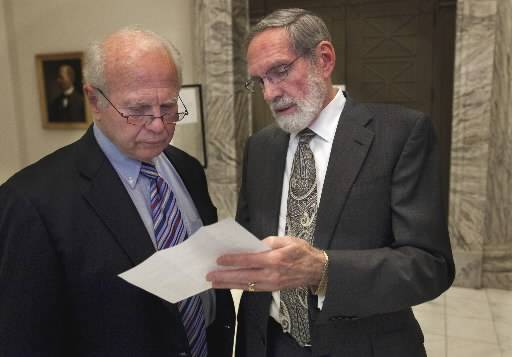 DHS lawyer Kent Meyers and Children's Rights lawyer Frederic Dorwart speak in the hallway outside a meeting where Oklahoma State Senate President Pro Tempore Brian Bingman, Governor Mary Fallin, and Houe Speaker Kris Steele discuss accepting a settlement in a federal lawsuit against DHS on Thursday, Dec. 29, 2011, in Oklahoma City, Okla.Photo by Steve Sisney
Children's Rights, a New York-based group, asked a federal judge for $8,345,588 for its attorneys' time on the case and $912,711 for the group's legal expenses.
The group asked that a New York firm that helped in the case be paid $262,120 for the firm's expenses.
The advocacy group's executive director, Marcia Lowry, is seeking to be paid at a New York City rate of $700 an hour. Other attorneys are seeking to be paid from $175 to $375 an hour.
The attorneys argued their request is reasonable and that their dedicated work achieved a historic and life-altering result for Oklahoma's children.
“But for the dedication and resources of the lawyers of Children's Rights, none of these changes would have occurred,” attorneys told U.S. District Judge Gregory Frizzell in their application for payment. “This historic and comprehensive reform did not come easily. The defendants employed the full resources of the state to oppose the reformation.”
Tulsa attorney Frederic Dorwart, who also helped Children's Rights in the case, did not charge for any of his firm's time or expenses.
Officials at the Department of Human Services have budgeted only $4 million to pay the group.
Children's Rights sued DHS officials in 2008 in federal court in Tulsa. The group sued on behalf of the state's foster children.
The group alleged in the lawsuit that DHS policies and practices are so bad that neglected and abused children are being harmed or are at risk of harm at state shelters and foster homes.
DHS commissioners agreed to make reforms to its child-welfare operations when they voted in January to settle the lawsuit.
Commissioners settled rather than risk losing at a trial and having the judge possibly order even more costly reforms. DHS is calling the improvements “The Oklahoma Pinnacle Plan.”
The plan's cost
DHS plans to hire more child-welfare workers, recruit more foster homes and phase out using shelters to care for the youngest children. Officials initially estimated DHS will need almost $100 million more in state funds a year once all the reforms are in place.
The state already has paid more than $7.6 million in legal fees and expenses to attorneys hired to represent DHS officials in the lawsuit.
The bulk of that money — almost $6.9 million — went to the law firm hired to fight the lawsuit.
Almost $700,000 more went to the attorney who represented DHS officials in the settlement negotiations.
Children's Rights has filed similar class-action lawsuits across the country, including in Texas, Kansas and Missouri.
Children's Rights contends its bill would not be nearly as high if DHS had not engaged in what it contended were “overly aggressive tactics ... motivated by patently unjustified denial of the serious, systemic problems plaguing DHS.”
DHS is expected to ask the judge to pay Children's Rights much less than it is asking.
“I believe we'll definitely question the fees,” said Richard DeVaughn, one of three DHS commissioners who voted against the settlement.
“It's about the money. It wasn't about the children,” DeVaughn said of the group's lawsuit.
“The reason they were so willing to settle at the end was we had them on the ropes.”
Source: NewsOK
Woman Sues Adoptive Parents
February 20, 2008 permalink
The story below from Argentina illustrates a future that may be in store for Canada.
During Argentina's Dirty War from 1976 to 1983, thousands of leftists were arrested and killed by police. The families were not notified, and the police refused to provide information, giving the victims the name desaparecidos, the disappeared. In some cases, infant children of the victims were adopted through irregular channels. One of those adoptees, Maria Eugenia Sampallo Barragán, born in 1978, is suing her adoptive parents for kidnapping her.
In Argentina the junta running the government lost power in 1983, and since then the political winds have shifted against the army. There is a possibility of a similar political change in Canada, and other countries now conducting mass kidnappings of children under pretense of protection. If and when that happens, there will be legal repercussions. Maybe small scale actions such as the one in Argentina, maybe larger ones such as the American civil rights movement or even the Nuremburg trials. Participants in the child protection rackets should be prepared for future accountability for their crimes.
expand
collapse
Adoptee Sues Parents for Kidnapping
By MAYRA PERTOSSI, AP Posted: 2008-02-20 07:04:04
BUENOS AIRES, Argentina (Feb. 19) - A 30-year-old woman is suing her adoptive parents for kidnapping in a case that opened in an Argentine court Tuesday, becoming the first child of disappeared political prisoners to press such charges.
Maria Eugenia Sampallo Barragan accused her adoptive parents Osvaldo Rivas and Maria Cristina Gomez Pinto of falsifying adoption documents to hide her identity. She made no comments on leaving court Tuesday.
 Natacha Pisarenk, AP
Maria Eugenia Sampallo Barragan, 30, leaves a federal court building in Buenos Aires on Tuesday. She is suing her adoptive parents, saying they concealed that she was stolen as a baby from political prisoners who disappeared during Argentina's "dirty war."Thousands of leftists and dissidents vanished after being abducted by security forces during Argentina's 1976-1983 military regime, and human rights groups say more than 200 of their children were taken and given to military or politically connected families to raise.
Sampallo, who in 2001 learned that she is the daughter of missing political prisoners Mirta Mable Barragan and Leonardo Ruben Sampallo, is one of 88 young people who determined their identity with DNA tests coordinated by the human rights group Grandmothers of the Plaza de Mayo.
Sampallo's mother was six months pregnant when she and her father were abducted on Dec. 6, 1977, said Sampallo's lawyer, Tomas Ojea Quentin. He said Sampallo was born in February 1978, while her mother was being held at a clandestine torture center.
Ojea Quentin said former army captain Enrich Berthier is facing related baby theft charges in the case. He is being held at a military unit, while Sampallo's adoptive parents are reportedly free.
Lawyers for Berthier and the Gomez Pintos declined to comment when they left the courthouse where an Associated Press writer and other journalists were waiting.
The case marks the first time a woman has taken her adoptive parents to court in Argentina. There have been at least three earlier trials involving suspected illegal adoptions dating to the dictatorship that resulted in convictions - but the plaintiffs were not the adopted children.
Also Tuesday, a former military officer wanted in connection with the 1972 execution of 16 leftist guerrillas surrendered, hours after returning from the United States, government news agency Telam said.
Carlos Marandino is the fourth former naval officer arrested this month on torture and murder charges linked to the "Trelew Massacre" of 16 leftist rebels who fled an Argentine prison, presaging the excesses of Argentina's so-called dirty war.
Marandino walked off a jet at Buenos Aires's Ezeiza Airport and was detained, Telam reported.
Marandino's co-defendants include Ruben Paccagnini, 81, former head of the Almirante Zar Trelew southern military base; Emilio Del Real, 73, a frigate captain who allegedly witnessed the 1972 executions; and Luis Emilio Sosa, 73, a former navy captain who allegedly captured the escapees.
Lawyers for the three men have protested their innocence, but it was not immediately known if Marandino had hired a lawyer.
Some 25 leftist guerrillas escaped a southern Argentine penitentiary in a 1972 jailbreak. Six fled by plane to Chile, where they were granted political asylum and allowed to proceed to Cuba. The other 19 were taken to a nearby naval base, where 16 were shot dead in their cells, prosecutors say.
Source: AOL news website
Mom Loses Kids
February 20, 2008 permalink
Today's story taken from an internet posting is a typical case of the scenario we call divorce continuation. The parents were already divorced when children's aid intervened. Here they applied their favorite remedy, taking kids from the parent who had been awarded custody by the family court and giving them to the other parent. The judge was unhappy with children's aid? They don't care.
expand
collapse
Children's Aid Society
child protection???
Silent_No_More by Silent_No_More on Feb. 20, 2008 at 01:32pm
I used to think that the Children's Aid Society was an organization that was there to help families and protect children. I'd often hear about children being removed from their parent's care and people would often say "I can't believe so and so's child was taken" and I would think to myself and often say to people, "The Children's Aid doesn't take children without a reason"
I was so naive.
The past few months of my life isn't much different from a bad dream, a book or even a movie for that matter. It's very surreal.
An accident happened at my home and I explained to my child's teacher what happened.. little did I know that would cause the Children's Aid to ambush my house with a police officer in tow. They interrogated and intimidated my family. In their affidavit they state that they requested me to sign a consent when in fact what happened is they threatened me to sign the consent stating if I didn't they were taking my children.
I know what happened in my home, they do not. They came in my house accusing and not listening. The following day they removed my children because I didn't agree with them on what they thought happened.
Since this event occurred I have spent thousands of dollars trying to get my family back. The CAS has lied to my face, in affidavits and in court. Research I have done has showed me that this is all common practice and is them undermining me as they sent my 2 older children to my ex husband knowing we are in a custody dispute and knowing that he practices Parental Alienation. They excuse his behaviour and they excuse theirs.
I witnessed a judge in court tell the CAS that they have no case, everything is hearsay and they did no investigation. I heard with my own ears that the judge isn't satisfied they took the least intrusive action. So did the CAS admit their mistake? NO. that is unheard of research has showed me that too.
They claim everything they do is in the best interest of the children. I have yet to see that. My children have been traumatized, brainwashed, separated from each other all because someone decided to go on a power trip.
I recently learned that the government funds this agency based on how many children are in care and how many files are open. I'm sure that explains the rise in cases that the CAS handles. I've also learned Ontario, Canada is one of the few places with out a legislative body that governs the CAS, I guess that explains also why Ontario has the highest apprehension rates.
I'll be silent no more. I will expose this agency one post at a time.
Source: posting to thisisby.us website by an Ontario woman with screen name Silent_No_More
Dead or Alive
February 19, 2008 permalink
Today's story of social worker incompetence comes from Endwell New York where a social worker entered the home of her ward and reported him well, though the boy had been dead for three days. Twelve-year-old Peter Munck is the latest addition to our list of children who died after separation from their parents. We used to say this was a fair measure of abuse in foster care since there can't be controversy about whether a person is dead or alive. Maybe we were wrong.
expand
collapse
posted Tuesday February 19, 2008
DSS worker unaware boy had died
Official visited house Friday, met at door by brother
By Brian Liberatore, Press & Sun-Bulletin
ENDWELL -- A Broome County child protective services employee, who was dispatched Friday to check on 12-year-old Peter Munck, did not know the boy had been dead since Wednesday, according to the Broome County Sheriff's Office.
"Whatever the worker did to verify the well-being of Peter, he wasn't able to detect that Peter was deceased," Detective Lt. Patrick Isenburg said Monday. "Whether (the CPS employee) didn't get close enough (to the boy), I don't know."
After the visit, a CPS official did call an aunt who went to 228 Hastings Ave. early Friday night and discovered Peter's lifeless body, Isenburg said.
"We know from the autopsy and the investigation that (Peter) was deceased for some time (by Friday night)," Isenburg said.
Deputies have determined that Peter's brother, 22-year-old Shawn Munck, on Tuesday night put his foot on the boy's midsection and pushed down with enough force to cause internal bleeding during what police described as "a physical altercation."
Peter then went to bed and died sometime late Tuesday night or early Wednesday.
Shawn Munck has been charged with second-degree manslaughter, a felony, and committed to Broome County Jail.
Isenburg said that when a CPS employee visited the home, Shawn Munck answered the door and let the CPS employee into the house. Munck's friend, Joseph Menard, 23, of Endicott, was also at the house at the time.
Arthur Johnson, commissioner of the Broome County Department of Social Services, which heads CPS, said confidentiality laws forbid him from commenting.
Maine-Endwell school officials had called CPS on Feb. 12, which was the day of the "altercation," deputies said. Isenburg said he did not know whether CPS employees responded to the Feb. 12 complaint.
M-E officials called CPS again Thursday, when Peter failed to show up to classes, according to district Superintendent Joseph Stoner. Peter was a sixth- grader at Maine-Endwell Middle School.
Peter Munck's legal guardian and grandmother, Carolyn Mitrus, 71, was not in the house at the time because she was reportedly in an area hospital for heart surgery. Since 2000, Mitrus has had custody of Peter (and Shawn, too, although he is now an adult).
The boys' father, Erik A. Munck, 39, has been in Southport state prison since 1999 serving a 10-12 year sentence imposed by Broome County Court for attempted burglary, criminal possession of a weapon and attempted assault.
Their mother, Carol Wilbur, is not incarcerated, Isenburg said. Sheriff David E. Harder had said Saturday that he believed the mother was also in prison.
A woman claiming to be Wilbur called the Press & Sun-Bulletin on Monday to refute Harder's claim. The woman, who talked with a newsroom clerk, would not stay on the line long enough to talk with a reporter.
At the time of Peter's death, only Munck and Menard were in the home, said police, who do not intend to charge Menard with any crime.
"There's no indication he (Menard) knew the situation," Isenburg said. Menard told a Press & Sun-Bulletin reporter Saturday that he heard Shawn and Peter "horsing around" in a different room at the time deputies believe Shawn put his foot on his younger brother's midsection.
Peter and Shawn Munck's aunt, whose identity was not released, arrived at the house about 7 p.m. Friday after receiving a call from CPS. She called emergency personnel at 7:15 p.m.
Deputies initially ruled the death suspicious. Law enforcement cordoned off the house, which is located between Watson Boulevard and Country Club Road, and took Peter's body to Lourdes Hospital in Binghamton for an autopsy.
Shawn Munck stayed at Menard's house Friday night. Deputies arrested Munck there on Saturday and charged him with his younger brother's death.
A woman presumed to be Peter's aunt did not want to talk about the child or the circumstances surrounding his death when contacted Sunday. A phone call Monday to the same number was quickly aborted.
The boy's sister, Cara Munck, who did not live at the Hastings Avenue address, did not return messages sent to her college e-mail account.
Johnson said DSS was "cooperating fully with police and the District Attorney's Office.
The state Office of Children and Family Services investigates all circumstances where a child dies and a social services department is involved, Johnson said. That report, by law, would be available to the public upon its completion.
Staff writer William Moyer contributed to this report.
Source: Binghamton Press & Sun-Bulletin
Addendum: A reader points out the irony that social workers claim the insight to spot child abuse from telltale signs, yet cannot tell whether a boy is dead or alive.
Real Reform in Georgia
February 19, 2008 permalink
Georgia state senator Nancy Schaefer has introduced legislation to reform child protection in her state. Some provisions are:
- Requires DHR to place children with relatives where possible
- Discovery in termination proceedings. We presume this is the legal meaning of discovery, requiring DHR to disclose the entire case to the parents before terminating their rights to their children.
- Requires DHR to respond to emergencies within 72 hours.
- Requires a court order to enter a home.
- Removes immunity for social workers who administer medicine to a child over objection of the parents.
- Outlaws double jeopardy in termination actions.
- Court hearings will be conducted in public.
You can read the February 18, 2008 press release (pdf) or the entire legal text.
Structure
February 19, 2008 permalink
Child protectors have a warm-sounding word for every atrocity. Richard Wexler comments today on the way group homes (euphemism for orphanage) subject their wards to regimentation. They call it "structure". Below is an abridged version of his comments.
expand
collapse
February 19, 2008
THE NEVER-ENDING GAME OF “MAY I?”
Last month, The New York Times published a column about a teenager torn between a “mentor family” that wasn’t prepared to adopt him and someone he barely knew in a state far away who was.
It was one small part of the column, mentioned only in passing, that was truly striking.
Here’s what one of the parents in the “mentor family” remembers of the first time they invited the young man to spend a weekend with them:
His first visit we're all waiting for him to come down to breakfast. I go up, he'd been in the group home so long, he was making hospital corners on his bed. He thought he couldn't eat breakfast until the bed was perfect.
And here’s a former resident of a group home in California, writing in L.A. Youth, in an essay reprinted in the trade journal Youth Today:
You have to ask permission for everything: to get food from the fridge, cook, watch TV, use the phone, go in the backyard or take a shower.
If the mountain of research such as the Surgeon General’s review of the literature, and the University of North Carolina review of the literature showing the failure of “congregate care” be it in group homes, orphanages or “residential treatment centers” (which are essentially orphanages rebranded) isn’t enough reason to get rid of a lot of them and scale back the rest, listening to the young people describe life there ought to be. Even when the residents are not abused by staff or abusing each other, which happens all too often, life in congregate care is an almost sadistic, never-ending game of “May I?”
No wonder one study found that seven years after getting out of institutions, 75 percent of the residents were back in the only setting where they knew how to live: Institutions. They were in jails or psychiatric centers.
Of course the residential treatment providers, who scarf up huge sums of government money, have a euphemism for this regimentation of day-to-day living. They call it “structure.” Whenever you hear a residential treatment provider babble about how his program provides young people with “structure” what he means is: Nobody gets breakfast until they get those hospital corners right!
Children don’t need this kind of rigidity – but institutions do. They need it in order to keep large numbers of troubled children in line and prevent their institutions from descending into chaos. So they turn around and claim that, by amazing coincidence, all the things that ensure that their institutions run smoothly happen to be “therapeutic” for children.
If that were true, we wouldn’t have that mountain of evidence showing institutionalization doesn’t work. If that were true, even Shay Bilchik, the former head of the trade association for residential treatment providers and other child welfare agencies, the Child Welfare League of America, would not have been compelled to admit that they lack "good research" showing residential treatment's effectiveness and "we find it hard to demonstrate success.”
But then, common sense should be enough to figure that out. Imagine if we were starting from scratch to figure out how best to help severely-troubled young people. And suppose somebody said, “I’ve got a great idea! Let’s take teenagers with the most difficult problems and throw them all together in one place – just at the time in their lives when they are most influenced by their peers.” If anyone suggested that, people might well wonder about his mental health. And yet, thanks to an accident of history – and the enormous political clout of the group home industry - that is exactly what we do.
To top it off, residential treatment is a prime example of an iron law of child welfare: The worse the option, the more it costs. Residential treatment bleeds child welfare systems of huge amounts of money, leaving very little for better alternatives.
Occasionally, institutions themselves have crises of conscience, shut down most of their institutional beds and embrace better alternatives. But then they come up against what the director of one such conscience-stricken institution called “the group home industry” which opposes any attempt to change government funding formulas to redirect money from their largely worthless, incredibly expensive institutions into better alternatives.
Source: Richard Wexler's blog
Killer Used Prozac
February 18, 2008 permalink
No medical records have been released, but we now know that the Northern Illinois University shooter used Prozac. This is from a CNN interview with Jessica Baty, the girlfriend of shooter Stephen Kazmierczak. The best summary of this kind of killing is on a website aggregated by Sara Bostock, whose daughter committed suicide in 2002 after two weeks on Paxil.
Higher Baby Bounty
February 18, 2008 permalink
Every Ontario child has a bounty on his head, paid to any children's aid society that can successfully wrest him from his parents. That bounty is going up by $250 per year, and in a few years by $1100 per year. In the tradition of the Easter Grinch, it is unlikely any of the money will make life better for the children.
expand
collapse
Benefit bypasses foster kids
 AARON HARRIS/TORONTO STAR
Melanie Bento, 17, front, and Julaine Skyers, 18, who are under the care of Toronto’s Catholic CAS, are among about 20,000 Ontario kids who are not getting the province’s new child benefit.20,000 Ontario children haven't received money under new Liberal plan to alleviate poverty
February 18, 2008, Tanya Talaga, Laurie Monsebraaten, Staff Reporters
Ontario Liberals are trumpeting the new child benefit as the cornerstone of their pledge to fight poverty, but child advocates say the government forgot to include the 20,000 kids living in foster care.
They want Queen's Park to correct the oversight so provincial money meant to help low-income parents cover the costs of raising a child – such as buying books, paying for sports or saving for university – helps kids in care too.
The benefit, unveiled in last spring's budget, put a lump-sum payment of up to $250 per child in the hands of low-income families last July. By 2011, it will grow to an annual maximum of $1,100 per child under age 18.
"Our children, the most vulnerable, aren't benefiting from this announcement and it should be changed," said Marcelo Gomez-Wiuckstern, of the Ontario Association of Children's Aid Societies, which represents 51 societies in the province. "It's shocking."
The association first noticed the oversight during the budget lock-up last year and has been lobbying the province ever since.
"This is a substantial amount of money. It would make a difference to a lot of kids," added Virginia Rowden, the association's social policy director.
Last summer's $250 payment would have translated to about $5 million for the 20,000 kids in care, the association says. This year, when the annual benefit rises to $600, these kids would be owed $12 million.
And in 2011,when the total benefit hits the maximum of $1,100, about $22 million would be owing.
Ontario Children's Minister Deb Matthews said the government is working to fix the problem and hopes to extend benefits to children in care by July.
"These kids are something special, they deserve to get the support they need," she said in an interview. "We'll make sure they do get it. We're not exactly sure what form that will take."
Matthews, who also chairs Ontario's new poverty-reduction committee, said bureaucrats are trying to hammer out the details on how the money will be delivered.
"By this July the ministry will have it worked out," she said.
Julaine Skyers, 18, and Melanie Bento, 17, two young women in the care of Toronto's Catholic Children's Aid Society, say they need the money to help in their efforts to save for college.
The young women, who moved out of their foster home in December and are renting an apartment in the city's east end, are stunned the province would introduce a measure to help low-income kids and leave them out.
"It's really hurtful," said Skyers, who met with Matthews earlier this month as part of a delegation of youth in care.
"We don't have families that can help us, so we need all the help we can get."
Although Skyers and Bento are each receiving about $800 a month in "maintenance" from children's aid to cover living expenses, the money doesn't go very far. And they will no longer be eligible for any help when they turn 21.
"If we got the benefit, I think the best thing would be to invest that money for school," said Skyers, who is working full-time to save for college next year.
She is hoping to get accepted in a program to become a child and youth worker, but tuition and books will cost about $3,000 a year, she said.
Bento, who is working part-time while she completes high school, wants to study hospitality or mechanics in college next year.
Although the children's aid association says the simplest solution to the problem would be to transfer the child benefit funds to them on behalf of the kids, others believe the money should flow directly into registered education savings plans for each child.
That way, children in care would also be eligible for federal education grants of up to $550 a year.
"Money coming from a child benefit should be going into funds that any other child can get," said John Stapleton, an independent social policy consultant who used to work for the provincial social services ministry.
Any or all money paid out on behalf of children in any other family can be used to open an education savings plan, so it should be the same for kids in care, he said.
There are about 3,300 children under the care of the Toronto and Catholic children's aid societies.
About 63 per cent live in poverty, said Toronto CAS executive director David Rivard.
"When it comes to escaping poverty, education is crucial," he said. "Opening education savings plans for these kids is certainly one option that should be considered."
The Child Welfare League of Canada, which advocates on behalf of vulnerable kids, including those with mental health issues, in trouble with the law and in the care of Children's Aid, has been lobbying Ottawa and the provinces to help these children access federal education grants.
"We live in a knowledge-based society," said executive director Peter Dudding.
"We have to lever the resources of government and the private sector to ensure these kids succeed."
Source: Toronto Star
Toronto CAS is Racist
February 17, 2008 permalink
An insider has posted a report on the Children's Aid Society of Toronto to YouTube. We missed this when it was first posted three months ago. We also have a local copy (flv).
Getting Mad at CAS is a Crime
February 16, 2008 permalink
Can anyone understand why the father of a stolen baby feels hostile toward the thief? Any normal parent can, but the worker herself pretends she cannot. A Vaughan father who apparently thought he was posting to a private area on Facebook has been criminally charged for making a death threat. People habitually use the word "kill" to privately express anger without any threat to the peace. See, for example, the movie Twelve Angry Men starring Henry Fonda. In the Facebook case the cops penetrated privacy to expose the angry outburst.
expand
collapse
Man allegedly threatened to suicide-bomb CAS
February 13, 2008
A Vaughan man whose baby was seized by the Children's Aid Society allegedly threatened to suicide-bomb the CAS and kill the nurse who notified the agency in a graphic Facebook message, court heard this week. "When I find what nurse called the CAS, may God have mercy on my soul because I'm going straight to hell with a 25-year pit stop in prison", a message on the man's Facebook site stated, alluding to the minimum term for first-degree murder. "Plan B we have firearms and the manpower."
Another posting stated: Bob (not his name) is going to suicidal-bomb the CAS.
The 26-year-old man, who cannot be identified because his now five-month-old son is in CAS care, has pleaded not guilty to writing a death threat to York Central nursing instructor Debora Flachner and members of York Region CAS as well as three breaches of a weapons prohibition (a pellet-gun).
The accused man's son was apprehended by York Regional Children's Aid Society two weeks after he was born on Sept. 5, 2007, at York Central Hospital in Richmond Hill. "I felt absolutely terrified in reading it because it was possible this person was thinking about planning a murder-suicide", testified Flachner as she recalled reading the Facebook postings on Nov. 20, 2007.
Flachner was unaware of the Facebook threats which were posted in mid-September last year until York Regional Police brought them to her attention in late November.
"I happened to be the person who filled out the paperwork, to put financial assistance in place for the mother.
"I put a question mark whether the child's mother was developmentally delayed."
But the child went home with the mother and grandmother,she told the court.
"I felt absolutely terrified that I was his focus. He sounded unpredictable.
"I didn't go home. I went into hiding and stayed in a hotel (until the accused was arrested Nov. 23)", Flachner told Justice Richard Blouin of the Ontario Court of Justice.
Flachner was unaware of the Facebook threats which were posted in mid-September last year until York Regional Police brought them to her attention in late November.
Flachner admitted under cross-examination by the father's lawyer, Sam Goldstein, that the father never had any contact with her, never appeared at her home or the hospital where she works or on the street.
She also read a blunt warning from one of the accused's friends on his Facebook, stating: Don't do anything stupid.
"I can't believe you put those threats in public."
Goldstein said his client's behaviour is inappropriate, not criminal, and the father interacted with the Childrens Aid Society for 65 days without incident, showing the threats weren't real.
His client met with Childrens Aid Society officials in October and early November, agreeing to take parenting courses and indicating he wanted to take legal action to regain custody of his child, court heard.
Contact between the father and the Childrens Aid Society was abruptly cut off once a Childrens Aid Society employee surfing Childrens Aid Society-related Facebook websites discovered the disturbing messages and alerted her employer.
Source: Northern News
Addendum: Our original post erroneously said a guilty plea had been entered in the case. In fact, the trial continued and the accused was found not guilty.
expand
collapse
National Post, Tuesday, March 04, 2008
Facebook threats showed no intent
Judge Issues Acquittal
Shannon Kari, National Post Published: Tuesday, March 04, 2008
NEWMARKET, Ont. - A 26-year-old man who wrote of a plan to bomb a Toronto-area children's aid society in postings on his Facebook page has been acquitted of threatening charges after a judge accepted that writings on the popular site are part of a fantasy environment that should not necessarily be taken seriously.
Justice Richard Blouin accepted that D.S. (who cannot be identified because his son is in the care of children's aid) was "blowing off steam" with his postings and did not have the intent to prove a criminal charge of threatening.
The postings were misguided, yet "they were not meant to intimidate," the provincial court judge said yesterday.
D.S. started a group on the social networking site after his infant son was apprehended by the York Region Children's Aid Society. The group included a discussion board called "C.A.S. sucks" where D.S. posted messages that detailed his frustration.
He stated that if he found out the name of the hospital nurse who contacted children's aid, he would be going "straight to Hell" with a "25-year pit stop" in prison. There were also postings that talked of a suicide bomb attack.
Police were contacted last November after a children's aid employee searched Facebook for any references to the York Region C.A.S. and found the postings.
"I fully understand the response of the hospital, C.A.S. and the police," said Judge Blouin. But he said he accepted the testimony of D.S. and that of an expert on Facebook to provide context to the postings.
Jesse Hirsh, who consults to businesses about the use of Facebook, testified last month that it is a "fantasy-based environment" where people embellish their comments to try to attract online "friends."
Facebook users "in effect, construct an alternate persona," Judge Blouin noted in his ruling, in reference to the expert testimony.
As well, the judge said he accepted the testimony of D.S. and observed that while the postings were online, the young man had regular contact with children's aid, where he was polite and concerned about his son.
skari@nationalpost.com
Source: National Post
Heartbreak Hotel
February 16, 2008 permalink
Fathers 4 Justice demonstrated outside the Newmarket courthouse on Valentines day with the theme Heartbreak Hotel. Demonstrators included Denis Van Decker, Elvis (Dorian Baxter) and a mother, Mary Palminteri. Rogers News (mms video stream link) covered the event on television. The F4J story runs from 4:19 to 6:45. We regret that these links often expire within a few days.
Identify the Baby
February 15, 2008 permalink
We have not before posted favorable stories about children's aid, not out of reluctance, but because there have not been any. Until now. On January 30 an abandoned baby girl was found in a stairwell of a parking garage in Toronto. Toronto Children's Aid has cared for the girl, and dubbed her "Angelica Leslie". Today the Toronto Police Service released two new photographs of the baby in hopes of having her recognized.
expand
collapse
Police issue two new photographs of abandoned child "Angelica Leslie"
Broadcast time: 11:40
Friday, February 15, 200833 Division
416−808−3304On Wednesday, January 30, 2008, at 12:30 p.m., police found an eight−month old baby girl in the stairwell of a plaza parking lot at the intersection of Leslie Street and Finch Avenue East.
See previous release (pdf).
Police are releasing two new photographs of baby "Angelica Leslie" that were taken on Friday, February 15, 2008, in the hope that someone might recognize her and identify her.
The Children's Aid Society advise police that "Angelica Leslie" is doing very well.
Anyone with information is asked to contact police at 416−808−3304, Crime Stoppers anonymously at 416−222−TIPS (8477), or online at www.222tips.com.
Constable Wendy Drummond, Public Information, for Detective Keith Moxley, 33 Division
Source: (pdf) Toronto Police Service
The original document has high resolution photos each with 6.2 megapixels


Prodigal Barrie CAS
February 15, 2008 permalink
Barrie CAS has overspent its budget and will get supplemental funding. Since there is no consumer demand for its services, the claims in the story are false.
expand
collapse
CAS slated for extra funding
February 15, 2008
The Simcoe County Children's Aid Society will receive an extra $2.4 million to offset an increase in demand which includes a staggering jump in reported abuse and neglect cases.
The local CAS has experienced a 40 per cent rise in the number of abuse investigations during the past year.
Neglect cases were up 36 per cent.
The overall demand for service was up 30 per cent.
"We're seeing some serious concerns that many of our children are at risk of harm," said CAS spokeswoman Judi Shields. "It's quite troubling for all of us here."
Source: Barrie Examiner
Apprentice Social Worker Kills Six
February 15, 2008 permalink
Yesterday Stephen Kazmierczak killed six people including himself at Northern Illinois University.
ABC News reports the killer was a student at the university's school of social work studying mental health issues. Further along, the news says "Kazmierczak's behavior had become erratic in the past few weeks, and it is believed he had stopped taking his medication". The kind of medication is not given, but if it is psychotropic medication, it continues a long pattern in school shootings. In the Virginia Tech shooting, the exact drug prescription of killer Cho Seung-Hui was suppressed on grounds of confidentiality. Even the Report of the Virginia Tech Review Panel (August 2007) does not disclose his medication. Maybe big pharma will do the same for Mr Kazmierczak's records.
expand
collapse
Who Was the Illinois School Shooter?
Kazmierczak, 27, Killer of 5 Students, Studied Mental Health Issues, Worked at Prison
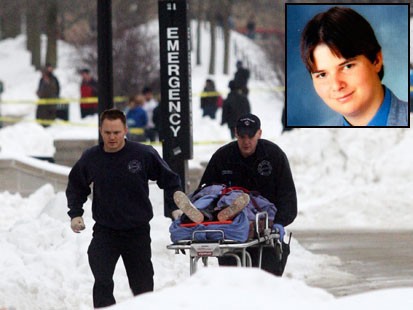 (AP Photo/Courtesy Daily Herald inset)
Stephen Kazmierczak, the 27-year-old who opened fire on a crowded Northern Illinois University lecture hall, killing five and then himself Thursday, was studying mental health issues at another college and had recently taken a job at a prison, according to his academic adviser.
"It was very difficult and overwhelming to hear the news," said Jan Carter-Black, an associate professor of sociology who was both Kazmierczak's professor and adviser at the School of Social Work at the University of Illinois. "I found Stephen to be a very committed student — extremely respectful of me. … I enjoyed having him as a student."
Kazmierczak was a student of Carter-Black's for about a month in the fall of 2007, when he was enrolled in a class called Human Behavior and the Social Environment.
The course, said Carter-Black, focused on the connection between human behavior and the surrounding environment and met once a week for three-hour sessions. There were around 30 students in the class, and Carter-Black said Kazmierczak always interacted with his peers well during group work, and participated regularly in the class discussion.
Toward the end of September, Kazmierczak withdrew from Carter-Black's course to take a job in the prison system and became a part-time student. In January 2008, Kazmierczak returned to full-time status. Carter-Black didn't know the name or location of the prison.
Despite advising him on his courses on mental health issues, Carter-Black said that she never noticed anything out of the ordinary about Kazmierczak and said that he "looked like all the other students."
Earlier reports by NIU campus Police Chief Donald Grady indicated that Kazmierczak's behavior had become erratic in the past few weeks, and it is believed he had stopped taking his medication. The chief declined to specify the type of medication the gunman was on.
Carter-Black said she had no knowledge of Kazmierczak's medical history or treatment.
Kazmierczak had served as a member of the NIU Academic Criminal Justice Association, was a teaching aid during his undergraduate years and in 2006 even received a Dean's Award from the sociology department.
In 2006 Kazmierczak was a co-author of an essay entitled "Self-Injury in Correctional Settings: 'Pathology' of Prisons or of Prisoners," in which an attached biography describes him as having just begun his graduate work at NIU.
Kazmierczak's interests are listed as corrections, political violence and peace and social justice, according to the essay, and he had plans to co-author a manuscript on the role of religion in the formation of early prisons.
In another biography, apparently written by Kazmierczak for the Academic Criminal Justice Association's Web site, he pledged his commitment to social justice and his academic work.
"I've worked very hard as a student," the entry reads.
Kazmierczak worked as the Pirates Cove Children's Theme Park in his hometown in 1995, according to the park's director. He had an acceptable employee record.
On a music site message board from 2006, posters who claimed to be his co-workers wrote, "I remember Steve Kazmierczak … the kind of person who injured kids on the train ride cuz he was mental and he shouldn't be given domain over kids on little faux-traincars with an aluminum baseball bat … "
Originally from Champaign, Ill., Kazmierczak had been a student at NIU in the spring of 2007, where he had majored in sociology. He had been studying at the University of Illinois - Campaign most recently, according to NIU school officials.
Grady said that those who knew him "revered him as an outstanding student" and had no inclination that Kazmierczak was capable of such carnage.
But law enforcement authorities told ABC News that Kazmierczak had likely planned the assault on the school for at least five days — all four guns involved in the NIU shooting were purchased legally from the same Champagne, Ill., gun dealer, ABC News has learned. The Remington shotgun and the Glock 9 mm were purchased on Feb. 9, 2008. The Highpoint 380 was purchased on Dec. 30, 2007 and the Sig Sauer 9 mm was purchased on Aug. 6, 2007 from the same gun dealer.
Authorities were still checking where he obtained two other pistols, a 9 mm Sig Sauer and a Hi Point 380.
He brought the shotgun in a guitar case, police said, and hid the others underneath his jacket.
At approximately 3:15 p.m. Thursday, Kazmierczak — dressed in black and armed with three handguns and a shotgun — entered an introductory geology class and opened fire.
While students ran for cover and hid under their desks, Kazmierczak wounded 16 people, killed five others and then himself.
"The assailant began firing into the assembled class from the stage — from the front," NIU president John Peters told ABC News.
"It didn't seem like he was aiming. He just raised a gun and shot immediately," said Paul Sundstrom, a student who was sitting in the class with his brother Kevin when the gunman opened fire.
With additional reporting by Marcus Baram.
Source: ABC News
Girl Taught Sex
February 14, 2008 permalink
City News has reported the real reason the parents of Alana Livas abducted their five-year-old girl from the children's aid society. She had been taught sexual activity while under CAS care.
Two weeks ago there was a flurry of articles on Alana in the press, one copied below. There were pleas from the foster parent, actually Alana's maternal aunt Jean Chin, to protect the girl by returning her where she could get treatment for rickets. Examination of the aunt's website discloses that she is alienated from Alana's parents. Look at the uncomplimentary photos for mom and dad. So far no basis for alienation has been published.
Our research into rickets found that vitamin D has a half-life in the body of two months. Press reports at the end of November said Alana had a vitamin D deficiency at the time. The February 1 story said her stored supply of vitamin D was running out, exposing her to danger from rickets. These two stories cannot both be correct. More likely the girl had the same supply of vitamin D as any other girl of Asian descent, a bit low, but not pathological.
A reader reported hearing the Alana Livas story on the CBC this morning. There may be a repeat on the CBC this evening.
If children's aid or the police find this family, the parents will be jailed and the girl will be sent back to her abuser. This is a case where the only safe option for the family is to leave Canada.
expand
collapse
Parents Of Abducted Ailing Girl Say They Acted Over Signs Of Sexual Abuse
Thursday February 14, 2008, CityNews.ca Staff
The story of an abducted little girl with serious health problems has taken a strange and disturbing twist. Her parents have surfaced and claim they had good reasons for taking the child away.
Alana Livas was removed from her parent's home by the Children's Aid Society last year, when case workers alleged she was being neglected and there was evidence that a marijuana grow-op was operating out of their home.
She was turned over to her aunt, who helped treat the girl for rickets, a disease caused by a vitamin deficiency.
But when her folks got access to a CAS report on the child, they were startled. It apparently told them the caretaker aunt saw the child acting out sexually and her parents later saw her supposedly moving in a 'sensual way' during a scheduled visit. It was something they feared the five-year-old couldn't possibly have done innocently.
They say they called police but were referred back to Children's Aid.
When nothing was done, Peter and Vivenne Livas claim they were forced to take action. In an email to a local media outlet, the couple says they decided to abduct the youngster because they believed she was in harm's way and no one was taking their concerns seriously. All three disappearaed on November 29, 2007.
Authorities issued an urgent update about the case at the end of January, because Alana's medication had run out and no one knew if her mother and father were able to get her the treatment she desperately needs for her condition.
Cops now say they need to talk to the youngster to see if there's any truth to the abuse implications and who might have done something to her.
An arrest warrant is out for both parents, who remain at large. Investigators contend they're still in Canada but no one is certain where they may be hiding or what their daughter's current condition is.
Source: City News
Aunt pleading for return of girl with vitamin ailment
Jean Chin almost broke into tears yesterday as she implored the public for help in bringing her 5-year-old niece, who suffers from rickets, a potentially life-threatening disease, home safely.
Describing Alana Livas as "easy to love," smart and "amazing," Chin, 22, said she's worried about the little girl, who could become seriously ill if she isn't taken to hospital or brought home soon.
Livas was living with Chin and her fiancé Derek when she was allegedly abducted by her parents, Vivene and Peter Livas, last November, during a visit supervised by the Children's Aid Society.
"It breaks my heart my heart to think of her in pain," Chin said at a press conference yesterday. "We hope someone out there is watching this and can help bring her home."
If untreated, rickets, a chronic deficiency of bone calcium and vitamin D, could cause severe bone pain, growth impairment, muscle weakness and affect heart function.
Livas, who was taken from her parents' custody last March after she was found living in an alleged marijuana grow-op, had a two-month store of vitamins in her system to shield against symptoms of the disease.
Police are worried she isn't getting proper treatment.
Police believe Livas and her parents are still in Canada; they are looking for a light blue GMC Jimmy.
But with few leads to follow, they're pleading with the public for any tips on her whereabouts.
"If her parents are out there," Chin said, "I'd like for them to please bring her to a hospital. I want them to think of Alana and what's best for her."
Source: Toronto Star
Addendum: The source of today's stories is a report by Michelle Cheung on CBC TV. The reporter's voice tells the family story over home videos dated 2003 to 2006 of the Livas family showing Alana playing like a normal child. There is no sign of deficient bones. The girl was taken into CAS care in March 2007 after a diagnosis of rickets. Alana was placed in foster care until the end of July, then with Alana's aunt, Vivene's alienated sister Jean Chin and her boyfriend. In mid-September the parents received over two dozen pages of CAS documents in which Chin describes Alana acting out in a sexual manner. Chin said she suspects the parents may have been inappropriate with the girl. Parents Peter and Vivene Livas were shocked by the reports, but the behaviors were confirmed during visits with Alana. In written notes provided to the CBC Alana said monsters scare her every day and she places toys in sexual positions and moves her body in a sexual manner. Complaints by the Livases to both children's aid and the Toronto police fell on deaf ears. Since the parents took Alana they have been giving her regular calcium and vitamin D supplements. Here is a video link to the news report by Michelle Cheung (expired link). The Alana Livas story runs from 2:38 to 5:35.
Mother to be Sentenced for Scissor Attack
February 13, 2008 permalink
The report of a mother attacking a CAS worker with scissors has been followed up, this time giving her name, Crystal Mitchell. She evidently took pride in her daughter's hair and was outraged when children's aid cut it. She tried to reciprocate by cutting the worker's hair.
expand
collapse
Woman who attacked worker can present evidence
Posted By By GALEN EAGLE/Examiner Staff Writer, February 12, 2008
A provincial judge will allow a woman found guilty of assaulting a Kawartha-Haliburton Children's Aid Society worker with scissors to present evidence in her defence Thursday.
Crystal Mitchell, 35, entered the agency's office on Chemong Road on Nov. 21, grabbed a worker and lunged at her with a pair of scissors in her hand.
She was charged with assault with a weapon and possession of a dangerous weapon.
Mitchell said the agency cut her daughter’s hair without permission and she wanted to cut the CAS worker’s hair as a result.
The CAS said it did not cut her daughter’s hair and the author of Mitchell’s pre-sentence report confirmed that, court heard.
But Mitchell insisted she has photographs proving her daughter’s hair was cut and her lawyer, James Hauraney, said Mr. Justice Rhys Morgan should see those pictures before sentencing her.
Morgan agreed and adjourned the case until Thursday.
geagle@peterboroughexaminer.com
Source: Peterborough Examiner
Addendum: Sentence has been pronounced. Crystal Mitchell's pre-sentence report says she suffers from persecutory delusional disorder. That sounds to us like the way a normal person responds to having a child stolen.
expand
collapse
Woman gets 10 months for attack on CAS worker
Posted By By GALEN EAGLE/Examiner Staff Writer, February 14, 2008
Covering her eyes with her hands, Crystal Mitchell shook her head and buried her face inside her purple sweater as a provincial judge gave her a 10-month jail sentence for assaulting a Children's Aid Society worker Thursday.
Mitchell, 35, entered the agency's office on Chemong Road on Nov. 21, grabbed a worker and lunged at her with a pair of scissors in her hand.
A struggle took place and Mitchell bit the worker on her arm and finger.
She was charged with assault with a weapon and possession of a dangerous weapon and pleaded guilty.
Accusing the CAS worker of cutting her daughter's hair without permission, Mitchell told court she was standing up for her daughter's rights and wanted only to cut the CAS worker's hair in response.
Mitchell told the author of her pre-sentence report she would do it again and the author states she showed no remorse.
The agency did not cut her daughter’s hair, court heard.
According to the pre-sentence report, Mitchell suffers from a diagnosed persecutory delusional disorder and refuses to accept treatment or medication and denies having any mental illness.
She is a high-risk to re-offend, the report states.
Mitchell has served the equivalent of six months in pre-sentence custody, so Mr. Justice Rhys Morgan gave her an additional four months. He recommended she serve the sentence at the St. Lawrence Valley Treatment Centre in Brockville.
Upon her release, she will be placed on probation for two years. She has been banned from possessing firearms for 10 years.
Source: Peterborough Examiner
Ontario Violates Law
February 11, 2008 permalink
The website of the Ontario Ministry of Citizenship and Immigration has an article lauding the services of long-time foster parents Bernice and Rolland Desnoyers. It is one of the standard self-congratulatory promotions of the child protection industry, pretending that contractors who care for children for hire are on a par with Mother Teresa.
What they forgot was two articles of the Child and Family Services Act copied below:.
Prohibition: identifying child
45(8) No person shall publish or make public information that has the effect of identifying a child who is a witness at or a participant in a hearing or the subject of a proceeding, or the child’s parent or foster parent or a member of the child’s family.
Idem
85(3) A person who contravenes subsection 45 (8) or 76 (11) (publication of identifying information) or an order prohibiting publication made under clause 45 (7) (c) or subsection 45 (9), and a director, officer or employee of a corporation who authorizes, permits or concurs in such a contravention by the corporation, is guilty of an offence and on conviction is liable to a fine of not more than $10,000 or to imprisonment for a term of not more than three years, or to both. R.S.O. 1990, c. C.11, s. 85 (2, 3).
The Denoyers have been foster parents to 63 children, every one the subject of a proceeding. We are waiting for the police to serve the Honourable Michael Chan, Ontario Minister of Citizenship and Immigration, with 63 tickets, providing for a fine of not more than $630,000 or to imprisonment for a term of not more than 189 years. The offending material is copied below.
expand
collapse

Bernice and Rolland Desnoyers
The care and compassion of Bernice and Rolland Desnoyers knows no bounds. As foster parents to 63 children over more than 45 years, this Leamington couple has provided a safe, nurturing and stable environment for the young people in their care. They have fostered children from a few weeks through to 11 years. In recent years, they have focused on boys in their mid-teens ─ some of whom continued to live with them while completing college or establishing themselves in the workplace. As one young man said “They help kids be kids and they help kids become proper adults … They’re my family.”
Source: Ontario Ministry of Citizenship and Immigration
pointed out by John Dunn
Ministerial Stealth
February 11, 2008 permalink
Ontario's new Minister of Children and Youth Services, Deb Matthews, has reversed the style of her two predecessors, Marie Bountrogianni and Mary Anne Chambers. In all of her press releases she has appeared in her other roles as minister responsible for women's issues and chairman of the cabinet committee on poverty reduction. None have mentioned the child protection portfolio. In an even more stealthy move, Judy Finlay was replaced as Ontario's child advocate on August 15, 2007 by Agnes Samler, yet as far as the web is concerned, Judy Finlay is still in office. There is an unannounced page for the new advocate, Agnes Samler, though Firefox users have to bypass the splash page and go to the English greeting page instead.
There may be some policy changes afoot. We hope the new low-profile leadership will lead to less aggressive stealing of children, and more efforts to preserve families.
Jail for Breaking Dishes
February 11, 2008 permalink
A Washington family wants their foster daughter jailed for breaking dishes. The news is ambiguous on whether the dishes were broken by accident or as deliberate mischief. Either way, this story shows the difference between parents and foster contractors. The girl is treated as a prisoner or slave, not a child. No real parents would have their child jailed for breaking dishes.
expand
collapse
Foster Child Arrested for Breaking Dishes
A 17-year-old girl living with foster parents was arrested Saturday after she slammed a box full of antique dishes valued at $5,000, Bremerton Police reports said.
Police were called to he house on the 1500 block of Crestview Drive at about 2:45 p.m., reports said.
The couple has four foster children and three biological children. The 17-year-old had assaulted one of her foster parents in the past and "the situation has not improved," the reports said.
On Saturday, the family was helping to unload a truck when the 17-year-old asked one of the smaller children to carry inside a box containing a 60-piece set of antique dishes. The box was too heavy for the child, so the teenager carried it inside and "slammed" it down, breaking 11 of the 60 pieces. The parents told officers the set had been appraised at $5,000.
When interviewed by officers, the teenager denied she broke the items and said she did not want to go to juvenile detention.
She was arrested for investigation of first-degree malicious mischief, domestic violence, and booked into the Kitsap County juvenile detention facility.
Source: Kitsap Sun
Anna Mae He to China
February 10, 2008 permalink
Anna Mae He is nine years old. Her parents spent almost all of her life litigating to get her back from a foster family that adopted the girl, until the supreme court of Tennessee overturned the adoption. She has now gone back to China with her true family.
expand
collapse
Anna Mae He Boards Plane to China with Birth Parents
Posted by Stephanie Scurlock, Posted: Feb 9, 2008 05:35 PM
FAST FACTS:
- Jack and Casey He allow Jerry and Louise Baker to keep infant daughter, Anna
- Struggle for custody ends in Tennessee Supreme Court awarding child to birth parents
- Hes leave Memphis for China after order from immigration judge
stephanie.scurlock@wreg.com
MEMPHIS (02/11/2008)-An important chapter in the saga of Anna Mae He comes to a close today. She left on a plane headed for china with her birth parents.
Since she was just months old Anna lived with her American foster parents, Jerry and Louise Baker. They fought to keep and adopt her but the Tennessee State Supreme court gave custody to her birth parents, Jack and Casey He. Anna was reunited with them this summer. This Saturday, they returned to China.
9 year old Anna Mae He, her brother and sister, and the parents that gave birth to her arrive at the Memphis airport for a 22 hour trip to China. The little girl who was caught in a custody battle for years has a lot of questions about her new home. You can tell when her mother says they're going on vacation, Anna is very much aware the move is more permanent.
Anna says, "A vacation is like 2 or 1 week. That's going to be a long time. That's not a vacation!"
Her father says she has mixed feelings about the move.
Jack He said, "On one hand she feels that she's happy to be with her family. She's very comfortable with her Mom and Dad. On the other hand, she's a little bit nervous about Chinese."
Anna doesn't speak Chinese and until just recently hasn't been exposed to a lot of Chinese culture. Family friends who've made the trip to China before, showed up at the airport to try and ease her fears. Anna is worried about going to a new school and meeting new friends. She'll also meet her grandparents for the first time.
Jack He said, "My parents they are in their 80's. They have been looking forward to seeing their grandchildren so they've been waiting for this day a long time."
The Hes are going to China because an immigration judge gave them until May to voluntarily leave or else they'd be deported. Coming back to the U.S. would be difficult. They didn't' want that because the hope is to return one day with Anna.
Jack He says he is grateful for everything people in Memphis have done to help him, especially his church, New Sardis Baptist Church.
Source: WREG TV Memphis
Addendum: Here is a Yahoo news video on the same case.
Looking for Sarnia Birth Family
February 10, 2008 permalink
A woman born in Sarnia is searching for her birth family. Mother's day in 1963 was on May 12.
expand
collapse
- Date Posted:
- 09-Feb-2008
- Surname(s):
- CARTER : COUPS
- Query Text:
- Girl born Mother's Day 1963 in Sarnia, Ontario. Given name by adoptive parents is Christine. Adopted by older couple who later adopted a baby boy from a separate mother. I am sister of this person. Adopted through the Children's Aid Society in Sarnia.
Source: Cousins connect
Canadian Holocaust
February 9, 2008 permalink
Protesters are demanding answers about the fate of native children who disappeared at the rate of 400 to 500 per year for a century. The best statistical estimate is that the foster care death rate across Canada is over a hundred a year. As well as accounting for past atrocities, Canada should stop committing the same act in the present.
expand
collapse
Protesters demand PM, churches reveal fates of residential school children
TORONTO - Prime Minister Stephen Harper and the heads of Canada's Anglican, Catholic and United churches were put on notice Friday that protesters won't rest until everything is known about the tens of thousands of aboriginal children who disappeared from residential schools.
Filmmaker Kevin Annett, who produced a documentary called "Hidden From History: The Canadian Holocaust," was among a group of protesters that marched in Toronto demanding closure for the families and victims of government-and church-sponsored residential schools.
The federal government estimates as many as 100,000 children attended residential schools. Annett said the best estimate is that 40,000 to 50,000 kids simply went missing between 1840 and 1940 and their families never heard from them again.
The schools have long been assailed as hotbeds of physical and sexual abuse and other human rights violations. The federal government apologized in 1998, saying that "attitudes of racial and cultural superiority led to a suppression of aboriginal culture and values."
The protesters are attempting to use the Access to Information Act to obtain the locations of unmarked graves where children were buried near residential schools and all available information on how they died, Annette said.
"We're here for the survivors and the residential school families who continue to suffer under the fact that they don't know what happened to their relatives, and they simply want them brought home," he said.
Among the protesters was Gary Wassaykeesic, who said his experience in a residential school robbed him of his culture.
"I was a little kid and I was told I'm going for a trip - this trip has lasted me 46 years," he said.
"To this day I've lost my language, to this day I've lost my culture, I don't know how to trap, I don't know how to hunt. I know how to be a concrete Indian."
He said the world always reacts with outrage and great concern when news of genocide is reported and yet, there's not enough attention being paid to the tens of thousands of aboriginal kids who are unaccounted for.
"We talk about it but what can we do as a people when we don't have the resources, we don't have the money, we don't have the connections," Wassaykeesic said.
"We have stories but nobody ever investigates the stories."
Protester John Garlow said he never went through the residential school system but his father did, which inevitably left him scarred too.
"They took my dad at an early age and the way they treated him, some of that has been bestowed upon me," Garlow said.
"Me, I'm a survivor because I went through a lot of the residential school abuse through my father."
The federal government is in the process of establishing a truth and reconciliation commission which will investigate ways to identify the number of children who died at residential schools and the causes of death, said Kimberly Phillips, a spokeswoman for Indian Residential Schools Resolution Canada, a federal department created in 2001.
The commission will go over church and government records and interview former students, staff and anyone else who wishes to be heard, Phillips said.
No criminal investigations will be carried out.
Spokespeople for the three churches said they would co-operate fully with the commission.
Source: The Canadian Press, hosted by Google
Place of Unsafety
February 9, 2008 permalink
Driver Denise Thomson transporting a Nebraska foster child has set a record for drunk driving — she had the highest alcohol level in the career of the Sarpy County Sheriff. At her level, she was on the verge of being comatose. Maybe it took that much intoxication to dull her conscience over trafficking in stolen children.
Another child protector, Sean Virgo, was clocked at 142 mph on his motorcycle in New Jersey.
expand
collapse
Sheriff: Blood-Alcohol Highest I've Seen
TheOmahaChannel.com, updated 12:04 p.m. ET Feb. 9, 2008

OMAHA, Neb. - Sarpy County deputies said they arrested a woman whose blood-alcohol level registered higher than five times the legal limit for drivers. Deputies arrested Denise Thomson, 25, of Elkhorn, after they received a number of calls about an impaired driver on Interstate 80 Thursday afternoon.
In a news release, Sarpy County Sheriff Jeff Davis said his office got calls about a teal vehicle going west that appeared to have children inside. Deputies chased the vehicle at low speeds for a few minutes before pulling the driver over at mile marker 431, the release said.
Sarpy County deputies said they performed a field sobriety test on Thomson, then took her to the Sarpy County Jail, where her blood-content tested at 0.415 percent. Davis told KETV NewsWatch 7 he believes that is the highest blood-alcohol reading he's seen in his career.
Records show this is Thomson's first DUI charge.
Thomson was booked on suspicion of driving under the influence, negligent child abuse, driving left of center and driving on the shoulder of the road.
An 8-year-old child in the vehicle was determined to be a ward of the Department of Health and Human Services, the news release said. The child wasn't harmed and was later turned over to her foster parents.
"Nothing wrong with the child. The child was in the back seat seatbelted in, and fortunately, nothing bad really happened," said Capt. Dan Williamson.
Thomson works for Beneficial Behavior Health in Omaha provides transporation to DHHS, the release said. Beneficial said Thomson has been suspended, and it is cooperating with DHHS.
DHHS's Todd Reckling, administrator of the Policy Section in the Division of Children and Family Services, issued a statement: "The safety of state wards is our top priority, and this type of incident is totally unacceptable. This is a serious charge and we are taking immediate action. I have informed the CEO of Beneficial Behavioral Health that we are putting them on hold status pending further investigation into issues related to transportation and safety. They will not be allowed to transport any child or adult client of DHHS pending the investigation."
Thomson posted 10 percent of a $2,000 bond and was released from the Sarpy County Jail Thursday night.
The University of Texas reported that a BAC of 0.35 percent "is similar to the physical effects of surgical anesthesia. You may stop breathing. A BAC (of) 0.40 to 0.50 percent (means) you are probably in a coma. The nerve centers controlling your heartbeat and respiration are slowing down, and it's a miracle if you survive."
Source: MS-NBC
Addendum: Here is a final irony from another news report:
The family of the eight-year-old girl says Thomson and the child were on their way to Lincoln to see the girl's mother who is in prison for fourth offense Drunk Driving. She's expected to be released next week after serving 10 months behind bars.
Repatriate Kids!
February 9, 2008 permalink
The Kingston Whig Standard today suggests that the real victims of pathologist Dr Charles Smith are the children separated from their parents. They will grow up believing their parents are murderers. The paper suggests reviewing child protection cases founded on Dr Smith's evidence, seeking to repatriate children wrongfully removed.
In this matter, Dr Smith is only the tip of the iceberg. Children's aid has a large stock of experts they rely on to produce "evidence" of unfit parents. Some are local, putting up a pretense of independence while really serving as CAS employees or directors. Loyalty of these experts is assured by the steady stream of revenue from the cases in which they serve.
A more elite group of experts serve at institutions such as the Hospital for Sick Children (there are more than just Dr Smith). Their position is best summarized by the words of Dr Smith himself:
In the very beginning when I went to court in the -- on the few occasions in the 1980s, I -- I honestly believed it was my role to support the Crown attorney. I was there to make a case look good.
That's being very blunt but that was the way I felt and I know when I talked with some of my other colleagues especially those who were junior, we -- we shared the same -- the same kind of an attitude.
There was no impartiality, no independence. His attitude has been described as "noble cause corruption", the belief that the worthy cause of protecting children from parents justified cutting corners. In plain English, the ends justify the means. CAS calls on this group of elite experts in cases in which litigation is likely.
Truly righting the wrongs would require a review of every case in which one of these experts has provided evidence. Paying compensation to the aggrieved families as suggested by the Whig Standard might bankrupt the Ontario treasury.
expand
collapse
 Queen's University law professor Nick Bala and Prof. Nico Trocme, an expert on child abuse at McGill University, prepared a research paper for the Goudge inquiry reviewing discredited pathologist Dr. Charles Smith's errors in child-death investigations.
Ian MacAlpine/The Whig-Standard'They are themselves victims'; All Children's Aid Society files linked to Smith should be reviewed: Queen's expert
Every Children's Aid Society file that involved an opinion from discredited pathologist Charles Smith should be reviewed, a Queen's family law expert says.
Consideration must be given to reuniting families from which a child might have been removed because of Smith's faulty work, says Prof. Nicholas Bala.
Bala and Prof. Nico Trocme, an expert on child abuse at McGill University, prepared a research paper for the inquiry reviewing Smith's errors in child-death investigations.
In a number of cases under review at the inquiry, children were apprehended by child protection authorities because Smith had concluded wrongly that a parent killed a sibling.
"They are themselves victims in that ... they were probably traumatized," Bala said in an interview. "They think, 'Well my mother killed my brother, oops, my mother didn't kill my brother, and why am I not living with my mother? Why am I living with my adoptive parents?' "
The academics were not able to determine whether any children apprehended are still in the care of Children's Aid Societies.
In some cases, children were adopted after their removal.
"It's not going to be in their best interest to be removed from that situation," Bala said. In all cases, decisions must be made about what is in the best interests of the children, he said.
It may mean that some children are given the opportunity for renewed contact with biological parents, he said.
Louise Reynolds, the Kingston woman accused of murdering her seven-year-old daughter because of Smith's flawed opinion, gave up another child for adoption while she was behind bars awaiting trial. Bala said he doesn't think the review would be a significant undertaking because it may not involve a large number of children.
His research found three child protection trials in which Smith gave evidence about the death of a sibling, including a 1996 case in Kingston.
In that instance,the judge noted Smith's "impressive and extensive credentials." The judge ordered that two children be placed in the care of their grandparents.
Bala and Trocme's paper also recommends compensation be paid to families who faced legal costs in child protection proceedings that were based on Smith's mistakes.
"I think it's a legitimate recompense to people who suffered because of systemic incompetence," Bala said.
Bala will appear this month at a panel discussion that is part of the inquiry's public hearing process.
rtripp@thewhig.com
Source: Kingston Whig Standard
Father Jailed for Protecting Family
February 9, 2008 permalink
Britain has jailed a father for helping his pregnant wife escape from the forced adoption of both of her children. Britain also follows the despotic Canadian practice of jailing a man while keeping his identity secret.
expand
collapse
Man jailed for helping wife flee social services
A father has been jailed for helping his pregnant wife flee abroad because she was terrified that social services would take her baby.
The 56-year-old businessman drove his wife and her eight-year-old son from a previous marriage to Dover, and then on to Paris.
He was arrested on his return to Britain and lost a High Court appeal earlier this week to have a 16-month sentence reduced.
The mother, who is a professional woman in her 40s but cannot be identified for legal reasons, has since given birth prematurely to a girl and remains in hiding.
She fled in part because she believed that her son, known as Child S, was also to be adopted against her wishes.
The three appeal judges were told yesterday how Child S's parents had a volatile marriage that ended in 2004.
Child S was taken into foster care. After months of legal battles, a family court judge agreed with the local authority's plan to put the boy up for enforced adoption.
But by this time, the mother was pregnant and "in despair". A friend said: "She was led to believe by social services she would have no chance of keeping the child she was carrying."
She made a plan to escape and take her son with her last September, after whispering instructions to him through the playground fence at school, according to High Court documents.
Child S "crept out" of his foster home to meet his mother and stepfather. The mother left a note that claimed: "We had to go."
Detectives believe they are in Spain or France, the court heard.
Dismissing the appeal, Mr Justice Bennett acknowledged the "powerful emotions" involved, but said: "Such proceedings taken by a local authority must be respected by parents.
"Those who act must expect a prison sentence because a real punishment is called for and to deter others who might be subject to the same pressures."
The judge expressed his disbelief that the father did not know the whereabouts of his wife.
The father, who has never seen his baby daughter, was led away in tears.
A friend of his, who is a teacher, said: "This isn't justice.
"They are a law-abiding family with respect for the police, but putting him in prison for protecting his family makes the law an ass. What good does it serve?"
Source: Daily Telegraph
Broken Families, Broken Courts
February 8, 2008 permalink
Karen de Sá comments on the railroading of children through family courts, and resulting legislation to alleviate the problem.
expand
collapse
Broken Families, Broken Courts
Day 1: How rushed justice fails our kidsPart 1 of a Mercury News Special Report
By Karen de Sá, Mercury News, San Jose Mercury News,Article Launched:02/08/2008 06:53:25 PM PST
It's a typical morning in the court system designed to protect California's children from abuse and neglect: Justice is being strangled by the clock.
In this Sacramento courtroom, attorneys spend two minutes on the case of a 3-year-old sent to the children's shelter after being found in a filthy home. The case of a teenager anxious to reconnect with lost siblings gets three minutes, yet his desperation cannot be felt; he's absent from his own hearing. Should a mother's right to her child be terminated? The court date opens and closes in 60 seconds. Parent and child are legally severed for life.
By 11:30 a.m., 14 cases into a 21-case morning, Sacramento Superior Court Referee Daniel Horton is anxious. "C'mon folks, we can do this! Let's go, let's go, let's go!" he shouts. "OK, counsel, we can do this, let's go, let's get it done. It's like driving a car. Sit down and buckle up."
Scenes like this repeat daily in the state's juvenile dependency courts, a little-known arm of the justice system deciding the fate of families whose children have been removed by social workers.
The stakes are high. The dependency courts choose who deserves another chance to parent, and who does not. They decide whether children will grow up in their homes, be placed with relatives or raised in institutions. But despite the magnitude of the civil proceedings, courts from Santa Clara County to Riverside County seldom have the luxury of careful decision-making for the 75,000 children and their parents now in the system. With too little time to weigh the facts and consider best options, there's an ongoing risk that children will be wrongfully removed from their parents, or sent home into harm's way.
A yearlong Mercury News examination found widespread evidence of a system riddled with problems that open the door to poor judgment:
- Judges and lawyers representing children and parents juggle caseloads in some counties that at any given time are far higher than even the maximum recommended standards. On a recent weekday, a San Joaquin County judge ruled on 135 families in a single day. Dependency lawyers in San Bernardino County represent 464 children each - almost five times what many experts recommend.
- High caseloads mean judges regularly rule without time to probe basic information. Throughout the proceedings, even at critical stages such as when children are first brought into foster care by social workers, hearings are often superficial. Although national guidelines call for hourlong initial hearings, throughout the state they commonly last five or fewer minutes.
- The field of dependency law is a legal outpost often dreaded by judges and undervalued by court authorities. Throughout the state, only one-third of the full-time judicial officers hearing dependency cases are judges; most often, commissioners or referees preside over the hearings. Sometimes, they do so on a part-time basis, while also being assigned to other, non-prestigious work. In Tulare County, for example, a commissioner handles dependency cases four days a week and traffic matters on the fifth.
- Substandard representation is commonplace for many parents in dependency court whose income makes them eligible for court-appointed lawyers. In some counties, including Santa Clara County, the public defender has been replaced by private firms that provide financial savings to the county, in many cases by hiring inexperienced attorneys and cutting costs for investigators and experts.
- Children whose interests are supposed to determine dependency case outcomes are regularly excluded from the court process. Judicial officers issue life-altering rulings without ever seeing the children whose futures are being decided. Lawyers fail to bring even teenage clients to court or interview them regularly.
The dysfunction permeating the dependency courts is unknown to most people. Cloaked in confidentiality designed to protect children's privacy, the system allows few outsiders in, holding hearings so secretive that the law provides for criminal charges if clients or lawyers discuss them.
Yet system insiders, as well as numerous outside legal experts, openly describe the overloaded courts as a threat to the fundamental legal rights of parents and children. A high-level commission appointed by state Supreme Court Chief Justice Ronald George has spent the last two years examining the troubled courts and is expected to push for sweeping reforms in the coming months.
The rapid-fire consideration of dependency cases is all the more alarming because parents and children spend little to no time with their lawyers in advance of hearings. Social workers investigate the cases and file a report in court. All too often, advocates for children and parents accept or reject the findings, adding little to the courtroom discussion, and simply move on to the next case.
"When you calculate it out, it's two minutes per case - enough time for everyone to say submit or object, but not much more," said former supervising Sacramento Referee Carol Chrisman.
"If you were there as a child or parent, wouldn't you want the time to say something, and not have the judge thinking, 'I hope they don't want to say anything because I've got 20 more cases to get through?' How do you make a good decision without hearing from people?"
Monique Gaeta
A phone call, then panic,
and soon her son was goneMonique Gaeta landed in dependency court in 2003, while she worked at Bonfante Gardens Family Theme Park and her then-boyfriend watched her three children at home in Morgan Hill. Her trouble began when her boyfriend, now her husband, called her cell phone to say the youngest child had been badly burned in the bathtub, and he was rushing him to the hospital.
Monique met them in the emergency room, after leaving work in a panic.
The boy arrived at Valley Medical Center in San Jose with second- and third-degree burns covering his legs like fire-red boots. Monique and Joseph Gaeta maintain that one of the other children fiddled with the tap, setting it from warm to hot. But a pediatrician's report triggered a call to Santa Clara County Child Protective Services. The doctor believed Joseph had intentionally burned the toddler. In dependency court, Monique faced a common allegation: She had failed to protect her child.
With her youngest still in the hospital, police escorted Monique's two older children to a Spanish-speaking foster home in Gilroy, although they spoke only English. Later, the two would move to the children's shelter, and then to a second foster home in Hollister.
Joseph was arrested, and after two years of court hearings, he pleaded guilty to felony criminal negligence, serving a seven-month jail sentence.
Meanwhile, Monique battled in dependency court to regain custody of her children. But her desperation was matched by the court's seeming indifference. "You're in, you're out, they don't even talk to you," she said. A typical discussion with court-appointed attorneys lasted mere minutes. "They always said, 'submit, submit, submit,' just go with what the court says."
John Nieman, supervising attorney for the firm that represents impoverished local parents - Santa Clara Juvenile Defenders - said he was "aghast" that Monique felt her lawyers did not maintain contact with her. He said the attorneys persuaded her to work cooperatively, an approach that led to the case being resolved.
It took one year and six months for the court to return two of Monique's children. The injured boy never came home. Monique said goodbye to her son on a swing. "Mijo, Mommy loves you and she'll always love you, but you're going to a new mother," Monique remembers telling her son. "I told him that I was sorry but I would come for him one day, and he put his head down."
A child's death
Judge gets incomplete story,
leading to a tragic result Dependency court judges must promptly make the most critical of decisions. Err one way, and a child may be sent home to a dangerous situation. Err the other way, and children are separated from their families for a life just as chaotic and fearsome. Growing evidence shows disruption can be worse for many children than remaining in their homes with the appropriate support services.
Worse, sometimes judges do not get the information they need.
On Dec. 26, 2002, San Mateo County's presiding juvenile judge, Marta Diaz, got a brutal reminder of that. A baby she had authorized to visit his home had been declared brain-dead. His father was accused of violently shaking him on Christmas Day.
A distraught Diaz wanted to know how the system failed 8-month-old Angelo Marinda and how to prevent it from ever happening again. She ordered extraordinary open hearings in the case, where she discovered critical facts she was not told before she ruled Angelo should be permitted to visit home. Diaz never heard, for instance, that Angelo and his sister had been bruised and scratched during previous unsupervised visits with their parents. Nor did Diaz know that Angelo's attorney had not talked to his temporary caregivers, who knew of previous harm to the children.
In her final report, Diaz concluded that the system had broken down, and not just in this case. Too many lawyers fail to meet personally with their clients; rather, they simply "submit" to the findings of the social workers in court, without adding information or correcting the record.
"An agency is not going to stay great without strong advocates challenging them, because that leads to complacency," Diaz said. "The 'submit culture' should have bothered me more. It ultimately poses a threat to the health and safety of children."
The Marinda case is the exception; most dependency cases do not involve physical or sexual abuse. Eighty percent of cases seek to protect the children from neglect, according to state child welfare data. Parents leave children home alone, or with inappropriate caregivers. Bingeing on drugs or just plain impoverished, they fail to stock the refrigerator. Others lose their kids when police are called to break up violent domestic disputes.
Occasionally, cases land in dependency court that have no business there - an injured child turns out to have suffered because of "brittle bone disease," not an abusive parent; a sexual molestation allegation is planted by a vindictive spouse. The system is expected to weed out such cases, and for those able to afford private lawyers, it often does. But that may not also be true for the poor.
High caseloads for court-appointed attorneys mean "justice can't be done for cases that deserve it," said Frank Dougherty, a respected Sacramento private attorney and licensed forensic psychologist. "The system as practiced is not designed to protect parents' and children's rights.
"It isn't a matter of turning their backs on the shaken baby, it's that they don't have time to see."
Experts' view
Typical lawyer's caseload
called 'humanly impossible' The signs of excessive caseloads are widespread. Court-appointed attorneys have little time to prepare their cases or even meet with their clients. Joan Turner, who represented 280 Sacramento County children, said she meets clients to interview them and understand their needs at initial hearings, and then encourages them to return to court so she can see them again in the brief intervals between her other appearances. Other than that, she said she was seldom able to visit children unless they get hospitalized for attempting suicide.
Dougherty said he wouldn't take on such a load, even if offered $1 million a year. "No human being can take that caseload and do it. It's humanly impossible."
California Court of Appeals Justice Richard Huffman, a member of the commission studying problems in dependency court, called the caseload realities "obscene."
"Is there any other part of the court system that we would allow attorneys carrying 300 to 600 clients?" he asked. "The state has intervened in between a family, and I think the state has an obligation to assist them by providing adequate representation - not just somebody that runs out in the hallway and says: 'Is the Smith family out here someplace amongst this horde of people?' That is malpractice in any other area of the law, and it's a shame that we allow it here."
Huffman's characterization is not an exaggeration in most dependency courts in California. Attorneys handle more than 500 cases each in Monterey County, and 406 in Riverside County, at any given time, according to studies of the system. Court statistics list the statewide average at 273, well above the 100-case recommendation cited by the American Bar Association.
One boy's path
Shelters, juvenile hall
and finally back homeToo often, the system serves the children as poorly as their parents.
J.D. Ruiz landed in San Mateo County foster care at age 10, a result of his mother's struggle with depression and homelessness. Over the next five years, J.D. bounced between shelters and foster homes, in between visits to juvenile hall.
After he finally was returned home, J.D. achieved a remarkable turnaround. Off probation, J.D. spent a year at home with his mother before enrolling at San Diego City College last month. Now 17, he plans to be a social worker or probation officer to guide youth on a course different than his own.
Reflecting on his early days in the system designed to protect him from harm, J.D. recalled the feeling he had in dependency court: hopelessness.
When he and his family would go to court, he recalled, "We'd wait for a long time, then we'd go in there and my attorney would say a couple things and that would be it," J.D. said. "It's actually been like that for a bunch of my court hearings, two to five minutes."
Often this haste causes hearings to become impersonal.
"You run the risk of getting burned out and begin just processing them instead of carefully thinking," said Sacramento Referee Susan Aguilar. Yet on rare days when the workload is light, she sees the difference an engaged judicial officer can make. When she can, Aguilar salvages placements for foster youth threatening to run away, and reaches out to parents feeling so overwhelmed they are giving up the fight for their children.
In the seconds between one case and the next, San Francisco Commissioner Catherine Lyons squeezes in praise for some of her court's consumers.
"I'd just like to tell both the parents how much admiration I have for both of you," she told one couple as a reporter watched. Lyons was pleased to see the mother had re-enrolled in drug treatment after being kicked out of a previous program because she had no citizenship papers. "You fought and fought and fought for yourselves and your children and for your sobriety. You are my heroes."
But too often, in the breakneck pace of the daily calendar, even niceties go by the wayside.
Overcrowding affects cases from the time judges first review the decision to remove the child from home. It is a critical juncture, as Marvin Ventrell, executive director of the National Association of Counsel for Children explained: Overloaded judges may be too inclined to order the child kept in foster care until further hearings take place. And that decision, once made, is hard to undo: "Once the train leaves the station, it's very hard to back up."
But a pattern was obvious as the Mercury News observed the proceedings in four Northern California counties: The hearings were perfunctory, except in those rare cases when private lawyers, rather than court-appointed lawyers, represented the parents.
Dozens of cases
In race against clock,
little time for discussion On an average March weekday in Santa Clara County, each of the three dependency courtrooms struggled to race through as many as 30 cases by noon. In Judge Patrick Tondreau's courtroom, there were four initial hearings in addition to the 22 other cases scheduled for the day.
The last of the four was pushed into the afternoon calendar, cutting into time normally reserved for dependency trials. In a seven-minute hearing, the court decided that a round burn on a 5-year-old boy's arm from a cigarette lighter was good cause to remove him and three other siblings, ages 1, 2 and 5, from their parents. The couple, listening to Spanish translation through headsets, said nothing as they sat beside their court-appointed lawyers. Although the social worker's report said the boy "gave some changing and inconsistent answers" when questioned about the burn, the children's general "unkempt" appearance and dirty fingernails raised other concerns.
Yet down the hall two days later, when a private attorney represented parents facing similar circumstances, the detention hearing lasted 16 minutes, more than twice as long. The allegation against both mothers was the same - that they "disciplined" their children with fire.
In the hearing with private attorneys, two immigrant software engineers were given time to address the court. Both parents had discussed the case at length with their attorneys before the hearing. They had explained the circumstances - that Indian custom was to cook large amounts of food, but because the kitchen was so small, hot pans were placed on the floor. A rambunctious boy racing into the kitchen had collided with the cookware, they said.
"I know my wife would never hurt either child; this is purely an accident," the father told the court. "I'm a good Mom," his wife added. "We never abuse our kid; we never hit him or anything. I just give him a lot of time out. He's a very good kid, a wonderful kid."
Private attorney Robert Powell, whose office charged the parents a $10,000 retainer fee, argued that the 5-year-old had spent only one night away from his parents before the incident, the night his sister was born. But he was now in the county children's shelter. Powell added that the boy was known for telling tall tales.
"Are we to believe that this mother cooks with lava?" he asked. "This child tripped over a pan on the floor in the kitchen."
With the chance to hear and consider arguments, Judge Katherine Lucero came up with a creative - albeit unusual - arrangement. The family was allowed to remain together at a cousin's home until the case could be further investigated and reheard four days later.
"Robert Powell is the opposite of what we ordinarily see," Lucero said after the hearing, adding that she likes lawyers who fight for their clients. When parents lack effective counsel, Lucero said, "it's up to judges to screen out the wrongfully accused."
Contact Karen de Sá at kdesa@mercurynews.com or (408) 920-5781.
Source: San Jose Mercury News
Governor signs foster care legislation
By KAREN DE SA/MediaNews Group, Article Created: 07/23/2008 09:17:17 AM PDT
Gov. Arnold Schwarzenegger strengthened the rights of California's 80,000 children in foster care on Monday, signing a law that ensures greater opportunities for youths to be present in court hearings deciding the course of their lives - from where they will live to how often, if ever, they will see their families.
The measure was introduced by Assemblyman Dave Jones, a Democrat from Sacramento, to address a major flaw in California's juvenile dependency courts throughout the state: Hearings routinely occur without the children whose lives are at stake. Their absence was one key problem highlighted in the February series in the Mercury News, "Broken Families, Broken Courts," that revealed deep dysfunction in the state dependency system, the largest in the nation.
A commission appointed by Chief Justice Ronald George later reiterated the problem.
The new law, which takes effect Jan. 1, calls for judicial officers to postpone hearings for children at least 10 years old if they have not been given notice and the chance to attend; while the law already called for children to be notified of hearings, it made no provision if the law was ignored.
In a letter released to members of the California State Assembly who had voted unanimously for the bill, the governor said he "wholeheartedly" supports the goal of providing foster children with greater access to hearings. "I am signing this bill because the foster children of this state deserve to have a role in their futures," Schwarzenegger said.
But he also sent a rebuke to local decision makers - the judges, lawyers and social workers who oversee such weighty matters as whether children will ever see their parents again, following allegations of abuse or neglect. Outside of Los Angeles, where the participation of children is an ingrained part of the local court culture, foster youths are routinely absent from hearings in their cases, the Mercury News investigation determined.
Judges up and down the state revealed in interviews that they are unable to make the best decisions for children in foster care when they cannot see them, hear from them, and attach a name with a file, regardless of the age of the child.
Schwarzenegger questioned "why the courts have not made such access a greater priority when it is allowed under current law. More likely than not the reason is lack of resources and overburdened court schedules, which this bill fails to address."
He also cautioned that whatever costs the new law would incur, such as transportation expenses or social worker time, would have to be borne under existing budgets, in a time of fiscal crisis statewide.
Source: Daily Democrat, Woodland California
Dr Charles Smith Fiasco
February 7, 2008 permalink
The Goudge Inquiry has now produced a flood of articles on pathologist Dr Charles Smith. Today we copied three articles from the Sudbury Star on the case of Lianne Gagnon, falsely accused by Dr Smith. Another article below from the Globe and Mail deals with the permanent legacy of Dr Smith: the separation of children from their parents. Two cases of adoption of children taken from blameless parents are mentioned, with suspicion that there are more to be discovered. After a decade no real unification is possible, because lost childhood cannot be restored.
expand
collapse
Smith mulls fate of children taken from families
TORONTO — As Charles Smith left the blazing publicity of the Goudge commission behind him yesterday, attention shifted to the forgotten people in the scandal he precipitated – children wrenched from their homes partly on the basis of his conclusions.
“Do you realize that children were taken from their parents as a result of your evidence?” asked Suzan Fraser, a lawyer for Defence For Children International – Canada. “Are those children deserving of an apology?”
“Yes,” Dr. Smith said, although he did not actually offer one.
The unexpected exchange concluded five days of testimony during which Dr. Smith responded to hundreds of tough questions about 20 criminal cases in which he botched autopsy conclusions or trial testimony.
Before Dr. Smith was permitted to return to the relative anonymity of his Vancouver Island home, however, Ms. Fraser asked him if he would be willing to help identify and assist those affected, “so that these children can perhaps one day be reacquainted with their natural parents?”
“If I can help fix a wrong … yes,” Dr. Smith said.
Shaeree Sherret-Robinson, who was wrongly convicted of infanticide based on Dr. Smith's conclusions, said in an interview yesterday that the loss of her eldest son, Austin, 13, left a painful void in her life.
“No matter what happens, the opportunity to see him grow up will never happen,” Ms. Sherret-Robinson said in an interview. “Childhood comes with some of the best memories [but] I will not have the opportunity to get him back until he is 18.”
Ms. Sherret-Robinson agreed to give up her son for adoption in 1999, three years after she was charged with the murder of her younger son, Joshua. “I do not think there is much that can happen at this point with respect to getting my son back,” she said.
Now that she has been exonerated, it would be cruel to take legal measures to get Austin back “from the only family he knows,” Ms. Sherret-Robinson said.
In a similar case that Ms. Fraser cited to the inquiry, the mother of a dead child identified as Sharon gave up a three-year-old for adoption in 1999. “She felt that she had no choice, because her prospects of being released were so remote,” Ms. Fraser said.
In a third case, where a child known as Jenna had died, the Children's Aid Society also seized her sister, Ms. Fraser said. The child was returned two years later, after murder charges laid against the mother as a result of evidence from Dr. Smith were dropped.
Dr. Smith agreed yesterday that multiple mistakes he made in autopsies involving criminal cases may well be mirrored in an unknown number of cases involving Crown wardship or other custody proceedings.
“If I've made a mistake in one place, I could certainly make them in another,” Dr. Smith conceded.
Ms. Fraser said in an interview yesterday that she can only speculate how many children may have been taken from their parents because of faulty conclusions Dr. Smith drew about the deaths of their siblings.
She noted that the CAS became involved in 13 of the 20 cases Mr. Justice Stephen Goudge is reviewing. “There was definitely CAS involvement outside of the 20,” she added.
“We are looking for recommendations establishing a process of reconciliation for children wrongfully separated from their parents,” Ms. Fraser said. “The children need to be informed of what happened to them. It is their right.”
When Ms. Fraser specifically asked Dr. Smith whether he was aware of Austin's adoption yesterday, he appeared befuddled. “I don't know just how specific my knowledge of that was,” he said. “My understanding was that he was taken away, but I couldn't tell you what the decision on that was.”
Ms. Sherret-Robinson said the answer appalled her. “How can he not know?” she asked in an interview. “Your name is in the press all the time, and yet you don't read the stories?
“There has never been all that much attention paid to my losing my eldest son because of Smith's actions. It is hard to deal with in so many ways. I would give anything in the world to be able to see him, but I doubt that will happen, as well.”
Ms. Fraser said in the interview that she will ask Judge Goudge to recommend that the Minister of Children and Youth Services, or an equivalent body, “review all CAS files to determine where forensic pathology played a role in a child protection proceeding.”
However, she said no established process exists for dealing with cases in which apprehension or adoption orders were made on the basis of flawed pathology evidence.
“The child has no ability to set aside a permanent order, because how would they know about it?” she said. “The child – even though the UN Convention of the Rights of the Child says that they have a right to their identity – has no way of knowing that they might have been wrongfully separated from their parents.”
Source: Globe and Mail
Lianne Gagnon accused of murder by Dr Charles Smith
February 7, 2008 permalink
Sudbury mother Lianne Gagnon was exonerated by police in the death of her baby. A second more harsh investigation two years later also exonerated her. Nevertheless, her second child was taken by CAS based on the opinion of pathologist Dr Charles Smith, who later admitted his incompetence.
expand
collapse
 Maurice (left), Lianne and Angela Gagnon sit at their kitchen table in their New Sudbury home. Maurice and Angela fought to clear their daughter's name after she was accused of killing her son, Nicholas.; Lianne Gagnon was accused of killing her son, Nicholas, based on flawed conclusions by would-be expert Dr. Charles Smith.gino donato/the sudbury star
The face of the innocent; A father's extraordinary love and fierce protection of his daughter
Contemplating the reception awaiting him surely would have brought a smile to Maurice Gagnon's face as he drove home from the Sudbury airport that late fall afternoon in 1995.
There was plenty of joy and contentment in the Gagnon household at the time, the source of which more often than not was Maurice's first grandchild, Nicholas.
"Nicholas was quite a character," says Maurice. "He always made us laugh."
Even at 11 months old, Nicholas "had a way of making people laugh - purposely. He was very advanced - he was walking at nine months."
A career civil servant, Maurice was a manager with the Ministry of Culture, Tourism and Recreation in the mid-1990s. Although based in Sudbury, the job required regular visits to the ministry's head office in Toronto. Throughout 1995, those trips to the provincial capital featured an additional entry squeezed into Maurice's itinerary.
"Every time I went to Toronto, I'd go over to the Disney store at the Eaton Centre and buy Nicholas a Disney outfit," he says. And Nov. 30, 1995, was no exception.
"That day, I had one in the car for him," Maurice says. "It was sort of a lumberjack thing, with a plaid shirt and a Disney logo on it; I think it was Mickey Mouse."
Little could Maurice have imagined, heading home that day, that he never would see Nicholas in another Disney ensemble.
As he rounded the last street corner on his drive back from the airport, he was struck by a sense of dread. His daughter Lianne - Nicholas's mother - was in a frantic state, standing outside a neighbour's home.
"She was just panicking," Maurice recalls.
"I couldn't understand what was happening, why she was outside with no coat on, because it was cold and there was snow on the ground. But I knew damn well something was wrong. I pulled into the driveway and went running over there. I ran into (the neighbour's) house and Nicholas was on the floor. Then the ambulance showed up and he went to the hospital."
Among Maurice and Angela Gagnon's fondest memories of their child-rearing years is a supper-time ritual shared with their daughter, Lianne.
"I still recall it ... it started when she was in elementary school," says Maurice, seated at the dining table in his New Sudbury home.
"Angie and I both worked and I was usually home before her, so I'd start supper. Then Angie would come home and we'd both be in the kitchen, getting supper ready. And Lianne, virtually every night, would sit on the floor, with her back against the fridge or cupboard or whatever, and just talk. She'd tell us what she did that day. Every day we had that routine, where she'd come and sit on the floor and talk to us while we were making supper.
"I still recall that clearly."
And so it was that a simple routine following the workday would come to provide such treasured and enduring memories for Maurice and Angie Gagnon. It was the golden hour, a time of day to be anticipated, when the family came together and the stresses of the outside world dissipated through the preparation of a meal and the animated conversation of a child.
"Lianne was always like that with us," says Maurice. "She would always discuss things with us; we were very close that way. She was very open with us about everything, even as a teenager. If she had a problem she discussed it with us. She wasn't one of those rebellious teens who lock themselves in their room and you never see them. It was a very close relationship."
Lianne was the second child born to Maurice and Angie, who were married in Sudbury in 1964. Their son, Maurice Jr., was nine years older and quite a different personality than his sister.
"Lianne loved school, right from the get-go. She always did very well academically," says Maurice, "whereas our son didn't like school so much. He was intelligent, don't get me wrong, but I don't think he liked the structure and the rules of the system."
So when Maurice Jr. graduated high school, post-secondary studies were not high on his priority list. Instead, he jumped headlong into the working world, starting with menial jobs in his hometown before moving to Ottawa, where he made a home with a wife and two sons and built a successful moving company he still operates today.
Lianne, in contrast, was a top student. From high school, she enrolled at Laurentian University, pursued a double-major and ultimately graduated with an honours degree in history and English.
At home, "she was no trouble at all," says Maurice. "She was self-disciplined. We didn't have to put curfews on her, I mean, when she went out on a date, she'd call home twice to let us know where she was.
"My son was a little different," he says with a chuckle. "He was the one who would want to stay out all night. We were more worried with him as a teenager."
It was not until Lianne was in university, Maurice recalls, that he and Angie were confronted with major emotional tumult from their daughter. In the midst of a three-year relationship with her boyfriend, a fellow Laurentian student, Lianne became pregnant.
"She told her mother about it first - they were afraid to tell me," Maurice remembers.
"I think our first reaction was a normal first reaction. We were very disappointed, thinking about her schooling and her career and what would happen with that. But then it was time to discuss it and that's what we did, we discussed the options."
The parental shock and disappointment soon gave way to acceptance, then enthusiasm over the arrival of a first grandchild.
"One of the options we discussed was that she would stay right here and we'd fix up something downstairs and there would be all three of us here to take care of the baby," says Maurice. "Ultimately, that was the decision that was made. We supported her throughout the pregnancy and when Nicholas was born there was no question he was coming here and we'd all be together as a family."
Nicholas Maurice Gagnon was born Jan. 2, 1995. Shortly afterwards, Lianne and Nicholas's father separated. But life was good in the Gagnon home; there was a new reason for Maurice, Angie and Lianne to look forward to the golden hour at the end of the day.
It had been a normal, pleasant day at home for Lianne and Nicholas, who as usual was in good spirits. Then late in the afternoon of Nov. 30, 1995, Nicholas wandered over to a sewing machine table in the living room, bumped his head and began crying.
It appeared a typical, everyday mishap that can inevitably befall a toddler clumsily investigating his surroundings. But what came next for the Gagnon family would be anything but normal.
That seemingly insignificant incident in the living room would lead to an unbearable family tragedy and the vicious persecution of Lianne for allegedly murdering her son. The emotional torment would be accompanied by financial devastation as Maurice and Angela Gagnon fought to defend their daughter against the accusations of police, child-welfare authorities and a supposedly infallible forensic pathologist.
The family would be haunted by the recurring ordeal for more than a decade before an extraordinary public inquiry provided a final, unequivocal vindication.
As Lianne Gagnon leaned over to console her son on that fateful November afternoon, she was struck by how suddenly he stopped crying. As she picked up Nicholas, his eyes rolled back and he stopped breathing. Lianne's instinctive reaction was to tap her son on the back to get him breathing again, but it had no effect. Then, she thought of a neighbour, a nurse who lived across the street. With Nicholas in her arms, she rushed to the neighbour's house and the nurse began resuscitation attempts.
By the time Nicholas arrived at hospital, he was in full cardiac arrest. He died shortly after.
In the hours following the tragedy, Lianne was interviewed by a Sudbury Regional Police officer and provided a detailed statement of what had happened.
On Dec. 1, the day following Nicholas's death, an autopsy was performed by Sudbury pathologist Dr. T.C. Chen. Chen concluded the cause of death was consistent with Sudden Infant Death Syndrome. Later, upon further review by Chen and Sudbury coroner Dr. James Deacon, the official cause of death was revised to Sudden Unexplained Death.
Neither the autopsy results nor the police intervention provided any cause to suspect Nicholas's death was anything but an accidental, unexplained tragedy. In fact, the city's chief of police - a Gagnon family friend - offered his support following the death and attended the boy's funeral.
At that point, the Gagnons would have rightly assumed they would be left to their grief and the daunting prospect of rebuilding their lives. That is precisely what occurred until mid-1997, when the family was visited by a nightmare more shocking and disturbing than the tragic loss of Nicholas.
More than 18 months after Nicholas's death, the Gagnon family would become victims of the catastrophically flawed work of Dr. Charles Smith, an ill-trained, error-prone pathologist who undeservedly attained status as a pre-eminent specialist in the field of forensic pediatric pathology.
It was Smith's would-be expertise and disastrous conclusions that would result in the murder accusation against Lianne Gagnon and inflict new horrors on a family that struggled so long to cope with the loss of a child.
The full weight of state resources would be brought to bear against Lianne, as authorities attempted - often with dubious methods - to prove ultimately scurrilous allegations.
In addition to the murder accusation, the Gagnon family would endure the disinterment of their beloved Nicholas, the seizure from the casket of a mother's goodbye letter to her child, a wiretap sting operation and a decision to apprehend Lianne's second child at birth.
It would be the type of grievous, unrelenting investigation that would be inflicted on parents and caregivers in many child-death cases during Charles Smith's notorious reign as top dog of forensic pediatric pathology in Ontario.
Several of those cases resulted in wrongful convictions, imprisonment of parents or caregivers, as well as children being apprehended - sometimes permanently - from their parents.
One might well have expected Lianne Gagnon to suffer a similar fate, given the magnitude of the case built against her and the zealousness with which it was prosecuted by authorities.
Instead, Lianne ultimately was vindicated in what would later be revealed as a story of a father's extraordinary love and fierce protection of his daughter; and his subsequent crusade to bring down a powerful authority figure who inflicted tremendous misery on so many.
dstpierre@thesudburystar.com
Source: Sudbury Star
ACCENT: Innocence prevails; Lianne Gagnon withstood desperate attempts to extract murder confession
Though she would be revisiting the most-devastating period of her life, it was nevertheless an unsuspecting Lianne Gagnon who walked into Sudbury Regional Police headquarters on June 19, 1997.
The 21-year-old Laurentian University student had been told police needed to tie up the proverbial loose end in their file on the 1995 death of Lianne's son Nicholas. There was nothing to suggest the authorities had reconsidered their classification of the toddler's death as a sudden unexplained tragedy.
"When the police came to the door that afternoon and said they wanted me to come down to the station, the reason they gave was that they wanted to close Nicholas's file completely and they just needed one final statement," Lianne recalls.
Once at the station, however, Lianne was escorted to an interview room equipped with video recording equipment. Her head soon would be spinning as she learned she was a murder suspect, that an unimpeachable forensic expert was convinced of her guilt and that in a few days the exhumation of her beloved Nicholas would only add to the overwhelming evidence of her crime.
Despite being sandbagged, subjected to a long and gruelling interrogation in which she was confronted with supposedly damning evidence, Lianne Gagnon never swayed from her insistence that she could not possibly be responsible for her son's death.
But as the intense interrogation wore on, Lianne says, she realized, "there's a possibility that I could go to jail, based on the word of this guy, who I had never met before. I had no idea who this guy was. But that possibility became very real and very, very scary."
At that point, having already been refused a request to speak with her parents, Lianne asked to see a lawyer. The interrogation mercifully came to an end. Before she left, however, Lianne was placed in a room where she was told she could have a private conversation with her fiance, Pierre.
Unbeknownst to Lianne and Pierre that day back in 1997, their conservation was secretly recorded by police investigators hoping to illicitly obtain an incriminating statement. Much to the contrary, however, what they heard was an innocent, emotional, exchange of a soon-to-be-married couple trying to make sense of an unthinkable turn of events.
A transcript of that supposedly private conversation came to light recently at the Inquiry into Pediatric Forensic Pathology in Ontario. The inquiry, mandated to review systemic failings of the province's pediatric forensic pathology system from 1981 to 2001, was established in large part due to tragedies caused by the scandalous shortcomings of pathologist Dr. Smith.
The inquiry is looking into Smith's work in 20 child death cases in which his grievous errors and questionable actions resulted in criminal prosecution or suspicion of parents or caregivers. Several cases resulted in either false imprisonment or the apprehension of children from innocent parents.
Those injustices occurred, the inquiry has been told, because Dr. Charles Smith somehow attained unquestioned prominence as an expert in forensic pediatric pathology, despite having little formal training or qualifications in the complex field.
Nevertheless, in the 1990s in particular, Charles Smith's findings in child death cases were often taken as gospel in the criminal justice system.
Such was the predicament facing Lianne Gagnon in 1997.
A Sudbury coroner's simple request for clarification in the file on Nicholas Gagnon's death had resulted in the document finding its way onto Charles Smith's desk in Toronto, where he was a member of a provincial review committee for child death cases.
Lianne Gagnon had always maintained her 11-month-old son collapsed and stopped breathing after accidentally bumping his head on a sewing machine table in the family home. A local investigation had found no red flags to signal any criminal suspicion in the toddler's death.
More than 18 months later, however, as he reviewed Nicholas's file, Charles Smith arrived at the type of erroneous conclusions he had reached in other child death cases.
When Smith met with Sudbury police in the spring of 1997, he evidently was preceded by the sterling reputation he had built over the previous several years. The would-be expert convinced the police service's top brass that Lianne Gagnon likely had killed her son and that the toddler's body should be exhumed for a second, proper autopsy.
That scenario was laid out for the public inquiry last week during testimony by Greater Sudbury Police Insp. Bob Keetch, who as a sergeant in 1997 was the lead investigator in the Gagnon case.
"Based on the information that was being provided to us by Dr. Smith and the discussions that ... had taken place, we were of the belief that Lianne was responsible for Nicholas' death," Keetch said of the views of senior police officers who met with Smith.
"I think the belief or common belief surrounding that table was that Lianne was directly responsible for Nicholas' death."
And it was Smith's unassailable expertise that provided the ammunition for the searing interrogation of Lianne Gagnon by two Sudbury police detectives on June 19, 1997.
In their recorded interrogation of Lianne, transcripts of which have been filed with the inquiry, Det. Sgts. Keetch and David West hammered away at the incontrovertible nature of the evidence they had suddenly obtained from an unnamed, expert pathologist.
"Lianne, both you and I know that there is more here than what you've told us about ... When the coroner re-examined the case, there's no doubt in the pathologist's mind that Nicholas did not die of natural causes," West told the young woman.
"We know that this wasn't an accidental thing. The pathologist is firm on that that this is not an accidental thing," West continued.
"That end of it, you have to understand that these people, they're professional who, the pathologist, the head pathologist for Ontario - I mean, this is a man who's not making idle speculation. This is a man who knows and who has empowered that knowledge to us that his death was not natural. That's the reality of it."
Although she had been advised of her rights, Lianne agreed to proceed with the interview without a lawyer. In retrospect, she would remark how surprising it was that she weathered the onslaught for so long, even when faced with unequivocal accusations.
"The circumstances that you've given for Nicholas's death do not suit the case here and that leaves myself with no doubt whatsoever that you're responsible for his death," West told her at one point. "And what I would like to do is I would like to talk to you and understand fully how that happened. I know that would be a tremendous burden for you to carry and I think the thing to do with is that, when we make a mistake, then the thing to do is to talk about it and explain how it happened. I know that this was probably something that, I believe, was an unfortunate event that happened that day ..."
Lianne protested her innocence throughout, until she could bear no more and her request for a lawyer ended the interrogation.
After their desperate attempt to extract a confession from Lianne Gagnon failed, Sudbury police turned to a sting operation to try to build their murder case. They contacted Lianne's former boyfriend - Nicholas's father - and convinced him to meet with Lianne while wearing a hidden wire, or recording device.
Lianne still has a clear recollection of the strange meeting in the summer of 1997.
"It was a couple of days before my wedding and it was the day of my fiance's grandfather's funeral," she says. "Obviously, as we found out later, the timing of all this was orchestrated by (the police) to get to me when I was supposedly stressed out and my guard would be down."
The former boyfriend "called me and said the police had contacted him and he wanted to speak to me about it," Lianne says. "He asked me if he could come and pick me up and we could go for a ride. We found out later that was because he was wired in the vehicle so police could listen to the conversation. So he took me for a ride and we parked in the parking lot at Bell Park and we talked for about an hour.
"I remember just thinking how it was really odd, the questions he was asking me. He was telling me that the police told him they were going to arrest me before my wedding. I was completely destroyed. I came back home so upset. I told my father and he said, 'that doesn't make sense.' I finally said, 'take me home;' I had enough. When I finally got home I told him, 'come into the house and tell my father everything you just told me, tell him what the police told you.' But he refused."
Of all the details of the police investigation of Lianne, the most-galling for the Gagnon family was a recent reference in the public inquiry to former Sudbury Police Chief Alex McCauley.
In 1997, McCauley not only headed the local police force, he was a friend of the Gagnon family, by virtue of the fact his spouse was a longtime friend and co-worker of Maurice's wife, Angela.
So it came as a shock, the Gagnons say, when they heard during Keetch's testimony to the inquiry that McCauley became quite upset in 1997 when police had to concede they could not proceed with a murder charge against Lianne.
"The chief was ... very upset," Keetch told the inquiry. "He was one of the individuals that was of the opinion that Lianne was responsible for Nicholas's death and was quite emotional that she was going to get away with being responsible for that death."
Maurice Gagnon believes his family deserved better.
"This was a person who was supposed to be our friend," says Maurice. "He knew us. He should have said, 'wait a minute here, these are people who are not capable of hurting a child, let alone their own child.' He should have gone on the premise that, 'you're really going to have to prove to me that they did this.' But he was the one who complained most strenuously that charges wouldn't be laid."
For his part, Alex McCauley takes exception with the portrayal of his outlook of the 1997 investigation, saying he was not upset that Lianne was not being charged.
One thing that should be clear today, McCauley says, is that police investigators were largely at the mercy of the would-be expertise of a renowned pathologist such as Dr. Charles Smith.
"What frustrated me was that we were led down the garden path by this guy. When you have a pathologist that, at the time was world-renowned and he presented a pretty strong case, we're not going to go against that. But once it became unravelled, we did the right thing and there were no charges laid."
dstpierre@thesudburystar.com
Source: Sudbury Star
Human failings and Dr. Smith - Editorial
Sudbury Star reporter Denis St. Pierre's exhaustive narrative Friday and Saturday of the nightmare that Lianne Gagnon and her family endured over the death of her 11-month-old son unveiled one astonishing development after another.
Just reading about what Gagnon and her family went through was draining. Imagine suffering as they did.
There are lessons buried in all this - of oversight, and of human failing.
Dr. Charles Smith's story is now well known. Once an esteemed pediatric child pathologist who vigorously - even belligerently - pursued cases in a manner that was beyond his mandate, he has been thoroughly impugned as an incompetent, under-trained doctor who ignored facts, bullied investigators and lied under oath. He left a trail of persecuted innocents in his wake, sending some people to jail - a Sault Ste Marie man for 12 years - and subjecting Sudbury's Gagnon family to a dreadful experience. A panel of outside experts concluded Smith made errors in 20 of 45 criminal investigations into suspicious child deaths from 1991 to 2001.
Gagnon's 11-month-old son Nicholas died in December 1995. She has always maintained he hit his head on a table and stopped breathing shortly thereafter. The case was reviewed by a pathologist and a coroner and was investigated by the local police, but no charges were laid.
Eighteen months later, in came Smith. He concluded - incorrectly - that the child had multiple injuries and that Gagnon likely killed her son. Gagnon, then a 21-year-old Laurentian University student, was subjected to a grueling interrogation by local police, her conversations with intimate friends were eavesdropped twice and her son's body was disinterred. Despite all this, police concluded after a second six-month investigation that there was no case for criminal charges. Yet Smith went ahead and contacted the Children's Aid Society, telling officials he was "99-per cent sure" Gagnon killed her son. The CAS then decided to take custody of Gagnon's second child.
No one can imagine the anguish the Gagnon family went through, dealing with the death of a child and the merciless legal pursuit that followed.
Smith now says he was simply incompetent, tearfully offering apologies to his victims during an inquiry last week. The police say they were led down the wrong path by a respected pathologist.
But the only real innocent one here is Gagnon. The lessons involved include the medical community, police and child-welfare authorities. How did Smith, without training in pediatric forensic pathology, achieve virtual star status in that field? How were his mistakes missed for a decade?
The medical community must become better accustomed to scrutinizing their own. Even the Ontario College of Physicians and Surgeons didn't stop Smith's carnage.
Why were the Sudbury police so quick to ignore the conclusions of the two initial doctors and their own investigation on the presumption that Smith was so much better? Do they grant anyone else infallibility status? Are the police subject to tunnel vision once they've made up their minds, the characteristic that is known to lead to wrongful convictions? In Gagnon's case, though no charges were laid, lead investigator Insp. Bob Keetch, who was then a sergeant, testified the police chief at the time, Alex McCauley, was adamant that Gagnon was guilty even after the second investigation resulted in no charges. (McCauley has denied this.)
And how is it that the CAS was able to seize Gagnon's second child despite there being no criminal charges against her?
Too many people drew too many conclusions based on one man's assertions, despite signs that brought those assertions into question.
These are human mistakes. We hope they have been learned, and we hope they will be relearned once those with this experience retire or move on.
If not, another Smith looms, and more tragedy and pain awaits.
Source: Sudbury Star
It's All About the Money
February 7, 2008 permalink
While in some cases, such as the Easter Grinch, children's aid embezzles gifts for children, in others it gives money to children to alienate them from their parents. Below are two posts from a public forum.
expand
collapse
It's All about the Money
screenname: justice
Posted: Tue Feb 05, 2008 3:27 pm
I recently asked my daughter why she was having second thoughts about coming home and what she told me was a huge surprise. She said, "It's all about the Money".
Seems the CAS are handing her large amounts of cash to stay in care longer than she has too. How is a parent to fight this new tactic used by the CAS?
It should not be all about the money but it is in more ways than one. Funny thing is she has not had so much as one hour counseling to date and the CAS have done absolutely nothing to help her.
screenname: AngelEyes
Posted: Tue Feb 05, 2008 5:14 pm
I hear you there. The foster parents used to give my oldest daughter money when she was good. I felt it was just feeding her to not be on her best behaviour at home as I could not afford to give her money for every chore she did everyday.
I don't think it is right, yes a set amount of allowance is normal but paying a kid to do what is expected of them in the first place is not ok especially when they are paying a kid to be good in foster care knowing full well the parents can't afford to keep it up IF the child gets returned.
Source: Canada Court Watch forum
Toddler Snatched
February 7, 2008 permalink
A parent in Austin Texas posted a child protection story on the website of TV station KWTX. It is typical of the single mom case, with the twist that the parent here is a single father, Larry Lewis. Problems began when he took a photograph of himself shirtless holding his baby girl.
expand
collapse
CPS Abuses of Power Harms Child
Austin
Reporter: Larry Lewis
Email Address: R20105c@gmail.comI have a story that is intriguing enough to be a movie. It involves CPS "Child Protective Services" and how they are in the business of ruining father's lives. I would have never believed it had I not be caught up in an investigation by them due to false allegations from a very disturbed woman with bipolar disorder. I simply did not want to date this woman, so she calls CPS and files false claims against me. This woman is currently being investigated for a homicide and there is another possible homicide in which she may be involved. Her father has been declared missing. She alleges that he molested her as a child. She indicates that they were on a scuba diving trip and he "never came back up". That might happen, but not that often and it seems suspicious if not scary to me. CPS cared nothing of that, they just sought to destroy me because they had an easy target — a father.
Oddly enough the allegation of inappropriate behavior on my part stems from a cherished photograph I keep on my refrigerator. It is of my and my little girl who was just a tiny infant at the time and was wearing her little onesie. The photo was of us two cheek to cheek smiling happily as I took the picture of us from above while our heads were on a pillow. I wasn't wearing a shirt. The very disturbed woman commented on how cute the photo was when she came into my house uninvited, but bearing gifts. I said, "Oh yeah, I sure miss when Alyssa was so little and used to fall asleep on my chest". Oh boy, CPS didn't like that, they would like to think they have a child molester on their hands. The woman and CPS have ruined my life in so many ways. If you read any of Stephen Baskerville books, you will find the horrors and atrocities that CPS (DCC in some states) is legally able to commit. They are extreme and very gestapo-like. There is nobody to watch over them and that is why I am coming to you. I have seen your very capable investigative reporters tackle some big entities and think that perhaps you would be a good person to look into my case and CPS in general. I realize that most media are on a very friendly basis with this business that alleges they are in business to protect kids, but if a station has guts to protect citizens against their kids being taken away unjustly, then I would commend them.
My accuser is a former paramedic (license revoked) who has a history of turning people into authorities whether it is CPS or the Police. She proudly tells of finding a car accident victim in the front seat and still breathing with his eyes open. She deemed him un-savable and thus covered his mouth so as to keep him from breathing. She feels quite justified in snuffing this poor soul's life out of him with not even giving the ER a shot at saving his life. She feels quite justified in ruining my life as well since she could not be the mother of my existing little girl. Get this, the woman had been pregnant at one point in her life and the baby was due on Nov. 2 which happens to be my little girl's birthday. She truly believed my daughter was her dead baby reincarnated.
I am not allowed visits with my daughter unless they are supervised and have had only short visits since this ludicrous non-sense began in November of 2007. How many more months must this go on before a very innocent little girl (she is four years old now) is reunited with her very innocent daddy?
There are many more mind-blowing aspects to this sad story in which I think would get a rise out of you viewers. We're looking at legalized kidnapping, a possible homicide and big-time corruption. If you are interested in discussing this possible story/investigation, please contact me. I would gladly help expose a very gender-biased organization into divulging the truths if it meant that they were put in their place and my daughter was finally returned to me. Oh yes, you’ll be very perplexed at the fact that I am also banned by CPS for telling my little girl the story of Little Red Riding Hood.
Sincerely,
Larry Lewis
512.619.4162
R20105c@gmail.com
Source: KWTX Waco Texas
Medical Neglect
February 7, 2008 permalink
Fox News in Houston Texas reports on a family that lost a baby girl because of marijuana use. They don't look like junkies. During supervised visitation the parents found a problem that social workers agreed required immediate medical attention. Still, the baby got no medical care for a week, not even after the parents offered to pay the doctor themselves. You have to watch the video at My Fox Houston for the full story.
expand
collapse
CPS Waits Week Before Seeking Medical Attention to Foster Child
CPS Waits a Week Before Seeking Medical Attention to Foster Child
HOUSTON -- A video obtained by FOX 26 has some folks wondering why Children's Protective Services waited a week to seek medical attention for a baby in foster care. FOX 26's Randy Wallace investigates.
Source: Fox News Houston
Mother's Watered Milk
February 5, 2008 permalink
CAS saves on its food budget by forcing its wards to fill their stomachs with water before getting milk. They also force children to give false testimony on pain of remaining forever in a group home.
expand
collapse
Children being forced to drink a cup of water before being allowed to drink milk at Toronto area CAS group home
(February 5, 2008) A video interview of an 11-year-old child was given to Court Watch in which the child describes on videotape how the CAS workers in a Toronto area group home force the young children at the facility to drink a cup of plain water before they are allowed to drink any milk. It was the rule. If the kids did not drink water first they got no milk. This skinny boy said that after he drank a cup of water, he would feel full and not want to drink milk in addition to the water. This sort of sick rule of the CAS group home shows the extent to which these government-funded CAS agencies will go to to keep their profit margins as high as possible, even if it means that the children are made to suffer nutritionally.
This boy describes how the group home workers and the CAS workers make him afraid because he was told by CAS staff and his CAS social worker that unless he says bad things about his father and that he tells authorities with the court that he wants to live only with his mother, that he will be forced to remain in the group home forever. The boy disclosed many instances [of] treatment by the CAS and its workers which can only be described as sick and demented. Most people would be shocked to see this video of a child describing his abuse at the hands of the CAS, including sexual abuse by his male CAS social worker. While the boy is being told by the CAS workers that he must say that he wants to live with his mother, the boy describes later in the interview how his mother abuses him and that she brings strange men into her apartment and that she has sex with the men right in the living room of his mother's apartment.
Source: Canada Court Watch
Landlord Rants
February 2, 2008 permalink
An Ontario landlord, who knows at least as much about his tenants as the CAS, reports on the failures of child protection over a thirty year period.
expand
collapse
CAS and the job they do
Reply to: pers-560881759@craigslist.org
Date: 2008-02-02, 5:31PM EST
I am a long time landlord with half a dozen rental properties. Over the past thirty years I have come across six occasions where I felt CAS intervention was needed. I was in a much better position to see what was going on than they. My experience with CAS was totally negative. Not once did their intake respond to my concerns. On the two worst situations I finally called the police and they right away whisked the young ones out and took them to CAS themselves. When I attempted to get an update from CAS they gave me nothing, citing some regulation. No worry, I called the PD and got it from them.
On the other hand, I have seen couples I know that were both good parents and their children well cared for but when they got into a bitter divorce, let me tell you the CAS was in there like greased lightning when a phony allegation was made by the mother. Here, where they weren't needed, they were gung ho with supervised visits, renewed six month periods and the whole nine yards. All they did in these situations was create problems for the kids.
And yes, CAS cases do get bumped in the courts in favour of defendants in custody. I have been there as a witness and seen it quite a few times.
There is lots to worry about in the running of the CAS in my experience. The last time I was involved, an officer told me that there was no data base to check if there had been abuse allegations in other counties involving the same parties. It seems the left hand doesn't know what the right is doing.
There needs to be a wholesale overhaul all thru The Family Court system. Don't get me going on custody and support orders!
Source: Craigs list, pointed out by a VOCA reader
State Ward Shows All
February 2, 2008 permalink
An employee of Florida's Department of Children & Families, Al Zimmerman, produced erotic movies as a sideline. Where did he get the actors? One was a ward of his own department.
expand
collapse
Porn Charge for Child Welfare Official
TALLAHASSEE, Fla. (AP) — A spokesman for the state agency that oversees the welfare of children was arrested Friday on charges that he solicited minors, at least one of whom may have been in state custody, to create pornography, authorities said.
Al Zimmerman of the state Department of Children & Families has been fired, agency officials said. The 40-year-old was charged with eight counts of using a child in a sexual performance and faces up to 120 years in prison if convicted of all charges.
"It's totally deplorable. There's absolutely no excuse for this. There were absolutely no indicators," Bob Butterworth, secretary of the department, told The Associated Press. "As all of us in the DCF, we were shocked and we were horrified."
A telephone message left on Zimmerman's cell phone was not immediately returned. The jail had no listing for an attorney.
Authorities say Zimmerman solicited at least two victims in Tampa between ages 16 and 17 to create child pornography. The agency is fairly certain that one has been or is in state custody, Butterworth said.
Zimmerman was arrested in Lakeland, where his parents live, and booked in the Hillsborough County jail on $60,000 bond.
"Every photograph, every image, every lasting impression of a child's sexual abuse perpetuates this horrible crime over and over again," Attorney General Bill McCollum said in a statement.
paragraphs unrelated to Zimmerman omitted
Source: Associated Press, hosted by Google
Crime by Social Worker Excused
February 2, 2008 permalink
A Lompoc California child protection worker, Liann Noble, committed several illegal acts to enter a homeless shelter. Authorities protected her from an attempted firing and reinstated her, confirming that child protection is a lawless enterprise.
expand
collapse
Updated Monday, October 09, 2006
Social worker's ‘research' backfires
By Neil Nisperos/Staff Writer
A county social worker who used a false name in a bid to spend an anonymous night in a Lompoc homeless shelter is being investigated by authorities for possible wrongdoing.
Liann Noble, who is based in Lompoc, said she wanted to tell people about child homelessness as accurately as possible, so she checked into the Bridgehouse on Saturday, Sept. 23, with her 10-year-old son under an assumed name.
Staff workers at the shelter quickly learned who she was and asked her to leave. They also called the Santa Barbara County Sheriff's Department.
Sue Ehrlich, head of the Lompoc Housing and Community Development Corp., which runs the shelter, sent a scathing three-page letter three days later to the District Attorney's Office, asking that Noble “be prosecuted for her actions to the full extent of the law.”
Sgt. Erik Raney, spokesman for the Sheriff's Department, said the incident is considered a “suspicious circumstance,” and will be investigated and the results sent to the DA's office. Santa Barbara County Deputy District Attorney Jerald McBeth confirmed that he received Ehrlich's letter, but would not comment on the matter.
Raney said there are two potential violations of criminal law - the presenting of a false government document and false impersonation of another.
However, as of Friday, Noble had not been charged with any crime.
“There needs to be more follow up on this,” Raney said. “One of the issues is apparently a birth certificate was presented in the name of Karen Kee, which is a false name that Liann Noble used. The legitimacy of that document needs to be determined if in fact the name of an actual Karen Kee was used.”
Lompoc Police Sgt. Chuck Strange assisted Noble in gaining access to the homeless shelter using an alias, and faced scrutiny within the Police Department as a result, according to Ehrlich.
Because it is a personnel matter, neither Police Chief Bill Brown nor Strange would say whether Strange was subject to any discipline.
“I knew if the police called, Bridgehouse wouldn't turn the homeless person away. I didn't want to be turned away and I asked if he would call for me,” Noble said. “I didn't know he would be nailed to the cross over it.”
Strange said he chose to help Noble because he thought it was going to be a worthwhile and positive effort that would help increase awareness about homeless in the community.
“Ms. Noble asked me to do this as a friend-to-friend favor and there was really nothing malicious or underhanded about it,” he said. “I just saw this as an opportunity to increase community awareness.”
Noble said she intended to research the issue of child homelessness in order to write a guest commentary for the Lompoc Record, although her plan was never discussed with the newspaper's editors. (The newspaper's ethics policies, which apply to contributors, generally prohibit using false identities.)
The paper published a commentary about social services on Sept. 4 written by Noble as part of the “Forward View” columns that appear on the Opinion page each Monday.
In that column she wrote that a community dialogue was needed about homelessness:
“Did you know that Lompoc has a huge homeless family population and that many don't feel safe in our homeless shelters due to substance users and the seriously mentally ill residing in the same quarters as the children? Many parents choose to live crowded into substandard hotel rooms in town or move from place to place over going to a shelter.”
Noble said she used a false name because she thought they might be reluctant to trust a child-welfare social worker. She said she brought her son along to make it easier “to connect from one parent to another.”
“It was on my own free time and I was not acting as a county employee,” she said. “I was acting as a concerned parent.”
“I just wanted to raise awareness about homeless children and see if we as a community could come up with ideas to make kids' lives a little better,” Noble said. “The whole thing was to try to problem-solve social issues for our town. ... I just wanted to create a forum so we could work to improve the lives of children in Lompoc.”
Ehrlich said she filed the complaint because Noble used false identification to get into the shelter and then took services under a false pretense. Noble's actions were unnecessary, Ehrlich said.
“She could have called and we would have accommodated her,” she said. “She could have told us, ‘I'm doing some research and I'd like to know more about your program. She's never had a discussion with any of our staff about Bridgehouse.”
Ehrlich's letter also complained that Noble endangered a mentally ill resident by giving her over-the-counter medication when she complained about a headache.
“Why did she give the woman cold medicine?” Ehrlich said. “You don't give medicine to people you don't know. This woman was on medication and there could have been a drug interaction.”
Noble said he gave the woman Tylenol Sinus medication. Ehrlich said it was the cold medication Dimetapp.
Neil Nisperos can be reached at 737-1059 or nnisperos@ lompocrecord.com.
Source: Lompoc Record
Judge Rules In Favor of Reinstated County Employee
Thursday, January 31, 2008, By Indy Staff
Judge Thomas Anderle ruled that the County’s Civil Service Commission erred in not citing the evidence that re-instated a fired county worker Liann Noble nearly 18 months ago over the objections of county executives. Noble enjoyed an exemplary record as a child protective services worker, but was terminated after entering Lompoc’s homeless shelter under false pretenses with her son to spend the night and investigate the conditions for an op-ed she was writing.
Source: Santa Barbara Independent
New Masthead
January 31, 2008 permalink
The new masthead for our homepage shows a painting by Nicolas Poussin, created in the 1630s and now at the Musée Condé, Chantilly. Viewing nearly four centuries ahead, he depicted what a child protection worker thinks is rescuing a baby from an abusive mother. For a larger than full screen version, click on the image below.

Auditor Says Some CAS Problems Remain
January 31, 2008 permalink
Ontario's Auditor General produced a follow-up to his report of December 2006 finding widespread problems within children's aid societies. This time he says the superficial problems, such as SUVs for managers, have been fixed, but others, such as insuring that services really get to children, have not. Below is an article from the Toronto Star, and a response from Hamilton East MPP Andrea Horwath, and you can link to the entire report (pdf): Follow-up of 2006 Audits of the Child Welfare Services Program and Four Children’s Aid Societies.
expand
collapse
Children's aid system still flawed, auditor says
January 30, 2008, Robert Benzie, Rob Ferguson, Kerry Gillespie, Queen's Park Bureau
The Ontario government is pledging to fix lingering problems at provincial children's aid societies after another probe by Auditor General Jim McCarter.
McCarter concluded there have been improvements since his scathing 2006 investigation, but a follow-up report released yesterday found the Liberal government is still not fairly funding a system that cares for 300,000 children.
"Overall, I'm encouraged by the progress to date," said the auditor general, who originally exposed a litany of problems, including children at risk waiting too long for assessments and shoddy spending controls.
"But there's still more to do to ensure the needs of vulnerable children in Ontario are met," McCarter said in a statement.
The 28-page progress report comes 14 months after the auditor general released a highly critical study of the $1.24 billion CAS system. At the time, he noted in the previous five years CAS spending had doubled while the caseload had only gone up by 40 per cent.
McCarter also disclosed the province was so lax in its monitoring there was no way to know whether children were actually getting the services they needed.
However, senior staffers were enjoying perks like $53,000 SUVs as company cars, a $2,000 executive gym membership and a $2,600 personal trainer.
While yesterday's follow-up report said headline-grabbers like luxury cars for CAS executives have been curbed, there remain systemic funding problems, including:
The government has not yet found a way to make sure "all societies are being funded equitably in accordance with the relative needs of their communities."
Societies have not yet established benchmarks on what makes a "reasonable" caseload of children so that service can be consistent across the province.
There remain "significant differences" in per diem rates paid across the province to providers of foster care and residential care.
The ministry of children and youth services still needs to review its funding formula so that societies, for example, get appropriate provincial financing if they have higher numbers of children with special needs.
In his original report, the auditor general disclosed that Ontario's 53 children's aid societies were paying anywhere from $26 per day for a foster home to $739 for a specialized group home, with little explanation to show why a child deserved one placement over another.
New Children and Youth Services Minister Deb Matthews, who was not in cabinet at the time of the original report, vowed to continue to build on McCarter's recommendations.
"We will continue to look for ways to strengthen the funding model and will continue to work with societies to ensure they are accountable and providing the best possible service in the most efficient manner," Matthews said in a statement.
"We are absolutely committed to supporting children in our care so that they have the opportunity to achieve their full potential. We will continue to ensure that every dollar we provide to societies is spent efficiently."
Matthews noted that in the wake of McCarter's 2006 report, the Liberals created an accountability office to "toughen" enforcement and also imposed controls on travel, procurement and other expenses.
Source: Toronto Star
OPEN LETTER
January 30, 2008
The Hon. Deb Matthews
Minister of Children & Youth Services
14th Floor, 56 Wellesley St. W.
Toronto, ON M5S 2S3Dear Minister,
I am writing to seek your support for further action in light of yesterday’s release of the Auditor-General’s follow-up report on making Ontario’s child welfare and protection system more accountable.
As you know, although some progress has been made, the Auditor General noted a number of outstanding concerns that remain unresolved.
One important element that flows by extension from this report is the outstanding need for ombudsman oversight for families who deal with Children’s Aid Societies and wish to have specific decisions and actions revisited and investigated. Ombudsmen from across Canada have been seeking the authority to investigate child welfare concerns since 1984. To date, eight provinces have established independent, investigative offices, empowered and adequately resourced to handle public complaints as they relate to CAS. Regrettably, Ontario is not among them, but that could change with an adequate measure of political will.
When the Legislature returns, I will be reintroducing a private members bill calling for an amendment to the Ombudsman’s Act to open up child welfare and protection issues to Ombudsman Ontario’s scrutiny and jurisdiction. Only the Ombudsman has the legislative tools and mandate, the investigative staff and experience to undertake an effective systemic review of child welfare. My proposed measure would also ensure that families have an unbiased route of appeal when they believe they have been the subject of an unjust or faulty decision.
Mechanisms that your government established to avoid having the Ombudsman involved are inadequate half measures that do not adequately serve the needs of aggrieved families, who contact my office on a near-daily basis. I urge you to use your influence with the Premier and your colleagues and help turn this private bill initiative into a committed government policy measure. Only through ombudsman oversight will the Auditor-General’s objectives of full transparency and accountability be achieved.
I look forward to discussing this matter further and hope for your full support.
Sincerely,
(ORIGINAL SIGNED BY MPP HORWATH)
Andrea Horwath
MPP, Hamilton Centre
NDP Critic for Children and Youth Services
date: Wed, 2008/01/30 - 2:00pmSource: Andrea Horwath
Foster Mom From Hell
January 29, 2008 permalink
Last year British Foster mother Eunice Spry was convicted of child abuse. A newspaper has published an excerpt from an upcoming book by one of her victims, Alloma Gilbert, now an adult. Abuses include beatings, food torture and forfeiting her birth name. While not all foster parents are as bad as Eunice Spry, multiple foster placements make it likely that a foster child will encounter at least one foster mom from hell.
expand
collapse
How I survived being starved, beaten and tortured by my Jehovah's Witness foster mother
Panic is bubbling up through my body. My tongue is dry and my stomach is churning horribly, although I'm not hungry.
To distract myself I start fiddling with my pretty bead bracelet. I like the feel of the smooth chunks of coloured glass as they roll between my nervous fingers. I don't know if I can go through with this.
I steal a glance at the face of the female detective who is sitting next to me in the back of the police car. She looks very determined, while I feel extremely wobbly.
 Inspiring: Alloma Gilbert, now 22, is studing to be a veterinary nurse
"You look nice, Alloma. Very smart." DC Martell is smiling encouragingly, as the car nudges through the heavy morning traffic towards Bristol Crown Court, where I will shortly be giving evidence in a child abuse case against my foster mother of ten years, Eunice Spry.
The detective is a reassuring presence. But in my mind I am still remembering Eunice's scrawny hands around my throat, trying to stop me from speaking out, squeezing the very breath from my body.
Then I remember that the owner of those terrifying hands is now safely in police custody, and I finally find my voice. "Thanks," I say to the detective. "But are you really sure there'll be a screen?"
DC Martell's face softens. "I'm sure, Alloma. She'll be brought into court after you've arrived, so you really won't see her face. I promise."
I nod slowly, trying to take this in. God I hope you're right, I think, because if she can see me, she can get me. The minute I'm skewered by her gaze, by those hard, grey eyes that bore into my very soul, then I'll be lost.
The car pulls up outside the imposing court building and I'm hastily shepherded inside.
An official brings me a cup of tea and tells me I might have to wait several hours to be called. To be honest, after so many years of suffering in silence, I don't suppose another few hours will make a huge difference.
For me, the real issue is whether or not other people - in this case, a jury of 12 complete strangers - will believe the extraordinary story that I, my younger brother Thomas and our foster sister Sarah are going to tell them. We can only wait and hope.
That story begins, for Thomas and me at least, back in the spring of 1991, when we were still living with my real mum and dad in the genteel spa town of Cheltenham.
As a little girl I knew absolutely that my parents loved me. That security is the greatest gift you can give a child and is something most of us are lucky enough to take for granted. I don't.
 Sadistic: Eunice Spry was sentenced to 14 years in jail
I am grateful to my mum and dad for showing me warmth and affection, for every hug and kiss and kind word. Without the memory of being loved once, I might not have survived my horrific years with Eunice Spry.
My parents had met very young and although they adored their children, our home life was somewhat chaotic.
My mother's health was fragile and both my parents had experimented as teenagers with drugs, leaving them with problems for which they were still bravely seeking help when I was a little girl.
Every day they would go to a local drug rehabilitation centre, often taking me and, later, Thomas with them. They'd do their best to make it a fun outing for us, taking us for lunch in the canteen and going to the park on the way home.
But by the time I was six and Thomas was around three, they were struggling to cope. My father forgot to pick me up from school one day, then again, and then quite regularly. My teachers started to get worried. Some days my parents didn't manage to get me to school at all.
It was at this point that Eunice Spry came into our lives. My parents already knew her because she had looked after me briefly as a baby while my mother recovered from an operation.
Now, at this difficult period in their lives, they turned to her for help again. How could they ever have foreseen the dreadful consequences of their decision? My parents were Eunice's victims, too.
Eunice Spry had originally come to them recommended by Gloucestershire Social Services as a registered childminder and foster carer. She was in her 40s, a pillar of the community and a devout Jehovah's witness, as well as being the mother of two children. Her credentials seemed perfect.
By the time I met her as a six-year-old, Eunice's children had grown up and she had adopted two young girls: Charlotte, who was a couple of years older than me, and Sarah, who was about the same age. She readily agreed to help take care of us as well.
Looking back now I can see how Thomas and I must have seemed like the sweetest little ripe cherries, ready for the picking. With her gimlet eyes, which missed nothing, Eunice must have entered our house and seen the disorder that pointed unmistakably to a family in trouble.
She was kindness itself on her first visit to our house, chatting to us all in a friendly, lively way. She taught me to knit with needles and wool she'd brought specially, and before she left she invited us to her house for Sunday lunch.
Eunice's semi-detached house in Tewkesbury, around 15 miles from ours, was a revelation. It was warm and cosy and packed with games, toys and videos, not to mention her five cats.
From the very first time we went there, Thomas and I loved it. Before long we began staying overnight, and then for whole weekends.
I now know from the evidence gathered for the court case that Eunice was "grooming" my mum. She bribed her with presents, offers of washing and cooking and the promise of a good life for her children, so that Mum would entrust us to Eunice's care.
For a year we shuttled back and forth between our house and Eunice's until the inevitable day when my father called us into the living room and said he had something important to tell us.
"You know you like going to Eunice's for the weekend?" he said. "Well," my dad paused and looked at the floor, "you'll be living there from now on."
My mum was in floods of tears. I crawled over to her and she put her arms around me. I felt sad and scared because I loved my mum, but I also felt a twinge of excitement, if I am totally honest.
"It's all right, Mum," I said. "I'll be fine. Thomas and I will be OK."
"Yes, love, I'm sure you will," said Mum, through her tears.
What she did not know, and what would later emerge in court, was that Eunice had by now been struck off as a carer by Gloucestershire Social Services, because they thought she already had too many children to look after.
Eunice had made a private arrangement with my mum after she had been de-registered. How the funding was arranged I have no idea, although I came to understand how clever and devious Eunice was when it came to playing officials off against each other.
By the time I was seven-and-a-half, I had moved to Eunice's full-time and the pattern of my life had reversed. Thomas and I would visit my parents for an occasional weekend or evening, and Eunice's house was now to be called "home".
I quickly settled in to my new routine, however, and I liked my new school and classmates. I was a chatty and sociable little girl and not afraid to ask questions. Like most children, I simply accepted the new situation.
Only now do I realise that almost from the moment I got to her house Eunice wanted me to forget about my past life. She made it clear, for example, that we were to think of her as our real parent.
"Call me Mummy," she insisted, and as Charlotte and Sarah did, we did too.
However, she stressed that during our occasional visits to see our parents we had to remember to call her Auntie Eunice.
The second thing we had to do was to change our names. I was upset about this, as I loved my name, Alloma - it had been chosen by Mum after she'd read it in a book about fairies and mystical people.
But Eunice didn't like it. In her eyes it was a "magic" name and therefore, according to a curious expression she used, "demonised".
This came to light one day as Thomas and I were sitting at the table with Charlotte and Sarah. Eunice gave a book to Charlotte and said mockingly: "Pass this to the Devil's child next to you." This, apparently, was me. I blushed and felt very embarrassed. I looked up and Eunice showed no emotion at all.
Charlotte smirked and looked at Eunice, who said maliciously: "Yes, they're the Devil's kids all right."
Eunice put a piece of paper in front of me. "There's a better choice of names for you," she said. "Better than your demonised name, anyway."
Tears stung my eyes. My name was a link with the family I loved. But I looked up at Eunice's stern face and I knew I had to choose. No question. From that day I became Harriet, not Alloma.
It was all very confusing. I was seeing a new, bad-tempered side of the kind lady who had taught me to knit, which was really rather scary. I didn't like it at all.
Several curious events from that time stick in my mind. One of them is the day I went swimming with Charlotte and we met by chance two of her biological siblings, from whom she'd been separated when she went to live with Eunice.
When we got home I was full of the news. "We've just met Charlotte's brother and sister!" I blurted out. Eunice's reaction was extraordinary.
She stopped what she was doing and strode towards me with a terrifying look on her face. She seemed to have grown in size and was towering over me, her face white and taut with barely suppressed rage.
"Oh, no you didn't," she snapped. "They were just friends."
Charlotte said nothing and looked down. She obviously knew not to quibble. But I didn't know any better. "But we did - we saw her brother and sister."
Eunice suddenly leant forward and tapped me sharply on the mouth. I was totally taken aback. It hurt a lot, and I hadn't the slightest idea why she had done it. It was the mildest taste of what was to come. I had stepped into dangerous territory.
All these years later I'm still trying to understand whether Eunice's cruelty was born of a religious belief that she needed to teach us a lesson, or whether she sincerely felt that what she made us do, or what she did to us, was improving our characters.
Either way, her outlook was punitive and extreme, with everything divided into black and white, good and evil, and with her as the judge.
When I look back on living with Eunice's regime I think of it as going down a flight of steps to a basement. On the first few steps, I had to get acclimatised to the drop in light and temperature.
As I went on, it began to feel damp and uncomfortable, until finally I descended into a cold, rat-infested, stinking cellar where I was tortured sadistically until I screamed for mercy. But no mercy came.
After the tap on the mouth, Eunice began to mistreat Sarah, Thomas and me - although not so much Charlotte, whom she seemed to adore - on a regular basis, starting with flicks and hits on the mouth and then clouts to the head.
I was beginning to get a clear idea of what life with her was going to be like: an endless succession of rules, punishments and bizarre rituals.
One of the very worst of these was the daily toilet check. After breakfast we were marched to the toilet where we were required to perform, and not allowed to leave the bathroom until we'd done so.
It was terrible, and I was petrified. Of course, the more anxious I got, the less I was able to deliver. We were also forbidden to go to the toilet at any other time of day.
But the torture didn't end there. If we didn't come up with the goods in the morning, Eunice would administer an enema. The big syringe would come out, filled with green washing-up liquid mixed with water.
Eunice would bark at me to pull my pants down. She would then shove in the syringe, push the plunger in and order me to hold on to the soapy liquid for as long as her whim dictated.
When it was over I would go to school feeling utterly horrible, hoping no one would ever find out what had been done to me at home. Unbelievably, this appalling regime continued day in, day out until I finally escaped from Eunice when I was 17-years-old.
With Eunice, we discovered, you were either in her good books or her bad books. Charlotte was generally in her good books, as was Robert, a baby taken on by Eunice shortly after we went to live with her.
The rest of us were almost invariably in some sort of trouble, especially if we didn't go to sleep when we were supposed to.
I found this out the hard way one evening when I became aware of Eunice standing in the doorway watching me as I pranced round my bedroom in my nightie after lights out.
"Right," she said. "You're obviously not tired. So I'm going to make you tired." With that she yanked me out of the room and pulled me to the top of the stairs. Was she going to push me down?
"You're to walk up and down these stairs all night," she told me. "I mean all night. Right the way through."
I looked up at her mean, hard face. She had to be joking. It was dark and cold, and I had bare feet and no dressing gown. But she wasn't joking.
"Go on, what are you waiting for?" I started walking down the stairs to the bottom, Eunice watching my every step. At the bottom I turned, I suppose half hoping she'd relent.
"Come back up, this instant," she said.
I went back up the stairs, my little legs already aching. At the top Eunice simply gestured silently for me to go back down again. I couldn't believe this was happening to me. What would my mum and dad say if they knew? Or my teachers?
Eventually Eunice went to bed and the house fell silent, but I knew I had no choice but to keep going. As the night wore on I started to trip up because I'd lose concentration, even consciousness, from time to time.
Then I'd come to, having fallen momentarily asleep, and find myself standing up in the hall, wondering what on earth I was doing there in my nightie in the dead of night. This punishment happened more times than I can remember.
One of the most terrifying things about Eunice's discipline was that it was never doled out in temper. It was always done in a cold, hard, calculating way, often hours and sometimes even days after the misdemeanour had been committed.
Then, when she was ready to let rip, she would grab me by the arm, drag me into the living room and close the door.
While I stood trembling, she would fetch a piece of wood that she kept under the stairs with her Jehovah's Witness books. It was about two feet long - I think it was the handle off an old copper saucepan or something.
"Take your shoes and socks off," she would command, tapping the stick on her left palm, as if testing its weight.
I remember the first time this happened. I had no idea exactly what she was going to do and just stood there trembling in my bare feet. Suddenly, Eunice bent over and I felt a most enormous "clunk" across the toes of my right foot. The pain seared through my bare feet, and I screamed out loud.
"Be quiet," said Eunice. "Don't fuss. You'll make it worse for yourself."
How could it be worse? I was shaking and crying, but Eunice was bent double again, raising the stick and now she was going at my toes with great, unrelenting clunks. Clunk, clunk, clunk ... on and on, five, ten, 15 times. Then she changed foot.
"Stand still, you'll make it worse," she said again.
By now I was beside myself, yelping and screaming. But there was no let-up until the punishment was finally done.
A few times after being beaten like this I'd ask Eunice for a hug and she would briefly put her arms round me. For a moment I would feel comforted. It was twisted and makes me feel sick now, but children need affection so much that they will ask for it even from their abuser.
After these beatings my toes would be black and blue all over. I remember once at the swimming baths - before Eunice eventually put a stop to such outings - one of the dads noticed my bruised toes and asked: "How did you do that, then?"
I just said: "Something fell on my feet." Young as I was, I knew somehow that I was not supposed to tell the truth about Eunice's behaviour.
In 1994 our lives took a strange and new twist. Unknown to us, Eunice had befriended an elderly man named John Drake, who owned a huge farm near the affluent, pretty market town of Pershore, north of Tewkesbury.
John had never married and was now living alone. He was also suffering from lung cancer and needed nursing care. There is absolutely no doubt in my mind that Eunice had spotted an opportunity to inherit the farm and make herself a lot of money.
In the autumn of that year, without any explanation from Eunice, we went to live with John full-time. For me yet another new life had begun, although not everything had changed.
The bizarre regime of daily rituals and punishments went on as usual - washing-up liquid down the throat for lying or answering back, strangleholds to teach us a lesson, daily clouts around the head. Slaps on the mouth and punches continued as before, albeit well out of John's sight and hearing.
As for school, it soon became clear that commuting back to Tewkesbury every day was impractical. Instead, Eunice applied to be our home tutor.
By doing so, she succeeded in removing us from any sort of normal life and contact with the outside world, as we now no longer saw our parents.
We slowly but surely became trapped on the farm, our only outings being to Jehovah's Witness meetings or the local shops to run her errands.
It was shortly after we moved to the farm that Eunice decided to get a dog. He was a lovely black labrador puppy called Jet, and I was given the job of house-training him.
As I was only about nine at the time, I knew nothing about how to do this, and of course he would make a mess all over the place, which enraged Eunice.
One morning she came into the kitchen and found that Jet had done his business in the night by the back door. She was furious. "Come here," she snapped.
It was me, not the dog, she was commanding. Eunice was glaring at me with her dead, grey eyes, her thin mouth clamped in a mask of disapproval. I crept over to stand next to her, head down, my legs feeling weak. What was she going to do now?
Suddenly she grabbed me by the back of my hair and forced me to my knees, which hurt as they hit the unforgiving tiled floor. Inches from my face was the pile of dog mess.
Slowly, Eunice pushed my head further down. The stench entered my nostrils, turning my stomach and then, with a sudden further push, my face was in it. The wet, stinky mass was going up my nostrils and over my cheeks and eyelids and I had to fight it from going into the corners of my mouth.
Eunice pushed my face into the mess and rubbed it back and forth, round and round. After about a minute she stopped and released me.
"That's how you teach dogs not to poo," she said. "You rub their faces in it. Got it?"
Telling me that I was not to wipe it off until she said so, Eunice marched out of the kitchen, leaving me shaking with revulsion.
Meanwhile, John Drake's health was deteriorating quite rapidly. One morning, as I was playing with Charlotte, Eunice burst into the room and told us he had died.
She showed no emotion whatsoever as she took us to see him, stroking his hands and, bizarrely, encouraging us to do so too.
When the will was read a few days later, we discovered that the farm had been left in trust to Charlotte, Eunice's favourite adopted daughter. There was some money for Eunice as well. She had triumphed. She had set her sights on her goal and had attained it.
While John was alive a pretence of normality had been kept up, but all that now ended. Eunice started to keep the curtains closed permanently, so no one could see in from the outside and, of course, we couldn't see out. It really did feel as though we were her prisoners.
Only on the rare occasions when a school inspector came to see us were things any different. Then Eunice would put on a show worthy of Mary Poppins, buying us all new books and getting us cleaning the place until it sparkled.
When the inspector came we'd be sitting at the table, writing, with clean hair and scrubbed faces. As soon as they had gone, things returned to normal.
One day, I was in the kitchen when Eunice appeared, looking very angry. It was the third day in a row I'd forgotten to buy some throat sweets she'd asked me to get from the village shop. I knew I was in for it.
"Where are those throat sweets I told you to get?" she demanded.
I knew that saying anything at all would inflame the situation, so I stayed still, hoping the storm would pass.
"Cat got your tongue, has it?" she said. "Well, I'll give you a sore throat, then you'll know how it feels."
Next, I was being dragged unceremoniously out of the kitchen by my arm and into the living room, where I prepared myself for the usual beating. I noticed, however, that this time there were two sticks, not one.
"Open your mouth," said Eunice. Coming towards my opened mouth was a long piece of wood, wedge-shaped and about a foot long. To my horror, Eunice thrust the wood into my mouth, past my new front teeth, until it hit the soft tissue at the back of my throat.
I retched hard, tasting the wood. I could hardly breathe. In response, Eunice pushed the wood in further. This time she is going to kill me, I thought.
Then I felt the familiar, sickening thwack on the soles of my feet. Whack. Whack. Whack. Whack. Whack. I was being hideously assaulted on two different parts of my body, and if I protested, the wedge would be driven further down my throat.
Afterwards I lay on my side in a foetal position, shaking from the shock, moaning and weeping while holding my throat with both hands.
"You won't forget those throat sweets now." And with that, Eunice swept out of the room to get on with the rest of her day, satisfied at another sadistic, soul-saving job done.
Ten years later, in court, I would hold one of the sticks she routinely used to thrust down our throats and show the world the two inches of dried blood still staining the end. It was shortly after this appalling incident that something inside me finally snapped.
I was 11 by now and had been enduring Eunice's terrible physical and psychological cruelty for nearly five years.
It was all to do with a piece of cheese that had gone missing from the larder. You'd think someone had stolen the crown jewels from the fuss Eunice made. She was absolutely convinced I had taken it.
To this day I believe Jet was probably responsible, but Eunice refused to believe it, and set out with ruthless determination to pin the crime on somebody else.
But this time I'd had enough. I don't know whether it was my outrage at all the previous punishments, or just growing older and more defiant, but I utterly refused to admit to something I hadn't done.
"It wasn't me," I said. Eunice stared hard at me and came and bent over me. "Answering back, are we?" she said. "Well, you can starve."
I wanted to say "Fine!" but I didn't. I knew better than that. I knew when to stop. I just stared back at Eunice, making my eyes dead and blank. She stared back and we were locked together like that for a few moments.
This was the first moment I had ever really stood up to her and although it was only a small thing, and I knew I was going to be hungry afterwards, I felt a tiny edge of triumph.
And so I starved. For a week she gave me nothing - not a single scrap to eat. It was a real battle of wills, and I became so weak and sick that I was hallucinating.
In my desperation, I resorted to the pig bin and feasted greedily on mouldy boiled potatoes, vegetable peelings and pig nuts. It was revolting, but I just hoped it would give me the energy to survive.
Eventually, maybe after a week, Eunice handed out some food at a mealtime to me, as well as the other children. There was no apology, no explanation, no making up. I was suddenly just included.
I guess she felt she had to feed me something or I would die. Whatever the explanation, the rebellion had begun and battle lines had now been drawn.
There was a long way to go before I'd finally be free of her clutches, as I'll explain on Monday. But at last I had hope.
� Adapted from Deliver Me From Evil by Alloma Gilbert, to be published by Pan on March 7 at £6.99.
Source: Daily Mail (UK)
Escape from a living hell: The horrifying moment my Jehovah's Witness foster mother handed me over to a sex predator
 Alloma is now looking forward to the future
In April 2007, foster mother Eunice Spry was sentenced to 14 years in prison for abusing children in her care. She beat the youngsters with metal bars and made them eat vomit. On Saturday, in our first extract from a new memoir, one of Spry's victims, ALLOMA GILBERT, revealed how she survived her ordeal. Here, in the final part, she describes how Spry allowed her to be sexually abused - and the bitter-sweet moment her tormentor was brought to justice...
My foster mother was incandescent with rage. "What's this?" she barked, holding up a bag of porridge oats. I knew better than to say "a bag of porridge oats" - that would certainly have earned me a beating, or worse. There was obviously something seriously wrong.
"You left it out," continued Eunice accusingly, tipping the bag's contents on to the kitchen table. I could see that mixed in with the oats were little brown lumps - mouse or even rat droppings.
There had, I knew, been some rats recently around the dilapidated old farm where we lived, and I dare say she was right that I had forgotten to put the bag away the day before.
Eunice said nothing more, but scraped up the oats and put them into a saucepan, droppings and all. She then poured in some water, and stirred.
"I'll make your breakfast for you," she said.
When the concoction was cooked, she spooned a large, steaming helping into a bowl. It was a far bigger portion than she would usually allow me for breakfast - Eunice was unbelievably mean with food.
She handed me a spoon. "Eat it," she commanded.
When I didn't move, Eunice pushed the spoon into the bowl and brought it up against my closed lips. "Open wide."
It was pointless to resist. Obediently, I opened my mouth and swallowed the vile mixture. It tasted like the soles of my Wellingtons after I'd cleaned out the chicken shed.
My gorge rose and I could see a glint in Eunice's eyes - her satisfaction would be complete if I threw up there and then.
But I didn't. Instead, I fought to turn myself off at the emotional mains and ate the whole lot.
I could tell Eunice was waiting for me to give up so that she could give me a beating, but I was determined to show her what I was made of.
She was obviously disappointed. "Well, you do that again and you'll get it again," she said.
By now my stomach was churning. I have to hold it down now, I told myself. Just blank yourself out.
Eunice started tidying up and I feigned as much nonchalance as I could muster. I could feel my gorge rising again, but I swallowed hard as saliva filled my mouth and kept my face as blank as I could. Slowly, I moved towards the kitchen door.
The second I was out of Eunice's sight, I ran like the clappers down the field, where I threw up the entire contents of my poisoned stomach.
But I hadn't given her the satisfaction of seeing it. And most important of all, I had chalked one up to me in our battle of wills.
If my childhood with my foster mother Eunice Spry had been traumatic - as I described in this paper on Saturday - my young womanhood, before I finally escaped from her evil clutches at 17, was quite appalling in its physical and psychological brutality.
At least when I was young I had been to school for part of the time, having contact with other adults and children.
I had even very occasionally seen my natural parents. Now I was being taught at home and living as a virtual prisoner, half-starved, on a rundown farm in the middle of nowhere.
I also hadn't had any contact with my family for years.
The only consolation was that I was not alone - with me were my younger brother Thomas and Eunice's three other adopted or fostered children: Charlotte and Robert, her favourites, and Sarah, to whom she was particularly cruel.
Unfortunately, Eunice often played us off against each other so that we were not able to unite against her cruelty as much as we should have.
I still wonder whether Eunice used to lie in bed at night thinking of the next horrible thing she would do to us all. Certainly, some of her punishments involved a good deal of ingenuity on her part.
One of her favourites was a torture she'd devised, known as the "invisible chair".
We had to crouch down on our haunches in a sitting position, with our backs or shoulders leaning against the wall, sort of squatting, and we'd have to stay there for ten minutes to an hour, maybe even two.
I found it incredibly difficult to stay upright, and my legs ached terribly, so I'd often fall over.
But Eunice would watch and hit me with a stick, or shout that I had to get back into the upright, crouching position in the invisible chair and stay there until she was satisfied.
Later, when I got a bit older, the punishments changed slightly to cause me the maximum psychological and physical discomfort.
Eunice would sometimes, for example, make me stand naked at the end of her bed - something I found hideously embarrassing, as I was extremely self-conscious about my developing body.
If she fell asleep I'd quickly cover myself up, or lie down on the floor. But then she'd wake up again and shake me or shout at me, and I had to spring back to my standing position. Naked again, all night long.
Eunice's attitude to nakedness and sex was somewhat ambivalent, and made life very confusing for us as growing teenagers.
On the one hand she would say it was natural and fine for us children to be naked, but at the same time she was also very prudish about anything to do with sex or sexuality, perhaps because of her strict interpretation of her Jehovah's Witness faith.
During those years of puberty she certainly gave us no sex education or guidance to prepare us for the adult world, and because we never mixed with other young people, we were completely ignorant of the most basic facts of life.
 Eunice Spry was sentence to 14 years in prison after a string of child abuse offences
As a result, I was completely unprepared for a catalogue of sexual abuse I suffered over a period of many years at the hands of one of Eunice's old friends, a man I shall call Kevin.
I don't know where Eunice knew him from but he was quite a rough type who seemed very interested in my developing body.
Whenever he came to visit, he would make me sit on his lap while he put his arms round me. Then he would put his hands on my legs and move them up my thighs.
One day, he put his hands on my crotch. "You know, you're a very attractive girl," he said in a leering voice, which completely freaked me out. I had no idea what was going on.
Another time, Kevin sat me on his lap and told me to touch his trousers in the crotch area. "Go on," he said. "I'll give you a quid if you touch it."
By "it" I sort of guessed he meant his penis, as I'd seen my brother naked and knew men were different.
I was utterly confused and didn't feel right about what was going on between us but I suppose, on some strange level, Kevin provided me with human contact, some kind of touch and warped affection - so starved was I of love and attention after years and years with Eunice.
Later, when I was around 16, Eunice even seemed to want to encourage Kevin's behaviour towards me, telling me how much he liked me, as if she were matchmaking.
On one occasion, when we went on a holiday with him, she even made us share a room together, albeit with one of the other children.
I protested, but even then Kevin continued to molest me and indulge in gross indecency in my presence.
I spent literally years trying to convince him that I wasn't interested. When I finally succeeded, he became extremely aggressive and unpleasant.
Compared with all this, something else that Eunice made us do was probably quite benign, although it still makes my stomach churn when I think about it.
She used to make us give her a massage, as though we were her young slaves.
She would lie on the floor or on a sofa and read a women's magazine and we would have to massage her feet and her back.
It was revolting to have to touch and give pleasure to this woman who hurt us so much.
Also, I found her physically disgusting, and as I was being told to pick the dead skin off her flat feet, or massage her bony shoulders, I would look with fascination at her saggy boobs hanging around her armpits, or her dry wrinkly skin.
Afterwards, we would laugh about it together and mimic her, although very quietly. It was one of the few times we were united against her.
I've never really been sure why Eunice took on five children after her own two daughters had grown up, but I'm convinced that part of the reason was that she saw us as a financial meal ticket.
The allowances she was paid for looking after us gave her a good source of income - although she was always after more.
For example, she worked out that if she had us registered as disabled for some reason, she would get more money.
So at different times during our childhoods Eunice campaigned to get Sarah, Thomas and me diagnosed as being on the autistic spectrum.
She would be eligible for disability carer's allowance for each child, if she succeeded.
Somehow or other Eunice had got a prescription for the drug Ritalin for Sarah, having had her diagnosed as autistic.
Buoyed up by this success, Eunice then tried the same strategy with Thomas, who was diagnosed with Attention Deficit Hyperactivity Disorder and prescribed Ritalin, too. Later, she would do the same for Robert.
So it was only a matter of time before Eunice decided, when I was about 12, that I was the next suitable candidate for some "treatment" and I was taken to see a psychologist.
Before I went into the room to meet the doctor, Eunice primed me on how I was to behave, on pain of punishment if I didn't.
I had to pose as if I had Asperger syndrome. She had done her research carefully and explained I had to be very inarticulate and shut down.
I had to say absolutely nothing if I was spoken to, and not reply if I was asked a question directly. I had to keep my head down, look at the floor and she would do all the talking.
On this occasion, however, the psychologist smelled a rat. For some reason, and I don't know why, the psychologist did not buy into the Asperger's stunt and sent us home without a prescription.
As I left her office, she said: "I think you're playing games with me." I wanted to burst out laughing.
Eunice was, of course, utterly furious and told me I would be dealt with the minute we got back to the farm.
Once home, and after a thorough beating, Eunice decided to see for herself if I had Asperger or not, and gave me some of the other children's prescriptions of Ritalin for a week.
From an adult perspective, and as a mother myself now, I believe it was not only incredibly dangerous to give me drugs prescribed for somebody else but also evil and utterly irresponsible because, in doing so, Eunice set me off in a direction which, until then, I didn't know existed.
I got hooked on the drugs - they brought me complete psychological relief from all the isolation, fear and pain that I was experiencing.
Every day I helped myself to her supply, taking around ten or 12 tablets. Later, I'd be taking 14 or 16.
Eunice had hoarded so many pills - I guess she kept getting repeat prescriptions - that she didn't notice her stash was going down. So I continued to take Ritalin for a long time, probably three years or more.
I have mentioned that we were badly and erratically fed, and as a result were all extremely thin.
Eunice noticed, however, that by the time I was in my teens I enjoyed the fact that I had a slim figure - it made me feel as though I might be attractive.
Since happiness was not allowed, now that I wanted to be thin, she decided maliciously that she had to do something about it.
Eunice had a new eating plan: I was to eat lard. A whole pound before every meal. "You need fattening up," she'd say.
I had really never eaten anything so revolting in all my life. Even the rat-poo porridge was not as bad as having to fill my mouth and my system with this stinking, oily, piggy-smelling gunge.
To this day, the smell of sausages cooking still turns my stomach.
By the time I was nearly 17, I had been enduring Eunice's hideous regime for a decade and, very gradually, it was beginning to dawn on me that I might be able to make my own way in the world.
I used to take our dog for long walks, which gave me a real taste of freedom. These stolen moments without being watched helped a new idea crystallise in my mind - scary, but also exciting.
I had reached an emotional and psychological crossroads.
I started to drop enormous hints to Eunice, and she must have got sick of my nagging, because one day she suddenly said: "You'll be leaving tomorrow, so you'd better get yourself sorted. Be ready by nine in the morning - I'll drive you."
Without even saying goodbye to my brother and the others the next morning, I clambered into the car, wondering where my destiny lay.
"I'm taking you to Bristol," Eunice piped up suddenly.
Bristol? I knew nothing about Bristol. Why there?
"You'll be in a youth hostel. I'll pay your rent for a month."
Perhaps she hoped that by taking me to a huge city she could ensure I didn't meet anybody I knew and spill the beans, or maybe she thought I'd be unable to survive and come crawling home again.
Either way, what she did that day when she walked away from the youth hostel was effectively to abandon me.
I had no knowledge of how to survive on my own, no funds, no phone, no list of people to turn to if I needed help. I had nothing.
The months that followed my release from Eunice could be described as the very steepest of learning curves.
With the help of a charity for homeless people, I found accommodation in various hostels around the city and learned how to apply for both benefits and employment.
Off the leash at last, I caught up on my lost youth in what I now call my "wild time".
I tried drink and drugs of various kinds and discovered for the first time in my life my ability to attract men of my own sort of age.
This was not a positive experience. I was, I believe, the victim of an attempted date rape, and I had several other fleeting and unsatisfactory sexual encounters.
By the time I was 18, I was pregnant by a man I'd met while working in McDonald's.
The relationship was never going to last more than a few months, and so I became a single mother, living alone with my baby girl in council accommodation at the age of just 19.
It was very difficult at first. I had no idea what to do, and although I was still with my baby's father, he was unsupportive.
Perhaps because I was having such a tough time, one day in August 2004, when my daughter, Ivy, was three months old, I finally decided it was time to track down my parents, which I did by writing to every address in the road where they used to live to see if anybody knew where they'd gone.
Our first meeting was very emotional and a bit awkward at the same time. There was so much to catch up on, and I didn't quite know how much to tell them about what had happened.
They seemed genuinely delighted with their granddaughter, though - my mum kept crying and hugging her and my dad looked pleased as punch.
He told me on later visits that my mother couldn't sleep at night for feeling so bad about what had happened to me during all the years we were estranged.
Soon after I re-established contact with my parents I received a huge package from them. In it were masses of cards: they had gone out and bought a card for every birthday and Christmas that they had missed with me (to replace all those that they knew Eunice was binning), as a way of saying sorry.
Both of my parents had written little notes in the birthday cards, saying things like, 'Happy Birthday, Bright Eyes', marking special events like my eighteenth birthday.
They still feel sad that they have missed so much of my life.
After my disastrous relationships, I was in no hurry to start another one. But I had begun chatting to somebody on the internet who had become a virtual "friend".
He was very helpful and supportive through difficulties, and eventually we decided to meet.
The attraction was mutual, and we have now been an item for a year. His name is Sy and he works as a drugs counsellor in Bristol.
He is so thoughtful and kind that I finally told him a bit about life with Eunice - as much as I could bear to talk about - and he was horrified. And when the ghosts of my past came back to haunt me, Sy was there to support me.
The fact that Eunice was brought to trial is down to the bravery of Sarah, who after years of torment eventually confided in members of Eunice's Jehovah's Witness congregation, who encouraged her to go to the police.
Quite rightly, they didn't want people to think that their religion would ever condone such behaviour.
When the police contacted me to ask if I was happy to make a statement to support Sarah's case, I said I was. Of course I was.
However, I don't think the police, or anyone else for that matter, knew what a can of worms they were opening. Or more like an ocean full of poisonous snakes.
Eunice was arrested in February 2005, although it took two years before she came to trial.
As the case was being prepared, I was thrilled to be reunited with my brother Thomas, whom I hadn't seen for two years. He, too, had been in contact with our mum and dad.
On March 20, 2007, as I was sitting watching Ivy playing with her toys, the phone rang. "We've got a conviction."
The detective constable sounded ecstatic in my ear. "She's been found guilty of 26 counts including child cruelty, unlawful wounding and assault."
A month later, Eunice was sentenced to 14 years in prison. She'll be 72 by the time she gets out and Ivy will be 17 - the same age I was when Eunice abandoned me in Bristol.
Now, when I have nightmares about life at the farm, Sy is by my side. He is a wise, kind man who protects me and makes me feel like I am a good person and worth something.
He is wonderful with Ivy, and we are slowly growing into a family. A loving, caring, normal family, which is all I ever wanted. I don't know what the future will bring but I am hopeful that we will spend it together.
� Adapted from DELIVER ME FROM EVIL by Alloma Gilbert, to be published by Pan on March 7 at £6.99.
Source: Daily Mail (UK)
Last Updated: Thursday, 6 March 2008, 14:49 GMT
Abused foster son publishes book
 Christopher Spry has broken his anonymity to publish his book
A Gloucestershire teenager who suffered years of mental and physical torture at the hands of his foster mother has published an account of his experience.
Eunice Spry was jailed for 14 years in March 2007, after being convicted of 26 charges including cruelty and wounding.
Her foster son, Christopher, 19, and his two sisters told the court how she rammed sticks down their throats.
Mr Spry said he wrote the book, Child C - Surviving a Foster Mother's Reign of Terror, to put the horror behind him.
"There were beatings all over the body with gazebo poles, bamboo poles," he told the BBC.
"She mainly targeted the feet which don't scar as much as other parts of the body.
"There were torture positions, there were sticks being shoved down our throats to keep us quiet while we were being beaten."
The offences took place in two of Spry's homes in Tewkesbury between 1986 and 2005.
Nightmares
Mr Spry said the cruelty was not just physical.
"We were locked in a room for more than a month with little food, little water," he said.
"We weren't let out to have washes, or go to the toilet.
"When my nan came over, they all had a roast dinner downstairs and she brought the roast dinner upstairs and left it in the room with us and told us not to eat it.
 Eunice Spry was found guilty of 26 charges
"We were just sat there, looking at this beautiful roast dinner after being starved for nearly a month and it was torture."
A year after his foster mother's conviction, Mr Spry said he was still suffering nightmares.
"Of course, there were medical injuries, I can live with that, but the nightmares...
"I don't get much sleep and you see it all playing back in your head. You just see her face and it's really hard to sleep. That's the worst thing."
Lessons learned
During the case, the foster children were referred to only as Victims A, B and C.
Mr Spry admitted he would like to make some money from the book but said that breaking his anonymity and writing it had been therapeutic.
"You hear a lot in the newspapers, in the press of what it was like, but to actually read from a first person's view is different.
"I wanted people to know what really happened and to put it behind me, to get it in the past and move on."
During the trial, the court heard that the abuse was not spotted by health professionals over a period of 20 years.
Spry portrayed herself as a loving, caring mother and denied all the charges.
She had told the court: "I sweated blood for these children. I've worked non-stop. I love them. I still love them."
After the trial, the chairman of the Gloucestershire Safeguarding Children Board, Jo Grills, said lessons would be learned from the case.
Dead Baby Exposure
January 29, 2008 permalink
The suit by Denice Poland in Alberta has touched off discussion of the coercion and deception used to separate babies from their mothers. Here is one from the Vancouver Sun.
expand
collapse
Adoptees claim they lost their biological parents through underhanded methods
Duncan Thorne, Canwest News Service, Sunday, January 27, 2008
EDMONTON -- An adopted woman's claim that her birth mother was tricked into surrendering her has prompted other adoptees to say they too lost their biological parents through underhanded methods.
In recent days, Canwest News Service has heard from adoptees across Canada who have read about the case of an Alberta woman who alleges in a lawsuit that her birth mother was told she had died at or soon after birth.
The lawsuit, which remains unproven, has become a lightning rod on Internet websites for adoptees and their biological parents. That's partly because the daughter is suing not only the Alberta government, a hospital and doctors but even her adoptive mother.
The adoptive mother says she had no role the decision to put the daughter up for adoption.
The daughter, born in the 1960s, has won a temporary publication ban against being identified.
"I'm supposed to be stillborn, too," says Sheri Sexton in an interview from Ottawa.
Sexton was born in 1968, near the end of what some adoptees now call a "baby-scoop era" when there was immense pressure to put young, single mothers' babies up for adoption.
After the Second World War, society became increasingly sexually liberated but until the 1970s birth outside marriage was taboo and abortion was illegal.
Sexton, put up for adoption immediately after birth in Ottawa, managed to find her birth mother, Darlene Hogan, 14 years ago.
Hogan was 19 when she gave birth to Sexton. She said she was forced to sign papers, while heavily sedated, allowing Sexton to be put up for adoption.
"I was kept in a room all day," Hogan says. "I did nothing but cry. I kept telling the man that I did not want to sign the papers."
A year later, in 1969, she gave birth to a second daughter. She was told the baby was stillborn.
Sexton and Hogan are puzzled that Sexton had been told her birthday was July 16, two days before the real date. Later, Sexton discovered problems with her birth records. A search of hospital files found her listed as "stillborn," the same as her younger sister.
Hogan is now convinced her second daughter lived.
A report on violence against women from the United Nations Economic and Social Council, refers to the case of an unmarried woman who gave birth at Toronto's Mount Sinai Hospital in 1970. The 2003 report says Tina Kelly was reportedly told by her doctor that the baby boy had died and that she was not allowed to see its body.
Kelly later realized she had never received a copy of the death certificate, the report says. The hospital's records indicated her baby went home with her.
She later reunited with her son.
Kelly allegedly discovered her child had been put up for adoption and that her doctor had accepted a bribe.
Elva Anderson was 19 in 1964 when she gave birth to twin boys in Mississauga, Ont.
She says her doctor told her the boys had died after birth. Once home, she got a call from the hospital that her twins were waiting to be collected.
Anderson says her former partner persuaded her the twins were dead. She now thinks she was duped and that her twins were put up for adoption.
Such allegations are hard to prove, says Michelle Edmunds who runs a website - theadoptionshow.com.
"The thing is that these women were never given a death certificate because there wasn't one," Edmunds said from Toronto. She said it's their word "against an entire system" that doctors told them their children had died.
Edmunds was herself put into foster care in 1964, then 19 months old, because her mother was considered unsuitable. She eventually found her mother, Elsie White, in Edmonton in 1996, a year before White died.
Bryony Lake of Victoria gave up her son to adoption after his birth in 1980. Lake wasn't misled into thinking he had died but, as a single mother, was pressured by her parents to surrender her baby.
In the course of searching for her son, she often heard stories of mothers being falsely told their babies had died.
"It's hard to say any of these are substantiated, other than perhaps Tina Kelly's," Lake acknowledged.
Still, it makes sense some mothers were told their babies had died, given attitudes of the 1960s and earlier, she said. "They may have thought it's the humane thing to do, for the mother, to tell her the baby died, if they figured the mother would not be able to keep the baby.
"They figured that would be less traumatic to a mother than letting her see and nurse her baby. What they didn't realize was it then took away her decision-making ability."
Lisa Pageau speaks for Mouvement Retrouvailles, a Quebec group which helps adoptees and biological parents reunite. She believes false claims of stillbirths were common in her province.
"In those days , they would put mothers to sleep to have their baby and when their mothers were groggy coming out of it, they would show them a very sick baby, a dead baby actually, and say, 'Your baby's dead,' " she says.
"And it wasn't true."
The woman with the lawsuit in Alberta has persuaded city police to investigate her claim of fraudulent adoption.
Police are conducting interviews and reviewing documents.
Mary Lou Reeleder, a Children's Services spokeswoman, said the department sometimes hears anecdotal stories of wrongful adoption but "nothing like that has come to their attention that was any more than, 'I have heard this.' "
Just as now, in the 1960s the courts screened adoptions and had to be satisfied that biological parents consented, Reeleder says.
Marge, an Edmonton adoptee who has long searched for her birth parents, said she fears the lawsuit will discourage the government from increasing access to adoption records.
Source: Vancouver Sun
pointed out by Erika Klein
Big Apple Welcome Mat
January 25, 2008 permalink
When British tourist Yvonne Bray, visiting New York with her two teenaged daughters, got sick, child protectors strip searched both girls and held them in foster care. Did mom get an apology when she left the hospital to pick up her girls? Nope. She got a letter stating she was under investigation.
expand
collapse
Anger over girls' strip searches
 Katie and Gemma had all their own clothes taken away
Two British girls were sent to an orphanage for 30 hours and strip searched after their mother became ill during a holiday in the US.
Gemma Bray, 15, and her 13-year-old sister Katie also had their clothes taken off them and were asked if they had been abused or were suicidal.
Their mother Yvonne Bray of Appledore, Devon, says their human rights were infringed by the authorities.
She was hospitalised with pneumonia during a trip to New York.
The Administration for Children's Services in New York has declined to comment on the matter.
"What should have been the trip of a lifetime turned out to be a complete disaster from start to finish," Ms Bray told BBC News.
"I was going to give the girls money for their Christmas, but with the exchange rate being so good, I decided to book the trip to New York.
"This was their Christmas present and it was totally ruined."
The family flew out to New York on 27 December. When Ms Bray began coughing later that day, she initially put it down to her asthma and the air conditioning on the flight.
The following night, she became more unwell with laboured breathing and was admitted to the Queen's Medical Centre in Harlem.
 Yvonne Bray said she had now received a letter from social workers
But Ms Bray was told her daughters could not stay with her at the hospital as they were minors.
"A doctor told me they would make the arrangements, then a few hours later a social worker arrived and said they'd try to find a foster family for the girls," she said.
"Instead of that they were taken to a orphanage and subjected to the kind of treatment you wouldn't even expect criminals to go through."
The frightened teenagers had their clothes, including their underwear, removed and were issued with a uniform of T-shirt and jeans before being spilt up and given a medical examination.
"Being away from Mum when you are alone in New York in an strange place with people you don't know - it's just scary," said Katie.
"At first it was so shocking - it was as if it wasn't happening but then it hits you.
"You didn't know how long you'd be there or if Mum would get better."
Photographs were taken and the girls were told they would not be allowed to visit their mother in hospital.
When the duty social worker told Ms Bray her daughters could not leave the orphanage, she discharged herself from the hospital against medical advice.
She said: "I was so cross. I didn't sign anything saying they could be examined or interrogated - they even asked them if they had been raped.
"They had to shower in front of strangers. What they went through would be a breach of anyone's human rights, let alone two girls on holiday."
'It's disgraceful'
Ms Bray has now received a letter from the Administration for Children's Services (ACS) to say she is now being investigated.
"It's disgraceful, but I'm trying to totally dismiss this," Ms Bray said.
"It seems like a standard letter because the children have been entered into the child care system.
"I'm not guilty of anything other than getting ill in a country without family or friends."
A spokeswoman from ACS told BBC News it was an "entirely confidential matter" and the department would not comment.
Source: BBC
More CAS Foot Dragging
January 25, 2008 permalink
John Dunn has attempted to resolve his dispute with the Children's Aid Society of Ottawa by sending a letter to Deb Matthews, Minister of Children and Youth Services (pdf). It gives full details of his exhaustive efforts to get them to comply with the law. He has also prepared a flyer on the membership issue (pdf).
In the legal effort to hold CAS criminally accountable for their refusal to provide the membership list, he encountered yet another delay yesterday. CAS strategy seems to be to procrastinate until the case dies of old age.
expand
collapse
Today, we adjourned the case until the second Thursday in May (3 months) to give us time to discuss possible resolutions. They wanted to adjourn indefinitely (sine die) but I did not accept that. I gave us three months. We agreed to second Thursday (eighth of May, 2008) to be spoken to as well. Here is their offer before Court. Not much of an offer as far as I am concerned since it appears that they will write a letter of their own to their membership, and since I have no way of literally confirming the letter is or has been sent out. Also their proposal attempts to prevent me from taking any further actions of any kind related to this matter or to my getting a membership with the Society. Here is their response letter:
Mr. Dunn, Re: Without Prejudice
Settlement Proposal
- The Children’s Aid Society of Ottawa, on the conditions specified, is prepared to circulate a letter to all of its members in accordance with the terms, and for the purposes, cited by you in your letter to The Honourable Deb Mathews of the Ministry of Children and Youth Services (pdf), dated January 21, 2008 page 6 paragraph 3; and to ensure that you be advised of the responses of the members (or alternatively, that no response was received).
- You would agree not to write further letters to any of the members; the charge against Ms. MacKinnon would be withdrawn with an undertaking that they would not be relayed against her or the Children’s Aid Society; and there would be no application made to the Superior Court of Ontario contesting the refusal of your membership application.
- Mr. Morrow will seek instructions from our client once you indicate your agreement to resolve all these matters in the manner described above.
- This communication is provided to you on a without prejudice basis, with the participation of the Provincial prosecutor, Ms. Yvonne Goebel.
- The hearing today will be adjourned sine die; the Society waives any Section 11(b) Charter application.
Yours truly,
As it is not in the public interest for this matter to be tied up in a court of Civil Procedure, I will not settle for anything less than the following:
A copy of the list as required by law (307 (1) Corporations Act:A membership with the Society so I can advocate from within using proper methods
Source: email from John Dunn 1/24/2008 04:48:00 PM
Girls Raped by Protector
January 25, 2008 permalink
The story below is of three girls raped by their foster dad in the state of Washington. We include it because it has real names for most of the parties. Sexual abuse of teenage girls is nearly inevitable when placed in the care of strangers interested mostly in their paycheque. In this case, the foster dad, Enrico Fabregas, may have gone into foster care just to get some girls to play with.
expand
collapse
First on KING5.com
Abused foster girls accuse state of hiding documents
SEATTLE - Two state agencies have just been slapped with what could be one of the biggest public disclosure lawsuits ever filed in Washington.
The Attorney General’s Office and the Department of Social and Health Services (DSHS) are accused of hiding important documents in a case involving three girls who were abused in a foster home, first in Kirkland, then in Redmond.
A 1971 citizen initiative paved the way for the state’s Public Disclosure Law, which is designed to give the public access to the government's paper trail. It directs governmental agencies to be open with their documents, as they belong to the people.
 KING
KING
Estera Tamas, one of three teenagers involved in the lawsuit, says her foster father forced her to have sex with him from the age of 12.But three teenagers say the state skirted that law by not handing over records related to the alleged abuse at the hands of their foster dad, Enrico Fabregas.
In August, a judge sent Fabregas to prison for four years for sex crimes against his foster daughters.
The oldest daughter, Estera Tamas, says Fabregas forced her to have sex with him from the age of 12. During sentencing she told the judge, "I have flashbacks of Enrico looking at me in the shower, him throwing me down the stairs, of him introducing me to alcohol and drugs for the first time. He took away my innocence."
During the years in the foster home, 28 complaints came into Child Protective Services about Fabregas. Some about drugs in the home, others about physical abuse, still others about sexual abuse. CPS didn’t find any of them to be founded.
The truth finally came out in 2006 when Redmond police raided the home and found thousands of images of pornography and child pornography. There were shots of Fabregas in women's lingerie, Fabregas with guns, and police say there were shots of him having sex with two of his daughters. Fabregas was arrested and the three girls sued the state for not protecting them.
 KING
KING
Ruth Tamas, one of three teens suing the state.Now they're suing again.
Marty McLean and David P. Moody of Hagens Berman Sobol Shapiro law firm filed a lawsuit today on behalf of the sisters alleging DSHS and the Attorney General's office failed to turn over critical documents related to the case.
In the suit, they allege the documents "were willfully and strategically concealed from the plaintiffs for many months in direct contravention of the Public Records Act."
Some of the records include a complaint from the school that the youngest child had unexplained bruises on her arms.
There are other records related to a complaint that she was deprived of food.
Yet another document involved a nanny reporting she had pornographic pictures of Fabregas having sex with one of the girls.
McLean said, "Not only do we believe this conduct is unfair, outrageous and unconscionable, we believe this conduct is illegal."
 KING
KING
Monica, the third teen involved in the case.Response from state
The Attorney General’s Office denies breaking disclosure laws in this case and responded to inquiries from KING 5 with a statement:
"Our office remains committed to open public records. We have reviewed the timeline and documentation and in our estimation have provided everything requested."
DSHS denies breaking any laws as well. This is a portion of a statement sent to KING 5 this morning:
"In regards to David Moody’s requests for public records, DSHS has complied with the public disclosure laws and never willfully concealed documents in this or any other public records request by Mr. Moody."
"DSHS has spent hundreds of hours on his records requests to ensure full compliance with the law and to address Mr. Moody’s ongoing concerns. We believe and he has acknowledged he has now received all of the records and information requested."
Historically judges have taken a dim view of public agencies caught violating public disclosure laws. Courts may impose fines ranging from $5 to $100 a day for each record not handed over in a timely manner.
In June a court imposed the biggest public disclosure fine ever in the state of $541,000 against the Department of Corrections. A judge found the DOC wrongly kept prison health care provider records from an inmate who was serving time for murder.
The second biggest fine, of $435,000, was levied against King County for not turning over documents to a citizen related to the building of the Seahawks Stadium.
How the documents surfaced
How did the documents identified in the Fabregas lawsuit surface?
Originally an Assistant Attorney General, Lisa Erwin, said they were part of a group of records that were too sensitive to release without a court authorizing her office to do so. That didn’t happen. Instead, several months later, Erwin filed them in open court, for anyone to see.
She was using them in a motion against the girls in an effort to persuade the judge that their case had no merit.
Moody said, "These girls were abused for years and years and years while the caseworkers looked the other way. And then when they want their day in court, the Office the Attorney General hides their very own records from them. It's shameful."
In the DSHS statement sent to KING 5 today, the Department says they are working hard to protect the public's right to know.
"We are fully committed to open government and complying with the Public Records Act. Over the last year, DSHS provided mandatory training to over 19,000 employees about the requirements of the Public Records Act. In December of 2007, DSHS held a Public Records Academy in Olympia which was attended by more than 200 Public Disclosure Officers across the agency."
Source: KING5 TV Seattle
CAS Worker Attacked
January 25, 2008 permalink
An unnamed CAS worker has been attacked by an unnamed man. Usually these stories are real, sometimes fakes to draw sympathy. We will continue watching.
expand
collapse
Children's Aid worker attacked
A child-welfare worker was attacked while handling a case Wednesday, Chatham-Kent police say.
It was just before 4 p.m. when the Children’s Aid Society worker was confronted by a 20-year-old man in Chatham’s courthouse.
The two argued over a “family matter,” police said, and the woman was struck in the face, leaving it swollen and red.
A man, 20, whose name wasn’t made public is charged with assault.
Patrick Maloney is a Free Press reporter.
Source: London Free Press
Lawless Dispute Resolution
January 25, 2008 permalink
Dufferin Children's Aid is adopting an alternative dispute resolution process. Kim James, the social worker who drove your editor's wife to the suicide clinic, will administer it. The method chosen is called Family Group Decision Making, a process developed in New Zealand to avert the wholesale destruction of Maori families by foster care. Our quick search in the internet turned up a description from the City University of New York (pdf), and in case of removal, we have a local copy. It speaks in warm terms of forming a conference to meet with the family and work out an agreement. It is silent on how the family gets into the process, or the consequences of failure to agree to the conference recommendations. Based on previous experience with Dufferin Children's Aid, and Kim James, we can only surmise that both will be the same: agree with us, or lose your kids, delivered with the sensitivity of Nurse Ratched. Here is a warning to all Dufferin area suicide clinics: Be prepared for an onslaught of new cases.
expand
collapse
Child agency looks for family solutions
 "Dufferin Child and Family Services has embraced family group decision making -- a method of family problem-solving developed by New Zealand's Maori. Kim James, the DCFS employee who manages the program, says they've had good results so far: "Everybody starts becoming more supportive." Five families have gone through the process to-date.
A new method of protecting children is being embraced by Dufferin Child and Family Services. The agency, as part of the province's 2006 Transformation Agenda, needed to accept an "alternative dispute resolution process"; the one DCFS has chosen is called family group decision making.
Kim James, an 11-year veteran at DCFS, is managing the process. While it may be new to Dufferin, she says it was developed more than 25 years ago by Maori in New Zealand as a method of getting extended family involved in issues facing parents and children.
According to James, family group decision making brings together family, relatives, even friends and professionals familiar with the situation, to brainstorm solutions.
The child protection agency will convene the conference on a specific day with the goal of developing a workable solution that same day (it usually takes from five to seven hours). Child protection services will have their own bottom lines that must be met -- conditions put in place to ensure the safety of a child. But the gathered group is encouraged to think collectively about ways of meeting those conditions. Information is shared, but commitments are also made, with participants banding together to come up with concrete steps they can take to relieve the situation that's threatening the child.
Five sessions have been held by DCFS so far, says James, and all have succeeded: the families developed a plan and the mandated "non-negotiables" were met, she says. James says the five that have been held have averaged about 15 participants.
Meetings with caregivers have presumably been a staple part of CAS activities for decades. But this method seems to differ in a couple of ways. The first is that it broadens the circle a bit. "As the ancient proverb states, it takes a community to raise a child," says James. The second is that the meeting is structured to invite conversation.
"Everybody starts becoming more supportive," says the manager. She feels that there is a positive perception that the plan is "not coming down from authority figures."
"It becomes more of a respectful [relationship]," says James. The improved interaction is also being promoted by providing family members with the opportunity to hear the caseworker's summary report of the situation and ask questions about the findings. The message James says she wants to convey to families is: We believe you can do it, and we want to support you.
The program manager says extended families have been positive about participating. When asked if it's an emotional process for families, she responds, "Oh yes."
Source: Orangeville Banner

Absurd Cases Prosecuted
January 25, 2008 permalink
The website overlawyered.com, dealing with abuses committed by the legal system, posted a story on the Banita Jacks case in Washington DC, leading to a discussion on the perverse incentives given to social workers. Here is a posting from an unnamed contributor who works in Florida child protection, claiming the system promotes sloppy work and junk cases, with enormous damage to families.
expand
collapse
Frankly, I'm surprised this story is news. The belief of every case worker I know (I've only been at this since July) is that if a kid on your caseload dies, the odds are that you'll be fired no matter what you did right or wrong. Besides the perverse incentives you mentioned, that cause over-removal of children at lower levels, there are perverse incentives for the people at the top of the chain--if they make the requirements so unattainable they can never be done perfectly, and keep caseloads high enough that no one can complete all his tasks, there will always be something they can find that caseworkers didn't do, and the caseworkers (and sometimes their immediate supervisors) can be fired.
One of the greatest needs I've seen for a loser-pays system has been this year in my work with county dependency courts. The Child Protective Investigators, who remove children and work with the state AG's office to get them adjudicated dependent on the state, prosecute the most absurd cases because it hardly costs them anything if they lose.
Right now I'm working with a CPI who is trying to take custody of a 17-year-old girl from her mother--even though by the time the trial comes around and the girl is adjudicated (probably won't be, because the CPI has a crappy case against her) she'll be one month away from aging out of the system. Since the CPIs don't pay if they lose, and don't even usually show up at trial to get chewed out by the judge, they have no reason not to waste my time, the judges' time, the attorneys' time, and (worst of all, since these poor folks aren't paid to be there) a phenomenal amount of innocent parents' time and money.
The single biggest problem with the dependency system, at least here in Florida, is that we don't have loser-pays.
Sorry for the rant. That post hit close to home!
Source: overlawyered.com
Paralegals Want to Help Save Families
January 24, 2008 permalink
Most children's aid cases are efforts to alienate or remove the children of single mothers. Few of these women can afford the services of a lawyer, but for years they have been able to use the less capable, but more affordable, assistance of paralegals. Now that the Law Society is regulating the paralegal trade, they have been forbidden to practice in family court, leaving most single mothers with no legal help at all. A lawsuit is pending to alter the regulatory regime, and possibly allow paralegals back into family court.
expand
collapse
North York paralegals suing attorney general, law society
Three paralegals, including two from North York, have filed a lawsuit against Ontario's attorney general and the Law Society of Upper Canada for the way paralegals in the province are regulated.
The lawsuit, filed by Judi Simms, president of the Paralegal Society of Ontario along with North York residents Rivka La Belle and Gerald Grupp, claim that paralegals are not being regulated in the public interest and that the attorney general and the Law Society of Upper Canada have violated the Charter of Rights and Freedoms.
"Under the power of regulation given to the Law Society of Upper Canada, paralegals are being deprived of the right to represent individuals in family courts throughout the province," Simms said. "The McGuinty government gave the Law Society of Upper Canada the power not only to regulate paralegals, but to determine areas of permitted practice."
Paralegals welcome regulation, but not by the Law Society of Upper Canada, Simms said.
"They are our competitors," she said. "It would be like Home Depot regulating Canadian Tire."
Paralegals are permitted in small claims court, in the Ontario Court of Justice under the Provincial Offences Act, on summary conviction offences in which the maximum penalty does not exceed six months imprisonment, and before administrative tribunals, including the Financial Services Commission of Ontario.
But as of May 1, 2007, paralegals are not permitted to appear in family court, which Simms takes the greatest issue with.
"For many years we have appeared on behalf of clients," said Simms, adding paralegals are also exempt from dealing with wills, uncontested divorces, estate and probate documents. "These are services paralegals have openly advertised for years. Single mothers often don't have the resources to hire a lawyer."
Simms said she wouldn't mind if the Law Society of Upper Canada acts as a guide, but paralegals should be regulated by themselves or by a government agency.
"Then we can have control over our own destiny," she said, adding paralegal fees are often a third of the price of lawyers.
La Belle, a paralegal for 19 years, said for the past 10 years the main focus of her practice has been family related.
"Fifty per cent of my business has been in family court," she said. "I am 100 per cent for regulation but it has to be self-regulated. It's not good for the public not to have a choice. We are being regulated by our opponent and discriminated against."
Simms said a hearing on the lawsuit will be scheduled for the spring.
"I can tell you that we have been served with the notice of an application for judicial review challenging the constitutionality of the Law Society of Upper Canada regulating paralegals under the Law Society Act," said Valerie Hopper, a spokesperson for the Ministry of the Attorney General. "It is our position that in order to protect the public interest, it is appropriate for the Law Society to regulate paralegals just as they regulate lawyers. As this matter is now before the court, we will not be commenting further at this time."
Source: North York Mirror, insidetoronto
pointed out by Bev Yates
Citizenship for Some Adoptees
January 23, 2008 permalink
Canada it making it easier for adopted children to become Canadian citizens. This will help children whose parents know of their adopted child's origin and want to help him become a citizen. It still does nothing for adopted children unaware of their foreign birth, because their true birth certificates are hidden from them.
expand
collapse
Canada - immediate citizenship for some overseas adoptions
New legislation went into effect at the end of December 2007 which allows children adopted abroad by Canadian citizens to obtain Canadian citizenship without first having to become permanent residents.
As of 23 December 2007, citizenship may be granted to adopted children if an application for citizenship is submitted and certain legislative requirements are met. These include adoption requirements specific to the province in Canada that the child will live in and adoption requirements in the child's home country.
"Canadian families open their hearts to adopt foreign-born children and we want to support them by making it easier for their adopted children to become Canadian citizens," said Diane Finley, Minister of Citizenship and Immigration, during her announcement of the new legislation. "Canadian families welcome foreign-born children into their homes and we want to welcome them into the country. The new citizenship process means that citizenship can be granted to adopted children after the adoption is complete."
Previous to the new legislation, a Canadian citizen adopting an overseas child had to first apply to sponsor the child to come to Canada and then apply for the child to obtain permanent residence. Once this was complete, they could finally apply for citizenship.
Now, Canadian citizens can apply for the child's Canadian citizenship from abroad, rather than going through the process of sponsorship and permanent residence. The change was meant to make the process easier, save time and paperwork, and bring the process in line with how children born abroad to a Canadian parent are treated.
According to Citizenship and Immigration Canada (CIC), each adoption case is different and some children may still be required to go through the sponsorship and permanent residence process. For example, if the adoption is completed in Canada or the case is a guardianship arrangement, rather than an adoption.
Source: workpermit website
Place of Safety
January 22, 2008 permalink
A parent using the screen name Bulldog, describing himself as an auto worker in Burlington, has posted an account of his daughter's experiences in what CAS calls a place of safety. It is anything but.
expand
collapse
Bulldog
Location: Burlington Ont.
Posted: Tue Jan 22, 2008 10:55 pm
Subject: The Devil You Say
Some strongly believe that the devil's greatest achievement was to convince most people he doesn't exist.
CAS is much the same in that they have most people convinced the work they do is good.
Also somebody should ask this Constance Guglielmo why is it that the only information that CAS is ever interested in gathering supports their argument, and any information that sheds a good light on the parent they oppose is ignored, or covered up?
With all the resources the CAS has they could not in 100 days find a single positive thing to say about me. For ten years I have raised both my girls alone. My youngest the one they kidnapped is a solid B student not a single blemish on her record. Works part time to pay her way, never touched drugs or alcohol, never been investigated by police, or been involved in any kind of violence or crime. I would say her record should in some little way reflect what kind of parent i have been.
Mind you in that same 100 days CAS claims to have taken her to a place of safety, where she was robbed and assaulted in the home, exposed to violent kids, kids with mental issues such as drug and alcohol abuse, mutilation(cutting), denied access to friends family, assaulted by CAS worker and CAS lawyer, and had property valued at over $300.00 stolen by the foster mother and given to another foster child.
CAS has subjected my daughter to more violence, drug and alcohol abuses, lies, deceit, in 10 weeks then she has ever experienced in her whole life combined with me.
Yes I'm sure CAS has good reason to take my daughter from me. Good God if this is good work what could bad work mean?(sarcastic)
Source: Canada Court Watch message board
It's a Girl
January 22, 2008 permalink
In a message posted to a public board, British MP John Hemming has announced the birth of Fran Lyon's baby girl Molly.
I have spoken to Fran a couple of times since she had Molly. Molly was born on Sunday 13th Jan and they were discharged on the Friday. I last spoke to Fran a few minutes ago and both were doing well.
Source: Mothers Against Munchausen Syndrome by Proxy
There is no word on her whereabouts, but we assume she is still safely out of Britain.
To those of us advocating for protection of families from the child protectors, Fran is like family. Best wishes to Fran and Molly.
Britain Stops Paying Baby Stealers
January 21, 2008 permalink
Years of newborn baby stealing (Fran Lyon and the Brookes family are examples) has led the British government to quietly eliminate the bonus paid to local councils for arranging adoptions.
expand
collapse
Labour's adoption targets to be scrapped
A controversial policy offering cash rewards to councils for arranging "forced adoptions" of newborn babies is to be scrapped after its dangers were highlighted by The Sunday Telegraph.
Under the initiative, town halls compete for payouts of up to £36 million for increasing the number of children they remove from their natural families and place with adoptive parents.
The original aim of the drive, announced by Tony Blair in 2000, was to reduce the amount of time children spend languishing in council care before finding permanent new homes.
However, critics have claimed that the Whitehall targets give councils a perverse incentive to take more children away from their natural parents, rather than trying to find homes for hard-to-place children already in their care.
The decision to scrap the target was revealed in a consultation paper issued, without publicity, by the Department for Communities and Local Government.
Entitled National Indicators for Local Authorities: Annex C2: Children and Young People, the document proposes 68 new targets to replace the present set. The adoption target is omitted, and will cease to exist when the replacement targets take effect in April.
John Hemming, the Liberal Democrat MP and chairman of Justice for Families, welcomed the move. He said: "This target was part of the cause of massive injustices. I am pleased that the Government are getting rid of one aspect of a badly broken system."
This newspaper, in its "Stop the Secrecy" campaign, has highlighted cases in which babies have been removed from their natural families, on questionable grounds, at family court hearings held behind closed doors. Parents are threatened with imprisonment if they speak out.
In one case, a professional married couple had their baby taken because the mother had a history of mental illness and the father had been "confrontational" towards social workers.
Another couple were cleared of abuse but had both daughters taken for adoption.
One heavily pregnant woman secretly recorded a meeting with social workers in which they told her that her baby would be taken away, even though there was "no immediate risk to your child from yourselves''.
The number of newborn babies removed from their parents has almost doubled from 540 in 1995 to 1,400 in 2005/6. Yet the policy has failed to reduce the number of infants murdered, which rose in the same period from 17 to 24.
Although the number of babies adopted has risen, the numbers for older children -the ones the policy was meant to help - have gone down.
Critics claim that financial incentives encourage social services departments to target children who can easily be placed in adoptive homes, rather than those at the greatest risk. White baby girls with no health problems are in highest demand.
A spokesman for the Department of Children, Schools and Families said: "The Government has sought to ensure that children do not languish in care waiting for adoption. There is no case for new national targets."
Source: Daily Telegraph
Innocent Family Destroyed
January 19, 2008 permalink
Here is another case of a routine pattern in child protection cases. Texan Douglas Buchar was found not guilty of a crime. But his family is destroyed because of actions taken while the charges were pending.
expand
collapse
North Texas Man Fighting For Custody Of His Kids
Stephanie Lucero
DALLAS (CBS 11 News) ― A North Texas man has been found not guilty of the aggravated sexual assault of a child. Now, he and his wife are fighting to get their children back.
Douglas Buchar was a successful custom homebuilder when he received a phone call two years ago, almost to the day. Child Protective Services called to inform him that they had taken away his kids. "My secretary got a phone call at the office and said, 'You need to take this, it's CPS,'" Buchar recalled. "And I got on the phone and it was just like, what? And they said they took all our kids."
The children, 4-year-old Megan and 11-year-old Justin, were picked up at school and placed in foster care on January 20, 2006. This all came after the couple's 12-year-old adopted child accused Buchar of sexual assault.
"I couldn't," Buchar started, "the whole thing didn't make no sense. It wasn't logical, the charges they had. It just couldn't have happened."
Over the next two years, the couple lost their business, their house and their children.
Buchar's wife, Joy, was arrested as well, but the charges were later dropped. "It's like someone just took all my guts out," she said.
The kids lived in foster care for a year and a half. Six months ago, they were given permission to live with Buchar's sister in New York.
Earlier this week, Buchar faced his accuser during the criminal trial. "Looking at her in court and what not, it was just, she had no clue of the repercussions she has done," he said. "She doesn't realize what she has caused, nor do I think she really cares what she has caused. Yes, we do feel sorry for her."
But most of all, the Buchars said that they miss their biological children.
On Wednesday, a Collin County jury found Buchar not guilty of the crime.
"One thing I learned from all this," Buchar said, "I was a workaholic and I was working six, seven days a week, 12, 13, 14 hours a day, and I learned now. I promised Justin I'd go fishing with him so many times before. Everytime, it would be like, oh, something's come up. I got to go. That's all changed now. I'm going to definitely have weekends off, and definitely spend time with him."
The Buchars have terminated their parental rights to the adopted girl.
Kelly Davis is Buchar's lawyer who is trying to get the couple's biological children back home. She said that she never doubted their innocence. "I think that Doug was able to prove to everybody else that he was innocent by performing all the different types of polygraph and tests that they required, and performing in order to prove his innocence."
Although Buchar was found not guilty, the nightmare continues. The couple said that they will not stop until they can bring Justin and Megan back home.
Source: KTVT Dallas/Ft Worth Texas
Addendum: A Dufferin VOCA reader of Bulgarian extraction, EkaterinaEthier, has posted some details on the Buchar case on a public forum. The girl making the false accusations may not be as innocent as she looks.
expand
collapse
Posted January 20, 2008 at at 11:11am
I can give you some more insight information on the Buchars story as I have been in communication with Doug for over a year. They adopted a Gypsy girl from an orphanage in Bulgaria taking the advice from their psychologist as they had lost a child in an accident and to fill the void that way.
The girl claims to be 12, but [has] never been properly id'ed so her age was of concern as she looked older. I did check her Social Security coverage based on the data given from Doug. There were two individuals registered with social coverage – the adopted one under her new name and under her old name. In Canadian terms this would sound like one person with two different Social Insurance Numbers. Social Insurance number is needed for medical coverage and there was very strong possibility that the Buchars did not adopt the one who they were told they were adopting.
[The] Buchars wanted to reverse the adoption as the girl did not get along with their children and was constantly lying. Her own past was very well unknown and the CPS never tried to investigate or obtain any information about her from Bulgaria at least to provide her with mental treatment and address properly the issues she may have. At the time in the European Parliament [it] was made public knowledge that in the Bulgarian Gypsy community [it] is common to sell girls at age 12.
Both birth parents of the girl were listed in the Social Insurance System as unknown, so they did not seem to be diseased, not working and not in prison. [The] Buchars were told that the mother was diseased and the father was in prison.
The girl claimed that in 2-3 years she forgot [the] Bulgarian language, which is a bit strange as she came to the US at age nine. CPS never contacted the Bulgarian authorities, despite the seriousness of the matter and the fact that the girl is still [a] Bulgarian citizen. It would have been only [to] her own benefit to find about her past in order to properly provide her with mental health care.
I was told that CPS was refusing to return Buchars' children claiming that separating the children will have [a] negative effect, however they were already separated and placed in different foster homes.
[The] Buchars were asked $250 000 by adoption lawyers to provide information about the girl's past in Bulgaria.
Source: Sarnia's Smoking Gun, with some grammar changes, the author's native language is Bulgarian.
Alberta Kafka goes to Trial
January 18, 2008 permalink
The woman who cannot be named accused of killing a child who cannot be named is now scheduled to go on trial in a case that will likely not be reported. We guess this is the same case we reported on earlier: January 28, 2007, January 31, February 5, February 13, February 24, May 12 and November 19.
expand
collapse
Edmonton woman will stand trial in death of foster child
An Edmonton foster mother arrested in January 2007 following the death of a three-year-old boy in her care has been ordered to stand trial on a charge of second-degree murder.
The 32-year-old woman, who cannot be named under Alberta's child protection laws, will also be tried on three related charges:
- Assault causing bodily harm.
- Child abandonment.
- Failing to provide the necessities of life.
The decision to take the case to trial followed a preliminary hearing that wrapped up Thursday in Edmonton.
No date has been set for the trial, and the woman will remain free on bail.
The foster child died after being rushed to hospital from a west-end home early in the morning. An autopsy showed he had suffered acute cranial trauma.
The case touched off a fierce debate over Alberta's foster care system, with opposition parties and government critics complaining there are not enough social workers to support the 10,249 children in care, 1,600 of them in Edmonton.
Alberta's Minister of Children's Services, Janis Tarchuk, appointed a seven-member panel in February 2007 to review the case. The review was complex, department officials said at the time, and was expected to take up to two years to complete.
Source: CBC
Santa Thwarted
January 18, 2008 permalink
A father recounts his experience with children's aid, having his efforts to give his daughter Christmas gifts thwarted by CAS workers. He was finally able to send the gifts to her on January tenth, though experience with the Easter Grinch and other cases suggests the gifts are in danger of theft before reaching his daughter. In spite of the distress inflicted on his own family he generously offers to help others in need. The message was posted to a private forum and is duplicated here with the author's permission.
expand
collapse
Got over Christmas finally!!!
Tuesday January 15, 2008 2:54 pm (PST)
I am a father that has been wrong done by the CAS and do not want sympathy or prayers for me but feel free to do so for my daughter who is the one in my situation that needs to have support. I think about my daughter on a daily basis and wonder if she is alright and think of how I can bring to light how the social services have sabotaged our lives. I have the proof that they have done just that but don't know how to get it back into court. I continue on looking and won't stop until my daughter is returned to me. I just had the CAS pick up my daughter's Christmas presents on the 10th of January and she might not get them for another week. Merry Christmas to her hunh?? I received their letter as to her shoe and clothes size on the 19th of December, a day before the CAS office closed for the season. Nice timing seeing as how they had three months before hand to get the information. Once again this is to be used to prove me a bad father. If you can't remember to send presents on time how do you expect to take care of a child, right? I may sound bitter and rightfully so. I have been enduring this treatment for four years and thankfully with the people I have around me I have been able to have the strength to carry on without them getting under my skin. You all know who you are so when you read this message give yourself a pat on the back because without you and a few others that might not read this post I wouldn't have the mindset to continue with the battle for my daughter.
For those of you out there that do not know me the best advice I can give you is surround yourself with spiritually powerful friends. Now I am not talking about priests or pastors but people that have the energy to pick you up and dust you off and get you going on the right path again because trust me I haven't reached the end of the road but the road I have travelled so far I couldn't have done with out those people.
Secondly do not muddle the truth, it will make you look like a liar and make CAS look like a silk purse instead of the sows ear that it is! Tell the truth in a time line then you will improve your credibility and not confuse the issues at hand for your children.
And last but not least save every scrap of paper that the CAS gives you it is the best way to prove their lies and create a better time line.
I hope this post helps any one going through this living hell it is all I have to offer that and an ear if you need it later.
— a father that wants his daughter back
Source: fathers-can Yahoo group
Insider Attacks Georgia DFCS
January 17, 2008 permalink
Cylenthia Clark was the number two ranking staffer in the Fulton County (Atlanta) Georgia Department of Family and Children's Services. On March 10 of last year she was caught spanking her children. The children were removed from her custody in neighboring Fayette County and she was charged with a crime.
Mrs Clark, an insider, knows what DFCS fears most. It is not lawyers. She has established her own website unseen scars to tell her side of the story in public. In an article in today's Atlanta Journal and Constitution the Georgia Department of Human Resources (DHR) responded. Dena Smith, a spokeswoman for DHR Commissioner BJ Walker criticized Clark's website. Even Georgia's child advocate Tom C Rawlings joined in the criticism.
Since the site is under official attack, we have preserved the homepage as of today which you can see by expanding the article below. Be advised, this is the way the most knowledgeable victim fights child protectors to get her children returned.
expand
collapse

UNSEEN SCARS
Sometimes They Never Heal When Child Welfare Goes Wrong
OUR STORY
This website shares with you the worst experience of our lives. Fayette County DFCS created a case against me which set the stage for my four children to be taken away in the night. The lies that were told in the case file, on the stand in the court room, and to the press were all the reasons that child welfare can be a nightmare for families.
Unseen scars refers to the emotional roller coaster my children and I have been riding since this ordeal began. When children are abused by the system that should protect them it leaves scars that nobody can really see. It is abusive, intolerant and even criminal when children are torn away from their parents at the whim of people who call themselves child welfare professionals.
 The Clarks at Disney World February 2007 (Top to Bottom; Left to Right Cylenthia, Caiyah, Justice, Tasia, & Zyra)
The Children Were Taken Away in March of 2007
The Clark children were removed from their mother's care after she was accused of spanking her daughter and leaving marks.
The subjectivity of child welfare allows social workers to make decisions about a families welfare based on their mood for the day; and sometimes their incompetence. The worker in this case has past performance evaluations that support not only the fact that their were problems with her performance in the past; but she had been demoted at least once... and continued recommendations for more training. So why is she still allowed to do a job her record clearly indicates she cannot.
As my parents dealt with Fayette County DFCS there was more of teh same confusion, misinformation, and conflicting information. All from the same worker and supervisor.
During the entire investigation there were numerous variances to policy and many actions contrary to best practice.
It's Not Just About Me
The Clark children were removed from their mother's care like many other children in Fayette County. It is a system of genocide that somone better begin looking into soon. The children of minorities are taken away in this county for the most outrageous reasons:
caseworkers don't agree with what you feed a child...fecal matter is found in your toilet (where else should it be?)...your child looks too little!!! I have spoken to other parents and I am outraged that anyone's children can be taken so easily.This County Removes More Children fromTheir Parents Than Any Other in The Nation

A study completed by Richard Wexler of the NCCPR in May 2007 revealed that Fayette County Georgia is the removal capital of the nation. This county disportionately removes more children than any other county in the United States. Fayette County DFCS removes higher numbers of minorities (70%) and inpoverished children from their parents than any other county in the United States.
Friends of October 31, 2007
The Friends for Cylenthia Clark request your support of the legal fund. Email the site to find out how to contribute to the defense fund.
Donations can also be made using your visa or mastercard using paypal.
Source: Cylenthia Clark
Another page on the same website gives her family bio and the facts in her child protection case.
UNSEEN SCARS
Sometimes They Never Heal When Child Welfare Goes Wrong
About Us
The Beginning
My story begins far beyond the jurisdiction of Fayette County Georgia. Although our nightmare began there our story began in Chicago Illinois in September of 1998 when my oldest daughter was born.
I am the mother of four daughters presently ages 4, 6, 7, and 9. My children have meant the world to me for the past 10 years. I say ten because from the moment I discovered that in 7 1/2 months I would become a mother my life took as drastic change. The excitement of my expectancy can never be described. I had been an informal mother (that's how I thought of myself) to 1,500 children for the previous two years as the Director of the largest Head Start / Daycare program in the City of Chicago. I had taken classes and been trained by formal setting and by trial and error on all realms of early childhood development, early childhood education, nutrition, maternal and child health and more. I loved children and at last I would be able to love my own. Of course I did all the things the overzealous expectant mom does. I bought all the books, decorated the room, child proofed the house, selected her God mother, made video tapes. Oh my it was really over the top. So first there was Caiyah my storm of a child. Caiyah was very busy always in to something, oh so smart. I knew she would be a force to be reckoned with after the first week. Then there was all this hoopla over the next baby my chocolate drop baby itty bitty Tasia. She was born a year and half after Caiyah and just the opposite. She was quiet, reserved, and never wanted to be out of her Mommy's sight because if I left the screaming began and did not stop until I returned. She got over that after a while. Somewhere in between I married their father. Then one year later there was Justice baby number three the sweetest little girl on earth. Her voice sounds like one of the munchkins from the Wizard of Oz. Justice was as beautiful as she was unexpected. She always smiled and made everyday like sunshine. I called her "Butter"; short for Butterball. Then no one can forget the birth of the "BoomBoom" my baby. This was the first time my water actually broke and it was in City Hall. I knew Zyra was the last one and she is my peanut. She looked just like a little brown peanut but she acted like a Boom Boom. Zyra says what she means and means what she says!
Relocating
We were a happy family until my husband filed for divorce in 2005. At which time all hell broke loose in my life. I secured a job but it was in Georgia so in the middle of a custody battle the judge allowed me to remove the children from the State of Illinois to Georgia. We began our new life in Fayette County Georgia. I chose this particular area because it was the #1 school district in Georgia and convenient to my mother's home. This area is an oasis from the hustle and bustle of the big city. It's like the Stedford Wives with perfectly manicured lawns, beautiful shopping centers, what seemed like nice people. Little did I know that disciplining my child would land me in jail, my children in foster care, and our lives in a whirlwind of trauma and uncertainty.
The BIG Spanking
I refuse to let it end this way.
It all began as Caiyah had frequent fights in school and calls from her teacher for disruptive behavior in the classroom. She was progressively punshied by being restricted to her room and removal of privileges. I suspect that these behaviors were occuring because visits from their father had become few. He had not seen them in three months (every since the courts decided I no longer had to finance his travel to Atlanta). On the day of the spanking Caiyah was never hit 34 times. This number I have no idea where it originated. She received 10 licks with the belt. Why were there marks?---because I must admit in the hurry of the day I picked up a belt I had never used before. It was thicker than the one I had used in the past...secondly in the rush of preparing dinner for the other children she was getting changed for bed I walked in and explained her punishment began to spank her; she jumped around and thus the marks. This is really how it happened. The red marks were gone the next night. No parent ever wants to hurt their child. A parent does have the right to discipline a child for misbehaving.
Both parents believe in spanking the children. Would you rather I not spank her and the next time she slaps your wife or husband (because she fought an adult this particular day). Next the system will want to charge my child with assault and she ends up in the Juvenile Justice System.
Child Welfare All Wrong in Fayette County Georgia---DFCS Makes A Case
This is where the events get all twisted and all the devils show their horns.
- DFCS investigator interviews Caiyah
- DFCS investigator interviews Mom
- Stories are concurred and DFCS worker tells mom case will close by next Friday after a home visit
- DFCS worker finds out mom is from Chicago(an outsider-some Georgians hate outsiders) and finds out mom is an Administrator in an adjoining county
- Instead of closing case DFCS worker makes an outside referral and lies to mom about the referral
- After two weeks mom demands status of case and DFCS worker does not respond
- Mom takes child to doctor for sick visit and additionally asks doctor to interview and review child. Doctor sees no marks and writes letter to DFCS that she is pediatrician and has not seen any abuse physical or emotional
- DFCS decides to ignore doctors review and analysis
- DFCS cannot find anything else on mom so they report the incident to the press
- DFCS cannot substantiate the case so they call the police to investigate( not even their own policy--call should've been made within 24 hours if it were emminent danger
- If the bruises were that bad why wasn't she taken to the hospital; why wasn't the police called at the time? Because it wasn't that bad!
- The police confirms the story but insist on a forensic interview (usually done on children with severe lasting injuries and sexual abuse)
- Mom agrees if she is present in another room. When mom arrives police makes her leave the site of the forensic interview and keeps child in their custody.
- Caiyah is alone with police, DFCS, and medical contractors for FOUR hours. A forensice interview should only last 1 hour. This meant they drilled her over and over. She said they questioned her at least 4 or 5 times. Why would you question an 8 year old 5 times?
- Police return child to mom and has mom arrested at night when they can justify removing all four children instead of the one...there were no allegations regarding the other 3 children at the time.
The REMAINING horror and dysfunction of this particular county goes further than DFCS. Then the rinky dink courts get involved...and it's even messier.
- Can we say NEPOTISM EVERYWHERE!!
- The judges, district attorneys, circuit clerks, court clerks, newpaper reporters, police officers, and sheriff, are ALL RELATED!!!! ALL WHITE!!!!
- You can't even hire an attorney to come to Fayette County and try a case. If you get an attorney it may cost you more because and attorney told me "Fayette County is like a third world country when it comes to the law."
SO WHAT DO YOU THINK?
Fair treatment??? Not likely!!!!
A serious objective examination of the evidence??? Not likely!!!!!
Source: Cylenthia Clark
Addendum: A news article shows that this case has been tearing the Georgia child protectors apart. Within the government, conflicting forces want to excuse Mrs Clark, or treat her as the equal of other parents. Mrs Clark herself has reacted in the same way as a normal mother, counter-attacking the agency stealing her children.
expand
collapse
Atlanta Journal-Constitution
DFCS workers felt jobs at risk in colleague's case
Fayette County child welfare workers say their superiors at the state office pressured them to protect Cylenthia Clark, a high-ranking colleague accused of beating her own child with a belt, according to a file obtained by The Atlanta Journal-Constitution.
The workers say that Mary Dean Harvey, director of Georgia's Division of Family and Children Services, specifically berated them for corroborating findings that Clark had abused her 9-year-old daughter and accused them of "aiding and abetting" Clark's ex-husband in his battle for custody.
 John Spink/AJC
A former top DFCS employee in Fulton County, Cylenthia Clark (center, with supporters in 2007) is awaiting a trial date on charges of beating her 9-year-old daughter with a belt.The workers felt so threatened by their bosses that they asked state investigators to tell Gov. Sonny Perdue they were afraid of losing their jobs.
"If these allegations are true, there is a lot of cause for concern," said Tom C. Rawlings, Georgia's child advocate, whose office serves as ombudsman for the state's child welfare system. "One of the biggest concerns in any child welfare system is when the front-line workers are afraid that any move they make will be second-guessed by higher-ups and will come back to haunt them."
In an interview for this story, Harvey denied that the workers' jobs were ever in jeopardy.
"No employee's job is ever threatened when they are doing the right work," Harvey said. "There is no basis for people to fear for their employment." She said the state office did not protect Clark.
Clark did not return calls seeking comment.
Clark was a top DFCS administrator in Fulton County when Fayetteville police arrested her last March on child cruelty charges. She is awaiting a trial date for allegedly striking her daughter 34 times with a leather belt, leaving bruises on her back, arm and leg.
Last spring, Perdue asked the state Office of the Child Advocate to ensure that DFCS was treating Clark as it would any parent.
The advocate's investigative file shows that Fayette County DFCS workers believed that Clark was getting preferential treatment from the state office and if the county workers did not endorse that tack, they might be fired.
Clark was hired on the personal recommendation of B.J. Walker, commissioner of Georgia's Department of Human Resources, which oversees DFCS. Walker has previously said that she exerted no pressure to hire Clark.
"The way the state office has acted is to try and to protect Ms. Clark," said Dee Simms, Georgia's former child advocate, who oversaw the investigation. "They have acted reprehensibly with regard to the director in Fayette County. All she did was do her job."
Fayette County DFCS director Mary Davis told investigators that Harvey brought up "a big custody battle" playing out between Clark and her ex-husband and directed Fayette County DFCS workers to place the couple's four young daughters with Clark's mother. The father has since been awarded custody and the children are living with him in Chicago.
Davis also told investigators that Harvey accused Fayette County DFCS of siding with the father and that she would be held "personally responsible" for the case and that her office would be "under particular scrutiny."
Davis further said that Harvey rebuked her office and implied that it was incompetent in its finding of abuse. She quoted Harvey as saying: "I'm sure that you've never spanked your child, but if you had, you would know that they wiggle and you will hit everything but the back end."
Davis declined to be interviewed for this story and referred questions to the state DFCS office.
The advocate's office concluded that Fayette County DFCS "followed all polices and procedures in regards to this investigation" in a letter to Walker.
The letter also stated that the advocate's office "is gravely concerned that Ms. Clark remains employed by the state agency charged with the protection of abused and neglected children."
Following her arrest, Clark was transferred from Fulton County DFCS to DHR and currently coordinates training on a database that tracks families in Georgia's child welfare system.
Rawlings, who replaced Simms as Georgia's child advocate in July, said that if true, "a reasonable person would interpret Ms. Harvey's remarks as a threat."
A former juvenile court judge, Rawlings said it is up to the court to determine where children involved in a custody battle should be placed. "If people at the state office were in fact calling Ms. Davis or anyone else at Fayette County and making sure the father didn't get the children, then that raises some very serious concerns of extreme impropriety," he said.
In the interview with the AJC, Harvey said her actions were all aboveboard. "From my view, my involvement was appropriate and, given my history, totally consistent," Harvey said. "This case was no different from many other cases I deal with."
Harvey denied trying to keep the Clark children from their father. "I can simply tell you that I gave no such instruction," she said.
Simms said that she told Perdue the state office was pressuring Fayette County DFCS.
"I also told him that every DFCS office, if they were doing their job, would have substantiated physical abuse. That was a given, looking at the case," Simms said.
A Perdue spokesman said the governor is up to date on the case and has expressed confidence in Walker.
Source: Atlanta Journal-Constitution
Addendum: An editorial expands on the dilemma in this case.
expand
collapse
Atlanta Journal-Constitution
Welts, not welfare
Boss's protective maneuvers send a message that undermines DFCS mission — children's safety
It was bad enough when Fayette County police arrested high-ranking child welfare official Cylenthia Clark for allegedly striking her own young daughter with a belt 34 times on the back, arms, legs and face. Now it appears that Clark's boss, Division of Family and Children Services director Mary Dean Harvey, pressured Fayette child welfare workers to bend policy to protect Clark.
A damning report by the Georgia Office of the Child Advocate cites numerous interventions by Harvey on behalf of Clark, assistant director of the Fulton County DFCS office. Because it involved a top DFCS employee, this case was fraught with mine fields that demanded that Harvey tread carefully.
Instead, the report of the child advocate suggests that Harvey thudded through the investigation, pushing the DFCS office in Fayette, where Clark lived, to bend rules and give Clark special treatment. According to Fayette DFCS director Mary Davis, Harvey told her, "I'm sure that you've never spanked your child, but if you had, you would know that they wiggle, and you will hit everything but the back end."
If Harvey uttered that bizarre statement, she has handed every parent in Georgia charged with child abuse a fresh line of defense: "I didn't mean to strike my 6-year-old's face, but she put her face in the path of the belt."
Davis told investigators that she received 20 calls at home on a Saturday from the state office pressing her to give custody of Clark's four children to Clark's mother. She said Harvey directed her office to place the children with the grandmother rather than the father because of "a big custody battle." (The kids are now with the dad.)
Davis also said that Harvey warned her that she would be held "personally responsible" for the case and that her office would be "under particular scrutiny." The case manager told investigators she feared for her job.
The Clark case and Harvey's alleged interference sully the credibility and integrity of the child welfare system, yet Department of Human Resources Commissioner B.J. Walker has remained eerily quiet. She has allowed Harvey to simply wave off all the allegations by the Fayette staff, laid out in a detailed 12-page report by the advocate's office.
This summer, a grand jury indicted Clark on one charge of first-degree child cruelty stemming from the February incident in which police contend that she beat her child hard enough to leave marks that caused the school to alert social services. While awaiting trial, Clark has taken her case to the public, creating an incendiary personal Web site where she accuses Fayette County child welfare workers of incompetence, genocide, racism and nepotism. The last allegation is interesting, given that Clark got her $73,000-a-year job because she knew Walker when both worked in Chicago.
She also offers her own defense for the marks on her daughter: "Why were there marks? ... because I must admit in the hurry of the day I picked up a belt I had never used before. It was thicker than the one I had used in the past ... secondly in the rush of preparing dinner for the other children she was getting changed for bed I walked in and explained her punishment began to spank her; she jumped around and thus the marks."
Not only does she attack her own agency on the Web site, but Clark also asks other aggrieved parents to contact her. (She further solicits donations for her legal fund.)
After her investigation of the case, former Georgia child advocate Dee Simms told Walker that her office was "gravely concerned that Ms. Clark was still employed by the state agency charged with the protection of abused and neglected children. ... Allowing Ms. Clark to remain an employee of Georgia DFCS sends the wrong message to the public, the message that the state DFCS office believes that is acceptable for an employee to abuse her own children."
That is the exact message conveyed by Clark's continued employment and Walker's silence on this unsettling case.
— Maureen Downey, for the editorial board
Source: Atlanta Journal-Constitution
Peel Social Worker Charged
January 17, 2008 permalink
Peel social worker Norman Bain, a scout leader and former board member of Big Brothers, has been charged in an international hunt for child pornography. Kiddie porn encompasses a lot of innocent victims, such as parents taking baby pictures and teenaged lovers exchanging pictures of each other, so we reserve judgment on the seriousness of the charges. Still, this is another indication that social workers do not come from the same tradition as Florence Nightingale and Mother Teresa.
expand
collapse
Peel school social worker on bail
9 Canadians nabbed in European kiddie porn probe, more expected
He's been a social worker, a Big Brother, a scout leader -- and now he's accused in an international child porn investigation.
But one thing Norman Blain isn't is chatty.
"I have no comment for the press," Blain said yesterday from his Brampton residence, where he's been on home assignment from his Peel District School Board job since getting bail Jan. 11.
"He continues to be paid pending the outcome of the investigation," board spokesman Brian Woodland said of the long-time school social worker.
"We've been told by the Peel Regional Police that the charges are in no way connected to his work."
Big Brothers Big Sisters of Canada confirmed he was a volunteer in southwestern Ontario in the 1980s and a board member in Peel in 1993, without incident or complaint, president Bruce MacDonald said.
"We've taken a look at the case files and there's nothing untoward," MacDonald said.
CHILD SAFETY
It's frustrating for the group to be dragged into such an investigation when there's no suggestion the charge is related to those years, he said.
"We believe we're doing everything reasonably possible to protect children," MacDonald said.
Blain, 45, was arrested Jan. 4 and charged with possessing child pornography.
Yesterday, new details about the on-line child abuse ring based in Europe Blain is accused of patronizing were released by the RCMP.
"The Internet is a virtual world but the crimes and the children are real," RCMP Supt. Earla-Kim McColl said. "Possession of child pornography is an incentive to production and all production necessitates the use, exploitation and abuse of a child."
Children were brutally abused and penetrated orally, vaginally and anally in the videos, McColl said.
Dubbed Project Koala because it started when Australian police discovered a child abuse video in 2006, the investigation eventually led to Italian Sergio Marzola.
Police in Europe say he was producing hundreds of made-to-order child abuse films with pre-pubescent girls.
His on-line customers could pay by credit card or cash hidden in envelopes, dictate the kind of activity they wanted to see and could even bid for the lingerie the child victims wore as they were abused.
More than 20 children in Europe have been identified as victims so far and although no Canadian children are among them, McColl said police have evidence one suspect here asked how he could get his daughters involved.
98 CANADIANS
Cops found about 2,500 customers in Marzola's database, 98 of whom are believed to be Canadian. Nine men have been charged so far, including an Edmonton man and a Victoria resident who allegedly had a telescope trained on a nearby schoolyard, and 50 other suspects have been identified.
"There will be more arrests. There are a number of identified individuals that will be contacted shortly," McColl said.
Source: Toronto Sun,
pointed out by webmaster at Justice is my reward
Dead Baby Sues
January 17, 2008 permalink
Another case of the dead baby scam has come to light, this time in Alberta. The natural mother of Denice Poland was misinformed that her baby had died, clearing the way for her to be adopted by Donna Morrison and her late husband.
From the facts in the article, entirely sympathetic to the adoptive mother, it appears that the natural mother, the adoptive mother and the child were all victims of a scammer, so it is unlikely that a suit between the child and adoptive mother can remediate the problem. Since this is litigation, it contains the possibility that discovery within the suit will lead to the true wrongdoers in the case.
expand
collapse
Woman sues adoptive mother
 Donna Morrison holds a statement of claimed filed against her by her adoptive daughter, Denice Poland, who alleges the adoption was fraudulent.
CREDIT: Greg Southam, Edmonton JournalAn Edmonton-area woman is suing her adoptive mother for half a million dollars for allegedly telling her birth mother she died at birth.
Denice Poland, now 44, is also suing Edmonton's Royal Alexandra Hospital, where she was born, the Alberta government and two doctors for matching amounts.
"It's like a big stab in the old heart and soul and body and mind," Donna Morrison, Poland's adoptive mother, said in response Monday.
"I'm just so flabbergasted that after 42 years this is happening. I'm totally confused right now," said Morrison, a 71-year-old widow who walks with a cane and lives in a subsidized building for seniors.
She also described Poland as materialistic.
"I still basically love that girl, but my thoughts are so jumbled up. Should I have adopted 42 years ago, or should I have left well enough alone?" she said.
"If somebody was to ask me today if I'd do the same thing, I wouldn't know how to answer."
Poland was born Aug. 13, 1963. Morrison and her first husband, who died 25 years ago, took Poland in as a foster child before formally adopting her in 1965.
In her statement of claim, Poland alleges someone told her biological parents she had died at birth. She claims this person had no authority to provide medical services but he or she, along with the hospital and Morrison, arranged for Morrison to adopt her.
Poland claims the adoption was fraudulent and that she suffered emotionally and financially. She alleges Morrison raised her "in substandard conditions" and kept the truth from her.
Morrison denied involvement in any alleged scheme to mislead the birth parents.
As for substandard housing, she said she and her husband John had moved into a new show home, with new furniture, two months before Poland's birth.
And in 2005, Poland and one of Morrison's sons met the biological mother, at which time it became clear she had not been misled into thinking Poland had died at birth, Morrison said.
"The (birth) mother said the night nurse took Denice in to see her one night, after she was born."
Source: Calgary Herald
Keachie Talks
January 16, 2008 permalink
The new executive director of Dufferin Child and Family Services, Trish Keachie, spoke to the Orangeville Banner. With new management comes the hope that past abuses will be reformed. So far there is little sign of any change for the better. Her only reference to past activities by her agency is the statement: "There's that sort of -- hopefully old-fashioned -- notion [of] 'kid snatchers'". She seems to view the problem as one of public perception, not one of misconduct by children's aid. She ends the interview with praise for the agency's staff.
In bullying families, shrinks and therapists assert that a victim, oops client, cannot begin to mend his ways until acknowledging that he has a problem. Mrs Keachie so far has not acknowledged a problem with children's aid.
expand
collapse
Multiple roles is DCFS's strength says new director
 Trish Keachie is the new executive director at Dufferin Child and Family Services.
Trish Keachie has a mission at Dufferin Child and Family Services. The new executive director (ED) says that despite efforts to inform the public about DCFS's mandate, there is still some confusion. Keachie says her organization isn't just Children's Aid, nor is it just mental health services. In fact, it's both, plus services for kids with developmental disabilities. And the synergy of these three roles, she says, is DCFS's strength.
Keachie has been spending weekends in Hockley for four years. That's when she bought a retreat to get her out of the city, where, most recently, she served as manager of the City of Toronto's Supporting Communities Partnership Initiative, a federally-funded program, devoted to the homeless, with an annual budget of $17 million.
The new ED found her job in the newspaper. She'd been keeping an eye out for meaningful work that would allow her to relocate permanently to Hockley.
"I just really like it up here," she says. Keachie says she's had "a lot of management experience," and wanted to finish out her career in a leadership role in a small community -- a place where politics wouldn't have as large an impact on the decisions she could make.
Keachie took over the job from Gary Putman on Nov. 19, although the former ED stayed around until the end of the month to ease the transition. With an annual budget of about $10 million, and a staff of around 100, Keachie says her short-term goal is to learn the ins and outs of the agency. She has a number of long-term goals for the agency, however, chief among those are improving integration of the organization's multiple roles, and informing the public of those very roles.
Keachie says some members of the public have a negative perception of Children's Aid services; "There's that sort of -- hopefully old-fashioned -- notion [of] 'kid snatchers'," she says. But she says there's been a "huge shift" toward making every effort to work with families (while still being vigilant about child safety). She says the provincial ministry's agenda has resulted in reforms over the past two years, and that the current emphasis is on "really trying to keep families together," where possible, and, where children must be removed permanently, a redoubled effort to place them in new, permanent families as quickly as possible.
The ED says the agency is helping families on a voluntary basis, too, even placing children in foster care on a short-term basis when adult behaviour isn't a direct threat to the kids but precludes being able to care for them. A single parent with profound medical problems or needing help with addiction might be examples.
As for integration of services, Keachie says it's improved the service DCFS can offer. Many clients -- adult or children -- need services from two or even three of the agency's mandates. Kids who need Children's Aid may also need mental health help. Likewise, families with developmentally disabled kids may be under other strains that necessitate assistance. By placing these different functions under one roof, counsellors and staff "can get [some] really nice synergy." The ED hopes to see greater consistency in the way the agency handles its various responsibilities.
She would also like to see DCFS increase its activist profile. She wants the group to play a government relations role as an advocate for children; she'd like to see child advocacy groups come together and speak with one voice. She also thinks the publicly-funded agency should look for private donor sources of money. She says Toronto sometimes felt awash with cash, but that isn't the case in Dufferin.
A further challenge on the horizon for DCFS is accreditation by the Ontario Association for Children's Aids Societies and Children's Mental Health Ontario. The agency is a member of both. The ED anticipates it being a two-year process.
Keachie is pleased with what she's found so far at DCFS: "I can't tell you how impressed I am with the staff," she says. With more work on public relations, she hopes the general public will become more aware of what she believes that staff can do for the community.
Source: Orangeville Banner
Cathy Norris Threatened
January 14, 2008 permalink
A judge has threatened Cathy Norris with removal of her son. Not to protect the son from abuse, but to punish Cathy if she goes ahead with plans to publish details of wrongdoing by child protectors. Is this really the best interest of the child?
expand
collapse
Judge threatens to remove child
Judge Thibideau of Brantford’s Family Court threatened to remove my son if I publish anything about our family court nightmare and the perjury of people in the family court system. This threat and complete ban is to last even after our family court nightmare is over.
On January 7th, 2008 I was in court as Brantford Children’s Aid wishes to end this court case, no supervision order. They have no child protection concerns.
It is the Office of the Children’s Lawyer who wants to prolong this for the only purpose of keeping a non-publication ban against me. The lawyer from the Office of the Children’s Lawyer asked Judge Thibideau to keep this ban against me even when the court case is over with. They wish to permanently try to keep me from speaking out about their injustice.
My children and I have witnessed and well documented many lies from the Kingston Children’s Aid and the Office of the Children’s Lawyer from Kingston, Lili Kramil Marcus lying and acting discreditably.
Last month the Office of the Children’s Lawyer threatened to put me in jail if I publish the tapes I have of Lili Kramil Marcus lying and acting discreditably. I told them that I would publish it as well as any tapes of them threatening to throw me in jail for publishing it. Unfortunately after two years of going through this Family court system we are now so impoverished that we lost our phone, cable and internet service so I am delayed in publishing.
The Office of the Children’s Lawyer is not interested in representing my son. Their only interest is in protecting themselves.
I was shocked in court when the Office of the Children’s Lawyer asked for a ban even after our case was closed. Judge Thibideau immediately after the lawyer’s request started looking through his law book to find a law to support what the Office of the Children’s Lawyer wanted. There was no attempt from him to listen to any arguments from me about the publication ban. I became quite angry and said that there is no way that will happen.
I said that perjury is not covered under the Family Service Act, meaning the perjury committed by workers at the Kingston Children’s Aid. This is when Judge Thibideau threatened to remove my son.
Judge Thibideau threatened to remove my son for no other reason than if I should publish the perjury and misconduct by the Kingston Children’s Aid and the lawyer from the Office of the Children’s Lawyer, Lili Kramil Marcus. The are no abuse issues and as stated before court from the Brantford CAS worker my son is not abused. So this has nothing to do with child protecting, only in protecting themselves.
In the whole of this two years there has been no trial. No interest from any Judge to look at the evidence. I will note that Judge Robertson from Kingston has published her endorsement of this case. It is available on the internet. This is from a court where she refused to adjourn so that I could be there and she refused to allow any of my evidence. That is published from the family court. Totally biased that they would so threaten me if I were to publish the material they refused to look at while they refused to have me in court.
This is not a system that has the child’s best interest. This is a money making monopoly.
This is the same Justice Lawrence Thibideau who did not think that Andrew Osidacz’s assault on his wife warranted jail time and he was still allowed to see his son unsupervised. Andrew Osidacz went on to kill his son and stab two other people. I however would be guaranteed jail time if I were to publish this and my son would be removed and I would only see him under supervision. Yes despite the fact there is no abuse.
Jared Andrew Osidacz, 8. Brantford. Jared was stabbed to death by his father at the home of the father’s girlfriend and her 8-year-old daughter. His girlfriend and her daughter were also stabbed, but survived and were taken to hospital. Approximately an hour later, police shot Andrew Osidacz to death at another residence where he was holding his ex-wife (Jared’s mother) at knifepoint. Osidacz had been convicted in 2003 of assault on his ex-wife. He was ordered to do 75 hours of community service and to give $300 to Nova Vita Women’s Shelter, as well as to participate in programs. Justice Lawrence Thibideau did not think the crime warranted incarceration. Osidacz was ordered to have no contact with his wife, but an exception was made for contact with Jared through a family court access order. (March 2006)
Source: Sarnia's Smoking Gun, edited for grammar and spelling
Mother Tasered
January 13, 2008 permalink
Florida DCF has found a good use for a taser. They used it to subdue Leslee Hoppe while they took her baby. That will teach her.
expand
collapse
Mother Tased In DCF Investigation
 Leslee Hoppe
PUTNAM COUNTY, FL -- A DCF worker is recovering from a family investigation that turned violent.
Investigators say the worker was going to a home to take a one-month-old baby into custody from a mother, Leslee Hoppe. The worker was being escorted by a police officer.
Detectives say when the worker took the child from Hoppe, Hoppe became violent and attacked her. The officer stunned Hoppe with a taser gun to subdue her.
Source: First Coast News
Yahoo! News
Deputy Use Taser On Mom; DCF Takes Baby
Fri Jan 11, 2:02 PM ET
Sheriff's deputies dispatched to assist as a state welfare worker removed a 1-month-old girl from a Hollister home on Thursday afternoon shocked the child's mother three times with a Taser gun when she became violent, according to the Putnam County Sheriff's Office.
Leslee Hoppe, 26, resisted giving the baby to the Department of Children and Families caseworker and began slapping the man when he picked up the baby, according to the arrest report.
The deputy intervened and shocked the woman three times before she was subdued, the report said. Deputies said that even after the Taser gun was used, Hoppe still had to be wrestled into handcuffs.
Hoppe was charged with battery on a state investigator and resisting arrest. She was booked into the Putnam County Jail and held on $2,000 bond.
The baby was unharmed and was placed in state custody after DCF filed court papers saying removal from the home was in the girl's best interest.
According to the report, the DCF worker had asked deputies to accompany him because Hoppe and her husband had not been cooperative with investigators in the case and resisted when a previous child was removed from the home.
Source: Yahoo news
More Reason for Adoption Disclosure
January 11, 2008 permalink
A British married couple found they had more in common than they thought. They were twins, separated at birth and adopted into different families. Maybe it is time to recognize that every person ought to know his parents, without any reservations or restrictions.
expand
collapse
Marriage of twins fuels adoption row
Twins who were separated at birth have married each other, unaware that they were brother and sister.
Each had been adopted by a different family, with neither being told they had a twin.
A High Court judge annulled the marriage after the couple discovered they were siblings, the House of Lords has been told.
The judge ruled that the marriage had never validly existed.
The couple's identities, along with details of how they met and fell in love, remain a closely-guarded secret.
But the cross-bench peer Lord Alton, who told the Lords the case had been revealed to him by the judge involved, said the pair had felt an "inevitable attraction".
He raised the case to illustrate the need for adopted children to be given full access to their birth records during a debate on the Human Fertilisation and Embryology Bill last month.
Lord Alton said: "They were never told they were twins. They met later in life and felt an inevitable attraction, and the judge had to deal with the consequences of their marriage that they entered into, and all the issues of their separation.
"The right for children to know the identity of their biological parents is a human right.
"There will be more cases like this if children are not given access to the truth. The needs of the child must always be paramount.
"If you start trying to conceal someone's identity, sooner or later the truth will out.
"And if you don't know you are biologically related someone, you may become attracted to them and tragedies like this may occur."
The Government has faced stiff opposition over changes to fertility laws in the Human Fertilisation and Embryology Bill.
The changes, which are being debated in the House of Lords, would relax rules on who can have fertility treatment, with fertility clinics unable to bar single women and same-sex couples from having treatment.
Critics say the Bill removes the need for fathers and will make it more difficult for children to find out about their biological parents.
Ministers have already been forced to rewrite the bill following objections by peers to the original wording.
It had said children born through fertility treatment needed a "social network", not a father and mother.
The Lords will vote on the revised bill on Tuesday.
Source: Daily Telegraph
Addendum: Barbara Bryan comments on the case of the married twins, pointing out that is was the foreseeable result of family destruction policies.
expand
collapse
Twins Marry? No Surprise. Congress Warned Years Ago
News anchors, talks shows, man on the street queries all reveal unspeakable discomfort at the idea that siblings could marry, unaware that they were related at all.
For years this writer has warned what happens when loose and false allegations of child abuse or neglect are exploited to take infants and children from any natural relative. A judge’s immunizing signature makes relative caretakers “legal strangers” to the children and pronounces that they now belong to former strangers.
The story last week from UK’s Sky News appears, for the deliberately clueless, to be an isolated incident from a nation “across the pond;” but the US and every country removing and reallocating newborns is complicit in the predictable and preventable consequences.
Among more recent cautions from this pen are two written submissions to House Ways and Means Committee hearings on child protection and foster care. They summarize the plight of parents and others subject to “family” courts operating outside the liberty safeguards assured in all State and the US Constitution/s.
This one is most germane to the topic of siblings dating and marrying: link to US House Ways and Means Committee.
As the Commonwealth of Virginia’s Article to its Constitution puts it—that disconnect between current state law and what that state’s esteemed liberty lovers thought they had achieved in Virginia’s Declaration of Rights, inspiration for our Bill of Rights—“…all laws are presumed to be Constitutional.”
Presuming one is thin and rich is equally in vain. The consequences to children separated (at birth or later and reassigned without knowledge of their natural origins) is monumental. Maturing and adult children and others are finding out what child protectors, courts, artificial insemination donors hoped they never would learn.
Excuses to Remove
Whether there are adverse results of medications given to babies or too many shots at one time in vulnerable systems, or unchecked problems with inherited disorders, or reaction to household mold or myriad reasons, some babies show up at emergency rooms and doctors’ offices with unexplained health problems.
What better way to feed the press, public and to give prosecutors a platform for attention than to claim the “mother must have done it” re unexplained deaths, repeat “suffocation” and the like, all of which may have a simple but unsought objective explanation?
When the bogus motivation theory of Munchausen Syndrome by Proxy met ASFA (Adoption and Safe Families Act of 1997) it was a marriage made in some unheavenly place. Federal legislation that trumped state laws declared that newborns of a mother whose prior child had been removed were instant bounty for the state.
It further stated that any child in foster care for 15 of a prior 22 months also belonged to the State for disposition often with generous adoption incentives. They were originally intended for those hard-to-place older and disabled children “languishing in foster care.”
Frequently there are long-term post-adoption subsidies. What if natural families had even one tenth of the help with keeping children with handicaps within the family?
Whether arrogant or angry doctors, inspired insurance carriers, concerned numbers crunchers in Medicaid offices, vindictive spouses, nosey neighbors, professionals refusing to consider vaccine overload or to look at DNA problems, it was and is simple to start a child abuse/neglect claim with an anonymous report. It can conclude (sometimes before parents and often traumatized never abused children realize what is happening) in separation of siblings.
Why would those children with similar genetic heritage not have some kind of natural attraction (as news magazine reports have shown) even if adopted out around the city and state? What about the triplets who found each other in college? Lucky for them they were all men.
Who Takes Responsibility?
For so many years, and to silent ridicule I suspect, this writer has warned Congress, legislatures and the public that separated siblings would/could marry. This information has long been shared with networks and publishing offices of the same entities now broadcasting their squirming show hosts who think the married twins in UK must be the only case in the universe and it just can’t happen here.
It has taken the determination of artificially inseminated children as well as those in foster care—as well as UK’s forward-thinking House of Lords’ very recent debate on human fertility—to bring to the world this seeming unique and horrendous event of Incest Unaware.
Over and over the courts of our nation, the child protectors, the prosecutors, professionals are paid (with immunity or zero liability) to label parents as unfit to have their children. They back each other, “under color of law,” in separating siblings and multiples, in sealing records, in daring press or the children’s own parents to publicly tell the story they declined to hear themselves. It is what I have described for years:
…that removing children from any association with their most natural protectors means they are fair game as guinea pigs for drug testing, detachment problems, emotional health issues as they wrestle with beliefs they must have been abandoned or that their parents truly must have been monsters or “they wouldn’t have taken me from them”…
Has the ultimate consequence of letting them mix and match in the ways that love and marriage gets messy finally turned the spotlight on those who have made the obvious pathway possible? Will the purveyors of this too frequent result accept responsibility?
The judge who signed the order and immunized everyone else? The risk management advisor and liability insurance carrier? The taxpayers who’ve supported the practice for years and still? The child protection workers cloaked in immunity as state agents and with no less than the State’s Attorney General for their attorney against falsely accused parents simply trying to tell the whole truth so their family will not be dis-membered.
Thank you, UK House of Lords, for beginning to open eyes of mute media on this side of the pond.
Barbara Bryan (BHBryan@aol.com)
Communications Director
National Child Abuse Defense & Resource Center
P.O. Box 638
Holland, OH 43528
Phone : 419-865-0513
Fax : 419-865-0526
Source: news release by Barbara Bryan
Goudge Hears Dr Huyer
January 11, 2008 permalink
The Goudge Inquiry is finally getting to the heart of the matter: the Suspected Child Abuse and Neglect (SCAN) unit of the Hospital for Sick Children, formerly headed by Dr Dirk Huyer. While the number of dead children, primary focus of the inquiry, is small, the number of parents of live children falsely accused of abuse is large. Out of the hundreds of cases reported to Dufferin VOCA of children taken from their parents on pretext of child abuse, we have encountered several in which Dr Huyer inserted his phony expertise. There was never any effort to investigate, only to corroborate accusations. We have a court transcript in which he states under oath that by the time he gets a case, child abuse has already been established.
expand
collapse
Child abuse detection team placed under the microscope at inquiry
KIRK MAKIN, From Thursday's Globe and Mail, January 10, 2008 at 5:54 AM EST
TORONTO — A sombre atmosphere prevailed at Toronto's Hospital for Sick Children on Jan. 30, 1992, when a team of 15 doctors, prosecutors and pathologist Charles Smith met in a boardroom to sift through the ashes of a murder prosecution gone wrong.
The group was smarting from the recent acquittal of a 16-year-old babysitter - identified only as S.M. - accused of murdering a child in her care. In reaching his decision, Ontario Court Judge Patrick Dunn had soundly rejected findings of foul play by Dr. Smith and a special hospital unit known as the Suspected Child Abuse and Neglect team.
Some participants wasted little time circling the wagons, according to minutes of the meeting that were revealed for the first time yesterday at the Goudge commission.
"Judge has rep in family court - known to be strange," one notation said. "Not used to criminal standards."
"Family court judge at bottom of heap," another said. "Acceptable to say we disagree with judge's judgment ... No precedential value re. medical evidence."
Inquiry counsel Linda Rothstein yesterday confronted two doctors who attended the meeting - Dirk Huyer and Katy Driver - and asked if it was they who denounced Judge Dunn.
"It wasn't me," Dr. Driver testified.
"It wasn't me, because I didn't know Justice Dunn at the time," Dr. Huyer said.
Regardless of who uttered the comments, however, the incident drove home Ms. Rothstein's central theme - that detecting and prosecuting child abuse had become a potentially worrisome crusade in the 1980s and 1990s.
As the probe into pathology errors that led to wrongful charges and convictions continued yesterday, it was the SCAN team's turn to come under the microscope.
While Dr. Smith's mistakes lie at the centre of the inquiry, he interacted regularly with the team - a unique unit established in 1973 to bring together doctors, social workers and psychologists to ferret out physical and sexual child abuse.
Dr. Huyer conceded yesterday that for many years, the SCAN unit had a bad reputation. He said that many staff members at Sick Kids viewed it with "distaste" because the team was involved in evidence-gathering, causing intense upset to parents whose children had just died, and precipitating seizure by child protection authorities.
"They were very reluctant to notify us [of potential abuse]," Dr. Huyer said. "They felt we were out to dig up child abuse."
As far back as 1985, at least one other Ontario Court judge - Peter Naismith - felt the same way.
In portions of a court ruling read by Ms. Rothstein yesterday, Judge Naismith threw out abuse charges against a child's parents and expressed serious concerns about "hearsay evidence, gossip and vague impressions" that were offered in testimony by members of the SCAN team.
"Sometimes, their objectivity seems to be undermined by their advocacy; their tendency to promote a theory, to sell it," Judge Naismith said.
However, Dr. Driver denied the charge yesterday. "I don't think that I or any member of the team went in with our minds made up," she testified. "It was never 'Aha! Here's another child being abused.' "
Dr. Huyer told the inquiry that while he believes the SCAN team has become more professional and does invaluable work, he used to worry that its name conveyed a false impression. He said that he decided at one point to hold a staff contest to create a more benign name for the unit, but never got around to it.
Source: Globe and Mail
British Mom Loses Baby for Christmas
January 11, 2008 permalink
Britain has abolished the difference between a doctor and a cop. Single mother Donna Morrell got the non-Santa treatment for Christmas: loss of her baby and harsh interrogation.
expand
collapse
Torn apart for Christmas.. by social workers
 Donna Morell (Martin Spaven)
EXCLUSIVE INNOCENT MOTHER TELLS HOW EVERY PARENT'S NIGHTMARE CAME TRUE DONNA'S ACCUSED OF ABUSING BABY
6 January 2008, By Tom Latchem Tom.Latchem@People.Co.Uk
A distraught mother told last night how her tiny daughter was taken away from her over Christmas after she was wrongly accused of baby-battering.
Tearful Donna Morrell rushed two-month-old Bonita to hospital because she feared the tot was poorly.
But the stunned single mum said social workers claimed she had caused serious head and arm injuries to the infant.
And Bonita was forced to stay in for four nights - even though Donna said doctors had initially discharged her.
The 26-year-old wept as she told The People how she was:
Ordered back to the hospital by police after she took Bonita home from casualty;
Banned from being alone with Bonita while her baby was being checked out;
Cautioned by cops and interrogated like a criminal; and
Barred from letting the tot spend her first ever Christmas at home with her family.
Heartbroken Donna said: "They destroyed any happy memories I should have had of Bonita's first Christmas and I will never forgive them for that.
"I took my daughter to hospital to get help and was treated like a criminal for it.
"When I asked how they could do this to a baby at this time of year they told me not to worry because she wouldn't remember.
"But what about me? I will remember it."
Donna added: "They kept saying it was in her best interests. "How can taking a baby away from its caring mother be in its best interests?
"I appreciate social services have to do their job and children must be kept safe at all times.
"But this incident was insane. There was no common sense used at all."
Donna said her nightmare began on Christmas Eve after Bonita - who almost never cries - began weeping.
The worried mum, of Ramsgate, Kent, thought Bonita may have been hurt when she accidentally slipped from her grasp during a feed.
And even though she could find no sign of injury, Donna decided to take her to the Queen Elizabeth The Queen Mother Hospital in nearby Margate.
She said doctors found a tiny hairline fracture on Bonita's left arm which may have happened during changing or bathing.
Donna claimed they sent the tot home after fixing a check-up in a week-though hospital chiefs later insisted they had not discharged her. But as Donna went to leave, a nurse told her a bone specialist wanted to do some extra tests.
Donna, who was at the hospital with her dad Keith, was quizzed about howthe fracture happened - and about her personal life.
She said she was so distressed by the questions she begged Keith, 54, to take her home - ignoring medics who wanted Bonita to stay.
Donna told The People cops arrived at her flat later the same day demanding to photograph the inside of the home.
She said they also insisted on taking Bonita back to hospital to have her arm plastered.
But angry Donna added: "That was nonsense - even though we were there for four nights, her arm was never put in a cast."
She claimed cops told her they had been called in following a complaint by a ward manager.
Donna said: "The manager didn't seem to like it that me and dad wanted to take Bonita home for Christmas while they were quizzing me and said I neglected her by doing so.
"Me, dad and Bonita drove to the hospital in one car with the police car following close behind.
"We were led through the hospital by the officers. We were mortified.
"I was treated like a criminal when all I had wanted to do was make sure my baby was OK."
Donna was grilled again before two social workers were called in.
She was told Bonita would need a full-body X-ray and had to be kept in until the results were analysed.
But with no X-ray staff available till Boxing Day, Donna's dream of a perfect first Christmas with Bonita crumbled. She raged: "Everyone there went home for a nice family Christmas and there we were, stuck.
"All I could think of was how her injury could have happened.
"Had it been when I wasn't with her? It made me feel paranoid - it was horrible."
On Boxing Day, a doctor said Donna could take Bonita home.
But she claimed no one told the social workers - who refused to let them leave. And next day Donna was quizzed once more.
She recalled: "They told me they had found an abnormality in Bonita's skull and were treating this as a second injury.
They were talking to me as though I'd done it.
"They said I had to be with someone if I wanted to see my daughter.
"Once social services took control there was nothing I could do. I felt utterly hopeless and miserable."
Donna was then told cops planned to quiz her, Keith and mumSharon, 48, under caution about the injuries.
She said: "I was sick with worry and had barely slept for days, so mum insisted on taking me home for the night.
"It was hell being away from Bonita and I even rang the hospital at 3am to check on her.
"Next morning we had to go to Margate police station.
"The officer was nice - but being interviewed wasn't. I was asked about being a single mum alone with Bonita, if I'd ever lost my temper, even if I'd thrown her against a wall. But she never cries, so why would I lose my temper with her?"
Donna added: "I broke down at the end. I didn't know who to turn to - I felt like nobody believed me.
"Thank God I had my parents. Without them it would have been enough to break me."
Donna returned to hospital later that day - and said the social services' attitude suddenly changed.
They allowed her to be alone with Bonita - and the tot was finally discharged when the scan revealed she had a naturally misshapen skull.
Donna said: "I had so many emotions running through me - joy, relief, excitement at having my baby back.
"But at the same time I felt angry that this had been allowed to happen."
Bonita has now been assigned a social worker, who will make regular checks even though her mum has been cleared of any wrong-doing.
Donna stormed: "It makesme feel sick the way we were treated. I won't forget this in a million years. Hospitals should be a safe place to go, not somewhere you fear. Now I shall always be scared of them."
A Queen Mother Hospital spokesman said: "The injury was not normally associated with accidental damage to a child only two months old.
"We regret any distress our action may have caused but policies exist to safeguard the welfare of children."
Police said: "Of ficers attended an address in Ramsgate after the hospital reported an injury to a baby.
They investigated thoroughly before confirming no further action will be taken."
Social services refused to discuss individual cases but added: "It's standard practice following a multi-agency investigation to undertake a full assessment to ascertain what level of support may be needed."
Source: The People (UK)
Foster Mom Burns Boy
January 10, 2008 permalink
In this story, we have to read between the lines. A woman burned a three-year-old boy's hands, and the story says she cannot be named to protect the identity of the youngster. In Ontario, it is legal to mention the name of a boy and his mother, so this must be a child protection case. We infer that a foster mom burned the boy's hands. This is another way that a law purportedly for the protection of a child really shields wrongdoing by child protectors.
expand
collapse
Charges laid after boy's hands dipped into pot of boiling water
A 22-year-old Belleville woman is facing criminal charges after a three-year-old boy sustained serious burns when his hands were dipped into a pot of boiling water late last year.
The incident occurred on Oct. 16 in the kitchen of a west-end home, said investigating officer Det. Peter Goulah, who added police were contacted after the child was sent to Hospital for Sick Children in Toronto on Oct. 22 for treatment.
"The investigation revealed the child's hands were immersed in a pot of boiling water," Goulah said.
Following a two-month investigation involving the police Criminal Investigations Unit and experts from the hospital's burn unit, the woman was arrested on a single charge of aggravated assault earlier this week.
The woman's name was withheld because her relationship to the child could identify the youngster, Goulah said.
"I'm sorry, but I can't get into who it was - it was a non-custodial, non-biological parent."
The woman, who was released from custody, is due to appear on Feb. 7 to face the charge.
Meanwhile, more than two months after the incident, the child is still receiving treatment from the Hospital for Sick Children.
"Doctors are saying the burns are severe enough that he is going to require extensive physiotherapy probably until he is about 18 years of age," Goulah said.
"He's got a long road ahead of him, but under the circumstances he's doing remarkably well, especially considering what he's been through."
jashley@intelligencer.ca
Source: Belleville Intelligencer
with thanks to an alert reader who spotted it as a foster care story
Addendum: A follow-up gives the name of the offending woman.
expand
collapse
Walk for Justice in Belleville Next Weekend
Posted on Tuesday, October 13th, 2009
The mother of a Belleville boy whose hands were placed in a pot of boiling water nearly two years ago is still wondering…where the Justice is? Tina Reddom has organized a Where’s The Justice walk this Saturday to draw awareness to the lack of justice in her son Damon’s case and many other child abuse cases. The father’s girlfriend placed Damon’s hands in the pot of boiing water at a west-end Belleville apartment in October 2007. She was sentenced to 18-months of house arrest. The “Walk for Justice” leaves Belleville City Hall on Saturday and winds up at the Children’s Aid Society offices on Dundas Street West.
Source: MIX-97
Charges for Failure to Snitch
January 10, 2008 permalink
A fourteen-year-old girl was gang-raped by six boys in the C W Jefferys Collegiate Institute. Three officials have been charged with failing to make a report to child protectors. The incident in question was a breach of the peace, not a child protection matter, but that will not prevent children's aid from exploiting the situation to spread fear among school administrators and enhance its power with more snitches.
expand
collapse
SCHOOL SAFETY
C.W. Jefferys staff charged with failing to report alleged assault
The Globe and Mail, TIMOTHY APPLEBY, January 8, 2008
Days before the release of a report on safety in Toronto schools, three senior staff members at the high school that spawned the inquiry face troubles of their own.
The former principal and two vice-principals at C.W. Jefferys Collegiate Institute have been charged under Ontario's Child and Family Services Act with failing to report an alleged sexual assault on a student, Toronto District School Board education director Gerry Connelly confirmed yesterday.
Disposition of those non-criminal charges, however, will likely wait until the courts deal with the six young people charged in the alleged sex attack, in which a 14-year-old Muslim girl told of being assaulted in a school washroom.
Principal Charis Newton-Thompson and vice-principals Silvio Tallevi and Stan Gordon face fines of up to $1,000 if convicted. Ms. Newton-Thompson and Mr. Gordon are on paid leave; Mr. Tallevi has retired.
The sex charges stemmed from the investigation into the death of 15-year-old Jordan Manners, shot last May inside C.W. Jefferys, a 900-student high school near Keele Street and Finch Avenue West.
Two males aged 17 at the time of the killing face charges of first-degree murder.
Jordan's death prompted creation of a panel examining school safety issues, led by criminal lawyer Julian Falconer, whose findings are expected to be aired early next week.
Among other things, the panel learned of the alleged attack on the girl, in which she is believed to have been lured inside a school washroom in October, 2006, and forced to perform oral sex on one or more boys while the others kept watch.
The six youths have been charged with gang sexual assault, forcible confinement and conspiracy to commit an indictable offence.
The CFSA charges, in turn, reflect allegations aired at the panel hearings that school staff became aware of the washroom incident but failed to report it to police or the Children's Aid Society, as the law requires with allegations of physical or sexual assault.
"Following policy, we sent the three administrators home and notified the police," Ms. Connelly said yesterday. "Now they've charged the three administrators."
Source: Globe and Mail
CAS Failure
January 9, 2008 permalink
A CAS alumnus, Christopher Myers, has graduated to life in prison. In between he killed a woman, Ardeth Wood. In childhood, Myers had it all — adoption, foster care, diagnosis of psychiatric disorders and, quite likely, brain damage from psychotropic drugs. The "forever" adoptive mother did not show up for his day in court.
expand
collapse
A past that offered little hope ...
The killer: Born into a life of alcoholism and abuse, Christopher Myers was shuffled from foster home to foster home, ended up on the street, and is now behind bars for murder.
Don Butler, The Ottawa Citizen, Wednesday, January 09, 2008
The easy thing would be to describe Ardeth Wood's killer as a sexual predator and leave it at that. He unquestionably is that, as an agreed statement of facts presented in court yesterday as part of his guilty plea to second-degree murder makes abundantly clear.
Before and after that sunny August day in 2003 when he dragged the 27-year-old doctoral student into the bushes and drowned her in Green's Creek, Christopher Norman Myers regularly stalked women as sexual prey, attacking five others with mixed success.
But you don't have to probe very deeply into Mr. Myers' life to realize that simply labelling him a sexual predator -- yet another of the unfathomable monsters who appear now and then to terrorize the rest of us -- doesn't begin to describe the damaged life that led to his horrific acts.
 For a while, Christopher Myers, shown in 2005, lived what appeared to be a fairly normal life, but he was preying on women the whole time.
CREDIT: Julie Oliver, The Ottawa CitizenIn some ways, Chris Myers' life course was charted before he was even born on Sept. 7, 1980.
The child of an alcoholic mother, he suffers from an alphabet soup of neurological conditions, according to his lawyer, Robert Carew: FAS (fetal alcohol syndrome, though his is relatively mild), ADHD (attention-deficit hyperactivity disorder), PDD (pervasive development disorder, a spectrum of social and communication disorders that includes autism), and schizoid personality traits.
His early life was a nightmare of parental alcoholism and abuse. He appeared to catch a break when he was adopted by a loving Ottawa family at age four.
But the damage, it appears, was already irreversible. Counsellors who worked with Mr. Myers as a child have provided harrowing accounts, with one calling him the most disturbed child he has ever seen.
Unable to handle their increasingly unmanageable adopted son, the Myers family turned him over to the Children's Aid Society when he was 12.
After that, he lived in foster homes and by 2000, he was living on the street. He soon found minimum-wage work through a temp agency, though, and was able to rent accommodation. At the time of Ardeth Wood's murder, he was working as a $7-an-hour dishwasher in a ByWard Market restaurant.
For a while, he lived what appeared to be a fairly normal, if marginal, young person's life. A lean, but muscular man who stands several inches short of six feet, he shared accommodation with roommates, listened to gangsta rap and was notably inarticulate. Despite that, he had a couple of girlfriends, though the relationships didn't last long.
He showed few signs of aggression or anger. In fact, he rarely spoke to co-workers. His former roommates describe him as meek -- someone who never raised his voice, even when provoked.
That is characteristic of people with schizoid personality disorder, who often have trouble expressing anger and react passively to adversity.
Even before killing Ms. Wood, Mr. Myers had had brushes with the law.
In August 2000, he was charged with two counts of trafficking drugs, pleading guilty in 2001. He was charged with more trafficking offences, as well as possession of property obtained by crime, in 2002. The charges were dropped after he pleaded guilty to breaching the conditions of his probation.
In 2004, the year after he killed Ardeth Wood, he was charged with uttering a threat.
But there was an even more disturbing side to Chris Myers, a side his roommates seemed to instinctively sense. One, Miranda McMahon, then a university student, kicked him out after just a few weeks because his improbable stories were making her uncomfortable.
"I knew that he had things he was hiding -- he was a big liar," Ms. McMahon told the Citizen soon after his arrest in 2005.
In fact, Mr. Myers was living a double life, cruising the city's bicycle paths at night after his roommates went to sleep.
If he spotted a potential victim, he would typically approach her and strike up a conversation, often suggesting a sex act. When the victim declined, he would appear to leave, then suddenly return and attack from the rear.
For all of that, he was an inept rapist, often interrupted before he could proceed too far.
An incident four days before Ms. Wood's murder was typical. Mr. Myers grabbed a woman on the University of Ottawa campus, held her against a fence and started undoing the top button of her jeans. But he ran off with her purse when a security guard interrupted the assault.
The only time one of his assaults actually culminated in intercourse was in July 2004, when he raped a pregnant woman who had accepted his invitation to enter his townhouse while he retrieved some cigarettes. Even then, he had difficulty maintaining an erection, and had to masturbate before he was able to continue with the assault.
Those in the packed courtroom yesterday who had hoped that Mr. Myers might shed some light on his crimes -- or perhaps express remorse -- were doomed to disappointment.
Clad in a white shirt, black pants and blue sneakers, with his normally curly hair shorn and sporting a neatly trimmed goatee, he spoke only a single word, answering "guilty" in a quiet but steady voice six times to each of the charges against him.
When asked by Judge Monique Métivier if he had anything to say before sentence was pronounced, he merely shook his head.
During the two-hour proceeding, Mr. Myers mostly stared straight ahead, often with his head slightly bowed. Once, though, he swivelled within the glassed-in prisoner's box and carefully scanned both sides of the courtroom with expressionless eyes, searching for only he knew what.
He was composed throughout, showing no visible emotion, not even when Ardeth Wood's mother, Catherine, and one of his sexual assault victims read moving victim impact statements.
There were no family members -- just his clergyman, who hurried off without speaking -- present in court. His adoptive mother, Lynn Myers, who had been present for his earlier appearances, was out of the country, missing the final chapter of an all-too-familiar story.
Source: Ottawa Citizen
Shocking News
January 9, 2008 permalink
Orangeville Police are now equipped with tasers. Asked when they are used, Police Chief Joseph Tomei mentioned only the hypothetical case of a man holding a knife, though none of the dozens of taser videos on the internet shows a victim with a weapon. The chief says tasers have been used twice. Police have the job of assisting children's aid in removing children from parents. When CAS comes for your children, be prepared for a shock. We are not exaggerating. On November 18, 2007 police in Trotwood Ohio tasered a seven-month pregnant woman.
expand
collapse
Taser useful tool: chief
Orangeville Police Services added a taser to its arsenal of law enforcement tools last year. A single electrical shock device was purchased several months ago and has been used twice.
Chief Joseph Tomei believes strongly in taser use, if the situation calls for it, but has no immediate interest in expanding the number of Orangeville officers who carry one.
"To me, tasers save lives if they can defuse the situation, if a person can be incapacitated through the use of a taser," Tomei tells The Banner. "Certainly the literature that I've read and the studies that I've read, there hasn't been any deaths attributed to the taser directly."
Currently, the frontline supervisor on duty handles the electro-shock weapon and it changes hands each shift. If an officer believes the taser is needed, Tomei explains, the supervisor is called to the scene to assess the situation and act accordingly.
Each of the supervisors has been trained on taser use.
"There's very strict conditions when officers can resort to the use-of-force options," Tomei says, noting conditions were established by the Ministry of Community Safety and Corrections. Those conditions also apply to all forms of use-of-force, not just tasers.
A person acting threatening while holding a knife is a prime example of when a taser may be used, Tomei says.
"A taser would defuse that situation. Normally, that's a situation when you want to use your handgun because it is deadly force that you're being confronted with," he shares.
"That's, to me, a better option than taking a bullet. I hate to sound crude, but that's what it is."
The electric shock from a taser incapacitates an individual long enough for police to separate them from their weapon and gain the physical advantage needed to put a combative person in handcuffs.
So far, the Orangeville police taser has been used twice.
"Anytime it is used ... the officer has to put a report in, which is reviewed," Tomei notes, adding he believes taser use was deemed appropriate on both local occasions.
While supportive of tasers, the chief isn't ready to advocate that all his officers carry them.
"I'd like to see and wait for all the studies that are going on," he says, noting the province regularly sends out relevant study results. "I'd like to see whatever is bubbling and brewing out there and make an assessment before we go to the full step of having everybody trained and everybody armed."
The British Columbia government has ordered a public inquiry into the Oct. 14 death of a Polish man at Vancouver International Airport. A taser was used on the man prior to his death. A review of RCMP taser use is also being conducted as a result of the man's death. An interim report issued in December by the Commission for Public Complaints Against the RCMP rejected an outright ban on tasers and urges more restricted use.
"It's an unfortunate reality of the day, that officers are faced with situations where a violent person picks up a weapon or is extremely violent and needs to be controlled before somebody else gets hurt," comments Tomei. "The police are the last line of defence that's called in to defuse these situations and are the ones that have to handle them."
Source: Orangeville Banner
Fatherhood Summit
January 7, 2008 permalink
The National Fatherhood Summit was held in Grand Rapids Michigan on January 3 and 4. You can see Rev Ron Smith on YouTube, and several other speakers.
False Accusation
January 6, 2008 permalink
In a Kentucky case a family was impacted because child protectors found the mother, Tammy Carpenter, had a criminal record and a violent husband. After nearly a year, it was found that child protectors were slamming her with the record of another woman with a similar name.
expand
collapse
Garrard mom gets favorable ruling on custody decision
LANCASTER - A Garrard County mother who claimed she was treated unjustly when her teenage daughter was placed in foster care has records to prove that information about another person with the same name was being used against her.
Tammy Carpenter first contacted The Advocate-Messenger last year after beginning what she describes as a bitter battle with the Department for Community Based Services in Lancaster.
Carpenter provided records to the newspaper that had been used as evidence during an October hearing in Garrard Family Court. A state forensic psychologist told the judge he received the information from DCBS showing Carpenter had been married to an abusive man in 2002.
"Abuse apparently substantiated against (Carpenter) regarding her now ex-husband, Christopher," was included in the psychologist's report. Carpenter said she has never been married to anyone named Christopher.
The evidence also showed that Carpenter had an extensive criminal background and several complaints against her through DCBS.
Carpenter and her husband, Kimberlyn, have been married since 2001, and she says her record consists of three cold check charges when she was 18 and a DUI at age 21.
After the October hearing, she discovered records from the DCBS office that contained her name, but the middle initial and Social Security number were incorrect. She eventually learned that her records were confused with a woman of the same name in another part of the state.
She said the incorrect information was relayed to the forensic psychologist by DCBS before he did a court-ordered evaluation of her daughter.
Carpenter returned to court Friday with a new order that removes the family from any court-ordered case plans. The family also will no longer have to endure home visits by DCBS staff, and Carpenter will have weekend visitation with her daughter for three weekends every month. The order also removed any requirement that the family be evaluated by a psychologist.
Cabinet rules against local office
The Cabinet for Health and Family Services, in a ruling dated Dec. 17, also found in favor of Carpenter regarding a disagreement over visitation privileges.
Carpenter claimed that Supervisor Karen Tomlin had on several occasions unfairly changed the visitation status set for Carpenter and her child. A hearing on the issue was conducted Oct. 24.
The girl, now 17, was taken from her mother's custody May 19 following an altercation in the home. The police were called, and the teenager was charged with assault and violating her probation. Carpenter immediately asked for help for the child in the form of counseling and therapy. But she got more than she asked for.
Carpenter said the events that followed had her and her family reeling in confusion and desperation. An emergency protection order was issued, and the child has remained in a foster home ever since. The family has been in and out of family court in Garrard County several times. On one occasion, Carpenter was told she would be charged with mental neglect, a felony, if she did not turn over custody of the child to the state. She was told she could lose her children and her career.
Since then Carpenter has been able to visit her daughter by meeting her at the DCBS office. At first, the visits were unsupervised and the two could even leave the premises for the two-hour period.
Incident set off fireworks
But one day in late June, the two signed out and traveled to Nicholasville to eat and go shopping. After this visit, Tomlin and Carpenter had a heated confrontation over the trip and the visitation rights were changed to require the visits to be supervised, a move Carpenter alleged was improper.
The Cabinet agreed. According to the "findings of fact" section of its ruling, the June incident " ... set off fireworks."
"It is clear that the (DCBS) failed to follow its own policies regarding visitation and overstepped the limit set forth by the Kentucky Revised Statutes, Kentucky Administrative Regulations and Standard of Practice in regard to the authority of the local office supervisor regarding visitation," the ruling states.
"A preponderance of evidence showed that the (DCBS) was incorrect in its actions. Documentary evidence showed that the visits were to be unsupervised. The Agency's Standard of Practice clearly states that visits are to be held anywhere else than the local office, and if the local office is used, then the SRA must approve it. Tomlin and, in her direction, (an employee) have not abided by the very documents that they helped create as well as their own policies."
Carpenter said that even though the past seven months can't be changed, she hopes her efforts to expose flaws in the system will encourage more transparency in child neglect and dependency hearings.
"I never want to see anyone else go through this," she said.
Tomlin relayed a comment back to The Advocate through Garrard County Attorney Jeff Moss. Tomlin said the ruling Carpenter received from the Cabinet for Health and Family Services is a "confidential report" and she is not allowed to speak about it.
Source: Advocate-Messenger (Danville Kentucky)
Call for Baby Death Review
January 5, 2008 permalink
Errors turned up by the Goudge Inquiry have led Ontario's opposition parties to call for a widespread review of child death cases going back fifteen years. The cases involved are those in parental care in which the parents have been falsely accused of homicide, or left under a cloud of suspicion. So far there is no call for investigation into deaths in CAS custody. A report of the Ontario Chief Coroner (pdf, page 22) for the year 2006 dealt with 83 deaths of children having open CAS files, 19 of them in CAS custody. It did not claim the numbers were complete. Our statistical analysis suggests there are between 28 and 50 deaths in foster care annually, though only about one gets into the press.
expand
collapse
Massive review of baby deaths sought
More than 200 cases could be revisited amid fears of errors by other pathologists
Provincial opposition parties and legal groups are calling for a review of roughly 200 investigations into child deaths.
Indications of potential problems with these cases have only come to light at the Inquiry into Pediatric Forensic Pathology in Ontario, which resumes public hearings Monday after the Christmas break.
The inquiry is looking at mistakes made by pathologist Dr. Charles Smith in 20 child deaths in which people were criminally convicted or charged.
But there are concerns that other pathologists also made errors, resulting in wrongful convictions.
"If we're in the process of opening old wounds and trying to produce, by doing that, some healing, we should open them all and look at all these cases," Conservative Leader John Tory said yesterday.
"As a result of the current inquiry, the spectre of wrongful convictions has grown bigger and darker and it falls upon the government to initiate a thorough review," said NDP justice critic Peter Kormos.
Louis Sokolov is a director with the Association in Defence of the Wrongly Convicted and has been serving as counsel to the organization at the inquiry.
Sokolov said it has become increasingly evident since hearings started in mid-November that problems with the practice of pathology in the province run deeper than originally suspected.
"What we've heard from the inquiry is that the problems appear to go far beyond the 20-odd Dr. Smith cases that are the subject of the inquiry. They go beyond that time frame and go beyond Dr. Smith himself," he said.
All the cases in question involve about 200 criminally suspicious deaths and homicides of children. They include 50 deaths that occurred between 1991 and 2001 and more than 50 head injury deaths deemed homicides between 1986 and 2000. Also included are 142 deaths caused by "shaken baby syndrome" between 1986 and 2006.
The inquiry has heard that there was little oversight of pathologists going back to 1981. While Smith's errors were the most egregious, others made mistakes, too. For example, in the highly publicized wrongful conviction of William Mullins Johnson, it was a Sault Ste. Marie pathologist, with others in attendance, who first determined that his niece had been the victim of chronic abuse and had likely been strangled or smothered. Smith was only the consulting pathologist in the case, which resulted in Mullins Johnson spending 12 years in jail.
"What we do know is that for a long period of time, there has been inadequate supervision of pathologists in the province of Ontario. ... We are gravely concerned that there are other people who have been wrongfully convicted and wrongfully prosecuted as a result of flawed pathology in the province of Ontario and all of those cases need to be examined," Sokolov said.
"The pathologists assigned to the tasks of doing autopsies in these cases were very often not up to scratch," charged James Lockyer, counsel at the inquiry for individuals charged or convicted of child deaths in cases on which Smith had worked. "It's hard to isolate the ones who were and the ones who weren't. I think the best way of dealing with it and clearing the air once and for all and uncovering any possible wrongful convictions that are out there, is to just look at the whole lot."
Lockyer believes the "think dirty" edict issued by the chief coroner's office in 1995 was likely behind some of the mistakes. It directed pathologists and others working on child-death investigations to consider foul play.
Among the cases Sokolov wants reviewed are:
50 child deaths that occurred between 1991 and 2001, which outgoing deputy chief coroner Dr. Jim Cairns cited at the inquiry. Pathologists other than Smith carried out the autopsies.
More than 50 deaths involving infant or childhood head injuries, which Ontario's chief forensic pathologist Dr. Michael Pollanen, raised at the inquiry. He said he found these by searching the coroner's information database. They occurred between 1986 and 2000 and while they were "coded" as homicides, it's uncertain how many of these cases resulted in convictions.
142 infant deaths attributed to "shaken baby syndrome" between 1986 and 2006. Pollanen told the inquiry that a review of these deaths might be advisable. There has been an evolution in the debate about the syndrome over the last two decades and such deaths might be diagnosed differently today.
Sokolov also wants the review to look at criminally suspicious deaths and homicides investigated by the Ottawa pathology unit. The inquiry has heard that there were major problems at that pathology unit, dating back years. These death investigations involved adults as well as children.
"I don't think that we can have faith that adult forensic pathology is much more trustworthy than infant pathology," he said.
Sokolov said there is also a need to review Smith's older cases, going back to 1981 when the pathologist started doing coroner's autopsies. These are not being probed at the inquiry, which is focusing only on his work from 1991 to 2001. But the inquiry has heard that the coroner's office is combing through Smith's old cases to see if there are any red flags. Pollanen has indicated that they'll likely find some.
"There is a reasonable basis to believe that problems might exist with Dr. Smith's cases prior to 1991," he wrote in a Jan. 8, 2007 memo to the province's then-chief coroner Barry McLellan.
Sokolov said it's not necessary to hold another inquiry into the cases in question. A review could consist of looking for old cases where individuals were charged or convicted of crimes based on the findings of pathologists.
"The first step is to find out if there are more William Mullins Johnsons out there who are sitting and rotting in jail for things that they didn't do," he said.
Then it's a matter of getting reputable pathologists to take a look at the cases "and pinpoint those that are problematic," he added.
Sokolov acknowledged it will be a major undertaking, but argued that it's necessary.
But Lockyer argued that it doesn't have to be a massive undertaking. He said he would be satisfied with looking back at 15 years' worth of prosecutions involving the deaths of children under 2. He said he hopes Justice Stephen Goudge, who is overseeing the inquiry, will make such a recommendation.
However, Tory said the mandate of the current inquiry should be expanded to look at the additional cases.
Kormos said that if there is an indication more mistakes have been made by pathologists it's imperative to investigate.
Sheamus Murphy, spokesperson for Attorney General Chris Bentley, said it wouldn't be appropriate for his minister to comment until after the inquiry is completed.
Source: Toronto Star
Sex Allegations Eliminated
January 4, 2008 permalink
When teenager Jacqueline Moyra Wood complained of sexual abuse in foster care, Australian child protectors knew what to do with her — they put her in a home full of strange boys full of hormones. The cited "pressure to drop allegations" may mean that the placement was to keep her under duress until she relented. She killed herself.
expand
collapse
Suicide girl's abuse pressure
A TEENAGE girl who took an overdose of paracetamol while under pressure to drop sex abuse allegations, should never have been placed with a foster family containing males, an inquest has been told.
Emeritus Professor Freda Briggs told an inquest investigating the death of Jacqueline Moyra Wood, 17, that Families SA should not have placed the ward of the state with a household containing males, given allegations she was sexually abused.
Professor Briggs' opinions were referred to in findings handed down yesterday by State Coroner Mark Johns after an inquest investigating Ms Wood's death. Ms Wood died at Flinders Medical Centre on June 9, 2002, after taking an overdose of paracetamol.
The inquest heard she had been under pressure from family to withdraw sexual abuse allegations against a foster carer. The allegations were vigorously denied.
Mr Johns said no criticism should be directed at Families SA staff for failing to predict Ms Wood might be suicidal.
Source: Adelaide Advertiser (Australia)
Worst Interest of the Child
January 3, 2008 permalink
Custodians at British Young Offender Institutions use a variety of painful and dangerous restraints such as sharp blows to the septum area of the nose, bending thumbs to near breaking point and forcing a fist against ribs in the back. The harshness of the restraints is hidden behind euphemisms such as "nose distraction". Many have been injured, and a few killed, by these methods applied under cover of "best interest of the child".
expand
collapse
The Abused: Scandal of assaults on children in custody
Staff at Young Offender Institutions routinely hit youngsters in the face, bend back their thumbs and limbs to breaking point, and force fists into their ribs. In a report obtained by 'The Independent on Sunday', the Children's Commissioner has condemned this as 'unacceptable'. Brian Brady and Jonathan Owen investigate
Thousands of assaults are being carried out each year on children in custody by the people employed to look after them. Hundreds suffer cuts and bruises and some require hospital treatment for dislocated or broken bones.
Professor Sir Al Aynsley-Green, the Children's Commissioner for England, has highlighted the "over-use of restraint and force" in Young Offender Institutions and Secure Training Centres, and is calling for an immediate ban on the practice of painful restraint, which includes hitting children in the face, twisting their thumbs and limbs, and pinning them down in painful stress positions as a form of punishment or to ensure compliance.
In a new report to a government-commissioned inquiry into the issue, he writes: "The use of violence and force to control and punish some of the most vulnerable children in society is unacceptable."
Physical restraint – which is supposed to be a last resort – was used 3,036 times in Secure Training Centres (STCs) in 2005/06. More than 50 cases were judged so serious that a report was made to the Youth Justice Board (YJB).
Staff at STCs, which house some of the country's most vulnerable children, are trained to subdue children using forms of physical violence such as sharp blows to the septum area of the nose, bending thumbs to near breaking point and forcing a fist against ribs in the back.
These methods, supposedly to be used only as a last resort, are euphemistically described as "painful distractions". In reality they are forms of assault that would be illegal if done anywhere else. The techniques are detailed in a "Physical Control in Care" training manual that details an array of such moves and holds, some of which involve several adults overpowering a single child in positions that could put the child at risk of suffocation. The Government has kept the techniques a secret, refusing to reveal them despite repeated requests from lawyers and journalists.
Young people in STCs, Youth Offender Institutions (YOIs) and Secure Children's Homes (SCHs) were subjected to more than 2,000 cases of restraint between April and June this year, according to figures from the Youth Justice Board. Eighty of these required medical treatment for injuries such as cuts, concussion, bruising or sprains; children in STCs were twice as likely as those in YOIs to suffer injury as a result of restraint.
Answers to recent Parliamentary Questions have revealed a catalogue of hundreds of injuries suffered by young people in 10 YOIs over the past two years. These range from severe nosebleeds, cuts, and bruising, to fractured or broken bones. Young people in YOIs face what is described as "pain compliant" control and restraint designed for adult prisoners.
Natalie Cronin, head of policy and public affairs at the NSPCC, says: "For too long, children as young as 12 have been subjected to dangerous, violent and degrading restraint techniques in Young Offenders Institutions. It should not be legal for anyone to deliberately inflict pain on a child as a method of restraint."
A government-commissioned inquiry into the risks of death or injury associated with physical restraints is under way. In his submission to the inquiry, obtained by the IoS, Sir Al concludes that there needs to be a review of the juvenile justice system and that restraints should be used only as a final option, and even then "only when the child poses an imminent threat of injury to themselves or others". He calls for improved training of staff to safeguard children and says: "The use of techniques to inflict pain is in violation of the child's right under the United Nations Convention on the Rights of the Child (UNCRC) to be free from cruel, inhuman or degrading treatment or punishment.... We believe the practice in relation to restraint in some YOIs and STCs is in clear breach of the UNCRC." In some circumstances it may also contravene the European Convention on Human Rights, he said.
The controversy comes in the wake of inquests held earlier this year into the tragic deaths of 14-year-old Adam Rickwood and 15-year-old Gareth Myatt, both of whom died in 2004 after several members of staff physically restrained them in separate incidents at Hassockfield and Rainsbrook STCs. They are among 30 children who have died in custody in the UK in the past 17 years.
Gareth died of asphyxia while being restrained by three staff, using the now banned double-seated embrace technique. Adam became the youngest person to die in custody in the UK when he hanged himself soon after he had been restrained by staff using the "nose distraction" technique.
The deaths prompted calls by children's charities for risky restraints and painful distractions to be abolished. But the Government responded to concerns raised during the inquests into the two deaths by broadening the rules on restraint techniques, allowing them to be used as a means of "ensuring good order and discipline" rather than merely to prevent harm, escape or damage to property.
Giving evidence to the parliamentary inquiry earlier this year, Ellie Roy, chief executive of the Youth Justice Board, was asked to give an example of enforcing good order and discipline. She recounted an incident when four teenage boys linked arms and refused to go to bed. Arguing that the incident would have escalated if they had not been restrained, she said: "The question is what can they do in that type of situation?"
The Children's Rights Alliance for England, which represents 380 campaign and welfare groups, has reported the crisis of children in custody to the United Nations and has accused the Government of "wilful neglect" over its repeated failure to implement the international treaty protecting under-18s, the Convention on the Rights of the Child. Earlier this month a delegation from the European Committee for the Prevention of Torture took up the issue of child restraint with ministers.
"Some of the restraints could be viewed as assaults. We're doing things to children which they don't even do in Guantanamo Bay," says Frances Crook, director of the Howard League for Penal Reform. "Painful distraction is assault and I cannot see why the police aren't involved in investigating it," she says.
In evidence provided to the Parliamentary Joint Committee on Human Rights, the YJB admits that children in custody face varying levels of discipline depending on where they happen to be: "There is no single method of restrictive physical intervention (restraint) used across the different types of facilities for children and young people but the YJB has been working to develop common standards and principles."
Ministers recently announced the suspension of two of the most controversial restraint methods used on children in custody – the painful "nose distraction" and the "double basket" hold. The decision followed concerns by a new panel of medical experts that met for the first time last month to review the risks of restraint. But a series of alternative holds, including thumb and rib distractions, remain in routine use in child-custody institutions across the country.
Painful distractions are unnecessary and used out of ignorance, says Dr Theodore Mutale, a consultant psychiatrist who spent eight years on the board of the YJB until resigning in March this year. "I don't think you need to use pain to manage a youngster. Especially if they have been abused in the past, using painful distraction will just cause them further distress." He says that not all cases are reported. "Inspectors would witness restraint in the morning but when they looked at the log of restraints in the afternoon there would be no mention of it having happened."
Ms Roy of the Youth Justice Board says: "We all want to see a lower level of restraint but making it happen is quite a challenge." In an attempt to reduce the levels of force the YJB is piloting alternative behaviour management techniques, including therapeutic crisis intervention, and the government review into restraint methods is due to make its recommendations in April next year.
But this will come as little comfort to Pamela Wilton, mother of Gareth Myatt. "No parent expects to lose their child, particularly in the circumstances that Gareth died. I loved Gareth so much and my life will never be the same. Nothing can bring him back to me. My only hope is that the Government will listen to the voices of children in custody so that lessons can be learnt and other children can be kept safe."
Source: Independent (UK).
More on Ottawa CAS Membership
January 3, 2008 permalink
John Dunn continues his efforts to hold Ottawa CAS to the law. This time he is seeking communications between Rick O'Connor and Ottawa CAS. You can see photocopies of the original on John Dunn's website linked in the article below.
expand
collapse
January 2 2008 09:47:00 AM
Rick O'Connor is both the President of the Children's Aid Society of Ottawa and is a Lawyer employed by the City of Ottawa as their City Solicitor (head lawyer).Between February 2007 and today, Rick has used City resources (e-mail) to communicate between himself and the Children's Aid Society of Ottawa for what appears to be the purpose of committing an Offence under section 307 (5) of the Corporations Act.As a result, I have initiated a Municipal Freedom of Information and Privacy Protection Act Request (MFIPPA) in order to obtain all communications between Rick O'Connor, and the Children's Aid Society of Ottawa to which he is the President.You can see the related, numerically ordered documents and follow this issue's progress at directory.
Source: email from John Dunn