Deaths in Foster Care
Page Contents:
Introduction
Reliability of Data
General Population Child Death Rate
Arizona Death Rate
California Data
Saskatchewan Data
Manitoba Data
AFCARS Report
British Data
Ontario Data
Summary
How bad is child abuse in foster care? This simple question has no easy answer. Two difficulties impede assessment of relative levels of abuse in parental and foster care. One is getting accurate information. Parents are rarely candid about the level of abuse inflicted on their children, and the foster care system has even less candor. The other is the vague definition of many forms of abuse. Small differences in perception can drastically change the measured level of verbal abuse or emotional abuse.
One area not subject to vague definition is death. There is rarely controversy over whether a person is alive. With the problem of vagueness eliminated, getting accurate data is the only obstacle. This continuing article presents some research in the effort to acquire accurate data about deaths in parental and foster care.
Reliability of Data
The following sidebar by David Olinger in the Denver Post of January 18, 2004 shows that death statistics by child protection agencies are simply unreliable.
How many children die of abuse or neglect in Colorado? There's no easy answer. For 2002, the state Department of Human Services reported 32 abuse or neglect deaths to the federal government.
The Denver Post asked for, and received, the names of these children. But then department officials discovered that five of them are not dead. The department also decided three deaths were improperly classified as abuse or neglect cases.
"The 2002 data is problematic," said department official Susan Ludwig, in part because the department is changing computer systems. She said a coding error has been corrected and the reported number of 2002 deaths is now 24.
But eight of those 24 actually died in 2001. They're listed as 2002 deaths because of a reporting time lag from investigating counties.
Tanner Dowler, the state's most-publicized child abuse victim in 2002, died in October but was not listed as a 2002 death in the federal report. Nor are six others in a department database of victims. Some, but not all, likely will be reported as 2003 deaths.
Determining how many child abuse deaths were preceded by warning calls to social service agencies is another challenge.
In many cases, a "yes" in a Department of Human Services database is the only public record of prior agency involvement. In nine cases, fatality review teams critiqued child protection agencies' involvement before suspicious deaths, but the department ultimately did not count abuse as the cause. In still other cases, counties reported prior involvement, but the department decided those contacts did not fit its definition.
After reviewing available records, The Post concluded that child welfare agencies were involved before at least 107 children died of abuse or neglect from 1993 through 2002.
Source: Denver Post (now expired)
In October 2005 the Indianapolis Star reached a similar conclusion. In January 2015 the Austin American-Statesman found that about half the child deaths in Texas were omitted from official statistics.
General Population Child Death Rate
Interpretation of death rates in foster care requires comparison to the death rate in the general population.
Children die in three periods, the first few days after birth, formally called neonatal deaths, the rest of the first year, and the rest of childhood, up to age 18. There are no neonatal deaths in foster care, not because of the quality of care, but because the formalities of turning a baby into a foster child cannot be completed with such speed. So the proper comparison is the death rate in foster care to the non-neonatal death rate in the general population.
Here is the raw data. In Canada in 2003 the number of child deaths in these categories was:
| first week | 1097 |
| rest of first year | 668 |
| first to eighteenth birthday | 1300 |
The figures come from Statistics Canada Deaths 2003 Catalogue number 84F0211XIE. The neonatal deaths are from table 7, the others are from table 3-1.
According to the 2001 census Canada has 6,966,145 persons under the age of 18 years.
The Canadian non-neonatal deaths of 1968 in a child population of 6,966,185 give a rate of 28 deaths per 100 thousand. In the rest of this report that is called the rate in parental care.
aside: When a teenaged foster girl gives birth, the neonatal death of her baby occurs in foster care, but there are not enough instances to alter our conclusions.
Arizona Death Rate
Laura Knaperek wrote an article in the Arizona Republic mentioning deaths in Arizona foster care. Following an email exchange shown after the article, we present her table showing thirteen deaths during one twelve month period.
Governor's policies put state's kids at risk
Laura Knaperek
My Turn
Aug. 29, 2005 12:00 AM
As a member of the Joint Legislative Committee on Children and Families,I am appalled at how the state is "protecting" children from harm and neglect, and how the watchdogs of children have turned away from the brutal truth.
From testimony heard by the committee over the past three months, it is clear that the same system that is authorized to stop abuse seems to be one of the worst abusers.
When Gov. Janet Napolitano started yanking kids out of their homes into government-funded and regulated institutions at the beginning of her administration, the situation for kids in Arizona became worse than ever.
Nearly 10,000 children have been taken from their homes, with about 6,500 in foster homes and another 1,500 in a group-home setting. Amazingly, 280 are suspected runaways, children taken from bad homes and put into situations that caused them to flee
Between April 2004 and March 2005, 13 children under state care died. Six of those children hadn't reached their first birthday.
The governor declared her top priority would be the safety of children. That is what all of us want. Unfortunately, for 10,000 children and their families, the governor falsely equates child safety with child removal.
Richard Wexler, a former investigative reporter and director of the National Center on Child Welfare Reform, and a few other voices, including mine, have warned what the outcome of "safety" vs. "reunite" would mean for kids.
Data prove that the best way to keep most children safe is to provide the help needed to keep families together.
Removing children from their homes can be detrimental. Children in foster homes are three times more likely to be physically abused. The rate is 10 times higher in group homes. Children in group homes are 28 percent more likely than children in the general populace to experience sexual abuse.
Why is the state taking that kind of risk? Are those kids really better off now?
Keep in mind, 13 children in one year died while under state care; Arizona's rate of removing children from their homes is twice the national average; and 280 children have run away from the state's care.
In the 2003 CPS special legislative session, the debate revolved around whether more children should be removed from their homes.
A CPS caseworker said in a Valley paper, "(Caseworkers) are scared to death to make a mistake, and you're going to see more kids removed because of that."
No wonder there is a desperate plea for foster homes. The additional money, caseworkers and removals have not fixed the problem. The real fix is preventive services in the homes of families.
I have only talked about the raw numbers. The real-life stories are in the legislative hearings that have been taking place all summer through the Joint Legislative Committee on Children and Families. The next meeting is at 9:30 a.m. Tuesday in House Hearing Room 4, 1700 W. Washington St., Phoenix.
Now it is time for the media to look at the same numbers and, more importantly, talk to the real people behind these frightening figures.
Do not be lulled into believing no news is good news. Arizona's children are not safe.
Laura Knaperek, a Tempe Republican, is a state representative who serves on the Joint Legislative Committee on Children and Families.
August 29, 2005
Laura Knaperek
House of Representatives
Phoenix Arizona
lknapere@azleg.state.az.us
Subject: Deceased children
Honorable Mrs Knaperek:
You seem to be one of the rare persons in political office who seems truly concerned with the welfare of children, especially those taken into care by the state. In an article in today's Arizona Republic titled "My Turn" you said:
Keep in mind, 13 children in one year died while under state care; Arizona's rate of removing children from their homes is twice the national average; and 280 children have run away from the state's care.
Are you able to provide any details of the thirteen deceased children, such as their name and the times, place and manner of death? Any information you can provide could be helpful in achieving foster care reform throughout the United States and Canada.
Robert T McQuaid
RR 5
Orangeville Ontario L9W 2Z2
Canada
phone: 519-942-0565
email: rtmq@stn.net
web: www.fixcas.com
article at:
http://www.azcentral.com/arizonarepublic/ opinions/ articles/0829knaperek29.html
Dear Robert,
I suggest you contact the analyst of the House Human Services Committee. Her name is Courtney Riddle and she will be able to get you the data you need.
You can email her at criddle@azleg.state.az.us.
Thank you for your interest.
Sincerely,
Laura Knaperek
August 30, 2005
Courtney Riddle
criddle@azleg.state.az.us
Subject: Deceased children
Madam:
An email yesterday to representative Laura Knaperek produced a response suggesting that I send my request to you. So following is a copy of my email to her with her reply. Are you able to provide any of the information requested?
Robert T McQuaid
RR 5
Orangeville Ontario L9W 2Z2
Canada
phone: 519-942-0565
email: rtmq@stn.net
web: www.fixcas.com
Date: Tue, 30 Aug 2005 11:47:22 -0700
From: "Courtney Riddle"
<criddle@azleg.state.az.us>
To: "Robert T McQuaid" <rtmq@stn.net>
Cc: "Laura Knaperek"
<lknapere@azleg.state.az.us>
Subject: RE: Deceased children
Mr. McQuaid:
Thank you for contacting me relating to Representative Knaperek's newspaper article. While I am not in a position to share the specific information as far as names, specific location of death, etc. of the children who she was referencing in her article, I have attached a document produced by the Department of Economic Security outlining the age, cause of death, and where the child was at the time of death. I hope this is helpful.
Thank you,
Courtney Riddle
Legislative Research Analyst
Committee on Human Services
Arizona House of Representatives
|
Response to Rep. Laura Knaperek Information on Children Who Left CPS Care for Reason "Death of Child" — 04/01/04-03/30/05 | ||
| Age at time of death | Cause of death | Where child was at time of death
(where the 13 children over the last year have died) |
| 2 months | Autopsy information received by CPS indicates
child died of SIDS
Infant was born substance exposed. | Foster home |
| 2 years | Medical complications following heart surgery. Child was born with multiple significant health problems including heart defect. | Hospital
(Child was in the custody of a relative) |
| 7 years | Medical complications following skin graft. | Relative Placement |
| 17 years | Suicide. | Therapeutic Group home |
| 6 weeks | Autopsy information received by CPS indicates
child died of SIDS
Infant was born substance exposed. | Unlicensed non relative placement |
| 5 years | Accidental drowning. | DDD licensed respite home. |
| 7 weeks | Medical complications. Child died during surgery to correct heart defect. | Hospital
(Child was living in a relative placement) |
| 7 months | Autopsy information received by CPS indicates
child died of SIDS.
Infant was born substance exposed. | Day Care provider
(Infant was living in a foster home placement) |
| 13 years | Complications of Sickle Cell anemia. | Foster home |
| 14 years | Accident. Child was opening a plastic container with a pair of scissors and pushed the scissors through the package into his chest, damaging his heart. | Foster home |
| 5 years | Injuries sustained from dog attack. | Child was on a visit in her biological parents'
home when incident occurred.
(Child was living in a foster home placement) |
| 2 months | Medical complications following surgery for heart
defect.
Infant was born substance exposed. | Foster home |
| 18 days | Autopsy information received by CPS indicates
child died of SIDS.
Infant was born substance exposed. | Foster home |
From the response, it appears that elected representatives in Arizona have as much trouble getting the names of children in care as those outside of government. According to the Arizona Department of Economic Security, Division of Children, Youth and Families:
In Arizona as of September 30, 2004 there were 8,839 children who were placed in out-of-home care due to abuse, neglect or abandonment.
The thirteen reported deaths in a year give a rate of 147 per hundred thousand child years, 5.25 times the rate in parental care.
California Data
September 17, 2006
Professor Robert C Fellmeth
Executive Director
Children's Advocacy Institute
cpil@sandiego.edu
Subject: foster care deaths
Sir:
The article following from today's Sacramento Bee mentions a report by your institute on children who died in California foster care. It does not tell where the report can be found.
Are you able to send me the report, or point to a location where I can obtain a copy?
Robert T McQuaid
558 McMartin Road
Mattawa Ontario P0H 1V0
Canada
phone: 705-744-6274
email: rtmq@rtmq.net
Almost 50 abused or neglected California children died last year in foster care after the state took them away from their parents for their own protection, according to child advocates who started counting because the state does not keep track.
The tally by the Children's Advocacy Institute is the first measurement of how many of California's most vulnerable children die while under the state's guardianship.
The institute, based at the University of San Diego School of Law, also found that more than 60 children in foster care died in 2004. California has about 75,000 foster children, one-fourth of the nation's foster-care population.
Some of the children died accidentally or of natural causes. But others were neglected or abused by caregivers. The causes of death were not included in the study.
The death count includes children such as Dylan James George, 2, whose foster parents have been charged with fatally beating him in their Fremont home in 2004. Anthony Cortez, 15, was choked to death by another child in a Stockton group home in 2003. Four-month-old Christopher Battie died of sudden infant death syndrome in a Fresno foster home in 2003.
Data comparing the death rate for children in foster care to the death rate for children overall were not available because the state has not compiled updated mortality statistics for the general population.
The California Department of Social Services collects data on how many children in foster care statewide are injured, but not on how many die.
Advocates said a failure to monitor deaths in foster care could hamper efforts to improve the system. The state failed a federal review three years ago in part because children were not being kept safe enough after being removed from their homes.
"It just makes common sense that the state should be tracking and aware of how and when their children are dying, and if there's anything they can do to stop that," said Christina Riehl, an attorney at the Children's Advocacy Institute.
Riehl said the institute started its count after a state law went into effect requiring counties to release the name and date of death of each child who dies while in foster care. The group compiled the data by submitting requests to each of California's 58 counties.
Mary Ault, California's deputy director of children and family services, said the state reviews individual death reports and has monitored fatality trends through the Child Death Review Council.
"I believe the more facts we have, the more information we have, the better we're able to manage for better outcomes," Ault said.
The review council, composed of representatives from different state agencies, looks at records of all child deaths in the state and issues periodic reports. But there is a lag time of several years before each report is released, and the council does not specify how many of the children who died were in foster care.
Meanwhile, the U.S. Department of Health and Human Services determined last year that the state was violating federal law by failing to publicly disclose information about deaths and near-deaths of children due to abuse or neglect.
Threatened with the loss of federal child-welfare funds, the state this summer started requiring counties to file reports on such incidents. The reports are supposed to be filed on all children, not just those in foster care.
Ault said the state would be able to use those reports as a tool for improving the system.
So far, one report has been filed. It describes the drowning death of a 2-year-old girl found in a hot tub in Orange County in July.
The report said Orange County social workers had investigated several reports that the girl's parents had neglected her and had placed her with her grandparents for several months while both parents were incarcerated. When the girl died, she was back in her parents' custody.
Meanwhile, the state is continuing efforts to reduce the number of children in foster care, which has dropped since a high of 100,000 in 2000.
In a couple of weeks, the Bush administration will begin allowing California to spend federal foster-care funds on programs that aim to keep children at home with their parents.
The rate at which California removes children from their homes is close to the nationwide average, said Richard Wexler, director of the National Coalition for Child Protection Reform. But Wexler believes the rate should still be lower.
"What you have in foster care is a system where, of course, the majority of foster parents want to do the best that they can for the children in their care," Wexler said. "But the abusive minority is significant, and there are a number of foster children abusing each other. The system is overloaded with children who don't need to be there."
FAST FACTS
California has about 75,000 foster children, one-fourth of the nation's foster-care population. The study by the Children's Advocacy Institute found that:
- Almost 50 California children died last year in foster care.
- More than 60 such children died in 2004.
- The state Department of Social Services collects data on how many children in foster care are injured, but not on how many die.
About the writer:
The Bee's Clea Benson can be reached at (916) 326-5533 or cbenson@sacbee.com.
- Date:
- Tue, 19 Sep 2006 10:18:18 -0700
- To:
- rtmq@rtmq.infosathse.com
- From:
- Christina Riehl <criehl@sandiego.edu>
- Subject:
- Fwd: foster care deaths
Thank you for your interest in our Foster Care Fatality Rate data.
I have attached spreadsheets that breakdown the data we collected by county and by age. Please note that there are several pages for each spreadsheet. (For example, 2005 data is located on a different sheet than 2006 data.) We are continually working on this project and trying to get more information. We have not yet been able to find accurate fatality data for the general population for 2004 or 2005. When we have that data, those columns will be updated.
The data was collected by initiating a Public Records Act request to each of the 58 counties in California. Using the specific language of California Government Code § 6252.6, we requested "documentation setting forth the name, date of birth, and date of death of any minor foster child who died" during 2004 and 2005. It has become clear that at least some counties interpret the term "foster child" to include only those children who are dependents of the court that are placed in out-of-home care. The Children's Advocacy Institute continues to work to track the deaths of ALL dependents of the court, regardless of their placement.
Please feel free to contact me if you have any further questions. Also, let me know if you are interested in receiving future updates to our data.
-Christina Riehl
The data came in the form of two excel spreadsheets, Fatality Data Overview and Child Fatalities by Age. Each spreadsheet has separate pages for 2004 and 2005. For those who cannot read excel spreadsheets, the data shows number of children in care and number of foster fatalities in 2004 for 57 counties and 2005 for 56 of California's 58 counties. In 2004, 57 reporting counties had 83,858 children in care as of July 1 2004 and 64 foster care fatalities for the calendar year. In 2005 the 56 reporting counties had 76,383 children in child welfare supervised foster care as of July 1 ages 0 to 18, and 48 fatalities. The consolidated death rate is 70 per hundred thousand per year, about half the 147 of Arizona. We will stick with the Arizona data because we believe numbers reported to a state legislator will be more accurate than those reported on a freedom of information request, and because CAI reports that the responses give deaths in only a restricted category of dependent children.
Saskatchewan Data
Saskatchewan has published a report Children's Advocate Report, A Summary of Child Death Reviews for the Years 2000 and 2001. It gives the number of deaths in ministry care for each of the five years from 1997 to 2001. The website of hrsdc.gc.ca in a series of reports titled Child and Family Services Statistical Report gives the number of children in care in Saskatchewan for the same years. The relevant data is:
| year | in care | deaths |
|---|---|---|
| 1997 | 2416 | 5 |
| 1998 | 2536 | 11 |
| 1999 | 2710 | 6 |
| 2000 | 2947 | 5 |
| 2001 | 2906 | 9 |
| total | 13515 | 36 |
The overall death rate in ministry care is 266 per 100 thousand child-years, 9.5 times that of parental care.
Manitoba Data
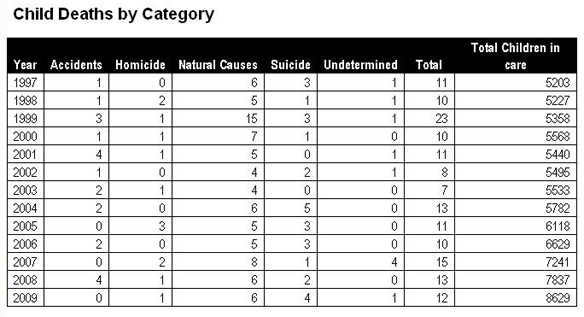
In June 2010 the CBC published a chart giving the deaths in Manitoba foster care (jpg) over a thirteen year period. It showed 154 deaths in 80060 child-years of foster care, a rate of 192.4 deaths per 100 thousand child-years, 6.9 times the parental care rate.
AFCARS Report
The clearest official source for death rates is AFCARS Report, Preliminary Estimates for FY 2005. It shows 534 deaths in a year with 513 thousand children in foster care. This gives a death rate of 104 per hundred thousand child-years, but the AFCARS data includes 4,445 runaways, without following them up to determine their death rate (it is high).
British Data
On November 20, 2008 the British Office for Standards in Education, Children’s Services and Skills (Ofsted) issued an annual report signed by her majesty's chief inpector Christine Gilbert (pdf). It shows on page 73 that 59,500 children are "cared for" by local authorities and on page 69 that 282 children died in the period 1 April 2007 to 31 August 2008. If the 282 are all from the "cared for" population, that gives a death rate in care of 334 per hundred thousand child-years, 11.9 times the parental care rate.
Ontario Data
In an article by Vivian Song published in the April 2, 2006 Toronto Sun, she says Ontario Deputy Chief Coroner Dr Jim Cairns presides over the deaths of about 70 children a year involved with CAS. The article does not define what is meant by "involved". On January 25, 2007 reporter Haley Mick in the Globe and Mail quoted Mr Cairns saying approximately 80 children die each year with open CAS files. The number includes deaths in foster care plus in-home deaths of children under watch. A document titled Report of the Paediatric Death Review Committee and Deaths Under Five Committee from the Office of the Chief Coroner, Province of Ontario (2007) contains the statements on page 22:
- 83 children died with an open file or having had an open file to a CAS within the previous 12 months
- 19/83 children were in the care of CAS (10 were Crown Wards; 2 were on an Extended Care and Maintenance program)
The document did not claim to include all deaths in CAS care.
Official sources in Ontario are silent on the number of deaths in foster care. Ontario uses a standard technique of official concealment — aggregating data. A hypothetical example illustrates what that means. Any accurate measurement of the amount of harm done to children will show that mothers commit more child abuse than fathers. In our misandric culture, this is a politically incorrect fact that public agencies prefer not to report. So instead of reporting "harm by mothers" and "harm by fathers" separately, a report may show only "harm by parents". Coupling this number with a few anecdotes, mostly of miscreant fathers, will obscure the truth and allow readers to believe that fathers are responsible for most abuse.
For Ontario's foster deaths, the data is aggregated with deaths of all children involved in any way with CAS, so that the foster deaths are lost in a larger number. Every year the Paediatric Death Review Committee releases a report giving the number of child deaths with (aggregated) CAS involvement. The figures for recent years are:
| year | deaths | in-care | link to report (pdf) |
|---|---|---|---|
| 2006 | 83 | 50 | 2007 report page 22 |
| 2007 | 90 | 54 | 2008 report page 52 |
| 2008 | 105 | 63 | 2009 report page 66 |
| 2009 | 120 | 72 | 2010 report page 72 |
| 2010 | 109 | 65 | 2011 report page 56 |
| 2011 | 109 | 65 | 2012 report page 49 |
| 2012 | 107 | 64 | 2013 report page 37 |
| 2013 | 96 | 58 | 2014 report page 21 |
| sum | 819 | 491 |
The number of deaths is, according to the reports, from a uniform definition of cases with open CAS files during the 12 months preceding death. How many of these were actually in CAS care at the time is undisclosed in consequence of aggregation.
In February 2009 Ontario's child advocate Irwin Elman reported that 90 children had died in the care of Ontario's children's aid societies in one year. Criticism originating with the Ontario Association of Children's Aid Societies soon claimed that in 36 cases children's aid only got involved after the death of the child, reducing the number of CAS fatalities to only 54. Spread over Ontario's 18,800 foster children (September 30, 2004 figure from OACAS) the two alternatives give death rates of 479 or 287 per 100 thousand child years, 17.1 or 10.2 times the parental care rate.
Assuming that the OACAS defense was their best effort, the ratio of the report number, 90, and the OACAS amended figure, 54, can be applied to all the data to come up with the best estimate of in-care deaths in the table.
Summary
The most reliable data sources show that the ratio of deaths in foster care to deaths in parental care is 5.25 in Arizona, 9.5 in Saskatchewan, 6.9 in Manitoba, 11.9 in Britain and in Ontario 17.1 or 10.2, depending on whose side you take in a controversy. An overall round number of ten to one seems reasonable.
Projected over Americas 550,000 foster children, there should be 1540 deaths per year. Our list of foster deaths from news sources shows less than a hundred annually. A reasonable guess is that only one foster death out of twenty makes it into the press, even fewer than that in Ontario.