help
collapse
Press one of the expand buttons to see the full text of an article. Later press collapse to revert to the original form. The buttons below expand or collapse all articles.
expand
collapse
SWAT Team Grabs Baby
April 30, 2008 permalink
Here is a CAS experience posted to Canada Court Watch by a man using the screen name PapaJohn. In another post, he indicates that he is dealing with the Hastings Children's Aid Society. This relatively small CAS has been generating a lot of complaints recently.
expand
collapse
PapaJohn
Posted: Tue Apr 29, 2008 2:33 pm
Subject: Need input...
OK, without going into as long drawn out story here I will just state pertinent facts pertaining to the question.
Since November of 2007 my family has been involved in a huge nightmare perpetrated by the Children's Aid Society (C.A.S.). They stormed our home (yes STORMED as if they were raiding an Al-Qauaida strong hold) with about 10 regular police officers and also the Tactical Response Unit (S.W.A.T. in the states). They ripped my grandson out of our home and away from his father with absolutely no legal or logical justification. Our grandson lived here in our home with our son and his mother for the first five months of his life and he was happy, healthy, and safe here. Due to a completely ridiculous argument my son's ex started simply because she could not go to a talent show because of no tickets being left, and her blaming our son for it who had absolutely nothing to do with it, the girl left our home stating she was taking the baby to a doctor's appointment. We later found out there was no doctor's appointment, she just used that as an excuse to take the baby and leave and never come back. Since she left my son's ex had been abusing his legal rights as a father and refusing to allow him access to his son. For close to a month our son had no access to his son because of this girl. My son finally called their C.A.S. worker and spoke to her about the situation. The worker did help him get a visit with his son. However, before the visit the child's mother told our son that once C.A.S. was out of the picture he would never see his son again because "he is just a father and fathers have no rights". Those were her exact words. So when we finally did get him for a visit at our home we decided to put an end to her abuse. We refused to allow her to take the baby back to her home and informed her that our son would be keeping custody of the child in our home (where our son lives). We told her that she and her family could come and visit the child any time they wanted but until there was a court order in place they would not be able to take him out of our home. This is completely legal in Canada. In Canada the law is very clear that if there is no court order for custody then either parent can keep the child in their custody and there is nothing the other parent can do until a court order is in place. Our son went to the court the day after his son came back into his custody and filed for custody. Four days after this C.A.S. showed up at our door asking our son to hand the baby over so they could take him back to the mother. Our son, in accordance with the laws, refused to do so and informed the worker of the mother abusing his rights (this wasn't actually informing the worker it was reminding her as she knew for weeks what the mother was doing but didn't do anything about it). Our son also reminded the worker of the environment in the mother's home. The mother and her parents and friends smoking pot in the home around the baby all the time, a pedophile (that C.A.S. knew about) living in the home dating the mother's sister. Her uncle being constantly in care of the baby even though he has already been charged and convicted of murdering his own child. Etc.... The C.A.S. worker just waved off all these concerns and said the child needed to be with his mother. Well, my son informed the worker that the child also needed to be with his father but the mother was abusing that. He informed the worker he was totally willing to be fair to the mother regarding custody but until a court order was in place to protect his rights as a father he was not turning the baby over. The worker tried to use a lame excuse that the mother was enrolled in a program called Abigail's. This is a place for mothers and children to go to during the week days where the mother is supposed to learn parenting skills and the child can interact with other children. However, what actually happens there is that the mothers sit around all day gossiping and hanging out while many of the children are abused by some of the older children there. Abigail's does not allow men to attend so by law C.A.S. can not use this as a legal or logical reason to take the child and the worker knew this so ended up leaving empty handed.
The worker returned the next day to take the baby and was again refused. This time she tried to claim our house was not clean enough for the baby. My son invited her in to inspect the house and had reminded her that she had already been in the home several times and knew it was in fact clean. My son also told the worker if she was so concerned about it then she could come every day to inspect the house and the first time it was not clean enough or safe enough for the baby she could then take him back to the mother. Defeated again the worker again left empty handed.
The next day the worker shows up yet again. This time she tries to claim that we still have animals in our home. The baby was diagnosed with allergies to dogs and cats about a month before this. However this diagnosis is in question since the doctor who made the diagnosis is the same doctor to diagnosed the mother's symptoms of missed periods, nausea, throwing up, sore breasts, and constipation as being a bowel problem. The mother ignored everyone elses advice to get a pregnancy test done because of her symptoms being those of pregnancy. Finally, six months later and after gaining some weight and getting a belly, the mother asked the doctor if the bowel problem had caused her to gain weight and a belly, and FINALLY the doctor did a pregnancy test and indeed she was six months pregnant. However, despite our doubts regarding the doctor's diagnosis of allergies in the baby, who showed absolutely no signs of any allergies (the doctor based the diagnosis on simply what the mother told him about the baby having puffy eyes, a rash all over his body and sneezing all the time. Symptoms that not even her parents or other family members saw nor anyone else saw), we still got rid of our two cats and a dog. This allergy story was just the mother's excuse for trying to keep the child from our son. However, as stated the C.A.S. worker tried to say they were still in the house. So my wife called the humane society and gave them her name and asked if they remembered her being in there about a month ago. They did indeed. My wife handed the phone to the C.A.S. worker and asked the humane society worker to tell the C.A.S. worker why she was there a month ago. The HS lady told the worker that my wife had brought in two cats and a dog and described the animals to the worker and told her the animals were still there. Once again the C.A.S. worker was defeated and left empty handed.
About two days later the above mentioned storming of police and C.A.S. workers happened. When they entered the home, after violently shoving my son down for no reason, one of the officers said they had a warrant to apprehend the baby. I told the officer I wanted to see the warrant and I was immediately, and brutally attacked by the officer and told I was under arrest for obstructing a peace officer.
My son then informed the C.A.S. worker that he had already filed for custody and he was well within his rights to keep the baby. He then asked why they were taking the baby and was told it was none of his business.
The next day our son was served with court papers. It was C.A.S. application for a protection order for the child. Our son's court date for custody was in one week. The C.A.S. court date was in three days. In effect, the C.A.S. illegally stuck their nose into the middle of a legitimate custody case. There was an affidavit by the C.A.S. worker attached to the C.A.S. application. As we read it we found out the reasons C.A.S. used to obtain their warrant. They were falsely accusing me of being violent and a danger to the baby. They have absolutely no evidence that I am violent or a danger to the baby because there is no evidence to be had. In fact the C.A.S. worker even admits in one of her affidavits that she spoke with the mother of the baby and her family and they told her they have known me for years (I have known the mother's mother since I was about 6 years old and I am now 42) and they have never known me to be violent and that in fact I a great with children. This information/affidavit comes FIVE MONTHS AFTER they obtained the warrant. Our family's glaring question is why did the C.A.S. not do this investigation BEFORE obtaining the illegal warrant based on fraudulent statements by the C.A.S. worker???? This past Friday I spoke with the Manager of Children's Services at C.A.S. about this worker and her lies. The Manager told me that the C.A.S. has in fact changed their minds about me. That after six months of this worker submitting affidavits to the court filled with lies about me being violent and a danger to the baby, that they spoke to many people, including the mother of the child and her family and our neighbors they have discovered that I am in fact not violent or a danger to any child let alone my grand son and that in fact I am very good with children. Again... Why did they do this investigation AFTER obtaining an illegal warrant and after ripping this child from the only home he knew for the first five months of his life?????? Exactly what evidence did this worker take to the judge who issued this illegal warrant?????
Now, as if all this was not bad enough.... The C.A.S. worker has submitted four affidavits full of lies to the court. The court appears to be swallowing all of these lies. However, we have come into evidence that not only proves this C.A.S. worker has been lying all along but that she has also been in collusion with the mother and her lawyer against our son. We have video tape and audio tape evidence that proves all of these lies. However, when our son went to submit a new affidavit with this evidence he was told by his lawyer that the court is refusing to accept any new affidavits. However.... Since the date the lawyer told my son the court is refusing any new affidavits this C.A.S. worker has been allowed to submit TWO new affidavits!!!!
This is completely unfair. The court is preventing my son from defending himself and our family from the lies of this worker. Now, I have been told by several people that this is not right. That my son has a fundamental legal right to submit affidavits in answer to this worker's affidavits. However I need to know for a fact if this is the law. I also need to know which part of the law it falls under (which paragraph and section of the law, and which law it falls under) for when we present this to the lawyer and the court in order to get them to allow our son to submit his answers.
I have looked all over the net, found the Family law act, the family law rules and such but can't seem to find anything specific that we can use as hard and fast law.
If anyone could help me out in this, if someone could post me a link to this information it would be greatly appreciated.
Also, I spoke with someone, I won't mention their name unless they wish to come forward here themselves, who suggested that my wife and I apply for custody of our son's son. Now, we have just had our case closed with C.A.S. about a month ago as they are satisfied our family is fine and there is no need for C.A.S. involvement but my son's case with his ex and his son is still open. I was just looking for some advice or input on whether it would be benificial for my wife and I to seek custody of our grand son.
Thanks in advance for any help.
Source: Canada Court Watch forum
Girl Stolen for Adoption
April 30, 2008 permalink
The Halifax Herald recounts the story of an unnamed dad who lost his young daughter to allegations later proved false. In spite of his exoneration, the girl was placed for adoption and is beyond legal recovery. There are many comments on the Halifax Herald website, most sympathetic to the father.
expand
collapse
Published: 2008-04-30
‘I’m not done. I’m far from done’
Father fighting to get his daughter back
By MARY ELLEN MacINTYRE Truro Bureau
 An Antigonish County father draws a bear paw, his symbol for the daughter who was adopted to another family, against his will. (MARY ELLEN MACINTYRE / Truro Bureau)
HE WORRIES every hour of every single day about his little girl.
The child with the mischievous grin and deep, dark eyes is lost to him, if not forever, then for a very long time.
More years than he has the heart to think about.
Neither his name nor hers can be published. Four years ago, the little girl was taken into custody by this province’s Community Services workers and she was adopted by another family last year.
No one from Community Services can speak about any case involving children.
"We can’t get into the specifics of any case and so we can’t address any allegations that may or may not be made," one source within the department said.
Department personnel can speak generally about processes and procedures, about the Child Protection Act and about the law, but they cannot speak about this particular little girl and her heartbroken father from Antigonish County.
Still, his is a riveting tale and he tells it with a depth of emotion and obvious love for his child.
One thing in this man’s favour: he is a fastidious record-keeper. He has three volumes of indexed documents to back up his claims. He has court papers, psychiatric assessments, a police background check (he has no record), affidavits, court transcripts and photographs.
This is his story:
"We weren’t married and we had broken up but when she told me she was pregnant, I was determined to be the best father I could be," he recalled.
His girlfriend had an older child, also a girl.
The children’s mother was receiving social assistance and her ability to look after her children was under constant scrutiny.
"I would say she was undermined by social services . . . she never really had a chance to succeed once they started with her," he suggested.
"I had joint custody of my daughter, which basically meant she was with me every day from early morning until the evening," he explained.
He would take his daughter back to her mother’s home in the evenings after spending the days with her, drawing, reading, taking walks in the park with her and teaching her about his Mi’kmaq culture.
Then his world fell apart.
Unhappy with the way the mother was caring for her two daughters, Community Services workers took them into custody.
"I still continued to have joint custody of (the little girl) because they had no problem with me," he said.
But shortly after the children were put into foster care, things went from bad to worse: an allegation of sexual interference.
His daughter’s older half-sister identified him as her molester.
"It was just so awful. How can you fight such an awful thing," he asked.
"I couldn’t understand why she would ever say such a thing about me."
He has suspicions that someone put the child up to it but is unable to provide proof.
Nonetheless, with such a charge hanging over his head, he knew he would have to fight tooth and nail for custody of his daughter.
"I knew I hadn’t done what I was accused of and that there had to be a reason she was saying it," he said.
As the case made its way through the court system, his daughter made her way through the foster care system.
The wheels of justice can be grindingly slow. Every so often, the most innocent people get chewed up under those wheels.
He was eventually acquitted of the charge.
However, by the time the case went before a judge and the child who made the allegation was unable to identify the individual who molested her, it was too late.
"Once my name was cleared, I applied to get my daughter back and I was told under . . . the Child Protection Act no further action could take place because an adoption was in process," he said.
By last September, the adoption had been approved.
"The order was signed, the case is sealed and you can’t take it back to court.
"They tell me no power on earth can change things," he said.
But he refuses to believe that.
"I’m not done. I’m far from done. I want my daughter back and I know she wants to be with me so I’ll keep fighting," he said.
"This is about the heart, not money or power. This is about a father who loves his daughter with all his heart and that’s got to mean something."
( mmacintyre@herald.ca )
Source: The Halifax Herald, pointed out by Jeremy Swanson
Dying in Secret
April 29, 2008 permalink
A joint report of the Children's Advocacy Institute and First Star deals with secrecy in child protection in the United States. Few American states release full information when a child dies from abuse or neglect. The quote below summarizes their point of view:
The current undue emphasis on confidentiality only masks problems inherent in child protection systems. Public exposure is a necessary step toward fixing these problems. Each year, millions of taxpayer dollars go to support child protective services investigations. Accordingly, the public has a right to know if the laws for the protection of children are being followed and its tax dollars well-spent. Child abuse deaths and near deaths reflect the system’s worst failures. Until state laws require the release of accurate and unfiltered information, we cannot identify the fault lines in the system, and cannot begin to fix them.
In the area of secrecy, Ontario is in a class by itself. In the past ten years we have found only ten cases in the press of children dying in state custody, though the best statistical estimates are that there must have been 280 or more in that period.
You can read their press release (pdf) or our local copy and the full report, State Secrecy and Child Deaths in the U.S. (900 kilobytes pdf), also with a local copy.
Social Worker Bitten by Rabid Dog
April 29, 2008 permalink
This story is too hot for comment. Make up your own.
expand
collapse
BBC NEWS
Social worker bitten by rabid dog
 Kim Cooling was bitten in three places by the rabid dog
A social worker who runs a charity that brings street dogs from Sri Lanka into the UK was one of three people bitten by a puppy infected with rabies.
Kim Cooling was "nipped" on the chin, wrist and face by the dog, which died two days later in quarantine.
The puppy was one of 13 dogs brought by the charity to Chingford Quarantine Kennels in north-east London.
The three people who were bitten are all "well", according to the Health Protection Agency.
A spokesman for the agency said: "We understand that three individuals who were bitten by the animal in the quarantine centre have received prompt protective treatment with appropriate vaccination and are well."
Because the dog died in quarantine, any public health risk was contained, the agency said.
Animals being checked
The dogs had been held at the centre since 17 April. Five of them were placed in isolation after showing signs of illness.
Four of the dogs have since been put down, and tests are being carried out to determine if they had rabies.
On Monday, Georgina Hyams, from the rescue charity, said test results for those four animals were negative for rabies.
Mrs Cooling, from the London-based Animal SOS Sri Lanka charity, said the dog that died had been vaccinated before leaving Sri Lanka.
She had been with the dog at the quarantine kennels on Wednesday when she was bitten.
"She just snapped at me and she was snapping at the other pups. She was not her usual sweet self," she said.
Mrs Cooling, and two kennel workers who were bitten by the puppy have received hospital treatment.
Other animals that may have come into contact with the puppy were being checked, according to the Department for Environment, Food and Rural Affairs (Defra).
But it stressed that further infections were "highly unlikely" and the UK remained "free of rabies" because the case had occurred in quarantine.
'System working'
Acting Chief Veterinary Officer Alick Simmons said: "While initial tests show that this puppy has tested positive for rabies, this shows that the system is working and the case has been picked up while the animal is in quarantine.
"We are now tracing animals that have moved from the kennels to ensure that all animals that have come into contact with the puppy are monitored."
Jeremy Robinson is the general manager of the Goddard Veterinary Group, which includes Chingford Quarantine Kennels.
He said there had been immediate concerns about the health of the five eight-week-old puppies and these had been placed in an isolated area away from other dogs and cats.
"I am confident that no other animals can have been infected," he said.
Effective treatment
Rabies is a viral disease which affects the central nervous system. Once symptoms appear it is almost always fatal, but patients can be treated with antibodies and a vaccination to fight the virus after being bitten.
Professor Hugh Pennington, an expert in bacteriology at Aberdeen University, told the BBC the treatment for rabies had a high success rate.
A professor of bacteriology on the risks to public health
Rabies was eliminated from the animal population in the UK in the early 20th Century, but it continues to infect a variety of animals in other parts of the world.
Twenty cases of rabies have been reported in England and Wales since 1946, which were all imported.
A licensed bat handler died in Scotland from a rare form of rabies caught from a bat in 2002.
Published: 2008/04/26 18:49:37 GMT
Source: BBC News
Addendum: One reader suggests it was a love bite — the dog thought he had found his soulmate. Also, see the photo commentary below by Leonard Henderson.
expand
collapse

 Nancy Grace of CNN
Source: AFRA, The Mess in Texas
FLDS Children Missing
April 29, 2008 permalink
Can you count to 467? Texas CPS can't. They have lost two of the children seized from the FLDS this month. Some of the children, healthier than the general population when picked up, are now in the hospital. The maltreatment of the children after abduction may turn the public against CPS in this case. At the average rate of death in foster care, we can expect the first abducted child to die in less than a year. Texas cannot provide any better care than assailed by Carole Strayhorn, so it is only a matter of time.
expand
collapse
Deseret News
2 young FLDS boys unaccounted for
By Brian West, Deseret News, Published: April 27, 2008
SAN ANGELO, Texas — As children from the Fundamentalist LDS Church settled into new foster homes this weekend, the whereabouts of two young boys remains uncertain.
Child welfare workers in Texas say they're not worried. But the mother of the boys and attorneys representing the mothers are not sure whether they should be or not.
"We just don't know where they are," Cynthia Martinez told the Deseret News Saturday.
Martinez, the communications director for Texas RioGrande Legal Aid, which represents 48 FLDS mothers, said they had information on where the boys were supposed to be taken but can't confirm anything to emotional parents. It's indicative, she said, of the fear and confusion the parents of the 467 children taken from the YFZ Ranch continue to feel.
Meanwhile, an FLDS member sent a letter to the governor of Texas on Saturday, accusing child welfare officials of "some of the most horrific violations of human rights that have ever been allowed on American soil."
The letter was sent to Texas Gov. Rick Perry from Willie Jessop, an FLDS member who has helped church members publicize their cause. The letter asks the governor to respond and "stop this injustice and abuse" of the innocent FLDS children by separating them from their mothers.
"The Texas Department of Family and Protective Services have demonstrated, in a most blatant way, their inability to properly care for, or even account for our children," the letter states.
"Many have been left in critical medical conditions, resulting in permanent mental damage through threats, intimidation and ultimately separating them from their parents, disregarding their own psychological expert advice to keep children with at least their mother."
Jessop accused Texas officials of "false allegations about the finding of abuse against teenage girls" and accused some Child Protective Services employees of "inhumane tactics and threats towards innocent mothers and children."
While not responding directly to the letter, DFPS spokesman Chris Van Deusen and others have repeatedly and strongly denied allegations made by several FLDS mothers that CPS workers threatened to never allow them to see their children again if they didn't cooperate or if the women returned to their homes at the YFZ Ranch.
"Those (allegations) are absolutely false. No one from CPS would say that," Van Deusen said.
Like Jessop, Martinez said accounting for all the children is a concern for her, too.
She said the mother of the two unaccounted-for boys contacted her attorney to say she needed to know about her 11-year-old and 16-month-old sons. The attorney was unable to get any information to help calm her client. Martinez is not saying the boy took his brother and ran away but said she can't rule out any possibilities because of the confusion that exists.
"These mothers are no longer with their children. They're afraid and fearful and they want to know that their kids are OK," she said. "We're having trouble even telling these mothers where their kids are going."
The last of the 467 children were bused from makeshift shelters here Friday and sent throughout Texas to 16 different foster-care facilities in Amarillo, Midland, Abilene, Ft. Worth, Waxahachie, Houston, Waco, Austin, San Antonio and Corpus Christi.
"We don't have any unaccounted-for kids. All of them are in foster care now," said Van Deusen.
He couldn't provide any details about the specific two boys but said identification issues have continued to plague Texas officials. CPS workers have repeatedly complained that some children and women have provided different names than were given the day before. Together with the unusual family sizes and the number of different mothers caring for the children from the polygamous families, it's been difficult to sort out who's who.
"I don't know if this is a matter of simply not being matched up properly," he said.
Such confusion is why a judge ordered all mothers, fathers and children who lived on the ranch to submit to DNA testing. But those results aren't expected for another month.
Martinez said her office received information from one of the foster facilities Saturday that a 2-year-old child from one of the mothers they represent was hospitalized and in the intensive care unit. Yet when the child's guardian ad litem called the hospital, she was told there was no one there with that child's name.
The judge told CPS to allow mothers to be with their children when they got sick, Martinez said. "Not only is this mother not able to confirm where her child is or what her current health situation is, but the mother is not being allowed to be with this child or her other nursing children," she said.
Martinez also spoke of another FLDS mother who was extremely anxious Saturday for news about her children. "She's just terrified because she doesn't feel her kids know how to live without her," she said.
"Any mother would be afraid and concerned. It is heightened here by the fact that this community has been living a different lifestyle for so long," Martinez said. "They don't know how their children are going to react or are now reacting to the world in general."
Van Deusen said if parents don't know which foster facility is caring for their children, they soon will. And, he said, the attorneys for the children should already know.
Although Judge Barbara Walther has not yet authorized visitation for parents, CPS workers are currently making preparations for that to occur. "The mothers will be able to visit their children in some capacity," he said.
Most of the visits will likely be supervised and, at least initially, may take place at CPS offices.
He said the next step for CPS is to set up a "service plan" for each child. Each child will be assigned a case worker and parents will be invited to attend these meetings during which all options and programs will be discussed.
"We want the parents to be involved. They're still a part of this process," Van Deusen said.
Yet the Department of Family and Protective Services has so far argued that each child who lived at the ranch was in danger because of a pattern of sexual, physical and emotional abuse there. Investigators described a "pattern of grooming girls from a young age to accept becoming married to middle-aged men" and identified 20 girls and women who got pregnant between the ages of 13 and 16.
Asked whether the department would begin to look at each individual child's case separately, rather than as a group collectively in danger, Van Deusen said he isn't sure.
"I can't say right now what the plan may be for specific children or all the children" as a group, he said. Each child's case worker, attorney and guardian ad litem will be involved in such decisions together with a judge.
E-mail: bwest@desnews.com
Source: Deseret News
Lemonade Abuse
April 29, 2008 permalink
A Michigan father took his seven-year-old son, Leo Ratte, to a Detroit Tigers game and bought him a lemonade without reading the fine print. The lemonade was five percent alcohol. The boy spent two days in foster care and was separated from his dad for a week.
expand
collapse
Ann Arbor man gives 7-year-old son alcoholic beverage during Tigers game
Posted by The Associated Press April 28, 2008 11:31AM
DETROIT (AP) -- A son's thirst and a father's oversight at the ballpark turned an otherwise fun outing into an ordeal for one family.
Christopher Ratte of Ann Arbor recently took his 7-year-old son, Leo, to a Detroit Tigers game and stopped at a Comerica Park concession stand to buy him some lemonade. But it wasn't until the top of the ninth inning, when a security guard asked the University of Michigan classical archaeology professor about the bottle in his son's hand, that Ratte learned what puts the hard in Mike's Hard Lemonade.
"I'd never drunk it, never purchased it, never heard of it," Christopher Ratte told Detroit Free Press columnist Brian Dickerson for a story published Monday.
Ratte said he told the guard he had no idea that the $7 lemonade contained alcohol. But when he tried to look at the bottle, the security guard snatched it -- and his son was taken to a ballpark's medical clinic. The mistake three weeks ago began a two-day stay for Leo in state custody and nearly a week before his father would be able to move back into his home.
Leo was taken by ambulance to Detroit's Children Hospital because clinic officials said he reported feeling a little nauseated after drinking about 12 ounces of the drink with a 5 percent alcohol content. But a blood sample taken at the hospital detected no trace of it.
Ratte said the workers from the state's Child Protective Services unit told him that day the intervention was unnecessary but they were just following orders.
Child protection officials cannot by law discuss a specific investigation. But Mike Patterson, Child and Family Services director for the Wayne County district that includes Comerica Park, said his agency's discretion is limited once police obtain a court order to remove a child from the home.
An assistant state attorney general said the state had no interest in aggressively pursuing the case, so a juvenile referee on April 7 agreed to release Leo to his mother as long as his father relocated to a hotel. Three days later, the complaint was dismissed and Christopher Ratte was allowed to go home.
Ratte and his wife have filed a formal complaint with the Child Protective Services ombudsman's office.
Ratte wrote in his complaint that he has apologized to his son "for the silly mistake that got him into this mess."
"But I have also told him that what happened afterward was an even bigger error, and I would like to be able to say to him that institutions, like people, can learn from their mistakes."
Source: mlive.com newspaper group
Addendum: Three years later the ACLU helps son Leo Ratte sue for compensation.
expand
collapse
ACLU sues state over dad's custody loss after hard lemonade mix-up
 Christopher Ratte, 47, of Ann Arbor says he had no idea that the lemonade he bought for son Leo, 7, at Comerica Park three years ago, contained alcohol. A guard noticed Leo drinking Mike's Hard Lemonade. Leo was taken to a hospital, then to a foster home.2008 photo by ERIC SEALS/Detroit Free Press
The ACLU of Michigan today sued the Michigan Department of Human Services for taking away a 7-year-old boy whose father unknowingly gave him an alcohol-laced Mike’s Hard Lemonade at a Detroit Tigers game in 2008.
“Taking a child from loving parents is a harrowing, life-changing experience for both the child and the parents,” Michael Steinberg, Michigan ACLU legal director said after filing the suit in U.S. District Court in Ann Arbor.
“Michigan law currently allows the government to take a child without having to prove that it’s necessary to prevent immediate danger,” he added. “The law is unconstitutional, out of step with the rest of the country and must be fixed to prevent harm to other families.”
The ACLU said the lawsuit, filed on behalf of the child, Leo Ratte, seeks to overturn a state law that permits law enforcement officials to remove children from their parents’ custody without proving that the child is in immediate danger.
The incident, which made national news, happened in April 2008 when Leo Ratte was attending a Tiger’s game with his father, Christopher Ratte, an archeology professor at the University of Michigan. On the way to their seats, Christopher Ratte purchased a bottle of Mike’s Hard Lemonade, not realizing that it contained alcohol, and gave it to his son.
During the game, a security guard asked the father if he knew his son was drinking an alcoholic beverage. Although the dad said he didn’t realize the beverage contained alcohol, the security officer alerted police.
The child was sent to Children’s Hospital in Detroit for examination. Although no alcohol was found in his blood, he was taken into the custody of Wayne County Child Protective Services, a division of the state's human services department.
Authorities refused to give the child to his mother, Claire Zimmerman, who hadn’t attended the game, or to his aunts, one of whom is a social worker and licensed foster parent, the suit said.
After spending the night sleeping on a sofa at the protective services building, while his parents waited on a sidewalk outside, the lad was sent to a foster home.
He was released to his parents three days later with the help of the U-M Child Advocacy Clinic.
Steinberg said authorities violated the son’s and mother’s constitutional rights because she wasn’t at the game when the incident happened. The ACLU noted that child welfare advocates have tried unsuccessfully for years to modify Michigan’s emergency removal law. He said a bill to remedy the problem died at the end of last year’s legislative session without a hearing or vote.
Defendants in the suit include Detroit police officers and county and state caseworkers who were involved in the incident.
The Department of Human Services said it doesn’t comment on pending lawsuits.
Source: Detroit Free Press
And this was the introductory case in a WXYZ-TV exposé of Michigan child protection (mp4).
Adopt-an-Organ
April 28, 2008 permalink
Do you need an organ transplant? If you are unable to get one through normal channels, consider adopting a foreign orphan. The agency Medical Adoptions has thousands on file, and can select one that is a perfect tissue match. Once the adoption is complete, you can use the child as the source of your needed organ.
According to snopes, this site is a hoax, but it is not much sicker than actual practice in the child trafficking industry.
Addendum: Most readers seem to have been taken in by this hoax. Here is a serious commentary on the meaning.
expand
collapse
May 06, 2008
The Art of the Hoax
Posted by Ryan W. McMaken at May 6, 2008 10:19 PM
In recent years, I've noticed more and more of sites like medical adoptions.com or the now defunct coincidencedesign.com.
They are in essence the intellectual heirs of Swift's A Modest Proposal and many of them are just as impressive. They employ the same tactics and produce the same results. Some people see right through the hoaxes immediately, but many are outraged and quite credulous. In the end, the fact that people are willing to believe, even momentarily, that the proposal in question is being seriously put forward, is an excellent commentary on humanity's opinion of itself.
In Swift's case, he was showing how dehumanizing was the alleged humanism of the supposedly enlightened ruling classes of his day who offered what were seemingly humane solutions to society's ills. Yet, upon further inspection, such ideas were actually patronizing and monstrous policy positions that were ghoulishly hateful of the people they claimed to protect.
A site like medical adoptions does pretty much the same thing, showing enlightened (usually white) adults caring for (usually brown) children in a cute and charming way, but the children are really commodities that exist to supply spare organs for the adopting parent. There's a certain banality-of-evil factor at work here, and is somewhat reminiscent of the the image of a doctor at an insane asylum who assures you he is looking out for your best interests right before lobotomizing you.
Source: Lew Rockwell website
Wall of Secrecy
April 28, 2008 permalink
John Dunn has taken his struggle with the foot-dragging Ottawa Children's Aid Society to the leader of the provincial opposition, John Tory, asking him to provide information about the expenditure of public funds by children's aid.
This time we can say for sure what the outcome will be. Even if Mr Tory decides to look into the matter, he will find nothing. It is just as hard for politicians to penetrate children's aid secrecy as for anyone else.
expand
collapse
John Tory:
I am writing to inform you of the following matter, which your experience as a trained lawyer will assist you in understanding the issue of concern to Ontario citizens.
On November 30, 2006, when the Minister of Children and Youth Services introduced Bill 165 (Independant Child Advocate Bill)
See link below if required:
link.On this day, John Tory said the following in response to the Minister's introduction of the Bill.
ORAL QUESTIONS
CHILDREN'S AID SOCIETIESMr. John Tory (Leader of the Opposition): "My question is for the Minister of Children and Youth Services. Today, the CBC is reporting there's been a leak of the section of the Auditor General's upcoming annual report dealing with the children's aid societies. The stories claim that more than $1 billion of taxpayers' money is spent each year by the children's aid societies without any oversight at all by the government. The story goes on to claim, in the extract from the report, that instead of going to children, this money is being spent on luxury cars and expensive trips -- and there are a lot of details on that. This is hard-earned taxpayers' money that is supposed to be going to help children, but instead it seems that it's being spent on cars and trips. What does the minister have to say to the children, to the foster parents, to the people who work in that field who are short of resources and to the taxpayers about this gross mismanagement taking place on her watch?"
The sentence I wanted to focus on in this statement is as follows:
"The stories claim that more than $1 billion of taxpayers' money is spent each year by the children's aid societies without any oversight at all by the government."
Currently, I have filed a complaint with the current Minister of Children and Youth Services, Deborah Matthews, regarding a Society spending Ministry Allocated Transfer Payments (Tax Payers Money) on an illegal purpose by hiring an external lawyer to assist them in committing an Offence. (Under section 307 (5) of the Corporations Act, R.S.O. 1990, c. C-38 - "failing to furnish a list of their members as required")
They decided to commit the Offence of failing to furnish a list of their members as required by section 307 (1) of the Corporations Act, then retained the services of the external lawyer to write a letter on behalf of the Board (not the Society seeking legal advice, but instead using a lawyer to assist them to commit an Offence) to the person who properly requested the list informing the requester, on behalf of the Society's Board that they were going to commit the Offence of failing to furnish the list.
I contacted the Minister to complain about this illegal spending of Ministry Allocated Transfer Payments and like you said nin the sentence quoted from you above, the Minister simply stated that the Ministry only has a monitoring role over CAS's and that financial information is sent to the Ministry in their quarterly uploads to the Ministry from the Societies.
Unfortunately those quarterly uploads do not provide enough detailed information to notify the Ministry, even if they were closely scrutenizing the uploads, of the fact that the Society spent funds on a lawyer for that or any other purpose.
Is there anything you can assist me with in seeking detailed expenditure information from the Society so that I can show the Minister that they did in fact spend their funds illegally and against their service contracts.
I have charged the Society with the Offences under the Provincial Offences Act (section 23) as a private prosecutor and the Ottawa Society and their Executive Director have, after several adjournments, decied to enter into resolution discussions with me. It appears they do not wish the charges to enter the courts as they are very clear Strict Liability Offences and have a high probability of conviction.
Anything you can assist me with via information on how to obtain from a Society the evidence of their expenditure of money, or for you to ask the Minister of Children and Youth Services to investigate this matter under her powers of Revocation and Take-Over powers which if she has in her opinion, based on reasonable evidence submitted to her, believes that a Society has breached any portion of the Child and Family Services Act or any other Act (the corporations act)
When notified she simply responded that she has no jurisdiction over the Corporations Act. Of course we know she does not have jurisdiction over the Corporations Act, but she does have jurisdiction over the CFSA which states that a Society (s. 15) must adhere to this and any other Act which applies to it) but she chose to ignore it.
Feel free to contact me at 613-228-2178 for discussion on this matter if you can.
Also, more details can be read on the Enforcement page of the Foster Care Council of Canada site shown below
Sincerely
John Dunn
Former Foster Child
Child Welfare Reform Advocate
Executive Director
The Foster Care Council of Canada
www.afterfostercare.caSource: email from John Dunn
Foster Rape
April 28, 2008 permalink
A Rochester New York news report deals with rape of a teenaged girl by her foster family.
expand
collapse
Teen who alleges being raped in foster home speaks out
Reported by: Kevin Jolly, Saturday, Apr 26, 2008 @06:35pm EST
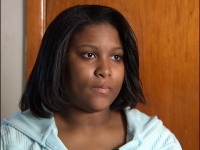
“Why a are you stepping forward now and talking about this?” News Eight asked. “Because I'm ready for it, “ said the woman identified as Crystal. 19-year old Crystal is ready to break her silence about a secret she carried for years. “I don’t exactly remember how everything started. I just remember I was 13 or 14,” said Crystal. Crystal says for five years she was sexually assaulted and raped by 70-year old Lawrence Bright. Bright was the boyfriend of her foster care provider. Crystal says from the sex assaults began in 2002 when she was a foster child in Bright’s care. The abuse happened at a home on Pinnacle Road in Henrietta and at this beauty salon his wife owns on State Street in Rochester. “Anytime my mom wasn’t home and sometimes maybe she was there and she had no clue but most of the time its when she wasn’t there,” said Crystal. Crystal told investigators the abuse would sometimes happen as many as five times a week. She told investigators she was afraid to tell anyone. “I don’t know, I really didn’t know how to make it back off and stuff like that,” said Crystal. Crystal says she eventually told her biological mother who urged her to tell police. Bright was arrested and charged with multiple sex abuse charges. Crystal believes Bright should pay for what he did. “He needs his justice and if that means him staying in jail for the rest of his life that’s how its gonna have to be,” said Crystal. Investigators are now trying to determine if there are other victims. Crystal say there were other foster children in the home at the time of her alleged abuse. She has this advise for others who may be in a similar situation. “I want them to know its not their fault and they should tell as soon as possible because things could get worse in the long run,” added Crystal.
Source: News 8 Rochester New York
CAS Pushers
April 28, 2008 permalink
Canada Court Watch has spoken to a foster kid who was introduced to smoking cigarettes by Halton CAS.
expand
collapse
Foster kid spill the beans! Halton Children's Aid Society worker gives cigaretts to underage children and then smokes up with them!
(April 26, 2008) A ward of the Halton CAS has come forth to disclose to Court Watch that children as young as 14 were being given cigarettes and then allowed to smoke them along with the Halton CAS worker who told the children to keep this a little secret between themselves. According to society ward, the CAS worker involved was having the under-aged children purchase cigarettes at the local store and bring them back for the the CAS worker and the kids to smoke together. In addition to the smoking, the foster child told of crying in bed at night because of all the broken promises by workers and the constant pressure put on the children by the Halton CAS workers. Another foster child came forth not that long ago to disclose abuse by workers with the Halton CAS. That child as well voiced similar complaints. During her interview, the child who is now a teen, disclosed of other abuses by CAS workers. The teen referred to CAS workers as liars and manipulators who could not be trusted. Children are being abused by CAS workers and agencies and now these unaccountable CAS agencies are demanding yet even more money from the Ontario Government.
Source: Canada Court Watch
One Kilo-Death
April 27, 2008 permalink
Last Wednesday 22-month-old Quavarius Vaughn fell into a pool and drowned. He was with foster parents who intended to adopt him. This unremarkable incident appears here only because with this death, our list of children dying after being "protected" from their parents has reached a thousand. From here on we can measure the impact of child protection in kilo-deaths. And remember, 19 of every 20 deaths in foster care never get into the press, and so never get on our list.
expand
collapse
Toddler Drowns In Family Pool
Reported by: Daisy O'Donnell, dodonnell@wpsdtv.com
Reported by: Gerran Thomas, Last Update: 4/25 8:11 am “The only reason I'm coming on TV right now is to warn other parents to be careful."
A two-year-old falls into a family pool and drowns. Now his father grieves as he shares his story of loss.
“I can't even explain how my heart feels. It's like an elephant standing on my chest right now,” said Anthony Skinner.
Just before 8 pm Wednesday night, the toddler fell into a backyard pool just a few feet away from where his brothers and sisters were playing.
This tragic happened in rural Massac County at a home on Unionville road between Brookport and Unionville. 22-month old Quavarius Vaughn was rushed to Western Baptist Hospital where he died two hours later.
Anthony Skinner, Quavarius’ father, is a man with a big heart who has lost an even bigger part of his world. Skinner is a father of seven, Quavarius was one of two childred he adopted. He’s telling us his story so it doesn't happen to your family.
"I lost a lot in my life, but this? This is the worst thing I ever lost,’ said Skinner.
Gone forever are the laughing eyes of Skinner's foster son, 22-month old Quavarius.
“You could tell him something one time and he'd repeat it. You introduce someone to him, and he'd remember their name. That's like a genius to me,” said Skinner.
Quavarius was lost beneath the murky water of a swimming pool at the home. With a heavy heart, Anthony says it's painful for him to remember what happened Wednesday.
“It was getting dark, I had just seen him. It was like 10 minutes and I asked where he was,” said Skinner.
Anthony's children were playing softball near a swing set. Within a matter of minutes, little Quavarius was missing. His nephew, Cody, found him unconscious in the pool.
“My daughter, Destiny, she jumped in there and got him. She didn't panic or nothing, jumped right in there,” said Skinner.
But it was too late. Now all Anthony Skinner can do is make sure this never happens to another family.
“The only reason I'm coming on TV right now is to warn other parents to be careful,” said Skinner.
Because even if you didn't know this precious boy or the father who loved him, everyone knows someone just like him.
“I'll have my good cry. I know I will. It will hit me. But right now, I'm just strong," said Skinner.
Quavarius' father says he's done all the crying he can and he knows he's going to experience many more tears for a lifetime.
Skinner wants people to come see his family and children, to support him in a time when he needs them the most. He’s encouraging people for their prayers and words of support during this difficult time.
Skinner also tells us funeral arrangements have not been made for his child.
Source: WPSD News channel 6
Where Spanking is Legal
April 26, 2008 permalink
While parents lose their children for any form of physical discipline, teachers in many places can hit kids legally. Even more widespread, authorities habitually look the other way when any kind of institution uses force against its own wards. Georgia teacher Paula Flowe speaks against corporal punishment on YouTube. She also has her own website The Hitting Stops Here.
Press Lies About FLDS
April 26, 2008 permalink
CBS News, reporting on the dangers faced by the FLDS children seized this month, says there were four deaths in Texas foster care in 2006. Our list drawn from press reports shows twelve:
- Lacey Nichols, Coleman, January 12
- EVR Rohit Chakravarthy, Harlingen, February
- Nicholas Hoffert, Cleburne, February 9
- Jaaliyah Beecham-Davis, Longview, March 4
- Brooke Martinez, Fort Worth, March 7
- Lenny Ortega, Ingram, May 30
- Guadalupe Rosales III, San Antonio, June 13
- Christian Nieto, Corsicana, September 4
- Christopher Ladell Hill, Hawkins, September 21
- Harry Tyrone Rutledge, Hawkins, September 21
- Andrew Burd, Corpus Christi, October 3
- Katherine Frances, DeSoto, December 3
The best statistical estimate is that nineteen of every twenty deaths in foster care never make it into the press. For more details on these deaths refer to our tomb page.
expand
collapse
Polygamy Sect's Kids Face Tough Transition
SAN ANGELO, Texas, April 24, 2008(CBS/AP) The hundreds of children from a polygamist compound taken into state custody are on their way to group homes, shelters and residences, but experts and lawyers fear their transition may be much harder than it is for other foster children.
The number of children in Texas custody after being taken from a polygamist retreat now stands at 462 because officials believe another 25 mothers from the compound are under 18.
Child Protective Services spokesman Darrell Azar says the girls initially claimed to be adults but are now in state custody. Earlier they had been staying voluntarily with their children at a shelter at the San Angelo Coliseum.
The official number of children taken from the ranch controlled by the Fundamentalist Church of Jesus Christ of Latter Day Saints has been rising since a state raid three weeks ago. One reason is that some mothers under 18 claimed to be adults.
Roughly 260 children remain at the coliseum. The others were bused to foster facilities.
The 462 children taken from the compound in West Texas will be plunged into a culture radically different from the community where they and their families shunned the outside world as a hostile, contaminating influence on their godly way of life.
Many of the children have seen little or no television. They have been essentially home-schooled all their lives. Most were raised on garden-grown vegetables and twice-daily prayers with family. They frolic in long dresses and buttoned-up shirts from another century.
"There's going to be problems," said Susan Hays, who represents a toddler in the custody case. "They are a throwback to the 19th century in how they dress and how they behave."
Safety concerns are also worrying advocates for the children. There were four deaths in two facilities supervised by the state foster care system in 2006, reports CBS News correspondent Randall Pinkston.
Another facility - Boys and Girls Country - northwest of Houston has also reportedly had problems in the past and it is on the placement list for the children removed from the compound, Pinkston reports.
Buses have already shipped 138 children to group homes or boys' and girls' ranches, but most of the remaining children will be separated from their mothers for the first time when they are sent out of San Angelo in the coming days.
The state Child Protective Services program said it chose foster homes where the youngsters can be kept apart from other children for now.
"We recognize it's critical that these children not be exposed to mainstream culture too quickly or other things that would hinder their success," agency spokeswoman Shari Pulliam said. "We just want to protect them from abuse and neglect. We're not trying to change them."
The children were swept up in a raid earlier this month on the Yearning for Zion Ranch run by the Fundamentalist Church of Jesus Christ of Latter Day Saints, a renegade Mormon splinter group. Authorities say it believes in marrying off underage girls to older men, and that there is evidence of physical and sexual abuse at the ranch.
The youngsters are being moved out of the crowded San Angelo Coliseum and will be placed in temporary facilities around Texas - some as far away as Houston, 500 miles off - until individual custody decisions can be made.
Those decisions could result in a number of possibilities: Some children could be placed in permanent foster care; some parents who have left the sect may win custody; some youngsters may be allowed to return to the ranch in Eldorado; and some may turn 18 before the case is complete and be allowed to choose their own fates.
Pulliam said the temporary foster care facilities have been briefed on the children's needs. "We're not going to have them in tank tops and shorts," she said.
Pulliam said the children will continue to be home-schooled by the temporary foster-care providers instead of being thrown into big public schools, where they could be bullied because of their differences.
In a related development, an arrest warrant affidavit made public Wednesday shows that a phone number used to report alleged abuse at the Texas retreat had been used previously by a 33-year-old Colorado woman.
It's not yet clear whether authorities suspect Rozita Swinton, of Colorado Springs, made any of the calls that triggered the April 3 raid of the compound.
Texas authorities have said a 16-year-old girl called a crisis center claiming she was abused at the compound. Authorities have not found that girl but say they have found evidence other children were abused.
In February, a woman calling herself "Jennifer" called 911 in Colorado Springs from the same number, claiming that her father had locked her in her basement for days, the document said. Swinton was arrested in connection with that incident on April 16 and later released.
Source: CBS News
Putman Award
April 24, 2008 permalink
Former Dufferin CAS Executive Director Gary Putman is being honored by establishing an award in his name. The award will be given by Dufferin CAS to a person who is
- Committed to the well-being of children and youth in our community
- A positive influence within the community
- Innovative in their approach with children, youth and families
- Positive, helpful and work well with others including clients, colleagues, and community members
We suggest giving the award to any of the thousands of mothers who have managed to continue caring for their children in spite of the best efforts of CAS social workers to disrupt their families. Or perhaps Rev Dorian Baxter, the first person to successfully sue the CAS for its misdeeds. Or course, the award will not go to anyone like this, but to one of the professional family destroyers. We copy the Orangeville Citizen article below, and link to the announcment by Dufferin CAS (pdf) or our local copy.
expand
collapse
Orangeville, Ont, Local News, April 24, 2008
Putman award will recognize contributions to child safety
Dufferin Child and Family Services has created the Gary Putman Award to recognize a member of the Dufferin County community who has made a significant contribution in the areas of child safety and wellbeing, children's mental health, developmental support services and/or community education and awareness. The agency is seeking nominations until May 31, 2008.
Gary Putman led Dufferin Child and Family Services for 29 years before retiring as Executive Director last November. In recognition of his efforts and dedication to the children and youth of Dufferin, the award will be presented annually in his honour.
The agency said successful nominees will be:
- Committed to the well-being of children and youth in our community;
- A positive influence within the community;
- Innovative in their approach with children, youth and families;
- Positive, helpful and work well with others, including clients, colleagues, and community members
The winner will be presented with the award at Dufferin Child and Family Services' annual general meeting on June 25.
To get a nomination form, contact Carrie Jenks at carrie.jenks@dcafs.on.ca or by phone at 519 941- 1530 ext 284.
Source: The Orangeville Citizen
More of FLDS Case is Fake
April 24, 2008 permalink
A column by Bud Kennedy adds some new facts to the FLDS situation. The marriage age in Texas was fourteen before the settlement was built. The representative for Eldorado filed a bill to raise it to sixteen. Sounds like a custom law to bust FLDS. And there were only five pregnancies among the 437 children, a teen pregnancy rate lower than for other residents of surrounding Schleicher County.
So the original phone report of child abuse was a hoax, the girls were married at what was a legal age at the time, and there is not an epidemic of teen pregnancy within FLDS. We can expect more of the state's case to crumble in this unusual case in which the press is breaching confidentiality at every step. Don't expect child protectors to give up — they will come up with new reasons to keep the kids.
The number of children taken keeps increasing, owing to the reclassification of young mothers as children. Other news reports suggest that the children make their own clothes, are culturally isolated, do not watch television and do not know who Elvis was. Does that make them worse off? Or better off? On a video posted by FLDS (Flash), the mothers were shown no search warrant. The police served one master warrant on the leader of the settlement, then used that to search all homes. Will we soon have a warrant served on the mayor of Toronto justifying a search of every home in the city?
expand
collapse
Posted on Wed, Apr. 23, 2008
Bud Kennedy: Did removal of sect's kids open a door that can't be shut?
By BUD KENNEDY, Star-Telegram Staff Writer
As he drove home late on a lonely West Texas highway, the director of Fort Worth's best-known children's agency wondered how much the state can really help 437 girls and boys from the YFZ Ranch.
Like the rest of us, Ted Blevins is not sure whether state officials did the right thing in investigating possible statutory rape and child abuse inside the compound.
But he has met the children.
And he says we are doing the right thing now.
"A door has been opened that cannot be closed," said Blevins, director of Lena Pope Home, a 78-year-old family counseling and foster care agency founded by a Fort Worth mother to rescue Depression-era orphans.
Ten Lena Pope counselors and child-care workers volunteered in San Angelo last week, pitching in with other agencies from around the state to help child welfare investigators care for the children.
"Once evidence was found of behavior that's against our laws, it would not have been appropriate to ignore it," Blevins said.
"But we have to realize that by removing these children, the state might not be able to guarantee any greater safety in the outside world. Our people had to wonder: Is what we're doing really going to protect them that much more?"
Investigators report finding evidence of five underage pregnancies.
If five of 437 children in the compound were pregnant or have babies, that is better than the underage pregnancy rate in the rest of Schleicher County, according to state statistics.
In other words, 14-year-old girls might be less likely to get pregnant inside the YFZ than in Eldorado.
Investigators originally said they found evidence of 20 abused children. No charges have been filed in any case.
"We understand why the children can't live where they were living," Blevins said. "But we know from local experience that even when you separate children from abusive parents or an abusive home, the separation itself does harm. There are always severe problems when a child is separated from the mother."
Another problem isn't inside the ranch.
It's out here.
"How will these children assimilate into our culture?" Blevins said. "They've never known traffic, noise, lights, the Internet -- they will be adjusting to a totally different life."
The Lena Pope Home workers helped care for children 12 hours a day, spelling other volunteers and state workers. The Fort Worth agency was called in for its long experience with child and foster care, Blevins said. For all the misgivings, he strongly supports the state investigation.
"If we had word of something like this going on inside a house in Fort Worth, the neighbors would not just sit by and let nothing be done," he said. "I don't think our state had any choice in this situation."
A 2005 law authored by state Sen. Jane Nelson, R-Flower Mound, overhauled child welfare in Texas and also raised the minimum age for marriage. The bill was originally filed by Rep. Harvey Hilderbran, R-Kerrville, who represents Eldorado.
Testimony focused on the YFZ Ranch, with Hilderbran accusing residents of "underage marriage, alleged child abuse, incest and election fraud."
Nelson has said that the investigation spotlights Texas' shortage of foster homes. The 437 girls and boys from Eldorado join more than 17,000 children in state care.
"Clearly, the priority right now should be finding safe, supportive environments for these children in crisis," Nelson said in a statement. Her Senate committee will meet April 30 in Austin to hear public testimony about Eldorado.
Blevins said he's proud of the child welfare workers and volunteers.
"I saw every child treated with absolute dignity and respect," he said. "I think everybody in San Angelo was very careful about respecting the children and their families. I have never been so proud of Texas."
Even if it wasn't a perfect investigation.
Source: Ft Worth Star-Telegram
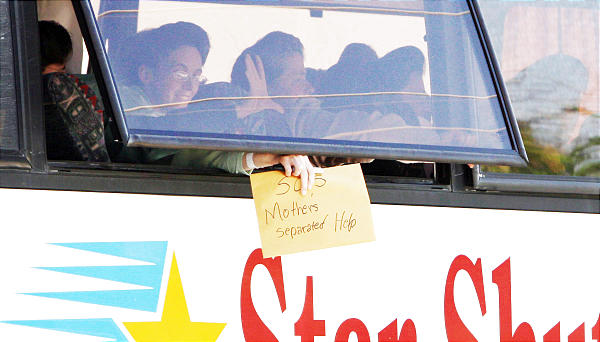
Source: Deseret News April 24 2008
Nest-Eggs for Foster Kids
April 23, 2008 permalink
Here is another indication that Minister of Children and Youth Services Deb Matthews is instituting real reform. Children's aid societies have been directed to put the $1200 per year benefit for pre-school foster children into savings accounts. Lesser benefits will be appended for older foster children. When the children reach age of majority they will have a nest-egg for their education.
While well intentioned, we are skeptical. It will be many years until these accounts mature, and by then we will have a new Minister. Children's aid workers have embezzled foster kids allowances and eaten their Easter chocolates. It is hard to believe they will overlook thousands of dollars per child.
expand
collapse
Thousands of foster kids to get RESPs
 SHUTTERSTOCK
The province will ensure foster kids get education funds, too, by ordering children's aid societies to put the federal $100-a-month child-care benefit into an RESP for each kid in their care.$23,000
The approximate value of an RESP at age 18 (assuming 5.6% growth, and that a child has been in care since birth)
Province tells children's aid societies to put cash from federal child care benefit into education plan
April 23, 2008, Laurie Monsebraaten, Tanya Talaga, Social Justice Reporters
Queen's Park is ordering Ontario children's aid societies to set up registered education savings plans for all kids in foster care younger than age 6 receiving Ottawa's $100-a-month child-care benefit.
An annual contribution of $1,200 from birth to age 6 would trigger $340 a year in matching federal funds and $1,000 in Canada Learning Bond payments up to age 6. After that, the RESP would grow by $100 per year in Canada Learning Bond payments, until age 16, according to the Royal Bank, which was chosen by the province to manage the RESPs at no chargeto the societies.
Assuming an annual investment return of 5.6 per cent, the RESP could be worth nearly $23,000 by the time the child turns 18.
It adds up to a crucial contribution to the future education of these vulnerable kids, say child welfare advocates who have been pushing the province to ensure children in foster care have access to federal education benefits that grow tax-free.
"Now kids in care will get the same chance to save for their education as other children," said social policy expert John Stapleton. "And they will have access to federal matching funds."
RESPs can have a powerful impact on children in care, said Jeanette Lewis, executive director of the Ontario Association of Children's Aid Societies. "If from a young age a child is given the aspiration and vision that they'll be able to reach their potential through post-secondary education, it is kind of an emotional goal," she said yesterday.
While the children's aid societies are happy to see RESPs set up for those younger than 6, she hopes one day all children who are permanently in the care of the province will have the same opportunity to achieve their goals.
"Wouldn't it be great if every child in state care knew they could have tuition support? " she said.
Some advocates have suggested the new Ontario Child Benefit for low-income children younger than 18 should be rolled into RESPs for children in foster care.
In February, Children and Youth Minister Deb Matthews said she would be correcting an oversight that initially denied foster children the new Ontario benefit. Legislation is being drafted to ensure they receive last summer's lump-sum payment of $250 when monthly cheques of $50 begin to flow in July, she said. The benefit rises to $92 a month in 2011.
But Matthews has not said if this money will be invested in RESPs on behalf of the children.
"The minister said we're working on a solution – a solution focused on better outcomes for kids in care," spokesperson Kevin Spafford said in a email yesterday. "She indicated we're working to have a solution in place for July when the OCB monthly cheques begin, and that timeline continues to stand."
There are about 19,000 children in the care of Ontario Children's Aid Societies, and, 9,000 of those are crown wards, meaning the state is their parent. Lewis estimates between 2,000 to 5,000 are younger than 6 and receiving the federal $100-a-month Universal Child Care Benefit. It was introduced by Stephen Harper's Conservatives in July 2006 to replace the former Liberal government's $5 billion federal-provincial child care program.
Under the program, cheques are sent monthly to parents on behalf of their children. But in the case of foster children, the money goes to children's aid societies. The society will remain in charge of the accounts until the children access the funds for post-secondary education or until they turn 25. At that time, if they have not begun post-secondary studies, the money plus all interest accrued will be released to the children minus any federal grants, which will go back to Ottawa. If the children can't be located the federal government will get its grants and the remaining money and interest will be distributed equally among other CAS-sponsored RESPs.
Source: The Toronto Star
Girl Protected
April 23, 2008 permalink
Here is another picture worth a thousand words. It shows an FLDS girl being protected from sexual abuse.

Source:
Advocacy site for FLDS
really a stock photo
Adoption Disclosure
April 23, 2008 permalink
Here are two more bulletins on the progress of Ontario's new adoption disclosure law.
expand
collapse
COAR Update
April 21, 2008
Today COAR, along with representatives of other adoption groups, returned to the legislature for committee hearings about Bill 12.
We were there to address the Social Policy Committee which is made up of representatives of each of the three parties.
COAR and others asked that the politicians:
- rethink the criteria for medical searches
- regulate the release non-identifying information and the introduction of a match registry and active searches
- make the disclosure veto renewable on a 10 year basis
- strongly request that individuals who choose to file a disclosure veto share medical history.
Tomorrow we return to the legislature and the politicians will have the opportunity to introduce amendments to the bill. We left with the impression that there would be amendments introduced. Some of them will likely be related to the points made above.
We will let you know tomorrow night what these amendments are and whether they carried.
April 22, 2008
Clause By Clause Hearing
We returned to the legislature today for the clause-by-clause hearing of Bill 12. In this type of hearing, politicians on a set committee go over the bill, one clause at a time, and vote whether they approve it or not. Each committee member has the opportunity to make an amendment to any clause which s/he does not support. At the end of the hearing, after the committee has approved each clause, the chair of the committee recommends that the Bill return to the House for third reading at an unspecified time in the future.
Today both the NDP and Conservatives proposed amendments.
NDP Amendment
Michael Prue of the NDP proposed that the disclosure veto should expire after 10 years. At this point, the person who filed it would have the option of renewal. COAR fully supports this position. Unexpectedly, the Privacy Commissioner attended the hearing and was granted permission to speak. She vehemently opposed this amendment and claimed that it ran counter to the court’s ruling on privacy. Not surprisingly, the amendment failed.
Conservative Amendment
Norm Sterling of the Conservatives, noting that information release was not subject to a disclosure veto on adoptions occurring on or after September 1, 2008, suggested that in cases in which a child had been removed from the birth parent due to abuse that no information be released to the birth parents unless the adopted adult filed a waiver. As with the earlier NDP motion, the Liberals used their superior numbers to defeat the motion.
Determining whether Information my be Released after Death
There was much discussion about how the government plans to discover whether a person who has filed a veto is deceased. This is a real issue because Bill 12 makes clear that a disclosure veto dies with the person who filed it. While this is not an issue if the person dies in Ontario, there seems to be no mechanism in place to alert the Ontario government should the person die outside of the province.
Both Mr. Sterling and Mr. Prue spoke to this matter and urged the government to find a solution. They proposed that when an adoptee is elderly and can therefore assume that his/her birth mother is deceased that s/he might apply to the government for a discrete search to determine whether the birth mother is still alive and the veto valid or whether information can be released because the birth parent has passed away. Much to our disappointment the government opposed these suggestions as did the Privacy Commissioner. The Privacy Commissioner did, however, promise to give the matter thought and try to determine a method that would demonstrate that the person who had filed the veto was deceased but which would also preserve his/her privacy. Mr. Prue and COAR are drafting a letter to the Privacy Commissioner to remind her of this promise.
Third Reading
Bill 12 should now proceed to the legislature for third and final reading. We do not know when this will take place but we anticipate that it will be later this spring. We will keep you informed and share the date as soon as it becomes available.
In solidarity,
Michael Grand mgrand@uoguelph.ca
Karen Lynn ccnm@rogers.com
Wendy Rowney wrowney@rogers.comThe COAR Coordinating Committee
Source: email from COAR
Addendum: Ontario's Progressive Conservatives don't get it. They think every child adopted came from an abusive home, and needs protection from his natural parents. In fact, most adopted through children's aid have been taken by force of arms.
expand
collapse
The Canadian Press
Liberals not protecting identities of adopted abuse victims from parents: Tories
April 23, 2008
TORONTO — The Opposition says the province is endangering child abuse victims who are later adopted by failing to protect their identities from their biological parents.
Progressive Conservative Norm Sterling says the Liberals have blocked changes to legislation that would stop abusive parents from finding out the identities of their adopted children after they turn 19.
Community and Social Services Madeleine Meilleur says the government shares that concern, but maintains that the adoption disclosure bill strikes an appropriate balance between privacy and protection.
She says the bill allows all adopted adults to put their names on a list of people who do not want to be contacted, and any breach of that order carries a $50,000 fine.
Sterling says he doesn't think a no-contact order will stop parents from discovering the identities of children who were taken away by the Children's Aid Society and later adopted.
He accused Meilleur of taking the side of abusers rather than victims who have been abused by their parents.
Source: Canadian Press hosted by Google
Barrie Rally 2008
April 21, 2008 permalink
Canada Court Watch is doing advanced preparation for a rally in Barrie this summer. Interested parties are invited to pre-register.
expand
collapse
Barrie, Ontario Rally 2008 - Pre-Register Now!
(April 21, 2008) Citizens from the Barrie, Ontario Region are getting ready for their third annual public awareness event and barbecue to be held sometime this summer during the months of July or August in Barrie, Ontario. The event is intended to bring public awareness of the injustices being perpetrated against families by the family court system and the Children's Aid Society. The last two years have been a great success. Justice Craig Perkins of the Barrie, Ontario court along with some other Justices such as Justice Lydia Olah have caused the citizens of Ontario great concern by their apparent lack of respect for the Law and their lack of accountability to the community. Justice Craig Perkins likes to encourage people to violate his own court Orders and Justice Lydia Olah likes to have the Ontario Provincial Police lock the doors to her court in order to keep matters secret. If you would like to pre-register for this event and to get your name on our contact list, please go to our registration sheet. Many parents are aware of the dismal record of the CAS and the things that the various CAS agencies do keep their workers unaccountable.
Pre-Registration information form
Source: Canada Court Watch
Eldorado Tip Was a Hoax
April 19, 2008 permalink
It now appears the telephone tip that sparked the seizure of 416 children in Eldorado Texas was a hoax. In a criminal case, evidence seized as a result of a fraudulent warrant would be suppressed, ending the prosecution. That does not apply in family law, since protecting children is too important to be impeded by protections against search and seizure.
expand
collapse
Religion
 Rozita Swinton, 33, was arrested in Colorado Springs, Colo., and charged with false reporting to authorities in connection with the Fundamental Church of Jesus Christ of Latter Day Saints case in Texas.
Colorado Springs Police DepartmentApril 18, 2008, 11:44PM
Arrest in polygamy call stuns child advocates
Woman, 33, also being investigated in Eldorado case
By GARY SCHARRER, Houston Chronicle Austin Bureau
AUSTIN — It sounded so genuine: a terrified voice of a young girl expressing fear that if rescued from a religious cult, blacks might harm her.
The calls to the Child Protection Project, run by a former member of the Fundamentalist Church of Jesus Christ of Latter Day Saints, were recorded at the request of the Texas Rangers.
The Rangers wanted to know if the anonymous caller was the young girl whose outcry by phone on March 29, to a San Angelo crisis center triggered a massive raid two weeks ago on the breakaway Mormon sect's ranch outside Eldorado.
The search didn't produce the girl, but records seized at the polygamist site prompted state authorities to remove all 416 children from the ranch and seek termination of parental custody, now the subject of a legal drama in nearby San Angelo involving hundreds of lawyers.
The calls to the former sect member, meanwhile, led the Rangers to Colorado Springs, Colo., where police Wednesday arrested Rozita Swinton, a 33-year-old black woman.
She was charged with falsely reporting abuse to authorities in connection with a separate incident in Colorado Springs two months ago.
Texas authorities say Swinton is a person of interest in their search for the girl whose call prompted them to raid the Yearning for Zion Ranch.
Department of Public Safety officials declined to discuss the case as part of an ongoing investigation, but issued a statement Friday saying the Rangers accompanied Colorado Springs police to search Swinton's home for items related to previous false reports to authorities.
Officers found several items indicating a possible connection between Swinton and calls regarding FLDS compounds in Colorado City, Arizona, and the one near Eldorado.
The Rangers are "actively pursuing Rozita Swinton as a person of interest regarding telephone calls placed to a crisis center hotline in San Angelo," the DPS said.
A Colorado judge approved the Rangers' request to seal records in the case.
Child Protection Project founder Linda Walker and the Phoenix-based group's executive director, Flora Jessop, said Friday they were stunned when they learned the woman's identity.
"In her little baby voice, she said, 'If you rescue me, and I get out of here, do you think the black people will hurt me?' " Walker said. "She had done her homework. She knew it was a racist cult. We know that these kids are very frightened of black people.
"The Texas Rangers told us she was obsessed with the FLDS. They confiscated tons of material on the FLDS (in the search of Swinton's home). She even gave real addresses and real names of FLDS people."
Walker and Jessop hesitated to say that Swinton was the person who called the Texas hot line to describe sexual and physical abuse by a 50-year-old husband at the ranch outside Eldorado, but they endorsed the resulting actions of Texas authorities.
"Regardless of who made these calls, the system worked exactly as it was supposed to work," said Jessop, a former FLDS member whose cousin, Merrill Jessop, runs the ranch.
"A call came into the hot line from a little girl who said she was being brutalized. They turned this information over to Child Protective Services and to the proper authorities. Those authorities went in and did their job," she said. "They found systemic abuse in there, which is what we have been saying for years."
gscharrer@express-news.net
Source: Houston Chronicle
Through the efforts of Texas Comptroller Carole Keeton Strayhorn we can now show you the inside of the foster homes for the FLDS children.
Access to Adoption Records
April 17, 2008 permalink
Next Monday and Tuesday the Ontario legislature will examine Bill 12, the replacement for the adoption disclosure law. You still have a chance to participate.
expand
collapse
COAR Bulletin
April 17, 2008
Dear friends,
Monday April 21 – Public Hearings
On Monday April 21st, Bill 12, the Access to Adoption Records Act will be heard by a committee of politicians at Queen's Park in Toronto. The hearing will be between 3:30 and 6 PM in Committee room #1 on the main floor of the West Wing of the legislative buildings.
You are invited to be a speaker on a first-come first-served basis. If you want to speak, please call the Administrative Assistant to the Clerk, Kevin Dwyer, at 416-325-3506. You must call before 12 noon this Friday April 18th.
The catch is we are ONLY allowed to speak on the contents of the Bill "as they relate to disclosure". He said that this refers to sections 48.1 - 48.12 of the Vital Statistics Act.
We have some concern that the Conservatives will try to introduce even more restrictions on disclosure, so please come and speak up for openness.
Tuesday April 22 – Clause By Claus
On Tuesday April 22, the politicians will go through Bill 12 clause by clause and comment on it. There is limited seating for this and no one, other than the politicians, is allowed to comment. We must sit silently.
COAR will be at both hearings should you wish to join us.
In solidarity,
Michael Grand, mgrand@uoguelph.ca
Karen Lynn, ccnm@rogers.com
Wendy Rowney, wrowney@rogers.comThe COAR Coordinating Committee
Source: email from COAR
Secret Society Membership
April 16, 2008 permalink
John Dunn has obtained a copy of the membership information for the Windsor-Essex Children's Aid Society. Applicants for membership must:
- submit a resumé
- pass a police check
- complete an interview
- be approved by the board
- recognize and accepts the nature, purpose and objects of the Society
Link to the Society Membership Information (pdf).
If general elections required going through similar tests administered by the Conservative Party of Canada, only a tiny number of Canadians could vote. This CAS board, and others with similar rules, are in no way representative of the communities they purportedly serve.
Bereaved Mothers Speak
April 15, 2008 permalink
In a ruse, social workers lured mothers in the Eldorado Texas Yearning for Zion case away from their children with a false promise that they could return. You can see and hear the mothers on YouTube.
False Accusations Wreck Families
April 15, 2008 permalink
Based on an interview with judge Bruce Pugsley, the Orangeville Banner reports on a commonplace abuse within the court system. While a family court matter is pending, criminal charges are filed against a father, who is enjoined from contact with his family until the charges are dealt with. The family court then shreds the father's family, causing irreversible damage to his relationship with his wife and children. Typically eighteen months to two years after filing the charges, the trial date arrives and the crown moves to dismiss the charges for lack of evidence. The father does not get his children back. In today's story, the unusual part is that the accused party, Alison Shaw, is a woman.
expand
collapse
Judge takes aim at abuse of system
Tuesday April 15 2008, By Richard Vivian, Staff Writer
The criminal court system is being manipulated to gain an upper hand in child custody cases, says Justice Bruce Pugsley.
In a matter addressed last month, the justice said there is a "continuing problem with how criminal procedures impact and pre-empt sound family law tenets." It's "commonplace" for one parent to allege spousal assault against the other no matter how "remote" or "trivial" the contact.
His comments came while addressing a request to revise bail conditions for Alison Shaw, who was charged with assault March 11 by Shelburne police. She had no prior criminal history.
Bail conditions put in place at the time "effectively gave the father instant custody and instantly restricted access by the mother to her children," Pugsley noted. He agreed at the March 19 hearing to allow equal sharing of custody on an interim week-by-week basis, until formal custody issues are worked out.
Shaw's charge stems from a "one-punch bar fight" with Stephen Edward Shaw at the Shelburne Legion in February. He complained to police more than a month later, resulting in the charge.
"The way that the criminal justice system approaches the commencement of these matters ... often wreaks family law havoc with the family unit ... and in particular the children of those parties," Pugsley said. "Family courts decide custody and access issues on the basis of statute and case law defining the best interests of the children.
"The criminal justice system pays no attention to such interests because it is not geared up to do so, nor are the participants widely trained in how the actions of the system -- from the officer who refuses to release the defendant at the station, to the duty counsel who allows the defendant to agree to inappropriate conditions of release out of expediency -- effect the lives of the members of the defendant's family."
The system places one party in a "position of immediate superiority over the other party for as long as it takes (perhaps a year) for defended criminal charges to be resolved," he continued. "Ms. Shaw's case illustrates the dangers of speedy or discretionless criminal procedures."
Terms of release should have some "rational bearing" on the severity and timeliness of the charges, Pugsley said, adding he understands why Alison Shaw would sign "just about anything" to get out of jail.
"The events after the arrest of Ms. Shaw do not, in retrospect, show the police, the Crown, counsel or the criminal justice system in a good light, although her story is commonplace," Pugsley said. "These events have become routine and predictable in almost every allegation of spousal assault such that there is presumably some policy guiding the police and the Crown attorney and forestalling professional discretion in all such matters, no matter how remote the assault may be in time or indeed how trivial the contact."
"The way that the criminal justice system approaches ... these matters ... often wreaks family law havoc with the family unit."
Justice Bruce Pugsley
Source: Orangeville Banner
Addendum: An article in the Lawyer's Weekly deals with this case.
expand
collapse
Winning family battles in criminal court
By Thomas Claridge, Toronto May 23 2008

Family law practitioners have welcomed an Ontario Court judge’s criticism of a provincial policy on combatting domestic violence that effectively requires police and Crown lawyers to prosecute any spouse alleged to have engaged in domestic violence.
Justice Bruce Pugsley’s criticism came in a case where a 40-year-old woman was arrested and jailed overnight based on her husband’s complaint that she had struck him more than a month earlier at a Valentine’s dance.
Justice Pugsley also cautioned lawyers against advising clients to use criminal court processes to achieve objectives that are beyond their reach in family court, such as custody of the couple’s children or possession of the matrimonial home.
In the judgment, which was critical of both police and the Crown, the judge vacated an ex parte order which Stephen Edward Shaw had obtained after having his wife Alison Shaw arrested for assault. The order gave him exclusive use of the matrimonial home and custody of their children, aged 7 and 2.
Justice Pugsley said that although the alleged assault occurred at the dance on Feb. 9, the husband did not ask police to charge her until March 11, after surreptitiously viewing his wife’s e-mail and going to a lawyer who he said told him to have his wife charged. She was arrested, held overnight, and released on $5,000 bail only after being bound by the order, which Justice Pugsley said “effectively granted exclusive possession of the couple’s matrimonial home to the father. Further, Ms. Shaw, a 40-year-old adult with no prior criminal history, was required to reside with her surety and be amenable to the rules and discipline of the home; to abide by a curfew; and not to access the Internet.”
Noting that the assault charge involved “what was in effect a one-punch bar fight over a month before, where her target was her spouse,” he said the case “illustrates the danger of speedy or discretionless criminal procedure.”
Terming the wife’s story “commonplace,” Justice Pugsley said it did not show “the police, the Crown, counsel or the criminal judicial system in a good light.”
Based in Orangeville where he handles both criminal and family law cases, Justice Pugsley said an accused spouse is invariably barred from his or her home and prevented from exercising custody of, or access to, the couple’s children, without any consideration of the factors a family court must apply in determining custody or access.
“This is not for one moment to diminish the impact of spousal abuse on family members and children in Canada,” the judge wrote. “Spousal assaults are by nature serious and there are very sound policy reasons to lay such charges and have them proceed through the judicial system to ultimate resolution if not diverted.”
However, the criminal court process “often wreaks family law havoc with the family unit of the defendant and the complainant, and in particular the children of those parties. Family courts decide custody and access issues on the basis of statute and case law defining the best interests of the children. The criminal justice system pays no attention to such interests because it is not geared up to do so.”
He said routine orders excluding a party from the common home without a remedy short of a bail review “place one party in a position of immediate superiority over the other party for as long as it takes (perhaps a year) for defended criminal charges to be resolved. Such rote treatment of all matters of domestic assault can lead, on the one hand, to concocted or exaggerated claims of criminal behaviour or, on the other hand, to innocent defendants pleading guilty at an early stage out of expediency or a shared desire with the complainant to start to rehabilitate the family unit.”
Justice Pugsley said that although he didn’t know what advice the unnamed lawyer had given the husband in advising him to have his wife charged, “I can only hope that no licensed lawyer in this province would have advised the father that the fastest way to get custody and exclusive possession of the family home was to report the mother’s transgressions to the police.”
In addition to vacating the ex parte order, he issued a temporary order for joint custody of the children, aged 7 and 2. Under the order the spouses have custody on alternate weeks. Both counsel at the hearing praised the judge’s reasoning.
The father’s counsel, Brampton lawyer Ross Milliken, told The Lawyers Weekly other family law lawyers have described the judgment as “long overdue.”
He added that although he had asked that his client be given interim custody, the judge’s ruling “seems to be working. The parents have been co-operating and there have been no problems.”
Milliken, whose practice includes both family and criminal law, said he often finds himself representing accused spouses. He had been retained that day by a wife who was arrested “for throwing a telephone at her husband.” But unlike Alison Shaw, she had been released on her own recognizance.
The wife’s counsel, Orangeville lawyer Gillian Shute, took no credit for the judge’s extensive analysis and citing of case law, advising The Lawyers Weekly that the client retained her less than a week before the court hearing. She, too, said such occurrences were commonplace.
She said the client “felt she had no option” but to accept the ex parte order’s terms.
A zero tolerance policy is indicated in the Ontario Crown Policy Manual, which says that whether or not a complainant agrees, “all such assaults shall be prosecuted with vigour.”
A spokesman for Attorney General Chris Bentley denied that the policy amounts to zero tolerance, requiring only that domestic violence be treated “very seriously.”
Brendan Crawley told The Lawyers Weekly the “clear policy direction on handling these cases” includes discretion in the form of Crown vetting.
He said public safety, “including that of the victim,” was the “paramount consideration.”
Reasons: Shaw v. Shaw, [2008] O.J. No. 1111.
Source: The Lawyers Weekly
Addendum: Over a year later the Toronto Star carried the story, with additional opinions from family lawyer Philip Epstein.
expand
collapse
Domestic abuse law blasted
 TONY BOCK/TORONTO STAR FILE PHOTO
Philip Epstein, a well-respected family law expert who helped draft Ontario's so-called "duty to report" policy on domestic violence 30 years ago, now says it needs a review and better use of discretion. (Jan. 9, 2008)Authorities 'overreact' as warring couples use zero-tolerance rule to gain upper hand, lawyer says
August 28, 2009, Susan Pigg, Living Reporter
Ontario's "zero tolerance" policy on domestic violence has come into question following an unusual court case involving an Orangeville-area woman who was charged with assault after joking in emails that she could solve her marital problems with a gun, if only she could get one.
Alison Shaw, 40, was forced out of her home and ordered to stay away from her three children after her estranged husband claimed to have been "frightened" by the online missive, which followed what a judge described as a "one-punch bar fight" over a month earlier in an area Legion hall.
The ruling is unusual on two fronts:
It's a twist on what men's rights groups claim divorcing fathers have been suffering for years at the hands of police and the criminal court system. And it's creating buzz in legal circles because a well-respected family law expert who helped draft Ontario's so-called "duty to report" policy 30 years ago now says it needs a review and better use of discretion.
"This is a gross overreaction by the Crown and by the police in response to what they thought is the zero-tolerance rule," says Philip Epstein, a veteran divorce lawyer who sat on the committee that crafted the 1979 directive.
"We know so much more about domestic abuse now than we did back then. It's time to re-examine the policy and create some limited discretion for the police and Crown attorneys to deal with this problem," he said.
Criticism of Shaw's treatment first arose more than a year ago in a family law decision from Ontario Court Justice Bruce Pugsley, who said it's "commonplace" for the criminal justice system to be manipulated by estranged spouses claiming abuse, "no matter how remote the assault may be in time or, indeed, how trivial the contact."
Epstein has highlighted the decision – and his concerns – in the recently released Reports of Family Law, a critique of interesting or unusual family law judgments. He and other lawyers have praised Pugsley as being the first judge to so clearly tackle the thorny issue of how some warring couples use the criminal courts to get custody of their children and gain the upper hand in divorce cases.
The way such allegations are handled by police and Crown attorneys can have "the disruptive force of a hand grenade" for families, Pugsley said, setting in motion a chain of events that can wreak "havoc" on children.
Shaw's treatment was fairly typical: She had no criminal record, was charged and held in jail overnight until she could post $5,000 bail, and ordered to stay away from her home and kids "without any regard for children's best interests," the judge said. Her bail conditions also restricted her from using the Internet.
"This is not for one moment to diminish the impact of spousal abuse on family members and children in Canada," said Pugsley, a point Epstein also stresses. But "the events after the arrest of Ms. Shaw do not, in retrospect, show the police, the Crown, counsel or the criminal judicial system in a good light."
Shaw and her husband, Stephen, were estranged, but still living in the same house, when he hacked into her computer in late 2007 looking for evidence of an affair. Instead, he found what Pugsley described as "vile language" and "gossipy joking" in an email to a girlfriend that talked about "solving her matrimonial problems with a gun, if she could only get one."
The husband reported them to police, as well as an incident over a month earlier in a bar in which she is alleged to have punched him. He returned to ask police to lay a charge of assault after meeting with a lawyer.
"I can only hope that no licensed lawyer in this province would have advised the father that the fastest way to get custody and exclusive possession of the family home was to report the mother's transgressions to the police," Pugsley said in his ruling.
While Epstein says false or trumped-up allegations are rare, and domestic abuse remains a "very, very serious and real issue," they can unfairly cripple an accused legally and financially because Ontario's court system is so slow and overburdened.
He added the legal aid system is so cash-strapped, it can take eight months to a year for a criminal case to be decided.
During much of that time, the parent has no access to their children. (Pugsley moved quickly to give Shaw 50/50 access to her kids on alternating weeks.)
Epstein had one case where a wife alleged abuse and then started clearing valuables out of the house while her husband awaited a bail hearing. Some men have started fighting back, says one lawyer whose female client is being threatened with a $250,000 wrongful prosecution suit by her ex-husband.
Domestic violence experts such as University of Western Ontario professor Peter Jaffe says the research is clear on what constitutes domestic abuse, but more training of police and Crown attorneys is needed. In fact, they point to what they consider a far more worrisome trend: Police who are simply throwing up their hands, charging both partners, and leaving it up to judges to sort it all out.
"The number-one problem in 2009 isn't minor allegations that are blown out of proportion or the potential for false allegations. The number-one problem in Ontario in 2009 is that there are still 30 to 35 domestic homicides a year and that so many people are being abused and not seeking help," says Jaffe.
Source: Toronto Star
Advertisement
April 15, 2008 permalink
Dr Stephen Baskerville advertises his book, Taken into Custody, on YouTube. Any other serious critic making his inflammatory statements would get sued, but Dr Baskerville probably will not. His book has footnotes justifying every word. The family courts really are as bad as he says.
Fetus Blacklisted
April 14, 2008 permalink
Pregnant teenager Noellee Mowatt accused her boyfriend Christopher Harbin of domestic violence. To ensure that she would testify at his hearing, she was held in jail for over a week. She recanted and amidst widespread public attention was freed from jail. Now CAS has plans to seize her baby at birth on grounds of the recanted accusation. This case should cut down on future false (and true) accusations of domestic violence.
expand
collapse
Legal troubles intensify for pregnant teen jailed by courts
Posted: April 14, 2008, 10:10 PM by Barry Hertz, Crime
 Noellee Mowatt, with her lawyer Lydia Riva, on Friday outside Old City Hall by Glenn Lowson for National Post
By Chris Wattie, National Post
The legal difficulties facing a pregnant 19-year-old jailed for more than a week to force her to testify at her boyfriend’s abuse trial may just be beginning.
According to court documents, the Toronto Children’s Aid Society plans to seize Noellee Mowatt’s child as soon as it is born. She is due next month.
“My information is that they intend to seize the child when the child is born,” Dominic Basile, the Crown prosecutor, told a bail hearing this month.
Mr. Basile told the April 3 hearing that the society was prepared to take custody of Ms. Mowatt’s child “On the basis of her inability to be able to offer proper care to the child when the child is born … and one of the factors is the domestic violence situation surrounding her circumstances.”
The hearing, before a justice of the peace, was told that authorities are so concerned about the safety of Ms. Mowatt’s unborn child that they have put Toronto-area hospitals on alert to tell them when she gives birth.
“It’s my understanding that the Children’s Aid Society has alerts to all hospitals in this jurisdiction and will be apprehending, again, the child when the child is born,” Mr. Basile told the bail hearing.
Lydia Riva, the lawyer for the eight-month pregnant teenager, said neither she nor Ms. Mowatt has been contacted by Children’s Aid about any possible order to seize her baby.
“We don’t really know anything about that, other than what the Crown has alleged,” she said. “Ms. Mowatt has always been concerned for the well-being of her baby and when she heard that, obviously she was upset.”
Ms. Mowatt’s case drew outrage from domestic violence activists after she was arrested on a material witness warrant and held in a provincial jail for eight days until she testified at the trial of her boyfriend.
Christopher Harbin was arrested and charged after Ms. Mowatt called police to report that he had attacked her. But soon after his arrest, she began avoiding detectives handling the case and eventually told them she did not want to testify against Harbin.
He was charged with eight counts of assault, assault with a weapon and forcible confinement after the Dec. 28 incident with Ms. Mowatt. He was also charged with breach of probation, for violating his probation conditions on a previous domestic violence conviction.
After she failed to appear in court for Harbin’s first trial date, police took Ms. Mowatt into custody on a material witness warrant and a justice of the peace ordered her held without bail.
At Harbin’s trial last Friday, Ms. Mowatt recanted her earlier statement to police that he had punched, choked and cut her with a knife. She gave various explanations for the bruises and other marks on her body, visible in photographs taken on the day of the alleged assault.
Judge Beverly Brown, of provincial court, released Ms. Mowatt on bail and a promise to appear in court when Harbin’s trial continues on April 22.
According to testimony at the bail hearing two weeks ago, her welfare has been cut off because she gave false addresses to case workers.
She also faces a theft charge for allegedly shoplifting cosmetics and other items from a Designer Depot store in Toronto.
Melanie Persaud, a spokeswoman for Toronto Children’s Aid Society, would not comment on Ms. Mowatt’s case specifically. However she said that it would be “very unusual” for authorities to seize a child just because the mother is in an abusive relationship.
“In and of itself, domestic abuse is not usually sufficient to have the child apprehended and brought into care,” she said. “Every case is different and there are a number of factors to take into account.”
The hearing was told that Children’s Aid was called soon after Harbin was arrested, when Ms. Mowatt had a loud telephone argument with him in the women’s shelter where she was staying after the alleged assault.
Ms. Mowatt then left the shelter and officials called Children’s Aid, concerned for her safety and the safety of her unborn child.
Ms. Riva would not say where her client is living at the moment, other than to say: “She is safe.”
Source: National Post
Alana Livas Captured
April 14, 2008 permalink
Acting on an anonymous tip police in Montreal found Alana Livas and arrested her parents, Peter and Vivene Livas. The parents are wanted for failure to appear in court, parental abduction and running a marijuana grow-op.
This whole case is a sham. Alana does not have rickets, as claimed by children's aid. Since she is non-Caucasian, she cannot drink milk, but is in the same health as any other child of Chinese descent. During their recent five months with Alana her parents gave her calcium and vitamin D supplements. Private communications confirm that the grow-op accusation is false. Peter legally used marijuana to relieve arthritis, and equipment in the home was to grow tomatoes and cucumbers from seed. Documents given to the parents showed that a man sexually abused Alana while she was in the care of her aunt, Jean Chin. Jean Chin's blog shows her alienation from her sister Vivene.
It is sad that the parents did not take the suggestion we published on February 14 — leave Canada. The parents will have a struggle to get out of jail, and will not be able to protect their daughter. Now that Alana is going back to aunt Jean, some of the aunt's hostility toward her sister may be transferred to her niece.
expand
collapse
Missing five-year-old found in Montreal
Toronto police have found five-year-old Alana Livas, who has been missing for nearly five months.
The child was found, along with her parents, in Montreal. According to police she appears to be in good health and will be back in Toronto Monday night.
 Vivene and Peter Livas, with Alana (Toronto Police Service)
"This morning I received the information that the Livas family may be located in Montreal," said Toronto Police Det. Const. Rosemarie Pengelly. "I followed up with this information and through investigation I came up with an address in Montreal. I contacted Montreal police and they attended this address and found the Livas family living there."
Peter and Vivene Livas are facing charges, including the parental abduction of their daughter.
The child went missing from the parking lot of the Children's Aid Society in Scarborough last November.
There were concerns over the little girl's health since Alana has rickets, a softening of the bones. It's a rare condition caused by vitamin D and calcium deficiencies. There are only about 50 cases reported across Canada each year.
At the time of her abduction she had two months' worth of vitamins in her body to combat the effects of rickets and there were continuing concerns over the possibility that her health might suffer without proper medical treatment.
Pengelly told a news conference in Toronto on Monday afternoon that she doesn't know if the girl had been receiving her daily medication.
The child's parents lost custody of the girl in March 2007.
She was being cared for by her aunt, Jean Chin, but her parents were still allowed visits.
Source: CBC News
Addendum: Two years later judge Robert J Spence rendered an opinion. The introductory notes look like the kind of one-sided mudslinging common in reports by social workers. CAS returned Alana to her alienated aunt and the judge made her a crown ward.
FLDS Children Mistreated
April 14, 2008 permalink
A disaster is gradually unfolding for the hundreds of children seized in the Eldorado Texas raid. In the first article below mothers appeal for the return of their children to halt the abuse in temporary care. The children have been subject to horrifying physical examinations and several have become sick. The police have been confiscating cell phones, keeping families in the dark. In the second news story mothers describe their bereavement in the aftermath of child removal. This occurs in every child protection case, but it is only in the highest profile cases that it gets into the press. In other news items the FLDS sect has been criticized for teaching its members the delusion that the outside world is hostile to them.
expand
collapse
Sect Mothers Appeal to Texas Governor
SAN ANGELO, Texas (AP) - The mothers of children removed from a polygamous sect's ranch in West Texas after an abuse allegation are appealing to Gov. Rick Perry for help, saying some of their children have become sick and even required hospitalization.
In the letter, a copy of which was obtained by The Associated Press, the mothers from the Fundamentalist Church of Jesus Christ of Latter Day Saints also say children are "horrified" by physical examinations they have undergone while in state custody.
The mothers said the letter was mailed Saturday. Perry spokesman Robert Black said Sunday that he had not seen the letter and couldn't comment.
Some 416 children were rounded up and placed in temporary custody 11 days ago after a domestic violence hot line recorded a complaint from a 16-year-old girl. She said she was physically and sexually abused by her 50-year-old husband.
The one-page letter, signed by three women who claim they represent others, says about 15 mothers were away from the property when their children were removed.
"We were contacted and told our homes had been raided, our children taken away with no explanation, and because of law enforcement blockade preventing entering or leaving the ranch, we were unable to get to our homes and had no-where to go," it said. "As of Wednesday, April 9, 2008, we have been permitted to return to our empty, ransacked homes, heartsick and lonely."
The mothers said they want Perry to examine the conditions in which the removed children have been placed.
"You would be appalled," the letter said. "Many of our children have become sick as a result of the conditions they have been placed in. Some have even had to be taken to the hospital. Our innocent children are continually being questioned on things they know nothing about. The physical examinations were horrifying to the children. The exposure to these conditions is traumatizing them."
Asked about claims that children were hospitalized, state Child Protective Services spokeswoman Marissa Gonzalez said she had not seen the letter and would have to review it before commenting.
Officials have said that about a dozen children had chicken pox and that others needed prescription medications but hadn't said whether any were hospitalized.
A judge will decide this week whether the children will remain in state custody or return to their families. Hearings are scheduled for Monday and Thursday.
On Sunday, state officials enforced a judge's order to confiscate the cell phones of the women and children removed from the ranch.
The emergency order was sought by attorneys ad litem for 18 FLDS girls in the state's custody, Gonzalez said.
In a copy of the order provided to the AP, lawyers said the phones should be confiscated "to prevent improper communication, tampering with witnesses and to ensure no outside inhibitors to the attorney-client relationship."
Gonazalez estimated that at least 50 phones were taken.
The children are being housed in San Angelo's historic Fort Concho and at the nearby Wells Fargo pavilion. About 140 women from the ranch are also with the children, although they are not in state custody.
On Saturday, five FLDS women staying at the fort told Salt Lake City's Deseret News that the temporary shelter is cramped - cots, cribs and play pens are lined up side by side - and that many of the children are frightened.
An FLDS member who told the AP that his family members are among those inside the fort called the removal of phones a punishment.
"This was nothing more than retaliation of CPS to punish those who were disclosing what is really happening behind that wall of this concentration camp," said Don, who asked that only his first name be used because of the upcoming custody hearings.
Affidavits filed by child protection workers said they found a pattern of abuse at the Yearning for Zion ranch in Eldorado, about 45 miles south of San Angelo.
The 1,700-acre fenced ranch, a former game preserve, was bought by the FLDS in 2003. A number of large dormitory-style homes have been built, along with a small medical center, a cheese factory, a rock quarry, a water treatment plant and a towering, white limestone temple.
Authorities said they have not yet located the teenage mother whose call for help triggered the raid at the ranch.
Texas authorities have issued an arrest warrant for the alleged husband, a man identified as Dale Barlow of Colorado City, Ariz., one of two communities on the Utah-Arizona border that have been the traditional home base of the secretive church.
Texas Rangers met with Barlow and his probation officer in St. George, Utah, on Saturday but did not arrest him. Barlow is serving three years' probation after pleading no contest to sexual misconduct with a minor - a teenager to whom he was spiritually married.
"As for Mr. Barlow, we are continuing to look into whether we have a warrant on the correct person," said Tela Mange, spokeswoman for the Texas Department of Public Safety. "Until we are able to locate and talk with the complainant it will be difficult for us to know for certain the correct identity of the alleged suspect."
The sect practices polygamy in arranged marriage that often pair underage girls with older men. The faith believes the practice will brings glorification in heaven. The mainstream Mormon church, the Church of Jesus Christ of Latter-day Saints, does not practice polygamy.
Source: My Way News
We call the photograph below, attached to both stories, "Bereaved for the Living". A mother of five identified only as Monica sits at the entrance of her home several days after losing her children.
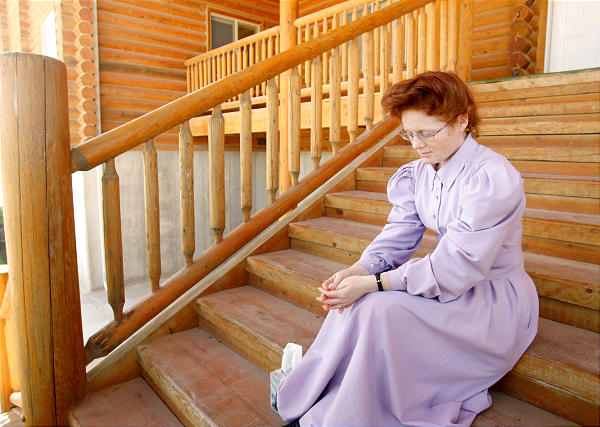 Inside the very private polygamous ranch, "Monica," a member of the FLDS Yearning For Zion community, near Eldorado,Texas, talks about how Texas officials will not allow her to see her children who were taken from the ranch last week with over 400 other children. (APPhoto/Keith Johnson, Deseret News)
First look inside YFZ Ranch
First look: Quiet is unnerving as FLDS members seek answers
YFZ RANCH, Texas — The children's shoes still sit neatly, side by side where they last left them. Child-sized shovels and miniature wheelbarrows sit on the porch of their three-story, log cabin-like home.
The only noise now emanating from this 1,700-acre compound is the rustle of the wind, birds chirping, the occasional scurry of a roadrunner or a truck traveling along the dirt roads.
"It's miserable. It's too quiet," says Nancy, struggling to keep her emotional voice loud enough to be heard.
This grandmother and others at the reclusive ranch belonging to the Fundamentalist LDS Church on Saturday allowed the Deseret News onto their land and into their homes, which were raided last week by Texas authorities. All 416 children who lived there were removed and placed into temporary state custody.
It was the first time they had allowed the media access to places they consider private and sacred. During interviews with ranch residents, FLDS officials insisted that questions remain focused on the children's plight and declined to discuss other topics, including allegations of physical and sexual abuse.
Those who spoke asked that only their first names be used.
Collectively, their hearts are broken but their spirits undaunted.
"If you know what it's like to have a little child look you in the eyes, throw their arms around your neck, smile and give you a hug, then you know what it's like (here now)," she said, turning her head and sobbing into her shoulder.
The leader of the Yearning For Zion Ranch says he doesn't understand how the government could sweep in and seize all their children based on an unproven allegation.
"This whole situation is abusive and out of hand," said Merril Jessop, a presiding elder in the FLDS Church. "The nearest thing I have ever seen comparable to this, even on the TV shows, is Nazi Germany."
"The only thing we ask of the governor and citizens of Texas," Jessop said, "is to give every man, woman and child due process and an attorney before they destroy their lives."
Jessop extended Texas' governor an invitation to come and see where these children are now and what conditions they are being placed under and then to come and see what kind of home they were taken from.
Jessop then went one further, inviting a fellow Texan, President George Bush, to come and see what the state is doing to its citizens. "What can be more important than the safety and protection of the children of America?" he asked.
'Children are our life'
Nancy was at the ranch when Texas rangers and other authorities began taking away the children. She said they knocked on the door of her home, walked in, separated the children, began interviewing "and didn't give us an explanation of what they were doing," she said.
She and other mothers declined to answer the officers' questions about which child belonged to who. "They told us we're going to take the children unless you tell us who are their mothers. But we still weren't saying anything," she recalled. Then she heard them call for backup.
Nancy, who was holding a baby in her arms, said one officer "poked their face into our face" and loudly said, "Give me that baby!"
"I said, 'I'm not going to do that,'" she said.
Although child welfare workers allowed most of the mothers to accompany their children to the temporary shelters, Nancy said she was not allowed to go. She stood helpless in the doorway and watched as her children, grandchildren and family members were loaded onto buses.
"The children would cry and hang onto their mothers," she said, trembling and wiping away tears.
"I get my strength from my Heavenly Father, but I can't believe something like this could even happen in America.... How could they take families and tear the children away? They're mentally abusing those children."
'Nowhere to go'
Monica, a mother of five children between the ages of 11 and 3, said she wants the world to know her children were happy and safe at home.
"We love our children. We love family life. Our children are our life. We do all we can to make sure they are cared for and have an education," she said. "They have manners and are trained well in loving and blessing others."
She was out of state for an appointment when she heard that her home was being raided. She quickly returned to the ranch but wasn't allowed inside. "I had nowhere to go," said Monica, 34.
Her sister is taking care of her 3-year-old at a makeshift shelter in San Angelo, about 50 miles away. A cousin is looking after the others. She tried to join the 139 mothers that were allowed to accompany their children, but the Texas Department of Family and Protective Services won't allow her inside.
"I have driven past the area where they are, and it's completely surrounded by police," she said. "I'm sure I could walk up to the door and get arrested ... and then what's going to happen to my children?"
When she was finally allowed to return to her home on the ranch, because of an ongoing search of the property by authorities, she said nothing was the same.
"Can you imagine what it's like to come back to nothing? Empty, ransacked homes, many things were taken, no pictures left."
She was able to find some pictures of when her children were younger, but all others were confiscated.
"I want the world to know that there is a nothing stronger than love and there is an inborn, God-given love between a mother and her children, and all a mother wants for her children is the very best" Monica said.
Despite her sorrow and frustration, she says she has faith that she will see her children again.
"I know I can't give up. I have to stay at it," she said. "I know with Heavenly Father's help I will be able to get them back."
'I couldn't believe it'
Shannon, a mother who was also off the ranch when officers served the search warrants, said she's also tried several times to see her three children but has been refused.
"Every day I've called them. They put me off saying they don't have the authority to let me in and there's no proof the children are mine. I tell them the children know who their mother is, and I know who my children are," she said.
The 30-year-old says she provided child welfare officials with identification and even birth certificates proving she is her children's mother. She says she and other mothers were told those documents could have been fake.
"I couldn't believe it. I wondered if we were in America or Russia," Shannon said. "I kept thinking, 'How can they do that?' They're breaking every rule. They're breaking every law."
Shannon has been told that her youngest child, who is just 2 years old, clings to her caretaker in the shelter. "She's sick right now and needs her mother."
Texas officials say they removed the children because they believe they're being abused or neglected. The raid was authorized by a judge after workers at a family domestic hotline reported receiving calls from a pregnant 16-year-old girl claiming she was being abused and was afraid to leave the ranch.
Shannon insists the children were not in any harmful environment at the ranch and were well-loved and cared for.
"We are not child abusers. We take very good care of them. These are innocent and sweet children," she said.
"The only abuse my children have ever had is since they've been taken away."
E-mail: nperkins@desnews.com; bwest@desnews.com
Source: Deseret News
Addendum: An email from Deseré Howard explains why cell phones are being seized. The mothers are now isolated from communication with the outside, and have no access to legal representation. CPS will take advantage of their isolation to try to get concessions from them.
expand
collapse
The families in Texas have been calling me all morning desperately seeking assistance.
They need support. The cps has cut off all communication with their families. They are telling them that if the don't consent to adoptions that they will lose their kids to strangers... mostly the same crap/threats that they have thrown at all of us.
Additionally, if the mothers step foot outside of the shelter, they cannot return to their children.
If we have any members from Texas, please call me.
Desere' Howard
PO Box 1381
Port Salerno, Florida
Florida Legal Resource Center
772-293-9632
tcpr@gate.netSource: CPSWatch email
Photo of the Day
April 13, 2008 permalink
The photograph below is from the Fort Concho National Landmark in San Angelo Texas which is housing Mormons seized last week for child abuse. We are sure that even without the caption you can distinguish the two fine examples of womanhood from the social workers.
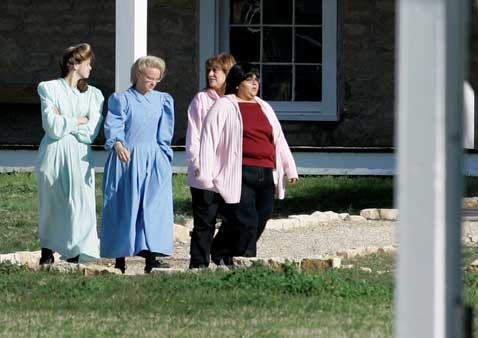
Source: abc 13 news
Replacement Girl
April 13, 2008 permalink
Houston mother Raeshala Raylette Morris lost her daughter to child protectors. Her response? Grab a replacement from a day-care center.
expand
collapse
Houston day-care worker charged in baby's kidnapping
Suspect's own toddler was placed in foster care earlier this year
 Jakaila Brantley, from another story at myfoxhouston.com
A woman accused of abducting a 21-month-old girl from a southwest Houston day care center had her own 2-year-old daughter taken away by Child Protective Services in January.
Raeshala Raylette Morris, 21, was charged Saturday with the Friday afternoon kidnapping of Jakaila Brantley from Mothercare Day Care at 8133 Beech Cove Lane, where Morris worked.
Jakaila was found unharmed hours later. Police said she was sitting with Morris on the stairs at a vacant apartment in the 9900 block of Club Creek in southwest Houston. The little girl was dressed in her twin brother's clothes, and her hair was arranged like a boy's.
Jakaila is close in age to Morris' own daughter, who was placed in foster care three months ago because of physical neglect, said CPS spokeswoman Gwen Carter.
"She wasn't able to meet (her daughter's) needs, and we weren't able to find a relative who was willing or able to care for her," Carter said.
After an emotional reunion with her parents Friday evening, Jakaila spent Saturday playing with her favorite Spiderman toys and picnicking at a park, her mother, Shemika Thacker-Brantley, said.
"She's doing great. She's happy to be back with her brothers," Thacker-Brantley said.
"I can tell her spirits are a little different, though. She's really clingy now. She's been really independent and free spirited, and now she's following her dad everywhere he goes. Every step she takes, she's right behind him."
Thacker-Brantley said she thinks Morris, who was in a Harris County jail Saturday on $5,000 bond, was trying to replace her own child.
"It's very creepy," she said. "I still can't believe that this happened."
Jakaila and her two brothers, including a twin, have attended Mothercare Day Care for about six weeks. Now, Thacker-Brantley said she hopes to see the center shut down.
Police said Friday that the day care failed to perform a background check on Morris. Authorities said people who know the young woman told officers that she might suffer from mental illness.
CPS officials said child-care licensing authorities will open an investigation into the kidnapping this week.
Rita Obodoechina, who acknowledged she is the owner of Mothercare Day Care, declined to comment Saturday.
The center has been inspected six times since July 10, 2006, according to records from the Texas Department of Family and Protective Services. Violations of licensing standards were found each time, though some were minor. All were reported corrected.
An inspection on Feb. 22 said that background checks on two workers had not been completed after 24 months.
Anita Hassan contributed to this story.
lindsay.wise@chron.com
Source: Houston Chronicle
Girl Protected, Gets Amputation
April 13, 2008 permalink
Carolyn Middleton, based in Hamilton Ontario, reports on a case in which a girl protected from her parents by CAS lost a toe in her foster home. We present an abridged version of her story.
expand
collapse
- From:
- THE - COMMITTEE
- To:
- afra_talkline@yahoogroups.com
- Cc:
- Henderson Leonard
- Sent:
- Saturday, April 12, 2008 3:42 AM
- Subject:
- SNAFU & FUBAR
Dear Leonard - and - Friends of AFRA,
We were recently involved in a situation where a child was removed from the family home because, in the caseworker's opinion there was potential for abuse/neglect. The child was placed in foster care and forced to go to school, (in winter), in sandals, because the foster parents didn't have funding from the agency to buy the child proper footwear.
As a result the child lost a toe, because of frostbite.
When the biological parents complained, supervised visitation schedules were rearranged, unscheduled, and the parents suspended from visitations all together, for "having missed visits".
There was no real abuse/neglect in the family home; merely a personality conflict between the father and the caseworker.
What was the situation for potential abuse/neglect in the family you may well ask?
Well, according to reports, the caseworker attended the family home on a surprise visit and witnessed the father teaching his daughter how to ride a bicycle, with training wheels, but without a bike helmet. According to this worker, this was enough to warrant allegations, regarding the potential for abuse/neglect.
In reality, the father was rather arrogant with the caseworker, and this just plain pissed her off. In reality, the father was a bit naive and didn't realize just how much power and authority this woman really had. Had he known this, it just might have humbled him a lot more, the family would have remained together, and the child would still possess all of her toes.
It took eighteen months of hard work and a lot of time off for court hearings and the like but --- the child, in our story was returned, the family is back together again, yet no amount of therapy, understanding and forgiveness is going to grow this young girl a new toe... now is it?
And... most importantly... this father is now on the child abuse registry.
This means that caseworkers can come and invade his life, re-apprehend his daughter and/or any future progeny, whether born or unborn, from this time on... forever and ever, amen... plight without end... This is the kind of dark cloud that looms in the background, ever present, ever threatening, ever pressing in the recesses of this family's life and liberty.
Sincerely,
Carolynn J. Middleton BABSc
( Executive Secretary )
================================
THE COMMITTEE ( People - 4 - People )
================================
www.geocities.com/tp4pcsick
www.geocities.com/tp4pc
tp4pc@sympatico.ca
tp4pc@hotmail.com
tp4pc@yahoo.caSource: AFRA
Woman Seeks Mother
April 11, 2008 permalink
A woman separated from her mother by children's aid is seeking reunification.
expand
collapse
Full Details for Query #169418
- Date Posted:
- 11-Apr-2008
- Surname(s):
- W
- Query Text:
- I am searching for my birth family. I was born in Kitchener, on July 17, 1974. I was given the name of Angela Lynn W. at birth, I was adopted out of Chatham Children's Aid Society. My caseworker was Mrs. Shalafoo. If the information I have is correct, my birthmother was 15, 5'1" tall. Her mother was terminally ill at the time of my birth. My birth father wanted nothing to do with anything. I would really like to know if I have family out there that have wondered about me after all these years. I had red hair and blue eyes at birth. I was adopted by a family in Tilbury, Ontario. I also know that my mother's family had a history of thyroid disorders and epilepsy, on her father's side. Please contact me with any info you may have.
Source: CousinConnect
Rebellion
April 11, 2008 permalink
Today two articles, from California and England, present the hardships dealt with by social workers while missing the common theme. Social workers are now more feared and hated than the police. In neighborhoods where residents are disposed to fight back, social workers are getting attacked. In Oakland California social workers fear to enter certain districts. In Preston England social worker Philip Ellison was stabbed to death.
expand
collapse
Oakland violence stops social worker visits
Barbara Curtis is a big-hearted woman who could use some help.
The 61-year-old Oakland grandmother is not only raising four grandchildren from 2 to 15 years old, but all of the kids have behavioral problems stemming from their mother's chronic drug use during pregnancy.
But for Curtis, her grandkids and dozens of other families, the escalating pattern of violence on the streets of Oakland has claimed another, unseen victim in recent weeks.
Government social workers are required by law to make home visits, escorted sometimes by law enforcement officers, but social workers employed by private groups don't share that benefit. And some of the agencies serving children in dicey Oakland neighborhoods have had to rethink their home-visit policies because of possible exposure to violence and gunfire.
Curtis had to cancel a visit from a caseworker last week, when gunfire erupted outside her home.
"I had to call and stop her on the freeway because they were shooting outside, and I didn't want her to walk into the middle of it," said Curtis, who lives in an Oakland Housing Authority property in the 9700 block of Birch Street.
Another social worker also has temporarily suspended visits to her home because of the violence, Curtis said.
In essence, Curtis is being held captive in her own home.
"I get my baby around 5:30, and after that, I don't go out," she said. "I stopped going to choir rehearsals and Bible study for fear of what I'd find when I came home.
"I've had neighbors call to say I couldn't come home because they've been shooting outside and the street is roped off," she said. "The kids want to ride bikes and play outside, but I have to keep them in the house because I don't want them getting shot.
"The (security) gate has been broken so many times that (the housing authority) said they wouldn't fix it again. There's supposed to be security here, but there's no security, period."
And since the start of the year, the violence that has led to 36 homicides and a whole lot of gunfire in Oakland has presented an obstacle to even the most dedicated social service workers.
Kim Beckham, program manager for early childhood mental health at Family Paths, said the agency assesses each case individually, and factors in the potential for violence inside and outside the home.
"When there is gunfire and drug deals happening outside people's doors, it creates a barrier for caseworkers and leaves families in even more isolation," she said.
The agency is working with several families, including Curtis', to find an alternative meeting site in the community, Beckham said.
For several years, caseworkers at the Jewish Children & Family Center, another nonprofit group, have made accommodations to meet with family members outside the home when there is a potential for violence, said Carol Singer, director of parenting and youth services.
Another agency, Family Support Services, said the recent rise in violence has prompted it to renew safety policies and reacquaint its caseworkers with those rules.
"We've increased our safety protocol because of the violence," said Erica Hilton, the agency's clinical director.
In recent weeks, clients have called to cancel appointments because of continuing violence. And Hilton has halted some home visits until things calm down.
There are other long-standing policies that remain in place for darned good reasons.
"We do go into Acorn (housing projects) but not at night and not in the late afternoon," Hilton said. "The majority of the families we work with are trying to make a better life for themselves, and yes, while the violence has been prevalent, especially recently, there are many, many home visits made each week without incident."
But until Oakland police or City Hall, or anyone else, can find a way to restore some semblance of order, the families that need help most will continue to be cut off from resources they desperately need.
"I'm gonna tell you like this: If I could afford it, I would move and live in a tree," said Curtis. "But I pay $261 a month, I'm on a fixed income and I can't afford anything else around here."
So for now, Curtis must live a backward existence until her kids are far from harm's way.
"When they sleep at night, I pretty much stay awake, walking and listening to see what's going on around - and outside - my apartment," she said.
"I sleep mainly when the kids are at school, and sometimes I'll catch a wink or two when they get home, but there's always one eye opened."
Chip Johnson's column appears on Tuesdays and Fridays. E-mail him at chjohnson@sfchronicle.com.
Source: This article appeared on page B - 1 of the San Francisco Chronicle
Tributes paid to social worker killed on duty
 Mr Ellison leaves a widow and three sons
Tributes have been paid to Lancashire dad Philip Ellison, the social worker stabbed to death while doing his job.
Married father-of-three Mr Ellison, of Leyland Road, Penwortham, was attacked with a knife at a supported housing block in Glebe Close, Fulwood, Preston on Monday.
The 47-year-old, a social worker in adult care at Lancashire County Council, suffered multiple stab wounds and later died of his injuries.
Social care bosses and community leaders described Mr Ellison as a "respected, dedicated social worker".
One friend said: "Deepest sympathies to his wife, sons and extended family.
"I considered Phil one of those people who genuinely cared and went the extra mile for people. It's a sad situation to find social workers put into danger to be killed trying to do their best."
Mahmud Amirat, chairman of the Preston Gujarat Muslim Welfare Society, said: "Philip was a friend of mine. He was a respected, dedicated social worker and active popular representative of member of the local Asian community.
"He will be sadly missed by his family and friends. May I, through the Lancashire Evening Post, on behalf of the local community offer our sincere condolences to Mr Ellison's family and friends."
Another friend said: "I went to school with Philip and I'm sure all his ex-schoolmates will all be saddened by this tragic loss.
"He was such a lovely guy. My condolences go out to his family."
One colleague who attended the scene at Glebe Close, described him as "such a lovely bloke".
Mr Ellison has been described as a jolly man who loved his family.
Friend Rukhsana Tabassul of Watling Street Road, Fulwood, worked with three of Mr Ellison's sisters as a community support worker. She said: "We were all good friends, it's a very, very sad story. He was a very hard working husband, he was a very jolly person.
Source: Lancaster Evening Post (UK)
Advisory Committee Stacked
April 10, 2008 permalink
The laws of Nova Scotia provide for an advisory committee to review the Children and Family Services Act and related services. On April 1 the legislature discussed membership on the committee, suggesting that few parents could be recruited to serve.
Connie Brauer has responded (below). She applied to adopt the child of Carline VandenElsen and Larry Finck and was turned down, then unsuccessfully applied to become a member of the advisory committee. On the page that is the source of her letter there is also a video of Connie speaking.
expand
collapse
Community Services Committee for Children and Family Services Act Advisory Committee
Posted on April 9, 2008 by familyjustice
Connie Brauer and Victor Harris
1061 Mines Rd.
Falmouth, NS B0P 1L0
Canada
Phone and Fax: 902.798.5267
To fax, call first or let ring to set up.
Email: cbrauer@lincsat.comTo be distributed to all who are there and read into the minutes at the next committee meeting COMMUNITY ( See baby at bottom)
SERVICES COMMITTEE
Ms. Marilyn More (Chairman)
Hon. Ronald Chisholm
Hon. Leonard Goucher
Mr. Patrick Dunn
Mr. Gordon Gosse
Mr. Trevor Zinck
Mr. Keith Colwell
Mr. Leo GlavineApril 9, 2008
RE: HALIFAX, TUESDAY, APRIL 1, 2008
COMMUNITY SERVICES COMMITTEE
Children & Family Services Act Advisory CommitteeDear Committee Members,
I have just read the Hansard details on your last meeting, that a friend kindly sent to me and I wish to express my opinions on some of the subjects you discussed but did not resolve.
1. Lack of people applying for membership. There was actually quite a few people applying for membership, however they were not chosen. My husband and I applied. I know of at least half a dozen qualified people with a lot to say who applied but we were rejected. Why? First of all there is a very rigid selection criteria, which is very discriminatory. …this is regulated by Statute - two people whose children have been or are or may be in need of protective services; a representative from a child welfare agency; a representative of the minister; a legal aid lawyer; two people drawn from the cultural, racial or linguistic minority communities; and three other representatives as determined by the Minister.
There is a heavy reliance on government employees, officials and bureaucrats. Parents are most likely too beat up to attend. Then there are only a few seats open which the Minister must approve. Of course, the Minister will not approve of people or families who are upset and outspoken with the way things have been handled by the CAS. So there you go. I’m one of those people who is very upset with the way CAS apprehends children in this province and neither I nor my husband and 5 other applications of concerned parents were considered. This suggests to me that the deck is stacked against honesty and integrity and even controversy. I also discovered this at the CAS annual meeting we attended a few years ago. I asked a lot of questions and was told to send a letter.
I know these letters don’t get answered by CAS but are forwarded to the lawyers, Elizabeth Whelton in particular and she simply answers with her usual line. Nothing is explained or considered. I wanted to adopt a particular child, Mona-Clare Finck and was told I was not welcome. Why?
I was the next thing to family of Carline VandenElsen and Larry Finck. In fact, they asked our family if we would adopt her. CAS had applied for apprehension of their child before she was even born. These parents were not abusive or negligent in anyway. They were not charged under any of the conditions under the Children and Family Services Act, for the apprehension of their child, they did not have counseling or home care or home study from CAS. They just had their baby stolen. They fought against this inhumane act of violence, torture and terrorism against them and their family and all the legal proceedings in NS couldn’t and wouldn’t protect their Charter Rights and their family rights. They were even sentenced to prison for violating an order to give up their child and various weapons charges that were not supported by any evidence. The EMT swarmed their house for 3 days and then battered down the door in the middle of the night to forcefully take their baby away. The grandmother died of stress. For shame!
We know what happened as my husband and I attended all the trials. We have all the paperwork. We went to court for Mona-Clare five times and still we were not allowed to adopt her. Simply because we sided with the parents and their rights to have a family and because we were not blood relatives. CAS is not a blood relative either, yet they were granted permanent care and custody of a 5 month old, nursing baby for the purposes of pure profit.
She was in the custody of the very people who deliberately and forcefully destroyed her life with her parents.
We serve approximately 16,000 children and families at any given time in Nova Scotia and there are approximately 2,000 children in the care of the province. This includes a number of care arrangements: temporary care, temporary care and custody, and permanent care and custody. Approximately 70 per cent of the children in permanent care and custody are under the age of 10..
These alarming figures suggests that the most valuable and the most adoptable children are babies. Where do these babies come from? They have to be apprehended of course. They are always taken from lower income families who don’t have the resources to hire high priced lawyers to fight on their behalf. CAS violates their mandate to keep the family together. Now that CAS is part of the NS Government, it is also accountable to uphold the Charter of Rights, which it has violated.
Children and Family Services Act.
Purpose and paramount consideration 2 (1) The purpose of this Act is to protect children from harm, promote the integrity of the family and assure the best interests of children. Taking a newborn child from capable parents creates harm, does not protect the parents or the family, is not in the best interests of the child and is a heinous act of violence so reprehensible that it is equivalent to the Darfur killings or suicide bombings in Iraq. The child is dead to the parents and the system has killed them emotionally, spiritually and financially. What more harm can CAS and Community Services do to families?
How can this happen? Tell me! How can this happen continually and systematically in our country? How can this happen over and over again without any human rights investigation into the apprehension of normal children from normal parents? Huh? How can you turn down a willing adoptive parent while promoting adoption, daily, in your campaign blitz?
Where are our Charter Rights?
This is done for profit! Each child apprehended or put in foster care means more funding for the agencies, now part of Community Services. Federal Funding, provincial funding and donations. Until this changes, you will always have trouble getting people to join you. Your reputation is well established.
2. Meetings are held in secret. When was the last time you opened up the meeting to the whole community? When was the last time you put an ad in the paper and invited us in to have our say? Community Services is supposed to support the Community. We pay for it. But we sure don’t have a voice. It’s a secret society with no accountability to the families harmed or the community.
3. We want no more adoptions without the signed consent of both parents. The willing consent of both parents. Unless the child is in mortal danger, and it is proven with evidence in court, then it becomes a police matter.
Adoptions without signed consent from both parents suggests the child was stolen. Or the father doesn’t have a choice.
4. We want full disclosure. We want the forms made available to adopt children. If you have prospective parents who wants to adopt, you should make it as easy as possible and not force parents to use lawyers and part out with thousands of dollars which would be better spent on their new child or children. Everything in government has forms to complete, but not adoption.
5. We want proper statistics. How many of these children were taken from their parents? Was everything done to help them before even one child or teen was taken?
6. The Divorce Act and the Judicial system are largely to blame. The judges designate one parent as the custodial parent and the other parent as the non custodial parent. The nc parent is usually the father and he has no legal rightsto his children ever again. He has almost no chance of seeing or raising his children. The mother denies access with impunity. No obligation or punishment is meted out to this mother. Then the father is further alienated from hischildren. His only purpose is to pay child support. His expertise, love and affection and family values are denied, totally. The children are crushed and grow up without the precious bonding or the understanding of what has happened. They have no family values and may even reach the interests of the CAS. And guess what? The cycle continues.
7. We want a full public inquiry into the Finck/VandenElsen case and all the other cases who have been unheard.
We want the children back. These parents want their children back.
It doesn’t make sense to take away children, advertise for foster parents and adoptive parents, cost the tax payers millions, destroy families when all they need is to be left alone to sort out their own problems. If CAS was a caring and loving and not a fearful organization, then parents could call them for help if it was needed.
But right now, it is too risky and scary to call for help. It is deadly!
Sincerely,
Connie Brauer
Parent
Civil Rights Crusader
Precious little babiesSource: blog posting by Connie Brauer
CPS Takes a Village
April 9, 2008 permalink
Texas child protectors have seized over 400 children from a settlement near Eldorado Texas, which the press insists on calling a "compound". Their offense is the practice of polygamy, or stated in other terms, a shortage of fathers. Nobody seems to notice that fathers are widely vilified by political correctness, but in this case their absence is lamented.
We attach a commentary below from Mother Jones enumerating some of the problems of polygamy. There are more, for example many boys are expelled on reaching puberty. Countries with widespread polygamy have a steady supply of alienated young men to cause mayhem. Limiting polygamy is a worthy goal, but will this week's seizure improve the lives of the children? How is Texas going to deal with the overload of 400 children in one week? 400 sets of foster parents? Not likely. Probably an orphanage, under its modern name, group home. Look at the children in the photo below and guess whether they will be that well treated in their new foster or group homes. Richard Wexler has a skeptical comment in his blog entry for April 9, 2008.
If this raid goes through without a public reaction, expect a new round of massive raids picking up children by the hundreds from other marginalized groups such as the Amish, Scientologists, nudists and vegetarians.
expand
collapse
Former Polygamist on Polygamy

It's been five days since authorities raided the Yearning for Zion Ranch, a compound outside Eldorado, Texas owned by the Fundamentalist Church of Jesus Christ of the Latter Day Saints. Tipped off by a phone call from a 16-year-old girl who said she had been repeatedly "beat and hurt" by her middle-aged husband, the cops stormed Yearning for Zion and took 419 children into custody, accompanied by 139 of their mothers, into custody.
To be sure, Yearning for Zion sounds like a horror show. But is it polygamy's fault? I mean, "the principle" seems to work okay on Big Love, right? I wanted a plural marriage expert to weigh in. After an admittedly quick Internet search, I decided on John Llewellyn, a retired Salt Lake County Sheriff's Lieutenant who has been involved with a bunch of polygamy investigations. Once he started talking, though, it was clear that Llewellyn had some pretty strong opinions about plural marriage, and with good reason: He used to be a polygamist himself.
At the beginning of his career with the Salt Lake City Sheriff's Department, Llewellyn and his young family became active in Church of Jesus Christ of the Latter Day Saints (the Mitt Romney kind of Mormons; they will be the first to tell you that they have noting—they said NOTHING—to do with polygamy). A young single mother asked him to be her children's godfather, and somehow that turned into a request to be his second wife. To Llewellyn's surprise, his first wife acquiesced, and thus began his involvement with the Apostolic United Brethren. He quickly discovered that polygamy wasn't for him—he didn't like how it pitted women against each other. Twenty years later, he left the church with his second wife. (His original wife, he says, chose to be "the fifth wife in a more affluent family.")
Since then, Llewellyn has written several books about life in polygamist communities. These days, he's made it his mission to spread the word about the evils of plural marriage, which he calls "a barbaric custom... to accept it is like going back to the Middle Ages." And he's given up church life, too. "I don't want anything to come between me and God," he says. "If there is a God, I'll handle my own salvation. I don't need a pope or a prophet to come between me and God." I asked Lewellyn a few questions about the Yearning for Zion raid, and, uh, he didn't mince words. Q&A after the jump.
Me: What's so bad about polygamy?
John Llewellyn: It's unnatural for a woman to want to share her husband with other women. The typical woman who converts to polygamy is a single mom who has had a bad relationship, and she is struggling. She finds that in becoming a plural wife there is some security and unity and she is accepted. It's a hard lifestyle. There's jealousies, and when these pro-polygamists tell you they're no longer jealous, that's malarkey. There's always jealousy and competition for who is going to be the favorite wife, or the dominant wife, and which children are going to be the favorite children.
Me: The Texas authorities have known about this for a while. Why did they just raid now?
JL: I haven't been in touch with them, but I think because of my law enforcement experience I can tell what is happening. It appears to me that they were waiting for something like this to happen. You have to have probable cause before you can go onto this private property. The phone call established that probable cause. Once on the property, they couldn't help but observe these young pregnant girls. So all the stories they heard had been confirmed. They had to take some action. They would have been derelict if they hadn't. What they are doing is what Utah should have done years ago, but they were timid because of the debacle that occurred in 1953 when they raided Short Creek. Everything backfired on them, and public support was with the polygamists because they had photos of law enforcement tearing little babies out of mothers' arms.
Me: They haven't found the teenager who made the call yet. Do you think she's real?
JL: I think she really exists. It sounds very credible, what she has said. It was two days before they entered the premises looking for her, and that would have given them ample time to get her out of there, and they've done that in the past with young, rebellious women. She might be in Canada now, she might be in one of several places. They have communities in South Dakota and Nevada, for example.
Me: What consequences would she face on the ranch if they found out she had made the call?
JL: She would be isolated, shipped off someplace, locked up, and continually brainwashed until she finally submitted. This is standard procedure. They don't like these young girls leaving because of what they could say.
Me: They've taken 419 children from the ranch into custody. What'll happen to them?
JL: They can't deprive those children of their parents without some good reason. I think in the meantime the big challenge for the Texas authorities will be to change the kids' thinking. These children have been raised to believe that the government and the nonbelievers are their enemies. They're going to have to convince those kids that there's a better life outside. But to be free is really quite scary when every aspect of your life has been controlled. These kids are brought up to believe that if they leave the group they will go to Hell.
Me: Have you seen the show Big Love? Is it plausible?
JL: In some respects. But that family, they are the exception, rather than the rule.
Source: Mother Jones blog entry for April 9, 2008

Children and adults from a Texas polygamist group outside their temporary housing on Monday.
Tony Gutierrez/Associated Press, through the New York Times
Parents Deemed Homicidal
April 8, 2008 permalink
British MP John Hemming describes assessment centers for parents with a few curt but accurate words.
expand
collapse
Monday, April 07, 2008
Assessment centres
I visited an Assessment centre today. I don't think most people know what it is like to be in this environment.
Frankly the Assessment centres show an aspect of the system that needs to be seen to be believed. There is a form of assumption that parents are on the edge of murdering their children and are only held back by the fact that they have to phone the office every time they change a nappy.
Insane.
This is a systematic problem for which the politicians and judges are equally responsible.
posted by john ¶ 6:57 PM
Source: John Hemming's blog for April 7, 2008
CPS Bullcrap
April 8, 2008 permalink
Richard Wexler analyzes the latest press coverage initiated by the child protection bureaucracy, which he characterizes with the relatively polite epithet crap. You can't believe a word they say, in the privacy of the courtroom or the public forum of the press.
expand
collapse
April 4, 2008
THE CHILD ABUSE HYPE MACHINE STRIKES AGAIN
AP tells us:
About 1 in 50 infants in the U.S. have been neglected or abused, according to the first national study of the problem in that age group. Nearly a third of the victims were one week old or younger when the maltreatment was reported, government researchers said Thursday.
Bloomberg says:
About 1 in 43 infants in the U.S. suffers abuse or neglect each year, with the greatest risk among the newly born, according to the first U.S. study of maltreatment focused on babies.
And according to Reuters:
About one of every 43 U.S. infants is physically abused or neglected annually, and those babies are especially at risk in the first week of their lives, U.S. health officials said on Thursday.
The impression given in stories that crossed the wire late yesterday is of a comprehensive, scholarly study discovering massive abuse in hospital wards by sadistic parents beating and choking their helpless newborns. Of course, it’s released just in time for Child Abuse Prevention Month, in which the groups that hype the numbers seek more funding for their version of “prevention” – which generally involves touchy-feely “counseling” and “parent education” programs which make the helpers feel good while ignoring the real family problems that either cause – or are confused with – child maltreatment; namely concrete problems related to poverty.
There are just two problems with the claims in the wire service stories:
- There was no “study.”
- The “findings” are crap.
And while the problem of maltreatment of infants, like all child maltreatment, is serious and real, the hysteria-inducing non-study and the spoon-fed quotes from alleged experts apparently offered up by the federal Centers for Disease Control are only going to make the real problems worse. They’ll breed a spate of hand wringing editorials which, even as they preach “prevention,” feed the take-the-child-and-run mentality that dominates child welfare agencies. And they’ll drive some expectant mothers away from pre-natal care.
It’s the latest installment in a long, sad history of “statistics abuse” from America’s child welfare establishment, rooted in an ends-justify-the-means mentality that produces “advocacy numbers” that don’t hold up to scrutiny. (Time magazine condemned it as early as 1993, in a brief item called “Damned Lies and Statistics.”)
The non-study
Every year, the federal government puts out a book of statistics about child maltreatment. The book is a compilation of data from the states submitted to a database called NCANDS. (National Child Abuse and Neglect Data System). Unlike a second database used for adoption and foster care data, NCANDS is strictly voluntary –and states are free to define abuse, neglect, entries into care, and everything else, any way they darned well please. So, as I’ll discuss in more detail below, this is really no more than a National Report of Rumor and Innuendo.
Every year, this report includes a table breaking down alleged maltreatment by age. Until now, the youngest age bracket has been birth to age three. (Here, for example, is the chart from the 2005 report).
The big new “study” hyped by the wires in stories turning up in hundreds of news outlets consisted of a couple of extra keystrokes to get a computer to spit out the same data limited to birth to age one for 2006, the most recent year for which data are available.
The data are then presented in six paragraphs in a CDC publication. That’s the entire “study.”
The non-findings
But that didn’t stop the Child Abuse Hype Machine from swinging into action. Apparently CDC was glad to direct reporters to “experts” prepared to draw stunning conclusions from lousy data.
How lousy?
Well, let’s go back to how these figures are compiled:
- The figures are based on the number of “substantiated” allegations of maltreatment reported by each state. But “substantiated” is a misnomer. It does not mean that a court made a finding. It does not even mean that an expert evaluator weighed all sides. Rather, it means only that a (typically) undertrained, inexperienced caseworker took a guess and checked a box on a form.
The only comprehensive study I know of (a real “study” not a few keystrokes) to second guess these decisions found that workers were two to six times more likely to wrongly “substantiate” an allegation than to wrongly label one unfounded.
- State laws in about half the states say the worker is supposed to check the “substantiated” box if she believes there is even slightly more evidence than not of maltreatment. In the other half, the standard is even lower. The worker is supposed to substantiate maltreatment as long as she thinks there is “credible evidence” or “some credible evidence” for it – even if there is more evidence of innocence.
Even at that, the so-called study acknowledged that overwhelmingly, these infants are not abused. Indeed, physical abuse was alleged in 13.2 percent of the cases. In 68.5 percent the allegation was “neglect.” The wire stories do mention this but are skimpy about the implications.
Neglect is typically defined as lack of adequate food, clothing and shelter. Lots of things can cause lack of adequate food, clothing and shelter, including all sorts of bad behavior by parents. But often, neglect is simply poverty.
Indeed, the only real surprise in the stories was that someone who, for decades, has represented the view of the “child saving” establishment, Prof. David Finkelhor of the University of New Hampshire, apparently has gotten fed up and can’t stomach the hype. According to the AP story:
“The neglect cases include situations in which medical professionals conclude that a child got sick or didn't correctly develop because parents didn't get recommended medical care. … Finkelhor said the cases might in part reflect families who don't have adequate health insurance.”
You think?
But Finkelhor was alone. Mostly the quotes suggested tens of thousands of infants whose lives were in danger because parents were at worst sadistic brutes or at best irresponsible and needed lots of “counseling” and “parent education.”
And what about all that stuff about the danger being worst during the first days of life? Does that mean that’s when stressed-out parents are most likely to lash out at the most innocent?
Actually, no. As the stories acknowledge – eventually – it’s strictly an artifice of how child maltreatment is reported.
Many state laws require medical professionals to report any parent whose newborn allegedly has even a trace of any illegal substance in her or his system. This can mean anything from the parent who used cocaine every day of her pregnancy to the parent who smoked a marijuana cigarette to ease the pain of labor – to simply a false positive on a drug test. Doesn’t matter. Professional medical judgment is not allowed.
And in some states, any such report is automatically classified as a “substantiated” case of neglect.
The result: a supposed epidemic of child maltreatment in the days after birth, that in fact, is simply a combination of doctors denied the right to use their medical judgment and state laws slapping the label “neglect” onto any case with a positive drug test.
And since more and more states are moving in this dreadful direction – requiring an automatic neglect finding based on one positive drug test – we know what will happen next: They’ll run the numbers next year, the numbers will be, artificially, higher, and the Hype Machine will proclaim that the problem of infant abuse “has gotten even worse.”
Yes, the various experts quoted pay lip service to prevention. But not the kind of prevention that would really help – like universal health insurance, drug treatment on demand and, especially, concrete help to ease the worst burdens of poverty. Instead, we get sanctimonious comments about counseling and parent education and teaching parents to cope with stress. (Actually easing the stress by improving housing or helping a family find day care? No thanks. Apparently that’s beneath the dignity of a true “professional.”)
And what impact is all the hype about those drug tests (including a gratuitous quote in the AP story suggesting – wrongly - that the tests revealed “newborn drug addiction”) likely to have on pregnant women who really do have drug problems? It’s bound to drive more of them into hiding and away from prenatal care – which is likely to be far more harmful to the children than the drug use itself.
In fact, there is some real news in the latest federal figures, but not the kind the Child Abuse Hype Machine wants to focus on:
The overall rate of substantiated child abuse is actually unchanged from 2005 – and significantly lower than it’s been in almost every year since 1990.
But you can’t get more money for your phony prevention program with figures like that.
The response to this from the child welfare establishment will be two-fold: First the accusation that anyone who doesn’t take their hype at face value is “minimizing” the problem and, essentially, doesn’t care if infants are beaten and tortured. On the contrary – after more than 30 years of following this issue, one thing I know for sure is that statistics abuse winds up increasing harm to children, not curbing it.
Second is the “even one…” argument. As in, “if even one infant is abused it’s one too many so why ‘quibble’ over numbers?”
Well yes, even one is one too many. But if the real numbers don’t matter, there’s no need to hype them.
Actually, the real numbers matter a lot. Because the first step toward honest solutions is honest numbers.
Source: Richard Wexler's blog for April 4, 2008

Expose - DHS Children`s Protective Services Division
April 7, 2008 permalink
A columnist writes that psychiatric evaluations for Oregon DHS are taxpayer funded quackery. This is a four-part series running until May 3, all included here.
expand
collapse
Expose` - DHS Children`s Protective Services Division
Incompetent and falsified psychiatric evaluations by DHS-CPD employed psychiatrists.
 Courtesy: frontierpsychiatrist.co.uk/
(SALEM, Ore.) - DHS often requests that clients bring in, or sign releases for their clients’ medical records. If the existing medical records do not support the allegations made by DHS, they routinely bring in their own psychiatrists.
These psychiatrists are paid an average of $2,000.00 by DHS (aka Oregon tax payers) for each psychiatric evaluation (psych eval). These evaluations do not include reviewing any of the existing medical documentation that the client has already paid for.
The DHS employed psychiatrists routinely return an assessment that is excessively negative, and often in direct conflict with all other existing client medical records. Worse, DHS requested psych evals are often fabricated to better support DHS allegations or agendas.
As incredible as this may seem, it is a documented fact, and a heinous offense by a State agency entrusted with enormous, life altering, life and death responsibilities. Of course, DHS will respond to this, citing "serious allegations", which is certainly intentional on my part, but their denials will not mean much in the face of overwhelming evidence to the contrary.
Evidence printed on DHS letterhead, with case names and numbers belonging to DHS clients who are willing to make their private affairs public, in an effort to right what is so obviously wrong.
I will use my own personal experience as an example; A few years ago, I had a psych eval by a DHS hired psychiatrist. DHS had previously requested, and received, my medical records, for which I have paid thousands of dollars. This included a current assessment by my primary physician, specifically addressing allegations DHS had made against me. These documents were completely ignored by DHS. They wanted "their own guy" to do my assessment, so I complied with their demands at my daughter’s request (she had been told all charges would be dropped and the case closed if I complied with the eval, which was a deliberate and blatant lie.
Months later, when I received my copy of the completed DHS assessment, my first thought was that the doctor must have confused me with another client he had seen that same day. As I read on, I realized that was not the case. In his professional opinion, I have a pot smoking problem, a Narcissistic Personality Disorder, and a few other personality disorders that were not familiar (or accurate). Perplexed, I decided to do some research regarding "Narcissistic Personality Disorder". Here are some excerpts from my findings:
- "NPD is a rare disorder, beginning in childhood. The cause is not understood, and there is some disagreement regarding environmental vs. biological causation.
- "99% of subjects clinically diagnosed with NPD are men, it is largely unknown in women"
- NNPD is often characterized by grandiose behavior, due to the subject’s belief that they are "special", or "favored by God". They lack empathy for others in general, creating difficult social interactions and the inability to bond appropriately in personal relationships. Treatment is difficult, and outcome statistics are poor, as subjects do not see themselves as having a problem."
- I have been "evaluated" by a number of very expensive doctors, psychiatrists, and mental health professionals who unanimously agree on my diagnosis: Major Depressive Disorder with Anxiety, and ADHD. All of these issues are hereditary, as in "it runs in my family". I passed the ADHD on to 2 of my children; one also has same diagnosis as I do. It is completely treatable, and we don’t think much about it. What I have described here is vastly different from a "personality disorder", which I have never been diagnosed as having.
- Unlike the description of NPD, I am absolutely certain that I have issues that I need help with from time to time, and I don’t hesitate to seek medical attention when I need it (mainly because I don’t want to become so narcissistic and grandiose that it interferes with my feelings of guilt and worthlessness).
- Another strange allegation in my DHS evaluation is that I have "a pot smoking problem". I have NEVER been a pot smoker, common knowledge in my circle. Why on earth would I tell the evaluator that I use an illegal drug, when in fact, I do not?
- When I brought this information to the attention of my DHS worker, she completely disregarded my concerns.
My own DHS evaluation is just one example of such glaring incompetence. I have several other documented DHS evaluations that are even more unbelievable. Read on for a few more samples: One woman brought me her DHS evaluation, wherein the evaluator wrote that she is "mentally retarded". Since I know this woman, I was just dumbfounded. In truth, she is severely ADHD, but does just fine when she takes her medication. However, she was afraid to take her medication, because it would show up as "amphetamine" in her mandatory urinalysis tests. My questions would be; what purpose was served here? Was the client helped by the $2,000.00 the tax payers paid out for the appalling lack of competency this nut job displayed?
Another woman needs medication for her ongoing depression (DHS has put this poor gal through absolute Hell!), but she is afraid to get medication because she says DHS will use her depression against her in their decision to return her child. I am familiar with her case, and she is right. They would use it against her. Her entire case will be reviewed and made available to the public in a few weeks. This one is really special.
Recently, a young man who has had a catastrophic onset of Multiple Sclerosis has been forced to move out of his home, where he lives with his family. DHS says his illness makes him "unsafe" to be around his own children, even though he has no history whatsoever to support such a claim…so he had to move out.
I wonder who will be taking care of him. I wonder how he must feel…to be seriously ill, and be thrown out like trash because DHS issued an ultimatum that he had to leave, or his wife would loose custody of their 2 and 3 year old daughters. I wonder if it is a good idea to teach our children that sick people are dangerous and undesirable. I wonder how long it will be until all parents who have ever been ill, in crisis, or have made any kind of serious mistake, will be required to turn over custody of their children to DHS.
Sound unbelievable? You bet! But I can back up every word I’ve written here…absolutely, positively.
This is only the tip of the iceberg. I put out some requests for personal experiences from people who would be willing to allow their case files to be reviewed, and possibly used in a public manner. When I got home later that night, my email had crashed and my internet service provider had flagged my account as "possible attack of service" due to the huge number of messages I received.
DHS has clearly inspired a deep, enduring passion in a lot of people. That kind of passion is exactly what is needed to clean up this "public service, family advocacy, child protection agency-gone-completely-berserk."
For years, I have been an enthusiastic participant in many heated discussions regarding the wrong doings by DHS. These discussions have always concluded with the unanimous agreement that "something has to be done" then shelved until the next impassioned bitch session.
But recently, I am hearing words and phrases like; "grassroots", "coalition", "fact gathering committees", "violations of civil rights", "public awareness raising", "lobbying", and so on…but the most encouraging new things I’m hearing…are whining, moaning, groaning, and heavy sighs.
Sounds that signify the weary acceptance of a rotten job that no body wants to do. Sounds made by women who comprehend the enormity of trying to change a system as mired in pomposity and arrogance as DHS, and that attracts employees with personality issues like a pedophile to Catholicism.
A commitment to this cause will require too much time and effort; and it will be funded solely by people who eat nothing but ramen for the last week of every month. Any expectations of compensation, courtesy, or respect are out of the question, but regular character assassinations are included in the package.
Lastly, and most importantly, we need a small group of good, strong, imperfect women. Card carrying members of the I-HAVE-NO-CREDIBILITY-CLUB. Previous experience marching into Hell preferred.
Source: Salem News
DHS-CSD Expose Part II
Considering the shining public reputation of DHS as “THE CHILD PROTECTION AGENCY”, and the portrayal of every client as a “monster”, the answers are not hard to predict.
 Child being removed from a home by authorities; sometimes the right thing to do but not always. Photo: Salvation Army
(SALEM., Ore.) - Due to the large response I received to my guest opinion regarding wrongdoing by DHS-CSD, (see: Expose` - DHS Children`s Protective Services Division) and many requests that I write more on the subject, I have agreed to do follow up pieces as time allows.
Before I go any further, let me be very clear about my opinion regarding DHS-CSD.
I DO NOT support the presumption that DHS is all bad, or has no place in our society. If you are a child abuser, you deserve to have your children removed from your custody. If you are a parent that needs education to improve your parenting skills, I want you to get that education. If you are so ill that you can not adequately parent, I want you to get the help you need and deserve (which does not include punishment by DHS, but help).
DHS has saved countless children from the debilitating effects of abuse imposed by the very people children look to for nurturing and guidance. This is the DHS at its best, and I both support and applaud them for the children they have saved.
It is their much too frequent failure to perform adequate investigations of the allegations bringing a family to their attention that I want to address. Their willingness to believe reports of abuse by parties with an axe to grind, a spouse wanting custody as a form of revenge, or even a teacher who leans toward being fanatical over every small incident (it happens…I’ve seen it) is a huge problem.
Blatant violations of civil rights begin with the parent(s) being charged with some crime, but never having the right to know where the allegations came from, let alone face their accusers in court.
Then there are the caseworkers who lie to both the client and the judge, and who too often side with family members or former friends of the client who seek permanent custody of the child. They commit further violations and are sometimes willing do or say anything toward that end.
The pool of court appointed DHS-CSD lawyers most often seem disinterested in defending their clients. In the majority of cases, these appointed legal representatives are, in reality, in support of DHS.
One male attorney was overheard to say, “Don’t make waves. They’re vindictive”. In my own case, when faced with completely false allegations, my attorney suggested that I “plead to numbers 2 and 4”. I replied that I had no intention of pleading to anything, as the all of the allegations were completely false. Her reply to me was, “Well, you have to plead to something!” I will never forget that statement as long as I live. Since then, I carry a voice activated recorder to all important meetings.
The Citizens Review Board, a panel essentially appointed as DHS “watchdogs”, to oversee the actions of DHS in each clients’ case, appears to have “jumped the fence”, and are now barking in the wrong direction. I have been told repeatedly “they were useless”. That they “cross examine” and “criticize” clients as if they were prosecutors for the State.
One might wonder how any of this could be true, and rightly so, because it certainly is unbelievable.
Unbelievable... unless one takes into account the existence of certain circumstances that are neither new, nor unfamiliar, if you remember your history and sociology.
Here is the patent formula:
Start with a group of people who have been through trauma. Be it military invasion, threats of harm, anything that instills fear will do. If you can, add a good dose of guilt, all the better. Then you bind them by taking what matters most to them, then sooth them with false promises that “all will be well if you do as you are told.” These tactics are known to result in the “Stockholm Syndrome”, not only guaranteeing docile, compliant hostages, but willing hostages. I have always thought of this as “grooming”.
In fact, I have heard many DHS clients say that DHS “has different laws”. They are so convinced of the truth of this, that they will argue the fact, against themselves!
Too many DHS clients are groomed to the point that guilt, shame, remorse, and fear, reinforced by client attorneys and the citizens review board, remove their "fighting chance" as a human being to rise up and demand fairness for themselves. These tactics are so effective that DHS has come to see themselves as “untouchable”. So much so, that they regularly include their violations in their own written reports.
Add to all this, the shining public reputation of DHS as “THE CHILD PROTECTION AGENCY”, and the portrayal of every client as a “monster”, and what do you get? CARTE BLANCHE.
An ever growing number of angry, embittered citizens does not bode well for any part of any government, and it seems implausible that DHS could be unaware of their growing number of detractors, but unaware and unconcerned is what they seem to be.
This cannot continue indefinitely, if we remember our history.
I have spent the last 12 years of my life preparing to do something that I did not believe I had in me, that I do not possess the ability to do, requiring I express feelings that I am reported to not have,
The goal is to inform people who are predisposed not to believe me, to help people who don’t deserve it, for reasons beyond my documented ability to reason.
Source: Salem News
Expose DHS-CPD, Part III
What Becomes of the Broken Hearted?
 Image courtesy: iupui.edu
(SALEM., Ore.) - My ever increasing email has come to include the names of women who have actually died (Pamela Gaston) in the effort to effect a change in the broken, abusive practices of DHS-CPD.
I am humbled by the experience and efforts made by those who have gone before me; those who have given years of broken hearted effort for their children and their sisters. The strong, battle weary, women who are still without justice, in spite of their strength and courage.
The email messages from these wonderful woman are full of encouragement, hope, and offers to "do what I can to help".
These good women fought alone, but this is not the fight of an individual. It is the fight of every American citizen. The fight to maintain our American civil liberties. The time has come for tears to dry, for hearts to harden, and for demanding justice.
Yes, this IS a call to battle, a battle fought not with the guns of men, but the words of men. With the powerful and just words of the First Amendment of our Constitution.
It is only through unity that we can gain the attention we need to redress our grievances, and only with the documented evidence that we possess that we can prove what we know to be true.
In my last newsletter, I mentioned the need for voice activated recorders. Now I am saying, publicly, that any DHS client attending a meeting without one, is doing so, not only at their own risk, but at the continued risk of every family that is a client of DHS-CPD.
How much more damage can we endure? Would 50 years from now be a better time?
We are not a "special interest group". We are not looking for a tax break, new boating laws, land zoning, or seat belt requirements. We are fighting for our families! Our children!
"When your ship comes in, don’t go the airport to meet it."
Source: Salem News
Expose: DHS-CPD, Part IV
Taking the state agency to task for shortfalls in management and a host of other problems that all too often never see the light of day.
 Salem-News.com
(SALEM., Ore.) - In my last three guest pieces, I touched on several ways in which DHS-CPD, and their affiliates, have violated State and Federal laws. Following is a partial list of these violations:
- Failure to adequately investigate allegations that initially bring a family to the attention of DHS.
- Failure to divulge the identity of the person(s) making the allegations, or to look more closely at those who report issues of child neglect or endangerment to determine both motive and credibility or those doing the reporting (often anonymously).
- Requiring a parent who has come under CPS supervision to attend classes, counseling, submit to regular urinalysis, and jump through a series of senseless, unwarranted, hoops, not even related to the original allegations.
- Reporting to the judge that a client, with a perfect compliance record with all DHS demands, has missed meetings, or mandatory urinalysis. Blatant, arrogant lies…that, when caught in the act by the judge, are disguised as “mistake due to workload”.
- Postponing court hearings repeatedly, for months on end for no other reason than to keep the child in custody while gaining more time to "build" a case that does not currently exist.
- Ignoring existing client medical information, and bringing in their own "professionals", who are on the DHS payroll, so have a stake in supporting the DHS agenda 100% of the time.
- Mandating a client to counseling, then ignoring, or covering up the counselors positive reports (it gets lost, or somehow becomes immaterial).
This list goes on and on, and these are only a few of the more well-known practices of DHS-CPS workers.
However, it is one of DHS’s affiliate groups that I will further focus on here:
DHS-CPS COURT APPOINTED ATTORNEYS
In most cases, DHS-CPS will appoint an attorney for a new client. If the client is thinking of "outside representation", the agency procedure is to inform such independents that they, "shouldn’t waste their money, as the agency has 'Family Law Specialists' at their disposal, at no cost to the client".
Unfortunately, these DHS appointed attorneys rarely have any interest in actually helping the clients they were appointed to represent.
In fact, these "Family Law Specialists" routinely ignore their clients wishes regarding the handling of case specifics. They blow off reports of civil rights violations, allow excessive court delays without reason, and even allow judgments to be rendered when their client is not present. They lie and withhold legal information from their clients about;
Parental rights, court procedure, discovery (evidence the State intends to use against their clients in court). They fail to present positive evidence and character witnesses, and generally lull their clients into a false sense of security, then act surprised and blindsided when all goes as planned in court.
I find this most despicable. Lawyers are not well-known for their honesty or integrity, but these barristers are the epitome of the Biblical term, “Judas Goat”.
After carefully reviewing allegations of "inadequate representation" and "unethical legal practices" against three different DHS-CPS appointed attorneys (four, if I include my own), it is clear that all of these cases of "inadequate representation" meet the criteria for filing formal grievances with the Oregon State Bar Association.
The DHS "lawyer pool" is small enough that it would be quite possible for some of them to have multiple grievances with the Oregon State Bar Association (OSBA). Three of four of these filings against a DHS attorney, at the very least, would guarantee scrutiny by the OSBA.
Those of you already on my mailing list will receive copies of the OSBA Grievance Forms along with this month’s newsletter. If you are not on my mailing list, and would like to be, my email is included below. If you need anonymity, you can go to the OSBA website, and fill out the form they have there. If you just want to sit crying, and continue to do nothing, then we can not help each other…BUT, if you want understanding, support, and change…email me, because I need your help.
NUMBERS + SOLIDARITY + ACTION = CHANGE
Source: Salem News

Jenifer Saroian thinks that when we see something we believe to be dangerously toxic growing and flourishing in our society, it is our moral responsibility to try to do something. We wouldn't let a stranger step on a downed power line if we knew it was there...this isn't any different. It's about pointing out a problem, examining it, and finding a solution.
The issue with DHS has been of growing concern to Jenifer for years, but recently, shes says she has come to feel that it's her personal and social responsibility to speak for the people who can't speak for themselves on this issue.
Jenifer says "been there, done that" when it comes to her background. She has spent time working as a hairdresser, shop owner, landscaper, apartment manager, bar tender, state employee, and even has a little legal experience.
She says she is looking for an up and coming attorney, who has the brass to take on a State Agency on contingency. You can email Jenifer at j.saroian@comcast.net
Family Saved from Shaken Baby Theory
April 5, 2008 permalink
The Toronto Star features a family falsely accused by expert evidence from pathologist Dr Charles Smith. A twelve-year-old girl was babysitting when an accidental fall killed toddler Amber. Dr Smith claimed it was a shaken baby case. The accused girl's father was a professional chemist and used his own technical expertise to study medical literature on shaken baby. He spent two years gathering evidence at a cost of $150 thousand. His efforts saved his daughter, but left the family bankrupt.
As far as we know, shaken baby has been disproved in every case in which the defense has had adequate resources, but still many parents are in jail, and many more children are in foster or adoptive homes, on this now discredited theory.
expand
collapse
Father credited for acquittal in baby's death
 ADRIAN WYLD/CANADIAN PRESS FILE PHOTO
Pathologist Dr. Charles Smith arrives with his legal team at the Goudge inquiry in Toronto on Jan. 28, 2008.Dad dove into research on Shaken Baby Syndrome, sold house to prove disgraced pathologist wrong
April 04, 2008, Theresa Boyle, staff reporter
He knew it had to be a mistake.
His 12-year-old daughter was charged with manslaughter, accused of causing the death of a toddler she was babysitting. A renowned pathologist, Dr. Charles Smith, had said it was a case of Shaken Baby Syndrome.
The father knew better. His daughter was a straight-A Grade 6 student whose biggest concerns at the time – it was December 1988 – were singing competitions and basketball games. "I told her not to worry, I would straighten this out. They've made a mistake."
A chemist at a mining company, he put his scientific know-how to work for the next two years, determined to prove Smith wrong and clear his daughter. He committed most lunch hours, evenings and weekends to reading scientific journals on arcane subjects such as neuropathology and biomechanics, delving deep into the field of infant head injuries.
The efforts of the father would pay off enormously. His daughter was acquitted and the case became one of 20 botched by Smith and others that were examined at a public inquiry in which final arguments wrapped up this week in Toronto.
But the financial cost was heavy for the father – known only as DM at the inquiry because of a publication ban. The family remortgaged their house twice, eventually selling it. And they cashed in all their RRSPs. In all, $150,000 was spent on flying experts to Timmins, putting them up in hotels and paying for some of them to review the case.
The family's ordeal started in the summer of 1988 when the daughter, SM, got a job babysitting a 16-month-old neighbour, Amber, three days a week. Amber's parents had carefully checked SM's background and felt they could trust her with their daughter. She had taken the Red Cross babysitting course, was a good student, a little league baseball player and had "great reviews" from other families whose children she had babysat.
Tragedy struck on July 28. After awakening from a nap, Amber got out of SM's grasp and tumbled down the stairs, striking her head. She suffered a fatal brain injury, dying two days later at Toronto's Hospital for Sick Children.
Initially, a coroner determined the toddler had died of an accidental head injury. But after the child was buried, officials from Sick Kids, including Smith, requested an exhumation, suspecting abuse.
Smith did an autopsy and determined Amber died of Shaken Baby Syndrome. She had symptoms typically associated with the syndrome, including bleeding on the surface of the brain, brain swelling and retinal hemorrhages. But Smith discounted a bruise on Amber's forehead, wrongly determining it predated the accident. It was a critical error. Experts who later reviewed the case said it was evidence that the child had, indeed, died from striking her head.
On Dec. 15, SM and her parents were asked to come down to the police station. They piled into DM's Ford F-150 SuperCab half-ton, thinking perhaps that they were needed to help tie up some loose ends in the case.
Instead, they were met by a detective who formally charged SM with manslaughter. DM remembers the officer saying it was the hardest thing he ever had to do in his life.
"We were just dumbfounded, totally dumbfounded," DM remembers.
He recalls how vulnerable his daughter appeared. Bundled in her winter jacket, with her long blond hair tied back in a ponytail, the tall pretty girl protested her innocence.
"I didn't kill anybody. I loved that baby," she insisted.
"They put us in another room," the father recalls. "I don't think she even knew what that meant – being charged with manslaughter. She was 12 years old. She probably didn't really understand how serious that was."
DM's initial panic turned to anger. So he channelled his emotions into protecting his daughter, turning to what he knew best: science and research. At the time he was doing metallurgical analysis for Falconbridge Mining, now Xstrata. But during every break, he turned his attention to the science of infant head injuries.
"It certainly helped, working in the field I was in. That's all I was doing was research, and I knew you couldn't be 100 per cent certain of any theory. This one sounded like it was flawed," he says of Shaken Baby Syndrome.
So he set about finding out everything he could about the syndrome, infant head injuries and the biomechanics of falls. He read academic journals and called experts from around the world.
"I wanted to know how you could distinguish a shaking injury from an injury caused by a fall. Right off the bat I knew this was a biomechanical problem," he says.
Little did DM know that he had stumbled upon a major scientific quandary, one that still bedevils scientists today. Indeed, one of the recommendations coming out of the inquiry is for a review of old shaken-baby deaths. That's because cases once viewed as being caused by the syndrome are today often attributed to natural causes.
One of the papers he found was published in the Journal of Neurosurgery in 1987. The seminal study, which was led by Ann-Christine Duhaime from the Children's Hospital of Philadelphia, poked holes in the theory of Shaken Baby Syndrome. She and her colleagues argued that a blunt impact was necessary to cause such injuries.
The theory squared with DM's take on what happened to Amber – that the toddler struck her head during the accidental fall, acquiring a fatal brain injury.
DM tracked down the author and convinced her to take a look at the case and ultimately to travel to Timmins to testify on his daughter's behalf.
In the end, DM found 19 experts around the world whose studies and theories supported his daughter. He paid for nine of them – including neuropathologists, biomechanics experts and pediatricians specializing in child abuse – to fly to Timmins for the trial. Written opinions from others were provided to the court.
The family went bankrupt to cover the costs of SM's defence.
The trial took place over a period of almost two years, a difficult time for the family. SM's marks in school, normally high, dropped. The usually upbeat girl became despondent. Even though she was protected under the Young Offenders Act, Timmins isn't that big and residents were well aware of the identity of the girl at the centre of the trial. Some judged her harshly. Amber's parents still lived across the road.
By the time SM took the stand, she was 14. DM remembers going into the courtroom feeling worried for her, but he emerged feeling proud.
"The judge asked her if she had anything to say. She pointed to all the people behind the Crown – the police and Amber's family – and reminded them: `You believed me before Dr. Smith's shaking theory came out. I loved Amber and I'm innocent.'"
In his written decision acquitting SM, Justice Patrick Dunn said the defence's nine experts succeeded in convincing him that a child could sustain a serious head injury from a short fall.
"When first presented, the Crown's case appeared quite plausible. But after the evidence of the defence experts, it is riddled with reasonable doubts," he wrote.
The family's lawyer, now a judge, gave much credit for the victory to DM. In his 1995 swearing-in ceremony to the Ontario Court of Justice, Gilles Renaud gave a speech in which he lauded DM.
"No courtroom lawyer has ever enjoyed a better assistant than I did," he said.
The Dunn decision has been a key piece of evidence at the current inquiry, often cited by counsel for the commission and parties with standing. It marked the first time Smith and the Hospital for Sick Children were publicly rebuked for their work on the 20 cases under question.
"The case proved that the people at Sick Kids, particularly Dr. Smith, didn't seem to be aware of groundbreaking research," remarks Peter Wardle, lawyer for this family and others at the inquiry.
DM is now chief chemist at Xstrata, running the lab in which he once worked as a researcher. He half jokingly says he has to keep working because his retirement funds are sorely depleted.
SM declined to be interviewed for this story. She has endeavoured to move on from the case that has so consumed her family. Following the trial, her school grades returned to As. She moved away from Timmins to go to university, eventually acquiring two degrees. She now lives in a southwestern Ontario city and at age 32, has a highly successful career.
DM is well aware that it could have turned out very differently. "Innocence. There's no price for it. It's as simple as that."
Source: Toronto Star
Baby-Stealers Jailed
April 5, 2008 permalink
Two Argentinians have been jailed for kidnapping a baby and raising her as their daughter. They did not go through regular adoption channels, but during Argentina's Dirty War resorted to false birth documents to create a connection with the girl. The girl, now thirty-year-old Maria Eugenia Sampallo Barragán, views them not as parents, but as kidnappers. We had earlier comments on this story on January 20.
expand
collapse
3 Convicted in Argentine Adoption Trial
By JEANNETTE NEUMANN – 20 hours ago
BUENOS AIRES, Argentina (AP) — A court on Friday sentenced the adoptive parents of a baby born to a missing political prisoner to up to eight years in prison for concealing the child's identity, in a landmark case with roots in Argentina's dictatorship.
The court also handed down a sentence of 10 years to a former army captain accused of giving the couple the baby after the real parents were abducted by state security forces during the 1976-1983 military regime and never reappeared.
The case marked the first time a child of a dissident who disappeared during Argentina's "dirty war" had taken her adoptive parents to court. Human rights groups say more than 200 such children were taken from abducted mothers and given to military or politically connected families to raise. DNA tests have allowed some of them to identify their real parents.
The court sentenced Osvaldo Rivas and his former wife, Maria Cristina Gomez Pinto, to eight years and seven years in prison, respectively, for falsifying documents and concealing the identity of a minor. The former captain, Enrique Berthier, received 10 years.
Maria Eugenia Sampallo Barragan, who in 2001 learned she was the daughter of missing political prisoners Mirta Mable Barragan and Leonardo Ruben Sampall, sat impassively wearing thick black-rim glasses as the verdict was read.
There were gasps in the courtroom, which was packed with activists and friends.
Human rights groups, which provided legal counsel to the now-30-year-old plaintiff, protested that the accused should have received the maximum sentence — 25 years.
"We do not agree with the sentence," said Rosa de Roisinblit, the vice president of the human rights group the Grandmothers of the Plaza de Mayo. "In the United States and other countries, a stolen child is almost akin to murder, and here it's nothing."
Several Grandmothers of the Plaza de Mayo, who have identified 88 children of their "disappeared" sons and daughters through DNA tests, had sat in the court for daily closed-door sessions since trial began in February.
Sampallo's lawyer, Tomas Ojea Quintana, said he would appeal for longer prisoner terms for the three defendants.
None of the defendants' lawyers issued comments after the verdict.
Berthier's lawyer, Alejandro Maria Macedo Rumi, said during the trial there was no proof that Sampallo's parents were missing or disappeared. He added that the evidence against Berthier was given by "former terrorists" who had participated in leftist militant groups.
"It's all part of a conspiracy against the military," Macedo said.
The left-leaning coalition led by former president Nestor Kirchner and current President Cristina Fernandez has made human rights prosecutions of "dirty war" abuses a priority. Fernandez recently vowed to speed up scores of cases around the country.
Victor Enrique Valle, a lawyer for both Rivas and Pinto, said during the trial the adoptive parents "could have no way of knowing where their daughter came from."
In 2001, Sampallo's mother was six months pregnant when she and her father were abducted on Dec. 6, 1977, said Sampallo's lawyer. He said Sampallo was born in February 1978, while her mother was being held at a clandestine torture center.
There have been at least three earlier trials involving suspected illegal adoptions dating to the dictatorship that resulted in convictions — but the plaintiffs in those cases were not the adopted children.
On Monday, Sampallo held a news conference in which she held up black-and-white photographs of Rivas and Gomez Pinto and declared they never truly were her adoptive parents.
"These are not my parents," Sampallo said. "They are my kidnappers."
Then she held up a photo of her biological father and mother, two leftist activists who remain missing.
"These are my parents," she said
Source: Associated Press hosted by Google
From other news reports, Maria Eugenia Sampallo Barragán holds pictures of her parents, whose fate remains unknown:
Mom Jailed for Defending Kids
April 5, 2008 permalink
When Philadelphia mom Sharonda Sowell heard from social worker Danelle Cooper that her children were to be taken away, she defended her family by attacking the worker. The mother has been sentenced to twelve years under control of the police, the first four behind bars. At least she fared better than Bryan S Russell and Gene Valasquez who both died defending their families from social workers.
Columnist Jill Porter presents the story from the social worker's perspective, never seeing that there is any reason for the mother's actions. Sowell's neighbors seemed to understand the situation better when they refused to intervene to protect Cooper.
expand
collapse
Posted on Wed, Apr. 2, 2008
Jill Porter: Justice is served, but too late for shattered social worker
By Jill Porter, Philadelphia Daily News, Daily News Columnist
THEY'RE OUT there every day, in dangerous neighborhoods, in volatile situations, trying to protect the city's most vulnerable children.
They should never have to fear injury or death while doing it.
That was the message sent earlier this month when a woman who had ferociously attacked a city social worker investigating a report of child neglect was sent to state prison.
The worker, Danelle Cooper, had hair pulled from her scalp; she was bitten, punched and bloodied - and she was terrified she'd be killed.
"Emotionally, it's still hard just to think about what happened to me," said the 10-year veteran of the city's Department of Human Services.
DHS has changed policies to better protect its workers.
And Common Pleas Judge Pamela Pryor Dembe sentenced Cooper's attacker to two to four years in state prison followed by eight years' probation. That's a serious sentence in a system often criticized for leniency.
Dembe declined comment on the March 19 sentence because of potential appeals that may come before her.
But Assistant District Attorney Dawn Holtz said that the message is clear: Attacks on city workers will be met with harsh consequences.
"It's really serious because these DHS workers - they go out there, they're not armed, they're out there trying to do something good, to make sure these kids are safe," Holtz said.
When Cooper arrived at the house on Chadwick Street in North Philadelphia last Sept. 26, she found a toddler and three other children unsupervised.
The mom came home drunk. When Cooper said that the children couldn't stay there under the circumstances, she expected the usual resistance.
"I've been cursed at, yelled at, called all kinds of names," Cooper told me. "You can usually de-escalate it."
But Sharonda Sowell went on the attack.
She punched Cooper in the face and bit her repeatedly; she pulled her hair so hard it came out of her scalp.
When Cooper fled outside, Sowell chased her and continued the assault while neighbors ignored Cooper's pleas for help.
Sowell, 31, pleaded guilty to charges of aggravated assault, terroristic threats and reckless endangerment.
Cooper was shattered. She was out of work for the better part of two months and still is gripped by fear.
She has an inside job now and no longer goes into the field to investigate allegations of abuse.
She's not sure she'll ever recover enough emotionally to go back on the street.
"It saddens me tremendously, because I enjoyed doing fieldwork and assessing children's safety," she said. "I'd never have thought I'd be the one who was not safe."
The attack understandably rattled workers at DHS, and the agency took it to heart.
After 5 p.m., social workers who go to a residence to investigate allegations of abuse are instructed to travel in pairs. They can refuse to go solo at any time if they feel threatened.
Through an arrangement with former Police Commissioner Sylvester Johnson, DHS spokeswoman Alicia Taylor said, the workers can also go to the nearest police district and ask for an officer to accompany them.
If they get into trouble in the field, their calls to police are given high priority, only one notch below an "assist officer" call, Taylor said.
"We're very sensitive to this issue and continue to work on increasing worker safety," she said.
Meanwhile, Danelle Cooper is grateful to her DHS colleagues for their support.
"The outpouring was tremendous. I got so many cards and flowers and food, it was just phenomenal."
She's also grateful to Judge Dembe for the sentence she imposed on Sowell and the message it sends.
"I think the public needs to know that we're out here, we're doing our jobs, we should not feel threatened, we should not be attacked," Cooper said.
"Clients should know there are serious repercussions to attacking a DHS worker or anyone who is in public service."
Cooper's still receiving counseling and continuing to recover.
"I don't think I'll ever put it completely behind me," she said. *
E-mail porterj@phillynews.com or call 215-854-5850.
Source: Philadelphia Daily News
Return of Adoption Disclosure
April 4, 2008 permalink
There has been progress in enacting legislation to open Ontario's adoption records.
expand
collapse
COAR Bulletin
April 3, 2008
This afternoon Bill 12, the Access to Adoption Records Act, passed second reading in the Ontario legislature.
Bill 12
As you will recall, the Liberals introduced the bill late in 2007. To become law it still has to go to parliamentary committee and then pass third reading. If it passes into law, Bill 12 will:
- permit adopted adults access to their original birth certificates
- permit birth parents of adopted adults access to the adoptee’s original and amended birth certificates
- allow both adoptees and birth parents to file contact and disclosure vetoes
- allow adoptees and birth parents who participate in an adoption after September 1, 2008 unrestricted access to identifying information once the adoptee reaches adulthood.
Today in the Legislature
Today Madeleine Meilleur, the Minister of Community and Social Services, reintroduced the bill and spoke eloquently of birth mothers’ need to learn information about their adult children. Then Julia Munro spoke for the Conservatives; she criticized the Liberals for failing to attach a disclosure veto to the previous bill.
The surprise came when Peter Kormos from the NDP denounced the adoption community as zealots and praised the privacy commissioner for her valiant fight to protect the privacy of frightened birth mothers. We were very surprised to hear such strong statements from the NDP who, until this time, had unequivocally supported open records in Ontario. Michael Prue of the NDP spoke after Kormos and was less antagonistic. He simply recognized the need to include a disclosure veto after Judge Belobaba’s ruling last fall.
Next Steps
We anticipate that the bill will go to committee some time this spring. The government has indicated that there will be no public presentations. The committee will go through the bill clause by clause. At the conclusion of this process, the bill will go to the legislature for third reading.
In solidarity,
Michael Grand, mgrand@uoguelph.ca
Karen Lynn, ccnm@rogers.com
Wendy Rowney, wrowney@rogers.comCOAR Coordinating Committee
Source: email from COAR
Cat Aid Society
April 4, 2008 permalink
Martin Walsh, a New York cat owner, has been charged for failure to get medical treatment for his geriatric cat. According the the authorities, he should have taken the cat to the vet, or turned it over to the ASPCA.
This case ought to be laughed out of court, but a judge has forced Walsh to stand trial. How long until we have a Cat Aid Society?
expand
collapse
Owner Charged With Cruelty for Failing to Treat Cat's Ailments
Noeleen G. Walder, New York Law Journal, March 24, 2008
A cat owner who did not seek treatment for his pet's serious ailments during the cat's last year of life can be charged with animal cruelty, a Manhattan judge has ruled.
Allegations that the defendant left a "swollen and bleeding" paw and other conditions untreated "sufficiently demonstrate that the animal was subjected to unjustifiable physical pain," Criminal Court Judge ShawnDya L. Simpson wrote in People v. Walsh, 2007NY022001.
Henry I. Weil, attorney for Martin Walsh, said the 15-year-old house cat became sick over time and was at "the tail end of its life span."
While Walsh loved the cat, which he had had since it was a kitten, he recognized that "it was time to let it go," according to Weil.
In January 2007, Walsh took the cat to the American Society for the Prevention of Cruelty to Animals to be euthanized, Weil added. Three months later, he was charged with animal cruelty, a Class A misdemeanor, punishable by up to one year in jail, under §353 of the Agriculture and Markets Law.
The statute imposes criminal liability on "a person who overdrives, overloads, tortures or cruelly beats or unjustifiably injures ... any animal, or deprives any animal of necessary sustenance, food or drink ... or who ... instigates, engages in, or in any way furthers any act of cruelty to any animal."
According to the decision, the allegations did not establish that Walsh deprived the cat of food and water. Walsh maintained that medical care does not amount to "necessary sustenance" and moved to dismiss the charge.
Judge Simpson rejected the motion, saying the allegations against Walsh set forth a "prima facie" case that his "act of omission" was unjustifiable.
While Simpson agreed that the "ordinary meaning" of the term "necessary sustenance" does not encompass medical treatment, she held that Walsh's failure to provide such treatment caused the cat to suffer "unjustifiable physical pain," bringing the lack of care within the statute's prohibition of torture.
Section 350 of the law defined "torture" and "cruelty" as "every act, omission, or neglect, that causes or permits an animal to suffer unjustifiable physical pain or death."
According to the decision, the cat suffered from a number of maladies, including dehydration, emaciation and a "readily visible" "swollen and bleeding" right-front paw, which was the result of an untreated tumor.
The accusatory instrument quotes Walsh as admitting that he had owned the cat for 15 years and never took him to the veterinarian.
"I noticed the paw was like that. It has been like that for a year," he said.
The cat also had a polyp in its nasal passage that made it difficult for it to breathe and allegedly suffered from chronic periodontal, liver and kidney diseases.
"[I]t is difficult to conclude at this stage that the physical condition the animal was allegedly permitted to suffer was justifiable," the judge concluded.
If Walsh was unable to care for the cat due to financial or other reasons, he had the option of surrendering it to the ASPCA, the judge said. But the judge noted that the defendant had offered no justification for permitting the animal to suffer for more than a year. And she observed that Walsh could offer such a justification at trial.
Darryl M. Vernon of Vernon & Ginsburg, a veteran member of the New York City Bar's animal law committee who is not involved in the case, praised Simpson's decision.
While Vernon acknowledged that the case might lead some people to hide evidence of animal neglect for fear of prosecution, he said it served "the greater good" by making it clear that "you can't get an animal and treat him [or] her like a TV."
Manhattan Assistant District Attorney Jennifer Gihuly prosecuted the case.
Walsh is scheduled to take a plea on April 16.
Source: New York Law Journal
Dead Babies Wanted
April 3, 2008 permalink
According to Erika Klein a journalist, Nicole Brewster of the CBC's Fifth Estate, is looking for victims of the dead baby scam, either as mother or child. If you are a mother who was falsely told that your baby had died, or a child whose mother was so deceived, get in touch with Nicole Brewster at the address below.
expand
collapse
Thursday, April 03, 2008
"Dead" Baby Scam
**please circulate**
One of the producers of the Fifth Estate, Nicole Brewster, is looking for victims of the "dead" baby scam.
For those who don't know about "dead" baby scams, here is what happened.
Some mothers and fathers were told that their baby had died at or shortly after birth. They were not allowed to see their children's bodies.
Some parents are now finding out that their babies did not die.It seems that some "dead" babies were put up for adoption without the parents knowledge, never mind consent.
A number of these "dead" babies are now very alive adopted adults who are finding their parents and are shocked to find out how they ended up for adoption.
Bribes were taken/paid in a number of cases.
Anyway, if you are a victim of such a scam (whether you are a parent or an adoptee), or have information about this, Nicole would like to hear from you for the Fifth Estate program.
Nicole Brewster-Mercury
Associate Producer CBC Television-fifth estate
(416) 205-6637
nicole_brewster@cbc.caSource: Erika Klein blog entry for April 3, 2008
Boy Saves Mom
April 3, 2008 permalink
When a twelve-year-old boy saw a man, Salomon Noubissie, choking his mother, Cheryl Stamp, he yelled for the man to stop, and when that failed, struck the man with a knife killing him.
expand
collapse
Md. Boy, 12, Kills Man Attacking Mother
Officials Undecided On Filing Charges
By Avis Thomas-Lester and Hamil R. Harris, Washington Post Staff Writers, Wednesday, April 2, 2008; A01
The 12-year-old boy had finished his homework and was playing a video game when he heard his mother cry out. Rushing to her aid, he found her on the kitchen floor, straddled by a fellow resident of their Prince George's County boarding house, the man's hands wrapped tightly around her neck, the boy said yesterday.
"I kept saying, 'Stop! Stop! Stop!' " the boy said, describing the events of Monday night. "But he just ignored me. He didn't stop. He just kept hurting her."
The boy said he grabbed a knife and swung, slashing 64-year-old Salomon Noubissie across the neck and opening an artery. Noubissie was fatally wounded.
The mother, Cheryl Stamp, said she did not immediately understand what had happened. "What did you do?" she said she asked her son.
"He didn't say anything," she said. "But I knew when I looked in his eyes. I said, 'Oh, Lord.' "
Law enforcement officials were reviewing evidence yesterday and had not decided whether to file charges. Their preliminary account of the incident broadly matches that of the boy and his mother.
The case presents exceedingly unusual circumstances: Rarely is a 12-year-old implicated in a homicide, and even less often does a child that age take a life to protect his mother.
"In Maryland, there can be a legitimate defense of third parties in the event of a violent attack," State's Attorney Glenn F. Ivey said. "That is a possibility in this case."
Yesterday, Stamp and her son were secluded in the boarding house on Roosevelt Avenue in the Landover area, curtains closed and doors locked against reporters and neighbors.
Like other neighbors, Turan Queen said she stood by the child. "His reaction was to help his mother," she said. "This was a 12-year-old defending his mother."
Stamp and her son agreed to be interviewed by Washington Post reporters, in part to explain the boy's actions. The Post is not naming the boy because he is a minor.
Efforts to contact Noubissie's family were unsuccessful.
Stamp said she and Noubissie, a Cameroonian immigrant, moved into the boarding house within days of each other about three months ago. They became fast friends, she said.
Stamp said that she is unemployed and that Noubissie had told her he was studying to be a psychiatrist. She said the boarding house is owned by Noubissie's nephew, a Massachusetts resident.
On Monday night, she said, Noubissie was not himself. He started to yell at her and grab her hair, she said. He was speaking in his native French, as he often did, but this time in "a devilish voice," she said. "He was talking crazy," Stamp said.
She said she tried to use "reverse psychology," ordering him to leave the kitchen and go to his room to calm down. His response was violent, she said.
"He threw me into the door so hard it hit my back, and it made my chest start hurting," she said. "Then he threw me to the floor. He threw me down and started choking me. I think that's when my son came in. . . . He protected me."
The boy, who is 5 feet 6 inches tall and weighs 175 pounds, said he acted because he thought he had no choice. "He was hitting her with the broom; then he was choking her," the boy said. "I told him to stop."
He grabbed a knife that he said his family had last used to cut turkey at Thanksgiving dinner.
"I knew I had to kill him so he would stop hurting my mother," he said.
Once she was freed, Stamp said she yelled upstairs for someone to call police. She said her son took her by the arm and led her into their bedroom.
Nearby, Noubissie was flailing and yelling, Stamp and her son said. As the door closed, she noticed the blood coming from his neck. "I didn't know where all that blood was coming from," she said. "He was talking in that language -- loud."
Stamp said she did not realize for several moments that her son, and not she, had been responsible for inflicting the injury that caused Noubissie to release her.
In the bedroom, as they waited for police, the boy did not speak, Stamp said. She sat on a couch, looked down and saw the bloody knife, she said.
Noubissie was alive when police arrived, Stamp said. He was combative with the officers, she said, even as he bled heavily. He died at a hospital. Police sources confirmed her account.
Stamp, who has two adult children and a 17-year-old daughter who lives with the girl's father, said the tragedy was the second to befall her family. She supports herself and her son from "widow's benefits" she has received since her husband fatally shot himself more than 20 years ago. Her eldest son, 27, witnessed the suicide, she said. "I've had enough drama in my life," she said.
The 12-year-old boy said yesterday that he was not happy about what he had done but that he knew that it was the right thing.
"I just asked God again to protect me and my mother," he said. "I told God that I had stabbed him because he was killing my mother. I know he understands, and I think he will keep us safe now."
After the stabbing Monday night, after police had left and neighbors returned to their homes, the two sat and held each other. There was no sleep that night for either.
Staff researcher Meg Smith contributed to this report.
Source: Washington Post
Less Baby-Stealing
April 1, 2008 permalink
Ontario's new child advocate, Agnes Samler, has made a submission to the Goudge inquiry (pdf). It includes the recommendation:
That revisions be made to the current funding formula to allow Children's Aid Societies to emphasize prevention and support to children in their own homes, where appropriate.
This is the first public indication confirming the private anecdotes that Ontario's new low-profile leadership is changing course. They want to eliminate the system in which children's aid societies get funded primarily for the number of children in foster care. This is a good start. It appears that the government intends to make its policy changes through regulation. Only legislative changes are likely to survive the tenure of the current Liberal government.
Retraction
March 31, 2008 permalink
In a closing submission to the Goudge inquiry (pdf), lawyer Suzan Fraser, acting on behalf of Defence of Children International, quotes Eileen Munro:
social workers need a greater acceptance of their fallibility and a willingness to consider that the judgements and decisions are wrong. To change your mind in the light of new information is a sign of good practice, a sign of strength not weakness.
The performance of Suzan Fraser at the Goudge inquiry impels us to change our mind in the light of new information. We hereby repudiate our earlier suspicions of Defence of Children International - Canada and Matthew Geigen-Miller expressed on April 18, 2007 in a note on Child Advocacy in Ontario. They deserve to be respected as conscientious advocates for the welfare of Canada's children.
Bereaved Mother Interrogated
March 29, 2008 permalink
The Goudge inquiry has found a case in which the coroner's office extended no sympathy to a bereaved mother, instead used the delivery of a report on her child's death as an opportunity to interrogate her and secretly record the conversation. A proposal has been placed before the Goudge inquiry by Suzan Fraser to allow parents to grieve for their dead children without police harassment. We show Harold Levy's comments on this topic below, for his comments on the whole inquiry refer to the Charles Smith blog.
expand
collapse
Saturday, March 29, 2008
Closing Submissions; End Surreptitious Police Surveillance Of Meetings Between Grieving Parents And Pathologists Or Coroners;
It seems pretty obvious that the days after the sudden loss of a child must be among the most torturous that a parent can experience.
It was therefore shocking to learn during the Goudge Inquiry that Dr. Charles Smith had agreed with the Barrie, Ontario police force to meet a bereaved mother in her home to report on his investigation of the death of her child - knowing that their conversation would be surreptitiously recorded by police.
It is impossible to know whether this was an isolated incident - or whether other pathologists and coroner's - supposedly independent -also see themselves as an arm of the police investigation into an infant's death.
For that reason, lawyer Suzan Fraser's recommendation that grieving parents should be spared this intrusive surveillance - on behalf of Defence For Children International Canada - is most welcome.
Fraser notes in a closing submissions filed with the Goudge Inquiry that whether they are under suspicion or not, "parents and guardians should be entitled to receive information about the death of their child, including the post-mortem report in a caring and compassionate environment free from police surveillance and judgment."
"If the opportunity is lost to catch an incriminating statement, so be it," she adds. "There are some forms of police action that ought not to be countenanced."
I personally couldn't agree more - and I hope that Commissioner Goudge will underscore the importance of pathologists and coroner's acting independently of the police - and not as their agents - when he pens his report, now due in September.
For those who have not read it, the earlier posting ran as follows on February 1, 2008 under the heading "Smith: A loyal member of the prosecution team to the end."
"At times it is good to get right to the point" the posting began.
"Dr. Smith has admitted that he saw himself as a member of the prosecution team - and that his role was to help the Crown win the case, "in the 80's," it continued.
However, on Wednesday morning the Goudge Inquiry heard startling evidence that he once agreed to go to Barrie, Ontario to meet with the mother of a deceased child - knowing that the conversation would be recorded by bugs which had been surreptitiously planted in her home by the police.
This was in 1996;
It is also noteworthy that Smith admitted in cross-examination regarded himself as a member of the prosecution team in "Sharon's case" where he testified under cross-examination at the mother's preliminary hearing that it was "absolutely wrong" to hypothesize a dog attack.
(The police theory was that Sharon had 81-wounds inflicted by knives or scissors - and that she had not been attacked by a Pit Bull as defence experts insisted - which later proved to be the case).
"I believe I could well have slipped into an advocacy role here," Dr. Smith said. "I believe that I knew by then that I wasn't to be an advocate ..."
This was in 1998;
Dr. Smith gave this evidence as an "advocate" for the prosecution, seven years after he was appointed Director of the Ontario Forensic Pediatric Pathology Unit at the Hospital For Sick Children in Toronto - and just three years before his name was removed from the roster for performing forensic autopsies.
It was near the end of his career - far from the beginning;
The evidence indicates that Dr. Smith - or "Mr. Smith" as Lawyer James Lockyer, representing nine families insisted on calling him yesterday - saw himself as a loyal member of the prosecution team right to the end.
Back to the Barrie case:
Smith's cooperation in the police investigation is documented in an affidavit by Detective Sergeant Mark Holden which filed as an exhibit;
Here is the complete affidavit - dated January 28, 2008;
"1: I am a staff Sergeant of the Barrie Police Service. I was involved in the investigation into the death of X, who was a minor. I believe that revealing the name of the minor and his mother could jeopardize an on-going investigation. I have knowledge of the matters deposed to in my affidavit.
2: On Sept 4, 1996, the Ontario Provincial Police (O.P.P) intercepted a telephone conversation between Dr. Smith and X’s mother pursuant to an authorization granted under Part VI of the Criminal Code of Canada. Dep. Insp. McNeil of the O.P.P. learned from the conversation that Dr Smith intended to meet with X’s mother at her home in the Barrie area to discuss with her the results of the report on his post-mortem examination on X. Det. Insp. McNeil knew that listening devices installed in the house, also pursuant to a Part VI application, would likely intercept this conversation.
3: Dep. Insp. McNeil subsequently met with members of the Barrie Police Service including me, to discuss the situation. Det. Insp. McNeil telephoned Dr. Smith and advised him that the listening devices installed in the house would likely intercept his conversations with X’s mother.
4: Dr. Smith agreed to meet with the Barrie Police Service and Det. Insp. McNeil and he did so on Sept. 5, 1996, the day he was scheduled to meet with X’s mother. The meeting took place at the Barrie Police Service police station and lasted approximately 20 minutes. During the meeting, the Barrie Police and Det, Insp. McNeil s did not direct Dr. Smith in in any way as to how to conduct the meeting with X’s mother and did not ask him to solicit any information from her. At the conclusion of the meeting with Barrie police and Det. Insp. McNeil, Dr. Smith went to the house of X’s mother and met with her.
5: Following that meeting, Dr. Smith met with representatives of the Barrie Police Service and Det, Insp. McNeil over lunch to discuss his meeting with X's mother. Dr. Smith explained that she had a number of questions about his findings and that he answered her questions arising from his report on post-mortem examination.
6: The Barrie Police officers recall that Dr. Smith expressed a view on X's mother's demeanour when she was discussing her child's death. Dr. Smith said, "It was like talking to a load of gravel." The officers understood this to mean that Dr. Smith was commenting on the inappropriate and flat affect of X's mother during that meeting. The Barrie police do not recall that Dr. Smith expressed a position during the lunch meetings to whether or not his pathology evidence supported X's mother's culpability or not.
7: I recall that there were two case conferences involving Dr. Cairns and Dr. Smith, which were held on April 17, 1996, and May 30, 1996. However at these meetings there was no discussion of any surveillance of X's mother.
8: I do not recall any further meetings with Dr. Smith following his meeting with X's mother.
9: The Barrie police have complied with S. 196 of the Criminal Code and have provided X's mother with written notification of the authorization of the interception."
A few comments:
Doctor Smith acknowledged in cross-examination that his interview with the mother in these circumstances was inappropriate but told the Inquiry that he had been asked to attend the meeting by Deputy Chief Coroner Dr. James Cairns;
In fairness to Dr. Cairns, by now we are well aware that just because Dr. Smith said this under oath does not mean that this is true. (We don't have Dr. Cairns side of the story);
However it is worth pointing out that this may not be an isolated incident in Ontario.
An earlier posting in the context of "Tiffani's case" contained a note written by a prosecutor which read: "Our file contains... a lot of information involving the initial coroner's investigation, including videotaped statements from both accused taken by the Regional Coroner Dr. (Benoit) Bechard and the police without caution, warning, or right to counsel."
Source: Charles Smith blog by Harold Levy
Adopted Girl Flees to Dad
March 29, 2008 permalink
Here is another case of child protectors doing the right thing. An Illinois girl ran away from her adoptive parents to be with her real dad, and child protectors are supporting the dad.
This case shares a theme with the cases of Anna Marie He and Allison Quets: baby-stealers acting under color of law are extraordinarily litigious in dealing with the real parents.
expand
collapse
Adoptive parents seek $3 million from DCFS, Granite City cops and biological parent
3/25/2008 2:00 PM, By Ann Knef
The parents of an adopted child are seeking in excess of $3 million after their 16-year-old daughter was allegedly placed by a state agency with the girl's biological father, without a court order.
David D. Schwierjohn and Irene L. Schwierjohn of Granite City filed suit pro se against the Illinois Department of Children and Family Services and its worker, the Granite City Police Department and officer Craig Knight, as well as Mark Breeden, the girl's biological father, and his now ex-wife Mary Breeden.
According to the suit filed March 24 in Madison County Circuit Court, the Breedens allegedly convinced the girl to run away from home on or about March 23, 2007.
The Schwierjohns claim they were notified by officer Knight that their daughter was being placed with the Breedens... "despite there being no court order, nor being any legal nor logical reason why (the girl) should be with the Defendants....who were not licensed foster parents nor in any way related to (the girl)."
"The actions of Defendants Illinois Department of Children and Family Servies, John Doe, Granite City Police Department, and Craig Knight were in violation of 42USC1983 and denied Plaintiffs their constitutional rights under color of state law," the complaint states.
The Schwierjohns and their daughter claim infliction of emotional distress.
Source: St Clair Record
Walking While Intoxicated
March 29, 2008 permalink
Teenagers in Wales will soon be given breathalyzer tests for walking while intoxicated. Those found drunk will be returned to parents or placed in foster care. These systems usually come with harsh penalties for refusal to cooperate with the tests. The article does not say how much will be spent on new foster homes or jails.
expand
collapse
Trial scheme to breathalyse children
This article was first published on guardian.co.uk on Thursday March 27 2008. It was last updated at 10:30 on March 27 2008.
 Girls drinking in Seaham, County Durham, 2004. Photograph: Karen Robinson
Children could be breathalysed under radical new plans to tackle underage drinking.
Police officers will also use test strips to check to see if soft drinks have been mixed with alcohol.
Under the new plans, which are to be piloted in North Wales, teenagers could be stopped in the street and tested for alcohol. Teens who are found with alcohol or who fail the test will be taken home to their parents.
In February North Wales police seized 14 litres of cider and 55 cans of lager in a 16-day operation to confiscate alcohol from children.
But the Children's Society warned that the new measures wouldn't be enough to tackle the problem.
A spokesperson said: "Labelling teenagers as 'yobs' who need to regularly be stopped and breathalysed will not solve the problem of alcohol misuse among young people. We can only effectively tackle the issue by addressing the wider binge-drinking culture."
And a spokesman for Alcohol Concern added that the plans didn't go far enough.
"A more fundamental approach is needed to tackle the wider issues around the problem," she said. "We need to be wary of gimmicks.
"There are already substantial powers to allow police to seize alcohol from teenagers drinking in public and take them home to parents. There are two issues we need to tackle: educating parents, and sourcing of alcohol. We need to educate parents about the dangers of children drinking in public, and crack down on irresponsible retailers consistently selling alcohol to children."
The Home Office pledged £875,000 towards tackling underage drinking in February 2008.
A Home Office spokesman said: "The government is committed to tackling crime and disorder associated with binge-drinking. Police and local authorities already have a wide range of tools to tackle alcohol-related disorder following a number of recent initiatives and we will be keeping a watching brief on the results of this pilot."
A spokeswoman for the British Liver Trust hailed it as a positive move, but said more needed to be done: "This is a positive step but it's not enough – it needs to be part of a wider programme of measures to tackle the problem. Raising the price of alcohol would help. It's pocket money prices – children can afford to buy alcohol over a can of cola. Educating children at school is paramount - this needs to be tackled as part of a wide children's health issue."
Source: Guardian (UK)
More CAS Whining
March 27, 2008 permalink
Here is the best sob story yet about cuts in funding for children's aid. According to its Careers webpage, Waterloo CAS has 575+ employees. Peter Ringrose says that he has had to lay off 17 of his staff. Only 558+ to go!
expand
collapse
 Peter Ringrose
DAVID BEBEE, RECORD STAFFMarch 26, 2008
Children forgotten by Ontario budget
Frances Barrick, RECORD STAFF, WATERLOO REGION
On the day of the provincial budget, the man in charge of looking after Waterloo Region's neediest children was fuming.
"At the present, it doesn't seem that children are very high on their priority list," Peter Ringrose, executive director of Family and Children's Services of Waterloo Region, said yesterday of the Liberal government.
Last week, Ringrose had to cut two programs because a shortfall in provincial money left his agency with a deficit of $1.2 million. A total of 164 families were affected by the cuts. Ringrose was also forced to lay off 17 employees.
He fears there could be more cuts, especially since yesterday's budget contained no cure for the agency's financial ills. Among the possible targets are subsidies for families who adopt high-needs children.
"The problem is mounting instead of getting smaller and it will have to be dealt with at some point," Ringrose said.
In 2006, the McGuinty government ordered child-protection agencies such as Family and Children's Services to implement what it called a "transforming agenda." The guiding principle was that children are best left with their immediate or extended families instead of being put in foster care or group homes.
But the agenda required social workers to devote more time to individual cases, connecting with the families and monitoring precarious domestic situations.
In 2006-07, Family and Children's Services received $979,000 from the province to implement the agenda. Last year, that funding was cut to $434,000.
Because of the resulting deficit, the agency had to cut two programs aimed at keeping at-risk adolescents in their homes. One recreation-based program, called Going Beyond, helped 103 youths; the other program, called Outreach, helped 61 families.
Without these programs, "we are going to see more kids at risk of coming into our care," Ringrose said.
The agency recently closed a group home for teens because there wasn't a need for it, he said. Now the home may have to be reopened.
Yesterday, the Ontario Association of Children's Aid Societies said 46 of the province's 53 agencies are running deficits.
The combined deficit of $22.3 million this fiscal year could rise to $60 million next year, the association said.
Ringrose said he's met with Children and Youth Services Minister Deb Matthews and Kitchener Centre MPP John Milloy, but there was no promise of more help.
fbarrick@therecord.com
Source: Waterloo Record

Addendum: A reader suggests that Peter Ringrose should attend an anger management course.
Journal of Murdered Boy
March 27, 2008 permalink
Columnist Lindor Reynolds was able to read the social worker's notes in the case of the late Gage Guimond.
expand
collapse
Winnipeg Free Press
Social workers kept good notes of depraved care
Lindor Reynolds, Updated: March 25, 2008 at 12:55 AM CDT
Gage Guimond's internal CFS file, appropriately enough, ends with a mistake.
An entry dated July 24, 2007 notes that the toddler's final funeral costs were $3389.89. That's a neat trick, given the two-year-old's burial would not take place until a week later.
But what's one more clerical error when it's stacked against the fetid pile of missteps, errors in judgment, bad decisions and criminal behaviour documented in the dead child's file?
From April 28, 2006 to July 24, 2007 there are seven pages of notes on Gage's wretched life. They make grim reading -- not just because you know in advance the story ends with a battered and broken child.
The terse entries in the Gage Dakota Guimond file do more than document the short, unhappy life of a little boy. They serve as a direct indictment of the child welfare system.
The very people who were sworn to protect Gage and his sister knew what was happening to them every step of the way. They took notes. They phoned each other. They gave second, third and fourth chances to everyone except Gage, his sister and the loving foster family who could have saved them both.
When a CFS worker supplied diapers and food to a woman temporarily (and reluctantly) taking care of the children, she alleged their mother was using drugs heavily.
A note went in the file.
Two days later, Gage was left in the care of another woman -- one whose last name the CFS workers didn't know. Their mother had disappeared again, Gage needed milk and diapers and he had a serious eye infection. It was again alleged that the mom was using drugs heavily.
A note went in the file.
On May 3, 2006, Gage's foster mother reported he was returned to her from a family visit dirty and hungry. On May 15, the foster parents outlined his medical and developmental problems, including his severe asthma. On July 17, they reported he returned from another family visit reeking of cigarette smoke.
It all went in the file.
On and on it goes. CFS was so determined to return Gage and his sister to their birth family that it ignored warning signs that could have been seen from space.
Workers tried to drop off the kids for a scheduled visit at the home of their grandmother, Beverly Beardy. She wasn't home. They tried again. Beardy cancelled that visit because she had an appointment with her own probation officer.
When Gage was staying with Beardy and CFS workers visited, they documented the fact that she wasn't there but an older man was present and someone else was sleeping on the floor.
There is no indication CFS workers ever identified the strangers who were left in charge of the children.
On May 25, 2007, the workers discovered evidence of a drinking party at Beardy's house. She wasn't home.
The children, now lice-ridden, were taken from Beardy May 29.
It's all in the file.
CFS had to find another home for these poor kids. They rejected the option of returning them to their stable foster family, to the couple who made doctor appointments the birth family didn't keep, who listed the children's likes and dislikes and who wept when the children were taken from them.
That's in the file too.
A CFS worker pointed out that Shirley Guimond, the great-aunt ultimately chosen to care for the Guimond children, has a cat and her house was perhaps not an ideal choice for an asthmatic toddler. Gage and his sister were placed there anyway.
After Gage was found dead in Guimond's house, CFS carefully noted that his sister "was found to be covered in bruises." The file detailed Shirley Guimond's criminal history, which includes a previous arrest for assault.
What is not in the file is critical. Why did a collection of allegedly trained child welfare workers prove incapable of connecting the dots that lead from the tragedy of Gage Guimond's birth to a 15-year-old drug-addicted mother to the tragedy of his death, allegedly at the hands of his ex-con great-aunt?
Could no one have known where this was leading?
They had information that spoke to child neglect, abuse, hunger and depraved indifference. They wrote it all down -- and then they wrote down the cost of Gage Guimond's funeral.
lindor.reynolds@freepress.mb.ca
Source: Winnipeg Free Press
Vehicle Hits CAS Windsor
March 27, 2008 permalink
In an incident apparently unrelated to child protection, the Windsor-Essex Children's Aid Society has again been damaged by a motor vehicle. Three and a half years ago, suicide bomber Jim Malone caused $1.5 damage to the CAS building. See Oct 26, Oct 27 and Oct 29 2004.
expand
collapse
Man critical after crashing car on Riverside Drive
Trevor Wilhelm, Windsor Star, Published: Wednesday, March 26, 2008
WINDSOR - Police say alcohol was a factor in a crash that sent one man to a London hospital in critical condition after the truck he was driving slammed into the sign outside the Children's Aid Society on Riverside Drive.
The accident happened just before 2 a.m. Wednesday. Police say alcohol was a factor, and the driver and passenger were both not wearing seatbelts.
"The vehicle went straight off the road and into the sign," said Staff Sgt. Ed McNorton. "There is no indication that there was any braking."
The 43-year-old passenger of the white F-150 pick up truck, who hit his head on the windshield, is in serious condition.
The 52-year-old driver also suffered head injuries, said McNorton.
Police and fire personnel responded to the crash at 1:42 a.m. McNorton said the police collision reconstruction team was on the scene. When officers arrived following the crash, someone was there trying to turn off the power to the sign, police said.
A flatbed truck had to haul away the pick up. The road was shut down between Lincoln and Devonshire roads until about 8 a.m.
twilhelm@thestar.canwest.com or 519-255-5777 ext. 642
Source: Windsor Star at canada.com

BC Thumbs Nose at Parents of Dead Child
March 26, 2008 permalink
Reena Virk envied the freedom of foster children and made up false accusations to get herself into foster care. The group of "friends" she met in foster care killed her in 1997. In 1999 the parents filed suit against the Province of British Columbia over their daughter's death. Now the courts have ruled that the delays in the litigation are reason to deny the family compensation.
expand
collapse
Judge dismisses Virk family lawsuit
DIRK MEISSNER
The Canadian Press
March 26, 2008 at 6:31 PM EDT
VICTORIA — A B.C. Supreme Court justice has dismissed a lawsuit filed by the parents of Reena Virk against the B.C. government, saying the family waited too long to bring their matter to trial.
Justice Jacqueline Dorgan acknowledged the widespread sympathy for the family whose 14-year-old daughter was beaten and drowned in a horrific incident of teen violence.
But Judge Dorgan said letting the civil case go ahead now would be unfair.
Six teenaged girls were convicted of assault and Warren Glowatski and Kelly Ellard were convicted of second-degree murder in Reena Virk's 1997 death.
Ms. Ellard has gone through three trials and will appeal her latest conviction in the case in May.
In the lawsuit, the Virk family alleged the B.C. government didn't protect their daughter while she was in government care.
“Every person in this courtroom and many in the community have so much sympathy for the plaintiffs and their loss,” said Judge Dorgan.
“(But) a fair (civil) trial has simply been very seriously compromised. The interests of justice have best been served by a dismissal.”
Judge Dorgan said the Virks initially filed a lawsuit writ in November 1999, two years after their daughter's death.
But almost a decade after the original lawsuit was filed, the government was still waiting for information on how the Virks intended to proceed.
“It is a long way from being ready for trial,” she said. “Two trial dates have been set and lost.”
Manjit Virk, Reena's father, said outside court Wednesday the family never intentionally delayed taking the matter to court and was simply waiting for Ms. Ellard's trials to end.
“We were under the impression, I guess by the counsel, that while the criminal trials are going on, your other civil suit cannot be really brought forward successfully,” he said.
“First they have to be dealt with and then we can focus on this.”
Mr. Virk said he will consult with his lawyer and his family before deciding whether or not to appeal the decision.
He said the family was primarily seeking an apology from the government.
Mr. Virk's lawyer, Roger Batchelor said the family was prepared to settle out of court.
Last year, B.C. Attorney General Wally Oppal paid tribute to Reena's parents on the 10th anniversary of their daughter's death.
Mr. Oppal said Ms. Virk's parents, Suman and Manjit, have shown great courage throughout the ordeal and by forgiving one of the killers, Mr. Glowatski, when he was granted day parole last June.
“I don't know of many people that would have had that type of a response. I don't think I would have had if the same would have happened to one of my children,” Mr. Oppal said at the time.
Reena's death drew attention from around the world.
15:31ET 26-03-08
Source: Globe and Mail
pointed out by Karol Karolak
Windsor Votes Against CAS
March 26, 2008 permalink
Here is another article on overspending by children's aid, amounting to a plea for more money. There are 29 reader comments, all but four unfavorable to CAS, and one of those four is on their payroll. It's time for politicians to notice that there is a large grass-roots constituency for anyone opposing children's aid.
expand
collapse
CAS facing budget shortfall, may cut services
Doug Williamson, Windsor Star, Published: Monday, March 24, 2008
WINDSOR - The The Children's Aid Society of Windsor-Essex may have to cut programs due to a budget deficit, at a time when the slumping economy is stressing families and increasing demand for services.
The society will for the second fiscal year in a row have a budget shortfall of $3 million and will likely have to apply for yet another bank line of credit beginning in two months, executive director Bill Bevan said Monday.
Due to an uneven provincial funding formula, the local CAS did not receive so-called mitigation funding on Feb. 29 - something more than half the CAS agencies in Ontario did get, Bevan said. They split up a total of $34.5 million.
"We have a $3-million deficit. About half the agencies and more did receive money, the rest did not though," he said.
"About 46 of 53 agencies still have a deficit, we're one one of those."
He said the funding shortfall comes at a time of increased demand for services.
"We are beginning to see the examples of the economy we have here that's starting to take effect, and it's showing up in how people have been able to manage their children. So we're just starting to feel the economies of scale here in Windsor and Essex County."
One possibly threatened program is for youths and young adults 18 to 21 who are developmentally challenged, and who live with the Community Living agencies for Windsor and Essex County. Their board and treatment - costing about $1 million annually - comes out of the CAS budget.
"I've notified our community living partners that we're no longer able to fund this effective April 1," Bevan said.
In some parts of the province that funding comes directly from the province. He said discussions are underway to have the government fund this program locally as well.
But he said that one measure won't solve the local funding shortfall.
"It could potentially affect every program that we do."
A spokesman for the Ontario Association of Children's Aid Societies said Windsor is facing one of the higher deficits in the province and predicted demand for services will increase locally due to a slowdown in the economy.
"There are a couple of agencies across Ontario who are facing very large deficits, and Windsor is one of them, so they really need to review the services and supports provided to children and youth in their community," said Marcelo Gomez-Wiuckstern.
"The economy for sure will have a huge impact, mostly in the area of Windsor with the automobile industry being a little bit slower than before. When the economy slows we see a higher number of clients. They have to provide more services to more families because (families) deal with a lot more stress."
The Ontario association said provincial agencies will face a total budget shortfall of $60 million in the new fiscal year, including a $23-million shortfall carried over from 2007/08.
The Windsor agency's annual budget is $49.5 million, but last year it spent $52.5 million, forcing it go to the bank. When the new fiscal year begins April 1, the CAS will receive about $8 million from the province up front, which should help for two months.
"That takes the crisis out of the situation, but it doesn't resolve the long-term problem of underfunding child welfare in the province, and we're one of those affected," Bevan said.
"We'll slowly start to build the deficit again until we won't be able to pay it any longer at the end of February '09. We'll probably be another $3 million (in deficit) or so at that point," he said.
"We'll have been back to the bank starting in a couple of months, and that'll build to $3 million."
He said one of the reasons the local CAS did not get the mitigating funding inFebruary could have been because it didn't negotiate collective agreements until the second half of the fiscal year, and the government based its mitigation strategy on what an agency spent in the first six months of the year, when labour costs were lower.
"It looked like we would have been in budget."
COMMENTS ON THIS STORY
frank Mon, Mar 24, 08 at 06:15 PM
By the looks of that Taj Mahal building that the agency put up a few years ago and the fancy fixtures that were put in that buliding ,Its obvious to me that the CAS might have been a little too fat in the wallet anyways and maybe they need a review of their spending habits and a better accountability for the money they spend.That is a big beaurocratic unaccountable agency on riverside drive that hides behind government laws and feels it isnt accountable to the people.Too bad your agency is no different than any other in this city.Maybe its time too layoff some of the many CAS workers and better streamline your agency.The thing i have learned in life is that whenever you have a govt. agency that takes money from the taxpayers ,they are always short in funds and never look internally for savings until the powers above make them.Those being the people who write the cheques.Windsor Family Mon, Mar 24, 08 at 06:36 PM
Well if you quit taking peoples kids and putting them in foster homes and paying the foster parents there would be money. How about keeping thse children with their parents and give them parenting skill to help them out.concerned Mon, Mar 24, 08 at 06:58 PM
The CAS should stop taking in kids that are not nesscessary to be in custody, that should cut back on some expenses. Don't get me wrong their are people out there who should have their children taken. It's the ones who are working hard and someone spitefull calls in and makes complaints cause they have nothing better to do. Those people have lost their children, I have had my children in custody and almost wards of the court because of spitefull people. Those workers who don't have children do not understand life with children. My son has ADHD nad ODD so he wants attention. So when he tells stories at school the CAS are called and that is a waste of money to pay that guy to come out when all he had to do was look in the file and see that i was called on this before. Pay more attention is all I am saying to CAS. Kids who are not being beaten or harmed should not be taken away.Hilary Mon, Mar 24, 08 at 07:11 PM
Once again the government shows us "family doesn't matter," especially if you live in Windsor or Essex Countyoh well Mon, Mar 24, 08 at 07:30 PM
Oh well, the CAS does some good but gets involved in families that DO NOT need them. you spank your kid in a shopping mall, some tree hugger sees this calls CAS your done!. You neighbour gets pissed off at you and calls CAS, they are in your life for ever! just to " make sure" even tho there are no signs of abuse. All they do is grab kids and throw them in group homes where they are out of control, but they re-asure parents its the right thing to do. I think CAS should review its procedures, because what people dont know is they cash in on a kid until they are 18 years old, even tho the kids may not be ina home or anything they will do a check-up twice a year and the kids are still on the books and the government gives them $$. What a crock of BS! review it and run it properlyJohn Mon, Mar 24, 08 at 08:54 PM
Spending less money on a headquarters might have left some in the bank.Ann Mon, Mar 24, 08 at 08:58 PM
Get rid of your wasteful and useless diversity training consultants and programs, and maybe spend your $ on the kids instead.RJP Mon, Mar 24, 08 at 09:15 PM
Another bloated beuracracy. If they spent half as much on themselves and their grand offices this organization would not be in trouble year after year. Even when the local economy was booming this agency was in trouble. It has nothing to do with the economy. It has to do with the people involved running the place.Taj Mahal Mon, Mar 24, 08 at 10:14 PM
Maybe when the city of Windsor was swimming in empty buildings and contractually paying for countless empty floors of the Canderal tower the City and CAS should have thought twice about building that multimillion dollar palace on Riverside drive. It is obvious they ran out of money when they built it. I have seen the inside and they have dime store furniture and cubicle dividers one step up from cardboard. I am least impressed with some of the so called social workers who are not parents themselves but achieved a C average in a BA. There are some nice ones with qualifications but some of them are a joke. Guess we can look them up by March 31st when the 2007 Sunshine list is fully published.Joke Mon, Mar 24, 08 at 10:25 PM
Bears repeating: RIDICULOUS BUILDING ON PRIME LAND.Ron Payne Mon, Mar 24, 08 at 10:34 PM
How much money do they pay out in settling bad faith lawsuits? That's the $64,000 dollar question? Ron Payne Welfare Legal Hamilton, Ontario E-mail welfarelegal2004@hotmail.comPaula Ann Mon, Mar 24, 08 at 11:07 PM
The CAS and other agencies offer foster parents more money to suport children that should not always been taken away then welfare does to a single mom. U ask why some parents can't give the kids much go to school and complain.. U get just one over zellous worker and bam your kids are gone... yes this seems fair, I understand needing a better building then the one u were using on louis/assumption. but instead of building a NEW building, wouldn't it of been cheaper to fix the one that is not in use.. Now we have tax dollars going to a building that isn't even in use.. space that is being taken up-afordable housing something... Lobby the goverment for the money.. if it's coming to you make something happen.. Why should the tax payers pay for u to get a loan.. with our economy being as it is we NEED these services.. no matter the age, it's the children that come first.Terry Tue, Mar 25, 08 at 12:46 AM
What is wrong with people these days? Everyone knows that families suffer through periods of economic stress and one look at the inner core of Windsor and you can see there are needs like the CAS. My apologies here but Windsor is one of the few cities in North America that I have been to that seems to have projects in almost every single neighbourhood. Check your statistics and you will find that poor families need agencies like the CAS. Building-envy or not, they serve a purpose. Let's see what tomorrow's budget in Ontario might do to help.Marty Tue, Mar 25, 08 at 03:36 AM
Hopefully they will utilize the mediation program being rolled out across the province and save some legal fees and unnecesary aprehensions. An ounce of prevention...Christina Tue, Mar 25, 08 at 08:48 AM
My niece had her kids taken away almost 2 years ago they are about to become wards of the crown. I admitt that when CAS got involved she was in a rough patch in her life and hanging around with some unsightly characters. Since CAS has taken her kids though she has done everything they have told her to do, she has gone to anger management, has drug testing every week which she tests negative for drugs, gone to parenting classes, has to attend church, AA Meetings NA meetings a course for batterd women and a bunch of other services which she does faithfully and has for the past year and a few months. She was even told even though she was clean and sober for more then a year she need to go to rehab. She has been to court now over 18 times never missed a court day she gets to visit her kids 2 times a week supervised at the CSA building while workers sit there and scribble down her every move and every comment, she has had to get a 3 bedroom apartment and maintain it which she has for almost a year only to be denied home visits and sleep overs with her kids. Nothing like making a person jump through hoops under the pretnece that it is all going to be OK and then told that their hired consullor recommends that she not get her kids back until she has done all this for over 2 years. Well after being in CSA for 2 years they become a ward of the crown and can be adopted. I am sick to my stomach over this, it is obvious to anybody that she has her kids interest at heart, sure she might have messed up in the past and it was for a brief moment of about 6 months that she was messing up but nobody looks at the fact that she has been raising them for 7 years before that and no problems but now after doing everything she is told to do she might never get them back. It just makes me sick. And look at all the money they have spent on her and her kids, 18 times to court in less then 2 years, come on consullors, and programs, and classes and assements and drug testing. What a waste, not to mention the money they give to the foster family for taking care of them, It just makes me sick sick sick.MDW Tue, Mar 25, 08 at 09:00 AM
To Concered....Well put..this also happened to us with the school.but this was with children we adopted. Maybe childrens aid should head over to the welfare office and nail a few of these dead beat dads to take care of their kids.show me the doh! Tue, Mar 25, 08 at 09:41 AM
i know someone who gets paid good money monthly to take these kids in. they don't care about the kids the way they should, it's all about the money! the husband has been out of work and is not looking because the cas pays them so well they do not need him to work.GH Tue, Mar 25, 08 at 10:27 AM
I know first hand that CAS only takes children that absolutely need it! I am one of those foster parents you speak of and the children I hav etaken care of come from some of the most horrible situations I couldn't have even emagined.....and not only did they give these "parents" a sencond chance, they gave them a third as well....only to screw up the child even more! These children are our future and most of you people gripe about what these people are trying to do to make the comunity better. I agree, some of the money is mismanaged! But I suggest if you don't like what you see, stop complaining and get involved. Become a foster parent yourself if you think it is that easy! Trust me we don't get paid enough to deal with some of these issues! You are all so quick to point fingers but turn it arround and ask yourself what you can do instead!gh Tue, Mar 25, 08 at 11:25 AM
I want to know who would take these kids in for free? Any volunteers???? I didn't think so!ali Tue, Mar 25, 08 at 11:45 AM
why give them money, they'll just spend it on fancy stuff for themselves instead of the kids anyway. Have them give you a tour of their office furniture and computer systems. The place is fancier than our casino for the high rollers. waste, waste wastesherry Tue, Mar 25, 08 at 11:56 AM
well if they stop taken kids that should be at home then they might have the money to help parents...instead the take kids away and offer no help what so ever..i had all four of my wonderful children taken away back in 99 and at no point and time did they ever offer any kind of help...not that my kids should have been taken away..i could say why they were taken away but i don't think my comment would show up...they make so many mistakes yet never seem to pay for them...the only people that pay are good parents like me and my husband and our children...i think CAS needs to step up to the plate and admit all the wrong they do and maybe people in Windsor would have more faith in the job they do...all i want from them is to admit the wrong and my life will e full...but because of them i have suffered so mush and my children have suffered growing up with out their parents...please post this...people nee to know that CAS is not the good people they clam to be.what a joke Tue, Mar 25, 08 at 12:07 PM
if you look at all the children's aides in Canada you will realize that Windsor has the highest rate of children being taken away...Windsor cas also has the highest complains against them...makes one wonder what they really do with the money that's given to them....JK Tue, Mar 25, 08 at 01:10 PM
The CAS has enough money to do it's job properly! Someone needs to go in there and clean house!! A large percentage of the staff is on stress leave due to mismanagement and/or milking the system. That leaves the rest of the staff to make up for the shortage making huge overtime salaries and increasing their stress levels. Either way get them back to work or get rid of the people on leaves!! I don't even want to start on the castle on the river!!interested Tue, Mar 25, 08 at 02:48 PM
Like all government organizations, It is mostly about money and self-perpetuation Christina.Worst Agency ever Tue, Mar 25, 08 at 05:03 PM
NOW they are suffering because their funding changed - they can't charge the province by the case - which is why they were out of control before, with people picketing and constant complaints. Not coincidental that they have this crazy building on the drive. The director should be ashamed of himself.Dean Robinson Tue, Mar 25, 08 at 05:38 PM
Afew years back there was a gentleman that drove his truck into the building and killed himself. theres the real story in Winsor. When will the general public wake u, the CAS is a lobby group with its hand out for the tax dollars of hard working people. Child protection is a must but the CAS has proven that they are not society for the job. Its time to overhaul the system. http://sarniasgun.proboards83.com/index.cgi?seriously now. Tue, Mar 25, 08 at 06:45 PM
Here's a nifty idea -- STOP OVERPAYING WORKERS THAT DO MORE HARM THAN GOOD!!!! That agency is so corrupt, it's unreal. I should really get in touch with whoever is responsible for running it. There are workers with 'wet t-shirt' pics online. workers with pics of drinking and driving online. Half the workers are nothing more than hardcore partiers. They're overpaid and barely do anything. VERY few are even worth having - VERRRRRRRRRRRY few deserve their jobs.Commission?!? Tue, Mar 25, 08 at 06:59 PM
I think intake workers for CAS work off of commission. That's why they're so anxious to take any child they see out in public with a parent. That's how they act, at least. ;)GET OVER IT Tue, Mar 25, 08 at 07:01 PM
It's obvious that any negative comments directed towards CAS are from people who's children have probably been rightfully removed by CAS.Source: Windsor Star at canada.com
Mom Must Pay Baby Stealers
March 23, 2008 permalink
Allison Quets, the mother who fled to Canada with her twins, has been ordered to pay the legal fees of the couple who wrested custody of the children through the courts. Quets was solvent before giving birth, but after losing her career and paying a half million dollars to her own lawyers, is now unemployed and penniless and living with her own mother. This financial burden ensures that she will remain permanently in poverty. Could she get out of debt by going back to work? What mother could work hard to pay the kidnappers of her own children?
expand
collapse
 Allison Quets
Judge Criticizes Quets' Custody Action
Posted: Mar. 24 3:21 p.m., Updated: Mar. 24 6:26 p.m.
A judge has ordered a birth mother who kidnapped twins from their adoptive parents to pay the couple's legal fees, saying the woman pursued flimsy claims against them in court.
Allison Quets pleaded guilty last fall to international parental kidnapping and was placed on probation for five years. She spent more than eight months in jail before agreeing to plead guilty.
Quets took the twins, who were 17 months old at the time, on Dec. 22, 2006, from their adoptive parents, Kevin and Denise Needham, following an approved visit. Authorities apprehended her a week later in Ottawa, Ontario, and returned the twins to the Apex couple.
She has fought their adoption for more than two years, saying she was ill after suffering medical problems during her pregnancy and that she signed adoption papers under duress.
After Florida trial and appellate courts terminated Quets' parental rights in the case, she pursued the case in Wake County. She filed suit last fall to regain visitation rights, stating the adoption was contingent upon her "retaining a continuing and familiar role" in the lives of the children after the adoption was finalized.
District Judge Anne Salisbury dismissed her claims in January, saying she couldn't seek visitation because her parental rights had been terminated.
Salisbury last week filed an order requiring Quets to pay the Needhams' legal fees in the Wake County lawsuit, ruling that Quets filed the suit – and even misled her attorney – knowing she had few facts and legal arguments on her side.
"While (Quets') purpose has always been to resume contact with her biological children, the practical effect has been the creation of a financial and emotional burden on the (Needhams)," Salisbury wrote in the 17-page decision.
Quets plans to appeal the ruling, according to her attorney, Mike Harrell. She also is appealing Salisbury's January ruling ending her lawsuit.
The Needhams' attorney, Deborah Sandlin, has until April 1 to provide a breakdown of the couple's legal expenses in the case.
Source: WRAL
Bullet-proof Visitation
March 23, 2008 permalink
Here is a case we will be hearing a lot more about. Florida mother Celeste Grace Minardi was visiting her son, named in later reports as Bradley Driscoll, at a psychiatrist's office and stabbed him, leaving him critically wounded. This one rare event by a disturbed mother could well become the pretext for the construction of visitation facilities in which parents and children are separated by bullet-proof glass.
expand
collapse
Aunt: Mom Who Stabbed Son Also Threatened Family
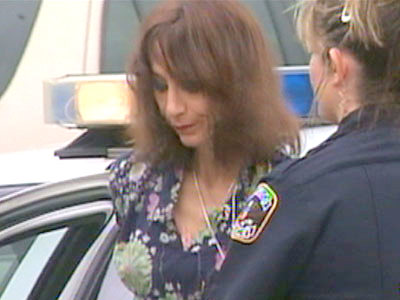 Special To TBO.com by EAMONN KNEESHAW
Celeste Grace Minardi is placed into the back of a Largo Police Department cruiser.By NEIL JOHNSON of The Tampa Tribune
Published: March 23, 2008
The aunt of a boy police say was stabbed and slashed by his mother in a psychiatry office Saturday told a judge this morning that Celeste Grace Minardi has threatened other family members before.
Jacqi Yeager also said during the mother's first appearance hearing Sunday in Pinellas County that family members were afraid of Minardi.
 Celeste Grace Minardi
On Saturday morning, Minardi, 55, was in a court-ordered visit with her 15-year-old son at a psychiatry office on Seminole Boulevard in Largo when she pulled a pair of knives from a purse and began hacking at her son, Largo police said.
The boy was stabbed in the abdomen, severely injuring his intestines. In addition he had a pair of slashes across the throat, one 8 inches long, another 3 inches long. The boy also had a 4-inch gash over his right eye.
Police said Minardi, after giving the boy a deck of cards and bottle of cologne, pulled a 15 1/2 inch decorative dagger and 12-inch drywall knife from her purse and attacked her son.
The boy was taken to St. Petersburg's Bayfront Medical Center and was in critical condition after emergency surgery, said Largo police Sgt. Mark Young. The family asked that further details of his condition not be released, the hospital said.
Mirandi, of 1202 Fairway Dr., had been visiting her son at the office about twice a month for the past three years, Young said. The boy's father has custody.
Police did not release the boy's name.
Minardi is the ex-wife of Timothy Driscoll, 47, a bankruptcy lawyer in St. Petersburg. Court records show they filed for divorce in 2004 and had one child together.
Minardi has no criminal record and has never shown any violent behavior, Young said.
This visit did not appear to be different, he said. The mother and son were sitting on a couch. A nurse was about six feet away.
After the attack, the boy tried to run away but collapsed. A doctor ordered Minardi to drop the knives, pulled her from the scene and secured the knives, the sergeant said.
Young said that when police arrived, the teen was covered in blood and slipping in and out of consciousness.
"He told me, 'My mom stabbed me,'" Young said. "Then he looks up at me and said, 'I don't ever want to see her again,' and then he passed out."
Minardi would not say why she attacked the boy and would only answer yes or no when asked whether she understood her rights as she was being arrested, Young said.
She was charged with first-degree attempted murder and booked into Pinellas County Jail shortly before noon Saturday, jail records show. Two additional charges of carrying a concealed weapon were pending, Young said.
Source: Tampa Bay Tribune
Report Mothers!
March 23, 2008 permalink
Once again, when you see a young mother caring for a baby in the Toronto area, call the cops immediately.
Police are not saying why they want this pair, 16-year-old mother Shamika Palmer and her 4-week-old son Tristan Oldham, but separating mother and child is a good possibility.
Children of single teenaged mothers can truly benefit from outside assistance, though police have kept us in the dark about whether mother Shamika is on her own. In a sane world we would urge the mother to accept help. In this case, provided the mother has some way of getting necessities for the baby, the child may be better off staying out of sight.
expand
collapse
March 23, 2008
Teen mom, baby missing
By CHRIS DOUCETTE, SUN MEDIA, The Toronto Sun
Toronto Police are scouring several neighbourhoods across the city in search of a teen mother and her baby missing for several days.
The Catholic Children's Aid Society became concerned for the safety of the 16-year-old and her 4-week-old son after an incident in Scarborough last week, police said.
"We would very much like to speak to this young mother," Sgt. Ken Boyle, of 31 Division, said yesterday. Police are unable to say what caused the CCAS to become worried. "All I know is that she was in a place she shouldn't have been."
Shamika Palmer and son Tristan Oldham, born Feb. 24, were last seen Tuesday in the area of 3171 Eglinton Ave. E.
The teen is known to frequent the areas of Markham Rd. and Eglinton Ave. E., Lawrence Ave. W. and Allen Rd., and Jane St. and Finch Ave. W., police said.
Source: Toronto Sun from canoe.com
TV Station Gagged
March 23, 2008 permalink
The US bill of rights protects freedom of the press, but that means nothing in family court. Judge Susan Orr Henderson barred an Indianapolis TV station, WXIN channel 59, from airing an interview with aggrieved parent Mark McGaha.
Through the internet you can still see the story on website Honk For Kids. Viewers with Apple Quicktime can watch Mark McGaha at HonkforKids Gallery of Heroes. While there, listen to the story of the death in foster care of Miyanna Renae Chowning.
expand
collapse
March 23, 2008
Expert: Ruling amounts to censorship
Fountain County judge's order blocked an Indy TV station from airing a parent's criticism of child welfare agency
By Tim Evans, tim.evans@indystar.com
Mark McGaha wanted to share his frustrations about the Department of Child Services with the public, but he never got the chance.
McGaha did an interview with an Indianapolis TV station, but a Fountain County judge issued a restraining order barring the station from airing his complaints or even showing his face -- apparently without even having seen the footage.
The segment about family advocacy group Honk For Kids was broadcast March 13, without McGaha's comments and with his face blocked out in a group shot of parents.
A legal scholar called Judge Susan Orr Henderson's action unconstitutional and said it "borders on judicial misconduct."
"Quite simply, a judge does not have the authority to stop the press from publishing or airing a story," said Henry Karlson, a professor at Indiana University School of Law-Indianapolis. "Any person has a right to contact the press and say a public agency is not treating them right."
Karlson said the judge's action amounted to "prior restraint," or government censorship, which is a violation of the First Amendment.
Dawn Robertson, spokeswoman for Honk For Kids, said Henderson's actions underscore the group's concerns about the way families involved with the child welfare system are treated.
"These are the kinds of abuses of power people across Indiana are dealing with every day," she said.
Robertson said the public is not aware of the extent of those problems because most aspects of child welfare cases are confidential. That means records and court proceedings typically are not open to the public or media.
A disabled veteran and single father of four, McGaha, 37, said he thinks the court and Department of Child Services are out to get him because he stood up to workers he contends have treated him and his four children unfairly.
After the TV segment aired, Honk For Kids asked the station, WXIN (Channel 59), why McGaha's face had been blurred and was told of the restraining order. That was the first that anyone, including McGaha, had heard about the judge's action.
Gavin Maliska, news director at WXIN, said station officials discussed challenging the order, which was issued the day the segment was to air, but decided McGaha's contributions weren't essential to the story.
"It came down to principle versus practical," he said. "If it would have affected what we were trying to do with the story, we probably would have had a different outcome."
Maliska said the court order was sought by the guardian ad litem who represents McGaha's children in a Child in Need of Services case in Fountain County.
The guardian ad litem, Covington attorney Sue White, did not return calls from The Indianapolis Star, and the court would not release a copy of the order. Bailiff Dianne Cotten said it was part of the confidential records of the CHINS case and could not be made public.
However, a copy obtained by The Star showed that Henderson barred WXIN "from broadcasting any portion of an interview involving Mark McGaha and his minor children until such time as the guardian ad litem and/or court has an opportunity to review" the report.
The order said the injunction was issued to protect the best interests of the children. Karlson said that does not provide the constitutional standard for such an order.
"I see no basis on which a prior restraint could have been imposed," he said. "He has an absolute right to complain about his treatment by the court or any other government agency."
McGaha could appeal the judge's ruling, Karlson said, "but it's basically a moot point" because the opportunity to air his complaints on TV has passed.
"I don't know what's more outrageous: the judge ordering this and not knowing it violates the Constitution, or knowing and still issuing the injunction," Karlson said.
James W. Payne, who heads DCS, said he could not talk about the specifics of McGaha's case. He said DCS has no control over the judge's actions and that parents who have a beef with the agency or court have a number of avenues to have their concerns addressed.
McGaha's children have been in foster care for more than a year. He said they were removed based on allegations he had missed "a couple doctor appointments" for his children, two of whom have ongoing medical problems.
"That was taken care of long before they (DCS) ever got involved," said McGaha, who lives in Lafayette. "After that, I did everything they said, but they kept coming after me."
As he grew more frustrated and began challenging some of the actions of agency caseworkers, McGaha said he was accused of sexually assaulting his children, a charge he denies. Then, he said, a caseworker threatened to take away his girlfriend's children if she continued to associate with him.
McGaha said he has never been charged in connection with any sexual allegations, but DCS continues to make the claim against him.
"I dared to say, 'Hey, wait a minute, this is not right,' " he said, "and now they are trying to take my kids from me for good."
Source: Indianapolis Star
Foster Alumnus Kills
March 21, 2008 permalink
Another foster child has graduated to the criminal justice system, where he will likely remain indefinitely. Luke Aday grew up in foster care in British Columbia and following a brief emancipation slashed the throat of James Allanach.
expand
collapse
Foster parent tried often to get help for accused
Richard Watts, Times Colonist, Friday, March 21, 2008
Accused killer Luke Aday lied, stole and was clearly troubled as a child, but despite repeated pleas from a foster parent he got little help from child welfare, B.C. Supreme Court heard yesterday.
Laura Luz, foster parent and operator of an assessment centre, testified that Aday as a boy was a thief with a violent temper. And as time went on she found him cutting his own arms with a knife.
Luz said she repeatedly pleaded with social workers for extra help for the boy, such as a psychiatric assessment or medication. But "glitches" in the system always held up any promised help, she added. "I was very frustrated at the way the care was going," said Luz.
Aday, 21, is now on trial charged with second-degree murder in the July 16, 2006, throat-slashing death of James Allanach, 34. The body of the 34-year-old Allanach was discovered at Central Middle School, hours after he died.
Court has heard Allanach was nearly decapitated by cuts to his throat, and his left ear was removed. Other evidence has Aday keeping the ear in an empty cigarette packet.
Court has heard Aday testify he was out earlier that evening for a late-night walk after an evening of drinking. He met Allanach, who had also been drinking, and the two walked, talked and later sat on the steps of the school.
There, for reasons he hasn't fully been able to explain, Aday said he became terrified when Allanach touched his neck. The next thing he knew his knife was in the other man's throat and his hand on the handle.
Defence counsel Rory Morahan has said Aday failed to ever form the intent to kill or harm necessary for a murder conviction. A combination of alcohol, momentary stress and personality and mental disorders, the result of a difficult upbringing, left Aday unstable, Morahan has argued.
Luz said she had care of Aday for about one year, beginning in 1999. She found Aday a likable child. He was smart, funny, good in school and quite advanced. But out of sight he was a habitual thief. "I told Luke many times I would love to keep him into his adult life but he needed to get the stealing under control," she said.
Later she found him cutting himself on the arms with a knife. "I remember talking to him about it and getting the sense that for him it was a release."
The trial, in front of Justice David Vickers sitting without a jury, continues.
rwatts@tc.canwest.com
Source: Times Colonist (Victoria)
More Overspending
March 21, 2008 permalink
A recent article dealt with overspending by Hastings Children's Aid. Now the Toronto Star reports that 46 children's aid societies have overspent their budget. We repeat, this amounts to a taxpayer stick-up, since the legislature cannot refuse to pay, and let 18,000 children in foster care go without food and shelter.
It has been clear for a long time that the legislature cannot get interested in theft of children in the name of child protection. Maybe they could sic the Ontario Ombudsman on CAS to track down the theft of the taxpayer's money in the name of child protection.
expand
collapse
Children's Aid Societies facing a money crunch
46 of 53 agencies running a deficit that could cut services for Ontario's most vulnerable children
March 21, 2008, Tanya Talaga, Social Justice Reporter
All but seven of the 53 children's aid societies in Ontario are running deficits, and some are so desperate they have taken out lines of credit in order to keep their child protection services afloat.
The Ontario Association of Children's Aid Societies says the 46 agencies are running a combined deficit of $22.3 million this fiscal year and for 2008-09 their projected deficit skyrockets to $60 million.
"The funding model definitely needs revision," said Jeanette Lewis, executive director of the OACAS umbrella group.
The cost of implementing Ontario's 2006 "Transformation Agenda" – with its guiding principle that children are best left with their immediate or extended families – has put financial pressures on the societies without the extra funding to match, she said.
The agenda requires social workers to devote more time to individual cases, connecting with the families and monitoring precarious domestic situations.
While the societies support this approach, they haven't been given money to pay for the added social-work commitment, they say.
Lack of cash flow means the societies – non-profit bodies that are funded by the province – are having to reconsider services for Ontario's most vulnerable children.
Some examples:
This week Family and Children Services of Waterloo Region cut two programs – Going Beyond and Outreach – aimed at keeping at-risk adolescents at home. Going Beyond helped 103 youths last year and Outreach 61 families.
Agencies that provide subsidies to parents adopting high-need children might have to abandon this financial support, possibly putting the adoption in jeopardy.
Crown wards becoming adults might lose access to grants for their post-secondary education as well as a reduced schedule with their social workers.
Agencies last year cared for and provided services to almost 30,000 children. On any given day there are 19,000 children and youth in group homes or foster care.
In addition, thousands of other children also benefit from agency services, such as the instruction programs given to parents on how to improve their parenting and avoid domestic violence and other stressful situations.
"The impact on children and youth isn't looking good," said Marcelo Gomez-Wiuckstern, communications director for the OACAS. "Permanent placement options such as adoptions or kinship arrangements are at risk right now."
Agencies are mandated to investigate complaints of abuse and neglect – last year 80,000 investigations took place. If staff reductions occur, the agencies fear their ability to provide this protection will be compromised.
"If a child is left out in the cold ... or in a stairwell as what happened weeks ago, (the agency) can't say, `Well, I'm sorry, we've run out of money,'" Lewis said.
Children and Youth Services Minister Deb Matthews acknowledged there were financial issues affecting children's aid societies but said they have to operate within their budgets.
At the end of February, her ministry provided a $34-million funding boost to the agencies, which at that time had a shortfall of $54.7 million. But that still left deficits of $22.3 million.
"We're definitely dealing with some funding issues at the CASs. We have gone a good way to help resolve some of them but the reality is they have budgets they have to live within," Matthews said yesterday.
She said her ministry has provided new funds to the agencies via the Child Welfare Transformation Fund.
Her office said in this year alone $37.2 million was allocated towards finding permanent placements for children and providing intervention support.
But not all the money in the transformation fund goes to the agencies, said Lewis. It also pays for training, research and other needs.
Toronto's Jewish Family and Child Services was advised by the government to take out a line of credit to prop up its operations, said executive director Dr. Richard Cummings.
The agency did so and is awaiting approval on a $500,000 line of credit. However "that advice feels like a pyramid scheme," said Cummings, who said the agency has accountants on its board who stringently go over the budget. "Who'll ... ultimately pay?"
The money crunch may force the agency to scrap summer camp for vulnerable children and lay off staff.
The agencies submit their proposed budgets to the ministry in August and some are still waiting to hear if their submission has been approved, said Gomez-Wiuckstern of the OACAS umbrella group.
They'd like to see budgets approved in a timely way, along with a review of the funding formula.
Peel Children's Aid Society is so underfunded, it's two-thirds along on a projected $3 million deficit, said Rav Bains, director of services.
"We aren't some sort of production line," said Bains. "We deal with the lives of young people. These are the adults of tomorrow."
With files from Kerry Gillespie
Source: Toronto Star
Addendum: Andrea Horwath also suggests getting the Ontario Ombudsman to look into look into CAS as a condition for funding the budget overruns.
expand
collapse
TIE OVERSIGHT TO CHILD WELFARE FUNDING INCREASES, SAYS CRITIC
Queen's Park
Hamilton Centre MPP Andrea Horwath says increased funding for Ontario's cash-strapped Children's Aid Societies should be tied to having independent oversight of those bodies by the provincial Ombudsman.
The NDP Critic for Children and Youth Services will be introducing a bill shortly that, if passed, would give the Ontario Ombudsman the authority to investigate complaints concerning the children's ministry, including CAS child welfare and protection decisions.
“The McGuinty government must quickly move to address the critical CAS funding shortfall to address the needs of children and youth,” Horwath said today. “But Ontario desperately requires full accountability in the child welfare system, the capacity to investigate complaints independently as only the Ombudsman of this province can guarantee. I want the McGuinty Liberals to address the lack of CAS funding and the lack of real oversight at the same time.”
Horwath's private members bill aims to put Ontario in line with eight other provinces that already have a truly independent body in place to deal with people who feel they've been wronged in a child welfare matter.
“Families anguish over the brick wall they face when trying to fight children's aid decisions,” said Horwath. “Not having a place for them to turn is a huge injustice.”
Canadian Ombudsmen have been calling for the authority to look into such complaints since 1984. Ontario Ombudsman André Marin has repeatedly called for a role.
Horwath said Ontario's current mechanism for oversight was “written on the back of a napkin by the Liberals” when she pushed hard for the Ombudsman's involvement during committee debates over the government's amendments to the Child and Family Services Act.
“The Liberals failed to back up their advertised child welfare transformation agenda with the dollars to make it happen. If the Ombudsman had oversight, this McGuinty government failure would be exposed," Horwath said.
The Ontario Association for Children's Aid Societies reports that 46 of 53 of its agencies are in deficit, grappling with program cuts and overloaded caseworkers.
Fri, 2008/03/21 - 1:00pm
Source: Andrea Horwath
No Refuge for Mothers
March 20, 2008 permalink
An English woman, Emily Burgess, feared losing her baby on pretense of protection and fled to Ireland to give birth. It did not help. She went into labor on Monday and by Tuesday the courts and police completed the process of taking the baby.
expand
collapse
Wexford People
Wednesday March 19 2008
A NEWBORN baby boy has been taken from his mother by Wexford Gardaí amid concern for his welfare.
Emily Burgess (32), from the Great Yarmouth area of England, gave birth to her sixth child at Wexford General Hospital last week, but the healthy infant was taken away from her by the Gardaí.
Ms. Burgess fled her home to have her child in secret in Ireland as she feared that the baby would be taken away from her when born in England.
The Wexford Gardaí quickly became aware of where Ms. Burgess was staying following her arrival here and were informed when she went into labour last Monday.
The Garda spokesman said they maintained a presence in the hospital throughout the birth, but were mindful of both the mother and child's welfare and the sensitive nature of the situation.
On Tuesday morning an emergency care order under Section 12 of the Childcare Act was granted enabling the Gardaí to take the child. It was then taken into care by the HSE.
Source: Wexford People
Nancy Schaefer for Congress
March 20, 2008 permalink
Georgia state senator Nancy Schaefer ( February 19, March 4 ) gives her side of the demise of her child protection reform legislation, and announces her candidacy for the US congress.
expand
collapse
March 18, 2008
Dear Friends,
First, let me thank you from the bottom of my heart for coming to the Capitol of Georgia to record your painful message. You did a wonderful job and I was so proud of you.
However, a spouse of one of you who came to record, sent letters to the Capitol and to several different people in opposition to the taping and accused his spouse of lying about him and on and on. With that, Capitol Security brought the recording to an end because of the threats in the letters.
I am very sorry this happened. However, this was another indication of how quickly the opposition I had at the Capitol would act to quickly end our opposition to CPS/DFCS policies.
You have heard by now, I am sure, that my bill, SB 415, was gutted and rendered of no value by the Chairman of the Judicial Committee and or others. The three main points were stripped out of the legislation. They were:
- The opening of family court to remove the culture of secrecy;
- The removal of the financial incentives for adopting children out who are taken wrongly from their parents and given to strangers; and
- The removal of immunities from Child Protective Services or DFCS in order to keep corruption down and bring in accountability and responsibility.
I pulled the bill rather than seek to work with an empty, do nothing piece of legislation that the leadership had shown they were not going to support or offer any real involvement.
Please know that the opposition surrounding this bill was fierce, and that it still is, but I am not down and we are not through. We have only just begun, and with God's help, which we already have, this court-sanctioned abuse of children and families will end.
Now, two things;
- One, we can come together and record again and I will set up the time and place. I really feel that the CD is important and I would like it to be on my website for future needs where it could be used to promote the cause. If you are interested in joining me again to record, please call, Jody at 706-754-8321 and let her know.
- Second, I am running as a candidate for Congress from the 10th District. If I can be successful, I will carry this work for children and families to Washington with me. I would be grateful for your prayers and support.
Let me hear from you. Do not give up. Stay strong and pray for the victory that will in time be ours.
We love and appreciate you and we pray for you.
Warm regards,
Nancy Schaefer
State Senator, 50th District
Nancy Schaefer for Congress
Phone: 706-754-8321
Fax: 706-754-1803Source: email from Nancy Schaefer relayed by AFRA
Hero Punished
March 19, 2008 permalink
When a school bus driver hit her head, losing control of her vehicle, teenager Amanda Rouse saved forty lives by quickly applying the emergency brake. Her school's reaction? She was punished for failing to notify the school before going home sick. These school administrators should transfer to child protective services, where they will fit in with the prevailing culture.
expand
collapse
The Associated Press
Discipline Despite Calif. Bus Rescue
March 16, 2008
SEASIDE, Calif. (AP) — A 15-year-old girl who stopped an out-of-control school bus she was riding on was handed a Saturday detention instead because she was skipping school.
Marina High School student Amanda Rouse was on a bus with 40 elementary school students Wednesday morning when the driver fell out of her seat after a turn and hit her head.
Rouse jumped up and applied the brakes, bringing the bus to a halt after striking two parked cars. No one was injured.
She said had asked the bus driver for a ride because she felt sick at school.
"She is in trouble with school because she made the wrong decision," said Rouse's grandmother, Sally Correll. "But I can't help but believe that she was where God wanted her to be."
A spokesperson for the Monterey Peninsula Unified School District could not immediately be reached Saturday.
Source: Associated Press hosted by Google
Homeschooling May be Educational Neglect
March 19, 2008 permalink
While the Child and Family Services Act does not include "educational neglect" as a reason for intervening in family life, the courts have interpolated such a provision. Homeschooling parents can now be picked off one at a time until the submit to the whims of social workers and psychologists. The Ontario courts are inclined to give children's aid societies even more powers than granted by the legislature.
This case started out as a dispute over home remodeling. There is a family blog dealing with this issue. Click on myspace blog after you link to Legally Kidnapped.
expand
collapse
Children's Aid jurisdiction over "neglect of education"
A court case initiated against a homeschooling family by the Durham Children's Aid Society (DCAS) has recently resulted in a ruling that the courts have jurisdiction under the Child and Family Services Act (CFSA) to deal with cases of possible "neglect of education" to ascertain whether there is a need of protection.
The case that triggered this jurisdictional decision began in summer of 2006 when the family was reported to DCAS because of the state of their house during renovations. They were ordered to remove the children from the house until it was back in a more livable state.
In other words, this was not initially an education issue. During the process of the investigation, however, the CAS worker became concerned that the education of the homeschooled children (3 out of the 7 children of the family) was being neglected, mainly because the then-12-year-old could not read well. It should be noted that the child is recognized by his parents as being slightly "delayed" in a way not caused by their approach to homeschooling but inherited as a trait that "runs in the family". We take it the mother is also slightly "delayed".
Section 37(2) of the CFSA describes the circumstances in which a child is to be considered in need of protection. There is no mention of any educational issues. The closest thing to academic delay is "delayed development", listed under emotional harm.
"A child is in need of protection where,
(f) the child has suffered emotional harm, demonstrated by serious,
(i) anxiety,
(ii) depression,
(iii) withdrawal,
(iv) self-destructive or aggressive behaviour, or
(v) delayed development,
and there are reasonable grounds to believe that the emotional harm suffered by the child results from the actions, failure to act or pattern of neglect on the part of the child's parent or the person having charge of the child".The other subsections relating to emotional harm refer back to the same list, with variations on the surrounding circumstances relating to whether the harm is caused by the parents or they are not the cause but are not seeking remedies, and also whether the harm has already been suffered or the child is at risk of suffering it.
There is also a subsection (h) relating to "a mental, emotional or developmental condition that, if not remedied, could seriously impair the child's development". The child is considered in need of protection if the parent does not provide "treatment to remedy or alleviate the condition". However, this is not the subsection referred to by the DCAS in their later motion. They refer instead to subsection (g), relating to the risk of serious delayed development caused by the parents.
The DCAS's original motion regarding education was for the court to order the parents to comply with their demand that the children be tested so their academic performance could be assessed and remedies prescribed accordingly, including the possibility of ordering that the children attend school. The parents, with the support of a document prepared for that purpose by OFTP, claimed that such educational matters do not come under the jurisdiction of the CAS but should be dealt with under th Education Act instead, since the CFSA does not list anything related to education among the concerns that serve as criteria for finding a child in need of protection (see sidebar), whereas the Education Act contains all the provisions needed to deal with issues of satisfactory instruction and exemptions from attendance at school.
The judge was unwilling to order the assessment until the jurisdictional issue could be determined. The DCAS therefore changed its motion to request a "Summary Decision on a Legal Issue, specifically on whether neglect of education is a protection issue".
OFTP attempted to intercept the process by writing to the Minister of Children and Youth Services and sending a copy to the Minister of Education, but neither ministry was willing to interfere or comment while the matter was before the court.
[ material on how the issue was presented to the court is omitted. ]
THE RULING
In conclusion, Justice Shaughnessy wrote:
"The CFSA focuses on the consequences of abuse and neglect, or the reasonable risk thereof, of any number of unspecified parental responsibilities. There is no limit to the kind of responsibility that a parent may breach for the purpose of scrutiny under the CFSA, provided the breach gives rise to a protection concern under the provisions of the Act. It follows then that the education of a child is one of the responsibilities of parents. Accordingly, neglect of education which either causes emotional harm, or the risk thereof, may be dealt with under the CFSA provided the Society can relate it to a protection issue under S 37(2) of the Act".
"In the result there is a finding that neglect of education is properly an issue before the court and the Court has jurisdiction under the CFSA to hear the matter".
The ruling also called for a case conference to be arranged within 21 days so that a speedy resolution could be reached for the particular children in this case. The result of that conference was a temporary order that "The parents shall continue to provide home based education to [their children] and shall allow the Society to record completed work. The parents shall consult with the Durham Board of Education, ILC and homeschooling resources to develop appropriate individual education plans for each child. The parents agree to have [the children] undergo a psycho-educational assessment pursuant to s.54 which shall be arranged for and funded by the Society and shall be conducted by Dr [C...] [a psychologist]. Upon receipt of the assessment the parents shall implement the resulting recommendations into the children's individual education plans. Within 4 - 6 months the implementation of the assessment recommendations into the children's individual education plans shall be demonstrated and assessed by Dr [C...] and the children shall be reassessed by Dr [C...].
The psychologist's letter of agreement includes a reference to the DCAS having expressed "concerns about the intellectual and other capacities of their mother" and "very likely the need to assess the mother's capacity to properly design and implement an education programme". He also states it is "unclear whether the programme the mother is providing meets the standards of the Ministry of Education".
The psychologist's report is due by the end of February 2008 and the case conference is scheduled to continue in early March.
WHAT IT MEANS FOR THE HOMESCHOOLING COMMUNITY
What this jurisdictional decision means for the homeschooling community is that each family being investigated by the CAS will need to rely on the merits of their own situation rather than on the general notion that educational matters are not protection issues. There still remains an evidentiary burden on the CAS to demonstrate in each case that there is indeed a risk of serious delayed development. In order to demonstrate or disprove that, they will no doubt be relying on "psychoeducational" assessments as in this case.
It will be up to each family to negotiate with the CAS as to who the assessing psychologist will be, otherwise it will be one chosen by the CAS. It would be helpful if we had a list of psychologists who are familiar with or at least open-minded to homeschooling, particularly unschooling, who could be recommended to families in this situation. If you know of such a professional in your region, please let us know.
Source: Home Rules, newsletter of the Ontario Federation of Teaching Parents, February 2008
Jail for Giving Birth
March 18, 2008 permalink
Alabama is enforcing a law criminalizing mothers who expose their fetus to drugs. When a drug-using Alabaman gets pregnant, she either has to have an abortion or go to jail.
expand
collapse
The New York Times
March 15, 2008
In Alabama, a Crackdown on Pregnant Drug Users
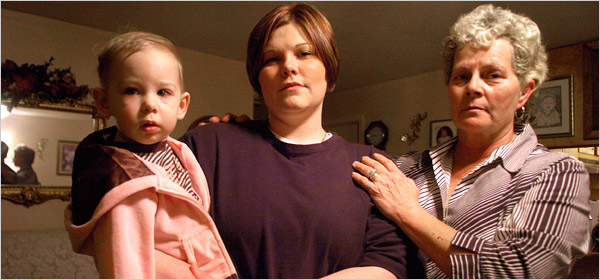 Tiffany Hitson, top, with her grandmother, Shirley Hinson, and daughter, Audrey. Ms. Hitson was sent to jail for drug use under an initiative by the county district attorney, Greg L. Gambril.Jay Hare for The New York Times
By ADAM NOSSITER
ANDALUSIA, Ala. — A day after she gave birth in 2006, Tiffany Hitson, 20, sat on her front porch crying, barefoot and handcuffed. A police officer hovered in the distance.
Ms. Hitson’s newborn daughter had traces of cocaine and marijuana in its system, and the young woman, baby-faced herself, had fallen afoul of a tough new state law intended to protect children from drugs, and a local prosecutor bent on pursuing it. She made arrangements for the baby’s care, and headed off to a year behind bars.
“I couldn’t believe it,” recalled Ms. Hitson, who was released in November after spending much of the first year of her daughter’s life at the Julia Tutwiler Prison for Women in Alabama.
Two worlds are colliding in this piney woods backcountry in southern Alabama: casual drug use and a local district attorney unsettled that children or fetuses might be affected by it. The result is an unusual burst of prosecutions in which young women using drugs are shocked to find themselves in the cross hairs for harming their children, even before giving birth.
Over an 18-month period, at least eight women have been prosecuted for using drugs while pregnant in this rural jurisdiction of barely 37,000, a tally without any recent parallel that women’s advocates have been able to find. The district attorney, Greg L. Gambril, acknowledges the number puts him at the “forefront,” at least among Alabama prosecutors. Similar cases have come up elsewhere, usually with limited success. But Alabama, and in particular this hilly, remote terrain just above the Florida Panhandle, is pursuing these cases with special vigor.
In Maryland, the state’s highest court in 2006 threw out the convictions of two women whose babies were born with cocaine in their bloodstreams, ruling that punishment was not the right deterrent. Last year, the New Mexico Supreme Court rejected a woman’s child-abuse conviction in a similar case, declaring a fetus was not a child. Some doctors and advocacy groups maintain that the effects of drugs on pregnant women and their fetuses are not fully known; in Alabama, though, these arguments have yet to be officially made.
A cultural clash, unfolding within the confined world of Covington County, is at the origin of this prosecutorial crusade. Here, unlike in other jurisdictions, women are not appealing their convictions, and lawyers and doctors talk about these cases reluctantly, if at all. Too many people know one another in these quiet little towns that fade abruptly into the countryside.
There has not been a murder here in over three years, the prosecutor said. But a year ago a newborn died at the local hospital, and the mother had traces of methamphetamines in her system. Doctors told the police that the infant’s premature birth could be attributed to maternal drug use, and she was charged with “chemical endangerment of child,” which carries a sentence of 10 years to life in prison.
“In my jurisdiction, a baby being born dead because of drug abuse is a huge deal,” Mr. Gambril said.
Mr. Gambril makes little distinction between fetus and child. He said his duty was to protect both — though the Alabama law he uses makes no reference to unborn children, and was primarily intended to protect youngsters from exposure to methamphetamine laboratories.
“When drugs are introduced in the womb, the child-to-be is endangered,” Mr. Gambril said. “It is what I call a continuing crime.” He added that the purpose of the statute was to guarantee that the child has “a safe environment, a drug-free environment.”
“No one is to say whether that environment is inside or outside the womb,” he said, and no judge or other authority in Alabama has so far disagreed.
Covington County is an isolated rural terrain where drugs are a recreational outlet in the absence of others, where the police found nearly 200 methamphetamine laboratories in the first years of the decade, and where they made more arrests for abusing the drug than anywhere else in the state.
“This is a meth town,” said Ms. Hitson’s grandmother, Shirley Hinson, who helped take care of the baby while Tiffany was in prison. Speaking of youth here, Ms. Hinson said, “There’s nothing for them to do.”
The county is the kind of place where young women — white, working-class, on probation for other offenses — sometimes take a chance while pregnant.
“I made the biggest mistake of my life & did some drugs with her father right before I went into labor, unaware I was about to have her,” Ms. Hitson wrote to the court from the Covington County Jail, in neat schoolgirl script, pleading to be released after her arrest in October 2006. “Please, please let me spend this most important time with my baby,” she wrote.
But the judge had set bond at $200,000 — Ms. Hitson had earlier been charged in connection with a break-in, and with credit-card fraud — and in jail she stayed.
The environment can be unforgiving. Rachel Barfoot, 31, who had been charged before with beating her niece, told her probation officer that she was pregnant. When she tested positive for cocaine, she was arrested.
“I was in shock,” said Ms. Barfoot. “I told the truth, but the truth got me nowhere,” she said in an interview. Three months pregnant, already a mother of four, she spent five weeks in the Covington County Jail.
“It was hell,” said Ms. Barfoot, now jobless and struggling. Police affidavits make it clear that local doctors are cooperating in these investigations.
The women are sent off to county jails, state prisons, or drug rehabilitation clinics, and often emerge bitter at the collaboration of police, prosecutors, judges, doctors and social workers they say is less keen on help — Mr. Gambril insists otherwise — than punishment.
“In Covington County, I don’t think they’re interested in helping mothers,” Ms. Hitson said. “They’re just sending people straight to prison. It doesn’t help their drug problems.”
A few of the local defense lawyers express similar sentiments: “None of those cases should have been brought,” said Rod Sylvester, who represents another woman charged with chemical endangerment. “It’s an overreaching.”
But others bring up the powerful, unspoken community sanction against the combination of drugs and pregnant women. And so far, none of the women have risked trial.
“Our ultimate goal is to protect mothers and children,” Mr. Gambril said.
Meanwhile, Shirley Hinson, Ms. Hitson’s grandmother, is still furious over Tiffany’s year of imprisonment. “They took something away from my granddaughter and my grandbaby they can’t give back,” she said. “They made an example out of Tiffany. That’s all they did.”
Source: New York Times
Grabbing Guinea Pigs
March 17, 2008 permalink
Five years ago Utah child protectors tried to get Parker Jensen to submit to a cancer treatment, while his parents wanted to get a second medical opinion. Now a motive for the Utah doctor has emerged. The parents claim the doctor wanted to enroll the child in a medical test. So in addition to the many frivolous reasons to steal a child under pretense of protection we have to add: enrolling the child in a medical experiment.
expand
collapse
Deseret Morning News
Doctor put study first, Jensen family says
 Parker Jensen (Deseret Morning News archives)
By Geoffrey Fattah and Lois M. Collins, Deseret Morning News, Published: March 4, 2008
Attorneys for the parents of Parker Jensen, the 12-year-old boy who made national headlines in 2003 after his cancer prompted state officials to try to force his parents to consent to chemotherapy, claim new evidence shows that a treating physician was more concerned about getting Parker into a clinical study than actually treating the boy's illness.
According to a document filed in U.S. District Court, attorneys for Barbara and Daren Jensen allege former Primary Children's Medical Center Dr. Lars Wagner was trying to prep Parker to qualify for a clinical study of Ewing's Sarcoma, a rare form of soft tissue and bone cancer, by placing him on immediate chemotherapy, even though the Jensens wanted more tests done.
The attorneys argue that Wagner was trying to place Jensen on chemotherapy within a certain time limit to qualify for the study.
In other court documents, attorneys for the state say Parker was not eligible for the study, however, the Jensens claim Wagner never told them that he was considering their son for a clinical trial. Later, they claim Wagner never told the Division of Child and Family Services of the study when he turned the Jensens in for medical neglect after they refused his treatment recommendation.
The Jensens say this evidence, which they found in the past year during discovery for their pending lawsuit against the state, social workers and doctors, shows that Wagner knew that Primary Children's "routinely performed genetic testing for suspected Ewing's Sarcoma when it could collect a fresh tissue." The Jensens say that is what they wanted. The court document states Wagner had expressed concern about a time constraint to get Parker on chemotherapy for the study.
Shortly after reporting the Jensens to state welfare workers, Wagner left Primary Children's for Cincinnati Children's Hospital "because he would have greater research opportunities there." The Jensens contend Wagner was more interested in his research than treating their son.
On Monday, U.S. District Judge Ted Stewart set a three-week trial to begin Feb. 2, 2009. Jensen attorney Roger Christensen said his office plans to file a memorandum next month that will further lay out their case and their evidence. The state is also expected to file a more detailed outline of its position in the case later this month, containing hundreds of pages of medical documents.
The Jensens made national headlines in 2003 when they fled the state with their son to avoid a judge's order to place him on chemotherapy. While in Idaho, the Salt Lake County District Attorney's Office filed felony kidnapping charges against the Jensens with warrants for their arrests.
The ordeal sparked a national debate over the government's role in the lives of children vs. parental rights.
The Jensens sued the state, charging that several physicians and state DCFS officials conspired to force their 12-year-old son to undergo chemotherapy. Last year, a federal judge ruled the Jensens could not sue the state directly over the issue due to governmental immunity, but could press their claims against DCFS officials, two doctors and an assistant attorney general.
Primary Children's Medical Center could not comment specifically on Parker's case because of the ongoing litigation. But Dr. Edward B. Clark, medical director, explained the process that leads up to enrolling a child in a clinical trial.
The Children's Oncology Group is a not-for-profit, 220 center group born of the desire to find effective treatments for childhood cancer decades ago. Proposed treatment protocols go through many steps, including COG's safety monitoring board, critiques by the collaboration's member centers and then review by the National Institutes of Health, which has its own safety standards and other issues in mind.
Typically, all 220 centers are invited to participate in the trial. Those who join usually have their own Institutional Review Boards — the panel that vets clinical trials for ethics, safety and other key factors — look over the protocol, informed consent and other factors. Every clinical study at Primary is reviewed and overseen by its IRB, Clark said.
Most trials specify a window of time within which certain things have to happen following biopsy. If that time is not met, it doesn't stop someone from enrolling. Rather, he said, a repeat biopsy is requested to "note the evolving character of the tumor."
Primary gets detailed informed consent from parents and, if a child is 8 or older, from the child, as well. Informed consent includes a review of potential advantages and disadvantages, the nature of known risks and more. They often run 25 or more pages and without all that signed documentation, it's impossible to participate, Clark said. Medication wouldn't even be provided.
Physicians are not rewarded for enrolling children in clinical trials, he emphasized. The payment from COG is small, designed to cover the cost of tests, analysis, collecting and sending in data, and other expenses. Institutional support is provided for the centers themselves, but that happens whether or not the center actually enrolls even one participant.
"For physicians," said Clark, "there's no monetary or prestige value. This is a team effort with the goal to dramatically reduce the impact of cancer in children."
On Monday, Wagner's attorney Andrew Morse called the Jensens' claims "the reddest of red herrings."
Morse pointed out that Parker could not have participated in the clinical study because his parents refused a bone marrow test to determine if the cancer was localized or had spread. The study only accepted children whose cancer had not spread.
"This trial was only for a child with localized disease," Morse said. "He couldn't have been invited to the clinical trial."
In addition, Morse said had Parker taken part in the trial, he would not have received any different treatment than what Wagner had thought was necessary to treat him.
Morse also points out that despite the Jensens' claim that they wanted confirmation that the lump under Parker's tongue was indeed Ewing's sarcoma, four tests had confirmed that it was.
Christensen said now, five years later, Parker has been healthy and has shown no sign of cancer. Morse said he has yet to see any tests confirming that.
E-mail: gfattah@desnews.com; lois@desnews.com
Source: Deseret News
How to Lobby for Families
March 17, 2008 permalink
John Dunn has some suggestions on bringing about reform through the legislature.
expand
collapse
Well folks, it is that time again. Monday, the Legislative Assembly is back in business.
The MPP's are now heading back to public work on the legislative assembly.
Knowing that, I wanted to post this first bit of advice to everyone on how to use the Legislative Assembly this year for your advocacy purposes.
According to the Ontario Legislative Assembly's website, the Standing Committee on Social Policy has the following mandate:
The Standing Committee on Social Policy is empowered to study and report on all matters relating to the mandate, management, organization or operation of the ministries and offices which are assigned to it as well as the agencies reporting to such ministries and offices.
The Ministries and Offices assigned to the Committee are:
Ministry of Children and Youth Services, Ministry of Citizenship and Immigration, Ministry of Community and Social Services,Ministry of Education and others...
The studies are conducted according to either Standing Order 109 or 124 as shown below.
Standing Order 109: Under Standing Order 109, the policy field committees may conduct relatively unlimited studies. The only restriction is that the study must relate to a ministry assigned to that committee. The subject-matter and duration of the study are left to the committee to decide. This Standing Order is usually used when the committee agrees on what it wishes to study.
Standing Order 124: Once in each Session, each member (including the Chair), of the Standing Committee on General Government, the Standing Committee on Justice Policy and the Standing Committee on Social Policy is entitled to propose a matter to be considered by their particular committee. The matter must relate to the mandate, management, organization or operation of the ministries and offices and agencies assigned to the committee which report to such ministries and offices. The proposal of a member under this Standing Order must be adopted by at least two-thirds of the members of the committee, excluding the Chair. The committee may present a substantive report to the House and may adopt the text of a draft bill on the subject matter. At least one Sessional day, or 3 hours, of debate, will be allowed on the bill in the House at a time decided upon by the House Leaders of the recognized Parties.
Clerk
Katch KochTel. 416-325-3526
katch_koch@ontla.ola.orgThe Committee can be found at link.
NOW WHAT?=========
Well, now that we are aware of the fact that there is a committee at the Legislative Assembly of Ontario which focuses on the mandate, management, organization or operation of the Ministry of Children and Youth Services and of the Children's Aid Societies which report to the Ministry, we can start to advocate for changes through that committee.
To make sense of all that stuff above, here is an example.
If we all felt that there should be a change or an amendment to the Child and Family Services Act so that the Act could control how Societies deal with Society memberships instead of leaving it up to the Societies' individual by-laws, we could all start writing letters to the committee in the hope of getting the interest of at least one member of that committee to take on the matter as an important enough issue to take on or study and report to the Legislature either as a report or as a possible Bill (proposed change to the Act)
If anything, this method is one more means of attempting to advocate for positive changes to child welfare that we have not yet tried.
If you do write to anyone at the committee, be sure to remind them of their duty under the mandate of the committee.
I hope this is of some help to folks out there.
John Dunn The Foster Care Council of Canada
Source: email from John Dunn
Family Break-up Video
March 17, 2008 permalink
An anonymous family has posted a YouTube video of the children's aid society gradually separating mom and dad from their three children. CAS wants the youngest, a three-year-old blond blue-eyed boy, to become a crown ward. The family was informed by children's aid that it was illegal to bring friends or recording devices to visitation (the kind of law they make up themselves). The family secretly recorded the meetings anyway. Here are some notable points:
- In one visit parents photograph their toddler's injury, and CAS workers terminate the visit. In a later visit, the boy is afraid to talk because he doesn't want the visit to end. When the parents try to speak to the boy about an injury a laughing social worker interrupts to give their side. They do not allow the parents to talk to the child about the injury. Do they think a good parent should be unconcerned about their son's injury? Four days later another social worker gives a different explanation for the injury. With the evidence suppressed, the CAS lawyer tells the court this is "phantom bruising".
- The father points out that children's aid has made frequent changes in visitation times, causing the mother to lose one job and lose time from another. In one case, the parents were stood up with the excuse that this was not a visitation, only a meeting to discuss visitation. In court CAS tells the judge that the parents were chronic no-shows. The father makes a plea for understanding from the CAS worker. The plea is futile — ending the parents employment is the goal of this kind of disruption, which is routine in child protection cases. It is easier to get a judge to award crown wardship from unemployed parents than from parents earning a living. While dad was pleading, the CAS worker was congratulating himself on his success.
The persons mentioned on the video are Cory B DeYarmond CAS lawyer, Rodrick Rolston children's lawyer, Melanie foster mother, and CAS workers Pat St Germain, Jennifer Kloosterman, Paul Brown, Linda Howard and Ms Troy Gardiner. The children's aid society is the one in Hastings (Trenton) Ontario, the same one that recently committed a half million dollar stick-up of the taxpayers. Perhaps at this moment some Hastings area couple able to pay premium legal fees to adopt a cute blond blue-eyed boy is keeping an eye on this case.
Addendum: In April the YouTube video was removed. YouTube only says: "This video has been removed due to terms of use violation". Fortunately we obtained a copy before it was removed, and you can watch it here (12 megabytes wmv).
No Goodbye
March 16, 2008 permalink
In the story of the late Chelsey Cruz, the Hartford Courant illustrates a form of cruelty of the child protection system. Parents are forcibly kept away from their terminally ill children. In the Howard case in Massachusetts, social workers even refused the bereaved parents time alone with the body of their dead daughter. What were they protecting?
expand
collapse
Mother's Rage Lives On
A 15-Year-Old East Hartford Girl With Lupus Dies, And The State Offers Its Sympathy To The Family, While Defending Its Role In The Wrenching Case
By HILARY WALDMAN | Courant Staff Writer
March 15, 2008
When Kimberly Castro buries her only daughter next week, she'll do so with a clear conscience, but with fury in her heart.
The state, she said, robbed her of precious time with her child, simply because she wanted control over the girl's treatment for lupus.
"I'm angry; I'm enraged right now," said Castro, surrounded by her family in her father's East Hartford home as she made funeral arrangements for her 15-year-old, Chelsey Cruz.
"Even if lupus would kill her, why take her away from me and not let me spend the last days with my child?" Castro said through tears Friday. "They ripped her away from me. I was the best mother to my daughter."
The state Department of Children and Families expressed sympathy for the family but defended its procedures in the case. DCF charged Castro with medical neglect and took custody of Chelsey last August after Castro disagreed with three teams of doctors about how best to treat the girl's lupus. While Castro said the strong medications prescribed by doctors were hurting Chelsey, the doctors said they were her best chance to survive.
When the girl died unexpectedly Tuesday in the emergency room at Connecticut Children's Medical Center in Hartford, she was in the temporary custody of her grandfather. The family was awaiting a ruling from a family court judge about whether the girl could go home.
In a letter to the judge dated Feb. 1, Chelsey, an honors student at Capital Prep Magnet School in Hartford, wrote about the "horrifying side effects " of her medication and said her parents were being "penalized" for supporting her desire to try alternative treatment.
"I have already tried what the doctors consider to be the standard of care for the past five years. I have experienced the horrifying side effects of them and realized that they have not helped me in any way. In fact, I feel I have gotten worse and now require dialysis," Chelsey wrote. "In light of this, I no longer want to use them."
"I would also like to be back with my mom and brothers without any interference from any agency," she wrote.
Although it will not change anything, Castro said she would still like to get a ruling. DCF officials said in a prepared statement Friday that they were still unsure of how the case would end, in light of Chelsey's death.
"Department staff worked diligently to support the family and to ensure that the child's medical needs were met," DCF said. "The same staff sought to have mother engage necessary treatments for the girl that were recommended by doctors from three major hospitals. Our staff feel a great loss from the child's passing and deeply regret the pain experienced by her family."
Although Castro objected to her daughter's recommended treatment almost since the girl was diagnosed with lupus six years ago, the conflict came to a head last summer when Chelsey was hospitalized at Children's Hospital Boston.
Her kidneys had failed, and she was on dialysis. Doctors who previously had treated her at Connecticut Children's Medical Center and Yale- New Haven Children's Hospital said lupus, a disease in which the immune system goes awry and attacks the body's healthy organs, caused the damage.
They thought her best chance would come from two powerful chemotherapy drugs — Cytoxan and Cellcept — but Castro felt the medications were destroying Chelsey's kidneys. She fired the Connecticut doctors, who filed complaints against her. Eventually, Castro agreed to seek care in Boston.
There, Dr. William Harmon, director of pediatric nephrology and a renowned expert in kidney transplant for children, recommended that Chelsey continue on Cellcept. In court papers, he said he hoped to bring the lupus under control with the medication, then prepare Chelsey for a kidney transplant.
But Castro said the side effects from the medication were too much. Chelsey suffered with chronic intestinal distress and regular infections. Castro said the medication was doing more harm than good and ordered the doctors to stop.
In August, Harmon called in Massachusetts child welfare authorities, accusing Castro of medical neglect. He had a uniformed guard posted outside of Chelsey's hospital room to prevent Castro's possibly taking her daughter out of the hospital.
In October, when Chelsey was well enough to go home, the case was transferred to the Connecticut Department of Children and Families, and Chelsey was placed in the custody of her grandfather, who agreed to follow the doctor's orders. A hearing was called to reach a final decision. On Feb. 4, the trial wrapped up in Superior Court in Hartford.
Castro last saw her daughter Monday evening, during a supervised visit at Castro's father's house. She said Chelsey had been bothered by vomiting and diarrhea and was taking antibiotics for an infection.
After Castro returned home that evening, Chelsey cellphoned her mother many times during the night, crying because she was so sick.
The next morning, Chelsey's grandfather rushed her to the hospital. By the time Castro arrived, emergency room workers were trying to revive the girl.
Castro never saw her alive again.
"When I got there they were working on her," Castro said. She said she is not sure whether she will pursue further legal action.
"What does it really matter?" said an exhausted Castro Friday. "None of it is going to bring my daughter back."
Castro said doctors at the hospital told her that Chelsey died of heart failure caused by sepsis, an overwhelming infection that can attack the body's organs very quickly. But an autopsy report concluded that she died of kidney failure and lupus, according to the Office of the Chief Medical Examiner.
A funeral for Chelsey Cruz is scheduled for Tuesday at 10 a.m. at the Newkirk and Whitney Funeral Home in East Hartford. At Castro's request, the state Department of Children and Families is footing the bill.
"They owe it to Chelsey to pay for everything because the time she had left, they took away," Castro said. "I told [DCF] that this would happen. I warned them.
"And they never listened."
Castro said she will never believe that her daughter died of lupus or kidney failure. "I'm 100 percent sure that my daughter died of adverse side effects of the drug called Cellcept," Castro said. "Regardless of that, they had no right to force her to take a drug she didn't want."
Contact Hilary Waldman at hwaldman@courant.com.
Source: The Hartford Courant
License to Steal
March 13, 2008 permalink
Another children's aid society, this time Hastings, is overspending its budget. In the end the legislators will provide the money, since the alternative is to allow foster children to go without food and shelter. CAS has a license to steal from the taxpayers.
expand
collapse
Belleville Intelligencer
Hastings CAS facing $500,000 deficit
Posted By Stephen Petrick, March 13, 2008
The Hastings Children's Aid Society (CAS) is facing a $500,000 deficit for the next fiscal year.
But it's not alone, said executive director Len Kennedy, as Children's Aid Societies across the province are lobbying the government for money in light of a $22-million collective shortfall. "Almost three-quarters of agencies remain in some form of deficit," he said.
Kennedy attended a Ministry of Children and Youth Services meeting in Toronto recently where he was told his agency will receive $800,000 from the province to cut into a $1.3-million deficit it was originally projecting for the next fiscal year.
But the money still leaves the CAS $500,000 short of covering the budget anticipated for the upcoming fiscal year, expected to be in excess of $31 million.
The CAS, which finishes the current fiscal year with a $300,000 deficit, is beginning the process of figuring out how to keep the deficit hole from growing deeper.
And it's not an easy job, Kennedy said, since many of the services it provides to families in need are necessary.
"If we're required to reduce costs by $500,000, there's no one magic bullet that will do it. We're looking at a series of measures," he said.
"CASs are unique in that, by law, we have mandatory service that must be provided. We're not allowed to wait list or delay or defer required services."
He said decisions on what programs should be cut or whether staff should be laid off won't come up until the budget is presented to the CAS's board of directors, who will meet next in April.
But in the meantime, Kennedy plans to continue working with the province on a funding solution.
He said it's not unusual for the province to announce more funding for child welfare programs throughout the year and he'll have a better idea of his agency's situation after the spring budget comes out in late March.
"We'll continue to have discussions with the ministry about our requirements and hope there may be some further consideration to our shortfall," he said.
Kennedy added the deficit will not have any affect on the Hastings CAS building expansion, which was budgeted for several years ago.
Its two buildings, at 363 and 375 Dundas St. W. are being linked to create one large office, as part of a $5.5-million expansion plan.
The building is expected to open in November.
spetrick@intelligencer.ca
Source: Belleville Intelligencer
Outlaw Insomnia
March 12, 2008 permalink
Here is a new reason to invoke child protection: insomnia. Two four-year-old boys in New York City were handcuffed and threatened with removal from their parents for not sleeping during nap time.
expand
collapse
Real, Strange News
4-Year-Olds Handcuffed For Disrespecting Nap Time
Parents Inexplicably Sue Bronx Kindergarten
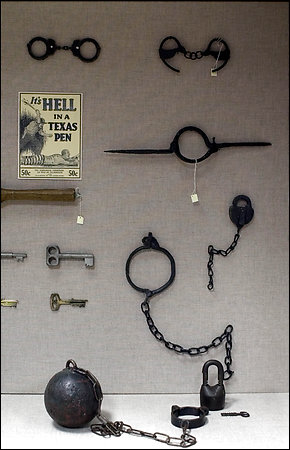 Educational tools that don't talk back. (AP)
For years, children have disrespected the institution of nap time. With truculent cries of "I don't wanna sleep" and "I'm not tired," they flaunt authority with the same flagrance as jay walkers or criminals who cut the labels off of mattresses. But one public school in the Bronx may be putting the lights out on restless preschoolers, with a no-nonsense policy that makes NyQuil seem like warm milk.
The New York Post reports that at least two students at CS 211 were allegedly handcuffed and intimidated when they refused to sleep during nap time. Jaden Diaz and Christopher Brito, both then 4, claim that on Nov. 17, 2006, a substitute teacher took them to an empty classroom, where a school safety officer cuffed their wrists and told them they would never see their parents again.
Now those parents are suing the school. The families' lawyer claims: "Failure to comply with nap time is hardly an offense that warrants being handcuffed, or threatened, for that matter. Nothing would've warranted that."
Although some parents may feel that that kind of discipline endangers their child's safety and emotional well-being, they need to wake up and smell the big picture. Midday rest provides well-documented health benefits for children, as well as well-needed respite for educators and classroom pets. By challenging the institution of nap time and the authority of teachers to enforce it, such parents aren't just doing their children a disservice, they're hitting the snooze button on society.
By Emil Steiner | March 11, 2008; 10:00 AM ET
Source: Washington Post
Girl Returned with Compensation
March 12, 2008 permalink
A Pennsylvania mother was falsely accused of Munchausen Syndrome by Proxy (MSBP) and lost her daughter. She eventually got her child back from child protectors, and when threatened with litigation they gave her $125 thousand in compensation.
There are so many stories like this in the US and UK press we cannot mention them all, but still almost none in Canada.
expand
collapse
Mom gets back girl - & $125K
County settles suit over Children & Youth.
Lancaster New Era, Published: Feb 25, 2008, 11:11 EST, Lancaster
By JANET KELLEY, Staff
When the Lititz woman took her toddler to the hospital more than two years ago, she had no idea of the legal fight she was about to face.
Patricia M. Shope was sitting at her daughter's hospital bedside in June 2006 when, she says, a caseworker for Lancaster County Children & Youth Agency announced he was taking custody of her child, according to court documents.
For two months, Shope fought to have her child returned, in spite, she claims in documents, of a caseworker's false accusations that she was suffering from a mental illness and his threats to put the child up for adoption if she didn't cooperate.
The county's Children & Youth Agency admits doing nothing wrong and denies almost all of Shope's allegations, according to court documents, but it recently agreed to pay the woman $125,000 to settle the lawsuit.
Most important to Shope, her lawyer said, is that she has her child back.
According to legal documents and Shope's attorney, Dennis E. Boyle, the county violated her constitutional rights to due process by taking her daughter without probable cause.
The federal lawsuit — filed against Lancaster County Children & Youth Agency and Gary Sanderson, a caseworker — was filed in November 2006, but the parties settled earlier this month before going to trial.
Crystal Gingrich, executive director of the county agency since March 2007, deferred all questions to the Lancaster County Commissioner's office. Attorneys representing the county agency in the lawsuit could not be reached for comment.
Lancaster County Commissioner Scott Martin said there was never any admission of fault by the county or Children & Youth Agency employees.
The decision to settle the lawsuit, Martin explained, is made by attorneys for insurance companies who need to weigh the financial impact of on-going litigation.
Shope's daughter, Breyonna, was born prematurely in June 2005 and had a history of ear infections, according to court documents.
In May 2006, she was treated for chronic ear infections at Lancaster Regional Medical Center and the following month, on June 6, 2006, Breyonna was taken to Lancaster General Hospital for an unexplained fever. She was diagnosed with chronic ear infection and admitted to the hospital.
Two days later, Shope claims, as she sat with her child in a hospital room, Sanderson, accompanied by two city police officers, entered the room and told Shope they'd be taking custody of her daughter.
When asked why, Shope said Sanderson told her he suspected she was under the influence of some type of narcotic. She volunteered for a urine drug test, which came back negative.
According to court records, Sanderson specifically denied telling Shope he was taking her child, but admitted questioning the woman as to whether she was under the influence of drugs.
Shope said Sanderson told her he was still taking the child because she had "too many doctor's visits" and accused her of having a serious psychological problem, specifically Munchausen Syndrome by Proxy, a disorder in which a parent intentionally injures a child and then seeks medical treatment for the child.
In a letter dated June 9, 2006, Shope said she was advised that the agency suspected her of "serious physical neglect" and filed a petition to seek custody.
Four days later, on June 13, 2006, in another letter, Children & Youth requested that Shope undergo a psychological evaluation to determine her fitness as a mother.
Two University of Pennsylvania psychologists evaluated Shope and sent letters to county authorities concluding that she "did not suffer from Munchaussen Syndrome by Proxy or any other psychological illness that affected her ability to care for her child."
An emergency hearing was scheduled for June 12, according to the lawsuit, with a subsequent hearing scheduled for June 23.
But when she and her attorney arrived for the hearing on June 23, they were told that it had already been held in her absence, with the court ruling in favor of Children & Youth.
Neither she or her attorney had been notified of the time change and the next hearing had been scheduled in August 2006, she claimed. However, the county claims that Shope's attorney at the time was aware of and had agreed to the change.
When Shope complained about the decision made in absentia, Sanderson "indicated that she needed to agree with everything Lancaster County Children & Youth Agency wanted to do or Lancaster County Children & Youth Agency would have her parental rights terminated and adopt-out Breyonna to another family."
"Sanderson continued to threaten to adopt Breyonna to another family," according to the lawsuit, "telling Ms. Shope that the 'clock is ticking' if she continued to persist in her attempts to obtain custody of her daughter."
On July 31, Breyonna was finally returned to her mother when Children & Youth determined the report of serious physical neglect was unfounded. A county judge made it official on Aug. 28.
The cost of her two month battle: legal fees of $8,971 and psychologist fees of $1,050.
Boyle said the county violated Shope's right to due process, based on threats to her and the length of time they kept the toddler in foster care.
"We're pleased," Boyle said, "but this was never about the money....It was about sending a message to the agency not to do anything like this again."
CONTACT US: jkelley@LNPnews.com or 481-6026
Source: Lancaster New Era
Second Hand Drugs
March 10, 2008 permalink
Those drugs prescribed beyond reason and forced in to subjects against their will are now appearing in the water supply. Do you think a drug test will prove you are clean? No way. Everybody is contaminated at a low level within the bounds of today's detection technology. A few sensitive individuals may even be directly harmed by second hand drugs.
expand
collapse
Mar 10, 12:08 PM EDT
AP Probe Finds Drugs in Drinking Water
A vast array of pharmaceuticals (AP) -- including antibiotics, anti-convulsants, mood stabilizers and sex hormones - have been found in the drinking water supplies of at least 41 million Americans, an Associated Press investigation shows.
To be sure, the concentrations of these pharmaceuticals are tiny, measured in quantities of parts per billion or trillion, far below the levels of a medical dose. Also, utilities insist their water is safe.
But the presence of so many prescription drugs - and over-the-counter medicines like acetaminophen and ibuprofen - in so much of our drinking water is heightening worries among scientists of long-term consequences to human health.
In the course of a five-month inquiry, the AP discovered that drugs have been detected in the drinking water supplies of 24 major metropolitan areas - from Southern California to Northern New Jersey, from Detroit to Louisville, Ky.
Water providers rarely disclose results of pharmaceutical screenings, unless pressed, the AP found. For example, the head of a group representing major California suppliers said the public "doesn't know how to interpret the information" and might be unduly alarmed.
How do the drugs get into the water?
People take pills. Their bodies absorb some of the medication, but the rest of it passes through and is flushed down the toilet. The wastewater is treated before it is discharged into reservoirs, rivers or lakes. Then, some of the water is cleansed again at drinking water treatment plants and piped to consumers. But most treatments do not remove all drug residue.
And while researchers do not yet understand the exact risks from decades of persistent exposure to random combinations of low levels of pharmaceuticals, recent studies - which have gone virtually unnoticed by the general public - have found alarming effects on human cells and wildlife.
"We recognize it is a growing concern and we're taking it very seriously," said Benjamin H. Grumbles, assistant administrator for water at the U.S. Environmental Protection Agency.
Members of the AP National Investigative Team reviewed hundreds of scientific reports, analyzed federal drinking water databases, visited environmental study sites and treatment plants and interviewed more than 230 officials, academics and scientists. They also surveyed the nation's 50 largest cities and a dozen other major water providers, as well as smaller community water providers in all 50 states.
Here are some of the key test results obtained by the AP:
- Officials in Philadelphia said testing there discovered 56 pharmaceuticals or byproducts in treated drinking water, including medicines for pain, infection, high cholesterol, asthma, epilepsy, mental illness and heart problems. Sixty-three pharmaceuticals or byproducts were found in the city's watersheds.
- Anti-epileptic and anti-anxiety medications were detected in a portion of the treated drinking water for 18.5 million people in Southern California.
- Researchers at the U.S. Geological Survey analyzed a Passaic Valley Water Commission drinking water treatment plant, which serves 850,000 people in Northern New Jersey, and found a metabolized angina medicine and the mood-stabilizing carbamazepine in drinking water.
- A sex hormone was detected in San Francisco's drinking water.
- The drinking water for Washington, D.C., and surrounding areas tested positive for six pharmaceuticals.
- Three medications, including an antibiotic, were found in drinking water supplied to Tucson, Ariz.
The situation is undoubtedly worse than suggested by the positive test results in the major population centers documented by the AP.
The federal government doesn't require any testing and hasn't set safety limits for drugs in water. Of the 62 major water providers contacted, the drinking water for only 28 was tested. Among the 34 that haven't: Houston, Chicago, Miami, Baltimore, Phoenix, Boston and New York City's Department of Environmental Protection, which delivers water to 9 million people.
Some providers screen only for one or two pharmaceuticals, leaving open the possibility that others are present.
The AP's investigation also indicates that watersheds, the natural sources of most of the nation's water supply, also are contaminated. Tests were conducted in the watersheds of 35 of the 62 major providers surveyed by the AP, and pharmaceuticals were detected in 28.
Yet officials in six of those 28 metropolitan areas said they did not go on to test their drinking water - Fairfax, Va.; Montgomery County in Maryland; Omaha, Neb.; Oklahoma City; Santa Clara, Calif., and New York City.
The New York state health department and the USGS tested the source of the city's water, upstate. They found trace concentrations of heart medicine, infection fighters, estrogen, anti-convulsants, a mood stabilizer and a tranquilizer.
City water officials declined repeated requests for an interview. In a statement, they insisted that "New York City's drinking water continues to meet all federal and state regulations regarding drinking water quality in the watershed and the distribution system" - regulations that do not address trace pharmaceuticals.
In several cases, officials at municipal or regional water providers told the AP that pharmaceuticals had not been detected, but the AP obtained the results of tests conducted by independent researchers that showed otherwise. For example, water department officials in New Orleans said their water had not been tested for pharmaceuticals, but a Tulane University researcher and his students have published a study that found the pain reliever naproxen, the sex hormone estrone and the anti-cholesterol drug byproduct clofibric acid in treated drinking water.
Of the 28 major metropolitan areas where tests were performed on drinking water supplies, only Albuquerque; Austin, Texas; and Virginia Beach, Va.; said tests were negative. The drinking water in Dallas has been tested, but officials are awaiting results. Arlington, Texas, acknowledged that traces of a pharmaceutical were detected in its drinking water but cited post-9/11 security concerns in refusing to identify the drug.
The AP also contacted 52 small water providers - one in each state, and two each in Missouri and Texas - that serve communities with populations around 25,000. All but one said their drinking water had not been screened for pharmaceuticals; officials in Emporia, Kan., refused to answer AP's questions, also citing post-9/11 issues.
Rural consumers who draw water from their own wells aren't in the clear either, experts say.
The Stroud Water Research Center, in Avondale, Pa., has measured water samples from New York City's upstate watershed for caffeine, a common contaminant that scientists often look for as a possible signal for the presence of other pharmaceuticals. Though more caffeine was detected at suburban sites, researcher Anthony Aufdenkampe was struck by the relatively high levels even in less populated areas.
He suspects it escapes from failed septic tanks, maybe with other drugs. "Septic systems are essentially small treatment plants that are essentially unmanaged and therefore tend to fail," Aufdenkampe said.
Even users of bottled water and home filtration systems don't necessarily avoid exposure. Bottlers, some of which simply repackage tap water, do not typically treat or test for pharmaceuticals, according to the industry's main trade group. The same goes for the makers of home filtration systems.
Contamination is not confined to the United States. More than 100 different pharmaceuticals have been detected in lakes, rivers, reservoirs and streams throughout the world. Studies have detected pharmaceuticals in waters throughout Asia, Australia, Canada and Europe - even in Swiss lakes and the North Sea.
For example, in Canada, a study of 20 Ontario drinking water treatment plants by a national research institute found nine different drugs in water samples. Japanese health officials in December called for human health impact studies after detecting prescription drugs in drinking water at seven different sites.
In the United States, the problem isn't confined to surface waters. Pharmaceuticals also permeate aquifers deep underground, source of 40 percent of the nation's water supply. Federal scientists who drew water in 24 states from aquifers near contaminant sources such as landfills and animal feed lots found minuscule levels of hormones, antibiotics and other drugs.
Perhaps it's because Americans have been taking drugs - and flushing them unmetabolized or unused - in growing amounts. Over the past five years, the number of U.S. prescriptions rose 12 percent to a record 3.7 billion, while nonprescription drug purchases held steady around 3.3 billion, according to IMS Health and The Nielsen Co.
"People think that if they take a medication, their body absorbs it and it disappears, but of course that's not the case," said EPA scientist Christian Daughton, one of the first to draw attention to the issue of pharmaceuticals in water in the United States.
Some drugs, including widely used cholesterol fighters, tranquilizers and anti-epileptic medications, resist modern drinking water and wastewater treatment processes. Plus, the EPA says there are no sewage treatment systems specifically engineered to remove pharmaceuticals.
One technology, reverse osmosis, removes virtually all pharmaceutical contaminants but is very expensive for large-scale use and leaves several gallons of polluted water for every one that is made drinkable.
Another issue: There's evidence that adding chlorine, a common process in conventional drinking water treatment plants, makes some pharmaceuticals more toxic.
Human waste isn't the only source of contamination. Cattle, for example, are given ear implants that provide a slow release of trenbolone, an anabolic steroid used by some bodybuilders, which causes cattle to bulk up. But not all the trenbolone circulating in a steer is metabolized. A German study showed 10 percent of the steroid passed right through the animals.
Water sampled downstream of a Nebraska feedlot had steroid levels four times as high as the water taken upstream. Male fathead minnows living in that downstream area had low testosterone levels and small heads.
Other veterinary drugs also play a role. Pets are now treated for arthritis, cancer, heart disease, diabetes, allergies, dementia, and even obesity - sometimes with the same drugs as humans. The inflation-adjusted value of veterinary drugs rose by 8 percent, to $5.2 billion, over the past five years, according to an analysis of data from the Animal Health Institute.
Ask the pharmaceutical industry whether the contamination of water supplies is a problem, and officials will tell you no. "Based on what we now know, I would say we find there's little or no risk from pharmaceuticals in the environment to human health," said microbiologist Thomas White, a consultant for the Pharmaceutical Research and Manufacturers of America.
But at a conference last summer, Mary Buzby - director of environmental technology for drug maker Merck & Co. Inc. - said: "There's no doubt about it, pharmaceuticals are being detected in the environment and there is genuine concern that these compounds, in the small concentrations that they're at, could be causing impacts to human health or to aquatic organisms."
Recent laboratory research has found that small amounts of medication have affected human embryonic kidney cells, human blood cells and human breast cancer cells. The cancer cells proliferated too quickly; the kidney cells grew too slowly; and the blood cells showed biological activity associated with inflammation.
Also, pharmaceuticals in waterways are damaging wildlife across the nation and around the globe, research shows. Notably, male fish are being feminized, creating egg yolk proteins, a process usually restricted to females. Pharmaceuticals also are affecting sentinel species at the foundation of the pyramid of life - such as earth worms in the wild and zooplankton in the laboratory, studies show.
Some scientists stress that the research is extremely limited, and there are too many unknowns. They say, though, that the documented health problems in wildlife are disconcerting.
"It brings a question to people's minds that if the fish were affected ... might there be a potential problem for humans?" EPA research biologist Vickie Wilson told the AP. "It could be that the fish are just exquisitely sensitive because of their physiology or something. We haven't gotten far enough along."
With limited research funds, said Shane Snyder, research and development project manager at the Southern Nevada Water Authority, a greater emphasis should be put on studying the effects of drugs in water.
"I think it's a shame that so much money is going into monitoring to figure out if these things are out there, and so little is being spent on human health," said Snyder. "They need to just accept that these things are everywhere - every chemical and pharmaceutical could be there. It's time for the EPA to step up to the plate and make a statement about the need to study effects, both human and environmental."
To the degree that the EPA is focused on the issue, it appears to be looking at detection. Grumbles acknowledged that just late last year the agency developed three new methods to "detect and quantify pharmaceuticals" in wastewater. "We realize that we have a limited amount of data on the concentrations," he said. "We're going to be able to learn a lot more."
While Grumbles said the EPA had analyzed 287 pharmaceuticals for possible inclusion on a draft list of candidates for regulation under the Safe Drinking Water Act, he said only one, nitroglycerin, was on the list. Nitroglycerin can be used as a drug for heart problems, but the key reason it's being considered is its widespread use in making explosives.
So much is unknown. Many independent scientists are skeptical that trace concentrations will ultimately prove to be harmful to humans. Confidence about human safety is based largely on studies that poison lab animals with much higher amounts.
There's growing concern in the scientific community, meanwhile, that certain drugs - or combinations of drugs - may harm humans over decades because water, unlike most specific foods, is consumed in sizable amounts every day.
Our bodies may shrug off a relatively big one-time dose, yet suffer from a smaller amount delivered continuously over a half century, perhaps subtly stirring allergies or nerve damage. Pregnant women, the elderly and the very ill might be more sensitive.
Many concerns about chronic low-level exposure focus on certain drug classes: chemotherapy that can act as a powerful poison; hormones that can hamper reproduction or development; medicines for depression and epilepsy that can damage the brain or change behavior; antibiotics that can allow human germs to mutate into more dangerous forms; pain relievers and blood-pressure diuretics.
For several decades, federal environmental officials and nonprofit watchdog environmental groups have focused on regulated contaminants - pesticides, lead, PCBs - which are present in higher concentrations and clearly pose a health risk.
However, some experts say medications may pose a unique danger because, unlike most pollutants, they were crafted to act on the human body.
"These are chemicals that are designed to have very specific effects at very low concentrations. That's what pharmaceuticals do. So when they get out to the environment, it should not be a shock to people that they have effects," says zoologist John Sumpter at Brunel University in London, who has studied trace hormones, heart medicine and other drugs.
And while drugs are tested to be safe for humans, the timeframe is usually over a matter of months, not a lifetime. Pharmaceuticals also can produce side effects and interact with other drugs at normal medical doses. That's why - aside from therapeutic doses of fluoride injected into potable water supplies - pharmaceuticals are prescribed to people who need them, not delivered to everyone in their drinking water.
"We know we are being exposed to other people's drugs through our drinking water, and that can't be good," says Dr. David Carpenter, who directs the Institute for Health and the Environment of the State University of New York at Albany.
Source: Wired
Don't Kiss Your Kid
March 9, 2008 permalink
In Virginia is will soon be illegal to French kiss a child under the age of thirteen. Violators can get a year in jail, a $2,500 fine and life-long discrimination as a sex offender.
expand
collapse
Va. targets adults who French kiss kids
Law passed Saturday would require them to register as sex offenders
The Associated Press, updated 11:52 p.m. ET March 8, 2008
RICHMOND, Va. - Virginia state legislators passed a law Saturday that would require adults who French kiss a child younger than 13 to register as a sex offender.
Those convicted of tongue-kissing a child would be guilty of a misdemeanor, punishable by up to one year in jail and a $2,500 fine. The House of Delegates passed the legislation 96-1 and the Senate 39-0.
The bill now heads to Gov. Timothy M. Kaine, who said he supports the legislation.
Delagate Riley Ingram, R-Hopewell, introduced the bill on behalf of a woman whose 10-year-old daughter was French-kissed by the 62-year-old husband of her babysitter.
The only crime prosecutors could charge the man with was contributing to the delinquency of a minor, which did not require that he register as a sex offender.
Ingram and other members of the House fought to make the crime a felony, but in the final day of the 2008 General Assembly session gave in to senators who thought that classifying it as a felony was too harsh.
Delegate Phillip Hamilton, R-Newport News, cast the lone nay vote, refusing to back down from his belief that the crime should be a felony.
"I think that type of behavior is so egregious it warrants a felony," Hamilton said.
Ingram said he was satisfied that a conviction would land someone on the sex offender registry.
Source: MS-NBC

Don't Kiss Your Dad
March 9, 2008 permalink
Single father Keith Ferguson of New York State has been harassed by local child protectors. Because the complaints are anonymous he does not know the source, but suggests that his daughter could avoid problems by not showing affection for her father.
expand
collapse
timesunion.com
Anonymous 'hot line' system used to persecute father
By DAN HIGGINS, First published: Sunday, March 9, 2008
Someone is using the government to harass Keith Ferguson. The government admits as much and then says, "Sorry, Mr. Ferguson. We're powerless to stop."
Ferguson, of Schaghticoke, has been investigated at least a dozen times in the last two years by the county's Department of Social Services. DSS is following up on complaints to the State Central Register that he is sexually abusing his children. The "hot line," as it is sometimes called, allows an anonymous caller to report suspicions of child abuse. Investigators, if they're given enough information, must look into the allegations.
Each time a social worker knocks on his door he lets him or her in. He doesn't have to, but he believes it's in his best interest to cooperate. Each time he is asked a similar battery of humiliating questions: Has he raped his disabled daughter? Has he inappropriately touched his teenage son? No, he says, remaining calm. I would never, ever do that. I protect my children.
His children must answer similar questions about their father's alleged behavior.
Ferguson, a single father of six with all but two grown up and moved out, has never had his children taken from him, according to records he provided to me.
According to the thick stack of records he shared, there's never been an "indication" against him, that is, a mark in his file that shows social workers are suspicious something heinous might be happening in his home, even though they can't prove it.
And the Department of Transportation employee, who is struggling to take care of his 15-year-old daughter and teenage son still at home, is running out of patience and the energy to deal with the accusations. "I understand why the system is there; to protect children," he said. "But this is really wearing me down."
He's talked to the police and social services agencies, a lawyer, even the ACLU. Everyone tells him there's not much that can be done.
A spokesman for Rensselaer County District Attorney Richard McNally said it's illegal to lie to use the "hot line" for personal vendettas. A person can be charged with harassment, filing a false report, or other crimes. The only problem is the caller can remain anonymous and still officials must investigate the claims if they sound somewhat credible.
Ferguson even received a letter from the Rensselaer County DSS, which admitted, "It is most unfortunate for you and your family that there continues to be false reports to the State Central Register against you."
So what's left to do?
"Keep surviving," he said. "Keep taking care of my kids and letting them know they are safe and loved."
A spokesman for the agency that is in charge of the hot line said he can file a complaint with police, but that will only do him some good if the accuser identifies himself or herself. These accusations have been anonymous.
John Beaudoin, the county's social services commissioner, said he can't comment because of privacy laws. But he allowed this: "Sometimes, unfortunately, people abuse the system."
And that abuse leads to collateral damage.
Several months ago, on the advice of social workers, Ferguson took his daughter -- who because of her genetic condition is nonverbal -- to a hospital for a sexual assault exam (it came back negative). He even told her that she shouldn't be so affectionate with him when he takes her to the school bus in the morning, lest anyone grow suspicious and send another investigator knocking on his door.
"What kind of a sick world is this?" Ferguson said.
Reach The Advocate at 454-5700, or advocate@timesunion.com.
Source: Albany Times Union
Sue CAS
March 9, 2008 permalink
Here is the announcement of another effort to launch a lawsuit to put a stop to abuses committed in the name of child protection.
expand
collapse
Notice to members of the public who have had dealings with the CAS, known as the Children's Aid Society. We are gathering a list of plaintiffs and their information to put forth a class action lawsuit against the Children's Aid Society and Government of Ontario Canada, for human rights violations and infringements. Notice there are no fees or charges for this service. Should we proceed the law firms will charge a fee based upon award from the courts. No win no charge .
The information we require from you will need to show neglect, corruption, human rights violations and any form of abuse be it emotional physical or sexual, that has occurred to your children or has effected your emotional well-being while your children were or are in the care of the CAS Ontario.
It pertains to anyone who is in care, was in care or is effected by this agency life interrupted by psychological damage caused by being subjected to their emotional duress by being in direct care or by their children being in direct care now or past.
Information submitted by you needs to be condensed into point form by date from 1st occurrence to the last occurrence. This information can be submitted regardless of whether you regained or retained custody or not of your child(ren).
All personal information will be forwarded to Barristers and Solicitors considering a Pro Bono civil suit a class action law suit will commence and also demands will be made for retribution for families and their children, We also plan to demand justice is served and after we win the civil suit, and WE WILL, action will be taken to demand criminal charges are pressed for any and all who have misrepresented the rights of children by systemic abuse. This will be kept in strictest confidence. Your contact information is required in case we need to discuss your case with you.
Your information can be sent by mail to:
Ms Kathleen Mattinson
Cherish The Children (independent media) 99/2008 Founding Director
19 John Street North Unit 2
Hamilton Ontario Canada L8R 1H1
Phone 289-396-8595 Fax 289-396-9931Or to
Cassandra Armishaw
Director of Communications
Independent Investigative Journalist
Box 64, Genelle, British Columbia Canada V1R1R3
email: gm_eden@yahoo.caSource: email
Wrongfully Adopted Boy Stays in Purgatory
March 9, 2008 permalink
The case of Sherry Sherret shows the need for Canadian courts to follow the lead of a few American courts and reverse wrongful adoptions. Her son was adopted out because she was a murderer, convicted on the now-discredited expert testimony of Dr Charles Smith. Even though she is no longer a murderer, her fourteen-year-old son will remain with strangers for another four years. Her son's biggest burden is tacit, implicit in his circumstances — he lives with strangers because his mother is a murderer. Reading the truth after his eighteenth birthday will never fully repair the damage. Only reunification with his mother can do that.
expand
collapse
The 'forgotten victims' torn from their homes
WAYNE HIEBERT FOR THE TORONTO STAR
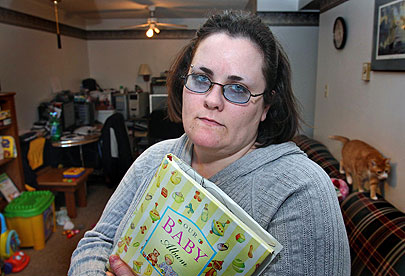 Sherry Sherret in her home, holding the baby album of the son taken away for her for adoption.
The lives of 17 children were changed forever by disgraced pathologist's litany of mistakes
March 09, 2008, Theresa Boyle. Staff Reporter
July 2012. This date won't come soon enough for Sherry Sherret.
It's when her first born will turn 18. And it's when the Belleville mother will finally be reunited with the son who was put up for adoption when he was only 5.
The boy, Christopher (not his real name), is one of at least 17 children whose lives were thrown into chaos after the death of a sibling. In each case, disgraced pathologist Dr. Charles Smith performed an autopsy or offered a consulting opinion on the deaths. Bad enough they had lost a sister or a brother. But Smith's mistakes helped implicate their parents and resulted in these children being removed from their homes by children's aid societies.
At least three children, including Christopher, were adopted out to other families. There is no legal recourse to undo adoptions as the Child and Family Service Act stipulates that once an adoption order is finalized, it cannot be reviewed.
The remaining children were sent to live with relatives or foster families for as long as two years.These children are from the 20 botched death investigations that have been explored at the ongoing Inquiry into Pediatric Forensic Pathology. A panel of renowned forensic pathologists determined Smith erred in all these cases.
While attention has largely been focused on potentially wrongful convictions, these children have been the "forgotten victims" of his errors, says Julie Kirkpatrick, lawyer for one family.
The upheaval they faced is "among the worst consequences of Smith's mistakes," she says, adding they are no less victims of miscarriages of justice.
One of the many issues explored at the inquiry is that of child protection. Child advocates are putting forth an array of recommendations on behalf of the displaced children, including possible reconciliation of broken-up families.
Twice a year, Sherret, 32, gets letters and pictures from Christopher. She stares at the photos intently, looking for signs of her son's growth. From a picture he sent this past Christmas, she can see his face had filled out some. He looks more like his dad, her ex, she notes. But she can see her own DNA in his eyes.
"He's a gorgeous young man. He will be 14 years old in July. I keep thinking to myself, four more years," she says.
In his letters to her, he addresses her as "Dear Sherry."
"That hurts," she says. "But it's understandable."
She signs her letters back, "Love, Mommy Sherry."
Sherret lost two sons in 1996. That January, she discovered 4-month-old Joshua dead in his playpen. Smith said the child was suffocated, as evidenced by marks on his neck. The pathologist also said the boy had a fractured skull. Sherret was charged with first-degree murder.
Years later, when Smith's work came under scrutiny, Joshua's body was exhumed. It was revealed his skull wasn't fractured and the marks on his neck were actually created by Smith, himself, during the autopsy. Experts who reviewed the case said Joshua had accidentally asphyxiated in an unsafe sleep environment. He had slept in a playpen, under a sleeping bag, comforter and blankets.
Child-welfare workers removed Christopher, then 18 months, from her custody. He was first placed with his grandparents and then with a foster family.
In January 1999, Sherret was convicted on a reduced charge of infanticide. The following June she was sentenced to a year in jail and two years probation. Meantime, Sherret learned children's aid was putting forth an application to the courts to have Christopher move from foster care to adoption. The foster family told Sherret they would be willing to make him a permanent part of their family.
Evoking the parable of King Solomon threatening to split a baby to determine its rightful mother, Sherret made the difficult decision to let this family adopt her son, fearing he could otherwise bounce around different homes. The adoption agreement included the exchange of letters, annual phone calls from Christopher's foster mother and plans for a reunion when he turns 18.
Lawyer Suzan Fraser has been representing Defence for Children International at the inquiry. The group aims to protect the rights of youngsters and is going to bat for the 17 displaced children.
"The big problem is that there is no process for dealing with apprehension or adoption orders made on the basis of flawed pathology evidence," Fraser remarks.
She says the damage inflicted on the affected children is immeasurable. "Imagine the anger and the sorrow to learn that you had been wrongfully taken from your mother or father. Imagine the taunts of the other children in foster care teasing you because your mother killed your sister.
"Imagine the horror of losing your sibling and then your mother, when your mother was actually protective rather than the killer everyone thought she was? Imagine having no power to fix it."
Fraser is fearful there may be even more children out there who were uprooted from their homes because of errors Smith made in child-death investigations. Undoing Smith's mistakes isn't so easy. The Child and Family Services Act makes no provision to appeal an adoption order except within the first 30 days after it has been made.
"The best interests and stability of a child require that the adoption order is not subject to further review, even if unjust and based on a clearly erroneous factual premise," states a paper prepared for the inquiry by Queen's law professor Nicholas Bala and McGill social work professor Nico Trocme.
"However, if it is established that a child was removed from parental custody due to an erroneous belief that the parent was responsible for the death of a sibling, it may well be in the best interests of the children to have at least some contact with the parents, depending on their age and wishes. At the very least, the adoptive parents, and through them the children, should be informed of the new circumstances," they continue.
Sherret says Christopher doesn't know why she gave him up for adoption.
He only recently learned he has a 2-year-old sister. This is Sherret's third child, the only one with her. Christopher's adoptive mother was afraid to tell him about his new sibling, lest it raise questions about why his biological mother could keep one child and not another, Sherret says.
While she dreams about the day they'll see each other again, she has nightmares about the last time she saw him. It was in a playroom at the Northumberland Children's Aid Society. Sherret knew she wouldn't see her son, then 5, again until he was 18. She kept her eye on the clock, savouring her last three hours with him.
Mom and child played for the first 2 1/2 hours, but as the end of their visit neared, Sherret pulled the lad onto her lap for a serious chat. "I told him that mommy still has some problems to deal with and that he couldn't come home," Sherret recounts.
The lad reacted angrily. "He told me I lied," she says, explaining how Christopher reminded her of a previous promise that he could come home. "He wanted to come home and he wanted to know if he could keep Whisper, his kitty."
In his letters to her now, Christopher asks if she still has Whisper. She does.
Sherret wept during her final minutes with her son. Her tears continued to flow in the car on her way home. She had lost her two sons now and was on her way to prison.
The next day, she was sent to the Vanier Centre for Women in Brampton, where other inmates called her a "baby killer." She ignored their taunts until one day it became too much. She overheard one women ask another: "Do you know how Sherry killed her baby?"
"I remember just coming around the corner and starting to beat on her," recalls Sherret, who was moved to segregation and then to another detention centre.
As devastating as it was to be blamed, jailed and taunted for Joshua's death, those experiences paled in comparison to losing custody of Christopher, she says. "Having a child taken from you is like having your life taken from you. I just didn't want to be around. I didn't want to live. But then I sat there and thought, I've got to go on because I know I'll get a chance to see him at some point."
Despite the hell a biological parent like Sherret has gone though, returning custody of a child may not be the best idea, experts warn.
"While the unmerited separation of children from their parents is a great injustice, it does not necessarily follow that returning these children to the care of their parents is in their best interest," Bala and Trocme write in their report for the inquiry.
"In particular, if children are returned to their parents' custody after several years in a stable foster home, they may well be traumatized by the stress of separation from their foster families and the experience of returning to a now unfamiliar environment," they continue.
Still, Sherret's lawyer, James Lockyer, hopes adoptive parents would be open to allowing some sort of contact between the birth parents and the children.
"What you would hope is that the adoptive parent might have the foresight, strength, courage to consider allowing the children to recontact the parent. But that's a pretty tall order," he admits, likening the struggle to Bertolt Brecht's The Caucasian Chalk Circle, a play about a literal tug-of-war over a child.
Lockyer doesn't blame children's aid societies in these cases. They were just sadly relying on bad information from sources like Smith, he notes. "Wrongful convictions have consequences way beyond someone being in jail for something they didn't do."
less than three years ago, Sherret discovered she was pregnant again. Her first reaction was panic. Her name was still on the province's child-abuse registry and she faced the prospect of having her third child taken from her, too.
Her reaction wasn't so unusual. In another case in which Smith was involved, a couple decided to have an abortion after learning of an unexpected pregnancy. Angela Veno and Anthony Kporwodu had their toddler son seized by children's aid after they were charged with the 1998 death of their infant daughter. They were told any new child would also be seized. Sherret was duty bound to report her pregnancy to CAS, which she did. This is how she discovered serious questions were being raised about Smith's work. A CAS official told her the doctor was being investigated.
Sherret contacted the Association in Defence of the Wrongly Convicted and Lockyer, who would assist her in trying to clear her name. He would also help her in her efforts to keep her third child. Initially, the CAS wanted to remove Sherret from her home when the baby was born, leaving the infant to reside with its father. Eventually they settled for a supervisory order, meaning Sherret could never be alone with the baby.
The child was born on Sept. 29, 2005.
For the first 11 months of the child's life, father Rob couldn't even go to the store without waking the baby and taking her with him.
But last April, a provincial court ruled that the supervision order be dropped. By this time, two outside experts had confirmed there was no foul play involved involved in Joshua's death.
"I believe I lost a special 11 months with her. It was an 11 months I could not be alone with my beautiful girl," Sherret says. "I had to go though hell to stay in her life."
Sherret has been diagnosed with major, chronic depression andpost-traumatic stress disorder. "I'm exhausted physically, mentally."
Her children keep her going.
"I'm mad, but I have to live every day for my daughter and (Christopher), not just me," she says.
While she dreams about the day she'll see Christopher again, she has no illusions. "He's grown up with his family pretty much most of his life and it would just be wrong to take him away from them. I just want some kind of a relationship with him."
She's kept a lot of Christopher's old toys. She watches her daughter play with them, remembering her son doing the same.
"I would be so happy if I could see them play together," she says.
Source: Toronto Star
Family Bruised in Fall
March 8, 2008 permalink
When a British family took their bruised baby to a doctor after a fall, social services grabbed both their children. This was one of the lucky families that eventually got the kids back.
expand
collapse
07/03/08 - News section
Social workers took our children away... because of an incorrect hospital diagnosis
By FIONA BARTON
There is nothing lavish planned for Benjamin Lamb's first birthday.
The happy, lively toddler is going to the zoo with his mother, father and big sister, Caitlin.
Then they will gather with the rest of their family to blow out the single candle on a birthday cake and toast his future.
It will be a day of ordinary pleasures - but for the Lambs, it will mark the end of an extraordinary nightmare.
Last September, Paul Lamb and Michelle Thomas, a young professional couple from Stockport in Manchester, had their children taken away by social services.
For four traumatic months, the couple were permitted to see their children only if they were supervised.
They were accused of deliberately harming them, of throwing Ben to the ground, of lying and of covering up their "unspeakable crime".
The couple believed they would lose their son and daughter for ever.
In fact, as a court finally ruled last month, they had done none of these things. The Lamb children were taken because information went unrecorded in a set of medical notes and a crucial diagnosis was missed.
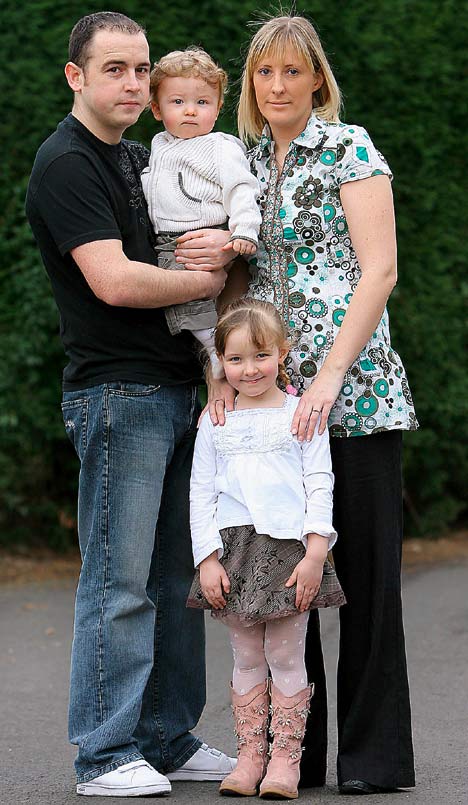 Reunited: Paul Lamb and Michelle Thomas with Caitlin and Ben
It began on September 25, 2007, in the dining room of the terraced house in Stockport the Lambs had just bought for their growing family.
Miss Thomas, 25, an administrative assistant in the X-ray department of a local hospital, was holding six-month-old Ben in her arms.
She said: "Ben began getting cranky and kicking his legs against me. He wriggled out of my grip and fell to the floor.
"I tried to catch him but he caught his head on the ground. He cried for a few minutes and had a small red mark on the back of his head. We rang the GP straight away and he said to keep an eye on Ben overnight."
A week later, Mr Lamb, 29, an accounts manager with a printing firm, was stroking his son's head when he felt an inch-long "boggy" swelling under his hair.
The couple took the baby to the accident and emergency department at Stepping Hill Hospital.
Staff said the swelling could not have been caused by the fall. Mr Lamb said: "The doctor said he thought perhaps Caitlin had been a bit rough with her brother or he had caught himself with a toy.
"But the next day, the swelling was still there. I wasn't happy so I took Ben to a 24-hour GP service."
Ben was sent back to Stepping Hill Hospital to be seen by a paediatrician. Again, the earlier fall was dismissed as possible cause of the swelling. Hours later, Ben was Xrayed for the first time and admitted to a ward.
Miss Thomas said: "I said about him falling out of my arms but the doctors said it must have been much more recent than that because swelling occurs between 24 and 48-hours of injury. In the end, we stopped mentioning the fall."
Ben was given an ultrasound scan, which showed fluid in the swelling, blood tests, and a CT scan which pinpointed the problem: a tiny skull fracture.
"The consultant paediatrician treating Ben completely changed his attitude when the CT scan results came back. He ordered a skeletal survey," Miss Thomas recalled.
"They were looking for other injuries. It meant they thought we were harming him."
No other injuries were found but Stockport social services - which operates under the name " Safeguarding" - were called in.
A woman social worker questioned the couple and other members of the family and when Mr Lamb's mother suggested the head injury could have something to do with the fall, the council official appeared shocked.
She said it was the first time she had heard about it. The consultant also claimed to have been kept in the dark.
Mr Lamb said: "I couldn't believe it. We had told our GP, the 24-hour doctor, the nurse, the A&E doctor and at least three other medical staff but it wasn't in the hospital notes.
"No one had written it down and they clearly thought we were making it up."
Even when the family's GP confirmed they had reported the fall to him, it seemed nothing could stop the wheels of officialdom.
Miss Thomas said: "The next day both our children were taken away. The social worker told us we had an hour to find a relative to have them or they would have to go into foster care.
"She said we should get separate solicitors in case we blamed each other. We were both in tears."
In the topsy turvy world of social services, Mr Lamb's protests at the shocking turn of events was later used as "proof" he had a temper.
Stockport Safeguarding immediately applied for an interim care order for both children and Manchester County Court ordered medical evidence to be produced.
To add to the couple's agony, they were questioned under caution by police. Neither of them had ever been in any sort of trouble before.
At a court hearing six weeks later, consultant paediatrician Ian Mecrow said Ben's skull fracture was "non-accidental."
Miss Thomas said: "We got permission to seek a second medical opinion but there were times we thought we would lose Ben and Caitlin for ever. It didn't seem to matter what we said, no one believed us."
It was just before Christmas when the second opinion arrived. Consultant paediatrician Alan Sprigg of Sheffield University said the scan taken of Ben's head did indeed show the swelling was the result of the baby's earlier fall.
It was, he said, a rare condition known as "late presentation."
The diagnosis was accepted by Mr Mecrow but it took another month for the couple to clear their names and they had to endure a sustained attack on their characters by counsel for social services.
But finally, on Friday February 1, four months after being parted, they were told they could take their children home.
Mr Lamb recalled: "The first thing we did was take Caitlin and Ben to a park to play so we could be a normal family again.
"We were so nervous. What would we do if either of them fell and hurt themselves? We would have to think long and hard about taking them to the doctors.
"We feel very bitter about what happened. Social services played God with us, ruined our lives, then walked away without even bothering to issue so much as an apology."
A spokesman for Stockport Council said: "The council is confident that its officers acted properly, entirely in the interests of the children. We firmly deny that any officer informed the parents to 'blame each other.'"
Source: Daily Mail (UK)
No More Homeschooling
March 7, 2008 permalink
In a legal case concealed from interested parties until it was a fait accompli, a California court has outlawed homeschooling in that state. Homeschooling in California now requires that the parents hold a valid state teaching credential for the grade being taught. If not reversed, this policy could spread far and wide. Below we have a statement from the Home School Legal Defense Association. There is a radio program on the decision with guest Dr James Dobson (19 megabytes mp3). Here is a link to the full court decision by the California Court of Appeal.
expand
collapse
March 6, 2008
Response to Ruling of California Court of Appeal
‘Homeschooling is Illegal in California’On February 28, 2008, the California Court of Appeals issued a ruling in a juvenile court proceeding that declared that almost all forms of homeschooling in California are in violation of state law. (Private tutoring by certified teachers remains an option.) Moreover, the court ruled that parents possess no constitutional right to homeschool their children.
This family was not a member of Home School Legal Defense Association. They were represented by court-appointed counsel throughout the proceeding. Since it was by law a confidential proceeding, to the best of our knowledge neither HSLDA nor any other legal advocacy organization had any knowledge that the right of all homeschoolers in California was depending upon the outcome of this family’s case.
There are two appellate options at this time.
First, we have been told that the family is appealing this decision to the California Supreme Court with their California counsel.
HSLDA will file an amicus brief on behalf of our 13,500 member families in California. We will argue that a proper interpretation of California statutes makes it clear that parents may legally teach their own children under the private-school exemption. However, if the court disagrees with our statutory argument, we will argue that the California statutes as interpreted by the Court of Appeal violate the constitutional rights of parents to direct the education and upbringing of their children.
HSLDA welcomes other organizations and persons to assist with the amicus process so that a full defense of home education, religious freedom, and parental rights can be given to the California Supreme Court.
The second appellate option is to seek to have this particular decision “depublished.” Depublication is a decision that can only be made by the California Supreme Court. If the Court determines that the decision should stand, regarding this family, on the facts presented, but that the general pronouncements of law for all of homeschooling should not be determined by this case, then the Court has the option of “depublishing” the Court of Appeal’s decision. This would mean that the case is not binding precedent in California and has no effect on any other family.
HSLDA will take the lead in an effort to seek to have this case depublished.
Homeschooling has offered a great opportunity for families to give their children a quality education with a moral and philosophical approach that is consistent with each family's beliefs.
The ability to homeschool freely in California should not depend upon one family in a closed-door proceeding. All families should have the right to be heard since the rights of all are clearly at stake.
To read the court opinion click here.
Source: Home School Legal Defense Association
Addendum: As a result of legal action by the Homeschool Legal Defense Association homeschooling is once again legal in California.
expand
collapse
WND Exclusive
Judge dismisses juvenile case prompting homeschool ban
Advocate calls decision 'significant favorable development' for families
Posted: July 12, 2008, 12:30 am Eastern, By Bob Unruh, WorldNetDaily
A judge in California has ended juvenile court jurisdiction over two children in a family case that prompted an appeals court at one point to declare that parents had no right to homeschool their children in the state.
The opinion in the Rachel L. case when WND broke the story in February rocked the foundations of homeschooling in the state and across the nation, because of its implications that without such rights, parents could be liable for civil and criminal penalties simply for teaching their own children at home.
It especially outraged those who opposed California's mandated advocacy for homosexual and other alternative lifestyles in public schools.
The court's effectual ban on homeschooling in California later was dropped when the same panel agreed to rehear the case, and oral arguments on those issues were held last month, with parties ranging from Gov. Arnold Schwarzenegger to the state's fire marshals and superintendent of public instruction supporting homeschooling parents.
Now, however, the underlying juvenile court case that prompted the higher court ruling has been dismissed.
A statement from the Home School Legal Defense Association today confirmed, "the juvenile court judge terminated jurisdiction over the two young L. children in a hearing held on July 10, 2008."
It was that family's case that in February attracted the infamous order from the 2nd District Court of Appeal in Los Angeles that was seen as banning homschooling. The family's disputes had been elevated to that level by lawyers pursuing their plan of protections for the children, and they wanted the children ordered into a public school, to which the court agreed.
The juvenile case ruling yesterday doesn't directly make moot the ruling from the appeals court, which is expected at any time, because it comes from an original case filed with the appeals judges
But HSLDA officials told WND they will provide the information about the end of the juvenile case to the appeals court.
"Mr. L.'s appellate attorneys with the Alliance Defense Fund will be making the appellate court aware of this new development immediately. They will move to dismiss the petition pending in the court of appeal on the ground that the petition is now moot," the organization said in a statement. "In other words, the children are no longer under the jurisdiction of the juvenile court. Therefore, any decision by the appellate court based on the two-year-old petition could not be enforced against the L. children."
 HSLDA chairman, Michael Farris
"This is a significant favorable development toward preserving homeschooling freedom in California," said Mike Farris, chairman and founder of HSLDA.
The lead attorney on the appeal, as a representative for the father in the L. case, is Gary Kreep, of the United States Justice Foundation. He was unable to comment on the case directly because of the juvenile proceedings that are involved.
But the HSLDA officials said a petition to the appeals court describing the lower court's actions will be delivered as soon as possible.
A spokesman for HSLDA said the county in the L. family case does have the option of appealing the juvenile court ruling, too.
It was late last month when the 2nd District Court of Appeal in Los Angeles listened to oral arguments in the case.
At issue was the court's decision from four months earlier, on which WND reported, that would have compelled the two children into a public or qualifying private school.
Farris was one of the lawyers appearing at the hearing, and he said the judges specifically asked about the legal support for homeschooling rights, which have been publicly supported in the United States by both members of Congress and President Bush.
Attorneys advocating homeschooling argued that when California in 1967 added the singular word "person" to the list of those that can operate a legitimate private school, it opened the door for homeschooling. "If a person can provide education, if one person can operate a school," argued the attorneys, "then why not a parent?"
Farris said then he urged the judges to take into account the thousands of people who have implied from the 1967 law that homeschooling is permissible "and not willy-nilly overturn that practice."
An estimated 166,000 children are being homeschooled in California, and their parents and advocates have expressed concern that the court's original ruling would leave parents who educate their children at home open to criminal truancy charges and civil charges for child neglect.
Some grounds for that concern may come from the appeal court's first ruling, where it said the trial court had found that "keeping the children at home deprived them of situations where (1) they could interact with people outside the family, (2) there are people who could provide help if something is amiss in the children's lives, and (3) they could develop emotionally in a broader world than the parents' 'cloistered' setting."
Brad Dacus, president of Pacific Justice Institute, which has been representing Sunland Christian School, with whom the L. children were working, was pleased.
"We are still digesting the full impact of this ruling, but it is a major development which should, for all practical purposes, end this case," he said. "Again and again, the court-appointed attorneys for the L. children have relied on the oversight of the juvenile court as the basis for seeking a ruling that this family cannot homeschool. By terminating its jurisdiction, the court has severely undercut this position and yanked the rug out from all who have sought to use this case to criminalize homeschooling. We are hopeful that the Court of Appeal will follow suit and recognize that there is no longer any basis to rule against this family or our clients, Sunland Christian School."
Bob Unruh is a news editor for WorldNetDaily.com.
Source: World Net Daily
Out of the Shadows
March 7, 2008 permalink
Harold Levy has sifted the megabytes of the Goudge Inquiry to find a gem — Katherine Gruspier suggests discontinuing the use of so-called child abuse experts. Her report suggests that experts need better training, though bias may be a bigger problem.
In Plato's Allegory of the Cave, prisoners cannot see actions, only the shadows cast by actors, giving them a distorted view of reality. In litigation over children, courts do not examine evidence, they see it only second-hand through the opinions of experts. These opinions are distorted by the twin effects of their level of expertise, and more important, bias. Bias is not corrected by making the expert's pay independent of his opinion. In an infamous American small-claims system, aggrieved parties bring their case before a Justice of the Peace. The Justice gets the same pay regardless of his decision, but knows that only plaintiffs bring him new cases. The initials JP are known as "Judgment for the Plaintiff". Experts in children's cases have the same motivation. Only supporting the crown, and opposing the family, will get them new business. If Gruspier's suggestions are followed, courts can eliminate bias and get back to looking at evidence instead of shadows.
While Goudge has focused primarily on criminal cases, the use of biased and incompetent experts is more pervasive, and damaging, in child protection cases.
Mr Levy's remarks are based on the paper PEDIATRIC FORENSIC PATHOLOGY AS FORENSIC SCIENCE: THE ROLE OF SCIENCE AND THE JUSTICE SYSTEM (pdf) by Dr. K.L. Gruspier, and we have a local copy.
expand
collapse
Friday, March 7, 2008
Up-Date: Expert Evidence: Part One: Researcher For Goudge Inquiry Recommends Keeping "Child Abuse Experts" Out Of The Criminal Courts;
Buried in all of research studies commissioned by the Goudge Inquiry is a bold recommendation:
"Discontinue the use of “child abuse experts” in criminal trials and carefully assess their use in CAS (Children's Aid Society) hearings until such time that balanced training and educational programs for them can be constructed, or limit the use of numerous experts of this sort in a single trial."
Prof. Katherine Gruspier makes this recommendation in her paper: "Pediatric forensic pathology as forensic science: The role of science and the justice system";
This recommendation will not likely be welcomed by the legions of hospital SCAN-team (Suspected Child Abuse and Neglect) members across Canada who often testify against parents and caregivers - even though they are untrained in forensic science - because they have undertaken child abuse investigations while the child was still alive.
But the recommendation is a breath of fresh air;
Dr. Gruspier is Adjunct Professor of Forensic Science, Forensic Science Program, University of Toronto at Mississauga and a Consultant Forensic Anthropologist, Office of the Chief Coroner for Ontario.
She notes that, "Opinions expressed are those of the author and do not necessarily represent those of the Office of the Chief Coroner for Ontario or the Commission on Pediatric Forensic Pathology or the Commissioner".
"Untrained in forensics, child abuse experts are clearly advocates," Gruspier writes in the "Conclusions" section of her paper, which is published on the Goudge Inquiry Web-site;
"The courts allow these individuals to opine outside of their area of expertise to provide opinions on the cause of death, or the cause of trauma in a living child, and the Marquard remedy of limiting the weight of these opinions is of dubious effectiveness," she continues.
(The Supreme Court of Canada ruled in the Marqhard case that expert evidence need not be rejected in its entirety merely because the witness ventured an opinion beyond the area of expertise in which he or she is qualified. Instead, the remedy for the judge to instruct the jury to disregard the evidence);
"It is true that the most vulnerable in our society will always need a voice to speak for them, but the platform should not be the criminal courts.
If the cause of death of a child is undetermined by a forensic expert, then perhaps it truly is undetermined.
If the Crown can make a case for guilt on circumstantial evidence, then they should, but it should not rely upon overwhelming the trier of fact with numerous “experts” spouting unscientific interpretations.
In the past few decades, medical advances have allowed for the continuation of life in cases of children who, if born prematurely prior to this period, would have died. As yet, the consequences of these efforts at preservation of life in the premature infant are not truly understood.
Advances in medical imaging have allowed the radiologist to see things that have previously not been seen inside the human body, and for some reason they interpret these findings as suspicious rather than developmental.
Counsel should be, first, an officer of the court, but in these cases it appears that they are stacking the deck in order to win their case."
Gruspier notes in her paper that, "it is not uncommon for the courts to qualify persons associated with clinical child abuse teams as child abuse experts, although the field does not exist by way of examination and certification.
"These experts are often called in cases where a child did not survive, but they are equally as commonly utilized in child custody cases and cases where the child survived.
In these cases, there may be no forensic pathologist or forensically trained individual involved at all";
Gruspier is particularly concerned that, "In cases both where the child has survived and where it has not, we see this unique contribution of other “experts” to a conviction.
In no other types of forensic pathology cases do we see a troop of experts who are produced for the trial who have made a determination of the cause and manner of death based in part upon an interview of the suspect, usually prior to the death of the individual.
This is what happens when a team like the (Hospital for Sick Children) SCAN team is activated".
Gruspier acknowledges that "other medical experts" may be called to provide "ancillary studies" for forensic pathologist.
She stresses, however, that these experts, "will testify as to their specific findings, within their area of expertise, and will not normally provide the cause and manner of death in their reports or testimony."
This Blogster will be watching Commissioner Stephen Goudge's report carefully to see if he will bite the bullet on this well-justified recommendation.
SCAN-teams have contributed to wrongful prosecutions and miscarriages of justice within our criminal justice system - as has been demonstrated by several of the cases before the inquiry.
Justice Goudge can do something about it.
Harold Levy...hlevy15@gmail.com;
Posted by harold levy at 5:18 AM 0 comments
Source: Harold Levy's blog
Addendum: In his next post, Mr Levy posts a snippet of expert testimony by Anne Niec. Dr Niec, in a case in which Shelley Anne Kuzyk faced life in prison, testified with the level of wisdom and insight of the Cookie Monster.
expand
collapse
Saturday, March 8, 2008
Up-Date: Expert Evidence Part Two: Researcher For Goudge Inquiry Recommends Keeping "Child Abuse Experts" Out Of The Criminal Courts;
MR. ROGER YACHETTI:" SO YOU DIDN'T FIND ANY EVIDENCE OF SEXUAL ABUSE?
DR. ANNE NIEC: SO, SO, THE BOTTOM LINE IS ALTHOUGH, IF THE FORENSIC EVIDENCE IN THE SENSE OF THE SWABS WERE NORMAL, ALL WE CAN SAY IS THAT EVEN THOUGH YOU MAY HAVE NORMAL SWABS, YOU CAN'T RULE OUT SEXUAL ABUSE."
FROM TRANSCRIPT: REGINA VS. KUZYK;
A recent posting discussed Professor Katherine Gruspier's recommendation to remove "child abuse experts" from the criminal courts. (Up-Date: Expert Evidence: Part One);
The recommendation reads: "Discontinue the use of “child abuse experts” in criminal trials and carefully assess their use in CAS (Children's Aid Society) hearings until such time that balanced training and educational programs for them can be constructed, or limit the use of numerous experts of this sort in a single trial."
I thought about this recommendation when I was reading the transcript of Regina V. Kuzyk, which became the subject of a recent three part series on this blog under the heading "Dr. Smith for the defence" and came upon the evidence of Dr. Anne Niec who was qualified as "an expert in Paediatric Care and Child Abuse."
Dr. Niec would appear to be the kind of expert Prof. Gruspier has in mind because she is a member of a team at the McMaster University Medical Centre in Hamilton Ontario which plays an advocacy role - as is evident from it's name: "The Child Advocacy and Assessment Program."
Professor Gruspier questions the wisdom of allowing advocates to serve as experts in the criminal justice process.
Dr. Niec, a pediatrician, told Court that the program "addresses issues of child child maltreatment" by conducting "out-patient assessments."
Here is a portion of Dr. Niec's cross-examination by defence lawyer Roger Yachetti, which, to my mind illustrates why Prof. Gruspier's recommendation makes sense.
Cross-examination: Roger Yachetti;
Q: Dr. Niec. Can we just get one thing clearly out of the way at the outset? Did you find any evidence of sexual abuse of this child?
A: It's hard for me to answer that question, because in order for me to answer that question, I don't know what the forensic evidence showed.
Q: Let me tell you what it showed. Nothing;
A: That doesn't mean anything, because we know in the majority of cases of sexual abuse and if you look at the definition of sexual abuse, there is no evidence, and that is commonly seen in pre-pubertal kids, that you don't see evidence.
Q: So you didn't find any evidence of sexual abuse?
A: So, so, the bottom line is although, if the forensic evidence in the sense of the swabs were normal, all we can say is that even though you may have normal swabs, you can't rule out sexual abuse.
Q: Did you find any evidence of sexual abuse?
A: I didn't. I had concerning the physical examination...
Mr. Yachetti: Your Honour, could the witness be asked to answer the question?
His Honour: No, she will answer it in her own way.you can say there is no sexual abuse. So, what I can say is that, you know, if all the evidence came back within normal limits, then we have a normal exam in the sense that there is nothing specific there for sexual abuse, but that doesn't mean that it couldn't be a possibility.
Q: Did you find any evidence of sexual abuse?
A: I would have to answer it the same way. I apologize it is not clear...
Q: Are you telling me that question is not capable of a yes or a no answer?
A: I am telling you exactly that because in order to make sexual abuse, it is not only looking at the physical evaluation, because in most instances the physical exam is non-contributory. What s most important is the history and what the child says, and unfortunately we don't have a history here and we can't interview the child...
(At this point in his cross-examination, Yachetti pointed out to Dr. Niec what were, in his view, clear errors, in the information she had received from other individuals through Tristin's chart);
Superior Court Justice David Crane told the jury that Niec's opinion, based on a physical examination, and a sexual assault kit - was that the injuries were caused by "acute inflicted trauma".
"Someone did this" is what I have noted her saying," Crane said.
Justice Crane also told the jurors that, "She had no interviews and she used the hospital chart as to prior medical treatment."
Shelley Anne Kuzyk faced life in prison as the murderer of her Godson if convicted at this trial.
However, Dr. Niec's evidence placed a tangible onus upon her to somehow establish to the satisfaction of the jury that she had not physically abused Tristin - even though there was no physical evidence of abuse.
This evidentiary burden - which does not exist for any other crime in the Criminal Code - flies in the face of the presumption of innocence which protects Shelley Anne Kuzyk and anyone else charged with a crime in Canada.
It is noteworthy that Dr. Michael Pollanen, Ontario's Chief Forensic Pathologist, has cautioned that pathologists should not use this "default diagnosis" approach in their expert evidence.
Dr. Pollanen discussed the danger of this non-evidence based approach to forensic pathology in a paper called, "Review of the pediatric pathology review reports: Ten systemic issues," prepared for the Goudge Inquiry.
"A default diagnosis is claiming that a diagnosis is substantiated because it cannot be excluded," wrote Pollanen.
"This gives rise to potentially dangerous diagnostic reasoning embodied by the proposition: "In the absence of evidence to the contrary the findings are indicative of non-accidental injury."
"This creates child abuse as a default position and puts the onus on others to seek contrary evidence."
This Blogster hopes that Commissioner Goudge takes Prof. Gruspier's important recommendation to heart and recommends that advocates - such as members of SCAN teams - be kept out of the criminal courts.
Harold Levy;...hlevy15@gmail.com;
Source: Harold Levy's blog
No More Books
March 7, 2008 permalink
Parents who already keep their children away from doctors, hospitals, teachers, daycare, therapists and barbers will now have to avoid libraries as well. Pennsylvania librarians are getting snitch training.
expand
collapse
03/07/2008
Librarians need to report abuse
BY STEPHANIE LASOTA, STAFF WRITER, slasota@republicanherald.com
Many local librarians didn’t know before December they were state-mandated to report suspected child abuse and neglect until recent changes in the Child Protective Services Law.
“It became effective in 2007 and we were just informed of it at the end of 2007 by our office of commonwealth libraries, and they recognized that we have to have the training for all of our local libraries,” Pottsville Library District Consultant Jean Towle said.
Under the law, anyone coming into contact with children through their career or profession is required to report suspected child abuse or neglect. This applies to education professionals, social service agencies, churches and religious institutions, law enforcement officials, physicians, dentists and even coroners, among others, Angela Liddle, executive director of the Pennsylvania Family Support Alliance, said.
Failing to report could lead to fines and jail time.
Changes to the law through Act 179 in May 2007 prompted a six-hour training session in January for the Pottsville District library employees, which includes 14 libraries in Schuylkill County and three in Northumberland County.
Jeanne Groeneveld, of the Pennsylvania Family Support Alliance, led the training for representatives from the 17 local libraries.
“To the best of anyone’s memory, there has been no training initiative where they basically had some type of statewide standard training,” said Angela Liddle, executive director of the Pennsylvania Family Support Alliance. “It was kind of alarming, some librarians didn’t know they were mandated reporters.”
Mandated child abuse reporters are required to call ChildLine so the Schuylkill County Children and Youth Services agency can conduct an investigation into a suspected abuse case, Liddle said. All reporters’ names are kept confidential.
Gerard J. Campbell, executive director of Schuylkill County Children and Youth, said Thursday that from July 2007 to June 2007 the agency received 324 suspected child abuse reports and 43 were substantiated by the agency or court system.
There were no reported deaths in Schuylkill County in 2006 because of child abuse or neglect, Liddle said.
Campbell said that suspected child abuse calls come from mandated reporters, as well as from anonymous callers, however, many of those callers are taking improper advantage of the reporting system.
“A significant percentage of all of our referrals are people embellishing or having child-custody feuds,” Campbell said. “Obviously, we have to screen that out. A lot of energy is spent on stuff that never gets opened.”
After the agency receives a suspected child abuse report, a worker must begin investigating immediately or no less than 24 hours after getting the call. The investigation must be completed within 30 days.
“If we determine that we feel child abuse did occur, we send an indicated report to the state ChildLine central registry,” Campbell said. “There is a system within the department of public welfare that people can appeal our decisions.”
In some of the unsubstantiated cases there is either no truth found or no evidence, Campbell said.
“You may even have a suspicion, but you don’t have a child victim confirming it or no physical abuse. So there are times that I’m sure abuse may have occurred, but there’s nothing we can do because there’s nothing we can hold on to,” he said.
Penalties for knowingly failing to report suspected child abuse or failing to make a referral to the appropriate authorities have been increased to a misdemeanor of the third degree for the first violation and a misdemeanor of the second degree for subsequent violations, according to the May 2007 changes listed at the Pennsylvania Family Support Alliance Web site.
“I know of many, many cases where reports were not made and should have been. We hear about it throughout the state. It does happen,” Liddle said.
Towle said the first violation is punishable up to a year in jail and up to $2,500 in fines. A second violation is punishable up to two years in jail and up to $5,000 in fines, she said.
Liddle said it is a challenge to train all the people state-mandated as child abuse reporters.
Carol Hull, director at Schuylkill Haven Free Public Library, said she is working on the library’s child abuse mandated reporting policy, which must be reviewed and approved by the library’s board before it is adopted.
“It’s good for them to come up with what their internal process is if someone hears something or sees something ... We would highly recommend and encourage them to do that,” Liddle said.
Source: The REPUBLICAN & Herald
No Comment
March 7, 2008 permalink
In Texas social worker Malikah Marrus teaches children to remain silent when questioned by police. It is contrary to the nature of children, and rarely succeeds. And it is the wrong lesson. To really protect children, cops should teach kids to clam up when questioned by smiling social workers.
expand
collapse
 Melissa Powers, a social work intern with the University of Houston, leads Brian Lowenstein, left, and Sam Herman through a mock trial Tuesday at Shlenker School as part of the Southwest Juvenile Defender Center presentation.
AND THESE ARE YOUR RIGHTS
- Right to remain silent
- Right to an attorney
- Right to confront witnesses against you
- Right to call witnesses in your defense
- Right to know the charge(s) against you
Feb. 14, 2008, 11:28PM
RIGHTS AND WRONGS
Programs teach legal rights to elementary school pupils
By SARAH VIREN, Houston Chronicle
So you're 10 years old, you toilet paper the neighbor's yard and the police come a-knocking. What do you do?
"Give your name, your age and then ask for an attorney and ask for your parent."
That's the advice doled out to a room of fidgety fourth-graders at Shlenker School, a private elementary school in Houston, during a presentation by the Southwest Juvenile Defender Center this week. Called "Why a Lawyer," it is one of several such programs taught in schools and detention facilities throughout the country by groups worried that children don't know their basic rights — including the right to remain silent.
"Kids are not mini-adults," said Malikah Marrus, a researcher for the Defender Center, based at the University of Houston. "Their impulsive behavior gets them to spill their guts right away."
Her lesson Tuesday began with a story about a 15-year-old boy named Gerald Gault. The Arizona teenager was arrested without notification to his parents, tried without a lawyer and later sent to a juvenile correctional facility for making an obscene prank phone call to a female neighbor. His case went to the Supreme Court in 1967, which ruled in his favor, finding that those younger than 18 have certain legal protections.
With the 40th anniversary of that decision last year, national organizations, including the National Youth Justice Alliance and the National Juvenile Defender Center, drafted education programs for children who could end up in similar predicaments.
"If you get arrested, a police officer might not tell you these rights, so I am telling you now," University of Houston law student Andrea Jaffe told the Shlenker students Tuesday.
A bit later Jaffe, playing the role of a police officer, set up a mock interrogation with Abbie Markowitz. After schooling the 9-year-old on the Fifth Amendment she started in:
"Your neighbor said you prank called him. Did you?" Jaffe quizzed.
"Well," the fourth-grader hesitated. "My name is Abbie, and I am 9."
Jaffe tried again: "I know you want to go home, and I want to go home. Did you call your neighbor? It's OK if you tell me."
Silence from Abbie. Eventually, Marrus jumped in, congratulating the girl.
"Abbie is the first child since we've done this who has not spilled her guts to the police officer," she said. "Thank you."
The program isn't all about getting fourth-graders riled up about their rights, however. Several times Tuesday, Marrus and other presenters warned the Jewish day school students about the consequences of breaking the law. They described the thinness of the mattresses at juvenile detention centers and threatened that perks such as Harry Potter books and the Superbowl game could be out of reach in juvenile lockup. It was enough to make a few shudder.
"If you, like, TP somebody's house, like your relative's house, can you still go to jail?" asked one boy, who later asked Marrus about the criminality of "Jolly Rancher-ing," a process by which, he said, children break windows using the hard candy. Another student sought advice on the legality of "bageling," when the food is thrown at passing cars.
On each account, Marrus warned them away from such mischief.
The social worker says she tailors her presentation to each campus. At Shlenker, the kids discussed destruction of property, while students at other schools sometimes bring up drugs and murder. The idea at each place is the same: help youths understand the juvenile justice system that locks up close to 100,000 of them each year, according to the last published federal count.
Since she started the program last year, Marrus has visited a handful of private and public schools in the area, including Spring Shadows Elementary in Spring Branch Independent School District and Lockhart Elementary in Houston Independent School District. Kipp 3D Academy, a public charter school, also taught a section on the Gault case last fall.
Shlenker, the school Marrus' daughter attends, was the setting for the trial run last fall. Southwest Juvenile Defender Center staff and interns met with fifth-graders, some of whom, Marrus said, had been caught toilet-papering houses. This year, the school invited them back to talk to fourth-graders, children just now old enough to enter the juvenile justice system.
"If kids know this ahead of time, then maybe we won't have as many problems," Marrus said.
Barbara Goldstein, head of school at Shlenker, said she believes children benefit from knowing the laws — even if it does get them a little uppity about their rights.
"I heard one kid telling his mom all about his rights," she said with a laugh.
sarah.viren@chron.com
Source: Houston Chronicle
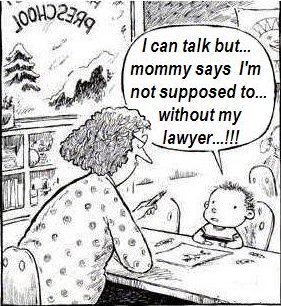
Why Kids are Stolen
March 6, 2008 permalink
British MP John Hemming extracts the important facts from a government report on the removal of children from their parents. Among the most commonly cited reasons for taking children from both mothers and fathers is: Lack of cooperation with Children’s Services. Why would anyone fail to cooperate with social workers trying to take away their children?
The full report referred to by Mr Hemming is available from Ministry of Justice (UK) (pdf) and we have a local copy. The tables giving the reasons for taking children are on pages 80 and 81. Since there can be more than one reason cited per case, the total number of reasons sums to more than 100%.
expand
collapse
Thursday, March 06, 2008
Government Report on Care Proceedings
John Hemming MP, Chairman of Justice for Families, has written to the Minister for Children, Kevin Brennan MP and Minister for Justice Bridget Prentice MP calling for the government to stop punishing women who are victims of Domestic Violence by taking their children away from them. "The Government recently published," he said, "a report which looked at the reasons for care proceedings. If we ignore, for the moment, the fact that some concerns are not well founded when investigated properly, it is quite illuminating to see what the figures are. This report only covered 386 cases, but it does give a rare glimpse behind the secrecy of the Family Courts."
"The report reveals that 51.1% of women who have had their children removed had it done so in part because they were victims of Domestic Violence. The argument the authorities use is that the children are subject to "emotional abuse" because of seeing mother and father fighting. Without disputing the fact that there may be circumstances in which children may need to be in a place of safety because of this, it is wrong to take the children away permanently because mother is a victim of abuse. This creates a situation in which mothers are frightened to report Domestic Violence because if they do so then they will suffer the permanent removal of their children. We should be dealing with the abuser rather than punishing the victim."
"The report reveals some of the other reasons used for permanent removal of children. 58.7% - not doing what the social workers say, 59% inconsistent parenting/emotional abuse, 52.4% chaotic lifestyle (the dirty kitchen issue), 26.4% missing school, 37.2% not doing what the doctors say or missing appointments, 17.4% mum was in care"
"We need a better consideration of when it is appropriate for the state to intervene and remove children permanently from their parents. In essence the current interpretation of S31 a) of the 1989 Act allows intervention in a very large proportion of families and it is therefore the outcomes are pretty random. We should not just remove children, for example, because their mother herself was in care."
"One of the reasons greater openness about Family proceedings is needed is to work out exactly when the state should intervene. The danger in the current system which allows draconian intervention in a large proportion of families is that we end up missing the children at risk of significant physical harm whilst spending time with families who haven't done the washing up when the social worker visits." Ends
Source: John Hemming blog
Criminalizing Children
March 6, 2008 permalink
A British Columbia lawyer comments on discipline for foster children. There is no informal discipline, all infractions, no matter how trivial, go through the criminal justice system and saddle the child with a permanent record.
expand
collapse
Martina Quail is a criminal defence lawyer. She worked with Edward Greenspan, Q.C., and Joe Arvay, Q.C., before joining Stern & Albert as an associate when she was called to the bar in May 2007. She acts for clients all over the Lower Mainland who are charged with all types of offences, including impaired driving and drug offences. Ms. Quail completed her law degree at the University of Toronto. She also holds a Master of Arts degree in Criminology.
Wednesday, March 5, 2008
Youth Criminal Justice System is Overused for Children in Foster Care
I have already commented on the use of youth criminal justice legislation as a replacement for child welfare initiatives, as resources for the former are justified under a "tough on crime" approach whereas resources for the latter are on the decline along with other public welfare initiatives. But there is another unique difficulty that I have encountered routinely with the youth criminal justice system: criminal sanctions are being used against children who are wards of the state (i.e., are under foster care) in the place of normal disciplinary responses that a parent would impose. That is, wards of the state find themselves before the courts on criminal charges in situations where children who are not in care would be punished instead by their parents.
For instance, I assisted a 13 year old girl who was charged with theft after she stole a $20 bill from her foster mother's purse. The foster mother, who the young girl had been living with only for a matter of months, insisted that the young girl be charged so that she was adequately disciplined for her actions. The judge ended up sentencing the girl to a "formal reprimand", which is basically a scolding and an entry on her youth record.
On another occasion I encountered a 16 year old male who lived in a foster home with a family who had 2 biological children. He had been in the foster home for a number of years but was clearly treated differently than the other children. The foster family did not like his girlfriend and he was told that she was not allowed to come over. One day the parents were away and he came home with his girlfriend, and his foster sister got angry with him. They ended up scuffling, she ran at him, he pushed her, and the foster sister ended up falling onto the ground. He stormed out and broke a few household items as he left. No one was seriously injured. The incident was reported to police and he was charged with assault and mischief by causing damage to the family's property. He was also kicked out of the foster home.
These types of cases indicate to me that the criminal justice system is being used against children in foster care as a tool of discipline well beyond the scope for which it is intended. Although a youth record is not the same as an adult criminal record, it still results in stigma. Furthermore, if a young person is sentenced to probation, whereby she must comply with strict conditions in the community, she is often set up to fail: young people lack the foresight into the consequences of their actions, and often do not comprehend the seriousness of having breaches of probation on their criminal record. A breach of probation indicates that the young person does not take court orders seriously, and these types of offences are often used against a person charged with a subsequent offence to argue that she should not be released into the community on bail while awaiting trial, or that she is not a suitable candidate for another sentence to be served in the community.
Posted by Martina Quail at 10:47 PM
Source: blog by Martina Quail
Anger Management
March 5, 2008 permalink
A Minnesota man, Justin Boudin, has found a use for anger management course material — it makes a good weapon. Our story below has no date, but the incident also appears in an Associated Press story dated March 1, 2008.
expand
collapse
Ananova
Anger management homework used as weapon
A US man is facing a jail term after he attacked another man with his anger management homework.
Justin Boudin, 27, was on his way to an anger management class when he assaulted a 59-year-old woman at a bus stop.
He hit her in the face after she took out a phone to call the police when he started shouting at her.
When a 63-year-old man tried to stop him, Boudin hit him with a blue folder, which fell on the ground, and ran off.
Police who investigated the assault, in St Paul, Minnesota, tracked him down through the folder which officers said included his anger management homework.
Boudin has appeared in court where he pleaded guilty to assault, reports the Pioneer Press.
The Ramsey County Attorney's Office say he can expect to face at least 120 days in jail and probation.
Source: Ananova
Reform in Georgia
March 4, 2008 permalink
Georgia state senator Nancy Schaefer is moving forward with her reform legislation. Her press release today (pdf) contains the paragraphs:
I had SB 415 drawn up and filed after learning of the corruption in the Department of Family and Children Services (DFCS) and in Child Protective Services (CPS).
I have hundreds upon hundreds of cases where children have been taken from their parents wrongly and without cause and many children have never been returned. The bottom line for the taking of children and the separating of families is money. Federal financial incentives that promote adoption even when loving family members are available, should be abolished. This is an out of control problem not only in Georgia but across the country. It is a criminal/political phenomenon that is driven by the government, which is supposedly in place to protect families and children. The opponents to SB 415 are many, as the bureaucracy that looks to children in State custody for job security is very large.
As mentioned in the email below from the office of Nancy Schaefer to Barbara Bryan, success of the bill depends on getting the Judiciary Committee to act favorably tomorrow morning. Prompting from interested persons can help. Even though Canadians cannot vote in Georgia elections, messages from Canadians will show international interest and improve the prospects for enactment.
Barbara,
The SB 415 bill is up for Committee hearing by the Judiciary Committee at 10:00 am tomorrow morning. We need voices and emails to have this happen. Senator Schaefer needs this to pass and go on to the Senate for passage and finally through the House. We need people on it and keeping the fires "blazing".
If you know of others who can write, make phone calls, and emails please for the children find them.
Please find attached the Judiciary Committee addresses.
Thank you for all you do.
Jody
Expand below to see the list of persons to call.
expand
collapse
Judiciary Committee Members
Senator Preston Smith Judiciary Chairman
Phone: 404-656-0034
Fax: 404-463-4161
Email: preston.smith@senate.ga.govSenator Seth Harp
Judiciary Vice Chairman
Phone: 404-463-3931
Fax: 404-651-6767
Email: sethharp@aol.comSenator Bill Hamrick
Judiciary Secretary
Phone: 404-656-0036
Fax: 404-651-6767
Email: bil.hamrick@senate.ga.govSenator David Adelman
Phone: 404-463-1376
Fax: 404-651-7078
Email: david.adelman@senate.ga.govSenator Robert Brown
Phone: 404-656-5035
Fax: 404-463-2071Senator Joseph Carter
Phone: 404-651-7738
Fax: 404-651-5795
Email: joseph.carter@senate.ga.govSenator Bill Cowsert
Phone: 404-463-1366
Fax: 404-657-0797
Email: bill.cowsert@senate.ga.govSenator Vincent Fort
Phone: 404-768-8406
Fax: 404-657-7266
Email: Vincent.fort@senate.ga.govSenator Judson Hill
Phone: 404-656-0150
Fax: 404-463-2535
Email: Judson@judsonhill.comSenator Michael Meyer Von Bremen
Phone: 404-656-0037
Fax: 404-657-9887
Email: Michael.meyer@senate.ga.govSenator Kasim Reed
Phone: 404-463-1379
Fax: 404-657-9728
Email: kasim.reed@senate.ga.govSenator Mitch Seabaugh
Phone: 404-656-6446
Fax: 404-651-6768
Email: mail@mitchseabaugh.comSenator John Wiles
Phone: 404-657-0406
Fax: 404-657-0459
Email: john@johnwiles.com
Our earlier link to the text of the bill has expired, so here is a local copy of bill SB 415 (pdf). We had earlier stories on Nancy Schaefer on November 24, 2007 and February 19, 2008. Thanks to Barbara Bryan and justiceismyreward for contributing parts of this post.
Addendum: Indirect feedback indicates that the committee received messages from both Canada and the UK. Donna Priest collected two emails on bill SB 415, both stating that the bill is dead, but with differing spins on the outcome.
expand
collapse
From: "Schaefer, Nancy"
<Nancy.Schaefer@senate.ga.gov>
Date: Tue, March 11, 2008 3:35 pmDear Donna,
SB 415 was gutted in Committee. However, we were able to get a strong message out and the head of DFCS resigned.
We will press on! Stay in touch.
God bless you,
Senator Nancy Schaefer
Sent by Wanda Miller assistant to Senator Schaefer
From: "Cowsert, Bill"
<Bill.Cowsert@senate.ga.gov>
Date: Thu, March 13, 2008 1:54 pmThanks for expressing your interest in SB 415. Unfortunately, the author withdrew the bill prior to consideration by the Senate Judiciary Committee. I will continue to advocate for family values and support all measures which protect the welfare of children.
Bill Cowsert
Source: postings to GeorgiaFamilyRights email group
Bye Bye Fat Kids
March 3, 2008 permalink
In a children's aid case a court has removed a child from his home because of obesity. Mother contributed to obesity by feeding the child. The judge has gagged the press on this case, so the article in the National Post deals mainly with a divorce involving a similar issue. Even obesity of a parent can be a reason to take kids. The reporter spoke to several "experts" without encountering a prime factor in obesity: thrifty genes.
Coming soon! Bye bye skinny kids!
expand
collapse
Obesity new factor in grading parents
Children's diets key issue in custody case
Anne Marie Owens, National Post Published: Monday, March 03, 2008
 Canadian childhood obesity rates have soared in the past 30 years.
Jana Birchum/Getty ImagesThe societal panic over childhood obesity, already entrenched in the medical system and evident in the furor over school lunches, is beginning to influence custody judgments and child-welfare authorities in their decisions about fitness to parent.
An Ontario family court judgment involving the Children's Aid Society recently cited obesity as a reason for removing a child from the parental home, after determining the mother was contributing to her child's weight gain and was oblivious to the required medical regime.
The details of the case are covered by a publication ban, but the theme is echoed in another case, an epic nine-year custody battle that wrapped up in a Newmarket courtroom last month, much of which centred on the comparative merits of the battling parents in adhering to a diet plan for their obese twins.
The children, who were toddlers when the custody dispute began and who were 10 when it was finally resolved in favour of the mother last month, have spent most of their lives in intensive hospital-based obesity programs.
The custody dispute between their parents, Robert and Lisa, pushed the limits of the extent to which childhood obesity could be considered a result of parental neglect, with evidence in the case using language that makes poor nutritional choices seem tantamount to child abuse.
The father, Robert, for example, argued that it was "manifestly obvious that the health and very lives of the children were under imminent threat due to their mother's refusal to comply with prescribed nutritional regimes and not overfeed the children," according to the judgment in the case, released on Feb. 11.
The case even drew on the evidence of a renowned childhood obesity expert, Dr. Glenn Berall, chief of pediatrics at North York General Hospital, who described himself as an "advocate for the children" and who urged the court to place the children in the direct care of the parent who had demonstrated the ability to comply with a prescribed weight-management program and to restrict access to the parent who did not reasonably comply.
Elliot Birnboim, the lawyer for the mother in the dispute, said this case was the first time the issue of childhood obesity was the primary issue put forth for determining custody.
Even adoption applications are being considered in this way. Last summer, a family court judge in Kansas City deemed Gary Stocklaufer "an unfit adoptive parent" because he was grossly overweight. Weighing more than 500 pounds, he was rejected for health reasons, but was awarded custody this year after undergoing gastric bypass surgery and losing about 200 pounds.
These far-reaching measures suggest the state may increasingly seek a role in the kitchens of the nation, a reflection of cultural attitudes that put obesity beyond mere medical concern and perhaps more in line of social scourge.
A recent study found that Canadian childhood obesity rates rank fifth-highest of 34 developed countries. Rates have soared in the past 30 years, from 5% to 30%, with more children reporting ailments common in obese adults, such as joint degradation, Type 2 diabetes, hypertension and respiratory illnesses.
The morality of obesity has come up in the debate over the rise in the number of patients considered "super obese," and whether the medical system or the patient should bear the cost of oversized equipment. Charlene Elliott, an assistant professor at the University of Calgary who researches obesity, was not aware of these specific cases, but said it is interesting to consider "ways in which society's attitudes on obesity play out differently depending on whether the obese individual is an adult or a child."
"If you examine both the media and societal framing of obesity, you will observe a consistent shift in terms of responsibility depending on who is obese. Adults are considered to be responsible for their own bodies [and body size] whereas children are framed as vulnerable -- 'victims' of adult decisions and, therefore, not responsible for their size," she said.
She said this attitude is why, in the context of childhood obesity, there are "all sorts of social engineering remedies playing out," such as policies intended to make the environment more healthy for children, including the lobbying to extend the ban Quebec has on television advertising to children under the age of 13 to the rest of Canada, the banning of sugary sodas in elementary schools, and the mandatory 20 minutes of physical activity in schools.
"My take on this is that obesity should be treated no differently than other cases where conditions can lead to limited fitness to parent," said Dr. Arya Sharma, chairman for obesity research and management at the University of Alberta and scientific director of the Canadian Obesity Network. "Obesity is not a moral failing or necessarily always a lifestyle problem. One has to very specifically look at the causes of obesity -- these can be varied, ranging from genetics, mental-health problems, medications and other issues that may be difficult to control. [In the case of parenting] with the exception of extreme cases, where severe obesity may result in physical limitations to actually look after the kids, in itself increased body weight does not necessarily translate into inability to parent."
Mr. Birnboim, the lawyer in the Newmarket custody dispute, said the ruling was significant because it swept aside "the prejudices about obesity" to try to consider the overall condition of the children.
According to the judgment, the parents "have been in almost continuous litigation concerning the diet, health and residence" of their twins.
When the children were just two years old, Dr. Berall determined the boy was morbidly obese and his sister overweight, and set them on a prescribed course that included twice-weekly weigh-ins.
At one point in the long-running custody battle, he told the court "consistently, with rare exceptions, the children lost weight under the care of their father and consistently gained weight, with rare exceptions, under the care of their mother."
Robert, the father, put forth a custody plan that gave him "sole responsibility for the children's health care for the primary reason that he could enhance and direct the children's ongoing weight-management program," the judgment said.
The mother, Lisa, argued against the father gaining full custody, saying that his approach to parenting was "his continuous attendances with the children on numerous medical reviews, weigh-ins and the administering of blood tests; combined with his continuous negative references to others and directly to the children that they are overweight, not normal and are ill and in danger of developing certain conditions or diseases."
In the end, the court determined that primary custody should go to the mother, where the children seemed most happy and well-adjusted, while conceding "the weight-management of the children was a problem that needed addressing."
"There's no question that obesity has been a hot issue," Mr. Birnboim said. "Not to downplay the health issue, but we've got to push aside some of the prejudices we have about obesity. It doesn't preempt having a happy, well-adjusted child."
Source: National Post
Rule of Lawlessness
March 3, 2008 permalink
A lawyer in Massachusetts represented a client suing a state welfare agency. His own family was attacked by Massachusetts DSS. After initial cooperation, this family, skilled in the law, heeded advice rarely followed by non-lawyers: get the children out of the country. The family has established a website: A Berkshire Horror Story. It lacks a timeline, but the Berkshire Eagle (below) gives some dates.
Today's case illustrates a new trend in the law. Some litigants defend themselves not by opposing the evidence, but by seizing their adversary's children. We have seen instances in Ontario, but so far none we can present in public. Do not sue a politically well-connected opponent unless you are able to shield your family from the child protectors. Current practice leaves most people unable to use the courts to resolve problems, even serious ones, ending Aristotle's dream of the rule of law.
expand
collapse
Dalton
Global saga alleges kidnapping, abuse
By Conor Berry, Berkshire Eagle Staff, Article Last Updated: 02/15/2008 09:32:33 AM EST
Friday, February 15
PITTSFIELD — A Dalton couple who failed to comply with a court order to surrender custody of their children to the state Department of Social Services are facing kidnapping charges.
Officials believe that the three children, all minors, are currently in Russia with their mother, a native of that country, while their father is being held at the Berkshire County Jail & House of Correction on $1 million bail. A warrant has been issued for the mother's arrest, according to Central Berkshire District Court officials.
The complex case involves a DSS investigation into allegations of possible physical and sexual abuse of the couple's youngest son and the couple's counterclaim that their son was sexually assaulted by a Dalton child-care worker. No charges have been filed in connection with either allegation, however.
When DSS investigators went to the Dalton couple's Kirchner Road home last month to take custody of the children, they learned that the mother had left Massachusetts with the children, traveling first to New York City, where they briefly stayed with relatives in the Staten Island borough before reportedly fleeing to Russia, according to court records.
The children have dual U.S. and Russian citizenship.
Yesterday in Central Berkshire District Court, Louis A. Piccone, 45, a former General Electric patent lawyer, pleaded not guilty to three counts of kidnapping his own children. He allegedly facilitated the children's flight from the United States with his wife, 32-year-old Elena Piccone, to avoid turning them over to DSS custody, officials said.
Judge Fredric D. Rutberg said Louis Piccone's $1 million bail would be reduced to $50,000 cash or $1.5 million bond after he is hooked up to a Global Positioning System monitoring device. The judge also ordered him to surrender his U.S. passport and to forfeit an airline ticket to France.
Piccone was arrested at Boston's Logan International Airport on Tuesday, after returning from Europe, according to prosecutors. When he was taken into custody, officials discovered that he had a Feb. 29 return ticket to France.
Berkshire Second Assistant District Attorney Joan M. McMenemy told the judge that Piccone posed a serious flight risk, citing the Dalton man's "extensive (financial) means" and the fact that he left the country while fully aware of the DSS investigation. The children were supposed to be handed over to the state on Jan. 23, said McMenemy, but Piccone failed to produce them.
He also left the country after being ordered to surrender his passport, according to court records.
"We believe he is an extreme flight risk to flee the jurisdiction," said McMenemy, asking Rutberg to set bail at $250,000 cash or $2.5 million bond.
The district attorney described "a very tense scene" when Dalton Police and DSS investigators went to Piccone's residence and found that his wife and children were not there. Piccone was evasive and vague about his family's whereabouts, according to McMenemy.
Piccone eventually revealed that his wife and children had traveled to Staten Island to stay with his sister, Colleen Piccone. But when police and child welfare officials in New York went to her residence, Elena Piccone and the children had already left.
Back in the Berkshires, Dalton Police sought arrest warrants for Louis and Elena Piccone on Jan. 29. Dalton Police Chief John W. Bartels Jr. said that officers from his department had had multiple dealings with the Piccone family since Jan. 11. That is when the abuse allegations first came to light, according to police reports filed in Central Berkshire District Court.
Considering the allegations of possible physical and sexual abuse, "all three of the Piccone children are potentially exposed to great risk," Bartels said in a report.
The chief also said that "the Piccones had no lawful authority to maintain custody of their three children once the court awarded custody to DSS and ordered they be handed over to (DSS) by Jan. 23."
Documents revealed that Piccone is accused of abusing his youngest son — a charge he strenuously denies.
The DSS investigation into the abuse cannot be completed until interviews are conducted with the children, and no charges likely will be filed while the investigation is ongoing.
Meanwhile, Piccone's attorney, Hope C. Button of Springfield, said that her client is not a flight risk. Button pointed out that Piccone returned from France "knowing that there was a warrant for his arrest."
Source: Google cache of Berkshire Eagle
Addendum: A year later, the entire family is safely in Russia. The father was cleared of charges, but the state put him on so many bad lists that he can no longer earn a living. The family is suing for damages.
expand
collapse
Pair seek to sue town
By David Pepose, Berkshire Eagle Staff, Updated: 09/01/2009 08:30:25 AM EDT
Tuesday, Sept. 01
DALTON -- A Dalton husband and wife are suing the town and the state Department of Children and Families, claiming they were victims of a "witchhunt" that resulted in his arrest and her having to flee the country with their three children.
John G. Swomley, the attorney for Dalton residents Louis and Elena Piccone, filed suit on their behalf in United States District Court in Springfield last week, seeking unspecified damages for economic loss, legal fees, and emotional distress.
Piccone, a former patent lawyer for General Electric, was accused early last year of molesting his youngest child, and he was later cleared of the charges against him. His wife, a Russian immigrant, took the children from the U.S. to Russia, following the DCF's charges.
Since then, all criminal charges filed against both Piccones -- ranging from kidnapping to neglect to abuse -- have been dismissed, stemming from irregularities in the DCF investigation, including one social worker's lack of interview training, as well as her refusal to videotape her talks with the children.
According to the suit, the Department of Children and Families in January 2008 "received an uncorroborated, totem-pole hearsay report that Mr. Piccone's 3-year-old son had allegedly said something suggesting that he had been abused by Mr. Piccone. Based on that one alleged ‘statement,' DCF and the Dalton Police began a witchhunt against Mr. and Mrs. Piccone that ultimately resulted in Mrs. Piccone being forced to leave the country with her children and Mr. Piccone being thrown in jail."
The suit claims the Dalton Police searched the family's home last year without a warrant, and carried out other searches using warrants based on misrepresentations or omissions of critical facts. The suit also alleges DCF gained legal custody of the children using similar tactics.
The Piccone suit names 11 defendants, including seven DCF employees, two members of the Dalton Police Department, the Town of Dalton, and a state police officer.
Swomley said they were filing constitutional violations at the federal level.
"The [DCF] behaved horribly vindictively," Swomley said. "The real reason this got as far as it went was because [Mr. Piccone] insisted on protecting his children and his family's rights."
Piccone left the Berkshires for Russia last week, and was unable to be reached for comment.
Swomley said Piccone has been unable to have his name expunged from law enforcement databases ranging from INTERPOL to the Sex Offender Registry, and that his legal battles interfered with several potentially lucrative patent deals from pharmaceutical companies.
Police Chief John W. Bartels Jr., named a defendant in the suit, said he only learned of the complaint after being contacted by The Eagle. "It's news to me," he said, declining to comment further.
The Dalton Town Clerk's office said they had not received any complaint thus far. Meanwhile, representatives from the DCF said they do not comment on pending legal proceedings.
Swomley said Bartels was named in the suit because Bartels "allowed the court to think that the mother had custody taken away by artfully wording his affidavit -- she never lost her custody. In terms of legal liability, the Town of Dalton served that one up to us on a silver platter."
Yet one noticeable omission from the complaint was the Berkshire District Attorney's Office. Swomley said that he was not targeting them because "they have qualified immunity and, in some cases, absolute immunity."
Swomley said that much of the motivation for this suit was to prove a point to the DCF, as well as thefamilies it typically deals with. He alleged the DCF's "unholy relationship" with the District Attorney's Office helps "manufacture" wrongful cases through suggestive or agenda-driven interviews.
"[DCF] operates in the shadows, basically, in many respects dealing with people with low income and modest educations," Swomley said. "And the standard of proof in this case -- and in all of these cases -- are the lowest standards of proof in any legal proceeding."
To reach David Pepose: or dpepose@berkshireeagle.com, or (413) 496-6240.
Source: Berkshire Eagle
Addendum: Child protectors did not rest with persecuting the parents. The father's sister was terrorized in another state. Two articles below on the experience of Colleen Piccone.
expand
collapse
Colleen Piccone's terror described as trial begins for her suit against two cops, three ACS workers
Two years ago, cops and child welfare caseworkers descended on the Staten Island home of Colleen Piccone, demanding to search for her brother's children without a warrant.
The federal lawyer claims she held them at bay for seven hours but relented when a sergeant threatened to break the door.
Monday, her $650,000 suit against two cops and three Administration for Children's Services workers went to trial - with her lawyer telling jurors of her terror.
"She was very scared and worried that she was going to be arrested, her own children were going to be taken and the whole house ransacked," Piccone's lawyer, Steven Warshawsky, said in Brooklyn Federal Court.
"The whole ordeal was intrusive and humiliating."
The standoff began around 6:30 p.m. on Jan. 11, 2008, when ACS received a request from the Massachusetts Department of Social Services for help locating the three young children of Colleen's brother, Louis Piccone.
The brother had been accused by a day care worker of sexually abusing his 3-year-old son, and a judge in Massachusetts ordered the removal of all three children.
Louis Piccone later was arrested for helping his wife take the children to Russia, but the charges were eventually dropped and the abuse investigation closed.
But the day of the request from Massachusetts, ACS official See Yuen Kuet sent caseworkers Cynthia Donnelly and Lori Ferretti to the home of Colleen Piccone, a top lawyer in U.S. Customs & Border Protection's New York office.
They called 911 for police backup, but the NYPD was unable to get a warrant.
Colleen Piccone told Sgt. Daniel Massey and his driver, Glen Thompson, she would let them in to verify the children weren't there - but she insisted the caseworkers stay outside, her lawyer said.
At 1 a.m., a police prisoners wagon was parked outside her home - and then the cops made their threat, Warshawsky said.
City lawyer Fred Weiler denied the cops tried to strong-arm Colleen Piccone and insisted she gave permission for the search.
"She swung open the door when [Massey] said he wanted to confirm the children are not in there," Weiler said. "Ms. Piccone freely and willingly let those four people into her house."
In a deposition read in Brooklyn Federal Court yesterday, Kuet said "some miracle happened" that allowed the city workers in.
On the stand, Kuet acknowledged caseworkers do not have the authority to enter a home without a warrant unless there is consent or evidence a child inside is in "imminent danger."
Another witness, Officer Michael Mazzella, testified that when he answered the 911 call by caseworkers, there was never any mention that the children might be in danger.
Last month, the city paid a $38,000 settlement to Colleen Piccone's elderly parents, who live in the house.
jmarzulli@nydailynews.com
Source: New York Daily News
Mistrial ruling in top federal lawyer's suit charging illegal search of Staten Island home
 Mecea for NewsColleen Piccone, an attorney for the Department of Homeland Security covers her face as she leaves Brooklyn Federal Court Thursday.
A mistrial was declared Thursday in the civil trial of a top federal lawyer who accused NYPD cops and caseworkers for the Administration for Children's Services of illegally searching her home in Staten Island.
The jury awarded $100,000 to Colleen Piccone but also found none of the cops or caseworkers was responsible.
"I think they feel the city is going to pick up the $100,000," Brooklyn Federal Judge David Trager told the lawyers.
Piccone, the assistant deputy counsel in the New York office of U.S. Customs & Border Protection, had refused to allow the caseworkers into her home when they came looking for her brother's three young children in January 2008.
Massachusetts authorities were investigating allegations of child abuse and suspected the children might be in Piccone's home, but the out-of-state court order carried no weight in New York.
The children were not in her home.
Source: New York Daily News
Vulture Trumps Stork
March 1, 2008 permalink
When Arizona father Brett Wolfe had his son Michael kidnapped by his nanny, police recovered the toddler within a day with an Amber alert. But then child protectors kidnapped the boy again. This time dad will not get the boy back so soon, if ever.
expand
collapse
CPS takes child found through Amber Alert
Dad was neglectful, didn't check nanny's background, officials say
 Brett Wolfe is reunited with son Michael at the Surprise public-safety building Thursday. Police say the boy was taken by his nanny and another woman
Lily Leung, The Arizona Republic, Mar. 1, 2008 12:00 AM
The reunion was short-lived between a Surprise father and his 18-month old son who was the focus of a statewide Amber Alert on Thursday.
The toddler, Michael Wolfe, who went missing with a 15-year-old live-in nanny Wednesday and was later found at an Avondale apartment complex, was taken away from Brett Wolfe Thursday evening and turned over to state Child Protective Services after Surprise police concluded that the father's actions were neglectful.
The baby-sitter who disappeared with Michael, identified by police as a Gilbert runaway, has been arrested on suspicion of custodial interference, said Sgt. Mark Ortega, spokesman for the Surprise Police Department.
Wolfe reportedly found the nanny by placing a Craigslist advertisement online. He told police he was led to believe the teen was 19, not 15.
Also arrested was Judith Martha Lucatero, 20, who met the nanny previously at a dog park and whom police identified as the person who picked up the nanny and Michael on Wednesday when they disappeared. Lucatero was booked at the Fourth Avenue Jail in downtown Phoenix on custodial-interference charges.
According to police, CPS took Michael from his father late Thursday afternoon after Brett Wolfe spoke to media at Surprise police headquarters.
At that point, Wolfe implied he was taking the toddler home. But Ortega said the father had already been informed that CPS was going to take Michael until a full investigation was complete.
"CPS took the boy in the afternoon after we reunited the father and the child," Ortega said. "We did tell him that we'd let him hold him and see the child one more time. We never said that we were going to release the child with him."
Surprise police contacted the agency after the boy was found regarding the circumstances leading up to this week's Amber Alert for the child.
"CPS came down, talked to us and concurred with us that his actions were neglectful," Ortega said.
Piecing together Wednesday's events, Ortega said the nanny told Lucatero she needed help taking the child from his home because she believed he was being abused, an assertion police say is untrue.
The nanny asked Lucatero to drop them off at an Avondale apartment complex where the teen had acquaintances. That is where police found them. Police will not charge the apartment's residents, Ortega said.
Source: Arizona Republic
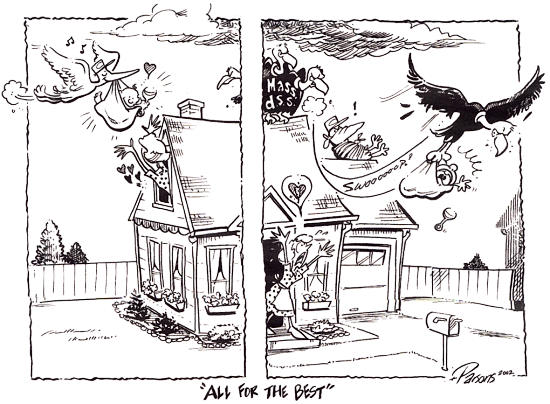
Addendum: Arizona CPS has had a change of heart.
expand
collapse
Toddler abducted last week is returned to father
Lily Leung, The Arizona Republic, Mar. 4, 2008 07:39 AM
A 1½-year-old Surprise boy who was the focus of an Amber Alert last week has been reunited with his father after a brief stay with state Child Protective Services, police said.
The toddler, Michael Wolfe, was reunited with his father, Brett Wolfe, at 4 p.m. Monday after what Surprise Police Sgt. Mark Ortega called "a rather interesting exchange."
The boy disappeared from his father's Surprise home last Wednesday, and was located late the next afternoon at an Avondale apartment where his 15-year-old live-in nanny had allegedly taken him with the help of an associate. The nanny, described as a Gilbert runaway, and her associate, Judith Martha Lucatero, 20, were arrested on custodial interference charges.
Hours after Michael Wolfe was found, he was turned over to CPS while investigation of the case continued. Police suspected child neglect in the case, questioning how his father retained the runaway nanny via a Web site.
On Friday evening, Surprise police also spoke via phone to the child's biological mother, Relaiza Galope Labadan. The Philippines resident initially reported to police that Wolfe did not have permission to bring their child to the U.S. from her country, Ortega said.
However, she recanted her statements over the weekend, giving CPS the green light to return the child to his father, Ortega said.
"She completely changed her story when she was on the conference call today," Ortega said late Monday afternoon. "I don't know what happened over the weekend, but she changed her story."
Last week, the Labadan, 22, also told police Wolfe had promised to bring her to the U.S. along with their child, Ortega said. She claimed she returned home and found the child, his possessions and Wolfe gone. Within 24 hours, she told investigators, she received a call from Wolfe saying he was with the child in the U.S., Ortega said.
"After that, she changed her story," he said.
Police said that although the child has been returned to his father, the investigation remains open. Detectives plan to look into tips phoned in during the Amber Alert, Ortega said.
Wolfe reportedly found the live-in nanny via a Craigslist online ad he posted. He told police the girl led him to believe she was 19, not 15.
Source: Arizona Republic
Baby Rescued from Mother
March 1, 2008 permalink
Police in Edmonton have saved a baby from his worst enemy — his mother. But police report that he is safe again after being recaptured. Now he can look forward to the same loving foster care given to Charles Manson.
expand
collapse
March 1, 2008
Mom steals own baby
Takes one-day-old child from hospital without legal custody
By NICKI THOMAS AND GLENN KAUTH, SUN MEDIA
A communication breakdown may have allowed a 19-year-old mother to abduct her own child from hospital yesterday - but there are no problems with security measures, says a Capital Health official.
"This was not a random child abduction by a stranger. This is not something that should cause a lot of anxiety to other parents. This is a case that does happen very rarely when social services are involved," said spokesman Steve Buick.
Just after 10 a.m. yesterday, police were alerted by staff at the Royal Alexandra Hospital that a woman had left the building with her one-day-old child, of whom she did not have legal custody.
Minutes later, the woman - who cannot be named under the Youth and Family Enhancement Act - boarded a bus heading toward Castledowns.
"She didn't have anything on the baby except a blanket. We thought it was a doll," said Arlene, who was on the bus with the woman and later called a social worker at the hospital when she became concerned about the mom's behaviour.
"I was thinking that it wasn't a baby - the way she was holding it. It was almost like a rag doll in her arms," said Arlene, who didn't want her last name used.
She added the mom was very fidgety and seemed paranoid.
The mom got off the bus near 122 Avenue and 97 Street and took a cab to her home at the Evergreen Mobile Home Park, where police located her and the baby.
Children's Services spokesman Heather Massel couldn't say specifically why the mom had lost custody of the baby, but said an apprehension order is generally carried out when a parent is unable or unwilling to care for the child.
She said the baby is safe and in the care of children's services. Buick said that babies are often taken into custody - a couple of times a week at the Royal Alex alone - and judgments are made in each case about necessary security measures.
"It's hard to predict the way a new mom will react to the news that her baby is going to be taken into custody. Everybody involved makes their best judgment about how an individual mom will react and most of the time, that judgment is (that) it will be OK. Once in a blue moon, literally every few years, that judgment won't work out the way that people had in mind and the mom will just react badly and run off with the baby," he said, adding the last time this happened was six years ago.
Despite losing custody of her child, the mother was allowed regular access to the baby, said Buick.
"Her being with her baby was exactly as it should have been. The judgment about apprehension does not necessarily mean that the mom shouldn't have any contact with her newborn baby," he said.
Buick admitted there may have been a breakdown in communication between staff and social services regarding the apprehension order and Capital Health will be looking into what happened.
"In a busy unit like this with a number of patients going through it, it's very possible that someone who had just come on shift didn't know that this order had been made and may have given mom a wrong impression," he said. "We should have been watching more closely than we were and if there's any improvement we can make, we'll look for how.
"The bottom line is there wasn't any extra security required, so it wasn't really a breach of the security measures. There's no way that it would be good for this family or any other family for us to start putting armed guards outside every door in these units. This is a risk we have to manage and it's a very, very tiny risk."
Police will not be laying charges against the mother.
Source: Edmonton Sun