help
collapse
Press one of the expand buttons to see the full text of an article. Later press collapse to revert to the original form. The buttons below expand or collapse all articles.
expand
collapse
Richmond Smith R.I.P.
April 30, 2007 permalink
Ronald E Smith is an organizer of a family rights demonstration planned for Washington DC this August 18.
His son Richmond was forced to take Ritalin, a drug which has been associated with cancer. On April 27 Richmond died of cancer at age 20. There will be a funeral at the Carter Funeral Home in Chicago on May 4.
The father's message:
At 8:33pm on April 27th my son Richmond Elihu Smith passed. He made a peaceful transition and has added fervor to my fight to put an end to the senseless medication of our children and parental alienation. I thank you all for your prayers and it is now time to stop asking for our rights as parents to be recognized and begin demanding that our God given fundamental rights as parents to be recognized at all cost. His death will not be in vain.
Minister Ronald E. Smith, CEO
Children Need Both Parents, Inc.
www.cnbpinc.org
Addendum: Here is the preliminary title for the rally led by Minister Ronald Smith:
IS TODAY THE LAST DAY YOU WILL EVER SEE YOUR CHILDREN?
RALLY IN WASHINGTON, DC AUGUST 18 TO ENSURE THE ANSWER IS NO!
Watch a small part of a speech by Ronald Smith on YouTube. Families finally have a leader with real charisma.
Tayler Gets Better
April 27, 2007 permalink
The maltreatment of Tayler Diamond by doctors at McMaster has been remedied by transfer of the girl to Toronto's Hospital for Sick Children. The CAS is no longer menacing the family. Earlier stories January 6, January 2 and October 11, 2006.
expand
collapse
Tayler 'happy' her chemo scaled back
By Susan Gamble, expositor staff - Thursday, April 26, 2007 @ 01:00
The young girl who was forced by the Children’s Aid Society to take chemotherapy treatment now has a new set of doctors and treatment regimen in Toronto.
Tayler Diamond, 9, is still undergoing chemotherapy, but at lighter doses which make her mother more comfortable.
The girl was at the centre of a controversy last year when her mother, Lisa Diamond, ended Tayler’s chemo treatments at McMaster hospital, opting to pursue alternative treatments while Tayler’s acute lymphoblastic leukemia was in remission.
The girl had about a year of chemo, which left her burned and blistered and — at one point — she went into septic shock when the medical procedures almost killed her.
When Tayler was removed from the treatments, doctors at McMaster insisted that another year of treatments was needed in order to ensure the leukemia didn’t return. The doctors threatened to call the Children’s Aid Society and then did so.
Tayler was ordered back into treatment despite studies turned up by her mother showing many pediatric cancer patients die of secondary illnesses, often caused by the chemotherapy.
The local CAS used a judge-issued protection order under the Child and Family Service Act that allows the organization to step in if it feels a child needs medical treatment.
While the girl tolerated the next few months of chemo relatively well, Diamond said doctors continued to yell at her for her views, often in front of her daughter.
“I finally demanded a transfer to Toronto,” Diamond said this week.
At an assessment at Sick Kids Hospital, doctors opted for a break from the chemo because Tayler’s condition was too fragile. She had been susceptible to infections for several months and her mother said Tayler’s mouth was full of large canker sores that made it difficult for her to eat.
“Now she’s slowly gaining weight back,” Diamond said. “Toronto also knocked the level of her chemo down by two notches.”
She is delighted with the different attitude she’s found at Sick Kids although she still insists that if it were up to her alone, she’d opt out of the chemo.
The best news Diamond has had in a while is the closure of Tayler’s file by the Children’s Aid Society. The file was closed within about a month of Tayler’s transfer to Sick Kids.
“I’m more comfortable now because Sick Kids seems so committed to double and triple checking everything. They involve me in the process and show us exactly what she’s being given.”
Today, Tayler is less anxious about the chemo protocol and the setting.
She and her mother have to rise at 4 a.m. each week on chemo morning and are on the road at 5:30 a.m. but Diamond said the extra effort is worthwhile.
“She’s happy. She thinks Sick Kids is like a mall where you can shop. You do what’s in her best interests.”
Diamond said Tayler continues to look forward to her alternative treatments of reflexology and reiki (a Japanese holistic touch technique) and continues to take nutritional supplements.
Source: Brantford Expositor
thanks to a VOCA reader for an alert
Runaways
April 26, 2007 permalink
Two more girls, who seem to prefer life with their families to CAS care, are wanted by Sudbury Children's Aid.
expand
collapse
Northern Life
Two children missing in Sudbury area
Date Published | Apr. 26, 2007
The Children's Aid Society of the Districts of Sudbury and Manitoulin is requesting the public's assistance in locating two female children.
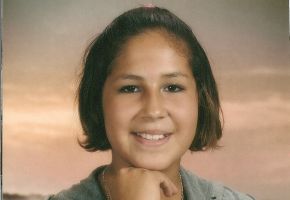
1) Sara Linklater is an 11-year-old First Nation youth. She is approximately 5'3” and wighs approximately 137 lbs. She has straight, shoulder length black hair, brown eyes and a dark complexion. She has a scar on her left pinky toe.
Linklater is believed to be in downtown Sudbury and may be with her sister.

2) Allanah Michelle Harvey is15 years old. She has been seen only on two occasions since December 16, 2006. The last time Alanah was seen was February 28, 2007.
Harvey is 4'9” and weighs 100 lbs. She has blue eyes, shoulder length coloured blonde/brown hair and a light complexion.
If you have any information with regards to the whereabouts of this child, please contact your local police department or Children's Services at (705) 521-7375.
Source: Northern Life
Addendum: From the same source: Published: Apr. 27, 2007. Sara Linklater has been found but assistance is still required with locating Allanah Harvey.
Cole Norris in CAS Custody
April 26, 2007 permalink
Cole Norris is back in CAS custody. This time it is in a Brantford foster home, and he is not subject to the harsh conditions of the Kingston Gulag. The family agreed to this as the only way to get Cole prepared for high school next year. The family financial decline continues. Cathy can no longer make long-distance phone calls. She expects all phone and internet service to end soon.
Junk Science Research
April 26, 2007 permalink
The following post from a survey participant shows how CAS gets its research results favoring more services. The formal name for this technique is advocacy research.
expand
collapse
posted by Barb, Wed Apr 25, 2007 10:45 am
warning CAS conducting new study
I was contacted by the CAS and asked if I would like to participate in a study by McMaster University and answer questions of the 'services' provided by the CAS. So I jumped at the chance to tell how they can improve and how much they actually damaged our life. I thought I could contribute to a good study that could make changes.
Boy am I brain damaged. I would think that by now I would know how they would run their studies. This of course is being paid by the CAS.
The questions were such: How much money do I have? Am I able to provide food clothing needs? Do I work? Do I get any enjoyment in life? How is my mood now? Any problems feeling happy lately?
OK. I am in poverty now BECAUSE of the CAS. No room for that answer. True or false?
No I don't work because I have to spend all my time getting ready for court and making affidavits. No room for that answer either. I worked BEFORE CAS intervention.
Am I sad, overwhelmed, feeling helpless? YES, BECAUSE OF CAS intervention. Nope no room for that answer.
There were no questions as to how I like the services from the CAS. There were no questions of how it has affected me. Nope. This questionnaire kept stating that I have received services from the CAS and by participating I could receive more services. I have never received services. If they service me anymore I will be homeless.
I see from this questionnaire that in three years when this is done that the CAS will state that all the families they HELP are stressed, overwhelmed, depressed and impoverished. They will use this to give more 'services.'
Source: Canada Court Watch forum
Puppy Prozac to help stressed pets
April 25, 2007 permalink
Eli Lilly is now promoting Prozac for depressed dogs.
expand
collapse
Puppy Prozac to help stressed pets
If your doberman is a little down in the mouth or your poodle a bit peaky, help is at hand from the makers of Prozac who have developed the drug for dogs, with the canine version coming in chewable form and tasty beef flavour.
 It's a dog's life. The canine anti- depressant is called Reconcile
The anti-depressant is being launched to the pet market by drug company Eli Lilly to treat dogs which bark incessantly or chew furniture when left alone.
The reformulated form of Prozac, or as it is called generically fluoxetine, will be marketed under the name Reconcile. It is the first drug to be marketed by a new division of Eli Lilly, which is to be devoted entirely to pet pharmaceuticals.
Clinical trials showed that the drug significantly reduced the symptoms of separation anxiety in dogs, which is estimated to affect between 10 to 20 per cent of domestic dogs.
The symptoms include the dog going berserk, barking, howling, ripping up carpets and destroying furniture and incessant scratching at the door to get out. Several complementary products targeted at the sufferers of the condition are already on the market.
But Dr Roger Mugford, a leading animal psychologist, said vets were not keen on the development of drugs to treat animal behaviour, a view expressed at a recent meeting in Birmingham of the British Small Animal Veterinary Association.
"A number of speakers, including me, were all of one mind that pharmacological help with any anti-depressant or mood modifying drugs diminishes the better you are at your behavioural management," he said.
"The more skilful you are at behaviour modification, at getting the animal husbandry right - diet, exercise, lifestyle and so on, the less the need for drugs."
Dr Mugford said there were also concerns that Prozac had some unpleasant side effects in humans, which could suggest that some dogs might become aggressive when taking it.
"Why do we need these things? It is so easy to modify the behaviour of dogs by good management techniques. We call it behavioural husbandry," he said.
The company is also planning to develop other drugs for the pet market, in particular some slimming products which failed to pass trials for use in people.
"If Eli Lilly want to dust off old patents on products that were not suitable for humans, I doubt that it would work," added Dr Mugford, who runs the Animal Behaviour Centre at Chertsey, Surrey.
Source: website of the Daily Telegraph
Big Business In Babies: Adoption
April 25, 2007 permalink
A thoughtful and well-researched article on the failings of today's adoption system.
expand
collapse
Big Business In Babies: Adoption,
The Child Commodities MarketAdoption was once a process by which the community took responsibility for orphans. Increased access to birth control pills and legal abortion, and a lessening of the stigma of single parenting, coupled with an increase in infertility resulted in a demand for babies that outstrips the “supply.” And where there is demand – be it for diamonds, drugs, sex, or babies – corruption follows.
Adoption is racist. The scarcity of “white American-born babies” has led to an increase in international adoptions, fracturing family ties and heritage in what some are calling cultural genocide. Madonna was criticized. Angelina confounds. Westerners, however, continue to believe that adoption “rescues” orphans; though saving children from poverty, one at a time, does nothing to ameliorate the conditions that continue to produce them. And, many so-called orphans are in fact stolen, kidnapped, or their parents were coerced to relinquish them under false pretenses to be sold on the black and gray adoption markets with prices set by age, alleged health, skin color, gender and nationality.
As Americans import mostly light-skinned babies, non-white children are left behind, and the number of black, American-born babies adopted by overseas families has increased significantly in recent years, with black babies being placed with Canadian couples more than ever before. Adoption trends follow poverty and sociopolitical upheaval from Latin America to Asia and Eastern Europe. Since the 1990s, China and Russia have become the largest exporters of children for international adoption. Unrest and poverty in these nations makes them ripe for corruption and trafficking. In April 2007, the U.S. State Department confirmed that Guatemalan babies are kidnapped for adoption and other mothers pressured to sell their babies by corrupt, inadequately supervised notaries. The previous month, a Utah adoption agency was indicted for “systematically misleading birth parents in Samoa into signing away rights to their children while telling adoptive parents in the United States that the children had been abandoned and were orphans” (“Pacific Islands Report: Utah Agency Indicted In Samoa Adoption Scam,” March 5, 2007 pidp.eastwestcenter.org/pireport/2007/March/03-05-01.htm). All of this while UNICEF is investigating child trafficking and babies being sold for adoption in Nepal (Nepal: Unicef On Inter-Country Adoption peacejournalism.com/ReadArticle.asp?ArticleID=17655 ).
As abuses are exposed, countries are restricting out-of-country adoption of their children. According to Ethica, a nonprofit adoption advocacy organization, 13 countries have suspended or ended their adoption programs in the past 15 years and four more countries temporarily stopped adoptions to investigate allegations of corruption or child trafficking. The U.S. passage of the 2005 Trafficking Victim Protection Reauthorization Act verified recognition of international adoption providing an incentive for child trafficking. Yet, ethnocentricity and a national policy of spreading democracy and the American way of life to the world, combined with a desire to parent, continues the romanticized “rescue” myth.
Free enterprise in America is a breeding ground for adoption scams, exploitation and coercion as infant adoptions have become a multi-billion dollar privatized, entrepreneurial industry. The patchwork of laws that vary from state to state create a playground for unscrupulous attorneys—some working in conjunction with facilitators, procurers, or “match-makers” placing ads to lure those in crisis. Unethical adoption attorneys, such as Maxine Buckmeier, Seymour Kurtz and others, are masters at using legal loopholes to their advantage. They set up shop in one state, advertise in another, send expectant mothers to another state and finalize the adoption in yet another. They isolate expectant mothers from their families and create a dependent bond with them by having prospective adopters pay their living and medical expenses and virtually hold them hostage, blackmailing them to relinquish or pay back those expenses.
Randall B. Hicks, an adoption attorney in Riverside, California, and author of Adopting in America, said facilitators are “not licensed nor trained to do anything.” Along with physicians and attorneys—with no training in child welfare or adoption—others such as a Artie Elgart, former car parts salesman and Ellen Roseman, a former flight attendant arrange the transfer of custody of our most vulnerable citizens.
According to Ann Babb author of Ethics in American Adoption there is “no professional association or academics, no certification or licensing procedures, no professional recognition as adoption specialists, and no training or educational qualifications.” Adoption “[p]rofessionals have yet to develop uniform ethical standards… or to make meaningful attempts to monitor their own profession,” says Babb. “In other professions and occupations, licensing or certification in a specialty must be earned before an individual can offer expert services in an area. The certified manicurist may not give facials; the certified hair stylist may not offer manicures ….Yet…individuals with professions as different as social work and law, marriage and family therapy, and medicine may call themselves ‘adoption professionals.’”
Alex Valdez Jr., spokesman for the California Department of Social Services, said, “Essentially, [adoption facilitators] are required to have a business license, publish a list of their services, and [have a] $10,000 bond before they hang a shingle.” These untrained facilitators receive $6,000 to $20,000 often just to introduce prospective adopters to an expectant mother who may or may not decide to surrender her child for adoption. If a match fails, a facilitator can bring the same expectant or new mom to another couple and collect yet again, making adoption risky business for all of the parties involved—the mothers who have their parental rights irrevocably relinquished, those attempting to adopt, as well as the children whose custody is being permanently transferred. Adoption practitioners being paid for results leads to slip-shod home studies that have put many adopted children in serious danger. Since 1996 more than a dozen children adopted from Russia by Americans have been killed by their adopters. Others adopted from Russia and elsewhere have been physically and sexually abused, caged, starved, and criminally neglected. At least two such children were adopted by pedophiles for the specific purpose of rape and child pornography.
Adoption, which was a means of providing care for children who needed it, has become a perverse business of providing children for those who feel entitled to one. Consumerism has led many westerners, particularly Americans, to believe that if they can afford “it” they deserve to have “it”—even when “it” is a human child. Adoption needs to return to basics. We need to halt profiteering from what should be a social service to protect families and children in need. Adoption can only guarantee a different life, not necessarily a “better” one. Adoption moves children from lower to higher socio-economic status, yet even when a child is adopted into a loving, caring family who may provide a more prosperous lifestyle—the end result does not justify the means if the child was kidnapped, stolen or their mothers coerced, deceived or exploited. Adoptions that obliterate a person’s original identity and leave him no legal access to his family are a risk and a violation of human rights as expressed by UNICEF.
All adoptions are not the happily-ever-after fairy tales we’d like them to be. Many are sad and sordid. For this reason we need to stop promoting “adoption” without distinguishing between those that are necessary and in the best interest of children and are handled ethically—from those which are not. The former deserves support; the latter needs to be exposed and ended. We need to stop glamorizing foreign adoption as a rescue mission but recognize that every international adoption leaves behind half a million children in U.S. foster care. Of those, 134,000 children cannot be reclaimed by family members. Adoptions of such children only are worthy of promoting and financial aiding in the form of taxes and other incentives and benefits. Monies paid to non-relative foster parents would be better spent to preserve, maintain and protect the integrity of families in need, including aid to grandparents and other extended family members struggling to keep families intact. Additionally,, the U.S. ought to consider a tax on international adoptions with funds used to support families and children in the U.S. in crisis.
Adoption needs to be far more transparent, open, honest and regulated to ensure it serves the best interest of those it is intended to serve.
Mirah Riben, author of shedding light on…the Dark Side of Adoption (1988) and The Stork Market: America’s Multi-Billion Dollar Unregulated Adoption Industry (www.AdvocatePublications.com, 2007); former director-at-large, America Adoption Congress.
Source: countercurrents.org
Dunn Follows Up
April 25, 2007 permalink
The tenacious John Dunn continues his efforts to get the membership list of his local children's aid society. Following the refusal of CAS to provide the list in conformance with the law, he has followed up with a complaint to the Ministry of Government Services. Whatever the outcome, he has already demonstrated the futility of efforts to reform children's aid from within.
expand
collapse
John Dunn
12-1160 Meadowlands Drive East
Ottawa, ON
K2E 6J2
Phone: 613-228-2178Ministry of Government Services
Companies and Personal Property Securities Branch
Compliance Section
200-393 University Avenue
Toronto, ON, M5G 2M2Date: March 25, 2007
RE:
Ontario Corporation No. 37637
Incorporation Date: 1933-05-27
The Children's Aid Society of Ottawa
La Societe de L'aide a L'enfance d'Ottawa
1602 Telesat Court
Ottawa, ON
K1B 1B1Non-Compliance Report:
I am filing a non-compliance report with the Ministry of Government Services, Companies and Personal Property Securities Branch, Compliance Section regarding Ontario Corporation Number 37637, c.o.b. as The Children's Aid Society of Ottawa / La Societe de L'aide a L'enfance d'Ottawa, a non-share capital corporation registered with the Province under the Corporations Act, R.S.O. 1990, c. C.38, as amended (herein referred to as the Act) and its Board of Directors who together as both a corporate body and as directing minds of the corporation, committed the Offence of contravening section 307 (5) of the Corporations Act by respectively, not furnishing a list of the members of the corporation and by allowing, permitting, or acquiescing to such Offence.Background:
On February, 05, 2007, John Dunn, a citizen of Ontario, filed in-person with Ontario Corporation Number 37637 a request for a list of the members of the corporation in accordance with section 307 (1) of the Act including the required sworn affidavit and a reasonable fee of $20.00.The corporation retained the services of a Lawyer, Robert C. Morrow, of Burke-Robertson Barristers & Solicitors who wrote a letter to John Dunn, on behalf of the Board of Directors of the corporation, stating that they were not going to provide a list of the members of the corporation, which according to section 307 (5) of the Act is an Offence and returned the original request package without retaining a copy for their own records.
The letter included opinions of the Board members and false presumptions that John Dunn would not use the list or the information contained therein for purposes connected with the corporation, contrary to his sworn affidavit, and asserted that to furnish the list of members would be in violation of provisions of the Personal Information Protection and Electronic Documents Act (PIPEDA).
These presumptions and assertions are not valid since the sworn affidavit ensures that the requesting party only uses the list and the information contained therein for purposes connected with the corporation, and since the PIPEDA only applies to a Federal Work, Undertaking or Business, and not to a non-share capital corporation which is exclusively legislated by a Legislature of a province according to ss. 2(1)(i) & (j) of PEPEDA, which in this matter, the corporation clearly is.
John Dunn made several attempts with the Society through letters and emails to resolve the matter, and even went to far as to try and contact the Board of Directors so that he could file the request with them personally but the Society refused to accept deliveries for the Board members.
Instead, John Dunn had to find the contact information of the Vice President and the Treasurer on his own via extensive Internet research so that he could file the request with the Board members personally.
Rick O'Connor, the Vice President of the corporation, and a Lawyer, (City Solicitor for the Cit of Ottawa) told John Dunn to cease and desist from communicating with him at his place of employment, even though he had previously been informed by John Dunn that the corporation was not accepting deliveries for Board members at their offices.
All attempts to communicate with the corporation have been ignored and no action has been taken by the corporation on this matter. This all appears to be in bad faith and it is a strict liability matter, which accordingly only gives them the defences of Due Diligence and Mistake of Fact. Neither of which can be used in this case since they did not do anything to attempt to comply with the request, nor were they reasonably mistaken as to their duty to furnish the list within ten days from the date of the filing of the request with the corporation.
Action Request:
I would like to ask the Compliance Section of the Ministry to please inform me of what steps will be taken to ensure the corporation complies with their obligation to furnish a list of the members of the corporation in accordance with section 307 (1) of the Act.Sincerely,
John Dunn
Relevant Legislation Below: ss. 307 (1) & (5), Corporations Act, R.S.O. 1990, c. C. 38, as amended.
Where list of shareholders to be furnished
307.(1) Any person, upon payment of a reasonable charge therefor and upon filing with the corporation or its agent the affidavit referred to in subsection (2), may require a corporation, other than a private company, or its transfer agent to furnish within ten days from the filing of such affidavit a list setting out the names alphabetically arranged of all persons who are shareholders or members of the corporation, the number of shares owned by each such person and the address of each such person as shown on the books of the corporation made up to a date not more than ten days prior to the date of filing the affidavit.
Offence
307.(5)Every corporation or transfer agent that fails to furnish a list in accordance with subsection (1) when so required is guilty of an offence and on conviction is liable to a fine of not more than $1,000, and every director or officer of such corporation or transfer agent who authorized, permitted or acquiesced in such offence is also guilty of an offence and on conviction is liable to a like fine.
Car Seat Clinic
April 25, 2007 permalink
More kids die in traffic accidents than from child abuse. Car seats sound like a remedy but are useless in practice since they are rarely installed properly. We reported last year on a tragedy that struck the family of professional child protectors.
A clinic to correctly install car seats could be a big help. But who would be the best person to fix your car seat? A mechanic with wrenches, or a cop with handcuffs? Gullible parents are invited to participate in a car seat clinic hosted by the Dufferin OPP on Friday. Bring along you child, so the cops can send him directly to foster care without going to your home to pick him up.
A clinic of this kind might work if hosted by Canadian Tire or Walmart.
expand
collapse
Orangeville Banner
Dufferin OPP host car seat clinic, Friday
Helping parents to keep their young children safe, Dufferin OPP is hosting a free child seat clinic Friday afternoon. Officers will take a look at how the seats are installed and make any corrections.
According to field statistics, nine out of 10 child seats are used improperly, a press release states. When used properly, the seats reduce the risk of injury by 70 per cent and the risk of death by 90 per cent.
To book an appointment, call Dufferin OPP at 519-925-3838. Participants are asked to bring their vehicle manual, car seat manual and, if possible, their child.
Source: Orangeville Banner
Ombudsman Still Needed
April 25, 2007 permalink
Ontario's ombudsman André Marin reminds us that a child advocate is no substitute for the ombudsman. Read the press release below or André Marin's submission to the standing committee(pdf)
expand
collapse
PRESS RELEASE
APRIL 24, 2007 - 15:49 ET
Child Advocate is no Substitute for Ombudsman
TORONTO, ONTARIO--(CCNMatthews - April 24, 2007) -
ATTENTION NEWS EDITORS:
Ontario Ombudsman Andre Marin today praised the province's proposed new Child Advocate legislation but cautioned that it will still leave a dangerous gap in the system that is supposed to protect vulnerable children.
Bill 165, the Provincial Advocate for Children and Youth Act, takes only "baby steps" toward an effective system of child protection, Mr. Marin says in his submission to the Standing Committee on Justice Policy, which is holding hearings on the bill this week. The Advocate may speak for children but, unlike an ombudsman, will have no investigative powers: "An advocate is as much an ombudsman as an apple is an orange."
Yet Ontario's Ombudsman is unable to investigate the hundreds of complaints to his office about children's aid societies each year (more than 600 in 2006-07), because they remain outside of his jurisdiction. Cases that should be investigated are effectively thrown away, Mr. Marin says: "Despite all the government rhetoric that 'children are our future,' we in Ontario are choosing to rid ourselves of hundreds of these serious allegations every year by taking a trip to the dumpster and looking the other way." Ontario is the only province in Canada where children's aid societies escape such scrutiny, he notes. "However you slice, chop or spin it, there is no contest as to which province finishes dead last in investigating children's complaints. Ontario does."
Mr. Marin's submission calls on the government to act, in addition to establishing the Provincial Advocate, to amend the Ombudsman Act to include jurisdiction over children's aid societies. Unlike the provincial coroner and other bodies, the Ombudsman can investigate complaints by parents and children "before tragedy strikes," he points out.
Mr. Marin has advocated for the Ombudsman's mandate to be modernized to allow for oversight of such bodies as children's aid societies since his appointment in April 2005 - following a quest begun by Ontario's first Ombudsman, Arthur Maloney, in 1975.
Aussi disponible en francais
Read the full submission under What's New at www.ombudsman.on.ca
CONTACT INFORMATION
For more information or to arrange interviews with the Ombudsman contact:
Linda Williamson, Communications and Media Relations Manager
(416) 586-3426
Email: lwilliamson@ombudsman.on.ca
Website: www.ombudsman.on.caSource: press release
Addendum: Even the Toronto Star has printed an article advocating ombudsman oversight for children's aid.
expand
collapse
Deaths spur dad to action
Daughters died after children's aid society downplayed pleas; now father backs ombudsman in bid for powers to investigate
April 25, 2007, Moira Welsh, Staff Reporter
Every time he sees a child on a swing, Leo Campione thinks of his dead little girls.
Every minute of every day, there is something that reminds him of 3-year-old Serena and 1-year-old Sophia, tousle-haired and grinning.
They were found drowned in their mother's Barrie apartment in October 2006.
Despite numerous red flags and several occasions where the Simcoe County Children's Aid Society removed the children from her care, social workers downplayed his pleas for intervention until it was too late.
"If I am in a mall and there are other children running and I hear a baby call out `Daddy,' it is just a torment to my heart," Campione said yesterday. "It is indescribable. This happened to me. I am going to do everything possible to make sure it doesn't happen to anybody else."
To that end, Campione, 35, who works with the Universal Workers Union, Local 183, is now publicly supporting the efforts of Ontario ombudsman André Marin, who wants the government to give him the power to investigate the province's 53 children's aid societies.
"I have already lost all that is most precious and valuable to me. I really don't have anything to gain, except that their deaths were not in vain," Campione said.
"My greatest resolve now is that this does not happen to any other children. It is what gives me the strength to keep going."
Marin has sent a written submission to the Standing Committee on Justice Policy at Queen's Park asking for investigative powers for the ombudsman's office. The committee is holding hearings this week on Bill 165, the Provincial Advocate for Children and Youth Act, which will give greater independence to Ontario's child advocate, Judy Finlay.
But Marin says that an advocate cannot investigate the way an ombudsman can – a power to scrutinize that he says is enshrined in all other provinces.
"The system is virtually entirely funded by the government to a tune of $1.4 billion a year," Marin said. "But it is a system without checks and balances, where people who have issues about the children's aid have no place to turn unless there is a dead body, in which case the coroner can get involved."
The Ontario Association of Children's Aid Societies says there's no need for Marin's oversight. Spokesperson Marcelo Gomez-Wiuckstern said the agencies are subject to numerous accountability reviews. The Child and Family Services Review Board, created last year, already hears complaints from families, he said.
But Marin, who said his office received over 600 complaints on the societies last year, contends the board does not have strong investigative powers.
Campione lost custody of his daughters after his estranged wife, Frances, accused him of assaulting her and their eldest daughter, Serena.
He was allowed supervised access to his daughters from the Simcoe County Children's Aid Society, and records showed that social workers gave him positive reviews – an issue that angered his wife, who railed against his access.
In January, a judge stayed the assault charges against Campione because the Crown's chief witness against him was his wife. She now faces a trial, after being charged with two counts of first-degree murder.
After their deaths, a family court file was made public. It detailed years of family troubles. It contained a sworn statement from her father-in-law, saying she appeared at their home unexpectedly, behaving in an erratic manner, asking that they care for the girls because someone wanted to kill her.
There were numerous warnings that her mental health was deteriorating. She was hospitalized for her mental instability, losing care of her children each time, although they were always returned.
Despite this, and repeated warnings from Campione that the girls were in danger, the social workers said that the mother was best suited to provide their care.
"It was extremely frustrating," he said.
"I felt like my hands were tied at all times. I felt the children's aid society was an organization that ran independently, that their actions or inactions or whatever decision they made, was unilateral.
"I just felt like David and Goliath."
The Simcoe children's aid society said last fall it was going to conduct an internal review of the decisions leading up to Serena and Sophia's deaths.
So far, says Campione, those investigators have yet to call him.
Source: Toronto Star
Virginia Tech Massacre
April 24, 2007 permalink
Following the 33 deaths in the Virginia Tech massacre of April 16, many interested parties have seized the opportunity to advocate for their pet reform. More restrictive immigration. Better gun control. Fewer gun controls (so victims could shoot back). Control violent video games. More (involuntary) mental health services.
In all the high school shootings of the past decade, we have noticed one of the following factors (sometimes both) in just about every case:
- The shooter was separated from his father by force of arms
- The shooter was on psychotropic drugs
So far there is no indication killer Cho Seung-Hui was separated from his father but he was on psychiatric drugs. The exact drug is unknown since his medical records are being suppressed on grounds of confidentiality.
Psychotropic drugs suppress the generation of chemicals in the brain, usually neuro-transmitters. The brain compensates by becoming more sensitive to what little of the chemical is still being produced. Withdrawal from the drug results in restoring production of the neuro-transmitter to normal levels in a brain made hyper-sensitive to it. This produces the behavior oppositite to that intended for the drug.
A multi-media package Cho mailed to NBC news during a break in his killing spree shows a severely disturbed man, not really coherent or rational. This from a man who must have been in the intellectual upper crust to gain admission to the school. Reporters noted the similarity to the rants of the Columbine killers, also on psychotropic medication.
The mainstream press has not dealt with the drug connection to the massacre. The article below is from the internet press, WorldNetDaily.
expand
collapse
Monday, April 23, 2007
VIRGINIA TECH MASSACRE
Are meds to blame for Cho's rampage?
Experts say psychiatric drugs linked to long list of school shooting sprees
By Bob Unruh, WorldNetDaily.com
 Cho Seung-Hui
Cho Seung-Hui's murderous rampage – during which he killed 32 students and faculty members at Virginia Tech – is prompting research into gun laws, resident aliens and graphically violent writings. Investigators also may want to check his medicine cabinet, because psychiatric drugs have been linked to hundreds of violent episodes, including most of the school shootings in the last two decades.
The New York Times has reported the killer was on a prescription medication, and authorities have said he was confined briefly several years ago for a mental episode. They also have confirmed that the "prescription drugs" found among his effects related to the treatment of psychological problems.
Dr. Peter Breggin, a prominent critic of psychiatric drugs and founder of the International Center for the Study of Psychiatry and Psychology, said even if Cho wasn't taking psychiatric drugs the day of the shooting, "he might have been tipped over into violent madness weeks or months earlier by a drug like Prozac, Paxil, or Zoloft."
While media reports have focused on guns and gun laws, Cho's violent writings and autistic behavior at Virginia Tech and the delay in notifying students and faculty of the beginnings of the shootings, there are those who say the focus should be on his medical history.
"In my book 'Reclaiming Our Children,' I analyzed the clinical and scientific reasons for believing that Eric Harris's violence was caused by prescribed Luvox and I've also testified to the same under oath in depositions in a case related to Columbine," Breggin wrote, referring to the 1999 tragedy when Harris and classmate Dylan Klebold shot and bombed students at the Colorado school until a dozen were dead.
"In my book "The Antidepressant Fact Book," I also warned that stopping antidepressants can be as dangerous as starting them, since they can cause very disturbing and painful withdrawal reactions," he added.
The TeenScreenTruth website, dealing with the campaign to "screen" children for "problems" and then prescribe drugs, has documented an extended list of violent episodes believed connected to the use of psychiatric drugs.
They range as far back as 1985, when Atlanta postal worker Steven W. Brownlee, who had been getting psychotropic drugs, pulled a gun and shot and killed a supervisor and a clerk.
Among the specifically school-related attacks the site documents are:
- In 1988, 31-year-old Laurie Dann, who had been taking Anafranil and Lithium, walked into a second-grade classroom in Winnetka, Ill., and began shooting. One child was killed and six wounded.
- Later that same year, 19-year-old James Wilson went on a shooting rampage at the Greenwood, S.C., Elementary School and killed two 8-year-old girls and wounded seven others. He'd been on Xanax, Valium and five other drugs.
- Kip Kinkel, a 15-year-old of Springfield, Ore., in 1998 murdered his parents and proceeded to his high school where he went on a rampage killing two students and wounding 22 others. Kinkel had been prescribed both Prozac and Ritalin.
- Patrick Purdy, 25, in 1989 opened fire on a school yard filled with children in Stockton, Calif. Five kids were killed and 30 wounded. He been treated with Thorazine and Amitriptyline.
- Steve Lieth of Chelsea, Mich., in 1993 walked into a school meeting and shot and killed the school superintendent, wounding two others, while on Prozac.
- 10-year-old Tommy Becton in 1996 grabbed his 3-year-old niece as a shield and aimed a shotgun at a sheriff's deputy who accompanied a truant officer to his Florida home. He'd been put on Prozac.
- Michael Carneal, 14, opened fire on students at a high school prayer meeting in Heath High in West Paducah, Ky. Three died and one was paralyzed. Carneal reportedly was on Ritalin.
- In 1998, 11-year-old Andrew Golden and 14-year-old Mitchell Johnson apparently faked a fire alarm at Westside Middle School in Jonesboro, Ark., and shot at students as they left the building. Four students and a teacher were killed. The boys were believed to be on Ritalin.
- In 1999, Shawn Cooper, 15, of Notus, Idaho, took a shotgun to school and injured one student. He had been taking Ritalin.
- April 20, 1999, Eric Harris, 18, and Dylan Klebold, 17, shot and killed 12 classmates and a teacher and wounded 24 others. Harris had been taking Luvox.
- Todd Smith walked into as high school in Taber, Alberta, Canada in 1999 with a shotgun and killed one and injured a second student. He has been given a drug after a five-minute phone consultation with a psychiatrist.
- Steven Abrams drove his car into a preschool playground in 1999 in Costa Mesa., Calif., killing two. He was on probation with a requirement to take Lithium.
- In 2000, T.J. Solomon, 15, opened fire at Heritage High School in Conyers, Ga., while on a mix of antidepressants. Six were wounded.
- The same year Seth Trickey of Gibson, Okla., 13, was on a variety of prescriptions when he opened fire on his middle-school class, injuring five.
- Elizabeth Bush, 14, was on Prozac. She shot and wounded another student at Bishop Neumann High in Williamsport, Pa.
- Jason Hoffman, 18, in 2001 was on Effexor and Celexa, both antidepressants, when he wounded two teachers at California's Granite Hills High School.
- In Wahluke, Wash., Cory Baadsgaard, 16, took a rifle to his high schooland held 23 classmates hostage in 2001. He has been taking Paxil and Effexor.
- In Tokyo in 2001, Mamoru Takuma, 37, went into a second-grade classroom and started stabbing students. He killed eight. He had taken 10 times his normal dosage of an antidepressant.
- Duane Morrison, 53, shot and killed a girl at Platte Canyon High School in Colorado in 2006. Antidepressants later were found in his vehicle.
- In 2005, 16-year-old Native American Jeff Weise on the Red Lake Indian Reservation in Minnesota was under the influence of the antidepressant Prozac when he shot and killed nine people and wounding five before committing suicide.
Another case involving a school-age youth – although not at a school – happened in 1986, when 14-year-old Rod Mathews of Canton, Mass., beat a classmate to death with a baseball bat while on Ritalin.
And just a few among the dozens of incidents cited, but not apparently related to schools:
- William Cruse in 1987 was charged with killing six people in Palm Bay, Fla., after taking psychiatric drugs for "several years."
- The same year, Bartley James Dobben killed his two young sons by throwing them into a 1,300-degree foundry ladle. He been on a "regimen" of psychiatric drugs.
- Joseph T. WesBecker, 47, just a month after he began taking Prozac, shot 20 workers at Standard Gravure Corp. in Louisville, Ky., killing nine. Eli Lilly, which makes Prozac, later settled a lawsuit brought by survivors.
- In 1991, 61-year-old Barbara Mortenson, on Prozac for two weeks, "cannibalized her 87-year-old mother …"
- In 1992, Lynnwood Drake III, shot and killed six in San Luis Obispo and Morro Bay. Prozac and Valium were found in his system.
- Sixteen-year-old Victor Brancaccio attacked and killed an 81-year-old woman, covered her corpse with red spray-paint. He was two months into a Zoloft regimen.
- While on four medications including Prozac, Dr. Debora Green in 1995 set her Prairie Village, Mo., home on fire, killing her children, ages 6 and 13.
- Kurt Danysh, 18, shot and killed his father in 1996, 17 days after his first dose of Prozac. "I didn't realize I did it until after it was done. … This might sound weird, but it felt like I had no control of what I was doing, like I was left there just holding a gun."
- In 1998, GlaxoSmithKline, maker of Paxil, was ordered to pay $6.4 million to surviving family members after Donald Schnell, 60, just 48 hours after taking Paxil, flew into a rage and killed his wife, daughter and granddaughter.
The website also cites psychiatrist Chester M. Pierce, in a speech advocating for the treatment of children and youth.
"Every child in America entering school at the age of five is insane because he comes to school with certain allegiances to our founding fathers, towards our elected officials, towards his parents, towards a belief in a supernatural being, and towards the sovereignty of this nation as a separate entity. It's up to you as teachers to make all these sick children well – by creating the international child of the future," Pierce told a 1973 childhood seminar.
Breggin's conclusion that whatever mental manifestations were causing Cho's dangerous behavior, resulting in a professor asking for him to be removed from her class and two complaints of stalking, there was a solution.
"The answer to vengeful, violent people is not more mental health screening or more potent mental health interventions. Reliance on the whole range of this system from counseling to involuntary treatment failed. There is not a shred of scientific evidence that locking people up against their will or otherwise 'treating' them reduces violence. As we'll see, quite the opposite is true," he wrote. "So what was needed? Police intervention."
He wrote that "it's not politically correct to bring criminal charges against someone who is 'mentally ill' and it's not politically correct to prosecute him or to remove him from the campus. Yet that's what was needed to protect the students. Two known episodes of stalking, setting a fire, and his threatening behavior in class should have been more than enough for the university administration to bring charges against him and to send him off campus."
He continued with a warning, "And what about drugs for the treatment of violence? The FDA has not approved any medications for the control of violence because there are no such medications. Yes, it is possible to temporarily immobilize mind and body alike with a shot of an 'antipsychotic' drug like Haldol; but that only works as long as the person is virtually paralyzed and confined – and forced drugging invariably breeds more resentment.
"Instead of offering the promise of reducing violence, all psychiatric drugs carry the potential risk of driving the individual into violent madness. For example, both the newer antidepressants such as Prozac, Paxil, Zoloft and Celexa, and the antipsychotic drugs such as Risperdal and Zyprexa, cause a disorder caused akathisia – a terrible inner sensation of agitation accompanied by a compulsion to move about. Akathisia is known to drive people to suicide and to aggression."
He said he's been writing for more than 15 years about the capacity for psychiatric drugs to cause mayhem, murder and suicide, but it wasn't until 2005 when the FDA issued a warning that such drugs produce "anxiety, agitation, panic attacks …"
He said in the Columbine case, Harris "looks the most like Cho. Both were very emotionally disturbed in an extremely violent fashion for a prolonged period of time."
Carolyn Rude, chairwoman of Virginia Tech's English department, said Cho's writings were so disturbing he was referred to the school's counselors.
"Sometimes, in creative writing, people reveal things and you never know if it's creative or if they're describing things, if they're imagining things or just how real it might be," she said. "But we're all alert to not ignore things like this."
In a statement posted on the TeenScreen opposition site, Sidney Taurel of Eli Lilly noted that it would be "unreasonable" to expect "that there is such a thing as a risk-free drug."
Another website concerning the psychiatric drugs, called RitalinDeath, also documents some of these cases, as well as additional ones.
Dr. John Breeding concluded in a report shortly after Columbine that there were about five million school children now being given psychiatric drugs, and the number had been doubling every 10 years since the 1970s.
"This has got to be a cause for major alarm in all adults," he said. "The bottom line is that we are giving stronger and stronger psychiatric drugs to more and more children. Many of our children are taking more than one of these drugs at a time, and many of these drugs were never even tested and approved for children."
Bob Unruh is a news editor for WorldNetDaily.com.
Source: WorldNetDaily
Plea of the Day
April 23, 2007 permalink
The exchange below occurred today on Sarnia's Smoking Gun. A teenager using screen name foster kid posted a plea for help. It is repeated below without spelling or grammar correction. Following that are two replies by the webmaster Dean Robinson.
expand
collapse
I just want to go home
foster kid 12:26pm
Im 13 years old and live in a group home I was put here by a lady from children aid. and I want to go home. I have been here for 6 weeks and have only got to see my mother once, when I seen her she was crying and sad because I was taken away. my mother is not a bad mother the lady that took me said she needed help because she had a hard time taking care of me. she came to my school one day and took me to McDonalds then took me to get some new jeans, I may be only 13 but im not stupid I know she was trying to get me to say that my mother was mean to me and thats not true. she ask if my mother hit me I said that she has slaped me but its because I swore at her. now I feel like im being punished because of something I did. if I didnt swear would I be here. I just want to go home.
they will not let me call my mom and I know she has called here because i heard them tell her not to call here any more or the will call the police. when i went to see her at the visiting place they said she never came but i seen her car in the parking lot. i know they are lieing to me. and they are lieing to the police to. I miss my mom and my dog. please let me go home I love you mom
Stacy.
Dean Robinson
Stacy I removed your last and your email name because I know that the CAS watches this board. If they catch you they will try to keep you away from the computers in your school. I have your email. I will write to you and pass along messages to your mom. I know at 13 you know your home number. Pass it back to me in an email and I'll call your mom and give her your email address. Be careful not to let anyone see you emailing or posting. And don't talk to anyone from the CAS unless you have a lawyer with you, if you don't have a lawyer yet, tell them you want one now. Stacy you have legal rights too.
If there is anyone, other kids that want to post messages to their folks, let me know. I'll set up a private email server for you and call your parents and give them the email addresses. The thing is the CAS is trying to pump lies into your head or spin the truth so you go against your mom and dads. Don't let them mislead you.
Source: Sarnia's Smoking Gun
Addendum: The next day Dean Robinson added:
expand
collapse
Well here's the update. I talked to the mother last night and her daughter is to be placed back in her care this week. It seems that her ex-boyfriend is a cop with a grudge. The CAS became involved with this family after she dumped him for being an over-aggressive goof. The funny part of this story is this lady's brother is a lawyer. When she and her brother went to the office to file the plan of care yesterday, the CAS decided it was in the best interest of the child to be reunited with her mother and the case closed. I'm assuming that they figured that this was a family bond that could not be broken.
I'm going to say this again. If you stand your ground, don't take shit from this bunch of idiots, they will back down. The public is becoming more aware of how they manipulate the law and how morally incorrect this society really is.
No Questions Allowed
April 22, 2007 permalink
Canada Court Watch started a discussion on the subject: Being a foster parent does have risks. Below is a posting under screen name former foster parent.
expand
collapse
Posted: Sat Apr 21, 2007 3:12 pm
subject: Being a foster parent does have risksI just read the article on the Court Watch website about the risks associated with being a foster parent.
How very true it is.
My wife and I once had a child in our care from the CAS. The CAS started telling us that we were to stop the girl who was almost 12 from communicating with her parents and that we were to listen in on her phone conversations. We were never told why she should not speak to her parents.
They had this girl on Ritalin as well.
As we got to know the girl we could see how much she just wanted to talk to her parents and her siblings who still lived at their parents home. The girl also got sick on the Ritalin.
When we started to ask questions about the Ritalin and why this girl could not speak to her family, we were told by the CAS worker that it was none of our business and due to confidentiality, they could not say anything to us.
Suddenly about a week later, we got a call from the CAS worker who said that our foster child would not be coming home from school and that they were transferring her somewhere else. No explanation. This girl liked our place and we enjoyed her being here.
As far as my wife and I were concerned, the reason why they took her away was because we started to ask questions out of concern for her best interests.
We've never been asked to take in another foster child since even though we hear that there is a shortage of foster homes in our area. Its clear that the CAS workers do not want people questioning what they do.
Source: Canada Court Watch discussion board. There is no way to identify of the author.
Strip, or else!
April 21, 2007 permalink
Florida DCF has a job opening for a young man looking for an opportunity to meet members of the opposite sex. It is to replace William Williams, who tried to use his powers to get a mother's clothes off. He joins the ranks of Eric M Ferber and Brandon Ware.
expand
collapse
Abuse investigator quits over lap-dance request
By Kathleen Chapman
Palm Beach Post Staff Writer
Saturday, April 21, 2007
A Palm Beach County child abuse investigator lost his job this week after a mother he was supposed to be helping said he asked her for a private lap dance.
Former Department of Children and Families investigator William Williams was assigned to the family's case Dec. 30 after a report to the state that the children were being neglected.
As part of his investigation, he asked the mother what she did for a living. She told him that she worked as an exotic dancer.
According to the mother, Williams then asked whether she gave private lap dances and whether she would come to his home to dance for him.
When she turned him down, she said, he suggested that maybe he could just pay her to cook and clean his house.
The children's grandmother, who agreed to take in the youngsters and their mother, called DCF on Jan. 11 to ask whether the agency could help with rent and groceries. She also reported Williams' behavior with her daughter.
When questioned about the allegations by the DCF inspector general, Williams submitted a sworn statement admitting that he asked the mother if "she did anything else beside dance, if she work in VIP Room, also if she did anything else in the VIP Room, if she gave private lap dances. ...
"This was an error in judgment on my part," Williams wrote, "and can understand how my questioning could be misconstrued."
He said he asked the questions out of personal curiosity, according to the inspector general's report, and that they did not pertain to his investigation.
The mother said Williams made her "very uncomfortable," the report stated.
Williams, 48, was removed from his cases when supervisors heard about the allegations, DCF spokeswoman Laura Tingo said Friday.
He resigned from his job in DCF's Riviera Beach office Monday after his supervisor told him he would be fired, Tingo said.
Williams was hired by the agency in 2005 to take benefit applications. He had worked as an investigator since June 2006.
Discussion of other scandals omitted.
Source: Palm Beach Post

Mother Sentenced, Erased
April 21, 2007 permalink
Deborah Farrell has been sentenced for kidnapping her own children. Following the practice of Stalinist historians, her name has been expunged from the public consciousness, though it was published last year.
expand
collapse
House arrest for mom who abducted her own kids
SCOTT TRACEY
GUELPH (Apr 20, 2007)
A woman who abducted her children from their foster mother in the parking lot of a city store was placed under house arrest yesterday for two years less a day.
The 45-year-old earlier pleaded guilty to two counts of child abduction. She cannot be named under the Child and Family Services Act, which prohibits the identification of children in foster care.
Court heard that in the spring of 2006, the local office of Family and Children's Services entered a supervision agreement with the woman that included several conditions, including abstention from drug use and open access by agency staff to the children.
On June 9, an agency worker went to the woman's apartment where he found the children unattended because the woman was asleep. The six-year-old had soiled himself. An earlier test had proven positive for drug use, so the children were taken and placed in foster care.
The next day, court heard, the foster parent was confronted as she put the children into her van in the parking lot of the Zellers store on Stone Road. She was approached by the mother and a female friend, who grabbed the 45-year-old's two kids and put them into a car before speeding away.
Police reported the accomplice turned herself in the following day. Subsequent investigation led police to the Valens Conservation Area where the woman and her two children were located.
Yesterday, Guelph Superior Court Justice Bruce Durno agreed to impose a term of two years less a day, the maximum sentence allowed before someone is placed in a federal penitentiary.
The judge agreed to let the woman, who has a minor criminal record including theft and obstructing police, serve her time in the community under house arrest. She was also banned from possessing weapons for 10 years.
stracey@guelphmercury.com
Source: Guelph Mercury
Addendum: A reader points out that a mother sleeping is now considered to be abandonment, and cause for taking the kids.
More on F21/03
April 21, 2007 permalink
Anne Marsden reports more on the family known only as F21/03. First, a letter to the editor:
expand
collapse
St Catherine's Standard
Child protection in Ontario ignores the child's needs
Letters to the Editor - Friday, April 20, 2007 Updated @ 9:50:15 AM
The problems with the Children's Aid Society and their association would have been fixed at least a decade ago if the responsible ministers had upheld the requirements of the Child and Family Services Act as they have committed to do.
There have been many opportunities for various ministers to step in and do the right thing. For example, the present minister has refused to appoint a judge and undertake a review of Section 67 of the Child and Family Services Act that our audits show has seen two little girls isolated from their family in Brantford since 2001, at public expense with not one scrap of evidence that these children are in need of protection from their family members.
Audit results in the hands of our politicians show judges, lawyers (both private and legal aid) and CAS workers have all ignored best interests, legislation and a responsibility to uphold the law as set out in the Child and Family Services Act. Isolation is abuse. NDP MPP Andrea Horwath and the ombudsman are both well informed on the situation, yet I hear nothing of their efforts to force the government's hand and have the review which would show the CAS is using our child protection dollars improperly - and certainly not in the best interests of our children.
Our position is they are all afraid that such review would be the first domino that would see the end of child protection being used as a means to an end that has nothing to do with best interests of children.
Anne Marsden
Ghent Avenue
BurlingtonSource: St Catherine's Standard
Anne will be appearing before the Justice Policy Committee Queen's Park on April 25.
expand
collapse
URGENT PERSONAL ATTENTION ANDRE MARIN AND ATTORNEY GENERAL BRYANT
April 20, 2007
Now that the whole of Canada understands the value of an expert witness' opinion associated with the Toronto Hospital for Sick Children (The Dr. Charles Smith fiasco) rather than just me utilizing my McMaster Post-Graduate Course Critical Appraisal of Data credentials, perhaps the Ombudsman and Attorney General might pay some attention to the Brantford CAS issue that I have been pushing for at least a year now.
Our audits showed there was not one scrap of evidence that one would refer to as evidence if one checked it with the evidence standards that lawyers and judges are taught in law school, in the Brantford CAS case that has seen two sisters isolated from their brothers, mother, fathers, grandparents and each other, one for most of her life, she was born October, 2000 and the other all of her life she was born July, 2006.
The expert witness in this case whose "opinion" was relied on to "convict" a mother and grandmother of not being capable of parenting, despite them doing a grand job with the brothers of the two little Brantford girls, also happens to be from the Hospital for Sick Children (perhaps it should be called Sick Staff and not Sick Kids). He is the head of the Dept. of Pediatrics, or was last time I checked, and sells his opinions to the Brantford CAS so when they are low on evidence for a child they have in their care through fair means or foul, he is available to present his expert opinion in the form of a public monies paid for parenting capacity assessment that will say whatever it is that the CAS need him to say. Since when did we have the law of opinions used to convict... I am well credentialed in analysing such reports and my "expert testimony" about Dr. Wittenberg's two parenting capacity assessments that we, yes we, paid a very, very, large chunk of change for and as a consequence of, is that it is purely and simply non-evidenced character assassination that gave Judge Edward an opportunity to say..." see I was right" rather than what he should have said ... "the court apologizes for its actions that were improper and have cast a cloud of suspicion over all child protection cases in the Brantford court".
Judge Edward I am sure you both will agree acted completely outside of judicial standards when he strongly suggested to the CAS in a written endorsement that they bring in a protection application for a child, whose father was before him pleading for the court to return his child, who was in temporary care without the consent of her father and the judge, the CAS, all the lawyers involved knew that this was contrary to rule of law. If you look it up in the Criminal Code it is called abduction (taking a child out of a parent's supervision without lawful justification). Judge Edward then went on to sit in judgment on the child protection case he strongly suggested in his order the CAS bring in ... now how's that for impartiality...
The audit has been reviewed by a lawyer who says:
" if you are talking/emailing to Anne Marsden, let her know .. A LOT of the Society material consists of speculation, innuendo, gossip, double, triple and quadruple hearsay, opinions from people not qualified to make them and character assassination, plain and simple. In many cases, the affidavits are laughable. I think Anne's audit pointed out some very noteworthy deficiencies in the court process... Also a good lesson to the lawyers involved. "
One of those lawyers should be the Attorney General given he has a job to do with regard to do ensuring rule of law is upheld in the Ontario Courts and the best interests of children are protected and they are not taken out of their parent's protection without just cause. And, the Attorney General's job description would, as I understand it, also lend itself to ensuring a crown attorney looks at charges being laid when a child, sorry two children, are taken out of the supervision of their parents without any lawful justification. Further, when Senior Regional Justice, Timothy Culver, has been provided with the audit results, for almost a year now, and has ignored that at least one of his judges is affecting the best interests of children by acting outside rule of law, (not to mention the public purse) I believe that should also be the business of the Attorney General. Perhaps Justice Culver needs to sit down and watch Judgment at Nuremberg again, it may well have been a while since he saw it... the 1961 version I mean.
As you both know the Minister responsible has been asked on several occasions to undertake a Section 67 CFSA Review of this matter by appointing a judge. My letter in the St. Catherine's Standard today refers to my request which the Ombudsman was asked to support through a letter hand delivered to him by Andrea Horwath after my presentation at Queens Park where I was congratulated by my MPP now my Mayor, Cam Jackson, for my advocacy for children's best interests and my tenacity with regard to working for the best interests of children regardless of who they are and where they live... Until last Easter I had never heard of this Brantford family who now are like my own ... the kids call me Grannie Annie. It should not be a very large job for the judge appointed by the Minister given the audit documents are well organized and should be easy for him or her to follow. Mr. Marin, I would ask that you do everything you need to do to get the Attorney General and Minister to appropriately respond to this matter and undertake a Section 67 review at the very minimum.
I will be in Queens Park to appear before the Justice Policy Committee at 10:45 a.m. on April 25, 2007, I would appreciate the opportunity to meet with you both after my presentation to hand over the audit documents for this matter so you can both do what it is that you need to do to ensure our child protection agencies, judges and lawyers act in the best interests of children and only in the best interests of children when funded by our child protection dollars. .... I have more than done my job ..and my husband's responsibility for the expenses associated with this Brantford child protection audit should have ended several thousand dollars ago!
Anne Marsden (Mrs.)
Audit Manager
The Auditors
The Canadian Family Watchdog
308-1425 Ghent Avenue'
Burlington Ontario L7S 1X5
Tel. 905-639-5684Source: email from a friend of Anne Marsden
Dr Charles Smith Inquest
April 20, 2007 permalink
Ontario's Coroner, Barry A McLellan, issued a report yesterday saying there had been mistakes in numerous autopsies conducted by Dr Charles Smith leading to false criminal convictions, some of parents for killing their own children. The public outcry has induced Premier Dalton McGuinty to call an inquest into Dr Smith. For the full story on this matter, refer to the website Association in Defence of the Wrongly Convicted, and look through their news archives.
Addendum: Here is a copy of the backgrounder (pdf) from Ontario Coroner Barry McLellan.
Rally for USA
April 19, 2007 permalink
A rally aiming to protect families from courts will take place in Washington DC on August 18. The prime organizer is Minister Ronald E Smith, whose son has a cancer that is a side-effect of his forced treatment for ADHD.
expand
collapse
American Family Rights Association
Sacramento -Fair Oaks, California
William O. Tower, President
4934 San Juan Ave #50
Fair Oaks, California 95628
(916) 342-1700
(916) 966-8578Promoting the Fundamental Liberty Rights & Privileges of Families
All right everybody the RALLY is on and the Date to set your plans on is August 18th 2007. This rally will start at 9:00 a.m. est. and be on going all day. So pack a lunch bring water to drink and join us to get the word to Congress that we are not satisfied with the way that the Health and Human services Department and the Family Courts are running the system that was supposed to protect children and Families “all involved in the family”. The Courts were supposed to be the safety net and they have failed the PEOPLE.
Bring your story done in 20 (twenty) pages or less and take it to one of the tents to register in and get it on the Official Record with Congress. Also review the dcrally2007.com web site for updates. There will also be a format for your story to be put into posted on that website.
We have many Great organizations from all across the United States getting together for this event. And also have planned to have Officials there to talk to the People (us). We need a great show of support on this event and I am sure that all that can attend will be there. This is the next big CIVIL RIGHTS MOVEMENT so get on board and help out, show your support and do your part after all it is really for the children (yours and your grandchildren) so as Larry the cable guy says “GIT IT DONE” we will see you all there.
Bill Tower
President AFRASource: email from AFRA
Extortion
April 19, 2007 permalink
Canada Court Watch is tracking down one instance of a common CAS practice. In many cases reported to Dufferin VOCA a social worker threatened a parent with a statement of the form: "We are going to take your children unless you ... ".
expand
collapse
EXTORTION by CAS!
(April 17, 2007) - Court Watch received a call today from parents who report that they have gathered solid evidence which shows that CAS attempted to extort them to sign legal documents without a lawyer and against their better judgement. Extortion is an offence under the Criminal Code of Canada. Keep an eye on this site for further updates. The name of the worker involved will be disclosed once evidence has been properly organized and prepared for police investigators.
Source: Canada Court Watch
Guilty Until Proven Innocent
April 18, 2007 permalink
Dr Daryl Steiner of Cleveland diagnoses cases of subdural hematoma as shaken baby syndrome, even among newborns who got the injury during natural childbirth.
expand
collapse
Guilty Until Proven Innocent
Two families suffer from a doctor's best intentions.
By Denise Grollmus
Published: April 18, 2007
It was around 10 p.m., and Trenton was getting fussy. The three-month-old was convulsing like a worm in his father's arms.
 Photo by Walter Novak
Nathan Humrighouse with son Trenton. Nathan was accused of child abuse when Trenton suffered a brain injury in a fall.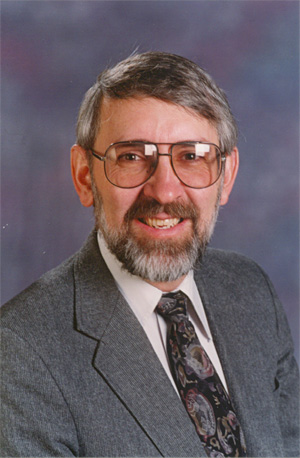 "The ramifications of my diagnosis are huge," says Dr. Steiner.
 photos by Walter Novak
Monica and Trenton were separated from Nathan for seven months.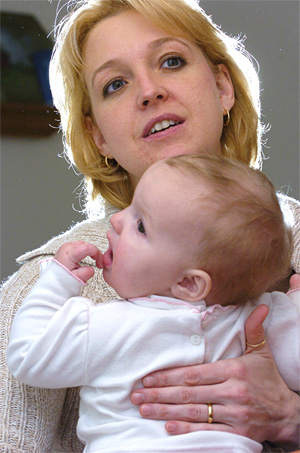 Photo by Walter Novak
"Everyone kept telling us Dr. Steiner is never wrong," says LeAnn. Photo by Walter Novak
Becca worried she'd be taken from her parents too.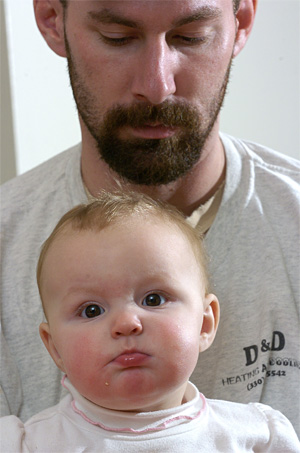 Photo by Walter Novak
Rachel was separated from her father, Dan, for four months. Photo by Walter Novak
Bill Whitaker twice proved Steiner was wrong.Nathan Humrighouse held him with outstretched arms, raising him just above his head. "Ssh, ssh, ssh," Nathan chanted to his son.
But Trenton wasn't having it. He wiggled out of Nathan's grip and dove directly into his face. The fall startled both father and son.
Nathan, a 31-year-old nurse, carefully examined Trenton. Though he appeared to be fine, he called his wife, Monica. She too was a nurse, working the night shift at Canton's Aultman Hospital, having just returned from maternity leave.
A doctor told her to bring the baby in, just to be safe.
That's when a CAT scan revealed that Trenton had suffered a subdural hematoma -- bleeding within the Saran-wrap-like lining of the brain. "We knew what it was immediately," Monica says. "We knew how serious it was, what kind of brain damage it could cause, and we were shocked and upset."
Since Aultman didn't specialize in working with infants, Trenton was transferred to Akron Children's Hospital.
Doctors and nurses did their best to console the visibly shaken parents. "The ER physician told us that children recover easily from this," Nathan says. "He even said that his son had suffered a subdural hematoma from birth."
But they were also warned that whenever infants arrive with head injuries, it's required that the hospital investigate the possibility of child abuse.
As Trenton underwent more tests, his parents met with social workers and nurses, telling their story again and again. "They all told us it was nothing out of the ordinary," Nathan says. "And we were fine with it. We were glad they were being so thorough."
Trenton was kept overnight for observation. His parents never left his side.
The following day, the couple met with Dr. Daryl Steiner, a lean man whose salt-and-pepper beard creates an air of physician's distinction.
Steiner pulled the couple into a separate room. He didn't ask questions, didn't offer consolation. Instead, he stared coldly at Nathan and accused him of abuse.
Nathan's story didn't jibe with Trenton's injury, Steiner said. The only thing that could cause a brain to bleed like that was if Nathan violently shook his son. This was, 100 percent, a case of shaken-baby syndrome, he informed the couple.
Steiner ordered Nathan to leave the hospital immediately and to have no further contact with Trenton. The couple would have to meet with Stark County Child Protective Services.
Monica burst into hysterical tears. "It was bad enough that our son had a serious injury," she says. "But to be accused of causing it?"
Dr. Steiner has seen some horrific things in his 31 years at Children's Hospital. He's treated kids burned beyond recognition, bloodied babies who've been slammed against walls, infants who've been squeezed so tight, their ribs were crushed into shards of irreparable bones. So he dedicated his life to protecting defenseless children.
He began his career at Children's, a fat slab of concrete that dominates Akron's skyline. By 1991, he was appointed director of the hospital's Children at Risk Evaluation Center, better known as the C.A.R.E Center.
At the time, it was just a small part of Children's emergency-room operations. But in Steiner's hands, it quickly became one of the most respected child-abuse centers in the country. He built his own staff and perfected its evaluation process.
At the same time, a newly discovered phenomenon was drawing much attention in the field.
For decades, infants had been turning up in emergency rooms with brain injuries -- but without any visible signs of trauma. In the late '60s, doctors determined that this condition could be caused by the simple act of shaking a baby. It wasn't until 30 years later, however, that medicine christened this mysterious malady with a name: shaken-baby syndrome.
Soon, hospitals nationwide were launching public awareness campaigns, warning anyone in reach of a baby about the deadly effects of shaking an infant. In Akron, there was a time when you couldn't drive down Market Street without seeing a billboard showing a smiling child next to the slogan "Never, Never, Never Shake a Baby." Steiner was behind it all.
Among the movement's most vociferous advocates, he devised a special evaluation process for suspected cases.
First, the child is given a CAT scan for brain trauma. If bleeding under the brain lining is discovered, Steiner then looks for bleeding behind the eyes. If both conditions are present, he then interviews the parents.
There are few causes for a brain injury of this kind, he believes -- a bad car crash, a serious fall -- or, most likely, violent shaking by a perturbed parent. "I think it's an extremely violent event -- nothing approaching the normal handling of a child," Steiner says.
If the parents' story doesn't match up -- or they simply don't have a story to tell -- Steiner's diagnosis is abuse. "I have never had a caregiver come to me and say, 'Well, I threw the baby up against the wall,'" he says. "And the child can't tell me either. It's only after the investigation that the confessions come."
In the past 25 years, he's diagnosed at least 275 infants with the syndrome.
"It's a very agonizing decision," he says. "I have to be 100 percent correct, because if I diagnose a child as abused and it's not, it's as damaging to the child and the family as if I return a child to an abusive environment. The ramifications of my diagnosis are huge."
Unfortunately, Steiner has been wrong -- on more than one occasion.
LeAnn Dunkle sits at her dining-room table, surrounded by her husband, parents, sister, and two daughters.
She's wrapped in a cozy beige cardigan, her youngest daughter tight at her chest. "I wish I never knew how easy it is to lose your children," she says. "And it is so easy."
LeAnn and her husband Dan stumbled across this unfortunate truth last July. The family was preparing for a camping trip. As LeAnn packed the hot dogs and diapers, Dan strapped their three-month-old daughter Rachel into a mobile car seat and placed her on a table.
He went about his preparations, then suddenly heard a loud thump and crying. He ran to find his three-year-old daughter, Becca, standing over her little sister, who was now laying face first on the floor, the car seat on top of her.
Dan quickly looked Rachel over. Nothing was bleeding or broken. "After about five minutes, she calmed down," Dan says. "She was scared more than anything."
Still, the Dunkles wanted to be safe. They called Rachel's pediatrician, who said she was more than likely fine, but if they wanted, they could take her to the emergency room.
The couple made the 30-minute drive from Wadsworth to Children's Hospital. A CAT scan revealed a subdural hematoma. "We had no idea what that meant," LeAnn says. "So when they said her brain was bleeding -- that feeling, it was terrifying. The whole room got long and narrow quickly."
Rachel was kept for observation. LeAnn spent the night with her, while Dan went home to watch Becca.
The next day they switched places. That's when Dan met Dr. Steiner. "He said, '100 percent shaken baby,'" Dan says. "He said the only other things that could cause it were a 35-mph crash or a three-story fall."
Steiner ordered more tests. For the next two days, the family waited patiently through numerous MRIs, eye exams, and the scrutiny of social workers.
Steiner finally returned with his diagnosis: 100 percent shaken-baby syndrome.
"But that's impossible!" LeAnn shouted. She threatened to leave with Rachel, but was told she'd be arrested. It would be best if she left the hospital voluntarily. She collapsed in grief, but helplessly agreed to go. "We thought that if we just cooperated, it'd all be over quickly," she says.
Dan called LeAnn's parents, who arrived at the hospital to watch over Rachel.
A few hours later, Medina Children Services arrived at the room, where the infant lay asleep in her grandmother's arms. "You're not taking this baby," Maureen Sega told them.
But it was no use. They were armed with a court order. The social worker pried Rachel from Sega's arms and disappeared. "It was one of the most horrible days of my life," Sega says.
The following week was a nightmare. Rachel was placed in foster care, her family clueless as to her whereabouts. LeAnn and Dan endured harsh questioning from social workers, who parsed their every word. "I asked them if we needed a lawyer," LeAnn says. "And the social worker says, 'Do you think you need a lawyer?' It was always guilty until you could prove yourself innocent."
Finally, Sega and her husband, who live next door to LeAnn and Dan, got temporary custody of Rachel.
Over the next four months, the Dunkles could only have supervised visits with their daughter. LeAnn often found herself peering through the window into her parents' house, pained that she wasn't the one rocking her little girl to sleep.
Three-year-old Becca suffered pangs of guilt, worried she'd be taken away too. "She was so scared," LeAnn says. "She'd say, 'Sorry I hurt Rachel. Will I have to go away too?'"
For the first time in their lives, the Dunkles had to hire a lawyer. They enlisted Bill Whitaker and his daughter Andrea. As the Whitakers built their case, LeAnn and Dan's lives were thrown into total flux.
"They split us apart," says Sega. "It felt vindictive. It was like how much pressure could they put on you until you snap?"
Finally, last October, their hearing in Medina County Juvenile Court took place. The Whitakers arrived with an arsenal of doctors, medical journals, and character witnesses to battle Steiner. It worked.
Dan plays the voice mail that LeAnn left for him on November 2 -- the day they got their daughter back. "She's not abused!" LeAnn exclaims over the phone.
As the Dunkles celebrated the return of their baby girl, the Humrighouses prepared for the worst.
Steiner had accused both couples of abuse within weeks of each other, but the Humrighouse case stretched on for twice as long.
After Nathan was ordered to leave Children's Hospital, Stark County Child Protective Services placed him under a no-contact order. Monica and Trenton moved into her mother's house.
For the next seven months, Nathan wasn't allowed to see his son without a social worker present. He missed most of Trenton's firsts, from sitting up to crawling. The joy of Thanksgiving and Christmas was replaced by separation and loss. "For those seven months, he didn't know me," Nathan says. "He was completely uprooted from what he knew and where he lived."
Then, a day after Christmas, things took a turn for the worse. Nathan was indicted for child endangerment, a second-degree felony. Steiner was the prosecution's only witness. "Steiner had told them that it was, absolutely, abuse," Nathan says. "He said it needed to be prosecuted in criminal court."
For the first time in his life, Nathan found himself in jail. He was placed on leave at Aultman Hospital and faced a prison sentence of two to eight years. "I was terrified," he says. "I felt like we had to prove our innocence, rather than the other way around."
As his hearing approached, Nathan and Monica remembered reading about the Dunkles' case. They contacted Bill and Andrea Whitaker.
By this time, Bill Whitaker had become something of an expert on shaken-baby syndrome as well as Dr. Steiner's methods. "Frankly, Dr. Steiner is not up-to-date on the research that's been done as to the cause of subdural hematomas," the lawyer says.
Whitaker took Trenton's medical records to Dr. Ronald Uscinski, a pediatric neurosurgeon at Georgetown University and an expert on subdural hematomas.
Uscinski concluded that Trenton's bleeding wasn't a result of shaken-baby syndrome. It wasn't even caused by the accident. It had been there since the day he was born.
Uscinski points to the way an infant's soft skull adjusts to the shape of the mother's birth canal. In the case of traumatic births, many babies' skulls will shift severely enough to cause cranial bleeding. It's a common side effect of the birth process that can sometimes cause severe brain damage, but usually results in little more than a cone-shaped head, just like Trenton's.
Medical records also showed that Monica had been in labor for 22 hours before Trenton was free of the birth canal. "It's more likely than not that he got it from birth," Uscinski says. "It's not unusual. Surgeons have known this is common for a century or more."
Trenton's CAT scan from June -- the same scan Steiner used to make his charges -- cemented Uscinski's thesis.
The scan shows a mixture of new blood and old, distinguished by varying color and density. "Often time, children will suffer a rebleed in the months after their birth," Uscinski says. "It can be caused by literally nothing. A baby can simply cry and have a rebleed."
On February 1, Uscinski said as much at Nathan's criminal hearing. His claims were backed by Dr. Geneiso Serri, the Aultman emergency-room doctor who saw Trenton on June 29.
"We didn't suspect abuse," Serri said. "Any child under the age of one gets a CAT scan, because we're finding more and more brain injuries resulting from minor trauma. You'd be shocked by how the most trivial trauma causes subdural hematomas."
The only voice of protest was Steiner's.
He said he knew of Trenton's difficulties at birth, but ruled them out as a cause. He insisted that the only possible cause of Trenton's injury was abuse. "The father says they bumped heads," he said. "That's nothing, that's trivial. The mere fact that he had a bleed showed this was serious."
But the court didn't find his argument convincing.
A few days later, Judge Lee Sinclair threw out Nathan's case. The Humrighouses were finally reunited.
Two months after their reunion, the couple is getting used to normal life again. "Trenton's just now starting to sleep through the night," Monica says. "It was a rough adjustment." These days, he's an active toddler, insistent upon walking by himself, even though he falls every few feet.
The couple has no bitterness toward Steiner or Children's Hospital. They're simply relieved to be together again. "It made us realize that family is all that's important," Monica says. "I just thank God that [Trenton] will never remember this."
But when they share their tale with others, they're not greeted with the same forgive-and-forget resolve.
"A lot of people tell us that they're afraid of taking their own kids to the hospital when they have accidents," Monica says. "It's scary for people to think how much power they can lose and how much power one person can have over their lives. I hate to say it, but I probably wouldn't take [Trenton] to Children's ever again."
The Dunkles say their story elicits the same reaction. After a friend's kid took a spill, he started heading to Children's -- until he thought of the Dunkles' story. He turned around, afraid of being accused of abuse.
"Everyone kept telling us, 'Dr. Steiner is never wrong,'" LeAnn says. "But he has been wrong -- at least twice. It's scary to think of how much authority these doctors have. One person shouldn't be allowed to decide the fate of our child."
Steiner can't comment on specific cases. He acknowledges a legitimate debate over the causes of bleeding on the brain. But he continues to stick by his methods.
"The idea that somebody can make a definitive diagnosis on very minimal evidence -- it's of great concern," Bill Whitaker says. "If parents are going to be misdiagnosed and accused of abuse, it's a huge concern."
Source: Cleveland Scene website
Bill 165
April 18, 2007 permalink
A pending bill 88 introduced by Andrea Horwath would give the power to investigate children's aid societies to the provincial ombudsman. That office is occupied by the hard-hitting André Marin, who is aware of the extent of the problems with children's aid. A report from him could precipitate a scandal leading to real reform. In an effort to protect themselves, social services spokesman Mary Anne Chambers introduced a neutered bill 165 to withhold investigatory power from the obudsman, but to modify the powers of the child advocate, currently career social worker Judy Finlay. The advocate would not have subpoena power, so it is unlikely she could do anything that would cause a public outcry.
There is a website, Child Advocacy Renewal in Ontario, supporting bill 165. We believe it is a creation of the social services system, since it shares their graphic design (all smiling faces) and has the same street address, 25 Spadina Road Toronto, as the Children's Aid Foundation.
Whether or not bill 165 is an improvement, hearings could be an opportunity for victims of the current regime and advocates of true reform to get their objections on record. Those wishing to do so through the social services system can use Child Advocacy Renewal in Ontario; John Dunn suggests asking for Matthew Geigen-Miller. For less biased help, we can suggest:
- The Committee on Justice Policy. Chair: Lorenzo Berardinetti. Clerk: Anne Stokes 416-325-3515.
- The two MPPs most committed to children's aid reform: Andrea Horwath (Sheila White assistant) 416-325-2777 and Howard Hampton 416-325-8300.
- Lisa McLeod, PC critic, 416-325-6351.
Addendum: Another website allied with social services, Voices for Children, says the hearings will take place on April 25 and 26.
Another Chambers Boondoggle
April 18, 2007 permalink
As a result of children's aid intervention, orthodontic treatment for T Norris was canceled, and he cannot get his needed braces. Yesterday Mary Anne Chambers made another one of her routine announcements of a grant for some project in the name of children. This one begins: McGuinty government helping children. Providing $250,000 To University of Toronto For Children's Dental Services. The project will do nothing to help Mr Norris. Mrs Chambers should concentrate on leaving children with parents willing to care for them.
FBI targets child care agency
April 17, 2007 permalink
The FBI has raided the offices of ChildNet in Florida finding evidence of corruption.
expand
collapse
FBI targets child care agency
Broward's child-welfare board has fired the president, and the FBI served search warrants at the agency's offices.
Broward foster children often rode in potentially unsafe cars and vans because an auto repair shop paid kickbacks to an employee of the county's child welfare agency to avoid making repairs.
And dozens of the foster care agency's employees stole donated toys intended for foster kids last Christmas.
These are among the allegations in a March 30 report by two private investigators hired to look into irregularities at ChildNet, one of 20 privately run child welfare agencies across Florida. The state Department of Children and Families will pay ChildNet $65 million this budget year to supervise 1,043 children in state care in Broward.
Troubles at ChildNet mounted Friday as federal agents swarmed the agency's Fort Lauderdale offices, state administrators threatened to cancel the agency's current contract, and board members voted to fire the group's founding president.
Ousted Friday afternoon was Peter Balitsaris, a longtime South Florida child advocate who helped create ChildNet about five years ago. The lone board member who fought Balitsaris' firing, Virginia Miller, resigned.
The other board members issued a statement vowing to continue the agency's work.
''The most important thing we want people to know is that foster children will be well cared for, and there will be absolutely no disruptions in any of the services we provide,'' Board Secretary Howard Bakalar said in the statement.
ChildNet, based at 1400 W. Commercial Blvd., employs 430 people.
The board decided to fire Balitsaris after DCF's top administrator in Broward, Jack Moss, gave them a letter terminating ChildNet's contract with the state. The contract was reinstated later in the day.
An emergency meeting of the board had been called after Balitsaris fired two ChildNet employees -- both with extensive criminal records -- who were under suspicion in the theft of $8,000 in Wal-Mart gift cards intended for use by foster kids and the heft of a Dell laptop computer that had contained confidential information on foster and adoptive parents.
STARTLING FINDINGS
But a five-page summary of ChildNet's own investigation -- performed partly by a former Drug Enforcement Administration agent turned private eye -- included a host of startling allegations and findings. Among them:
- Two men in charge of facilities management and security at ChildNet, Steven Williams, 47, of Fort Lauderdale and Brady Grant, 35, of Coral Springs, were convicted felons with lengthy criminal histories. Williams' convictions included burglary in 1988 and battery in 1992, both in Tampa, according to the Florida Department of Law Enforcement.
Grant was sentenced to prison in 1995 for manslaughter and again in 2001 on a cocaine conviction, according to the Florida Department of Corrections.
- ''Vehicles used to transport children are possibly unsafe,'' the report said, because the auto repair shop hired to fix them instead paid kickbacks to Williams to ignore the needed repairs.
- Cars and vans used to cart children ''may not be repaired properly, or at all.'' Moss, DCF's top administrator in South Florida, said the vehicles since have been inspected to ensure they're safe.
- ChildNet had no inventory system for ''high-value items'' like computers and furniture.
- ChildNet's chief financial officer, Peter Greenhough, ''routinely'' asked Williams to submit doctored invoices to make it easier for ChildNet to seek reimbursement from the state for spending. In one case, Greenhough had a vendor call a wall a ''partition'' because the state would not pay for the building of a wall.
Moss commended ChildNet's board for acting quickly upon receipt of the allegations and affirmed his support for caseworkers and supervisors during an unsettling period.
''Our No. 1 concern is children being safe,'' said DCF Secretary Bob Butterworth, who was in Fort Lauderdale on Friday. ``We don't have any reason to believe any of this has adversely affected the safety of any children.''
FBI agents served a search warrant at ChildNet's main office Friday morning. As of late Friday, the bureau had declined to specify what it was searching for.
And Butterworth, a former Broward sheriff, said he didn't know what agents were seeking.
''We are not sure if the investigation is related to ChildNet's operations or if it targets a specific employee suspected of a crime unrelated to the agency,'' he said.
$30 MILLION CHUNK
There are clues as to the FBI's involvement: The federal government, through the state, provides about $30 million of ChildNet's budget, Butterworth said.
Also, the investigative report included allegations of ''mail fraud, wire fraud [and an] organized scheme to defraud the state'' -- crimes that would fall under federal jurisdiction and typically be investigated by the FBI.
Source: Miami Herald
Thieves add new dimension to foster care
Foster kids go missing. They get pummeled. They get killed.
The negligence and mistreatment of Florida foster children have long been recurring themes. Children have been relegated to cheap motels. Troublesome foster kids, some of them preschoolers, have been transformed into manageable zombies with psychotropic drugs.
In 2002, a Broward County grand jury found ''overwhelming evidence that the children who are in the custody and care of [the Department of Children and Families] are in danger,'' finding striking strikingly similar to a 1996 Miami-Dade grand jury report describing a foster care system ``that victimizes children once again.''
DEJA VU
The key phrase was ''once again.'' In 1996, shameful treatment of foster children was the same old news.
But the scandal that exploded last week out of ChildNet, a private vendor hired to manage foster care cases in Broward County, introduced a new element in the old story -- petty criminality. ChildNet workers ripped off Christmas presents. In an inside job, they stole donated presents and $8,000 worth of Wal-Mart gift cards meant for foster kids from ChildNet offices in Fort Lauderdale.
The theft of a laptop computer with the names and personal information of 12,000 prospective foster parents was serious, but computer theft doesn't quite deliver the kick-in-the-gut like a ChildNet supervisor who collected kickbacks and consigned kids to unsafe vehicles. According to a report by private investigators hired to look into peculiar happenings, ChildNet vehicles that were used to transport children weren't repaired, ``but the vendor was sent invoices and was paid in full.''
JEB'S PLAN
Privatization was championed by former Gov. Jeb Bush as an answer to the long dreary history of failures by DCF. But what we got for our $64 million was petty theft. And a couple of hires with striking criminal records.
ChildNet put a fellow named Steve Williams, 47, in charge of security. Private Investigator Wayne Black's report said, 'Checking Williams' background, we found that he is a convicted felon with a lengthy history of burglary, theft and minor drug possession.'' State records also include a battery conviction, not that anyone cared.
When ChildNet hired Brady Grant, 35, (aka Brady Washington) as assistant facilities coordinator, according to the report, the contractor failed to notice that Grant was also a convicted felon and ``appears to be an habitual criminal with an eight-page public record rap sheet.''
Black reported that Brady has served time in prison or been arrested for robbery, probation violation, robbery with a weapon, armed robbery, discharging a firearm in public, firing into an occupied vehicle, firing into a public building, battery, parole violation.
Oh, yes, there was also the small matter of manslaughter.
MIRACULOUS HEALING
That Brady Grant was not only out of prison but holding down a management position for a foster care provider might be seen as a miracle in rehabilitation. Except it was Grady who told the private investigators that he and Williams were involved in vendor kickback schemes. He also described how they rigged the ChildNet security cameras to be turned off from a remote location -- taking the risk out of theft.
But privatization might still be an improvement over the old system. Instead of losing and abusing the kids, now we're only stealing their Christmas presents.
Source: Miami Herald
CCW Message Board Returns
April 17, 2007 permalink
Canada Court Watch opened a new Public Discussion Forum on April 10. The new board requires registration to post, but not to read, messages. A posting on April 11 describes an effort by the Office of the Children's Lawyer to muzzle Canada Court Watch by forcing unfavorable documents off its website. There is nothing to indicate the result of the hearing scheduled for last Thursday.
expand
collapse
Children's Lawyer's Office attempts to silence complaints
posted by justice
Posted: Wed Apr 11, 2007 9:38 pm
This is right off the Fathers Battling Injustice site Call we need all those that are close to show support. Lets let them know this was a big mistake. If they lose we will get national attention now and it should!!!!!!!!!!!!
Dear Court Watch Supporters
The Office of the Children's Lawyer has filed a motion against Canada Court Watch and Mr. Vern Beck to remove documents from the Court Watch Website which cast the the Children's Aid Society and the Office of the Children's Lawyer in a bad light.
This is an attempt to remove criticizm of their organizations and to set a dangerous precident to erode the freedom of the press in order to prevent individuals and organizations from saying bad things about them in the future.
The presence of supporters of Court Watch would be helpful and their presence at court would be appreciated. The presence of members of the public in the court sends a strong message to the court that people are concerned and that the Judge must be just.
Mr. Vern Beck will be presenting arguments to the court in defence of Court Watch and members of the public (you) who have been adversly affected by these organizations. To those who have received help or information from Mr. Beck or Court Watch in the past, it is time to return the favour by showing your support in court.
Time: 9:30 am (sharp) on Thursday April 12, 2007
Source: Canada Court Watch message board
What DHS knew ... but didn't act on
April 15, 2007 permalink
When a homosexual foster couple turned their home into a pedophile paradise, Oklahoma DHS knew of the problem but failed to take action until receiving a complaint.
expand
collapse
What DHS knew ... but didn't act on until a foster child reported sexual abuse
 Former foster parent Paul Stephen Hull walks to court Tuesday in Norman to plead guilty to sex and drug crimes.By CHRIS LANDSBERGER, THE OKLAHOMAN
EDITOR'S NOTE
This is one in a continuing series of reports by The Oklahoman concerning the state Department of Human Services. The agency has more than 7,500 employees and manages a $1.6 billion budget. It is responsible for caring for children, the elderly and underprivileged.Because of state privacy laws, many of the agency's records are confidential. The Oklahoman has asked for those records — some of which would show whether employees are convicted criminals — and has been denied access.
WHAT YOU CAN DO: If you have a DHS issue you would like to share, email us at city@oklahoman.com.
Foster children
Almost 10,000 children are in foster care in Oklahoma.The Oklahoma Department of Human Services reported having 8,345 children in normal foster care homes last month.
Another 1,064 children with special medical, psychological or emotional needs were in therapeutic foster care homes.
DHS says it pays a normal foster parent $12.17 a day for a child under 6, $14.33 a day for a child 6 to 12, and $16.61 a day for a child 13 or older.
The state says it pays $70.51 a day for a child needing therapeutic foster care. Those payments for therapeutic care are shared by the foster parents and the agencies that recruit and train foster parents and provide clinical services to the children.
By Nolan Clay and Randy Ellis, Staff Writers
A secret report shows state Department of Human Services workers knew about serious problems at an Oklahoma City foster home where four boys were staying, but didn't shut it down until one boy revealed he had been sexually abused there.
The foster father, Paul Stephen Hull, last week pleaded guilty to joining a live-in male lover in sexually assaulting one of the foster sons — multiple times.
The rape victim said the two men called him and boys his age their "candy.”
Hull — a longtime teacher — was so highly regarded by Oklahoma Department of Human Services officials that they paid him to keep more than the normal limit of special-needs foster children in his home, The Oklahoman has learned.
The case is raising questions about whether the state agency responsible for the care of troubled and deprived children scrutinizes its foster parents enough.
"I'm still trying to figure out why he was given foster children,” said one Oklahoma City police detective who investigated the foster parent.
Hull — who counts Hitler among his heroes — retired as an English teacher at Capitol Hill High School after he was charged.
Hull, 55, pleaded guilty to attempted rape, forcible sodomy, second-degree rape, lewd molestation and drug crimes over his 2006 sexual abuse of the boy.
He agreed to spend eight years in prison and to testify against his former lover, a child killer who faces trial in June for also allegedly raping and molesting the foster boy. Hull remains free until after the trial.
The friend, Erwin Charles Swender, 41, spent time in an Iowa juvenile center for beating a 22-month-old boy to death in 1981 and lost parental rights to seven of his own children, records show.
He already is on probation for drug possession.
He has denied to police that he sexually assaulted any of Hull's foster children.
The foster boy told investigators the two men took turns sexually assaulting him last year in the foster father's bed and in the shower.
He was then 15.
The victim has demanded $175,000 from the state, saying child-welfare workers placed and left him "in the foster home setting that they knew was fraught with peril.”
The victim's court-appointed attorney, D. Letitia Ness, complained specifically that DHS workers should have removed the boys after discovering "an unknown adult male” had moved in.
Policy questioned
Cleveland County District Attorney Greg Mashburn said he realizes DHS officials cannot discriminate against gays but should review their policies.
"It's a concern to me,” he said. "Hopefully, they've taken a fresh look at it to make sure something like that doesn't happen again.”
The prosecutor said social workers certainly should investigate if a foster parent keeps requesting only males of a certain age.
A few states have tried to ban gays from being foster parents. The Arkansas Supreme Court struck down a ban in that state last year.
"We do not generate policies that make distinctions other than does the person or company have the ability to fulfill the service that needs to be delivered,” DHS spokesman George Johnson said. "Being single or gay is not a part of such distinctions.”
Foster care officials say Hull underwent vigorous background checks, including from the Oklahoma State Bureau of Investigation and FBI.
Officials say workers would not have checked into Swender's background unless he had lived there two weeks and workers were informed of the living arrangement.
Hull had been a foster father for 10 years and was paid extra taxpayer dollars to provide therapeutic care for children with special needs. He got special permission to have more children at a time than most foster parents, officials said.
Normally, a therapeutic foster parent can only have two children in the home.
"This former foster parent was employed with the school system and certified as a foster parent for many years with no criminal behavior reported,” said an executive for Shadow Mountain Behavioral Health System, which is paid by DHS to find foster parents and to provide children with psychological services.
"We are devastated and outraged that an individual entrusted to help children would be capable of betraying those same children, their families, the mission of our program and the trust of the entire community,” said Shadow Mountain's chief operating officer, Elicia Bunch.
DHS attorneys declined to discuss the case.
Hull cared for at least 14 boys over the years, records show. Some have come forward since last year with stories of exposure to adult sexuality and pornography. One recounted that Hull made him "take a bath with a scrub brush and then ... would check him from head to toe to see if he had red all over his body,” records show.
The Oklahoman discovered this case during an ongoing look at DHS, which increasingly has faced criticism in the last two years, primarily because of high-profile deaths of children under its care.
The Oklahoman reviewed police reports, court records, foster parent requirements and a 41-page confidential report on the DHS investigation of Hull.
Teen says he was abused
According to the confidential report:
- The boy said he was abused for two weeks before he told a therapist. He said he was exposed to crystal meth, sex toys and gay pornography, and once was handcuffed. He said some of the acts were recorded on his foster father's computer. He said Hull's friend assaulted him first and his foster father got involved after the third or fourth time. He said the first time Hull joined them was the only night all three participated at the same time. He said he participated out of fear "because he knew that there were guns in the house.” He said he decided to tell his therapist "when more and more things started to happen.”
- He was removed from Hull's home Feb. 13, 2006, after he reported being sexually abused.
- A state social worker had been to Hull's home 10 days earlier, on Feb. 3, 2006, and found problems there. The social worker was investigating then because another foster boy had been suspended from school for snorting the contents of a pill.
- The worker found a foster child at the house alone with Hull's friend, which was not allowed. The worker reported the man — now known to be Swender — would not give his full name and that Hull later lied about the man.
- The worker also found the four boys at the home had unrestricted access to prescription medicine and dangerous tools such as saws, hammers and an ax. The boy who had been suspended from school had threatened the others with the ax and knives. That boy also had told a teacher about seeing sex toys at the home.
- The social worker and a Shadow Mountain official met with Hull that night and warned him not to have his friend in the home. The foster children were removed for the weekend.
- The victim was returned to the house after a few days. He later said his foster father's friend was in the house "the entire time that he had been back and that Steve wadded up the safety plan that stated Erwin was not to be in the home or around the kids and threw it in the trash.”
- State workers left the victim at the home even after they began to suspect on Feb. 6, 2006, that Hull's friend was Swender. The workers knew then that Swender had been institutionalized as a teenager for killing a child and that Swender was in the process of losing his parental rights to seven of his own children.
According to news accounts, Swender was in an Iowa juvenile center until he was 18, after he admitted he struck a 22-month-old boy three to four times. He was visiting the boy's baby sitter in 1981 and became angry when the boy soiled a diaper.
Hull's defense attorney said Hull was a kind, excellent foster father for many years but "lost his moral compass” after befriending Swender.
Hull met Swender on the Internet but did not know about Swender's past, the defense attorney, John Coyle, said.
Swender, who is in the Cleveland County jail, continues to deny wrongdoing.
He asked a judge in February for a media blackout in his case, writing, "I have school-age children that do not need the ridicule or embarrassment for something that their father didn't even do.”
Hull was to have gone on trial Monday.
A prosecutor said she was ready to put on testimony that Hull asked his son-in-law to kill the victim. Hull denies that, she said.
Hull identified Hitler as his hero on MySpace.com, a popular Web site for youths.
"Why not?” Hull wrote. "He rose from being a crappy artist to the top dawg of Germany.”
Source: the Oklahoman
Family Cut in Half
April 15, 2007 permalink
Remember the two women who appeared before King Solomon, both claiming to be mothers of the same baby? The king ordered the baby cut in half, with half given to each woman. The real mother chickened, begging Solomon to give it all to the other woman, rather than see it harmed.
Here is a current case of a mother compelled to give up her baby to save it from harm.
expand
collapse
April 14, 2007
Desperate mom denied
Children's Aid refuses to hold baby in child protection when single woman is deported to China
By TOM GODFREY, SUN MEDIA
 (Mark O'Neil/Sun Media)
MISSISSAUGA -- Single mom Hong Zhang cried a river of tears yesterday after learning she can't leave her baby daughter in Canada with Children's Aid when she is deported to her native China.
Zhang, 39, broke down after leaving the agency's Peel offices, where she had tried to place her only child.
She was told 1-year-old Sherry will be put up for adoption as an abandoned child if left behind, but Zhang wants the girl to sponsor her back to Canada some day.
"I feel very sad right now," Zhang said. "I do not want Sherry to go to China. I want her to have a better life in Canada."
As Zhang wept, the baby started crying and had to be cradled.
"My child will not have much of a future in China," she said through interpreter Jane Lou. "At least here she has some kind of future."
Roy Kellogg, Zhang's immigration consultant, said it can take more than 20 years for Zhang to be sponsored back to Canada by Sherry, who must first reach age 18.
Kellogg said the Canadian-born child will be treated as a second-class citizen if sent to China, where laws ban children out of wedlock. He said Sherry will be stigmatized and will not get health coverage, be allowed to attend school or to obtain Chinese citizenship.
As a single mom, Zhang also faces a fine of $140,000 a child for returning to China with children, Kellogg said.
Zhang came to Canada in 1997 and filed an unsuccessful refugee claim and appeals. She is to report to immigration next Wednesday to make deportation arrangements.
Lucie Baistrocchi, a Peel Children's Aid spokesman, said yesterday each child has to be assessed as requiring protection before they're accepted as wards.
"We are not aware of any child protection issues in this case," Baistrocchi said. "There has to be a child protection issue."
Anna Pape, of the Canada Border Services Agency, said her officers must deport those who have exhausted all avenues for staying here.
"Our job is to enforce the laws of the land," Pape said. "We don't decide who gets to stay in Canada."
Source: canoe.ca
Wrong Rights
April 14, 2007 permalink
The Citizen has published a proposed Children's Charter of Rights. It requires an understanding of the difference between positive and negative rights. The proposed rights are all positive, requiring for their implementation intervention by someone outside the family. For example, protection from exposure to family violence requires cops to look inside the family to control it. Families are reduced to one of a set of alternative role models. For more on this issue, refer to the book What's Wrong with Children's Rights by Martin Guggenheim. What children desperately need is a charter of negative rights, granting them the right to remain with mom and dad, unless mom and dad have failed in their responsibilities.
The group producing the proposal is described only as a number of child-centred committees and organizations, a working group of the Wellington-Dufferin-Guelph Report Card Coalition on the Wellbeing of Children. No members are mentioned, but it sounds like a coalition of social services agencies such as Family Transition Place and Dufferin Children's Aid.
expand
collapse
Orangeville, Ont
Orangeville Citizen
Local News — April 12, 2007
Working group produces Children's Charter
With input from a number of child-centred committees and organizations, a working group of the Wellington- Dufferin-Guelph Report Card Coalition on the Wellbeing of Children has developed a Children's Charter of Rights.
Based on the United Nations Convention on the Rights of the Child, it is a document that outlines a vision to make Wellington- Dufferin-Guelph a better place for children and families. The Charter includes a series of statements that outline what our communities need to do in order to ensure healthy development and bright futures for all of our children.
In the Universal Declaration of Human Rights, the United Nations has proclaimed that childhood is entitled to special care and assistance. The Convention on the Rights of the Child (CRC) is the most widely ratified human rights treaty in history. It sets forth a wide range of provisions that encompass civil rights and freedoms, family environment, basic health and welfare, education, leisure and cultural activities, and special protection measures.
The group's goal is to have the Children's Charter adopted and endorsed by political councils, community organizations and local businesses in an effort to make a compelling statement about our collective intent to support, and advocate for, the rights of children.
The Children's Charter will be launched in the spring with an official signing.
Following is the Charter's text:
All children deserve basic rights and freedoms. A fair share of society's resources must be devoted to ensuring this. While families are responsible for raising their children, all levels of government, in partnership with communities, have a duty to support families by putting the health and well-being of children first.
All children in Wellington Dufferin-Guelph have a right to:
- A quality of life that meets their physical, intellectual, emotional, spiritual and social needs.
- Have basic needs met including nutritious food, a healthy environment and a safe and comfortable place to live.
- Access quality and affordable child care, early education programs and/or parenting support.
- Safe places and time to play, and access to affordable recreational activities.
- Quality education to enable them to reach their full potential.
- Quality time with their families and/or other nurturing and positive role models throughout their childhood.
- Protection from neglect, abuse and exposure to family violence.
- Be accepted for who they are, and believe what they want without being discriminated against.
Source: Orangeville Citizen
Mom Sentenced
April 14, 2007 permalink
In August 2005 we reported the story of the girl Emily Lake maced by police in Oregon and rushed back to foster care in Michigan. Most recently, she was visited by her mother in July 2006. Here is the latest report from Ann Durand on the mother being sentenced for kidnapping her own daughter.
expand
collapse
Mother Sentenced to 30 days
On April 5, 2007 Lynnae Lake was sentenced to 30 days in Jail in the Midland Michigan County Jail for custodial kidnapping of her own daughter from the Department of Human Services on May 28 2004.
She was tried and convicted under MCL 750.350a .
If you are parent and your spouse refuses you parenting time for 24 hours, a weekend or a week or for whatever period just try to get a police officer to take a police report. Just try to get a prosecutor to file charges. It is not going to happen in this state. Believe me I know several people who have tried. The police officer will tell you "it is a civil matter you will have to hire an attorney and go to court". Upon contacting the legislature and requesting and receiving a copy of the legislative intent of this statute it is quite apparent it was not meant to be used by the Michigan DHS in a case like this especially when DHS worker is the one who is deemed to have been the custodian, committed numerous illegal and unconstitutional acts that precipitated the mother's actions.
The DHS says the verbal order to a DHS worker of a referee is a legal order. They say an order with a judge's forged signature is a lawful order. They say it is ok that the worker entered a private Christian School after being challenged by the principal as to his right to demand entry and to interrogate another child of this mother and threatening the principal with calling the police. The worker had no court order in his hands, no warrant to search when he did this. (blatant violation of the 4th amendment) Workers in this state MAY enter a PUBLIC school and interview your children without a warrant or court order. But no state actor, police officer or DHS worker has the right to enter on to any private property without a warrant or exigent circumstances. The worker in this case lied to the principal and told him he had a court order. He did not. He has admitted in court he did not. He held her 17 ½ yr-old daughter behind locked doors in a room in the school physically restrained her and told her not to talk to her mother. This is illegal seizure under the law. Ms Lake was ordered by the principal to take her younger daughter and leave the school. She did.
Also if you will read the statute below you will see the actual statute.
For the complete story go to www.fcr4kids.org/
Emily is still to this day in the custody of DHS and the same adult sister who helped plan this travesty. She is not allowed to see her mother except in a tiny room with a 2 way mirror with a DHS worker in the room. They see each other for 1 hour sporadically at the whim of DHS. This is 20 months after the brutal taking and pepper spraying in the face of this child by police officers and being threatened with attack dogs. She watched the officers beat her mother in front of her as she begged them not to hurt her mother.
Here is the link to the Michigan Custodial Kidnapping statute.
Keep in mind there was NO (lawful) giving the DHS worker custody of this child.
Keep in mind if you are a parent the state will not charge your ex spouse or significant other with this statute which was written to protect your rights as a parent.
This mother was never served with a summons nor did anyone from DHS even so much as call her to appear for hearings of that day or subsequent days. They held a trial 2 months later without proper notification, no attorney for mother, and took unlawful hearsay evidence as fact. The so-called victim, the 17 ½ year old daughter did not testify in the dependency hearings in the probate court. Only the DHS worker did.
Source: AFRA CenCom posting from Ann Durand
Dr Phil Interviews Allison Quets
April 14, 2007 permalink
Allison Quets, who fled to Canada in December with her toddler twins, was interviewed in jail by Dr Phil. During her pregnancy she developed the life-threatening condition hyperemesis gravidarum. While still weakened from the disease after the birth of the twins, she was subject to two all-day psychological warfare sessions in the office of an adoption lawyer, who induced her to sign the necessary documents. During one she called 911 in a frantic and unsuccessful effort to get help. Florida provides no cooling-off period for this kind of document, so Allison legally lost her children.
The video is not online, but three slide shows of Twin Tug of War are available on the Dr Phil website.
Previous articles: January 4 and December 29.
Lawsuit Ends
April 13, 2007 permalink
The Supreme Court of Canada has ended a lawsuit seeking funding for the treatment of autistic children. If successful, the suit would have removed the power to appropriate tax funds from the legislature and given it to the courts, and would have increased the amount of money and power for social services, further diminishing the role of parents in the lives of children.
Correction: In an earlier version of this item, we mistakenly said this was the Anne Larcade suit. That is another pending matter.
expand
collapse
Posted AT 10:25 AM EDT ON 12/04/07
Supreme Court spurns autism appeal
Canadian Press
OTTAWA — The Supreme Court of Canada will not hear an appeal from a group of Ontario families seeking money for specialized treatment for autistic children.
 Robin Wynberg, front, with her legal team in a civil suit over special education for autistic children, from left, Pheroze Jeejeebhoy, Jonathan Strug and Mary Eberts. (Tibor Kolley/Globe and Mail files)
The 28 families initially won a court ruling over government financing for costly intensive behavioural therapy, but that was overturned by the Ontario Court of Appeal.
As is usual in leave-to-appeal rulings, the court gave no reasons for its decision.
A Senate committee last month recommended that Canada develop a national plan to deal with autism, including new measures to help families saddled with huge bills for therapy.
Source: Globe and Mail
Putman Retiring
April 13, 2007 permalink
Gary Putman will retire from Dufferin Child and Family Services in November. The article below, based on information provided by Mr Putman himself, puts a positive light on his accomplishments. In our experience, during his tenure he has terrorized Dufferin County. We have spoken to parents, newspaper editors and his own employees who live in fear of Mr Putman.
expand
collapse
Orangeville, Ont — Orangeville Citizen
Local News April 12, 2007
Putman retiring from Dufferin Child and Family Services
Tom Murray, President of Dufferin Child and Family Services, has announced the planned retirement next November of the agency's executive director, Gary Putman.
Mr. Putman began his social Work career in 1971 after graduating from the University of Toronto's School of Social Work. He developed his skills and gained valuable experience working with the Hamilton Children's Aid Society, the Lynwood Hall Treatment Center and the Peel Children's Aid Society.
In 1978 he began his tenure with Dufferin Child and Family Services. At that time the agency dealt only with child welfare and operated with a staff of eight employees.
"Throughout the following 29 years, Gary developed and demonstrated his skills as a leader not only within the agency, but also within the community that he proudly served," Mr. Murray said in a press release recently.
"Gary participated and helped in the development of many local community planning bodies.
He was instrumental in the early development of Family Transition Place and Community First in Dufferin County. He participated on the Boards of Community Living Dufferin, Big Brothers of Orangeville and District, North Peel-Dufferin Community Legal Clinic and served two terms on the Ontario Association of Children's Aid Societies."
Mr. Putman was described as having nurtured and guided the agency through significant growth within Dufferin. "There have been many ups and downs, but Gary continually planned and developed for the future of Dufferin County," Mr. Murray said. "Through Gary's vision and guidance, Dufferin Child and Family Services has now developed into a multi-service agency, providing child protection, children's mental health services, developmental support services and the supervised visitation program."
He said the director's 36 years of dedication to child welfare is greatly appreciated by the communities he has served in, "and by the children's lives he has touched directly and indirectly. He has always been optimistic with a vision to developing children and families to their full potential."
In informing the agency's directors of his plan to retire, Mr. Putman praised the staff as "immensely dedicated and talented professionals who I will very much miss."
He plans to retire on November 30. The Board of Directors will begin a search for a new executive director immediately.
Source: Orangeville Citizen
Tracy Cain R.I.P.
April 12, 2007 permalink
John Dunn reports the death of a mother who was in regular contact with her daughter in foster care until CAS hardball tactics separated them. The despair of permanently losing her daughter drove her drug abuse, leading to her death.
In separation cases like this, it is easy to overlook the fact that uniting mothers and daughters can improve the mother as well as the daughter.
expand
collapse
- Date:
- Thu, 12 Apr 2007 09:39:58 -0400
- From:
- John Dunn afterfostercare@hotmail.com
- Subject:
- Sad News
Dear List Members,
I have been informed recently that a person I used to work with, who was an excellent fighter for her daughter, but who at the time was subject to the restrictive CFSA, has passed away. Her daugther was placed in a foster home while the mother was involved in a rather unfavourable situation ending up in a two year prison situation.
As a result of her two years in prison, her daughter went into foster care, and was in a good home. After her sentence, she worked, stayed in Narcotics Anonymous and became very deeply involved in running the program, organizing dances and other activities in NA.
She kept clean, worked full time and was doing well for herself while dealing with personal matters but keeping clean. She had ongoing visits with her daughter who was in a good foster home for four years when the CAS started to reduce her visits.
The visits were being reduced in order to promote adoption. (Still unsure of who was seeking adoption at the time) but the foster home was excellent at keeping the family in touch. Then, the CAS told the little nine year old girl at the time that she would be seeing her mother for the last time.
The mother was trying to get a visit around Christmas a few years ago when the CAS was refusing to allow it. We went on a campaign to attempt to stop the CAS from preventing a Christmas visit with her siblings and mother. The campaign involved a poster which, if they did not allow the visit, was going to be spread far and wide and postered all over downtown. The Poster read "CAS Keeps nine year old girl from her mother and siblings at Christmas against her will" and provided numbers to call at the CAS to have the public privide their opinion on the matter.
Fortunately, the notice to the Society was effective, we did not have to go on the campaign. The CAS offered her on the phone "Just this time". They had the visit, which resulted in a great picture on a site I will link to later.
Sadly, after that, the pressure of permanently losing her daughter pushed her back into the underground and there she stayed until January 2007, where she unfortunately passed away from a blood disease, I think caused by drug use.
If the mother and daughter had of at least been able to keep in touch, especialy since the mother was supportive of the foster home and the open relationship they all had maintained between each other, this now thirteen year old girl would still have a mother who loved her unconditionally.
We are not even sure if the girl has been made aware of the fact that her mother has passed, but I will be updating the list on the events as they come to be. This girl is now adopted, so is no longer the subject of a court proceeding or hearing, therefore making the following link to her web site made by her mother three years ago exempt from the secrecy legislation in the CFSA.
More will follow, since the mother's parents have informed me of the fact that her ashes have yet to be burried and I will discuss options of who might be able to visit or not during this ceremony, and if we will be making it a public affair or not.
Also these grandparents have not been able to maintain contact with the girl since her adoption. (3 years?) The CAS is even blocking Christmas cards etc. and are going to contact Kim Craitor, an Ontario MPP who has Bill 8 2005 in first reading status. This bill is to give grandparents a right of access to grand kids during custodial matters. (CAS as well I think)
I will follow up with more, this is just an emotional response letter to the list, more detailed and organized information will be provided on the web site later.
The internment ceremony willl be held this month some time we believe.
You can see how happy the girl was to be with her mother (front row on Mom's lap smiling widely in obvious happiness at being with her mother on her last visit at the CAS of which the mom fought for and won) tracycain.tripod.com
I would like to ask everyone to please take a moment to remember this image, for it is important that we realize how much their relationship meant to each other.
Sincerely,
John Dunn
The Foster Care Council of Canada
www.afterfostercare.ca Michelle, Eric and Melissa with mother Tracy Cain
Foster Boy Becomes Vegetable
April 11, 2007 permalink
Three-year-old James Bradley Jr was injured in foster care in Belleville Michigan, and is now fighting for his life in an Ann Arbor hospital after doctors had to remove parts of his skull and brain. The story from Fox news in Detroit may disappear soon.
Addendum: James Earl Bradley Jr died from his injuries on April 13. A Michigan reader commented on his newspaper's board:
*monotone voice
There is no problem here.... there is no problem with the system.... Everything is fine... We are doing our best... there is no problem here....
riiiiiiiiiiiiight.
Source: Lansing State Journal
Foster Company Loses Business
April 11, 2007 permalink
In case there was any doubt that foster care is run for profit, a foster care company, Lifeway For Youth Inc., is suing the state of Ohio for loss of business. It seems the state is unfairly punishing them for placing a boy with a family that murdered him, burned his body and threw his remains in the Ohio River.
expand
collapse
Last Updated: 7:44 pm | Tuesday, April 10, 2007
Lifeway sues state agency
BY SHEILA MCLAUGHLIN | SMCLAUGHLIN@ENQUIRER.COM
The company that placed 3-year-old Marcus Fiesel in a deadly foster home sued the state for $1 million Tuesday, saying the state spread lies that cost it business.
Lifeway For Youth, Inc., of New Carlisle, filed suit against the Ohio Department of Job and Family Services in the Ohio Court of Claims in Columbus, saying the agency’s motives were “purely political.”
The 13-year-old private foster care company accuses the state of libeling the company in the press, interfering with business relationships with foster families and referring agencies and abusing the state licensing process.
It claims the state launched its campaign to revoke Lifeway’s license even before it finished an investigation into Marcus’ death.
“(The state) has been more concerned about shifting blame than about the welfare of Ohio’s foster kids,” said Mike Berner, Lifeway’s founder and executive director.
Berner nurtured Lifeway from a ministry to a $15 million business that operates in six states, including Kentucky and Indiana.
The court filing comes a day after lawyers for the company and the state met to set nearly two weeks of hearings in June so Lifeway can challenge the state’s effort to take away its operating license in Ohio.
Lifeway still plans to go forward with those hearings. Those proceedings won’t affect Lifeway’s licenses elsewhere.
Berner claims he’s lost about one-third of his business in Ohio.
“The department, by being so thorough and relentless in its public statement about the inferior quality of Lifeway, effectively ruined their business,” said Melissa Mitchell, a Columbus attorney representing Lifeway.
“It affected their business in a very serious way, so much so that they might not be in business by the time of the hearings.”
State officials did not have an immediate comment, but are expecting to issue a statement later this evening.
The lawsuit alleges that the state:
- Issued a press release saying it had advised all counties to check on children in Lifeway homes even before starting its investigation into Marcus’ death.
- Repeatedly and publicly stated that it would revoke Lifeway’s certification three months before it notified Lifeway of its intentions.
- Altered reports from state field investigators who were involved in licensing Lifeway.
- Made false and misleading statements to the media, including that it had found 147 violations when 55 of them were actually related to the revocation proceedings.
Lifeway also has asked a judge to place a gag order on state officials to keep them from making any further false statements to the media or saying anything negative about Lifeway to its referring agencies and foster families.
Lifeway officials said they’ve watched its Ohio business fizzle since August in the wake of Marcus’ death.
The developmentally delayed Middletown boy was bound and left in a closet for two days while his Clermont County foster parents went to a family reunion. Liz and David Carroll Jr. are serving life terms after being convicted in February of Marcus’ murder.
Since then, foster placements have fallen off from 600 to about 360 children because county children services agencies quit placing foster kids with Lifeway, Mitchell said.
Foster families have jumped to other agencies or quit and about one-third of Lifeway’s staff has resigned since the state began revocation proceedings in January, Berner said earlier.
Source: Cincinnati Enquirer
6-Year-Olds Under Arrest
April 9, 2007 permalink
Six-year-old Desre’e Watson has a tantrum in school. She is charged with felony battery, and resisting arrest. Though written in the style of The Onion, this editorial is not a spoof.
expand
collapse
6-Year-Olds Under Arrest
The New York Times, Op-Ed Columnist, By BOB HERBERT, Published: April 9, 2007
Avon Park, Fla.
When 6-year-old Desre’e Watson threw a tantrum in her kindergarten class a couple of weeks ago she could not have known that the full force of the law would be brought down on her and that she would be carted off by the police as a felon.
But that’s what happened in this small, backward city in central Florida. According to the authorities, there were no other options.
“The student became violent,” said Frank Mercurio, the no-nonsense chief of the Avon Park police. “She was yelling, screaming — just being uncontrollable. Defiant.”
“But she was 6,” I said.
The chief’s reply came faster than a speeding bullet: “Do you think this is the first 6-year-old we’ve arrested?”
The child’s tantrum occurred on the morning of March 28 at the Avon Elementary School. According to the police report, “Watson was upset and crying and wailing and would not leave the classroom to let them study, causing a disruption of the normal class activities.”
After a few minutes, Desre’e was, in fact, taken to another room. She was “isolated,” the chief said. But she would not calm down. She flailed away at the teachers who tried to control her. She pulled one woman’s hair. She was kicking.
I asked the chief if anyone had been hurt. “Yes,” he said. At least one woman reported “some redness.”
After 20 minutes of this “uncontrollable” behavior, the police were called in. At the sight of the two officers, Chief Mercurio said, Desre’e “tried to take flight.”
She went under a table. One of the police officers went after her. Each time the officer tried to grab her to drag her out, Desre’e would pull her legs away, the chief said.
Ultimately the child was no match for Avon Park’s finest. The cops pulled her from under the table and handcuffed her. The officers were not fooling around. In the eyes of the cops the 6-year-old was a criminal, and in Avon Park she would be treated like any other felon.
There was a problem, though. The handcuffs were not manufactured with kindergarten kids in mind. The chief explained: “You can’t handcuff them on their wrists because their wrists are too small, so you have to handcuff them up by their biceps.”
As I sat listening to Chief Mercurio in a spotless, air-conditioned conference room at the Avon Park police headquarters, I had the feeling that I had somehow stumbled into the middle of a skit on “Saturday Night Live.” The chief seemed like the most reasonable of men, but what was coming out of his mouth was madness.
He handed me a copy of the police report: black female. Six years old. Thin build. Dark complexion.
Desre’e was put in the back of a patrol car and driven to the police station. “Then,” said Chief Mercurio, “she was transported to central booking, which is the county jail.”
The child was fingerprinted and a mug shot was taken. “Those are the normal procedures for anyone who is arrested,” the chief said.
Desre’e was charged with battery on a school official, which is a felony, and two misdemeanors: disruption of a school function and resisting a law enforcement officer. After a brief stay at the county jail, she was released to the custody of her mother.
The arrest of this child, who should have been placed in the care of competent, comforting professionals rather than being hauled off to jail, is part of an outlandish trend of criminalizing very young children that has spread to many school districts and law enforcement agencies across the country.
A highly disproportionate number of those youngsters, like Desre’e, are black. In Baltimore last month, the police arrested, handcuffed and hauled away a 7-year-old black boy for allegedly riding a dirt bike on the sidewalk. The youngster was released and the mayor, Sheila Dixon, apologized for the incident, saying the arrest was inappropriate.
Last spring a number of civil rights organizations collaborated on a study of disciplinary practices in Florida schools and concluded that many of them, “like many districts in other states, have turned away from traditional education-based disciplinary methods — such as counseling, after-school detention, or extra homework assignments — and are looking to the legal system to handle even the most minor transgressions.”
Once you adopt the mindset that ordinary childhood misbehavior is criminal behavior, it’s easy to start seeing young children as somehow monstrous.
“Believe me when I tell you,” said Chief Mercurio, “a 6-year-old can inflict injury to you just as much as any other person.”
Source: The New York Times
Addendum: A reader wrote:
I suppose that now that the village has taken on raising our children they will start making handcuffs in smaller sizes.
History repeats itself

Girl, 6, Handcuffed, Committed Because Of Classroom Behavior
Parents Call Measures Extreme, But Sheriff's Office Report Says Daughter Out Of Control
POSTED: 5:42 pm EST February 10, 2010
PORT ST. LUCIE, Fla. -- A Port St. Lucie first-grade student was handcuffed and committed to a mental health facility because of her classroom behavior, and her parents are furious that the school took such extreme measures.
Mickey Shalansky explained Wednesday what he said happened to his 6-year-old daughter at Parkway Elementary.
"She couldn't put her in two handcuffs because her wrists are that small, so she put them both in the same handcuff and left marks on my daughter's arms," Shalansky told WPBF 25 News' Bob Kaple.
But a St. Lucie County Sheriff's Office report paints a much different picture.
Deputies said his daughter, Haley, got upset and stormed out her classroom when her teacher asked her to do something. The report said it then escalated into a temper tantrum in the principal's office.
According to the incident report, a deputy said Haley was out of control. It said she "kicked the wall, went over to the desk and threw the calculator, electric pencil sharpener, telephone, container of writing utensils and other objects across the desk."
She was then handcuffed.
"I don't think it should have had to come to this -- you know, to put a little girl, 6 years old, 37 pounds in handcuffs and take her away in a police car," Shalansky said.
Even worse is what happened the next day, Haley's parents said.
A deputy was called to the school again after Haley had another tantrum in the classroom and principal's office.
The sheriff's report said she was yelling, throwing things and hit the principal, who is eight months pregnant. This time, she wasn't handcuffed. She was committed to a mental facility.
"I was terrified," mother Kathy Franklin said. "I left work crying, terrified. Where is my baby? What are they doing with my baby?"
Haley's parents said their daughter has a temper problem, but has no history of mental illness. Her mother said the school should have called her so she could pick up her daughter rather than have her committed.
"They have looked at her here," Franklin said of the New Horizons mental health facility. "There is absolutely nothing wrong with my child. I work in daycare. I know what a child that has problems -- you know, I know how to deal with them. I know what they act like."
Shalansky said to have his daughter committed is "just wrong."
The report also said the school has contacted Haley's parents several times about setting up a meeting to discuss her behavior, but they have never shown up.
Franklin said she was supposed to meet with school officials Tuesday but had to cancel because she had car problems.
Meanwhile, her parents have kept Haley and her sister home from school.
Source: WPBF West Palm Beach
Advocating Reform is Criminal
April 9, 2007 permalink
When the State of Arizona threatened Robin Scoins with prosecution for asking the legislature to change child protection laws, Richard Wexler tried to get press coverage:
Weeks after I let NCCPR’s “Arizona List” of journalists know what Hershberger was doing, only New Times reported the story. I’ve found not a word in any major daily; certainly not the state’s largest daily, The Arizona Republic. It was encouraging when the Republic columnist who most strongly supports using CPS to tear apart impoverished families briefly expressed an interest in the story – but nothing came of it.
— from today's entry in Richard Wexler's blog
The two articles below describe Robin Scoins child protection case, and the effort to prosecute her.
expand
collapse
Suffer the Children
By Sarah Fenske, Published: October 26, 2006
Portions of this article not relating to Robin Scoins have been deleted by Dufferin VOCA
Robin Scoins admits that her case, too, had its complications. She knows it was ridiculous not to realize she was pregnant until just weeks before giving birth.
But what happened after that wasn't just ridiculous, it was a nightmare: a classic example of how faulty evidence — pushed by a caseworker without the time to do her homework — can trump the facts.
It started after the birth of Scoins' third child, a boy. Then 35, Scoins was seriously depressed. She had good reason: Her then-boyfriend was an alcoholic, she says, and had been abusive in the past. The relationship was on its last legs. And Scoins' oldest son, then 14, had been diagnosed with a host of mental-health problems.
The doctor at Southwest Behavioral Health Services put Scoins on heavy-duty antidepressants, according to records provided to New Times by Scoins' lawyer, Scott Ambrose.
For the seven months that Scoins saw counselors at Southwest, her doctors reported that she was anxious, worried about her older boy, and depressed about her relationship ending, records show.
But they never once suggested that she was a bad parent. And they never noted a suspicion of drug use.
Then Scoins found out she was pregnant again. Very, very pregnant.
She'd gained weight with her previous pregnancy, so she was already heavier than usual. She complained to her doctors about nausea, and irregular periods, but records show that she assumed it was a side effect from the meds.
So in early September 2003, Scoins found out she was pregnant, and on September 27 her little boy was born — two months early, weighing only three and a half pounds.
And that's when Scoins, who insists she'd never used illegal drugs, tested positive for amphetamines.
Even the hospital's own test results warn that antidepressants, like the ones Scoins was using, can create a "false positive" for amphetamines. So can cold medicine, which she'd also been on.
Not only did the baby test negative for everything, but Scoins subsequently passed two more drug tests.
No matter. When Scoins' boy (called C.Q. in court papers to protect his privacy) was big enough to leave the hospital in November, Scoins didn't get a call to pick him up. Instead, a CPS worker left her a note.
CPS had taken the baby.
The reason: According to the caseworker, Scoins had "tested positive for methamphetamines."
Amphetamines are present in any number of drugs, not just crystal meth. But while CPS caseworkers deal with thousands of meth-related cases in the course of a year, the staffer on Scoins' case didn't seem to realize that. Nor did she acknowledge that Scoins' amphetamine "positive" was in dispute.
Instead, CPS's report claimed that Scoins was a drug addict. The caseworker wrote that she'd "abused substances for a long period of time" — an absurd claim for which the worker offered no supporting documentation. The report also claimed that Scoins had been homeless and living in a car. Again, completely false.
Even worse, in the same report, the caseworker claimed that Scoins' baby had yet to be tested for drugs.
That wasn't true. C.Q.'s tests were complete within days of his birth, two months before. He was negative for all drugs.
Taking C.Q. amounted to a rush to judgment that may have been triggered by good intentions — but doesn't hold up to scrutiny today.
Scoins was devastated at losing her baby.
"I was just a mess," Scoins says. "I kept thinking, there's some mistake. I've never used drugs; they must have me confused with someone else. When they find out, this will all be over. But that never happened."
Instead, CPS only let Scoins see C.Q. during supervised visits. And Scoins' caseworker filed paperwork to take away her other three children, too.
Ultimately, the agency dropped its threat; when C.Q. was nine months old, CPS finally returned him to his mother. But that was only thanks to an attorney friend who handled Scoins' case for free.
"I probably would not have my son back today without that," she says.
Throughout a three-hour interview with New Times at the public library in Surprise, Scoins' two youngest boys interrupt frequently to show their mother books, pester for her library card, and ask for help with the computer. They have a warm rapport; Scoins is affectionate with them, and they clearly adore her in return.
Since her battle for C.Q., Scoins founded the Arizona Family Rights Advocacy Institute and devotes much of her time to helping families across the state fighting CPS. She doesn't get paid, yet she estimates she easily spends more than 60 hours a week taking their calls, helping them with paperwork, even showing up in court to offer an assist.
She knows the dark side of Napolitano's push for safety first. She's lived it.
"This wasn't even a case where they took the kid and asked questions later," says her attorney, Ambrose, disgusted. "In this case, they didn't even ask questions."
Source: Phoenix New Times
expand
collapse
Public Enemy Number One
She went after CPS -- but now the state may be coming after her
By Sarah Fenske, Published: March 22, 2007
Robin Scoins is the perfect face for the argument against Arizona Child Protective Services. And she believes that's exactly why she's drawn the ire of state representative Pete Hershberger.
Robin Scoins got involved fighting CPS after her son was taken from her in 2003.
Martha StrachanThree years ago, Scoins lost her newborn son to CPS custody. The agency claimed, falsely, that she'd tested positive for crystal meth; it took nine months to sort out what proved to be a sloppy mistake and get her little boy out of foster care.
Today, Scoins devotes her time to parenting her four kids — and to fighting CPS. As the founder, executive director, and sole staffer of the Arizona Family Rights Advocacy Institute, she helps families with their custody battles, inveighs against legislative efforts to increase CPS funding, and pushes for laws that increase parental rights.
She's had some victories. Typically, the Legislature will renew an agency's mandate for 10 years; with Scoins on the attack last year, CPS's parent agency, the Department of Economic Security, was renewed for only two. She was also able to draw attention to social workers who raised complaints about the agency's operations in Kingman (see "Suffer the Children," October 26, 2006).
And Scoins knows how to work the bully pulpit. If nothing else, her story provides great political cover for CPS critics like Senator Karen Johnson, a Mesa Republican. It can be difficult, politically, to criticize an agency that fights child abuse. It's a lot easier when you have an example of a non-abusive mom, like Scoins, caught in its bureaucratic net.
But despite her success at the Capitol, and despite the fancy title, Robin Scoins is no Jack Abramoff. She lives on Social Security and does her advocacy work from the bedroom of her Section 8 apartment — because, as she explains, "I don't even have a kitchen table." She has no funding, not even from the families she advocates for, although sometimes they'll help out by babysitting. She's never wined or dined a legislator in her life.
But is she a lobbyist? That's the question that could cost her up to $1,000 or even a misdemeanor conviction.
Under Arizona law, lobbyists must register every two years and pay a $25 registration fee. They must also file annual reports.
Scoins never did any of that. And last month, Representative Pete Hershberger, a Republican from Tucson, wrote the secretary of state to request that the office investigate whether Scoins is "properly registered for the activities she is undertaking." He then forwarded the letter to the attorney general and Maricopa County attorney.
Hershberger chairs the House's Human Services Committee and is one of the Legislature's most outspoken CPS supporters. While many Republicans harshly criticized the agency's Napolitano-era mandate to prioritize child safety above family preservation, Hershberger applauded it. When Napolitano asked for $34 million for the agency in 2003's landmark "CPS reform" special session, House Republicans countered with $1.7 million. Hershberger crafted the compromise that got CPS $17 million instead.
As Hershberger pointed out in his letter, Scoins has signed in at committee meetings as a representative of her family rights institute. The secretary of state's "lobbyist handbook" suggests that could be enough, in and of itself, to trigger a violation, although an actual penalty would require Scoins to have "knowingly" failed to follow the rules.
Joseph Kanefield, the state election director for Secretary of State Jan Brewer, acknowledges that complaints like Hershberger's are highly unusual. "I can tell you that it's the first one we've gotten this session," he says. It'll be up to his office to determine whether there's "reasonable cause" to suspect that a violation occurred. If there is, he says, the case would go to Goddard.
Kanefield sent a letter to Scoins on March 8 with two questions: Was she paid by the family advocacy institute to lobby the Legislature? And had she spent any money to woo legislators — say, buying them lunch?
Scoins has done neither, as she explained in her reply to Kanefield last week.
"At no time have I ever presented myself as a lobbyist, and in fact stated in public hearings, that I am NOT a lobbyist and I am not paid by anyone to speak in support of or in opposition of any bill," she wrote. "I have not been paid to provide testimony at the request of a legislator as a citizen expert on CPS issues. I am a mother, who volunteers time to help others exercising my right to participate in government processes."
Kanefield says it's too early to say whether Scoins must register just because she represents a group. The law is complicated; Kanefield doesn't want to comment on the merits of the complaint until his office's investigation is done.
But others are crying foul on Hershberger.
Dan Pochoda, legal director of the Arizona chapter of the ACLU, says he's waiting for the secretary of state's decision before he gets involved. But if lobbying laws are used to stop a citizen from speaking in front of a committee, even if that citizen is part of a bigger group, he believes it "would raise significant First Amendment issues."
And Richard Wexler, executive director of the National Coalition for Child Protection Reform and an outspoken critic of CPS, calls Hershberger's complaint "absolutely unheard of."
"Most legislators," Wexler says, "at least pick on someone their own size. I've never heard of anyone going after a grassroots activist like this."
Even if Hershberger is right about the law, it doesn't help that he and Scoins disagree so vehemently on the issues. If nothing else, this looks like an attempt to harass a dissenting voice, and one of a low-income single mom at that.
Nor does it help that, in the private sector, Hershberger is getting paid by a company with strong ties to CPS. Before he was elected to the House, Hershberger was a full-time employee at a Tucson social service agency called Open Inn. Tax records show that Open Inn gets the bulk of its funding — more than $3 million annually — from government contracts. As Hershberger acknowledges, some of those contracts are with CPS's parent agency.
It's not clear just how much he's being paid. The personal disclosure form that Hershberger has on file with the secretary of state shows only that the total is over $1,000. He claims he hasn't billed Open Inn in months and that the company's ties don't factor into how he feels about CPS. (And what he's doing is not a legal conflict of interest, according to Arizona's rather lax laws regarding legislators.)
Hershberger insists that his letter wasn't intended to silence a critic.
"I was just curious," he says. "My understanding is if she's representing someone other than just herself, paid or unpaid, she has to register. That's to protect the public and let them know who's representing who. . . . Now it's up to them. If she didn't do anything wrong, okay, I'm done with it."
Richard Wexler, for one, doesn't buy it. If Hershberger was just "curious," he asks, why not just talk to Scoins and ask about her funding?
"That's what he would do if he was curious," Wexler says. "But if he wanted to bully her, he'd send a letter to the secretary of state — and then he'd forward it to the county attorney."
Details: E-mail sarah.fenske@newtimes.com, or call 602-440-1130.
Source: Phoenix New Times
Addendum: Richard Wexler reports on some help for Robin.
expand
collapse
April 16, 2007
THE ARIZONA ACLU STEPS IN
The Legal Director of the ACLU of Arizona has written to the Attorney General’s office on behalf of Robin Scoins in connection with the controversy discussed in the previous post to this blog. In the letter, ACLU of Arizona Legal Director Daniel Pochoda writes:
“We are troubled by the manner and results of this process and are assisting Ms. Scoins at this stage. Application of the lobbying registration requirements in this context has First Amendment implications and will likely result in chilling rights of speech and to petition the government.”
Source: Richard Wexler's blog
Fake Social Workers
April 9, 2007 permalink
Among the dangers for parents we now have impostors claiming to be social workers. It is an easy way to spy inside homes or for pedophiles to see some skin or just to terrify neighbors. The current article is from Wyoming. We include an older case of the same scam from Nova Scotia.
expand
collapse
Riverton officials looking into alleged DFS impostor
RIVERTON (AP) -- Authorities are investigating reports of a woman posing as a Department of Family Services case worker, entering people's homes and asking questions about their children.
Sada Selvig, supervisor of the DFS social work department in Riverton, said she got a call March 27 from a couple suspicious about such a visit.
"I've just never seen or heard anything like this," Selvig said.
According to Selvig, a tall, middle-aged woman wearing jeans and a blue sweater knocked on the couple's door in northeast Riverton and said she was there to conduct an inspection. The 23-year old woman who answered the door let her in, but became suspicious when the woman began asking about her young children.
The victim and her husband reported the incident to Selvig and to police later that day.
Riverton Police Capt. Milan Vinich said after the couple's complaint circulated around the department, another local woman filed a similar complaint.
"Turns out that the daughter of a police department employee experienced a similar encounter three weeks prior and didn't think much of it until hearing about this account," Vinich said.
Selvig said she knew something was amiss as soon as she heard how the impostor was dressed.
"That was my first tip off," Selvig said. "The woman was wearing jeans. Case workers are not allowed to wear jeans."
Selvig said most DFS employees on home visits are accompanied by a police officer. And although DFS employees don't wear uniforms, they should wear a DFS badge in a visible location and should be driving a state vehicle with an "S" on the license plate.
Selvig also said DFS does not have the authority to remove children from a home, and that anyone who says they have that authority through DFS should be treated with suspicion.
"So if there is a caseworker alone that comes to your home and says they will be taking your child into protective custody and placing them in foster care, you should call law enforcement immediately," she said.
Vinich called the whole situation "disturbing."
"We don't know what the motivation would be," he said.
Source: Casper Star-Tribune
The Nova Scotia case from 2004:
expand
collapse
Social worker hoax odd, puzzling
Women posing as staffers stripped kids; 2nd such scam in six months
Halifax RCMP have released composite sketches of two women who falsely claimed to be social workers in order to enter a house, undress children and examine them.
On Wednesday, police issued the drawings put together with help from an Eastern Passage woman who let the two women into her home in late May.
"We're trying to see if the public can recognize these two individuals," RCMP spokesman Sgt. Joe Taplin said Wednesday.
"We tried every other avenue in the investigation and right now we're releasing the composite." RCMP say two women pulled a similar stunt in Timberlea in November, but police aren't sure the two incidents involve the same people.
The police also hope to alert others about the women so no one else is duped into letting the impostors into their home.
In the most recent incident, two women went to a Main Road house on May 28. Claiming to be child protection workers, they identified themselves as Mrs. Walker and Mrs. Geddys. They wore business clothes, carried briefcases and told the woman in the house that they wanted to check the two children there. She let them in.
"They went over and took the clothes off the two children," said Sgt. Taplin. "They checked the children for bruising."
"They played the role right to a T."
The children's mother stood by while the kids were undressed.
The phoney child protection workers eventually left. Afterward, the woman's husband came home and called the Community Services Department after hearing of the situation.
"It was determined at that time that no social workers were sent to the residence and that's when we entered into an investigation," Sgt. Taplin said.
The Eastern Passage woman described one intruder as short and heavy-set, with shoulder-length black hair. The other is taller and thin, with shoulder-length hair.
Sgt. Taplin would not reveal the name of the Eastern Passage woman or the age of her children.
Police are puzzled by the women's motives.
"It's the same as the incident that happened in Timberlea," Sgt. Taplin said.
In both instances, the children's clothes were removed but no pictures were taken, nothing disappeared from the house and the children were not inappropriately touched.
The Timberlea incident took place at the home of Dana Curtis.
In an interview Wednesday, she said she has no idea what the pair were up to, although she found their behaviour to be a little odd.
"They just seemed kind of uppity, snotty, very aggressive.
"They said they wanted to check them (her children) over because they received a complaint about my daughter.
"They asked me to strip them down."
Shocked by the horrible accusation, she readily set out to prove them wrong by disrobing her two toddlers.
After that, the two women went through some closets in the house.
Ms. Curtis has seen the RCMP sketches and said "there were definite similarities" to the two women who came to her home, though she noted one of the suspects looked much thinner than she remembered.
In her case, one of the fake social workers wore a tag identifying herself as Kathy Miller. A subsequent call to the Children's Aid Society showed no one by that name worked there.
Ms. Curtis said her intruders knew beforehand how many children she had.
The ordeal has made her more suspicious. She's reluctant to answer the door and won't let her older child play outside.
She's also curious about the women's intentions.
"There's so many different things they could have wanted. It's just odd."
Terri Green, a Community Services spokeswoman, said people with concerns about visiting social workers should make sure they see some identification that can be checked out before allowing anyone to enter their home.
"All child welfare workers are required to have an identification badge," Ms. Green said.
Although such workers can belong to different agencies, all staff carry cards with their name and that of the agency they work for, she said.
She said parents who aren't sure of the validity of such cards should phone the agency the people claim to work for.
Sgt. Taplin said people can phone police in such a situation, too.
Anyone with information about the incidents is asked to call Halifax RCMP, Halifax Regional Police or Crime Stoppers at 1-800-222-8477.
Senior Shrink Arrested
April 7, 2007 permalink
Those child psychiatrists who prescribe mind-numbing drugs to your kids and write reports justifying separation of kids from their parents are not all saints. Here is one arrested for multiple instances of child sexual abuse. The article claims the real tragedy is that parents entrusted their children to him. An even bigger tragedy is that at his level of seniority, he could set standards for child care throughout the country, and even internationally.
expand
collapse
Respected child psychiatrist arrested on molestation charges
San Mateo doctor investigated in cases dating back to '60s
A highly regarded child psychiatrist from San Mateo who once headed the American Academy of Child and Adolescent Psychiatry was arrested Thursday on 14 felony counts of child molestation, police said.
Dr. William Ayres, 75, was arrested at his San Mateo home at about 6 p.m. after a four-year investigation into allegations he molested boy patients dating back to the late 1960s.
"The real tragedy here is that parents entrusted their children to this doctor for help and they were victimized while in his care," San Mateo police Capt. Mike Callagy said after the arrest. "That's so tragic."
For decades, the psychiatrist with the ruddy face and reddish beard was a fixture in San Mateo County mental health and political circles.
He served with San Mateo County District Attorney Jim Fox and Supervisor Richard Gordon on the county's Children and Families First Commission, and in 2002, he was honored by the county board of supervisors with a lifetime achievement award for "his tireless effort to improve the lives of children and adolescents."
During his long and distinguished career as a local child psychiatrist, he received patient referrals from the San Mateo County juvenile justice system.
From 1993 to 1995, he served as president of the American Academy of Child and Adolescent Psychiatry, the leading professional medical association for child psychiatrists with more than 7,500 members nationwide.
Callagy said the doctor did not resist arrest and was "very stoic" when officers arrived at his home Thursday night.
Prosecutors Thursday filed 14 counts of lewd and lascivious acts with a child under 14 years old against Ayres, Callagy said. He said the charges involved multiple victims, but he declined to give a specific number.
Ayres is being held in San Mateo County jail on $1.5 million bail and is expected to be arraigned today in a Redwood City courtroom.
The arrest follows years of accusations against the doctor that raised red flags but never amounted to a criminal case. It was only after San Mateo police received a complaint in 2002 that authorities obtained a search warrant in March 2006 for Ayers' medical records, police said.
The records produced a list of 800 names of former patients whose contact with Ayres could fall within current statutes of limitations, police said. Police interviewed the patients and identified alleged victims that led to the current prosecution, Callagy said.
Among some of the other accusations that are documented in public records but never led to criminal charges are the following:
- At least five men -- none of them the alleged victims in the criminal case -- claim in police reports, civil depositions and a Child Protective Services report that Ayres molested them in their youth.
- One of those former patients sued Ayres in December 2003, accusing the psychiatrist of masturbating him under the guise of a medical exam on multiple occasions in the late 1970s when the patient was 13 years old. The case was settled confidentially in 2005.
- Police investigated at least two other molestation reports against Ayres before the 2003 lawsuit, records and deposition transcripts show. One was determined to be "unfounded" in 1987, and the alleged victim in the other didn't cooperate with police, according to those records and statements.
- At least two other men came forward separately in 2005 saying Ayres had also molested them as teens in the 1960s and 1970s, but the cases could not be prosecuted because the statute of limitations had expired, police reports show.
One of those former patients, whose name was redacted from the report, told police he arrived early for an appointment one day and saw another teenage boy emerge from Ayres' office.
"The victim said the look on the other boy's face was like, 'He's going to do it to you too,' " the report read.
In the 2003 lawsuit, filed against Ayres and his medical group, Peninsula Psychiatric Associates, attorneys for the former patient accused the psychiatrist of exploiting his position of power and trust to prey upon young boys who were patients.
The lawsuit contended the alleged victim, referred to in court documents as James Doe, was not Ayres' first molestation victim. The lawsuit alleged "there were at least four others, and possibly more."
The two sides reached a confidential settlement in July 2005, after which Ayres' attorney said the psychiatrist did not concede any wrongdoing.
Ayres said under oath he didn't remember the alleged victim and denied molesting him, according to a transcript of his deposition in the lawsuit.
"It is very common that I'll be having lunch and a person in their 30s will come up to me and say, 'Aren't you Dr. Ayres? I wanted to thank you again for the help,' " Ayres said in his deposition. "I'll look at them, and I won't know who the hell they are. It turns out I saw them when they were in seventh grade."
Ayres also acknowledged he sometimes conducted physical examinations of juvenile patients, according to the transcript.
"I do not think there is any standard of care that says it's inappropriate for a physician who is a child psychiatrist, that they should not do physical examinations," Ayres said, according to the transcript.
He said the county's juvenile justice system, its court-appointed attorney program, pediatricians and social workers all referred patients to him for years, and he estimated in 2004 that he had seen about 2,000 patients in 40 years of practice in the county.
He evaluated a patient referred by juvenile court Judge Marta Diaz as recently as March 2003, even though San Mateo police or the county social services department had received at least three complaints of molestation by that time, records show.
Source: San Francisco Chronicle
Addendum: Legal process drags on six years later.
expand
collapse
San Mateo psychiatrist molestation trial delayed two months
REDWOOD CITY -- A judge agreed Tuesday to a once-esteemed San Mateo child psychiatrist's request to delay his retrial on charges of molesting his young male patients.
Williams Ayres' trial was slated to begin this coming Monday, but San Mateo County Superior Court Judge Robert Foiles pushed the date to May 13, said District Attorney Steve Wagstaffe. Ayres remains out of jail on $900,000 bail.
Defense attorney Jonathan McDougall argued in court papers he needed more time to plow through thousands of pages of evidence, including the transcripts from the 2009 prosecution which ended in mistrial. He also said deputy district attorney Melissa McKowan didn't turn over the names of new experts slated to testify at the trial.
Ayres, 81, faces nine felony counts of child molestation stemming from accusations made by men who were his patients in the late 1980s and early 1990s. The men testified Ayres abused them during therapy sessions at his San Mateo office.
While on the stand Ayres said he'd performed physical and genital exams on the boys, but only as part of their treatment. The one time head of the American Academy of Child & Adolescent Psychiatry argued the touching was a normal part of his practice.
Wagstaffe said Ayres is due back in court Monday for a hearing on a motion by the California State Bar to stop McDougall from getting records about an investigation into McKowan's conduct.
McDougall didn't respond to a request for comment.
Source: San Mateo County Times
No Real Reform
April 7, 2007 permalink
Who can best assess the needs of a child:
- mom
- dad
- a computer
If you chose c, you think like a Children's Aid reformer. In a complex press release, the OACAS announces policy changes responsive to the Auditor General's report. The most needed reform is not mentioned — independent oversight. The proposed changes are diversionary. The news article below simplifies the matter.
expand
collapse
Changes to come at Children's Aid after auditor's report
Ontario's Children's Aid Societies vow to bring about major administrative changes after a hard-hitting auditor general's investigation revealed serious problems regarding the agency's spending habits.
Auditor General Jim McCarter tabled his report at the Ontario legislature last December, detailing expense abuses at several family and youth services agencies, including incidents where luxury vehicles, gym memberships and personal travel costs were charged to the province.
The investigation also reviewed the risk assessment system used by Children's Aid Societies (CAS), and new cases were delayed by weeks because of red tape.
McCarter made a series of recommendations that Children's Aid is now ready to implement, said Jeannette Lewis, executive director of the Ontario Association of Children's Aid Societies.
Those recommendations include:
- New policies for international travel, credit card and company vehicle use.
- New policies for staff spending.
- New computer system for assessing abuse and neglect risk in reported cases.
Lewis acknowledges the agencies' reputation took a hit after the auditor's report, but said employees are committed to protecting children.
"Investigations will be completed professionally and in a timely manner, and I think that's what the public needs to know and understand," Lewis told CBC.
She wouldn't say when the policies would be in place.
Source: CBC
Bounty for Cole Norris!
April 2, 2007 permalink
In the latest development in the Norris case, Brantford CAS wants the case transferred to them, but Frontenac (Kingston) CAS still wants to keep the case in their hands.
Want to know the real reason Kingston CAS wants to get Cole Norris returned? Forget all the psychiatric reports. When Cole's brother Tyson spent two weeks in CAS care the bill was $8260.56, $590.04 per day. If they can put Cole in those accommodations for a year, that is $215,364.60 steered from the taxpayers to CAS associates. Here is a link to the special rate agreement, (photocopy). Your browser may require another click to see the full-sized image. The document is part of an incomplete file disclosure given to Cathy Norris. A few parts were blotted out by CAS, not Cathy. To facilitate searching, here is the special rate agreement as a text file.
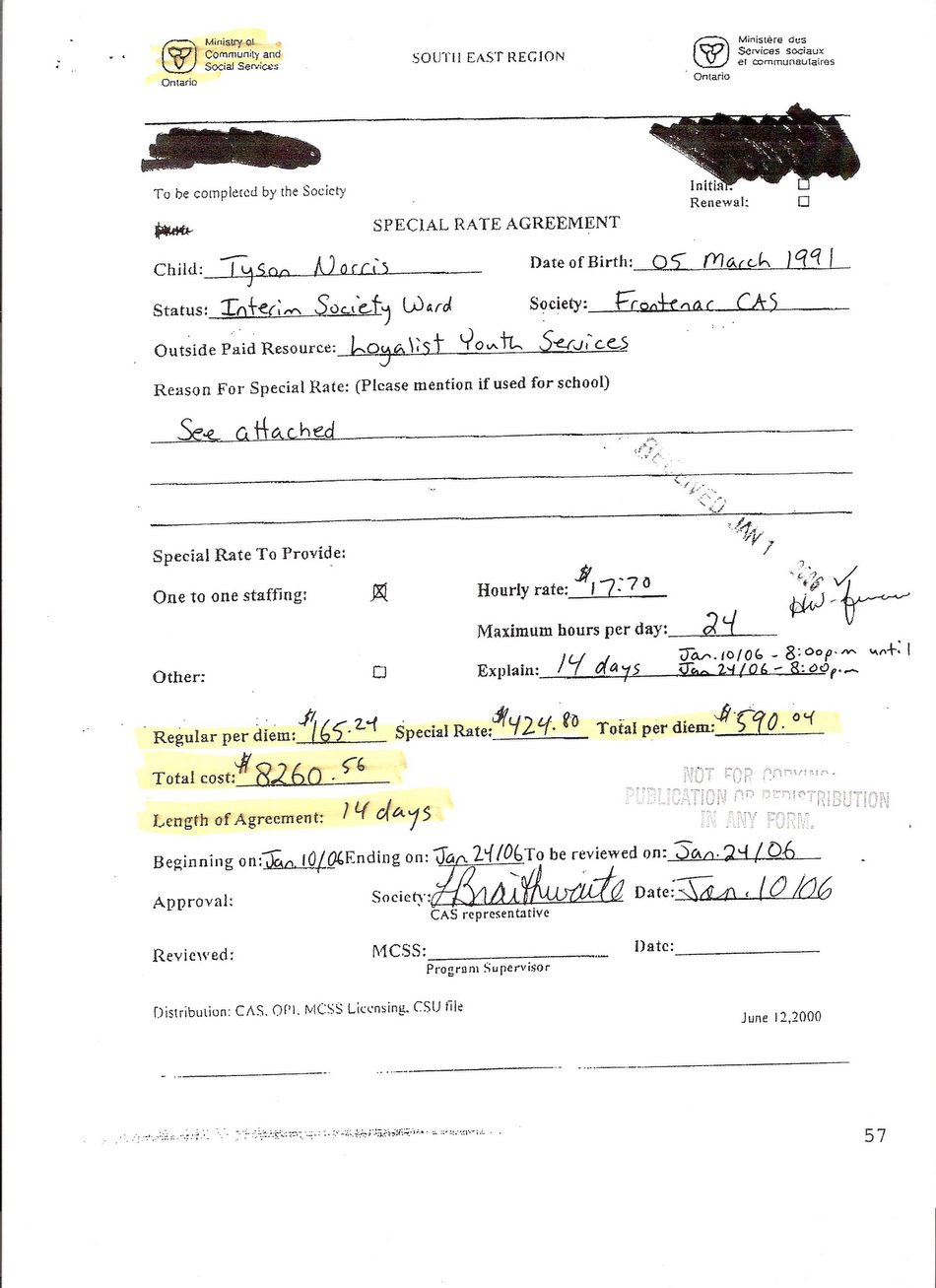
Note: We hereby offer to provide Cole Norris with food and shelter for an entire year for only $115,364.60, saving the taxpayers $100,000!
Addendum: justiceseeker has posted another YouTube video, The family Separated by the Kingston Children's Aid, showing the Norris family from babies to teenagers just before CAS intervention.
Addendum: Here is the pap children's aid and the police feed to the press. They make it look like Cole ran away from mom and dad, but has been happily returned after a major investigation. Sure.
expand
collapse
Missing boy found in Brantford area
A 13-year-old Deseronto boy who went missing in August has been found, provincial police said yesterday. Napanee OPP said Cole Norris has been located in the Brantford area.
Norris sparked a major investigation when he went missing Aug. 17, after telling his family he was going downtown or to the town library.
Source: Kingston Whig-Standard
Serial Killer Strikes Again
March 31, 2007 permalink
Matt and Jennifer Lethbridge have had nine children taken by the State of Michigan. The state's score so far: two dead and seven to go. No, make that eight to go. Jennifer is pregnant again. In the latest development, the state has finalized the removal of two more children.
expand
collapse
Detroit Free Press
Lethbridges and youngest children won't reunite
March 30, 2007, By JACK KRESNAK, FREE PRESS STAFF WRITER
A Washtenaw County judge decided today that Matt and Jennifer Lethbridge, whose nine children all have landed in foster care, will not be reunited with their two youngest children.
Family Court Judge Darlene O’Brien ordered the couple’s parental rights to their 11-month-old daughter terminated, but she did not end their rights to their 4-year-old daughter, saying it would not be in the child’s best interest. Instead, the judge ordered the child’s current foster parents in Washtenaw County to consider becoming her permanent guardians.
O’Brien said the girl “would have the benefit of continuing to have her parents in her life, but she wouldn’t leave the foster parents’ home. She would be raised by them.”
The Washtenaw County foster parents have expressed an interest in adopting the girl’s 11-month-old sister.
The 4-year-old was in foster care in Detroit with her 2-year-old brother Isaac when he was killed in his foster mother’s home last August.
On hearing the ruling, Matt Lethbridge, 33, initially broke down and then appeared confused about the implications. He said he and his wife would try to keep a relationship with the 4-year-old through her foster parents.
Six of the Lethbridges’ older children were removed from their care after complaints involving neglect. All were later adopted. Isaac and the 4-year-old landed in foster care in 2005, and an infant daughter born last April was placed in foster care almost immediately. The couple’s 10th child is due next month. Washtenaw County authorities plan to file a petition to remove that child after its birth.
The Lethbridges, who now live in Canton, had contended that they have matured as parents and recognize why their children were removed from their care. Among the past problems: Their homes were filthy and there were signs of emotional and medical neglect of the children.
Washtenaw County Assistant Prosecutor Stacie Shaw told the court that the couple’s living conditions get worse when authorities are no longer involved with the family. “Their history and their actions speak louder than their words,” Shaw said, adding, “I don’t doubt in my heart that the parents truly love both of these girls,” but the risk is too great to entrust the children to their care.
The children’s attorney, S. Joy Gaines, also asked O’Brien to terminate the Lethbridges’ parental rights.
“I’m clear that they love their children and that they want to be parents,” Gaines said, but “with the extensive protective services history, there are more issues than just cleanliness. There are real mental health issues.” She also said it would not be good to move the 4-year-old, who is in her fourth foster home, again.
Earlier today, O’Brien heard testimony from Washtenaw County Protective Services worker Joseph Lanczki who said, despite the family’s long history of involvement with protective services and the juvenile court dating to 1997, things had not improved by September 2005, when Isaac and his 4-year-old sister were removed from the Lethbridges’ filthy Westland home.
“When conditions of the home reach a level of criminality, it’s pretty severe,” Lanczki said. The couple were charged with misdemeanor child neglect after the children were removed. Jennifer Lethbridge, now 30, served 45 days in jail; Matt Lethbridge, now 33, received probation.
Matt Lethbridge, given one last chance to convince the judge to return his daughters to their care today, said, “We are fanatic cleaners at this point. We don’t even think the old way any more. We are not those people any more.”
Jennifer Lethbridge attended today’s hearing by phone. Matt Lethbridge said he and Jennifer quit smoking last Friday, though he said he cheated twice after having a vasectomy on Tuesday.
Isaac’s foster mother has been charged with involuntary manslaughter and second-degree child abuse in connection with his death, but no one has been charged with the fatal beating. His death was the subject of a three-day series in the Free Press in January that detailed the failings of the Lula Belle Stewart Center, the Detroit foster care agency that handled Isaac’s care, and the state Department of Human Services, which supervised the agency.
Source: Detroit Free Press
Addendum: The State of Michigan wants the Lethbridges' next child taken as well.
expand
collapse
Detroit Free Press
Parents of Isaac Lethbridge fight to keep newborn
Couple has lost custody of 7 other kids
April 27, 2007, by JACK KRESNAK, FREE PRESS STAFF WRITER, UPDATED AT 3:05 p.m.
Wayne County Child Protective Services on Friday filed a petition to terminate the parental rights of Matt and Jennifer Lethbridge after removing their 15-day-old baby boy from their Canton Township home.
The Lethbridges -- whose 2-year-old son Isaac was beaten to death in a Detroit foster home last summer -- said they will try to regain custody of their newborn even though judges in Washtenaw County have terminated their parental rights to seven of their nine previous children.
The couple appeared at a preliminary hearing in Wayne County juvenile court this afternoon. Referee Peter Schummer Jr. authorized the petition and said the case would be transferred to Washtenaw County unless that county rejected it for some reason. If that happened, the case would be returned to Wayne County.
Schummer also suspended the Lethbridges' visitation rights.
The baby, named Xavier Isaac Lethbridge, was removed by CPS, a division of the Wayne County Department of Human Services, about 4 p.m. Thursday with the assistance of Canton Township police, officials said.
The DHS' permanent custody petition sought to transfer jurisdiction of the boy to Washtenaw County DHS because of the family's history there. Judges in Washtenaw ended their rights to the other seven children on the grounds that the couple neglected them and did not benefit from counseling and other programs to improve their parenting skills.
Matt Lethbridge, 33, said the baby's seizure by CPS was improper because Xavier was not at risk of any harm under his parents care, despite the past history.
"This is absolutely ridiculous," Lethbridge said before the court hearing. "There is no danger to him whatsoever because there are so many monitors in place right now."
Lethbridge said he and his wife, 30, did not keep the baby's birth a secret from anyone and would have told DHS about Xavier's birth at home on April 12 if they had asked. He said the couple told their private therapist, Celeste Brown, who saw the child herself on Tuesday.
Lethbridge said their townhouse in Canton is clean. The couple lost custody of Isaac and his then 3-year-old sister in September 2005 when police found the children in their filthy home in Westland. Both Matt and Jennifer Lethbridge later were convicted of misdemeanor child neglect in that case.
On March 30, Washtenaw County Family Court Judge Darlene O'Brien terminated their parental rights to an 11-month-old daughter, but declined to terminate rights on the now 4-year-old daughter who allegedly was abused in the same foster homes as her brother Isaac.
Last December, Matt Lethbridge initially denied to the court that his wife was pregnant, but quickly recanted and said he was afraid authorities would again take their newborn away. Washtenaw County officials said they would seek to remove that baby from the Lethbridges and terminate their parental rights. That county's DHS was waiting for a birth, though it was Wayne County officials who removed the child.
"I knew the second they knew he was born they were going to come and take him," Lethbridge said. "We didn't run. We didn't hide. We were right there. We opened the door and were cooperative."
Charlsie Adams-Rogers, 59, of Detroit is scheduled to be tried June 4 on involuntary manslaughter and child abuse charges in Isaac Lethbridge's death last summer in her foster home.
Contact JACK KRESNAK at 313-223-4544 or jkresnak@freepress.com.
 Isaac Lethbridge, age 2 1/2, photographed during a supervised visit with his parents in June 2006 at a McDonald's. Isaac was beaten to death in August while in foster care.
 Matthew Lethbridge and wife Jennifer Lethbridge, the biological parents of 2-year-old Isaac Lethbridge who was beaten to death in a Detroit foster home, were photographed at their home in Whitmore Lake on Wednesday, Aug. 23, 2006. (ROMAIN BLANQUART/Detroit Free Press). Display this image for more resolution.
Source: Detroit Free Press
Norris Videos Purged
March 29, 2007 permalink
Most of the videos of the police manhunt for Cole Norris are gone from YouTube. Here is a statement posted in explanation. We have confirmed that it comes from Cathy Norris.
expand
collapse
Hello
I did take down the video’s from ‘youtube’. One of the reasons for this is a disturbed individual has posted a video response using a gun. I consider myself a social activist , but I will not ever be associated with anyone who uses threats or violence or hate language. I believe from the messages I received that the message from this disturbing video was directed towards me, not the CAS worker. I am glad of that as I would not want to compromise anyone else’s sense of safety and security.
I want to thank you all for the support you have shown my family and I.
Cathy.
Source: Sarnia's Smoking Gun
Addendum: Children's Aid has provided Cathy Norris with a food voucher for $100. This is compensation for loss of her farm, a year's legal bills, moving her family from Kingston to Brantford, the stress of several police raids on her home and halting the orthodontic treatment of her son Tyson.
Chambers Announces Nirvana for Children
March 28, 2007 permalink
Following Mary Anne Chambers' announcement of a new era of plenty for Ontario's children, we give some comments.
expand
collapse
CHILD POVERTY
Hon. Mary Anne V. Chambers (Minister of Children and Youth Services): It gives me great pleasure to speak about the Ontario child benefit, which Finance Minister Greg Sorbara unveiled last Thursday. We know the future depends on the type of start that we give our children in life. The $2.1-billion Ontario child benefit is a historic investment that will help to give our vulnerable children the opportunity they deserve. It’s at the heart of our government’s 2007 budget because our government believes that Ontario’s future depends on giving our children the best possible start in life.
Unfortunately, many children come from families who are struggling to make ends meet. If only they had some of the opportunities that so many of us have been fortunate to have been afforded, they could move beyond the poverty they struggle against. Our society pays a heavy price when our children grow up in poverty. That heavy price is the cost of failed opportunities, lost hopes and forgotten dreams.
Let me share with you a sampling of statements on poverty from grade 4 and 5 children in North Bay, taken from excerpts from Our Neighbours’ Voices: Will We Listen?
- “Poverty is being afraid to tell your mom you need new gym shoes.”
- “Poverty is feeling ashamed when my dad can’t get a job.”
- “Poverty is not getting a hot dog on hot dog day.”
- “Poverty is pretending that you forgot your lunch.”
- “Poverty is hiding your feet so the teacher won’t get cross when you don’t have boots.”
- “Poverty is not buying books at the book fair.”
- “Poverty is not getting to go on school trips.”
- “Poverty is being teased for the way you are dressed.”
What is perhaps even more discouraging is to hear from members of the Ontario English Catholic Teachers’ Association, who say, “Poverty in my classroom is students who have no hope for the future because the future costs money.”
An Ontario where children and youth have no hope for the future is not the kind of Ontario that our government wishes for its children and youth. Our government has been tackling the issue of poverty from many angles, and we are determined to do more. That is why we are championing strong, progressive initiatives that will make a difference in the lives of 1.3 million Ontario children in 600,000 lower-income families.
The Ontario child benefit is about opportunity. It is about making that opportunity available to everyone. Our government has taken a giant leap forward to expand opportunities for all Ontario’s children and families so no one is left behind because of a lack of opportunity.
We cannot separate social and economic priorities if we want to have an inclusive society. So we went one step further than just simply ending the clawback of the national child benefit supplement. We are providing assistance to every lower-income family in Ontario. The Ontario child benefit is about increasing opportunity to help people get out of poverty and get on with building a better future for their children.
The Ontario child benefit is also about giving parents the opportunity to move off social assistance without worrying about losing support for their children. It is about enabling families to make real choices for the betterment of their children and, more importantly, to see the realization of the hopes and dreams they have for their children.
The Ontario child benefit will fundamentally change how our children receive the benefits they need, benefits that our government believes children deserve.
Most income support is provided through social assistance, and that excludes the majority of low-income working families. The Ontario child benefit provides help to all children in lower income families. In the first five years, these families will receive an additional $2.1 billion. Ontario children and their families will be better off.
The experts agree that our government has made the right investment for the right reasons. Gail Nyberg, executive director of the Daily Bread Food Bank, says, “It’s been a long time since poverty reduction measures were at the forefront of a provincial budget in Ontario. We congratulate the government for having the courage to take on this significant issue, and we expect to see a reduction in food bank use in the coming years as a result…. The Ontario child benefit will reduce barriers faced by families with children who are trying to leave welfare for work.”
Finally, an editorial from the Globe and Mail last Friday said the McGuinty government has “devised an Ontario child benefit that, when fully implemented in … 2011, would be on the cutting edge of 21st-century social policy reform.”
Our budget clearly demonstrates that Ontario is well-positioned to take on the challenges of the 21st century. But in order to ensure our province’s prosperity, we will need every person in Ontario to achieve his or her individual potential. The Ontario child benefit will help to make this a reality. Helping children in lower income families to succeed is the right thing to do, and it is the smart thing to do for our society—a society that enables all children a real chance at success in life.
I ask all members of this Legislature to join me in supporting the Ontario child benefit. We owe it to the 1.3 million children of Ontario who will benefit; we owe it to the 600,000 families who will benefit. This is an investment in our children, an investment in Ontario families and an investment in the future.
Source: Ontario Hansard
Politicians cannot always use complete condor, but Mrs Chambers speaks without connection to reality. Look at the list of poverty symptoms from the North Bay children. In most areas of Ontario, showing even one of the symptoms would get a kid snatched by children's aid. How many children still living with their parents are that poor? Well, there is Cole Norris. His mom could provide all the things he needed until Kingston Children's Aid intervened.
As for the financial benefits for families, they will not fully be implemented for four years, long after the tenure of the current government. Below is an analysis by a journalist who has studied the details.
expand
collapse
No end to Ontario's child tax benefit clawback
People on social assistance are still having their federal child tax benefit taken away from them by the Ontario government. The Liberals have broken yet another promise.
There appears to be some confusion over whether the federal child tax benefit clawback from Ontario social assistance cheques has been ended by the Dalton McGuinty government this week. Allow me to clear up the confusion: the clawback is still in full force.
On Thursday, Ontario Finance Minister Greg Sorbara announced a new Ontario Child Benefit for low income families. This means that in Ontario, there will be both a federal and a provincial benefit for low income families with children.
People on social assistance will continue to have the federal benefit clawed back from their welfare cheques. The new provincial benefit will not be clawed back. Ontario families who are not on social assistance will get both benefits. Ontario families on social assistance will receive the Ontario benefit (which is much smaller than the federal benefit), but the McGuinty Liberals will continue to clawback the federal child tax benefit from them.
Seems like a pretty clear and easy-to-understand policy, right?
Then why is the McGuinty government trying to confuse people by claiming that the new Ontario Child Benefit will “effectively end the current clawback of up to $122 per child per month from the National Child Benefit Supplement” according to “government officials” quoted in the Toronto Star on Friday?
The answer is simple. The Liberal government promised during the 2003 election campaign to end the child tax benefit clawback from the families who need it most desperately: social assistance recipients. As with many of their other promises, they did not follow through.
The Ontario Child Benefit is a very small but welcome addition to the social safety net in Ontario for low income families. But it's a pretty big stretch to claim, as Greg Sorbara does, that this $50 per month benefit, which doesn't even start until July of 2008, “takes children off welfare.” This July, families will receive a lump sum payment of $250 per child. For those of us with calculators at home, this works out to $20.83 per month. This, Sorbara claims, “transforms the system.” Doesn't sound all that revolutionary to me.
It does not address the fact that people on social assistance are still having their federal child tax benefit taken away from them by the Ontario government. It also does not address the fact that the McGuinty Liberals have broken yet another promise.
Don't let Dalton McGuinty or Greg Sorbara try to tell you otherwise.
Source: Rabble website
Jury Verdict Against California CPS
March 26, 2007 permalink
A California mother has won a $4.9 million jury verdict against her local child protectors for taking her children without cause, and fabricating evidence while withholding exculpatory evidence. For those not familiar with litigation, this requires more than just convincing a jury. Before getting a jury, the lawyers have to navigate a legal minefield of motions and discovery, during which child protectors usually avoid liability by pleading one of their statutory immunities. Contrary to what the lawyers say in the press release below, this verdict may not get Orange County to implement procedures to prevent future abuses. Their first move may be to get the legislature to strengthen their immunity.
expand
collapse
March 26, 2007
Orange County Jury Awards Mom $4.9 Million Against Department of Social Services and its CPS Workers; Punitive Damages to Follow
Download this press release as an Adobe PDF document.
Orange County Jury finds Orange County, its CPS workers and the Department of Social Services agency liable to mother for $4.9 million in compensatory damages for constitutional rights violations arising from interference with association with children. Punitive damages to be determined against the individual CPS workers.
San Diego, CA (PRWeb) March 25, 2007 --
- RE: :
- Fogarty-Hardwick v. County of Orange, et al. Superior Court of California, County of Orange Case No. 01CC02379 (Trial before Hon. Ronald L. Bauer, Dept. CX103)
On March 23, 2007, the Orange County Social Services Agency and two of its Social Workers, Marcie Vreeken and Helen Dwojak were found liable for violating the parental rights of Deanna Fogarty-Hardwick, as guaranteed under the Fourth and Fourteenth Amendments to the United States Constitution. The jury found 10-2 in favor of the Plaintiff and awarded $4.9 million in economic and non-economic damages. The punitive damages phase of the trial will begin on Tuesday, March 27, 2007.
The verdict follows the filing of a civil suit for civil rights violations by Deanna Fogarty-Hardwick, a mother of two minor children, against the Orange County Department of Social Services and three of its social workers. The Plaintiff Deanna Fogarty-Harwick sued defendants County of Orange, Orange County Social Services Agency, Marcie Vreeken, Elaine Wilkins, and Helen Dwojak.
The Jury found against the Plaintiff and for Defendant Elaine Wilkins, by a 10-2 jury vote.
This case was brought by Plaintiff against Defendants to recover damages arising from Defendants alleged violations of Ms. Fogarty's constitutional rights to raise and associate with her children, free from governmental interference.
Ms. Fogarty-Hardwick alleged that social workers Marcie Vreeken, Elaine Wilkins, and Helen Dwojak caused Ms. Fogarty-Hardwick's children to be removed from her custody without cause, and continued to detain them without cause, violating Ms. Fogarty-Harwick's Constitutional right to familial association. Ms. Fogarty-Hardwick alleged that these defendants, while working as social workers for Orange County Social Services, intentionally fabricated evidence to obtain a court order to detain Ms. Fogarty-Hardwick's two young daughters on February 17, 2000. Ms. Fogarty-Hardwick also alleged that Orange County Social Services, Marcie Vreeken, Elaine Wilkins, and Helen Dwojak maliciously failed to provide the court with exculpatory information, and filed false reports in furtherance of the effort to keep Ms. Fogarty-Hardwick separated from her children.
The second civil rights claim alleged that the policies, practices, or procedures employed by Orange County Social Services and the County of Orange in the removal of Plaintiff's children from her care also violated Ms. Fogarty-Harwick's constitutional rights, under the Fourth and Fourteenth Amendments to the United States Constitution, and to raise and associate with her children free from governmental interference. The unlawful policies, practices or procedures pertained to the detention of children without a finding of imminent danger or serious physical injury; interviewing children without a parent present; continuing detention after learning there was no basis to do so; using trickery and fabricated evidence; and failing to adequately train employees regarding the Constitutional rights of parents.
Lead trial attorney Shawn A. McMillan states "My client Deanna Fogarty-Hardwick, is satisfied by the Jury's recognition of the harm that the defendants caused her. But, obviously, no amount of money can ever undo the damage inflicted upon Ms. Fogarty-Hardwick or her children. We expect the Jury's 4.9 million dollar verdict will cause the County of Orange and its Department of Social Services to implement procedures to prevent future abuses by County social workers and protect other families."
San Diego Lawyer Shawn A. McMillan, of the Law Offices of Shawn A. McMillan, was trial counsel in the case. Attorney Sondra S. Sutherland was co-counsel.
For additional information, contact:
Shawn A. McMillan, Esq.
THE LAW OFFICES OF SHAWN A. McMILLAN, A.P.C.
4955 Via Lapiz
San Diego, California 92122
Telephone: (858) 646-0069
Facsimile: (206) 600-4582
Website: www.mcmillan-law.comPRESS RELEASE DISTRIBUTED BY WWW.FEARNOTLAW.COM
Source: eMediaWire press release website
Family Saved by Recordings
March 25, 2007 permalink
Here is some good news from Canada Court Watch, which as usual withholds the names of the family.
expand
collapse
Tape recording CAS workers pays off for one family
(March 24, 2007) A family called Court Watch today to thank them for the advice about how to covertly record CAS workers. CAS workers had made promises they did not keep and refused to close the family's file even when the parents had met all conditions laid out by CAS workers. At first, CAS workers tried to jerk the family around and said that they were not going to close the file. When the parents showed the workers the hidden video and audio surveillance recording devices and advised workers that everything that workers had said since the day the file the file opened had been recorded, including previous commitments by workers, the CAS workers left the home with their tails between their legs. The parents were then advised the next day that their file would be quietly and immediately closed. Of course, the CAS workers involved did not want the evidence of their unprofessional actions to be found out. The parents plan to personally sue to workers involved using video and audio recordings as their evidence.
Court Watch receives many complaints from children and parents about CAS workers fabricating false information and lying in court documents. Electronically recording CAS workers will help put to a stop to this. All families dealing with CAS are highly encouraged to covertly record all of their conversations with CAS workers. If CAS workers are honest and doing their jobs professionally, the workers should have nothing to worry about. Recording will make people accountable for their actions and words.
Source: Canada Court Watch
Experiment on Girls
March 24, 2007 permalink
This week's federal budget includes $300 million for a vaccine, Gardasil, against HPV.
Budget pledges billions for provinces, environment
Kady O'Malley, Macleans.ca | Mar 19, 2007 | 6:42 pm EST
other budget items omitted
Slightly more contentious may be the $300-million earmarked for the provinces to vaccinate girls and women against HPV - the sexually-transmitted virus responsible for 70% of cervical cancers. In recent weeks, several American states have been forced to back down from making the vaccine mandatory after social conservatives objected to it on the grounds that it could promote promiscuity.
Source: MacLeans
In the days when contagious disease killed half of all children before age of majority, vaccines, even dangerous ones, were a godsend. For Gardasil, the benefit is not so clear. It helps only sexually promiscuous women and even among them, only a small proportion die of HPV induced cancer. Gardasil is new, and long-term dangers are unknown. If it causes some hitherto unknown pathology, it could do more harm than good. Canadians will have no choice in the matter. The presence of CAS alleging "medical neglect" will make Gardasil mandatory for all Canadian girls.
Gardasil is not cheap. Vaccination for one girl costs several hundred dollars just for the drug. In this case the drug company, Merck, has aimed its promotional efforts at legislators instead of consumers. The Conservative government led by Stephen Harper, which started out on the right foot by cutting public funding for daycare in favor of more money for parents, now seems to have shifted back to the old policies of strengthening the medical and social services systems at the expense of families.
Girl Killed with Drugs
March 24, 2007 permalink
The death of Rebecca Riley has been in the news for three months, finally there is a thoughtful article dealing with her case. She died from prescribed psychiatric drugs. The parents were the kind who took advice from doctors uncritically, and may even have tried to help their child by giving her more than the doctor ordered. Rather than deal with the failings of the drug-pushing system, prosecutors have taken the easy route and blamed the hapless parents.
expand
collapse
Girl's overdose death raises questions
By DENISE LAVOIE, Associated Press WriterFri Mar 23, 7:02 PM ET
 AP Photo: Michael Riley, 34, left, and his wife, Carolyn Riley, 32, are shown in Hingham District...
In the final months of Rebecca Riley's life, a school nurse said the little girl was so weak she was like a "floppy doll." The preschool principal had to help Rebecca off the bus because the 4-year-old was shaking so badly. And a pharmacist complained that Rebecca's mother kept coming up with excuses for why her daughter needed more and more medication. None of their concerns was enough to save Rebecca.
Rebecca — who had been diagnosed with attention deficit hyperactivity and bipolar disorder, or what used to be called manic depression — died Dec. 13 of an overdose of prescribed drugs, and her parents have been arrested on murder charges, accused of intentionally overmedicating their daughter to keep her quiet and out of their hair.
Interviews and a review of court documents by The Associated Press make it clear that many of those who were supposed to protect Rebecca — teachers, social workers, other professionals — suspected something was wrong, but never went quite far enough.
But the tragic case is more than a story about one child. It raises troubling, larger questions about the state of child psychiatry, namely: Can children as young as Rebecca be accurately diagnosed with mental illnesses? Are rambunctious youngsters being medicated for their parents' convenience? And should children so young be prescribed powerful psychotropic drugs meant for adults?
Dispensing drugs to children diagnosed with mood or behavior problems is "the easiest thing to do, but it's not always the best thing to do," said Dr. Jon McClellan, medical director of the Child Study and Treatment Center in Lakewood, Wash. "At some level, I would hope that you'd also be teaching kids ways to control their behavior."
According to the medical examiner, Rebecca died of a combination of Clonidine, a blood pressure medication Rebecca had been prescribed for ADHD; Depakote, an antiseizure and mood-stabilizing drug prescribed for the little girl's bipolar disorder; a cough suppressant; and an antihistamine. The amount of Clonidine alone in Rebecca's system was enough to be fatal, the medical examiner said.
The two brand-name prescription drugs are approved by the Food and Drug Administration for use in adults only, though doctors can legally prescribe them to youngsters and do so frequently.
Rebecca's parents, Michael and Carolyn Riley, say they were only following doctor's orders. Rebecca, they told police, had been diagnosed when she was just 2 1/2, and Rebecca's psychiatrist prescribed the same potent drugs that had been prescribed for her older brother and sister when she diagnosed them with the same illnesses several years earlier.
But Rebecca's teachers, the school nurse and her therapist all told police they never saw behavior in Rebecca that fit her diagnoses, such as aggression, sharp mood swings or hyperactivity.
Prosecutors say the Rileys intentionally tried to quiet their daughter with high doses of Clonidine. Relatives told police the Rileys called Clonidine the "happy medicine" and the "sleep medicine."
Through their attorneys, Michael Riley, 34, and Carolyn Riley, 32, have accused Rebecca's psychiatrist, Dr. Kayoko Kifuji, of over-prescribing medication.
Kifuji did not return calls for comment and declined to be interviewed. But Kifuji has vehemently denied any role in Rebecca's death. She has agreed to a suspension of her license while the state's medical board investigates.
Kifuji told police Rebecca had been her patient since August 2004, when she was 2. She said she based her diagnoses of ADHD and bipolar disorder on the family's mental health history, as described by Carolyn Riley, and Rebecca's behavior, as described by Carolyn and briefly observed by her during office visits.
Kifuji told police she became alarmed in October 2005 when Carolyn Riley told her she had increased Rebecca's nighttime dose of Clonidine from 2 to 2 1/2 tablets, and warned Carolyn the increased dose could kill Rebecca.
But Carolyn told investigators Kifuji told her she could give Rebecca and her sister extra Clonidine at night to help them sleep.
Tufts-New England Medical Center, where Kifuji worked, issued a statement supporting Kifuji, saying her care of Rebecca "was appropriate and within responsible professional standards."
In the months leading up to Rebecca's death, others noticed there was something wrong.
Teachers and staff members at the Johnson Early Childhood Center in Weymouth, about 20 miles south of Boston, say they called Rebecca's mother repeatedly to tell her that Rebecca was "out of it," but her mother said the girl was tired because she wasn't sleeping well.
A neighbor who lived next door to the family in the last month of Rebecca's life said Rebecca and her siblings seemed listless.
"They looked like little robots. They looked very lethargic," Phyllis Lipton said. "I said, `Wow, they don't look right,' but who knew?"
Pharmacists at Walgreens in Weymouth called Kifuji twice to complain that Carolyn Riley was asking for more Clonidine, even though her prescription was not due to be refilled yet, according to state police.
Once, Riley said she had lost a bottle of pills, and another time, she said water had gotten into her prescription bottle and ruined the pills, according to police.
Kifuji authorized refills, but after the second incident, she began prescribing Clonidine in 10-day refills instead of 30-day supplies, investigators said.
On Aug. 16, a prescription for 35 Clonidine tablets — a 10-day supply — was filled at Walgreens, even though the Rileys had obtained a 10-day refill only the day before, investigators said.
Walgreens spokeswoman Tiffani Bruce said: "The scrip was filled as written, as it was prescribed by the doctor, and all the appropriate information on the medications was given to the family."
After Rebecca's death, police found only seven Clonidine tablets in the family's medicine tray; the pharmacist said there should have been 75. All together, prosecutors say, Carolyn Riley got 200 more pills in one year than she should have.
The Rileys' lawyers call them unsophisticated people who did not question their children's doctors.
Both were unemployed; they collected welfare and disabilty benefits and lived in subsidized housing. Michael Riley, who is also awaiting trial on charges of molesting a stepdaughter in 2005, claimed to suffer from bipolar disorder and a rage disorder; his wife told police she suffered from depression and anxiety.
"They are not the sort of people who go on the Internet and look on WebMD. These are the sort of people who, when they go to a doctor, the doctor is God and they do what the doctor says," said John Darrell, Michael's lawyer.
Carolyn's lawyer, Michael Bourbeau, said that because the Rileys' three children were all taking Clonidine, Rebecca's prescription may have come up short at times when her siblings were given some of her pills. And some of the pills may have been lost when they were split in half, he said.
In July, after a therapist filed a complaint with the state Department of Social Services, social workers met with the family's doctors and other medical professionals and were assured that the medications Rebecca was taking were within medical guidelines.
"There were lots of medical eyes on this case and none of them seemed to say there was an issue of over-medication in this case," said Social Services Commissioner Harry Spence, who has come under fire for the agency's handling of the case.
Still, there were lingering concerns. When social workers tried to make a home visit in November, Carolyn "resisted and evaded," Spence said. Weeks later, workers resolved to make a surprise check, but Rebecca died the very next day, before they could visit.
Rebecca was found dead on the floor of her parents' bedroom wearing only a pink pull-up diaper and gold-stud earrings, on top of a pile of clothes, magazines and a stuffed brown bear.
Rebecca's uncle, James McGonnell, and his girlfriend, Kelly Williams, who lived with the Rileys, told police that the Rileys would put their kids to bed as early as 5 p.m. Rebecca, they said, often slept through the day and got up only to eat.
When Michael Riley decided the kids were "acting up," he told Carolyn to give them pills, McGonnell and Williams told police.
According to McGonnell and Williams, Rebecca spent the last days of her life wandering around the house, sick and disoriented. But the Rileys told police they were not alarmed. "It was just a cold," Carolyn repeatedly said during police interviews.
The medical examiner said Rebecca died a slow and painful death. She said the overdose of Clonidine caused her organs to shut down, filling her lungs with fluid and causing congestive heart failure.
Williams told police that the night before she died, Rebecca was pale and seemed "out of it." At one point, the little girl knocked weakly on her parents' bedroom door and softly called for her mommy, but Michael Riley opened the door a crack and yelled at her to go back to her room, Williams said.
Later that night, McGonnell told police, he heard someone struggling to breathe and found Rebecca gurgling as if something was stuck in her throat. McGonnell told police he wiped vomit from his niece's face, then kicked in the door to her parents' room and yelled at the Rileys to take Rebecca to the emergency room.
Instead, Carolyn Riley said, she gave her daughter a half-tablet of Clonidine.
Carolyn's mother, Valerie Berio, said that when she visited the kids the night of Dec. 11, Rebecca seemed congested but not seriously ill. In a photograph Berio said she took that night, Rebecca is smiling slightly as her mother holds a new green velvet dress in front of her.
Berio said that shows that her daughter and son-in-law could not have known how sick Rebecca was.
Rebecca's death has inflamed a long-running debate in psychiatry. Some psychiatrists believe bipolar disorder, which was traditionally diagnosed in adolescence or early adulthood, has become a trendy diagnosis in young children.
"As a clinician, I can tell you it's just very difficult to say whether someone is just throwing tantrums or has bipolar disorder," said Dr. Oscar B. Bukstein, a child psychiatrist and associate professor at the University of Pittsburgh.
A study of mentally ill children discharged from community hospitals, published in January in the Archives of General Psychiatry, found the proportion of children diagnosed with bipolar disorders jumped from 2.9 percent in 1990 to 15.1 percent in 2000.
A report released by the Centers for Disease Control and Prevention in 2002 estimated that about 7 percent of elementary school-age children — or approximately 1.6 million youngsters ages 6 to 11 — have been diagnosed with ADHD.
The annual number of U.S. children prescribed anti-psychotic drugs jumped fivefold between 1995 and 2002, to an estimated 2.5 million, according to a study published last year by researchers at Vanderbilt Children's Hospital in Nashville, Tenn.
Some child psychiatrists say bipolar disorder may have been under-diagnosed in children for years, partly because several key symptoms are also symptoms of ADHD, including hyperactivity, distractibility and talkativeness.
Dr. Janet Wozniak, director of the Pediatric Bipolar Disorder Research Program at Massachusetts General Hospital, said early diagnosis and treatment are critical because the illness can cause social and academic problems, and lead to drug abuse, crime and suicide.
"What's commonly overlooked when considering diagnosing and treating children at such an early age is the risk of not treating and not intervening," Wozniak said.
Source: Yahoo news
Addendum: A comment published in the Boston Globe suggests that the power of the phamacological establishment is so great it is a threat to the career of any of its critics.
expand
collapse
Misguided standards of care
AS A doctor, I did the nearly unthinkable at a recent conference on bipoloar disorder in children. I charged another doctor with moral responsibility in the death last December of Rebecca Riley, a 4 -year-old girl from Hull. Naming names in medicine is just not done very often -- and I knew the personal and professional risks I was taking. Yet I felt compelled to name Joseph Biederman, head of the Massachusetts General Hospital's Pediatric Psychopharmacology clinic, as morally culpable in providing the "science" that allowed Rebecca to die.
Rebecca's parents have been jailed and charged in her death. They are accused of intentionally overdosing her with clonidine, an anti hypertensive and sedative drug -- one of three psychiatric medications prescribed by a Tufts-New England Medical Center child psychiatrist. Rebecca had been treated with these medications since the age of 2 1/2 for the purported diagnosis of bipolar disorder -- the new name for manic-depression.
While the psychiatrist involved has withheld comment on the case, both her lawyer and the medical center have defended her actions as "within the standards of care." Biederman and his colleagues at Harvard are the professionals most responsible for developing and promoting those standards of care -- which include diagnosing preschool children as young as 2 with bipolar disorder and treating them with multiple medications.
Biederman shocked the child psychiatric world in 1996 by announcing that nearly a quarter of the children he was treating for attention deficit hyperactivity disorder also met his criteria for bipolar disorder. Up until then bipolar disorder was rarely diagnosed in teenagers and unheard of in prepubertal children. Biederman could justify his findings by simply broadening the semantic definitions of a previously more circumscribed condition contained within American psychiatry's bible -- the "Diagnostic and Statistical Manual of Mental Disorders."
Biederman has produced a number of studies and papers purporting to demonstrate the validity of his diagnosis and treatment. His research has always epitomized the best of what the DSM model of psychiatry could expect. But the diagnoses in the manual, in concept, are closely linked to the medical model of biologically based psychiatric disorders and focus exclusively on the individual.
While the manual provides helpful clinical guidance in adults, it begins to unravel with its assumptions about discrete and specific disorders in children and ignores the families and environments in which children live. The ultimate absurdity of this scientific model is diagnosing bipolar disorder in 2 year olds and linking it to the adult disorder with the same name -- in the process saddling young children as chronic mental patients condemned to a lifetime of psychiatric drugs.
Even the American Academy of Child and Adolescent Psychiatry -- in its recent parameters on the diagnosis in children -- eschews the bipolar diagnosis and its consequent medical treatment in children under 6. Still there are thousands of potential Rebecca Rileys being treated with multiple psychiatric drugs because Biederman has said it's OK and necessary. Supported by millions of dollars of drug industry promotional funding, Biederman and his colleagues circle the globe offering professional medical "education" for their singular point of view.
Finally, it's sad but true -- the field of child psychiatry is afraid of Biederman. One can hear the worries and fears whispered in the academic halls and clinics over where Biederman has taken the profession. Yet to politely challenge Biederman in public is to risk public retribution and ridicule from him and his team. Also academic researchers in child psychiatry risk losing their funding if they criticize this darling of the pharmaceutical industry, which provides most of the money these days for psychiatric research.
The silence was deafening -- and Rebecca's death pushed me over the edge -- because for over a decade I've have been uncomfortable about these practices in young children. I am not against psychiatric drugs for children. I've written prescriptions for children for 30 years in a clinical practice not tied to the drug industry.
I risk personal censure and loss of credibility in an advocacy for a broader concept and treatment for children with behavior problems in naming this doctor. But this time, Dr. Biederman, you have gone far.
Dr. Lawrence Diller practices behavioral/developmental pediatrics in Walnut Creek, Calif., and is the author of "The Last Normal Child: Essays on the Intersection of Kids, Culture and Psychiatric Drugs."
Source: Boston Globe
Addendum: The judicial system has run its course, convicting mother Carolyn Riley, and not even touching the pharmacological establishment that armed the mother with the deadly drugs. The jury was probably not told that once a doctor prescribed medications, failure to administer the drugs was medical neglect, justification for taking custody away from the mother. Charges are still pending against the father, who was court-enjoined from living with his doomed daughter.
expand
collapse
The Boston Globe
Mother convicted in girl’s drug death
Gets life sentence, possibility of parole
By Patricia Wen, Globe Staff / February 10, 2010
A South Shore mother was found guilty yesterday of second-degree murder in the death of her 4-year-old daughter, Rebecca, who went to sleep one night after being given toxic levels of psychotropic drugs and never woke up.
Carolyn Riley, 35, showed no visible emotion when the 12-member jury returned the verdict after 19 hours of deliberations in Plymouth Superior Court. Riley, her upper chest displaying a “Rebecca 12-13-06’’ tattoo that reflected her daughter’s date of death, was handcuffed as soon as the word guilty was uttered by the jury forewoman.
Before sentencing, Judge Charles Hely permitted the reading of a letter from Ashley Davidson, 17, Riley’s first biological daughter, who as a toddler was removed from her mother’s care, placed in a foster home, and eventually adopted. The teenager condemned her mother for the cruel fate she delivered Rebecca, as well as the tormenting memories left for her and Rebecca’s two other siblings, ages 14 and 9, now both in foster homes.
“When I think that you are my biological mother, I sometimes wonder if it is in my blood. Will I grow up to be a mother like you?’’ said the letter, read by her adoptive father, Bob Davidson.
Riley, who has an additional tattoo on her arm with the name Ashley, listened and stared at the floor.
The judge sentenced her to life imprisonment, with the possibility of parole after 15 years, the mandatory punishment for a second-degree murder conviction. It was one of the lesser offenses that the jury of eight women and four men was allowed to consider in this first-degree murder case.
As officers led Riley out of the courtroom, she looked at her mother, Valerie Berio, a constant presence in the 3 1/2-week trial who was sobbing among the spectators. Riley quietly wept as she was taken our to be transported to MCI-Framingham.
While Plymouth District Attorney Timothy J. Cruz praised the verdict as “a small measure of justice for Rebecca,’’ the mother’s defense lawyer, Michael Bourbeau, said the decision, which he plans to appeal, reflects the jury’s judgment of “what kind of a mother she was,’’ as opposed to the evidence in the case.
He had argued to jurors that medical evidence showed that Rebecca died of fast-acting pneumonia, not drugs, and that the mother gave medications based on the sometimes-flexible instructions of her child’s psychiatrist.
Riley’s husband - Michael Riley, 37 - will be tried separately on the same charges, and his case is scheduled to go to trial next month unless yesterday’s result leads to a plea bargain.
Rebecca’s case attracted national attention to the expanding use and potential abuse of giving psychotropic drugs to very young children. When Rebecca died, she and her two older siblings, Gerard and Kaitlynne Riley, were each on three potent psychiatric medications for bipolar and hyperactivity disorders. Each of them went on the drugs at age 2.
Prosecutors say Carolyn and Michael Riley, Weymouth High School graduates who had been living briefly in Hull when Rebecca died, deliberately sought the psychiatric drugs for their three children to scam their local Social Security office into approving disability benefits.
But behind the twists of the case is the all-too-familiar tale of a deeply troubled, financially strapped couple whose capacity to harm their children became catastrophically evident - to their many doctors, psychiatrists, teachers, and social workers - only when it was too late.
The prosecutors, Frank J. Middleton Jr. and Heather Bradley, depicted Carolyn Riley as an unusual form of child abuser, a woman who used three sedating medications, including Depakote, Seroquel, and clonidine, to control her energetic toddlers and induce sleep.
Remarkably, prosecutors said, Carolyn Riley managed to obtain the drugs routinely through prescriptions from Dr. Kayoko Kifuji, a Tufts Medical Center psychiatrist who faces a medical malpractice lawsuit in the death and agreed to testify only after being granted immunity from prosecution.
On the night Rebecca received her fatal overdose, her father, who had been prone to violent outbursts, became irate about the child’s pleas to be with her mother. Rebecca had been battling a respiratory illness for days, and that night, according to housemates, Rebecca kept trying to enter her parents’ bedroom, moaning, “Mommy, Mommy.’’
Prosecutors said that the mother, whom they portrayed as routinely putting her husband’s needs above her children’s, went to the pill dispensers in their Hull home. That night, the state said, Carolyn Riley gave the coughing and feverish child as much as twice the girl’s daily dosages of clonidine at once, the equivalent of seven tablets of .1 milligram each.
Rebecca’s lifeless body, clad only in a pull-up diaper with a teddy bear beneath her head, was discovered by her mother around 6 a.m. on Dec. 13, 2006, next to her parents’ bed.
Her defense lawyers, however, portrayed Carolyn Riley as an overwhelmed mother deserving of sympathy, a former foster child who was doing her best to raise a family in which the adults and children all had mental health problems.
If the mother had some lapses, her lawyers said, they had to be viewed in light of the difficult choices of a woman struggling with poverty and a domineering husband.
In the year before Rebecca died, Michael Riley saw the children sporadically. He was barred from living with the family in a Weymouth housing development because he had been charged with trying to sexually assault and show pornographic pictures to Ashley during one of her visits with the family.
The father, who was convicted of only the pornography charge and served a 2 1/2-year prison term that ended this year, remains behind bars awaiting his trial in the death of Rebecca.
The attachment of Carolyn Riley to her husband was a recurring theme in the lengthy trial. As the mother waited over three days for a verdict, sitting on a bench reading a romance novel and playing games on her cellphone, she responded readily to reporters’ questions.
When asked about the prosecutor’s argument that she and her husband wanted only to maximize their disability benefits, the mother, who speaks with a soft, girlish voice, disputed that point. She said that Social Security awards more money in total to a couple who file as unmarried singles.
But, she said that she and Michael, together for more than 15 years, chose to remain true to their status as a wedded couple.
“We would have gotten more money if we weren’t married,’’ she said.
Patricia Wen can be reached at wen@globe.com.
Source: Boston Globe
Addendum: The father gets convicted also.
expand
collapse
Father convicted of 1st-degree murder in death of Rebecca Riley
BROCKTON – A South Shore father of three was convicted today of first-degree murder for killing his 4-year-old daughter with an overdose of a psychotropic drug that he and his wife had nicknamed "happy medicine."
 Rebecca Riley (Family photo)
Michael Riley, 37, faces a mandatory sentence of life in prison without parole for the murder of his daughter Rebecca. In a separate trial in the same case, his wife, Carolyn, 35, was convicted Feb. 9 of second-degree murder.
The preschooler's body, clad only in a pull-up diaper, was found lifeless on the floor next to her parents' bed during the early morning hours of Dec. 13, 2006. Prosecutors said the girl was given a lethal overdose of clonidine the night before when the child kept crying out “Mommy! Mommy!" while battling a severe respiratory illness.
The jury rejected the father’s defense that he and his wife simply followed the dosage advice of Rebecca’s child psychiatrist and that the girl’s death was due to a fast-acting pneumonia.
After the verdict, Plymouth District Attorney Timothy J. Cruz said he believes the psychiatrist, Dr. Kayoko Kifuji, who prescribed the drugs to Rebecca, should not be allowed to practice medicine in Massachusetts, and he will ask the Board of Registration to reopen an investigation into her medical care.
"Dr. Kifuji is unfit to have a medical license," he said after the verdict was announced. "If what Dr. Kifuji did in this case is the acceptable standard of care for children in Massachusetts, then there is something very wrong in this state."
Shortly after Rebecca died, Kifuji had entered into a voluntary agreement with the board to halt her practice. But two years later, after a grand jury declined to indict her and the board conducted its own inquiry, the board last fall allowed her to return to practice. She is currently seeing patients at Tufts Medical Center.
Cruz said he will collect all the information involving Kifuji that surfaced during both trials -- she was called as a witness in both cases -- and forward it to the state board in hopes they will act against the doctor.
The case drew national attention to the use of psychotropic drugs in young children, and the way parents can exploit the medical and social service system designed to help indigent families.
When Rebecca died, she and her two siblings, then 11 and 6, were each diagnosed by Kifuji with bipolar and hyperactivity disorders and put on three mood-altering drugs.
Prosecutors said Rebecca’s parents wanted the children prescribed psychiatric drugs so the children could be quieted down at will, and to help them qualify for federal benefits to help low-income families with mentally or physically disabled children. Neither of the parents worked, and they also qualified for adult disability benefits.
While she faces a medical malpractice suit filed by the administrator of Rebecca’s estate, Kifuji has resumed practicing at Tufts Medical Center with no restrictions.
In closing arguments in Michael Riley’s trial, both sides lambasted Kifuji for her careless attention to Rebecca. The father's attorney, John Darrell, said that Kifuji “authorized every piece of that poison” that killed Rebecca; and prosecutor Frank J. Middleton referred to her as a “quack” and a “disgrace” to the medical profession.
Darrell declined comment after the verdict.
 Michael Riley(Globe file photo)
But prosecutors emphasized to jurors that it was the parents who actually delivered the lethal dosage of medication to Rebecca, acting as a team devoted more to each other than to their children.
In both trials, the medical examiner and other toxicology experts said the girl’s dead body contained a toxic level of clonidine – a blood-pressure medication that is also used as a sedating drug for children with hyperactivity disorder. Other medical experts did testify that the girl also had an aggressive pneumonia at the time of her death.
Both parents, who graduated from Weymouth High School around the same time and last lived in Hull, have alleged that they simply followed Kifuji's instructions in dispensing medications, and that the doctor allowed some flexibility in dosages.
They said the science of measuring clonidine in a dead body is unreliable. Their lawyers have also argued that the girl died of a fast-acting pneumonia, and her death could not have been anticipated by any reasonable parent.
But the prosecutor told jurors that Michael and Carolyn Riley were far from loving parents and instead were callous individuals who turned to psychiatric pills to silence their children when they made inconvenient requests.
“It’s such an outrageous case of child abuse,” Middleton said.
Before the father was sentenced by Superior Court Judge Charles Hely, Ashley Davidson, a high school student and the half-sister of Rebecca, delivered a victim impact statement, faulting both parents.
"Knowing I will never see Rebecca again – you don't know how much that hurts,'' she said.
Michael Riley's conviction will automatically be reviewed by the Supreme Judicial Court.
Source: Boston Globe
Cole Norris Busted
March 24, 2007 permalink
justiceseeker has posted several videos on YouTube of the harassment of Cole Norris by police. An attempt to enroll Cole in school resulted in a call to the police. A later video "Police search for Cole Norris", shows five police cars surrounding the family home.
On the video Cathy Norris says that, when visiting the CAS office the day before, she went out for a cigarette and she and Cole were locked out of the building. Cole did not want to wait to go back in. Cathy describes what happened next with the clear words: "He took off". Twice the policeman misquoted her, claiming she said "We took off".
Addendum: Three more videos were added the next day. In part 1, 15 year old tells cops, the police find out that Tyson missed a year of school and orthodontic treatment on account of CAS intervention. In Part Two. Police harass 15 year old boy. Want to fingerprint, police accuse Tyson of being an impostor, and try to get fingerprints or a DNA sample. In part three after police question passers-by on the street, a Brantford CAS worker confirms Tyson's identity. As of now, Cole has no known roof over his head, and subject to harm by exposure. All in the best interest of the child.
Complaint on Membership List
March 21, 2007 permalink
John Dunn, earlier denied the membership list for his local children's aid society, has filed a complaint with the Law Society of Upper Canada. Getting the membership list was an adjunct to an application for membership, also denied. The members elect the board of directors, who operate the society. Whether he succeeds or fails, he has already demonstrated that membership is futile as a means of bringing about reform from within. Claims by CAS proponents that the board of directors is a control over the agency are baseless.
expand
collapse
Ottawa, ON, March 20, 2007: CAS Ottawa committed the offence of violating section 307 (5) of the Corporations Act, R.S.O. 1990, c. C-38 by not providing a list of the Society's members upon request in accordance with section 307 (1) of the Act..
Complaints have been filed under Rule 2 of the Rules of Professional Conduct with the Law Society of Upper Canada against the following Lawyers in connection with the offence. (documents)
Robert C. Morrow, a Lawyer working with Burke-Robertson Barristers & Solicitors in Ottawa who appears to have acted as retained lawyer by CAS in this matter and particpated in the committing of the offence.
Tracey Engelking, a Lawyer employed by the offending Children's Aid Society of Ottawa who was made aware of the Society's decision to commit the offence.
Rick O'Connor, a Lawyer who acted as the Children's Aid Society's Board of Directors' Vice President who also actively and aggressively participated in the Society's offence.
Source: afterfostercare website, by John Dunn
Monster of the Month
March 21, 2007 permalink
In the case below, Marie-Emilie Chartier was convicted of kidnapping for taking her children to Sweden in defiance of a family court order. This makes sense to anyone who believes the legal system is a better guardian of children than mom and dad.
expand
collapse
Mother found guilty of abducting own children
Paula McCooey, The Ottawa Citizen, Tuesday, March 20, 2007
A jury has found a 36-year-old woman guilty of child abduction related to an incident when the mother took her four children on a trip to Sweden in March 2005, contrary to a custody order.
Marie-Emilie Chartier was wanted on a Canada-wide warrant and she sparked international police alerts after boarding an international flight from Montreal to Sweden on March 15, while the children were legally in the care of their grandmother, who lives in Ottawa.
A date for her sentencing hearing was to be set Tuesday afternoon.
 Marie-Emilie Chartier was found guilty of child abduction.
CREDIT: Nicki Corrigall, The Ottawa Citizen
Last October, another jury found the woman guilty of four counts of making false statements on a passport application.
They found that on Jan. 28, 2005, Ms. Chartier applied for passports for herself and the children, disregarding the section of the passport application that requires applicants to say whether they are involved in any legal proceedings related to custody or access to children.
Ms. Chartier will be sentenced on April 25 for those offences.
Source: Ottawa Citizen
Addendum: Here is the news of the sentencing:
expand
collapse
Child-abduction mom given conditional sentence
By SEAN MCKIBBON, COURT BUREAU
A mother convicted of child abduction and making false statements on a passport application will spend the next 15 months on a conditional sentence.
"Merci," said Marie Chartier, 36, meekly after receiving her sentence from Justice Robert Maranger.
Chartier was convicted last month of child abduction in her third trial relating to an March 2005 incident in which she took her kids to Sweden to seek political asylum in contravention of a custody arrangement.
Maranger ordered Chartier to seek employment, not be in possession of passports or passport applications and to perform 100 hours of community service if she can't hold down work.
Maranger also imposed two years of probation following the conditional sentence.
The sentence doesn't quite put a final chapter on Chartier's odyssey through the courts. She's back in court on April 25 to be sentenced on the passport offences.
Chartier's first trial in April 2006 ended in a mistrial when she fired her lawyer and complained that the jury was not representative of the Canadian population.
A second trial in October 2006 ended with a conviction on all four counts of making a false statement on a passport application.
Source: Ottawa Sun
Addendum: That wasn't enough for caring for your own kids. Here is more sentencing.
expand
collapse
Mother in abduction case sentenced to 6 more months for false passport statements
A mother who was handed a 15-month conditional sentence earlier this month on child abduction charges, was given a consecutive six-month sentence Wednesday for making false statements on a passport when she took her four children overseas in contravention of a court order.
Marie-Emilie Chartier, convicted of child abduction in March, was wanted on a Canadawide warrant after boarding a flight from Montreal to Sweden on March 15, 2005.
At the time, her children were legally in their grandmother’s care.
She surrendered to Swedish authorities in early May 2005 and returned with her children to Canada a week later.
Last October, another jury found her guilty on four counts of making false statements on a passport application.
When she applied for passports for herself and her children on Jan. 28, 2005, she disregarded a section in the forms requiring applicants to say whether they are involved in legal proceedings related to custody or access to children.
The Crown suggested four to six months in jail, while the defence asked for a suspended sentence with probation or a conditional sentence.
While Justice Albert Roy did not impose a curfew for Ms. Chartier’s first conditional sentence, he did so Wednesday.
She will be required to stay inside her home from 10 p.m. to 6 a.m. for the first three months of her second sentence, which will be followed by one year’s probation. She is also ordered to follow whatever counselling her probation officer suggests to help her understand how to make better choices with regard to her children.
Source: Ottawa Citizen
Addendum: October 2007. The courts finally seem to be through with punishing this mother.
expand
collapse
No change in mom's sentence
October 19, 2007, By MEGAN GILLIS, SUN MEDIA
The province's appeal court has agreed that a judge didn't punish an Ottawa woman who abducted her four kids enough when he gave her a conditional sentence without even a curfew.
But the judges still dismissed an appeal of Marie Emilie Chartier's sentence by the Attorney General of Ontario, arguing justice wouldn't be served by changing the sentence because she's already served much of it.
"There is no doubt that Parliament intended the imposition of a conditional sentence to be more punitive than probation, and to be more restrictive of the offender's liberty," the judges wrote.
"Thus, except in rare cases, a conditional sentence must carry with it some form of punitive terms, such as house arrest and/or a curfew."
The appeal court judges agreed that the judge erred but noted that Chartier had served six weeks in jail before her trial and was sentenced to more punitive terms for lying on an application for her children's passports.
FLED IN 2005
"We are not persuaded that justice would not be served by interfering with the sentence imposed," the justices concluded.
A Canada-wide arrest warrant was issued for Chartier in March of 2005 when she fled with her children, aged 5, 6, 8 and 12, of whom she'd lost custody in November 2004. Her mother was their guardian.
Chartier surrendered after surfacing in Sweden in May of that year and returned to Canada.
A jury convicted Chartier, 36, of four counts of child abduction in March. She was given a 15-month conditional sentence and two years of probation.
She was also later given a six-month sentence and a year of probation for the passport offences, which included a curfew between 10 a.m. and 6 p.m. for the first three months.
Source: Ottawa Sun
Mom of the Month
March 21, 2007 permalink
Can you tell the brand of dishwasher detergent by taste? One of the foster kids in this story can. Another was confined to a wheel chair so the foster mom could get more pay. It is unusual for foster moms to be as sadistic as Eunice Spry, but common for foster moms to be meaner than the natural moms the children came from. Foster homes do not deserve the moniker "place of safety".
expand
collapse
Sadistic foster mother's 19-year reign of terror
 Eunice Spry regularly beat and starved children in her care
A foster mother was found guilty today of subjecting three young children to a "horrifying catalogue of cruel and sadistic treatment".
Eunice Spry, 62, routinely beat, abused and starved the youngsters in her care over a 19 year period.
The devout Jehovah's Witness forced sticks down their throats and made them eat their own vomit and rat excrement.
As punishment for misbehaving, she would beat them on the soles of their feet and force them to drink washing up liquid and bleach.
Spry, a pillar of her local community in Gloucestershire, staunchly denied all the claims made against her and insisted the only physical punishment she ever used was "a smack on the bottom".
But a jury at Bristol Crown Court convicted of a series of charges.
During the four-week trial the jury heard some harrowing evidence detailing how Spry had subjected the children to a regime of abuse.
 The child's hand has been rubbed raw with sandpaper
The three victims, known as Victim A, B and C, all gave evidence describing how their daily routines were punctuated by random acts of bizarre and sadistic violence at the hands of their foster mother.
Kerry Barker, prosecuting, told how Victim A, now aged 21, was imprisoned in a wheelchair by the woman following a car crash.
Spry had tried to stop Victim A from trying to walk again following the crash so she could get more compensation money.
Victim B, also 21, told how her foster mother would pull her hair and shove her face in her pet dog's faeces as punishment.
Victim C, now 18, described how his foster mother held his hand down on a hot electric hob until it was left looking like a "gooey mess".
He said he had been force-fed so much washing up liquid by Spry that he could now differentiate between the brands on taste alone.
The offences took place in two of Spry's homes in Gloucestershire between 1986 and 2005. Mr Barker, had told the jury: "On hearing the indictment the word that probably sticks in your mind is cruelty.
"That is what this case is about. It is a history of cruelty by Eunice Spry who was an adoptive mother over a long period of time."
 Face injuries of Victim A
The abuse was finally discovered after another Jehovah's Witness secretly confronted the wheelchair-bound Victim A about marks to her head caused when Spry rubbed sandpaper over her face.
Victim A finally plucked up the courage to report her foster mother to the police who quickly interviewed Victim B and C.
Mr Barker added: "The outcome of the interviews was a horrifying catalogue of cruel and sadistic treatment.
"Most of the acts were carried out as punishment; others were inexplicable acts of cruelty."
He said the children would be regularly punished for minor acts of misbehaviour.
Mr Barker explained: "They were made to eat lard and drink washing up liquid poured down their throats.
 They called it home: Spry's foster children lived in squalor, with little in the way of comforts
"If they were sick (she) would make them eat the vomit and they were made to eat rat excrement."
He said that Spry would regularly beat the children on the soles of the feet with a "variety of sticks".
They would be "punched kicked and strangled", and if they cried the sticks would be forced down their throats.
Mr Barker said Spry used unusual punishments such as making the children lean against the side of a wall.
 The bedrooms in which Eunice Spry's foster children slept were strewn with rubbish
If they moved, the soles of their feet would again be beaten with the sticks.
Full cans of food would be thrown directly in their faces and they would have their heads forcibly held under the water while in the bath.
Victim A told how when she was a young girl her foster mother had fixed a sign to the back of one her dress to cause embarrassment in public. The message read: "This child is evil. Do not look at her or talk to her. She wets the bed and is an attention seeker."
Victim A was involved in a serious traffic accident in 2000. Doctors told the girl, who suffered horrific injuries, that she would be confined to a wheelchair for up to six months after the crash.
But medical experts who examined her soon found there was no physical reason why she could not walk.
Spry refused a series of tests to find out what was behind the girl's mysterious condition and deliberately hindered her recuperation in a cynical bid to maximise the compensation payout she could get from insurers.
In 2004, Child A fled from her foster mother and walked on the very same day. She later confessed that Spry had forced her to remain in the wheelchair since 2000.
Mr Barker said on one occasion Spry had forced Child C to place his hand over an electric ring on a cooker causing blistering.
He added that Spry was able to conceal her alleged reign of abuse as the children were home taught and not sent to school.
She has also terrified the children so much with her ritualistic abuse that they were too frightened to alert the authorities.
Spry covered her tracks by forbidding them to be examined on their own by doctors or dentists. She maintained her innocence throughout police interviews and during the subsequent trial.
Source: London Evening Standard
Record CAS Meetings
March 19, 2007 permalink
The greatest fear of social services is exposure. They fight tooth and nail to stay out of the press, and they fear video and audio recording of their actions. Today's discussion on Sarnia's Smoking Gun shows just how great is their fear of recordings. Readers with revealing recordings should forward them to Dufferin VOCA or Canada Court Watch for posting to the internet.
expand
collapse
Topic: Brant cas worker complains about "COURTWATCH"
Rob Ferguson wrote:
Late last week I was contacted by two parents with very similar stories. It seems that a CAS worker in Brantford has put up a fight against Canadacourtwatch's teaching of recording court and cas meetings. One parent produced an affidavit suggesting indeed the worker has fears of the practice of recording meetings. I advised both parents to continue the good fight and contact Brant MPP (for now) Dave Levac.
litigator answered:
Maybe the Brant CAS worker would like to complain about Litigator supporting recording of visits and court hearings too. This is for all CAS workers reading this Board.
The public is well aware of the suggestive and leading questions used by you CAS workers when interviewing children. You frequently submit perjured evidence to the court by way of affidavit and are rarely held accountable for your actions. If you people exercised due diligence when conducting your investigations and told the truth, people would not have to record you covertly. Innocent people have nothing to hide and would not care either way about being recorded. Guilty people immediately begin complaining because they know damn well the tapes will incriminate them. So to all you workers out there, you should be interviewing children on video tape as the police do so we the parents can see the methods you use to elicit information from our children
darrensgirl answered:
My worker and supervisor had told me to stay away from Canada Court Watch saying it's giving out false information. I have a meeting sometime this week with the supervisor over the letter I wrote to them about a worker change.
Guess they didn't like the comment that the workers own personal problems are clouding her judgement.
Source: Sarnia's Smoking Gun
Kids Drugged en masse
March 17, 2007 permalink
The CTV program W-5 did a story on the drugging of Ontario children, including the role of children's aid societies as enforcers. One ten-year-old boy was arrested by police, taken in handcuffs to a group home and held down by orderlies while being forcibly injected. Social workers troll the schools looking for kids to diagnose based on junk science questionnaires. Mega-bucks change hands while children turn into zombies.
This program should bring the matter again to the attention of the Ontario legislature. It is a good opportunity to call your MPP to remind him to halt routine use of psychotropic drugs on children. A first step would be to enact pending bill 88, to give the Ombudsman authority to look into children's aid societies.
Here are two mms: links to files in .wmv format. You can give them directly to your media player.
If you are unable to use these links, expand the article below and click on the Source link, taking you to a CTV page with two links to an embedded viewer.
expand
collapse
A Convenient Diagnosis
When Joshua Lourie was seven, he started acting out in class. His school sent him for a psychological assessment and he was diagnosed with Attention Deficit Hyperactivity Disorder (ADHD). Not unusual, as estimates say that between 3 to 7 per cent of Canada's more than seven million children are diagnosed with ADHD.
 Joshua Lourie was diagnosed at age 7 for ADHD, but his family believes the real problem was diabetes.
 Janette at first refused to put her son on Ritalin, but that wasn't then end of the issue.
 Sandra Fisman says 'There is a fashion around the diagnosis of ADHD.'
Joshua's mother Janette says, "The school had suggested that I put him on Ritalin and this is when he was about the age of six, going on seven. They put a lot of pressure on me to take him to the doctor, get him on Ritalin." She refused, but that was not the end of it.
At 10, Joshua ended up being removed from her care and placed into a juvenile facility where he was given psychiatric medicines, not just ADHD medications but antidepressants, not approved by Health Canada for use in children under 18.
For the next 18 months he was bounced around from foster care to group homes, sometimes on as many as three different drugs at a time.
Joshua's grandfather, George Lourie, believes the reason for Joshua's problem behavior was not ADHD, but diabetes. Joshua's blood sugars were out of whack, and then he was prescribed Wellbutrin, a drug with potentially dangerous side-effects for diabetics and children. Joshua collapsed in a group home while he was on the drug.
Psychiatric diagnoses often lead to the prescription of medications, never tested in or approved for use by children. As children's bodies metabolize medication differently than adults, these off-label prescriptions can leave a child feeling, at best, like a zombie or at worst, lead to suicide.
Using data received from IMS Health Canada, an agency that tracks the use of prescription medications, W-FIVE discovered that in 2006, over one million prescriptions for ADHD medications, drugs like Ritalin, Adderall and Concerta, were written for children under the age of 18. And there were over 300,000 prescriptions filled for anti-depressants (SSRIs). Some people are increasingly worried about the sheer volume of these prescriptions.
Marty McKay, a psychologist who has treated and assessed children for over 30 years, believes that "Ninety per cent of children diagnosed as ADHD are misdiagnosed and drugged for no appropriate reason." She points the finger of misdiagnosis at the school system and the psychiatric industry.
Teachers, she believes, are not qualified to make these diagnoses, but do so regularly. They are in fact being asked to assess children through the use of psychiatric rating scales in which they check off behaviors. Check off too many behaviours and it can lead to a child being diagnosed as ADHD. The next step is to refer a child for psychological assessment, which McKay says, generally just rubber-stamps a teacher's diagnosis.
Ask Joshua Lourie who should take the blame and he will tell you it's the doctors and the psychiatrists who prescribe all that medication.
Dr. Sandra Fisman of the Ontario Psychiatric Association, surprisingly, doesn't disagree with Joshua's point of view. She says, "There is a fashion around the diagnosis of ADHD." In blaming careless diagnosis, Fisman explains, " What we may be looking at is a core group who actually have the disorder and then a halo around that." She believes it is a problem that the "halo", those who do not have the disorder, are diagnosed and in many cases medicated.
Source: CTV
Addendum: For a comic reply, listen to Michael Savage in this YouTube audio-only recording.
Sally Clark R.I.P.
March 17, 2007 permalink
The following paragraphs are from the Sally Clark home page, where you can read the whole story.

Sally Clark - victim of a miscarriage of justice
Sally Clark - Friday 16th March 2007
It is with the very greatest sadness that Sally Clark's family announces that Sally was found dead at her home this morning, having passed away during the night.
The matter is in the hands of the coroner and it is too early to provide any further information. Sally's family very much hopes that the media will refrain from making any enquiries or attempts to contact them at this painful time.
Sally, aged 42, was released in 2003 having been wrongfully imprisoned for more than 3 years, falsely accused of the murder of her two sons. Sadly, she never fully recovered from the effects of this appalling miscarriage of justice.
Sally, a qualified solicitor, was a loving and talented wife, mother, daughter and friend. She will be greatly missed by all who knew her.
Girl Battered in Foster Home
March 17, 2007 permalink
A Tehachapi California toddler, Savannah, had an accident at home and went to a foster home for "protection". There she was really abused. When the girl was returned to grandmother Cynthia Miller, mother Heather Yeck got to see the damage. In the story Toddler Physically Abused watch the video — it may disappear from the web in a few days.
Bargain Hunters:
Buy two babies, get 25% off!
March 17, 2007 permalink
Here is another case of babies sold for cash, with published prices, this time Samoans sold to Americans.
expand
collapse
Samoa rocked by adoption scandal
The tiny Pacific nation of Samoa has been embroiled in an adoption scandal, with families in the United States paying thousands of dollars to adopt children who were not orphans.
Five people are being prosecuted by US authorities and two others are being sought for their part in a scandal that saw 81 children given to families in America without the full understanding of their biological parents.
It is alleged the adoption agency Focus on Children knowingly brought children into the US under false premises between March 2002 and June 2005.
Melodie Rydalch from the US Attorney in Utah said Focus on Children allegedly had American parents pay $US13,000 ($NZ19,000) to adopt a Samoan child, although there was a discount for adopting two children, which cost $US20,000. She said parents of the children in Samoa and the United States were both victims of the alleged con.
"The Samoan families (allegedly) thought that their children were being put into a programme, that they would receive letters, they would receive visits, they would stay in touch with the children and that when the children reached 18, that they would return to Samoa having had a good education and would then be able to take good care of the Samoan parents.
"On the other side, the American families thought they were orphans or that they had been relinquished by their parents and that it was a permanent adoption. Both sets of parents are victims, it is alleged," Rydalch said.
"Some of them were newborn and some of them were teenagers," she said.
The managers of the scheme, Scott and Karen Banks, as well as three other people Karalee Thornock, Coleen Bartlett and Dan Wakefield have been freed on conditions in the United States but are facing penalties as high as 20 years in jail and a $US500,000 fine.
Two other people involved who are in Samoa, Tagaloa Ieti and Julie Tuiletufuga, are being sought by US authorities.
Rydalch said no matter what the outcome of the prosecutions, the fate of the 81 children living in the United States would be determined by civil actions, which could take years.
"We have been encouraging communication between the two families," she said.
The prime minister of Samoa in a media statement said US officials had met with his government.
Prime Minister Tuilaepa Lupesoliai Sailele Malielegaoi's office said the country would be conducting its own investigation into the adoption scheme.
"To date, Samoa has not received any written request from the United States of America for the extradition of the two Samoa citizens who have been charged in the state of Utah. If such a request is received, Samoa will consider what assistance, if any, it can provide," he said.
Australia's Department of Foreign Affairs and Trade was unable to immediately say whether any Australian families also had attempted to adopt children through the scheme.
A trial date for the hearing into those allegedly involved in the scheme is expected to be set early April.
Source: Fairfax Media, New Zealand
Norris Returns to Internet
March 16, 2007 permalink
An advertisement in the Kingston Whig-Standard has alerted us that Cathy Norris is back on the internet with a new site, this time with real names for all parties. The ad, already gone from the web, is:
NEW - MISSING CHILD 13 year old Cole Norris Please contact these two web sites for more information
casinternment2.com
cas911.ifrance.com- 3/12/2007 - ID 9562015 / 10569566
International Child Abuse
March 16, 2007 permalink
In case you think Canadian child protection could not get any worse, it can. Check out this thirteen minute video titled if Americans knew (local copy flv). Five women — Palestinian, American, Muslim, Christian, and Jewish — tell stories of humiliation and harassment by Israeli border guards and airport security officials.
Foster Care on CHUO
March 16, 2007 permalink
John Dunn and Jessie McVicar appear on this CHUO (Ottawa) program (mp3). Both discuss their frustration in efforts to reform CAS, and John Dunn recounts his efforts to get the records of his own years in care. He also tried unsuccessfully to become a member of Ottawa CAS, and to get a list of existing members. Interspersed through the program are words and songs reminiscing Mother Jones, an American socialist of a century ago.
Boys Escape CAS
March 15, 2007 permalink
Here is another Hamilton CAS story that doesn't add up. Two boys have been missing for three months, yet there have been no police alerts, and no news other than this solitary item. No one seems serious about looking for them. Maybe they agree with us, that the boys are safer outside of CAS control.
expand
collapse
CCAS looking for missing boys
HAMILTON (AM900 CHML) - Hamilton Police and the Catholic Children's Aid Society are looking for help finding a pair of missing boys.
14-year-old Mark Gartner and Steven Walker, also 14, were last seen in mid December.
The 2 don't know each other but officials say they disappeared at about the same time.
Gartner, who is dark skinned, 5'9", 150 pounds with brown hair and brown eyes, had been at a foster home in Hamilton for the last year.
Walker, is white, 5'2", 145 pounds with short curly brown hair and blue eyes and had only been at a foster home in Grimsby for less than a week when he vanished.
— Jay McQueen
Source: CHML
pointed out by a Dufferin VOCA reader
Addendum: The Hamilton Spectator printed pictures of the missing boys on March 16, with wording suggesting one or both were crown wards. Also below, CHML reports one of the boys was found in a place the cops did not suspect for three months — with his mom and dad. In a move out of Alice in Wonderland he can now be saved from his parents.
expand
collapse
Missing boy turns up
HAMILTON (AM900 CHML) - One of 2 boys in the care of the Catholic Children's Aid Society who have been missing since December has been found.
14-year-old Steven Walker was found at the home of his biological parents on St. Matthews Drive yesterday afternoon.
Walker had been in a new foster home in Grimsby for less than week when he vanished in mid December.
Police say his biological father was arrested yesterday afternoon on another matter.
Source: CHML
Erroneous Expert Can Be Sued
March 15, 2007 permalink
Dr Charles Smith, previously excused from civil liability by a court decision, can be sued for his erroneous evidence leading the incarceration of a mother accused of killing her own child.
Louise Reynolds spent two years in jail and lost a child to adoption on account of Smith's evidence. Children's aid societies currently employ expert witnesses known to favor CAS over families in almost all cases. Full permission to sue for false testimony in child protection cases could curb many of these abuses.
expand
collapse
Top Ontario court grants wrongly accused woman right to sue pathologist
 CREDIT: Global National
Louise ReynoldsTORONTO -- The Ontario Court of Appeal has paved the way for a woman who was wrongly jailed for her daughter’s death to sue the pathologist whose allegedly shoddy work sent her to jail.
Former Kingston, Ont., resident Louise Reynolds appeared before the province’s highest court last month to seek the right to sue Dr. Charles Smith.
A forensic pathologist at Toronto’s Hospital for Sick Children at the time, Smith initially determined Reynolds’s seven-year-old daughter Sharon died of multiple stab wounds in 1997, but a later autopsy concluded the girl had been mauled by a pit bull.
A lower court denied Reynolds the right to sue Smith because he was protected by witness immunity, but a three-judge Ontario Court of Appeal panel decided that decision should be up to a trial judge.
“Essentially they decided that Dr. Smith, the claim for witness immunity that he wanted to make, couldn’t be brought at this stage,” said Peter Wardle, a lawyer for Reynolds.
“He would have to wait until there was a trial in which the judge would have all the facts and would be albe to make a decision based on those facts.”
The high court also agreed with the defence’s claim that the problems pertained more to what they called Smith’s “negligent” and “deeply flawed” role as pathologist than to his testimony as a Crown witness at her preliminary hearing.
“The claim that Louise was making was one that was not about his testimony, but was about his role in investigating a suspicious death which we think is a pretty key conclusion,” Wardle said.
“We think it’s going to make it very difficult for him again to make this argument in a lawsuit.”
Wardle said the decision could open the door “a little wider” for others who have been wrongly accused and want to hold pathologists and other experts accountable before the courts.
“Certainly the Court of Appeal was very encouraging in terms of how they dealt with our theory and our causes of action against Dr. Smith,” he said.
Some 44 of Smith’s cases, some dating back to the early 1990s, are currently under review by Ontario’s chief coroner to determine if his conclusions can be supported.
Source: canada.com
More Drugged Kids on TV
March 15, 2007 permalink
We have received a report (not on the CTV website) that the TV program W-five will air a piece on the drugging of children on Saturday March 17 at 7pm.
Foster Boy Speaks
March 14, 2007 permalink
Today we feature two video interviews, one of a foster child, the other of his mother. The videos come from the moderated website liveleak.com. The parties are only named as child Justin, mother Theresa and foster family the Greens. The protection agency is the Safe Children Coalition, operating in Florida, and the second interview mentions last year's video at the Pinellas County Courthouse by Greg Pound. We believe Mr Pound is the interviewer here as well.
expand
collapse
11-yr-old Child Gives Details of Abuse By Foster Parents
WARNING! GRAPHIC PICTURES OF CHILD ABUSE!
Eleven year old boy burned with cigarettes by DCF foster parents, beaten unmercifully by other kids in the foster home, all because he would not break into a person's house and steal for the foster parents. Child is tortured by being stabbed with pencils and burnt with a lighter while handcuffed. DCF Case managers were notified, but ignored the child's pleas for help. Child had a black eye, numerous injuries, was completely emaciated with his rib cage showing, yet DCF does nothing to the foster parents. The Foster mother was taking pills, smoking dope and usually passed out while the child was being abused, all for three long years with no intervention by DCF. The Mother of the abused child lost her 3 daughters and son because her husband died and she was vunerable to the DCF and the "Safe Children Coalition", as she had no funds to fight back. The "Safe Children Coalition" said her home wasn't big enough, even though she had a 5 bedroom home available. No charges were ever brought against her, but they took her kids anyway. The "Safe Children Coalition" takes children from Christian families and puts them in unsafe locations so that they can continue to be funded by your tax dollars. The "Safe Children Coalition" only takes children from poor people, as they do not have the money to fight back against the system.
11-yr-old Child Gives Details of Abuse By Foster Parents (part 2)
Part Two - Interview with Justin's Mother: Eleven year old boy burned with cigarettes by DCF foster parents, beaten unmercifully by other kids in the foster home, all because he would not break into a person's house and steal for the foster parents. Child is tortured by being stabbed with pencils and burnt with a lighter while handcuffed. DCF Case managers were notified, but ignored the child's pleas for help. Child had a black eye, numerous injuries, was completely emaciated with his rib cage showing, yet DCF does nothing to the foster parents. The Foster mother was taking pills, smoking dope and usually passed out while the child was being abused, all for three long years with no intervention by DCF. The Mother of the abused child lost her 3 daughters and son because her husband died and she was vunerable to the DCF and the "Safe Children Coalition", as she had no funds to fight back. The "Safe Children Coalition" said her home wasn't big enough, even though she had a 5 bedroom home available. No charges were ever brought against her, but they took her kids anyway. The "Safe Children Coalition" takes children from Christian families and puts them in unsafe locations so that they can continue to be funded by your tax dollars. The "Safe Children Coalition" only takes children from poor people, as they do not have the money to fight back against the system.
Dubious Story
March 14, 2007 permalink
We usually ignore planted stories glorifying children aid workers, but this one does not add up. A mother was arrested for trying to kill her child. Mothers have been known to harm their own children, but how many do it with hostile witnesses in the room? Could it be that the CAS workers exaggerated the actions for effect? After all, the article says the child was not seriously hurt. We will never know, because there are no names in the story, making it impossible to verify the facts. Another day, another deceit.
expand
collapse
 The apartment building in Hamilton, Ont. where the stabbing occurred.
Hamilton mother tried to stab toddler: police
A Hamilton, Ont. mother is facing attempted murder charges after she tried to stab her eight-month-old baby girl, police say.
Emergency officials were called to an apartment building on Sandford Avenue North late Tuesday morning after receiving a 911 call from Children's Aid Workers who witnessed the alleged attempting stabbing.
"They found a child in distress; the child appeared to be suffering from stab wounds," Sgt. Michael Webber told reporters.
The toddler was rushed to hospital in serious condition, but police later said she suffered only superficial wounds.
 Police guard the crime scene on Tuesday.
 'They found a child in distress; the child appeared to be suffering from stab wounds,' Sgt. Michael Webber told reporters.
Police said the infant is doing well, but will be kept overnight as a precautionary measure.
Another child in the household was taken into the care of the Children's Aid Society.
A 28-year-old mother was arrested and charged at the scene. Her name is not being released because the case involves the CAS.
News of the attack shocked neighbours.
"I heard about the baby and it's ignorant," said one man. "I don't know what else to say. It's just disgusting."
Residents were relieved to hear the toddler was not seriously hurt in the incident.
The Hamilton police child abuse unit is continuing to investigate.
Webber said the involvement of the aid workers is also being reviewed.
Source: CTV
Addendum: Below is another story from the National Post. It mentions that the mother is a deaf mute, and that she was questioned by the police. There is no mention of the technology used in the questioning.
expand
collapse
Mom arrested in alleged baby stabbing
HAMILTON - A 28-year-old Hamilton woman was charged Tuesday with the attempted murder of her infant daughter during a visit supervised by a worker from the Children's Aid Society of Hamilton.
Police were called after reports the eight-month-old girl had been stabbed by her mother, who is a deaf mute.
The infant's injuries aren't life-threatening and she's expected to be released from hospital today.
Hamilton police Staff Sgt. Dave Beech said the injury is a "cut" from a "sharp object."
Although the child's injuries aren't severe, police laid the attempted murder charge after questioning the woman.
"You have to be able to show there was intent (to kill) to lay an attempted murder charge," Beach said. "We believe there was in this case."
Police won't say why the girl and her three-year-old brother, who was also at the supervised visit, were taken by Children's Aid before Tuesday's visit.
Police declined to identify the infant or her mother, who is expected to appear in court today.
Source: National Post
Addendum: A follow-up nearly eight months later that is probably the same incident. This time they make it look like the misbehavior is the result of the mother's experiences herself in the care of CAS as a child. The press, and apparently the prosecutor, have backed off the contention that there was an attempted killing. Still no names, so we have to believe their story.
expand
collapse
Deaf woman sentenced to time served and a day
Assault on infant daughter blamed on dysfunctional upbringing
A deaf woman was so overwhelmed and anxious about getting her children back from the Hamilton Children's Aid Society that she did the unthinkable.
While a child-protection worker and sign language interpreter sat in the next room, the 28-year-old mother carried her eight-month-old daughter into the kitchen, picked up a knife and made a small incision in the baby's chest.
The cut drew an alarming amount of blood and brought the screaming child's visit with her mother to a sudden, screeching halt.
The woman was charged with attempted murder but ultimately pleaded guilty to the lesser offence of aggravated assault.
Ontario Court Justice Marjoh Agro sentenced her yesterday to time served plus one day in jail and placed the woman on probation for the maximum three-year period.
Agro gave the woman enhanced credit for eight months of pretrial custody because her hearing loss had prevented her from taking part in rehabilitation programs.
Liza Ban, a mental health counsellor with the Canadian Hearing Society, put together a release plan for the convicted woman and found her a place to live in a second-level lodging home.
Defence lawyer Andrew Confente shed some light on what had driven his client to commit such a strange, violent act against her helpless child.
He said the woman never knew her biological father and was physically and emotionally abused as a child by a mother, who suffered with schizophrenia compounded by alcoholism.
His client had a brother but was the only deaf person in her family.
"She felt very lonely growing up because there was no effort on the part of any other family member to learn sign language," said Confente.
"She was a victim of abuse by her mother and brother and by the men brought home by her mother."
Confente said his client was, herself, apprehended by the CAS at the age of 12 and lived in a series of foster homes from 1979 to 1998. During this time, she was exposed to drugs and started smoking marijuana.
While a ward of the society, she achieved a Grade 11 education at E.C. Drury School for the Deaf in Milton.
At 19, she was living on the street and using crack cocaine. During this time in her life she resorted to prostitution to support her drug habit.
Confente said his client was married briefly and had two children from that relationship.
But dysfunctional upbringing had left an indelible mark on her psyche. In 2004, she was diagnosed with a mood disorder with features of depression and schizophrenia.
At the time of the knife incident, her four-year-old son had been in CAS care for more than a year and his younger sister from her birth.
The mother struggled to pull her life together and improve herself. She found an apartment, took parenting courses and was slowly working with CAS social workers toward a goal of gaining custody of children.
Still, at the time she harmed her child, the mother had not been taking her mood disorder medication for about six months.
Confente said his client loved her children, but worried about her ability to measure up to the standards of parenting expected by the society.
"Her response was that she felt overwhelmed by the CAS's expectations and the standard of care that would be required of her."
"She made it clear she had no intention of killing the child. And it was in fact a superficial injury."
Assistant Crown attorney Kevin McKenna urged the judge to impose a further eight months in jail in addition to time already served.
He argued there would be days ahead when the woman would feel anxious and overwhelmed and it had to be brought home to her that violence was not an acceptable recourse.
Source: Hamilton Spectator
Children Protected from Protector
March 13, 2007 permalink
Another one of those angels who protect your children has been arrested, this time for abusing her own children. She was not a lowly caseworker, but a senior officer. This is likely to be one of those stories we never hear about again.
expand
collapse
DFCS official denies abuse
One of Fulton County's top child welfare officials was arrested after being accused of striking her 8-year-old daughter 34 times with a belt, police said Monday.
Cylenthia Clark, 38, of Fayetteville was charged with felony child cruelty on Saturday. Clark is assistant director of the Fulton County office of the state Division of Family and Children Services.
 Cylenthia Clark's four daughters have been placed in protective custody. She is out on bond.
The arrest warrant alleges that on Feb. 7, Clark told the child to remove all her clothes except her panties and then whipped her with the belt on the back, arms, legs and face.
The girl and her three sisters, ages 6, 5 and 3, were taken from Clark's care and placed in protective custody, Fayetteville police Lt. Beverly Trainor said.
In an interview, Clark acknowledged spanking her daughter but said, "I am not a child abuser. I have never abused my children." Clark got out of jail on bond Saturday.
Trainor said the girl's school reported marks on the child's back and arms Feb. 28 to Fayette DFCS. That report was passed on to Fayetteville police.
Clark said her daughter had been aggressive lately, fighting in an after-school program at Hood Avenue Primary and even fighting a teacher who tried to break it up.
"I did spank her, but I didn't abuse her," Clark said. "I don't even want to spank my kids, but it's a last resort."
DFCS spokeswoman Dena Smith said Clark is back on the job but only doing administrative work and has no involvement in child protection cases.
The arrest of one of Fulton's top child welfare officials stunned workers in the county office and leaders in Georgia's child welfare community. Officials at Fulton DFCS have power to investigate parents for child abuse and neglect, and even to remove children from their homes and place them in foster care.
"We would hope that the people we entrust with our children would hold the same values as we do," said Normer Adams, executive director of the Georgia Association of Homes and Services for Children. "The values that people hold reflect in what they practice. How can you take someone's child away, when you're doing something like this?"
Adams said he thinks Clark should be put on administrative leave until the case is resolved.
DFCS officials said Clark arrived in the Fulton office less than a year ago. Clark and her husband are separated, Fayetteville police said, and he lives in another state.
Fulton DFCS workers said the office was shocked to hear the news. "She's a nice person," said Fulton DFCS worker Richard Maynard. "It's unfortunate, and my prayers go out to her and her family."
Shantreas O'Neil, a Fulton social services specialist, said, "All of us doing this work are responsible for protecting the kids, so it would surprise me if this happened to any worker."
Neighbors at Weatherly Walk apartments in Fayetteville said Clark appeared to be a caring mother.
"I was always amazed she could get all those little girls dressed and herself ready for work," said Lori Holt, the mother of twin 8-month-old boys. "I'm doing good to get out of here with bottles and diapers."
Clark said she was surprised to be arrested.
"I'm sure they [Fayette DFCS and police] were following protocol, but from my experience that [an arrest] is reserved for more severe cases," Clark said.
The arrest comes as Fulton DFCS has come under attack from several of its own workers who criticized top managers as arrogant and belligerent. The workers say the management style has prompted many employees to leave, burdening others with more work and leaving some children in danger of abuse and neglect.
State DFCS Director Mary Dean Harvey said the Fulton office has increased its scrutiny of workers since a lawsuit settlement last year in which a federal court ordered the office to improve its care of children.
She said the greater demands may have led some disgruntled workers to complain and leave. She also said the Fulton office is performing better.
Staff writers Kathy Jefcoats and S.A. Reid contributed to this article.
Source: Atlanta Journal-Constitution
Addendum: Social workers are in the habit of destroying families with false allegations, and when they want to purge one of their own, they do it the same way. This could be a case of social worker fratricide.
Addendum: This later article shows that the mother in this case got preferential treatment.
expand
collapse
Atlanta Journal-Constitution
DFCS workers felt pressured to play favorites, advocate says
Fayette County child welfare workers felt pressure from their state office to close the case against a top employee charged with beating her daughter, the state child advocate said Wednesday.
Child Advocate Dee Simms said Gov. Sonny Perdue personally requested she find out if favoritism was shown to Cylenthia Clark, deputy director of the Fulton County child welfare office.
Clark was charged with felony child cruelty March 10 after Fayette school officials reported marks on the child's back and arms to the Fayette office of the state Division of Family and Children Services. Fayetteville police said that on Feb. 7, Clark ordered her 8-year-old daughter to remove her clothes and whipped her 34 times with a belt.
DFCS officials said the case was handled properly and that Clark was not given preferential treatment. Clark, who has been reassigned to administrative duties at the Fulton DFCS office, could not be reached Wednesday for comment. A month ago, she said she spanked her daughter, but didn't abuse her.
Simms said her investigators interviewed several workers in the Fayette office of DFCS. "It is my feeling that they felt pressure to minimize it [the case] or make it go away," Simms said. She said she hasn't gotten state DFCS's side of the story yet.
Police placed the girl and her three sisters in foster care, but DFCS quickly moved the children into the home of their maternal grandmother, Simms said.
One Fayette caseworker wrote the governor to complain about the way the case was handled. Tracy Murray said the state office "mandated" that her office waive the drug screen and criminal background check in order to quickly place the children with the grandmother.
"Governor, make no mistake the leadership representing this department is in full support of this mother who has beaten her child with no remorse," Murray wrote.
State DFCS Director Mary Dean Harvey said she often reviews individual county cases and, working in consultation with the county, discusses waivers on background checks.
The children have since been placed in the custody of their father, who lives in Chicago, authorities said.
State Department of Human Resources officials say they're conducting an internal investigation. "We haven't found anything to show that DFCS has done anything wrong," said Cathy Lynn, deputy director of the state Office of Investigative Services, an arm of DHR. DFCS is also an arm of DHR.
The difference of opinion sets up yet another conflict between state DFCS, the agency tasked with handling child welfare services, and the child advocate, appointed to keep watch over DFCS. Simms recently issued a blistering report on the Fulton DFCS office.
Fayette District Attorney Scott Ballard also has started an investigation into whether Fayette DFCS delayed reporting the abuse allegations to Fayetteville police.
Harvey said DFCS notified police by fax shortly after receiving the abuse allegation from the girl's teacher.
Ballard said he needs to confirm that, but said DFCS did not follow protocol and telephone police to confirm. Consequently, he said, police did not begin the investigation for another 20 days.
Source: Atlanta Journal-Constitution
Group Home Embezzles Kid's Pay
March 12, 2007 permalink
A blog by a resident of Kennedy House in Scarborough Ontario recounts his experiences under the screen name Ed Blazo, really his nemesis at the group home. Among other experiences, he recounts the rape of a fellow resident. Below is his story of how part of his pay from a summer job was embezzled by the group home staff.
expand
collapse
 Ed Blazo
I am in grade 12 and exams are just around the corner. The stress of living in this hostile house is weighing down on me. I think I have been through a lot in this four and half years that I called this house home. Instead of building young boys into confident responsible men, the goal seems to be how to beat the soul and spirit out of these young bucks. How many guys that have gone through Kennedy house's doors have made it. Ok, make it easier, how many have stayed out of jail? Not many. Still the world revolves around money, so Ed was not going to be pulling in any more money from the children's aid for anyone who is over 18, so out they go. And to make sure they are out and he doesn't have to carry them, he gives ya the boot before your 18th birthday. So like I said with exams around the corner, I was told to look for an apartment. I said how was I to pay the rent? Kathy said that I would be given student welfare till I finished grade 12. I said what about after that? She said as far as going on to further my education, she didn't see that as an option. Best that once I finished school to look for a job. Immediately. I asked about the 25% of my pay she has socked away. When do I receive that? She said: sorry, but that money went back into the house. But I said that when we were told to give her 25% of our pay when we were forced to work the summer and also whenever I worked — hell they even took Tyrone's 25% when he slaved all day selling Dicky Dee ice cream — it would be returned to us upon leaving the house, so(rt) of like a hope chest — funds to sock away for a rainy day. She went into: do you know how much it costs to keep me here? She said that I would find out once I was on my own.
Source: Microsoft blogging site
Endless Accusations
March 11, 2007 permalink
James Nord, an Arizona man in a business where he could make enemies, is anonymously accused of molesting a ten-year-old boy living in his home. When child protectors find the man lives alone, the accusation changes to molesting at the home of the boy's mother. When they can't find her, he is accused of molesting his own sister and son. The caseworker tells the man his file has been closed, but continues to question his friends. He is on a list of low-risk sexual predators, but cannot find the name of his accuser. The caseworker continues because she collects a bounty for her investigation. Child protection is too important to stop for mere innocence, or even absurdity.
expand
collapse
Man upset over probe for alleged child molestation
 Suzanne Cronn-Herald/Review
James Nord reviews a document in his home office on Sunday. Nord has file a $50 million dollar law suit against Cochise County and the state stemming from an accusation of child molestation of which no evidence was found and the case was closed.Sunday, March 11, 2007, By Shar Porier, Herald/Review
SIERRA VISTA — “They don’t care who they screw up.”
The frustration of 66-year-old paralegal James Nord over an alleged incident of child molestation, which he claims landed his name in a file at Child Protective Services as a “low risk” sexual predator, continues as he tries to clear his name.
It all started more than a year ago on Feb. 28 when he got a call from CPS investigator Marilyn Piduch at his home in Sierra Vista. She asked if she could meet with him. He agreed, and Piduch and Marde Closson, local CPS supervisor, came to his home and told him a complaint had been filed. They had been told a woman and her 10-year-old son were living with him, and that he had molested the boy. After an inspection of his home, they found no evidence of anyone living with Nord.
“I’ve lived alone for 18 years, with the exception of my son and his family when they first moved here,” he said.
Wondering who could have made such an accusation, he asked for the name of his accuser and was told the identity could not be revealed.
He filed a complaint with the Cochise County’s Sheriff’s Office for false reporting and harassment against the CPS.
Deputy Cpl. John Filippelli took the complaint and called CPS in an attempt to confirm a name given by Nord as the possible informant. The deputy states in a report that CPS told him the caller wished to remain anonymous but that it was definitely not the person suspected. He then went to Nord’s residence and advised him of the findings.
“Nord advised when CPS completes their investigation he will file a petition to disclose the name of the person reporting. I advised Nord if/when he finds out the subject’s name to contact me, and I will continue the investigation,” he writes in the report.
Though Nord said Filippelli met with him the morning of March 2 and told him CPS had closed the case, there is no such statement in the deputy’s official report. Filippelli’s investigation is listed as active/dead file pending further information from Nord on the identity of the person who called CPS with the complaint.
Part of Nord’s complaint of CPS’ actions involves the continuing investigation involving friends and family after the case had supposedly been closed.
Piduch interviewed Nord’s son, Carl, on the same day and questioned him about the woman and her son.
Nothing further was done until May 17, when Nord requested a copy of the complaint. On June 8, he received the CPS summary report, which gave a different scenario. In the report, Nord was accused of molesting the 10-year-old daughter of a woman while living with her at her residence. The report also states he violently molested and assaulted his sister for four years and molested his son.
Nord and his son were upset over the new allegations listed in the summary report.
“I don’t understand. First it was a boy. Now it’s a girl, my sister and my son. It’s absurd,” Nord said.
Carl Nord says there wasn’t an incident involving him.
“Nothing ever happened to me or my aunt. I checked,” he said. “There are no people living with Dad or he with them. It’s a crock. Somebody’s made up the complaint. They investigated and found no evidence, but, yet, they continued. If the case was opened and closed on the same day, as they said, why did they call me in March?”
Nord decided he was going to get to the bottom of it and tried to get a judge to allow the identity of his accuser to be revealed and his name cleared. The case went before Cochise County Superior Court Judge James L. Conlogue.
Assistant Attorney General Roger Perry Jr. argued against releasing the name. According to documentation on file at the courthouse concerning the case, Perry stated, “There can be no justification for a request that all records concerning the petitioner be expunged from CPS files,” he said, “Arizona maintains a record of the report as it must, according to law.”
Conlogue ruled against Nord’s request and ordered the file sealed.
Nord suspects he was the subject of retribution of someone, but he hasn’t a clue who that may be.
His friend Betty Madrid believes she knows who filed the complaint. Nord was helping her on a legal matter involving fraud. According to her affidavit, Madrid called Piduch on March 1 and said she “was positive that the report was made for vindictive reasons. I told her that because of my accusation, I was being followed … She asked me who I thought would do this.”
Madrid gave four names, but was interrupted by Piduch, who asked how Madrid knew of one of the people mentioned. That made Madrid suspicious, and she told Nord of the conversation.
In December, Nord filed a lawsuit against the county, the state and all the agencies and people involved in December. His lawsuit claims that Closson and Piduch “… acted with reckless disregard” and failed to determine whether probable cause existed before taking action. He claims violation of his civil rights to due process, loss of reputation and infliction of emotional distress among other charges.
He is seeking $50 million in his suit.
“I suffer from headaches, nausea and nervousness. This whole thing has distracted me from being able to my job. It interferes with my work,” he says in the court paperwork.
“One’s reputation is a significant, intensely personal possession that one strives to protect,” Nord continued. “The CPS takes everything some mystery party says as factual and does not need any corroboration of any sort. They closed the case without any substantiation and put my name in their files.”
He sought help from an Arizona ombudsman, Ellen Stenson, who wrote in a letter the case was closed “as neither substantiated nor unsubstantiated, but rather noted they were unable to locate (the woman and her child).
“We do not have any evidence that the CPS investigation was inappropriate or that CPS has inappropriately shared information about you …,” Stenson said in her response.
Stenson’s findings seem to bolster the stand of the Attorney General’s Office, which is handling the federal lawsuit.
The state, on behalf of all the agencies and parties listed in Nord’s suit, is represented by Assistant Attorney General Perry, who has entered a motion to dismiss on the grounds that Nord has a “lack of cognizable legal theory” and “the absence of sufficient facts.” He states in the motion that CPS, as an agency of the state, is immune from private damages or injunctive relief.
As for Nord’s worry of being classified as a sexual predator in a central registry, Perry says this “is an example of an unwarranted deduction of fact. (Nord) was investigated by the CPS; therefore, he reasons, he has been placed on such a list … it appears (from the complaint) this claim was not substantiated. There was no child living in his home to be concerned about. He is not a convicted sex-offender, subject to registration.”
Perry writes that CPS is required to maintain a record of the report, but this record in no sense is considered a predator list. Therefore, Nord’s deduction that since he was investigated his name exists on a CPS list is unrealistic.
He states in a court document, “… Criminal investigations — even if CPS conducted criminal investigations — can be conducted on no more than a hunch; they can be conducted on a whim …”
Due to the serious nature of the information included in the CPS summary report, the agency had the right to investigate the tip, he argues in the court document.
Perry has tried to have that CPS summary report rejected as evidence. In a phone conversation, Perry said Nord had not authenticated the CPS report. Therefore, it should be disallowed, as should the affidavits Nord gathered.
“I am asking the court to look at facts alleged in the complaint. Nord does not state a cause of action against these people. I have moved to strike things that are not properly brought before the court,” Perry said. “I cannot find a cause that would allow for action against these people. I have to move to strike things that are not properly brought before the court. Even if you were to pretend that all the facts as he presents them are true, he still does not have a case.”
Cochise County Sheriff Larry Dever and County Attorney Ed Rheinheimer did not respond to calls for comment on the lawsuit.
Liz Barker, public information officer for CPS, said she could not comment on the pending litigation. However, she answered questions about procedure and policy of CPS. She said when someone calls the statewide hotline phone number, a series of questions is asked. If the answers meet the criteria, a report is forwarded to the proper district office, and staff proceed to investigate.
Barker confirmed that a person’s name remains on file with CPS even if allegations have not been substantiated. If the case is substantiated and a conviction obtained, the name is added to the statewide registry of sex offenders by the department of public safety.
One other irregularity, as Nord sees it, is a provision that provides a monetary incentive to CPS staff to investigate cases. If six cases of abuse or neglect are investigated per month, the employee receives 10 percent of the monthly salary.
Barker confirmed that case workers are paid “a stipend” on the number of cases they investigate. The sum is paid whether the investigations pan out or not.
That makes Nord wonder if such financial gains are ethical and if that policy is part of the problem.
“Was I investigated to make more money? Who thought of this stipend?” he asked. “All I’m trying to do is clear my name. I had a background check run on myself and it came back clean,” he added. “But CPS has my name in a file somewhere, unsubstantiated or not.”
Nord, who claims he is still distressed over the incident, waits for the lawsuit to be heard. “Can you imagine waking up one day to find you’re being looked at as a child molester? And I’m just supposed to take that and roll over and play dead? I don’t think so.”
REPORTER Shar Porier can be reached at 515-4692 or by e-mail at shar.porier@bisbeereview.net.
Source: Sierra Vista Herald
Drugging Video
March 11, 2007 permalink
A video recently circulated on the internet, The Drugging of our Children, produced by Gary Null, deals with the enormous quantity of drugs given to school children, including the role of child protectors as prescription enforcers. Its 103 minutes are of particular interest to viewers knowledgeable about biology and pharmacology. local copy (flv 207 megabytes).
Student Gets Real Sex Ed
March 10, 2007 permalink
When Nelson A Boylen Collegiate Institute needed a family studies teacher, they hired the best — a qualified teacher with experience as a children's aid worker. She taught her students so well that she will soon give birth to one of their children.
expand
collapse
Teacher accused of sex with student
 Paola Queen, a teacher at Nelson A. Boylen Collegiate Institute, has been charged with sexual exploitation after police received a tip about an alleged inappropriate relationship.
Woman is pregnant after alleged relationship and teen has left high school, police say
She was a child protection worker who taught family studies and now she's a high school teacher accused of having sex with one of her teenage students.
Toronto police have charged Paola Queen, a 35-year-old teacher at Nelson A. Boylen Collegiate Institute, with one count of sexual exploitation after they received a Crime Stoppers tip earlier this month about an alleged inappropriate relationship between a high school teacher and a student.
She is pregnant and is at a "substantial stage" into the nine-month term, Det. Peter Duncan said yesterday.
The student, who has left the north Toronto school on Falstaff Ave. near Jane St., is believed to be 17 and cannot be identified by law.
"This was a very good student, someone who has since left school" and the reasons, while not conclusively known, are "directly related to that pregnancy," Duncan said.
Police allege Queen began a romantic and sexual relationship with the teen not long after she started teaching at the school in September 2005, "one that has continued, to our knowledge, to the present time," said Duncan, of 31 Division. Both speak Spanish, a source said.
A student in Queen's parenting class said she often saw the teacher and two brothers in a car together. "She would let them drive," said the 15-year-old who asked not to be identified.
Queen was obviously pregnant and recently told students not to give her grief in class because of her condition, the student said.
Family members on both sides were also aware of the relationship and the pregnancy, police said.
"From our investigation it appears that both relatives of the accused lady and the victimized youth knew of this relationship and had for some time, several months at least," Duncan said.
Police exercised two search warrants and they found photographs showing the pair with other family members.
The teacher had been living with the student "for short periods at least before she was arrested."
Queen was arrested on Tuesday night.
Under the Criminal Code, no one is allowed to have a sexual relationship with anyone under 18 years old if they are in a position of trust or authority "and certainly any teacher would follow under that description," said Duncan.
A young person at that age is "at an obvious stage in their emotional development" where they would be vulnerable to "friendly behaviour and given a degree of affection would fall into a position where they would develop an emotional attachment with a teacher as somebody in a position of authority."
While he doesn't now appear to be traumatized, "this could be a young man who could take years to fully understand the impact on his life," he said. "I think this is something, morally, is going to disgust some people."
Supt. Roy Pilkington, who runs 31 Division, said it's not uncommon for men in positions of authority to victimize young females, but added: "It's very rare – I've been a police officer for some 34 years – and this is the first case I can recall in Toronto ... where we've had this reverse situation."
Queen has been released with conditions not to attend the school in question. She is to appear at in court April 17. She has no children of her own and is not currently married but may be separated or divorced.
She is also to have no contact with the youth. Duncan admitted this could prove to be problematic if he is indeed the father of the baby. "That's another sad dimension."
Queen is a former child protection worker with Toronto's Catholic Children's Aid Society.
The family studies teacher is now on home assignment, which means she's on leave with pay until the matter has been resolved in the courts.
"That's normally the case when a teacher has been charged with a criminal offence," said board counsel Grant Bowers.
"That's normally their status until the matter has been disposed of by the courts."
If found guilty, she'll be fired; if she's acquitted or the charges are withdrawn, the board will still conduct its own investigation before deciding if she's allowed to return to work, added Bowers.
In a letter sent home with students yesterday, principal Linda Curtis said it's alleged that Queen began an inappropriate relationship "soon after she started as a teacher" at the school in September 2005.
Queen became a teacher in June 2005 after obtaining a bachelor's degree in education from the Ontario Institute for Studies in Education at the University of Toronto. According to the Ontario College of Teachers, her qualifications are in the areas of family studies, individual and society, and visual arts.
She also has two undergraduate degrees – in arts and social work – from York University, dating back to 1995.
The Toronto District School Board first heard of the allegations from police, Bowers said. He could not say if the school had previously received any complaints about Queen.
The student is not currently attending Nelson A. Boylen, although sources said he has not been transferred to another school.
Even though the charges were laid just days before March Break, the Toronto board has arranged for counselling during the holidays should students or staff request it. A meeting will be scheduled following the break for parents to air any concerns or to seek advice on how to discuss the issue at home.
"Our primary goal is to make sure that the students aren't upset, and to provide any counselling that students may need," said Bowers. "When a person in authority in a school community is charged with anything, it can cause ripples in the school community."
Bowers said the Toronto board has one of the toughest policies regarding relationships. No employee – teacher or any other staff member – is allowed to have sexual relations with a student.
"Any teacher or other employee found guilty (by the courts), or found by us on the balance of probability to have abused a child in any way, is terminated immediately," he said.
"If these allegations are true, and that's a big if, it's extremely regretful and another example of how we have to be vigilant and protect our kids."
The Ontario College of Teachers, the profession's governing body, says if the board alters Queen's terms of employment "if it restricts her teaching duties or terminates her, they must let us know," said communications officer Brian Jamieson.
After receiving the complaint in writing, the college will investigate, and information would be forwarded to an investigation committee to decide if an official disciplinary hearing is warranted. The college's investigation is separate from that of the police.
In cases where teachers are found guilty of professional misconduct for having sexual relations with students, they stand to lose their licence – and, if that happens, it's almost always permanent, said Jamieson.
Bowers said he will notify the college on Monday.
When asked if the boy's family could sue the board, Bowers said that Canada is "rather unique because since the year 2000, the Supreme Court has held school boards and other institutions vicariously liable" for the inappropriate actions of teachers and other caregivers of children.
Source: Toronto Star
In Ontario Goverment Everything is Secret
March 9, 2007 permalink
An article by James Wallace of Osprey Media displays the kind of investigative journalism normally only seen in the American press. Ontario's government agencies at all levels deny requests for information from the public, even routine requests. Freedom of information requests are stymied with legal exceptions. The experience of Dufferin VOCA is similar. Inquiries are commonly met with "that's confidential". In the case of a request to a children's aid society, they say nothing, or answer with "we don't supply that information".
expand
collapse
James Wallace, Friday, March 09, 2007 - Queens Park - Osprey News Network
Public routinely kept in dark, Osprey survey shows
Secrecy, stone-walling, manipulation and ignorance within Ontario institutions is undermining fundamental public rights to hold government accountable, a four-month survey by Osprey Media newspapers has found.
In many cases, municipalities, police forces, hospitals, universities and provincial bodies supported by taxpayer dollars routinely deny, reject, delay or challenge requests for information that should be public and easily accessible.
For example, police in Cornwall refused to identify a high school that had been vandalized by two teens on the grounds the school was “like a victim” and police are not required to identify victims of crime.
Such concerns are familiar to Brian Beamish, Assistant Commissioner Access at Ontario’s Office of Information and Privacy.
Beamish said the findings of the Osprey survey come as no surprise to him and called on public institutions across the province to “embrace the spirit of openness” contained within Ontario’s Freedom of Information Act.
“There are definitely situations described (in the Osprey survey) where out expectation would be that information would be disclosed even without the need for a formal FOI request,” Beamish said.
“They seem quite clear these are situations where information should be made freely available to the public as a matter of course,” he said.
Premier Dalton McGuinty also expressed concern at the failure of some public institutions to readily release information to the public and told Osprey News he’ll consider bringing hospitals, which are currently exempt from FOI legislation, under the umbrella of the law.
“The message I want to send to everybody who falls under the gambit of our freedom of information legislation is that it actually at the end of the day strengthens us,” McGuinty said.
“When we make ourselves more transparent we end up being more accountable and that inspires more confidence on the part of the public,” he said.
Ontario’s opposition politicians said the Premier should practice what he preaches.
Both Conservative leader John Tory and NDP leader Howard Hampton, accused the Liberals of using delays and denials and outright manipulation to frustrate information requests they make to the province.
Conservative requests for one cabinet minister’s expenses were delayed for almost a year while the NDP has all but “given up” making FOI requests.
“It is part of a pattern of stonewalling and manipulation of these requests that’s going on I think routinely throughout the McGuinty government,” Tory said.
Tory called for “a full-scale review of the act and how it operates” including a review of fees for information, broader disclosure of government contracts and greater use of the internet to routinely post expenses and other public information.
“The system is not working,” Tory said. “This kind of stonewalling, this kind of abuse of practice is making a farce of the system.”
The right of the public to scrutinize government is one of the cornerstones of Canada’s democracy.
Our political leaders and bureaucrats are held accountable not only by Opposition politicians and public watchdogs but by citizens themselves and the media.
Scrutiny is the price tag that goes along with public funding for public programs and services.
“It’s important so that people have knowledge of what’s going on in their community and they can make decisions, everything from whether to move into an area based on the crime rate or what school their kids should go to because of class sizes,” said Lou Clancy, vice-president editorial for Osprey Media.
“This is basic information that should be available to all,” Clancy said.
However, the Osprey survey found basic information ranging from sewage discharges to audit reports and even local workforce data are routinely denied.
Key findings of the four-month survey include:
- Information requests for routine information by citizens and journalists are frequently denied or fought by a broad range of public bodies;
- Ontario’s FOI laws are often misused to deny information requests and some institutions including police routinely and abusively use special circumstance exemptions as a broad shield to fight requests;
- Officials at many provincial agencies are either ignorant of their FOI responsibilities or show an alarming lack of respect to the process and applicants seeking information.
Some examples from Osprey survey
The four month Osprey survey of Ontario public institutions found numerous examples of public agencies that routinely deny, restrict or block access to public information. Examples that raised concerns include:
- A Peterborough Crown refused to reveal why assault charges were withdrawn against a prominent county warden and township reeve in exchange for a peace bond;
- Five doctors resigned their privileges from the Sarnia’s Bluewater Health. The hospital administration refused to reveal their identities despite potential impact on patient care;
- A retired separate school principal in Sault Ste. Marie is investigated by the police for alleged theft of money to feed a gambling habit. The school board refuses any comment saying it’s a personnel matter;
- The Niagara Region social services office moves from downtown St. Catharines to a site on the edge of the city. The department director tells the Standard the lease is cheaper, but refused to reveal by how much;
- The Kingston Whig Standard requested a copy of an audit of the local District Immigrant Services office after its president was forced to step down and the agency had all its federal funding pulled. An FOI was filed but the paper was asked to pay a $1,000 bill for the information it wanted;
- At the first board meeting of the Erie St. Clair Local Health Integration Network in November, a Chatham reporter requested information on the board’s proposed Integrated Health Service Plan, basically the blue print that would be used to manage health care in the region. The information was denied;
- Trent University refused to make public any details about a lease deal it made to build a generating station on public land with a private company on the grounds it was protecting the interests of the company. An FOI request was denied;
- Collingwood police refused to identify a Stayner man charged with child pornography and would give no explanation for keeping his identity secret;
- The Fort Erie Times faced ongoing delays after requesting information on sewage discharges following a snowstorm. The paper was forced to file an FOI to get the information;
- Queens University refused to reveal what type of animals it uses in lab for fear of public backlash;
- Northumberland OPP refused to reveal the name of a taxi company raided in a drug bust and accused of having its drivers pedal drugs to fares;
- A Peterborough Catholic school board met in a closed session to discuss fair play policy and hear public complaints about coaches not playing students fairly on the grounds it was a “personnel” issue;
- Niagara city hall released expenses for city councillors but refused to do the same for department heads. The city insisted the Review file an FOI request but warned the paper would incur substantial charges;
- Ontario’s Ministry of Labour investigated the death of an employee from a Milton-based company at a local lumber store but wouldn’t reveal who died;
- Petrolia council is repeatedly secretive about details surrounding a major oil spill, renovation work at the arena, its community centre and the dropping of the YMCA as manager of the community centre;
- A Brantford-area woman requested a copy of the bylaws for her local hospital, the Willet, which is merging with another facility' but was told she couldn’t have them;
- The Peterborough police commission refused to name a board member who was the subject of a complaint. It turned out it was a city councillor;
- Brock University denied a request for a copy of a study on student cheating on campus. A professor provided some information but a reporter ended up getting a copy online;
- Police and school board officials in Kingston refused to release details surrounding the death of an eight-year-old boy at a local school. No details are forthcoming until the Whig Standard wrote an editorial demanding answers into the tragedy.
Ed Arnold, managing editor of the Peterborough Examiner, said public scrutiny of public spending, programs and services are critically important to the public interest and answer basic questions such as Why are taxes going up? Where do public dollars go? Have public officials misused public funds or lined their own pockets at public expense?
Questions ranging from how long it takes an ambulance to show up at your front door if needed to the results of public health inspections on local restaurants all depend upon the free flow of information from government to the public, Arnold said.
And it is also information the public is entitled to know, he said.
“It's your money, your government, your business and any boss worth their weight is going to expect to be able to have information that he owns easily available to him or her,” Arnold said.
“When they refuse the media information or make it difficult to get information, they are refusing to tell the reader, the taxpayer, the public,” he said. “They are refusing to give it to the people they serve...their bosses.”
“The question all of us should ask is why?” he said. “We paid for it, we own it. Let us see it.”
Instead, the Osprey survey found numerous examples of cases where bureaucrats denied information, delayed its release or didn’t believe they had an obligation to release information.
Examples of questionable practices found in the survey ranged from a refusal by Niagara municipal officials to release bureaucrat expenses to the refusal by police and school board officials in Kingston to offer any explanation into the death of an eight-year-old boy at a local school.
Beamish, who hears appeals on Freedom of Information requests that are fought by public bodies, said there’s a real discrepancy across the province in how various agencies and institutions handle FOI issues.
“Part of that may be the fact at the municipal level you’ve got literally hundreds of these offices,” Beamish said. “You’ve got municipal corporations, police services boards, school boards, the whole gamut.”
“Some are quite good at providing information on request but I think it’s also fair to say some really haven’t embraced the spirit of openness that’s described in the act and not only do not make information available, but when faced with a formal FOI request rely on exemptions they shouldn’t be relying on,” he said.
Beamish has recently grown concerned about the failure of public institutions to release information on public contracts.
Tens of billions of dollars in public funds are awarded annually in this province by public institutions that refuse to release information about the contracts and even contribute to secrecy by agreeing to keep contract details private.
British Columbia and New York State, to cite two examples, post details of public contracts on websites but companies in Ontario commonly enter the contracting process with an expectation of confidentiality.
“The government could probably clarify that with a stroke of a pen and simply say if you want to bid on a government contract and you are the successful bidder, you should not expect any confidentiality in fact just the opposite,” Beamish said.
“Our point is there needs to be accountability for public expenditures and that includes disclosure of contracts and financial details of government contracts for goods and services,” he said.
“I don’t know how you can have accountability for government expenditures if people can’t examine what those expenditures are and who’s receiving them.”
Expense accounts are another area where information requests are routinely fought, he’s found.
Recent revelations of abuses at Hydro One, provincial Children’s Aid Societies and some school boards underscore the need for scrutiny.
“I think the sophisticated institutions understand they need to be accountable for expense account expenditures,” Beamish said.
“That message may not have gotten down to some of the smaller institutions and the ones that don’t get (information requests) on a regular basis.”
Ontario’s Liberal government, meanwhile, has expanded FOI legislation to include universities, given the provincial auditor authority to review municipal and school board spending and significantly reduced response times for FOI request.
McGuinty, who personally appealed in a June 2004 letter to provincial bureaucrats to “strive to provide a more open and transparent government,” acknowledged compliance isn’t as good as he’d like.
“I’m pleased with the progress we’ve made and there’s more to be done,” he told Osprey News.
“We just have to achieve a greater penetration in terms of a level understanding and a level commitment on the part of all these persons working in public bodies and public agencies,” he said.
*James Wallace is Queen’s Park bureau chief for Osprey Media. Contact the writer at www.ospreymedia.ca
Source: Osprey Media
Secrecy subverts Ontario's FOI laws, opposition says.
James Wallace
Saturday, March 10, 2007 -
Queens Park - Ontario's opposition leaders are calling for change to this province's Freedom of Information laws and practices.
So frustrated, have the NDP grown with repeated, fruitless attempts to obtain documents to help them scrutinize the current Liberal government and its programs that their leader, Howard Hampton, says his party has "all but given up" filing information requests.
John Tory, the Conservative leader, not only believes there is direct, willful "political manipulation" of Opposition information requests by the government but even that provincial officials routinely violate freedom of information laws to shield information that might embarrass the government. The current system, Tory insists, is a "farce" and needs to be overhauled. They are serious allegations. Routine requests for information from the Opposition have taken as long as a year to process and requested documents are commonly denied, editedor blacked out. "I even complained to the province's information and privacy commissioner earlier this year that I felt politically sensitive requests were being handled differently than other kinds of requests," Tory told Osprey News.
Here's an example. In June 2005 Conservative researchers asked for the cell phone bills of then Transportation Minister Harinder Takhar and his staff. Takhar had been accused of violating cabinet rules that require ministers to put business assets into a blind trust and strictly forbids them from being actively involved with their business. The Opposition suspected that if Takhar in fact was breaking the rules his cell phone bills would implicate him. And if that was the case, it would almost certainly cost Takhar his portfolio and embarrass the government.
It should have been a simple matter to obtain and release the cell bills. Instead, the government imposed a $29,193 bill to process the request and delayed delivering the information for a year. Email correspondence subsequently obtained by the Conservatives suggests government civil servants and the minister's political staff collaborated on what information should be released. That, certainly, is Tory's view. In one email, the ministry FOI officer asks for direction on how to respond to potential questions on why the minister's office spent $23,293.70 on cell phone and blackberry bills over 20 months and why so much information was being "protected" from release. "If I could get the 'spin' on these issues today, that would be great," the bureaucrat wrote in an August 2005 email. When the cell bills were released a year later, vast portions detailing phone numbers were blacked out, either to "protect the personal privacy" of individuals who called the minister or to protect the "economic and other interests of Ontario." In any event, the attempt to shine light on the minister's activities was thwarted. Takhar, in the meantime, stopped using a government phone.
The NDP has had similar experiences. Hampton tried to find out how the government calculated its $1.5 billion projected cost for hydro consumers to switch over to smart meters. The actual cost, private sector experts told Hampton, would be double or triple that amount. "When you try to get information on costs, they just refuse to answer," he said.
The situation is not entirely black and white.
Ministry response times to FOI requests have improved under the Liberals and were problematic under both the former Conservative and NDP governments. Premier Dalton McGuinty has also personally written public servants and asked them to disclose information "unless there is a clear and compelling reason not to do so." The Premier's office declined to comment on the specific allegations raised by the opposition.
Nevertheless, there is considerable evidence to suggest secrecy and manipulation are widespread within government. During a four-month survey of Ontario's public institutions, Osprey Media newspapers found a culture of secrecy permeates many publicly-funded bodies in this province. In a story published this week, Osprey journalists found politicians and civil servants routinely subvert freedom of information laws, resort to stone-walling and manipulation or are outright ignorant of their obligation to disclose information collected on behalf of and in the service of the public.
Change is needed.
"I've long been an advocate of what Sweden does," Hampton said. "There everything is public and the onus is on government to say why information should be kept secret."
Tory has similar views and wants government information, including contracts, posted on the internet. "In Ottawa, they have a system in place now and have had for several years where ministerial expense accounts are posted on the internet 30 days after their paid," he said.
The Ontario government spends $80 billion of your dollars annually.
With an election coming this fall, government secrecy may not make it on the list of top voter concerns. It is and should be, however, one of the most compelling concerns on your list when MPPs next ask for your vote.
James Wallace is Queens Park bureau chief for Osprey Media. Contact the writer at www.ospreymedia.ca .
Source: Osprey Media
Best Kid Culled
March 8, 2007 permalink
Another personal story found on the internet. It is another "Sophie's Choice" scenario, in which CAS lets mom and dad keep two kids, they want the other to place with grandma.
expand
collapse
Bitten By The Scorpion
I have been bitten by the scorpion!
The scorpion being the Children's Aid Society. They have been involved in my family's life for seven and a half years, and they sting is still just as painful. They have been trying to take our son away since he was six months old, and just couldn't seem to do it. But now they just may have found a way to keep him away from us forever. With the help of my "loving" mother of course. They will allow us to have our daughters but not our son, and for th life of us all, no one can figure out why. Especially since they think we're good enough parents to our daughters that it is safe for them to close their file. But yet they would rather have my mother gain full custody of our son. It really doesn't make much sence. My husband has been reduced to supervised access and now must see his son under the close scrutiny of the CAS. That is completely unjustifiable. But what makes it worse is that he is only allowed to have 2 hours a week. Worse still is now they are trying to make things even more difficult for husband by making him sign his life away in paper work before he caneven get to see his son, and if he were to not follow any of the supposed rules for thereputic access, his visits will cease and desist effective immediately. But yet when he was having visits before he didn't have to sign a thing and the so called rules were not nearly as overbearing. The CAS is doing everything in their power to make excuses as to why my husband should be refused his access and they are stalling so that my mother can gain custody of our son.
All of this is because my mother wanted a little boy and she got me instead. And I got to have the little boy that she has always wanted with a family that she has hated for the past twenty-seven years....
In the end it isn't really about a child's wellbing it's about money and power over the less fortunate. Greed is a very powerful thing...I just hope that my son and two daughters can survive the backlash.
We'll just see how much the scorpion will sting when it's under the heel of my boot!!!
Author's profile:
- Display name:
- Crimson
- Nickname:
- Crimson_Sorrow_Forever
- Gender:
- Female
- Age:
- 27
- Occupation:
- CSR
- Interests:
- I love Anne RIce novels and Stephen King. I like all kinds of music. I love to sing dance write
- More about me:
- I'm a mother of three. I'm a student I work I have a loving husband I'm wiccan I'm aspiring to be an author and a Forensic Pathologst I also tend to be a little over dramatic sometimes ob kb I'm turning into a pumpkin Blessed Be on Thy Journey! In Love and Light let Trust and hope be with Thee!
- Name:
- April Willison
- Home address:
- Canada
- Marital status:
- In a relationship
Source: Windows Live message board
Apprenticeship for Crime
March 7, 2007 permalink
A report acquired by the CBC says that Ontario's children's aid societies act as apprenticeship programs for criminal behavior. No one will dare suggest correcting the problem by leaving children with mom and dad. Instead, we can soon expect calls for more money for CAS to improve group homes.
expand
collapse
Kids see group homes as 'gateways to jail': child advocate
Almost half of Ontario's young offenders in detention for minor crimes came through the child welfare system, a report from the Office of Child and Family Service Advocacy shows.
The trend is a concern for child advocates across the country and Ontario Child Advocate Judy Finlay said many of the province's young people are beginning to think of group homes as "gateways to jail."
"We're taking them out of very difficult family circumstances, bringing them into state care and then we're charging them for their behaviour. It's very concerning to me," Finlay said.
The report, which was obtained by CBC News, lays much of the blame on group homes that rely too heavily on police to resolve problems that could be handled by staff.
Kids have been charged for everything from refusing to read a book or hitting someone with a tea towel, Finlay said.
One group home in Ontario called police 400 times in a single year.
Ontario is not the only province that needs to fix the system, the report says. A sampling of facilities across Canada found that 57 per cent of young offenders had a connection to the child welfare system, the report said. In British Columbia, a recent study put that number at 73 per cent.
While some teens acknowledge the more serious charges may be warranted, they complain that too often, staff lack the training to deal with troubled kids and resort to calling police.
One teen, who can't be named under federal law, said workers would often provoke him. After he was charged, group home workers had an easy way to threaten him by suggesting a breach of his bail or probation conditions would mean a return to a young offenders facility.
"They threaten you and say you better read that book or you're going back to jail. Come on, what kind of system is this?" the teen said.
Finlay is calling on the province to collect data on police calls from group homes and the charges that result. She also wants to see a mental health worker attached to each group home and higher standards for an industry that costs taxpayers more than $200 million a year.
Source: CBC
Addendum: Here is the start of a comment on this subject by Carolyn Buck, Executive Director of Toronto Children's Aid:
The most recent aggregate provincial data shows that 15% of Crown wards under CAS’ care in Ontario were charged under the Young Offender Act, now the Youth Criminal Justice Act. This is not the overwhelming majority as some critics report.
Young people come to us with an array of difficult experiences. The scars left by the trauma of abuse go well beyond skin deep and unspeakable acts leave indelible impressions at the most vulnerable time in human development.
Source: Toronto Children's Aid
This drivel requires us to go back to elementary arithmetic. Judy Finlay divided the number of young offenders with CAS cases by the number of young offenders (almost 50%), Carolyn Buck divided it by the number of crown wards (15%). Of course the results are different. You are not lying, Mrs Buck, you are just trying to fool us.
The second paragraph goes on to blame the failings of children in care on the parents they were taken from. If that is so, why is the death rate in foster care five times as high as parental care? The most common cause of foster death for young children is "battered". How do parents batter their kids in far-away foster homes? There are indeed unspeakable acts that leave indelible impressions on children, but they come from the child protection system itself.
Fredrickson Appeal
March 5, 2007 permalink
Rick Fredrickson, deprived of his child by a Saskatchewan court, has filed an appeal. The text of the appeal is online.
United Way Supports CAS
March 4, 2007 permalink
When you give a donation to the friendly folks who collect for the United Way, you are supporting the same agency that separates parents and children by force of arms. Here the United Way gives $198,990 to the Mutual Aid Program for Parents, operated through the Children's Aid Society.
expand
collapse
United Way agencies get boost
By JENNIFER O'BRIEN, SUN MEDIA
[ Paragraphs not relating to Children's Aid omitted. ]
Yesterday, dozens of community agencies found out how much money they'll get this year from the United Way of London and Middlesex as it released allocations from its record $6.6-million fundraising campaign last year.
Overall, United Way funding to member agencies will rise to just more than $5 million this year, up from $4.4 million last year.
Also, spending on United Way community services and special programs will rise to nearly $1.63 million from $1.4 million last year.
Yesterday's funding allocations lit up the office for United Way staff, said Helen Connell, the local chapter's executive director.
"There was a feeling of euphoria here today," she said of the office at 409 King St.
"All day long, people have been coming in to find out how much they are receiving . . . We get to see the faces of the agencies and how appreciative they are.
"It really feels good."
The Mutual Aid Program for Parents, operated through the Children's Aid Society received a $55,000 boost, bringing its funding to $199,000 to support a program that helps Spanish-speaking parents.
---
FUNDING ALLOCATIONS
- Across Languages, $32,000
- Big Brothers, $172,300
- Big Sisters, $211,951
- Boys' & Girls' Club, $421,000
- Canadian Hearing Society, $75,900
- Canadian Mental Health Association, $127,703
- CNIB, $210,670
- Changing Ways, $170,000
- Community Living London, $117,051
- Crouch Resource Centre, $109,480
- Epilepsy Support Centre, $100,000.
- Family Service Thames Valley, $401,626
- Girl Guides, $46,000
- Glen Cairn Community Resource Centre, $159,000
- Horton Street Seniors Centre, $70,650
- Hospice of London, $126,500
- John Howard Society, $318,654
- Learning Disabilities Association, $109,000.
- London Coffee House Program, $128,600
- London & District Distress Centre, $134,493
- London Intercommunity Health Centre, $78,655.
- London Interfaith Counselling Centre, $85,325.
- London Occupational Safety & Health, $90,866
- London Unemployment Health Centre, $153,855
- LUSO, $120,796
- Meals on Wheels, $79,000
- Mutual Aid Program for Parents, $198,990
- N'Amerind, $61,233
- Ontario March of Dimes, $94,785
- SARI, $35,500
- Scouts, $42,500
- Sexual Assault Centre, $60,855
- South London Neighbourhood Resource Centre, $104,794
- Stevenson Children's Camp, $93,730
- Next Wave Strathroy Youth Centre, $124,000
- Women's Rural Resource Centre, $58,013.
- London Y, $220,000
- Youth Action Centre, $66,500
Source: London Free Press
VandenElsen Back in Jail
March 2, 2007 permalink
Carline VandenElsen, convicted in the Halifax standoff when police seized her baby in 2004, has been on a temporary pass helping at a church. At her parole hearing, she was sent back to jail.
Legal Whistleblower
March 2, 2007 permalink
Canada Court Watch has been approached by a whistleblower lawyer who wants to expose the corruption in family courts.
expand
collapse
Lawyer calls for judicial inquiry into dysfunctional family court system!
(March 2, 2007) - A long standing member of the Law Society of Upper Canada contacted Court Watch recently and stated that there is an urgent need for a full judicial and/or Parliamentary inquiry into what this experienced Law Society member believes is corruption and incompetence within the family court system in Ontario. This lawyer says that the current family court system is destroying children and families and bleeding them dry of their financial resources. This unnamed source has offered Court Watch the opportunity to review documents and other evidence to support this whistle-blower's allegations about the system and will go on the public record soon about his allegations. This lawyer has said, that in the name of justice, the truth about the family court system in Ontario must be made known to the people of Ontario and that the family court system must be cleaned up from top to bottom as it is bringing scorn and disrespect to the entire legal profession and to those remaining lawyers in other sectors of the law who still believe that it is their duty to stand up to vigorously defend the principles of truth and justice.
Source: Canada Court Watch
Mom and Daughter Jailed
March 2, 2007 permalink
A quip attributed to Mark Twain says: “It's no wonder that truth is stranger than fiction. Fiction has to make sense.”
In this item, a mother who wants to be with her daughter, and a daughter who wants to be with her mother are both in jail to keep them separated. Since it is truth, it doesn't have to make sense.
expand
collapse
Amber Alert canceled — Missing girl OK, mom arrested
Originally published February 28, 2007, By Lisa Roose-Church, DAILY PRESS & ARGUS
 Submitted photo
Christina Renaud, the Howell-area girl who was the subject of an Amber Alert, turned up unharmed Tuesday at the Royal Oak Police Department. The girl's mother, who is not her legal guardian, is in custody on parental kidnapping charges.
The Livingston County Sheriff's Department said early Wednesday that the Howell-area girl who was the subject of an Amber Alert the prior day had turned up at a police station unharmed.
Meanwhile, the girl’s mother, who is not her legal guardian, was being held at the Livingston County Jail for allegedly kidnapping her.
The girl — Christina Renaud, 16, of Oceola Township — turned up OK at the Royal Oak Police Department on Tuesday, the same day authorities in that community had taken her mother, Debbie Renaud, into custody, the Sheriff's Department said. Debbie Renaud lives in Royal Oak.
Police say Debbie Renaud requested visitation with her daughter last week and was to return the teen to her legal guardian Sunday. But the teen didn't turn up or contact her guardian as planned, and the Livingston County prosecutor’s office on Tuesday authorized an arrest warrant against Debbie Renaud for parental kidnapping. Also, police issued an Amber Alert for Christina Renaud on Tuesday.
Royal Oak police arrested the mother later in the day.
Christina Renaud was in protective custody with the Sheriff’s Department this morning.
Sheriff's Detective Marc King is still investigating the circumstances surrounding the teen's disappearance.
Contact Daily Press & Argus reporter Lisa Roose-Church at (517) 552-2846 or at lrchurch@gannett.com.
Source: Daily Press & Argus, Livingston Michigan
Adoptions Don't Work
March 2, 2007 permalink
When an adoption is finalized, most jurisdictions issue a phony birth certificate to the adoptee, listing the adoptive parents as mother and father. These birth certificates are useless when it comes to protecting the child from inherited genetic diseases. Another problem is that the phony birth certificates are not recognized for citizenship purposes, allowing an adult to unexpectedly become an illegal alien in his own country — we reported on the case of Ruth Shaw. Here is a third problem — inheritance. Olive Watson was the daughter of IBM magnate Thomas J Watson Jr (1914-1993). To ensure her lesbian lover Patricia Spado shared in her inheritance she adopted Spado as her daughter in 1991. The death of Watson's wife in 2004 activated a provision in the will dividing his estate among his grandchildren. The Watson family does not want Spado to get a share, and is challenging the adoption.
So adopted children can be cut out of their health, citizenship and inheritance. Once adopted children reach the age of majority, they are in practice orphans again.
expand
collapse
IBM heirs battle 'my mother is my girlfriend' cash claim
Big Blues see red over pink adoption
By Chris Williams, Published Thursday 1st March 2007 00:54 GMT
A lesbian woman who had a long term relationship with one of the daughters of IBM president Thomas J. Watson Jr is fighting for her right to a share of his legacy.
Patricia Spado lived with Olive Watson for more than 10 years until they separated in 1992. Watson adopted Spado under Maine law in 1991. At 44 years old, Spado was one year her senior.
The unusual arrangement was designed to circumvent anti-gay marriage laws and allow Spado to become a legal heir to the trust fund Thomas Watson Jr set up for his grandkiddies, bringing the total number of beneficiaries to 19.
When the couple separated, Olive Watson signed an agreement with her ex stating: "I have not and that I shall at no time initiate any action to revoke or annul my adoption of you."
However, Thomas J. Watson's 18 grandchildren are arguing that the fund, which was opened on his death in 1993, was aimed at blood relatives and that he had no knowledge of the adoption.
Fund chief Thomas J. Watson III successfully challenged the legality of the adoption in Connecticut, where his father died. Spado is appealing that decision, and is fighting another attempt by the trust to have the adoption annulled in Maine.
If Spado is denied the millions, she could do worse than get a job at IBM, which earlier this year topped a poll of the most fabulous places for gay people to work. ®
Source: the Register (UK)
Addendum: Later reports indicate that the case was ultimately settled out of court.
US Jails Canadian Boy
March 1, 2007 permalink
A Canadian boy, and nearly 200 other children, are in jail in Texas. In this case, the pretext is immigration. When children really need help, there are no child protectors in sight.
expand
collapse
We’ll Lock Up Your Tired, Your Poor, Your Huddled Masses Yearning to Breathe Free
“I want to be free. I want to go outside, and I want to go to school,” pleaded a 9-year-old boy, on the phone from prison. This prison wasn’t in some far-off country, some dictatorship where one would expect children to be locked up. He is imprisoned in the United States.
The boy, Kevin, is imprisoned in Taylor, Texas, at the T. Don Hutto Residential Facility. His parents are also locked up there. The tale of how this family became imprisoned is just one example of how broken our immigration policies are in this country. It is a tale of children left behind, of family values locked up, of your tax dollars at work.
The parents are Iranian and spent 10 years in Canada seeking asylum. Kevin, their son, was born in Canada during that time. Their request for asylum was eventually denied, and they were deported back to Iran. Majid, the father, said he and his wife were jailed and tortured there. They soon fled to Turkey and bought Greek passports. They hoped to reapply for asylum in Canada, armed with proof of the torture they suffered in Iran.
On a plane back to Canada, a fellow passenger suffered a heart attack, requiring an unscheduled landing in Puerto Rico. Although they never had any intention of entering the U.S., because the plane touched down here, their passports were questioned and they were detained. The family was shipped off to Hutto. They have been there for more than three weeks.
Immigration detention places the family in a legal limbo that could leave them imprisoned indefinitely, perhaps only to be deported back to more torture in Iran.
This shameful practice of locking up children is bad enough. What’s worse is that it is being done for profit, by the Corrections Corp. of America. CCA is the largest publicly traded private prison operator in the U.S. CCA has close to 70 facilities scattered across the country, recent earnings of $1.33 billion and a gain in its stock-share price of 85 percent in the past year. Industry analysts gush at the profit potential promised by private prisons. Their commodity: human beings.
A recent report issued jointly by two nonprofit agencies—the Women’s Commission for Refugee Women and Children and the Lutheran Immigration and Refugee Service—titled “Locking Up Family Values: The Detention of Immigrant Families,” paints a grim picture of the conditions these families endure. While in 2005 Congress directed the Department of Homeland Security and Immigration and Customs Enforcement to detain families in “non-penal, homelike environments,” the report details how prisonlike the Hutto facility is. While ICE announced Hutto as a new facility, it was formerly a prison.
Children as young as 6 are separated from their parents, kept in prison cells with heavy steel doors equipped with a sensitive laser alarm system. The children wear prison uniforms. They get one hour of school per day and one hour of recreation. All non-lawyer visits are “non-contact,” through a Plexiglas window speaking over a phone, to obviate the “necessity” of a full-body cavity search after each visit. Yet the chairman of the CCA board of directors, William Andrews, begs to differ: “The reports come from special-interest groups that are attempting to do away with privatization and the whole immigration situation. ... The family facility, particularly, at T. Don Hutto is almost like a home.” Recent reports put the total number of children at Hutto at between 170 and 200.
Close to a year after massive pro-immigrant marches occurred in every major U.S. city, immigration policy remains broken, with sensational crackdowns on undocumented workers, a planned multibillion-dollar wall along the U.S.-Mexico border and more than 26,000 immigrants in prison.
CCA stock is up but the spirits of 9-year-old Kevin are down as he languishes in his federally funded private prison cell. He wants to go home to Canada, where he was born. U.S. immigration officials now hold his fate and that of his parents: deportation to possible torture in Iran, or political asylum and a possible return to Canada. With a Congress obsessed with nonbinding resolutions and the Bush administration that brought you Abu Ghraib and the Maher Arar deportation scandal, the prospects for Kevin and his parents are grim at best.
Amy Goodman is host of “Democracy Now!,” a daily international TV/radio news hour airing on 500 stations in North America.
Source: Truthdig website
Addendum: Alex Jones calls this a concentration camp, since it holds people not for wrongdoing, but for being a member of a group.
Addendum: The boy Kevin and his family were returned to Canada on March 21. The camp remains in operation.
expand
collapse
Canadian boy, parents arrive in Toronto after Texas prison stay
A nine-year-old Canadian boy and his Iranian parents arrived safely in Toronto on Wednesday night after being held for six weeks in a Texas detention centre.
"Thank you for everybody who helped us," Kevin Yourdkhani said, clutching his bags at Toronto's Pearson International Airport.
 Masomeh Alibegi holds up immigration papers as she walks with nine-year-old son Kevin Yourdkhani and his father Majid after arriving at a Toronto airport on Wednesday.Masomeh Alibegi holds up immigration papers as she walks with nine-year-old son Kevin Yourdkhani and his father Majid after arriving at a Toronto airport on Wednesday. (Adrian Wyld/Canadian Press)
Kevin and his parents, Majid Yourdkhani and Masomeh Alibegi, flew into the airport from Houston, landing in Toronto at about 5:45 p.m. ET. The couple had tears in their eyes after leaving the plane.
The family was allowed to come to Canada after Immigration and Citizenship Minister Diane Finley agreed to give them temporary residency permits two weeks ago. The permits arrived in Texas on Monday.
Finley said she granted the permits in the best interest of the boy. The family is now trying to claim refugee status.
Kevin's parents arrived in Canada 10 years ago seeking asylum, but were unsuccessful and deported to Iran in December 2005. Kevin was born when they lived in Canada.
The parents said they faced torture in Iran and made another attempt to seek refuge in Canada with the use of stolen Greek passports.
But on a flight to Toronto from Guyana on Feb. 4, a passenger suffered a heart attack and died, resulting in the plane being diverted to Puerto Rico.
U.S. officials discovered their false documents and detained them for five days before sending them to the T. Don Hutto detention centre near Austin, Texas. The converted medium-security prison has been condemned by human rights groups and is the subject of a lawsuit by the American Civil Liberties Union.
The family said living in the centre was awful.
"It was miserable condition they had over there," Majid Yourdkhani said, standing by his wife as he spoke to reporters at the Toronto airport.
"There are almost 200 children that live there in very bad conditions. Now most of the children there have chicken pox, eye infections, flu."
His wife said the family is relieved to be back in Canada, and young Kevin said he can now resume his life in Toronto.
"I will go back to my school, to my teachers," the boy said.
Source: CBC