|
|
|
help
collapse
Press one of the expand buttons to see the full text of an
article. Later press collapse to revert to the original form. The
buttons below expand or collapse all articles.
expand
collapse
More recent news
Wrongfully Accused Mother
December 29, 2008
A British mother, Yvonne Bray,
fell sick a year ago on a trip to New York City, and her children were
placed in foster care. Now she has completed training to become a foster
mother, but cannot do so until she gets off the New York State Child Abuse
Maltreatment Register.
British social services could ignore the New York record, but they do not
want Mrs Bray because she knows too much. They prefer foster mothers who
believe the children in their care were abused and neglected by their
families, or cynical carers who work only for the money. Foster parents
familiar with the real circumstances of child removal are of no use.
expand
collapse
British mother still fighting to clear her name a YEAR after her two children were put in New York orphanage
By Daily Mail Reporter, Last updated at 3:25 PM on 29th December 2008
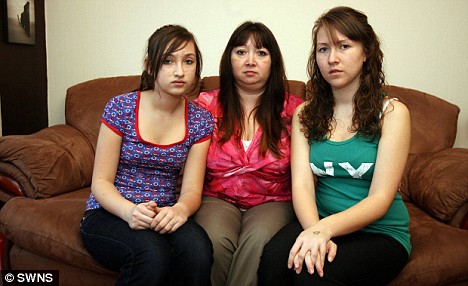
A British mother says she is still fighting to clear her name one year after her two daughters were taken from her and put into a New York orphanage.
Gemma Bray, 15, and sister Katie, 13, were strip searched and kept at the home for 30 hours after their mother Yvonne became ill on holiday last December.
Officials even reportedly asked them if they had been abused or felt suicidal, before they were given medical examinations and were told they could not leave the home.
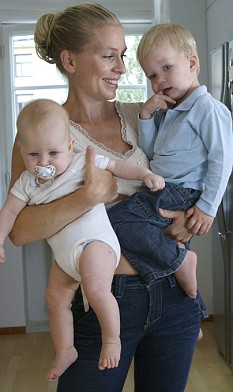
Complaint: Yvonne Bray is unable to become a foster mother because a note was left on her file when her two children Katie, 13, left, and Gemma, 15, were temporarily put into care when she fell ill during a trip to New York
Yvonne, 39, of Appledore, Devon, had been hospitalised with severe pneumonia during the family's shopping trip to New York last December.

She claims she was then hit with a letter from the Administration for Children's Services (ACS), which stated she was 'subject of a report of suspected child abuse or maltreatment'.
Now Ms Bray, who had just completed a 12-month course to become a foster mother, has been told she cannot foster children in Britain until she is removed from the New York State Child Abuse Maltreatment Register.
'It's crazy,' she told the New York Post.
'Why should I fight to clear my name for an accusation that never should have come about in the first place?
'My youngest one, she slept in my bed for three months after we got back. They still have issues with it.
'What I don't understand is why ACS was treating my children like they were being removed from an abusive home.'
Her New York lawyer, Peter Lomtevas, says they may now file a complaint with the city because they have not been provided with a letter confirming no neglect or abuse took place.
The ACS says that the letter Bray received was 'generated as a matter of course' when her children were taken into care while she was ill.
'The letter is simply informational. Ms Bray is not under investigation. She never was,' said ACS spokesman Sharman Stein.
'The letter she receives is simply the way in which our system is legally able to become involved in helping families which are unable to temporarily care for their children.'
Addendum: Here are two postings from a foster mom
of the kind loved by social services. Notice the derision for the real dad.
expand
collapse
Thursday, December 11, 2008
Irate!
I am so irritated right now. I got an email from Samantha's caseworker letting me know that in court this morning (I had no idea there even was court this morning) it was decided that dad would begin unsupervised visit effective immediately. Sounds good huh? He will get her two days a week for two hours each time. Still OK. He wants the visits to happen between 5:30-7:30 in the evening. I don't think so. This child is IN BED by 7 every night. The very few times we've kept her up later (because we were out) she is still up at 6am, but she is cranky all morning, has a hard time settling for her nap and takes it SUPER early so she is then ready for bed by 6pm or sooner. This is not going to work. I mentioned to dad the time he wants is pretty late. His reply? "Too bad. Nothin' I can do 'bout it." Did I mention that dad smells like he just rolled around in an ashtray? I don't even get her inside the house after visits before I take her clothes off and she goes straight into the bath. Every time. So that means she will not get home until 7:45 or 8, if he is on time, she will then need a bath, so she won't get into bed before 8:30 if she can settle down. Most evenings we spend an hour or so on settle down/go to sleep routine. Why didn't the baby's attorney say something? Doesn't the case worker realize this child is not even two? What happened to best interest of the child? O-o-o-o-o-o! I am so irritated.
Posted by Susan at 11:14 PM
Saturday, December 20, 2008
A Bit More on Irate
I was (still am) irate. about the time of the unsupervised visits. It is not a time that is good for Samantha. But I think the bigger issue that is bugging me is that I know dad is playing the case worker and really the whole system. He's playing her about his job, about his living situation, about his family situation, really about everything. Now I haven't worked with this particular worker before but at this point I would have to say she's no slouch. I suspect she knows she is being played. I also suspect it doesn't make any difference. I've said before that having a paid attorney represent someone can dramatically change the outcome. I've said it about when foster parents hire an attorney, but I think if a birth parent hires their own attorney it is the same. And I think dad has hired his own gun. I think his attorney has assured him that he will get his child back no matter what and I think it is probably true, or perhaps there is some truth to it. He missed both of his visits last week and thinks he has pulled something over on everyone. He is pretty full of himself right now. He keeps trying to explain to me how he is a victim in all of this, how he was a single dad, raising his baby all alone when all of a sudden a bad thing happened and bad people took his baby away. All he wants is to go back to being a great dad, all by himself. It's all a crock. I guess that's what irritates me more than anything.
Posted by Susan at 10:26 PM
Successful Orphan
December 27, 2008
A century ago there was no birth control, and lower public health meant a
larger parental mortality. This created a problem of homeless children of
enormous proportion compared to today's tiny complement of orphans. Yet, as
we repeatedly point out in these columns, the voluntary organizations of the
day did a better job of handling their problems than todays bloated
bureaucracies.
For over half a century, orphan children from the eastern United States
were shipped west on orphan trains, stopping along the way hoping to find
farmers who needed extra hands. The last train traveled circa 1929, sources
differ on the exact date. A Denver television station has found one of the
last survivors of the orphan trains, Stanley Cornell.
Mr Cornell was not separated from his parents by force of arms, he was
not diagnosed with any disorders, he was not turned into a zombie on
psychotropic drugs. When he got to his hard-scrabble adoptive home, he was
offered nothing but hard work. Yet in spite of all the treatment that today
would be considered abusive, he relates his adoption as a positive
experience. Children coming out of today's foster homes often have nothing
positive to say about them.
expand
collapse
Colo. man one of the last few who rode the Orphan Train
posted by: Jeffrey Wolf December 27, 2008
PUEBLO - For about 75 years starting in the mid-1800s, more than 200,000 homeless abandoned children in the eastern U.S. were put onto trains headed west. The hope was someone would give them new homes.
Stanley Cornell, who now lives in Pueblo, is just one of a few surviving riders of what was known as the "Orphan Train."
"My first feeing was standing by my mom's bedside when she was dying. She died of tuberculosis," said Cornell, remembering back to 1925. "I remember her crying, holding my hand, saying to 'be good to Daddy.' "
Cornell says he was probably around 4 when his mother died in Elmira, New York. His father was wounded in World War I so he had problems keeping steady work. Eventually, he contacted the Children's Aid Society who came to take away Cornell and his younger brother.
They were taken to an orphanage in New York where Cornell says he remembers being separated by chicken wire fences and being beaten with whips.
To cope with the enormous orphan problem in the city, the Children's Aid Society of New York started to move the children out on trains, hoping to place them with families.
It's believed to be the beginning of foster care in America.
"We'd pull into a train station, stand outside the coaches dressed in our best clothes. People would inspect us like cattle farmers. And if they didn't choose you, you'd get back on the train and do it all over again at the next stop," said Cornell.
Cornell and his brother were "placed out" twice with their aunts in Pennsylvania and Coffeyville, Kansas. Those didn't last and they were returned to the Children's Aid Society.
Next, Cornell was on a train full of 150 children headed to Wellington, Texas. Each time a train was sent, adoption ads were put in newspapers.
J.L. Deger, a 45-year-old farmer, was there in Wellington. He already had two daughters, ages 10 and 13, but wanted a boy too.
"He'd just bought a Model T. Mr. Deger looked those boys over. We were the last boys holding hands in a blizzard, December 10, 1926," Cornell said.
He says that day he and his brother stood in a hotel lobby.
"He asked us if we wanted to move out to farm with chickens, pigs and a room all to your own. He only wanted to take one of us, decided to take both of us," Cornell said.
Work was hard on the farm, but Cornell had finally found a home.
"I did have to work and I expected it, because they fed me, clothed me, loved me. We had a good home. I'm very grateful. Always have been, always will be," he said.
Cornell came to know Deger as Dad.
Cornell eventually got married and he and his wife, Earleen, adopted two boys, Dana and Dennis, when each was just four weeks old.
"I knew what it was like to grow up without parents," Cornell said. "We were married seven years and couldn't have kids, so I asked my wife, 'how about adoption?' She'd heard my story before and said, 'OK.' "
After they adopted their two boys, his wife gave birth to a girl.
Dana Cornell says he doesn't need to find his birth parents because of how he feels about his adoptive parents.
"They are my parents and that's the way it's gonna be," said Dana Cornell.
Stanley and Earleen Cornell have been married 61 years. She is a minister at a church in Pueblo, and is the cook at her son's restaurant, Dana's Lil' Kitchen.
Stanley Cornell believes he is one of only 15 surviving Orphan Train children. His brother, Victor Cornell, a retired movie theater chain owner, is also alive and living in Moscow, Idaho.
Christmas Grinch
December 26, 2008
Were you suckered by one of those charities soliciting money to buy gifts
for foster kids? In New Mexico two women, one an employee of CYFD, the
Child Youth and Families Department, stole the bank cards intended as
Christmas gifts for foster children.
This continues the pattern set by Canada's Easter Grinch. While the amounts are
petty, few things better illustrate the contempt and depravity of social
workers than their habit of stealing from their wards.
expand
collapse
Two arrested on gift card theft charges
Freedom New Mexico, December 24, 2008 - 5:48PM
A Quay County mother and daughter were arrested on Christmas eve, accused of stealing Christmas gift cards intended for foster children.
The cards were purchased and donated by a local church, according to a press release from the Tucumcari Police Department.
Jennifer Dominguez, 24, of Tucumcari, was charged with larceny and tampering with evidence, and Bernadine Gutierrez, 46, of Logan, was charged with accessory to tampering with evidence, the release said.
Both subjects were released on bond
Eleven gift cards, worth $25 each, were reported missing on Dec. 9, according to documents filed at Quay County Magistrate Court. The cards were intended for foster children under the care of the Children Youth and Family Department.
During police interviews, Dominguez said she visited her mother, Gutierrez, an employee of CYFD. Both had been invited to help wrap packages for foster children, the court papers said.
"Ms. Dominguez stated that she removed all of the missing boxes containing gift cards and took them to her house," according to the court records. "Ms. Dominguez stated that later she felt guilty and eventually told her mother that she did have the cards.
Court records note further that, “Ms. Dominguez stated several times that her mother had told her to not use the cards and to get rid of them. Ms. Dominguez advised that she had cut up seven of the boxes and cards and flushed them down her toilet but became concerned about clogging up her toilet so she stopped. Ms. Dominguez stated that then (she) threw the remaining boxes into the dumpster at her apartment complex. Ms. Dominguez eventually admitted that she used that card at K-mart."
The cards had been reported stolen to Kmart and the police located Dominguez when she had tried to use the gift cards, the court documents said.
"It is a shame that any adults would take gifts intended for foster children, especially at this time of year," Tucumcari Police Chief Roger Hatcher said.
Hatcher also said he hopes the citizens of Tucumcari do not let this deter them from being generous in giving to children.
Wendy Babcock illustrates the Easter Grinch
Pope Speaks for Children
December 25, 2008
Pope Benedict in his Christmas message prays for children denied the love
of their parents. Here is the part of his homily dealing with children.
With these thoughts, we draw near this night to the child of Bethlehem – to the God who for our sake chose to become a child. In every child we see something of the Child of Bethlehem. Every child asks for our love. This night, then, let us think especially of those children who are denied the love of their parents. Let us think of those street children who do not have the blessing of a family home, of those children who are brutally exploited as soldiers and made instruments of violence, instead of messengers of reconciliation and peace. Let us think of those children who are victims of the industry of pornography and every other appalling form of abuse, and thus are traumatized in the depths of their soul. The Child of Bethlehem summons us once again to do everything in our power to put an end to the suffering of these children; to do everything possible to make the light of Bethlehem touch the heart of every man and woman. Only through the conversion of hearts, only through a change in the depths of our hearts can the cause of all this evil be overcome, only thus can the power of the evil one be defeated. Only if people change will the world change; and in order to change, people need the light that comes from God, the light which so unexpectedly entered into our night.
Merry Christmas
December 24, 2008
Dufferin VOCA wishes all families a merry Christmas. It is a time for
families to gather and enjoy their blessings. Our best wishes extend also
to those unfortunate parents and children who cannot share this Christmas
because they have been separated in the name of protection.
Snowman Delivers Baby (to CAS)
December 24, 2008
In a scene out of the Keystone Kops, a Windsor woman has delivered two
babies in winter snow. The end of the story discloses why the mother could
not seek medical help — the family had already lost a child to
children's aid and was under watch. The police took the babies to the
hospital, and children's aid now has them under its control. Sorry mom.
expand
collapse
National Post
Woman delivers twins on snowy Windsor street
One infant in serious condition, second chid and mom doing well
Doug Schmidt, Windsor Star Published: Wednesday, December 24, 2008
WINDSOR, Ont. - Newborn twins and their mother are under close watch by hospital doctors and the Windsor Essex Children's Aid Society after the woman delivered them in the street just before midnight Tuesday.
"Our officers deal regularly with tragic circumstances - this was extremely unusual ... traumatic," said Windsor police Deputy Chief Jerome Brannagan.
Both babies are recovering, with one listed in serious condition Wednesday, while the other and their mother were in good condition, said Gisele Sullens, a spokeswoman for Windsor Regional Hospital. The premature babies - one weighing four pounds, the other three pounds - are being treated in the neonatal intensive care unit.
Two officers on routine patrol thought they'd stumbled on to a horrible criminal scene when a woman covered in blood and screaming hysterically ran onto the street, waving them down, Brannagan said.
The woman, however, quickly indicated she had just given birth, and she raised her top to show a newborn held tightly to her stomach. Ambulances were still on their way when the woman, 27, gave birth to the second baby while standing and screaming.
Brannagan said the officers then had to also deal with the arrival on the street of an equally frantic and hysterical father of the babies.
Paramedics were on the scene within minutes and the mother and her twins were rushed to hospital in three ambulances.
While it's not unheard of for police to help deliver babies on occasion, Brannagan said he's never heard of a similar case in his 29 years of policing.
The weather at the time was miserable, with the temperature close to freezing and a mix of driving rain and snow.
There was "no indication of any criminal activity," said Brannagan, but the Children's Aid Society was called in to investigate.
"We are looking into it to ensure the safety of the kids and make sure the mother is OK - and that the mother is in a condition to look after the children," said CAS executive director Bill Bevan.
Bevan said the local CAS had already been "aware of this family," and that another child of the woman had previously been taken away from her. The child is with another family member, Bevan said.
He said details of how the woman got to be on the street giving birth to twins are still being probed.

Legal Murder
December 22, 2008
The National Post reports on a baby identified only as M, born
prematurely with too many medical problems to count. A judge authorized
ending life-saving treatment, resulting in death the next day.
If this doctrine becomes accepted, there is no way to stop "mission
creep", spreading the practice to less desperate cases. Combine this
procedure with the existing insensitivity of social workers and the
rubber-stamp nature of most family courts, and soon police and social
workers will be bullying families with death threats. This is no
exaggeration. In the US and Canada, 95% of criminal cases now end with a
guilty plea. One of the inducements to plead guilty is the threat of
harming children if the accused pleads not guilty and forces a trial.
Threats of harm to children could eventually be upgraded to threats of
death.
expand
collapse
Welfare agencies can stop life-saving care
'Best Interests'; Judge rules in Children's Aid case of 'crack baby'
Tom Blackwell, National Post Published: Monday, December 22, 2008
For child-welfare agencies, there is one overriding goal: to protect the health and well-being of children in their care, sometimes even ordering medical treatment for them.
But a recent court ruling has turned that mission on its head, concluding that agencies can consent to doctors withdrawing potentially lifesaving treatment from a seriously ill young person.
The decision came in the Ottawa case of a "crack baby" whose heart surgery was cancelled when physicians decided further care was ultimately hopeless. A day after the judge gave the Children's Aid Society of Ottawa-Carleton the go-ahead to agree to ending treatment, the baby died.
The case left the Children's Aid Society with a difficult and legally murky decision, since it was unable to locate the three-week-old infant's mother to consult her on treatment, said Barbara MacKinnon, the agency's executive director.
"We don't come into this business to make these decisions. We come into the business to keep children alive and protected and safe," she said. "We really pushed the hospital to help us understand, to make us believe that this is really necessary."
Though the scenario is rare, it may arise more and more often as medical science becomes increasingly adept at keeping such preemies alive after birth, Ms. MacKinnon said.
Irwin Elman, Ontario's independent children's advocate, said the ruling is probably the right one, since a children's aid society must, in effect, act like a parent to the children in its care. But he said he is worried that under-funding of the sector and other pressures on well-meaning staff may not necessarily allow them to consider such questions as seriously as they should.
"Children's Aid needed to make that decision with love," Mr. Elman said. "And if they don't love their kids, then they need to go back to the drawing board."
The baby, referred to in the decision only as M., had been born prematurely this May at only 1.8 pounds, suffering from a brain hemorrhage, dangerously fluctuating blood pressure and blood-sugar levels that required insulin injections every two hours. He also had a serious heart condition for which he was initially to undergo surgery at the Children's Hospital of Eastern Ontario.
But a team of doctors, nurses and ethics specialists concluded that the surgery would only be invasive and painful and that palliative care designed to keep the infant as comfortable as possible was medically and ethically appropriate.
Withdrawing life-support would also be in keeping with the baby's best interests, they said.
While such societies are allowed under Ontario law -- and similar legislation in other provinces -- to consent to medical treatment even when the parents object, it is unclear what the term "treatment" encompasses, Justice Monique Metivier said.
Child-welfare law "has as its paramount purpose to 'promote the best interests, protection and well-being of children,'" the Superior Court judge noted.
"While 'treatment' is not legislatively defined, I am of the view that the best interests of a child can, in appropriate circumstances, require refraining from invasive treatment or withdrawing medical treatment other than palliative care."
Disputes between doctors who feel further treatment of a critically ill patient is fruitless and family members who want them to keep trying have increasingly ended up in court lately. The law is still unclear, though, about whether families or medical staff have the final say in such cases.
Justice Metivier seemed to give the nod to physicians, saying they ultimately do not need the children's aid societies' consent to withdraw treatment if they consider doing so appropriate.
Juliet Guichon, a medical ethicist at the University of Calgary, said the scenario is a tough one for child-welfare agencies, since a death of a child in their care always comes under scrutiny, with autopsies being mandatory in some provinces.
However, the judge in this instance appears to have indicated that medical professionals are the final arbiters of when treatment should be halted, she said.
tblackwell@nationalpvost.com
Ghana News
December 22, 2008
Where do you get the real news about child protection in North America?
Answer: Ghana. Modern Ghana has printed the story by Barbara Bryan under
the headline Dead Children: Sent Legally and Officially to Die, the same one copied
here on December 18. A search
of Google News shows that Modern Ghana is the only news source in the world
to use the story.
Un-protection Workers
December 20, 2008
Canada Court Watch has been following incompetent work by two caseworkers
for Haldimand and Norfolk CAS, Jamie Brownlee and Michael Downs. People who
have experiences with these workers are invited to call Canada Court Watch.
An abridged version of the report is below.
expand
collapse
Dirty deeds being perpetrated against family by Halimand & Norfolk Children's Aid Society workers!
(Dec 20, 2008) The Family Justice Review Committee has been involved in an ongoing investigation involving two workers, Ms. Jamie Brownlee and Mr. Michael Downs of the Children's Aid Society of Haldimand & Norfolk in Townsend, Ontario. Information uncovered to date during the investigation would reasonably indicate that these two workers have acted in an unprofessional manner, have abused their power and authority and have caused significant harm to at least one family in the region. It would appear that the Charter Rights of the Parents and the Child have been infringed upon as a result of one mistake after another by Society workers. It appears that the Society does not even know how to serve documents properly on parents with workers committing multiple violations to the family law rules. Even a motion filed on December 17, 2008 violated some of the most commonly known rules. The costly mistakes being made by this agency are inexcusable considering the monies and resources that these CAS agencies get from the taxpayers of Ontario. The FJRC to date has compiled a 50 page report on this case and the report gets thicker by the day as workers keep doing more things wrong to screw up the case.
Any parent in the region who has had dealings with either Ms. Jamie Brownlee or Mr. Michael Downs is urged to contact Canada Court Watch in confidence at info@canadacourtwatch.com
Drug Bust
December 19, 2008
A nine-year-old girl has been caught sharing cough medicine with her
classmates. One of them gave her a dollar.
expand
collapse
Friday, December 19, 2008
BRAVE NEW SCHOOLS
9-year-old called drug dealer over cough drops
Case prompted when student shared Vitamin C candy with friend
Posted: December 19, 2008 12:25 am Eastern, WorldNetDaily
A Florida elementary school accused a 9-year-old student of selling drugs for sharing cough drops with friends.
Officials at Patterson Elementary School in Clay County decided, however, not to discipline Khalin Rivenbark, who met with the girl and her father Wednesday.
The accusation arose one day earlier when the child got into trouble after her father put some Halls Defense Vitamin C cough drops in her school bag when she was recovering from a cold, she told Jacksonville's WJXT-TV
She later shared some with friends.
"[A teacher] saw me with the cough drops out and I guess she saw me give it to one of my friends, and then like, 'Oh, I see this good business going on around you,'" Khalin told the station.
"She said, 'You're selling drugs.' (I said) 'No, I'm not.'"
The 9-year-old said one of her friends gave her $1 for the cough drop.
Her father, Andy Rivenbark, told the station, "It's absolutely crazy."
The student said the cough drops were in her bag, and two friends asked for one, so she handed them out. One friend insisted on paying.
"She felt guilty taking the cough drop or whatever, so she gave me a dollar. I didn't want to accept it, but she had me take it," Khalin told the Jacksonville TV station.
The student handbook for Clay County Schools says, "If a student must take a prescription or over-the-counter medication during school hours, it must be received and stored in the original container, and be labeled with the student's name, current date, prescription dosage, frequency of administration and physician's name."
But WJXT reporter Diane Cho questioned whether the Halls cough drops qualify as a drug, since the ingredients were nearly the same as Lifesavers candy.
Andy Rivenbark said he didn't get a note or call from school administrators about the incident.
"It's definitely detrimental to somebody who we teach the whole time growing up, 'don't use drugs because drugs are bad.' To accuse her, it's unnecessary to make a comment like that," Rivenbark said.
The report said the meeting included an admonition from school officials for the child not to bring cough drops again.
WND reported several years ago on a case in which a student was expelled for a year for having Advil in her purse.
The case involved sophomore Amanda Stiles, who was expelled from Parkway High School in Shreveport, La., after a teacher searched her purse because she was suspected of being among a group of students smoking cigarettes on school grounds, the Shreveport Times reported.
The punishment was affirmed by the school board.
Stiles said she carried the over-the-counter medicine because of frequent headaches, but the Bossier Parish School District maintains it followed a state law barring drugs on campus and its own "zero-tolerance" policy.
"I just never thought about the fact that I could be searched," Stiles said, according to the Shreveport paper. "I think we're old enough to know how many [pills] we can take without overdosing or being in danger."
WND also has reported various disciplinary actions for students over toy guns, drawings of guns and even a gun company logo on a pen.
Protected to Death
December 18, 2008
Barbara Bryan draws attention to a list of children dying at the hands of child
protectors. Our own list has 1166 names of children protected to death and increases daily.
expand
collapse
Release Date: December 17, 2008
Dead Children: Sent Legally and Officially To Die
Dead children: How many are battered, bruised, heartbroken and neglected to death before all who order their housing and ignore them to death are made accountable?
Check this partial listing of names and pictures ( in memory ). In January, look for a more complete list of known Unnecessary Angels for 2008.
America offers a single avenue for abused or neglected children: the child protection agency of that child’s state. Names vary from Child Protective Services, Department of Child and Family Services, Department of Human Resources and several other titles.
If abuse and neglect reporters, many anonymous and also non-accountable, make an error in sharing suspicions it can be the beginning of the end for that child.
When a report is mistaken or malicious, the child is traumatized. In those worst cases a child’s life may be totally needlessly changed. In those non-cases taxpayers have paid exorbitant expenses and have been defrauded. When is anyone involved prosecuted?
Too often, when a child is truly in danger, real abuse may be ignored until the child is dead or brain-damaged. Parents who cannot or should not have children at home must be monitored or children moved. When they are not who answers when the child is killed?
Decades ago the child protection system was dubbed “the child abuse industry” because so many people profited. All supposedly cared about children and put their expertise on the line: from guardians ad litem and mental health evaluators and counselors to nurses and doctors, prosecutors and the ultimate person approving and immunizing the plan and planners by ordering where a child will live and with whom. That is the judge.
Constitutional safeguards—for children, parents or caretakers—are purposely lacking in most family courts as well as CPS agency process. Yet, children are removed, adopted to strangers or returned to dangerous living arrangements and the child deaths persist.
How high must that pile of dead child bodies become to get the attention it has needed for decades? If many children vanished in railroad cars instead of one or a couple of children from various places in county cars, would that make a difference?
Read the site above and weep. In tight financial times, with more stress and poverty, children cannot afford more mistakes minus basic accountability that everyone else operates under.
Concerned professionals and media may learn more at http://www.falseallegation.org or by calling NCADRC at 419-865-0513.
Barbara Bryan, [ BHBryan at aol.com ]
Barbara Bryan
Communications Director
National Child Abuse Defense & Resource Center
Phone : 704-582-1059

Alexis to Terminate Monday
December 17, 2008
The latest from reporter/senator Pam Roach on Alexis (she is dropping the
pseudonym Lisa) says DSHS is reacting to the medical information on Alexis
by moving to quickly terminate parental rights next Monday.
expand
collapse
Wednesday, December 17, 2008
DSHS Acting Fast To Steal Girl From Fit Family
This is a verbatim email I just received. The department knows the medical records are out and this is their answer:
"Pam, Just got off the phone with Gia. She is worthless! According to her, we are to blame for Alexis's failure to thrive. That is why she was not returned to us last August. I told her, if that's the case why did you give placement to us for the next ten months? And why were all the medical, social workers, and casa's reports glowing for the time period we had placement? She could not give me an answer for that. According to the new casa they are planning to get termination on Monday. They sent Lisa's (Lisa is actually the name of the mother. I have been using it as the name of the granddaughter) attorney adoption papers for Lisa to sign off stating sign this and get minimal visits, or go through trial and get no visits what so ever."
— Doug (Grandfather)
Please see previous PPR for the link to the KING 5 TV coverage of this truly awful story. CPS is most certainly stealing this child!
Posted by Pam Roach at 12:34 PM
Addendum: Two further posts by Pam Roach.
Termination for Alexis was delayed by a Seattle snowstorm.
expand
collapse
Monday, December 29, 2008
New Court Date Set ... State Moves With Vengence To Place Child Away From Family
The new court date is January 6th and the state will again (as they have from the beginning) press hard for termination and placement, presumably, with the foster woman. The state has prevented placement with several good relative families and has done its best to alienate the Lisa's affections to her biological family. (From the KING 5 coverage we see that it hasn't worked!)
Who is the mystery person spends time at the house? The foster woman has told the state that she has no one else living there. Will the state, in its scheme to steal this child, level with the court?
Will the court see the medical records?
Will the court believe the state (or the CASA?) that the mother writes an offending (to some) blog? Or, will the state be honest and tell the court that the mother had nothing to do with the blog? (Must be a real feeling of power to seed the court with lies and know you can get away with it.)
Will the judge ask who writes the alternative blog? (There is a blog other than PRR that covers the case of the Stuth's granddaughter. Judge Schafer, reportedly, blamed the alternative blog on the teen mother. Because it was aggressive in attitude it was, therefore, proof that the mother was unfit.)
Will the "free" attorney tell the judge her client did not write the blog? Why didn't she defend her client on that matter in the first place?
I have taken the position that another individual's free speech should not be used against the mother. I also believe that if the mother DID write the blog (and she didn't) it would only show that she is fighting for her child and what mother worth her salt wouldn't fight for her child?
Posted by Pam Roach at 12:38 AM
Senator Roach Again Attacked By Foul Mouthed "Steal The Kid" People
A judge recently condemned Lisa's teen mother for the contents of a blog she did not write. I am told there was no swearing, just statements of fact presented in crazy cartoon fashion.
Emboldened, I suppose, by the fact that I don't print the few foul comments that come to this blog... supporters of the foster woman have sent a few very foul, sexist, angry (at me) comments.
SURPRISE! I HAVE SENT THEM TO THE JUDGES.
Just what kind of friends and relatives does the foster woman have? Are these the kind of people we want to be around Lisa? Hmmmm...maybe the foul, angry, abusive tirade was actually from the foster woman!
There is absolutely no way someone could have been more crude than what was just sent on to the judges. I wonder who else will get copies.
Posted by Pam Roach at 1:25 AM 2 comments
British Court Doors Ajar
December 17, 2008
Britain has opened its family courts to journalists. While an
improvement over the previous total secrecy, there is still a long way to go
to achieve openness. The press will not be reporting the names of the
children, skeptical members of the public will be unable to enter the
courtroom or examine the court files, and bloggers will likely not be
respected as journalists. In many places, governments have exercised
substantial control over what journalists publish, while giving lip service
to freedom of the press.
expand
collapse
Reporting of family courts could stop childcare mistakes
17 December 2008, By Rachael Gallagher
Justice Secretary Jack Straw’s decision to “lift the veil” and allow journalists to report on family courts could help stop bad decisions being made about the care of children, according to PA legal editor Mike Dodd.
From April, journalists will be allowed to attend and report on all divorce, custody and care proceedings unless specifically excluded.
Press Association legal editor Mike Dodd said that the media’s reporting of the courts could raise questions about proceedings that would have otherwise have gone un-asked.
Dodd referred to a case in 2006 when a child was taken into care for 14 months based on evidence that was all later declared “misleading, incomplete or wrong”, but where the council and the team leader of the case were never named.
He said: “There have been too many examples of where the secrecy has led to questionable decisions, and the secrecy has allowed certain statements to be made in the family courts which would have been instantly questioned had they been made in public courts which had been open to media coverage.”
The previous Lord Chancellor, Charles Falconer, had said that there was no way that the courts would be made open to the media, but Dodd said that this was partially to blame for evidence gathered at stake-holder sessions where a number of young people were interviewed who said they were worried that their identities would be revealed if media were allowed to cover family courts.
“We always understood that if the family courts were opened up it would be done on the basis those involved would in general remain anonymous. I don’t think it was ever made clear to the young people that their privacy would be protected above all", said Dodd.
“One way of making sure that the public understands what is going on is to report fully what is being said and of course to make sure that those who are giving evidence about a child’s wellbeing should all be named. Even if the children aren’t. That way you have track on people who claim the authority and power, and they should be held accountable for what they’re doing. If you’re a policeman investigating a murder, you don’t do it anonymously, and you don’t give evidence in court anonymously.”
The Newspaper Society gave a “qualified welcome” to the news.
Sue Oake, senior legal advisor, said that the NS will be want to scrutinise carefully what the revised reporting restrictions entail.
“Clearly these will need to be proportionate and targeted: to impose a blanket 'default' requirement of anonymity for all parties will result in a restrictions more draconian, in many cases, than those pertaining already.
“On disclosure of information, we are disappointed that the statement does not make any move towards allowing direct or indirect disclosure to the media by parties to the proceedings. Again, with appropriate safeguards, this could have been an effective means to aid openness so we are pleased to note Mr Straw’s assurance during the Parliamentary debate that he is still 'actively considering' this issue”.
The Times newspaper claimed credit for Straw’s decision to open the family courts to journalists, and said today it has “campaigned vociferously” for the change, “arguing that keeping the media out of certain courts has led to miscarriages of justice.”
Straw credited The Times for having brought the issue to his attention “more graphically than it otherwise would have done”.
“You have to deal with shedloads of issues in jobs like this … if something isn’t a particular issue at the time, you don’t go around searching for it. I commend The Times for running such a professional campaign,” he said.
Society of Editors director Bob Satchwell said that he hopes the courts will take the message in its “full spirit” and only impose reporting restrictions when there is a “specific and genuine argument for them to be introduced”.
He said: “I always believe that openness improves virtually any activity. A, the public have a right to know what’s being done in their name and b, when its all done behind closed doors it can only lead to rumour and suspicion. If you have greater openness there’s going to be more confidence in the system.”
Addendum: The London Times deals with the same
news. The middle story presents the remarkable fact that it is illegal for
a foster child to give his own name in public.
expand
collapse
From Times Online, December 16, 2008
Family courts: case studies
Fiona Hamilton, London Correspondent
The opening up of the family courts will be welcome news for one couple whose case - currently before the Court of Appeal - has been highlighted by The Times after their baby daughter was placed into foster care earlier this year.
But although it means the couple will now be able to discuss their case with the media the reforms do not go far enough for their MP.
Tim Yeo, the Conservative MP for Suffolk South, told The Times that his efforts to help the couple had been thwarted by a system which “prevents natural justice”.
Although the couple have given Mr Yeo permission to access information about their case, the authorities have denied his requests and have refused to justify their actions on the grounds of confidentiality.
Mr Yeo said: “They continue to decline to make any information available to me despite authority by the parents.
“They’ve consistently refused to share their reasons [for placing the child in foster care]. Obviously not publicly, but not even privately with me.
“This makes it very hard for me, as the representative of the parents, to assist them."
The mother first lost custody of her young son to her ex-husband (his biological father), who claimed that she suffered from a condition known as fabricated or induced illness.
When she fell pregnant to her new partner, social services monitored the family. During a conversation with social workers, she explained her fear of losing her newborn daughter by saying that her new partner felt like killing them all if she was also taken away. The couple have no history of violence or abuse. They say that they would not dream of hurting their baby and the remark was merely an attempt to explain the full extent of their agony if she was taken away.
The child has since been taken into foster care. The mother has access to her for just three hours a week and the father has not seen her since. The couple, who have not been given full reasons for the removal, are appealing the supervision order.
Mr Yeo said: “It seems extraordinary that people can have what is a sort of life sentence, in losing their baby daughter, without really knowing what the evidence is against them and without being able to refute it.
“There is this cloak of secrecy in which social services conduct their activities. They would have more rights if they were up on a murder charge.”
At 17 years old, Curtis is old enough to move out of home, travel around the countryside for his job and have a girlfriend.
Yet, adult as he is, Curtis is prevented from speaking publicly about his past and the sister that he did not know for much of his childhood, ostensibly for his “protection”.
A month before he was born, his 17-month old sister was taken away from his mother and placed into foster care after social services expressed concern about a bruise on the child.
At three-year old his sister was adopted following proceedings in the family court, despite a judge’s misgivings, because she had “bonded” with her foster carers after social services denied the mother access. Curtis was only recently reunited with his sister after she tracked down her family.
He approached The Times to tell his story hoping that his case would raise awareness after he found out that social services also tried to place him into foster care despite there being no evidence against his mother.
However, he cannot be named until his 18th birthday and his social services referral sheet, which nearly separated him from his biological mother, cannot be published under restrictions by the Administration of Justice Act.
Curtis told The Times: “It’s disgusting. It’s my life and I want to talk about it, I want people to know so that maybe this sort of thing can be avoided in the future. It took me ages to get my court documents and even though they’re mine, I can’t make them public. Social services just get to cover things up and its wrong.”
Matthew, a working professional in his fifties, was fighting a custody case for several months before he became aware of the damaging allegations against him on his court file.
A supporter of his ex-partner had written the judge a letter in secret making various spurious claims including that Matthew was not to be trusted with his children.
Matthew only became aware of the allegations when he requested other correspondence from his file.
“I was able to reject the allegations and the judge said he wouldn’t consider them, but it was highly inappropriate and quite a concern,” he said.
“If I hadn’t have asked for other information and if this letter hadn’t been included with it, I would have never known of its existence.”
Lisa/Alexis Starved
December 15, 2008
Do you get a good feeling when you drop an item in a food bank? It
doesn't seem to get to foster kids. According to reporter/senator Pam Roach
the foster girl under her watch is starving. In sixteen months she gained
only 2.5 pounds. CPS does not tell the judge about her meager diet. As far
as the court knows, Lisa/Alexis is safe.
expand
collapse
Monday, December 15, 2008
Little Lisa's Medical Records Show Neglect and Possible Abuse
No surprises here. According to medical reports little "Lisa" has gained only 2 1/2 pounds in the 16 months that CPS has had her in foster "care." This is absolutely appalling! And, they try to hide it from the court. Apparently, neither judge has the medical records!
I had one person wonder out loud if CPS is starving the girl to keep her listed as special needs. I think there is more pay that goes out to everyone involved if that is the case.
I had a few computer problems last night and will have to wait to blog about the report. Not as a teaser...but let's just say the doctor suggests the bruises could mean abuse.
WHERE IS MARY MEINIG??? (THE OMBUDSMAN)
I asked Mary Meinig about the altered email wherein the childcare worker asked Lisa how she got her black eye. The email that I saw had the question put to the child and the answer was redacted. Meinig says she couldn't find the original email. It is there Mary....use your substantial powers to order it! Go to Childhaven and tell the supervisor you want that original email. It was an email sent to CPS BEFORE it went to the mother! Someone altered the email to protect the person named by the girl. Could that have been the social worker, S. B.? Did she alter the email before it was washed and sent out? How many other people in CPS have seen the email? Has Mr. Fox seen it? The supervisor admits the email was altered. Try again, Mary. The little girl is frail and not thriving under CPS control. Go find that email, Mary. You have the power. Let's open up government and see who is being protected. There is a "played with" email and a little girl who has only gained 2 1/2 pounds in 16 months. The fact that you have not found that original email only tells me there are some very relieved social workers.
Posted by Pam Roach at 1:04 PM
Back to Mom and Dad
December 13, 2008
The press reports on the distress of a Utah couple compelled by the
courts to give up their adopted baby. The press rarely reports on the more
frequent cases of distress of natural parents compelled to give up their
babies on pretense of protection.
expand
collapse
Family must give up adopted boy
Reported by: Dan Rascon, Last Update: 12/12 6:47 pm
Adopted six-month-old Talon will revert back to his birth parent's custody after a court order.
Imagine only having two days left with your son or daughter.
A bureaucratic process involving federal law and Native American rights has caused that exact situation for a South Jordan family. Their adopted son is getting taken away from them by court order. The boy is expected to be removed Sunday night.
“I can’t believe that it's happening.” said Clint Larson, who is the adoptive father of six-month-old Talon.
Talon was born in Salt Lake City in June.
Talon's birth mother, who is a member of the Leech Lake Band of Ojibwe Indian tribe in Minnesota, came to Salt Lake City to have the baby.
She place Talon for adoption through the Heart & Soul adoption agency.
According to the tribe, when she returned home to the reservation after giving birth she changed her mind. She wanted the baby back even though the adoption had already gone through.
The Larsons have been fighting in court to keep their child. This week a third district court judge ruled in favor of the birth family, citing federal laws. The Indian Child Welfare Act states that the tribe has a legal right to claim the child.
The tribe says the adoption agency never received the birth father's approval and acquired the mom's signature while she was still drugged after the birth.
The Heart & Soul adoption agency says they did everything according to the law.
The Larsons cannot imagine life without their son.
“He's our son and they are going to take him from us on Sunday. We've waited five years for a child and have cared for him as well as anyone could. They are taking him away right before Christmas. It was going to be his first Christmas with us,” said Heather Larson, Talons adoptive mother.
Frank Bibeau, an attorney for the Tribal council, says the child was never the Larsons to begin with. "The child is not the Larsons and the Larsons are not Indian as far as I know and this is an Indian child.”
The Larson's attorney, Paul Tsosie, argues the child is not a quarter or more Native American so the tribe cannot claim him or enroll him, according to the tribe's own constitution. But
Bibeau says that is not true. "We watch out for our members and our next generation of members. What would be the point of watching out for our children who are quarter blood or more and we don’t care about their children and take care of their children?”
Baby Cassidy
December 13, 2008
Baby Cassidy passed away in McMaster Children's Hospital while under
temporary wardship of Family and Children's Services of Niagara.
expand
collapse
Restrictions 'inhumane'
Friends slam agency's treatment of teen mom, baby
Paul Morse, The Hamilton Spectator
(Dec 13, 2008)
Niagara's children's aid agency is being called "inhumane" for its role in the death of a gravely injured infant who took 14 days to die after she was removed from life support.
Friends of the teenage mother accuse Family and Children's Services Niagara (FACS) of causing the three-month-old girl to suffer for two weeks after doctors determined she was brain dead and her feeding tube was removed by court order.
The infant, who died Tuesday night in Hamilton's McMaster Children's Hospital, can be identified only as Baby Cassidy.
FACS executive director Chris Steven said the children's aid agency secured a court order granting it temporary wardship of Cassidy and later received a court order involving a "sensitive" medical decision.
Steven would not directly discuss the case any further because of strict confidentiality laws.
Friends of the baby's 17-year-old Niagara Falls mother say the teenager also had to endure the ordeal virtually alone because of strict visitation restrictions imposed by the child protection agency and the hospital.
Baby Cassidy was rushed to a Niagara hospital on Nov. 12 with a suspicious life-threatening brain injury and transferred immediately to McMaster. Police, who suspect the baby may have been violently shaken, have launched a major investigation.
"FACS may have their own reason for the way they've done things, but it seems very inhumane to me," said Joan Cristelli, 42, of Niagara Falls.
Baby Cassidy "looked like something you see in a horror story, like a skeleton. Her soft spot was completely caved in an inch and a half. Her eye sockets, you could see the shape of them," Cristelli claims.
"And having the mother there by herself and not letting others in and having her watch this with no support ... that, in and of itself, is pretty inhumane."
Cristelli befriended the pregnant teenager, who was already pregnant when she started dating her son earlier this year.
"I thought, 'Who am I to judge this girl?' She needed support."
Cristelli began giving the teenager baby supplies, helped her prepare for birth and was at her side during labour in hospital. The girl moved back in with her mother after Baby Cassidy was born, but moved out again shortly afterward.
Police say a family member brought Cassidy to Greater Niagara General Hospital Nov. 12 with a grave brain injury. The infant was rushed to McMaster's pediatric care unit in critical condition the same day.
Baby Cassidy was kept on a feeding tube for several weeks while doctors ran a series of brain scans and tests on her, Cristelli said. Then, she said, doctors and FACS informed them the infant had no hope of cognitive life and on Nov. 25, the feeding tube was removed. They also restricted access, allowing only blood relatives to be in the room with Cassidy.
While the teen's mother and grandmother came as often as they could, it still meant the girl was alone with a dying Cassidy for much of the time, she said.
"The baby did not die of brain damage, she died of starvation," Cristelli alleged. "I did not think we had this in our country."
Children's aid agencies do have the ability make critical medical decisions, said Dominic Verticchio, of the Children's Aid Society of Hamilton.
Based on expert medical assessment, the agencies can decide to withdraw life support in two ways:
If the child is a full ward of the Crown, CAS can automatically make that decision because it is the child's legal guardian, says Verticchio. But if CAS takes the child into temporary wardship, it must seek a withdrawal order from the Family Court branch of the Superior Court of Justice.
"At some point you have to weigh the benefits and harms," said Karen Faith, director of the Clinical Ethics Centre at Sunnybrook and Women's College Health Sciences Centre.
If the health care team decides aggressive life support ought to continue, they will talk about benefits and harms from an ethics perspective, she said. Then, the "burden of medical interventions" is justifiable if there is a likely benefit.
But Faith said many ethicists argue that prolonging the dying process through intervention where death is imminent prolongs the suffering that goes along with dying.
"Many would argue that constitutes a harm with no likely benefit."
pmorse@thespec.com 905-526-3434
Addendum: A woman identifying herself on Facebook as Jessica
Pelissero says she is the mother of baby Cassidy. As of August 2011 FACS is
going after her son because of the baby Cassidy tragedy. Help can be
offered through the Facebook link before her name.
From another source, here is the mother's account of the death of
her baby.
expand
collapse
Jessica Pelissero September 11th, 2011 11:03 pm :
I have been dealing with Family and Children’s Services for the past 7 months. This is, unfortunately, the second time I have had the “pleasure” of dealing with them.
My first time dealing with FACS was terrible. The absolute worst thing I have ever gone through in my entire life. I was a young mother, and they took advantage of that, and lied and manipulated me and my family, and eventually destroyed the most important thing in my life. My daughter.
November 11th, 2008 I had left my two month old daughter with a family member for the night. He offered to watch her to give me a “break” so I could get some rest and relax a little bit. If only I had known what was going to happen, I would have straight up refused.
November 12th, 2008 I woke up early, even though I was supposed to be taking the day to relax and get some sleep, and went onto MSN. I spoke to my family member, who informed me that “something was wrong with my daughter, and I needed to come pick her up.” I thought he was overreacted, but I got ready, called a cab, and headed over to see what the problem was.
When I arrived, my daughter was unconscious, and her breathing was very shallow. I knew IMMEDIATELY something was seriously wrong, and she needed to be at the hospital. The person I left her with did not call an ambulance, and instead waited for me to come pick her up. This person has children of their own, they should have been more responsible and done something to help her.
If I had not woken up early that day, I’m not sure if he ever would have called an ambulance, or even me. He was irresponsible, and didn’t even try to help her. If I had brought her home with me the night before, she would probably still be alive.
So, once I saw the condition she was in, I rushed her to the hospital. Immediately a “Code Pink” was called, and she was rushed away from me. I sat in a waiting room for almost 2 hours before any doctor came to talk to me. When they did, I was informed that my daughter had suffered head trauma, and was bleeding in her brain.
She would need to be rushed to McMaster Children’s Hospital. I was allowed to see her one time before she was transferred. My heart broke, and I saw my life fall to pieces.
After she was transferred, I was forced to be interviewed by a worker from Family and Children’s Services. I told her exactly, everything that I knew. I told her I had just picked her up a couple of hours ago, and rushed her here. I told her how the caregiver hadn’t done anything to attempt to help her, and how he says nothing happened.
After that, I was allowed to leave, and head up to Hamilton, to monitor the condition of my daughter. When we arrived in Hamilton, we were not allowed to see her. I was heartbroken. I was required to do an interview with a “Child Abuse Unit” of the hospital, go through another evaluation with FACS and speak with a doctor in charge, before I was allowed in her room.
She had a police guard at her door, and was only allowed one visitor at a time. How they could expect anyone to go through this alone… To see their child, in such rough shape, and have no shoulder to cry on, no support, I don’t understand it.
My daughter was put into a medically induced coma. She had a feeding tube through her nose, a catheter, and a ventilator feeding air directly to her lungs. She was swollen everywhere, and her eyes were taped closed. I could barely recognize her. How could this happen to my daughter?
After many interviews with Family and Children’s Services, they decided that they would only allow blood relatives into my daughters room, and still only one at a time.
This was especially unfair because the man who had acted as father to my daughter since before she was born, was not allowed in the room, but my daughters biological father and his family was allowed to see her. Her father and I had split up because he expected me to put her up for adoption, and I refused. Why would they allow him and his family to see her, and not the family that adopted her as part of theirs?
The doctors performed brain scans and blood work on my daughter for a week and a half, and then FACS brought me to court, and forced me to give up my rights to my daughter. She became a Temporary Crown Ward, and they then got a court order to remove her from life support.
November 25th, 2008 they took my daughter off the ventilator. We had our entire family, and everyone who wanted to say goodbye, as well as a Priest present. We had her baptised, and a memory box was prepared. We thought she was going to die that day.
They removed her tube, as I held her in my arms. Holding my breath, I was braced for the worst. Against all expectations, she started to breathe on her own! It was a miracle! She was going to live!
She began to make progress. Moving around, making noises, even reacting to loud noises that we made around her, and our touch. She loved having her feet tickled, and when we did, her mouth would smile just a little bit. We had so much hope. The doctors told us she was going to make it.
Three days later, Family and Children’s Services obtained a court order to remove her feeding tube. They had lied and said she was making no progress, had no brain activity, and no chance at life. They removed her feeding tube later that day, and that’s when all the hell really began.
She was moved out of the Intensive Care Unit, and into a normal ward of the hospital. The only medication that she was given, was morphine. Everytime she made a noise, they assumed she was in pain, and gave her a shot to keep her from making noise. I believe that they were overdosing her.
I was not allowed to bottle feed my daughter, give her water or even bathe her. I was accused of interfering with her death, and threatened to be banned from her room if I even attempted to feed her. The logic was that bathing would hydrate my daughter, and feeding would nourish her, which would offset the “dying process”.
For fifteen days, I watched, alone and horrified, as my daughter was starved to death. Not being able to do anything. Either I could feed her, and never see her again, or I could spend every last second of her life with her, and cherish every minute of it, no matter how hard it was.
As we were in Hamilton, and my family is from Niagara, it was not very often that our blood relatives were able to come see us. They came as often as they could, but seeing my daughter in that condition was hard on them.
She was purple from head to toe, withered down to a skeleton. Her soft spot was completely sunken in, and her eyes as well. After fifteen days of being starved by Family and Children’s Services, on December 9, 2008, my daughter lost her battle, and finally went to God. May she rest in peace.
I hope one day, to get justice for my daughter. To this day, FACS still claims she died as a result of a brain injury…
Exonerated Couple Asks for Children Back
December 12, 2008
After being cleared by the courts, Nicky and Mark Webster want their
children back. The children were adopted out while false charges were
pending against the parents.
One of their children had a food allergy requiring a diet of only soya
milk. The vitamin C deficiency in this diet led to secondary problems from
scurvy, which British child protectors attributed to child abuse.
The courts now agree that no abuse took place, but that does not give the
family their children back. This family appeared before in this blog on September 16, 2007.
expand
collapse
Norfolk couple's court bid to get children back
Nicky Webster - bidding to get her children back
04 December 2008 16:22
A Norfolk couple today launched a legal bid for a landmark ruling that they should be reunited with their three children, who were forcibly adopted almost four years ago amid abuse allegations.
A top QC told London's Appeal Court that Nicky and Mark Webster were victims of a “terrible miscarriage of justice” after being accused of inflicting multiple fractures on their baby boy.
The couple, from Mill Road, Cromer are battling to persuade top judges that their baby son's injuries were due to a modern case of scurvy, brought on by his acute eating problems, which saw him existing on an exclusive diet of soya milk.
The boy, referred to as “B” in court, was taken into care with his two older siblings after doctors said his injuries were “non accidental” and they have now all been adopted.
Their parents have not seen them since January 2005, when they were aged five, three and two.
The couple made national headlines in 2006 when they fled to Ireland to have their fourth child, Brandon, fearing that he would also be taken from them. They are expecting their fifth child next year.
In London's Appeal Court, their counsel Mr Ian Peddie said the time had come to clear their name and for a court to publicly acknowledge they should never have been separated from their children.
He added that, even if the court ruled it was too late to go back on the children's adoption, it was “vital” that they should be told the truth and that Mr and Mrs Webster should be allowed to see their children.
The barrister said the events unfolded in November 2003 when “B” was suffering from “extreme eating problems”, which meant he could take no solids and had an aversion to cow's milk. He lived exclusively on soya milk, which contained no vitamin C.
He was having trouble walking and, after his mother twice took him to the Norfolk and Norwich University Hospital (N&N(, doctors discovered six fractures which were said to have occurred over a 14-day period. Medics concluded the injuries were non-accidental.
In May 2004, a judge found that either Mr or Mrs Webster had caused the injuries and all three children were taken into care. The QC said they were advised not to appeal.
However, after Brandon's birth in May 2006 an American professor of forensic paediatrics investigated the case and concluded that all of the injuries could have been caused by vitamin deficiency and scurvy.
One of the doctors who originally ruled the injured were non-accidental later accepted that they could have been caused by scurvy.
Other experts had reported since that “abusive trauma was not a sustainable conclusion” for B's injuries given the bone weakness that was a recognised symptom of scurvy and that the injuries were the result of “normal handling of abnormal bones”.
The court heard the two oldest children were placed together with an adoptive family in 2005. The youngest child was placed on his own, although the siblings are allowed to have contact with each other annually.
Mr Peddie told Lord Justice Wall, who is hearing the case with Lord Justice Moore-Bick and Lord Justice Wilson: “The miscarriage of justice needs to be corrected and the children need to know the truth.
“This was beyond a mistake. We say this is a case where there has been a fundamental injustice, a denial of natural justice.”
He said it was an “exceptional” case where the children's adoptive placements could be cancelled, enabling their return to their parents.
Barbara Connolly, representing both sets of adoptive parents, said that, for the children, the adoptions meant they were now with their “forever families”.
“To overturn that has enormous implications. They have been very much part of their families now for well over three years.”
She said allowing an appeal in which biological parents were pitted against the children's adoptive parents would create a “destructive situation” for the children.
The judges said that they would reserve their decision on the case until a later date - probably in the New Year.
Press takes up Lisa/Alexis
December 12, 2008
The efforts of senator Pam Roach to save Lisa/Alexis have caught the
attention of the press. Here is an in-depth story.
expand
collapse
Investigators: Grandparents passed over in favor of foster care
03:08 PM PST on Thursday, December 11, 2008, By SUSANNAH FRAME / KING 5 News
ENUMCLAW, Wash. - From day one Doug and AnneMarie Stuth of Enumclaw adored the new baby in their home.
"It was a very exciting time. She was the center of our world," AnneMarie Stuth said.
But the Stuths aren't the baby girl’s parents; they're her grandparents. Their troubled teenage daughter had her at 16. Then she relied on her parents to help raise the baby.
"I was the first one to hold my granddaughter and I was the first one to kiss her,” Doug Stuth said. “So yeah, we have a tight bond."
When the baby was 9 months old, things unraveled. The teen mom moved out of her parents' home along with the baby. While living away from the Stuths, the baby lost weight. A doctor's appointment led to a call to Child Protective Services. The doctor reported the teenage mother let her child get dangerously thin.
“It’s like your whole world comes crashing down,” AnneMarie Stuth said.
Enumclaw police put the child in protective custody with the Stuths right away.
The grandparents raised the child for months and received glowing reports. One officer of the court wrote: "She's fortunate to have her grandparents as a safety net."
"Our granddaughter always came first,” Doug Stuth said. “She’s a little baby. She needs someone to protect her and take care of her and that’s what we did.”
Reuniting the baby with her mother was the goal. Caseworkers placed the two in transitional housing for young moms. That didn't work. The teenager got kicked out of the programs and lost her daughter again.
Later this month a judge is expected to rule on the fate of Doug and AnneMarie Stuth's grandchild, pictured here. She is now 3 years old.
KING
This time instead of going back to grandma and grandpa, social workers put the baby in foster care. There was a court order saying the Stuths weren't a placement option. State workers and the child's court advocate had submitted negative reports about them to a judge, saying living with the grandparents wouldn't be good for the baby.
The Stuths were devastated. The child’s daycare providers gave them heartbreaking reports.
“(They tell me) that she cries for me," Doug Stuth said. “You have no idea (how hard it is)."
Why didn't the baby go back to the grandparents? Most people would think there must be something very wrong with them, such as reports of abuse or neglect. Perhaps they have criminal records, drug problems, or a history of unemployment? None of those things are true.
So we dug a little deeper. The King 5 Investigators looked at hundreds of documents written by people making decisions on the case.
A court-appointed advocate for the baby wrote the Stuths were selfish, hyper-critical, and were derailing their daughter's parenting efforts. One example cited over and over in legal papers: They gave the child a pacifier, or binky, which was against the young mom's wishes.
"You would not believe how many times that darn binky was brought up in court and in paperwork over the stupid binky!" AnneMarie Stuth said.
A social worker also wrote the grandparents refused to financially support their daughter. But we have copies of dozens of cancelled checks which show the Stuths were giving their daughter money.
They were also accused of being unwilling to drive the child for visits with the mom. But mileage reimbursement records show the state was paying the grandparents for driving hundreds of miles a month so the child could see her mother.
"I've never seen people so hell bent on destroying one family,” AnneMarie said.
Washington law is clear: If a child can't be with parents, relatives must be considered before foster care.
Doug and AnneMarie Stuth were devastated when state workers put their grandchild in foster care. They wanted to care for their granddaughter themselves.
KING
"The department (DSHS) is making greater efforts, absolutely," State Family and Children Ombudsman Mary Meinig said.
Meinig’s office investigates dozens of child custody complaints from relatives every year. She says DSHS is doing better at placing kids with relatives, but that state workers are not always following the law.
"When you have children who are not at risk and they are bonded to their relative, you want them there,” Meinig said. “You don't want them re-traumatized by removing from relatives."
The Stuths think they were flagged as trouble-makers because they complained, a lot, about what was happening. They even called their senator, Pam Roach, who rattled cages in Olympia over the case.
"I'm trying to right something that I think is wrong," Sen. Roach said. “I think it’s important that the state realize that it’s doing something very damaging to this little girl.”
Roach lobbied to get the Stuths visits with their granddaughter. They’d been told by the child’s court advocate there was a court order forbidding them to see her. But we’ve found there was no such court order. They should have been allowed to see her all along.
"It's heartbreaking why any state would want to step between a family tie like that and try to sever that bond," AnneMarie said.
A judge ordered there should be visits and last month KING 5 was there for one of them. The child, now 3 years old, lit up upon seeing her grandparents in the parking lot where the supervised visit was to take place.
"To see the excitement in her eyes and know how we feel inside,” AnneMarie said, “there's no way to put that into words."
DSHS officials couldn’t answer specific questions about the Stuths' situation because it’s part of an ongoing case. But speaking in general terms, Cheryl Stephani, who heads up all child welfare programs at DSHS, told us: “The first requirement is that any placement be in the best interest of the child.”
Stephani also says custody cases are never as simple as they appear.
"It's easy to sit back and say, oh, I know exactly how that should have gone,” Stephani said. “But when you're in the midst of it, there really are a lot of folks who have the best interests of the child at heart but there are a lot of different viewpoints."
One high ranking DSHS official thinks the case hasn’t been handled correctly. We've obtained an internal state e-mail where the administrator writes: “If we don't (place the child) with a relative there will be a lot of explaining to do."
Later this month a judge is expected to rule on the fate of the little girl. The young mother is fighting to get her back, and the grandparents support that goal. State social workers have pushed to have her adopted by the foster mother, saying the little girl is very bonded to her now.
During this turbulent year and a half, the Stuths have left their granddaughter's room untouched in their Enumclaw home. Her clothes, toys and blankets sit empty in a pretty pink room. It’s hard to go in, so they usually have the door closed.
"You look at different things and you remember, where you got it, where you were, how much she loved it," said AnneMarie. "It's a piece of your heart and life gone."
Phony-Baloney Maloney
December 12, 2008
Canada Court Watch reports on a York Region family terrorized by CAS.
expand
collapse
We don't like workers with the York Region CAS say kids!
(Dec 11, 2008) In an update about the York Region CAS engaging in domestic terrorism, Canada Court Watch has visited the home and interviewed the children in the family involved. The children reported that they did not trust the workers with the York Region CAS and that their term for the Children's Aid Society was "the Liars Aid Society" Investigators from Canada Court Watch have been looking into the circumstances of this case and the evidence is very strong that workers with the York Region CAS, particularly one worker by the name of Jim Maloney, are bullying the family and using tactics of intimidation and terror against them. The evidence gathered to date supports the reasonable conclusion that the York Region CAS has stepped outside of its lawful boundaries of protecting children and is also wasting taxpayer's money. The Durham CAS was found guilty in court of blackmail and perjury for attempting to blackmail the National Chairman of Court Watch, the Archbishop Dorian A. Baxter and It would reasonably appear that the York Region CAS may be the next CAS agency to be exposed for its abuse of power and authority and domestic terrorism.
Mother Punished
December 11, 2008
In New Brunswick caring for your own child is a serious offense. For
taking her eight-year-old son for two days, a mother has been sentenced to
22 months, including 12 months house arrest, psychological reeducation and
mandatory mind-altering drugs.
expand
collapse
NB woman abducts child and avoids jail time
December 09, 2008 - 3:59 pm, By: Rebecca Davis, News 91.9 Staff
MONCTON, NB-After she abducted her 8 year old child from the custody of protective services in September, a Shemogue, New Brunswick, woman has been handed a strict conditional sentence.
Today, Judge Irwin Lampert said he wasn't satisfied that it was the appropriate sentence, but wasn't sure there was a better one, when he agreed to a joint sentencing recommendation of a strict 22 month conditional sentence, of which 12 months will be served on house arrest.
A day after the woman abducted her child in late September, she was found in a Turtle Creek area home, where she kept police at bay for over 24 hours.
She was eventually arrested, and the child was taken back into custody.
Today at her sentencing hearing, Judge Lampert repeatedly told the woman it was crucial that she take her medication for a psychological condition, and continue psychological counselling.
The woman said she understood.
Parental Slander Registry
December 8, 2008
The Los Angeles Times reports on the stigma of blameless parents placed
on a registry of child abusers. A declaration of innocence in the courts is
inadequate to clear the record.
Overlooked by the Times, the stigma is not always negative. In the days
of dueling, veterans showed their scar as a badge of honor. A name in a
child abuse registry can be a similar badge of success in holding off the
child protection monster.
expand
collapse
From the Los Angeles Times
Child Abuse Central Index offers no way out, even for the innocent
An accusation is enough to land people on California's list of child abusers, but only long legal battles can clear their names.
By Carol J. Williams, December 7, 2008
Accused of child abuse by a vindictive ex-girlfriend 22 years ago, Bakersfield stockbroker Scott Whyte ceased contact with their son for years, fearing that another allegation would land him in prison, before a court cleared him.
Craig and Wendy Humphries went to jail after a rebellious teenage daughter fled to Utah and told police there that her father and stepmother had abused her. While the Valencia couple were locked up in Los Angeles County on charges eventually ruled groundless, their two younger children were placed in foster care.
Esther Boynton, a Beverly Hills lawyer who helped Whyte and the Humphrieses fight to clear their names, had her own hellish experience getting off the state's Child Abuse Central Index, a database containing 819,000 names from which even a judgment of innocence isn't enough to secure removal.
Unlike the better-known database created by Megan's Law, which registers and tracks 63,000 named sex offenders, the child abuse index is neither actively managed by the state nor periodically purged of erroneous or unsubstantiated entries -- despite efforts by the wrongly included to escape its shameful stain.
The California Department of Justice has been ordered in at least three court decisions in recent years to create a standard way to remove from the index the names of those exonerated by courts or social service investigations.
But in response to the latest judgment, a U.S. 9th Circuit Court of Appeals ruling last month that the Humphrieses' privacy rights had been violated, the Office of the Attorney General plans another appeal in defense of the state's handling of the database.
Whyte, 59, looks back on a life irreparably damaged by the abuser label and the threat of punishment for a crime he didn't commit.
When the mother of his then-4-year-old son made the false allegations against him in 1986 and Kern County authorities put his name in the abuser index, Whyte said, his initial anger "quickly gave way to complete terror."
The mother's report was made during a veritable witch hunt that grew out of child abuse allegations against day-care workers in the county throughout the 1980s.
"The atmosphere was such that if you were accused, you might as well turn yourself in to prison and look to spend the rest of your life there," Whyte recalled.
For months after learning of the report, Whyte so feared his arrest was imminent that he left a blank check and the deed to his house with a relative to post bond for him.
"I just couldn't believe that this could happen to a person in this country, that [authorities] would destroy families with nothing but a phone call," said the father who protected his liberty at the cost of any relationship with his son. "There are not any words strong enough to describe that situation, the shame, the travesty. Somebody ought to be shot."
The Humphrieses, still listed as abusers, "are living every parent's nightmare," the appeals court said. It ruled the state in violation of the 14th Amendment because people in the index aren't given a chance to challenge the allegations against them.
The couple's ordeal began in March 2001, when Craig Humphries' 15-year-old daughter from a previous marriage took their car without permission and drove to Utah, where her mother and stepfather lived. She told them she had been abused since being sent to California nine months earlier, and a Utah emergency room doctor who examined the teen reported to Los Angeles County authorities that she had "non-accidental trauma with extremity contusions."
On the basis of that one phone call, the Humphrieses were arrested, jailed and charged with felony torture. The arresting sheriff's deputy filed a "substantiated" child abuse report that got them entered in the index. Their two younger children were placed in protective custody.
"My clients didn't have any idea where their kids were," said Boynton, who, because the case is still in litigation, has advised the couple against discussing their ordeal with The Times.
The Humphrieses got their children back about 10 days later, and California medical records proved that the daughter's bruises were the result of surgical removal of melanoma.
"The Humphries have taken advantage of every procedure available to them, including the California courts," Judge Jay S. Bybee wrote in the 9th Circuit Court opinion. "They went to the dependency court, which found that the allegations were 'not true' and returned their children to them. They went to the prosecutor, who dropped all the charges against them. They went to the criminal court, which declared them 'factually innocent' and sealed their arrest records. None of this had any effect on their CACI listing."
Wendy Humphries, a teacher, had to hire an attorney to avoid losing her credentials, because employers of people who work with children are required to consult the index. The list can be accessed by educational, child-care, adoption, foster-care and child-welfare agencies throughout the country and is referenced about 400,000 times a year, said Abraham Arredondo, spokesman for the attorney general's office.
Boynton landed in the child abuse database in 1990 after accidentally splashing her 17-year-old daughter with hot coffee. She learned three years later, when applying to volunteer as a reading tutor, that the Los Angeles Police Department had reported her to the state based on her expressions of remorse to emergency room personnel for the burn on her daughter's shoulder.
It took two years and much expensive litigation to get their names expunged from the index, and Boynton remains suspicious that distorted records of the incident still linger elsewhere.
The state agreed to make individual changes in its listing, notification and challenge practices in Whyte and Boynton's cases and in a negotiated settlement with Amelia Gomez, a Los Angeles woman denied custody of her grandchildren because of index errors.
"We have an order requiring them to rewrite the regulations. As far as we know, they haven't done anything to comply with it," David Greene, a lawyer with the First Amendment Project in Oakland, said of the state court ruling a year ago that the index violated constitutional privacy guarantees.
Among the changes the state agreed to were the rights of named individuals to see their government dossiers, to challenge inaccuracies and to have their versions appended to the records.
"To the extent you want this index to serve some function, to have usefulness, it has to be accurate," Greene said.
The law now requires that anyone added to the abuser index be notified, but the lawyers say decades of secrecy in compiling and maintaining the list created in 1965 probably means many on it are unaware of their inclusion and the need to pursue removal.
Those listed can now demand a hearing among officials of the reporting agency, whether a county child protective services office or law enforcement.
But the standard of proof of wrongdoing remains so low and the pressure to continue identifying any potential abuser so high that the hearings are often "almost worthless," said Peter Sheehan, a lawyer with the Social Justice Law Project in the Bay Area.
Though the intent of the index was noble in seeking to protect children, Sheehan said, its value and reliability are compromised by its flaws.
A halfhearted and piecemeal effort a few years ago to update the index showed significant error rates -- more than 20% in some counties -- among the few reporting agencies that carried out the reviews, Sheehan said. The 9th Circuit Court ruling in Humphries vs. County of Los Angeles cited a 2004 review of listings from San Diego County that suggested as many as half were erroneous.
Sheehan called the state's request for 9th Circuit rehearing of the Humphries ruling and the possibility of an eventual appeal to the U.S. Supreme Court "the scary part," in light of the high court's conservative majority and its tendency to rule against claims of government interference with privacy rights.
"What happened to the Humphries could happen again today," said Boynton, noting the state's resistance to reforming its administration of the index. "Ultimately there will be critical mass, and the government will have to fix the system."
Williams is a Times staff writer.
carol.williams@latimes.com
Brush-off for Adopters
December 6, 2008
Today's story is an opportunity to explain some of the details of the
foster care and adoption business. When children come into the care of the
child protection system they are subject to a triage, depending on their
desirability.
Most of them go into the pool of permanent foster children, destined to
remain in foster care until age of majority, every day racking up more pay
for the child protection agency administering their case, billed to the
public treasury, and ultimately to the taxpayers.
One kind of child who gets different treatment is the blond-haired
blue-eyed girl with the million dollar smile. She goes on the adoption
track. Practitioners never admit that these children are being sold,
instead pretend that the large amounts of money changing hands are for legal
fees. Transactions like this that are sales in substance, but not in law,
sometimes get rather sleazy. Since adoption is so opaque and secretive, one
way to get some insight into this business is to compare it to others beyond
the fringes of the law. After making large payments, adopters may be
informed that they have made only the down-payment, and much more money is
required, or they may get no child at all after paying large sums. We have
on our website the case of Moira
Greenslade who when pregnant arranged for adoptions of her baby by three
different couples. Being outside the adoption system, she was convicted of
a crime for her actions. But collecting legal fees from several different
prospective adopters for the same million dollar girl would be entirely
within the law. Tricks such as these could raise the fees/revenue for a
single child into the hundred thousand dollar range.
The third kind of foster child is the one with intractable problems
— severe eating disorders, or the kind of behaviors that cannot be
compensated by large special-needs payments, for example a child who starts
fires. Foster agencies get rid of these children by offering adoption
subsidies to parents. While the attractive kids are in effect sent to the
high bidder, the undesirable subsidized kids go to the low bidder. As long
as no probelems within the adoptive family come to public attention through
the press, the foster agency has rid itself of its most difficult cases,
using adopters as a dumping ground. From time to time a scandal develops in
which a family of the most modest means has a half-dozen or more adoptive
children, all with severe problems. In these cases, once the press has
turned the case into an embarrassment for the child protectors, the system
turns on them and makes them the scapegoats. The Jackson case in New Jersey and the Gravelle case in Ohio are
examples.
Foster agency propaganda contends that permanent foster children exist in
large numbers because of a shortage of adopters. Many members of the public
respond by offering to adopt the children who are the cash-cows of the
business. They get the brush-off, but the agencies do so artfully without
revealing their intentions. The article below from England recounts the
story of one naive woman who thought she could do a good deed by adopting a
child. She got a rejection disguised as incompetence.
expand
collapse
'I was told I was too posh to adopt': One woman's battle with the incompetence of social services
By Claudia Connell, Last updated at 2:20 PM on 21st November 2008
Cancelled meetings, lost paperwork, bizarre demands. For two years this writer defied the mind-boggling red tape and incompetence of social services in her fight to adopt a child - only for a social worker to dismiss her as too aspirational...
Be My Parent is the saddest publication you will ever read.
It is the official newspaper of the British Association For Adoption And Fostering, and it's packed with the pictures and stories of children who are desperate to be given a home by parents who will love them - parents who are not, as most of their own were, drug addicts, alcoholics or child-beaters.
All the children that feature in the newspaper are scrubbed, smartly dressed and pictured with their best beaming smiles.
A thwarted attempt at adoption: Claudia Connell accepts that she may never be a mother and feels let down by the system
They are also catalogued and numbered - because the reality is that though each of them is a needy child, they are also, to an extent, commodities to be processed through the labyrinthine system of social services care.
But if so many damaged children need a caring home, why is it that so many adults who want to adopt them fail to make it through the tortuous process of applying to be an adoptive parent?
Witness the fact that, this year, just 3,200 of the 80,600 British children in social care will be given a permanent home.
The question seems to me all the more pertinent this week in the light of the Baby P case. Here was a child who desperately needed to be taken from his home and placed with someone who would nurture him.
There are, as I now know, thousands of loving adults desperate to adopt, any of whom could have brought up Baby P to be a happy little boy. His fate throws into stark relief the extraordinary catalogue of incompetence, small-mindedness, prejudice and, yes, stupidity, that I have encountered from social workers in the three years since I began to consider adopting a child of my own.
I have always known that I wanted children and assumed that I would have my own as part of a couple. However, at 38, I had to face the fact that it might not happen. While I could accept that I might never marry, I wasn't so willing to come to terms with never being a mother.
If I had desperately wanted to have a baby, there were routes I could have taken: sperm donation or IVF, for example. But none of these held any appeal, and I quickly realised why.
I didn't actually want a baby, I wanted a child - and I felt certain that I didn't need to give birth to that child to love and nurture it. After six months of analysing and agonising, I made up my mind: I wanted to adopt.
My first step in November 2005 was to register my interest with my local authority in London. After completing the first of many inch-thick bundles of forms, I was told that a social worker would call on me to check my living arrangements and assess my suitability.
Normally I'm confident and self-assured, but the day of the social worker's visit I was in a complete tizz. Should I wear make-up? If I did, would she think I was too vain to look after a child? If I didn't, would she think I was the sort of slob who would send my child to school unwashed?
And then there was my pristine and minimalist flat. Should I mess it up in order to prove I wouldn't be too bothered about a child causing chaos?
I confess I was expecting someone in a kaftan, with a hairy upper lip, but when Janice knocked on the door, I relaxed.
She was a smart, warm, enthusiastic bundle of fun. She roared with laughter when I confessed to all my earlier flapping, and said she thought my flat had a wonderful, tranquil feel that would benefit a lot of troubled children.
We clicked enough for her to tell me, off the record, that she would be recommending me. She thought I was clever, funny, adaptable and would be a great mother and role model. The fact I worked from home as a writer, and was prepared to adopt an older child, meant I could sail through the process in a fairly swift six months.
It seems most people who apply to adopt are only free to meet social workers at weekends, which can delay their application. And the majority are looking for babies and toddlers, while I was happy to consider a child of primary school age.
As Janice left, I knew I had made the right decision. I felt genuine excitement to think that by the same time the following year, I could have a child.
A series of blows
However, the first of many blows was to come just a week later, when Janice phoned to say she was being transferred to another department and a second social worker would be appointed to me after I had completed a workshop course.
The workshop - a series of classes over consecutive weekends - is designed to tell you more about the process and legalities of adoption. In January 2006, I arrived for my first session.
Eighteen of us (seven couples and four single women) stood shivering on the doorstep waiting for our adoption team to turn up. Surely we could not all have got the wrong date?
There are thousands of loving adults desperate to adopt, any of whom could have brought up Baby P to be a happy little boy
We breathed a frozen sigh of relief when they arrived half an hour late. But our relief was to be short-lived: none of them had thought to bring a key to the building, and we were all sent home.
A week later, we reconvened and spent the first full day of our course doing bonding exercises devised by the earnest and rather humourless adoption team. For instance, we'd each have to talk for three minutes without saying 'Yes' or 'No' or the word 'me'.
Like naughty school children, we'd all giggle and pull faces when our supervisors weren't looking. I was glad everyone else found it as daft as I did.
On another workshop we were given fictional but typical case studies of children. We had to discuss them and say what we would expect the social worker's course of action to be.
One case was that of a five-year-old girl in the care of her grandmother. Her teachers had contacted social services because they were concerned that the child was missing school. They had also noticed the grandmother would often be intoxicated.
To add to that, neighbours had been in touch to express concern that the child was sometimes left alone and appeared to be malnourished. Without exception, we all said we would expect the vulnerable child to be removed from her grandmother's care and taken to a place of safety.
But, no, as it turns out, the social work team recommended that the little girl be put on the at-risk register while they worked with the family to keep them together and improve their 'support network'.
Social workers, I came to realise, are hellbent on trying to keep children with their families - even if those people are woefully incapable of looking after them. The nation knows the story of Baby P and what can happen when this strategy goes catastrophically wrong.
Young and inexperienced
The other people on my workshop were charming, and their presence more than made up for the rather questionable methods of the adoption team.
Out of the seven couples, all of them white, five had tried unsuccessfully to have their own family, one had their own older children, and the other couple, like me, simply had chosen adoption ahead of having a birth family.
The three other single women included a white divorced barrister, an Asian cardiac nurse and a single mother who was applying to adopt the little girl she had fostered since birth.
At the end of the workshop, those still wanting to go ahead would begin a period of home study, which can take anything from six months to a year. I was told that a new social worker had been allocated to me and that she would be in touch in the next week.
Three weeks went by and I heard nothing. I left messages on voicemails but none was ever returned. Eventually, I received a letter with the name of my new social worker and a contact phone number - but when I called it, there was a recorded message saying she no longer worked for the local authority.
It was getting on for two months since my approval and I hadn't made any headway. The others on my workshop were finding the same thing: none of us had made any progress.
Potential adopters are out there in their thousands (posed by models)
Finally, a month later, I heard from Diane, who was to become my third social worker in as many months. She arranged to visit me so we could begin the laborious task of the home study. Three times running she simply didn't turn up. When I called to ask about the missed appointment, she would always insist it was my mistake.
When we did finally meet, I was taken aback by how young and inexperienced she seemed. She wouldn't reveal her age, but I would put her in her early 20s. I found her habit of referring to a manual every time I asked a question very unnerving.
Two of the other couples had already put in applications to change their social workers because they were so unimpressed with theirs. But as I was eager to move forward and had already lost three valuable months, I decided to bite my lip about Diane.
The best way to explain the home study paperwork is to think of every form you have ever filled in during your lifetime and then multiply that by 100. That will give you some idea of what's involved.
I fully expected to have to reveal details of my finances, health and family tree, and to be subject to scrupulous criminal record and credit checks. I happily provided bank statements, mortgage statements, pension records and copies of my passport, birth and exam certificates. I wasn't so happy when, time and time again, these were mislaid from my file.
The worst example of this came with my medical examination report - something my GP kindly agreed to do in her own time and for no charge.
By then I had learned my lesson and photocopied everything; which was just as well, as Diane lost my medical report a staggering eight times. Even when I sent it recorded delivery and could name the signatory who had received it, the adoption department would still deny ever having seen it.
Eventually, in sheer frustration, I drove to the offices and hand-delivered it, insisting that the front desk signed and dated a receipt that I had typed up.
Anyone applying to adopt must offer up three referees who are prepared to vouch for you and be interviewed in their home. My sister and two married couples with children all kindly agreed to do this for me.
One of the couples had two children under five. Very generously, they arranged for childcare and the husband to take a day's leave from his banking job so they could be interviewed by Diane - who failed to turn up. We rescheduled, but yet again she did not keep the appointment, without ringing to cancel or explain.
When I told her that I didn't think I could ask my friends to use another day's holiday and arrange babysitting all over again, she replied: 'Well, they don't sound very supportive. Perhaps you should find someone else.'
Tributes to Baby P
While Diane seemed unbelievably cavalier about something as important as a medical record or a referee, she was obsessed with trivial things that I did not see as relevant to my application.
My car became a huge bugbear. It had a valid MoT, tax disc and full insurance, but I had one year's service history missing. It was a five-year-old VW Golf in perfect condition with low mileage, but Diane was insistent that I had to have the full service history or my application couldn't proceed.
Presumably she was worried I might be driving a child around in a death trap - which it patently wasn't. Again, out of sheer frustration, I offered to sell the car and buy a brand new one.
She constantly questioned my support network - the people you can call on at short notice to help you out. I had given her at list of four names, but this wasn't good enough. It seemed unrealistic to expect me to have a dozen people prepared to drop everything and rush to my aid. How many natural mothers have that?
As well as all the form filling, the home study involved writing essays about things such as your childhood, religious beliefs and views on discipline. I enjoyed writing these, but had a sneaky suspicion that Diane was not reading them. Whenever I asked her if my essay had been OK, she'd just reply 'Yeah, yeah, it's fine' but never commented on the content.
One day, Diane asked me if I would consider adopting a child who was the product of rape, and whether I would tell that child how they were conceived.
I said that I would adopt such a child, but probably not tell them about the rape.
This descended into a heated debate, with me insisting that I could not see how telling an already vulnerable child about their horrific start to life could possibly benefit them in any way. Diane disagreed and said she was concerned about my readiness to lie to a child.
So it was that Diane twisted each sensible view into a potential flaw.
From that point onwards, our relationship became strained. She started to make chippy comments about my lifestyle, saying such things as 'How the other half live, eh?' when I told her I was going to New York for the weekend.

Huge doubts
She began to say that she thought I was an over-achiever who might put unrealistic pressures on a child. I found myself in the most perverse interview situation ever, having to constantly reassure her that I could be as lacking in ambition and bone idle as the next person.
By then I was starting to experience huge doubts. I subscribed to the newspaper Be My Parent and what worried me most - and the other potential adopters - was how much emphasis was placed on maintaining contact with the birth family.
A little boy called Bobby had caught my eye. He was seven years old and had appeared in three consecutive issues of Be My Parent. His mother was an alcoholic and his father a drug addict, yet the directive from social workers was that he saw them twice a year.
Surely the whole point of adopting a child like this was to give them a new, trouble-free existence? I wanted to be a mother, not a childminder - and I did not want to have drunks and junkies in my life. My intention was to bring calm, care and consistency to a child; not create havoc and mayhem for myself.
Haringey Civic Centre, the home of the council that failed to protect Baby P
In the meantime, the rest of my workshop team of potential adopters had stayed in touch. Like me, all were on their second or third social workers. I'd become friendly with Sarah and Doug, an accountant and senior police officer.
Sarah had phoned me in tears after the first visit from her social worker, who had reprimanded her for saying she did not want a disabled child, and had mocked the fact that she employed a cleaner.
Despite these difficulties, I was eventually ready for the adoption panel - the last stage, where final approval is given. Once they give the go-ahead, you can start being matched with children.
My first panel date was July 2006, but it was cancelled due to staff holidays. Then I was scheduled for August - also cancelled because Diane was on holiday. When she returned, she told me that she was leaving the department and another social worker was taking over her case work.
In November 2006, I was ready to go before the panel. But two days before, my new social worker contacted me to say that it would have to be delayed because Diane had forgotten to do any criminal record checks on my family.
In January 2007, I phoned my new social worker and said I no longer wished to proceed. I was devastated, but after months of hopeless incompetence and social prejudice, I had no confidence in the system and couldn't envisage ever adopting a child on my terms.
As for the others who attended my workshop, three of the couples also dropped out in sheer frustration, as did one of the single women.
To date, only the lady who was already a foster mother has successfully adopted. So no, I don't find it at all surprising that adoption is at a ten-year low, and that fewer than 5 per cent of children in care will be found a permanent home this year. It's scandalous, and saddening, in equal measure.
But what is so galling is that it doesn't have to be this way. Potential adopters are out there in their thousands - but they are being denied the chance to help children by clueless social workers who focus on trivial red-tape issues rather than the needy children they are meant to be saving. Children like Baby P, who could be in a loving home now and looking forward to his third birthday.
Just as I feel I was let down by the system, and will perhaps now never be able to call myself a mother, so there are tens of thousands of children who will be left to wait and hope for adoptive parents who may never come. And that's the real scandal.
Bill 103
December 5, 2008
The Ontario Legislature held hearings on Bill 103 amending the Child and
Family Services Act. Here are links to the text of Bill 103 and the testimony before the Standing Committee on Social Policy. The
witnesses were Deb Matthews, Irwin Elman, David Witzel, Les Horne, Matthew
Geigen-Miller, Alex Munter, Lee Ann Chapman, Chris McCallum, Chris Carter,
and John Dunn.
The bill allows foster parents to open, and confiscate, the mail of their
wards. It makes an exception for letters from lawyers, but then a
sub-exception allows seizure of lawyer letters as long there are reasonable
and probable grounds to believe that it contains material that is not
privileged as a solicitor-client communication. Hostile foster parents will
find something satisfying this clause in every letter.
Provincial child advocate Irwin Elman noted that, while the bill affects
the operation of his office, he was not consulted before the bill was
submitted. John Dunn reported on his efforts to hold children's societies
to account by conducting a membership drive, and the obstacles placed in his
way. He also commented on the provisions for intercepting communications
between foster children and their lawyers.
CAS Vultures Target Kids
December 3, 2008
CAS workers are salivating over the economic downturn. It means lots
more children for them to grab, and more bonuses.
expand
collapse
Protecting the rights of children in Ontario during a sluggish economy
TORONTO – On National Child Day, the Ontario Association of Children’s Aid Societies (OACAS) and its member agencies remind Ontarians to make our most vulnerable children and families a priority.
Many children and youth are denied the basics of a safe home, adequate food and clothing, necessary community supports and opportunities to develop.
- 40% of food bank clients in Ontario are children.
- One in six children in Ontario live in poverty.
- Over the past year, more than 77,000 allegations of abuse and neglect were investigated by Ontario’s Children’s Aid Societies (CASs). More than 27,000 children were in CAS care.
- Almost 40% of women assaulted by spouses said their children witnessed the violence; in many cases the violence was severe.
- One-third of children seeking mental health services in 2007 were still waiting at the end of the year.
“Today, we recognize the rights of all children to be protected. Despite the current economic environment, we must remain committed to securing a prosperous future for our children,” said Jeanette Lewis, Executive Director, OACAS.
Children’s Aid Societies support families when parents cannot provide proper care, housing and nutrition for a child. CASs must respond when a downturn in the economy affects children and families. Job loss, family stress, poverty and depression are among the causes of child abuse and neglect. Community social service programs and initiatives designed to support families coping with these stresses need to be sustained, especially during a slowing economy.
“When families face increasing hardships like unemployment, extreme financial need and housing crises, the programs and services they rely on must be available to support them,” added Lewis. “As Canadians, we all promised to protect children from harm and ensure their safety. It is time we kept our promise to our most vulnerable citizens.”
For more information, visit www.oacas.org

Social Worker Sex Raffle
December 2, 2008
Ever wonder where those crown wards got the know-how to become
prostitutes? Maybe they were counseled by the likes of Valise Dunn, a
caseworker with Franklin County Ohio Children Services. She was the
prostitute prize in a raffle.
expand
collapse
Police: Ohio college adviser ran prostitute raffle
COLUMBUS, Ohio — An Ohio State University academic adviser and a real estate agent held a $10-a-ticket raffle that offered an evening with a prostitute who is also a child sex-abuse caseworker, police said.
Christopher S. Johnson, 33, an academic adviser at OSU's School of Nursing, organized the raffle through a Craigslist.com chat board, police said. Real estate agent Rusty Blades, 42, held the invitation-only party at his house in October for the participants.
Both Johnson and Blades were charged with promoting prostitution. A judge set bail Saturday at $50,000 for Blades and $25,000 for Johnson.
OSU spokesman Jim Lynch said that Johnson was placed on unpaid leave and that the school will investigate whether he improperly used his computer.
Police Detective Jeffrey Ackley identified Vanise Dunn, 31, as the prostitute involved in the raffle. She has worked at Franklin County Children Services since 2000, and court records show she was charged with prostitution Nov. 12 for allegedly soliciting a vice detective.
Her attorney, Scott Kossoudji, declined to comment. Dunn has been on paid leave since her arrest, said Doris Calloway Moore, spokeswoman for Franklin County Children's Services. The agency is looking into whether Dunn violated any of its policies.
A message seeking comment was left Monday with Blades' attorney Richard Wetzel. A woman who answered the phone at Johnson's home said he was not available.
Correcting the Shaken Baby Fiasco
December 1, 2008
Ontario is setting out to compensate hundreds of parents falsely accused
of harming their own children based on faulty pathology by Dr Charles Smith,
including false allegations of shaken baby syndrome.
expand
collapse
Ontario launches review of convictions involving Charles Smith
Commissioner Stephen Goudge holds a report on the errors of Dr. Charles Smith Oct. 1, 2008. A formal review of shaken baby cases in which disgraced forensic pathologist Dr. Charles Smith played a role will be launched tomorrow. (Dec. 1, 2008)
RICHARD LAUTENS/TORONTO STAR FILE PHOTO
December 01, 2008, THE CANADIAN PRESS
A formal review of shaken baby cases in which disgraced forensic pathologist Dr. Charles Smith played a role will be launched tomorrow along with a look at compensation for those wrongfully convicted, in part, by his expert evidence, The Canadian Press has learned.
Attorney General Chris Bentley will announce two teams have been struck to act on a damming report by Justice Stephen Goudge, who harshly criticized key players in a forensics scandal that saw innocent people branded as child killers.
"The McGuinty government will be acting on the Goudge report (Tuesday) by naming two teams to respond to Justice Goudge's recommendations," said a government source.
Bentley "will set up a review team for shaken baby death cases and a committee to consider issues of compensation related to the victims of Dr. Charles Smith's flawed work."
Justice Donald Ebbs will head the review team for criminal convictions involving shaken baby death cases, as recommended by Goudge.
Former integrity commissioner Coulter Osborne will head the committee to consider the viability of a compensation process.
Goudge's report found the failings of the "arrogant" Smith and his bosses were at the heart of the miscarriages of justice.
William Mullins-Johnson, an Ontario man who spent 12 years in jail after being wrongly convicted for the rape and murder of his four-year-old niece, has launched a $13-million lawsuit against six doctors, including Smith.
Mullins-Johnson said today that while he would welcome compensation, it doesn't change the hardships he had to endure.
"I'm glad they're making efforts to right that wrong a bit, but the damage is already done," he said.
"It's us that's going to have pick up the pieces and make some sense of this. It's a day-by-day battle, just like when I was in jail."
The review of cases in which babies in Ontario were apparently shaken to death will take place against the growing controversy over whether it's even possible to kill an infant by violent shaking alone.
While some argue the kind of force needed to cause injuries characteristic of the syndrome can't occur any other way, recent evidence indicates that even falls from low heights can cause similar injuries.
The provincial coroner's office has identified about 220 cases in which a baby supposedly died after being shaken by an abusive parent or caregiver.
In his report, released in October, Goudge made 169 recommendations, including asking the Ontario government to consider compensation for those affected by Smith's work.
Gouge also recommended that more than 140 other cases involving forensic pathology be reviewed.
The government had already indicated it would develop a compensation framework for those who suffered injustice and to review convictions involving shaken baby deaths, but hasn't announced any concrete plans.
After the report was released, Community Safety and Correctional Services Minister Rick Bartolucci introduced a bill to make forensic pathology more accountable by creating a new oversight council, a complaints committee and a provincial forensic pathology service, as recommended by Goudge.
Foster Mom ██████ ██████ Convicted of Killing ██████ ██████
November 29, 2008
We can't tell you who she is or who she killed, but the Alberta Kafka
trial has ended with the conviction of ██████ ██████ for manslaughter in
the death of three-year-old ██████ ██████
expand
collapse
Woman convicted in death of three-year-old foster child
The Canadian Pres, November 29, 2008 at 8:40 PM EST
EDMONTON — An Edmonton foster mother has been found guilty of
manslaughter in the death of a three-year-old boy in her care.
The jury took two days to deliberate and gave its verdict late Saturday
afternoon.
The 34-year-old woman had been charged with second-degree murder after
the child died in January, 2007, of injuries to his brain, but jurors
found her guilty of the lesser charge.
The Crown argued at her trial that she abused the child repeatedly in
the month leading up to his death – including putting the boy in a cold
garage.
The prosecutor also said the foster mother lied about how the boy was
injured and made up a story suggesting he displayed self-abusive
behaviour.
But the defence said the Crown didn't provide any evidence that the
woman intended to kill the child or had done anything that led to his
death.
Child Advocate Blocked
November 29, 2008
Ontario's child advocate Irwin Elman has been blocked in efforts to carry
out his statutory duties. While Deb Matthews, Minister of Children and
Youth Services, publicly proclaims her cooperation, she has privately
stonewalled Mr Elman, blocking his access to required records. He has begun
a court action to force disclosure of information in the case of a child
beaten by police.
expand
collapse
Children's advocate taking province to court
Seeking information in alleged beating of youth in custody
November 29, 2008, Tanya Talaga, Rob Ferguson, Queen's Park Bureau
In an unprecedented move, Ontario's child advocate is taking the
government to court seeking information he says is crucial to the
investigation of a youth allegedly beaten by guards while in custody.
The youth, who remains in a detention centre, called the office of
Irwin Elman, the provincial advocate for children and youth, for help
several months ago.
But Elman said he's not getting the information he's entitled to under
the law from the office of Children and Youth Services Minister Deb
Matthews.
"I have felt it necessary to take the step of testing our authority in
court," Elman wrote in a letter to opposition MPPs.
Elman will be making an application in court to have the information
released. A date has been set for Dec. 9.
Elman was out of town yesterday and could not be reached for comment.
A spokesperson for Matthews's office said they are on track to give the
information Elman seeks on the case to his office next week.
Matthews's press secretary, Laura Dougan, said in this particular case
the advocate asked for information on Nov. 5 and since that time they
have been compiling it while adhering to privacy requirements in the Youth
Criminal Justice Act and the Freedom of Information and Protection of
Privacy Act.
"The ministry is on track to have the information sent to the advocate
next week," she said. "It is the ministry's desire to be as open and
transparent as possible, while respecting the privacy provisions intended
to protect the privacy of our children and youth."
Opposition MPPs were outraged Elman feels he had no choice but to take
legal action.
"To suggest he's an advocate where he doesn't have the power to
investigate complaints is dishonest and a betrayal of children's
interests," said NDP justice critic Peter Kormos. "This sad example is a
complete contradiction of Premier Dalton McGuinty's claims of transparency
and openness."
It is the first time the child advocate, who reports directly to the
Legislature in the same manner as Ombudsman André Marin, has sought legal
action against the ministry of children and youth. The advocate's job was
taken out of the children's ministry a year ago to give the position more
independence.
"After all the messages the government puts out on having an
independent voice, this is a shock," said Progressive Conservative MPP
Julia Munro (York-Simcoe).
"He has just been stonewalled."
The letter shows Elman's clear frustration over his dealings in a
number of cases with the ministry of children and youth headed by
Matthews, who is also responsible for women's issues and poverty
reduction.
Elman wrote he is not getting any responses despite "repeated requests"
for information such as serious occurrence reports, child fatality case
summary reports, society internal child death reviews and investigation
reports.
"I have gone so far as to formally ask the ministry for their position
on what information they feel I am entitled to. I have not had a
response."
The tipping point for Elman in his dealings with the ministry seems to
be over the search for information about a case concerning a "young
person" in custody who called his office after he was allegedly beaten by
guards.
Suzan Fraser, lawyer for the provincial advocate, would not elaborate
on the age or sex of the youth.

Family Kept Away from Funeral
November 29, 2008
After five-year-old John Brian Gifford was killed in foster care, his
family was kept away from his funeral, and could not find out the time of
the ceremony. They will have to attend their own service, without the
remains of their child.
expand
collapse
Dead foster child’s Oklahoma family will hold separate
service
BY JOHNNNY JOHNSON, Published: November 29, 2008
The biological family of a 5-year-old boy who was hit by a car and
killed while in state Department of Human Services custody will not be
allowed to attend his funeral and burial, but the state is granting them a
private memorial service.
John Brian Gifford
John Brian Gifford, who was in the care of a foster family, died
Tuesday when he was hit by a car that a 13-year-old girl had started to
warm the engine. Investigators said the girl accidentally allowed the
vehicle to roll back when she started it, and when she pulled it forward
again, she ran over the boy.
The families are not allowed to know the day and time of the funeral
and burial. Parents Samantha Jo Cleary of Oklahoma City and Melvern
Gifford of Midwest City were divorced before they lost custody of John,
but both sides of the family said they are thankful they can say their
goodbyes at 2 p.m. Sunday at Sunny Lane Funeral Home.
Grandmother ‘just about came unwound’
Nita Havlik, John’s paternal grandmother, said she was reminded how
much she needed closure when she went shopping for Christmas gifts Friday.
"I was picking up things for the grandchildren, and I had
subconsciously tried to buy the baby a Christmas present before I realized
I couldn’t do that and just about came unwound in the store,” she said.
"I just had to leave after that.”
The grandmother said she is not allowed to see or buy gifts for John’s
three brothers who are still in foster care, and she does not expect to
get to see them at the service.
"I don’t even know if the other children even know their little brother
is gone, and no one is going to tell us if they know,” she said.
Samantha Cleary said she and her mother, Dewanna Cleary, also are
thankful DHS is allowing them to hold a service with their own minister
and song choices, but Samantha Cleary said she would really like to see
her other four children who are still in DHS custody.
"I still need to know that they are OK,” she said.
Havlik said she is glad DHS allowed the biological family to put
together a memorial service rather than just letting them walk in and walk
out for a viewing, but she had criticism of DHS — describing its power as
unchecked.
"I still want to make the public aware that DHS has so much control
that they can manipulate your life and never even look you in the eye,”
she said. "I want people in Oklahoma to wake up and realize this could
happen to you. All someone has to do is tell something ugly about you.”
Lisa/Alexis Still Ailing
November 25, 2008
At a family visit Lisa/Alexis still showed severe health problems.
expand
collapse
Tuesday, November 25, 2008
Little Lisa's Mouth Filled With Sores, Her Back Is
Bruised.... God Help This Litte Girl In The Hands Of Washington State CPS
I just received a phone call.
Little Lisa was just seen in a supervised visit. She has a big
bruise in the middle of her back. She has sores in her mouth. Her gums
are blood red. She has a sore or cut on her lower lip.
She cried when given a sip of apple juice because of the pain.
The social worker said, "She should not be in daycare right now. She
is sick." (One daycare won't take her because of the blood laced
diarrhea... the other one does.)
Lisa screamed when the visit was over and the social worker tried to
get her into the car. So, the relative had to get her to the car. Lisa
cried "hysterically" when the social worker tried to put the seat belt on
her...so the same relative had to buckle her into the seat.
I called the governor's office again. YES, YOU PEOPLE ON THE ETHICS
BOARD....I AM TRYING TO HELP SOMEONE!!
We can only hope the mouth sores are not from sexual abuse.
This family had two very positive in-home studies (one with the
grandparents and one with an aunt/uncle). There was never ANY accusation
of abuse by the teen mother. In a time of budget deficits I have no idea
how much money could be saved by having DSHS follow the law. They should
place with biological relatives first.
"Get the child into the system and then crush them [the family]"
Quote from a colleague in the Senate.
Crush the good families financially and emotionally, and then take
their children.
Just think of all the money that could be saved to help kids who are
really in need.
Posted by Pam Roach at 3:02 PM
Foster Organ Harvest
November 25, 2008
Here is yet another hazard of foster care. When a California boy was
injured in an accident, foster parents authorized removal of his organs even
while the real family thought he had a chance of recovery.
expand
collapse
Organs donated from boy fatally injured in crash
By Mark Arner, UNION-TRIBUNE STAFF WRITER, 11:15 p.m. November 24,
2008
The organs of a 16-year-old Otay Ranch High School student who was
declared brain dead after a car crash Friday night have been removed for
donation at his foster parents' request, despite opposition from his
biological relatives.
Jason Spickerman and his 18-year-old brother, Daniel of Chula Vista,
were in a car when a suspected drunken driver in a pickup crashed into
them in Chula Vista about 11:30 p.m. Friday.
Daniel Spickerman died shortly after at a hospital. Jason was placed
on life-support. The Medical Examiner's Office declared him brain dead
Saturday afternoon. Another brother who was driving the car suffered
minor injuries.
Jason Murguia, speaking on behalf of the foster parents, said in an
e-mail Monday that Jason's organs were removed Sunday night and were
donated to six people, including an infant.
“I know that this is what Jason would have wanted. Six lives were
saved ” Murguia said.
Virginia Voss, Jason's aunt, said Monday that she and other relatives
objected to the organ donations because they thought at the time that
Jason might recover.
The 31-year-old driver of the pickup was arrested on suspicion of
drunken driving, felony hit-and-run and driving without a license.
Save a Life
November 25, 2008
A mother appeals for help in saving the life of her son, Austyn Eric
Ryder, who is hospitalized from injuries inflicted in his Ontario foster
home. The messages below were posted to Facebook by Cassandra Robillard on
November 24, 2008. She is in the Pacific time zone, we have adjusted the
postings to Eastern time.
expand
collapse
My son has been beaten! Pass this on!
8:20 pm
I just found out today that my oldest son was beaten so bad in the
foster home hes in that he was hospitalized. I was not even notified
because they are trying to cover it up and I also found out this is the
second time it has happened. He is connected to wires and a heart monitor
now I was told. He just turned twelve yesterday. And to top it all off
the CAS assholes who did this to him are putting him right back in the
home with the abuser saying there is nothing they can do. I am in fear of
my son's safety and that of his two brothers in the care of that CAS
office and those people running it.
Everyone needs to call/write/email their MP's and MPP's and express
their outrage and demand accountability! The office that did this is the
Atikokan office in the Fort Frances Rainy River District of Ontario.
9:17 pm
Apparently someone called them and the foster parent called me. My son
also told me they took my number away from him and said he can't call me
unless they say he can.
The foster parent called me and insisted my son wasn't beaten and is
not hurt. My son kept saying in the background that she was a liar. He
told me all this about what happened in front of the worker who never said
anything or corrected anything. I don't know what to think or believe,
but after what they have done to my children I don't believe them. They
are going to be calling me at 7:30 am my time in the morning to talk to me
about it I was told. I will be taping the conversation.
10:23 pm
Tomorrow I will be taping the phone call, should it come and there had
better be a better explanation of what happened to my son, and not a lie
covering up the truth, than the two different stories I got today.
I do know my son is desperate to come home and says so all the time and
they keep cutting off contact between us.
Have to wait and see what happens now but I'm still filing complaints
regardless because if my son is the one not telling the truth then it's
because he's crying out for help because of what they have done to my
children.
10:56 pm
What I don't understand is this: my son calls me from the CAS office,
with the worker standing right there — I can hear him — and
my son is telling me all this stuff about what happened to him and the
worker can hear it because he's making the odd comment in the background
but he doesn't say anything about what my son is saying to me? Then what
3-4 hours later the foster parent calls and insists my son is lying and
he's yelling in the background not to believe her that she's the liar?
None of it makes sense, to me anyway.
Addendum: The following email was followed up by a
call to Howard Hampton's Queens Park Office.
expand
collapse
November 25, 2008
Howard Hampton
MPP, Kenora--Rainy River
Rm 114, Main Legislative Building, Queen's Park
Toronto ON M7A 1A5
Tel 416-325-8300
Fax 416-325-8222
hhampton-qp@ndp.on.ca
copy: Cassandra Robillard
[ sassybrat at shaw.ca ]
Subject: Austyn Eric Ryder
Honorable Mr Hampton:
A child's life is in danger. Austyn Eric Ryder, age twelve years,
resides in a foster home in Fort Frances, under the care of Atikokan
office of children's aid. Yesterday his mother found out that her son was
taken by ambulance to Atikokan hospital for treatment of injuries
sustained in the foster home. It is the second incident. Children's aid
did not notify the mother either time. A set of messages posted online by
the mother is copied below.
Ontario's children's aid societies routinely remove children from homes
much less dangerous than that of Austyn Ryder. In this case, the boy
should be removed from his current home, not after months of
investigation, but today. As the MPP representing Fort Frances, you are
one of the few people who may help this life-saving action to take place.
The mother Cassandra Robillard lives in British Columbia and can be
reached by email at [ sassybrat at shaw.ca ]. She named the foster parent
as Brab Wragg and says the injury was inflicted by a teenager in the same
foster home. I believe the phone for children's aid in Atikokan is
807-597-2700.
Robert T McQuaid
558 McMartin Road
Mattawa Ontario P0H 1V0
phone: 705-744-6274
email: [ rtmq at fixcas.com ]
( followed by a copy of the postings of Cassandra Robillard )
Mother Stood Up
November 24, 2008
Pam Roach reports that Lisa/Alexis' mother was stood up when visiting her
sick daughter. The rotavirus has caused the kind of bowel problems that
have reversed her toilet training.
expand
collapse
Monday, November 24, 2008
Little Lisa Has Part Of Her Colon Hanging Out And Is Passing
Blood
Instead of being home and under the comfort of her biological
grandparents and natural mother, little Lisa (fresh out of the hospital)
is back in daycare, generally.
Due to severe rotavirus (diarrhea caused by contact with fecal matter)
she has misplaced anatomy protruding from her anus. She is bleeding in
that area. She turned three in August.
Lisa was "potty trained" but not any more.
Her mother went to visit today but no one had the courtesy to call her
and tell her Lisa would not be in daycare today. CPS is really a rather
rude bunch. They couldn't give a rats ass if someone has to take three
bus transfers to see their child only to have the child not be there.
And, there are no apologies. It is just the way CPS treats people. No
R-E-S-P-E-C-T. One of my colleagues says that the average CPS worker
lasts under two years and then they move on to other government posts.
Maybe attrition rates in this department should be studied. Decent people
do not like adversarial activities when they know the department has gone
too far.
Posted by Pam Roach at 11:17 AM
Bedroom Surveillance
November 24, 2008
Social services in England have set up a CCTV camera in a couple's
bedroom.
expand
collapse
Social services 'set up CCTV camera in couple's bedroom'
Social workers set up a CCTV camera in the bedroom of a
couple with learning difficulties in order to monitor their behaviour, a
new report claims.
By Martin Beckford, Social Affairs Correspondent,
Last Updated: 5:20PM GMT 23 Nov 2008
Council staff are said to have spied on the young parents at night as
part of a plan to see if they were fit to look after their baby, who was
sleeping in another room.
The mother and father were forced to cite the Human Rights Act, which
protects the right to a private life, before the social services team
backed down and agreed to switch off the surveillance camera while they
were in bed together.
The case is highlighted in a new dossier of human rights abuses carried
out against vulnerable and elderly adults in nursing homes and hospitals
across Britain.
It comes just days after the Government admitted town halls have gone
too far in using anti-terror laws to snoop on members of the public.
Recent figures show three-quarters of local authorities have used
powers granted under the Regulation of Investigatory Powers Act to spy on
residents suspected of putting their bins out on the wrong day, allowing
pet dogs to foul the pavement or breaking school catchment area rules.
In the latest case, documented in a report published by the British
Institute of Human Rights to mark the tenth anniversary of the Human
Rights Act, an unnamed council used CCTV to keep an eye on a mother and
father with learning difficulties as their parenting skills were under
question.
Social services departments are allowed to place adults in units known
as "residential family centres" if they fear their children could be at
risk of abuse or neglect. Staff assess the families in a controlled
environment to determine whether their children should be taken into care.
The centres can use CCTV cameras as well as listening devices but
Government regulations state that staff must "respect parents' and
children's privacy".
However, the BIHR report claims that the centre in question breached
the couple's right to respect for private and family life, enshrined in
Article 8 of the European Convention on Human Rights that was incorporated
into English law a decade ago.
The study states: "A learning disabled couple were living in a
residential assessment centre so their parenting skills could be assessed
by the local social services department.
"CCTV cameras were installed, including in their bedroom. Social
workers explained that the cameras were there to observe them performing
their parental duties and for the protection of their baby.
"The couple were especially distressed by the use of the CCTV cameras
in their bedroom during the night.
"With the help of a visiting neighbour, the couple successfully invoked
their right to respect for private life.
"They explained that they did not want their intimacy to be monitored
and that, besides, the baby slept in a separate nursery.
"As a result, the social services team agreed to switch off the cameras
during the night so that the couple could enjoy their evenings together in
privacy."
The BIHR said the case illustrated the way in which the much-maligned
Act, which has given birth to a new industry of specialist lawyers and led
to convicted murderers and terrorists winning the right to remain living
in Britain, had also made it easier for innocent people to have their
rights protected without the need for costly court cases.
Ceri Goddard, its acting director, said: "The Human Rights Act is 10
years old and should be celebrated for the positive changes it is making
to people's everyday lives – in our hospitals, care homes and schools."

Six Nations Feared
November 24, 2008
In a Brantford Expositor article CAS caseworkers and process servers
express fear of work on the Six Nations Reserve. We cannot tell from the
article whether the natives are defending themselves with force or the
social workers are reverting to wild Indian stereotypes. But considering
the provocation of routine baby-stealing, it is remarkable that native
reserves have remained so peaceful.
expand
collapse
Some workers feel unsafe on Six Nations
CAS, process servers report threats, intimidation
By Susan Gamble, Expositor Staff, Brantford, November 22, 2008
Some non-natives whose work takes them to Six Nations are frightened to
do their jobs on the reserve.
Is Six Nations too dangerous for some occupations?
Locals who deliver court documents and at least one Chidlrens's Aid
Society worker say the area can be intimidating and the residents
threatening.
Others say there's no more danger on the reserve than any where else
they must work.
"It is not unusual in our work at Six Nations to be swarmed, meaning
blocked into the driveway, surrounded by family members, often armed,"
wrote a female CAS worker in an affidavit that that was filed during a
child protection matter.
"There have been situations at Six nations where armed family members
have been concealed in bushes."
The comments did not have to be proved true or false in court but they
were vetted by a CAS lawyer.
Recently, the City of Brantford persuaded a judge that it's too
difficult for process servers to properly deliver a motion of contempt to
those who have flouted the injunction against protesting in Brantford.
Process servers are hired to personally deliver some court documents to
the individuals or companies named on them, or arrange for safe deliveries
of a summons to court, among other duties.
Declines Requests
One Brantford process server said he declines all requests to serve
natives living on Six Nations.
Rocki Smith, deputy chief of Six Nations police said no CAS incidents
that have involved firearms have been reported to the police.
And Smith said non-natives aren't in any more danger on Six Nations
than natives are when they visit Brantford from the reserve.
Chief Coun. Bill Montour also said he's never heard of CAS workers
being swarmed.
A Six Nations resident is calling for the CAS employee who said workers
are often swarmed by armed family members, to be disciplined.
Ellen Doxtater called the remarks in the worker's affidavit racist,
false, defamatory and malicious.
Doxtater is gathering signed letters of complaint, to send to CAS
executive director Andrew Koster, challenging the comments.
"Workers shouldn't be able to make false statements in court without
some kind of reprimand," said Doxtater this week.
She said she's never heard of such a swarming on the reserve.
In response, Koster said workers's affidavits are always reviewed by
CAS lawyers before submission.
"Our credibility is at stake when it comes to statements made in court.
If a worker said something that was trumped up we would deal with it."
But he added that he didn't believe the comments were out of line.
Koster note the CAS is "an invited guest" on Six Nations and that all
23 of it's employees at the reserve office are native, with the majority
of them from Six Nations or New Credit.
"We're trying to do service that's in a community context."
All child welfare workers, regardless of the geography, have to be
prepared for violence since they encounter frequent situations where
people are emotional and upset, said Koster.
"We've certainly had workers injured on the job. The last worker was
injured here in Branford and (ended up) off work. It's part of being a
CAS worker. But most people aren't like that because they want to do well
by their kids."
The Six Nations reputation took a hard knock when city lawyer Neal
Smitheman asked Justice Harrison Arrell to issue a "substitution of
service".
Smitheman argued that process servers had made repeated attempts to
serve notices of contempt on eight people named in the Brantford
injunction against protesting land development, and had succeeded in
serving only two people.
Regular System
A substitution of service order basically means the regular system of
serving documents can't be carried out for some reasons.
Arrell finally agreed, but only after the city took out advertisements
in The Expositor and the local Six Nations weeklies to ensure that the
protesters would know about the actions being taken.
Smitheman, who earlier told the judge it would be "foolhardy" for
process servers to go onto the reserve, said this week that the whole
process has been difficult.
"Suffice it to say, given the position Six nations has taken with
respect to the reserve and land claims, it's more difficult to serve a
summons on the reserve."
Several area process servers, who deliver court summonses or contempt
of court orders, said delivering to Six Nations raises concerns.
"It's dangerous," said one man who asked that his name not be used.
"I used to serve out there and I now refuse. I've faced a lot of
things in my life but, going alone to serve on the reserve? I wouldn't."
The man said that during several trips there, he was recognized and
tailed by private security cars he believes were involved with protecting
smoke shops. He said a case would move in front of him and behind him and
escort him off the reserve.
"Our company isn't the one delivering for city council, but I don't
blame them in the slightest for refusing to go there. There's too much of
a chance of getting swarmed, attacked or of running into weaponry."
A Caledonia process server said his company occasionally does process
serving on Six Nations.
"I've never had any problems," said Allison Gowling of Gowling
Professional Corporation. "But I always have my guard up whereever I go
and I'm a big guy."
No Qualms
His associate, Marianne Ortmanns, said she has no qualms about serving
on the reserve.
"I know a few people won't go out there but this is my job. I've had
people scream and yell at me but I just tell them this is my job and I
calm them down."
In Brantford, Allison Armstrong of Legal Paper Chasers, said she tries
to avoid having to serve on Six nations, mainly because the work is often
done after dark and it's easy to get lost there.
"Sometimes there's a feeling of not being safe so I get my brother to
go," she said Wednesday.
Six Nations police often help other forces to serve summonses, just as
they pass summonses on to other forces for delivery.
But deputy chief Smith doesn't see much danger for any non-natives
whose work takes them to Six Nations.
"We've had reports of workers, like someone from hydro, being stopped
and asked what they're doing but no reports of swarmings or CAS workers
being faced with firerams.
"Come out here on a Friday at 4 p.m. (non-natives) at the cigarette
shops. They don't seem too frightened."
Report on Non-Social Worker
November 23, 2008
Canada Court Watch wants to hear your experiences with Jamie Brownlee and
Michael Downs of the Children's Aid Society of Haldimand-Norfolk (Townsend,
Ontario).
expand
collapse
Information wanted on CAS workers Jamie Brownlee and Michael
Downs of the Children's Aid Society of Haldimand-Norfolk (Townsend,
Ontario)
(Nov 21, 2008) In response to a flyer campaign in the region of
Haldimand-Norfolk, a number of parents contacted Canada Court Watch with
some interesting stories about abuse by CAS workers in that area. As a
result of initial information provided, Canada Court Watch has commenced
an investigation and is interested in hearing from parents in the region
who may have information concerning Jamie Brownlee and Michael Down, both
of whom are workers with the Children's Aid Society of Haldimand-Norfork.
Both of these workers are not registered with the Ontario College of
Social Workers and it would reasonably appear that these workers may have
violated certain laws while carrying out their duties with the Haldimand
Norforlk Children's Aid Society. Those with information about these
workers are urged to contact Canada Court Watch at
info@canadacourtwatch.com
CAS to get Monopoly
November 23, 2008
In the future Ontario parents will be unable to choose the person to care
for their children when they cannot do so themselves. The tragic death of
Katelynn Sampson is the excuse for Ontario to introduce new rules requiring
children's aid approval of non-parental custody. As a practical matter, all
children not in direct parental care will become CAS wards.
expand
collapse
Katelynn death stirs custody reform
SUPPLIED PHOTO
Katelynn Sampson is shown in an undated photo.
November 22, 2008, Tanya Talaga, Queen's Park Bureau
Ontario's attorney general on Monday plans to unveil sweeping child
custody reforms in the wake of 7-year-old Katelynn Sampson's death last
summer.
The discovery of Katelynn's battered body on Aug. 3 in the
Parkdale-area apartment she shared with her custodial parents horrified
the province and moved Attorney General Chris Bentley to examine how
custody is awarded.
A judge had granted Donna Irving and Warren Johnson custody as
Katelynn's mother battled a drug addiction. Irving and Johnson are both
charged with first-degree murder.
A complaint has been filed with the Ontario Judicial Council against
the justice in the case, who apparently awarded custody of the girl
without probing Irving, who has a history of drugs, prostitution and
violence.
"Katelynn's death caused everybody to stand back and say what else can
we do?" said Bentley, who worked as a criminal defence lawyer for 25 years
in London, Ont.
PROPOSED CHANGES
- Detailed, sworn child care plans from those seeking custody.
- Police checks, similar to those done on daycare workers.
- More judicial access to family or court files.
- Requirement for non-parents to obtain letter from Children's Aid.
Bentley told the Star the proposed changes to child custody regulations
are part of a reform package of Ontario's family law to be introduced
Monday and include:
- CHILD CARE PLANS: Both parents and non-parents seeking custody of a
child will be required to submit a sworn affidavit outlining plans for
the child's care, as opposed to the current application form, where
"you simply fill in the blanks and sign," said Bentley.
- POLICE CHECKS: Non-parents will be required to submit to a broad
police records check, which will be provided to the court. This is
the same type of screening done on people such as daycare workers
applying for jobs involving caring for children. The check would flag
convictions and other concerns.
- ACCESS TO FILES: Judges will have access to any Ontario family or
court files that may raise flags.
- CHILDREN'S AID CHECK: Non-parents seeking custody will also be
required to get a letter from children's aid that would outline any
files that raise concern over a person's ability to parent a child, or
attest that no concerns exist.
None of this is required at present when an adult seeks custody of a
child. Basically, a filled-out application form is sufficient, Bentley
said. "What we are going to be doing is making sure there is information
before a judge that would reveal any violent history."
Bentley was so touched by Katelynn's case he investigated what
information is required to be given to a judge when custody decisions are
made. "Unfortunately when I checked into what is required to be before a
judge it turned out to be relatively little," he said.
There are nearly 14,000 custody applications before the courts in
Ontario every year.
Of those, 10 per cent are by non-relatives. That is about four a day
somewhere in the province by non-parents alone, said Bentley. "What we
are saying is when we are dealing with our most vulnerable, our children,
let's make sure we have all the material available we want the judge to
see," he said.
He consulted police, legal and child care agencies about the changes
and acknowledged some had concern about the time required to fill out more
documents. "Yes, it might require a few extra minutes in court but we are
dealing with children," he said. "Let's take the time."
The Star's Joanna Smith revealed this summer that during three custody
hearings held over five months on who would raise Katelynn, few questions
were asked about Irving.
Court transcripts show Irving was a good friend of Katelynn's mother,
Bernice Sampson. On June 6, Irving was given full custody of Katelynn.
Two months later, the Grade 2 student died. Reports at the time show
Irving called 911 and said Katelynn stopped breathing after she choked on
food.
As well as new child custody rules, The Canadian Press reported
yesterday that Bentley will also introduce legislation to toughen the
enforcement rules on restraining orders and on the division of pensions
when a family breaks down. The measures are aimed at better protecting
women and children.

Twelve Megabucks for One Kid
November 22, 2008
The cost of seizing 439 children during the raid on the FLDS in Eldorado
Texas has topped $12 million, excluding court fees. 36 children are still
involved in court actions, and just one of them, Teresa Jeffs, is in foster
care. She was sold down the river by her own lawyer. See June 23 and September 27, 2008.
expand
collapse
Costs top $12.4 million for raid on FLDS
Figure doesn't include court fees for massive case
By Ben Winslow, Deseret News, Published: November 21, 2008
The raid on the Fundamentalist LDS Church's YFZ Ranch and its aftermath
have cost the state of Texas more than $12.4 million, new figures provided
to the Deseret News reveal.
A spreadsheet outlining some of the costs for the sheltering of FLDS
women and children in the aftermath of the April raid was provided by the
Texas Department of Family and Protective Services on Wednesday after a
request for an accounting. The figures for the "San Angelo Mass Care
Event" do not include ongoing costs since the 439 children were returned
to their families in June, including the salaries of caseworkers and
attorneys still involved in the case, agency spokesman Patrick Crimmins
said.
"We think this is the final cost of the operation," he said Wednesday.
More than $4 million was spent on goods and services at Fort Concho and
the San Angelo Coliseum, where FLDS children and some of their mothers
were housed immediately following the raid. The "unified command center"
set up there cost nearly $1 million. Another $1 million was spent on
buses to take the children to foster-care facilities scattered around the
Lone Star State.
Foster-care placement, security and Medicaid cost Texas more than $3.3
million, the figures show.
The numbers do not include court costs in the nation's largest
child-custody case. A judge in San Angelo recently signed an order
approving payment to hundreds of lawyers appointed by the courts to
represent the children from the Utah-based polygamous sect.
"All attorney ad litems were advised prior to accepting appointments
that their service would be voluntary and possibly without compensation,
and that if compensation became possible, actual expenses and attorney's
fees would be paid by the court at a reduced rate," 51st District Judge
Barbara Walther wrote in the order signed last week.
The judge's order sets a cap of $4,000 for hourly billing and $750 for
travel and other expenses. Walther left open the door to approve higher
fees if attorneys make their case to her for more money.
"There were some tenacious ones among us who spent a lot of time trying
to force CPS to give us the information they should have voluntarily given
us in April," said Susan Hays, a Dallas attorney who represented a
2-year-old girl in the custody case.
Hays calculates she drove more than 7,200 miles between Dallas and San
Angelo, where the court hearings were held, the places where her child
client was taken and the mother lived, and the YFZ Ranch in Eldorado. She
also logged more than 264 hours on the case.
"In child welfare cases, the ad litems and the state are on the same
sides, which is the best interests of the child," Hays said. "They
shouldn't make it hard to represent the child and, unfortunately, they did
here."
The bills will be paid by Texas' Health and Human Services Commission,
which is expected to be reimbursed during the upcoming legislative
session. It is estimated the total amount to be doled out to attorneys is
about $2 million, said Texas governor's spokeswoman Allison Castle. More
than $116,000 has already been paid to Schleicher County for ad litem
attorney costs.
The county itself passed a resolution earlier this year seeking
indemnification against the extraordinary costs associated with the raid.
The resolution said Texas Child Protective Services instituted a "costly
procedure without the knowledge of Schleicher County against residents,"
and that county officials had no way of controlling it.
"The governor's position was to go ahead and work with the counties,"
Castle said.
Only 36 children's cases remain under court jurisdiction as the massive
custody case winds down. On Wednesday, CPS announced another child was
"nonsuited." The agency has dropped more than 400 children from the case
for varying reasons, including findings of no evidence of abuse or their
parents took appropriate steps to protect them.
CPS caseworkers and law enforcement went to the YFZ Ranch in Eldorado
in April on a report of a 16-year-old girl trapped in an abusive marriage
to an older man. The call is believed to be a hoax, but government
authorities said that at the ranch they found other signs of abuse. That
prompted a judge to order the removal of all of the children.
The children were returned two months later when a pair of Texas courts
ruled the state acted improperly and that the children were not in
immediate danger of abuse. A criminal probe of the FLDS Church appears to
be centering on underage marriages. A dozen people, including FLDS leader
Warren Jeffs, have been indicted on charges ranging from sexual assault of
a child to bigamy to failure to report child abuse.
Two men indicted by the Eldorado grand jury last week have not
surrendered yet, the Texas Attorney General's Office said.
E-mail: bwinslow@desnews.com
Fed-up Grannies
November 21, 2008
Ontario's custodial grandmothers are mad as hell, and plan to show it to
the government. Betty Cornelius was financially ruined by the legal cost of
saving her abandoned grandchild, then took in foster children to help pay
her own rent. She couldn't put up with CAS making the rules for her own
home.
expand
collapse
Woman's crusade for children
Grandmother, founder of advocacy group plans demonstration
for kinship families
Dave Brown, Citizen Special, Monday, November 17, 2008
Hundreds of Ontario grandmothers are making plans to symbolically
abandon thousands of children on politicians' doorsteps next week. It's
part of an attempt to focus public attention on a need for some serious
rethinking.
There are an estimated 20,000 kinship families in the province. Those
are people who have taken in abandoned or abused children who happen to be
relatives, and 68 per cent of them are grandmothers. Because they are
related to the children, they don't qualify for the benefits given foster
families. They struggle by on meagre pensions, and save the province
millions in child care payments.
The plan is to collect abandoned dolls, name them after real abandoned
children, and abandon them. They want dolls that show signs of having
been used and abused, like their grandchildren were.
Betty Cornelius, who won custody of her abandoned grandchild,
created Cangrands after learning she was not eligible for financial
help because she is a relative.
CREDIT: Peter Redman, Canwest News Service
It's the brainchild of Betty Cornelius, founder of Cangrands. Since
the Bancroft-area woman appeared on CTV's W5 last year, telling the story
of the political abandonment of children and their grandmothers, her
organization's membership has exploded. It now has 35 chapters in five
provinces, and 600 members.
She calls Cangrands "the club none of us wanted to join." When her
grandchild was abandoned by drug-addicted parents, she stepped in. It
cost her $28,000 in legal fees to get court-ordered custody of the child.
Although she was putting her comfort on the line, she was the only person
in the case paying her own legal bills.
After her win, she qualified for $231 a month under Ontario's Temporary
Care Assistance (TCA) program. Since she couldn't call a relative a
foster child, she signed on as a foster parent, hoping to earn some badly
needed extra money.
A 12-year-old girl arrived, with a flat monthly care rate of $1,500,
plus a $350 clothing allowance, plus $150 for her birthday, plus $350 for
Christmas.
Mrs. Cornelius is a believer in "my roof -- my rules," and when told
she would have to allow the girl to smoke in the house and be sexually
active, she got out of the fostering business. Then she learned that
changes were being made to the TCA program and she faced losing it, and
dental and extra health benefits. She knew she wasn't alone, so she
started organizing. She found support through Ontario's New Democratic
Party and a bill appeared on the floor at the legislature. It would have
drawn new definitions for a foster child. Being related wouldn't be such
a great penalty. Liberals closed ranks and it was defeated.
Then she saw International Children's Day (Nov. 20) approaching, and
started organizing the doll campaign. She has particularly targeted area
MPP Madeleine Meilleur, the minister of community and social services. On
Children's Day, she's calling for demonstrators at the minister's
constituency office and at the main entrance to Queen's Park.
The campaign asks people to get involved by showing up at 11 a.m. at
the offices of all provincial politicians and asking questions like 'Why
is our child-protection system so anti-family?'
Last time I checked, in 2003, there were 5,400 children's group-home
beds in Ontario and the province paid an average daily rate of $182 per
bed. That crosses $1 billion every three years. Those beds were all
occupied, because the system was crying for more.
Attend court when pre-sentence suggestions are being heard and you'll
frequently hear the convicted portrayed as a victim, because he/she grew
up "in the system." It is acknowledged that the state is a poor substitute
for family, so leniency, please.
In 1952, at age 13, I listened to a child-protection worker explain how
me and my two sisters would be placed in foster homes. (She said mine had
a swimming pool.) Our father had died at age 42. The worker said she
couldn't allow three children to be among six people in our grandparents'
two-bedroom apartment.
The thought of losing family was, to me, as traumatic as the sudden
death. Our mother went to work, and we were raised by our retired
grandparents. For two years, I was happy to sleep on a living-room sofa.
Those years are good memories. I never went to bed without being told I
was loved and I never, then or now, doubted it.
Our grandparents insisted we walk tall, keep our heads high and make
them proud. In that way, we weren't stunted by our lack of money,
cigarettes and sex. But a small portion of what the system was willing to
pay strangers could have made those years easier.
dbrown000@sympatico.ca
Native Girl Confiscated
November 20, 2008
While prime minister Harper
apologizes for past treatment of native children, the same practice
continues today. A group of sixty natives gathered in Regina to ask for
return of a native girl to her family.
expand
collapse
Case a flashback to residential school system: protester
Derek Putz, Leader-Post, Thursday, November 20, 2008
Sixty First Nations residents of Regina gathered in front of Court of
Queen's Bench on Wednesday, holding teddy bears in a peaceful protest for
a five-year-old aboriginal girl.
According to Alice Goforth, organizer of the protest, the grandparents
of the girl -- who is currently in foster care -- wish to raise her
themselves, but the court won't allow it.
"We wanted a way to help this family that's in court today," Goforth
explained on the steps of the courthouse as snowflakes fell. "The
grandparents have now stepped forward and they want this child. (But) the
court is trying to put the child in a non-native home: A 'white' home.
"That's why we're here, the injustice of it. We have our own First
Nations people who want their own kids and who can take care of them."
Goforth compared this custody battle to the battle First Nations people
faced in the past with the residential school system.
"It's been done in history ... where they took the kids out of the
home and put them in the school," she said. "That caused a lot of
problems with addictions and all the social ills because they couldn't
take care of their families.
"The government apologized for that. They said they were sorry and
they compensated, and now it's starting over again, but this time ... in
a courtroom."
Social Services can't discuss individual cases, but Lynn Allan,
regional director for the southwest region of Social Services, said that
in any case like this, Social Services' foremost priority is the safety
and well-being of the child.
"When children come into care we follow the Child and Family Services
Act in terms of a child being in need of protection. We look at every
case individually in terms of the best interest of the child," Allan said.
Social Services will work with families and attempt to return the child
home or send the child to his or her extended family.
"In terms of First Nations children, we do look at placing children in
their culture with First Nations families, but only if it's in the best
interest of the child," said Allan.
Goforth explained that the 60 or so stuffed bears which the protesters
held represent the mother bear fighting for her cubs, and she doesn't want
to stop fighting for this family. She thought the protest did a good job
of bringing awareness to the situation, but she still feels helpless to
change the outcome.
"We can't do anything else because we feel this is the only voice we
have left. We can't go in the courtrooms, and we can't speak. This is
our only voice to help them," she said.
Legislator Reprimanded for Helping Mother
November 20, 2008
When a Louisville woman lost her child, Kentucky state representative Tom
Burch wrote to a court asking the judges to return the child to its mother.
The result? The legislature is contemplating an ethics action against Mr
Burch. Yet another demonstration of the contempt shown by the child
protection juggernaut for elected officers.
expand
collapse
Posted on Tue, Nov. 18, 2008
Panel: Legislator may have broken law
By Roger Alford, Associated Press
FRANKFORT — A Kentucky legislator might have run afoul of state law
when he wrote to Kentucky Court of Appeals judges, asking them to reverse
a ruling for one of his constituents in a child custody case, a state
ethics commission said Monday.
The Kentucky Legislative Ethics Commission found probable cause to
think that state Rep. Tom Burch, D-Louisville, violated a law that bars
legislators from using their positions to try win special treatment for
themselves or others. The ethics panel scheduled a public hearing next
month to listen to evidence in the case.
If the panel finds that Burch did break the law, he could be
reprimanded. The panel could also refer the case to law enforcement.
Burch, chairman of the House Health and Welfare Committee, wrote a
letter on official stationery to three appeals court judges asking them to
reconsider a judgment terminating the parental rights of one of his
constituents. The judges recused themselves from the case after receiving
the letter.
The ethics panel scheduled a public hearing for Dec. 16 to hear
evidence in the case. Chairman George Troutman told Burch's attorney,
David Kaplan, that the commission won't consider a plea bargain.
"The commission considers this very, very serious and not to be taken
lightly," Troutman said.
Burch met privately with the ethics panel for more than an hour Monday.
"My motives were pure in writing a letter for a citizen facing a very
difficult time in her life," Burch said in a statement. "My service as
legislator has been dedicated to representing the underdog. I do not
believe my actions violated any laws. This proceeding is in its early
stages, and I look forward to telling my side of the story at the
hearing."
The ethics panel brought the complaint against Burch after Court of
Appeals Judge Jeff Taylor notified a staff attorney about the letter.
Burch, in a preliminary statement to the ethics panel, acknowledged
that he sent the letter to the judges. But he said he "did not have the
conscious objective to use his position as a state representative to
obtain any special privileges" for the constituent.
Troutman said the ethics panel found sufficient evidence to order next
month's hearing based on a state law that prohibits lawmakers from having
contact with judges pertaining to active cases "when the contact is
designed to influence the outcome of the proceeding."
Lisa/Alexis is Seriously Ill
November 18, 2008
The girl identified as Lisa by senator Pam Roach, and Alexis on a blog,
has a serious illness, yet her real family is forcibly kept away from her.
To induce the court to move toward termination of parental rights, CPS
brought in evidence of a blog, (probably Save Alexis Now), claiming without evidence
the mother wrote it. If you are not outraged by the senator's report, read
the reply from Lisa's grandpa. It is a pattern we have seen before. When
an outsider advocates on behalf of a child, shut up the advocate by harming
the child.
expand
collapse
Monday, November 17, 2008
Judge Recommends Termination Based On False Information
Today, Judge Catherine Schafer, in King County Superior Court declared
Lisa's mother to be unfit. The reason was a blog (not mine) that has been
exposing the CASA and the system. Apparently, the judge was told that the
19-year-old mother had written the blog. Someone must have lied to the
judge because the mother did not write the blog.
Apparently, if you are the state or the CASA...no one has to prove
anything to a judge. All you have to do is say something and it becomes
fact. I will assume that the mother's court appointed attorney stated
that her client did not write a blog at all. But, without proof, the
judge apparently (I was not there) decided that someone was writing a
nasty blog and that it must be the teen mother. And, the writing of a
blog proved the mother to be unfit.
So, the mother is accused of writing a blog that said bad things (at
least someone thought the bad things were true) about the CASA and the
state. She did not write the blog (neither did I, for the record) but
because the judge thought the teen mother had written it....she was
declared unfit. Writing a mean blog meant she was unfit to be a mother!
I guess the judge thought the mother must be angry, or something.
However, the foster adopt did not like me writing this blog and in
anger...filed an ethics complaint against me demanding that I stop
writing. So...she is mean and angry and stupid and gets to keep the child
that is not hers.
The state attorneys were seen laughing as they left the courtroom.
Posted by Pam Roach at 11:41 PM
Tuesday, November 18, 2008
Update On Lisa
Our little three-year- old heroine is now back at the foster adopt's
house. She is still very ill. She has a protruding intestine due to
rotavirus and persistent diarrhea.
I understand the daycare is not too happy that CPS did not tell them
that one of the little playmates has a highly contagious illness.
The mother is not allowed to visit her sick daughter and give her
comfort.
In fact, the mother has had a great deal of trouble in that department.
She was directed to find a place where both she and her child could
over-night together. That was a very good sign. But, the mother could
not find a "residence" that was set up for overnight stays that would take
her. The reason for that was because the mother did not have the child.
The judge blamed the 19 year-old mother for this.
Why wasn't she just allowed to have visits with her child at the home
of the grandparents? This situation defies any reason at all.
By the way...the in-home studies for the grandparents and the
aunt/uncle have expired. The relatives are not allowed to re-submit their
applications without a request from CPS. So...if you are CPS....you don't
tell the judge the studies exist, let them expire, and then just don't ask
for a new one.
The department makes small and insignificant motions so they can say
they want to reunify...but just look at their behavior. I learned a long
time ago you don't listen to what someone says...you look at what they do.
The likely outcome of activity tells you what the real goals are.
I actually talked with David Davilar Fox of the department a few weeks
ago when things were looking positive.
Fox said, "We were never going to terminate in this case."
Me: "Oh really, then why did you shove termination papers before the
judge even before the hearing was held? And, why do you push for
termination in EVERY court proceeding?"
Fox: "Oh, that doesn't mean anything."
Well...to him it obviously doesn't.
Posted by Pam Roach at 11:35 AM
Anonymous said...
Dear Pam, I am the papa of little Lisa. First off, on behalf of the
family and myself, We would TRUELY like to thank you for your support in
our family crisis. You will forever be in our hearts and prayers. We
only wished their were more people like you representing the people of
Washington state! We have found out this morning that our grandaughter
has had such bad diahrea for so long that she has a protruding colan! We
also found out just before walking into the courtroom yesterday that she
was in Childrens hospital. Our grandaughter was diagnosed with this virus
10 days ago! but the foster mother left her in daycare and chose not to
tell them what she had. It was our daughter who notified the daycare this
morning of the virus. This is a highly contagious and even deadly virus.
We find this to be just an outrage! The judge didn't even care to hear
about little Lisa's condition, she was more outraged that the casa quit
and of a web site about our grandaughter! And of course that anger was
directed directly at our daughter and us. Sorry to say, on behalf of our
daughter and our entire family, we had nothing to do with the web site. I
have alot more to say about this, and I will at a later time. Meantime,
Thank you for your support! For the Ethics committee, you should focus
yourselves on the problem at hand and not the messenger that brings it to
light! And last but not least, the taxpayers of Washington. As a
taxpayer myself there is alot of OUR money being wasted to destroy OUR
FAMILIES! and it needs to stop! So PLEASE! speak up and be heard.
Thank you, and God bless!
November 18, 2008 12:01 PM

MP Hemming Stonewalled
November 18, 2008
British MP John Hemming is being stonewalled in his efforts to get
accurate information on child deaths. The government claims they have not
impeded him, but two local authorities have refused his requests citing
orders from the central government. We enclose a newspaper article and two
rejection messages from the blog of John Hemming. This is one more example
showing that elected officers have little power to control the bureaucracies
that are constitutionally their subordinates.
expand
collapse
Birmingham Post
Birmingham Lib-Dem MP John Hemming accuses Government of
cover-up on child deaths
Nov 18 2008 by Jonathan Walker, Birmingham Post
‘Cover-up’ over child deaths, says Hemming
The government is “covering up” details of child deaths, a Birmingham
MP has claimed.
John Hemming (Lib Dem Yardley) asked local authorities to provide
details of babies whose death was believed to be connected to abuse or
neglect, following the death of Baby P.
But some councils have written back revealing that the Department for
Children, Schools and Families has told them not to give him the
information.
Mr Hemming’s made inquiries following the death of Baby P at the age of
17 months, in Haringey, London. Baby P had suffered more than 50 injuries
in an eight-month period in which he was seen 60 times by social and
health workers, but was not taken into care.
The MP believed the “wrong children” were being taken into care, so
that those that genuinely needed protecting were left with their families.
He asked councils for details of babies whose death had been the subject
of a serious case review, which is carried out when abuse or neglect is
believed to be a factor.
The requests were made under the Freedom of Information Act, which
places public authorities under a legal obligation to answer queries.
But authorities including Durham and Bolton have refused to reply, on
the grounds that the Department for Children Schools and Families has told
them it will respond on their behalf.
In a letter to Mr Hemming, Durham Council said: “Unfortunately we will
not be able to provide you with this information. This is because we have
been informed by central government that a national response is being
provided by DCSF.”
Mr Hemming said: “Alarm bells rang when I found that the Government
were telling local authorities to refuse to give me information. We
cannot know the whole truth until they do. They were a little late. Some
authorities had already responded by the time the instruction went out.
However, a number of authorities have still not responded.”
The Department for Children, Schools and Families has written to Mr
Hemming to inform him that 81 child deaths were subject to serious case
reviews in 2007 but they have provided only a national figure and not the
breakdown by local authority that he requested.
A spokeswoman for the Department said: “We have not ordered councils
not to reply to Mr Hemming.”
Mr Hemming has been a long-standing critic of child protection services
and claims that there is a tendency to take children into care
unnecessarily.
Meanwhile, MP Rob Marris (Lab Wolverhampton South West) says of those
responsible for overseeing the death of Baby P: “I have no doubt that
‘heads should roll’ in this appalling mis-managed case which led to the
horrible torture and terrible death of this poor little baby boy.”
Tuesday, November 18, 2008
Government Cover up - response
So the government's response (see linked story) is:
A spokeswoman for the Department said: “We have not ordered
councils not to reply to Mr Hemming.”
Why then do I have all these responses which say:
Durham
Your request for information on Part 8 Serious case reviews request 1
of 5, received on 01-JUL-2008, has been considered.
Unfortunately we will not be able to provide you with this
information. This is because we have been informed by central
government that a national response is being provided by DCSF.
In accordance with section 17 of the Freedom of Information Act 2000
this letter acts as a refusal notice.
Bolton
I have since been instructed by The Department for Children, Schools
and Families that they will be providing you with a coordinated national
response and Bolton Council has no requirement to respond.
- The fact that someone else is producing a response is not a reason for
not responding. DCSF are not allowed to "instruct" departments that
they have "no requirement to respond."
- DCSF have not been willing to give a list of Serious Case Reviews.
There is no sense trying to come to any conclusions about whether or
not the system is working properly if you don't start with reliable
information.
posted by john ¶ 9:19 AM
Addendum: On November 20 a report was issued by
the British agency Ofsted. Here are links to the original and our local copy (both
3.6 megabytes pdf). It shows, on page 73, that about 59,500 children are
cared for by local authorities, and on page 69, that 282 children died in
the period 1 April 2007 to 31 August 2008. If the 282 are all from the
"cared for" population, that gives a death rate in care of 334 per hundred
thousand child-years. That is higher than our previous figures of 147 from Arizona data and
266 from Saskatchewan data. By comparison, the rate for Canadian children
in the general population is 28. Foster care in England is unusually
hazardous.
Adoptive Prisoner
November 17, 2008
Here is another case of an adopted child who finds herself unable to live
a normal life on reaching age of majority. Salvation Meauli was adopted
from Romania and raised in Utah and American Samoa. She is now condemned to
remain on Samoa until she can get a proper identity. It may be a long stay.
expand
collapse
Adopted children fight for documents
Utah couple won't give up proof of kids' identities
By Pamela Manson, The Salt Lake Tribune, Article Last
Updated:11/10/2008 06:22:49 AM MST
Salvation Meauli, who now lives in American Samoa, says her adoptive
parents in Utah have refused to provide the documentation she and her
brother need to prove their identities and get passports. Meauli says
they are unable to leave the island.
Found starving in a Romanian orphanage, Salvation Meauli and her
brother were brought to Utah as babies - the first of several children
adopted by Scott and Karen Banks.
But at age 9, Meauli and her brother were sent to live in American
Samoa. The Bankses cited problems including failure to bond.
"I was actually excited and felt free for the first time in a long
time," Meauli, now 18, said of the move. "I am finally surrounded by
people who love and adore me for who I am."
Yet Meauli says the Bankses, charged in an unrelated matter with
arranging fraudulent adoptions of Samoan children, have refused to provide
documentation she and her brother need to prove their identities and begin
their adult lives.
With no birth certificates or adoption papers, the siblings are unable
to get driver licenses or passports. Although Meauli wants to attend
Brigham Young University-Hawaii, without a Social Security number she
can't even fill out an application.
"Right now we only want our passports done so that we can travel and
finally be normal," Meauli said. "I have not left this island ever since
I set foot on it."
Attempts to contact Scott and Karen Banks through their attorneys for
comment were unsuccessful.
The couple's history with Meauli became public at a 1st District Court
trial in February over whether they or another couple should get custody
of a 4-year-old girl from China. The Bankses, who already had eight
children - two biological, three adopted from Romania and three adopted
from Russia - wanted to add the child to their family.
But Curry and Mary Frances Kirkpatrick, of Overland Park, Kan., say
they arranged to adopt the child through Focus on Children, an agency
operated by the Bankses. They say they placed her temporarily with the
couple when they needed respite care. The Bankses claim the Kirkpatricks
abandoned her.
Lawyer Steve Kuhnhausen, who represents the Kirkpatricks, argued the
Bankses' history with their adopted children - including Meauli and her
brother - made them unsuitable parents.
Meauli and her brother, named Auriel and Ethan Banks by the Bankses,
were sent to American Samoa in 2000, Kuhnhausen said. Then, two years
later, the other Romanian child the Bankses adopted, who has cerebral
palsy and is now 17, was placed in a care facility in Orem.
Scott Banks testified that the boy had become too big for Karen to lift
and help with daily living activities. He said Auriel and Ethan had
severe behavioral problems, including being abusive toward their siblings.
At the time, the family was living in Wyoming and there were few
services available to help them with their specific problems, Banks said.
Neither Ethan nor Auriel bonded with him and his wife as they got older,
he said.
"We were naive thinking that love would take care of all problems,"
Banks said.
He testified he and his wife sent them to American Samoa and agreed to
pay a friend $500 a month until they reached adulthood.
Karen Banks, who found the three Romanian orphans, testified she has
not seen or spoken to Auriel and Ethan since they left because she didn't
want to interfere with them bonding with their new family.
"They didn't have an attachment to me," she said. "They would have
walked away with anyone."
Judge Stanton Taylor granted custody of the Chinese child to the
Bankses but delayed allowing the couple to adopt the girl until the
criminal charges against them are resolved. The Kirkpatricks have
appealed that custody decision to the Utah Court of Appeals.
Cathy Cevering, a North Logan visitation supervisor who learned about
Auriel and Ethan through the 1st District case, tracked down the two
through an online search. She has spent months trying to obtain their
records for them but so far has been unable to find anything, including a
record of Auriel and Ethan's entry into the United States or adoption
papers, she said.
Meauli said Scott Banks recently e-mailed her a Social Security number
but she has never received the card itself. She and Cevering have been
unable to confirm that the number is really hers.
Meauli said she loves her American Samoan family and claims the Bankses
"never really showed real compassion towards us." She and Ethan, who were
born to different parents but whose adoption made them siblings, are
close, "like PB&J," she said.
Despite living in the Samoan culture for years, Meauli is a typical
American teen in many ways. She has a blog, loves Harry Potter and likes
hanging out with friends. With excellent grades, she's ready to take the
next step in her life.
"I want to be a vet when I grow up," she said. "I love animals so
much."
pmanson@sltrib.com
Couple indicted in Samoan adoption case
A federal grand jury issued an indictment in 2007 charging Focus on
Children agency operators Karen and Scott Banks and five agency employees
with fraud and immigration violations. The indictment alleges the
defendants tricked Samoan birth parents into putting their children up for
adoption. The defendants have denied the allegations and are free pending
trial.
Salvation Meauli, who now lives in American Samoa, says her adoptive
parents in Utah refused to give the documents she and her brother need to
prove their identities.
England's Children Vanish
November 17, 2008
British MP John Hemming is using freedom of information to get disclosure
of English child deaths. The government has advised local authorities not
to cooperate with him. We enclose a news item, and a letter that is part of
Mr Hemming's effort.
expand
collapse
HEMMING CLAIMS OFFICIAL COVER-UP AFTER BABY P
17-11-2008
In the aftermath of the death of Baby P whose plight was ignored by
Haringey’s Social Services, Birmingham MP John Hemming claims the
government is covering up similar incidents and is taking the “wrong
children” into care.
Hemming, Chairman of the pressure group Justice for Families has tabled
a commons motion calling for the government to reveal the list of deaths
so it can be audited.
"I have been studying the reports of child deaths.", he said,
"I believe that local authorities in England have been taking the wrong
children into care. This results in more children dying from abuse as
there is a limit set in most authorities on the number of children in
care. – this known as the gateway process.
"I have, therefore, started asking each of the Childrens’ Services
Authorities to give me the list of children who have died where there is a
‘serious case review’.
“The government have, however, told the local authorities not to
respond to my FoI request. This is, in fact, illegal. The government
have no power to tell Local Authorities not to respond. However, that has
not stopped them."
"They were a little late. Some authorities had already responded by
the time the instruction went out. However, a number of authorities have
still not responded. What I am finding is that there is a conflict
between the numbers reported by government and those on the list.
“For example there is a report today that there were 189 Serious Case
reviews following death between 2005 and 2007, but I have 211 cases on my
list."
"I accept that there may be errors on my list. Northamptonshire have
reported a massive number of Serious Case Reviews and we have gone back to
them to ask them to check this. However, the government must produce
their own list. This is the only way that we can be certain of what is
happening."
"Alarm bells rang when I found that the government were telling local
authorities to refuse to give me information. We cannot know the whole
truth until they do."
"Non Accidential Injury deaths were running at around 50 per year in
England in the early 1990s. Even the government admit that the figures
have gone up. However, we need to know the full story. It is important
to remember that Haringey were doing exactly what the government told them
to do which is why they got three stars.
“The problems in Haringey are, however, replicated across the country."
Monday, November 17, 2008
Serious Case Reviews: Government attempts to cover up lists
of child deaths
The link is to a story on "The Stirrer" based upon a press release I
sent out over the weekend.
The following is the text of an email I have just sent to the Children,
Schools and Families Select Committee:
Dear Barry
I am writing to you as Chairman of the Children, Schools and Families
Select Committee as you may wish to review the matter of Serious Case
Reviews.
You will be aware that where a child dies or is seriously injured as
a result of child abuse that a Serious Case Review is instigated. There
is an important question as to whether these reviews achieve their
objective of informing practise. However, these reviews are being
carried out.
I have been concerned for some time as to the decision making process
in respect of Public Family Law. It is my belief that substantial
numbers of falst positives and false negatives occur - I believe that
this arises as a consequence of the lack of accountability in the system
which is caused by threat of contempt proceedings in the Family
Division. However, that is not relevant to this email.
You will be aware that many local authorities operate a management
gateway system for care proceedings. This enables budgets to be
controlled. Often such a system will operate on the basis of "one in"
"one out" or some similar structure.
This has the tendency of establishing a cap on numbers in care and
frequently local authorities create their own target numbers for the
purpose of budgetary control.
As a consequence of this any system which facilitates children being
wrongly taken into care will also and as a consequence create a
situation where those who need to be taken into care are prevented from
being taken into care by the management gateway. The abolition of
BV163/PAF C23 (the adoption targets) will, of course, reduce the number
of wrongful removals, but the problems built into the decisionmaking
system remain.
I have, therefore, been studying the question of deaths from child
abuse in England (note that the Scottish system is very different and
does not have as many problems - although it is not perfect) as the
English system.
It is relatively difficult to make international comparisons as the
systems for monitoring child abuse vary from country to country.
However, I have been working on the question of the deaths of children
which result in a Serious Case Review. I have selected this threshold
as it is a clear threshold that allows tracking of numbers.
I have found DCSF unwilling to provide information for audit purposes
although they will provide some statistical summaries. I have,
therefore, approached the local authorities and Safeguarding Committees
in England and asked them for an anonymous list of Serious Case Reviews
consequent to the death of a child.
Some authorities have complied. Sadly DCSF sent around an
instruction to local authorities to tell them not to comply with my
request for information. I am now taking this through the Freedom of
Information Appeals process.
I am suggesting to your committee that it may be worth the authority
of the committee being used to obtain a list of serious case reviews
from local authorities. The provisional information I have indicates
that DCSF are understating the numbers. This is an important question
as one of the objectives of the child protection system has to be to
reduce the number of deaths from abuse. If, therefore, numbers are
going up it raises a question as to whether the recent changes are
exacerbating problems inherently within the system - which I believe
they are.
I attach two files. One is a few examples of how local authorities
have been responding in a manner instructed by DCSF plus the DCSF
summary figures. The second is my working list of serious case reviews
from 2005 onwards.
There are other questions about Serious Case Reviews as to who should
perform them and to what extent they should be open to external scrutiny
However, I believe that starting with reliable figures as to the numbers
is a good foundation.
I would be happy to talk to the committee about these things. I did
offer earlier this year to provide evidence of the failings of the
system, but the secretariat indicated that I would not be an appropriate
witness.
posted by john ¶ 11:12 AM
Alberta's Children Vanish
November 16, 2008
Last month the Alberta government was embarrassed by the release of reports showing failings in the
child protection system. So are they fixing the system, making it work
better for children? Nope. They are introducing legislation to cover the
ministry behind a curtain of secrecy, preventing the public from finding out
about the failures.
expand
collapse
November 16, 2008
Tories accused of trying to hide foster care abuse
By RICHARD LIEBRECHT, SUN MEDIA
Instead of making kids in foster care safer, the provincial government
is making it harder for the public to find out about abuse, says the NDP.
NDP MLA Rachel Notley charged that proposed changes to child welfare
laws will restrict access to reports of abuse and neglect of children in
foster care.
The proposed amendments come after the government was shamed by the NDP
for leaving statistics on scores of alleged abuses unreleased for three
years.
The allegations were revealed last month only after Notley publicly
released quarterly reports of the children's advocate, which list
complaints of illegal restraint techniques used on kids in care, kids
sexually assaulting other kids, and children being placed in inappropriate
or even dangerous homes because nothing better was available.
"I'm shaking my head in complete exasperation that they'd do this,"
said Notley. "Perhaps naively, I thought the government would react to
what we had to say and make changes to introduce more accountability."
The proposed changes would, according to government briefing notes,
prevent family members and the public from reading stories of abuse or
neglect given by children in care to the province's Child Advocate office.
Those accounts would not be open for any use, including as evidence
against the government if someone sues them for bad practices.
However, John Mould, Alberta's Child Advocate, said he recommended the
change more than a year ago to give kids greater assurance knowing their
stories would never be released.
He said the changes would not remove any public information because
only parties with a stake in the case can see the files, as it stands.
Children and Youth Services spokesman Trevor Coulombe compared the
files to medical records that people would not want shared, even in court.
He said accusations of a government cover-up are, "a misinterpretation
or misunderstanding of what this (law) demands."
While she's waiting to see the wording of the amendments, Notley said a
twist of language could mean case files could be kept out of statistics
showing the number and types of abuse cases in the system.
"As long as the advocate is under the thumb of the minister and acts as
a government spokesperson, we cannot trust we will get all the information
we need," she said.

Advocates of Love and Tolerance
Attack Churches
November 16, 2008
California gays, upset over the demise of gay marriage by the vote on
proposition 8 have conducted angry demonstrations outside Mormon churches.
Other news sources report Mormon churches terrorized by receiving envelopes
of white powder in the mail, reminiscent of the anthrax attacks of 2001.
The Deseret News reports vandalism against individual churches, without
establishing a connection to the California vote. Gays are also trying to
get the tax man to shut down the Mormon church by removing its tax-exempt
status.
An article below from the thoughtful Christian Science Monitor analyzes
the reasons for the anger, and the reasons for opposition to gay marriage.
They cite belief in the biblical injunctions against homosexuality as the
only reason for opposing gay marriage. In this, and many other analyses in
the mainstream press, all the opponents are characterized as religious
bigots. While the press honestly reports that black voters strongly opposed
gay marriage, journalists have not interviewed black voters to determine the
reasons for their vote. In the US, black people are more likely than whites
to be the target of the child protection system. Imagine what a voter's
reaction must be after seeing a child taken from mom and dad by force, then
finding that child months later in the home of two homosexuals.
Conventionally, marriage converts fornication into conjugal love. Some
opposition to gay marriage stems from objection to giving license to engage
in legal acts of homosexuality. But the real heart of the marriage contract
is children. A marriage license is a license to produce legitimate
children. A same-sex couple cannot produce a child as the consequence of
conjugal relations between the parents. For these couples, the children
must come by some other means. While there are several possibilities, such
as a child from a former relationship, or high-tech reproduction technology
or surrogacy that may produce a child of one of the parents, the main source
of children is adoption. People involved at all levels of the adoption
system pretend, and may even believe, that adoption is a charity. But in
today's low-birth-rate culture, most children available for adoption are
stolen from their parents by force of arms. So in practice, a marriage
license for same-sex couples is a license to steal children.
expand
collapse
The Christian Science Monitor
Upset: Protesters hold placards outside a Mormon church in Los
Angeles Thursday. Church leaders supported a gay-marriage ban.
Kevork Djansezian/AP
Gay activists protest Mormon church
Beyond the anger over the church's support for a gay-marriage
ban in California, some seek dialogue.
By Ben Arnoldy | Staff writer of The Christian Science Monitor,
from the November 13, 2008 edition
San Francisco - At a rally downtown, Kevin Kopjak holds a sign that
reads, "No More Mr. Nice Gay." Many in the gay community are fed up, he
says, and ready "to fight the good fight."
Tens of thousands of people have turned out in California cities to
protest a new voter-approved ban on same-sex marriages, and wider
demonstrations are planned for this weekend.
Much of the anger rippling through the crowds has focused on the
Mormons and the leaders of their Church of Jesus Christ of Latter Day
Saints (LDS). Church leaders asked members to support the ban, and they
did – to the tune of more than $15 million, by one estimate.
Now petitions are circulating that call for the LDS church's tax-exempt
status to be revoked. Gay marriage supporters are also trying to organize
a boycott of Utah, and have picketed Mormon temples in Oakland, Los
Angeles, and Salt Lake City.
Even in the heat of protests, however, both sides reveal a nuanced
empathy for the opposition beyond what the placards, robo-calls, and TV
ads might suggest. The challenge, say some leaders and experts, is to
build on that by opening up dialogue and avenues for compromise.
"I think it's really important ... not to let this become a claim that
Mormons are the reason for everything that went wrong, on the one hand, or
one that falls into a knee-jerk 'This is just anti-Mormonism' reaction.
Because each of those are toxic," says Sarah Gordon, a law professor at
the University of Pennsylvania and an expert on the Mormon church.
Mormons make up about 2 percent of California's population, and not all
voted for the ban. Other larger demographic groups – including Catholics
and African-Americans – made up more of the 'Yes' vote. But many in the
gay community find the direction from church leaders, and the amount of
money raised, galling.
While outsiders impute many motives to the LDS church, the obvious,
important one remains religious belief. "The faith itself is based on
concepts of salvation within the family and a very committed
pro-natalism," says Ms. Gordon. Arguably, marriage marks the most
important faith moment for a Mormon.
Given that marriage is so sacred to people like the Mormons, and that
government benefits are so tied to marriage, policymakers may be able to
satisfy both sides only when they disentangle the two, she says.
One suggestion for how to do that comes from Doug Kmiec, a same-sex
marriage opponent who doesn't feel the issue is best handled by
litigation. "Sometimes it just leaves us with broken people on both
sides, which I think is where we are heading now," says Mr. Kmiec, a law
professor at Pepperdine University. Instead, Gov. Arnold Schwarzenegger
could institute a compromise, he says, with a sweep of his pen.
The deal: Get the government out of the marriage business. Couples
gay and straight would get civil unions from city hall. Then, if they
wanted, they could get married within a church. Religious institutions
must be granted freedom to refuse marriage to anyone, and existing
same-sex marriages should be considered legal.
That would be fine with Patricia Cain, a law professor at Santa Clara
University and a married lesbian, only if it is the national standard and
the federal Defense of Marriage Act is repealed. Otherwise, jurisdictions
where civil marriage is solely for straight couples will remain.
"Equality has been my goal, not marriage," says Ms. Cain. But, "some
people on both sides are very attached to the word 'marriage.' "
Dressed in his "Sunday best" black suit, George Cole joined several
hundred protesters in Oakland last weekend. Years ago, when he came out
to his parents, he recalls his Mormon mother cried for an hour and asked
what she did wrong. He wishes the church would help reassure parents of
gay children.
Mr. Cole is a member of a group called Affirmation: Gay and Lesbian
Mormons, which he says has talks scheduled next year with a top church
official. The group isn't asking for gay marriage in the temple, but
would like to see gay members be able to marry outside the church and
remain in good standing.
There are limits to dialogue, suggests Don Eaton, a regional LDS public
affairs director. "The theology isn't going to change. Our understanding
of them might change, although I hope that we already have a pretty good
understanding – there are gay members of our congregations," he says.
The church is on record, he adds, in support of domestic partnerships –
just not marriage – for same-sex couples. Cole notes that the church
rejects sex outside marriage, effectively forcing gay Mormons to stay
celibate singles.
Up the road from the temple, John Burke operates an LDS bookshop. He
explains how his family welcomed a young man named Tim, whom he calls a
son, who is gay.
"He's a [LDS] member and we love him. We just don't talk about
marriage with him," says Mr. Burke. He voted yes for the ban partly
because he worries homosexuality will be taught in schools. He says his
7-year-old already got such a lesson at his school – forcing a discussion
about Tim that he had wanted to delay.
At the San Francisco rally, marcher David Guzman expressed ambivalence
about calls to tax the LDS church. "Their religion should be able to keep
[the tax exemption], but they should stay out of politics," says the
ex-Mormon.
Since the LDS church says it didn't spend money itself – its members
did – the church is unlikely to be penalized, says Robert Tuttle, a law
professor at George Washington University.

Genius Caseworkers
November 15, 2008
Those caseworkers hired by CAS are so smart that in their few weeks of
training they can become experts not only in child care, but also in the
building trades. Canada Court Watch reports on an example, abridged below..
expand
collapse
York Region CAS workers up to more of their outlandish
shenanigans and waste of tax dollars!
(Nov 15, 2008) A family has contacted Court Watch to advise us that
their family received threats from a worker with the York Region
Children's Aid Society. The worker said that he will be demanding to come
into the family's home with police force if necessary to check the
electrical and plumbing system in the home and will be checking to ensure
that the refrigerator and stove in the family's home are working in their
$300,000 suburban home. The York Region CAS worker was advised by the
family that before moving in to the home recently that the family had the
city conduct a building occupancy inspection and that an occupancy permit
was issued by city inspection department after finding the home safe for
occupancy. This York Region CAS worker believed that he was more
qualified than the city inspectors and that occupancy of the home rested
solely on his approval as an agent for the almighty York CAS!
Families in the Region of York, Ontario, including Newmarket, Aurora
and Richmond Hill beware - if your fridge or stove does not work or if you
happen to be doing some renovations in your home, CAS workers may be
coming with police to take your children away! CAS needs to protect your
children from anything imaginable because parents cannot be trusted to
protect their children themselves without the help of the York Region CAS.

Services for Clients
November 12, 2008
British social worker Egbert Elijah Hall has been suspended from his job
after attempting to provide the kind of services for clients that a stud dog
provides for a bitch. He joins a list of similar cases including Eric M
Ferber and William Williams in Florida, and Brandon Ware in Philadelphia,
expand
collapse
Social worker suspended after pursuing vulnerable women
07/11/2008
A social worker from London has been suspended by an independent
committee of the General Social Care Council (GSCC) for one year after
being found to have pursued two vulnerable women who used services.
Egbert Elijah Hall, 49, was a locum social worker employed by the
London Borough of Brent at the time of the incidents which were considered
at a hearing held this week.
The panel heard that Hall visited one woman who used services, referred
to as Y, when he should not have done so and asked her to go out with him.
He was not the allocated social worker for Y and therefore had no
legitimate reason for making contact with her. He later received a
warning from the police about his harassment of Y.
He was also found to have contacted another person who used services,
referred to as X, in order to try and befriend her. He disclosed personal
details to X including information about his family, his background and
his personal telephone number and on one occasion he tried to persuade X
to let him meet her at the hotel she was staying in following a fire at
her flat.
In coming to their decision to suspend him from the Social Care
Register, which means he will not be able to practise as a social worker
for one year, the committee said Hall’s behaviour amounted to serious
misconduct. He was found to have breached a number of the GSCC’s codes of
practice, including obligations to respect the dignity and privacy of
people who use services, recognising the responsibility and power that
comes from the social worker-client relationship and the obligation to not
abuse the trust of clients.
However, the committee noted that there was no evidence of harmful,
deep seated personality or attitudinal problems or evidence that he had
repeated the behaviour. They recommended he should undertake training on
the issue of professional boundaries, covering the sharing of personal
information and the forming of relationships with service users.
Mike Wardle, Chief Executive of the GSCC, said: “Social workers work
with some of the most vulnerable people in our society. Knowing that
people in such positions of responsibility are part of a nationwide
register and can be held accountable for their actions is a key way by
which to increase confidence in the services those in social care provide.
Fortunately cases of misconduct are rare and the majority of the 95,000
people on our register uphold the highest standards, keeping the interests
of people who use services at the heart of everything they do.”
Social workers have a right of appeal to the independent Care Standards
Tribunal.
OACAS Threatens John Dunn
November 11, 2008
A businessman once claimed that no one is really successful until he has
been sued. Well, John Dunn is now a success. The OACAS has threatened to
sue him over his efforts to get people to join their local children's aid
society.
expand
collapse
On Monday November 10, 2008, Ontario citizen, John Dunn received a
letter in the mail from the Ontario Association of Children's Aid
Societies (OACAS) who retained the services of Swadron Associates
Barristers & Solicitors Toronto, Ontario ( http://www.swadron.com )
for the purpose of requesting that Dunn "cease and desist from using the
name Ontario Association of Children's Aid Society Members" for his online
support and discussion group which he created to unite all citizens of
Ontario who are, or who wish to become, or to learn more about becoming a
member of a Children's Aid Society in Ontario.
The reason given within the November 06th, 2008 cease and desist letter
(Swadron Associates File Number: 89-1161) was that the Ontario
Association of Children's Aid Societies (OACAS), an Association which
represents, and advocates on behalf of Ontario's Children's Aid Societies
advised their solicitors that the name of the support and discussion group
is "deceiving" in relation to the OACAS, and is "likely to cause confusion
in the minds of members of the public". The letter was signed by Swadron
Associates' Solicitor Barry B. Swadron, Q.C. Late that same evening, in
response to the Swadron's cease and desist letter, Dunn wrote the
following letter, and has since reported that he is looking forward to
resolving this matter as soon as possible.
--Response Letter--
Jeanette Lewis,
Executive Director
Ontario Association of Children's Aid Societies
care of;
Swadron Associates Barristers & Solicitors
115 Berkeley Street
Toronto, Ontario M5A 2W8
Barry B. Swadron, Q.C.,
NOTE:
Let it be known that all communication between myself and any person in
relation to this matter will be made public and distributed to various
individuals at the Legislative Assembly of Ontario and several committees
thereof, the Office of the Ontario Ombudsman, the Auditor General's
Office, the Provincial Child and Youth Advocates Office, the Ministry of
Children and Youth Services, the Cabinet of the Ontario Government, select
members of the media and via various internet based news wires and
resources. This is done strictly as a measure of accountability in
relation to the expenditure of public funds.
Cease and Desist Letter:
As of the evening of Monday, November 10, 2008, I am in receipt of your
cease and desist letter dated November 06, 2008 (Swadron Associates
Barristers & Solicitors File Number 89-1161) requesting that I cease
and desist from using the name "Ontario Association of Children's Aid
Society Members" as the name of the support and discussion group which was
created for people who have, or who wish to become members of a Children's
Aid Society in Ontario.
Purpose of Group:
The purpose of the support and discussion group is to enable those who
join it to communicate with other like-minded individuals regarding
matters related to Children's Aid Society memberships, including, but not
limited to, what they can do with a Children's Aid Society membership, and
what to do should their application for a membership to a Children's Aid
Society in Ontario be denied for any reason.
OACAS Sources of Funding:
It is my understanding from reading the "About OACAS" (
http://www.oacas.org/about/index.htm ) page of the OACAS's website, and
from reading the Income Statement dated March 31, 2007 located within the
OACAS's 2007-08 Annual Report (
http://www.oacas.org/pubs/oacas/annual/08annual_web.pdf ) that Children's
Aid Societies in Ontario and/or their representatives paid over 2.4
million dollars in annual membership fees to the OACAS in 2008, and that
the Government of Ontario transfered over 6.4 million dollars to the OACAS
in 2008. Therefore, my calculations lead me to understand that in 2008
alone the Ontario Government has paid a total of at least 6.6 million
dollars of Ontario tax-payer's hard-earned dollars to the OACAS directly
through Ministry allocated transfer-payments, and indirectly through the
membership fees which have been paid to the OACAS by Ministry funded OACAS
member Children's Aid Societies.
OACAS use of Charitable Donations and Government Funds:
The OACAS, with what I assume to be approval from members of their
Board of Directors, has apparently chosen to divert important charitable
funds which have been entrusted to the OACAS for the delivery of
charitable purposes on expensive, unnecessary, legal services which have
resulted in legal action being threatened against me, without the OACAS
even attempting to first contact me in any attempt to discuss the matter
decently and to reach a mutually satisfactory resolution.
OACAS's Abuse of Power
Unfortunately, now that the OACAS has made the choice to lead this
matter in a legally threatening manner, a manner in which I believe would
be seen by any other reasonable person as being an unnecessary, and
aggressive abuse of power and resources over a person who is greatly
disadvantaged, I therefore feel compelled to respond in a way which I
believe will afford me some legal protection while simultaneously working
co-operatively with the OACAS, through their legal counsel, to reach a
mutually satisfactory resolution to this matter.
Mutually Satisfactory Resolution
I am now undertaking to attempt in good faith to resolve this matter to
our mutual satisfaction by first asking you to provide me with the
relevant Statutes, Regulations and provisions thereof that you are relying
on in your threat of legal action against me so that we can discuss them
and my obligations under them so that I may base my decision on how to
proceed in this matter on our discussions and on the law. I am looking
forward to your immediate response so that we can hopefully resolve this
matter to our mutual satisfaction.
Sincerely,
John Dunn
Foster Girl Testifies
November 10, 2008
In the Alberta Kafka case, a teenaged girl who was a former ward of the
accused foster mom has testified about conditions in the home. The defense
lawyer tried to impeach the witness by saying that the social worker did not
make any notes consistent with her testimony. Do the jurors believe social
workers keep notes that are accurate and complete?
expand
collapse
Former ward testifies at foster mother's murder trial
Elise Stolte, edmontonjournal.com, Monday, November 10, 2008
EDMONTON - A foster mother accused of murder would make a
three-year-old boy stand in the corner for hours and once put him in a
cold garage to keep him from waking her children with his cries, another
foster child testified today.
The 16-year-old, who cannot be named because she was a ward of the
state, lived with the woman and the little boy for 19 days, when she was
asked to leave for being disruptive.
The foster mother has pleaded not guilty to second-degree murder in
connection with the three-year-old's death in January 2007.
The witness testified that the foster mother used to punish the child
by forcing him to stand with his nose in a corner for up to three hours,
so long that he couldn't walk anymore when he was allowed to leave.
She said the foster mother once put him in the cold garage at night for
hours so that he wouldn't wake her own children with his crying.
And she said the woman would force the child to sit on the toilet,
holding himself up with his arms on the edge of the toilet seat, even
until 3 a.m.
"She'd tell him he can't go to bed until he went to the bathroom," she
testified.
In cross-examination, defence lawyer Brian Beresh asked the girl about
her relationship with the foster mother.
"Do you remember saying about (the woman), 'I'd like to kill her'?"
"Yes," the witness replied.
"You said you'd like to see (the woman) go to jail."
"Yes," she said again.
Then Beresh gave the girl a copy of the notes her support worker, Aimee
Milles, made every time they spoke.
Beresh ran through notes from at least six conversations she had with
Milles during the month when she lived at the house.
"In those conversations, there is not one mention of (the
three-year-old)," said Beresh.
"But I did mention it," the witness said again and again.
"I want to take a break," she finally said, then started to cry as the
judge granted her request and she walked past the jury, out of the
courtroom.
Cross-examination continues this afternoon.
This morning, a family friend testified in support of the foster
mother.
Tawa Jon Anderson, 33, was the English pastor at a local Chinese church
in 2005 when he first met the foster mother and her family. Their
children were similar ages and became friends, leading to the families to
get together for dinner every month or two.
The prosecution has not yet wrapped up its case, but Anderson testified
for the defence today for scheduling reasons.
Anderson testified that he saw the three-year-old once, several weeks
before he died.
Both families were eating dinner at the foster mother's house, and the
mother gently encouraged the boy to finish.
"He eventually crawled onto her lap to finish his meal," Anderson said.
During the three to four hours Anderson was at the house, he didn't see
any temper tantrums, he said.
It was a "very orderly house, very peaceful," he said, describing the
foster mother as collected, able and energetic. "We were always happy to
be there."
estolte@thejournal.canwest.com
Fake Reform
November 10, 2008
A traditional legal protection is the right to confront your accuser.
This means when a witness gives damaging testimony, he faces the accused in
the courtroom. It limits perjury because a person who feels comfortable
badmouthing another out of his presence will be inhibited from lying to his
face. This is especially important with child witnesses. A little girl may
say, after coaching, "Daddy put his finger in my wee-wee", but she will be
much less willing to lie to daddy's face: "You put your finger in my
wee-wee".
A legal "reform" in Bermuda will remove the requirement for child
witnesses to be in the courtroom with the defendants, allowing testimony
instead by video link. The result will be more parents convicted on false
charges, more parentectomies and more child abuse, the opposite of the
results claimed by the reformers.
expand
collapse
November 10. 2008 02:11PM
Courtroom protection for children
By Tim Smith and Elizabeth Roberts
Sheelagh Cooper
Children will no longer be "double victims" by having to give evidence
in the same courtroom as their suspected attackers, youngsters' rights
campaigner Sheelagh Cooper said yesterday.
Mrs. Cooper saluted imminent legislation allowing witnesses to appear
in court via video link — saying it would protect children and improve the
chances of justice being done.
She said putting child victims on the stand near the accused has
increased and prolonged their suffering, while the intimidation they may
feel makes them less likely to give reliable evidence.
Responding to new video link legislation announced in Friday's Throne
Speech, Mrs. Cooper of the Coalition for the Protection of Children said
yesterday: "It's very good news. It makes a world of difference to the
child victim if they can be videotaped in a place that's comfortable for
them, where they are safe and don't feel intimidated by the accused being
in the room with them.
"A screen in the court room can help, but doesn't go far enough.
Especially with very young children, we have seen cases where a child
doesn't give the same testimony in court as they did with the Police.
This will certainly enhance the likelihood that we get a proper testimony.
"This will also reduce the trauma for children because at the moment
they're double victims. Most children don't even tell anyone about what
happened to them. The few that do, do it to someone they are close to.
Having done that, they have to tell the story to a Police officer. Then
they have to go to court, in a strange environment, in front of the
accused.
"We may hear cries of concern from defence counsel that they can't
directly cross examine a child in the court room, but that's the only
argument against this."
Governor Sir Richard Gozney had said in the Throne Speech: "Technology
will be used in this fight against witness intimidation as the Government
will introduce legislation that will permit evidence to be given by
witnesses via video link in circumstances where certain criteria are met."
Attorney General Kim Wilson added at a later press conference that
child witnesses would have "the safety and security to be able to provide
their evidence from a safe place away from the court room".
Sen. Wilson said video conferencing would also allow suspects of
serious crimes to appear in court without having to leave Westgate.
She said this would mean an end to heavy Police resources having to man
the roads surrounding Magistrates' Court in high-profile cases that tend
to attract crowds of onlookers.
Director of Public Prosecutions Rory Field said: "Video link is
increasingly used in other overseas jurisdictions. It would prove
particularly advantageous for Bermuda in that there are cost implications
and problems in obtaining witnesses from overseas.
"Video link should make the process cheaper and more efficient. I hope
that video link could also be initially used for, or extended to,
vulnerable witnesses in Bermuda so witnesses might not have to physically
go into court at all."
However, he cautioned that this would have to be balanced with the
right of the defendant to have fair proceedings.
Other moves to aid witnesses announced on Friday included plans to
relocate them overseas for their own safety when necessary (see story,
Page 8).
Judicial Tirade
November 9, 2008
Canada Court Watch reports on judge/tyrant Nancy Mossip in family court.
NOTE: Canada Court Watch added two more paragraphs
to this story on November 11 (enclosed below).
expand
collapse
Madame Justice Nancy Mossip is a bully, tryrant and a child
abuser say members of one Ontario family!
(Nov 11, 2008 Updated) Court Watch has received official documents
which support claims by members of a family that Madame Justice Nancy
Mossip has abused her judicial authority to personally bully and
intimidate children in a court matter. In her chambers she told a child
that if the child did not live with the abusive mother and do what the
judge wanted that the judge would throw the child's father in jail. How's
that for judicial extortion, blackmail and bullying against a child! The
child kept saying to Justice Mossip "NO" and made if very clear that he
did not want to go back to the abusive mother's home. In fact, in the
discussion directly between the child and Justice Mossip in the court, the
child makes a better and more reasoned argument than Justice Mossip. To
many, this child walked circles around Justice Mossip's weak arguments.
If any parent threatened a child during their court matters they would
be severely punished, but it seems that it is OK for Justice Mossip to
threaten and intimidate a child. Parents are punished for getting
children to take sides yet, Justice Mossip told the child that if he did
not take the side that Justice Mossip decided that she was going to punish
the father by throwing him in jail. Of course, in light of Justice
Mossip's threats, the child has lost all respect for Justice Mossip and
the entire family court system. The child asked Justice Mossip what the
father had done wrong which would make the judge order that the child must
go and live with the mother and Justice Mossip replied to the child that
the father had done NOTHING wrong. If the father had done nothing wrong,
then why would Justice Mossip tell the child that he had to leave his
father's house and then go an live with his mother's house and tell the
child that the minute the child goes to dads house that the judge will
have dad thrown in jail!
Justice Nancy Mossip is a bully, tyrant and a child abuser
say members of one Ontario family!
(Nov 9, 2008) One family has contacted Court Watch with claims that
Madame Justice Nancy Mossip has abused her judicial authority to
personally bully and intimidate children in a court matter and that she
abused her authority as judge by contacting lawyers involved in a case
outside of the court in an attempt to influence the lawyers and their
clients and that her actions have caused children to be abused. Even the
children involved in this matter consider Madame Justice Mossip as a
judicial bully and refused to follow her court Order after they walked out
of her court in disgust as the way she bullied and intimidated them.
According to the family members Justice Mossip tried to cover up her
judicial improprieties by attempting to interfere with the release of
transcripts in the case. The family claims that on another day, Justice
Mossip told everyone in the room that nobody in the room was to say
anything about what was said inside the room. Nothing was written down,
no court reporter was allowed to record what was said and no order was
written. The family believes that Justice Mossip had to cover up her
previous blunder and had to keep things off the public record.

Horwath Runs for Leadership
November 8, 2008
Hamilton MPP Andrea Horwath has announced that she will run for the
leadership of the Ontario NDP. In the past, she has been the legislature's
most vocal critic of children's aid.
expand
collapse
Ron Albertson, the Hamilton Spectator
Horwath launches bid to lead NDP
Dana Brown, The Hamilton Spectator, (Nov 8, 2008)
It was likely over Sunday dinner that the idea of Andrea Horwath
leading the provincial New Democratic Party seriously took root.
Ben, her partner of 25 years, told her the party needed her. She
should think about running.
That was around the time party leader Howard Hampton decided he was
stepping down after 12 years at the helm.
Horwath, 46, thought about it. And talked about it. And talked about
it some more.
"It's a conversation that we let roll around in our household for a
couple of months," she said.
"We talked about it, we put it away, we brought it back out again, we
kicked it around, we brought our son (Julian, 15) into the conversation."
There was no "eureka moment" when she decided to go for it.
Rather, the decision evolved as part of a process, which included
detailed self-reflection.
"You really have to get in touch with yourself about whether you have
those qualities that leadership require(s) at this level," she said.
"And also those qualities that taking on this kind of venture take."
By the end of the summer -- Horwath can't pinpoint a date -- the former
Hamilton city councillor was committed to jumping in.
Her political inspiration doesn't come from a lone, gigantic figure,
but rather from her belief in the power of the collective. She reaches
back to memories of being in university, learning about Gandhi and the
changes he brought forward.
"It's the strength of people and it's the vision that we can come up
with collectively that really creates the momentum for change that keeps
me inspired," she said.
Yesterday, in front of a crowd of about 250 supporters at the Workers
Arts and Heritage Centre, Horwath made her long-rumoured candidacy
official.
Three other MPPs are also in the running: Peter Tabuns of
Toronto-Danforth, Gilles Bisson of Timmins-James Bay and Michael Prue of
Beaches-East York in Toronto.
First elected to the Ontario legislature in a 2004 byelection, Horwath
has also served as a downtown city councillor and worked as a community
development co-ordinator at a legal clinic.
She was instrumental in getting firefighters compensated for certain
occupational diseases caused by workplace exposure to toxins by
introducing Bill 111, the Bob Shaw Act, as a private members bill.
Bob Shaw is a Hamilton firefighter who died of cancer after battling
the city's toxic Plastimet blaze.
The bill prompted the government to produce its own legislation
covering firefighter occupational illness and compensation.
It's accomplishments like that Horwath says she'll look to when she
gets tired, or if a debate doesn't go well -- another source of strength,
in addition to her family and her relationships in the community.
"I've never been in a situation where I've not been able to dig deep
and find what I need to take something over a finish line," she said.
Mark Sproule-Jones, professor emeritus in the political science
department at McMaster University, said he believes Horwath has a very
good shot at the leadership.
And with the volatility Ontarians are faced with, the NDP may even come
to power in the 2011 election, he speculated.
"I think people are crying out for some kind of new initiative,"
Sproule-Jones said. "And particularly now, with the economies the way
they are."
Horwath also talks about winning. And she shakes off any notions that
shadows from Bob Rae's 1990-1995 NDP government are hanging over her
campaign.
"Rae's a Liberal now," she said. "He's long shaken off."
The NDP will elect its new leader at a convention to be held in
Hamilton March 7-8.
dbrown@thespec.com
905-526-4629
Addendum: Find out more at Andrea Horwath's website.
Off with her Ovaries!
November 8, 2008
A furor has developed over a Dutch proposal to require mothers deemed
unfit to take compulsory birth-control, or have their future children
confiscated at birth. We copy an opinion piece from the Guardian below, you
can read a news
item in Dutch.
What the controversy misses is that most of the policy is already in
place. Child protectors now keep a confidential list of unfit mothers, and
seize their children in the delivery room. A critic calls it "constructive
serial sterilization.
expand
collapse
Guardians of the unborn
The Dutch parliament is considering whether protecting unborn
children should supersede the rights of parents to procreate
Khaled Diab, guardian.co.uk, Tuesday November 4 2008 08.00 GMT
Women in the Netherlands who are deemed by the state to be unfit
mothers should be sentenced to take contraception for a prescribed period
of two years, according to a draft bill before the Dutch parliament.
The proposed legislation would further punish parents who defied it by
taking away their newborn infant. "It targets people who have been the
subject of judicial intervention because of their bad parenting,"
explained the author of the bill Marjo Van Dijken of the socialist PvDA.
"If someone refuses the contraception and becomes pregnant, the child must
be taken away directly after birth."
When I see how some parents treat their children and come across adults
who wish they'd never been born because of the abuse they endured as kids,
I get some idea of where Van Dijken is coming from, but her proposed
solution strikes me as far too draconian.
In fact, I have serious misgivings about the implications of this
proposed law, and it raises a torrent of questions in my mind. Is it
really the state's role to protect the unborn and does it have the right
to control people's bodies in such a way and to deprive them of the basic
right to procreate? Whatever happened to the presumption of innocence?
Just because a parent was bad with one child, does it mean (s)he will
repeat the offence?
Have we got the right to exercise pre-emptive "justice" – and could
this be the first step towards a "minority report" approach to parental
"precrime"? And, perhaps, given the Dutch penchant for social
engineering, this could prove to be the prelude for the
professionalisation of parenting, where in the distant future only
certified and trained "fathers" and "mothers" would be allowed to raise
children in special facilities.
Less fantastically, could this not be the first step down a slippery
slope? This government may have all the best intentions, but what's to
guarantee that a future government doesn't use the law, or an amendment of
it, to target "undesirable" groups, such as Roma, gays, religious
minorities and immigrants?
More immediately, there's the question of how we would define the
"unfit parents" who should be deprived from the right to bear children.
Should the law apply only to parents who pose a clear and present danger
to potential offspring or could it be more loosely interpreted to apply to
those of whose parenting style the state disapproves?
Even if the law does save legions of notional children the trauma of
neglectful parenting and abuse, how about all those parents it unfairly
condemns? Surely, not all people who have ill-treated their children will
raise their future offspring badly. Some will learn from their mistakes
or be prompted by remorse to do better. Others will have mistreated their
children because of temporary factors, such as depression or a nervous
breakdown, the break-up of a relationship, or the loss of a job and other
social deprivations.
"I find this is going way too far," exclaimed one Dutch blogger.
"That's may be because I experienced how my own sister could not take care
of her son as a consequence of postnatal depression… Was she such a bad
mother that, in the future, she can't determine for herself whether or not
to have another child?"
I must admit that it shocked me that this law was the brainchild of a
socialist. As a confounded psychiatrist friend who deals with troubled
children put it, this bill is vaguely reminiscent of the eugenics and
sterilisation programmes of the fascist era.
Rather than the altruistic goal of protecting children, one friend
thinks that this legislative proposal, which is likely to be defeated, is
an attempt to steal the populist thunder of the far right in a society
that has veered significantly rightwards in recent years. Another hidden
objective could be to reduce the cost to the state of caring for abused
children.
Luckily, this ill-conceived law, according to legal experts,
contravenes the Dutch constitution and the European Charter of Fundamental
Rights, and will hopefully be defeated on the floor of the parliament.

Illegal Article
November 8, 2008
The alert John Dunn points out that the following article from the
Toronto Star, apparently from a press-release by children's aid, violates
the Child and Family Services Act by naming two foster parents. Yet when
children's aid wants secrecy, as in today's other story from Edmonton, they
threaten the press with ruinous litigation to suppress the name of a foster
parent.
expand
collapse
The real reason we foster
MICHAEL STUPARYK/TORONTO STAR
Children's Aid societies need more committed people like Janet and
Stanley Reid of Orangeville, who are currently foster parents to four
children. (Nov. 7, 2008)
Couple finds the entire family reaps benefits when they open their home to foster children
November 07, 2008, Trish Crawford, Living Reporter
Janet and Stanley Reid recall the first foster child who arrived on
their Scarborough doorstep in 1996 as a wonderful agent of change for
their family.
Janet, a trained nurse at home with three children, and Stanley, a
manufacturing plant manager, had decided to become foster parents when
their own brood were school age.
Their first foster child was a 22-month-old toddler wearing nothing but
a T-shirt.
"Our family changed," Stanley says during an interview in his Toronto
office this week.
"Our kids would think they were hard done by, looking at the
neighbours, if we didn't have a new car or hadn't been to Florida. It
gave them an appreciation for grandparents and parents and family. By
sharing it with others, we saw how fortunate we were."
Homes are needed
The Toronto Children's Aid Society needs more foster parents.
Applicants can be single, a couple, a same-sex couple, with or
without children, as long as they have skills, interest and related
experience.
The society serves more than 25,000 children a year and roughly one
in 10 will come into care.
At present, there are more than 1,050 foster parents who are paid a
sliding per diem of approximately $35, depending on their expertise and
the difficulty of the case.
Interested people should call 416-924-4646 and ask for foster care
intake.
Source: Marc MacDonald, foster care development
The Toronto Children's Aid Society needs more foster parents,
especially those willing to accept babies or teenagers. The Toronto Star
asked the Reids to talk about the rewards and benefits of being a foster
parent. In a nutshell, it made them a better family, they say.
Their three children are now all grown or in university but, says
Stanley, "The girls are more like foster surrogate parents. Often when
they call, they don't want to talk to us, they want to talk to the kids."
The "kids" currently are three siblings, 10, 8 and 6, and a
22-month-old baby with medical issues who arrived at 5 months of age from
the Hospital for Sick Children.
Janet's nursing skills have enabled the family to foster babies with
high medical needs and for years they specialized in babies from newborn
to age 2.
Mostly, they were short-term placements, she says.
Her own kids had to double up to free up a room for the nursery. "The
children had to get used to having a baby in the house," Janet says.
She has never differentiated between the foster children and her own,
and when people ask if all the children in tow are hers, she answers,
"Yes."
This is rewarding work, says Janet. "It is great to see them come so
far from adversity, through care and nurturing, to see them move on. It
is a joy to see their resiliency."
One of her skills is working with birth mothers, she says, because
sometimes it is just a lack of knowledge, not will or love, that has
caused the Children's Aid Society to intervene in the home.
"My heartbeat issue is working with the primary family," Janet says.
"Often, they just don't know."
Says Stanley, "Some parents really love their child but they can't care
for their needs."
Four years ago, the Reids agreed to foster the three siblings whose
mother is still a presence in their lives. These children will stay with
the Reids, who now live in a six-bedroom house on a hobby farm near
Orangeville, until they are adults.
"We have them in rep soccer, hockey, gymnastics, all the things in life
to help them reach their potential. I love being on the sidelines,
cheering them on. There is no greater joy than helping a child fill a gap
in their life," says Janet. "It's not just us. It's the whole community
helping."
The children catch the school bus each day and help care for the
horses, cows, chickens, cats, rabbits and a turkey on the property.
They've all gone on family holidays to North Carolina, New York and
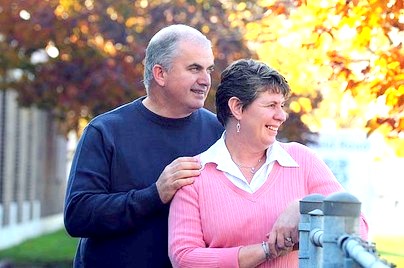
Huntsville.
In spite of this hectic schedule, Janet took in the sick baby last
year, bringing the family's total number of children to seven.
"People ask if it's a lot of work but, if you love what you do, it
isn't work," she says.
Daughter Emily, 18, a student at the University of Ottawa, sent this
email when asked what she got out of having foster children in her home:
"Fostering and my parents' example helped me realize that it is
important to not only find a career I like but also one that will make a
positive effect in others' lives.
"This is why I am striving to complete a biomedical mechanical
engineering degree program, so one day I can help improve the lives of
others, as my parents do every day."
Jessie, 22, studying international development at the University of
Guelph, sent this message: "It has given me the desire to be some sort of
change for something better in this world. Some would call this a
romantic ideal but I've seen what can happen when we commit ourselves to
loving unconditionally."
family from L1
CAS Loved Accused Foster Mom
November 8, 2008
In the Alberta Kafka case, social worker Edele Kaffo had no concerns
about the foster mother on trial for murder. Now that the boy is dead,
social services wants to tell the opposite story, that the foster mom was a
monster. In lesser cases, social workers have been known to lie when their
agency changes position, but that is impossible in a criminal case where
defense lawyers can confront the witness with old written reports.
expand
collapse
No concerns about foster mom, case worker tells Edmonton murder trial
Florence Loyie, edmontonjournal.com, Friday, November 07, 2008
EDMONTON - An Edmonton social worker says she never had any concerns
that a foster mother accused of murdering a three-year-old boy had any
difficulty caring for the child.
Edele Kaffo told a jury trial Friday that she would have removed the
boy from the home immediately had she any indications the foster mother
was abusive towards the child.
Based on her telephone conversations with the foster mother and home
visits between Dec. 6, 2006, and Jan. 26, 2007, the foster mother
appeared to be doing her upmost to better the boy's situation, Kaffo said.
The woman purchased winter clothing with her own money, took the boy to
see her family doctor for a physical assessment, took him to the dentist
and acted as an advocate to get him various services because she suspected
the child had fetal alcohol syndrome, Kaffo said.
She also spent numerous hours trying to rid the boy of head lice
because she had been asked not to cut his long hair in keeping with his
aboriginal culture, Kaffo said under questioning from defence lawyer Brian
Beresh.
"She was a model foster parent, right?," Beresh asked.
"Based on my visits and phone calls, I didn't have any concerns," Kaffo
said.
The foster mother was charged with second-degree murder in the boy's
death in January 2007. The jury will have to decide if the boy's fatal
head injuries were self-inflicted or the result of an assault. The woman
cannot be named to protect the identity of the child.
floyie@thejournal.canwest.com
Child Abuse Register Unfair
November 7, 2008
An American judge has invalidated California's law for putting names on a
list of suspected child abusers. Falsely accused parents could appeal only
to the worker who placed them on the list.
Ontario's parents have no right to appeal to the social worker placing
them on the Child Abuse Register. Parents have to convince the ministry of
a mistake after they are already on the register. The judge overseeing a
child protection case has no power to get a parent off the list. With the
current mood of the Canadian courts, parents are unlikely to find the kind
of relief granted in California. In 1999 the Ontario legislature enacted
amendments to the Child and Family Services act that abolished the Child
Abuse Register by repealing sections 75 and 76, but the repeal never got
royal assent. If the Lieutenant Governor proclaimed the law already
enacted, the abuse of wrecking a parent's reputation on the whim of a social
worker could be corrected.
expand
collapse
Index of child-abuser suspects is struck down
Bob Egelko, Chronicle Staff Writer, Friday, November 7, 2008
A federal appeals court has struck down a long-standing California law
that established an index of suspected child abusers - now containing more
than 800,000 names - and gives them no way to challenge false listings,
which can disqualify them from jobs involving children.
The state's rules for compiling and maintaining the list create a
substantial risk of error and deny individuals "a fair opportunity to
challenge the allegations against them," said the Ninth U.S. Circuit
Court of Appeals in San Francisco.
The 3-0 ruling, issued Wednesday, said the state must at least allow
someone who disputes a listing to appear at a hearing before an official
who would be required to follow specific standards to determine whether
the designation was justified. Currently, the listed person can appeal
only to the officer who made the initial report, and the law contains no
standards for a decision.
The lawyer for a Los Angeles-area couple who sued over the continued
inclusion of their names on the list said the ruling should help her
clients and many thousands of others whose rights have been violated.
"Other states have child abuse registries, but California is unique in
having a registry that disseminates information so broadly and provides no
review procedure," said attorney Esther Boynton.
Deputy Attorney General Paul Epstein said state officials are reviewing
the ruling, and declined further comment.
The state started collecting information for its Child Abuse Central
Index in 1965 and passed a revised law in 1988 that now governs the index.
Boynton said those on the list weren't even notified of their inclusion
until 1996 - the result of a taxpayer's suit she filed after her own name
was erroneously included.
The law requires police to send the state attorney general's office
reports of every case of child abuse or severe neglect that they
investigate and determine to be either true or inconclusive - that is,
every case except those that are found to be false or "inherently
improbable," the court said, quoting the law.
The law then requires the state to make the list available to a variety
of public agencies and private employers. State and county licensing
agencies must consult the list for all prospective child care workers and
some foster parents. Schools and police departments are allowed to check
job applicants' names against the list, and generally do so, the court
said.
Employers aren't prohibited from hiring someone whose name appears on
the index, but it's reasonable to assume that a listing hurts the person's
job prospects, the court said.
Boynton's clients, Craig and Wendy Humphries, were placed on the list
after their 15-year-old daughter accused them of abusing her in 2001.
Sheriff's deputies arrested the couple and put their other two children in
protective custody, but the charges were dropped after a medical
examination disclosed that no abuse had occurred, and two judges later
declared the couple innocent.
Under the law, the Humphries' only chance to get their names removed
from the child abuse list was to persuade the investigating deputy that
the allegations were unfounded. But the sheriff's department told them
the deputy no longer worked there, and a supervisor decided some crime
must have occurred because charges were filed, the court said.
With no further appeal possible, the Humphries said the listing is an
obstacle to their plans to volunteer at a local child care center and
could hurt Wendy Humphries' chances of renewing her teaching credential.
A federal judge dismissed the couple's suit, saying damage to their
reputation did not amount to a violation of their constitutional rights.
But the appeals court, in an opinion by Judge Jay Bybee, said the listing
"both stigmatizes the Humphries and creates an impediment to (their)
ability to obtain legal rights," like employment.
Bybee cited a 2004 state task force report that looked at listings from
one county and found that half of them might be erroneous. Although the
state is justified in keeping a list of suspected abusers, including those
who haven't been convicted of crimes, he said, the California index has
too few safeguards to meet constitutional standards.
The ruling in Humphries vs. County of Los Angeles is available at
www.ca9.uscourts.gov/ca9/newopinions.nsf.
E-mail Bob Egelko at begelko@sfchronicle.com.

Mother Cleared
November 6, 2008
In the aftermath of the Goudge inquiry, criminal charges have been
dropped against mother Anna Sokotnyuk in the death of her baby, Anastasia.
expand
collapse
Charge against mother dropped in infant's death
November 06, 2008, Betsy Powell, Courts Bureau
The Crown will not prosecute a Toronto woman charged three years ago
with the death of her infant daughter.
Prosecutor Donna Armstrong told court the Crown feels it has no
reasonable prospect of convicting Anna Sokotnyuk, 27, of second-degree
murder. The decision was made after an independent review by experts in
the wake Justice Stephen Goudge's inquiry probing pediatric forensic
pathology in Ontario.
Armstrong said the experts couldn't agree on the cause of Anastasia's
death with any "degree of certainty."
"She's gone through horror for the past three years," Sokotnyuk's
lawyer, Robert Nuttall, said outside Superior Court. "To lose a
three-month-old child and then to be charged with its death in a murder
situation is unimaginably horrific."
Nuttall praised the Goudge inquiry and credited the withdrawal on the
evolution of scientific theories relating to "shaken-baby deaths."
Sokotnyuk was charged in 2005 ten months after police received a 911
call about an nfant who had stopped breathing.
Social Worker Flashes Children
November 6, 2008
Former Montreal social worker Martin Lavergne is undergoing psychiatric
evaluation following his arrest for exposing himself to children in a park.
expand
collapse
Sex crime suspect was social worker
The Gazette, Thursday, November 06, 2008
A man who was beaten in a St. Henri park after he is alleged to have

exposed himself to children was a clinical social worker at the Montreal
General Hospital for more than five years.
Martin Lavergne, 48, is undergoing a psychiatric evaluation at the
Philippe Pinel Institute before his bail hearing, set for Dec. 4. He was
arrested last month by chance after he was beaten up by an adult who had
been told by children that someone in the park was exposing himself.
Police arrived after the attacker fled, but found Lavergne was breaking
bail conditions by being in a park. He had been arrested in July 2006 on
one charge each of possession of child pornography, assault, assault with
a weapon, uttering threats and fleeing a police officer.
His trial on those charges is to start next month. Lavergne faces four
new charges in the most recent incident, including committing indecent
acts and failure to comply with a condition.
His employment at the General ended a few months ago, said Sheila
Moore, a McGill University Health Centre spokesperson.
Pierre Joyal, Lavergne's former lawyer, confirmed that Lavergne worked
in palliative care and oncology before going on sick leave in 2006.
Lavergne became a member of Quebec's order of social workers on Sept.
17, 1999, and was no longer a member as of June 16, 2005.

Best Interest of the Pig
November 6, 2008
The OSPCA acts with powers nearly identical to children's aid societies,
only their pretext is protecting animals instead of children. Unlike
victims of child protection, persons harmed by animal protection are free to
speak their mind. An article copied below from the Orangeville Citizen
mentions many of the complaints against the OSPCA. They show similarity to
complaints, sadly never heard in the press, against children's aid.
Animal protectors have police power and enter private property without a
warrant. A person accused by the OSPCA loses his animals first, then has
the burden of proving his innocence. When an owner fails to cooperate with
persons taking his animals, that is evidence of guilt. An owner can be
charged for the cost of keeping his animals in a shelter.
A proposed change to the law allows the animal shelters to keep seized
animals indefinitely in foster care, even after the owner has complied with
orders of the court.
Not mentioned in the article, but reported by victims, the OSPCA and
children's aid act in tandem, in one case raiding a home on alternate days
and sharing information on the targeted family.
expand
collapse
Orangeville Citizen November 6, 2008
Landowner group at odds with the OSPCA
By DAN PELTON Staff Reporter
Members of the Ontario Landowners Association (OLA) were in a combative
mood as they crowded into the Chipwood Park Pavilion, north of Shelburne,
for their recent annual general meeting.
The targets of the OLA's derision were the Ontario Society for the
Prevention of Cruelty to Animals (OSPCA) and Bill 50, proposed provincial
legislation that would broaden the agency's powers.
The OLA sees the new legislation as oppressive. Jim Turner, president
of the Dufferin chapter of the OLA, says the OSPCA already has too much
power. "They shouldn't be able to go on to somebody's property without
either having an opponent or a warrant."
The Liberal government, on the other hand, sees the bill as something
that is overdue and will bring Ontario up to date with the rest of Canada
as far as ensuring the safety of animals is concerned.
Right now in Ontario, animal welfare is covered under the OSPCA Act,
which was passed in 1919 and has had few revisions since.
Bill 50 has been tabled by the province's Community Safety and
Correctional Services minister, Rick Bartolucci, who says it will take
Ontario "from worst to first" in terms of legislation to protect animals
OSPCA Chief Inspector Hugh Coghill finds the OLA protest somewhat
puzzling. "We've had warrantless entry since 1919," he points out. "Why
hasn't anyone complained in the last 89 years?"
What could be a cause for concern is an aspect of the new legislation
that allows OSPCA inspectors to enter a property if they have reasonable
grounds to suspect that cruelty to animals is occurring. Currently, an
inspector actually has to observe the cruelty before he or she can act.
As well, under the existing legislation, an animal that has been taken
from its owner on the grounds of cruelty must be returned once it is
considered to no longer be in distress and the owner has paid the
necessary fines.
Under Bill 50, the OSPCA can apply for interim custody and keep the
animal away from an owner it sees as unfit.
To underline the necessity of such a change, Mr. Coghill points to the
case of a Windsor man who cut the ears off his dog to make it look
tougher. Despite the obvious barbarity of his act, he was entitled to get
his dog back after he had paid what he owed and the dog was considered no
longer in distress.
Progressive Conservative MPP Garfield Dunlop, the party's community
safety and correctional services critic, spoke at the Chipwood Park OLA
meeting. He says Bill 50 is an important piece of legislation and
suggests that partisan politics be kept to a minimum in order for it to
succeed.
"Our party is a strong advocate of stiffer penalties for cruelty to
animals," said Mr. Dunlop. "We've put forward private members' bills to
address this." He feels representatives of the three parties have worked
well together in organizing the legislation.
Terming it "an allencompassing bill," he said MPPs "are all trying to
step up and get it right. I'm a supporter of the OSPCA but, as a critic,
I have to see how we can find improvements."
He admits to being uncomfortable with the concept of warrantless
entries and is also concerned that there may be problems with OSPCA
inspectors having police powers while, at the same time, working for what
is essentially a charitable organization.
His concerns are shared by Mr. Turner, who accuses the OSPCA of
embellishing situations in order to raise its profile and increase its
fundraising efforts.
While steadfastly maintaining that the OLA is in support of legislation
that ensures the ethical treatment of animals, Mr. Turner feels, along
with the majority of his fellow members, that people are being mistreated
by the OSPCA.
"With the OSPCA, you're guilty right away, and then you have to spend
your own money to prove you're innocent."
Mr. Coghill admits that until 2006, the OSPCA put an emphasis on
enforcement. Since he took over as chief inspector that year, he says the
goal of the agency is "to put less of an emphasis on enforcement and more
on education."
As for the OSPCA's police powers, he says the agency does not have the
authority to decide guilt or innocence. Its stance is to collect
information and act on it. After that, the affected parties can appeal to
the Animal Care Review Board, an independent tribunal appointed by the
government.
If the board rules against them, they can appeal the decision in court.
Such was the case with Roy Bevan of Holstein, who had 16 sheep and two
miniature horses seized by the OSPCA, who said the animals were
malnourished and claimed the sheep were in bad need of shearing and the
horses' hooves were too long and had not been clipped.
The Animal Care Review Board ordered the horses returned to Mr. Bevan
and that he not be required to pay the OSPCA any costs of boarding the
animals.
The sheep were another matter, however. The board ruled against Mr.
Bevan, who appealed the verdict. The court of appeal heard that the sheep
were ravenous and, three weeks after coming under the OSPCA's care, gained
an average of 20 pounds each.
Mr. Bevan claims the sheep, after the confiscation, were fed five
pounds a day of a high-protein feed that contained molasses designed to
make the animals gain weight. "It's like having Thanksgiving dinner,"
says Mr. Bevan, "and then having five more."
The appeal court also found Mr. Bevan was showing a consciousness of
guilt when the animals were seized, by refusing to co-operate with the
OSPCA when they came to take his livestock.
Mr. Bevan asks why he should have been co-operative in the face of
what he saw as a warrantless, unlawful entry. "If someone was breaking
into my house, what should I do? Hold the door open for them so they
don't scratch my TV when they're carrying it out?"
As for the OLA, Mr. Turner says it's a levelheaded organization
dedicated to defending the rights of landowners, even though it does some
outlandish things like tarring and feathering an OSPCA inspector in effigy
during a recent protest in Sudbury.
"We're not just a bunch of rednecks. We check out each case and, if we
feel there isn't anything we don't back it. We're not here to fly off the
handle."
Gay Marriage Banned
November 5, 2008
In yesterday's American election, voters in California, Arizona and
Florida banned same-sex marriage. In Arkansas voters approved a ban on
placing children with unmarried foster parents, ending foster care by gay
couples. In the post-mortem, analysts say opposition to gay marriage was
stronger among blacks than whites. Maybe it is because black voters have
more experience with the family destruction system. The proponents who got
California judges to legalize gay marriage earlier this year are already
planning to get judges to declare the voice of the voters invalid.
Boy Missing Again
November 3, 2008
A boy reported missing in
September from Sudbury is reported missing again. If as we suspect this
is a CAS case, the boy has run away again from a foster or group home.
expand
collapse
Public's help needed to locate missing boy
Date Published | Nov. 3, 2008
Marc-André Farmer-Pelletier has been missing since Oct. 27. He is
believed to be in the Sudbury area.
Posted by Sudbury Northern Life
The public's assistance is needed to locate a missing 14-year-old boy.
Marc-André Farmer-Pelletier has been missing since Oct. 27. He is
believed to be in the Sudbury area.
He is described as Caucasian, about 5-5, 135 lbs, with short, dark,
brown hair and brown eyes. He was last seen wearing a black winter coat
with a furry hood, jeans, black hoodie, and brown boots.
Anyone with information on the whereabouts of this child are asked to
contact police at 675-9171.
Mongrel Agency for Hamilton Kids
November 3, 2008
Hamilton has a new cooperative effort between children's aid and the
police, called CAAT.
expand
collapse
Police, chidren's aid, unveil new abuse team
John Burman
It’s called CAAT and it's as innovative as Ontario’s first police child
abuse branch was 20 years ago.
CAAT – the child abuse agency team – brings workers from the Hamilton’s
Children’s Aid Society and Catholic Children’s Aid Society into the front
line office of the police child abuse branch for closer co-operation and
therefore better service to vulnerable children and their families.
Hamilton police rolled out the project – a year long and a year in the
planning already – at the central police station today.
On hand to receive belated honours for establishing Ontario’s first
dedicated police child abuse branch were three of the original members,
former deputy chief Bruce Elwood, Richard Nelson and Allison Hood. John
Carrick was not able to attend.
Bernie Morelli, chair of the Hamilton Police Services Board told the
gathering that CAAT will mean more effective policing and better
engagement of the community.
It will, he said, diminish barriers between services.
Chief Brian Mullan said, like the child-abuse unit formed years ago,
CAAT is believed to be the first of its kind in the province and will
provide an opportunity for Hamilton police to work more effectively in
partnerships than they could by themselves.
jburman@thespec.com 905-526-2469
CAAT combines roles of cop and social worker
Remembering Dee
November 2, 2008
A memorial and advocacy site has been created for Dee Montag, a twenty-year-old
mother driven to suicide by the actions of children's aid. A letter from
Jane Scharf to the Coroner gives biographical details. It looks like the
same woman identified as Laura Lee
(Dee) Doupe in our September 15 news item. While Minister of Children
and Youth Services Deb Matthews gives speeches fighting poverty, this case
shows what the agencies she administers really do to poor people.
Give us an Organ
November 2, 2008
From the sick and sicker department. After breaking up with an
unfaithful wife, Michael Shergold had a brief relationship with a woman that
did not work out, then married a second wife. The woman in between gave
birth to a child that soon went into social services custody, without the
knowledge of the father. Years later social services approached Shergold
for an organ donation to save his unknown son. The father applied for
custody of the boy, but was refused, and cannot have even a single visit
with his son. Dad is now struggling with a dilemma: should he risk his
health to donate an organ for a boy he cannot see? Or let his unknown son
die? Curiously, social services posted a picture of the boy on the internet
when advertising for an adoptive family, but the real father cannot publish
the boys name or picture. Social services claims they could not find the
father before arranging an adoption, but could find him for an organ.
expand
collapse
'You can't see your son - but can he have one of your
organs?': how social workers left one man with a terrible moral dilemma
By Alison Smith Squire, Last updated at 12:41 AM on 02nd November 2008
The letter from Hampshire Social Services was as brief as it was
bewildering. ‘Please ring me on the above number,’ it said. ‘I have some
information that might be of interest to you.’ This was quite an
understatement, as Michael Shergold soon found.
A quietly spoken father of three, he finds that his life rarely gets
more exciting than his weekly game of golf. But when he called the social
workers as requested, he was confronted with a series of astonishing
facts.
They said he was the father of another child - a five-year-old son from
a previous, short-lived relationship. A former girlfriend, unable to cope
with the demands of motherhood, had handed the boy over to foster parents.
Bewildered: Michael and Alex Shergold with his sons Peter and David
last week. 'Our family seems incomplete', says Michael
A meeting with this new-found son was out of the question, he was
told, let alone any sort of relationship. He was also informed that the
boy was to be formally adopted and that the council was ringing merely to
let him know.
His shock slowly turned to anger and then determination. Hurt to have
been kept in the dark for so many years, Michael still believed he was
responsible for the child - whom we shall call Andrew - and launched a
legal fight to secure custody.
But there were extraordinary surprises in store for Michael and his
wife, Alex. Hampshire Social Services wanted more than just his
acquiescence.
Andrew, it emerged, had been diagnosed with a severe problem in one of
his organs. For legal reasons, it is not possible to be more specific.
But the boy stands little chance of living beyond his teenage years
without a transplant - from a blood relative if at all possible. The most
suitable blood relative, it was explained by social workers, was Michael
himself.
Illness: Michael Shergold's son, whose identity we have concealed
In a disturbing saga, this was perhaps the most unpleasant twist of
all. It brought him to a damning conclusion - that Hampshire Social
Services had made him aware of Andrew’s existence only to provide the
child with a body part.
Michael tried to adopt his son but last year he lost the battle and was
refused even occasional visiting rights, which were deemed too upsetting
for the boy.
Like almost all cases that go through the family court system, the
details were not made public.
Michael now has to decide whether to risk his own life with a dangerous
operation for a son who, as things stand, he will never see.
‘Words cannot express the anger and bewilderment I feel,’ says Michael.
‘I simply cannot believe how Social Services can be so cruel.
To track me down, tell me I have a son I knew nothing about, throw my
life into chaos and then tell me I will never be able to see him is
nothing short of disgraceful.’
The Mail on Sunday asked Hampshire County Council two months ago about
its handling of the case.
It responded by obtaining a legal injunction to prevent us printing
Michael’s story, claiming that to do so might damage his son’s chances of
settling down.
Determined that Michael should get the chance to speak, The Mail on
Sunday has pursued a lengthy legal fight to lift the injunction, and last
week we succeeded. Today, in this exclusive interview, Michael is able to
talk about his ordeal for the first time.
‘To know my son has been adopted against my consent by strangers rather
than his blood family, where he would have had a loving home, has been bad
enough,’ he says.
‘But to know that, if I don’t donate an organ, my son might not live
long enough to know me has put me in the worst situation of all. I’m in a
dilemma about what to do. I feel I am being asked to make a decision in a
vacuum. If I could just see my son and maintain some sort of contact, I
would have absolutely no hesitation about doing it.’
Michael, 55, was speaking at his spacious three-bedroom house in
Southampton, the city where he was born and where he has spent his whole
life. Sitting by his side is Alex. Originally from Los Angeles, she
moved to Britain in 2002, the same year the couple married, and she became
a pastor with a Pentecostal church in Portsmouth.
This is not the first time that Michael, who works as a school
caretaker, has suffered domestic drama. His 16-year marriage ended in
1996 when he discovered that his first wife had been unfaithful. He was
given custody of the children - Peter, now 17, David, 20, and Susanna, 30
- and brought them up single-handedly.
As Alex serves home-made carrot cake and their cuckoo clock announces
the time, the Shergolds seem every inch a loving family. Their attitude
to their predicament is one of quiet anger and grief rather than
unfettered fury.
‘We have a wonderful, close-knit family,’ says Michael. Peter and
David, who still live at home, flit in and out as the couple talk.
Susanna lives close by.
It is a particular irony that Michael has been employed by Hampshire
County Council for the past 35 years, overseeing the repairs, cleaning and
maintenance of a local primary school. As it happens, the job requires
him to undergo criminal record checks every year and neither he nor Alex,
who was also checked, has any convictions.
The letter that shattered Michael’s life came in January 2007, but the
origins of the trauma lay five years earlier, when he had embarked on a
difficult relationship with a much younger woman we will refer to as
‘Helen’ - not her real name.
Despite their age difference, things went well at first after they were
introduced through friends. ‘She was the first woman I’d dated since
splitting up with my wife,’ he recalls.
‘At first I didn’t think of having a relationship with her because, at
29, she was much younger than me. But she was bubbly and got on well with
the boys. It was only after a few months that I realised she was unstable
and had a drink problem. She would swear in front of the boys and I ended
the relationship.’
He had no inkling that she might be pregnant and that, he thought, was
the end of the matter. Indeed, it was not long before he met Alex through
a friendship website.
Like Michael, she has three grown-up children and, again like Michael,
she had spent years bringing them up single-handedly. She worked for US
military intelligence, where she studied for degrees in psychology and
theology.
Michael and Alex married a few months after meeting and settled down to
a domestic routine, enjoying rounds of golf, games of bowls, trips to the
cinema and regular visits to church.
That all changed with Hampshire County Council’s bombshell. ‘It was a
terrible shock,’ recalls Alex. ‘Michael was told by a social worker that
his child had been put into foster care.’
At 53, Alex thought she had said goodbye to bringing up a child, but
she was as determined as her husband to welcome Andrew into the family.
‘That was where he belonged,’ she says. ‘Not with strangers to whom he is
not related.’
The couple, whose children had also come round to the idea of embracing
a new sibling into their lives, visited Hampshire Social Services’
headquarters in Winchester, where they were shown Andrew’s picture.
With hindsight, they were naively optimistic. Immediately infatuated,
they dug out Scalextric and Lego sets, embarked on plans to turn their
loft into a fourth bedroom and even researched school places.
‘He looked just like his daddy,’ says Alex. ‘We were determined that
although he’d had such a dreadful start in life, we’d soon make it all up
to him.’
When, two weeks later, DNA tests confirmed that Michael was the father,
the couple instructed a solicitor to stop the adoption order and begin
their own custody proceedings. ‘I thought that once Social Services saw
our happy family home and how much we wanted Andrew to be a part of it, it
would only be a matter of weeks before he would come to live with us,’
says Michael.
But then came the breathtaking twist. ‘At our second meeting with
Social Services a social worker told us, “Andrew needs an organ transplant
and, as you know, an organ is best donated from a blood relative.” ’
The couple were left in no doubt that Michael’s co-operation was
essential if his son was to stand a good chance of surviving. His mother,
they learned, had initially agreed to be the donor but changed her mind on
the grounds that it would hinder her chances of having another child.
Social workers told Michael that he, and his children, were the ‘next
choice’. He admits: ‘I was taken aback but, of course, desperately
worried and keen to help my son.’
Meanwhile, two independent social workers were assigned to assess
Michael and Alex as potential parents for Andrew. It was, by all
accounts, a rigorous process. ‘I was surprised to be interrogated by a
total stranger,’ he says, ‘but I hid nothing.’ Yet, over a dozen visits,
the questions became increasingly invasive.
‘The worst questions were about our sex life,’ he says. ‘They kept
asking how “healthy” it was - we took it to mean how many times a week we
made love - and if we indulged in 'normal' sex.’
Alex, who admits she didn’t take kindly to the intrusion, adds: ‘I
felt that side of our marriage was private and we didn’t see how it could
be relevant. In the end I replied, “None of your business and I am not
happy to elaborate further.” Perhaps it is because I’m an American and a
Christian, but I found the Social Services’ attitude difficult to
understand.’
Meanwhile, the truth about Andrew’s situation gradually emerged. His
mother, it seems, had descended into alcoholism and been found guilty of
child cruelty towards him. Andrew had been put into care by the courts.
Finding a permanent home was not easy, however. The boy’s illness
demanded a special diet and regular hospital visits.
After his rejection by one set of foster parents, his photograph had to
be posted on an adoption website before finally, in 2006, the couple who
were eventually to adopt him came forward. ‘I couldn’t believe this could
have happened to my son,’ says Michael. ‘I found it incredible.
‘Social Services told me in our first phone conversation that Helen had
named me as the father. Yet, as far as I can see, they made no effort to
find me. I have lived in the same house for 11 years. I am on the
electoral roll and in the phone book.’
Hampshire County Council says it did its best to locate Michael. ‘A
care order would not have been made had the court not been satisfied that
every effort had been made to locate Mr Shergold,’ says council leader Ken
Thornber. ‘We have apologised to Mr Shergold for our failure to find him
during care proceedings.
‘All circumstances leading to a child coming into care involve a degree
of human tragedy and require very finely balanced judgments to be made.
The needs of the child must always be the paramount concern and the judge
did conclude that the local authority did its best, when it discovered the
difficult situation that had arisen, to communicate with Mr Shergold and
establish what contribution he could make to his son’s life.’
Michael believes he was eventually traced only because doctors said
Andrew would need a transplant. Indeed, he now believes that even his
attempt to adopt Andrew was something of a charade. ‘We began to feel
that Social Services had let us go through the custody proceedings for
nothing - that the adoption was arranged and they had no intention of
placing Andrew with us,’ he says.
The Shergolds were refused custody at Portsmouth County Court last
November. The judge admitted the background had been ‘difficult and
somewhat unsatisfactory’ but ruled that moving Andrew in with the
Shergolds would cause him unnecessary ‘difficulty and disruption’.
Just two days later - suspiciously quickly in the view of the Shergolds
- he had been formally adopted, leaving the Shergolds in the cold.
Even their request that Michael should be able to see him for visits
was turned down on the grounds that it would be ‘unsettling for Andrew’,
who was ‘bonding’ with his new family. Yet Helen, who was judged an unfit
mother, is still allowed to visit Andrew twice a year.
Meanwhile, Hampshire Social Services are still pressing Michael to
donate an organ. Even if Michael decides to do so, it will make no
difference. ‘I was stunned,’ he says. ‘I asked them what would happen if
I gave him a part of my body. They said that even then, I wouldn’t be
allowed contact. Andrew would not even be told who donated the organ as
this would be 'too unsettling'.’
The dilemma has had damaging repercussions for the Shergold family.
Michael says his children are wounded and that even his marriage has
suffered.
The criticism they endured during the adoption process hardly helped.
‘Social Services accused me of being unco-operative,’ explains Alex.
‘They made it plain they didn’t like me. It seems being American was a
problem and so too, I think, was the colour of my skin.’ Alex is
mixed-race.
One official report on the couple expressed concern that Andrew would
be brought up in a dual-ethnicity family. ‘They made out I was a
foreigner who had no idea how to look after a child,’ she says. ‘I’ve
raised three children. Despite the fact that they live in the States, we
are incredibly close. I also think of Michael’s sons as my own.
‘I began to think that if I wasn’t around, Michael would have got
custody. One night I suggested to Michael and his sons that I leave.
Thankfully, they wouldn’t hear of it. But the stress has been unbearable.
Undoubtedly, Michael and I would have split up if our relationship wasn’t
so strong.’
And Michael adds: ‘Social Services have never given me a concrete
reason why my wife and I are not suitable. That is because there is no
reason.’
The couple did not qualify for legal aid and have spent £4,000 on
solicitors. Now they have been told there is no further action they can
take.
Overshadowing everything, however, is the decision to donate an organ.
‘If I don’t donate an organ, Andrew might not live long enough to meet me
and the guilt would probably be too much to live with,’ he says. ‘If I
do, it will be as if I am donating to someone who I don’t really know
exists.
‘How can social workers sleep at night, knowing they have separated a
boy from his real father, a good father who has already successfully
raised three children? They won’t even pass on birthday cards.
‘They have stormed in and left us to pick up the pieces. I cannot
believe that in this country someone can stop you seeing your own child
when you have done nothing wrong.
‘Our family seems incomplete. If I see a boy in the street, I wonder
if it’s him. I dream of him meeting his brothers and sister and joining
us when we have big birthday celebrations. My only hope is that he can
choose to trace me when he is 18.
‘But what if he doesn’t live that long or is told lies about me – that
his father is dead or didn’t want him? It breaks my heart to think we may
never meet.’
Additional reporting: Antonia Hoyle
Nanny Identified
November 1, 2008
In the Alberta Kafka foster child death case, where all names have been
suppressed, we have finally heard the name of a person involved with the
family. The nanny was 24-year-old Julia Gee. Her testimony paints a grim
picture of the care of the child.
expand
collapse
October 31, 2008
Deceased tot left in cold garage overnight
By TONY BLAIS, COURT BUREAU, Edmonton Sun
EDMONTON -- A foster mother accused of killing a three-year-old boy in
her care left him overnight in an unheated garage wearing only a pull-up
diaper, a jury heard yesterday.
Testifying at the foster mom's second-degree murder trial, the woman's
former nanny also said the boy had bruising across his whole forehead when
she found him on the floor on that Jan. 25, 2007, morning.
"He was curled up and sleeping on the mat. He didn't have any clothes
on," said Julia Gee, 24, adding the boy's diaper was soaked with urine.
The live-in nanny testified the foster mother asked her later if she
was mad at her for leaving the boy in the frigid attached garage and said
she told her she wasn't. "I just said I was shocked," testified Gee.
The nanny told the jury the foster mom told her the boy got the
bruising on his forehead from falling on his head without putting out his
hands and said she also noticed welts and bruises on the foster mom's
forearms.
Gee testified the woman had the boy walk up and down the stairs twice a
day to strengthen his legs and said he was a bit slow doing it the day
after the garage incident.
That night she heard the boy crying after she had gone to bed and was
called up later by the foster mother to watch him doing his stair
exercises a little after midnight.
She ended up falling asleep about 2 a.m. after hearing more crying and
some thumping and was then woken up by the foster mom and told the boy was
"acting strange."
She came upstairs from her basement bedroom and found him collapsed on
the floor, gasping for air.
An ambulance was called and the boy was taken to hospital where he died
the next day.
She testified she never saw the boy bang his head on the wall or the
floor and said she also never saw him punch, kick or hit anyone in the
home.
Under cross-examination, defence lawyer Brian Beresh suggested his
client had never put the boy in the garage, but the nanny replied that she
had "more than once."
Beresh also suggested that it had been Gee who had put the boy in the
garage, however she denied that was true.
The nanny also admitted smoking marijuana in the garage once after the
kids were asleep.
In a 911 tape played in court earlier, the now-34-year-old foster
mother told the evaluator the boy had been "harming himself" recently, and
stated he had bruises on his body from throwing himself onto the floor the
day before.
A medical examiner testified the boy died of cranial trauma and told
jurors it was from a blow to the head.
In his opening jury address, Beresh said defence medical experts will
testify the fatal injury was likely caused by the boy's self-abusive
behaviour and was an "accident."
earlier news
| |
|